Shared posts

24 Dec 04:46

The regulatory difficulties of NBFCs in India

by Ajay Shah
by Shubho Roy.

The founder of the Shriram Group, R. Thyagarajan, who is one of the most respected people in Indian finance, spoke to Forbes India expressing concerns about the things that are being done with the regulation of NBFCs. This is important food for thought for understanding the problems of Indian finance. He talks about how the NBFC sector is being stifled with regulation and the need for moving it away from the Banking Regulator. He points out that the mind-set and objectives of RBI, in regulating NBFCs in ways that are appropriate for banks, is killing the industry.

Banks and NBFCs are different, pose different problems for financial regulation, and should be regulated differently. RBI is smothering NBFCs by applying banking thinking for them, and is thereby hampering access to credit for the firms who obtain financing from NBFCs. The FSLRC approach offers logical answers to these questions.

What motivates regulation


Regulation must not degenerate into central planning; it must be motivated by the need to correct a precisely stated market failure. We must understand the anatomy of the market failure, and use the coercive power of the State at the precise root cause. Occam's Razor of Regulation implies that we should get the job done with the minimum use of force. The market failures associated with banks and with NBFCs are quite different. For banks, the market failure is consumer protection of unsophisticated depositors. This is the reason why we have detailed banking regulation. If there are no unsophisticated depositors in a lending institution, regulating them like banks is wrong, and harms the economy.

Consumer protection in banking regulation


When you deposit your money in a bank, you can go and withdraw the principal at any time you want. Even for fixed deposits, the principal is protected in the case of premature withdrawal.

How does a bank pay interest on money which you can withdraw at any time? Through loans. However, when a bank gives a loan: the bank gets repaid only as per the loan terms (and not when the bank needs money). If you take a home-loan or a car-loan for five years, the bank cannot come and ask you to repay the entire money before the five years are up (unless you default). The bank can only ask for the regular predefined installments. No bank can come to you (a borrower) and say:

"a lot of people are withdrawing money this month, so please pay up your five year car loan, ahead of time, this month."

Similarly, when you (depositor) go to withdraw the money from a bank the bank cannot say (legally prohibited):

"a lot of people have delayed their loan repayments so you cannot withdraw your money today, come back after a few months."

These types of deposits are technically called deposits callable at par. i.e. Deposits you can withdraw at any time without losing the principal.

Contrast this with a term loan or a bond/debenture. When you buy a five year Tata Motors debenture in the debt market, cannot withdraw it at par before the debenture matures. i.e. If you go with the debenture to the offices of Tata Motors before the five years are up, Tata Motors has no legal obligation to repay the loan amount in the debenture. You can only get your principal and interest payments as per the terms of the debenture and not a minute before that. You may sell your debenture to someone else (secondary market), but that is not the same as getting your principal back from Tata Motors. In the secondary market you have no assurance you will get your principal amount back.

Ensuring that households are able to withdraw their deposits, whenever they need it, is not trivial. Whenever a bank fails do it, eventually, there is a run on the bank. A run happens when you households panic that their life savings will be destroyed and queue up to get withdraw their deposits. Governments know (from the history of bank failures) that you cannot trust banks to pay up to households on time. Therefore, countries create banking law and corresponding banking regulator to check the banks.

Three important components of these regulations are:

  1. Deposit Ratios: This requires the bank to lend out only a part of its deposits, say 80%. The bank has to keep the rest for withdrawals on any given day.
  2. Equity buffers: Banks are required to have a certain minimum equity capital. As an example, in India, the leverage of the banking system is roughly 20 times, which means that for each 20 rupees of total assets there is 1 rupee of equity capital. This acts as a buffer against losses as the shareholders bear the loss.
  3. Loss Recognition: Banks are forced to recognise losses and write them off using equity capital, so as to not subvert the intent of the equity buffer.

Banks have the incentive and capability to cover up bad news about the loans they have made. If banks admit they have bad loans then the banking regulator forces them to raise money from other sources (equity market). Raising money from the equity markets is hard, expensive and, dilutes existing shareholders. Normally, a bank likes to hide and delay the fact that debtor is not repaying as long as possible.

Unlike sophisticated creditors, you and I are unable to really understand the balance sheet of a bank. I cannot judge whether the bank will have enough money to repay a fixed deposit five years from now. Without a financial agency looking over banks every day, it is easy for banks to lend money profligately and end up defaulting to depositors.

The oversight of the financial agency, and the checks imposed by these regulations, are not without benefit to banks. In return for complying with all these regulations, the government encourages the general public, to keep money in banks. The government and the central bank extends a guarantee of safety in bank deposits. The Jan Dhan Yojana does not encourage you to buy corporate bonds but put money in bank deposits. The government runs a deposit insurance program to protect helpless households who have deposits with banks.

NBFC regulation


Non-Banking financial companies should be what their name suggests: non-banks. Sadly, this was not the case for India till about a decade ago. Because, there were few banks, Indian laws allowed NBFCs to also take deposits callable at par. i.e. Take money from depositors (unsophisticated savers) which the depositors could withdraw at any moment (working hours). These were called NBFC-Deposit Taking.

Over the last few years, RBI has gradually removed this category. Today, most NBFCs take money from the bond market or term loans (sophisticated depositors). There are no unsophisticated depositors in most NBFCs today. Since there are no unsophisticated depositors who may need their money immediately on demand, there is no consumer protection angle from deposits.

However, in spite of closing down most deposit-taking NBFCs, RBI continues to regulate NBFCs like banks, requiring them to keep liquid funds (in government securities) and also recognise problematic loans and keep capital against it. This defeats the very purpose why NBFCs are prohibited from taking deposits callable at par from household. If you are not taking deposits callable at par from households, you can go and make risky loans which banks are not going to make. There is no point in recognising and regulating NBFCs, if they are forced to meet banking regulations. We may as well call them banks and allow them to collect deposits callable at par.

The FSLRC approach


FSLRC does not indulge in artificial distinctions between banks and non-banks. It has a clear functional test for designating something as a bank or not:

Are you taking deposits from the public?

If you are; you are a bank; and you will be regulated like a bank; by the banking regulator. If you are not; then you are not a bank and you will not be regulated as a bank.

It takes care of concerns of shadow banking (entities taking deposits callable at par without complying with banking regulation) with a principled based approach. All the regulator has to test is if an entity is taking deposits callable at par. Then whatever be its name, it should be regulated like a bank.

FSLRC recommendations are driven by informed analysis of the need for regulation. Banks have unsophisticated consumers on both sides of the balance sheet and therefore the regulations have to address the consumer protection issues on both sides of the balance sheet. NBFCs on the other hand have unsophisticated consumers only on the side of borrowers. There are no depositors in an NBFC in the same sense as banks.

FSLRC recommended that financial firms which do not do this activity should not be regulated like banks and therefore not be regulated by the banking regulator. FSLRC does not leave NBFCs out of regulation. It concentrates regulation of NBFCs in two areas:

  1. The protection of unsophisticated consumers who borrow from NBFCs, in line with regulation on consumer protection.
  2. Systemic risk regulation, which would be done in a consistent way for all systemically important financial firms, some of which may be NBFCs.

The concerns of systemic risk however is not limited to NBFCs. Systemic risk regulation cross-cuts across all segments of the financial sector and has its own set of instruments/regulations which are not the same as the ones in banking regulation.

Conclusion


Mr. Thyagarajan reminds us that it's broke. We should fix it. He recommends that the central bank should not regulate the NBFC sector. The intellectual framework for regulating banks and NBFCs is so different that the same regulator cannot do it. India has a few large and stable businesses which banks can lend to. However, most of India's growth will come from new businesses which are small and risky. The small entrepreneur who buys a truck will face liquidity shocks (will miss a few of the regular installments). As long as such entrepreneurs are not being funded with household safe savings, there is nothing wrong in that. NBFCs have to be different from banks, they should be more risk taking. And yes, more of them will fail, but it will not harm the unsophisticated savers.

Regulation should be based on some rational requirement to address market failures. Without identifying market failures, regulations are no more than arbitrary injunctions from the powerful which serve no purpose.


Shubho Roy is a researcher at the National Institute for Public Finance and Policy.
23 Dec 14:09

Latticework of Mental Models: Externalities

by Anshul Khare

About five years back when I moved into my current apartment community, the area around was pretty much empty. The open land and the surrounding greenery attracted so much that making the decision was a no-brainer.

Or so I thought because I forgot one thing. I should have asked for a guarantee that the greenery will stay that way.

It didn’t take much time for small houses to start mushrooming around the campus. Honestly, I shouldn’t be complaining. It’s a free country and people are allowed to construct houses. But it’s always the second order effects which create unexpected problems.

With inadequate supply of water from the government, came the need for bore wells for every house. I guess you can imagine where this story is going.

With bore wells getting installed in some or the other house every few weeks, started the unwanted and unbearably irritating noise emanating from heavy mechanical devices, drilling holes in mother nature’s heart.

I felt I was living in the middle of a factory. I had never signed up for this.

In today’s capitalist society, when I want to listen to a song on iTunes, I have to shell out money for it. But if I am forcefully exposed to a deafening, non-musical, and unhealthy sound, why am I not being compensated for it? Who should pay for my misery? The driller, the landowner, the government? I demand that all of them should but nobody seems to be interested.

Once someone has bought a piece of land and paid the required taxes and duties, he or she is legally allowed to drill a hole in their land, because they have paid the price. But have they really paid the full price? Does the tax include the ‘cost of inconvenience’ caused by such activities to others?

For many years I have been at the receiving end of quite a few unpleasant noise polluting activities and sadly I don’t remember getting a tax rebate for the same. I am sure I am not alone. It’s a social problem affecting almost everybody in some way or other.

Now before I give a picture of myself as an innocent and helpless victim of such atrocious and violent acts of noise pollution, let me admit that I have been an offender myself. There is at least one instance that my selective memory allows me to divulge.

While getting a pigeon net installed in my balcony, which required drilling at least 40-50 holes on the shared concrete wall, I ended up creating severe nuisance for my neighbours for couple of hours. And all I had to do was fetch a permission letter from the apartment owner’s association without paying a dime for it.

There’s nothing that my neighbours could do except to wait for their opportunity to put holes in their walls and feel avenged.

So how do we explain this socio-economic aberration?

Sometimes our actions do not have direct costs. These actions can affect others and yet we do not suffer any consequences. The instance of drilling that I just quoted above is a great example of something called negative externality.

MM-2Imagine the plight of those living close to airports. They neither get a sound sleep nor a discount coupon from airlines. Or for that matter those living close and downwind to industrial areas emitting toxic gases and air pollutants.

So that’s our mental model for today – Externalities. An externality is cost incurred or benefit received by a third party who has no control over the factors that created the cost or benefit.

In other words, externalities are the spillover effects we experience from an economic decision made by someone else. We experience the externalities without paying a price for the benefit or receiving compensation for the cost. Which means externality can be both negative and positive.

Negative Externality

Imagine yourself reaching home on a Friday after a very tiring and hectic work week and all you want to do is crash on your bed and sleep. But your neighbours are in the party mood. I smell a perfect setup for negative externality. I am sure you can relate to Jerry in this short cartoon video.

Let’s go back to the example of the factory that emits too much smoke. Its owners do not suffer the costs experienced by those downwind, so there is a mismatch between private and public costs.

It is not that it’s an unsolvable problem. Policies – like imposing taxes on emissions – can correct the mismatch. Still there is no channel for the emission taxes to directly flow to the victims.

An attempt to solve this problem has given rise to a whole new industry called carbon emission trading. Every pollution causing industry is assigned its quota of carbon credits that it’s allowed to do. If it emits more carbon dioxide (a proxy for pollution) than it’s allowed, it can buy carbon credits from another company which hasn’t used its quota of carbon credits.

Passive smoking is another hazard in form of negative externality.

Positive Externality

If the exterior of a house is particularly beautiful, both passersby and neighbours alike will receive a benefit from its appearance.  When a private gardener plants an assortment of beautiful plants in her front garden and enhances the environment for her neighbours and passers-by.

Public goods like parks, national security, and public education are costly to provide. Economic theory tells us people will try to free ride i.e., to let others do the work and pay the costs. But, of course, many public goods are provided voluntarily. People vote to pay taxes to educate other people’s children and to maintain parks they will never visit.

Another interesting example that I came across is about the polio vaccination program that government of India has been doing for years. It requires vaccination of every child upto the age of 5 years irrespective of the fact that it has already been vaccinated before. When a child is vaccinated, the concentration of polio antibodies increases in the environment and the threat to unprotected children gets diluted. That’s a positive externality created by a protected child for the unprotected ones.

When someone is courageous enough to pursue their life’s calling, they not only end up creating a meaningful life for themselves but create a positive externality for others who get inspired.

If you think about it, people like Warren Buffett and Charlie Munger generate tremendous amount of positive externalities by continuing to do their own work.

Measuring Externalities

Without a price tag on externalities, it is difficult to consider their value and, therefore, their effect on society’s total welfare. Indeed, this is how they are defined.

The inability to charge for externalities may be a problem and is therefore an opportunity for better resource allocation.

Markets have trouble measuring externalities. Ensuring maximum social welfare may require specialized institutions to monitor the positive and negative spillovers created in private markets.

We already have some institutions that do this: government agencies that limit air and water pollution, tax credits that reward energy conservation, a legal system that imposes liability on firms that supply unsafe products, and professional codes that proscribe unethical conduct.

In Business

Value creation is an important goal for all companies, but value creation for a company’s shareholders isn’t always necessarily aligned with value creation for society as a whole.

A company involved in manufacturing tobacco products or alcohol (even sugared beverages) may be operating very ethically in all money matters. But when it comes to adding value to the society by such businesses, it becomes a highly debatable topic.  If one used the mental model of externalities, it may help think through this problem.

In Investing

Investing in a well-run business where the management changes subsequently and mis-allocates capital, creates negative externalities for its investors.

Another example of negative externalities in the stock market is when a leading company from an industry lists on the exchanges, which reduces the valuation premium that other listed companies from that industry enjoyed in the past. This is what happened, for example, when TCS listed on the exchanges in 2004, which reduced the valuation premium that investors in Infosys and Wipro had enjoyed in the past.

Speculators selling good quality stocks in a market crash is a positive externality for a sensible, long term investor. Of course you have to be prepared to take the full advantage of these opportunities. Bargains in market aren’t as easy to find as a neighbour with a beautiful garden.

Conclusion

Here is an excerpt from the book Poor Charlie’s Almanack –

It is clear throughout these talks [Charlie’s] and speeches that Charlie places a premium on life decision over investment decision. His mental models, drawn from every discipline imaginable, recur repeatedly and, in no way, focus on ‘business portfolio strategy’ or ‘beta’ or ‘Cap M’. Rather, they center on fundamental truth, human accomplishment, human foibles, and the arduous path to wisdom. Charlie once said, “I wanted to get rich so I could be independent, like Lord John Maynard Keynes.” Independence is the end that wealth serves for Charlie, not the other way around.

I hope you understand that learning mental models from various disciplines will not just help you improve the quality of your decisions in investing but as a side effect of this learning process, you will become a better thinker in general.

Do let me know if you have any additional insights about externalities and how it applies to life and business of investing.

Take care and keep learning.

The post Latticework of Mental Models: Externalities appeared first on Safal Niveshak.

    
23 Dec 13:37

Have Indian banks gone berserk on FATCA?

Under the US FATCA Act and the related Inter-Governmental Agreement between India and the US, banks and other financial institutions in India are required to report information about accounts held with them by US persons or entities controlled by US persons. All the documents that I have read are clear that this should not affect Indian citizens who are tax resident in India. But I find Indian banks and financial institutions send out notices demanding complex information and threatening closure of accounts to Indian citizens resident in India.

I am not a lawyer, but both Rule 114H(3) and the RBI Guidance Notes are very clear that banks should seek information from the account holder only if any of the indicia of foreign citizenship or foreign tax residence are present. The indicia include:

  • Foreign citizenship or residence
  • US place of birth
  • Foreign address or telephone number
  • Repeating payment instructions to US address or US account
  • Power of Attorney or signatory authority granted to a person with a US address
  • “Care of” or “Hold mail” address is the sole address for the account holder

In the cases that I am referring to, the account is fully KYC compliant, the Indian address and identity documents are on record with the bank, and none of the other indicia are present, and still the FATCA notice is being sent. In one case, where the Indian citizen and Indian resident account holder was threatened with closure of account, I spent several minutes struggling to understand the complex form in which information was sought before realizing that the form that had been sent to an individual account holder was the form relevant for legal entities! Surely, a bank should know whether its customer is an individual or a corporate entity. But this elementary confusion had caused the bank to apply the $250,000 threshold applicable to legal entities for identifying “high value” accounts instead of the $1 million threshold applicable to individuals. It is another matter that even if it was classified as a “high value” account, the FATCA notice should not have been sent because the bank knew that none of the indicia were present.

I think tax terrorism by governments in both hemispheres of the world has become so severe that banks would rather harass their customers needlessly and go berserk with enforcing non existent compliance requirements than risk being held guilty of any shortfall in compliance. Perhaps some customers should sue the banks for sending baseless threatening letters so that banks would start doing what is required by law – neither more nor less.

19 Dec 09:53

Not everything that counts, can be counted

by Rohit Chauhan
In an earlierpost, I wrote about the two types of risks faced by an investor – risks faced by all investors irrespective of the nature of the investment and business risks associated with a particular investment.


In this post, I will try to describe a variety of business risks and how I use it via a checklists to further evaluate a business. The list I present below is by no means comprehensive (as I am not writing an academic paper) and just represent the ones I have faced in the past or can think of as I write this post.

Advance warning – this is a long post even if it is not comprehensive and there is no silver bullet or blue/red pill at the end to make investing easier.


Regulatory risk [earning excess returns from favorable regulations]


If a company is able to make above average profits due to a favorable regulation, then it is exposed to this risk. For example, think of a banking license or the right to supply natural gas to a specific geography such as Delhi in the case of indraprastha gas.


In these cases, the company has a pseudo monopoly due to a favorable regulatory position. If the terms of the regulation changes, the company could find that the economics of the business has worsened or worse, it no longer has a viable business at all.

There are a lot of examples of this kind of risk. For example, PNGRB – the gas regulator announced in april 2012 that they had the authority to fix gas prices and asked IGL to drop its price by 50%+. The company lost more than 50% of its value after the day of the announcement and since then has recovered most of it, after the supreme court overturned the decision. In spite of the favorable response, an investor in this stock has done worse than the index during the same time period.


The same story has played out for several companies in the mining space after the Supreme court order banning iron ore mining due to the illegal mining problem in some states. This kind of risk is critical in the case of telecom, power, finance and other heavily regulated industries.

The key point is this – If the business model of a company depends on specific regulations, then the company is always exposed to this kind of risk. . The company could be doing well for a long time and then suddenly the regulator or the government can change its mind and put the entire business at risk.


I have noticed that the market is usually sanguine about this risk and it is generally not priced in. However if the risk materializes, the reaction is swift and brutal. The only way to mitigate this risk is either to avoid such companies altogether or hope and pray that the regulator/ government does not change its mind on the key regulation.

Reputation risk [earning excess returns based on reputation/ brands ]


This is a key risk in those businesses which depend on the reputation of a brand or a company. If the company earns an above average profit due to a favorable image or brand position, then it is very important for the company to safeguard the brand.


In the event that there is some incident where the brand image is impacted, the management should react swiftly and prevent further damage to it.

Case in point – Maggi from nestle.  Irrespective of the merits of the case, the response of the company to the whole lead content issue and subsequent recall was appalling. The issue surfaced in April and the company finally responded in June when the issue blew up in the media. This is a 1.2 Bn dollar brand and the management did not react to the situation till it finally got out of hand.  Net result – The company lost close 20% of its market cap in the aftermath.


This risk is critical when the company you invest makes money based on the power of its brand and trust. The only way to mitigate this risk is to have a management which reacts promptly if it sees a risk to the reputation of the company or its brands.

Management risk [Poor quality management]


This is a risk commonly understood, accepted but least followed by a lot of investors. If you talk to someone who has been investing in the markets for a period of time, they will agree that it is important to invest only with a high quality management.


Lets first define what is high quality which I like to think of on two parameters

Capital allocation and distribution – does the management allocate capital at high rate of return in the business and distribute the excess to shareholders via dividends?


Ethical behavior towards all stakeholders – Does the management behave ethically or treat other stake holders (such as customers, employees, shareholders etc) in a manner they would like to be treated if the roles were reversed?

The first parameter is quite objective in a nature and can easily be verified by looking at the return on capital of the business over an entire business cycle. It is amazing to find that people end up investing with managements which have consistently destroyed wealth (several airlines come to mind). I understand that at a certain price, even a value destroying business can give good returns, but a majority of the investors end up buying such companies at the peak of a cycle when the profitability seems to be high (but is just a mirage)


The second factor is far more difficult to evaluate and needs careful study of the management’s actions over time. Again it is not easy to define the right behavior in several cases such as high compensation or bending regulations to gain an undue advantage in business.

Even if we leave aside some of the fuzzy stuff, it is quite easy in a lot of cases to just reject a company if several red flags pop up. In the end, my own experience has been that if you ignore this risk, it eventually catches up. A particular investment with unethical and incompetent management may not go south, but over time the law of averages work and the overall result will be poor.


The only way to mitigate this risk to avoid such companies and management. It will prevent a lot of anxiety, heartburn and sleepless nights

Customer concentration risk [All eggs in one or few baskets]


This risk arises when a company derives a large percentage of its revenue from a handful of customers. Although this is an easy to understand risk, it not necessarily as easy to evaluate.


For example, is it better for IT and other service companies to focus on their top customers who provide 80% of their revenue instead of spreading themselves thin? I don’t have an answer to this question.

There is one crucial factor to consider when thinking of this risk – Customer lock-in. If a customer is locked in with a company and cannot easily switch then it makes sense to devote enough resource to maintain this competitive advantage.


However if a customer can easily switch suppliers based on price, then customer concentration will kill a business. A company fighting price based competition and earning its revenue from a limited set of customers is never going to earn profits above its cost of capital and is likely to remain locked in a low return business.

This risk turns up in surprising places. China as a country is the largest consumer of most commodities such as steel. So when this ‘customer’ slowed, the price of the product collapsed and has hurt all suppliers in the product category. It does not matter if as a steel company you don’t supply to the Chinese market. Once the no.1 customer in the steel industry (accounting for 50%+ of global demand) slowed, everyone in the industry was going to get hurt.


There is no easy way to mitigate this risk and it requires a case to case decision. One needs to be aware of the level of concentration for the company and check if the management is focused on either reducing the concentration or has such as hold on the key customers, that it will not be exposed to price based competition.

Competitive risk


The easiest way to think about this risk is to count the number of companies in an industry and tabulate their market share. If you find just one company and that company has a 100% share, then you have found a monopoly with no competitive risk.


At the other extreme if you start listing the companies and end up with a long list of firms with each company having a tiny share of the market, then you are looking at an industry with high competition and poor returns.

I have generally used a simple thumb rule to evaluate this risk. If the top 3-5 companies account for 60%+ of an industry and most of them earn over 15% return on capital, then the competitive intensity within the industry is low. On the other hand, if I have to spend over a week finding all the companies in an industry and if the top 10 companies account for less than 50% share (assuming I can even get this number), then it is very likely I have stumbled into an industry with high levels of competition and poor profitability.


For example – most consumer brands have limited numbers of companies and high profitability. On the other hand, industries such as cement, textiles etc are the other end of the spectrum with a large number of companies and poor profitability.

As an investor, you can manage this risk by first diversifying across industries so that a sudden worsening of the economics in a particular industry will not sink the entire portfolio. The second way to manage this risk is to study each company and its competitive position in detail so that you are atleast aware of the risks and do not get blindsided by it. Finally, as an investor one is paid to understand and manage this risk.


Change or obsolescence risk


This risk is especially relevant in fast moving industries where the underlying technologies are going through a lot of change.  Think of telecommunications – this is a fast paced industry which needs a lot of investment, but at the same time the underlying technology keeps changing rapidly (see my post herea long time back on the same topic).


We have seen the technology go from 2G to 3G to 4G to who knows what ( 5G is already being tested in labs and can do 1 gbps ). There is wifi, satellite or balloon internet and all sorts of communication tech coming up. Is it easy to predict what will be the shape of this industry in 2020? Doing a DCF analysis and putting a terminal multiple on the valuation of a telecom or similar company is sheer insanity.

The way to mitigate this risk is to have a very deep understanding of the particular industry, monitor the changes closely and not overpay for the stock. However if you do not have any specialized understanding of such an industry, it is best to stay away – discretion is often the better part of valor in investing


Commodity risk


This is the case where the price of a specific commodity drives the profitability of the business. This is obvious in the case of industries such as steel, metal, oil etc.


It was not so obvious in some other cases, till the commodity price dropped and hurt the industry badly. Take the example of jewelry/ gold loan companies.


These companies became the darling of the markets in the 2010-2012 period when the price of gold was going through the roof. A lot of these companies got a double boost from rising demand (due to rising gold prices) and from an increase in the value of their inventory.


Once the tide turned, some of these companies have struggled to remain profitable.

A similar story has played out in the agri space for seed companies (where the price of commodities have dropped) or mining firms.


One way to mitigate this risk is to evaluate a company over the entire business cycle and see if the company is merely the beneficiary of a lucky tailwind from rising commodity prices or will do well inspite of the commodity prices.

Capital structure risk


A company having a high debt equity ratio is generally a riskier company. What is ignored sometimes when evaluating this risk are the hidden liabilities which are the equivalent of debt, even though they do not appear as such on the balance sheet.


Take the example of tata steel and its pension liabilities or airplane lease and other fixed costs in case of airlines, which are a form of quasi debt.

The deadly combination is when some other form of business risk hits a highly indebted company. In such cases, the end result is often bankruptcy (atleast for the minority shareholders in india, promoters have no such risks)


How do you mitigate this risk? Learn to read the balance sheet carefully and understand all forms of fixed obligations which cannot be reduced even if the revenue goes down. Try to answer the question – How long will the company survive if its revenue dropped by 20%.

Valuation risk/ growth risk


This not a risk of the business risk. If you pay for the growth and it does not happen, then you are in trouble. An example which comes to mind is Hawkins cooker. A lot of investors continued to give high valuations to the company even when the growth slowed.


However once reality hit the market, the reaction was swift and sudden. As much as investors curse the management after such an event, I do not blame them for it. One can fault the management on not doing its best to deliver the highest possible growth, but then if growth is not visible, nothing stops an investor from exiting the stock for better opportunities.

There are several other companies (Which I will not name) which seem to be in a similar place – low growth, but high valuations. If we are lucky the drop in the multiple would be slow and gradual unless the growth picks up and justifies the valuations.


How do you mitigate this risk – simple, don’t follow the herd and think for yourself. If you don’t understand why a company sells for a high valuation, move on. Investing is not an exam paper where you have to answer all the questions to pass!

How to think about risks


Are you still reading? congrats !! you are true fan of this blog and also like to read boring stuff on investing J


It is easy to go on and on about risks and there are books on each type of risk. I cannot do justice to all of them in a single post. As an investor one has to evaluate all of these risk and more for each investment idea and identify which ones are the most critical.

Let me give an example – I used to hold Noida toll bridge company earlier in my portfolio . As I started thinking of the risks associated with the company, there were two key ones I was able to identify

- Reinvestment risk: The company had been generating a good level of free cash flow, but had no opportunity to re-invest it. A company which cannot re-invest its cash flows is equivalent to a long dated bond and will get valued as such. Hence in this case, once the company reached its steady state cash flow, the future returns were likely to follow the growth in cash flow which was expected to be in the range of 6-8%.


-  Regulatory risk:  The Noida toll bridge is a BOT project with an assured 20% return during the operation period (around 30 years). On top of that if the company did not make these returns in any year, the company could just carry forward the shortfall to the subsequent years. This meant that by 2011-12 the company had close 2000 Crs+ of shortfall on its books. The ground reality was that the Noida authority had refused to raise the tolls even by the level of inflation and every time they did, there were protests and dharnas. So the chance of realizing this shortfall was low.


The key point in the above idea was that the upside was limited and there was a regulatory risk which if it materialized, could completely destroy the investment thesis. So in a stroke of brilliance, after having held the stock for 2+ years and with a minimal gain, I decided to wise up and exited the company.


In July 2015, the management announced that company was re-writing the contract which would now end by 2031 and its likely the company will not be able to recover the prior shortfall. The stock dropped promptly as the market had assumed that company would be able to make up some part of this shortfall by an extension in the lease term or land development rights.


The above case is instructive of a variety of business risks. A lot of business risks are fuzzy and grey and one cannot put a precise number behind it. In addition, these risks do not materialize for a long time. However if one does materialize, the stock market is quite efficient in resetting the valuations promptly.


As an investor, you can ignore business risks at your own peril.


No mathematical precision


You would have noticed that I have not used any greek letters or volatility measures till now to measure the business risk. It should be quite obvious that these academic measures do not represent the risks for a company.


Think of the example of Noida toll bridge – did the past volatility of the company give any indication of the regulatory risk faced by the company?

The best one can do is to be aware and analyze these risks on an ongoing basis. If you are being compensated to bear this risk (in the form of expected returns), then you continue to hold the stock. If the returns are inadequate or if you think the downside from the risk will be too severe, then the best option is to sell and move on


My current approach to evaluating the risk is usually as follows

-       I have a checklist of all the above risks and use it to evaluate which of these risks are relevant for the company I am analyzing.


-       I try to dig deeper into the critical risks for the company and understand what are the key drivers and how it could hurt the company and its valuation


-       My job as an investor is to evaluate the upside from the bull case of the company versus the downside from all the risks facing the company. If the downside risk seems too high, I will just move on to the next idea.


One final point – if this sounds complicated and difficult to implement, let me assure you – it is and will always be. The upside is that with an increase in competition for investment returns, this may still be an area where a hardworking and diligent investor will continue to have an edge over others.
----------------
Stocks discussed in this post are for educational purpose only and not recommendations to buy or sell. Please contact a certified investment adviser for your investment decisions. Please read disclaimer towards the end of blog.
19 Dec 09:47

Top regrets of the dying… What can you do to avoid them

by Hemant Beniwal

No human can escape the fact that one day he/she is going to die! I can put this in polite words, but a fact is a fact however you put it across in words. We are all busy with education, jobs, family, travel, finances etc and never really think about such morbid details. Of course, it is not healthy to have negative thoughts all the time but have you taken a little time out to think about your death? What would you regret most on your dying day? Here are some of the top regrets that people have and our two cents on how you can avoid them (this list is based on international survey) –

Top regrets of the dying

Image courtesy of Craftyjoe at FreeDigitalPhotos.net

Top regrets of the dying

1) I should have let myself be happier –

Many people on their deathbed have felt that they could have been happier in the state that they were in instead of wishing for more or complaining about the current state of affairs. We should strive to achieve more in life, but we should be happy with what we have. A positive outlook always helps us to achieve more. It helps to be less serious and is nice to laugh at some silly jokes or even laugh at yourself and find humour in life.

Read: Money can buy happiness

2) I wish I had saved more for retirement –

Some people in their dying days feel that they should have managed their retirement funds better. If you have not planned for your finances for retirement, you could get into trouble. In old age, one may not have a regular income and inflation and medical bills can eat into your savings. It is important to plan for your retirement so that you can live comfortably without any financial trouble.

Read: I am too young to plan my retirement is a myth

3) I wish I worked less –

We are always busy making a living. We are so immersed in working towards reaching our career goals and business goals that we forget to make time for ourselves. It is important to make money but not at the cost of our health, personal time and relationships as in the end these things matter more than materialistic things.

Read: 7 ways of reducing “shaadi ke side effect” in financial life

4) I missed spending time with family and friends –

It is important to spend time with loved ones as that time makes for the best memories. It is important to spend time on activities that we like so that our lives will be more fulfilled. Many people on their deathbed regret losing touch with friends, drifting away from family ties or missing on their children’s growing years as they were busy working too much, meeting impossible deadlines and working long hours in office just to prove to others that one is working hard.

Read: How to live & die – Khushwant Singh style of managing life 

5) I should have taken more chances –

When we look back in life, we see many missed opportunities. Some people regret that they did not chase their dreams or were scared to do something considered unconventional. When one is healthy and has the time, he should take the chance and try to fulfil his dreams. You  should apply for that dream job or take the course that you always wanted to or a business. You should be more courageous and not live as per boundaries that you have set for yourself. Yes, a stable job, a steady salary and a comfortable life are important but once in a while, we should try to do what we are really passionate about and that is living to the fullest.

Read: Money Vs Job Satisfaction – which is more important for you?

6) I should have taken care of my health and happiness –

Many people close to their last day, feel they should have taken better care of their health. We should find time in our daily routine to follow a healthy lifestyle. This helps us physically, mentally and financially in our old age. We are responsible for our happiness. It is important to maintain relationships and do things that will make us feel happy. If we are too serious or do not make ourselves happy, we will be grumpy and have a negative outlook in life. This affects our health and wealth. It is better to resolve issues as soon as possible else it might be late leading to bigger problems.

Read: Complete Health Check Up – Yuvraj’s message for you

Take some time out and review your life, work, finances and relationships. Do you think you will regret some things later on. If yes, it is not late yet. You should make some conscious decisions and concrete action to change your lifestyle that so that you don’t experience any of these regrets when it is too late.

10 Dec 05:18

The Revenue Neutral Rate for GST, in Nice Looking Graphs

by Deepak Shenoy

The Finance Ministry has released the report on the “Revenue Neutral Rate” for GST. This may be purely academic because the thought of going to jail has spooked the Congress High Command so much that they won’t let the bill pass – but let’s look at the key aspects of that paper. Its boring to read if you don’t get it but you’ll get the gist here: Kitna hai boss?

Firstly, The Numbers. They’re Anywhere Between 15 and 19%

Yes, that’s the point. The real number is mentioned as 17%. This is the table that matters:

Revenue Neutral GST Rate Recommended

The funda is:

  • You either charge EVERYTHING at 15%
  • Or you put a 6% rate on gold and silver, a 12% rate on “low” rate goods which you like, a 40% rate on what you don’t like, and then a 16.9% on everything else.
  • Or a 4% on gold, 12% “low” rate, 40% higher rate, and 17.3% on everything else
  • etc.
(Read On...)
09 Dec 10:37

A few common misconceptions..about investing

by subra
When people talk to me about investments, I see the kind of damage that Google has done to the investor’s mind set! It is but obvious that when a person wants to invest he turns to Google and searches for ‘how to invest’ or something like that. He is nicely led by Alexa to dubious […]
09 Dec 10:36

Inequality in income and consumption

by SK

My hypothesis is that while inequality in terms of income or wealth (measured in rupees/dollars) has been growing, consumption inequality is actually coming down. I hope to do a more detailed analysis using data, but I’ll stick to an anecdote for this this introductory blogpost.

The trigger for this thought came about a year back, at a meeting in one of the organisations I’m associated with. The meeting wasn’t terribly interesting, so I spent time checking out the guy sitting next to me, whose Net Worth I knew is at least a couple of orders of magnitude more than mine.

He was wearing a Louis Philippe shirt, and I have several shirts of that brand. He had a Parker pen, and I use a Parker too. He had a rather fancy watch whose brand I do not recall now, but my Seiko isn’t that bad in comparison. And he had an iPhone, which cost four times as much as the phone I used then (a Moto G), but not out of reach for me.

I can go on but the gist is that while our income and wealth levels were different by an order of magnitude, our consumption wasn’t all that far off. I must admit that I’m also a so-called “1-percenter” in terms of income (recall a study which said that 99th percentile of income in India is Rs. 12 lakh per annum), so I was also part of the power law tail, yet the marginal difference in consumption to income levels was strikingly low.

Since this is an introductory blog post on this topic, I posit that this is a more general trend and applies at many other levels. The thing with inequality is that income (and wealth) is usually distributed according to a Power Law (unless the state is extremely coercive and extractive), so as the economy grows, inequality as measured by measures such as the Gini coefficient is bound to increase (here’s a nice but hard-to-read paper by Nassim Nicholas Taleb on why the Gini coefficient is flawed for fat-tailed distributions such as the power law).

Yet, as the economy grows, more people are pushed beyond a “basic level” of income where they are able to afford “necessities” (and certain kinds of luxuries), so inequality as measured by consumption will actually be lower. The challenge is in measuring such inequality appropriately.

I’ll mention a couple of more anecdotes in support of this. One sector where inequality has fallen is in commute. Some rich old-time Bangaloreans look back in nostalgia at a time when there was no congestion on the streets of Bangalore, and how the city has since deteriorated. Yet, that congestion-free travel was then available only to the extremely wealthy (who could afford private vehicles) or lucky (my father waited for four years to get his first scooter because of limited supply). Public transport infrastructure was abysmal and buses infrequent.

Now, a larger proportion of the population can afford private vehicles and public transport has also improved (though not by much), making life better at the lower end of income/wealth levels. And the rich (who had exclusive access to roads in private cars earlier) are faced with higher congestion.

Another obvious example is the telephone. Very few people had them even twenty years back (we applied for ours in 1989, only to get “allotted” a phone in 1995), and now pretty much everyone has a basic mobile phone now (and with cheaper smart phones, even some relatively poor people own smart phones).

This is a theory worth pursuing. Need to analyse how to collect data and measure inequality, but I think there’s something to this hypothesis. Any thoughts will be welcome!

09 Dec 07:02

Biases and Blunders

by Farnam Street Team

Nudge: Improving Decisions About Health, Wealth, and Happiness

You would be hard pressed to come across a reading list on behavioral economics that doesn’t mention Nudge: Improving Decisions About Health, Wealth, and Happiness by Richard Thaler and Cass Sunstein.

It is a fascinating look at how we can create environments or ‘choice architecture’ to help people make better decisions. But one of the reasons it’s been so influential is because it helps us understand why people sometimes make bad decisions in the first place. If we really want to understand how we can nudge people into making better choices, it’s important to understand why they often make such poor ones.

Let’s take a look at how Thaler and Sunstein explain some of our common mistakes in a chapter aptly called ‘Biases and Blunders.’

Anchoring and Adjustment

Humans have a tendency to put too much emphasis on one piece of information when making decisions. When we overweigh one piece of information and make assumptions based on it, we call that an anchor. Say I borrow a 400-page-book from a friend and I think to myself, the last book I read was about 300 pages and I read it in 5 days so I’ll let my friend know I’ll have her book back to her in 7 days. Problem is, I’ve only compared one factor related to me reading books and now I’ve made a decision without taking into account many other factors which could affect the outcome. For example, is the new book a topic I will digest at the same rate? Will I have the same time over those 7 days for reading? I have looked at number of pages but are the number of words per page similar?

As Thaler and Sunstein explain:

This process is called ‘anchoring and adjustment.’ You start with some anchor, the number you know, and adjust in the direction you think is appropriate. So far, so good. The bias occurs because the adjustments are typically insufficient.

Availability Heuristic

This is the tendency of our mind to overweigh information that is recent and readily available. What did you think about the last time you read about a plane crash? Did you start thinking about you being in a plane crash? Imagine how much it would weigh on your mind if you were set to fly the next day.

We assess the likelihood of risks by asking how readily examples come to mind. If people can easily think of relevant examples, they are far more likely to be frightened and concerned than if they cannot.

Accessibility and salience are closely related to availability, and they are important as well. If you have personally experienced a serious earthquake, you’re more likely to believe that an earthquake is likely than if you read about it in a weekly magazine. Thus, vivid and easily imagined causes of death (for example, tornadoes) often receive inflated estimates of probability, and less-vivid causes (for example, asthma attacks) receive low estimates, even if they occur with a far greater frequency (here, by a factor of twenty). Timing counts too: more recent events have a greater impact on our behavior, and on our fears, than earlier ones.

Representativeness Heuristic

Use of the representativeness heuristic can cause serious misperceptions of patterns in everyday life. When events are determined by chance, such as a sequence of coin tosses, people expect the resulting string of heads and tails to be representative of what they think of as random. Unfortunately, people do not have accurate perceptions of what random sequences look like. When they see the outcomes of random processes, they often detect patterns that they think have great meaning but in fact are just due to chance.

It would seem as though we have issues with randomness. Our brains automatically want to see patterns when none may exist. Try a coin toss experiment on yourself. Simply flip a coin and keep track if it’s heads or tails. At some point you will hit ‘a streak’ of either heads or tails and you will notice that you experience a sort of cognitive dissonance; you know that ‘a streak’ at some point is statistically probable but you can’t help but thinking the next toss has to break the streak because for some reason in your head it’s not right. That unwillingness to accept randomness, our need for a pattern, often clouds our judgement when making decisions.

Unrealistic Optimism

We have touched upon optimism bias in the past. Optimism truly is a double-edged sword. On one hand it is extremely important to be able to look past a bad moment and tell yourself that it will get better. Optimism is one of the great drivers of human progress.

On the other hand, if you never take those rose-coloured glasses off, you will make mistakes and take risks that could have been avoided. When assessing the possible negative outcomes associated with risky behaviour we often think ‘it won’t happen to me.’ This is a brain trick: We are often insensitive to the base rate.

Unrealistic optimism is a pervasive feature of human life; it characterizes most people in most social categories. When they overestimate their personal immunity from harm, people may fail to take sensible preventive steps. If people are running risks because of unrealistic optimism, they might be able to benefit from a nudge.

Loss Aversion

When they have to give something up, they are hurt more than they are pleased if they acquire the very same thing.

We are familiar with loss aversion in the context described above but Thaler and Sunstein take the concept a step further and explain how it plays a role in ‘default choices.’ Loss aversion can make us so fearful of making the wrong decision that we don’t make any decision. This explains why so many people settle for default options.

The combination of loss aversion with mindless choosing implies that if an option is designated as the ‘default,’ it will attract a large market share. Default options thus act as powerful nudges. In many contexts defaults have some extra nudging power because consumers may feel, rightly or wrongly, that default options come with an implicit endorsement from the default setter, be it the employer, government, or TV scheduler.

Of course, this is not the only reason default options are so popular. “Anchoring,” which we mentioned above, plays a role here. Our mind anchors immediately to the default option, especially in unfamiliar territory for us.

We also have the tendency towards inertia, given that mental effort is tantamount to physical effort – thinking hard requires physical resources. If we don’t know the difference between two 401(k) plans and they both seem similar, why expend the mental effort to switch away from the default investment option? You may not have that thought consciously; it often happens as a “click, whirr.

State of Arousal

Our prefered definition requires recognizing that people’s state of arousal varies over time. To simplify things we will consider just the two endpoints: hot and cold. When Sally is very hungry and appetizing aromas are emanating from the kitchen, we can say she is in a hot state. When Sally is thinking abstractly on Tuesday about the right number of cashews she should consume before dinner on Saturday, she is in a cold state. We will call something ‘tempting’ if we consume more of it when hot than when cold. None of this means that decisions made in a cold state are always better. For example, sometimes we have to be in a hot state to overcome our fears about trying new things. Sometimes dessert really is delicious, and we do best to go for it. Sometimes it is best to fall in love. But it is clear that when we are in a hot state, we can often get into a lot of trouble.

For most of us, however, self-control issues arise because we underestimate the effect of arousal. This is something the behavioral economist George Loewenstein (1996) calls the ‘hot-cold empathy gap.’ When in a cold state, we do not appreciate how much our desires and our behavior reflects a certain naivete about the effects that context can have on choice.

The concept of arousal is analogous to mood. At the risk of stating the obvious, our mood can play a definitive role in our decision making. We all know it, but how many among us truly use that insight to make better decisions?

This is one reason we advocate decision journals when it comes to meaningful decisions (probably no need to log in your cashew calculations); a big part of tracking your decisions is your mood when you make themA zillion contextual clues go into your state of arousal, but taking a quick pause to note which state you’re in as you make a decision can make a difference over time.

Mood is also affected by chemicals. This one may be familiar to you coffee (or tea) addicts out there. Do you recall the last time you felt terrible or uncertain about a decision when you were tired, only to feel confident and spunky about the same topic after a cup of java?

Or, how about alcohol? There’s a reason it’s called a “social lubricant” – our decision making changes when we’ve consumed enough of it.

Lastly, the connection between sleep and mood goes deep. Need we say more?

Peer Pressure

Peer pressure is another tricky nudge that can be both positive or negative. We can be nudged to make better decisions when we think that our peer group is doing the same. If we think our neighbors conserve more energy or recycle more, we start making a better effort to reduce our consumption and recycle. If we think the people around us are eating better and exercising more we tend to do the same. Information we get from peer groups can also help us make better decisions because of ‘collaborative filtering’; the choices of our peer groups help us filter out and narrow down our choices. If your friends who share similar views and tastes as you recommend book X, then you may like it as well. (Google, Amazon and Netflix are built on this principle).

However, if we are all reading the same book because we constantly see people with it, but none of us actually like it, then we all lose. We run off the mountain with the other lemmings.

Social influences come in two basic categories. The first involves information. If many people do something or think something, their actions and their thoughts convey information about what might be best for you to do or think. The second involves peer pressure. If you care about what other people think about you (perhaps in the mistaken belief that they are paying some attention to what you are doing), then you might go along with the crowd to avoid their wrath or curry their favor.

An important problem here is ‘pluralistic ignorance’ – that is, ignorance, on the part of all or most, about what other people think. We may follow a practice or a tradition not because we like it, or even think it defensible, but merely because we think that most other people like it. Many social practices persist for this reason, and a small shock, or nudge, can dislodge them.

How do we beat social influence? It’s very difficult, and not always desirable: If you are about to enter a building a lot of people are running away from, there’s a better than good chance you should too. But this useful instinct leads us awry.

A simple algorithm, when you feel yourself acting out of social proof, is to ask yourself: Would I still do this if everyone else was not?

***

For more, check out Nudge.

--
Sponsored By: Greenhaven Road Capital: You think differently - now invest differently.

08 Dec 15:50

We Eat Dollar Weighted Returns — VII

by David Merkel

I intended on writing this at some point, but Dr. Wesley Gray (an acquaintance of mine, and whom I respect) beat me to the punch.  As he said in his blog post at The Wall Street Journal’s The Experts blog:

WESLEY GRAY: Imagine the following theoretical investment opportunity: Investors can invest in a fund that will beat the market by 5% a year over the next 10 years. Of course, there is the catch: The path to outperformance will involve a five-year stretch of poor relative performance.  “No problem,” you might think—buy and hold and ignore the short-term noise.

Easier said than done.

Consider Ken Heebner, who ran the CGM Focus Fund, a diversified mutual fund that gained 18% annually, and was Morningstar Inc.’s highest performer of the decade ending in 2009. The CGM Focus fund, in many respects, resembled the theoretical opportunity outlined above. But the story didn’t end there: The average investor in the fund lost 11% annually over the period.

What happened? The massive divergence in the fund’s performance and what the typical fund investor actually earned can be explained by the “behavioral return gap.”

The behavioral return gap works as follows: During periods of strong fund performance, investors pile in, but when fund performance is at its worst, short-sighted investors redeem in droves. Thus, despite a fund’s sound long-term process, the “dollar-weighted” returns, or returns actually achieved by investors in the fund, lag substantially.

In other words, fund managers can deliver a great long-term strategy, but investors can still lose.

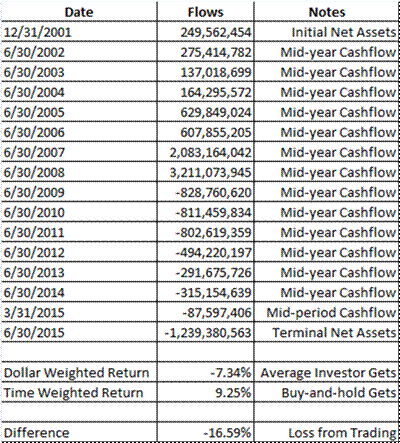
CGMFX Dollar Weighted_1552_image002That’s why I wanted to write this post.  Ken Heebner is a really bright guy, and has the strength of his convictions, but his investors don’t in general have similar strength of convictions.  As such, his investors buy high and sell low with his funds.  The graph at the left is from the CGM Focus Fund, as far back as I could get the data at the SEC’s EDGAR database.  The fund goes all the way back to late 1997, and had a tremendous start for which I can’t find the cash flow data.

The column marked flows corresponds to a figure called “Change in net assets derived from capital share transactions” from the Statement of Changes in Net Assets in the annual and semi-annual reports.  This is all public data, but somewhat difficult to aggregate.  I do it by hand.

I use annual cashflows for most of the calculation.  For the buy and hold return, i got the data from Yahoo Finance, which got it from Morningstar.

Note the pattern of cashflows is positive until the financial crisis, and negative thereafter.  Also note that more has gone into the fund than has come out, and thus the average investor has lost money.  The buy-and-hold investor has made money, what precious few were able to do that, much less rebalance.

This would be an ideal fund to rebalance.  Talented manager, will do well over time.  Add money when he does badly, take money out when he does well.  Would make a ton of sense.  Why doesn’t it happen?  Why doesn’t at least buy-and-hold happen?

It doesn’t happen because there is a Asset-Liability mismatch.  It doesn’t matter what the retail investors say their time horizon is, the truth is it is very short.  If you underperform for less than a few years, they yank funds.  The poetic justice is that they yank the funds just as the performance is about to turn.

Practically, the time horizon of an average investor in mutual funds is inversely proportional to the volatility of the funds they invest in.  It takes a certain amount of outperformance (whether relative or absolute) to get them in, and a certain amount of underperformance to get them out.  The more volatile the fund, the more rapidly that happens.  And Ken Heebner is so volatile that the only thing faster than his clients coming and going, is how rapidly he turns the portfolio over, which is once every 4-5 months.

Pretty astounding I think.  This highlights two main facts about retail investing that can’t be denied.

  1. Asset prices move a lot more than fundamentals, and
  2. Most investors chase performance

These two factors lie behind most of the losses that retail investors suffer over the long run, not active management fees.  remember as well that passive investing does not protect retail investors from themselves.  I have done the same analyses with passive portfolios — the results are the same, proportionate to volatility.

I know buy-and-hold gets a bad rap, and it is not deserved.  Take a few of my pieces from the past:

If you are a retail investor, the best thing you can do is set an asset allocation between risky and safe assets.  If you want a spit-in-the-wind estimate use 120 minus your age for the percentage in risky assets, and the rest in safe assets.  Rebalance to those percentages yearly.  If you do that, you will not get caught in the cycle of greed and panic, and you will benefit from the madness of strangers who get greedy and panic with abandon.  (Why 120?  End of the mortality table. <img src=" class="wp-smiley" style="height: 1em; max-height: 1em;" /> Take it from an investment actuary. <img src=" class="wp-smiley" style="height: 1em; max-height: 1em;" /> We’re the best-kept secret in the financial markets. 😀 )

Okay, gotta close this off.  This is not the last of this series.  I will do more dollar-weighted returns.  As far as retail investing goes, it is the most important issue.  Period.

07 Dec 13:17

Good News for JP Morgan Debt MF Holders, They Have Sold The Amtek Auto Debt at a Haircut

by Deepak Shenoy

Why should mutual fund holders care that a vulture fund has bought the bonds of a beleagured auto company at a discount? The answer: because their mutual fund has managed to sell those bonds, even if at a discount, and instead of being locked out of their own money, the mutual fund holders see some money back.

The history:

(Read On...)
07 Dec 11:51

Essar Oil sets Rs 146.05 as Floor Price for delisting ~ Critical Questions remain

by Gaurav Parikh
Essar Oil sets Rs 146.05 as Floor Price for delisting ~ Current Market Price is @ Rs 210 ~ What will be the discovered price ? Some Critical Questions yet in the air Six Years ago,LIC had picked up Rs 300 crs+ of Essar Oil in January 2010 at Rs 140 a share ~ Will they [...]
07 Dec 10:30

Alpha more difficult to get..?

by subra
When more people take to investing in mutual funds – or even worse – Index funds – what happens to the active investor? Does it get easier because there are are fewer players seeking alpha or does it become more difficult? first of all it is mythical to say that all index investors are passive […]
06 Dec 06:00

Diderot Effect – You may not have heard of it but you may be a victim

by Hemant Beniwal

You buy the new fashionable shirt or a new coffee table and you feel that you don’t have a good pair of trousers to pair up with the new shirt or feel that the good old couch does not match up to the nice new coffee table. You then go and buy a pair of trousers and then maybe a pair of shoes to go with the new outfit. You buy a couch, new cushions for the couch etc. to match the coffee table. You end up splurging a lot of money or over consuming. If you had never got that shirt or the coffee table, you would have saved a tidy sum. I was surprised that this phenomenon of overconsumption due to the acquisition of one item have a name…. the Diderot effect.

Diderot Effect

Image courtesy of Vlado at FreeDigitalPhotos.net

I am a recent Victim of Diderot Effect

From last  1 year, we were planning to replace our decade old car but I was resisting for the simple reason – our house lacked covered parking area (it really pains to see your car battling the sun in Rajasthan’s dry summers). Earlier we thought to put a fiberglass shade over iron frame, which will not cost much & our purpose will be solved. But then WE (wife empowerment/enforcement) decided that let’s have proper porch & the first floor can be used as a guest room (spouse was after my life for this from last few years & I was resisting).

Finally, work started after the rainy season…. and after a few days of work came another twist as the contractor suggested some changes in our layout & from nowhere he was able to add an extra room that can be called “kids room”. Home Minster okayed the plan & Finance Minister was looking at his deficit. In addition to this some changes in elevation, additional furniture & paint in whole house which was overdue also happened, leaving a vast ditch in my pocket.

Now work is in final stage & I know why one ad screamed CAAAAAR – car has become 2.5X…. Oops!! now I realise Rs 1000 car cover was a better option, but it’s too late :(

Yesterday this thought came to my mind that is there any scientific name of this DISEASE & discovered Diderot effect.

Who observed this first

This effect was described by Denis Diderot, a French philosopher. In an essay, he tells how a new dressing gown made him feel that all his other things were old and resulted in him buying a lot of stuff. This led him to falling into debt. The phenomenon of overconsumption where one item leads to spiralling buying spree is called the Diderot effect. Many of us have been victim to this concept even though we may not be aware of it.

Read: SmartPhones are making us dumb – Financially & Mentally

There’s another problem

Many of us fall prey to the Diderot effect as we tend to identify ourselves on the basis of what we have, what we wear and our lifestyle. Society is tending towards the Diderot effect. In earlier times, a family used to buy 1 car or 1 television set. It was used for many years. It was taken care of and maintained well. If it broke down, it was repaired. But today we do not have much patience to take care of our possessions and we want the new car or TV that is in the market. We throw away the older stuff even if there is nothing wrong it. Manufacturers also market goods in such a manner that makes us throw away the old stuff and buy new stuff. This results in overconsumption. The fashion industry is a perfect example of making us fall into the Diderot effect. We buy clothes not just to protect us but as a means of self-expression and show. Fashion keeps changing and we keep buying new clothes and accessories to keep up with latest fashion trends.

The Diderot effect results in our bank balance going down and us getting trapped in over consumerism.

Here are some tips to avoid falling into the Diderot Effect trap 

1) You should avoid unnecessary buying or consumption. You should buy what you need and not satisfy all your wants.

2) You should not let materialism dominate your life. You should live your life with a sense of purpose and be involved in things that give you peace of mind and happiness. You should not let buying of new things and possessions define your self-worth and status in society.

3) When you feel you are buying more than you need, check the cost implications. If you are going to buy things like a belt, handbag and shoes to match the new outfit, calculate the total expenditure involved before buying. You will realise that you are wasting money.

4) You can set limits on yourself if you feel you are falling in the Diderot effect trap. You can set a monetary limit on new purchases or different expenditure categories. You should buy new gadgets that work well or sync well with existing gadgets like chargers and cables. If you really want the new phone launched, you should set a constraint on yourself that you will gift yourself that phone next Diwali or on your birthday. This helps in curbing consumption.

5) Stick with the PLAN.

Read: How to Stop Buying things you never use

There is nothing wrong in wanting good things in life or having a well-coordinated wardrobe or home. But this should not make us consume unnecessarily and feel good only when we possess more and more. We should strike the right balance so that we satisfy our needs by consuming optimally, do not go into a  drive to possess more and more material things and save money and use it to improve our financial status.

There is a difference between lifestyle & quality of life – choose wisely.

Take some time to reflect on your buying behaviour in the last couple of months. Do you think you were a victim of the Diderot effect? Let me know how you want to change this behaviour.

05 Dec 16:10

Richard Feynman on Refusing an Honorary Degree, Being Driven, and Understanding his Circle of Competence

by Jeff Annello

Perfectly Reasonable Deviations From the Beaten Track is a wonderful collection of letters written to and from the physicist and professor Richard Feynmanchampion of understanding, explainer, exemplar of curiosity, lover of beauty, knowledge seeker, asker of questions—during his life and career in science.

The book explores the timeless qualities that we cherish in Feynman. Let’s dive a little deeper.

Driven

Feynman was precocious; it’s clear that even early in his career, he knew he had the intelligence and drive to make an impact in science. At the age of 24 he had the foresight to mention, in a letter to his parents defying their wish that he not marry a dying woman (his fiancé Arlene had tuberculosis, a deadly diagnosis in those days), that:

I have other desires and aims in the world. One of them is to contribute to physics as much as I can. This, in my mind, is of even more importance than my love for Arlene.

He worked hard at that goal, and he showed signs of enjoying the process. In letters he wrote during his time working in academia and on the atomic bomb, Feynman writes that:

I’m hitting some mathematical difficulties which I will either surmount, walk around, or go a different way—all of which consumes all of my time—but I like to do (it) very much and am very happy indeed. I have never thought so much so steadily about one problem—so if I get nowhere I really will be very disturbed—However, I have gotten somewhere, quite far—to Prof. Wheeler’s satisfaction. However the problem is not at completion, although I’m just beginning to see how far it is to the end and how we might get there (although aforementioned mathematical difficulties loom ahead)—SOME FUN!

This week has been unusual. There is an especially important problem to be worked out on the project, and it’s a lot of fun so I am working quite hard on it. I get up at about 10:30 AM after a good night’s rest, and go to work until 12:30 or 1 AM the next morning when I go back to bed. Naturally I take off about 2 hrs for my two meals. I don’t eat any breakfast, but I eat a midnight snack before I go to bed. It’s been that way for 4 or 5 days.

We see this frequently in genius-level contributors doing intensive work. It is not so much that they find the work easy, but they do find pleasure in the struggle. (There is actually another book about Feynman called “The Pleasure in Finding Things Out.”) Warren Buffett has said many times that he taps dances to work every day, and those who have spent time with him have corroborated the story. It’s not a lie. Charlie Munger has mentioned that one of the main reasons for Berkshire’s success is the fact that they enjoy the work.

Feynman is an interesting character though; for a super-genius scientist, he comes off as unusually romantic with passages like the following one, in a letter to his then-wife, Arlene:

There is a third thing you will be interested in. I love you. You are a strong and beautiful woman. You are not always as strong as other times but it rises and falls like the flow of a mountain stream. I feel I am a reservoir for your strength — without you I would be empty and weak like I was before I knew you — but your moments of strength make me strong and thus I am able to comfort you with your strength when your steam is low.

And long-time readers will remember the heart-breaking letter he wrote after she had passed away.

Honor and Honesty 

As the book rolls along and Feynman gets older and more famous, he is regularly asked to be honored. Generally, as most who have studied Feynman would know, he showed considerable discomfort with the process, which valued exclusivity and puffery over knowledge. One letter is typical of the middle-aged Feynman:

Dear George,

Yours is the first honorary degree that I have ben offered, and I thank you for considering me for such an honor.

However, I remember the work I did to get a real degree at Princeton and the guys on the same platform receiving honorary degrees without work—and felt an “honorary degree” was a debasement of the idea of a “degree which confirms certain work has been accomplished.” It is like giving an “honorary electrician’s license.” I swore then that if by chance I was ever offered one, I would not accept it.

Now at last (twenty-five years later) you have given me a chance to carry out my vow.

So thank you, but I do not wish to accept the honorary degrees you offered.

Sincerely yours,

Richard P. Feynman

He also offers his usual wit upon resigning from the National Academy of Sciences:

Dear Prof. Handler:

My request for resignation from the National Academy of Sciences is based entirely on personal psychological quirks. It represents in no way any implied or explicit criticism of the Academy, other than those characteristics that flow from the fact that most of the membership consider their installation as a significant honor.

Sincerely yours,
Richard P. Feynman

In fact, Feynman was constantly displaying his tendency towards intellectual honesty, whenever possible. He understood his circle of competence. Several letters scattered throughout his life show him essentially throwing up his hands and saying “I don’t know,” and he took pride in doing so. His general philosophy towards ignorance and learning was summed up in a statement he made in 1963 that “I feel a responsibility as a scientist who knows the great value of a satisfactory philosophy of ignorance, and the progress made possible by such a philosophy…that doubt is not to be feared, but it is to be welcomed…”

The following letter was typical of his lack of intellectual arrogance, this one coming in response to something he’d written about teaching kids math in his younger years:

Dear Mrs. Cochran:

As I get more experience I realize that I know nothing whatsoever as to how to teach children arithmetic. I did write some things before I reached my present state of wisdom. Perhaps the references you heard came from the article which I enclose.

At present, however, I do not know whether I agree with my past self or not.

Wishy-washy,
Richard P. Feynman

He does it again here, opening a reply to a highly critical letter about a TV appearance with the following:

Dear Mr. Rogers,

Thank you for your letter about my KNXT interview. You are quite right that I am very ignorant about smog and many other things, including the use of Finest English.

I won the Nobel Prize for work I did in physics trying to uncover the laws of nature. The only thing I really know very much about are these laws….

***

In the end, Feynman’s greatest strength, outside of his immense scientific talent, was his basic philosophy on life. In 1954, Feynman wrote with tenderness to his mother:

Wealth is not happiness nor is swimming pools and villas. Nor is great work alone reward, or fame. Foreign places visited themselves give nothing. It is only you who bring to the places your heart, or in your great work feeling, or in your large house place. If you do this there is happiness.

Check out Reasonable Deviations from the Beaten Track, and learn more about life and learning from the best.

--
Sponsored By: Greenhaven Road Capital: You think differently - now invest differently.

05 Dec 05:38

Treatment of individual credit in the draft Insolvency and Bankruptcy Code

by Ajay Shah
by Shreya Garg and Renuka Sane.

The focus of thinking on bankruptcy and insolvency in India has primarily been upon defaults by firms. However, defaults by individuals are equally important for the economy. Most small firms obtain debt financing through the vehicle of personal borrowing of the entrepreneur. Households require credit for reducing the volatility of consumption. In this article, we sketch the treatment of individual insolvency in the draft Insolvency and Bankruptcy Code, and compare and contrast this against the treatment of firms.

The design of a sound insolvency process for individuals


In India, at present, we lack a well functioning market for personal credit, in part because of poor consumer protection, and the absence of well-functioning insolvency framework for enforcing repayment of loans. A key element of a credit contract is predictability around what happens if the borrower cannot repay. Creditors need mechanisms to enforce repayment, or alternatively, restructure obligations. At the same time, coercive collection mechanisms need to be blocked. Creditors need information on whether potential debtors have failed to repay in the past. Debtors need the assurance that if they fail to repay once, there is the possibility of starting all over again. Both creditors and debtors need to know that decisions will be taken swiftly. The following elements are thus important in the design of the insolvency process:

  1. Participation of both the creditors and debtor: When the debtor is facing financial difficulties, it may in the interest of both the creditors and the debtor to re-negotiate the terms of repayment, and come to a new agreement. Voluntary decisions by both sides are best in terms of obtaining flexibility and maximising the recovery rate. This allows the debtor to reorganise payments in line with expected cashflows. A good insolvency process should aim to bring together all the creditors with the distressed debtor, and facilitate this re-negotiation.

  2. Fair, orderly and timely: The process of re-negotiation needs to be fair and orderly for everyone to participate. It has to be timely as delays can be costly. If the re-negotiation fails, then there has to clarity on what follows, and in what time period the actions follow.

  3. Release from financial liabilities: The debtor will only meaningfully participate in the process if there is the certainty that participation in the process will lead to a clean slate and the possibility of starting all over again. If the process allows the debtor to keep certain crucial assets such as tools of trade, then the debtor has a better chance at a restart.

  4. Ex-ante incentives: The participants in the process will naturally want to maximise their own value first. In this process it is likely that either the creditors or the debtor will game the system to their own advantage at the cost of the others. This can skew incentives and lead to a poor credit market. For example, if the debtor knows that debt forgiveness can be had easily, it will encourage the debtor to be reckless with credit, while discourage creditors from lending. The outcome will be credit constraints.

  5. Care about frictions: The institutional design needs to be mindful that for most individuals, as with most small firms, the magnitude of the debt at stake does not justify substantial expenditures on negotiation, payments for insolvency professionals, and processes at a judicial forum.

Individual insolvency in the IBC


These design principles are at the foundation of the report and the draft Insolvency and Bankruptcy Code submitted by the Bankruptcy Law Reforms Committee (BLRC). The draft Bill proposes three processes:

Insolvency Resolution Process
The Insolvency Resolution Process (IRP) is the process through which all creditors and the debtor agree on a negotiated repayment plan. This process is core to the IBC. Only on the failure of the IRP would a bankruptcy process be triggered. Individuals are required to attempt a resolution of their insolvency, as this provides debtors a chance to renegotiate and not be divested of their estate through bankruptcy, and thereby avoid the tag of being "bankrupt". The IRP can be initiated by the debtor or the creditor.
Establishing the validity of the claim of default is a bigger problem in the case of individuals than firms. If the debt is registered with an `information utility', the class of infrastructure providers envisaged by the IBC for recordkeeping, then the debtor would be precluded from contesting the validity of the debt. The absence of this electronic information would lead to delays.
Once the IRP has been triggered, a moratorium of six months would commence on all collection actions. Debtors and creditors would be required to agree on a repayment plan within this moratorium period under the supervision of a resolution professional. Once approved by the creditors and sanctioned by the adjudicating authority, the plan would be binding on the debtor and all the creditors mentioned in the plan. The debts would have to be repaid by the debtor under the terms of the repayment plan including the dates envisaged.
A certain class of assets of the debtor would remain outside the purview of this process: e.g. unencumbered assets like his dwelling house upto a certain value, life insurance policy, household items, items necessary for personal use and employment. Compared with the existing law, the ambit of excluded assets under the IBC has been expanded.
The negotiated plan would determine when the debtor is discharged from all debts. It is possible that the debtor is granted a discharge even before all dues are paid. The regulator, which has been named `Insolvency & Bankruptcy Board of India' would keep a record of the default by the debtor for a time period as may be prescribed by regulations and such information would be publicly available.
Bankruptcy Process
The IBC envisages three grounds for failure of the IRP which can lead to bankruptcy proceedings: (a) If the application to the IRP is not accepted due to failure to provide requisite information, (b) If creditors and the debtor cannot agree on a repayment plan, and (c) If the debtor fails to implement the repayment plan within the period prescribed for such implementation in the plan.
The bankruptcy proceeding will not start automatically: the creditor or the debtor would have to make an application to trigger it. On the admission of the application for bankruptcy, a bankruptcy order will be passed by the adjudicating authority.
It will have the effect of declaring the debtor as 'bankrupt' and vesting a subset of the estate of the bankrupt with a resolution professional. A moratorium will begin, on all collection actions of unsecured creditors. Secured creditors will have the option to participate in the process or enforce their security outside the process. On the vesting of the estate of the bankrupt, the resolution professional will declare the amount to be distributed amongst the creditors of the bankrupt, in the order of priority encapsulated in the IBC. The record will be kept by the Board for a time period to be prescribed by regulations. Such information will be publicly available.
Fresh start
An IRP makes sense only when there is a possibility of a repayment plan. In the case of low-income, low-asset debtors, transaction costs in the process of resolution or bankruptcy may exceed the debt at stake. There is also the danger in India that politically motivated loan-waivers destroy the credit culture. A smooth process of dealing with insolvent poor people, which works every day, could potentially de-politicise the problem.
The IBC, therefore, proposes a concept of a Fresh Start, aimed at providing debt relief to the poorest. A debtor with gross annual income of less than Rs.60,000, assets less than Rs.20,000, debts less than Rs.35,000, and no home-ownership, will be eligible to get a complete waiver of debts. These thresholds have been designed using the SECC, 2011, Deprivation Index as well as the Key Indicators of Debt and Investment in India for 2013 and will need to get revised over time.
Only the debtor can trigger this process and on submission of the requisite information, the adjudicating authority may grant him a discharge order. A moratorium will become applicable on all the creditors of the applicant for a period of six months, to provide a conducive environment for the process to go through. The Board will keep a record of the default by the debtor for a time period as may be prescribed and such information is publicly available. Facts about fresh start would stay on the record of the individual and be available to future creditors, thus containing moral hazard.

How does this process differ from corporate insolvency?


While the individual insolvency provisions mirror the corporate insolvency provisions, there are a few differences.

  1. In individual insolvency, an interim moratorium starts from the date of the application, unlike corporate insolvency. This is to prevent coercive debt recovery action.

  2. The corporate insolvency framework divides creditors into financial and operational creditors. This distinction is not made in respect of individuals. This is because it is expected that the debt structure of an individual or a partnership firm is likely to be less complex and it should be possible for both sets of creditors to be included in the negotiations on repayment.

  3. In individual insolvency, secured creditors are permitted to stay out of IRP entirely by enforcing their security interest, unlike corporate insolvency. One reason for this is that SARFAESI has seen the greatest success in situations where the lender has extended a single loan to a single individual borrower and it was considered worthwhile to retain SARFAESI rights to individual lenders. It may also be easier for an individual or partnership to rebuild the value destroyed on account of security enforcement.

  4. In corporate insolvency, the fast track IRP makes it possible for the firm to go into liquidation directly. In the case of individuals, there is no such provision. Only when the possibility of a repayment plan is completely ruled out, will the debtor be taken to bankruptcy proceedings. The thrust of the IBC is thus to resolve insolvency through re-negotiation.

  5. In corporate insolvency, failure of the IRP directly triggers the liquidation proceedings. In the case of individuals, a failure of the IRP only entitles the debtor or the creditors to make an application for triggering the bankruptcy proceedings. The trigger is not automatic. The rationale for the distinction lies in the higher stigma attached to an individual's bankrupt status.

  6. Corporate insolvency does not have an option of a fresh start process, as this process has been conceptualised specifically to provide debt relief to poor individuals, for whom the recovery procedure is likely to be more expensive than the amount recovered.

  7. Adjudication for firms will take place at NCLT, while individual insolvency cases will go to DRTs. Over time, individuals from all corners of the country will want to access the DRTs. In terms of organisational capabilities, DRTs as presently structured are not modern courts. A tremendous effort will be required, on the lines of the work that has begun for constructing the Financial Sector Appellate Tribunal, in order to make NCLT and DRT deliver what is required for IBC.

Conclusion


The draft IBC is the first attempt at a comprehensive law for insolvency by individuals. If the code is implemented, and if the infrastructure in the form of resolution professionals, the information utilities, and the adjudication infrastructure falls into place, this could yield a sea change in the working of the market for individual credit.

Acknowledgments


We thank Richa Roy for useful comments.


Shreya Garg is a researcher at Vidhi Centre for Legal Policy. Renuka Sane is an academic at the Indian Statistical Institute, New Delhi.
05 Dec 05:07

Weekend Reading Links

by noreply@blogger.com (Gulzar Natarajan)
1. India needs more of this type of market makers and peer-to-peer lending platforms which can credibly signal the credit-worthiness of borrowers by using non-conventional sources and strategies of credit assessments,
The financial tech startups are trying to evaluate credit risk using a wide variety of consumer data including the digital footprint of customers arising out of social networks, ecommerce, mobile usage and geo-location. For example, IndiaLends claims to capture alternative information points such as bank statement, utility data, social data and customer interaction with the website... Startups like IndiaLends do not lend money of their own. Using their technology platform, they connect consumers with banks and financial institutions which results in better rates for the borrowers and a reduction in overall default rates... where they differentiate... from the bank is in scientifically matching the right borrower profile with the most relevant lender and hence reducing inefficiencies that lead to lower loan approvals, higher interest rates and sub-optimal loan amounts.
2. The most obvious indicator of state capability weakness is the gross inadequacy of personnel in many critical public agencies. As against a global average of one policeman per 450 people, India's has one for 709 people, with the numbers being 1298 and 1282 for Bihar and UP respectively. 
The problem here is that any discussion on increasing personnel strength gets conflated with the mistaken belief that the government is already too big and needs to be pruned down.

3. Ian Bremmer points to this map of the world would could well represent the beliefs of ISIS
4. Economic Times has a story on the increasing use of robots among India's car manufacturers,
Robots have begun to take over an array of functions from humans at car plants in India. Volkswagen India has 123 robots at its Pune plant while Hyundai Motor India, the subsidiary of the Korean carmaker, has 400 robots at its factory in Chennai... The Ford Sanand plant actually has 453 robots in the shop floor, with up to 90 per cent of the work automated... The entire body shop, most of the paint shop and parts of the final assembly line in these plants are now automated. Robots are performing functions ranging from welding to foundry operations to laser applications.
But robots are not likely to displace humans any time in the foreseeable future,
Still, despite the many benefits, companies will not be in a hurry to replace labour simply because robots are costly. A robot does the work of three technical workers, but it typically costs between $3,00,000 and $4,00,000. In other words, automation is 10 times more expensive than manual labour
5. Business Standard has an article on the findings of the Ashok Misra Committee which examined India's unregulated professional course entrance examinations coaching industry. The report proposes the establishment of a regulator for the coaching industry. The report highlights the scale of the industry,
According to an a 2013 survey by Associated Chambers of Commerce and Industry of India (Assocham), titled "Business of Private Coaching Centres in India", the size of the private coaching sector was $23.7 billion, or Rs 1.41 lakh crore. The survey also predicted that by 2015, it would grow to $40 billion, or Rs 2.39 lakh crore. The survey had collected data from 5,000 students and parents across 10 cities. It revealed that 87 per cent of primary and 95 per cent of high school students in the major cities took private tutoring. This industry grew by 35 per cent in the previous six years.
6. Global corporate bond offerings have crossed $2 trillion for the fourth consecutive year on the back of continuing monetary accommodation and signals that the ECB may be willing to continue and expand the ongoing QE.
7. Roula Khalaf has a nice summary of the differences between Isis and Al Qaeda. This is interesting,
The Sahwa movement comprised a group of Iraqi tribesmen that collaborated with the US a decade ago to root out the Iraqi branch of al-Qaeda. That branch took its revenge: it eventually became the Islamic State of Iraq and the Levant, better known as Isis... Isis seems obsessed with al-Qaeda, from which it split in 2013 following disagreements over the goals of jihad in Syria. Since then Isis has distinguished itself from its parent through its savagery (there is no limit to the violence it is willing to inflict) and its move to create a caliphate in parts of Iraq and Syria. 
8. Nice article in NYT on how Isis sustains itself - "they fight in the morning and they tax in the afternoon". The article describes how Isis is running the legitimate revenue collection operations of a regular government,
The better known of the Islamic State’s revenue sources — smuggling oil, plundering bank vaults, looting antiquities, ransoming kidnapped foreigners and drumming up donations from wealthy supporters in the Persian Gulf — have all helped make the group arguably the world’s richest militant organization. But as Western and Middle Eastern officials have gained a better understanding of the Islamic State’s finances over the past year, a broad consensus has emerged that its biggest source of cash appears to be the people it rules, and the businesses it controls...
(Isis) has set up a predatory and violent bureaucracy that wrings every last American dollar, Iraqi dinar and Syrian pound it can from those who live under its control or pass through its territory. Interviews... describe the group as exacting tolls and traffic tickets; rent for government buildings; utility bills for water and electricity; taxes on income, crops and cattle; and fines for smoking or wearing the wrong clothes. The earnings from these practices that mimic a traditional state total tens of millions of dollars a month, approaching $1 billion a year, according to some estimates by American and European officials. And that is a revenue stream that has so far proved largely impervious to sanctions and air raids... 
In Raqqa, the Syrian city that is now the de facto capital of the Islamic State, a department called Diwan al-Khadamat, or the Office of Services, sends officials through the city markets to collect a cleaning tax — 2,500 to 5,000 Syrian pounds, or about $7 to $14, per month depending on the size of the shop. Residents go to collection points to pay their monthly electricity and water bills, 800 Syrian pounds, or roughly $2.50 for electricity and 400 pounds, about $1.20, for water. Another Islamic State department, the Diwan al-Rikaz, or the Office of Resources, oversees oil production and smuggling, the looting of antiquities and a long list of other businesses now controlled by the militants. It operates water-bottling and soft-drink plants, textile and furniture workshops, and mobile phone companies, as well as tile, cement and chemical factories, skimming revenues from all of them...
The group has taken over the collection of car-registration fees, and made students pay for textbooks. It has even fined people for driving with broken taillights, a practice that is nearly unheard-of on the unruly roads of the Middle East. Fines are also included in the punishments meted out for breaking the strict living rules imposed by the Islamic State. 
In this context, the prevailing strategy to contain them, involving targeting their oil production and smuggling operations is unlikely to yield results,
Ultimately, though, many officials and experts said the Islamic State would probably be able to cover its costs even without oil revenue, and that so long as it controls large stretches of Iraq and Syria, including major cities, bankrupting the group would take a lot more than blowing up oil tankers. “These are all going to be little pinpricks into Islamic State financing unless you can take their revenue bases away from them, and that means the territory they control,” said Seth Jones, a terrorism expert at the RAND Corporation... the old strategy for stopping the flow of money to terrorist groups like Al Qaeda, which was largely based on cutting them off from donors in the Persian Gulf upon which they depend, does not apply to the Islamic State. 
9. The $160 bn reverse takeover of US-based Pfizer (maker of Viagra) by the Dublin-based Allergan (maker of Botox), an investment company trading pharmaceuticals businesses, is classic tax-inversion. It enables Pfizer to use its accumulated overseas profits without incurring US tax liability, thereby saving atleast $21 bn in future tax liabilities. It also joins Burger King and Liberty Global as brands which have fled overseas to avoid tax payments.

Apart from tax inversion, as John Gapper writes, it also highlights a new trend in pharmaceuticals industry,
Pharmaceuticals companies used to be research enterprises that discovered and developed drugs. Then they became marketing giants, skilled at selling as many blockbuster pills as possible. Lately, they have turned into mergers and acquisitions machines, buying and selling medicines invented by others. It is hard to view their evolution as progress... Instead of taking their chances by investing in drug discovery themselves, some wait until a smaller biopharmaceutical enterprise has done so and then try to buy the rights. It is less risky and uncertain for investors but it also tends to be extremely expensive. AbbVie, for example, paid $21bn for Pharmacyclics this year, largely to acquire a single blood cancer treatment.
In this case, Pfizer is buying up Botox!

10. Finally, the ECB has extended QE, but not by as much as anticipated. Apart from extending its 60 billion Euro a month bond buying program for another six months till March 2017 or "beyond" and purchase municipal bond in addition to government bonds, it has also lowered the deposit rate to minus 0.3 per cent.
Add to Technorati Favorites
05 Dec 05:01

Understanding Trump

by Greg Mankiw
This passage from Ross Douthat caught my eye:
Writing for Slate last week, Jamelle Bouie argued that Trumpism, however ideologically inchoate, manifests at least seven of the hallmarks of fascism identified by the Italian polymath Umberto Eco. They include: a cult of action, a celebration of aggressive masculinity, an intolerance of criticism, a fear of difference and outsiders, a pitch to the frustrations of the lower middle class, an intense nationalism and resentment at national humiliation, and a “popular elitism” that promises every citizen that they’re part of “the best people of the world.” Does this sound like Trump? Well, yes, it rather does.
04 Dec 11:44

Poke the Box: The Hardest Part is Starting

by Vishal Khandelwal

Let’s Start with Safal Niveshak
Just in case you missed any of this on Safal Niveshak over the last few days…

Book Worm
I was recently reading the book Beyond Wealth: The Road Map to a Rich Life by Alexander Green where he writes about his life experiences and lessons he learned along the way. In one of the chapters, Alex writes about the importance of walking for your health and mental well-being. Here is an extract from that chapter I liked the most –

For most of our history, walking wasn’t a choice. It was a given. Walking was our primary means of locomotion. But, today, you have to choose to walk. We ride to work. Office buildings and apartments have elevators. Department stores offer escalators. Airports use moving sidewalks. An afternoon of golf is spent riding in a cart. Even a ramble around your neighborhood can be done on a Segway.

Why not just put one foot in front of the other? You don’t have to live in the country. It’s great to take a walk in the woods…A long stroll slows you down, puts things in perspective, brings you back to the present moment. In Wanderlust: A History of Walking (Viking, 2000), author Rebecca Solnit writes that, “Walking, ideally, is a state in which the mind, the body, and the world are aligned, as though they were three characters finally in conversation together, three notes suddenly making a chord.”

Yet in our hectic, goal-oriented culture, taking a leisurely walk isn’t always easy. You have to plan for it. And perhaps you should. Walking is good exercise, but it is also a recreation, an aesthetic experience, an exploration, an investigation, a ritual, a meditation. It fosters health and joie de vivre.

Cardiologist Paul Dudley White once said, “A vigorous five-mile walk will do more good for an unhappy but otherwise healthy adult than all the medicine and psychology in the world.”

A good walk is anything but pedestrian. It lengthens your life. It clears, refreshes, provokes, and repairs the mind. So lace up those shoes and get outside. The most ancient exercise is still the best.

Stimulate Your Mind
Here’s some amazing content we read in recent times…

Poke of the Week – The Hardest Part is Starting

“Sometimes the hardest part isn’t letting go but rather learning to start over.” ~ Nicole Sobon

The Hardest Part is Starting
If I look back at the most difficult period I went through in my journey of Safal Niveshak, it was the time when I was making the decision to start. The usual fears of quitting a well-paying job and thoughts of not being able to earn enough to feed my family were my chief concerns that led me to several pauses before I finally decided to start this journey.

As I have realized over and over again, and I am sure you would vouch for it, starting something is the hardest part of anything — of cleaning the house, of getting into yoga, becoming fit, or planning a trip, writing a post like this, of learning meditation, or building a relationship.

Starting is no doubt the steepest step, the biggest hurdle, the most giant obstacle standing between where you are and what it is you want to achieve.

But then, as I have also realized, it’s up to you to make your goals your reality, because although we wish it wasn’t so, dreams don’t just magically unfold simply because you wish them to.

You have to start when you want to start. Careful and well-studied action is the biggest truth and your biggest asset. Even though it hasn’t been easy, I have found solace in the knowing that starting is and will be the hardest part of anything I wish to do in life. What about you?

Start something. Now.

Be kind to others, and to yourself.

Stay happy, stay healthy, stay blessed.

With respect,
Vishal & Anshul

The post Poke the Box: The Hardest Part is Starting appeared first on Safal Niveshak.

    
04 Dec 06:49

Contrarian Financial advice

by subra
Well too many people are looking a little lost at around 23 about what to do in life. So enter financial gurus including yours truly..giving them advice. Well, here is some contrarian advice to disturb all the b..t that you have heard: If you do not try something out at this stage, you never will: […]
04 Dec 06:46

Quality of Financial Advise

by subra
What really decides the quality of financial advise that you get? I guess it is simple..it depends on the questions you ask. So what questions should you ask? Let us ask Google Maharaj for advise? Well you will see some 23,824 answers to this question, and it is likely that you will pick the first […]
04 Dec 06:45

Chennai floods…how many more till we learn any lessons?

by Amol Agrawal
The way India’s top cities keep going under due to natural disasters is not even a joke anymore. Some like Bangalore do not even a natural disaster! This time it is the turn of Chennai which is under some serious trouble. What is worse is it took the media so much time to report on the […]
04 Dec 06:36

Three Fundamental Activities of Mindfulness

by Farnam Street Team

Three Fundamental Activities of Mindfullness
According to the excellent, Mindfulness in Plain English, there are three fundamental activities of mindfulness.

We can use these activities as functional definitions of the term: (a) mindfulness reminds us of what we are supposed to be doing, (b) it sees things as they really are, and (c) it sees the true nature of all phenomena.

Here are the three.

1. Mindfulness reminds you of what you are supposed to be doing

In meditation, you put your attention on one item. When your mind wanders from this focus, it is mindfulness that reminds you that your mind is wandering and what you are supposed to be doing. It is mindfulness that brings your mind back to the object of meditation. All of this occurs instantaneously and without internal dialogue. Mindfulness is not thinking. Repeated practice in meditation establishes this function as a mental habit that then carries over into the rest of your life. A serious meditator pays bare attention to occurrences all the time, day in, day out, whether formally sitting in meditation or not. This is a very lofty ideal toward which those who meditate may be working for a period of years or even decades. Our habit of getting stuck in thought is years old, and that habit will hang on in the most tenacious manner. The only way out is to be equally persistent in the cultivation of constant mindfulness. When mindfulness is present, you will notice when you become stuck in your thought patterns. It is that very noticing that allows you to back out of the thought process and free yourself from it. Mindfulness then returns your attention to its proper focus. If you are meditating at that moment, then your focus will be the formal object of meditation. If you are not in formal meditation, it will be just a pure application of bare attention itself, just a pure noticing of whatever comes up without getting involved—“ Ah, this comes up… and now this, and now this… and now this.”

Mindfulness is at one and the same time both bare attention itself and the function of reminding us to pay bare attention if we have ceased to do so. Bare attention is noticing. It reestablishes itself simply by noticing that it has not been present. As soon as you are noticing that you have not been noticing, then by definition you are noticing and then you are back again to paying bare attention.

Mindfulness creates its own distinct feeling in consciousness. It has a flavor— a light, clear, energetic flavor. By comparison, conscious thought is heavy, ponderous, and picky. But here again, these are just words. Your own practice will show you the difference. Then you will probably come up with your own words and the words used here will become superfluous. Remember, practice is the thing.

2. Mindfulness sees things as they really are

Mindfulness adds nothing to perception and it subtracts nothing. It distorts nothing. It is bare attention and just looks at whatever comes up. Conscious thought pastes things over our experience, loads us down with concepts and ideas, immerses us in a churning vortex of plans and worries, fears and fantasies. When mindful, you don’t play that game. You just notice exactly what arises in the mind, then you notice the next thing. “Ah, this… and this… and now this.” It is really very simple.

3. Mindfulness sees the true nature of all phenomena

Mindfulness and only mindfulness can perceive that the three prime characteristics that Buddhism teaches are the deepest truths of existence. In Pali these three are called anicca (impermanence), dukkha (unsatisfactoriness), and anatta (selflessness— the absence of a permanent, unchanging entity that we call Soul or Self). These truths are not presented in Buddhist teaching as dogmas demanding blind faith. Buddhists feel that these truths are universal and self-evident to anyone who cares to investigate in a proper way. Mindfulness is that method of investigation. Mindfulness alone has the power to reveal the deepest level of reality available to human observation. At this level of inspection, one sees the following: (a) all conditioned things are inherently transitory; (b) every worldly thing is, in the end, unsatisfying; and (c) there are really no entities that are unchanging or permanent, only processes.

Mindfulness works like an electron microscope. That is, it operates on so fine a level that one can actually directly perceive those realities that are at best theoretical constructs to the conscious thought process. Mindfulness actually sees the impermanent character of every perception. It sees the transitory and passing nature of everything that is perceived. It also sees the inherently unsatisfactory nature of all conditioned things. It sees that there is no point grabbing onto any of these passing shows; peace and happiness cannot be found that way. And finally, mindfulness sees the inherent selflessness of all phenomena. It sees the way that we have arbitrarily selected a certain bundle of perceptions, chopped them off from the rest of the surging flow of experience, and then conceptualized them as separate, enduring entities. Mindfulness actually sees these things. It does not think about them, it sees them directly.

When it is fully developed, mindfulness sees these three attributes of existence directly, instantaneously, and without the intervening medium of conscious thought. In fact, even the attributes that we just covered are inherently unified. They don’t really exist as separate items. They are purely the result of our struggle to take this fundamentally simple process called mindfulness and express it in the cumbersome and inadequate thought symbols of the conscious level. Mindfulness is a process, but it does not take place in steps. It is a holistic process that occurs as a unit: you notice your own lack of mindfulness; and that noticing itself is a result of mindfulness; and mindfulness is bare attention; and bare attention is noticing things exactly as they are without distortion; and the way they are is impermanent (anicca), unsatisfactory (dukkha), and selfless (anatta). It all takes place in the space of a few mind-moments. This does not mean, however, that you will instantly attain liberation (freedom from all human weaknesses) as a result of your first moment of mindfulness. Learning to integrate this material into your conscious life is quite another process. And learning to prolong this state of mindfulness is still another. They are joyous processes, however, and they are well worth the effort.

--
Sponsored By: Greenhaven Road Capital: You think differently - now invest differently.

04 Dec 06:35

Ten Questions and Answers on ETFs and Other Topics

by David Merkel

I was asked to participate with 57 other bloggers in a post that was entitled 101 ETF Investing Tips.  It’s a pretty good article, and I felt the tips numbered 2, 15, 18, 23, 29, 35, 44, 48, 53, 68, 85, 96, and 98 were particularly good, while 10, 39, 40, 45, 65, 67, 74, 77, 80, and 88 should have been omitted.  The rest were okay.

One consensus finding was that Abnormal Returns was a “go to” site on the internet for finance.  I think so too.

Below were the answers that I gave to the questions.  I hope you enjoy them.

1) What is the one piece of advice you’d give to an investor just starting to build a long-term portfolio?

You need to have reasonable goals.  You also have to have enough investing knowledge to know whether advice that you receive is reasonable.  Finally, when you have a reasonable overall plan, you need to stick with it.

2) What is one mistake you see investors make over and over?

They think investment markets are magic. They don’t save/invest anywhere near enough, and they think that somehow magically the markets will bail out their woeful lack of planning.  They also panic and get greedy at the wrong times.

3) In 20 years, _____. (this can be a prediction about anything — investing-related or otherwise)

In 20 years, most long-term public entitlement and private employee benefit schemes that promised fixed payments/reimbursement will be scaled back dramatically, and most retirees will be very disappointed.  The investment math doesn’t work here – if anything, the politicians were more prone to magical thinking than naïve investors.

4) Buy-and-hold investing is _____.

Buy-and-hold investing is the second-best strategy that average people can apply to markets, if done with sufficient diversification. It is a simple strategy, available to everyone, and it generally beats the performance of average investors who buy and sell out of greed and panic.

5) One book I wish every investor would read is _____. (note that non-investing books are OK!)

One book I wish every investor would read is the Bible. The Bible eliminates magical thinking, commends hard work and saving, and tells people that their treasure should be in Heaven, and not on Earth.  If you are placing your future hope in a worry-free, well-off retirement, the odds are high that you will be disappointed.  But if you trust in Jesus, He will never leave you nor forsake you.

6) The one site / Twitter account / newsletter that I can’t do without is _____.

Abnormal Returns provides the best summary of the top writing on finance and investing every day.  There is no better place to get your information each day, and it comes from a wide array of sources that you could not find on your own.  Credit Tadas Viskanta for his excellent work.

7) The biggest misconception about investing via ETFs is_____.

The biggest misconception about investing via ETFs is that they are all created equal.  They have different expenses and structures, some of which harm their investors.  Simplicity is best – read my article, “The Good ETF” for more.

8 ) Over a 20-year time horizon, I’m bullish on _____. (this can be an asset class, fund, technology, person — anything really!)

Over 20 years, I am bullish on stocks, America, and emerging markets.  Of the developed nations, America has the best combination of attributes to thrive.  The emerging markets offer the best possibility of significant growth.  Stocks may have a rough time in the next five years, but in an environment where demographic and technological change is favoring corporate profits, stocks will do better than other asset classes over 20 years.

9) The one site / Twitter account / newsletter that I can’t do without is _____.

Since you asked twice, the Aleph Blog is one of the best investing blogs on the internet, together with its Twitter feed.  It has written about most of the hard questions on investing in a relatively simple way, and is not generally marketing services to readers.  For the simple stuff, go to the personal finance category at the blog.

10) Any other ETF-related investing tips or advice?

For a fuller view of my ETF-related advice, go to Aleph Blog, and read here.  Briefly, be careful with any ETF that is esoteric, or that you can’t draw a simple diagram to explain how it works.  Also realize that traders of ETFs tend to do worse than those that buy and hold.


04 Dec 06:25

Peter Thiel on the End of Hubris and the Lessons from the Internet Bubble of the Late 90s

by Farnam Street Team

Madness is rare in individuals—but in groups, parties, nations and ages it is the rule.

The best interview question — what important truth do very few people agree with you on?— is tough to answer. Just think about it for a second.

In his book Zero to One, Peter Thiel argues that it might be easier to start with what everyone seems to agree on and go until you disagree.

If you can identify a delusional popular belief, you can find what lies hidden behind it: the contrarian truth.

Consider the proposition that companies should make money for their shareholders and not lose it. This seems self-evident, but it wasn’t so obvious to many in the late 90s. Remember back then? No loss was too big. (In my interview with Sanjay Bakshi he suggested that to some extent this still exists today.)

Making money? That was old school. In the late 1990s it was all about the new economy. Eyeballs first, profits later.

Conventional beliefs only ever come to appear arbitrary and wrong in retrospect; whenever one collapses, we call the old belief a bubble. But the distortions caused by bubbles don’t disappear when they pop. The internet craze of the ’90s was the biggest bubble since the crash of 1929, and the lessons learned afterward define and distort almost all thinking about technology today. The first step to thinking clearly is to question what we think we know about the past.

Peter Thiel:The first step to thinking clearly is to question what we think we know about the past

There’s really no need to rehash the 1990s in this article. You can google it. Or you can read the summary in chapter two of Zero to One.

Where things get interesting, at least in the thinking context, are the lessons we drew from the late 90s. Thiel says the following were lessons most commonly learned:

The entrepreneurs who stuck with Silicon Valley learned four big lessons from the dot-com crash that still guide business thinking today:

1. Make incremental advances. Grand visions inflated the bubble, so they should not be indulged. Anyone who claims to be able to do something great is suspect, and anyone who wants to change the world should be more humble. Small, incremental steps are the only safe path forward.

2. Stay lean and flexible. All companies must be “lean,” which is code for “unplanned.” You should not know what your business will do; planning is arrogant and inflexible. Instead you should try things out, “iterate,” and treat entrepreneurship as agnostic experimentation.

3. Improve on the competition. Don’t try to create a new market prematurely. The only way to know you have a real business is to start with an already existing customer, so you should build your company by improving on recognizable products already offered by successful competitors.

4. Focus on product, not sales. If your product requires advertising or salespeople to sell it, it’s not good enough: technology is primarily about product development, not distribution. Bubble-era advertising was obviously wasteful, so the only sustainable growth is viral growth.

These lessons, Thiel argues, are now dogma in the startup world. Ignore them at your peril and risk near certain failure. In fact, many private companies I’ve worked with have adopted the same view. Governments too are attempting to replicate these ‘facts’ — they have become conventional wisdom.

And yet … the opposites are probably just as true if not more correct.

1. It is better to risk boldness than triviality.
2. A bad plan is better than no plan.
3. Competitive markets destroy profits.
4. Sales matters just as much as product.

Such is the world of messy social science — hard and fast rules are difficult to come by, and frequently, good ideas lose value as they gain popularity. (This is the “everyone on their tip-toes at a parade” idea.) Just as importantly, what starts as a good hand tends to be overplayed by man-with-a-hammer types.

And so the lessons which have been culled from the tech crash are not necessarily wrong, they are just context-dependent. It is hard to generalize with them.

Peter Thiel Think For Yourself

According to Thiel, we must learn to use our brains as well as our emotions:

We still need new technology, and we may even need some 1999-style hubris and exuberance to get it. To build the next generation of companies, we must abandon the dogmas created after the crash. That doesn’t mean the opposite ideas are automatically true: you can’t escape the madness of crowds by dogmatically rejecting them. Instead ask yourself: how much of what you know about business is shaped by mistaken reactions to past mistakes? The most contrarian thing of all is not to oppose the crowd but to think for yourself.

In a nutshell, when everyone learns the same lessons, applying them to the point of religious devotion, there can be opportunity in the opposite. If everyone is thinking the same thing, no one is really thinking.

As Alfred Sloan, the heroic former CEO of General Motors, once put it:

Alfred Sloan

--
Sponsored By: Greenhaven Road Capital: You think differently - now invest differently.

04 Dec 06:25

10 fabulous habits that can transform the lives of people

by Katherine brunt

10-fabulous-habits-that-can-transform-the-lives-of-peopleThere is a difference between the lives of ordinary and extraordinary people and this difference is created because of the habits, which they acquire and apply. This is the way through which the lives of people are transformed and eventually become successful. This aspect should be taken into consideration there are different sorts of people who do not understand the value of their lives and, as a result, they live their lives without any purpose or goal. Whereas there are people who like to take challenges and strive to take something out of their every action. In this manner, these people live better lives and create positive influences on the lives of other people. This is an important question to consider that relates how these […]

The post 10 fabulous habits that can transform the lives of people appeared first on Dumb Little Man.

04 Dec 06:09

Brazil olympians will have to pay for their own AC

by Amol Agrawal
Brazil economic crisis is hitting its own olympians. In what is a really weird move, Brazil’s athletes will have to pay for the air conditioners in their dorms during the games: The Brazilian economic crisis has finally hit the 2016 Olympics. Following a new round of cost-cutting by the Rio 2016 organizers, athletes will be asked to pay for the […]
04 Dec 06:08

Electricity shortages and industry: Evidence from India

by Amol Agrawal
Hunt Allcott, Allan Collard-Wexler, Stephen D. O’Connell have a research article on impact of electricity shortage on Indian industry: In many countries, electricity supply is cited as a primary impediment to firm growth and productivity. This column assesses the effect of endemic electricity shortages on Indian manufacturers. The average reported level of shortages reduces annual […]
04 Dec 06:04

Fermi’s Martians

by Atanu Dey

Enrico Fermi (1901 – 1954), the Italian-American physicist, Nobel laureate, etc etc, asked the famous question “Where are they?” That question became known as the Fermi paradox. The universe should be teeming with life. But the striking lack of any evidence of extraterrestrials is puzzling. Where are they?

Leo Szilard (1898 – 1964), was a Hungarian-American physicist who came up with the idea of a nuclear chain reaction, and together with Fermi patented in 1933 the idea of a nuclear reactor. He gave a plausible answer to Fermi’s question. “They are among us,” he said, “but they call themselves Hungarians.” Plausible because Hungarians are weirdly super-intelligent. In fact, they have been suspected of being Martians.

“The Martians” was the name of a group of prominent scientists (mostly, but not exclusively physicists and mathematicians) who emigrated from Hungary to the United States in the early half of the 20th century. They included, among others, Theodore von Kármán, John von Neumann, Paul Halmos, Eugene Wigner, Edward Teller, George Pólya, and Paul Erdős. They received the name from a fellow Martian Leó Szilárd, who jokingly suggested that Hungary was a front for aliens from Mars.

This is an example of a general phenomenon: some groups lie at the extremes of the normal distribution of human characteristics. Some are over-represented in, say, the list of Nobel prize winners; some in the mystical traditions; some in engineering and technology; some in producing ideological warriors.

There seems to be some kind of endogenous comparative advantage dynamics at play. Once a few people within the group become good at something, there are spill-over effects to the rest of the group.

I find it astonishing that Jews make up only 0.2 percent of the world population and yet account for 22 percent of the world’s Nobel laureates between 1901 and 2015.

Chemistry (36 prize winners, 21% of world total, 31% of US total)
Economics (29 prize winners, 38% of world total, 49% of US total)
Literature (14 prize winners, 13% of world total, 27% of US total)
Peace (9 prize winners, 9% of world total, 10% of US total)4
Physics (51 prize winners, 26% of world total, 36% of US total)
Physiology or Medicine (55 prize winners, 26% of world total, 39% of US total)

The Jews must be from the Andromeda galaxy. And the Muslims are definitely not from the same galaxy. Though Muslims account for approximately 20 percent of the world’s population, they have among the whole lot only 12 Nobel prizes, or 0.2 percent of the prizes ever awarded: 8 in Peace, 2 in literature, 2 in Chemistry. One Nobel in Physics was awarded to Abdus Salam but Pakistan declared him non-Muslim (he was an Ahmadiyya) through a 1974 constitutional amendment.

To reiterate, Jews are 0.2 percent of the world population with 22 percent of the prizes; Muslims are 20 percent of the world population with 0.2 percent of the prizes. No wonder the Jews are the most hated group in the Islamic world.

Another outlier in this distribution are the Americans. They have won 357 of the 573 ever awarded so far, or 62 percent.

While we’re at it, I should note that India does really poorly in the Nobel prize count: only 11 were awarded to people with an Indian connection — either born in India or became Indian residents. With approximately 17 percent of the world population, that is only 0.2 percent of the prizes. Shoddy showing but understandable given the fact that Indians are a subjugated people with a miserable education system. The relationship between academic achievement and freedom is robust.

In passing I should mention that MK Gandhi did not get a Nobel Peace prize, although given that the peace prize is a ridiculous joke, he should have got one like the other anti-humanitarians who got it.

Back to the Hungarians. Here’s a graphic about them that I found on the web.

Hungary


04 Dec 05:14

Charlie Munger on Costco

by Atanu Dey

I am a fierce Costco loyalist. I have been a card-carrying member of Costco for over 20 years, and have bought tens of thousands bucks worth of stuff from the store. It is somewhat comical this habit of mine: to my friends and acquaintances, I keep insisting that they get a Costco membership and buy stuff there. There’s something about Costco that warms the cockles of this economist’s heart. I end up going to Costco about twice a week at least. And since there’s one within a 12-minute walk — less than a mile — of where I live, I sometimes go there just for a slice of pizza. Did you know that Costco is the largest pizza retailer in the US?

It would be a long post if I were to tell you why I love Costco. So I won’t go there. But here’s the bottom line: if you can’t find it in Costco, you can very well do without it. Meaning, pretty much every material thing you need, you can find in Costco. I buy food, wines and spirits, clothing, electronics, shoes, underwear, winter clothes, TVs, computers, luggage, furniture, fridges, fans, cars, boats, insurance, heating and cooling equipment, whathaveyou, from Costco. The quality of the goods that Costco sells is outstanding.

That’s why they have a simple guarantee. It says, “If you don’t like something that you bought at Costco, simply return it.” There are not ifs, ands, and buts to their guarantee. Your satisfaction is guaranteed or your money back. This even applies to their annual membership fee. If at any time during the year, you are not satisfied with the membership, they will refund you the entire membership fee without any fuss. It just takes only a minute to get your refund.

One time, a friend who was visiting me from India, bought clothes for his wife. (I bring all my foreign visitors to Costco.) When he got back to India, he found that he had misjudged the size. Anyhow, by the time I actually got around to returning those clothes to Costco, it was over a year since the date of purchase. I didn’t have the receipts either. No problem. The customer service people took the trouble to figure it all out and in 15 minutes, they cheerfully refunded the money.

Like I tell my friends, I would not live in a place that is too far from a Costco. I kid you not.

OK, enough of what I think of Costco. Does anyone else think Costco is great, you ask? Glad you asked. There’s this guy called Charlie Munger. Go read “Charlie Munger’s Love Affair with Costco.” (Warren Buffett: “Please shoot me first before letting Charlie tell us any more about how much he loves Costco.”)

Here’s good ol’ Charlie at the 2011 Berkshire Hathaway meeting:

Costco of course is a business that became the best in the world in its category. And it did it with an extreme meritocracy, and an extreme ethical duty—self-imposed to take all its cost advantages as fast as it could accumulate them and pass them on to the customers. And of course they’ve created ferocious customer loyalty. It’s been a wonderful business to watch—and of course strange things happen when you do that and when you do that long enough. Costco has one store in Korea that will do over $400 million in sales this year. These are figures that can’t exist in retail, but of course they do. So that’s an example of somebody having the right managerial system, the right personnel solution, the right ethics, the right diligence, etcetera, etcetera. And that is quite rare. If once or twice in your lifetime you’re associated with such a business you’re a very lucky person.

I don’t really care about sunscreen, despite what Kurt Vonnegut says about that stuff. He said, “Wear sunscreen”. (It is doubtful that Vonnegut ever said what he is supposed to have said in a commencement address he gave at MIT in 1997. But it’s still worth reading.) If I were to give a commencement address, it would definitely include the lines, “Get yourself a Costco membership. And don’t live in a place which is too far to shop at Costco for all your material needs.”

Alright, I shall have to end it here. I am off to Costco with my friend Sudipta and his wife Suvagata. We has stuffs to buy ’cause we be going to India soon.

Be well, do good work and keep in touch.