Shared posts

06 Jan 14:17

Renegotiating infrastructure contracts

by noreply@blogger.com (Gulzar Natarajan)
Contract renegotiations are passé. The challenge today is not so much to prevent renegotiations by trying to write complete contracts, but to manage them effectively. It is an acknowledgement of this reality that the Union Budget has proposed the enactment of a Public Contracts (Resolution of Disputes) Act.

Experience from several decades of concession contracts from across the world and in different sectors shows that incomplete contracts are the norm. In a famous analysis of over 1300 concession contracts in Latin America, World Bank economist Luis Guasch has shown that 54% of them ended up being re-negotiated within 18 months. In India too, the vast majority of national highways and all the ultra-mega power projects (UMPP) which were allotted through competitive bids are now being re-negotiated. 

This should come as no surprise given the deep uncertainty that is sought to be tamed by such contracts. It is extremely difficult, even impossible, to conceive of all possible contingencies which can possibly derail a contract over a 20-30 year period of time. There are simply too many unknown unknowns for anybody to write a reasonably credible contract for such a long duration. Renegotiations become inevitable. 

Concessionaires demand tariff increases, extension of concession tenure, back-loading or reduction in their investment obligations, and adjustment of periodic fees payable. But re-negotiations detract from the sanctity of the original contract and generate moral hazard. 

In the circumstances, the objective should be to minimize the distortion of incentives, given the strong likelihood of renegotiations. Adhering to a few principles during contracting can minimize moral hazard, align incentives, and reduce uncertainty. 

One, the rigor of technical and commercial feasibility analysis of the project should not be compromised for constraint of time. Unrealistic demand and traffic forecasts, tariff assumptions, and maintenance estimates – most often the result of hurried project preparation - are the commonest causes for renegotiations. 

Two, any contracting process should focus on prudent risk allocation. It should not encumber concessionaires with risks whose realization is high and which cannot be diversified. The example of Case I bids for UMPPs, where aggressive developers passed over the option of imported fuel price pass-through and preferred to quote levellized tariffs involving fixed-price for fuel is a case in point. It was ex-ante evident that developers were assuming a huge price risk they could not control. Similarly price-cap regulated contracts (tariff is regulated), though politically acceptable because they shift risk allocation from consumers to operators, are more vulnerable to re-negotiations than cost-plus regulated (tariff calculated based on rate of return) contracts. 

Three, sanctity of contracts should be protected. Contract re-negotiations should be explicitly prohibited in cases where the risks were clearly defined and voluntarily borne by the concessionaire. This of course raises the important issue of clear risk allocation in public private partnership (PPP) contracts. In the aforementioned case of UMPPs in India, the concessionaire knew about the real risks and consciously chose to quote the risky option. Any renegotiations then become untenable. One way to approach this problem would be to have a negative list of considerations which cannot merit re-negotiations. 

Four, the concessionaire should internalize the cost of re-negotiations. For example, in annuity or toll-based highway contracts which go for renegotiations, any changes to the contract tenure or schedule of payments should not modify the contracted net present value of the payments payable or receivable. A toll contract where the successful bidder is one who bids the lowest net present value of revenues (to recover his investments and make a profit), for example, allow for such renegotiations. 

Five, the Guasch study shows that contracts which have investment obligations and those under price-cap regulations are most vulnerable to renegotiations. They generally result in either delays or reduction in investment obligation targets and tariff increases. Transport, water and sewerage sector contracts dominate these. Such contracts would benefit from a built-in provision for periodic reviews, with clearly defined contingencies that demand such reviews as well as their scope. In such projects, the British model of price-cap regulation – where tariff increases are capped based on inflation, efficiency improvements and capital investments, where the bid values are valid for only the initial few years, and is followed by regulatory reviews over 5-7 year periods - may be more appropriate.

Six, the process of renegotiations should be apolitical and institutionalized. The original mandates of regulators should clearly outline the scope, terms, and protocols for any re-negotiations. The legal basis of the entire renegotiations and its appellate processes should be clear and strong and insulated from the government. And all this should be reflected in the contract. Further, regulatory autonomy is critical to curbing both political opportunism and corporate greed, besides creating institutional credibility surrounding such contracts. This credibility can be enhanced by involving a panel of reputed sector specialists in the renegotiations process. 

Seven, in cases where the project valuation is clear, governments should also consider buying out the developer’s investments and then re-contract it out. In such cases, in order to avoid the moral hazard, the amount payable for termination should be contingent on the bids received during the re-tenders. 

Eight, cost over-runs during construction phase is a common cause for renegotiations. Since many public transit and utilities contracts are price-cap regulated, cost over-runs invariably result in demand for price/tariff increases. The case of Mumbai metro is just the latest. In this regard, the practice in Australia and UK of adjusting for an “optimism bias”, calculated based on the history of cost over-runs in all projects in the sector, while writing contracts can be useful. Scenario planning that accommodates various contingencies of risk materialization and the action thereon would help mitigate its adverse consequences. 

Finally, renegotiations are more likely when competition is intense and on contracts negotiated in good times when plentiful credit is available. Just as investors pour money into asset classes driving up valuations and inflating bubbles, developers throw caution to the wind and low-ball bids with excessively optimistic revenue projections that reflect the euphoria of the boom. In such times, financial markets fail to do the due diligence that prevents excessive risk-taking by euphoric developers. Once the business cycle turns downward, affecting the project’s commercial viability, the developer is left with no option but seek renegotiations. Governments would therefore do well to be cautious with excessively attractive bids that get made in such times and when competition is high. The real cost of such apparent “free lunches” follow, but much later.
Add to Technorati Favorites
06 Jan 14:10

Risks to the world economy are mainly political

by T T Ram Mohan
I had a post in August, following the crash in China, saying that I did not think the Chinese slowdown was not the primary reason for market jitters. I said the primary reason was worsening geo-politics, in particular, the resumption of the Cold War between Russia and the west and the heating up of the Middle East.

I was happy to see my position echoed by Martin Feldstein in a recent article. He sees the primary geo-political risks as emanating from four sources: Russia, China, West Asia and cyberspace. I agree with his analysis in respect of three of these sources. China's flexing its muscles as it grows in economic strength is certainly a problem. The Sunni-Shia conflict epitomised by the rivalry between Saudi Arabia and Iran is a source of tension. And the potentially crippling effects on infrastructure, physical and financial, of cyber attacks should not be under-estimated.

However, Feldstein's portraying Russia as a threat thanks a loose cannon called Putin is a travesty of the truth. Russia has demonstrated its willingness to be a disciplined member of a multilateral fraternity such as the UN. In the case of Syria, in particular, it has repeatedly asked for a UN-led coalition against ISIS. It is the West's ambitions in the Middle East, as much as those of Nato in relation to the Russia periphery, that has led to the estrangement between Russia and the West. This is what poses the biggest danger at the moment.

The West hopes that tightening sanctions and an economic collapse will bring about Putin's fall. This could turn out to be a serious miscalculation with grave consequences for the world order. It is hard to see the world economy -and world markets- return to an even keel as long as the rift between Russia and the west continues.
06 Jan 14:08

Learn How to Grow Your Reach with “Taught Leader” Chris Brogan

by Keenan


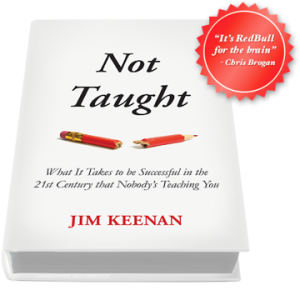
Reach is the first chapter in Not Taught, and this quote from the book couldn’t be any more true. It’s becoming, even more, true in the 21st century.

“Reach is arguably the most valuable non-monetary asset in the world. “

OK, so if it’s so valuable, what is “reach” and why is it so valuable?

Reach is the ability to influence large groups of people. It’s the capacity to connect with and influence hundreds, thousands, hundreds of thousands and even millions of people. Reach is what Michael Jordan has. It’s what Oprah has. It’s what Warren Buffet has. It’s what every single successful person in the 21st-century is going to HAVE to have if they expect any modicum of success. It’s a connected world, and it expects you to be connected too.

Meet Chris Brogan

Chris Brogan Taught Leader

Chris is the king of reach and a reach “Taught Leader.”  Chris is a New York Times AND Wall Street Journal Best Selling Author. He’s the CEO of Owner Media Group and a highly sought after speaker. With over three hundred thousand Twitter followers, Chris has incredible reach, and he has cultivated this reach to become wildly successful.

Oddly enough, it’s not Chris’s raw number of social followers that inspired me to name him a Taught Leader, but HOW he’s built and cultivated those followers (his reach). Chris is a giver, and it’s through giving that he’s developed such a loyal and committed following.

Chris started blogging in 1998, way before anyone knew what blogging was. They called it journaling back then. Regardless of what they called it, he started doing it, and he did it well. Chris blogged about marketing, social media, and entrepreneurship. However, more importantly, what Chris did was shared what he knew, what he was learning and who he was day after day, month after month, year after year. He was constantly looking for ways to bring value to his audience, to “serve.”

It’s this commitment to giving, serving, educating, helping, sharing and putting others first that Chris built one of the largest social bank accounts in the world. Chris has what we call mad social capital. And it’s this social capital that is at the center of his success.

Chris’s wild, meteoric success has come from the reach he’s built over the past 17 years. In one way or another Chris can attribute his entire financial success to his social capital, his reach. Best-selling author, credit a killer book AND amazing reach. Highly sought after paid speaker, yup give crazy reach the credit. A successful business, that’s right sick reach is right behind it. Do you see the theme here?

Chris’s entire existence and success was born out of his meticulous and maniacal commitment to building and developing his social capital through reach.

Chris is a genuine reach Taught Leader. He can teach you how to build, develop, and elevate your social capital. He can teach you how to get your reach on.

It’s important you understand, you will not be successful in the 21st century without reach. You must learn how to influence large swaths of people. It will not be OK to influence only those people at your office, in your neighborhood or at your school. It’s a connected world and it’s demanding you be connected too. You have to have global reach.

Leverage Chris’s Genius to Build Your Reach

Chris can get you there, and that’s why I’ve named him a Taught Leader. He has lots to share, and you can learn tons from him. Here’s a nifty little check list for you.
  1. Read Chris’s book(s):
    1. Trust Agents
    2. Freaks Shall Inherit The Earth
    3. The Impact Equation
  2. Check out his website
  3. Read Chris’s award-winning blog and subscribe to his newsletter. He drops mad wisdom weekly. It will keep you going and not let you forget the commitment you made to building your reach and banking some good solid social capital.
  4. Listen to his brief but powerful radio show/podcast. It’s fun, lively and he has great guests.  I was episode 69 😉
  5. Follow Chris on Twitter and Facebook. He won’t let you down.

Someone once asked me how I got the capital to start A Sales Guy. I told them I didn’t. It wasn’t capital (money) that started A Sales Guy. It was social capital. I had blogged for two years, and people started reaching out to me asking for help. I suspect this is exactly how it happened for Chris. And it’s how it should happen for you too.

Start working on your reach now, it’s never too late  — because it’s always too late.

Not Taught Book w. Brogan Review————————–

The Taught Leader series is a weekly series highlighting those who exemplify the tools and skills discussed in my new book Not Taught. Each week I highlight a different chapter and share the killer stories of the people who have become experts in the area. I provide readers with all the wonderful goodness these early adopters and 21st-century success stories have to offer. The goal, to help you learn the new rules to success and crush it in the 21st-century.

What, you haven’t read Not Taught? Then get it here. Hurry up, you’re already late.


06 Jan 14:08

How North Korea became the world’s worst economy..

by Amol Agrawal
Nicholar Eberstadt of American Enterprise Institute has an article on North Korea. It says how North Korea was better than many countries in 1970s but has declined to becoming the worst economy in the world: Economic history is a story of progress and success, but also of retrogression and failure. Among the latter cases, the most gruesome […]
06 Jan 14:04

Religion and History: Will Durant on the Role of Religion and Morality

by Farnam Street Team

“Even the skeptical historian develops a humble respect for religion, since he sees it functioning, and seemingly indispensable, in every land and age.”

***

Will and Ariel Durant have written a masterpiece in The Lessons of History. Inside the book, which is a condensed version of his life work, you can find an interesting chapter entitled Religion and History that explores the role of religion throughout history. 

Scientists often question the value of religion. Durant demurs:

To the unhappy, the suffering, the bereaved, the old, it has brought supernatural comforts valued by millions of souls as more precious than any natural aid. It has helped parents and teachers to discipline the young. It has conferred meaning and dignity upon the lowliest existence, and through its sacraments has made for stability by transforming human covenants into solemn relationships with God. It has kept the poor (said Napoleon) from murdering the rich. For since the natural inequality of men dooms many of us to poverty or defeat, some supernatural hope may be the sole alternative to despair. Destroy that hope, and class war is intensified. Heaven and utopia are buckets in a well: when one goes down the other goes up; when religion declines Communism grows.

The role of religion and morality is not clear at first. According to Petronius, who echoed Lucretius, “it was fear that first made the gods.” The fear he was talking about was a fear of the unexplainable — fear of hidden forces in the earth, oceans, skies, and rivers.

Religion became the propitiatory worship of these forces through offerings, sacrifice, incantation, and prayer. Only when priests used these fears and rituals to support morality and law did religion become a force vital and rival to the state. It told the people that the local code of morals and laws had been dictated by the gods.

In the eyes of the Durants, the effect of this new moral law was to dampen the worst of moral disorder—sensuality, drunkenness, coarseness, greed, dishonesty, robbery, and violence.

"Gregory VII saying Mass" (Via Wikipedia)
“Gregory VII saying Mass” (Via Wikipedia)


“Though the Church served the state,” they write, “it claimed to stand above all states, as morality should stand above power.” The idea of a moral superstate briefly come to fulfillment in the century after The Emperor Henry IV submitted to Pope Gregory VII at Canossa in 1077. The dream crumbled, however, under attacks of nationalism, skepticism and human frailty.

The Church, after all, was manned with men who proved all too human in their failings of greed and power. As states became stronger and wealthier they made the papacy a political tool. “Kings,” the Durants write, “became strong enough to compel a pope to dissolve the Jesuit order which had so devotedly supported the popes.” In response, the Church stooped to fraud. Increasingly the religious hierarchy spent time promoting orthodoxy rather than morality. The Inquisition almost killed the Church.

Even while preaching peace the Church fomented religious wars in sixteenth-century France and the Thirty Years’ War in seventeenth-century Germany. It played only a modest part in the outstanding advance of modern morality— the abolition of slavery.

This allowed the philosophers to take the lead in the humanitarian movements that “alleviated the evils of our time.”

History has justified the Church in the belief that the masses of mankind desire a religion rich in miracle, mystery, and myth. Some minor modifications have been allowed in ritual, in ecclesiastical costume, and in episcopal authority; but the Church dares not alter the doctrines that reason smiles at, for such changes would offend and disillusion the millions whose hopes have been tied to inspiring and consolatory imaginations. No reconciliation is possible between religion and philosophy except through the philosophers’ recognition that they have found no substitute for the moral function of the Church, and the ecclesiastical recognition of religious and intellectual freedom.

Does history support a belief in God?

If by God we mean not the creative vitality of nature but a supreme being intelligent and benevolent, the answer must be a reluctant negative. Like other departments of biology, history remains at bottom a natural selection of the fittest individuals and groups in a struggle wherein goodness receives no favors, misfortunes abound, and the final test is the ability to survive. Add to the crimes, wars, and cruelties of man the earthquakes, storms, tornadoes, pestilences, tidal waves, and other “acts of God” that periodically desolate human and animal life, and the total evidence suggests either a blind or an impartial fatality, with incidental and apparently haphazard scenes to which we subjectively ascribe order, splendor, beauty, or sublimity. If history supports any theology this would be a dualism like the Zoroastrian or Manichaean: a good spirit and an evil spirit battling for control of the universe and men’s souls. These faiths and Christianity (which is essentially Manichaean) assured their followers that the good spirit would win in the end; but of this consummation history offers no guarantee. Nature and history do not agree with our conceptions of good and bad; they define good as that which survives, and bad as that which goes under; and the universe has no prejudice in favor of Christ as against Genghis Khan.

Our Place in the Cosmos

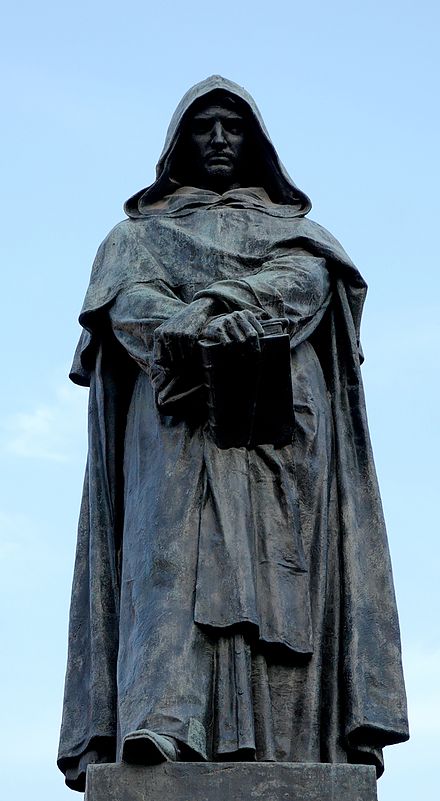
Bronze statue of Bruno by Ettore Ferrari at Campo de' Fiori, Rome.
Bronze statue of Bruno by Ettore Ferrari at Campo de’ Fiori, Rome.


As science further develops, it shows our minuscule place in the cosmos. This knowledge further impairs Religion. We can date the beginning of the decline with Giordano Bruno and then with Copernicus (1543). In 1611 John Donne was “mourning that the earth had become a mere suburb in the world.” All was thrown into doubt. Francis Bacon proclaimed that science was the religion of the modern man. This was the generation that began the  “death of God” as an external deity.

So great an effect required many causes besides the spread of science and historical knowledge. First, the Protestant Reformation, which originally defended private judgment. Then the multitude of Protestant sects and conflicting theologies, each appealing to both Scriptures and reason. Then the higher criticism of the Bible, displaying that marvelous library as the imperfect work of fallible men. Then the deistic movement in England, reducing religion to a vague belief in a God hardly distinguishable from nature. Then the growing acquaintance with other religions, whose myths, many of them pre-Christian, were distressingly similar to the supposedly factual bases of one’s inherited creed. Then the Protestant exposure of Catholic miracles, the deistic exposure of Biblical miracles, the general exposure of frauds, inquisitions, and massacres in the history of religion. Then the replacement of agriculture— which had stirred men to faith by the annual rebirth of life and the mystery of growth— with industry, humming daily a litany of machines, and suggesting a world machine. Add meanwhile the bold advance of skeptical scholarship, as in Bayle, and of pantheistic philosophy, as in Spinoza; the massive attack of the French Enlightenment upon Christianity; the revolt of Paris against the Church during the French Revolution. Add, in our own time, the indiscriminate slaughter of civilian populations in modern war. Finally, the awesome triumphs of scientific technology, promising man omnipotence and destruction, and challenging the divine command of the skies.

The ceiling of the Sistine Chapel (Via wikipedia)

In a way Christianity lent a hand to its reduced place, by fostering a moral sense in believers that could no longer tolerate the vengeful God of traditional Theology.

The idea of hell disappeared from educated thought, even from pulpit homilies. Presbyterians became ashamed of the Westminster Confession, which had pledged them to belief in a God who had created billions of men and women despite his foreknowledge that, regardless of their virtues and crimes, they were predestined to everlasting hell. Educated Christians visiting the Sistine Chapel were shocked by Michelangelo’s picture of Christ hurling offenders pell-mell into an inferno whose fires were never to be extinguished; was this the “gentle Jesus, meek and mild,” who had inspired our youth?

The industrial revolution replaced Christian with secular institutions.

That states should attempt to dispense with theological supports is one of the many crucial experiments that bewilder our brains and unsettle our ways today. Laws which were once presented as the decrees of a god-given king are now frankly the confused commands of fallible men. Education, which was the sacred province of god-inspired priests, becomes the task of men and women shorn of theological robes and awe, and relying on reason and persuasion to civilize young rebels who fear only the policeman and may never learn to reason at all. Colleges once allied to churches have been captured by businessmen and scientists. The propaganda of patriotism, capitalism, or Communism succeeds to the inculcation of a supernatural creed and moral code.

But one lesson of history is that religion adapts and has a habit of resurrection. Often in the past it has nearly died only to be reborn.

Generally religion and puritanism prevail in periods when the laws are feeble and morals must bear the burden of maintaining social order; skepticism and paganism (other factors being equal) progress as the rising power of law and government permits the decline of the church, the family, and morality without basically endangering the stability of the state. In our time the strength of the state has united with the several forces listed above to relax faith and morals, and to allow paganism to resume its natural sway. Probably our excesses will bring another reaction; moral disorder may generate a religious revival; atheists may again (as in France after the debacle of 1870) send their children to Catholic schools to give them the discipline of religious belief.

Religion and Morality

If we are wondering whether history warrants the conclusion that religion is necessary for morality — “that natural ethic is too weak to withstand the savagery that lurks under civilization and emerges in our dreams, crimes, and wars” — we need look no further than the answer given by Joseph de Maistre who said: “I do not know what the heart of a rascal may be; I know what is in the heart an an honest man; it is horrible.” Whether religion must be the force to temper the hearts of future men and women, the Durants think that’s certainly been the case in the past:

There is no significant example in history, before our time, of a society successfully maintaining moral life without the aid of religion. France, the United States, and some other nations have divorced their governments from all churches, but they have had the help of religion in keeping social order. Only a few Communist states have not merely dissociated themselves from religion but have repudiated its aid; and perhaps the apparent and provisional success of this experiment in Russia owes much to the temporary acceptance of Communism as the religion (or, as skeptics would say, the opium) of the people, replacing the church as the vendor of comfort and hope. If the socialist regime should fail in its efforts to destroy relative poverty among the masses, this new religion may lose its fervor and efficacy, and the state may wink at the restoration of supernatural beliefs as an aid in quieting discontent. “As long as there is poverty there will be gods.”

The Lessons of History is full of condensed wisdom on the meaning of history, the age of play, the lessons of biological history, and more.


--
Sponsored By: Siebels Research — Customized research featuring on the ground original insights at a great value!

06 Jan 13:52

Good is Bad?

by subra
If NaMo and his team do good for the country, that will be good for the economy, so that will be good for the companies, so it will be good for the shareholder, right? Not so fast my friend. Let us see what happens when by some quirk of fate competition is shut out. Take […]
06 Jan 04:33

Rahul Dravid and Wealth creation

by subra
I am going to give you 2 sporting examples. One of course is Cricket and the other is Running. Rahul Dravid is not the most spectacular of batsmen. However he knew one thing – the total number of runs that he scored depended on the amount of time that he spent at the crease and […]
06 Jan 04:30

Grofers scaling down

by SK

Readers of this blog might be aware that I’m not a big fan of hyperlocal grocery delivery firm Grofers’s business model. The problem is that there are no costs saved to make Grofers its margin – apart from the retail inventory expense incurred at the retailer (from whom Grofers procures), there is also the last mile delivery expense that is incurred which doesn’t leave much profits.

The reason for Grofers scaling back from nine cities in India, however, is not related to this. It is more to do with market size and scale.

Given the uncertainties in terms of demand and service times, a business such as Grofers makes sense only when there is a minimum critical mass in terms of demand. Serving a locality with only one delivery person doesn’t make sense, for example, since uncertainty in demand will mean that either that delivery person is underworked or service levels cannot be guaranteed.

If the average demand in an area can support more delivery persons, though, this can smoothen out the uncertainty (that aggregation smoothens uncertainty is one of the fundamental principles of operations) and higher service levels can be guaranteed without building in too much slack.

While the cities that Grofers has pulled back from are not small (Mysore/Vizag/Coimbatore etc) it is unlikely that any of them would have had the size and density of demand in order to support a scale of operations which would make sense for Grofers. There are several reasons for this.

Firstly, Grofers only captures the incremental demand for grocery delivery, and with most small retailers already offering grocery delivery, the value Grofers adds is to deliver from large retailers. While I don’t have data to support this, my hypothesis is that large retailers have a smaller share in small cities thus cutting Grofers’s natural market.

Next, the transaction cost of travelling to the store is lesser in smaller cities, given shorter travel times (on account of both size and traffic), further cutting demand for on-demand delivery. Thirdly, while smartphones are widespread across the country, my hypothesis (again don’t have data to support this) is that usage is lower in smaller cities (compared to larger cities). Fourthly, smaller cities are likely to be less dense than larger cities (data on this should be available but NED to compile it now) meaning delivery personnel have to cover larger areas.

Some thinking can lead to more such reasons, but the basic point is that not only are these cities small, but demand for on-demand hyperlocal grocery delivery is also much lower (on a per capita basis) than in larger cities for several reasons.

These two factors have together meant that the scale (and density) of demand that is necessary for Grofers to be viable as a business was simply not there in these cities. So it’s a logical move for them to pull out.

This doesn’t answer, however, the question of why Grofers entered these cities in the first place, since the above factors should’ve been apparent before the entry. My hypothesis here is that some fast-growing startups measure their growth in terms of the number of cities they’re in. I’ll elaborate on that on another day.

05 Jan 16:57

Richard Thaler and Rip Van Winkle

by Muthu

I was browsing and reading about Richard Thaler today.

This quote of Thaler grabbed my attention:

Rip Van Winkle would be the ideal stock market investor: Rip could invest in the market before his nap and when he woke up 20 years later, he’d be happy. He would have been asleep through all the ups and downs in between. But few investors resemble Mr. Van Winkle. The more often an investor counts his money – or looks at the value of his mutual funds in the newspaper – the lower his risk tolerance.

I then remembered writing you something similar in 2014 and want to reproduce the same below:

Technology has enabled us to know the value of our financial assets on a daily basis, wherever we are. We don’t do it for the house we live in or even for other real estate investments. We don’t even know as to what is the value of the provident fund accumulated so far. When it comes to equity, we want to know the daily value.

Liquidity and transparency (every day NAV and real time share price) is the boon of equity. We make it a curse by checking the value frequently and reacting emotionally to the same.

Extend the habit of not checking the daily value of house, land etc. to equity investments as well. Would we not consider somebody insane if he wants to know the value of his house daily or even monthly? Somehow this insanity is an accepted way of life in equity market. People who check daily or frequently do not stay in the market for long.

Rip Van Winkles have higher success rate in the market. Sleep on your investments for next 20 years.

We do once a year review and advice you to stay the course, which is asking you to sleep well:-) This would be our advice for next 20 years:-)

Course correction, change in asset allocation etc; if and when necessary can be done. Most of the time it would be doing nothing.

People like me have occupational need (hazard) to know about markets and related news on a regular basis.

For investors like you, there are better ways of spending time instead of getting hooked to these gyrations.

I’ve shared a piece earlier citing how people who have fared well in their investments are those who forget about them.

You’ve invested right. You entrusted us to monitor the same.

So sleep well.

Be Rip Van Winkles.


05 Jan 04:55

Danish economic model: Don’t try it until you understand what it means..

by Amol Agrawal
There is a lot of talk especially in US Presidential debates on adopting Danish economic model. Otto Brøns-Petersen of Center for Political Studies (CEPOS), a think tank in Denmark has an article on the issue. He says do not try the model at home until you know what it is all about: Increasingly, both in Denmark and […]
05 Jan 04:48

Some Megatrends..

by subra
In the 1960s if you wanted to buy a house in Mumbai, you did not go to a builder, you went to 7 or 8 friends and said ‘let us form a co-operative society. Then you bought land, and then went to a builder and asked him to build a house for all of you. […]
04 Jan 15:23

India’s Manufacturing PMI at 15 Month Low, Contracts For the First Time Since Oct 2013

by Deepak Shenoy

The Nikkei Indian Manufacturing Purchasing Managers Index (PMI) has fallen to a 15 month low in December 2015, plunging to way below the 50 line that marks the difference between contraction and expansion. This is the lowest since October 2013. But note that this is heavily impacted by the shutdown of various factories in Chennai due to the floods in early December.


PMI 

This is not isolated:

Expect far more volatility ahead, especially if there’s war in the Middle east.… (Read On...)

04 Jan 04:44

Will 2016 be a year of sovereign defaults?

by Amol Agrawal
Not a good article right at the start of the year. Carmen Reinhart rings warning bells for 2016: When it comes to sovereign debt, the term “default” is often misunderstood. It almost never entails the complete and permanent repudiation of the entire stock of debt; indeed, even some Czarist-era Russian bonds were eventually (if only partly) repaid […]
03 Jan 03:01

A shift in retail

by Rohit Chauhan
I recently tweeted the following


The current assumption is that the local corner retailer (kirana) which has survived the large retail chains will continue to do well inspite of the online threat. Let’s look at some of the arguments made to support this thesis

Convenience


It is undeniable that the local kirana store offers a lot of convenience and personalized service. My own mother continues to buy grocery from the local guy and he is able to provide personalized service and home delivery at the same price. What can really beat that?


My point – is this a real differentiator for all products? The current mobile carrying generation may really not care as much about it. Now it’s true that rice, oil and other staples will still be bought from the local kirana store, but what about the higher value items – both FMCG and otherwise ?

Will the consumer not use a blend of these two options? Buy the bulky staple from the local guy as it cheaper to do so, but buy the higher value (read higher margin) items online where the price could be lower and selection larger.


What happens to the profitability of the local store which uses the staples as a loss leader to drive sales for the other products?

Credit


That’s true for a large portion of the poor/ unbanked population. But is that also true for the middle class? What happens when newer forms of banking and credit options start proliferating? Does the local kirana store still have an edge?


Personalized relationship


This is a difference no online retailer can meet ..right? Welcome to the world of data analytics. Look at Netflix and Amazon who are now able to look at your purchases and make recommendations. With the improvement in data analytics, mobile and AI, this will only get better


Trend in other markets


There is a consistent trend in several markets towards the following


- Big box stores such as Costco/ Walmart etc which sell high volume staples at very competitive prices which no online retailer can beat (yet)


- Convenience stores such as 711 which are able to provide quick convenience at a much higher price/ margin. These stores usually cater to impulse buying (snacks, coffee etc) and also stock a small assortment of staples for emergency purchases (milk, eggs etc)
- Ongoing pressure on brick and mortar stores to match the pricing of their online counterparts

The retailer’s point of view


Till now we are talking of the landscape from the customer’s point of view. If you turn this around and look at it from the retailers’ point of view, the situation can appear quite bleak.

What happens to the profitability of the physical retailer if the high value/ high margin items continue to migrate online and all that remains are the bulk and low margin items which are more efficiently served by the high volume/ low margins chain stores such as D-mart ?


The retailer still has all the overheads for inventory, real estate and labor costs which are rising, whereas the margins keep shrinking. The end result is a drop in the return on capital. What does this do to the small time and marginal store?

I have tried to raise highlight some of the points one needs to think about when trying to answer this question. I don’t think that the small store/ kirana will disappear completely, but it is quite likely that they will keep shrinking and their share of the economic pie is surely to go down.


In addition this trend will not remain limited to the local grocery stores. One can extend the same logic to any other goods which has some level of standardization and does not require a high level of touch and feel.

The above speculation is based on the current level of technology. Now combine that with ongoing developments in Artificial intelligence/ Machine learning, advances in drone tech to reduce delivery costs and finally 3D manufacturing.


Does it still mean that retail as we know now, will remain the same? ----------------
Stocks discussed in this post are for educational purpose only and not recommendations to buy or sell. Please contact a certified investment adviser for your investment decisions. Please read disclaimer towards the end of blog.
03 Jan 02:58

IREDA 7.74% Tax-Free Bonds – January 2016 Issue

by Shiv Kukreja

This post is written by Shiv Kukreja, who is a Certified Financial Planner and runs a financial planning firm, Ojas Capital in Delhi/NCR. He can be reached at skukreja@investitude.co.in

First of all, we wish all the readers of OneMint a very Happy & Prosperous New Year !! May God give you success in your work and peace in your life and 2016 turns out to be the best year in your life !!! :-)

IREDA 7.74% Tax-Free Bonds

Hunger without food is bad for health, so is overeating. Investors were hungry for tax-free bonds, especially a big issue to satisfy their demand, like the NHAI one. But, when such an issue came, they were not able to have full of it. It only got subscribed by 0.86 times in the retail investors category.

Such a big supply or say shortage of demand resulted in poor listing for the IRFC bonds. Investors were expecting some healthy listing gains with IRFC bonds after it received a good response and big oversubscription on the first day itself. But, that did not materialise, probably because NHAI offered slightly higher rate of interest or probably many investors subscribed to IRFC bonds to get its listing gains only.

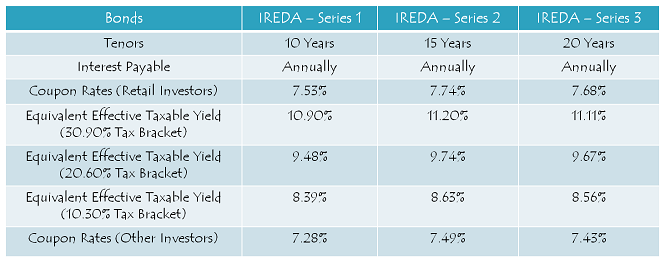
As the NHAI issue got closed on the last day of 2015, IREDA announced slightly higher rate of interest for its issue which is getting launched on Friday next week i.e. January 8th. It will offer a maximum of 7.74% coupon rate for a period of 15 years, which is 0.14% higher than NHAI’s 7.60%. But, at the same time, this issue is AA+ rated, so it can carry a slightly higher rate of interest.

The issue is officially scheduled to close on January 22, but I think it should get fully subscribed much before than that.

Before we analyse it further, let us first quickly check the salient features of this issue:

Size of the Issue – IREDA is authorized to raise Rs. 2,000 crore from tax free bonds this financial year, out of which the company has already raised Rs. 284 crore by issuing these bonds through a private placement. The company will try to raise the remaining Rs. 1,716 crore in this issue.

Rating of the Issue – ICRA and India Ratings have assigned ‘AA+’ rating to the issue, thus suggesting that these bonds carry very low credit risk and high degree of safety regarding timely payment of financial obligations. As all the previous issues were rated ‘AAA’, this is the first issue this financial year which is rated AA+.

Moreover, these bonds are ‘Secured’ in nature i.e. in case of any default, the bondholders would carry a right to make claim on certain assets of the company.

Coupon Rates on Offer – As this issue is rated AA+, it can offer interest rates which are 10 basis points (or 0.10%) higher than the rates which a AAA-rated issue could have offered. While NHAI 15-year option carried 7.60% rate of interest, IREDA is offering 7.74% for the same duration. For 10-year period, IREDA issue will have 7.53% rate of interest as against 7.39% which NHAI was offering.

Picture 2

As the NHAI issue did not offer 20-year investment period, IREDA offer will be attractive for the long-term institutional investors like insurance companies or pension funds. For 20-year period, IREDA is offering 7.68% to the retail investors and 7.43% for the non-retail investors.

For the non-retail investors, these rates would be lower by 25 basis points (or 0.25%).

NRI/QFI Investment NOT Allowed – Non-Resident Indians (NRIs) and Qualified Foreign Investors (QFIs) are not eligible to invest in this issue.

Investor Categories & Allocation Ratio – The investors have been classified in the following four categories and each category will have certain percentage of the issue size reserved during the allocation process:

Category I – Qualified Institutional Bidders (QIBs) – 20% of the issue is reserved i.e. Rs. 343.20 crore

Category II – Non-Institutional Investors (NIIs) – 20% of the issue is reserved i.e. Rs. 343.20 crore

Category III – High Net Worth Individuals including HUFs – 20% of the issue is reserved i.e. Rs. 343.20 crore

Category IV – Resident Indian Individuals including HUFs – 40% of the issue is reserved i.e. Rs. 686.4 crore

Allotment on First Come First Served Basis – Subject to the allocation ratio, allotment will be made on a first come first serve (FCFS) basis in each of the investor categories, based on the date of upload of each application into the electronic system of the stock exchanges.

Listing & Allotment – IREDA has decided to get these bonds listed only on the Bombay Stock Exchange (BSE). The company will allot the bonds and get them listed within 12 working days from the closing date of the issue.

Demat A/c. Not Mandatory – It is not mandatory to have a demat account to apply for these bonds. Investors have the option to subscribe to these bonds in physical form as well. Whether you apply for these bonds in demat or physical form, the interest payment will still get credited to your bank account through ECS.

Also, even if you get these bonds allotted in your demat account, you have the option to rematerialize your holding in physical/certificate form if you decide to close your demat account in future.

No Lock-In Period – These tax-free bonds are freely tradable and do not carry any lock-in period. The investors may sell them at the market price whenever they want after these bonds get listed on the stock exchanges within 12 working days of the closing date.

Interest on Application Money & Refund – Successful allottees will earn interest at the applicable coupon rates i.e. 7.53% p.a. for 10 years and 7.74% p.a. for 15 years and 7.68% p.a. for 20 years on their application money, from the date of realization of application money up to one day prior to the date of allotment. Unsuccessful allottees will get interest @ 5% per annum on their refund money.

Minimum & Maximum Investment – Investors are required to put in a minimum investment of Rs. 5,000 in this issue i.e. at least 5 bonds of face value Rs. 1,000 each. There is no upper limit for the investors to invest in this issue. However, an investor investing more than Rs. 10 lakhs will be categorized as a high networth individual (HNI) and will get a lower rate of interest as applicable.

Interest Payment Date – IREDA will make its first interest payment exactly one year after the date of allotment and the date of allotment will be announced just before the listing date. I will update this post as and when it gets announced.

Record Date – For the payment of interest or the maturity amount, record date will be fixed 15 days prior to the date on which such amount is due to be payable.

Should you invest in this issue?

IREDA (Indian Renewable Energy Development Agency), 100% owned by the Government of India, was established in 1987 to promote, develop and extend financial assistance for renewable energy and energy efficiency/conservation projects. As the company has strategic importance in the development of the renewable energy sector, certain special privileges have been provided to the company:

* Regular capital infusion in the company by the Government,

* Sovereign guarantee to the lenders against approximately 58% of IREDA’s total borrowings,

* Rs. 300 crore allocation from the National Clean Energy Fund (NCEF),

* Access to cheaper sources of funding, like these tax-free bonds etc.

Reasons for a lower Credit Rating as ‘AA+’ – Many investors want to know why this issue has been rated ‘AA+’ this time around when last time in February 2014, IREDA issued these bonds and the issue was assigned ‘AAA’ rating by the credit rating agencies. Investors also need to decide whether they should invest in this issue with a higher rate of interest being a AA+ rated issue or wait for HUDCO to announce its interest rates and then take a decision.

So, as the HUDCO interest rates are yet to get announced and we also don’t know when exactly the issue will be launched, it is difficult to guesstimate its interest rates. That is why I can talk only about this issue at this point in time. As far as the rating is concerned, I think higher NPAs and lower yield on its lending portfolio resulting in a fall in the company’s net interest margins (NIMs) are the two primary reasons for its rating downgrade from AAA to AA+.

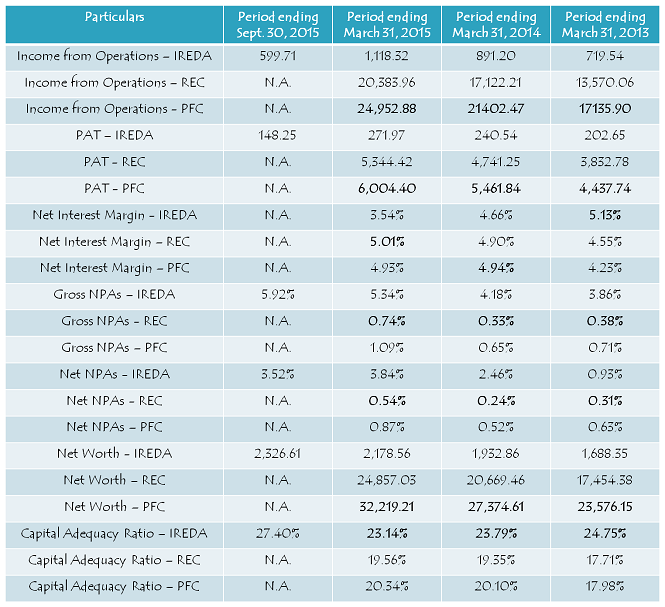
IREDA was doing well in terms of managing its asset quality a couple of years back. Its Gross NPAs improved from 19.9% in 2007 to 3.86% in 2013. But, in recent times, its financials have taken a hit and its Gross NPAs have again increased to 5.34% by March 31, 2015 and 5.92% by September 30, 2015.

IREDA vs. REC vs. PFCPicture1

(Note: Figures are in Rs. Crore, except figures in %)

Moreover, as per ICRA, lending only to the renewable energy sector, low net worth of the company as compared to some of the bigger players in the power financing business and higher NPAs in the small hydro, cogen and biomass segment are a few other reasons for a lower rating.

However, as IREDA is 100% owned and backed by the Government of India and as the government is committed to encourage the use and development of renewable sources of energy, I think the company should be able to improve its financials going forward. Its capital adequacy ratio (CAR) is quite comfortable at 27.40% on September 30, 2015 and its debt-to-equity ratio is expected to be 3.93% after this issue gets completed. IREDA also plans to go public in the next 2-3 years.

Personally, I am quite comfortable investing in this issue as I think IREDA should be able to improve its balance sheet going forward and the government backing will always be there for a company financing the renewable energy space. However, conservative investors, who need to invest only Rs. 10 lakh or less in these tax-free bonds, should wait for the HUDCO issue or NHAI Tranche II.

Application Form for IREDA Tax Free Bonds

Note: As per SEBI guidelines, ‘Bidding’ is mandatory before banking the application form, else the application is liable to get rejected. For bidding of your application, any further info or to invest in IREDA tax-free bonds, you can contact me at +919811797407

03 Jan 02:58

how to be a great sales person..

by subra
as a sales trainer i have met some amazingly good sales person..and I could write a lot about how to be a good sales person. In fact I know some people who think talking is selling. It is not. Telling is not selling at all. Getting the client to be interested in a product at […]
02 Jan 05:22

Exploiting Unrecognized Simplicity

by Farnam Street Team

Andy Benoit

“Most geniuses—especially those who lead others—prosper not by deconstructing intricate complexities but by exploiting unrecognized simplicities.” — Andy Benoit

--
Sponsored By: Siebels Research — Customized research featuring on the ground original insights at a great value!

02 Jan 05:22

How I Brought My Debt Under Control

by Fay Wein

Save Money in CollegeSometimes, debt sneaks up on you when you least expect it. You think you’re doing all right, but suddenly, you realize that your debt has spiraled out of control. For me, the wake-up call was realizing that, while my income hadn’t changed, I had more credit card debt, higher payments, and less available money each month. I was struggling. My spending habits were completely out of control. Here’s the good news: I’m a success story. I did manage to get out of debt and get my spending back on track, and you can do it, too. Start with an honest, if painful, assessment. Where has your spending really gotten you into trouble? Do you frequently make impulse purchases of items that you don’t really need? […]

The post How I Brought My Debt Under Control appeared first on Dumb Little Man.

29 Dec 16:38

Wrong things to be impressed by?

by subra
The road to being a minimalist is not easy, but has its pleasures. When you look at a branded item and see the price at X and decide that you will not have it because it is ‘2 months effort’, it means you are that much closer to financial freedom if you do not buy […]
29 Dec 16:38

5 Charts in the RBI Financial Stability Report That Might Shock You

by Deepak Shenoy

Here’s Five Charts in the RBI Banking Financial Stability Report that are worth a look:

1. India Was Biggest Hit in 2013’s “Taper Tantrum”. Least Hit Now!

The Federal Reserve showed signs of a rate hike through a “taper” in 2013, and then, all emerging markets were hit badly. And now, when the Fed actually hiked rates, the corresponding “tantrum” has hurt everyone else a lot more – and India, a lot less. Even though our currency is hit, it’s not quite as bad as the others. Put another way – the rupee could get much weaker just to be normal.

EM Currencies

2. The Public Sector is the Problem Banker, But Quality in Private Banks Too is Deteriorating

Public sector bank stressed loans – adding NPAs and restructured loans – are at nearly 14% of their total loans. Even Private banks show an uptrend, at 4% or so.

SCB Asset QUality

3. And Stress Is In The Most Troubled Banks

If you divide banks into buckets based on their “stressed advances” ratio – you will find that many banks who don’t do any lending (or not much lending) are doing okay.… (Read On...)

28 Dec 04:16

Personal insolvency: Lessons from the UK and Australia

by Ajay Shah
by Renuka Sane.

In India, we have always paid more attention to the restructuring and winding up processes for companies. These include provisions in the I(DR)A Act, 1951, Companies Act (1956 and 2013), the Sick Industrial Companies (Special Provisions) Act, 1985. The 1993 Recovery of Debts Due to Banks and Financial Institutions Act set up Special Tribunals, the DRT, with special powers for adjudication for recovery of loans and enforcement of securities charged with banks and financial institutions. The Securitisation and Reconstruction of Financial Assets and Enforcement of Security Interest (SARFAESI) Act, 2002 was put in place to allow banks and financial institutions (FIs) to take possession of securities and sell them.

In contrast, the legal framework for insolvency of individuals is rooted in very old laws. Individuals are geographically divided across the Presidency Towns Insolvency Act, 1909 (PTIA) for Calcutta, Bombay and Madras, and the Provincial Insolvency Act, 1920 (PIA) for the rest of India. A unified version of the existing laws was submitted to the government by the 26th Law Commission in 1964 but not enacted as law.

Individuals do not have a high share of unsecured borrowing from the banking sector. This seems to have been used as a justification for ignoring the substantive and procedural problems in the law governing individual insolvency. But poor recovery practices may be precisely the reason why there is limited lending to individuals leading to financial exclusion and ultimately inhibiting the emergence and growth of small enterprise in the country.

This is not true of other parts of the world. How have other countries designed their personal insolvency system? What lessons can we learn from them? In a recent paper (Ramann, Sane and Thomas, 2015), we motivate the need for a personal bankruptcy law, and study the existing Indian legal framework and contrast it with the UK and Australian experience. This was part of the research that fed into the Indian bankruptcy reforms.

The UK system


In the UK, the Cork Committee undertook a comprehensive review of the insolvency law, publishing its report in 1982 (the "Cork Report"). This led to the enactment of the UK Insolvency Act 1986 (the "UK Insolvency Act"), an omnibus bill which combined the personal and corporate insolvency regimes. Substantial refinements were again made to the UK's insolvency regime by way of the Enterprise Act 2002 (the "UK Enterprise Act") (which amended the UK Insolvency Act) and the Cross-Border Regulations 2006, which adopted the UNCITRAL Model Law on Cross-Border Insolvency into the UK regime. There are three kinds of relief possible for individuals in the UK law:

  1. Individual Voluntary Agreement (IVA): which is a private negotiation between debtors and creditors so that debtors avoid the stigma of bankruptcy. While negotiations are outside of the court, they are supported by legal provisions embedded in the law.
  2. Court initiated bankruptcy: which is process intensive and governed by the rules of the Court.
  3. Debt Relief Order (DRO): which provides debt relief to low-income households, where the costs of doing an IVA may often be higher than the debts of these households.

In the first two cases debtors in bankruptcy can be subject to Income Payment Orders, requiring payment of all future income beyond ``reasonable domestic needs'', generally for a term of three years. An important feature of the UK process is that the house or dwelling of bankrupt is excluded from estate available for distribution only after 3 years of adjudication of debtor as insolvent by the Court. Discharge in the UK has also become faster. Debtors are now discharged automatically after one year. As a result they can return to professional and financial life (at least legally) in a year.

The recent institutional changes made in the UK law include the Insolvency Practitioner, the Trustee, the supervisor, the nominee all of whom assist the debtor or the Official Receiver in its role as a mediator between debtor and creditors. The specific provisions in the 2007 amendments on time-lines for completion of negotiations strengthened the hands of creditors and also fixed discharge at the end of one year without an adverse credit history bringing relief to debtors.

The Australian system


The Commonwealth legislation, the Bankruptcy Act 1966, covers personal insolvency, including bankruptcy, Part IX (debt agreements) and Part X (personal insolvency agreements) in Australia. Corporate entities are covered by the Corporations Law administered by the Australian Securities and Investments Commission. There are four forms of relief available in Australia:

  1. Declaration of intention (DOI): in which the debtor does not file for either insolvency or bankruptcy. This is just a period of 21 days of relief from unsecured creditor action provided to the debtor to be able to choose the future course of action.
  2. Debt agreement (DA): a binding agreement between debtors and creditors where creditors agree to accept a sum of money that the debtor can afford. This is similar to the negotiation in the IVA in the UK. Only those below certain specified thresholds are eligible for a DA.
  3. Personal insolvency agreement (PIA): is also a binding agreement between debtors and creditors, but is more formal than the DA described above. It allows the debtor to come to an agreement with creditors to settle debts without the stigma of bankruptcy.
  4. Bankruptcy: is a court-led bankruptcy procedure. It may be voluntary (when the debtor presents a petition), or involuntary (when the creditor makes a petition if the debtor fails to pay within 21 days of the creditor serving a notice).

The Australian system departs from the UK in having a separate institution, knows as the Australian Financial Security Authority (AFSA), responsible for the administration and regulation of the personal insolvency system.

Lessons for India


A sound framework for personal insolvency involves an impartial, efficient and expeditious administration. The trend in the UK and Australia, and in other parts of the world as well, is towards placing administrative proceedings outside of the courts. A negotiated settlement outside of court allows more flexibility in the repayment plans, and the time to execute the plans, that can be acceptable to both parties, as opposed to a court procedure which can constrain the possibilities. Thus the lower the intervention of the court, the better. Recourse to courts should only occur after completion of the negotiation or composition process in the event a party is aggrieved by the order. The record in the credit history of a negotiated settlement should differ, and be lighter from that of bankruptcy. This ensures that individuals will be incentivised to agree on a repayment plan with the creditors.

The process of negotiation, and bankruptcy, is carried out more effectively by an intermediary, instead of an officer of the court. The institution of an insolvency professional (IP) is critical if negotitations between debtors and creditors have to take place outside the court. The same intermediaries can also be entrusted with the task of verifying submissions of debtors, and the claims of creditors. This will assume a lot of importance in India as documentation is weak, and disputes on claims may be large, at least in the early years of the system.

It is important to hold the intermediary accountable, and ensure minimum standards. A regulatory body to monitor the performance of IPs and discipline them as necessary is an important element in the system of personal insolvency. The regulator in Australia plays a larger role in the personal bankruptcy framework than the regulator in the UK, and is a model worth considering, given the problems with the judicial system in India.

A DRO equivalent is worth introducing for India for low-income households. An additional reason to consider this mechanism is that it will lead to formalisation of rules for loan waivers done by the state. Debt-relief has to come at some price, in the form of a record in a credit-registry, which may make it difficult for the person to take future loans. This forces individuals to evaluate the trade-off between relief in the present and expensive credit in the future, thus guarding against misuse of the provision.

These considerations have played an important role in the proposals of the Insolvency and Bankruptcy Code submitted by the Bankruptcy Law Reforms Committee (BLRC).

References


Ramann, S., Renuka Sane and Susan Thomas (2015), Reforming personal insolvency law in India, IGIDR Working Paper.


Renuka Sane is a researcher at the Indian Statistical Institute, New Delhi.
28 Dec 04:15

Giving cattle to the poorest was the best strategy after all

by noreply@blogger.com (Gulzar Natarajan)
The Economist points to a recently released evaluation of a large program by the non-profit BRAC in Bangladesh which gave the poorest people a small stipend for food, followed with a cattle asset (a cow or a few goats) coupled with extension services to help them graduate from 'extreme' poverty to 'normal' poverty. It writes, 
We combine data from 21,000 poor and non-poor households in 1309 villages in Bangladesh with the randomized evaluation of a program that provides a large, one-off, transfer of assets and skills to the poorest women. The evidence suggests the poor face imperfections in capital markets that keep them in a low asset-low employment poverty trap where they are only able to engage in low return and seasonal casual wage labor. The transfer of assets and skills allows them to address this misallocation of labor by undertaking more productive capital-intensive work activities, thus increasing total labor supply, earnings, savings and asset holdings. The improved earnings capacity and resource base of the poor allows them to engage in financial intermediation that benefits non-poor households and leads to village-wide increases in savings, saving rates and capital accumulation. Lifting the poor out of the poverty trap therefore sets in place a virtuous cycle that improves the allocation of labor and places the entire village economy on a trajectory out of poverty. 
The paper finds that since agriculture labor is seasonal, the poorest, especially the women, have considerable idle time. So, any asset like cattle immediately gives them an opportunity to utilize their idle time and earn additional income. But such assets require large investments, which may not be forthcoming for the poorest from standard credit sources like microfinance. 
In this context, India's decades-old experience with self-employment programs for rural poor is instructive. Income generation support to poor people by way of providing milch cattle was the centerpiece of India's flagship rural poverty alleviation programs, starting from the earliest IRDP to the more recent SGSRY. Animal husbandry related components formed more than three-quarters of all income generating schemes administered by the District Rural Development Agencies (DRDAs) across the country. 

In fact, the old IRDP documents had exactly the same mechanism logic - more effective utilization of spare time - to justify the disproportionately high spending on milch cattle. The later versions of such self-employment programs, especially those funded with multilateral assistance, in states like Andhra Pradesh even made the distinction between the poor and the poorest of poor to target such assistance. There exists a rich literature on the advantages of cattle rearing for the poorest and evaluations of such programs across different states. But, while cattle formed the major share of aggregate spending, there were regional variations in this focus within the state itself depending on the climate, water availabilty, and social acceptance.  

It then constantly faced criticism for this bias towards cattle with arguments about whether it was financially viable enough or not. In any case, the findings of this study come as an evidence-based endorsement of the existing policy priority. But, as I blogged earlier here, it is questionable as to whether a long-drawn and expensive RCT was necessary to draw this policy inference. This would all the more be so since atleast some of these studies are likely to throw up inconclusive findings, thereby raising red-flag on the evidence-based adoption of what is arguably one of the best interventions to assist the poorest among the poor.  
Add to Technorati Favorites
28 Dec 04:12

Decline of West Indian cricket: A case of too much government intervention?

by Amol Agrawal
The West Indian cricket in many ways is like Japanese economy. Both peaked in mid-1980s and have just struggled ever since. Just that Japan has somehow maintained its stagnation levels but West Incies cricket keep finding new ways to decline further. One is waiting for a recovery which has become a perennial issue. Tony Cosier has […]
27 Dec 14:56

A financial plan on an index card

by Muthu

Thanks to Ron Beaubien (https://twitter.com/RonBeaubien). He has retweeted a tweet from The Motley Fool (https://twitter.com/themotleyfool/status/629677515200679936).

They have provided a financial plan concisely in an index card. I liked it and thought of sharing the same with you.

1)Work in a job that genuinely excites you when you wake up in the morning.

2) Makes sure your material aspirations grow slower than your income. It’s the only way to accumulate wealth.

3) Pay no attention to the Joneses. They’re crying inside.

4) Avoid debt even if you can afford it. It takes away options, which is your most valuable asset.

5) Save enough of your income so you can retire at the age your dad started complaining about his back hurting. You won’t want to work after that.

6) Invest in diverse portfolio of stocks, with the intention of staying invested for decades.

7) Dollar cost average (which means SIP) for your entire life and you won’t care what the market is doing.

8) Have enough cash to ensure you’re never forced to sell stocks at inopportune times.

9) When in doubt, choose the investment with the lowest fee.

10) Check your brokerage account as infrequently as it takes to prevent rash decisions.

11) Accept that the future will pay out differently than you think it will.


27 Dec 03:22

India economy update

by noreply@blogger.com (Gulzar Natarajan)
More disturbing signals about the Indian economy. The RBI's latest Financial Stability Report points to increased banking sector risks due to deteriorating asset quality and weak corporate performance. Asset quality, in terms of both Gross NPAs and restructured loans has been continuously worsening.
Much the same trend is mirrored in all the important indicators of banking health.
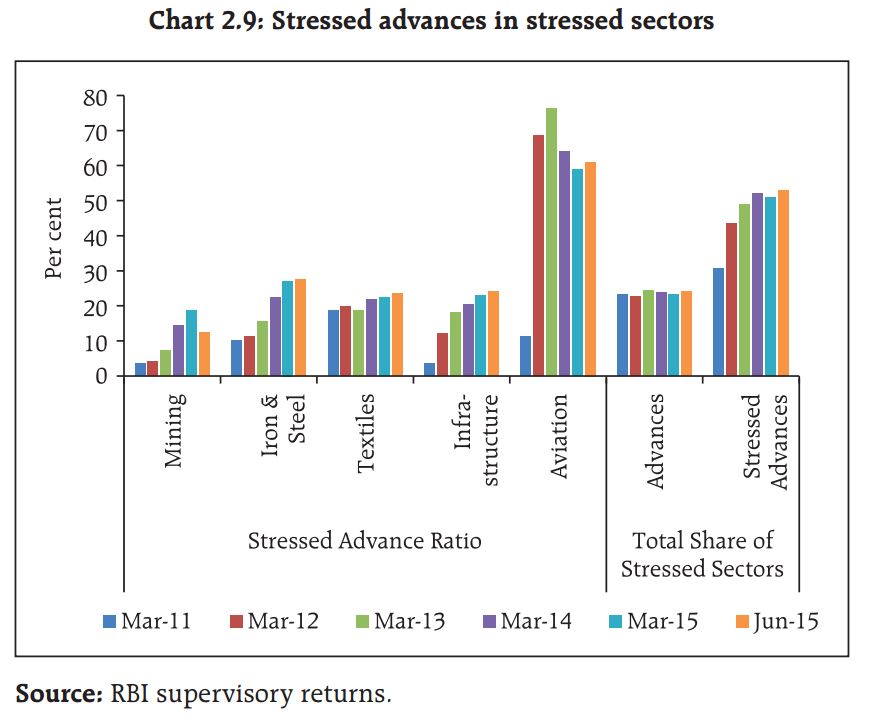
Interestingly, as a share of total sectoral exposure, aviation is the most vulnerable. Encouragingly, with lower fuel prices, sectoral competitiveness and profitability of the aviation sector would, in all likelihood, improve significantly in the years ahead.
An interesting feature of the firm size-wise credit allocation break-up is the dominance of large firms. But the disturbing trends are the share of stressed advances to large and medium scale enterprises, at 21% each. Given that large enterprises make up nearly 35% of all non-food credit, the high share of stressed advances is a matter of systemic concern. The equally high share of stressed advances to medium scale sector is likely to further deter lending to these types of firms, thereby reinforcing the forces that prevent greater credit inflows into a category of firms which are critical to driving job creation.   
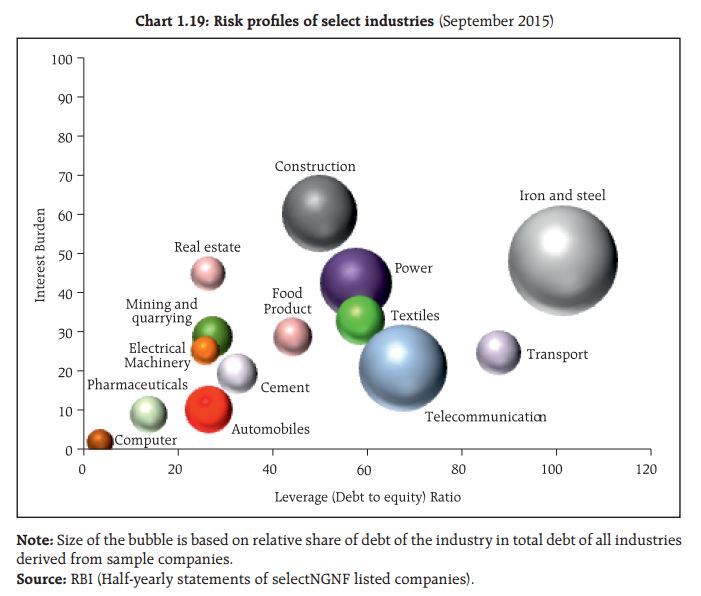
The other, upstream, side of the banking sector balance sheet is corporate performance. The major share of the stressed assets, in terms of low interest coverage ratio and high leverage, is in the construction, power, iron and steel sectors. The graphic below highlights the performace of 2711 non-government, non-financial companies.
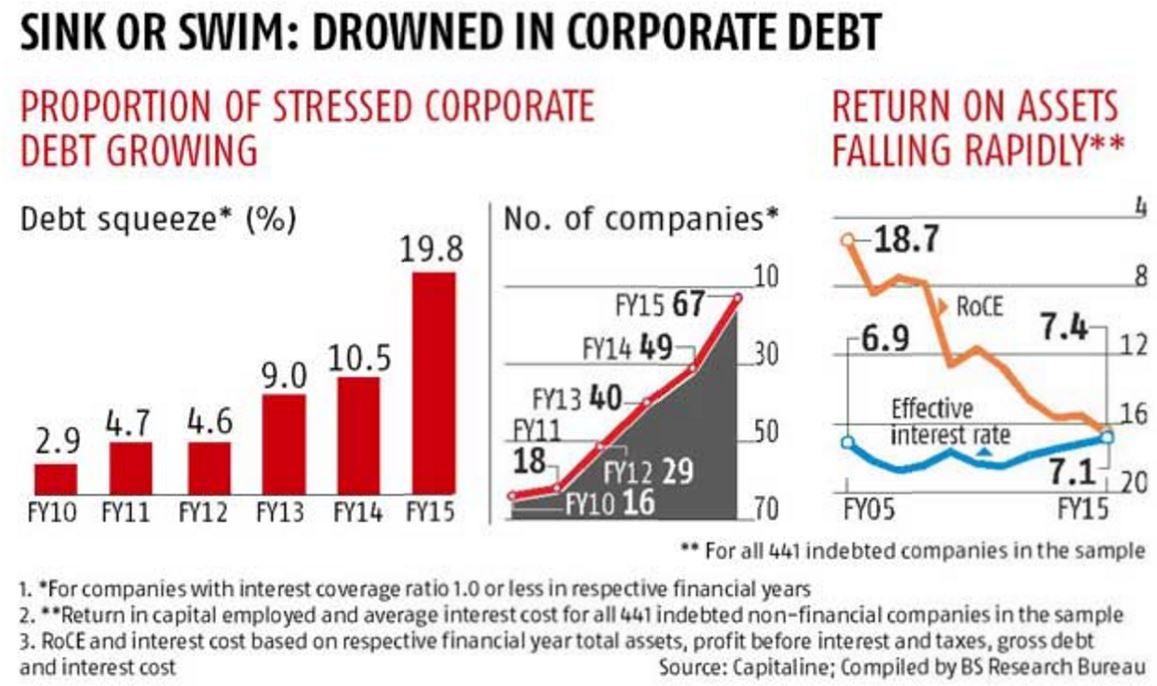
The Business Standard analysed the balance sheets of the country's top 441 indebted non-financial companies and found that 67 firms, with a total debt of Rs 56,500 bn at end 2014-15, had negative net worth or financially insolvent. This was an increase from 16 companies at the end of 2009-10. The total debt of these 441 companies was Rs 285,000 bn and accounted for 98.1% of the gross debt of 654 listed non-financial corporates. 
The analysis points to a negative feedback loop of falling profitability, rising interest costs, and falling investments, 
Return on capital employed (RoCE) for the indebted in the Business Standard sample declined to a decade-low 7.4 per cent in 2014-15, which was only a few basis points (a basis point is a hundredth of a percentage point) more than their average interest cost of 7.1 per cent. At this rate, many companies may be forced to default on their loans as profits from operations will be insufficient to cover the cost of debt servicing. The firms' interest cost on incremental debt is already trending higher than the underlying return on capital employed. In 2014-15, the cost of incremental debt shot up to 11.8 per cent, nearly 440 bps higher than the underlying return on capital employed. At its peak during the financial year 2004-05, these companies reported a return on capital employed of 18.7 per cent more than twice their average interest cost of 6.9 per cent.


The last financial year was also the first instance in a decade when companies' interest expenses were higher than depreciation. The indebted companies of the sample spent Rs 2.03 lakh crore on interest payments in 2014-15, up from Rs 1.83 lakh crore a year ago. In comparison, their depreciation allowance rose marginally to Rs 2.02 lakh crore from Rs 1.9 lakh crore in 2013-14. Thus, companies spent a greater part of their operating profits on debt servicing rather than capital expenditure and growth. In all, interest payments accounted for 34.2 per cent of the companies' operating profits in average last financial year, up from 16.7 per cent five years ago and 12 per cent a decade ago. This leaves little resources for growth capital.
This is a powerful deterrent to the revival of the investment cycle, essential to the creation of jobs. Worse still, it appears to be taking its toll on the existing jobs, as a recent series in the Indian Express, which also examined the situation in power and roads sectors, wrote
A look at the group of 230 leading companies listed on the Bombay Stock Exchange (BSE 500), and have an aggregate market cap of over Rs 55 lakh crore, shows that for the first time in at least four years they witnessed a decline in their aggregate employee strength as it fell by 14,000 in the year ended March 2015. While 105 out of the 230 companies reduced their headcount by an aggregate of 84,688 during the year, 114 companies within the list increased their staff strength by 69,910. For the remaining 11 companies, the numbers remained constant. The aggregate employee strength for these companies came down from 21.56 lakh in the year ended March 2014 to 21.41 lakh in the year ended March 2015... In Financial Year (FY) 2014 the same group of 230 companies added an aggregate of 1.63 lakh employees and in the three year period between FY’11 and FY’14 they added close to 4 lakh employees. However, the numbers fell in FY’15 as companies facing decline in revenue growth and low capacity utilisation resorted to laying off their employees. The biggest drop in number of employees during the year was witnessed by companies in manufacturing, construction and infrastructure, and capital goods, whereas IT and pharma companies saw net addition to their employee strength.
This trend, especially in those sectors which traditionally contribute to large job creation, does not portend well. 
Add to Technorati Favorites
26 Dec 05:00

Poke the Box: Compounding Goodwill

by Anshul Khare

Let’s Start with Safal Niveshak
Just in case you missed any of this on Safal Niveshak in the last week…

Book Worm
Stephen King’s book On Writing had been lying in my anti-library for quite sometime. Every time I would go near my bookshelf, the book seemed to catch my attention, as if asking, “Dude, are you ever going to read me?”. When I couldn’t tolerate its stare for many weeks I finally picked it up.

Let me share some ideas from the book which I found intriguing.

King writes –

“…books are uniquely portable magic. I usually listen to one in the car (always unabridged; I think abridged audiobooks are the pits), and carry another where I go. You just never know when you’ll want an escape hatch: mile-long lines at tollbooth plazas..airport boarding lounges. At such times I find a book vital.”

All great writers are voracious readers. For them reading comes first and writing is more of a byproduct of reading so much. It’s a myth that good writers spend all their time writing. They spend as much time, if not more, reading as they spend for writing.

So read, read, read and it will show up in your writing.

Another interesting insight that I found in King’s book is that an engaging piece of writing, especially a work of fiction, leaves quite a lot of room for reader’s imagination to fill in the details. For example, while describing a room, you may not give all the finer details about it, like the colour of ceiling or the size of the windows. Let the reader fill in those details and make the story his own creation.

You may be interested in reading and writing non-fiction but don’t forget – to effectively communicate your ideas, you have to be a great story teller. So learning the art of writing fiction cannot be ignored completely.

King’s book is a must read for every aspiring writer. And if you have a blog – you are a writer. If you don’t have a blog, then start one. Your tribe is waiting for you buddy!

Stimulate Your Mind
Here’s some amazing content we have read in recent times…

Poke of the Week – Compounding Goodwill


Einstein said, “Compound interest is the eighth wonder.” If you understand the basics of compounding, you would tend to agree with Einstein’s statement. There is immense power in compounding. A small amount of money left for compounding for a very long time, even at a modest rate, can turn into a staggering sum.

But what most people miss is that the real beauty of compounding lies not in wealth creation, but in another, more important area of life too. It’s called goodwill that you create in this world.

In his book, Education of a Value Investor, Guy Spier writes about Mohnish Pabrai …

“…over the past ten years, I’ve repeatedly observed how he looks to see what he can do for others, not the other way round…By acting this way, I could see that Mohnish created an incredible network of people who wish him well and would love to find ways to help him and thank him for his kindness. This is the extraordinarily powerful effect of compounding goodwill by being a giver, not a taker. And as he has taught me, the paradox is that you end up receiving infinitely more in life by giving than by taking.”

Here is an excerpt from a recent post of Jana Vembunarayanan –

“In the month of March, I was very lucky to attend the talk given by Mohnish Pabrai and Guy Spier at Stanford Business school. T​he core theme of the talk was centered around the concept of giving without expecting anything in return. Guy drew a chart on the board which I redraw below with my own annotations.

Goodwill-1

He told us to be a giver without expecting anything in turn. In the first few years one won’t see much happening to their goodwill account. But as years progress, goodwill snowballs and starts to grow exponentially. Buffett’s goodwill account is at its peak and still growing at alarming rates.”

True gifts bring people closer together. An unconditional gift, one given with nothing expected in return, can change everything. It creates conversations and spread ideas. It opens doors and creates forward motion.

So what value are you adding to the world? What is it that you’re giving out without any expectation of returns?

As with all matters of compounding, the sooner you start the longer runway you’ll get.

Start today!

 
To write better, read more.

Goodwill is more important than money…go compound it.

Be kind to others, and to yourself.

Keep poking.

Stay happy, stay blessed.

With respect,
Vishal & Anshul
Chief Pokers – Poke the Box

The post Poke the Box: Compounding Goodwill appeared first on Safal Niveshak.

    
26 Dec 04:58

Charity should be voluntary, not coerced

by Atanu Dey

All actions of a just society should be principles-based. One of the primary guiding principles of a just society is that coercion is kept at a minimum. That is, people should be free of coercion from others, including the government. Certainly, a case can be made for why there will have to be some coercion — but that has to be reserved for matters that are essential for the functioning of society. For these matters, government coercion is justified for raising revenues required for funding certain activities. Examples of such matters are policing (to maintain law and order) and the provisioning of collective goods such as public access roads or sanitation, etc. Aside from those limited exemptions, coercion is not justified.

Coercion is absolutely verboten in the case of charity. Using force to extract revenues to fund charity leads to the absurd result of the means frustrating the end. What’s worse, it is immoral and unethical.

Of all the things that a bad government does is to coerce people into paying for charity that they would not support had they not been threatened with violence. It is not the job of the government to decide on behalf of the citizens who should pay how much for what charity. When the government arrogates to itself the right which properly belongs to the individual to decide how much to give to whom by way of charity, it robs the individual not just of the money but also of his dignity and freedom of choice.

I came to know that PM Shri Modi has awarded scholarships to some selected children. I am certain that it was very good of him to be generous with his money. It’s his money and he has a right to give it to whomever he wishes. But in case Shri Modi was handing out Indian taxpayers’ money, that is problematic. That decision is not his to make. There are alternate mechanisms. For instance, he could have appealed to Indians that they voluntarily support a fund for the said scholarships. That would not have involved coercion and the threat of violence (imprisonment for non-payment of taxes.)

Perhaps I am over-reaching here, though I don’t think so, but I feel that one of the reasons for India’s disastrous lack of prosperity is that Indian leaders are not all that concerned with principles-based actions. It is shameful.

I have argued the case for why the government should not be involved in charity of any sort in a piece “Whose money is it anyway?” Excerpt:

Of all the pernicious things that a government does, arguably the worst is when the government gets into the business of charity. That’s the kind that Mr Bunce took exception to. If politicians and bureaucrats want to support charity, they should do that with their own money, not the public’s money. They are free to contribute as much as they wish of their own money, and they should extend that freedom to everybody else. Let people decide how much they want to spend and on which charity.

I can honestly claim that I contribute to charity regularly. Why? Because I am moved by empathy and compassion towards my fellow beings. I not only receive the joy of giving without expectations of return, I also derive psychic satisfaction by exercising the freedom of deciding on whom or what I spend my money. I wish I had more money so that I could give more of it away. A favorite quote from Khalil Gibran’s The Prophet goes, “All you have shall some day be given; Therefore give now, that the season of giving may be yours and not your inheritors.”

When the government takes my tax money to spend on what it considers charity, it deprives me of my freedom to give freely, it deprives me of the joy of giving, and takes away a responsibility from me that I treasure. What is worse, when I forced to do something, I resent it even if that something is something that I would have otherwise voluntarily done.

When the government taxes me to do charity, it is to me morally and functionally equivalent to someone putting a gun to my head and robbing me to help a poor person. Regardless of what the money is going to be used for, robbery is immoral and unethical.

Enough said.


26 Dec 04:55

I Know Finance

by subra
Let me start with two examples. The Airline industry is an amazing example of level playing field. An airline based in Dhaka, Sri Lanka, India, Tokyo or Singapore, all of them buy their aircrafts from the same manufacturer, have similar funding arrangements, fly similar routes, and have dramatically different Profit and Loss accounts. In fact […]
26 Dec 04:53

What did HE mean when he said Never Lose Money?

by fundooprofessor
A while back I clarified what Warren Buffett really meant when he said: You should invest in a business that even a fool can run, because one day a fool will. Now, it’s time to clarify another one of his famous, and often misunderstood quotes which goes like this: There are only two rules in investing. Rule […]
25 Dec 05:35

The one-way renminbi bet?

by noreply@blogger.com (Gulzar Natarajan)
It is now well-acknowledged that the fortunes of the world economy for the year ahead are more intimately tied to developments in China than elsewhere, including the US. Arguably one of the most keenly watched China-related news is that about its currency. In this context, Christopher Balding argues that the renminbi may be a one-way bet,
The market knows the RMB is going in one direction and they like those odds. Even if a hedge fund just shorts the CNY/CNH overnight with a not insignificant leverage and sells at trading open, recently, they would be making solid money... Chinese investors, retail and institutional, know that quality investment options in China are limited and are very interested in moving money elsewhere... If investors believe that the RMB is going lower, they will move more money out of China... the more the PBOC moves the RMB down, I see the pressure build on the RMB for additional weakening and additional pressure for rapid and violent movement. I see the incremental downward movement as adding incrementally to the probability of a sudden dislocation.
Given this strong incentive to short renminbi, the People's Bank of China's (PBoC) management of the currency over 2016 would be a test of its ability to play against global financial market participants. In this contest, it is likely that we end up seeing a few bouts of volatility in the value of renminbi, with its adverse consequences on the global financial markets as well as the competitiveness of other emerging market exporters.

But Beijing may have few other options left. As Balding writes, given the estimated 20-40% overvaluation of renminbi, any abrupt floatation would result in a sharp depreciation, with attendant adverse financial market consequences. It is, therefore, appropriate that on 11th December, the People's Bank of China (PBoC) announced that the currency would be denominated against a basket of currencies and not just the dollar. But this is also confirmation that Beijing prefers devaluation. Given the rising dollar and depreciating currencies elsewhere, this move would allow the renminbi to decline hopefully gradually against the dollar, thereby increasing China's export competitiveness without destabilizing other EM economies.
Add to Technorati Favorites