Shared posts

16 Feb 04:38

Capitalism and Freedom and JNU

by SK

This piece by David Henderson has a very powerful quote by Milton Friedman. Quoting in full:

In the circumstances envisaged in the socialist society, the man who wants to print the paper to promote capitalism has to persuade a government mill to sell him the paper, a government printing press to print it, a government post office to distribute it among the people, a government agency to rent him a hall in which to talk and so on. Maybe there is some way in which one could make arrangements under a socialist society to preserve freedom and to make this possible. I certainly cannot say that it is utterly impossible. What is clear is that there are very real difficulties in preserving dissent and that, so far as I know, none of the people who have been in favor of socialism and also in favor of freedom have really faced up to this issue or made even a respectable start at developing the institutional arrangements that would permit freedom under socialism. By contrast, it is clear how a free market capitalist society fosters freedom.

Think about the ongoing protests at Jawaharlal Nehru University, a far-left-of-centre university, regarding the rally they took out last week and the government crackdown thereafter. While the current protests there have little to do with economics, and mostly about government control, given that a large section of the university has a mostly leftist anti-capitalist agenda, it’s a good example to take.

So where did the students and faculty of JNU obtain the resources to organise their protest marches? Some posters and banners might have been handmade, but many would’ve been bought (or made to order) from capitalist banner manufacturers.

The protests were largely covered by capitalist media houses which gave them further ballast, and acted as a force multiplier. Discussions on capitalist TV channels and newspapers (some of them publicly listed) added legitimacy to the protests.

Protestors would have needed a way to coordinate regarding the time and location and manner of protests. While old-fashioned methods such as notice boards and offline meetings could have been used, it is far more likely (and far easier) that the protestors used a capitalist social network (such as WhatsApp or Telegram (though admittedly the latter is not-for-profit, but it’s just that its owners are not optimising for profits) ) to coordinate their protests, using smartphones and computers made by capitalist manufacturers and sold by capitalist shopkeepers.

In other words, capitalism is a necessary condition for any kind of freedom, especially freedoms directed against the state. In a wholly state-owned economy, last week’s protests would have been far harder, if not impossible.

The state-owned media could have been one-sided in the coverage. The state-owned banner manufacturers could have refused to sell to the protestors. State-owned social media would have snooped on and subverted attempts to organise (if not block them altogether). I’m only picking a few examples here.

The next time you think you can have social freedom without capitalism, think again. It is capitalists driven by profit motives who provide anti-state activists the necessary tools to express their freedom.

16 Feb 04:37

Too Busy to Pay Attention to Life

by Farnam Street Team

“You act like mortals in all that you fear,
and like immortals in all that you desire.”
Lucius Annaeus Seneca

***

Alan Lightman, the physicist who brought us The Accidental Universe, has also written several works of fiction, including Einstein’s Dreams, presented as dreams Einstein might have had while working as a patent clerk in Switzerland in 1905. More philosophy than physics, the book is a collection of thought experiments about the concept of time. Each of the hypothetical scenarios is only a few pages long, but all provide food for thought. What if we knew when our time would end? What if there were no cause and effect to our actions? What if there was no past? No future? If we could freeze a moment in time, what moment would we choose? And, most critically, are we spending our finite allotment of time on this earth wisely?

In one of Einstein’s dreams, people live forever. In this world, the population is divided into the Nows and the Laters.

The Nows note that with infinite lives, they can do all they can imagine…Each person will be a lawyer, a bricklayer, a writer, an accountant, a painter, a physician, a farmer. The Nows are constantly reading new books, studying new trades, new languages. In order to taste the infinities of life, they begin early and never go slowly…They are the owners of the cafés, the college professors, the doctors and nurses, the politicians, the people who rock their legs constantly whenever they sit down.

The Laters reason that there is no hurry to begin their classes at university, to learn a second language, to read Voltaire or Newton, to seek promotion in their jobs, to fall in love, to raise a family. For all these things, there is an infinite span of time. In endless time, all things can be accomplished. Thus all things can wait. Indeed, hasty actions breed mistakes…The Laters sit in cafés sipping coffee and discussing the possibilities of life.

If you recognized yourself or the people in your life in these descriptions, it’s not surprising. People in this world of infinite time are strikingly familiar to us because we live our lives as if we are going to live forever. We bury our awareness of our mortality beneath our busyness or convince ourselves that there will be time to live the lives we want ‘later’. This is nothing new. Two thousand years ago, Seneca wrote:

What man can you show me who places any value on his time, who reckons the worth of each day, who understands that he is dying daily? For we are mistaken when we look forward to death; the major portion of death has already passed. Whatever years lie behind us are in death’s hands.

Too Busy to Pay Attention to Life

The Now personalities, the perpetually-busy, rushers-through of life, can be spotted in several of Einstein’s Dreams. A dream where “one may choose his motion along the axis of time”, illustrates the consequences of moving too quickly.

The woman catches her breath. She is fifty years old. She lies on her bed, tries to remember her life, stares at a photograph of herself as a child, squatting on the beach with her mother and father.

In another world, time passes more slowly for people in motion, but the faster people travel, the less happy they seem to be.

Because when two people pass on the street, each person perceives the other in motion, just as a man in a train perceives the trees to fly by his window. Consequently, when two people pass on the street, each sees the other’s time flow more slowly. Each sees the other gaining time. This reciprocity is maddening. More maddening still, the faster one travels past a neighbor, the faster the neighbor appears to be traveling.

These words strike a chord in today’s hectic, always-connected, world where we race from one commitment to the next, using our electronic devices along the way to maximize our productivity. But, as Seneca observes in On the Shortness of Life, multi-tasking only takes us further from our ultimate goal.

…no one pursuit can be successfully followed by a man who is preoccupied with many things…since the mind, when distracted, takes in nothing very deeply, but rejects everything that is, as it were, crammed into it. There is nothing the busy man is less busied with than living: there is nothing that is harder to learn.

We don’t slow down long enough to think. We’re so focused on what’s next that we rarely take the time to ask ourselves whether we’re living the life we want or if we’re even really present in the one we have.

Waiting for Life to Happen

Not everyone in Lightman’s tales is speeding through life. In one world, people get stuck in time.

In another house, a man sits alone at his table, laid out for two. Ten years ago, he sat here across from his father, was unable to say that he loved him…The man begins to eat, cannot eat, weeps uncontrollably. He never said that he loved him.

The tragedy of this world is that no one is happy, whether stuck in a time of pain or of joy. The tragedy of this world is that everyone is alone. For a life in the past cannot be shared with the present. Each person who gets stuck in time gets stuck alone.

In another of Einstein’s dreams, that will be painfully familiar to some, two couples are having dinner together, their conversation banal and meaningless.

For in this world, time does pass, but little happens. Just as little happens from year to year, little happens from month to month, day to day. If time and the passage of events are the same, then time moves barely at all…If a person holds no ambitions in this world, he suffers unknowingly. If a person holds ambitions, he suffers knowingly, but very slowly.

We can get stuck in the past, unable to let go of regret, or we can get stuck in a rut of routine, too uncertain of what the future might hold to risk chasing our dreams. Like the people in Dr. Seuss’s waiting place, we can end up ‘just waiting’…waiting for life to happen, passing our time in idle pursuits and telling ourselves that we’ll live the life we want when the mortgage is paid off or when the kids are grown or when we retire.

In On the Shortness of Life, Seneca writes:

How late it is to begin to live just when we must cease to live. What foolish forgetfulness of mortality to postpone wholesome plans to the fiftieth and sixtieth year, and to intend to begin life at a point to which few have attained!

Living a Life Less Short

Despite the title of his essay, Seneca argues that life is only as short as we choose to make it.

It is not that we have so little time but that we lose so much…the life we receive is not short but we make it so; we are not ill provided but use what we have wastefully.

In Moonwalking with Einstein, Joshua Foer suggests one way we can stretch out time.

Monotony collapses time; novelty unfolds it. You can exercise daily and eat healthy and live a long life, while experiencing a short one. If you spend your life sitting in a cubicle and passing papers, one day is bound to blend unmemorably into the next – and disappear. That’s why it’s important to change routines regularly, and take vacations to exotic locales, and have as many new experiences as possible that can serve to anchor our memories. Creating new memories stretches out psychological time, and lengthens our perception of our lives.

This also helps explain why time seems to move faster as we age. The older we become, the fewer novel experiences we tend to have.

In Lightman’s fictional worlds, the people who find contentment are those who learn to live in the moment. Staying in the present is surprisingly difficult to achieve, but practicing meditation and mindfulness can help us get there more often, and the reward when we do so is well worth the effort.

In the final dream of the book, time is a nightingale, as fleeting and elusive as the present moment.

On those occasions when a nightingale is caught, the catchers delight in the moment now frozen. They savor the precise placement of family and friends, the facial expressions, the trapped happiness over a prize or a birth or romance, the captured smell of cinnamon or white double violets. The catchers delight in the moment so frozen but soon discover that the nightingale expires, its clear, flutelike song diminishes to silence, the trapped moment grows withered and without life.

Einstein’s Dreams and Seneca’s essay On the Shortness of Life (also available free online) are both very quick reads. Reflecting on what they have to say is time well spent.

--
Sponsored By: Siebels Research — Customized research featuring on the ground original insights at a great value!

16 Feb 04:33

State capability 2.0 - How much transparency and accountability is too much?

by noreply@blogger.com (Gulzar Natarajan)
In 2009, the Harvard Law School Professor, Lawrence Lessig authored a provocative article titled 'Against transparency: The perils of openness in government'. In the context of disclosure requirements on campaign donations, he describes the difficulty of not falling into the trap of attributing causality to every political decision if the decision-maker accepted some form of donations from those who benefited from the decision. He writes,
The point is salience, and the assumptions of our political culture. At this time the judgment that Washington is all about money is so wide and so deep that among all the possible reasons to explain something puzzling, money is the first, and most likely the last, explanation that will be given. It sets the default against which anything different must fight. And this default, this unexamined assumption of causality, will only be reinforced by the naked transparency movement and its correlations. What we believe will be confirmed, again and again.
But will not this supposed salience of money simply inspire more debate about whether in fact money buys results in Congress? Won’t more people enter to negate the default... This is the problem of attention-span. To understand something--an essay, an argument, a proof of innocence-- requires a certain amount of attention. But on many issues, the average, or even rational, amount of attention given to understand many of these correlations, and their defamatory implications, is almost always less than the amount of time required. The result is a systemic misunderstanding--at least if the story is reported in a context, or in a manner, that does not neutralize such misunderstanding. The listing and correlating of data hardly qualifies as such a context. Understanding how and why some stories will be understood, or not understood, provides the key to grasping what is wrong with the tyranny of transparency.
Once we have named it, you will begin to see the attention-span problem everywhere, in public and private life. Think of politics, increasingly the art of exploiting attention-span problems--tagging your opponent with barbs that no one has time to understand, let alone analyze. Think of any complex public policy issue, from the economy to debates about levels of foreign aid.
This insight carries great significance in the context of recent trends on transparency and accountability that has swept public affairs in India. Over the past decade, led by the Right to Information (RTI) Act 2005, crusading information activists, auditors, investigators, and judges have sought to shine light on political corruption and bureaucratic complicity and cleanse public life. This, coupled with the explosive growth of 24X7 electronic news media channels, has shifted the benchmarks on transparency and accountability towards the other extreme. While largely welcome, this transformation has not been without its debilitating effects.

The most damaging effect has been its contribution to shrinking the decision-making space available and inducing a 'decision-paralysis' at the highest level of the state and central bureaucracy. It has made officials reluctant to exercise their judgement and take decisions, for fear of being accused post-facto, several years later, even after retirement, of having caused presumptive loss to public exchequer. This has seriously undermined state capability at policy formulation level and in the execution of large infrastructure projects. The growing pile of stalled projects and decision-making delays at higher levels are just two manifestations.

All these changes have to overcome strongly held conventional wisdom and political correctness. They need to be done with great care and tact so as to not upset the delicate institutional balance that is critical to India’s vibrant democracy. They have no quick-fix solutions. No extent of lateral entry is going to resolve this. Not even change in governments and a strong commitment to good governance can easily correct the incentive distortions created by these trends. It requires introspection, foresight and leadership of an exceptional nature from all institutional stakeholders. An acknowledgement of the problem is, therefore, an essential first step to address this deep-rooted institutional incentives problem.
Add to Technorati Favorites
16 Feb 04:32

Chart: Broad Market Nifty P/E Ratios Still Too High To Call This A Value Buy, EPS Has Shrunk In The Last Year

by Deepak Shenoy

Nifty’s P/E ratio – something we at Capital Mind track regularly – was looking like it finally came into the 18 zone on Thursday. But the Bank of Baroda results have killed much of the excitement around the Nifty EPS growth, which is down about 1.85% from last year as we write this:


image

While we seem to be in slightly better shape on the valuation, the multiple is still too high.

If the Nifty had to be at an 18 P/E (which would just about be the average P/E and therefore not exactly undervalued) it would have to fall to 6673, which is another 6.8% fall from here.

The Nifty 500: Even Worse

The CNX 500 is both:

  • at a higher P/E
  • at a lower EPS growth

than the Nifty 50.

India should start using the Nifty 500 more – especially for P/E calculations since it’s a broader index.

image

Our View: This doesn’t look like “value” even now.… (Read On...)

13 Feb 16:32

Are You Worried About Falling Bank Stocks?

by Dev Ashish
I would love to say that all is well and you should not worry. But that is easier said than done. When portfolios are down 15%-20% and banking stocks are down upto 50% in a matter of just few months, any gyan that anyone gives, feels like hurting the financial soul. :-) Nobody likes losing money. Absolutely no one. But markets are like that. It doesn’t owe you a thing. It doesn’t know
13 Feb 16:21

Don't Make This Mistake

by Greg Mankiw
The Associated Press reports:

Conan's biggest regret at Harvard? Skipping economics

BOSTON (AP) — Conan O'Brien was a prankster during his Harvard years, but he also credits his success to hard work in the classroom. The late-night TV host spoke to an audience of Harvard University students on Friday about the value of a liberal-arts education and about his time at the Ivy League school....

Asked about his biggest regrets, O'Brien said he still kicks himself for shying away from an economics class because it intimidated him. "That was knowledge that I don't have, and I've always regretted it," he said. "I wish I had taken that course."
13 Feb 10:46

Weekend reading links

by noreply@blogger.com (Gulzar Natarajan)
1. The difference a century makes! Tim Taylor has this snapshot of the life of an average American worker from 1915,
Whether or not your abode was a single-family home or a crowded tenement, it probably was heated by a potbelly stove or by a coal furnace in the basement. It wasn’t until the coal shortage during World War I that oil or gas-powered central heating became a popular replacement for the hand-fired coal furnaces and stoves. Your home probably wasn’t yet wired for electricity; less than a third of homes had electric lights rather than gas or kerosene lamps. However, electricity was the byword of new middle-class homes, which sported electric toasters and coffee pots... Telephones could be found in at least a few million homes. However, direct dialing did not exist until the 1920s. If your home had an indoor toilet, the toilet likely was located in a closet or a storage area. It would be a few more years until it was common for toilets, sinks, and bathtubs to share a room... Although some households had running water in 1915, many rural families and city dwellers did not. Less affluent residents still heated a boiler full of water on a coal or wood range, rubbed clothes on a washboard, used a hand ringer, and hung clothes to dry. Homes without gas or electric heat were harder to clean because of soot from the fireplace or wood stove.
2. Election cycles affect Padma Awards too. The Times of India reports that 30% more awards were given during election years compared to the average of the preceding four years.

3. After nuclear weapons and stealth technologies and precision guided missiles, US military is embracing robotics in its attempt to stay ahead of rivals. "Swarming, unmanned, autonomous vehicles" have become the priority. Like with all previous endeavors, this time too, the field of robotics will benefit immensely from this focus. It is most likely that most of the major advances in robotics related technologies and its civilian applications will have its origins in US military. 

4. Amidst all talk of declining China, its firms appear well-positioned to play a dominant role in the  global telecoms, search, email, social media and e-commerce markets,
(After Samsung and Apple) the next three biggest smartphone makers are all from China: Huawei, Xiaomi and Lenovo... Alibaba has greater reach than Amazon... Ecommerce accounts for about one-tenth of all retail sales in China compared with about 7 per cent in the US. Tencent’s WeChat messaging and calling app has more than 650m active monthly users and is catching up rapidly with Facebook’s WhatsApp, which has just passed the billion-user mark... Google, Apple, Facebook and Amazon, the big four tech companies, may soon be competing more directly with Chinese companies — Baidu, Huawei, Sina and Alibaba, to name a few.
5. In December 2014, Rajasthan passed legislation that mandated functional toilets and minimum educational qualifications (Class X for Zilla Parishad and Panchayat Samiti, Class VIII for Sarpanch, and Class V for Schedule areas) to stand in local body elections. Haryana followed suit for Panchayat elections. The Supreme Court, in another example of kritarchy, upheld the legislations mandating minimum educational qualifications to stand in local government elections. The implications are profound,
The conditions have resulted in the shrinking of the pool of candidates who are eligible to contest. In Haryana, the education requirements—matriculation for the general candidates, Class VIII for women and Scheduled Caste men and Class V for Scheduled Caste women—has disenfranchised 78% of all men, 89.1% of all women and 62.1% and 67.5% of Scheduled Caste men and women, respectively, according to Census 2011 data... Of the 6,207 sarpanch elections across Haryana, 274 were won unopposed and 22 went vacant. It’s more or less the same story in Rajasthan where the January-February 2015 election saw 260 sarpanchs getting elected unopposed, compared to 35 in 2010.
The level of political participation fell across a range of parameters.

6. The day of reckoning for India's start-ups may be soon coming. After nearly $9 bn poured into startups over the past two years, Livemint reports that funding has dried up and firms are hiring investment banks to secure new funds or find buyers. In another manifestation of an impending disruption, FT reports that the investors in the larger ones are getting impatient and are demanding returns on their investments.

In this context, apart from the obviously inflated valuations, it is most likely that all the e-commerce firms may have over-estimated the size of the country's consuming class and their price elasticity of demand. Like with post-liberalization consumer durables market, which initially pointed to decades of China-like very high growth rates, it is likely that the initial growth spurt of e-commerce captured the pent-up demand and the market may now be settling down to more realistic levels of growth.

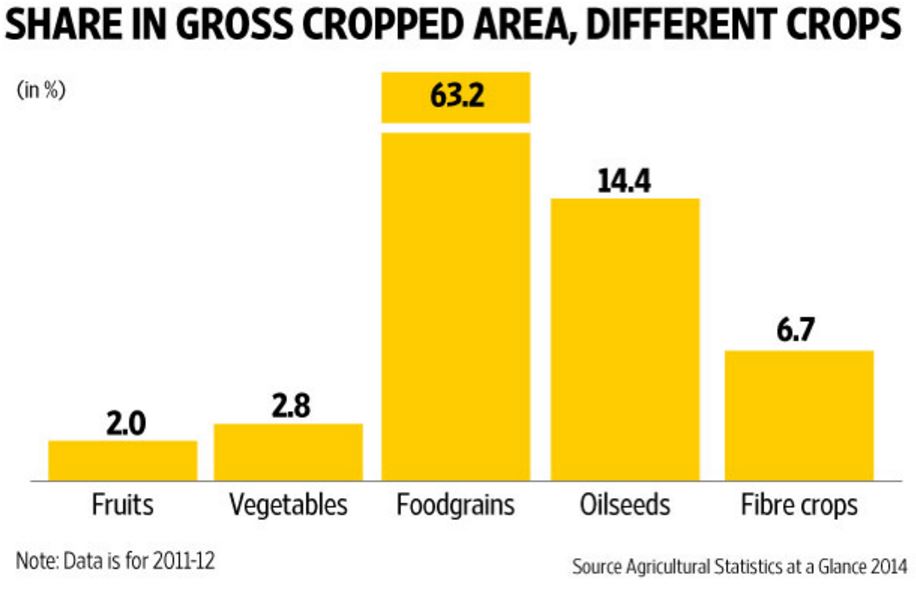
7. Interesting comparison in Mint about horticulture and foodgrains cultivation. Though its share of cropped area is miniscule, vegetables and fruits have overtaken foodgrains in production.
In terms of irrigated area, 87-90% of fruits and vegetable cultivation is in irrigated areas to just under half for foodgrains.
8. The Masala Bonds were always likely to be exactly that, masala, more garnish than substance. And the reluctance of corporates to go ahead only confirms it. Even with the removal of the with-holding tax and even if the Government of India takes the lead with direct issuances, it is most unlikely to take off. Apart from the well documented historically persistent and pervasive original sin hypothesis (developing countries cannot borrow abroad in their domestic currencies), the global economic uncertainties make it pretty much a non-starter. The comparison with Chinese 'dim-sum' bonds was plain misleading, as would be with most such things Chinese. In any case now, India is more investment demand constrained than capital constrained - decreasing overseas bond issuances (a five year low of $9 bn in 2015 against $19.2 bn in 2014) and ECBs, declining domestic corporate bond yields, lower credit off-take, and falling investment intentions. 

9. Negative interest rates and record low Baltic dry index portends dismal prospects for the world economy. Sweden's Riksbank cut its key short-term interest rate by 15 basis points to minus 0.5 per cent. Rates for dry bulk carriers, including container ships, have fallen below break-even prices, on the back of large capacity expansion over the past decade, in turn motivated by a 7% increase in global trade in the decade to 2008.  
10. India's banking sector appears to be gripped by a reflexive downward spiral of rising non-performing assets (NPAs), dragging down equity markets. Indian Express reports that the provisioning coverage ratio (total provisions to gross NPAs) of 20 public sector banks fell over the 2011-15 period and are all below the RBI mandated 70 per cent. Indian banks have written off Rs 2.77 trillion over the past ten years, more than half happening in the last three years, and gross NPAs are estimated to jump to Rs 4.26 trillion by March 2016, an increase of 32% over the year. 

Faced with a systemic bad asset problem, regulators face the classic dilemma. Clean up too fast and run the risk of individual bank runs and systemic contagion. Cleaning up too slowly runs the risk of prolonging the misery, even exacerbating it, and encouraging bankers to hide bad assets. 

11. Finally, Ricardo Hausmann makes a compelling case that Venezuela will be the first oil exporting domino to fall and predicts a disorderly sovereign default this year, 
While most other oil exporters used the boom to put some money aside, former president Hugo Chávez, who died in 2013, used it to quadruple the foreign debt. This allowed him to spend as if the average price of a barrel of oil was $197 in 2012, when in fact it was only $111. He also used it to maim the private sector through nationalisations and import controls. With the end of the boom, the country was put in a hopeless situation. The year 2015 was an annus horribilis in Venezuela with a 10 per cent decline in gross domestic product, following a 4 per cent fall in 2014. Inflation reached over 200 per cent. The fiscal deficit ballooned to 20 per cent of GDP, funded mainly by the printing press. In the free market, the bolivar has lost 92 per cent of its value in the past 24 months, with the dollar costing 150 times the official rate: the largest exchange rate differential ever registered...
As bad as these numbers are, 2016 looks dramatically worse. Imports, which had already been compressed by 20 per cent in 2015 to $37bn, would have to fall by over 40 per cent, even if the country stopped servicing its debt. Why? If oil prices remain at January’s average levels, exports in 2016 will be less than $18bn, while servicing the debt will cost over $10bn. This leaves less than $8bn of current income to pay for imports, a fraction of the $37bn imported in 2015. Net reserves are less than $10bn and the country, trading as the riskiest in the world, has no access to financial markets.
Add to Technorati Favorites
12 Feb 06:29

How to invest now

by subra
These are surely difficult times for the investor now. Looks like the Titanic times. There are kids telling you there is a ice berg. However you as the experienced captain of your ship do not know whether to say “Full steam ahead” or to be cautious. You have also read the Titanic story. Well if […]
12 Feb 06:24

Poke the Box: Choose Must

by Anshul Khare

Let’s Start with Safal Niveshak
As Mr. Market behaves like a drunkard trying to get on a horse, here’s time to revisit some old posts dealing with how to behave during a stock market turbulence like we are seeing now –

Stimulate Your Mind
Forget the stock market for now, and consider some amazing content we read in recent times…

Book Worm
This is what Nassim Taleb wrote about Peter Thiel’s book Zero To One

If a risk taker writes a book, read it. If it is Peter Thiel, read it twice. In fact, read it thrice to be safe.

For the uninitiated Peter Thiel was the founder of PayPal (with Elon Musk) and an early stage investor in Facebook, Linkedin and SpaceX. He is one guy who has been there, done that. Thiel’s ideas are a must read for every entrepreneur.

Like a Zen master, Peter Thiel doesn’t believe in giving ready made answers. His ideas are more like an exercise in thinking.

The most important skill an entrepreneur requires is hiring the right people. How do you find the right people? Here’s Thiel’s favorite interview question to assess people –

What important truth do very few people agree with you on?

If you think about it, it’s a very tough question. You can’t make up an answer on the spot. The only way you can answer it convincingly is if you have spent a lot of time thinking (independently) about a tough problem.

Thiel writes –

This is a question that sounds easy because it’s straightforward. Actually, it’s very hard to answer. It’s intellectually difficult because the knowledge that everyone is taught in school is by definition agreed upon. And it’s psychologically difficult because anyone trying to answer must say something she knows to be unpopular. Brilliant thinking is rare, but courage is in even shorter supply than genius.

Answers like “Our educational system is broken and urgently needs to be fixed” or “There is no God” are all bad answers. When most people answer contrarian questions, they usually try to extrapolate the present.

A good answer looks something like this – “Most people believe in x, but the truth is the opposite of x”.

Answering contrarian questions and noticing what is ‘not present’ is a skill that can take you closer to seeing the future. Contrarian questions allow you to see the present in different ways and good answers give you a glimpse of the future.

As Taleb says, this book is not just a must read but a must re-read. So if you’ve already read the book, do yourself a favour. Read it again.

Poke of the Week – Choose Must

“Let yourself be silently drawn by the strange pull of what you really love. It will not lead you astray.” ~ Rumi

At 7 a.m. on April 8, 2014 Elle Luna clicked the publish button for an essay titled The Crossroads of Should and Must. Little did she know that her words were going to touch a chord with millions of people worldwide. Over few short weeks Elle’s article was shared over 5 million times on the internet.

Goes without saying that I was one among those readers who drew boatload of inspiration from Elle’s post.

Luna redefined the meaning of Should and Must. She writes –

Should is how other people want us to live our lives. It’s all of the expectations that others layer upon us…When we choose Should, we’re choosing to live our life for someone or something other than ourselves. The journey to Should can be smooth, the rewards can seem clear, and the options are often plentiful.

Must is different. Must is who we are, what we believe, and what we do when we are alone with our truest, most authentic self. It’s that which calls to us most deeply…Unlike Should, Must doesn’t accept compromises…To choose Must is to say yes to hard work and constant effort, to say yes to a journey without a road map or guarantees.

Vincent van Gogh chose Must when he continued to paint, canvas after canvas, even as the world rejected his art. His work went largely unrecognized while he was alive.

Elle Luna

Image Source: The Crossroads of Should and Must by Elle Luna

Choosing Must raises questions that are scary, big, and often, without an easy answer in sight.

What if one doesn’t know what his path is?

“If you can see your path laid out in front of you step by step, you know it’s not your path,” Joseph Campbell said. “Your own path you make with every step you take. That’s why it’s your path.

Thinking that your Must will appear, fully formed, is like believing you can write a book by wishing and thinking. But doing one small thing, daily—pick up the pen, write a paragraph, make a list of words—that is how your Must will appear.

When you choose Must, the line separating you and your work starts disappearing. Elle quotes from Arianna Huffington’s biography of Pablo Picasso. Arianna describes how Picasso balanced work and life, saying:

The more I discovered about his life and the more I delved into his art, the more the two converged. “It’s not what an artist does that counts, but what he is,” Picasso said. But his art was so thoroughly autobiographical that what he did was what he was.

Picasso’s secret to his genius was this – his life blended seamlessly with his work. It was impossible to tell where his life ended and his paintings began. This observation lead Elle to a set of profound questions.

What if who we are and what we do become one and the same? What if our work is so thoroughly autobiographical that we can’t parse the product from the person? In this place, job descriptions and titles no longer make sense; we no longer go to work, we are the work.

I guess if you give an honest thought to these questions, it can open up a world of possibilities. It did for me.


Find the answer to – What important truth do very few people agree with you on?

Choose Must, always.

Stay happy, stay blessed and keep poking!

The post Poke the Box: Choose Must appeared first on Safal Niveshak.

    
11 Feb 04:41

The importance of urban leadership

by noreply@blogger.com (Gulzar Natarajan)
This blog has consistently held that Indian cities lack visionary leadership of the kind that is necessary to shape their long-term development. Municipal Commissioners, with their limited tenures and misaligned incentives, cannot be expected to provide the sort of leadership that a city resident with a five-year tenure and long-term political aspirations can potentially do.

Fernanado Haddad, the mayor of the 20 million Sao Paolo metropolis, is only the latest example of such leadership, challenging the "supremacy of the automobile" to ease congestion and improve commutes,
Drawing inspiration from policies in New York, Bogotá, Paris and other cities, Mr. Haddad has embarked on the construction of hundreds of miles of bicycle lanes and corridors for buses to blaze past slow-moving cars, while expanding sidewalks, lowering speed limits, limiting public parking and occasionally shutting down prominent avenues entirely to cars... surveys show relatively high lvels of support for his policies.
Such paradigm redefining policy mutations are most unlikely to come from bureaucrats. They are most likely to originate from political leadership. But critics point to its pitfalls. And they merit serious consideration. It may be true that three out of five (or four out of five) leaders may turn out to be less than benign, even venal.

But, given the institutional checks and balances, in the long run, we are likely to be none the worse off. In fact, the positive deviants alone may be enough to unsettle the bad equilibrium our cities are currently entrapped in. In any case, when this is the norm in pretty much all major developing countries, with equally corrupt and short-sighted political eco-system, and many of their cities have done far better than ours, it is not clear why we should be different.
Add to Technorati Favorites
10 Feb 08:18

Parks and public safety

by SK

I spent the last hour and a half working from a park near my house in Barcelona. It helped that I wasn’t using my laptop – I was mostly working with a notebook and pen. The incredible thing was that never once did I feel unsafe working in that park, and it has to do with the park’s design.

I got accosted by a human only once – by this guy asking me if I had a cigarette lighter and who walked away when I said no, and by dogs (of all shapes and sizes) multiple times. Despite the fact that I was in a park, and people don’t go to parks at 10 am on a weekday morning, there was a constant flow of people in front of me. There were, to put it in other words, sufficient “eyes on the street” which contributed to the place’s safety.

I’ve ranted sufficiently on this blog about the design (or lack of it) of Bangalore’s public parks (one with a name sufficiently similar to that of this post). The problem with the parks, in my opinion, is that they are exclusive closed spaces which are hard to access.

The sprawling Krishna Rao Park in the middle of Basavanagudi, for example, has only two or three entrances, and the number of trees in the park means that large parts of it are hardly visible, providing a refuge to unsavoury elements. This phenomenon of few entrances to parks is prevalent in other city parks as well, with the consequence that the BBMP (city administration) closes off the parks during the day when few people want to go in.

The park I was sitting in this morning, on the other hand, had no such safety issues. It helped that there weren’t too many trees (not always a positive thing about parks), which improved visibility, but most importantly, it was open on all sides, providing a nice thoroughfare for people walking across the area. This meant that a large number of people in the vicinity, even if they didn’t want to “go to a park” ended up passing through the park, because of which there was a constant flow of human traffic and “eyes on the park street”, making it a significantly safer space.

There might be (maintenance-related ) reasons for having limited entrances to parks in Bangalore, but the administration should seriously consider opening up parks on all sides and encouraging people to walk through them (after all, walking paths are an important part of Bangalore parks). Maintenance costs might go up, but safety of parks will be enhanced significantly, and it will be possible to keep parks open at all times, which will enhance their utility to the public.

Maybe Krishna Rao park, with roads on all sides and in the middle of Basavanagudi, might serve as a good pilot case for this.

10 Feb 08:12

Latticework of Mental Models: The Bystander Effect

by Anshul Khare

“Madness is a rare thing in individuals – but in groups, parties, peoples, and ages it is the rule.” ~ Friedrich Nietzsche

Just after 3 a.m., March 13, 1964 in New York City, Catherine Genovese, a 28-year old woman, was stabbed to death in a parking lot in front of her apartment complex. Catherine’s murder story could have drowned in the middle pages of most newspapers like many other crime stories, except that it didn’t.

Catherine’s murder wasn’t a quick, muffled death. It had been a long, loud, tortured, public event. The killer had chased and attacked her in the street three times over a period of thirty-five minutes before his knife finally silenced her cries for help.

Shockingly, thirty-eight people, all in the surrounding apartments, witnessed at least one of her killer’s three attacks from the safety of their apartment windows for 25 minutes without calling the police.

The story has since been thoroughly debunked, a case of sensational reporting, but at the time it was written it led to intense interest in the phenomenon from psychologists. Even if there is a ten percent truth to above story, it’s a baffling account of a crime, not because it was a murder, but because “good people” failed to call the police.

Why didn’t the neighbours help? Were they indifferent? Frightened? Why should they be afraid of calling the police from the safety of their own homes? Has the violence on TV and movies made people so insensitive? Was it the beginning of a new epidemic known as large scale social apathy?

Interview with the witnesses revealed none of these explanations was the real reason behind people’s inaction.

I found Genovese’s story in Robert Cialdini’s masterpiece, Influence – The Psychology of Persuasion. Cialdini writes –

A simple anonymous call to the police could have saved Catherine without threatening the witness’s future safety or free time. No, it wasn’t the observers’ fear or reluctance to complicate their lives that explained their lack of action; something else was going on there…They[social psychologists] examined the reports of the Genovese incident and, on the basis of their knowledge of social psychology, hit on what had seemed the most unlikely explanation of all – it was that thirty-eight witnesses were present…no one had helped precisely because there were so many observers.

This is called The Bystander Effect, which basically states that as humans, we don’t only imitate good actions, but we also have a tendency to follow wrong actions and inactions of fellow humans.

Diffusion of Responsibility

When several people, potential helpers, around you are witnessing the same event, the personal responsibility of each individual reduces. It’s called diffusion of responsibility.

Have you ever seen someone broken down on the side of the road and thought, “I could help them, but I’m sure someone will be along.” Everyone thinks that. And no one stops. Watch the following video of a social experiment which demonstrates the bystander effect.

In a crowd, your inclination to rush to someone’s aid fades, as if diluted by the potential of the group. Everyone thinks someone is going to eventually do something, but with everyone waiting together, no one does.

To be able to extend any help we must interpret an event as an emergency. When we are uncertain, we have a tendency to look at people around us to see how they react. If others don’t react, we interpret that as evidence that it is not an emergency, and we therefore don’t react. We don’t want to be the ones that stand out in a crowd and risk embarrassment for acting in a non-emergency situation.

Fear of embarrassment plays a big role into group dynamics. Talking about fear of embarrassment, it should be obvious to see that bystander effect is founded on the principle of Social Proof.

But here comes the problem. If each person reasons the same way, everyone draws the same conclusion. “Since nobody is concerned, nothing is wrong. It can’t be an emergency. ”

Sometimes it’s also termed as Pluralistic Ignorance – a psychological state characterized by the belief that one’s private thoughts are different from those of others. Simply put, it’s a situation where everyone is thinking the same thing but believes he or she is the only person who thinks it.

When it comes to explaining behavioural biases humorously, there is no one who can do it better than Dan Ariely, author of wildly popular book Predictably Irrational. Dan, in this short video, not only explains but demonstrates (watch it till the end) the idea of pluralistic ignorance-

Social psychologists determined that when the potential helper doesn’t see anyone around, except the victim, he’s more likely to come forward for help. So the more people present when a person needs emergency help, the less likely it is any one of them will lend a hand.

What aggravates pluralistic ignorance? Cialdini writes –

It seems that the pluralistic ignorance effect is strongest among strangers: Because we like to look poised and sophisticated in public.

I suspect if people were to witness the Genovese murder case in present time, instead of watching silently they would, probably and unfortunately, tweet about it.

MM-1

Breaking Spell of Pluralistic Ignorance

So the two primary factors that create bystander effect is uncertainty about the emergency and diffusion of responsibility. If we can address these two things, we can break the spell of pluralistic ignorance.

Many studies have shown it takes only one person to help for others to join in. Whether it is to donate blood, assist someone in changing a tire, drop money into a performer’s coffers, or stop a fight—people rush to help once they see another person leading by example.

In fact it’s usually not the first person but the second one who tips the attention of the crowd. See this video where the first follower converts a lone nut’s dance into a movement.

God forbid, if you ever find yourself in a situation where you’re the one who needs the help and people around you seemed to be under a strong spell of Bystander effect, what should you do?

The key is to first realize that bystanders fail to help, not because they are unkind, but because they are unsure. They are still guessing whether an emergency actually exists and whether they are responsible for taking action.

Should you cry for help? No, that doesn’t work as we have seen in the case of Catherine Genovese. Cialdini suggests –

Based on the research findings we have seen, my advice would be to isolate one individual from the crowd: Stare, speak and point directly at that person and on one else: “You, sir, in the blue jacket, I need help. Call an ambulance.” With that one utterance you should dispel all the uncertainties that might prevent or delay help…In general, then, you best strategy when in need of emergency help is to reduce the uncertainties of those around you concerning your condition…Be as precise as possible about your need for aid. Do not allow bystanders to come to their own conclusions because, especially in a crowd, the principle of social proof and the consequent pluralistic ignorance effect might well cause them to view your situation as nonemergency.

When a person realizes that he’s the one responsible for taking an action, bystander effect disappears. There is no diffusion of responsibility.

So the takeaway here is to remember you are not so smart when it comes to helping people. In a crowded room, or a public street, you can expect people to freeze up and look around at one another.

I hope you remember the fairy tale about The Emperor’s New Clothes where everyone pretends the king is wearing clothes, until a child points out the emperor isn’t wearing any clothes. Whether it’s the naked emperor or a ragpicker dying on street, the Bystander Effect gives both of them an equal treatment – a stare of ignorance.

Bystander Effect in Investing

Warren Buffett says –

We derive no comfort because important people, vocal people, or great numbers of people agree with us. Nor do we derive comfort if they don’t.

A stock price may or may not reflect the true value of the underlying business, however what it does reflect, at all times, is either the pluralistic ignorance or the wisdom of the crowd. How would you know?

Is the falling stock price really an emergency situation i.e. is the underlying business is deteriorating? Does it require your intervention, in terms of selling your holding or buying more? Why is nobody buying a particular stock which is languishing in spite of a great underlying business?

May be it’s a victim of bystander effect. But how do you know?

The only way you can know that is by becoming an independent thinker. By not letting the uncertainty and the diffusion of responsibility let you affect. Decide for yourself, do your own evaluation, think independently and then take action.

As we have seen in the case of the lone dancer in the video, you could be the first follower, the first mover and then you will reap the benefits when the crowd follows you.

Bystander Effect in Business

Most of the so called “independent directors” on the boards of publicly listed companies are mere bystanders. Even if some of them feel that the CEO of the company is taking wrong decisions, they rarely raise a voice against it.

And the reason is again the same – uncertainty and diffusion of responsibility. Most independent directors sit on the board to help the CEO comply to regulation for a minimum number of independent directors. And of course the easy money (director’s compensation) doesn’t hurt.

When an independent director doesn’t understand the business of the company and/or doesn’t have the required experience to contribute to the decision making process for the company, it’s obvious that he/she will be uncertain about the quality of decisions that CEO takes. Moreover these people don’t have their skin in the game, i.e. their interests aren’t aligned with the minority shareholder, so their attitude is mostly – It’s not my responsibility.

Charlie Munger, while talking about social proof, said –

…the outside directors on a corporate board usually display the near ultimate form of inaction. They fail to object to anything much short of an axe murder until some public embarrassment of the board finally causes their intervention. A typical board-of-directors’ culture was once well described by my friend, Joe Rosenfield, as he said, “They asked me if I wanted to become a director of Northwest Bell, and it was the last thing they ever asked me.

In life and in business, the importance of independent thinking can never be over emphasized. It’s this one skill that will separate you from the crowd.

George Patton wisely summarized the idea in few words, “If everyone is thinking alike, then somebody isn’t thinking.”

Conclusion

Learning about mental models will not only make you smarter but can also save your life. After having seen the potentially dire consequences of bystander effect, you now know how to rescue yourself, if you ever find yourself a victim of emergency situation in a public place.

Charlie Munger once observed –

The more basic knowledge you have, the less new knowledge you have to get.

That’s why learning the fundamental ideas from major disciplines like physics, biology, math, psychology, history and economics and then remembering them in form of mental models will give you the highest return on investment (of your time and effort). Problems are solved better if you jump over the jurisdictional boundaries of multiple disciplines and grab the best ideas.

It won’t be an overstatement if I call these list of mental models as a cheat sheet which allows us to better understand when to follow and when to reject the conventional wisdom.

Vicarious learning is a very intelligent form of learning. Learning mental models is vicarious learning – learning from other people’s mistakes.

After all you don’t have to pee on an electric fence, quips Munger, “to know that it’s dangerous.”

Take care and keep learning.

The post Latticework of Mental Models: The Bystander Effect appeared first on Safal Niveshak.

    
09 Feb 06:44

What Went Wrong With Kitex Garments?

by Deepak Shenoy

Kitex Garments (KGL) is a company that seems to never go out of the news, though you’ll be forgiven for never even hearing about the company. It’s run by Sabu Jacob, in Kerala. Why the interest in a company that makes cotton undergarments for kids, and sells them abroad, and managers to run a labour intensive company out of Kerala?

Answer: He generates awesome ROCE (Return on Capital Employed) in Kitex, with ludicrously high margins.

But recently, the company has been in the news for the wrong reasons. They have an excellent video that shows you how well they treat employees. And that’s needed for running a business in Kerala, where apparently the highest issues with trade unions occur. When the local politicians diverged and decided to cut their influence off, they even fought panchayat elections, and won!

What went wrong then? A number of things that have happened recently have spooked investors.… (Read On...)

09 Feb 06:43

What is your PERSONAL INFLATION RATE?

by subra
A few years ago I rounded up 10 friends and asked them to gjve a hurdle rate that their investment should give. Most of them had 8% for debt instruments and an amazingly fantastic range of 12% to 40% when it came to equity. Some of them BELIEVED that real estate HAD already given about […]
09 Feb 06:41

The Difference Between a Selling Product or Selling a Service

by Keenan

product-vs-service_imageWhat’s the difference between selling a product and selling a service?

I get this question a lot.

Here’s the answer and I’ll make it as simple and as clear as possible. I think it’s important, very important, people understand the difference between selling a product and selling a service. Knowing the difference can affect how you sell AND how one hires, evaluates and assess salespeople.

The difference between how you sell a product verse how you sell a product is . . .

There is no difference!  Period.

Let me be perfectly frinkin’ clear here.

There is no difference between selling a product and selling a service — absolutely NONE!

Those of you who think there is a difference, need to evaluate how you sell because you’re selling wrong. The sales people who focus on their service or product as their selling approach are missing the point.  Good selling doesn’t sell a product or a service. Good selling focuses on identifying problems, then offers a solution to solve the problem and if it’s a kickass solution, no one cares if it’s a product or a service.

When we start with the customer and their problems, there is no difference whether the solution is a product or service. It’s what the product or service delivers that matters. The impact of a solution, product or service, is still a vision, an intangible. It’s not something you can touch or feel and it’s custom to EVERY customer.

The argument I hear most often is, you can see and feel a product, where a service is harder to sell because it’s an intangible. Are fucking kidding me?  When someone tells me this, I just want to jump out of my skin. When someone argues a tangible product is easier to sell than an intangible service, it tells me they are a horrible sales person or worse yet, a terrible sales manager. It tells me their sales approach is to lead with their offer (the product or the service) and that they don’t look to understand their customers issues and problems. It tells me they sell feature/function. This is terrible selling.

If we’re selling correctly, we’re ultimately anchored in the customers “gap.”  The gap between where they are today and where they want to be tomorrow. We’re selling based on solving, measurable, tangible, urgent, business problems. We’re not selling our service or our product, but what our product or service can deliver for our customers in terms of their business value. When we’re selling like this, it’s all intangible. It’s always different for each client, customer. When we’re selling like this, there is no cookie-cutter approach. It doesn’t matter if you have a tangible, tactile, visual product or an intangible, nontactile service. It’s all intangible if you’re selling incorrectly.

There is no difference between selling a product or a service.

If you believe, there is a difference between selling a tangible product or an intangible service you have a bigger problem than you realize. You need to re-evaluate your sales skills. Start here with these books.

If you’re selling correctly, there is no difference between selling a product and selling a service. In the case that there is, it means your not selling, you’re pitching a product and it’s time to start over, read this.

Anyone disagree?

If so, how do you sell a product differently than a service?

I’m all ears.

09 Feb 06:34

Revenue management at Liverpool Football Club

by SK

Liverpool Football Club, of which I’ve been a fan for nearly eleven years now, is in the midst of a storm with fans protesting against high ticket prices. The butt of the fans’ ire has been the new £77 ticket that will be introduced next season. Though there will be few tickets that will be sold at that price, the existence of the price point has been enough to provoke the fans, many of whom walked out in the 77th minute of the home draw against Sunderland last weekend.

For a stadium that routinely sells out its tickets, an increase in ticket prices should be a no-brainer – it is poor revenue management if either people are scrambling for tickets or if there are empty seats. The problem here has been the way the price increase has been handled and communicated to the fans, and also what the club is optimising for.

At the outset, it must be understood that from a pure watching point of view, being in a stadium is inferior to being in front of a television. In the latter case, you not only have the best view of the action at all points in time, but also replays of important events and (occasionally) expert commentary to help you understand the game. From this point of view, the reason people want to watch a game at the ground is for reasons other than just watching – to put it simply, they go for “the experience”.

Now the thing with stadium experience is that it is a function of the other people at the stadium. In other words, it displays network effects – your experience at the stadium is a function of who else is in the stadium along with you.

This can be complex to model – for this could involve modelling every possible interaction between every pair of spectators at the ground. For example, if your sworn nemesis is at the ground a few seats away from you, you are unlikely to enjoy the game much.

However, given the rather large number of spectators, these individual interactions can be ignored, and only aggregate interactions considered. In other words, we can look at the interaction term between each spectator (who wants to watch the game at the ground) and the “rest of the crowd” (we assume idiosyncrasies like your sworn enemy’s presence as getting averaged out).

Now we have different ways in which a particular spectator can influence the rest of the crowd – in the most trivial case, he just quietly takes his seat, watches the game and leaves without uttering a word, in which case he adds zero value. In another case, he could be a hooligan and be a pain to everyone around him, adding negative value. A third spectator could be a possible cheerleader getting people around him to contribute positively, organising Mexican waves and generally keeping everyone entertained. There can be several other such categories.

The question is what the stadium is aiming to optimise for – the trivial case would be to optimise for revenue from a particular game, but that might come at the cost of stadium “atmosphere”. Stadium atmosphere is important not only to galvanise the team but also to enthuse spectators and get them to want to come for the next game, too. These two objectives (revenue and atmosphere) are never perfectly correlated (in fact their correlation might be negative), and the challenge for the club is to price in a way that the chosen linear combination of these objectives is maximised.

Fundamental principles of pricing in two-sided markets (here it’s a multisided market) say that the price to be charged to a participant should be a negative function of the value he adds to the rest of the event (to the “rest of the crowd” in this case).

A spectator who adds value to the crowd by this metric should be given a discount, while one who subtracts value (by either being a hooligan or a prude) should be charged a premium. The challenge here is that it may not be possible to discriminate at the spectator level – other proxies might have to be used for price discrimination.

One way to do this could be to model the value added by a spectator class as a function of the historic revenues from that class – with some clever modelling it might be possible to come up with credible values for this one, and then taking this value into account while adjusting the prices.

Coming back to Liverpool, the problem seems to be that the ticket price increase (no doubt given by an intention to further maximise revenue takings) has badly hit fans who were otherwise adding positive value to the stadium atmosphere. With such fans potentially getting priced out (in favour of fans who are willing to pay more, but not necessarily adding as much value to the ground), they are trying to send a message to the club that their value (toward the stadium atmosphere) is being underestimated, and thus they need greater discounts. The stadium walkouts are a vehicle to get across this point.

Maximising for per-game revenue need not be sustainable in the long term – an element of “atmosphere” has to be added, too. It seems like the current worthies at Liverpool Football Club have failed to take this into account, resulting in the current unsavoury negotiations.

Now that I’ve moved to Barcelona, Liverpool FC need not look too far – I’ve done a fair bit of work on pricing and revenue management, and on two-sided markets, and can help them understand and analyse the kind of value added by different kinds of spectators, and how this can translate to actual revenues and atmosphere. So go ahead and hire me!

07 Feb 07:21

Family enterprise startups

by SK

Recently, Ambiga Dhiraj, co-founder of MuSigma, was appointed CEO of the company, replacing her other co-founder (and husband) Dhiraj Rajaram. There was a lot of chatter about the “first woman CEO of Indian unicorn”.

I didn’t see it that way. The way, I saw it, MuSigma was like a family enterprise, and so it was no big deal that one of the woman founders had become CEO. A couple of tweets went out:

People didn’t take my tweets too kindly. One guy quickly pointed out that she had had a pivotal role in building the company, and so she was more like Hillary Clinton than like Rabri Devi.

Another guy (a MuSigma employee) said that she’s gotten there on merit and not on account of her relationship.

While it might be the case that she got there on her own merit (I don’t know her at all, so can’t comment), the fact that she’s become CEO of a company she founded with her husband means that people will judge her on her relationships rather than purely on merit.

I wonder if this is a good reason to not start a company with a close relative.

On another note, I’d think twice (or maybe three times) before working for a company whose top management is closely related to each other – it will create a kind of glass ceiling and also a highly correlated top management meaning others will find it that much harder to create impact.

07 Feb 07:04

Weekend reading links

by noreply@blogger.com (Gulzar Natarajan)
1. Tyler Cowen points to the stark contrast in night-time ariel photographs of South and North Koreas to highlight the importance of institutions.
2. The US LNG exports, which just began, have already triggered off speculation of price wars in Europe. Like Saudi Arabia in oil, Gazprom has the potential to become the swing gas producer since it has the largest spare capacity and is also the lowest cost gas producer in the world. In the context of rising US exports and liquefaction terminal construction, the FT reports that Gazprom may be encouraged to increase production to push prices down lower to keep out the shale imports. 

It is only a matter of time before these forces reach the East Asian markets, keeping gas prices there contained. A truly integrated global natural gas market may be only a couple of years away. It is all the more important that India's policy makers keep this in mind while formulating gas pricing policies for the new production sharing contracts. 

3.  A good summary of research on the impact of MGNRES in Livemint. One thing that is clear from recent events is that the program is good politics.

4. In addition to the conventional indicators of economic weakness, consider these trends. Corporate investment intentions hit all-time lows; external commercial borrowings decline; investment commitments by China, Japan, UAE etc fail to materialize; the same Indian corporates who hesitate to invest in India are doing so abroad etc. 
It appears that, at this point in time, India is investment-demand constrained. Public investment should undoubtedly become the engine to revive investment cycle. But, at about 1.72% of GDP for 2015-16 and a high fiscal deficit, there is only so much that is possible with this strategy.

5. Following the 20% import duty on hot-rolled coils imposed in September for 200 days, the Government of India has imposed a minimum import price on different categories of steel products for a period of 6 months. These measures are aimed at protecting a bruised steel industry. It comes even as the industry is floating on excess capacity, and steel makers across the world are fighting sharply falling demand and thereby prices. 

This is certain to invite action against India before the WTO's Dispute Settlement Board and most likely to be untenable. Further, it is not clear whether this is going to improve the prospects of most Indian steel producers whose competitiveness have been seriously hurt by their very large debt-servicing costs, which alone in some cases is more than the import price of Chinese and Russian steel. Finally, the biggest losers will be the country's manufacturing industry, for whom steel is an important intermediate, and the consumers. 

6. The Citylab writes that 2015 was a bumper year for skyscrapers (more than 200 m high), with the highest ever completions. Interestingly, Jakarta had the largest number of skyscrapers completed in 2015, at seven. As a comparison, Mumbai had one.
It is surprising that India, where A-grade commercial real estate has been frothing, does not figure anywhere. Interestingly, while Mumbai has 14 skyscrapers, all but one are residential. This is in stark contrast to global trends, where office and mixed-use dominate and residential is a very small share. Why doesn't India's office space developers go vertical?

7. The Business Standard argues that the Vijay Kelkar report recommendations would go a long way towards reviving PPPs in infrastructure. In particular, this caught attention,
The most path-breaking suggestion is a two-tier framework of dispute resolution with Infrastructure PPP Project Review Committee and Infrastructure PPP Adjudicatory Tribunal. Once a stakeholder files a reference before the tribunal, and it takes cognisance of it, no party or stakeholder would be allowed to approach any court of law, and all courts shall refrain from adjudicating upon any proceedings initiated that are related to the project in question.
The committee has proposed enactment of a law under Article 323B of the Constitution under which Infrastructure PPP Project Review Committee and Infrastructure PPP Adjudicatory Tribunal should be empowered to determine whether there is such a change in the economic foundation or economic viability of a project which requires any intervention amongst options contemplated in that statute. The law will also lay down the guiding principles on the basis of which Infrastructure PPP Project Review Committee and Infrastructure PPP Adjudicatory Tribunal will exercise their functions. In case a substantial question of law is involved, the matter should be directly heard by the tribunal.
I am not that optimistic. There is nothing different here than with all the other Tribunals. In other words, there is nothing that prevents the disgruntled party from approaching the Courts at the drop of a hat and the latter from entertaining their pleas. All such talk of "independent mechanism for speedy redressal of disputes" appears logically and academically great, but have limited real-world basis in India's messy decision-making systems.

8. Are cows and buffaloes substitute goods? The Maharashtra government's ban on cow slaughter appears to have unintended consequences. The prices of cows, even good milch ones, have fallen sharply, just as those of buffaloes have risen. 
Add to Technorati Favorites
06 Feb 04:56

Recessions uncover what auditors do not

by Ajay Shah
On 14 December 2008, I was nervously looking around at the world and wrote a blog post Goodbye great moderation, hello financial fraud?  Almost on cue, we got the Satyam scandal: 21 December, 24 December, and then 7 January. We also got a few other problems in India which (I think) surfaced owing to the Great Recession : NSEL, a rash of ponzi schemes, Sahara, Saradha.

In China, unprecedented times are bringing forth revelations on an unprecedented scale [link, link]. Some of the rackets that are described in China appear quite familiar to us in India, but the magnitudes seen there are astonishingly large. We had such problems in developed markets also -- Madoff and MF Global.

Institutional reform: Consumer protection


One part of addressing this problem is the familiar machinery of the Indian Financial Code (IFC) version 1.1. As an example, see this analysis of ponzi schemes. As an IFC quality law is not found in either China or India, we have a rash of such problems in both countries.

Institutional reform: Criminal justice system


An important subset of financial crime is about plain criminal law. While the main track of financial policy has been along the Indian Financial Code, we need to develop a work program on improvements of the criminal justice system also. Put together, these will create an enforcement machinery that will generate deterrence against big financial scandals.

Procyclicality of trust?


Watching China unfold in recent weeks, I wonder if there's a general proposition of the following nature. Recessions will uncover what auditors could not, but under conditions of low institutional quality, this will happen on a bigger scale. Conversely, when institutional quality is low, business and finance will be hampered at all times by low trust. But in good times, when it's easier for the crooks to keep things under wraps, fewer scandals will burst into the public consciousness, and trust will go up. Procyclicality of trust may be heightened in places with low institutional quality.
05 Feb 15:26

Bias in price signals from ask only markets

by SK

Yesterday I listened to this superb podcast where Russ Roberts of the Hoover Institution interviews Josh Luber who runs Campless, a secondary market for sneakers (listen to the podcast, it isn’t as bizarre as it sounds). The podcast is full of insights on markets and “thickness” and liquidity and signalling and secondary markets and so on.

To me, one of the most interesting takeaways of the podcast was the concept that the price information in “ask only markets” is positively biased. Let me explain.

A financial market is symmetric in that it has both bids (offers to buy stock) and asks (offers to sell). When there is a seller who is willing to sell the stock at a bid amount, he gets matched to the corresponding bid and the two trade. Similarly, if a buyer is willing to buy at ask, the ask gets “taken out”.

The “order book” at any time thus contains of both bids and asks – which have been unmatched thus far, and looking at the order book gives you an idea of what the “fair price” for the stock is.

However, not all markets are symmetric this way. In fact, most markets are asymmetric in that they only contain asks – offers to sell. Think of your neighbourhood shop – the shopkeeper is set up to only sell goods, at a price he determines (his “ask”). When a buyer comes along who is willing to pay the ask price of a good, a transaction happens and the good disappears.

Most online auction markets (such as eBay or OLX) also function the same way – they are ask only. People post on these platforms only when they have something to sell, accompanied by the ask price. Once a buyer who is willing to pay that price is found, the item disappears and the transaction is concluded.

What makes things complicated with platforms such as OLX or eBay (or Josh Luber’s Campless) is that most sellers are “retail”, who don’t have a clear idea of what price to ask for their wares. And this introduces an interesting bias.

Low (and more reasonable) asks are much more likely to find a match than higher asks. Thus, the former remain in the market for much shorter amount of time than the latter.

So if you were to poll the market at periodic intervals looking at the “best price” for a particular product, you are likely to end up with an overestimate because the unreasonable asks (which don’t get taken out that easily) are much more likely to occur in your sample than more reasonable asks. This problem can get compounded by prospective sellers who decide their ask by polling the market at regular intervals for the “best price” and use that as a benchmark.

Absolutely fascinating stuff that you don’t normally think about. Go ahead and listen to the full podcast!

PS: Wondering how it would be if OLX/eBay were to be symmetric markets, where bids can also be placed. Like “I want a Samsun 26 inch flatscreen LCD TV for Rs. 10000”. There is a marketplace for B&Bs (not Airbnb) which functions this way. Would be interesting to study for sure!

05 Feb 15:25

Poke the Box: Don’t Set a Bad Goal

by Anshul Khare

Let’s Start with Safal Niveshak
Just in case you missed any of this on Safal Niveshak in the last week…

  • In investing, knowledge is cumulative and the relation between effort and results is nonlinear, so focus on the process and keep practicing the art of investing.
  • For investors, like airline pilots, the job entails hours of boredom punctuated by moments of terror. If you can stomach the stock market turbulence you’ll end up with very satisfactory results over long term.

Book Worm
Derek Sivers is the perfect example of what one might want to call as an accidental entrepreneur.

He was a musician who simply wanted to sell his music CDs online. In 1998 the internet was still picking up and e-commerce was pretty much an unknown phenomenon. So Derek started his own website to sell his music CDs online which, to his utter surprise, grew into a multi-million dollar business. He eventually sold his business, CDBaby.com, for $22 million.

Derek’s approach to business is very unconventional but makes a lot of sense. He has compiled his business philosophy in a small book called Anything You Want. It was an absolute treat to read this book. I just couldn’t put it down and ended up finishing this 100 page book in one sitting.

Sivers writes –

I realized I had accidentally started a business. But I didn’t want to start a business! I was already living my dream life as a full-time musician. I didn’t want anything to distract me from that.

So, I thought that by taking an unrealistically utopian approach, I could keep the business from growing too much. Instead of trying to make it big, I was going to make it small. It was the opposite of ambition, so I had to think in a way that was the opposite of ambitious.

The key point is that I wasn’t trying to make a big business. I was just daydreaming about how one little thing would look in a perfect world. When you make a business, you get to make a little universe where you control all the laws. This is your utopia. When you make it a dream come true for yourself, it’ll be a dream come true for someone else, too.

That’s a strange way to approach the idea of entrepreneurship. But I think it’s the ideal way to get started in any business. It’s should be an extension of what you’re already doing or want to do.

Sivers didn’t have any background into building website, so he bought few programming books and taught himself how to write software for an online webstore. The way he would recruit people was to ask his friends for anybody who was looking for work and then get them started immediately without even interviewing.

Ironically, the more Sivers tried to limit the business, the more it grew.

Five years after I started CD Baby, when it was a big success, the media said I had revolutionized the music business. But “revolution” is a term that people use only when you’re successful. Before that, you’re just a quirky person who does things differently.

If you think your life’s purpose needs to hit you like a lightning bolt, you’ll overlook the little day-to-day things that fascinate you. When you’re on to something great, it won’t feel like revolution. It’ll feel like uncommon sense.

I hope you too are on to something uncommon sensical. If you’re not then get started soon.

As an aside, you must watch the TED talks that Sivers has given. They are not only very thought provoking but very entertaining too.

Stimulate Your Mind
Here’s some amazing content we read in recent times…

Poke of the Week – Don’t Set a Bad Goal

Everybody has some goals that they keep putting off. When you say to yourself, “Someday I am going to do this thing.”, it’s a bad goal.

Whatever this someday-goal of your is, let go of it.

Why?

Because goals are not to change the future. Future is something which is only in your imagination. What you have at your hands is the present moment. So a good goal is something which allows you to change the present.

If a goal doesn’t make you jump into action, it’s not doing its job.

A bad goal is where you’re not sure what to do next, but a good goal is where you know exactly what your next step is going to be. Just thinking of a good goal gets you started immediately.

A bad goal is where you say, “I am not sure how to find time from my busy schedule”. A good goal is where all your current work is pushed aside.

The daily actions related to your goals have to be exciting otherwise you’ll never stick to it. You have to enjoy the process.

In investing, setting a goal for compounding your money at 18% CAGR is a bad goal. However, setting a goal of reading 100 annual reports every year is a good goal because it easily translates into reading at least 2 annual reports today which is something you can start doing immediately.

Remember, the goal of setting a goal is to push yourself forward. Even if it’s in the wrong direction.

Note: This poke of the week is inspired by one of the talks given by Derek Sivers.


Start something uncommon sensical.

Set the right goal and attack the present moment.

Stay happy, stay blessed and keep poking!

The post Poke the Box: Don’t Set a Bad Goal appeared first on Safal Niveshak.

    
05 Feb 14:52

My Boss Asked Me to Resign

by Evil HR Lady

I am a middle manager without a union who has been told that because of poor job performance, I would need to step down. My boss had offered me a lower level position that I do not wish to fill as I don’t want to work for them any longer. I asked my boss to dismiss/terminate me for poor performance. They won’t dismiss me and have asked me to resign. How can I go about this now? I may need unemployment and really do not think that I should be the one to resign. Any thoughts on this?

Yes. Take the lower level job and focus on finding a new job. Your boss has actually offered you a gift in the form of the lower job. Yes, I absolutely hate it when bosses won’t fire and try to force resignations without offering anything in return, but your boss is offering something–a job.

Now, it’s not a job you want, and it’s a lower level job, but here are the advantages to taking the job and not resigning or being fired.

Finding a job is easier when you have a job. It just flat out is. You don’t have to explain that you were fired or that you resigned without a job lined up. Your resume doesn’t have that awkward gap in it. It’s just easier. Keep working.

Your current boss doesn’t have to be a reference. Most recruiters will respect your request not to contact your current company when you say, “My boss doesn’t know I’m looking.” However, if you resign or are fired, they’ll want to speak to your last company–the very boss that fired you or forced you to resign. If you’re still employed, he never gets a call, and you don’t have to explain your poor performance (until you look for the job after this one).

Money, money, money. Unemployment is great because you get money when you’re not working. It allows you to focus on job hunting. The problem is, unemployment is not as much as your current paycheck. If you’ve got lots of money saved up, then the money part isn’t problematic. But, even if you have a big chunk of cash saved up, why waste it when you can be drawing a full paycheck?

Health insurance. Sure there’s COBRA, and sure, there are the exchanges, but do you really think you’ll be better off on those than on your employer-provided plan? If you have a spouse whose plan you can go on, this isn’t as big of a deal. But, if not, think long and hard about giving up health insurance. We’re a generally healthy family, but that didn’t stop my daughter from absentmindedly stepping in front of a tram.

Exceptions. There are always exceptions to the don’t quit without a new job lined up. If your job is destroying your physical or mental health, it’s time to walk away. But by destroying I mean that literally. Hating it and dreading work is not the same thing as destroying your health. See your doctor if you need an expert opinion.

Good luck on your job hunt.

05 Feb 14:51

Investment Myths need bursting

by subra
There are a few Investment myths which are so prevalent that I do not make too much of an attempt to break it in private conversations! When I am in a crowd or a group people do step up and ask ‘what do you think the market will do’. I actually do not have to […]
05 Feb 14:51

Recognizing Our Flaws is The Beginning of Wisdom

by Farnam Street Team

A short post today that packs a punch.

The liberating power of humility is one we’ve covered before. In fact, it’s a concept that is core to understanding your Circle of Competence. Now Russ Roberts adds to our collection of wisdom with this excerpt from How Adam Smith Can Change Your Life: An Unexpected Guide to Human Nature and Happiness:

As I have gotten older, I have become less confident and maybe more honest. The economy is too complex; we can’t measure the interactions of all its various pieces with any precision. We don’t have enough data, and we don’t understand how things fit together. We are drunks looking for our lost keys under a lamppost not because that’s where we lost our keys but because that’s where the light is. We should be humbler and more honest. Our empirical studies are very imperfect. We often hold the views we do because of ideology and principle. Then we find some evidence that supports those views. We ignore the rest … An awareness of reason’s limits is a caution sign to remind us that we’re not as smart as we think; we’re not perfect truth seekers. We’re flawed. Recognizing our flaws is the beginning of wisdom. Many things look like nails that do not benefit from being pounded. That should induce caution and humility for those with hammers … Humility is an acquired taste. Once you come to like it, it’s a dish best served hot. It’s amazing how liberating it can be to say “I don’t know.”

--
Sponsored By: Siebels Research — Customized research featuring on the ground original insights at a great value!

05 Feb 14:38

China Makes 50% More Steel Than The Next 10 Countries Combined – A Perspective on Steel Production Cuts

by Deepak Shenoy

To understand the scale at which China has dominated the steel business, here’s a recent comparison of their steel production with the next 10 countries on the list: (source: http://worldsteel.org )

China makes more steel than the next 10 countries, combined:

China Makes More Steel Than Next 10 - Chart

Why are steel prices low?

It started in 2014, in October, during the Crude price crash. The ruble fell to half its value (went to 80 to the Dollar, from 40) and Russia is a big steel producer (70 million tons). They cut the prices by half!

To follow, South Korea and Japan made massive cuts too – and look how big they are (Japan makes over 100 million tons and South Korea about 70 million tons).

China had to follow, because Chinese local domestic use has crashed due to the slowdown. With production of 803 tons in 2015 that is 8x the second highest player (Japan) and more than the next 10 countries combined, which manufactured just 566 tons.… (Read On...)

05 Feb 14:37

Counter staffing and service levels

by SK

I’m writing this from the international section of the Bangalore International Airport, as I wait to board my flight to Barcelona. It was a plan I’d made in October 2014 to “hibernate” for a few months in Barcelona during my wife’s last term of classes there, and this is the execution of the same plan.

There was a fairly long line at the passport control counters this morning, and it took me perhaps twenty minutes to cross it. When I joined the line, there were about 10 passport officers to say goodbye to Indian passport, so the line moved fairly quickly.

Presently, officers started getting up one by one, and going to one side to drink tea. I initially thought it was a tea break, but the officers drinking tea soon disappeared, leaving just four counters in operation, implying that the line moved much slowly thereafter. Some people were pissed off, but I soon got out.

It is not an uncommon occurrence to suddenly see a section of “servers” being closed. For example, you might go to the supermarket on a weekday afternoon to expect quick checkouts, but you might notice that only a fraction of the checkout counters are operational, leading to lines as long as on a weekend evening.

From the system of servers’ point of view, this is quite rational. While some customers might expect some kind of a moral obligation from the system of servers to keep all servers operational, the system of servers has no obligation to do so. All they have an obligation towards is in maintaining a certain service level.

So coming back to passport control at the Bangalore airport, maybe they have a service level of “an average of 30 minutes of waiting time for passengers”, and knowing that the number of international flights in late morning is lower than early morning, they know that the new demand can be met with a smaller number of servers.

The problem here is with the way that this gets implemented, which might piss off people – when half the servers summarily disappear, and waiting period suddenly goes up, people are bound to get pissed off. A superior strategy would be to do it in phases – giving a reasonable gap between each server going off. That smoothens the supply and waiting time, and people are far less likely to notice.

As the old Mirinda Lime advertisement went (#youremember), zor ka jhatka dheere se lage.

05 Feb 04:41

Our Growing World

by David Merkel

In general, I tend not to go in for macro themes.  Why?  I tend to get them wrong, and I think most investors also get them wrong, or at least, don’t get them right consistently.

I do have one macro theme, and it has served me well for a long time, though not over the past two years.  I was using the theme as early as 2000, but finally articulated it in 2006.

At that time, I was running my equity strategy for my employer, as well as in my personal account.  They used it for their profit sharing plan and endowment.  They liked it because it was different from what the firm did to make money, which was mostly off of financial companies, both public and private.  They didn’t want employees to worry that their accrued profit sharing bonuses would be in jeopardy if the firm’s ordinary businesses got into trouble.  In general, a good idea.

At the end of the year, I needed to give a presentation to all of the employees on how I had been managing their money.  Because my strategies had been working well, it would be an easy presentation to make… but as I looked at the prior year presentation, I felt that I needed to say more.  It was at that moment that the macro theme that i had been working with became clear to me, and I called it: Our Growing World.

The idea is this: in a post-Cold War world where most economies have accepted the basic idea of Capitalism to varying degrees, there should be growth, and that growth should create a growing middle class globally.  This middle class would be less well-off than what we presently see in America and Western Europe, at least not initially, but would manifest itself in a lot of demand for food, energy, and a variety of commodities and machinery as the middle class grew.

Now, I never committed everything to this theme, ever.  Maybe one-third of the portfolio was influenced by it, on averaged.  Most of what I do was and still is more influenced by my industry models, and by bottom-up stock-picking.

That said, the theme has a cyclical bias, and cyclicals have been kicked lately.  I still think the theme is valid, but will have to wait for overinvestment and overproduction in certain industries to get rationalized globally.  Were this only a US problem, it might be easier to deal with because we’re far more willing to let things fail, and let the bankruptcy process sort these matters out.  Governments in the rest of the world tend to interfere more, particularly if it is to protect a company that is a “national champion.”

But the rationalization will take place, and so until then in cyclical industries I try to own financially strong companies that are cheap.  They will survive until the cycle turns, and make good money after that.  That said, the billion dollar question remains — when will the cycle turn?

More next time, when I write about my industry model.

05 Feb 04:38

Coca-cola, Marico and dogs

by Rohit Chauhan
There is a class of companies which enjoy a very strong competitive position in their respective markets. These companies have strong brands with their customers, great return on capital and finally good management.

The market really loves these companies due to all the above mentioned factors. Consequently, these companies enjoy a fairly high valuation.

There is ofcourse one small problem – Some of these companies are not growing rapidly. They are probably growing in the range of 10-15%, which is slightly higher than the GDP, but definitely not at the 20%+ rates of the past (which got them in the present position).

Lets call this the coca-cola effect. Why coca-cola ? let me explain

Coca-cola is one the most admired and high quality company. It has a very strong brand which has thrived for 100+ years. In addition the company has a global distribution network which cannot be matched by any company in the foreseeable future (in beverages for sure).

The company grew rapidly in the late 80s and 90s and was valued at 40+ PE levels by early 2000

On top of this, the company was held by warren buffett. What could be a bigger endorsement?

There was one little problem – the company growth had already slowed, but the price was not reflecting this new reality. So what happened since then?


The company did quite well, but the stock went nowhere.

So lets define the coca-cola effect now
-           High quality company with great brands, strong competitive position and good management
-           Past history of high growth
-           High valuations
-           Slowing growth and lower probability of repeating the high growth of the past (key word – probability)
-           Price stagnates (low returns) as the earnings rise slowly , while the PE multiples contract in face of the new reality

Does this look familiar? I think so. I can think of a few companies in the indian market which will go through a similar phase. I will not give names as these are universally loved names and I will get hate mail and comments for suggesting that.

Let me however give a past example from the indian markets

Infosys ltd: see this chart below. The company has done well (profit grew by 15% CAGR during this period)  but investors have made around 6% CAGR in last five years (excluding dividends)


Why does this happen?
I can think of two reasons

Hindsight bias – investors are looking at the past, whereas returns depend on the future growth ! As they say, you do not get to go to heaven twice for the same reason. So if the future growth slows down, the returns are likely to be sub-par.

Contrast effect / Frog in boiling water syndrome – The slow down or price change is not dramatic. Price does not drop drastically, but kind of bobs around for a while. So after 4-5 years of holding a company, an investor wakes up one day and realizes that they have made a paltry level of return.

How to manage this?
For starters, one should get over the warm and fuzzy feeling of holding such a stock (I am guilty of this too). It is easy to fall in this trap as the company has done well in the past, rewarded you handsomely and is still universally admired.

The second step to take is to look at the future growth prospects and try to arrive at an upper bound for it. If company sells at a high valuation and is unlikely to see a further multiple expansion, then this growth will define the future returns for the stock. If the expected returns do not match your minimum threshold, start exiting the stock slowly over time (few are able to do it in one shot due to the emotions involved).

The caveat around continued growth
Some of you would saying to yourself by now that my previous argument does not square entirely with reality. There are a few companies which do not fall in this bucket. Recall my earlier point about coca-cola : Past history of high growth and slowdown in the future.

The companies which do not stagnate are those which are able to maintain an above average growth in the future. Such companies may appear to be overvalued for sometime, but are able to keep growing and hence justify the valuation. As a matter of fact, some of these companies even appear to be undervalued in hindsight

So what happens when you confuse these kind of companies (with good growth prospects) with my earlier example (coca-cola). Let me call that the marico effect !

A close friend of mine used to work in Marico and based on my understanding of the business (and inputs from my friend), I purchased the stock in around 2002-2003 time frame at around 5 times earnings (no typo there).

Fast forward to 2006, and after a lot of analysis and mumbo jumbo, I sold the stock as it seemed overvalued at around 30 times earnings. I was right, for a period of 3 years and then spectacularly wrong. Have a look the price action below


If you are comfortable with the long term growth prospects of the company and believe that the company will do well over the next 5-10 years, it would be silly to sell the stock as the earning would slowly catch up to the valuations in time and once that happens, the stock returns would match the earnings growth

There are no short cuts here – you have to decide if you are holding a cocacola (high quality, low growth), a marico (high quality, high growth) or a dog (no quality, just fluff) and act accordingly.

There is one action, which you should take without hesitation if you are holding a dog – Sell before everyone else realizes that it is a dog. A lot of investors in 2015 bought dogs and have only recently realized – too late, they are holding dogs !
----------------
Stocks and dogs ! discussed in this post are for educational purpose only and not recommendations to buy or sell. Please contact a certified investment adviser for your investment decisions. Please read disclaimer towards the end of blog.
05 Feb 04:36

Why Micromanaging Kills Corporate Culture

by Farnam Street Team

“The more he kept sweating the details,
the less his people took ownership of their work.”

***

The most important part of a company’s culture is trust. People don’t feel trusted when you micromanage and this has disastrous implications.

In It’s Your Ship: Management Techniques from the Best Damn Ship in the Navy, Michael Abrashoff  writes:

The difference between thinking as a top performer and thinking like your boss is the difference between individual contribution and real leadership. Some people never make this jump; they keep doing what made them successful, which in a leadership role usually means micromanaging. My predecessor on Benfold (the ship Abrashoff commanded), for instance, was extremely smart—a nuclear engineer and one of the brightest guys in the Navy. He spent his entire career in engineering, and when he took command of Benfold, he became, in effect, the super chief engineer of the ship. According to those who worked for him, he never learned to delegate. The more he kept sweating the details, the less his people took ownership of their work and the ship.

This so often happens in organizations: Micromanagement (or picomanagement, if micro doesn’t quite describe it) kills ownership. And when employees don’t have ownership—skin in the game—everything starts to go to hell. This is one reason government organizations are considered to be dysfunctional — everything is someone else’s responsibility. The incentives are awful.

Consider this anecdote Abrashoff uses to illustrate his point.

A pharmaceutical company I was working with promoted its best salesman to be head of sales. Instead of leading the sales force, he became the super salesman of the company. He had to be in on every deal, large or small. The other salespeople lost interest and stopped feeling as if they were in charge of their own jobs because they knew they couldn’t make a deal without him there to close it. The super salesman would swoop in at the last minute, close the deal, claim all the glory, and the others were left feeling that they were just holding his bat.

This reminds me of something Marshall Goldsmith, author of the impressive What Got You Here Won’t Get You There, once relayed in a conference. He told the story of a typical person in a typical organization presenting an idea to the senior approval body. This person did all this work, it’s their idea, and they know it inside and out. Anyway, they present and the senior management team, keen to exercise their egos, start chiming in with things like “did you think of this …” or “but … ” or “however …”. The project gets better with these comments, after all most people don’t get to that level without being somewhat intelligent. However the commitment of the person who presented the idea goes down dramatically because it’s no longer their idea. They’ve lost some ownership (the degree to which is very dependent on the conversation). The end result is a better idea with less commitment. And you know what? The outcome is worse than if the management team just approved the project. Goldsmith was pointing out the obvious and the world has never looked the same to me since.

Abrashoff aptly concludes:

When people feel they own an organization, they perform with greater care and devotion. They want to do things right the first time, and they don’t have accidents by taking shortcuts for the sake of expedience.

[…]

I am absolutely convinced that with good leadership, freedom does not weaken discipline— it strengthens it. Free people have a powerful incentive not to screw up.

Remember the wisdom of Joseph Trussman. Trust is one of the keys to getting the world to do most of the work for you. Call this an unrecognized simplicity — and one that Ken Iverson exploited to help show why culture eats strategy.

--
Sponsored By: Siebels Research — Customized research featuring on the ground original insights at a great value!

05 Feb 04:34

A 2016 recession would be different

by Antonio Fatas
If the US or the Eurozone entered a recession this year, a few macroeconomic variables would look very different relative to previous recessions.

1. The Yield curve would be very steep. Unlike in any previous recession when the yield curve was flat or inverted.


2. The real federal funds rate (or the ECB real repo rate) would be extremely low and would be at a level similar to that of the beginning of the expansion. Unlike in previous recessions where the real central bank interest rates was high relative to the beginning of the expansion.

3. And nominal central bank interest rates would be stuck at zero so there will be no room to lower them in response to the recession. Unlike in previous recessions where nominal interest rates came down by about 4-7 percentage point (this is also true for real interest rates, see previous chart).

So maybe this tells us that a recession is not about to happen. But if it is, the lack of space to implement traditional monetary policy tools should be a big concern for policy makers. If a recession ends up happening, helicopter money will likely become a policy option.

Antonio Fatás