Shared posts

04 Feb 14:28

Growth rate is the politicians' call

by T T Ram Mohan
In my post a couple of days ago, I wondered whether the political class would settle for the 7% growth rate that the RBI governor posits is consistent with macroeconomic stability. As the Economic Survey points out, growth will be in the range of 7-7.5% not just this year (perhaps, closer to the lower bound) but also in 2016-17. The PM and the FM are committed to raising the growth rate to 8-9%- that is crucial to the BJP winning in 2019. I said that what this means for fiscal and monetary policy is a call the political class must take.

Sanjaya Baru, writing in ET today, echoes my line of thinking. He argues, in effect, that economic objectives are too important to be left to professional economists:
While politicians in power should listen to professional opinion and weigh the pros and cons of a policy recommendation, it is useful to remember that fiscal policy requires political judgement and its implementation entails political management. If economists had all the answers, we would not have so many poorly performing economies in countries with the best-trained economists.
Consider the fact that while the best performing post-World War 2 economies have been Germany, Japan, China and South Korea, no economist from any of these countries (bar one German in 1994) has ever been awarded the Nobel Prize.
Clearly, there is no reason to imagine that imported economists stand on surer ground when it comes to macroeconomic policy than homespun ones. And merely because an economist has been correct on one policy issue (this appears to be a reference to Rajan's famous warning of an impending financial crisis in 2005) does not mean that he would be so on all.
The problem for the PM and the FM is that there is little agreement amongst economists themselves on whether or not we should stray from the fiscal deficit targets laid out in earlier budgets and whether there is a case for monetary loosening or not. The Mid-Year Economic Review, which bears the stamp of the CEA, Arvind Subramanian, suggests that a departure from the target would be justified if the fiscal space so created is used for public investment. On monetary policy, it hints that there may be scope for flexibly interpreting inflation targets and the glide path. Niti Ayog Chairman has weighed in in favour of both fiscal and monetary easing on several occasions. NIFPF director Rathin Roy wrote in BS recently:
The RBI will also need to look afresh at its inflation targeting mechanism. The analytical work on which the current inflation targeting band is based provides no technical justification for the target other than some references to what exists in other countries and what previous committees have recommended. An inflation target of four per cent is secured through interest rate policies that result in average lending rates close to 12 per cent. It is little wonder that investment demand is flat. If the RBI does not have the capacity to lower interest rates consistent with four per cent CPI inflation, then government must re-examine the policy justification for a higher target rate within the two to six per cent band. This is, finally, a political decision and the collapse in nominal growth rates provides a sufficient analytical basis for urgent reconsideration.


04 Feb 14:26

Liquidity or profitability in your portfolio?

by subra
Over the past 2 years there have been many bond issues by the PSU bodies and all of them were fully subscribed. IN fact even the Green Shoe option was filled up. However when I spoke to a few people they were worried about the liquidity of the bonds. Sure the markets are not too […]
03 Feb 14:05

Disconnect between the elite and the masses

by T T Ram Mohan
Democracy is about making the rulers accountable to the ruled. The ruling elite cannot afford to be distanced from the masses as they cannot then get the votes they need to gain power.

That is the theory. In reality, the elite everywhere has been getting distanced from the masses, as Martin Wolf points out in a recent article.  It is this distancing that is reflected in the unexpected popularity that Donald Trump and Bernie Sanders are enjoying in the US. Voters are disenchanted with traditional parties and their leaders and yearn for change- change at any cost.

One important reason for this, Wolf says, is growing inequality in today's societies. Ordinary people see that growth overwhelmingly favours those at the top.They either stay in the same place or lose out. Ideally, such a situation should throw up alternatives to the traditional parties (as happened with Aap in Delhi). But today elections cost serious money and so it's difficult for meaningful challenges to arise. Sullen voters are faced with a choice between Tweedledum and Tweedledee. Over a long period, this should cause an overthrow of the established order. For a variety of reasons, this has not happened. The result is societies in which discontent and even anger are widespread.

Wolf comes up with several prescriptions for restoring the legitimacy of the elite. One is specific to the west, namely, containing mass migration. This is something that ordinary people find unsettling. But closing the borders it not the answer. The causes of the exodus, such as bloodshed in the Middle East, must be squarely addresssed.

His other prescriptions are more universally applicable:

Second, the eurozone needs to embark on a fundamental questioning of its austerity-oriented macroeconomic doctrines. It is appalling that real aggregate demand is substantially lower than in early 2008.
Third, the financial sector needs to be curbed. It is ever clearer that the vast expansion of financial activity has not brought commensurate improvements in economic performance. But it has facilitated an immense transfer of wealth.
Next, capitalism must be kept competitive. We are in a new gilded age in which business exerts great political power. One response is to promote competition ruthlessly. This will require determined action.
Then, taxation must be made fairer. Owners of capital, the most successful managers of capital and some dominant companies enjoy remarkably lightly taxed gains. It is not good enough for business leaders to insist that they are sticking to the law. This is not an adequate definition of ethical behaviour. This view is particularly disingenuous when commercial interests play such a powerful role in shaping those laws.
In addition, the doctrine of shareholder primacy needs to be challenged. Shareholders enjoy the great privilege of limited liability. With their risks capped, their control rights should be practically curbed in favour of those more exposed to the risks in the company, such as long-serving employees. And, finally, the role of money in politics needs to be securely contained.
There is little sign in India of any of these issues is getting serious attention (with the possible exception of competition being actively promoted). 


03 Feb 14:03

How to Deal with Stock Market Turbulence

by Vishal Khandelwal

“Ladies and gentlemen, please fasten your seatbelts; the captain has just announced that we will be encountering some unexpected turbulence.”

I hate hearing this phrase whenever I am flying, but there is no way an airplane can completely avoid turbulence (unless it is standing still in a hangar). When flying, captains don’t choose the route where there will be fewer clouds or less turbulence. Instead, they choose the safest, fastest way to get their passengers where they need to be. This, more often than not, means hitting a bit of unexpected turbulence.

Now, not unlike a flight, any journey you embark on is undoubtedly going to be a bumpy one. And investing in the stock market is not any different.

A lot of people fear stock market crashes and ‘unexpected’ turbulence like we are seeing now. But if your investment plan will only succeed if there is no turbulence at any time, it’s probably not a very good plan. If you follow a sound process, you need to embrace the turbulence, which I believe is a better option than avoiding it, if you actually want to get somewhere in your investment journey.

Successful investors are not those who tend to avoid all turbulence, crashes, and declines in their stock portfolios. Instead, they are the ones who know that turbulence might come and look forward to it, brace for it and embrace it at the same time.

The Wrong Barometer of Risk
Most investors are led astray in a market crash because they equate falling or volatile stock prices with rising risk.

Some would sell high-quality stocks “before they fall further,” while other will keep holding on to low-quality stocks “till they rise again.” Such investors need an understanding of what Warren Buffett wrote in his 2014 letter to shareholders

Stock prices will always be far more volatile than cash-equivalent holdings. Over the long term, however, currency-denominated instruments are riskier investments – far riskier investments – than widely-diversified stock portfolios that are bought over time and that are owned in a manner invoking only token fees and commissions. That lesson has not customarily been taught in business schools, where volatility is almost universally used as a proxy for risk. Though this pedagogic assumption makes for easy teaching, it is dead wrong: Volatility is far from synonymous with risk. Popular formulas that equate the two terms lead students, investors and CEOs astray.

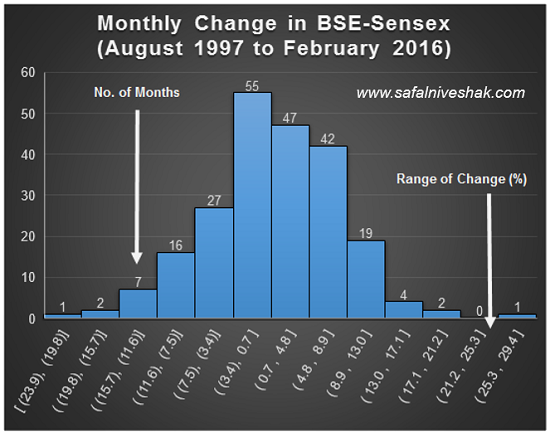
If you consider the following BSE-Sensex data – monthly changes between August 1997 and February 2016 – you will notice that of the 222 months that have passed, the index has been ‘volatile’ for most of them – I am defining volatility here as ‘greater than 5%’ rise/decline in the Sensex value (yes, sharp rise in stock prices is also volatility). In fact, if I consider the months that most people will associate with turbulence, or when the Sensex fell by over 5%, these constitute more than 20% of the universe.


How to read the chart – Look at the tallest bar. The BSE-Sensex has fluctuated between -3.4% and +0.7% in 55 months during the period August 1997 to February 2016
So it hasn’t been a clear, trouble-free ride all the way, even if you had held what a lot of people would erroneously call ‘safe’ – an index fund (the Sensex, by the way, has clocked a CAGR of 9.1% since August 1997, or around 18.5 years). Even for investors who have ridden a few 50 or 100-baggers during this period, the journey has been marred with occasional, deep turbulence.

Thomas Phelps concluded the first chapter of his book – 100 to 1 in the Stock Market – with this powerful thought from George F. Baker –

To make money in stocks you must have “the vision to see them, the courage to buy them and the patience to hold them.”

Patience – or the ability to keep on with your investment process despite the occasional periods of turbulence or euphoria – is the rarest of the three, but it pays off in the long run.

Buffett wrote in his 2014 letter –

It is true, of course, that owning equities for a day or a week or a year is far riskier (in both nominal and purchasing-power terms) than leaving funds in cash-equivalents. That is relevant to certain investors – say, investment banks – whose viability can be threatened by declines in asset prices and which might be forced to sell securities during depressed markets. Additionally, any party that might have meaningful near-term needs for funds should keep appropriate sums in Treasuries or insured bank deposits.

For the great majority of investors, however, who can – and should – invest with a multi-decade horizon, quotational declines are unimportant. Their focus should remain fixed on attaining significant gains in purchasing power over their investing lifetime. For them, a diversified equity portfolio, bought over time, will prove far less risky than dollar-based securities.

As the old stock market adage goes, “When they raid the house of ill repute, even the piano players, and the cook go to jail.” But if they get a good judge, the piano player and the cook will be out in no time.

Every time you are deciding on an investment, the question you must ask yourself isn’t “Will my investment go up or down?” — because of course it will. The question you must ask is, “Will the fact that this investment may go up and own bother me enough to do something dumb?”

Howard Marks started his latest memo thus –

My buddy Sandy was an airline pilot. When asked to describe his job, he always answers, “hours of boredom punctuated by moments of terror.” The same can be true for investment managers…

If you are looking to achieve some success in stock market investing, you should be able and willing to face moments of terror like you face good times, and both with equanimity.

The post How to Deal with Stock Market Turbulence appeared first on Safal Niveshak.

    
03 Feb 04:28

Income Tax for AY 2016-17 or FY 2015-16

by bemoneyaware

This article talks about Income Tax for AY 2016-17. The tax rates are applicable on the income earned during 1 April 2015-31 march 2016. The assessment of income tax according to this slab rate will be done in the year 2016-17 by filing Income Tax Return or ITR by 31 July 2016. Your total income shall be taxed according to the income tax slabs applicable for this year FY 2015-16. This article talks about Tax slabs for Financial year 2015-16 or Assessment Year 2016-17, gives Overview of Income Tax,Focuses on Income Tax for a Salaried Employee on HRA,LTA , Medical exemptions and submission of proof to employer.

Tax slabs for Financial year 2015-16 or Assessment Year 2016-17

Every individual whose total income before allowing deductions under Chapter VI-A of the Income-tax Act, exceeds the maximum amount which is not chargeable to income tax is obligated to furnish his return of income. The maximum amount not chargeable to income tax in case of different categories of individuals is given below. Other than increase of Surcharge from 10% to 12% for income tax when taxable income is more than 1 crore there is no change in the tax slabs compared to FY 2014 or 2015-16. The tax calculator can be used to find your tax liability.

TAX MEN and WOMEN SENIOR CITIZEN(Between 60 yrs to 80 yrs) For Very Senior Citizens(Above 80 years)
Basic Exemption 250000 300000 500000
10% tax 250001 to 500000 300001 to 500000
20% tax 500001 to 1000000 500001 to 1000000 500001 to 1000000
30% tax above 1000000 above 1000000 above 1000000
Surcharge 12% of the Income Tax, where total taxable income is more than Rs. 1 crore
Education Cess  3% on Income-tax plus Surcharge.

Some changes in deductions in FY 2015-16

  • Exemption of transport allowance increased from Rs 800 pm to 1600 pm
  • Investment in Sukanya Samriddhi Scheme will be eligible for deduction u/s 80C and any payment from the scheme shall not be liable to tax.
  • Limit of deduction u/s 80D of the Incometax Act increased from Rs 15,000 to Rs 25,000 on health insurance premium (in case of senior citizen from Rs 20,000 to Rs 30,000).
  • The limit of deduction increased in case of very senior citizens u/s 80DDB of the Income-tax Act on expenditure on account of specified diseases from Rs 60,000 to Rs 80,000.
  • The limit of deduction increased u/s 80DD of the Incometax Act in respect of maintenance, including medical treatment of a dependant who is a person with disability, from Rs 50,000 to Rs 75,000.
  • The limit of deduction increased from Rs 1 lakh to Rs 1.25 lakh in case of severe disability
  • the limit of deduction increased u/s 80CCC of the Incometax Act on account of contribution to a pension fund of LIC or IRDA approved insurer from Rs 1 lakh to Rs 1.5 lakh.
  • the limit of deduction increased u/s 80CCD of the Incometax Act on account of contribution by the employee to National Pension Scheme (NPS) from Rs 1 lakh to Rs 1.50 lakh.
  • Also a deduction of upto Rs 50000, under new section 80CCD(1B), over and above the limit of Rs 1.50 lakh in respect of contributions made to NPS is provided for. Therefore for financial year 2015-16, Total Deduction under Section 80C, 80CCC, 80CCD(1) and 80 CCD(1B) is Rs 2,00,000. From assessment year 2012-13, Employer’s contribution under section 80CCD(2) towards NPS is outside the monetary ceiling mentioned above. Our article Should you Invest in NPS the National Pension Scheme for additional 50,000 and save tax talks about it in detail.

Information about the ITRS would be made available in April once the new Forms are released.

Overview of Income Tax

Time period for earning the income is between 1 Apr to 31 Mar of next year. So here we will be focussing on Income earned between 1 Apr 2015 to 31 Mar 2016, which is called FY 2015-16, PY 2015-16 or Assessment Year 2016-17. The return for income earned will be filed by 31 st July 2016.

Who pays the income tax: Income-tax is to be paid by every person. The term ‘person’ as defined under the Income-tax Act covers natural as well as artificial persons. For the purpose of charging Income-tax, the term ‘person’ includes Individual, Hindu Undivided Families [HUFs], Association of Persons [AOPs], Body of individuals [BOIs], Firms, LLPs, Companies, Local authority and any artificial juridical person not covered under any of the above.

As per Income tax laws, there are five kinds of Income:

  • Salary by working for someone or Pension having worked for someone, comes under category of Income From Salary. Proof is Form 16 and Form 12BA
  • Selling items like gold, house comes under category of Income from capital gain
  • Having a house or many houses  comes under category of Income from House Property
  • Having a business or profession ex shop, doctor, consultant comes under category of Income from Business or Profession
  • Having income which does not fit into any of above category,comes under the category of Income From Other Sources. Such as interest on Bank Account, Interest on Fixed Deposits, Dividends from companies, Family pension ,Insurance commission,Income from royalty,gift amount etc.

The Income Tax Act, 1960 allows you to save tax by investing your income.   Depending on where you invest , the maximum amount, section of Income tax act which governs it changes For example :

  • Under Section 80C,80CCD, 80CCC, 80CCCE etc one can save tax by investing upto 1 lakh in different options, each suited to a different need. One can choose a combination of fixed income, life insurance and market-linked investments depending on one’s financial goals and investment horizon.
  • Under Section 80D one can save tax by paying Premium for health insurance of youself, your spouse, children or dependent parents
  • Under Section 80E one can save tax if one has taken Education Loan
  • Under Section 80G one can save tax if one has donated money to charity.
Income Tax Section Gross Annual Salary How Much Tax Can You Save?
Sec. 80C Across all income slabs Upto Rs  46,350 saved on investment of Rs. 1,50,000
Sec. 80CCC Across all income slabs Upto Rs 30,900 saved on Investment of Rs 1,50,000
Sec. 80 D Across all income slabs Upto Rs 10,815 saved on investment of Rs 35,000
(Inclusive of Rs. 20,000/- towards health insurance of parents who are senior citizens)

Everyone does not have to pay same tax. Income tax depends on the

  • Income earned, more the income, more the tax.
  • Residence(india/non-resident India) : You’re considered a Resident in a financial year if you satisfy one of the conditions below. You are an NRI or Non Resident Indian, if you do not meet any of these conditions.An exception is made for Indian citizens working abroad and members of a crew of an Indian ship or a PIO visiting India, where 60 days is replaced with 182 days.
    • You are in India for 182 days or more during that financial year OR
    • You are in India for 60 days or more during that financial year AND you are in India for at least 365 days during the 4 years preceding that financial year.
  • It also varies with with age: Based on Age there are three categories, Ordinary(below 60 years),Senior Citizen(age between 60 years to 80 years), Super Senior Citzien(above 80 years). If an Individual attains the age of 60 years or 80 years during the financial year, his age shall be regarded as 60/80 (as the case may be), for that whole Financial Year. For the purpose of ascertainment of the applicable tax slab, For FY 2015-16 or AY 2016-17 an individual can be classified as follows:
      • Ordinary: Resident individual below the age of 60 years. i.e. born on or after 1.4.1956
      • Senior Citizen: Resident individual of the age of 60 years or above at any time during the year but below the age of 80 years. (i.e. born during 1-4-1936 to 3 1-3-1956)
      • Super Senior Citzien(above 80 years) : Resident individual of the age of 80 years or above at any time during the year. i.e. born before 1.4.1936
      • Non-resident individual irrespective of the age.
  • Gender(male/female) : No difference in tax for men or women
  • Financial year : The income tax rates are usually revised every year during the Budget.

How to compute Income Tax

Steps involved in Computation of Income Tax are as follows. The tax calculator can be used to find your tax liability.

  • Computation of total income.
      1. Subtract the exemptions of HRA, Conveyance and Medical expense from the gross salary.
      2. Add the extra income of interest, commission and bonuses, if any.
      3. Add the rental income, if any.
      4. Add the capital gains, if any.
      5. Add Interest from all Saving bank accounts. Subtract 10,000 from the sum.
      6. Add Income from other sources: Interest on FD, RD etc.
  • Deducting valid deductions.
  • Determination of the tax payable thereon.
  • Deducting TDS. Verifying Tax already paid such as TDS deducted from Salary income, From FD.
  • Paying the tax.
  • Filling Income Tax Return Form

Image below shows the tax calculation for an employee with salary of 12 lakh for FY 2014-15 and FY 2015-16. By paying Medical Insurance of Rs 25,000 and Investing in NPS under 80CCD he is able to save around 15,000 Rs tax more.

Example of Income tax calculation for one with income of 12 lakh

Example of Income tax calculation for one with income of 12 lakh

Income Tax for Salaried Employee

An overview for income tax Salaried employee is given here. Money earned by working for someone or by receiving Pension after having worked for someone, comes under category of Income From Salary.

  • Money that is received under Employer-Employee relationship is called as Salary.  If one is freelancer or is hired by an organization on contract basis, their income would not be treated as salary income. In such case the  income is treated as income from business and profession.
  • The salary consists of Basic Salary, Allowances and Perquisite.
  • Employer deducts TDS on the income every month.
  • There are various Kinds of Allowances that one can get under the Head Salary some of which are exempt partially or fully. Some popular Allowances are House Rent Allowance or HRA, Conveyance allowance,Leave Travel Allowance.
  • One can also claim benefit of Interest on Home Loan , Income Tax Deductions from Sec 80C to 80U. One needs to submit proof to the employer to claim these deductions.
  • Proof of Income from Salary,TDS, Allowances and Deductions claimed is Form 16 and Form 12BA which is given by the employer sometime in May 2016 . You must verify Form 26AS.

Exemptions a salaried employee can claim

  • HRA Exemption for Salaried Employees : House Rent Allowance or HRA is given by the employer to the employee to meet the expenses of rent of the accommodation which the employee has taken for his residential purpose. A portion of the House Rent Allowance is exempted from the levy of the Income Tax. To claim HRA exemption, If you are paying rent of  more than Rs 8,333 per month you need to provide landlord’s PAN  Landlords without a PAN must be willing to give you a declaration.  If you pay house rent to your spouse, this does not qualify for exemption. But you can claim exemption on rent paid to others including parents, brother, sister in-laws etc. Our article HRA Exemption for Salaried Employees discusses it in detail.
  • Leave Travel Allowance :Many employers  also give allowance, called as Leave Travel Allowance, to their employees to go on a vacation in India with their family which is exempted from tax.  Only the travel costs are covered so expenses on hotel rooms, sightseeing, food, etc, cannot be included. You can claim exemption for up to two journeys in a block of four calendar years. The new block started on January 1, 2014 and will end on December 31, 2017.  This amount can only be claimed through the employer, if the employee actually goes on a vacation in India and bills for the same has to be furnished. Our article What is Leave Travel Allowance or LTA discusses it in detail.
  • Medical Bills: You can claim income tax relief for your medical expense depending on whether the employer pays medical allowance or reimburses the bills. For the purpose of medical expenses a family is defined as the spouse and children of the employee. The employee’s parents and siblings of the employee can also be considered for such benefits but the condition is that they need to be completely dependent on the employee. Please claim these by submitting bills to your employer.
    • Medical reimbursements are the actual amount that the employer’s gives to an employee when they submit bills for medical treatment availed. Medical reimbursements are exempt from taxes till the limit defined by the IT Act, which is Rs. 15,000.
    • Medical Allowance: Many employers don’t provide reimbursements. They pay their employees a fixed amount, in their monthly salary, as medical allowance. This payment can be of Rs. 1,250 a month or Rs.15,000 a year. If the employee incurs medical expenses then the amount up to Rs 15,000 is exempt from taxes. . For example: An employee,whose company pays Medical allowance, suffers from Typhoid and is ill for a few weeks. His treatment and the medicines cost him Rs. 5,000. He retains all the bills relevant to his treatment and when he gets back to work he submits them to his company. In this case, since the medical allowance is already paid to him as a part of the salary, he will not have to claim the amount. He will instead get tax benefits for the Rs. 5,000 spent on the treatment. If he submits no other bills then the remaining Rs. 10,000 of the medical allowance will be liable for tax.

Investment Proof Submission to Employer

Please plan you tax liability at the beginning of financial year. Calculate how much tax you need to save under 80C and other sections like 80D for medical insurance premium. Don’t rush at last minute and buy Insurance policy just to save tax. Before Buying Insurance Policy to Save Income Tax Our article Income Tax Proof Submission to the Employer discusses it in detail.

  • The employers asks employees for declaration of the their proposed investments for tax exemptions/deductions from employees in the beginning of the financial year (April itself) . Based on your declaration and the investments that qualify for deductions and exemptions, your employer deducts tax on your salary every month.
  • E-filing : Excel File of Income Tax Return,
  • By December or January employer asks for submission of the proofs for all proposed tax saving investments. If you submit proof to your employer for amount less that declared , employer will recompute your tax liability and deduct more tax in remaining months. If you submit proof to your employer for amount more than declared , employer will recompute your tax liability and deduct less tax in remaining months. If Your tax liability is not recomputed or somehow you still have extra tax paid you can claim it while filing income tax return.
  • You can share your saving bank interest, FD/RD interest earned during year, any capital gains from shares or mutual fund, rental income and other kind of incomes with your employer, so that they get a complete picture of your taxable salary/Then your employer would recalculate your tax liability and also pay tax on your other investments like FD on your behalf. But if you don’t then you need to pay the tax due yourself through Challan 280 either as Advance Tax or Self Assessment Tax.

To calculate how much to save under 80C

80C has overall limit of 1.5 lakh. While calculating amount you need to save please consider your EPF contribution. If you have bought some life insurance policy, then you claim it too.

Amount you need to save : 1,50,000 – Employee EPF contribution – Tuition fees for two children – Principal of Home Loan – Life Insurance Premium -Stamp Duty , Registration charges of new House.

Income Tax on Leaving a Job

When a person switches the job in between the financial year i.e between 1 Apr 2015 to 31 Mar 2016, he would get two Form 16, one from previous employer and one from new employer. He might also get leaves encashed and Gratuity.

  • Exemption on Encashment of Leaves for Salaried Employees : Most employers give all their employees a certain no. of days which can be claimed as leaves. However, in case a person does not claim these leaves, many employers also give their employees the option for en-cashing these leaves i.e. the employers pays extra to the employees for the leaves which were allowed to be taken but were not taken.This amount received as Leave Encashment is also allowed to be claimed as an exemption up to a certain extent. Our article Encashing Earned Leaves : Exemption and Tax covers it in detail.
  • Income Tax Exemption on Gratuity for Salaried Employees : Gratuity is a gift made by the employer to his employee in appreciation of the past services rendered by the employee. Gratuity can either be received by The employee himself at the time of his retirement or leaving job a)after 5 years of working with the same employer or b) The legal heir at the time of the death of the employee. Our article What is Gratuity? covers it in great detail.
  • Multiple Form 16: When you change job in a financial year you need to make sure that the deductions and exemptions regarding tax liability are made only once. Our article Changing Jobs and Tax, Form 12B talks about how basic exemption is accounted by two employers, correct way to calculate tax when one switches jobs, how Form 26AS will have multiple entries. It is better to give a copy of your full and final settlement from previous employer to new employer so that new employer can take care of tax liability and you have to refer to just one Form 16 while filing ITR. Else you will have to take care of it while filing ITR. Our article How to Fill ITR when you have multiple Form 16 talks about filling ITR with multiple Form 16.
  • EPF: It is best if you submit your UAN number to your new Employer so that new Member ID is linked with it. And transfer your EPF account. If you withdraw before 5 years of contribution to EPF the withdrawal is taxed and you have reverse earlier 80C deductions.

A video (14 min) by bemoneyaware on Understanding what is income and Income slabs

03 Feb 03:43

Why PMGSY (rural roads scheme) has performed better than MGNREGS (rural jobs scheme)?

by Amol Agrawal
Mr. NC Saxena has a nice detailed post on the topic. He goes into the details of the two government schemes and points why PMGSY (Pradhan Mantri Gram Sadak Yojana) is better than MGNREGS (Mahatma Gandhi National Rural Employment Guarantee Scheme): The central hypothesis that I wish to explore in this paper is that when a programme […]
02 Feb 04:54

The decision paralysis example of the day

by noreply@blogger.com (Gulzar Natarajan)
As the Non-Performing Assets (NPAs) of India's banks mount and the RBI has allowed them to assume majority equity stakes through the Strategic Debt Restructuring (SDR) mechanism, the role of Asset Reconstruction Companies (ARCs) assumes greater significance. But so far ARCs have made limited headway in the Indian market, with the 15 existing private ARCs having a combined net worth of just Rs 40 bn and have been able to resolve just a third of their acquired assets. 

In this context, this quote in the Indian Express gets to the heart of the challenge,
Public sector banks are scared to sell to private ARCs for fear that the quantum of hair cut can always be questioned by the government’s auditor, vigilance or at worse be probed by the intelligence agencies.
This is very relevant in a bureaucratic environment where every decision is likely to be subjected to post-facto scrutiny, often many years later and completely divorced off its context. Consider the case where an ARC makes windfall gains from one of its assets. A malicious complaint can trigger an enquiry. An auditor, with limited awareness of the context, can attribute presumptive loss and fault the decision by the bank management to take haircuts. An investigating agency with no professional competence to investigate the issue could find fault with the magnitude of the haircut or not having given the asset to a public ARC or managed itself. A humiliating media trial confined to headlines follows.

Construction of such counterfactuals and hindsight with half-knowledge creates a moral hazard which engenders, at best, sub-optimal decision making, and, at worst, decision paralysis. In this environment, vitiated further by deep political acrimony, it is highly unlikely that a large scale program of distressed asset sales from public sector banks to private firms can be pulled off. The systemic constraints, relaxation of which may be beyond administrative and legislative actions, are just too binding. On the issue itself, here is more on what needs to be done to enable the market for ARCs in India.
Add to Technorati Favorites
01 Feb 10:29

Process, Practice, Perseverance

by Anshul Khare

Have you ever wondered why a doctor’s clients are called ‘patients’? Even a more interesting question, why do doctors call their work as ‘practice’?

Well, one of the reasons is that you can’t become a good doctor without practicing what you learn in textbooks. For that matter, any work done under any profession is nothing but practice. And that doesn’t exclude investing in the stock market.

I recently read a nice post from John Huber on his investment process. Here’s something John wrote that caught my attention –

…stop trying to read everything under the sun and get out there and actually start investing—start valuing companies, make investments, learn, repeat, etc…Whether you’re playing the piano, hitting a sand wedge, shooting a jump shot, riding a bike, or even driving a car—the way you learned was through repetition. The same can be said for valuation. Reading books is fine, doing case studies is better, but actually valuing companies and making investments—practicing—is the best way to learn.

This made me rethink how I am spending my time. Reading about investing is not investing. It only assists in investing and beyond a point it starts becoming counter-productive if I am not applying what I read.

So what distracted me from practicing investing till some time back?

One thing that I figured in my case was impatience. I expected that any investment research work that I did had to yield result – in form of accepting or rejecting the idea – immediately. I expected my research process to end at a decision. What I forgot was that investing process is non-linear.

Investing Knowledge is Cumulative
As I have realized in my interactions with Vishal and other value investors, the best part about investing is that no effort goes waste. If you spent one month evaluating a business, reading everything about it, running through the numbers, estimating the value, and ended up discarding it – it’s not a waste of time. It’s time well spent.

John writes in his post –

Our investment results in investing are due to work and effort that has been accumulating for years. Buffett was reading Bank of America reports for decades before ever buying a share. The work that I am doing today is not going to pay off tomorrow. It is going to pay off at some unknown time in the future.

What makes value investing versatile is that all the knowledge that you gain while studying businesses is cumulative. When you study a business, even if you end up rejecting it, you gain important knowledge about the industry in which that business operates and at the very least learn more about characteristics of poor businesses.

Noted value investor Mohnish Pabrai, in his book The Dhandho Investor, describes how his knowledge about oil shipping industry (which he gained while researching a stock that he eventually didn’t invest in) helped him find another bargain later. He wrote –

I knew nothing about the oil shipping business, but was curious to find out more about the industry and why these businesses had such high dividend yields. I spent a few days studying Knightsbridge and the oil shipping business…Knightsbridge was making astronomical profits at the time, and the dividend yield went through the roof. But, of course, it was not durable or sustainable. At the time I studied Knightsbridge, I also took a look at half a dozen other publicly traded pure plays in oil shipping. Since the dividend could go to zero, Knightsbridge was an easy pass.

In investing, all knowledge is cumulative. I didn’t invest in Knightsbridge, but I did get a decent handle on the crude oil shipping business. In 2001, we had an interesting situation take place with one of these oil shipping companies called Frontline. Pabrai Funds had a 55 percent return on the Frontline investment and an annualized rate of return of 273 percent. Not bad for a near risk-free bet based on boning up on the nuances of oil shipping by reading a few documents.

In our interview with Ian Cassel, when we asked him how he went about finding his investment ideas, he said –

I find ideas through a combination of: word of mouth, private message boards (MicroCapClub), public message boards, reading filings and press releases, screens, and serendipity. I wish I could tell you there was a one best way to find ideas but it’s really the combination of all these things. You just need to put in the work and turn over a lot of rocks.

In my countless discussions with Vishal on how he works on finding his own stock ideas, he has credited a lot to serendipity and cumulative knowledge that he has built up over the years by reading and analyzing companies from various industries. He tells me –

Over a period of time, if you continue to read, study, and analyze businesses, small bulbs keep lighting up in your mind and you are able to connect them well to form ideas that you never thought existed.

Press On!
Einstein said –

It’s not that I’m so smart, it’s just that I stay with problems longer.

The former US President Calvin Coolidge said –

Nothing in the world can take the place of persistence. Talent will not; nothing is more common than unsuccessful men with talent. Genius will not; unrewarded genius is almost a proverb. Education will not; the world is full of educated derelicts. Persistence and determination alone are omnipotent. The slogan Press On! has solved and always will solve the problems of the human race.

So don’t worry if you haven’t found any businesses worth investing after spending weeks and months together analysing and rejecting couple of dozen stocks. If you keep at it, the day is not far when you’ll be connecting the dots faster than you imagined.

Press on!

The post Process, Practice, Perseverance appeared first on Safal Niveshak.

    
01 Feb 10:28

Rajan's tough messages: will the government buy in?

by T T Ram Mohan
RBI Governor Raghuram Rajan used the CD Deshmukh memorial lecture end of last month to send out some tough messages on the economy and the banking sector. Some of it is familiar enough but those wanting to know where he stands in relation to major policy questions today would do well to go through the speech.

Growth and inflation: Rajan thinks we need to put stability ahead of growth at this point. Trying to grow at more than 7% through resort to fiscal or monetary stimuli could endanger stability. Higher fiscal deficit and higher borrowings could raise the debt to gdp ratio. Monetary stimulus could lead a to resurgence of inflation.

He thinks neither savers nor businessmen should complain about interest rates. In real terms, savers are better off. And businessmen are seeing profits rise even while revenues fall because input costs are falling even more. This may be true for some businesses but not all (as the governor concedes). The fact, remains, however, that the real interest rate for investors (which would be nominal interest rate adjusted for WPI) is rising because WPI is in negative territory. This does cripple investment, which is the area where we have maximum pain at the moment.

Yes, the international situation is grim. But I doubt that the government can settle for 7% growth for long. Job creation is crucial to the PM's agenda. And 7% growth won't give us the jobs we need. The government may accept a low growth rate in the third year of its tenure. But, in the last two years, it will want to press the accelerator. Then, the stability argument won't wash. What if the international environment remains adverse next year? Will the government forsake monetary and fiscal stimuli? I doubt very much.

Banks and stressed assets: Rajan reiterated the need to clean up banks' balance sheets. This means recognising NPAs in full and providing for them. But this means an erosion in banks' capital. On this, the Governor has an interesting take. He thinks the government may not have to chip in a great deal on top of what it has committed. Other sources (the capital markets?), he thinks, can provide some. Plus, he thinks there are several assets the banks have that the RBI would be willing to count towards regulatory capital provided the banks have met the common equity norms. I am not very sure about this. First, I think the infusion by government will have to greater than the Rs70,000 crore the government has committee to under Indradhanush. Secondly, I don't know how the market will view the other sources of capital that the RBI proposes to include towards regulatory capital. Thirdly, these may suffice to keep the banks afloat but lending will be sluggish unless there is significant infusion from government- remember, you need a buffer of about 5 percentage points over the regulatory minimum if you want banks to take risks with loans.

Bank governance: On this sensitive subject, the Governor has been content with posing several questions. 
....should boards not determine strategy as well as the appointment or renewal of their chief executive? What about their executive directors? Can bank boards have more freedom in choosing these? Can boards be given the freedom to set compensation structures and performance measures for their senior executives, including long term stock options?
He wants PSB board members to be paid better, an incontrovertible proposition. Why they continue to be paid Rs 5000 as sitting fee must rank among the mysteries of government in India.

On a lighter note, the RBI governor refers to a recent scam that involves ripping off gullible individuals. I couldn't help chuckling although it's no laughing matter:
Many of you must have received an email from me saying that the RBI had concluded a pact with the IMF or the British Government to take over the gold found on pirate ships in the sixteenth century, sell it, and give the proceeds to deserving citizens like you. In return for a small transaction fee of ₹ 20,000, the email goes on, I would be happy to transfer the sum of 50 lakh rupees into your bank account. Without pausing to think why I need ₹ 20,000 when I supposedly have ₹ 50 lakhs of your money with me, some of you send ₹ 20,000 as requested into an untraceable account. My office then gets repeated phone calls from you asking what happened when the ₹ 50 lakhs does not show up. The truth is that we are all gullible – no amount of warnings that the Reserve Bank does not ask you for your money helps. The central theorem of financial literacy is “There is no such thing as a free lunch”. In the context of financial investments, it can be restated as “There is no return without risk”. We need to imprint these two statements in everyone’s head and we intend to roll out campaigns to do so.


01 Feb 07:08

Weekend reading links

by noreply@blogger.com (Gulzar Natarajan)
1. Despite concerns about its decline, Apple dominates the global smart phone market,
Among leading smartphone manufacturers, Apple takes 60 percent of the sector's revenue on just 20 percent of the sector's unit sales (or about 14 percent of the world's overall smartphone market). Samsung, on the other hand, snares 26 percent of the sector's revenue, on 43 percent of the sector's unit sales.
2. The WSJ captures the increasing weakness among emerging market economies as reflected in the successive downward revisions of their growth projections by the IMF.
3. For all talk of China's debt stricken corporates, India's corporate debt servicing problem is worse than that of Chinese firms, and has remained at that level for more than three years.
4. An OECD policy note finds that financial expansion fuels greater income inequality, and advocates the use of macro-prudential instruments to prevent credit over-expansion and eliminating the tax bias against equity (interest payments are deductible from income tax payable, whereas dividends are not). It also "supports measures to reduce explicit and implicit subsidies to too-big-to-fail financial institutions through break-ups, structural separation, capital surcharges or credible resolution plans". Underlining the skewed nature of its effect, a 10% of GDP expansion of financial sector credit has a positive effect on incomes of only the top decile of households.
5. Thomas Piketty's book elevated the problem of widening inequality to the center of public policy debates across the world. However, the consensus on its contributors, leave aside how to mitigate it, elides us. Skill-biased technological change, automation of middle-class jobs, greater financialization, weakening unions, greater returns to capital complemented with stagnating labor incomes etc have been blamed. In this context, Mathew Rognlie (paper here) has this compelling graphic which spotlights attention on the role of housing prices as contributing to the inequality wedge.
As the graphic shows, Rognlie argues that "recent trends in both capital wealth and income are driven almost entirely by housing". It does not depreciate whereas modern technology investments depreciate rapidly. He, therefore, advocates liberalization of zoning and building regulations to lower property prices. Irrespective of whether it is the leading contributor to widening inequality or not, its can be safely presumed that greater deregulation of the property market has so many beneficial effects. 

6. The latest NSSO data draws attention to India's chronic under-employment problem. Though there were 62 million graduates and post-graduates in 2011-12, formal unemployment rate was less than 5%, since a large share of them are employed in occupations which clearly do not need such educational qualifications. Livemint has the followin graphic about the occupation patterns of Indians.
Underlining this, just 35.4% of graduates and above have regular salary paying jobs.
7. There are very few large low-hanging fruits with public sector reforms in India. One exception may be Indian Railways and the potential benefits and savings from a series of cumulative operational reforms. Rationalization of trains and routes, increasing speed by reducing stoppages, radically improving its IT systems, outsourcing services, more efficiency manpower deployment, and so on have massive potential for unlocking value. This is apart from more macro and policy-oriented reforms like private participation, PPPs in the development of railway stations, high-speed rail etc. 

The challenge is with the political economy of these reforms. One strategy may be to undertake a devolution of far greater powers to the eighteen zones, especially operational powers, leaving the Railway Board with minimal co-ordination responsibilities. Letting zones develop as cost-centers and fostering competition among them in both commercials and service delivery quality is more likely to create the conditions required to overcome the political economy obstacles. Allowing a few mutant General Managers to change the rules of their game is a more likely strategy for change. 
Add to Technorati Favorites
01 Feb 07:06

Occam's razor of public policy

by Ajay Shah
Occam's razor is the idea that when two rival theories explain a phenomenon, the simpler theory is to be preferred. Aristotle's epicycles fit the data as well as Kepler's ellipses, and a pure empiricist could have been agnostic between the two. Occam's razor guides us in preferring Kepler's ellipses on the grounds that this is a simpler explanation.

In the world of public policy, a useful principle is:

When two alternative tools yield the same outcome, we should prefer the one which uses the least coercion.

Example: Punishment


When we want to drive the incidence of a certain crime to the desired rate, we want to find out the lowest possible punishment that gets the job done. You can reduce theft to desired levels by promising to cut off the hand of the thief. We would much rather achieve the objective using a reduced use of the coercive power of the State, with mere imprisonment.

The purpose of punishment is deterrence, not vengeance. And, in the class of deterrents, we seek to find the smallest possible use of the coercive power of the State that gets the job done.

Suppose 4 years of imprisonment and 2 years of imprisonment are equally able to get the incidence of a particular crime down to the desired level. Suppose a person says: I am not a liberal; I am not squeamish about using the coercive power of the State; I hate the people who commit such crimes; I don't care whether they get 2 years or 4 years in jail. But an $\alpha$ fraction of all convictions are in error. In these cases, we are inflicting the punishment upon an innocent. The harm is minimised when we have deployed the lowest possible punishment.

Example: Spending on government programs


All government spending is grounded in taxation, present or future. All taxation is grounded in the coercive power of the State. If there are two different spending programs that get the job done, we should favour the one which spends less.

Example: Infrastructure bonds


When the market for infrastructure bonds in India does not work, too often, solutions are proposed which use extreme force. Some people propose tax breaks. Some people propose harsh interventions such as forcing every bank to buy infrastructure bonds or forcing every bidder to NHAI to issue infrastructure bonds. As an example, we in India force insurance companies to buy infrastructure bonds.

If, on the other hand, we trace the failures of financial sector policy which have held back the market for infrastructure bonds, this would show how to get the job done while actually reducing State coercion (i.e. getting the State out of inappropiate coercion).

Example: The journey to cashless


Cash is an abomination and we should have a thousand flowers of electronic payments blossoming. India is one of the most backward places in the world in the domination of cash.

Tax breaks for electronic payments or high taxes for cash transaction or outright bans of cash transactions: these are all ways that get the job done using a lot of force.

If, instead, we understand the failures of financial sector policy which have hobbled the sophistication of payments in India, we will get the job done while actually reducing the use of the coercive power of the State. We would have less cash in India if RBI did not use the coercive power of the State to block the clever Uber cashless transaction.

Example: Family welfare


A government which runs counselling services on family welfare is using less coercion when compared with forcible sterilisation or a one-child policy.

How to reduce the use of coercion: go to the root cause of a market failure


Market failures can be addressed in many ways. When we go to the source, with well understood causal claims about the source of the market failure, we will find ways to address the market failure using the smallest use of the coercive power of the State.

If we don't have a deep understanding of the sources of the market failure, we may often endup hitting a symptom rather than the disease. Getting the job done may then require the use of a lot of coercion.

As an example, for some market failures that are rooted in information asymmetry, if an intervention can be found which rearranges the structure of information, this can get the job done using the least coercion.

Why are big punishments often favoured in India?


A person who thinks of violating a law to obtain an ill gotten gain $G$ faces a probability $p$ of being caught and the fine imposed upon him will be $F$. Standard economic arguments suggest that we must set $F = G(1-p)/p$. In this case, the expected gain from violating the law is 0, and a risk averse person will favour the certainty of compliance over the lottery of breaking the law.

In India, too often, the executive works poorly and $p$ is quite low. This creates a bias in favour of driving up $F$. This is giving us very large penalties. This induces its own problems. We are inflicting terrible harm on the $\alpha$ fraction of innocents who are wrongly convicted. We are giving great power to front-line investigators and judges at a time when institutional capacity is low.

If we are able to build institutional capacity for enforcement, and $p$ goes up, we will then be able to come back to lower punishments that generate adequate deterrence.

Why does Occam's Razor of Public Policy make sense?


  1. It is consistent with the liberal philosophy that desires that humans should be free to pursue their own life with the minimum interference.

  2. At best, governments work badly. The information available to policy makers is limited, many wrong decisions are taken, many decisions are poorly implemented. Governments do not know the preferences of citizens. Politicians and officials are self-interested actors and work for themselves. The Lucas critique comes in the way: rational actors change their behaviour when policy changes take place in ways that confound the original policy analysis. Many government actions fail to achieve the desired outcome, but they always have unintended consequences.

    It's good to be humble, and swing the smallest stick that would get the job done.

Limitations


All this, of course, presupposes that all use of coercive power of the State is a purposive activity aimed towards achieving a certain well specified objective. This is not always the case. As an example, the objectives of exchange rate policy or capital controls are hard to decipher. Before we get to discussion of more coercion vs. less coercion, it would be a great step forward if all government intervention were fully articulated in terms of market failure, objective of the intervention, demonstration of the causal impact of the intervention upon the objective, and cost-benefit analysis.

The examples above have featured comparisons where more versus less coercion is easy to identify. Amputation of the hand $>$ imprisonment for 4 years $>$ imprisonment for 2 years. Forcing banks to give out 40% of their loans into priority sector lending is more coercion than information interventions which make the credit market work for poor people. Opening up to private and foreign telecom companies is a way to get phones to everyone with less use of State coercion when compared with forcing banks to open accounts for everyone.

In many situations, however, it is not easy to identify which of two alternative policy pathways involves more coercion. A government program which educated parents that their kids should get immunised seems to involve lower coercion when compared with a forced immunisation program, but this is perhaps not the case when we envision an education program that must generate eradication of polio. A government program to educate young people about saving for old age involves less coercion than forcible participation in the NPS.

Conclusion


The State has a monopoly on violence and is the only actor who can coerce citizens to do things against their will. All public policy initiatives involve the use of the coercive power of the State. In the field of public policy, we should be humble about our lack of knowledge, respectful of the freedom of others, and use this power as little as possible.

Acknowledgements


I am grateful to Jeff Hammer, Shubho Roy and Renuka Sane for useful conversations.
01 Feb 07:00

Does Regulation Crowd out Private Ordering and Reputational Capital?

The crowdfunding portal Kickstarter commissioned an investigative journalist to write a report on the failure of Zano which had raised $3.5 million on that platform, and the report has now been published on Medium. I loved reading this report for the quality of the information and the balance in the conclusions. It left me thinking why London’s AIM market never published something similar on many of the failures among the companies listed there, or why NASDAQ never commissioned something like this after the dotcom bust, or why the Indian exchanges never did anything like this about the vanishing companies of the mid 1990s.

Is it because these highly regulated exchanges are protected by a regulatory monopoly and they can safely leave this kind of thankless job to their regulators? Or are they worried that an honest investigative report might be used against them because of the regulatory burden that they face? Does regulation have the side effect of crowding out the private ordering that emerges in the absence of regulation? Does regulation weaken reputational incentives?

In the context of crowdfunding, the reputational incentives and private ordering are well described in Schwartz’ paper on “The Digital Shareholder”:

These intermediaries [funding portals] want investors to have a good experience so they will return to invest again on their website, making them sensitive to a reputation feedback system. A funding portal with lots of poorly rated companies will find it difficult to attract future users to its site. Importantly, this appears to be an effective constraint for existing reward crowdfunding sites, such as Indiegogo, which take care to avoid having their markets overrun by malfeasance.

It is true that regulation does have positive effects, but the challenge in framing regulations is to avoid weakening private ordering.

31 Jan 09:03

Oil industry - this time is no different!

by noreply@blogger.com (Gulzar Natarajan)
Commodities markets are prone to the classic boom and bust cycle - economy booms/demand increases, prices rise, capacity expands, production soars, excess supply/economy weakens, prices fall, capacity expansion halts, and so on. The US shale market is the latest to fall victim. Shale oil production in the US soared on the back of rising global oil demand (China effect), rapid technological developments (hydraulic fracturing and horizontal drilling), and cheap capital. The FT writes,
Companies have achieved remarkable gains in productivity by optimising production techniques and drilling only in the “sweet spots” that generate the most. They have also been driving down the prices they pay their suppliers and contractors. Jim Burkhard of IHS, the research group, says the cost of drilling and completing a typical shale well fell 35-40 per cent last year...

US crude production rose from 5.1m barrels a day at the start of 2009 to 9.7m b/d in April last year, a surge that has few parallels in the industry’s history... The small and medium-sized companies that led the shale revolution raised $113bn from selling shares and $241bn from selling bonds during 2007-15, according to Dealogic... Low rates drove investment in marginal US shale projects “that are uncompetitive at lower prices and now need to be unwound”...

The boom years left the US oil industry deep in debt. The 60 leading US independent oil and gas companies have total net debt of $206bn, from about $100bn at the end of 2006. As of September, about a dozen had debts that were more than 20 times their earnings before interest, tax, depreciation and amortisation... Almost a third of the 155 US oil and gas companies covered by Standard & Poor’s are rated B-minus or below, meaning they are at high risk of default...

Private capital funds raised $57bn last year to invest in energy, according to Preqin, an alternative assets research service, and most of that money is still looking for a home... Bankruptcies, a cash squeeze and poor returns on investment mean companies will continue to cut their capital spending. The number of rigs drilling oil wells in the US has dropped 68 per cent from the peak in October 2014 to 510 this week, and it is likely to fall further... The US oil and gas industry has lost 86,000 jobs over the past year, about 16 per cent of its workforce, and many of those people will never return. When the industry does want to expand again, it will need to offer attractive wages and training, which will raise costs.
This is all predictable history, exactly the same storyboard as earlier episodes. There is nothing which warrants a belief that this time will be different with the rebound. The most compelling arguments in favor of a long period of low oil prices are secular stagnation in developed economies, the continuing decline of Chinese demand, and the full return of Iran and Iraq. All first is only a marginal contributor to the decline in demand, the second vastly over-played, and the third marginal and one-off. So the question is not whether oil prices will stay long for a long period or not, but when, over the next 1-3 years, will it start its rebound. 
Add to Technorati Favorites
31 Jan 09:01

Cheapness versus Economic Cyclicality

by David Merkel
Photo Credit: Paul Saad

Photo Credit: Paul Saad || What’s more cyclical than a mine in South Africa?

This is the first of a series of related posts.  I took a one month break from blogging because of business challenges.  As this series progresses, I will divulge a little more about that.

When I look at stocks at present, I don’t find a lot that is cheap outside of the stocks of companies that will do well if the global economy starts growing more quickly in nominal terms.  As it is, those companies have been taken through the shredder, and trade near their 52-week lows, if not their decade lows.

Unless an industry can be done away with in entire, some of the stocks an economically sensitive industry will survive and even soar on the other side of the economic cycle.  At least, that was my experience in 2003, but you have to own the companies with balance sheets that are strong enough to survive the through of the cycle.  (In some cases, you might need to own the debt, and not the common equity.)

The hard question is when the cycle will turn.  My guess is that government policy will have little to do with the turn, because the various developed countries are doing nothing to clear away the abundance of debt, which lowers the marginal productivity of capital.  Monetary policy seems to be pursuing a closed loop where little incremental lending gets to lower quality borrowers, and a lot goes to governments.

But economies are greater than the governments that try to milk them.  There is a growing middle class around the world, and along with that, a growing need for food, energy, and basic consumer goods.  That is the long run, absent war, plague, resurgent socialism, etc.

To give an example of how markets can decouple from government policy, consider the corporate bond market, and lending options for consumers.  The Fed can keep the Fed funds rate low, but aside from the strongest borrowers, the yields that lesser borrowers borrow at are high, and reflect the intrinsic risk of loss, not the temporary provision of cheap capital to banks and other strong borrowers.

It’s more difficult to sort through when accumulated organic demand will eventually well up and drive industries that are more economically sensitive.  Over-indebted governments can not and will not be the driver here.  (Maybe monetary policy like the 1970s could do it… what a thought.)

So, what to do when the economic outlook for a wide number of industries that look seemingly cheap are poor?  My answer is buy one of the strongest names in each industry, and then focus the rest of the portfolio on industries with better current prospects that are relatively cheap.

Anyway, this is the first of a few articles on this topic.  My next one should be on industry valuation and price momentum.  Fasten your seatbelts and don your peril-sensitive sunglasses.  It will be an ugly trip.

28 Jan 13:33

Continuous and barrier regulation

by SK

One of the most important pieces of financial regulation in the US and Europe following the 2008 financial crisis is the designation of certain large institutions as “systemically important”, or in other words “too big to fail”. Institutions thus designated have greater regulatory and capital requirements, thus rendering them at a disadvantage compared to smaller competitors.

This is by design – one of the intentions of the “SiFi” (systemically important financial regulations) is to provide incentives to companies to become smaller so that the systemic risk is reduced. American insurer Metlife, for example, decided to hive off certain divisions so that it’s not a SiFi any more.

AIG, another major American insurer (which had to be bailed out during the 2008 financial crisis), is under pressure from its activist investors led by Carl Icahn to similarly break up so that it can avoid being a SiFi. The FT reports that there were celebrations in Italy when insurer Generali managed to get itself off the global SiFi list. Based on all this, the SiFi regulation seems to be working in spirit.

The problem, however, is with the method in which companies are designated SiFis, or rather, with that SiFi is a binary definition. A company is either a SiFi or it isn’t –  there is no continuum. This can lead to perverse incentives for companies to escape the SiFi tag, which might undermine the regulation.

Let’s say that the minimum market capitalisation for a company to be defined a SiFi is $10 billion (pulling this number out of thin air, and assuming that market cap is the only consideration for an entity to be classified as a SiFi). Does this mean that a company that is worth $10 Bn is “systemically important” but one that is worth $9.9 Bn is not? This might lead to regulatory arbitrage that might lead to a revision of the benchmark, but it still remains a binary thing.

A better method for regulation would be for the definition of SiFi to be continuous, or fuzzy, so that as the company’s size increases, its “SiFiness” also increases proportionally, and the amount of additional regulations it has to face goes up “continuously” rather than being hit by a “barrier”. This way, the chances of regulatory arbitrage remain small, and the regulation will indeed serve its purpose.

SiFi is just one example – there are several other cases which are much better served by regulating companies (or individuals) as a continuum and not classifying them into discrete buckets. When you regulate companies as parts of discrete buckets, there is always the temptation to change just enough to move from one bucket to the other, and that might result in gaming. Continuous regulation, on the other hand, leaves no room for such marginal gaming – marginal changes aer only giong to have a marginal impact.

Perhaps for something like SiFi, where the requirements of being a SiFi are binary (compliance, etc.) there may not be a choice but to keep the definition discrete (if there are 10 different compliance measures, they can kick in at 10 different points, to simulate a continuous definition).

However, when the classification results in monetary benefits or costs (let’s say something like SiFis paying additional regulatory costs) it can be managed via non-linear funding. Let’s say that you pay 10% fees (for whatever) in category A and 12% in category B (which you get to once you cross a benchmark). A simply way to regulate would be to have the fees as a superlinear function of your market cap (if that’s what the benchmark is based on).


28 Jan 13:32

Money View App : Take Control of your Finances

by bemoneyaware

“”Its so difficult to manage money. What should I do – earn money, spend money, pay bills, manage money, invest, Grr! Ek akeli jaan aur itne saare kaam! ” We all would agree to the need to manage our money responsibly. We know how much have we earned this month? But how many of us know how much have we spent this month? This article talks about free Android App,Money View, which helps one to get control of the money.

Need to Manage our Financial Life

In our parents’ generation, financial life was simple, people earned less. Not many people took loans early in their lives and significant chunk of people had retirement benefits. But times have changed. People also have associations with multiple financial institutions – banks accounts, credit cards, investments, loans, etc. We have so many bills,mobile,broad band, electricity, EMIs. Remembering how much we’re carrying in our wallets is tough enough. Keeping a tab on how much we have in various accounts is difficult. Our financial life has also become very complicated. And hence the need to stay on top of your finances is higher but contrary to the older times, people spend less time in managing their finances. The fact is that it has also become more difficult to do it since one has to collate data from multiple sources, arrange it and keep it updating them manually. Tracking the data seems like a task by itself. My parents used to maintain a dairy. Now we use Excel sheets. But one feels like Abhimanyu caught inside the maze during Mahabharat war and often one just gives up!

There are many apps around in the Personal Finance space,such as Gullak, MyUniverse, Expense Manager, etc. in India and Mint in the US, which can be divided into two categories given below.

  • One that ask you to enter all the financial data – user has to add all the transactions, accounts, balances, etc. on a regular basis to create a view of their finances, difficult again!
  • Other that asks you to link your bank accounts by providing the user id and password , these apps then scrape your transaction data from your bank web site and then put together a view. People are scared to do so for security reasons.

The MoneyView App

Money View is an Android Application or App for financial management with a number of powerful features. In Jan 2016, it has over 3 million subscribers and its growing.The app is free to use but still offers full value for money to users. It does following

    • Track income
    • Keep a tab on expenses
    • Analyse spending pattern, Users can categorise expenses under different predefined heads like travel, gifts, dinner etc, or they can create their own categories. Based on the spending pattern so that users can track where most of their money is going.
    • Budget: To keep a check on the spending, users can set a monthly budget, and they can see how much of it has been spent and how much is remaining.
    • Remind them to pay bills on time, and even helping them pay the bills within the App itself.
    • App is user-friendly as it doesn’t require a login ID or password.
    • Gives a single view across all accounts -Bank accounts, credit cards and loans
    • Real-time account balances

Money View app removes that hassle, as it’s all automated.It also helps you plan your future spends. The bill reminder and the budget feature also help you.

MoneyView App: Your personal finance manager

MoneyView App: Your personal finance manager

How does MoneyView App Works?

For all the features supported by MoneyView, a user does NOT have to enter in their name or bank account details. The App collects all the information by tapping into a user’s SMS data. But there are no security or privacy issues involved.

We get SMS notification for all electronic transfers, ATM withdrawal, crediting of salary in your bank account, payments we make via debit card, credit card etc. And they lie dormant in our inbox. The app uses them to automatically track your income and expenses. It also has an option to manually key in the figures when the transaction is not electronic. The app also shows you the latest bank balance.

Is the Money View App safe?

MoneyView App has been built in such a way that it

  • Doesn’t have/store any of user personal information. It doesn’t ask your name or phone number. Nor does it have your full account number. The only personal information it has is your email ID.
  • The app doesn’t read the personal messages, OTP or bank login ID.
  • No one can make any transaction on your behalf.
  • Email ID of the users and their financial data are stored in different sets of servers. The only linkage between them is through the user’s phone. A human being can link the two only if you give him your phone ID.
  • There is no way it can know your bank balance and your spending pattern.

This YouTube video shows the features of MoneyView.

Use MoneyView App to Split bills

An interesting feature of the MoneyView App is the ability to split bills. We often eat out and party out with friends and colleagues. We have to worry about who owes how much. It is difficult to keep track of shared expenses, to split amount evenly or a different amount. And then sometimes our friends tell us that if you pay this time, the next expense is on them. You’ve probably make mental notes and they flutter away till next time. Sometimes even written notes are not of much help, there’s too much to calculate, and you lose track of your money. Moneyview offers the feature Split Expenses which makes splitting bills and keeping track of finances a breeze.

Split Expenses, lets you tag your friends on a particular spend, so you know exactly how much they owe you. The app incorporates your phone book contacts, so when you tag friends, it is against their numbers. Once tagged, the app will send an SMS to your friends about how much they owe you, and for what. So you don’t need to make excel sheet records, post-it notes, gentle reminders or send pay-up messages! Go Dutch with Split Groups. The Split Expenses feature allows you to:

  • Keep track of all the shared expenses
  • Tag your friends against the expense
  • Divide the amount equally or assign particular amounts to friends
  • Send notification to friends sharing the expense, stating the expense and the event
  • Allows you to update as “settled” when friends pay up
MoneyView App Split the expenses

MoneyView App Split the expenses

Developers of the MoneyView App

Money view App is brainchild of Puneet Agarwal and Sanjay Aggarwal. Puneet graduated from IIT-Delhi in 1995 and moved to the US to complete his MBA from Purdue University. He was in US for the next 15 years, working at different companies including McKinsey, Capital One, and Google, where he worked on Google Wallet. In 2013 after returning to Bangalore,India he reunited with his IIT senior, Sanjay Aggarwal, who was exiting his own venture, Minglebox. Together they co-founded their start up.

Money View was started in early 2014 with their first beta rollout in mid September 2014 and a general availability in Oct-Nov 2014. The two of them bootstrapped Money View and the first version of the app was built by just them. Just before the launch they started building the team and they are currently a 25+ member team. They have got Series A funding from tier 1 VC such as Tiger Global, Accel India and Ribbit Capital.

The App receives lot of feedback through Google Play Store. The co-founders say that “every single query is responded to and every user issue is resolved as quickly as possible. In fact, we typically start our days reading user comments and feedback and that sets the tone for the day”.

Details of the MoneyView App

You can download the MoneyView App from Google PlayStore here and read about MoneyView at it’s website moneyview.in

  • Size : 6.7M
  • Rating : 4.3
  • Current Version : Venus-1.7.3
  • Requires Android :4.0 and up

Features:

  • Simple: No Set-Up. No Manual Entry: Works automatically with Zero effort to provide a real-time view of your entire finances
  • Secure: Never reads personal messages, OTP or bank login ID. Industry leading security and privacy protection.
  • Manage all your bills, pay with single click .Timely reminders for bill payment
  • Track your spend, stay within budget
  • Supports all major banks

There is a need for financial discipline today, as spending money or taking loans is easy. So Money View App is a good way to start getting control of your money! Do you use any App for your finances? How do you track your spendings and bill payment? Did you use the MoneyView App? What features did you like or didn’t like? What more features you would like it to have? Share in the comments

28 Jan 13:30

On Currencies That Are A Store Of Value, But Maybe Not For Long

by David Merkel

I get letters from all over the world.  Here is a recent one:

Respected Sir,

Greetings of the day!

I read your blog religiously and have gained quite a lot of practical insights in financial field. Your book reviews are very helpful and impartial.

I request you to write blog post on dollar pegs in Middle East and under what conditions those dollar pegs would fall.

If in case you cannot write about it, kindly point me to some material which can be helpful to me.

Thanks for your valuable time.

Now occasionally, some people write me and tell me that I am outside my circle of competence.  In this case I will admit I am at the edge of that circle.  But maybe I can say a few useful things.

Many countries like pegging their currency to the US dollar because it provides stability for business relationships as businesses in their country trade with the US, or, with other countries that peg their US dollar, or, run a dirty peg of a controlled devaluation.  Let me call that informal group of countries the US dollar bloc. [USDB]

The problem comes when the country trading in the USDB begins to import a lot more than they export, and in the process, they either liquidate US dollar-denominated assets or create US dollar-denominated liabilities in order to fund the difference.

Now, that’s not a problem for the US — we get a pseudo-free pass in exporting claims on the US dollar.  The only potential cost is possible future inflation. But, it is a problem for other countries that try to do so, because they can’t manufacture those claims out of thin air as the US Treasury does.

Now in the Middle East it used to be easy for many countries there because of all the crude oil they produced.  Crude oil goes out, goods and US dollar claims come in.  Now it is reversed, as the price of crude is so low.  Might this have an effect on the currencies of the Middle East.  Well, first let’s look at some currencies that float that are heavily influenced by crude oil and other commodities: Australia, Canada, and Norway:

Commodity Currencies

As oil and commodities have traded off so have these currencies.  That means for pegged currencies the same stress exists.  But with a pegged currency, if adjustments happen, they are rather large violent surprises.  Remember the old saying, “He lied like a finance minister on the eve of the devaluation,” or Monty Python, “No one expects the Spanish Inquisition!”

That’s not saying that any currency peg will break imminently.  It will happen later for those countries with large reserves of hard currency assets, especially the dollar.  It will happen later for those countries that don’t have to draw on those reserves so rapidly.

Thus my advice is threefold:

  1. Watch hard currency reserve levels and project future levels.
  2. Listen to the rating agencies as they downgrade the foreign currency sovereign credit ratings of countries.  When the ratings get lowered and there is no sign that there will be any change in government policy, watch out.
  3. Watch the behavior of wealthy and connected individuals.  Are they moving their assets out of the country and into hard currency assets?  They always do some of this, but are they doing more of it — is it accelerating?

Point 3 is an important one, and is one seemingly driving currency weakness in China at present.  US Dollar assets may come in due to an excess of exports over imports, but they are going out as wealthy people look to preserve their wealth.

On point 2, the rating agencies are competent, but read their writeups more than the ratings.  They do their truth-telling in the verbiage even when they delay downgrades longer than they ought to.

Point 1 is the most objective, but governments will put off adjustments as long as they can — which makes the eventual adjustment larger and more painful for those who are not connected.  Sadly, it is the middle class and poor that get hit the worst on these things as the price of imported staple goods rise while the assets of the wealthy are protected.

And thus my basic advice is this: gradually diversify your assets into ones that will not be harmed by a devaluation.  This is one where your government will not look out for your well-being, so you have to do it yourself.

As a final note, when I wrote this piece on a similar topic, the country in question did a huge devaluation shortly after it was written.  Be careful.

27 Jan 06:23

Matt Levine describes my business idea

by SK

When I was leaving the big bank I was working for (I keep forgetting whether this blog is anonymous or not, but considering that I’ve now mentioned it on my LinkedIn profile (and had people congratulate me “on the new job”), I suppose it’s not anonymous any more) in 2011, I didn’t bother looking for a new job.

I was going into business, I declared. The philosophy (that’s a word I’ve learnt to use in this context by talking to Venture Capitalists) was that while Quant in investment banking was already fairly saturated, there was virgin territory in other industries, and I’d use my bank-honed quant skills to improve the level of reasoning in these other industries.

Since then things have more or less gone well. I’ve worked in several sectors, and done a lot of interesting work. While a lot of it has been fairly challenging, very little of it has technically been of a level that would be considered challenging by an investment banking quant. And all this is by design.

I’ve long admired Matt Levine for the way in which he clearly explains fairly complicated finance stuff in his daily newsletter (that you can get delivered to your inbox for free),  and more or less talking about finance in an entertaining model. I’ve sometimes mentioned that I’ve wanted to grow up to be like him, to write like him, to analyse like him and all that.

And I find that in yesterday’s newsletter he clearly encapsulates the idea with which I started off when I quit banking in 2011. He writes:

A good trick is, find an industry where the words “Monte Carlo model” make you sound brilliant and mysterious, then go to town.

This is exactly what I set out to do in 2011, and have continued to do since then. And you’d be amazed to find the number of industries where “Monte Carlo model” makes you sound brilliant and mysterious.

Considering the difficulties I’ve occasionally had in communicating to people what exactly I do, I think I should adopt Levine’s line to describe my work. I clearly can’t go wrong that way.


26 Jan 13:12

Make for India?

by noreply@blogger.com (Gulzar Natarajan)
Sometime back I had blogged highlighting the differences between making in India (for external markets) and making for India. In this context, a Project Syndicate article, which points to the possibility of China emerging as a global innovation hub, highlights the point,
Chinese companies have prospered in customer-focused industries because they have learned to tailor their goods to the needs of their country’s emerging consumer class. Whereas Chinese companies used to focus on designing products that were “good enough” – not quite matching the standard of Western products, but offering huge cost savings – they are now out to create products that are cheaper and better, in order to satisfy wealthier consumers. The sheer size of China’s market – comprising more than 100 million mainstream consumer households – also helps, as it enables companies to commercialize new ideas rapidly and on a large scale.
As numerous studies - SECC, Credit Suisse, Pew, and the government's own income tax database - show, India simply does not have a large enough, less price sensitive domestic consumer class that can sustain learning by doing involving world-class innovation. Given this country's narrow and deeply price-sensitive consumer base, that vast majority of manufacturing has to be stripped-down, less-than-world-class, and frugal to be competitive enough for the domestic market. In the circumstances, in the medium-term, even with the headwinds of competition from Chinese exports and weak domestic manufacturing competitiveness, a more realistic approach would be to promote making for India.

Update 1 (07.02.2016)
Arun Maira is the latest to talk about "Make for India".
Add to Technorati Favorites
26 Jan 03:24

If it takes time

by Muthu

In the long run, growth in stock markets would be on par with earnings growth of underlying companies.

Markets would deliver only what corporate India can deliver.

Our earnings growth currently is not worth mentioning. It is expected to pick up in a year or two.

In the short run, markets can be ahead of or behind earnings. So it is difficult for anyone to predict whether markets would be up or not, in next 2 years. It can be either way.

Once earnings start going up at decent rate, we can expect the market to mirror it. Again markets are capable of both mirroring it in advance or with a time lag.

It is not possible for us to predict the timing of these. It is not required either. We are disciplined investors who invest regularly across business and market cycles.

The present government is taking many right steps which should start reflecting on the ground in one to two years.

Though I do not know how the markets would be for next 2 years, I would suggest you to keep the expectations low.

If markets perform well despite our lack of expectation, it is well and good.

If it takes time to start performing, let us utilize the opportunity to acquire more units every month at lower price.

The long term future of this country is good. There are many peaks which we would be scaling in the years and decades to come.

At the same time, we’ll continue to go through business and market cycles. No asset class can escape cycles. People who thought real estate and gold are exception to the cycles, now realise it is not so.

Remember in a long term growth story like India, declines are temporary and uptrend is permanent. The units we acquire in each decline multiply our wealth in next peak. As I said above, we would be scaling many new peaks in the coming years and decades.

All you need to do is to continue to stay the course.

So please continue to stay the course with no near term expectations.

As I always repeat, avoid the bad habit of looking at the portfolio regularly. This is true for any market more so for bad markets like these.

Completely avoid financial media. It would do you more harm than good.


26 Jan 03:20

Namo Has achieved this…and it is amazing

by subra
Yesterday I said I am not a Modi fan because he has not done much in 2 years. However having seen 3-4 Board Room battles I know how difficult it is for a person not very good in communication to fight, EVEN IF HE/SHE was right. We had one rich trader who was never accepted […]
26 Jan 03:11

Investment Blunders that I see

by subra
When you have been in the Investment field for a long time you see a lot of people who have done a great job with their money, and also a lot of people who have no clue from where their next meal will come from. Let me do yet another post on the mistakes! Panic […]
25 Jan 06:57

Weekend reading links

by noreply@blogger.com (Gulzar Natarajan)
1. The latest Oxfam report on global wealth distribution points to worsening inequality. Just 62 people own the same wealth as 3.6 billion people in the poorer half of world population, down dramatically from 388 five years ago. The report also finds that their wealth rose 44% since 2010 to $1.76 trillion, whereas that of the bottom half fell by 41% in the same period! In fact, since the turn of the century, while they received just 1% of the total increase in global wealth, the top 1% of population, whose wealth now exceeds the rest of the world, received half the increase!
This is part of a secular decline in the share of labor income across the world.
2. Livemint points to Ambit Capital's Keqiang index of real economic indicators (auto sales, cargo volume, capital goods imports, and power demand), which exhibits a striking correlation (81% positive correlation) with the old GDP series and a very weak (35%) correlation with the new series. As per this index, which has consistently declined over the past year, the September quarter GDP estimate would be 6% against 7.4% in the new series.
3. More signatures of corporate distress come from the rising proportion of shares pledged by India's business owners. Promoter share pledging rose 14% in the last quarter to reach Rs 2.03 trillion, or 46.35% of promoter holdings. There were 25 companies where promoters had pledged 100% of their holdings, 79 with more than 90%, and 208 with more than 50%.
Unsurprisingly, infrastructure firms dominate the list of those who have pledged their shares.

4. Livemint points to a WEF report on labor market disruption based on survey of executives across 15 countries which points to a loss of 7.1 million jobs due to redundancy, automation, or disintermediation, especially in white-collar office and administrative roles.
5. Solar power tariffs continue their sharp downward trend, with the latest round of reverse bidding under the National Solar Mission resulting in Rs 4.34 per unit. Finnish firms Fortum Energy bid that rate for 70 MW, with US firm Rising Sun Energy quoting Rs 4.35 per unit for two projects of 140 MW, and French Solairedirect bidding Rs 4.36 for the same capacity. NTPC had bid out a total of 420 MW in its solar parks across Rajasthan in this round.
Softbank, along with its joint venture partner SBG Cleantech had quoted Rs 4.63 for 350 MW in Andhra Pradesh earlier. Under the NSM, the Government of India provides viability gap funding of Rs 1 Cr per MW as well as land and transmission corridor. 

6. Arvind Panagariya has flagged off a debate on the merits of having a two per cent inflation lower bound for India arguing that none of the developing countries have had 2-3 percent inflation rate on a sustained basis. 

7. The financial market problem facing the Chinese economy is a teachable moment in foreign exchange management policy. In recent months, even as the dollar has strengthened against other currencies, the renminbi's dollar peg has had the effect of keeping the Chinese currency over-valued, and making it appear as an one-way bet. The Chinese government's recent apparent tolerance of depreciation, if only motivated by considerations of external trade competitiveness, by way of widening the renminbi's trading band may have lend further credence to this perception. This has had the effect of encouraging domestic capital flight from China in anticipation of weakening renminbi, circumventing tight capital controls. In 2015, there was $676 bn in net capital outflows from China. 
The outflows put pressure on foreign exchange reserves which fell by $512.7 bn last year, the highest ever. The Chinese government's clumsy response to equity market volatility, rising public and private non-financial debt, and uncertainties about economic growth numbers have naturally spooked the markets and fuelled a belief that things may be far worse. As the graphic below shows, capital outflows by domestic investors have been the driving force behind the reversal of capital flow trends.
In such situations, market reactions are far from rational and are easily swayed by perceptions and more often than not over-shoot its repsonse. In this context, a gradual easing of capital controls and transitioning to a floating exchange rate may have the effect of triggering an irrational run on the currency. Given the recent precedents, its response from the Chinese government is more likely to exacerbate the concerns and deepen the devalution spiral. 

In the circumstances, where markets have taken control, for good or bad, the best that Chinese government can do is to reassure the markets and gradually depreciate. Some form of capital controls, despite the difficulty of its enforcement, during this transition may be useful. 
Add to Technorati Favorites
25 Jan 06:52

Right things to do for wealth creation

by subra
First of all let us be happy about one thing – we have enough money that we are reading about creating wealth. I can start a class by saying “by the end of this class you will all be wealthier” – all I have to do is distribute Rs. 100 at the end of the […]
24 Jan 05:26

Is Honesty Really the Best Policy?

by Zohaib Akhlaq

Not everyone is a born smart or Genius. As we grow old, we get that funny feeling. There were lot of fights and quarrels , that could have been avoided. Many things were meaningless. There were not worth dying for. This is like what they say….Growing up. There were so many people, whom we met in our adult hood. They left. We moved on. I remember hearing from my old friends, that time has changed in this generation. Now, I see myself saying it sometime. Actually, nothing has changed. Life , society and world has been like that for so many centuries. Its just the outlook, design , facilities and infrastructure that vary with the time, otherwise, life remains same. Its us , who evolve. […]

The post Is Honesty Really the Best Policy? appeared first on Dumb Little Man.

22 Jan 07:29

Poke the Box: Recycle Your Wealth

by Anshul Khare

Let’s Start with Safal Niveshak
Just in case you missed any of this on Safal Niveshak over the last few weeks…

Book Worm
So how do you judge if a book is worth reading or not? One is, if you find a book which starts with a foreword from Warren Buffett. Don Keough’s The 10 Commandments of Business Failure is one such book.

Keough worked in The Coca Cola company for close to 40 years and retired from the post of president and CEO. So even if Buffett hadn’t endorsed him, it would still be a huge mistake to miss a book written by a person who ran one of the most iconic companies of last century.

It’s quite common to find business leaders dispensing advice about what it takes to be successful, expounding on the secret sauce of success. But it takes a genius to recognize that, in business and life, what needs to be investigated is not what works, but what fails. Don’s lifetime experience in business made him realize the same.

So instead of developing a step-by-step formula for success, he came up with commandments for failure. A total ten of them among which my favourite commandment is …

Play the Game Close to the Foul Line

This commandment says that you are more likely to succeed in losing the trust if you play it close to the line. This tendency ensures that you’re not likely to inspire much trust on the part of your customers or employees. And you will fail.

When the markets are rising, a very few corporate leaders ask “Is it right?”. Instead they begin pondering “Is it legal?” And then from that point, it’s not very far from “Can we get away with it?”

Don writes …

“Despite improvements in technology and new fads in management and marketing, all business finally boils down to matters of trust—consumers trust that the product will do what it promises it is supposed to—investors trust that management is competent—employees trust anagement to live up to its obligations.”

In recent years, the line separating what’s legal and what’s ethical has become so blurred that it has started enticing the new generation of smart and energetic people who have a fuzzy view about the right thing. It all starts small when you ignore the tiny cracks in the ethical conduct. Management’s talent is now in being creative with the rules than by being guardians of transparency and fiscal integrity.

Passing laws and making new regulations can never make men ethical. People who don’t mind playing close to the foul line are more prone to cross that line. It’s extremely dangerous to even work with such people, because someone who can steal for you will steal from you.

Peter Drucker said that there is no such thing as business ethics. Just ethics. It’s not separate from the rest of your life. Plus, the biggest benefit of an ethical conduct is that it removes a lot of stress from your life.

So if you want a stressful life culminating into a grand failure, make sure you always play the game close to the foul line.

Don’s advice may seem cliched but don’t forget – things which are easy to see are easy to miss too. I am even considering getting a laminated version of these commandments for my wall.

On a lighter note, if I could add one more commandment to Keough’s list, it would be “Don’t read this book”!

Stimulate Your Mind
Here’s some amazing content we read in recent times…

  • The seven sins of fund management.
  • Prof. Bakshi’s short note on fixed charges coverage and risk aversion.
  • Life is too short and precious to be wasted in traffic jams.
  • Asking the right questions is very important for revealing the real problem because most problems are incompletely stated, says George Polya, professor of mathematics in Stanford.
Poke of the Week – Recycle Your Wealth

While reading Things a Little Bird Told Me, written by Biz Stone, co-founder of Twitter, a particular thought on philanthropy caught my attention. Stone writes …

“People generally go about philanthropy the wrong way. They think you need to wait until you’re comfortable – i.e., rich – to give. We all define financial success differently, but I can tell you that for almost anyone at any income level, being rich exists only in the future. Waiting to give is a mistake. It doesn’t have to be about money. If you get involved early – now – the value of your gift is compounded over time. This is true in two ways. First, setting the habit of thinking of others early, before you have much to give, means that intention matures along with you. As your fortune increases, so does your inclination to give. Second, and perhaps more important, your gifts have a ripple effect, just like Stephen Colbert’s gift cards [you will have to read the book for the complete story]. Over the next two decades, the amount of good you will have done will be exponentially greater than if you’d waited until you were forty or fifty years old to write a cheque.

Having lot of money amplifies who you are. If you’re a nice person, and then you get money, you become a wonderful philanthropist. But if you’re a moron*, with lots of money you can afford to be bigger moron*.

In times of abundance, it’s human nature to seek a more purposeful life. This is often best satisfied by practicing selfless concern for the well-being of others.” (* Stone used a stronger word)

The theme that seemed to emerge from Biz’s experience is that once your bigger goals and ambitions start getting fulfilled, there is a high chance that boredom and emptiness will set in your life. It’s not a matter of if, but when. For some that stage might come much earlier and for some, a little later.

Question is what are you going to do about it? If the plan is to deal with the problem when it comes, then it might be too late. I inferred that giving back and helping others is actually a very selfish act. By starting early, you ensure availability of meaningful activities at the end of your ambitions.

Starting early may mean that you merely start thinking and researching about a cause which you find interesting. You may even approach it as a problem that needs to be solved which may or may not generate financial rewards for you.

As Biz mentions, it’s important to at least start thinking in that direction so that you start compounding the ‘thinking’ also over time. So when you’re rich, it would be much easier to deploy your resources efficiently and productively for whatever cause you choose.

Mohnish Pabrai, who runs a $850 million hedge fund in US, believes that philanthropy is an area far more difficult to excel in than stock picking. He says –

“A few years ago, my wife Harina and I were fortunate enough to have our net worth exceed $50 million and we decided it was time to start giving some of it away. I had always assumed we’d copy Warren Buffett’s approach, letting our wealth compound into my 70s and then giving away the hopefully-much-larger amount. But listening to Warren on the subject of philanthropy—he wisely says it’s far easier to make money than to give it away effectively—Harina and I decided we had better get started earlier….Getting good at philanthropy would take time, so our plan was to give away about 2% of our net worth each year. Hopefully, that would allow us to learn from our mistakes as we went and avoid blowing the whole wad at once.”

My intention is to nudge you to think about a subject, which many successful and wealthy people have discovered to be very important and difficult later in their lives. So that when you do reach your financial goals, you won’t be surprised with the overwhelming complexity and enormity of the task of ‘giving back’.

I think any plan is better than no plan. Having no plan will mean that you never get started but having some plan, even if a wrong one, will at least start moving you in some direction and eventually the efforts will start compounding over the years.

The plan could be as simple as Mohnish’s. Give away 1% of my net worth once the net worth crosses certain number. Then keep your ears and eyes open for social causes (businesses) which look promising (in terms of social impact ROI).

I would leave you with a thought from Charlie Munger –

“People should take way less than they are worth when they are favoured by life. I would agree that when you rise high enough, you’ve got a moral duty to be underpaid.”

Munger probably said this while talking about corporate governance, but I can relate a lot to his thought in the context of social governance, if there is such a word.

If you’re reading this, you’ve been favoured by life. Perhaps somebody created an opportunity which you exploited to reach where you’re today.

How about poking the life in such a manner that someone, somewhere, few decades down the line, can benefit from your efforts and feel ‘favoured by life’.

Don’t forget to return the favour life has conferred upon you.

Don’t play too close to the foul line.

Go green and recycle your wealth.

Stay happy, stay blessed and keep poking!

The post Poke the Box: Recycle Your Wealth appeared first on Safal Niveshak.

    
22 Jan 07:28

SC stays disinvestment in Hindustan Zinc

by T T Ram Mohan
The Supreme Court has stayed the government's decision to disinvest its residual stake in Hindustan Zinc Limited by selling it to Vedanta which runs the company now. Vedanta had acquired control of HZL through the disinvestment that happened in 2002-03. The reason given by the SC should make people, especially in government, sit up- it raises serious questions as to whether disinvestment in several PSUs, especially profit-making ones, can happen at all.

Going by this news report in the TOI, the National Confederation of Officers' Associations of Central Public Sector Undertakings had challenged the residual stake sale.The reason given by the SC is interesting. I have not seen the judgement but, going by news reports, the SC had earlier given an order that, in selling stakes in PSUs, the government needs to amend the Act of parliament by which ownership in these PSUs came to be vested in government.

This was not done in the original disinvestment. The Attorney General argued that the company has ceased to be in the public sector, so the SC order, which came after the first disinvestment, was not applicable. As reported in Mint, the SC refused to buy this:
Referring to the earlier sale of 26% stake in the firm to Sterlite Ltd (now Vedanta Ltd) in 2002, the court told the government that the sale was a circumvention of the law.
“You’ve done it once and we can’t allow you to do it again,” it said.
The remark was in the context of the apex court-mandated probe by the Central Bureau of Investigation into the alleged irregularities in the 2002 sale.
“No divestment can happen in a public sector undertaking without Parliament amending the concerned statute,” the court said.

The SC has also raised the question of whether the government is at all justified in selling stakes in profit-making PSUs:
“If the company is making profits, then let the government also make some profit from the remaining stake. Why disinvest in that case,” the court remarked. 
Since the government can reasonably hope to make money only out of disinvestment in profit- making PSUs, one wonders whether taking credit for disinvestment proceeds in the budget document makes any sense at all until this issue is sorted out. 
21 Jan 05:21

Why the right time to invest in equities is now..

by subra
well that is not me speaking. It is Nilesh Shah. Yes you guessed it right. He represents an Asset management company. You all know which. so read it, and also remember to read other articles…!!! http://www.morningstar.in/posts/35286/1/nilesh-shah-on-why-the-right-time-to-invest-is-now.aspx Post Footer automatically generated by Add Post Footer Plugin for wordpress.
21 Jan 05:19

The Retirement Core Portfolio: for those in the 30s

by subra
When I started investing in the 1970s, I did not know what ‘core’ in investing was. When I started running in 2008 I did not know what ‘core’ in running was! However what you understand by the English word ‘core’ is what ‘core’ means whether in investing or in running. Go to a gym or […]
21 Jan 05:14

Monetizing road projects

by noreply@blogger.com (Gulzar Natarajan)
Conventional wisdom would have it that infrastructure contracts should be structured in a manner that bundles construction with long-term maintenance so as to minimize life-cycle costs and maximize efficiency gains. Accordingly, the orthodox approach for PPP contracting in roads, that hitherto pursued by India, has been to allot projects as long-term Build-Operate-Transfer (BOT) concessions. It was hoped that this would align the incentives of the concessionaires to construct the project in a manner that minimizes maintenance costs. 

But this search for first-best contract structuring betrays an ignorance of the complex dynamics that drive long-term infrastructure contracting, especially in certain sectors like transportation and urban infrastructure. I have written about incentive distortions that detract from the achievement of desired objectives and how it squares up with global experience. This blog has therefore consistently, for a very long time now, held the view that infrastructure contracts should preferably be constructed through arms-length public procurement, construction risk off-loaded, concessioned out as long-term contracts, and be supported with an incentive compatible renegotiations framework.  

The Ministry of Road Transport in India embraced the public procurement based EPC model last year after the classic PPP BOT models failed to generated bidder interest. Now, the Ministry has apparently identified 104 commissioned toll roads for monetization and hopes to earn Rs 800-1000 bn from these public funded projects over the next 20-25 years. What remains is the adoption of enabling renegotiation frameworks. 

As to the present proposal to monetize toll roads, there are certain concerns that should be addressed. I had co-written earlier about them here, describing them as second generation issues. One in particular assumes significance. A 20-30 year operation and maintenance (O&M) concession naturally raises the issue of mid-term upgradation of the asset. There is ample evidence that concessionaires generally tend to skimp on this or demand renegotiations when the time comes. It is therefore essential that the bids can accommodate the resources required for such capital investment. Further, project lenders should ensure that the project cash-flow waterfall be structured accordingly. 
Add to Technorati Favorites