Shared posts

01 Mar 08:41

Encounter Life’s Ups and Downs Fearlessly

by bemoneyaware

Our life is full of ups and downs, twists and turns, love and loss. You can’t have the good without the bad, you need to learn to accept the bad so you can endure and overcome. Let’s look at some situations which many face in their life.

Losing the Job

“The company is scaling back, and I’ve been told to reduce the size of the group”, my boss told me as we sat down. “Sadly we would have to let you go! “You’re kidding right!’ was my immediate response, but then I found myself stammering. ‘You can’t do that – I’m doing so well, in the performance appraisal you gave me Exceeding’ I said.

He looked helpless with an expression of pity on his face. “It’s totally unfair,” I said as I walked out. I was shell-shocked. I went for a long walk afterwards trying to figure out what I was feeling.

I said aloud, “I just lost my job”. The words felt so strange in my mouth. What will I do now? For last few years I have been caught in the daily routine.  This job was huge part of my life.  I am cut loose and I’m either floating or falling, like Kati Patang. I went through range of emotions – fear, anger, sadness, pain, confusion, embarrassment. The future has become this big unknown thing and it’s scary. Is this the end of my story? I asked myself.

You are diagnosed with…

It’s just after midnight and Rajan was sitting with her laptop trying to work. No matter how he positioned his body the pain kept creeping up. The pain scared him, these attacks have been coming frequently now and it made him angry.

The next day he visited the doctor and he prescribed some tests. “Just routine tests, we can talk when we have the report”. He was at her desk at work late in the afternoon when the phone rang. It was a call from his doctor’s office– the answer to why he was so exhausted, having constant migraines, and a number of other painful problems.

“You have cancer” said the doctor.

Home Loan EMI due

“Your Home Loan EMI is due”, said the letter from the bank. Shuttling between hospitals and house in last few days, Ananya just didn’t find time to open the letters that had been piling up. Her mind went back to few days back when she got the call from the hospital. “Your husband’s life was saved, but since the accident was near fatal we had to perform some crucial operations.”

Ananya remembered her father’s words that property was one of the best, most reliable investments you can make because it was scarce—after all, you can’t make more land. And they had found this house and moved in after taking a home loan. Why is the EMI due? Didn’t Rajesh opt for ECS? He never told her much about finances, saying “Why are you worrying about it. It’s my job just like handling home is yours”. Now with the EMI due and Rajesh still under treatment Ananya wished she had taken more of an interest.

Adversity is inevitable. Life brings with it many challenges and many things to learn. It’s how you are prepared to face these challenges, how you overcome these adversities that makes all the difference, what you learn from them that makes up your life. How we wish we could just skip this uncertain part and jump ahead to.  Every challenge we successfully conquer serves to strengthen not only our will, but our confidence, and therefore our ability to confront future obstacles.

So, the next time you find yourself standing in front of a huge mountain that feels impossible to climb–whether it involves your job, partner or business– refer to these words

Khudi ko kar buland itna ke har taqder se pehle Khuda bande se khud pooche bata teri raza kya hai.” Khudi is ‘self’ which in this context means mind/psyche/soul, Taqdeer here means fate and Raza  means desire.Raise thyself to such heights, That God Himself may Ask- What do you wish me to write your fate?

Be armed with a plan and face adversity head on!  #KhudKoKarBuland

This is a sponsored post

29 Feb 15:32

Investment banks, scientific research and cows

by SK

I’ve commented earlier on this blog about how investment banks indirectly fund scientific research – by offering careers to people with PhDs in pure sciences such as maths and physics.

The problem with a large number of disciplines is that the only career opportunity available to someone with a PhD is a career in academia. Given that faculty positions are hard to come by, this can result in a drop in number of people who want to do a PhD in that subject, which has the further effect of diminishing research in that subject.

Investment banks, by hiring people with pure science PhDs, have offered a safety net for people who haven’t been able to get a job in academia, as a consequence of which more people are willing to do PhDs in these subjects. This increases competition and overall improves the quality of research in these topics.

Beef is like investment banks to the dairy industry. I recall an article (can’t recall the source and link to it, though) which talked about V Kurien of Amul going to a meeting called by the Union government on banning cow slaughter. Kurien talked about his mandate from his cooperative being that everything was okay as long as cow slaughter wasn’t banned – for that would kill the dairy industry.

Prima facie (use of latin phrase on this block – check)  this might sound like a far-fetched analogy (research to cows). However, cow slaughter has an important (positive) role to play in encouraging the dairy industry.

When you buy a cow, you aren’t sure how good it is in providing milk, until you’ve put it through a few cycles of childbirth and milking. If after purchase it turns out that the cow is incapable of producing as much milk as you were promised, it turns out to be a dud investment – like getting a PhD in a field with few non-academic opportunities and not being able to get a faculty position.

When cow slaughter is permitted, however, you can at least sell the cow for its meat (when it is still healthy and fat) and hope to recover at least a part of the (rather hefty) investment on it. This provides some kind of a “safety net” for dairy farmers and encourages them to invest in more cows, and that results in increasing milk production and a healthier dairy industry.

This is not all. Legal slaughter means that there is a positive “terminal value” that can be extracted from cows at the end of their milking lives. Money can also be made off the male calves (cruel humans have made the dairy industry one-to-many. Semen from stud bulls is used to impregnate lots of cows, and most bulls never get to fuck) which would otherwise have negative value.

A ban on killing cows implies a removal of these safety nets. Investing in cows becomes a much more risky business. And lesser farmers will invest in that. To the detriment of the dairy industry.

There are already reports that following the ban on cow slaughter in Maharashtra last year, demand for cows is going down as farmers are turning to the more politically pliable buffaloes.

Similarly, with the investment banking industry seeing a downturn and the demand for “quants” going down, it is likely that the quality of input to graduate programs in pure science might go down – though it may be reasonable to expect Silicon Valley to offer a bailout in this case. Cows have no such luck, though.

28 Feb 07:24

Weekend reading links

by noreply@blogger.com (Gulzar Natarajan)
1. In the context of the Jat agitation, Christophe Jaffrelot makes the argument that it is a reflection of the inadequacy of private sector employment opportunities and the relatively high wages in public sector, 
In the private sector, the average daily earnings of the workers was Rs 249 in 2011-12, according to the Labour Bureau, and those of the employees at large, Rs 388. By contrast, in the public sector, the figures were respectively almost three times more at Rs 679 and Rs 945... Understandably, the young Jats, Patels, Kapus and Marathas who do not find good jobs in the private sector fall back on the government. The search for government jobs among these castes is also influenced by their particularly skewed sex ratio... With fewer girls compared to boys in these castes, there is competition in the marriage market. However, there are fewer government jobs these days. There were 19.5 million jobs in the public sector in 1992-93 when India’s population was 839 million. While there are 1.2 billion Indians now, the number of jobs in the public sector has shrunk to 17.6 million. In states that have aggressively implemented the liberalisation policy, government jobs have almost disappeared. For instance, the government’s share in employment in Gujarat is only 1.18 per cent whereas it is 16 per cent in Kerala.
2. Livemint has six graphics drawn from IMF data illustrating how badly India fares on general public finance indicators and expenditures on health and education in comparison to other far less developed countries. General government revenues as a share of GDP is the lowest among the comparison group,
3. The second consecutive weak monsoon and declining farm prices mean that rural distress is compounding general economic woes. Rural incomes have been falling, as reflected in the declining tractor sales,
4. The latest addition to the very large body of evidence that India's middle class is disturbingly small comes from Livemint - just 51 million households with annual income above $10000 out of 267 m families, with the vast majority living at extremely vulnerable income levels. 
And as a reminder to those constantly playing the China theme, the contrast is night and day,
5. Livemint reports that the experiment of having an exclusive tax bench in the Supreme Court, hearing only tax matters, appears to have been a success. The two-judge bench disposed-off 170 cases, a four-fold increase over previous years. 
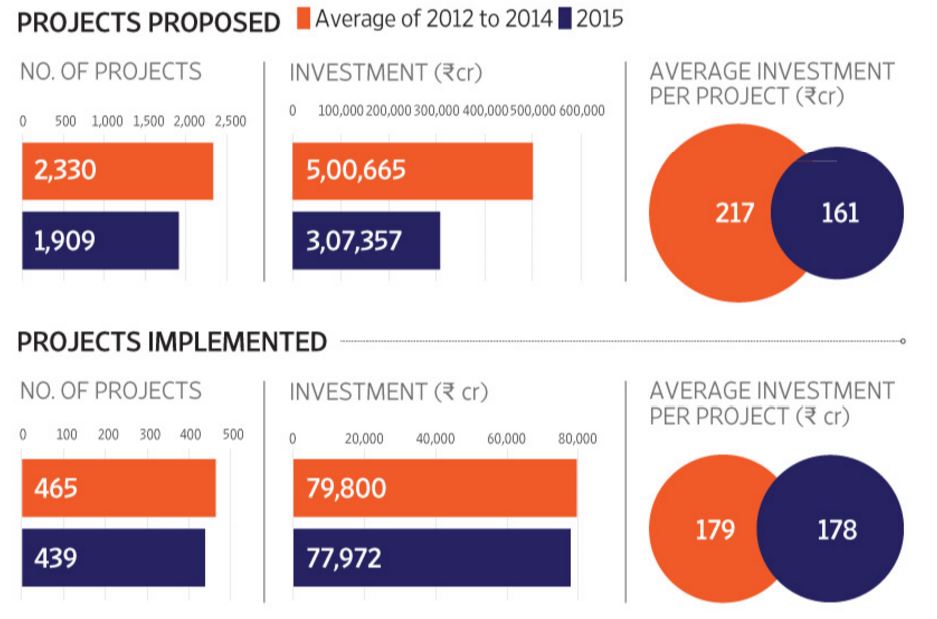
6. Business Standard draws attention to the just released data on investment proposals, which at Rs 3.11 trillion for 2015, touched an 11 year low. Actual investments too were down from Rs 787.47 bn in 2014 to Rs 779.72 bn in 2015. 
As the Livemint grahic below shows, while the metrics are smaller in investment proposals, the actuals materialized have stayed the same over the past four years. Further, ten industries accounted for 65% of all investment implemented and 10 states for 80% of all proposals. 
The most worrying sign is about the level of investment proposals. Given the aggressive courting of investors and the widespread euphoria, coupled with economic weakness across the world, it was only to be expected that the investment proposals increase. This would especially be so given the low base effects legacy from a weak economy and decision-paralysed governance of 2012-14. But even here, the decline in investment proposals over 2012-15 has been about 40%. 

7. Distressed corporate balance sheets and rising bank NPAs have created a self-reinforcing downward spiral of bank credit squeeze to private firms, especially those outside the larger corporates
8. While capital investment as a share of total central government expenditure has been rising slowly to nearly a fifth, its distribution has increasingly been towards social services - housing, labor welfare, and rural works - whereas the share of transportation has declined sharply.
Interestingly, and underlining the importance of co-operative federalism, just a third of the capital expenditure of the central government is executed by itself, with the major share being transfers and loans to state and local governments. 
In fact, in 2014-15, the central government's capital expenditure was 1.78% of GDP or Rs 1.92 trillion, to the state government's 3.54% of GDP or over Rs 4 trillion.

9. Interesting observation on the changes in India's tax-to-GDP ratio over time,
In the 25-year period from 1965 to 1990, India’s tax-to-GDP increased steadily from 10% to 16% while GDP increased 2.8-fold. In the subsequent 25-year period from 1991 to 2014, India’s tax-to-GDP stayed roughly constant between 16% and 17% while GDP increased 4.5-fold. It is puzzling to us that just as India broke away from its clichéd Hindu rate of growth post the 1991 economic reforms to grow much more rapidly, its tax-to-GDP ratio stayed constant, belying those who would have predicted an increase. That, curiously, India’s rate of tax revenues did not grow commensurate with its GDP growth post the 1991 reforms is inexplicable.
What could possibly be the reason? Given that direct taxes at 2-3% of GDP is marginal, most of the changes would have revolved around indirect taxes. Evidently, in the 1965-90 period, state expanded its indirect tax base, while in the 1990-2014 period, it did little to expand the direct tax base. The later is difficult to rationalize, given the massive income growth, concentrated especially at the top of the income ladder, both individuals and corporates, who, in any case, form the lion's share of direct taxation. In other words, these incomes at the top may have grown much faster than the proportionate rise in their income tax payments. Among all public policy priorities, this demands an urgent examination by the government.    

10. The positive side of the high inflation was that it kept the tax revenues high and ensured that the debt-to-GDP ratio was kept under control. Now with low inflation, nominal GDP growth has fallen, even touching the government's average interest cost, thereby raising questions about the country's debt sustainability.
11. While this is well-known within the government, but rigorous evidence has been scarce,
Since 2009, Accountability Initiative’s PAISA study (Planning, Allocations and Expenditures, Institutions: Studies in Accountability) has been tracking money flows in elementary education. In not one of the eight districts across six states that we have studied did we find a district that received its entire allocated budget within the financial year. For the money that does reach, much of it makes its way to the district half way through the financial year. Even districts in well-functioning states like Maharashtra and Himachal Pradesh face this unpredictability. Once money reaches the district, it can take two to six months to travel from the district bank account to the schools, where expenditure actually takes place... for over 50% schools in India, even small grants that schools are expected to receive annually for essential purchases, are credited to their bank accounts somewhere between November and December, well over halfway into the school year. 
12. For all talk of decentralization, local governments share of revenues and expenditures, on a variety of metrics, remain marginal.
13. This analysis of the CAG report, which paints a very dismal picture of Indian Railways,
As of March 2014, the Indian Railways had spent around Rs.92,000 crore on 479 projects, including some dating back to the 1970s and 80s. But due to shoddy contract and project management, costs have more than doubled, and the Railways needs an additional Rs.183,000 crore just to finish these ongoing projects.
And this analysis of the ticket prices,
The Indian Railways' average revenue per passenger km for ordinary second class is a mere 13.80 paise, 14.54 paise for suburban trains, 27.47 paise for second class mail and express trains, and 109.47 paise for upper class, making it possibly the cheapest rail transport system in the world.
The assumptions underlying the optimism presented in the Railways Budget may not exactly be forthcoming. 

14. Finally, in order to relieve crowding, and boost revenues, Disney introduces surge pricing in its Florida and California theme parks during holidays and some weekends, raising prices by about 20%, 
At Disneyland, located in Anaheim, Calif., which attracts roughly 17 million visitors annually, single-day tickets now cost $99... “Value” tickets, for Mondays through Thursdays during weeks when most schools are in session, will drop to $95. “Regular” tickets (most weekends and many summertime weeks) will climb to $105. “Peak” tickets (most of December, spring break weeks, July weekends) will cost $119. At Disney World in Orlando, Fla., which includes four major theme parks, the price changes are more complex, because they vary by park. At the most popular Disney World park, the Magic Kingdom, which handles nearly 20 million visitors annually, single-day prices will remain at the current level, $105, for value periods. Prices will rise to $110 for regular periods, and to $124 for peak... The largest proportion of days at both Disneyland (46 percent) and Disney World (49 percent) fall in periods designated as regular; peak days account for 27 percent of the year at Disneyland and 29 percent at Disney World.
Add to Technorati Favorites
28 Feb 06:49

Mr. Google may be the best Financial Adviser..

by subra
I saw an article by my friend Dr. Malpani about how Dr. Google could be better than your physician..and I did a copy paste of the article..believe me I only changed 15 words, nothing more, nothing less. Read on.. Your personal financial planner is very valuable, and having someone who can hold your hand, talk […]
27 Feb 04:58

When Breath Becomes Air: What Makes Life Worth Living in the Face of Death?

by Farnam Street Team

“When you come to one of the many moments in life where you must give an account of yourself, provide a ledger of what you have been, and done, and meant to the world, do not, I pray, discount that you filled a dying man’s days with a sated joy, a joy unknown to me in all my prior years, a joy that does not hunger for more and more but rests, satisfied. In this time, right now, that is an enormous thing.”

***

Dr. Paul Kalanithi was 36 years old and in his final year as a neurosurgical resident when he was diagnosed with terminal cancer. His beautifully written memoir, When Breath Becomes Air, published posthumously, chronicles his lifelong quest to learn what gives life meaning.

Kalanithi’s wife Lucy, also a doctor, explains in the epilogue why he chose to write about his experience.

Paul confronted death – examined it, wrestled with it, accepted it – as a physician and a patient. He wanted to help people understand death and face their mortality. Dying in one’s fourth decade is unusual now, but dying is not.

In a letter to a friend, he writes, “That’s what I’m aiming for, I think. Not the sensationalism of dying, and not exhortations to gather rosebuds, but: Here’s what lies up ahead on the road.”

In When Breath Becomes Air, Kalanithi shares his journey along that road as he transitions from doctor to patient and comes face-to-face with his own mortality.

As a student

Before studying medicine at Yale, Kalanithi had earned a BA and an MA in English literature, a BA in biology and an MPhil in the history and philosophy of science and medicine. He was interested in discovering where “biology, morality, literature and philosophy intersect”.

I was driven less by achievement than by trying to understand, in earnest: What makes human life meaningful? I still felt literature provided the best account of the life of the mind, while neuroscience laid down the most elegant rules of the brain.

Throughout college, my monastic, scholarly study of human meaning would conflict with my urge to forge and strengthen the human relationships that formed that meaning. If the unexamined life was not worth living, was the unlived life worth examining?

After years of theoretical discussions about mortality and the meaning of life, he came to the conclusion that “direct experience of life-and-death questions was essential to generating substantial moral opinions about them”. And so, he chose to study medicine.

As a physician

In Being Mortal: Medicine and What Matters in the End, Dr. Atul Gawande, calls for change in the way medical professionals deal with illness. While medical science has given us the ability to extend life, it does not ask – or answer – the question of when life still has meaning.

The problem with medicine and the institutions it has spawned for the care of the sick and the old is not that they have had an incorrect view of what makes life significant. The problem is that they have had almost no view at all. Medicine’s focus is narrow. Medical professionals concentrate on repair of health, not sustenance of the soul. Yet – and this is the painful paradox – we have decided that they should be the ones who largely define how we live in our waning days.

As a neurosurgical resident, Kalanithi was well aware of this paradox and the interplay between our medical choices and the things that give our lives meaning.

While all doctors treat diseases, neurosurgeons work in the crucible of identity: every operation on the brain is, by necessity, a manipulation of the substance of our selves, and every conversation with a patient undergoing brain surgery cannot help but confront this fact…At those critical junctures, the question is not simply whether to live or die but what kind of life is worth living. Would you trade your ability – or your mother’s – to talk for a few extra months of mute life? The expansion of your visual blind spot in exchange for eliminating the small possibility of a fatal brain hemorrhage? Your right hand’s function to stop seizures? How much neurologic suffering would you let your child endure before saying that death is preferable? Because the brain mediates our experience of the world, any neurosurgical problem forces a patient and family, ideally with a doctor as a guide, to answer this question: What makes life meaningful enough to go on living?

Both Gawande and Kalanithi help us recognize that knowing what we – and our loved ones – value in life will inform the choices we make about death when that time comes.

As a patient

What happens to your identity and sense of purpose when your plan for the next 40 years is suddenly wiped off the table?

My brother Jeevan had arrived at my bedside. “You’ve accomplished so much,” he said. “You know that, don’t you?”

I sighed. He meant well, but the words rang hollow. My life had been building potential, potential that would now go unrealized. I had planned to do so much, and I had come so close. I was physically debilitated, my imagined future and my personal identity collapsed, and I faced the same existential quandaries my patients faced. The lung cancer was confirmed. My carefully planned and hard-won future no longer existed.

After the diagnosis, Kalanithi was forced to re-evaluate what was most valuable to him.

While being trained as a physician and scientist had helped me process the data and accept the limits of what that data could reveal about my prognosis, it didn’t help me as a patient. It didn’t tell Lucy and me whether we should go ahead and have a child, or what it meant to nurture a new life while mine faded. Nor did it tell me whether to fight for my career, to reclaim the ambitions I had single-mindedly pursued for so long, but without the surety of the time to complete them.

Like my own patients, I had to face my mortality and try to understand what made my life worth living…

The old adage to ‘live each day as if it were your last’ loses strength under scrutiny. What gives our lives meaning on any given day depends to some extent on how imminent we believe death is.

Grand illnesses are supposed to be life-clarifying. Instead, I knew I was going to die – but I’d known that before. My state of knowledge was the same, but my ability to make lunch plans had been shot to hell. The way forward would seem obvious, if only I knew how many months or years I had left. Tell me three months, I’d spend time with family. Tell me one year, I’d write a book. Give me ten years, I’d go back to treating diseases. The truth that you live one day at a time didn’t help: What was I supposed to do with that day?

In searching for solace, Kalanithi returned to his love of literature.

And so it was literature that brought me back to life during this time. The monolithic uncertainty of my future was deadening; everywhere I turned, the shadow of death obscured the meaning of any action. I remember the moment my overwhelming unease yielded, when that seemingly impassable sea of uncertainty parted. I woke up in pain, facing another day – no project beyond breakfast seemed tenable. I can’t go on, I thought, and immediately, its antiphon responded, completing Samuel Beckett’s seven words, words I had learned long ago as an undergraduate: I’ll go on. I got out of bed and took a step forward, repeating the phrase over and over “I can’t go on. I’ll go on.”

That morning, I made a decision: I would push myself to return to the OR. Why? Because I could. Because that’s who I was. Because I would have to learn to live in a different way, seeing death as an imposing itinerant visitor but knowing that even if I’m dying, until I actually die, I am still living.

In one of the most profound passages of the book, Lucy and Paul discuss whether to have a child, “Don’t you think saying goodbye to your child will make your death more painful?” she asks, and he responds, simply, “Wouldn’t it be great if it did?”

Kalanithi comes to believe that life is about striving, not about avoiding suffering.

Years ago, it had occurred to me that Darwin and Nietzsche agreed on one thing: the defining characteristic of the organism is striving. Describing life otherwise was like painting a tiger without stripes. After so many years of living with death, I’d come to understand that the easiest death wasn’t necessarily the best. We talked it over. Our families gave their blessing. We decided to have a child. We would carry on living instead of dying.

He leaves behind this impassioned message for his daughter, Cady, eight months old at the time of his death.

When you come to one of the many moments in life where you must give an account of yourself, provide a ledger of what you have been, and done, and meant to the world, do not, I pray, discount that you filled a dying man’s days with a sated joy, a joy unknown to me in all my prior years, a joy that does not hunger for more and more but rests, satisfied. In this time, right now, that is an enormous thing.

When Breath Becomes Air, paired with Being Mortal, will get you thinking about what matters in your life and about ‘what lies up ahead on the road’.

--
Sponsored By: Siebels Research — Customized research featuring on the ground original insights at a great value!

27 Feb 04:55

What Can You Learn From Well Behaved Investors

by Hemant Beniwal

Movement in the markets depend on 2 factors – One is the actual numbers like growth rate, company performance, prices of commodities and local and global economic conditions. The second is the behaviour of the market participants that is the people and their beliefs, sentiment, fears, optimism and pessimism. We think second factor is more important & that’s the reason we keep repeating… Investing is not a number game, it is a “Mind Game”.

InfographicsIt’s a bull run when….

It is not enough to have only technical and financial knowledge if you want to be a successful investor. You should also manage your emotional quotient properly. Some investors do better than others in investing. One of the main reasons is that they behave appropriately in different market conditions and while taking investment decisions.

What Can You Learn From Well Behaved Investors

What these investors do different to be more successful –

1) Sometimes it is okay to not make any investment decisions –

There are a lot of news items on the economy, prices, markets all over the place. Many investors constantly want to keep doing something. They want to buy or sell else they feel left out even if they do not understand where the markets are heading. well behaved investors  take a step back and take time to assess the situation. It might be profitable in terms of time, money and mental peace to not react to market movements and wait till the markets are more steady or make more sense.

Read: Keep Away from too much news

2) Loss Aversion –

Sometimes as investors, we do make the wrong purchase decisions. Sometimes, due to economic conditions or company performance the stocks/sectors that we thought would perform well do not perform as expected. It’s important to keep asking a simple question to ourselves – If I weren’t already invested in this ……, how much would I invest in it now?” It is difficult for most of us to admit that we made a loss or sell and accept the loss.

Read: Sunk Cost fallacy – throwing good money after bad

3) Overconfidence –

Many investors tend to be overconfident and estimate their ability to pick investments that can give very high returns to be very good. This can backfire as the investments picked may not give the most optimum returns or even run into losses. It is even worse if the investors overlook the mistakes they have made due to overconfidence. Well behaved investors estimate their investing capabilities realistically. They try to improve their skills in different ways and also take the help of professionals to make the right investments

ReadDon’t believe PREDICTIONS

4) Understand the difference between skill and luck –

Sometimes we make profits or get high returns from our investments because we have made the right investment decisions and sometimes it is because of a little luck. Well behaved investors know and acknowledge the difference. If we attribute all profits to our skills and capabilities and all losses to bad luck, we may not be interpreting correctly. This will impair our rational behaviour and we will not take steps to improve our investing skills.

ReadHerd Mentality

5) Keep emotions out while investing  –

Humans have a range of emotions – greed, humility, impatience, fear, self-confidence levels, frustration, anger etc. These emotions can play into an investor’s mind and bias the investment decisions. Some people are scared of making any decisions which might make them lose opportunities to make money. well behaved investors keep emotions and intellect required for investing separate. They do not let emotions cloud their mind while deciding on their next move. They may not watch the market closely but learn and assess rationally. Just as professional investment managers behave rationally while taking investment decisions. Well behaved investors also do not have extreme reactions for profits and losses. They continue with the right strategies and change the wrong ones.

Read3 Principles to generate superior returns

6) Well behaved Investors are disciplined and persistent –

Well behaved investors are disciplined when it comes to investments. They stick to investing rules. They have a well-thought-out investment strategy in place and follow it even if there are sudden changes in the market. They update their strategy only if it is required. They have certain standards and make sure they follow them. For example, a well behaved investor might have kept a target to sell a stock that he owns when he gets a  return of X%. Now if the market swings wildly and the stock keeps going up, he will not get greedy and wait for the stock to go Y% higher to sell. Chances are that the stock might drop to much lower levels and he will end up getting less profits or even make losses. Of course it might happen that after he sells as per his target, the stock price goes higher. But if there are no indicators of the same earlier as per his analysis, he would stand by his strategy.

Read7 types of investors

7) Well behaved investors are also persistent –

They work hard and persistently follow their investment strategy. They keep updating their knowledge and look for opportunities. They review the investment strategy and update it  as required. They will not succumb to market tips and rumours. They would have set their financial goals and work towards achieving them.

Read: Instant Gratification is Hazardous for your wealth

Many of our investment decisions are clouded by behavioural aspects. We should emulate well-behaved investors to be successful investors. To begin with, we should find out which emotional aspects affect our investing capability and then work on each of them so that they do not affect investment decisions negatively.

27 Feb 04:49

Bonds or Bond Funds for retirement?

by subra
IFAs mostly do not go through this dilemma. For them only bond funds make sense. However bond funds have one major problem – a fluctuating nav dependent on the existing interest rates. Actually this should not matter to you as an investor, but if your duration need and the duration of the fund may not […]
26 Feb 06:59

James Cash Penney and the Golden Rule

by Farnam Street Team


It is then we must remember that all good days in human life come from
the mastery of the days of 
trouble that are forever recurrent.
-J.C. Penney

Many are unaware that the department store J.C. Penney was originally the work of a man named, appropriately, James Cash Penney. Penney was raised in Missouri by a father who doubled as a preacher and a farmer. After a career full of turbulence, James became manager of a Golden Rule store in Evanston, Wyoming. The stores traded in dry goods — grain, flour, beans; anything that wouldn’t spoil. After a few years of success, Penney was offered his own store in Kemmerer, Wyoming, and took his shot.

James_Cash_Penney_(ca._1902)
Penney turned the venture into a great success, and by 1913 had ownership of 34 Golden Rule stores which were renamed J.C. Penney. He’d go on to expand the chain into a dominant national department store chain that continues on today, albeit in a less prosperous form.

In 1949, Penney published a very slim book called My Experience with the Golden Rule — it didn’t describe in detail his retail experience, but instead his thoughts on the Rule itself. The little volume has some beautiful passages worth sharing. He speaks with a bit of a Southern Baptist tone, but whether you are a spiritual person or not, the lessons hold.

On the Teachings of Life

He starts with a refrain which echoes our favorite from Joseph Tussman:

As I look back over the entire range of my life’s journey I would say that discipline has never let up. I seem to have moved from one contest to another—from one hard situation to another. As I try to read it all now it seems to me as if life has been trying to make me understand that a man has only to work with the universal law and purpose and they, in turn, will work for him. But if he decides to work, trusting wholly to his own judgment, ignoring all wiser leadership, he will get hurt.

On The Challenge of Ethical Principles

I want to show that we build lasting values for later life precisely as we are motivated in our youth. For what we do in the beginning of our careers capitalizes us all the way along. If it happens that one is challenged in youth by ethical principles and if one is led, or even compelled, to adopt them, he will begin to have high altitude experiences. In other words, it is well for every one of us to be forced by whatever circumstances to work righteously. This is the supreme benefit even if, in the doing it, it seems to “go against the grain.” We learn, slowly, that all accomplishment and advancement are gained only by a contest—a fight with the circumstances and conditions through which we pass.

And we gradually begin to see that great principles have it in them to make the going rough, hard and foot-wearying. To seek to do best for ourselves by doing right for all concerned is by no means an easy proposition. It is, in fact, infinitely hard. But at the same time it guarantees us safety and security as a dividend on the investment of the effort we make. It does not keep us from attaining material success, hard as the going may be. But it makes the way safe and the method effective.

[…]

There were a lot of cowboys in Kemmerer in my time. One of them put the fact I have in mind in better words than I can command. Speaking of a rodeo he said: “There is one thing about a bronco that is always true. With never an exception. He is full of unexpectedness.”

The point is this, any ethical principle that one may adopt is just as full of unexpectedness. I mean, in the challenge it puts up to one. The problem with the bronco is to get on and stay on.

On the Value of Having One’s Principles Tested

Penney proceeds to tell the story of his father forcing him to start earning his own money if he wants new clothes. Upon earning a small amount, he buys a pig and uses the earnings from the first pig to bankroll the purchase of many more, until he’s got about a dozen. It’s then that his father tells him he must get rid of the pigs due to complaints, even though James would have to take a loss on the sale.

It was a long time after the event that I was able to look back upon the experience as one might look back upon a mountain range where he has been tramping and see its skyline. Let it suffice for me to say that what I leaned out of that business experience and the three parties concerned, namely, myself, my father, and the neighbors, proved to be a treasure worthy to possess.

My father knew that if I was compelled to clothe myself it would make me think and search and find ways of earning the money to do it. And furthermore he knew that I would learn this important fact:

We do not meet the demands of life with money. But with the imagination, forethought, plans and energy that earn the money.

Through life we learn many principles of business operation. But this one is of high rating among them all. Then, one thing further, my father took pains to make me understand:

–That I would not exercise my ingenuity to get money if by so doing I caused distress to other people.

–That any effort is worth only what can be gotten out of it by the action of a fair deal.

[…]

My father said to me one day: “We would resent it if a neighbor distressed and discomforted us in any way. Therefore, you see that a neighbor will resent distress and discomfort if we cause it. This means,” he said, “we must do to everyone as we wish to be done by.”

And so there emerged into my youthful experience the Golden Rule.

On Holding Fast to Ethics When You’re Riding High

Penney spends some time discussing his relationship with employees and his hope to develop them to their highest purpose. His basic idea is that “…to hire a man and literally leave him as is, is the beginning of a degree of human dissatisfaction that can go to any length.”

And then he returns to the Golden Rule:

So I come back again to the condition that the Golden Rule, if one adopts it, is a difficult master to serve. The ship’s captain will not throw the compass overboard because the wind blows fair and the day is funny. For he knows, from the experiences of the ocean’s instability, that the danger days of storm are always “just ahead.” So the compass must always be handy and obedience to it must always be loyal. And so with the Golden Rulle—the compass must be ever at hand through life’s journey. It will see us through trying times. And perhaps the most trying of all times comes when success is riding high and we may be tempted to “throw the compass overboard.” It is then we must remember that all good days in human life come from the mastery of the days of trouble that are forever recurrent.

On Advice to Young Men in Finding Their Purpose and Career

Penney closes with an admonition that the purpose of life is to find the calling to which you can devote your time and energy and feel fulfilled. As he makes clear, devoting your energy to something which you care about and feel fulfilled by is the highest purpose you can achieve:

To young men my advice is as simple and distinct as my own experience. It runs like this:

Take time to discover what you would prefer above all else to make your life work. You may have to do a lot of temporary jobs before you reach the one your ambition places above all others. But if your idea is clear and your determination firm, you will surely reach it.

Remember that it is often necessary in life to learn to work hard at many things before you arrive at the very great privilege of working hard at the one thing you prize the most.

Think persistently into great principles. That many have persisted for thousands of years simply because their truth is unassailable, applies to all of us in all situations and problems. Hence the great Proverbs, the Golden Rule, the Decalogue, the Sermon on the Mount, and, along with these, the testimony of men who have sought their way to the rare privilege of doing what they most wanted to do.

Remember that all this effort to reach your preference in life work and your further effort to perfect it within the scope of your ability is for just one purpose. And the purpose is to give service to the utmost of your ability.

Still Interested? You can find the book here, but it’s out of print and a bit pricey for such a short volume. Another one to learn more about J.C. Penney is a book about his life and career, Main Street Merchant. If you want more on ethics and wisdom, try some of our posts on Seneca.

--
Sponsored By: Siebels Research — Customized research featuring on the ground original insights at a great value!

26 Feb 05:27

State capability 3.0 - The Finance Ministry veto?

by noreply@blogger.com (Gulzar Natarajan)
In addition to the standard examples of state capability weakness, reflected in weak public service delivery, there are atleast two other far less discussed forms. One is decision paralysis due to excesses by judges, RTI activists, auditors, and vigilance officials. The second, barely discussed contributor to state capability weakness is the de-facto veto exercised by Finance Ministries. 

Consider the example of financial inclusion. Business Correspondents (BCs) were introduced with the intention of expanding access by taking banking services to the customer's door-step in remote rural areas. Its success was evidently contingent on the commercial viability of the business model as reflected in the income earned by the BCs. But as Sumita Kale points out, this may have been compromised by the hard charging Finance Ministry,
While the Report of the Task Force on an Aadhaar-Enabled Unified Payment Infrastructure had recommended a 3.14% transaction processing charge to the banks, in reality the rates allowed by the central and state governments have been 1-2%. In January 2015, the finance ministry fixed DBT commissions for banks: for urban schemes, at the National Electronic Funds Transfer/Aadhaar Payment Bridge rate; but for rural schemes, the rate was fixed at 1%, subject to an upper limit of Rs.10 per transaction. Detailed costing analysis fromconsulting firm MicroSave in May 2015 shows that 2.63% is the break-even charge: the break-up of this across the three main constituents in the disbursement chain came to about 0.96% for business correspondent (BC) network managers, 0.85% for business correspondent agents, and about 0.82% for the banks. The analysis also revealed that the savings to the government through lower administrative costs and leakages are significant. Clearly, the government can well afford adequate compensation to the banks and agent networks for their role in the disbursements.
The story is the same everywhere, across programs, both in central and state governments. Ministries formulate schemes and proposals after elaborate stakeholder consultations, with detailed costing taking into consideration program sustainability and commercial viability factors, and run them through Finance Ministry to the approving authority (Cabinet or Chief Ministers). As would be expected given the scarce resources and large competing demands, the Finance Ministry cuts down on program allocations. It would have been perfectly fine, indeed necessary, if this was all. 

Unfortunately, in most cases, the Ministry goes far beyond and offers its wisdom on program commercials (a unit rate compensation of Rs x instead of Rs y), procurements (why not through the local government agency or SHGs), financials (why not leverage resources from Corporate Social Responsibility funds or PPP), contracting strategies (one model of PPP over another), and even on manpower deployment (one administrative structure over another, x number of people to do a task instead of y). And each of these prescriptions are drawn from mindless generalization of outlier and misleading thumb-rules and 'best practices'. 

If it were only offering suggestions, the implementing Ministry could have examined and taken necessary action. But in India's bureaucratic rules of the game, such prescriptions assume the force of a veto. This is all the more so since Finance Ministry's recommendations are invariably in line with the bureacratically correct practice of lowering public expenditure. Disagreement with it runs the future risk of a malicious complaint or a RTI query or an adverse audit comment and a potential vigilance investigation with its public humiliation.  

Its manifestations are felt across programs, especially at the last-mile of implementation, and become the difference between success and failure. The commonest form of veto is by way of skimping on transaction costs (transportation and storage charges for PDS), remunerations (mid-day meal workers), construction costs (unit costs for ), operation and maintenance expenditures (school and toilet maintenance in SSA, hospital maintenance in NHM), leverage from other sources (CSR, NREGS etc), and so on. Doubtless some of these are unavoidable, forced down by the acute scarcity of resources and political economy considerations that demand the butter be spread evenly and universally. But many others like the one for BCs are plain arbitrary and flippant. 

At a very objective level this is as much a transgression of jurisdiction as kritarchy or tyranny of presumptive valuation. Consider this. A professionally competent agency (the Ministry concerned), with the responsibility of implementation, and democratically empowered, formulates a program following the due process, and circulates for approval. En-route, another Ministry, with neither the contextual knowledge nor the professional competence, and at best, with accounting and budgeting competence, picks apart program components and details, and that too in a manner that seriously undermines its successful implementation prospects. Where else can you have this except in a 'flailing' state! 
Add to Technorati Favorites
25 Feb 06:18

The Boundaries Between Science and Religion: Alan Lightman on Different Kinds of Knowledge

by Farnam Street Team

“The physical universe is subject to rational analysis and the methods of science. The spiritual universe is not. All of us have had experiences that are not subject to rational analysis. Besides religion, much of our art and our values and our personal relationships with other people spring from such experiences.”

***

Alan Lightman, whose beautiful meditation on our yearning for permanence in a universe that offers none, looks at the tension between science and religion in The Accidental Universe: The World You Thought You Knew.

In the essay, “The Spiritual Universe,” Lightman sets out to reconcile his personal struggle between religion and science. In so doing he sets out the necessary criteria for science to be compatible with religion:

The first step in this journey is to state what I will call the central doctrine of science: All properties and events in the physical universe are governed by laws, and those laws are true at every time and place in the universe. Although scientists do not talk explicitly about this doctrine, and my doctoral thesis adviser never mentioned it once to his graduate students, the central doctrine is the invisible oxygen that most scientists breathe. We do not, of course, know all the fundamental laws at the present time. But most scientists believe that a complete set of such laws exists and, in principle, that it is discoverable by human beings, just as nineteenth-century explorers believed in the North Pole although no one had yet reached it.

Our knowledge of scientific laws is provisional. We do not know all the laws but we believe in a complete set of them. We further believe, in principle anyway, that humans will uncover these laws. An example of a scientific law is the conservation of energy.

The total amount of energy in a closed system remains constant. The energy in an isolated container may change form, as when the chemical energy latent in a fresh match changes into the heat and light energy of a burning flame— but, according to the law of the conservation of energy, the total amount of energy does not change.

Even scientific laws that we already know about are updated and refined over time. Lightman offers the replacement of Newton’s law of gravity (1687) by Einstein’s deeper and more accurate law of gravity (1915). These revisions are part of the very fabric of science.

Next, Lightman provides a working definition of God.

I would not pretend to know the nature of God, if God does indeed exist, but for the purposes of this discussion, and in agreement with almost all religions, I think we can safely say that God is understood to be a Being not restricted by the laws that govern matter and energy in the physical universe. In other words, God exists outside matter and energy. In most religions, this Being acts with purpose and will, sometimes violating existing physical law (that is, performing miracles), and has additional qualities such as intelligence, compassion, and omniscience.

Lightman then offers a continium of religious beliefs based on the degree to which God acts in the world. At one end is atheism — or denying the existence of god. Moving along the spectrum, we find deism, which was a prominent view in the seventeenth and eighteenth centuries that God created the universe but has not acted since this spark.

Voltaire was a deist. As God’s role expands we find immanentism, which holds that God created the universe and its scientific laws. Under this view, God continues to act through the repeated application of those laws. We can probably put Einstein in the immanentism camp. (Philosophically both deism and immanentism are similar because God does not perform miracles.)

Opposite atheism lies interventionism. Most religions, including Christianity, Judaism, Islam, and Hinduism subscribe to this view, which is that God created the universe and its laws and occasionally violates the laws to create unpredictable results.

Lightman argues that all of these views, except interventionism, agree with science.

Starting with these axioms, we can say that science and God are compatible as long as the latter is content to stand on the sidelines once the universe has begun. A God that intervenes after the cosmic pendulum has been set into motion, violating the physical laws, would clearly upend the central doctrine of science.

Lightman cites Francis Collins, who offers some thoughtful advice on reconciling a belief in an interventionist God and science, or at least, deciding which to turn to for answers to the right kinds of questions. They are often very different.

“I’ve not had a problem reconciling science and faith since I became a believer at age 27 … if you limit yourself to the kinds of questions that science can ask, you’re leaving out some other things that I think are also pretty important, like why are we here and what’s the meaning of life and is there a God? Those are not scientific questions.

Under this reconciliation, miracles cannot be analyzed by the methods of science. This is an echo of Richard Feynman, who put it most clearly in one of his letters, saying that science only tells us if we do something then what will happen? Cause and effect. It doesn’t give us any guidance on the question of should we do it?

Lightman, himself, falls in the atheist camp.

I am an atheist myself. I completely endorse the central doctrine of science. And I do not believe in the existence of a Being who lives beyond matter and energy, even if that Being refrains from entering the fray of the physical world. However, I certainly agree with (Other Scientists) that science is not the only avenue for arriving at knowledge, that there are interesting and vital questions beyond the reach of test tubes and equations. Obviously, vast territories of the arts concern inner experiences that cannot be analyzed by science. The humanities, such as history and philosophy, raise questions that do not have definite or unanimously accepted answers.

And yet we must believe in things we cannot (yet) prove. Lightman himself believes in the central doctrine which cannot be proven. At most we can only say there is no evidence to contradict it. This is what Karl Popper called real science – a process by which we hypothesize and then attack our hypotheses. A scientific “fact” is one that has stood up to extraordinary scrutiny.

With much of life, and much meaning in the world, there are often things outside of the scientific realm. These are worth considering.

I believe there are things we take on faith, without physical proof and even sometimes without any methodology for proof. We cannot clearly show why the ending of a particular novel haunts us. We cannot prove under what conditions we would sacrifice our own life in order to save the life of our child. We cannot prove whether it is right or wrong to steal in order to feed our family, or even agree on a definition of “right” and “wrong.” We cannot prove the meaning of our life, or whether life has any meaning at all. For these questions, we can gather evidence and debate, but in the end we cannot arrive at any system of analysis akin to the way in which a physicist decides how many seconds it will take a one-foot-long pendulum to make a complete swing. The previous questions are questions of aesthetics, morality, philosophy. These are questions for the arts and the humanities. These are also questions aligned with some of the intangible concerns of traditional religion.

Lightman recalls his time as a grad student in physics and the concept of a “well-posed problem” — a question with “enough clarity and precision that it is guaranteed an answer.” Put another way, scientists are trained not to “waste time on questions that do not have clear and definite answers.” And yet questions without clear and definite answers are sometimes just as important. Just because we can’t apply the scientific method to them doesn’t mean we shouldn’t consider them.

[A]rtists and humanists often don’t care what the answer is because definite answers don’t exist to all interesting and important questions. Ideas in a novel or emotion in a symphony are complicated with the intrinsic ambiguity of human nature. That is why we can never fully understand why the highly sensitive Raskolnikov brutally murdered the old pawnbroker in Crime and Punishment, whether Plato’s ideal form of government could ever be realized in human society, whether we would be happier if we lived to be a thousand years old. For many artists and humanists, the question is more important than the answer.

The question is more important than the answer — just as the journey is more important than the destination and the process is more important than outcome.

As the German Poet Rainer Maria Rilke put it a century ago:  “We should try to love the questions themselves, like locked rooms and like books that are written in a very foreign tongue.”

“As human beings,” Lightman argues, “don’t we need questions without answers as well as questions with answers?”

The God Delusion, a widely read book by Richard Dawkins, uses modern tools to attack two common arguments for the existence of God: Intelligent Design (only an intelligent and powerful being could have designed the universe) and that only the action and will of God explains our morality and desire to help others. Dawkins convincingly shows that Earth could have arisen from the laws of nature and random processes, without the intervention of a supernatural and intelligent Designer. Our sense of morality and altruism could be a logical derivative of natural selection.

However, as Lightman reminds us, refuting or falsifying the arguments put forward to support a proposition does not necessarily falsify the proposition itself.

Science can never know what created our universe. Even if tomorrow we observed another universe spawned from our universe, as could hypothetically happen in certain theories of cosmology, we could not know what created our universe. And as long as God does not intervene in the contemporary universe in such a way as to violate physical laws, science has no way of knowing whether God exists or not. The belief or disbelief in such a Being is therefore a matter of faith.

Lightman is troubled by Dawkins’ wholesale dismissal of religion.

Faith, in its broadest sense, is about far more than belief in the existence of God or the disregard of scientific evidence. Faith is the willingness to give ourselves over, at times, to things we do not fully understand. Faith is the belief in things larger than ourselves. Faith is the ability to honor stillness at some moments and at others to ride the passion and exuberance that is the artistic impulse, the flight of the imagination, the full engagement with this strange and shimmering world.

Indeed, William & Ariel Durant have argued that we need religion; it is part of our fabric of understanding and living in the world.

***

With that, Lightman brings the essay to a beautiful conclusion.

The physical and spiritual universes each have their own domains and their own limitations. The question of the age of planet Earth, for example, falls squarely in the domain of science, since there are reliable tests we can perform, such as using the rate of disintegration of radioactive rocks, to determine a definitive answer. Such questions as “What is the nature of love?” or “Is it moral to kill another person in time of war?” or “Does God exist?” lie outside the bounds of science but fall well within the realm of religion. I am impatient with people who, like Richard Dawkins, try to disprove the existence of God with scientific arguments. Science can never prove or disprove the existence of God, because God, as understood by most religions, is not subject to rational analysis. I am equally impatient with people who make statements about the physical universe that violate physical evidence and the known laws of nature. Within the domain of the physical universe, science cannot hold sway on some days but not on others. Knowingly or not, we all depend on the consistent operation of the laws of nature in the physical universe day after day— for example, when we board an airplane, allow ourselves to be lofted thousands of feet in the air, and hope to land safely at the other end. Or when we stand in line to receive a vaccination against the next season’s influenza.

Some people believe that there is no distinction between the spiritual and physical universes, no distinction between the inner and the outer, between the subjective and the objective, between the miraculous and the rational. I need such distinctions to make sense of my spiritual and scientific lives. For me, there is room for both a spiritual universe and a physical universe, just as there is room for both religion and science. Each universe has its own power. Each has its own beauty, and mystery. A Presbyterian minister recently said to me that science and religion share a sense of wonder. I agree.

The Accidental Universe is a mind-bending read on the known and unknowable, offering a window into our universe and some of the profound questions of our time.

--
Sponsored By: Siebels Research — Customized research featuring on the ground original insights at a great value!

25 Feb 06:04

An update on DISCOM Bonds

by noreply@blogger.com (Gulzar Natarajan)
As part of the UDAY scheme, the state governments across India will assume three-quarters of discom debts over the next two years. Apart from significantly lowering their borrowing cost (current cost of 12-14% to 8-9%), it is hoped that this would relieve the discoms off the crippling debt burden. As part of the scheme, the state governments are expected to issue bonds worth about Rs 3.2 trillion (75% of Rs 4.3 trillion total discom debt) over the coming two fiscal years, with two-thirds in the first year.

In this context, Andy Mukherjee pointed to the $48 bn challenge of markets ability to absorb these bonds. Consider this. The total net market borrowings of the central and state governments for 2014-15 were Rs 4.53 trillion and Rs 2.07 trillion respectively, and Rs 4.4 trillion and Rs 2.2 trillion respectively till February 12, 2016. In other words, if all state governments join, and most the largest have already done so, the cumulative UDAY bond issuance in 2016-17 would, at Rs 2.15 trillion, be larger than the state government issuance for 2014-15.

This coupled with a higher fiscal deficit could put a massive strain on the bond markets and quickly drive up the yields on these bonds. In fact, in the first round of auctions for Rs 21,445 Cr worth 10 year State Development Loans (SDLs), yields touched 8.88%, higher than expected, and indicative of the strains likely as more bonds flow into the market. As a reflection of the widening spreads, 
The SDL auction found takers at yields between 8.63-8.88% for 10-year maturity bonds. The 10-year benchmark G-sec (central government bond) yield is currently hovering around 7.82%, indicating a spread of 80-105 basis points. The spreads are sharply higher than the average spread of 39-45 basis points at the start of 2016.
One way around this, and not a very desirable one, is to summon the perennial buyer of last resort in India's financial markets, LIC. And unsurprisingly, Livemint reports that LIC and EPFO have been asked to assist in mopping up the restructuring bonds that will be issued. 
Add to Technorati Favorites
25 Feb 06:01

About market timing and time in the market

by subra
This is a slippery banana peel and I am wearing roller skates. So time in the market or market timing? Honestly there is no single answer. Some people who have no public record of their investment track record (like me) can say whatever we want and get away. A Prashant Jain or a Warren Buffett […]
25 Feb 05:57

India on the verge of ‘a million mutinies’?

by Amol Agrawal
R Jagannathan of Swarajya has a piece raising several controversial (if not millions) ideas. If 2015 was annus horribilis for the Narendra Modi government, 2016 and beyond could be worse. The Jat agitation and the Jawaharlal Nehru University (JNU) eyeball-to-eyeball confrontation with student protestors are surely being fanned to make it difficult for Modi to govern, […]
24 Feb 05:15

Latticework of Mental Models: Permutation and Combination

by Anshul Khare

Here’s an interesting trivia.

If you wear different tie on the same shirt, most people will think that you’re wearing a different shirt. That’s an interesting way to multiply your options without really buying new cloths (except few new ties).

“That’s not a trivia, that’s a Jugaad.”, you might want to say. Anyways, That brings me to an equally interesting mindbender.

If you have 2 shirts (white, blue), 3 pants (black, gray and brown) and 3 different ties (pink, orange, red), in how many different ways can you get dressed? Assumption here is that getting dressed requires you to wear all three i.e. a shirt, a pant and a tie.

Using the multiplication principle we can say that there are total 2 x 3 x 3 = 18 ways to get dressed. Of course some of the dress combinations will look outright funny but our concern here is to find out all possible ways to get dressed. Moreover, today we are getting into Maths discipline and most mathematicians don’t really have whole lot of fashion sense anyways.

So that’s the simplest example of using the idea of combinations in real life. Now let’s say, for some strange reason, we were also considering the order in which you put on the cloths, i.e. it matters to us if one puts on the shirt first instead of tie.

Imagine wearing a tie first and then squeezing the shirt inside the tie, funny right? I told you mathematicians don’t care much about the dressing etiquettes :)

Okay, back to the same question again. In how many ways can you get dressed if the order of dressing matters?

For each of those 18 combinations, there are six ways to dress. So for a given combination of pant, shirt and tie you could go pant first, followed by the shirt and then tie. Or you could wear the shirt first, followed by the tie and finally the pant. Or you could do shirt, pant and tie. And so on.

Here the order (or the arrangement) of the objects matter. So permutation is just a fancy pants (no pun intended) definition of all possible ways of doing something. Simply put, permutations or rearrangements mean the different ways we can order or arrange a number of objects.

Combinations means the different ways we can choose a number of different objects from a group of objects where no order is involved, just the number of ways of choosing them.

For that matter a combination lock should really be called a permutation lock. The order you put the numbers in matters. A true combination lock would accept both 10-17-23 and 23-17-10 as correct.

In most simple terms, permutations and combinations (P&C) is all about counting the possible outcomes.

I am not sure about the current curriculums in schools but I learnt about P&C after 10th standard. Perhaps they are teaching these mathematical principles to kids in junior classes now.

Mathematicians get a kick out of converting simple numbers into complicated equations containing english and greek letters. So this is how a typical maths text book would describe the idea of permutations –

If one event can happen in ‘n‘ different ways, and a second event can happen independent of the first in ‘m’ different ways, the two events can happen in n x m (n multiplied by m) different ways.

To add little more clarity to the above definitions, it would help to think it this way – Permutations are for lists (order matters) and combinations are for groups (order doesn’t matter).

The Factorial (!)

Let me take help from Peter Bevelin, author of Seeking Wisdom, for explaining the idea of factorial. Bevelin writes –

We have 3 hats to choose from – one black, one white and one brown. In how many ways can we arrange them if the order white, black and brown is different from the order black, white and brown? This is the same as asking how many permutations there are with three hats, taken three at a time. We can arrange the hats in 6 ways:

  1. Black-White-Brown
  2. Black-Brown-White
  3. White- Black-Brown
  4. White-Brown-Black
  5. Brown-White-Black
  6. Brown-Black-White.

Another way to think about this: We have three boxes in a row where we put a different hat in each box. We can fill the first box in three ways, since we can choose between all three hats. We can then fill the second box in two ways, since we now can choose between only two hats. We can fill the third box in only one way, since we have only one hat left. This means we can fill the box in 3 x 2 x1= 6 ways.

Another way to write this is 3! [another fancy pant word] If we have n (6) boxes and can choose from all of them, there are n (6) choices. Then we are left with n-1 (5) choices for box number two, n-2 (4) choices for box number three and so on. The number of permutations of n boxes is n!. What n! [pronounced as n-Factorial] means is the product of all numbers from 1 to n.

Suppose we have a dinner in our home with 12 people sitting around a table. How many seating arrangements are possible? The first person that enters the room can choose between twelve chairs, the second between eleven chairs and so on, meaning there are 12! or 479,001,600 different seating arrangements.

The number of ways we can arrange ‘r’ objects from a group of ‘n‘ objects is called a permutation of ‘n’ objects taken ‘r’ at a time and is defined as

p(n,r) = n! / (n-r)!

A safe has 100 digits. To open the safe a burglar needs to pick the correct 3 different numbers. Is it likely? The number of permutations or ways of arranging 3 digits from 100 digits is 970,200 (100! / (100-3)!). If every permutation takes the burglar 5 seconds, all permutations are tried in 5 6 days assuming a 24-hour working day.

In how many ways can we combine 2 flavors of ice cream if we can choose from strawberry (S), vanilla (V), and chocolate (C) without repeated flavors? We can combine them in 3 ways: SV, SC, VC. VS and SV are a combination of the same ice creams. The order doesn’t matter. Vanilla on the top is the same as vanilla on the bottom.

The number of ways we can select ‘r‘objects from a group of ‘n’ objects is called a combination of n objects taken r at a time and is defined as

C(n,r) = n! / r! (n-r)!

The number of ways we can select 3 people taken from a group of 10 people is 120 i.e.

(10! / (3!) (100-3)!)

P&C In Investing

The study of permutations applies to investing in a broad sense because a good understanding of probability is sometimes necessary to make rational financial choices.

Infact, if you don’t understand P&C properly, you would have a tough time understanding probability. So P&C forms the foundation for understanding the concept of probability.

Charlie Munger, in his famous talk at USC Business School in 1994 entitled A Lesson on Elementary Worldly Wisdom, said –

Obviously, you’ve got to be able to handle numbers and quantities—basic arithmetic. And the great useful model, after compound interest, is the elementary math of permutations and combinations. And that was taught in my day in the sophomore year in high school…It’s very simple algebra. It was all worked out in the course of about one year between Pascal and Fermat. They worked it out casually in a series of letters.

It’s not that hard to learn. What is hard is to get so you use it routinely almost everyday of your life. The Fermat/Pascal system is dramatically consonant with the way that the world works. And it’s fundamental truth. So you simply have to have the technique.

If you don’t get this elementary, but mildly unnatural, mathematics of elementary probability into your repertoire, then you go through a long life like a one legged man in an asskicking contest. You’re giving a huge advantage to everybody else.

One of the advantages of a fellow like Buffett, whom I’ve worked with all these years, is that he automatically thinks in terms of decision trees and the elementary math of permutations and combinations.

Conclusion

For me, preparing tea is a combination problem. All I know is that I need to throw in the ingredients (tea, water, milk, sugar) in a pan and heat it for 5-10 minutes. But for my wife it’s a permutation problem. She insists that milk be added at the last. No wonder, nobody wants to drink my tea.

Okay now that you’re equipped with the knowledge of P&C, riddle me this. If my wife, my two kids and I go to a movie theatre, in how many different ways can four of us be seated on our four allotted seats?

Did you say 24?

That could be correct except that the real world hardly presents itself like a well defined mathematics problem. In real world, there’s always a catch.

The catch in my case is that my kids are identical twins. So for all practical purposes, assuming the kids are wearing the same attire, half of the seating arrangements will look identical. And the correct answer would be 12.

Talking about probability, the odds of having an identical twins is approximately 1 in 300 i.e. 0.33 percent. My wife and I consider ourselves very lucky :)

One goal to learn differMM-1ent mental models from multiple disciplines is to learn how problems can be transformed. Remember that painting of the old lady and young woman?

Do you see both? Once you can see both of them it’s easy to switch between them. That’s the beauty of multidisciplinary thinking. The more models you have available, faster you can turn problems into each other.

It’s completely fine to use one model to understand the idea, and another to work out the details. But life becomes difficult when we think there’s only one way to approach it.

Beware! These mental models and multidisciplinary ideas do no good sitting inside your head like artifacts in a museum for they need to be taken out and played with.

I hope these mental models help you cut through the optical illusion around you and you start seeing many young and old ladies – metaphorically :)

Take care and keep learning.

The post Latticework of Mental Models: Permutation and Combination appeared first on Safal Niveshak.

    
22 Feb 20:19

Creating Effective Incentive Systems: Ken Iverson on the Principles that Unleash Human Potential

by Farnam Street Team

The issue of setting compensation seems to be struggled with in every organization. Most are pretty lazy about it — hiring someone else to take care of it and failing to think through the incentives they’re creating.

Some companies are different. Nucor, a steel company, under the leadership of Ken Iverson is one of them. Iverson details his thoughts in the masterful Plain Talk. (This isn’t the first time we’ve covered Iverson’s wisdom on running a company. His genius was exploiting unrecognized simplicities.)

Ken Iverson

Under Iverson, compensation at Nucor had two components: A small but meaningful base pay and a very simple weekly bonus based on production. Outside of benefits and a little profit sharing, that was it. Simple, straightforward, and powerful. No subjective criteria.

The real beauty of Nucor’s compensation system, in my opinion, is that there is nothing to discuss. Daily output and corresponding bonus earnings are posted, so employees know exactly what their bonus will be before they tear open their pay envelopes. No judgment. No negotiation. No surprises.

There are three beautiful aspects to the design of this program.

The first is that it’s eminently clear what you will be paid for: making more steel. It’s so simple. Your compensation is never at the hands of someone who may or may not like you. You have no reason to say it’s unfair: You signed up for it when you signed on. If you worked at Nucor under Iverson, the first thought you had every morning was how to make more steel.

Secondly, it offers immediate feedback. Human nature, and the nature of many other higher-thinking animals, is such that immediate rewards work better than delayed rewards. B.F. Skinner knew this, but some corporations haven’t figured it out yet. A year-end bonus isn’t nearly as effective as a weekly bonus. A year-end review isn’t nearly as useful as immediate feedback. It’s simple.

And lastly, this program gave Nucor’s employees tremendous skin in the game. Everyone was working towards the same goal. Rowing in the same direction. And that makes a tremendous difference.

Nucor’s great success in harnessing incentives reminds me of Charlie Munger’s discussion on Federal Express:

From all business, my favorite case on incentives is Federal Express. The heart and soul of their system—which creates the integrity of the product—is having all their airplanes come to one place in the middle of the night and shift all the packages from plane to plane. If there are delays, the whole operation can’t deliver a product full of integrity to Federal Express customers.

And it was always screwed up. They could never get it done on time. They tried everything—moral suasion, threats, you name it. And nothing worked.

Finally, somebody got the idea to pay all these people not so much an hour, but so much a shift—and when it’s all done, they can all go home. Well, their problems cleared up overnight.

So getting the incentives right is a very, very important lesson. It was not obvious to Federal Express what the solution was. But maybe now, it will hereafter more often be obvious to you.

Does this mean every company should model their compensation program after a steel company? Hell no. But you want to think about it. It’s easy to come up with a suboptimal incentive system — just look around corporate America. The difference between a suboptimal compensation system and an optimal one is huge.

The principles for an effective compensation system work at all companies. Let’s invert — think about the common reasons that compensation systems likely fail. First, most of them are hard to explain. They are overly complicated and wordy. (At Nucor everyone from the CEO to the newest employee could explain it.) Second, the rewards are small and untimely. Yearly bonuses anyone? Third, the program has to be designed in a way that the people in it (and the people running it) can’t game it. Finally, everyone is subject to the same plan.

Done poorly, compensation systems foster a culture of individualism and gaming. Done properly, however, they unleash the potential of all employees.

--
Sponsored By: Siebels Research — Customized research featuring on the ground original insights at a great value!

21 Feb 08:06

Weekend reading links

by noreply@blogger.com (Gulzar Natarajan)
1. The banking sector and corporate balance sheets constitute the Indian economy's two biggest immediate problems. The ebitda-to-interest ratio of the median company with market capitalization of more than $100 m four years ago is lowest for Indian corporates.
2. This blog has held the view that Indian economy is currently investment demand constrained, and, therefore, unlikely to respond to supply-side measures. In this context, Jahangir Aziz highlights the challenge,
Ask any corporate (entity), and in private they will all tell you the reason to have shelved their expansion plans is not because they can’t get land, or that labour reforms have not been implemented or that cost of capital is high—instead, they will all say there is no visibility of demand, and until there is visibility of sustained demand over the medium term, regardless of reforms on the cost side, it is very difficult for them to invest.
About the priorities for public policy to re-ignite demand,
You will need to now start spending on restructuring and reforming the areas where Indians save the most—for their children’s education, housing, daughter’s wedding and healthcare. If you look at out-of-pocket expenses on health and education, they are astronomically high in India. The government needs to start attacking the areas where precautionary savings are the highest. Education and health are readily and easily observable areas where people put in massive amounts of savings and, therefore, the government should be putting in money here, rather than infrastructure. We need a better balance between infrastructure and pushing money into education and health. The biggest expenses are for higher education and not for 12 years of schooling—where you spend ridiculous amounts for private colleges and universities. This is because the centre has not met its responsibilities of building places of higher education.
And why the current priorities, even in infrastructure may be off the mark,
If you look at infrastructure design in India, we are expanding ports and connecting them to hinterlands, we are expanding airports, we are connecting the metros by expanding the Golden Quadrilateral. But no one talks about, say a 10-lane highway from Kanpur to Coimbatore. There is no way I can go from Kanpur to Coimbatore without going through either East Coast or West Coast. These large investments make sense only if we believe that the export-led model of growth that we had in the early part of 2000s will come back. But if exports won’t come back, why are we even bothering with new ports.? From infrastructure design to mindsets, all has to be changed if we need to find new sources of demand, and this new source is domestic consumption. This new demand will get me the corpus to start investing, and that will generate growth.
3. A fascinating feature on how baseball has become the ultimate socio-economic mobility ladder in the Dominican Republic. As of opening day 2015, Dominicans made up 83 of US major league baseball’s 868 players.
4. Thanks to tax inversions, the Tiebout theory would bind even more strongly for corporate tax in the years ahead. Nice article in the Times on the recent spate of tax inversions in the US. Addressing the issue of tax arbitraging should top any multilateral agenda. By the way, it is surprising why the beggar-thy-neighbor, low-tax policies of countries like Ireland does not attract the same level of indignation that currency manipulation does. 

5. Martin Wolf analyzes Japan's problem as fundamentally one of weak demand - an aging population and declining demand shrinks investment opportunities, leaving corporates with growing surpluses. In this, as has often been said, Japan may be a portend for many developed economies in the years ahead. But despite this serious headwind, the Japanese economy has done remarkably well, having the highest growth rate of GDP per working person for the 2000-15 period among all G-7 economies.
Martin Wolf's prescription is for policies to slash corporate surpluses by encouraging them to raise wages (to boost demand) and impose taxes. I am not sure. This works under the presumption that demand is currently suppressed. A country with worsening demographic balance needs a little less of everything each passing year. Higher wages are therefore only likely to be saved. A more compelling suggestion would be to ease immigration and activate that demand channel.

6. Japan may also be in the vanguard of secular stagnation trends, of which Larry Summers is ever more convinced,
With appropriate caveats about the complexities of drawing inferences from indexed bond markets, it is fair to say that inflation for the entire industrial world is expected to be close to one percent for another decade and that real interest rates are expected to be around zero over that time frame. In other words, nearly seven years into the U.S. recovery, markets are not expecting “normal” conditions to return anytime soon.
Apart from cheap capital goods, this explanation for investment demand being constrained is interesting,
The new economy tends to conserve capital. Apple and Google, for example, are the two largest U.S. companies and are eager to push the frontiers of technology forward, yet both are awash in cash and are under pressure to distribute more of it to their shareholders. Think about Airbnb’s impact on hotel construction, Uber’s impact on automobile demand, Amazon’s impact on the construction of malls, or the more general impact of information technology on the demand for copiers, printers, and office space. And in a period of rapid technological change, it can make sense to defer investment lest new technology soon make the old obsolete.
Having said all this, Summers appears to refute his original assertion and claim that it is, after all, possible to get back on the previous growth path,
Although developments in China and elsewhere raise the risks that global economic conditions will deteriorate, an expansionary fiscal policy by the U.S. government can help overcome the secular stagnation problem and get growth back on track... An expansionary fiscal policy can reduce national savings, raise neutral real interest rates, and stimulate growth.
This argument is surprising and runs contrary to his own argument about investment demand being constrained. How would fiscal policy address the headwinds of technology and capital conservation? As Japan has been finding out over nearly a quarter century, public investments in infrastructure can only get you so far. It can, at best, ameliorate some of the pains of a secular stagnation.

7. A very good exploration of the divide in the Keynesian camp between those advocating continuation of monetary accommodation (Krugman, Summers, De Long) and those (Fed insiders) preferring to proceed with raising rates.  
Add to Technorati Favorites
20 Feb 13:04

Resolving bad loans and reconstructing assets

by noreply@blogger.com (Gulzar Natarajan)
I had blogged earlier that addressing India's banking crisis would require both resolving bad loans and reconstructing assets. And both would have to be complemented with devolving complete operational autonomy and massive recapitalization. 

The first step would be to classify stressed assets into completed infrastructure projects, ongoing projects, and all remaining retail, credit card, and commercial loans. In the case of the last category, equity holders should be stripped and assets auctioned off to private Asset Reconstruction Companies (ARCs). 

As regards completed infrastructure projects, where it is possible to monetize the revenue stream, the current Strategic Debt Restructuring (SDR) may be the best course of action. But banks ability to dispose-off these assets remains questionable. An alternative, therefore, may be to auction them off to ARCs, stripping equity holders and with haircuts on banks, with a cascaded and backend clawback of some share of future revenues to the banks and equity holders. This could avoid the political backlash likely in case the asset generates windfall revenues once the economy recovers. 

Finally, ongoing projects would need financial reconstruction. A vast majority of them are likely to be commercially viable once completed, but may require further equity infusion. Further, the construction risks associated with them make them less attractive for long-term investors like infrastructure debt and equity funds. And, in any case, such risks are best borne by the government. In the circumstances, a preferable strategy would be to value them and sell off to a public entity like the IIFCL. The IIFCL, by itself or through the newly created National Infrastructure and Investment Fund (NIIF), can raise three or four dedicated infrastructure debt funds, leveraging long-term foreign patient capital, to finance these purchases. These funds, with professional project management units, should manage the completion of these projects. The financing patterns can even be restructured once the construction is completed. A distinction may have to be made between public good assets like roads and private assets like power and steel plants, in terms of the extent of public financing. 

All this would have to be done quickly and simultaneously. The entire process may be concurrently audited and all requisite clearances taken to pre-empt post-facto audit and vigilance objections. As aforementioned, it would have to go with clearly defined operational autonomy as well as an equally clear recapitalization schedule. The operational autonomy would have to include eschewing the urge to saddle banks with various social obligations without sufficiently compensating them. 

The biggest uncertainty with this approach rests on the supply side. Does India's credit and capital markets have the capacity to absorb such scale of transactions? Will there be enough buyers for these assets? The gross NPAs are estimated to reach Rs 5.5 trillion by end-March 2016, and maybe double that by including all the other badly stressed assets. To put that in context, the total incremental non-food bank credit in 2014-15 was Rs 5.46 trillion, new bond and equity issuances Rs 0.17 trillion, new PSU bond issuance Rs 0.38 trillion, net CP issuance Rs 0.87 trillion, and all disbursements by public financial institutions Rs 1.03 trillion.

Update 1 (22.02.2016)

Links to articles that explain how an ARC works, problems faced by ARCs, more on problems, high ARC asset acquisition costs and banks' risk aversionsystemic problems, and disturbing relationships between bankers, promoters and ARCs.

Update 2 (26.02.2016)

Corruption is never far away with such deals. Livemint reports of a circular by the RBI on,
... fears that promoters of companies acquired by banks after they failed to repay loans may be using shell entities, in India and elsewhere, to buy back these assets at much lower prices... If that is the case, it would also allow unaccounted-for or black money stashed by Indian businessmen overseas to come back into India.
And on the progress with the Strategic Debt Restructuring (SDR) scheme,
Since June 2015, when SDR rules were introduced, lenders have converted debt to equity in a number of firms including Electrosteel Steels Ltd, Ankit Metal and Power Ltd, Rohit Ferro-Tech Ltd, IVRCL Ltd, Gammon India Ltd, Monnet Ispat and Energy Ltd, VISA Steel Ltd, Lanco Teesta Hydro Power Pvt. Ltd, Jyoti Structures Ltd and Alok Industries Ltd. Of these, the only known case where lenders are closing in on a sale is Electrosteel Steels.
Add to Technorati Favorites
20 Feb 12:22

What new investors do…

by subra
Tips for ‘new’ investors – is what I thought should be the title of this post..changed it to..observations..so that new investors can read and learn…so let me enumerate: Do too much of trading and tell their wives that they are investing: Giving investing a bad name by not understanding the difference between Trading and Investing […]
19 Feb 18:09

Enough! You’re Not A Fucking Entrepreneur

by Keenan

I’ve gotta get this shit of my chest.

I fuckin’ love all the opportunity that is out there today. It has NEVER been a better time to start a business, to go out on your own, to pave your own path.  Never!

But to the majority of you running around calling yourself an entrepreneur, while you have a full-time job, collecting a paycheck from someone else, stop! You’re not.

Anyone can start a business in seconds. They can throw up a website. They can create a Twitter account. They can open up an eBay store. The can sell shit on Etsy. Anyone can call themselves an expert, a thought leader, a kingpin or a badass and start selling something.

But just because you have business cards, or slick website, or 1,00,000 Twitter followers, a million Periscope fans, or a savage Instagram account, it doesn’t make you an entrepreneur.

You’re an entrepreneur when your company is your job. When the only way you feed your family is when your company says you can. You’re an entrepreneur when the only time you go on vacation, is when your company says you can. You’re an entrepreneur when the only time you buy a new car, a new couch, a new house, go to a badass, kickass, dry aged steak dinner with a ’75 Chateau Lafite Rothschild is when YOUR COMPANY says you can.

Then and only then are you an entrepreneur.

In today’s world, everyone has a side gig. It’s easy to sell something to someone today. It’s easy to make money. The Internet has virtually removed all barriers to starting a business and it’s fucking awesome.

But the truth is just ’cause you can make a few hundred or even a few thousand bucks a month selling something, it doesn’t make you an entrepreneur — it’s a hobby.

An entrepreneur is in full tilt. An entrepreneur has bet everything on their company. They are all in. There is no safety net of a full-time job. If you have a full-time job, you’re not all in.  You’re not 100% committed to the business.  It’s a hobby or your dabbling.

Until you’ve felt the fear of missing your mortgage, you’re not an entrepreneur.  Until you’ve walked to the mailbox 4 times a day desperate for a check to come or you miss payroll, you’re not an entrepreneur. Until you’ve not been able to go grocery shopping, buy a new shirt, or had to skip a haircut, cause you couldn’t afford to spend the money, you’re not an entrepreneur.  Until you’ve woken up in the middle of the night in a cold sweat terrified your biggest client is about to switch, you’re not an entrepreneur. If you go to work every day for someone else and collect a paycheck. You’re not an entrepreneur.

With this said, there are two types of entrepreneurs, successful ones, and failures. Being an entrepreneur is hard enough, but being a successful one, that’s an entirely different discussion.

Guess who gets to decide if you’re a successful entrepreneur or not?  The market – not you! And this is why 99% of most people are not entrepreneurs or are failed entrepreneurs and don’t quit their real job. It’s fuckin’ hard.

When you’re at home working on your business, in between and after your full-time job, that’s the market telling you that your business doesn’t offer enough value to enough people. It’s the market saying to you,  hey not enough people (buyers) give a shit about your product, your service, your whatever so don’t quit your full-time job. That’s a real voice you need to listen to. If your offering provided enough value, and enough people knew about it, you wouldn’t have to work for the man. But, you do, because it doesn’t and you’ve yet to change that.

The market crowns successful entrepreneurs. Successful entrepreneurs don’t crown themselves.

Now before you go get your panties in a wad, I’m not saying those that are successful didn’t do it themselves. You bet your ass they did, but what they did was get the market to see the value in what they had to offer in a manner that got us to spend tons of money. And they didn’t do that working on it “part-time.”

You can’t win over a market workin’ for someone else and doing your thing on the “side.” You just can’t, eventually you have to jump in, all in,  or it’s just a hobby.

Now that I’ve got most of you all worked up because I called your part-time hustle a hobby, take a deep fuckin’ breath.

You’re a good person. You hustle. You’ve got grit. You grind it out. You are worthy . . . you’re just not an entrepreneur.

You’re an entrebetweener (entre-between-er): Someone who has started a business but still works for someone else full-time collecting a paycheck.

If you’re an entrebetweener be proud, but have a goal, have a launching point, know when you are going to jump and commit your entire being to your business. In many ways, that should be more important than actually running the business. ‘Cause if you don’t pick a date, a moment, a milestone to go all in, you never will.

Reasons NOT to take risks are a lot easier to come buy than to take them

Not Taught, Chapter 5 Have the Balls to Make it Happen

To all those huslin’, grinding, passionate, entrebetweeners I salute you. But please, stop calling yourself an entrepreneur — ’cause you’re not!

19 Feb 18:06

Pink tax: Why women pay higher prices for the “same” products

by Amol Agrawal
One has always wondered why women pay many times more for things like haircuts, shoes etc compared to men. Most women laugh off hearing the price of men haircuts saying it is too low to be true. This higher pricing has been dubbed as pink tax. It is not really a tax imposed by govt but […]
19 Feb 18:06

The Origins of the Superrich: The Billionaire Characteristics Database

by Amol Agrawal
Caroline Freund and Sarah Oliver have this interesting paper on superrich across world regions: This working paper presents a new dataset on the sources of billionaire wealth and uses it to describe changes in extreme wealth in the United States, Europe, and other advanced countries. The data classify wealth as either self-made or inherited and […]
19 Feb 18:01

Investor Distraction…

by subra
I once went for a walk with my 5 year old niece. She asked for a balloon, I walked on ignoring her requests. She pleaded, cried,..but I went on. She stopped asking for the balloon and started talking about icecream. She knew I would buy her an ice-cream. I was intrigued so I asked her […]
19 Feb 17:51

Isaac Asimov: Integrity over Honesty

by Farnam Street Team

This thought from Isaac Asimov sums up much of Farnam Street’s ethos in how to operate ethically in the world.

From the book he co-authored with his wife How to Enjoy Writing: A Book of Aid and Comfort.

Integrity, is, to me, a somewhat stronger word than “honesty.” “Honesty” often implies truth-telling and little more, but “integrity” implies wholeness, soundness, a complex philosophy of life.

To have integrity is to stand by your word, to have a sense of honor, to do what you have agreed to do and to do it as best as you can. To have integrity is to be satisfied with nothing less than the best job you can do.

In that sense, anyone can have integrity, regardless of how small and unimportant a role he may play in the world…

A bit later, Asimov gives a short example of his concept of integrity:

Integrity not only simplifies your life by making it easy to come to a decision, but it may keep you out of trouble.

A writer I knew slightly once suggested that I write a book very quickly and that I then engage in complicated financial dealings that would involve my risking some money to begin with. The book I wrote would, however, fail and that would enable me to write off so much money as a loss that I would save on taxes many, many times what I had invested in the book. Of course, we would have to be certain that my book would be a failure, so I would have to undertake to write a really bad one. I would be taking advantage of a “tax shelter” in this way, and it was all perfectly legal.

I shook my head. “No,” I said. “It’s perfectly possible for me to write a bad book while I am trying honestly to write a good one, but writing a bad one on purpose is more than I can undertake to do, no matter how much money it would save me on taxes and no matter how legal it might be.”

I walked away and, a couple of years later, I read that the fellow who had advanced this proposition to me was now on trial for this same “tax shelter,” I was rather relieved that I had been simpleminded enough to have integrity.

Still Interested? See our post on The Difference Between Truth and Honesty.

--
Sponsored By: Siebels Research — Customized research featuring on the ground original insights at a great value!

19 Feb 17:49

Investing During a Crash

by Abhishek Basumallick
These are some questions that friends and investors kept coming up with during discussions in the last few weeks. And my attempts at answering them.

  • Have we reached the bottom? Will the market fall further?
  • There is no way I (or anyone) can predict the level at which the price correction in the market will stop.  Technical chartists can provide levels, but they are not sacrosanct. They are based on previous levels in the market. If the situation has changed, the levels also may change.

  • Can we start buying at these levels?
  • Again a difficult call to take. It really depends on your ability to handle volatility in prices after you buy. There is no guarantee that a stock which has corrected 50% cannot go down another 30% from there. There are two approaches to buying during tough times - i) keep nibbling in small lots once the stock reaches your desired buy levels and ii) wait for the overall market to stabilize and then start buying. In the second case, you will probably end of buying at higher levels, but that is okay. If the choice of stock is right, and you are buying with atleast a three year horizon, a few percentage points should not materially change your overall result.

  • Could I have sold before the crash and sat on cash?
  • Wouldn't we all love to do it!!! Unfortunately, there is no predictable, repeatable and foolproof way to predict a crash. So, if you could not predict the crash, you could not sell beforehand and have the cash ready to be deployed at depressed levels. On the other hand, if you had sold early, you could have been too early and maybe you would have sold out at prices lower than where it is today even post correction. These decisions are easy only when viewed through the rear-view mirror. Some indicators that can help identify serious market corrections are:
    • Overall market (indices) heats up and trades at high PE multiples
    • Sectors within the market gets into bubble territory (Dot com, Banking crash etc)
    • Large number of IPOs with craze valuations
    • Major currency change (appreciation / depreciation)
    • Major political event
             
  • I don't have any cash now. How to benefit from the low prices now?
  • You can't. Cash is the raw material of investing. If you don't have the raw material, you cannot produce the finished goods!! The best you can do is to rejig your portfolio and move cash from one holding to another (either new or existing) based on the relative valuation. But then again, that option is always available, irrespective of market crashes.

There is no easy or simple answer to investing. Remember what the old man said, "Investing is simple, but not easy!!"
19 Feb 17:48

Budget 2016: Will The Government Tax Long Term Capital Gains from Stock Markets?

by Deepak Shenoy

Much speculation exists that the government will change the nature of Long Term Capital Gains tax for equities – from zero to…something.

For the record, I would fully support a change in this regard, because I’m against any specific exemptions – they all skew the game in favour of something or the other at the cost of something else. I will explain, but let’s do a bit of a history thing. 

Budget LTCG2

Why Tax Capital Gains? And Why at a Lower Rate?

The government taxes income of any sort. If you earn money as a salary there’s tax on it and you don’t get to account for any expenses. If you put your savings into a bank deposit, the interest you earn is your next year’s income and you’re taxed on that too. If you get money from any source – gambling, lottery, horse races, consultancy, or from a business you run, you will pay tax on it.… (Read On...)

18 Feb 05:10

Crony capitalism, kritarchy, and India's banking sector

by noreply@blogger.com (Gulzar Natarajan)
Livemint has a good summary of the problems facing India's banks,
Collectively, 39 listed banks have posted a profit of Rs.307 crore in the December quarter against Rs.16,807 crore in the year earlier and Rs.17,411 crore in the three months ended 30 September 2015... For the entire banking system, provisions rose from Rs.23,646 crore to Rs.49,017 crore. State-run banks... gross non-performing assets (NPAs) rose close to Rs.1.3 trillion in just one quarter, between September and December—from Rs.2.62 trillion to Rs.3.93 trillion. For all publicly traded banks, the rise has been close to a trillion in a quarter—from Rs.3.4 trillion to Rs.4.38 trillion. If we compare this with the year-ago period, then the gross NPAs have risen by almost 50% for the industry, from Rs.2.92 trillion in December 2014. After provisions, net NPAs of the Indian banking industry in the December quarter crossed Rs.2.5 trillion, about 48% higher over December 2014. The state-run banks account for more than 90% of this—Rs.2.31 trillion... Fifteen Indian banks now have at least 7% and up to 12.64% gross NPAs and only one of them is from the private sector (Dhanlaxmi Bank Ltd, 9.69%). 
The aggregate solvency ratio, net NPA to net worth, of 19 public sector banks rose from 35.8% to 45.3% from the first to third quarter of 2015-16 fiscal year, far below the 15-20% acceptable rates. The provision coverage ratio has slipped to 43% and the Credit Suisse estimates the gross NPAs to rise to 6.6% by March 2016. The RBI has given banks two quarters to recognize and provision for all their NPAs. It is being estimated that the gross NPAs could rise to about Rs 5.5 lakh Cr from Rs 3.5 lakh Cr at the end of second quarter of 2015-16. All this is apart from the problem of disposing off the assets taken up under the Strategic Debt Restructuring (SDR) by 31st March 2017, and the potential losses in the 5:25 takeout scheme.

As banking sector woes mount in India, the Indian Express writes,
According to RBI estimates, the top 30 loan defaulters currently account for one-third of the total gross NPAs of PSBs. Till March 31, 2015, the country’s top five PSBs had outstandings of Rs 4.87 lakh crore to just 44 borrowers, if borrowers were to be categorised in terms of those having outstandings of over Rs 5,000 crore
The RBI Deputy Governor SS Mundra made a presentation on the mounting NPA problem, which had the graphic below on the distribution of bad loans based on category of borrowers,
It is clear that India's banks have a problem with lending and recovering from its largest clients. That the banks are able to efficiently manage operations with its 'riskiest' and largest group of borrowers (agriculture and micro enterprises) bears some testament to the strength of its general due-diligence and recovery mechanisms. But somehow, this systemic strength breaks down with its largest clients. It is hard to not avoid coming away with the impression that crony capitalism is the contributor. Or is it so that the small borrowers are more credit-worthy (or less unscrupulous) than the bigger ones in India's context!

And in the latest example of cowboy justice, the Supreme Court, taking cognizance of newspaper reports, expanded the scope of an ongoing PIL and directed the RBI to furnish the list of all defaulters with due more than Rs 500 Cr. Now, this is not as cut and dry a case as it would appear to those newspapers. When markets are spooked, it may not exactly be a good idea to go the full hog with transparency and reveal all the bad news, especially if the firm faces a liquidity, and not solvency, problem (as would be the case with a delayed project, which has soaked up debt and is not generating cashflow). 

It is for this reason that TARP in the US was implemented without disclosing information on which bank was accessing various credit windows. In fact, even revealing information about which bank was getting assistance from the Treasury or the Federal Reserve was considered systemically unhealthy. The results of the stress tests done at the height of the sub-prime crisis, which are otherwise on the public domain, were not disclosed. Such information have the potential to trigger runs on financial institutions and contagion on the financial market itself, with the effect of turning a liquidity problem into a solvency crisis. 

It is surely beyond the Honorable Supreme Court's competence to adjudicate on such decisions. And, unlike a few recent cases, it cannot withdraw its orders without having caused considerable economic damage. 
Add to Technorati Favorites
18 Feb 05:08

Latticework of Mental Models: Switching Costs

by Anshul Khare

How many times in last 6 months have you bought something from any of the these websites –

  1. Flipkart
  2. Amazon
  3. Snapdeal

In my case I have used all three, at least once, in last 6 months. With two infants at home, my wife’s favourite online shopping destination is firstcry.com these days. But when it comes to buying diapers, I order from Amazon. Why? Whichever website offers better discount, we go for it. I am not loyal to any particular online store.

Now let me ask you another similar question. How many times have you switched your bank in last 6 months?

In last 1 year? Or in last 5 years?

Well even if another bank comes with an offer of higher savings interest rates, how many people actually take the pains of shifting all their cash and bank deposits to another bank? Very few I guess. My father hasn’t changed his bank in last 30 years.

But why is it that we change our online shopping stores in the blink of an eye but never really change our banks. Even credit cards or demat brokers don’t see too much churning in their customers base. If you talk to bankers, you’ll find that the average turnover rate for deposits is around 15 percent, implying that the average customer keeps his or her account at a bank for six to seven years.

When you think about it, that’s a curiously long time. After all, money is the ultimate commodity, and bank accounts don’t vary a whole lot in terms of their features. Why don’t people switch banks frequently in search of higher interest rates and lower fees?

Because it’s a pain to do that. Switching your bank isn’t as simple as opening another browser window and few clicks to order something online. Changing banks involve lot of efforts and lot of paperwork. I remember my experience in closing a bank account. The process was so cumbersome that I eventually had to get it done through direct help from a friend who was an employee in the bank.

Banks know this, so they take advantage of their customer’s reluctance to leave by giving them a bit less interest and charging them somewhat higher fees than they would if moving a bank account were as easy as buying diapers online.

This pain of changing or switching is called Switching Cost. It’s those one-time inconveniences or expenses a customer incurs in order to switch over from one product to another.

Take a look at the following list –

  1. Operating system in your computer
  2. DTH set top box.
  3. Internet service provider
  4. Newspaper

These are all examples of businesses where the cost of switching is high for the customer. You find switching costs when the benefit of changing from Company A’s product to Company B’s product is smaller than the cost of doing so.

You may not think twice before stopping your vehicle on the next fuel pump but you will think 10 times before changing your mobile number or cellphone service provider.

The cost of switching could also be psychological. For example, if you were asked to change the layout of your keyboard, i.e. instead of standard QWERTY keyboard, I asked you to switch to a keyboard where keys are laid out in alphabetical order. You’ll go crazy. There is a huge psychological costs associated with this change. The standard QWERTY keyboard isn’t going anywhere for a long time.

Switching costs make a product or service sticky.

Now, switching costs can be tough to identify because you often need to have a thorough understanding of a customer’s experience – which can be hard if you’re not the customer.

Switching Costs in Business and Investing

As we have seen some businesses have high switching costs, may be due to hassle of switching (banks, DTH), or complexity (PC operating system) or habit (newspapers or QWERTY keyboards). These switching costs generate a very valuable competitive advantages for the business because a company can extract more money out of its customers if those customers are unlikely to move to a competitor.

Microsoft Windows is a great examples which has high switching costs for the customers. Since majority of the world uses Windows operating system, most of the softwares are first built for Windows. Because of which most people are forced to work with Windows since many tools and softwares are available only for Windows platform. This type of switching cost is because of something called network effect which we will cover some other day.

Here’s another example. Smartphone marketplaces like the App Store or the Google Play Store host content and apps that can’t be transferred elsewhere. Android or Apple users will have to give up their purchased music tracks, apps or movies if they want to switch to a competitor.

MM-2Consider the case of Indian IT companies. Repeat business for them forms anywhere around 80-95% of their total revenues, suggesting that they benefit from the switching cost advantage, which is ultimately seen in their high margins.

So switching cost is an important source of Moat for a business. Moat is a metaphor used by Warren Buffett to explain the economic characteristics of those businesses which have sustainable competitive advantage. This type of economic moat, by virtue of higher switching costs, can be very powerful and long-lasting.

So what kind of businesses have low switching costs?

Many consumer oriented firms, such as retailers, restaurants, packaged-goods companies, and the like. You can walk from one clothing store to another, or choose a different brand of toothpaste at the grocery store, with almost no effort whatsoever. That makes it very hard for retailers and restaurants to create switching costs in their businesses.

Creating Switching Costs

There are several ways in which switching costs are created by companies. Here are few examples –

  1. Base Product and Consumable trick – Companies lure customers into their ecosystem with a base product and then milk profits from ‘consumables’ that customers are forced to buy. A good example is home printers by companies like HP, Canon and Epson. The printer itself isn’t very expensive but the cartridge is where the company earns real profit. Printer specific cartridge also makes it hard for the customer to switch to other product since the original base product (printer) works only with the consumable (cartridge).
  2. Data trick – In this arrangement customers are encouraged to create or purchase content that are exclusively hosted on a platform. ERP software companies like SAP and Oracle enjoy this advantage. If an enterprise has been using Oracle’s database software, a competing database would have to be phenomenally better (or cheaper) than an Oracle database for a company to choose to pay the massive cost of ripping out its Oracle database and installing another one.
  3. Learning curve trick – Customers can be discouraged when they have to start over and learn how to use a new product. The ‘learning curve’ trick is centered around offering a great value proposition that’s only accessible to those willing to train to know how to use it. Adobe uses this trick to get customers hooked to their products. Adobe’s Photoshop and Illustrator programs are taught to budding designers in school, and they’re complex enough that switching to another program would mean significant retraining.
  4. Servitization trick – In this approach, a company can bundle their products with complementary services provided only to their customers. Rolls Royce creates such switching costs in their ‘power by the hour’ offer. In essence, ‘power by the hour’ consists of leasing jet engines, maintenance and repair services for a flat fee. The real game-changer is that Rolls Royce only charges airlines for the time they use the engine. This experience is outstanding for airlines because it relieves them from the huge pain of losing money when defective engines block planes from flying. By bundling its highly profitable services with its first-class engines into one integrated offer, Rolls Royce makes it harder for airlines to switch to a competitor.
  5. Industry standards trick – Sometimes, you are forced to do things because everyone else does it a certain way. That’s another way companies lock customers in. They position themselves as leaders by public acceptance. Their product, or one of their product features, has become the standard in an industry, which makes it very difficult to use something else. Microsoft Office’s Word software is one of them. The .doc format, distinctive to Word documents, has been the industry standard since Microsoft’s early entrance on the word processing software market. Switching costs are high because it is nearly impossible to work with a word processing software that doesn’t create or accept .doc files today. The .pdf format is another widely accepted file format around the world and has enabled Adobe to create switching costs the same way.
  6. Exit penalty trick – This arrangement forces customers to use a product for a certain period of time specified in a contract. If the customer wants to exit the contract, he/she has to pay early termination fees. This strategy is commonly used to dissuade customers from switching to a competitor before their contract ends. For example, banks discourage its depositors for breaking fixed deposits prematurely by levying a penalty.

This is how businesses lock in customers. The more customers are locked in, the more likely a company can pass along added costs to them without risking customer loss to a competitor.

Human Brain on Switching

It’s not just businesses which have switching costs. Even human brain has characteristics of high switching costs.

Daniel Levitin, in his book The Organized Mind, writes –

Switching attention comes with a high cost…Our brains evolved to focus on one thing at a time. This enabled our ancestors to hunt animals, to create and fashion tools, to protect their clan from predators and invading neighbors. The attentional filter evolved to help us to stay on task, letting through only information that was important enough to deserve disrupting our train of thought. But a funny thing happened on the way to the twenty-first century: The plethora of information and the technologies that serve it changed the way we use our brains. Multitasking is the enemy of a focused attentional system. Increasingly, we demand that our attentional system try to focus on several things at once, something that it was not evolved to do. We talk on the phone while we’re driving, listening to the radio, looking for a parking place, planning our mom’s birthday party, trying to avoid the road construction signs, and thinking about what’s for lunch. We can’t truly think about or attend to all these things at once, so our brains flit from one to the other, each time with a neurobiological switching cost. The system does not function well that way. Once on a task, our brains function best if we stick to that task.

Higher switching costs may be good for a business but it’s bad for human brain.

So we see that switching costs come in many flavors—tight integration with a customer’s business, monetary costs, and retraining costs, to name just a few. Companies that make it tough for customers to use a competitor’s product or service create switching costs. If customers are less likely to switch, a company can charge more, which helps maintain high returns on capital.

Conclusion

The best way to learn what, how and why things work is to learn from others. Munger says –

I believe in the discipline of mastering the best that other people have ever figured out. I don’t believe in just sitting down and trying to dream it all up yourself. Nobody’s that smart.

When it comes to writing a prescription for gathering worldly wisdom, Charlie advises that the best way is to learn the big ideas, the mental models, that underlie reality.

A mental model is a representation inside your head of an external reality.

So what my attempt in this Latticework series is to share the ideas that are focussed on how our thoughts are influenced and how we make decisions. It’s a gentle nudge for the readers in the direction of discovering tools to improve their thinking.

I would like to quote Publius Terentius who wrote –

Nothing has yet been said that’s not been said before

The ideas in these posts are largely from the works and thoughts of others. I am just a collector of ideas who likes sharing and I always keep reminding myself – The advice we give other is the advice that we ourselves need.

I hope these ideas add value to your decision making process and to your life in general.

Take care and keep learning.

The post Latticework of Mental Models: Switching Costs appeared first on Safal Niveshak.

    
17 Feb 08:19

The Risk in Debt Funds Surfaces as JSPL Gets Downgraded Yet Again

by Deepak Shenoy

After reporting a Rs. 550 cr. loss in December, Jindal Steel and Power Limited has seen a downgrade in its bond rating by Crisil. They were moved from BBB+ to BB+ (a full letter down, which is three notches).

The downgrade reflects CRISIL’s belief that the JSPL group’s liquidity will deteriorate significantly in the near term as stake sale in rolling mill and the receipt of proceeds from settlement in Bolivia may take longer. CRISIL had earlier expected these to be completed before March 31, 2016; delays would adversely impact group’s debt-servicing ability in the near term and increase group’s reliance on timely refinancing of debt taken for Angul (Odisha) steel plant. Any delay in the said refinancing beyond CRISIL’s expectations of March 2016 could lead to severe pressure on cash flow and will hence remain a key monitorable.

Recent introduction of minimum import price for steel products by the Government of India will not provide immediate respite to the group’s liquidity.

(Read On...)
17 Feb 04:30

Admission of errors and bad bank loans

by SK

I have a policy that whenever I make a mistake, I admit it. I believe that suppressing an error does more harm than good in the long run, and it is superior to admit it at the time of discovery and correct course rather than keeping things under wraps until the shit hits the fan (a la Nick Leeson, for example).

There is another reason I like to admit to my mistakes – by doing so frequently, I want to send the signal that I’m self-aware and self-critical and aware of what I’ve done wrong. This, I believe, sends a signal that I should be trusted more, since I have a grip on rights and wrongs.

It doesn’t always work that way. There was a company I once worked for, where my responsibilities meant that my errors had an immediate material impact on the company. I don’t know if this (direct material impact) mattered, but my signalling went horribly wrong there.

The powers-that-were came from a prior belief that people would suppress their mistakes as much as they could, and that I was admitting to them only because I couldn’t suppress them further. Their reaction to my constant admission of mistakes (I was writing production code, a bad bad idea given my ADHD) was that if I were admitting to so many mistakes, how many more of my mistakes were yet to be discovered?

In other words, the strategy backfired spectacularly, possibly given the mismatch of our priors, and I later figured I might have done better had I tried suppressing (or quietly fixing) rather than admitting. That, however, hasn’t led to a change in my general strategy on this issue.

I was reminded of this strategy when State Bank of India and Punjab National Bank released their quarterly results last week. Their stocks got hammered on the back of drastically reduced profits on account of higher provisions – an admission that a significantly higher proportion of their loans had gone bad compared to their earlier admissions.

The question that comes to mind is whether the increase in provisioning and admission of bad loans should be taken as a credible signal that these banks are cleaning up their balance sheets (which is a good thing) or whether it only indicates a bigger tip of a bigger iceberg (in which case I’d be paranoid about my deposits).

Not knowing what strategy these banks are playing (though statements from the RBI suggest they’re likely to be cleaning up), I guess we have to wait for results over the next couple of quarters to learn their signals better.

17 Feb 04:25

Payment systems

by SK

I had lunch today at a rather fancy Japanese restaurant here in Barcelona (I’ve forgotten if I wrote that blog post last year on how you get fantastic East Asian food of all kinds here). I didn’t pay a fancy price – this concept called “Menu del dia” (menu of the day), one of the very few good things instituted by General Francisco Franco meant that you can get cheap weekday lunches at most restaurants in Spain.

The above (Katsudon and beer), along with some noodle soup and two sushis and a cup of coffee, set me back by €13, which isn’t too bad by Barcelona standards (most weekday lunch platters at restaurants cost ~€10).

While eating I noticed that other patrons at the restaurant were walking up to the bar to pay the owner directly, rather than asking for the bill at the table.

So once I was done with eating and drinking, I went up to the bar to pay. The owner had seen me coming and had prepared my bill, which he presented to me. As I reached into my pocket, he got out the card swiping machine.

It might have been a shock to him when I presented a €20 bill instead, and he had to scramble to produce the change from somewhere inside the kitchen (the other patrons before me had all paid by card).

While this is one data point, it’s interesting how the economy here has moved to a situation where the default method of payment is through credit/debit card, rather than by cash (though my favourite bakery refuses to accept card for payments less than €5). The ease of card payments (most debit cards nowadays come enabled with NFC, though a fair number of merchants still insert the card to read the chip) combined with ubiquity of cards has meant that card usage has started trumping cash.

It will be interesting to see how the payments ecosystem will develop in India, which is still largely a cash economy. My belief (and hope) is that India will leapfrog credit/debit cards (as it has leapfrogged landline telephones and big box retail, moving directly to mobile phones and e-commerce) and take up electronic payments in a big way.

IMPS (immediate payment service) is already a fantastic protocol for bank-to-bank transfers, and the costs are extremely low. In April, the Unified Payment Interface (UPI) will be rolled out, which makes transfers to hitherto unknown people even easier! If our banks do a good job of implementation, there is a good chance it might get adopted widely (long back I’d made a case for the RBI to subsidise such payments).