Chaitanya Patel
Shared posts
Growth on steroids - the case of infrastructure sector
Financial Market Liquidity Isn’t That Important for the Economy as a Whole

Photo Credit: Ricardinyo || Secondary Markets are *not* the gears of the capitalist economy
Note to all of my readers before I start on my main topic: on the morning of 3/12 I give a talk to the American Association of Individual Investors in Baltimore. If you want to see my slide deck, here it is.
-==–=-=-==-=–=-=-=–==–==-=-=-=-=-=-=-=-=–=-=-=-==-=-=-=-=-=-=-=-=-=–=
Okay, time for some secular economic and financial heresy, which is always somewhat fun. Secondary market liquidity isn’t very important to the functioning of the general economy of the capitalist world, including the US. (That said, my exceptions to this statement are listed here.)
Finance has an important role in the economy, aiding business in financing the assets of the corporation, and most of the value of that comes from the debt and/or equity financing in the primary markets, or from loan granted by a bank or another entity.
After the primary financing is done, the company has the cash to enter into its projects and produce value. Then the stocks, occasionally bonds, and rarely bank loans issued trade on the secondary markets if they trade at all. That trading is:
- A lot of noise
- A zero-sum or negative sum game
- sometimes important for future capital raising
- and we pay too much attention to it
The real action of value creation goes on in the companies — occasionally secondary market investing, through activists, M&A, etc., may find ways to realize the value, but the value was already created — the question was who would benefit from it — management or shareholders.
If you are investing, choosing assets to buy is the most important aspect of risk control. Measure twice, cut once. Yes, secondary trading may help you do better or worse, but only if the rest of the world takes up the slack, doing worse or better. There is no net gain to the economy as a whole from trading.
I grew up as a portfolio manager for a life insurance company. Many assets were totally illiquid — I could not sell them without extreme effort, and only interested parties might want to try, who knew as much or more than me. Ordinary bonds were still largely illiquid — you *could* trade them, but it would cost you unless you were patient and clever. In such an environment you made sure that all of your purchases were good from the start, because there was no guarantee that you could ever make a change at an attractive price.
My contention is that most if not all financial institutions could exist the same way, rarely trading, if they paid attention to their initial purchases, matched assets and liabilities, and did not buy marginal securities. Now some trading will always be needed because individuals and institutions need to deploy new cash and raise new cash to meet expenditures.
But I would not give a lot of credence to those in the banks who complain that a lack of liquidity in the financial markets is harming the economy as a whole, and as such, we should loosen regulations on the banks. After all, liquidity used to be a lot lower in the middle of the 20th century, and the economy was a lot more perky then.
Don’t let finance exaggerate its role in the economy. Is it important? Yes, but not as important as the financial needs of the clients that they serve. Don’t let the tail wag the dog.
We need a Vibrant secondary debt market Raghuram Rajan, NOW.
Weekend Reading Links
I conduct four disparate analyses, each of which offers empirical challenges to this “mismeasurement hypothesis.” First, the productivity slowdown has occurred in dozens of countries, and its size is unrelated to measures of the countries’ consumption or production intensities of information and communication technologies (ICTs, the type of goods most often cited as sources of mismeasurement). Second, estimates from the existing research literature of the surplus created by internet-linked digital technologies fall far short of the $2.7 trillion or more of “missing output” resulting from the productivity growth slowdown. The largest—by some distance—is less than one-third of the purportedly mismeasured GDP. Third, if measurement problems were to account for even a modest share of this missing output, the properly measured output and productivity growth rates of industries that produce and service ICTs would have to have been multiples of their measured growth in the data. Fourth, while measured gross domestic income has been on average higher than measured gross domestic product since 2004—perhaps indicating workers are being paid to make products that are given away for free or at highly discounted prices—this trend actually began before the productivity slowdown and moreover reflects unusually high capital income rather than labor income (i.e., profits are unusually high). In combination, these complementary facets of evidence suggest that the reasonable prima facie case for the mismeasurement hypothesis faces real hurdles when confronted with the data.
Maximum Retail Price is a conspiracy by FMCG companies
A few months back, Anupam Manur, a colleague at the Takshashila Institution, had written an Op-Ed in The Hindu that the Maximum Retail Price (MRP) mechanism is archaic and needs to be shelved.
Introduced in 1990 by the Department of Civil Supplies, this regulation governs that the maximum price at which packed goods can be sold be printed on the packet, and makes any transactions at a price higher than this price illegal. This was intended to be a mechanism to protect consumers from usurious shopkeepers (remember this was introduced just before economic reforms were launched), and Anupam’s piece also treats the intention as such.
Having now briefly lived in a country with no such regulations (Spain), I must say that my entire perspective of how retail works has been turned upside down (and this, having spent a year consulting for a major retail chain in India).
The existence of the MRP in India means you tend to look at everything in retail from that perspective – the manufacturer/packager, for example, can set margins (a percentage of the MRP) that each segment of the supply chain can earn. As a consequence, players in the chain have little leverage on what prices to charge – at best, they can forego a part of their (usually tiny) margins in order to drive sales.
Without the existence of MRP, however, the (power) equation is turned upside down. Two supermarkets close to my home in Barcelona (about 200m from each other), for example, charge €0,79 and €0,96 respectively for identical cartons of milk (of the same brand, etc.). This price difference (17% or 21% the way you look at it) of a retail commodity between two nearby stores would be impossible to see in India.
Given the broad similarity in these two supermarkets, it is unlikely that there’s too much difference in what they would have paid to procure these cartons of milk. In other words, one supermarket makes a far higher margin selling this milk (which is possibly compensated by the other’s higher sales).
In other words, in a market without MRP, the manufacturer/brand loses control over the pricing once he has sold products down the chain – it is up to the respective player in the chain to determine what he will charge for from his buyers, and thus manage his own revenues. While free markets mean that prices of products broadly converge across stores, the manufacturer/brand can do little in order to dictate them beyond a point.
With this kind of pricing power missing from retailers in a market like India (with MRP), the retailer is at a greater mercy of the manufacturer. The manufacturer can allow the retailer some leeway in pricing, for example, by setting an artificially high MRP, but the question is whether the manufacturer wants the retailer to have this leeway.
Under the current system (MRP), the retailer is mostly at the mercy of the manufacturer. The manufacturer has bargaining power over how much stocks to distribute to the retailer and when, and there is little leeway for the retailer to manage his stocks intelligently. In fact, for some products, manufacturers even control discounts and don’t allow retailers to sell below a particular price (threatening to stop supplies in case they do so). Without the MRP, this kind of coercion on behalf of manufacturers will be significantly reduced.
In this context, it is useful to look at the MRP as a tool that shifts the balance of power in the packaged goods supply chain in favour of the manufacturers/brands and away from the retailers. As Anupam has established in his piece, customers don’t necessarily benefit from this regulation. They are merely an excuse for manufacturers of packaged goods to exert bargaining power over the retailers.
In other words, the MRP is a conspiracy by the FMCG companies, who stand to benefit most from such regulations (at the cost of retailers and customers).
With the current union government supposedly enjoying support of the trading community, there is no better opportunity for this MRP regulation to go.
Multitasking: Giving the World an Advantage it Shouldn’t Have

Echoing the comments of William Deresiewicz, Charlie Munger offers some sage advice on multi-tasking:
I will say this, I know no wise person who doesn’t read a lot. I suspect that you can read on the computer now and get a lot of benefit out of it, but I doubt it will work as well as reading print worked for me.
I think people that multitask pay a huge price. They think they’re being extra productive, and I think they’re (out of their mind). I use the metaphor of the one-legged man in the ass-kicking contest.
I think when you multi-task so much, you don’t have time to think about anything deeply. You’re giving the world an advantage you shouldn’t do. Practically everybody is drifting into that mistake.
Concentrating hard on something that is important is … I can’t succeed at all without doing it. I did not succeed in life by intelligence. I succeeded because I have a long attention span.
It sounds counter-intuitive but if you want to increase discretionary time and reduce stress you need to schedule time to think. The tiny fragments of time many of us find ourselves with have a negative effect on our ability to think deeply about a problem. Furthermore they impede our ability to learn — we stay at a surface level and never move into a deep understanding.
Deresiewicz warns: “You simply cannot (think) in bursts of 20 seconds at a time, constantly interrupted by Facebook messages or Twitter tweets, or fiddling with your iPod, or watching something on YouTube.”
The opposite approach is to focus on a problem or subject and try to achieve a deep fluency. How many of us, however, have time? We don’t do the work required to have an opinion. Instead we operate with surface knowledge. We tackle problems with the first thought that comes to mind. Because we make a poor initial decision, we spend countless hours attempting to correct it. No wonder we have no time to think. We’re not heeding the advice of Joseph Tussman and letting the world do the work for us.
We sound good and yet and we fail to learn — in part because everyone else is doing the same thing. Well, when you do what everyone else does, don’t be surprised when you get the same results everyone else gets.
If you want to get off the same track that everyone else is on, start scheduling time to think. That’s what Munger did when he sold himself the best hour of his day. Structure your environment in a way that promotes thinking and reduces interruption. And match your energy to your task.
--
Sponsored By: Siebels Research — Customized research featuring on the ground original insights at a great value!
IT Notice- Top 7 Reasons You Can Get an Income Tax Notice
Picturing Pensions

Photo Credit: Tori Barratt Crane || “When is the next pension check coming, dear?”
I’ve seen a small group of pension articles in the recent past, none happy:
- Europe Faces Pension Predicament
- More Companies Freezing Corporate Pension Plans
- The Tragedy Of California’s Public Pensions
- Retirement Is Looking Even Worse for Americans
A defined benefit pension is a stream of payments that continues until the beneficiaries die, mainly. It is funded from the assets set aside by the sponsor, and the earnings that flow from them, as well as additional contributions, should the assets not be enough. With municipal pensions that means taxes.
Pension benefits are like debt, and sometimes more so. What I mean is this — pension benefits earned can’t be reduced, except in bankruptcy. Many states give municipal pension payments preferential treatment, so troubled municipalities can’t compromise pension payments easily, even in bankruptcy, if allowed. (The main point of the third article is that underfunded pension plans in California will lead to taxes rising further, or, some sort of compromise, with a huge political fight either way.)
In principle, if defined benefit pensions had been funded properly, there wouldn’t be a lot of furor over them. From inception, funding rules were not conservative enough, particularly in what plans could assume they would earn off investments.
Thus the second article is no surprise. From my start in investment writing over 20 years ago, I predicted that more corporate pensions would get frozen, terminated, and replaced with defined contribution plans. Plans assumed too much in the way of investment earnings. Sponsors contributed too little, encouraged by the IRS, that wanted more tax revenue, and thus limited the amount sponsors could contribute.
Things could always be worse, though… many nations in Europe will undergo a lot of strain trying to pay all of the benefits that were promised. Here’s a quotation from the first article:
“Western European governments are close to bankruptcy because of the pension time bomb,” said Roy Stockell, head of asset management at Ernst & Young. “We have so many baby boomers moving into retirement [with] the expectation that the government will provide.”
Even the U.S., with a Social Security trust fund of $2.8 trillion, faces criticism for promising more than it can afford. That is because the fund—which is mostly in the form of IOUs from the Treasury—is projected to fall short of the sums needed to cover all benefits in a dozen years or so, and run out in 2035. Europe’s situation is much worse.
When taxes are already high, and because of demographics, the ratio of workers to pensioners is falling, it gets difficult to figure out what many European governments will do. It will be a political fight. Think Greece — but more widespread.
And from the article, one thing that all should expect is that older people will work to supplement their economic needs — the homey example was the lady raising berries to sell, and rabbits for her personal consumption.
The fourth article had a lot of pension factoids:
- New York is the worst state to retire in, by one survey. (But no state is that well off.) Wyoming, South Dakota, Colorado, Utah, and Virginia are supposedly the five best states for retirement.
- The odds for a woman of being in poverty after age 65 are high. Part of that is that women live longer. Also, the private pensions of most women are smaller. Another part is that joint pensions for the often higher-earning husband drop in amount paid after he dies. Two *do* live more cheaply than one, so that *is* a loss.
- Most people think they won’t have as comfortable a retirement as their parents. (Probably true.)
Altogether, many are worried about retirement. That is a rational fear. I have older friends who have thought ahead, and retrained for lower-impact occupations. If you don’t have assets, you will probably end up working. Best to think about that sooner, rather than later. After all, many Americans get to age 65 with less than $100,000 saved. In this low interest rate environment, getting less than $4,000/year from your savings won’t do much to pad old age, but maybe working in a nice place could.
This isn’t the advice that many want to hear, but for 75% of Americans reaching 65, it is realistic. Be grateful if you get to retire. Be more grateful if you don’t get bored.
Hysteria over NPAs is not helpful
But that's not the impression you would get going by screaming newspaper headlines and raucous discussions on TV. You would also think that all of the NPAs reflect crony capitalism and are the work of crooked politicians and businessmen, aided and abetted by public sector banks (PSBs). Two solutions are being prescribed accordingly. Privatise PSBs- the government has ruled these out. Instead, the government would prefer consolidation of banks: as the FM puts it, we need strong banks, not many banks.
Let me deal with the diagnosis first. It's sheer nonsense to say that all or most of the NPAs are the result of poor judgement or mala fide decisions. Banking is a play on the economy. NPAs at PSBs reflect larger problems in the economy:
i. The global economic crisis is still unfolding and banks the world over are feeling the impact. European banks especially are in poor shape. A large number of banks are trading below their book value- as the papers mention, HDFC Bank is today worth more than global giant, Deutsche Bank. The Indian economy, like other emerging markets, is facing the lagged impact of the global crisis. Banks are impacted as a result.
ii. More than half the stressed assets arising from five sectors- mining, iron steel, infrastructure, textiles and aviation. It was PSB finance that drove the infrastructure boom of 2004-08. So PSBs are more exposed to these sectors than private banks. They are more impacted as a result.
iii. Maybe PSBs should have been as clever as private banks and take a lower exposure to key sectors of the economy? Maybe they too should have focused on retail assets? Well, we don't have deep enough corporate bond markets. And we wound up development financial institutions years ago. So, if the PSBs don't fund key sectors, who's going to fund them?
iv. The infrastructure and related sectors have been impacted by several factors which could not have been anticipated: delays in land acquisition, problems with environmental clearance, adverse court judgements, a sudden slowdown in the Indian economy, etc. It's not that private banks judged these risks better because they too are exposed to the very groups and companies to which PSBs are exposed. It's just that they had lower exposures because their business focus is on other assets.
Let me now address the prescriptions.
- Privatising PSBs is no insurance that the tax payer will not have to foot the bill arising from failed banks. Just look at the recurrent bouts of banking crises in over 100 economies worldwide. The media cost of recapitalising banks has been 6.8% of GDP. In India, the total recapitalisation cost over a two decade period of 0.5% of GDP. The cost of recapitalisation is not the real cost of banking failure. The real cost is lost economic growth. This cost can amount to 3% of GDP every year. India has not had a banking crisis. The cost of recapitalising PSBs is thus miniscule in relation to the larger cost arising from a banking crisis.
- Consolidation does not necessarily lead to a stronger bank. It's hard to make a success of mergers even in economies where the labour market has flexibility. Here, the HR issues would be very difficult to surmount. Since almost all PSBs are in a stressed state, it is not meaningful to add to the stress of an SBI or BoB by merging an even weaker bank with it. We must first rationalise and restructure all the weak banks. Then, we can take a view on which can continue on its own, which can be merged and which may be privatised.
More in a couple of pieces I wrote recently:
http://thewire.in/2016/02/28/sense-and-nonsense-about-bank-losses-22972/
http://qz.com/626955/there-is-only-so-much-arun-jaitleys-budget-can-do-to-fix-the-rot-in-indias-banking-system/
The Distorting Power of Incentives
“The rabbit runs faster than the fox, because the rabbit is running for his life while the fox is only running for his dinner.”
— R. Dawkins
***
Simply put, incentives matter a lot. Incentives are at the root of a lot of situations we face and yet we often fail to account for them. They carry the power to distort our behavior and blind us to reality.
Even accounting for them is often not enough. As Charlie Munger cautions, “I think I’ve been in the top 5% of my age cohort all my life in understanding the power of incentives, and all my life I’ve underestimated it. Never a year passes that I don’t get some surprise that pushes my limit a little farther.”
In Pebbles of Perception: How a Few Good Choices Make All The Difference, Laurence Endersen writes:
We can only see a situation with true clarity when we take the time to carefully consider the interests at hand. And we understand it even better when we consider how the situation might be different if the underlying interests were different.
But … just as we often fail to understand them, we can also overly focus on them. To the man with a hammer, everything looks like a nail.
Imagine the nature of a football game where the first goal scorer took all the spoils. There would be one hell of a scramble to score the first goal and it might make compelling viewing. The carrot is effective, but it is too pointed. We suddenly focus on the incentive and forget about the second order consequences. What we see is that narrow incentives influence performance, but they may not improve it. Studies of loan officer approvals during the recent US mortgage crisis showed that the loan officers actually believed the cases with the highest commission were more creditworthy. The effect was worse than naked self-interest: the incentive actually blinded their judgement.
Understanding incentives comes through second-and-third-level thinking. Many incentive systems have backfired because people failed to consider other interests and incentives.
An example is monetary rewards offered to help exterminate unwanted animals such as rats and snakes. What authorities failed to foresee was that people would start to breed the rats and snakes. Forcing people to have overly complex passwords can be another perverse incentive. When faced with this complexity we simply write down our passwords somewhere “safe”.
As to good incentives, money is not enough.
Good incentives acknowledge recognition, public perception, and the value of pursuing work that we can be proud of. So yes, if we want to persuade, we should appeal to interests not reason. But when it comes to interests, appeal not just to net worth but also to self-worth.
There are a few things worth keeping in mind.
First, the behavior you see is usually the result of incentives you don’t see. Consider the sharp elbows you see in a typical workplace. Looking at this behavior in isolation it makes little sense. However, odds are, this is rewarded in some way.
Second, we generally get the behavior we reward.
Third, creating effective incentive systems is hard work. We need to consider not only the first level of incentives but also the second and third and how they will impact the system.
Enderson concludes:
Incentives matter greatly – underestimate them at your peril. People will navigate the shortest path to the incentive. The curious among us will pay particular attention to incentives, monetary or otherwise.
--
Sponsored By: Siebels Research — Customized research featuring on the ground original insights at a great value!
Get 5% Better
“People often overestimate what they can accomplish in one year.
But they greatly underestimate what they could accomplish in five years.”
— Peter Drucker
* * * * * *
Self-motivated, self-starting individuals are incredibly motivated to find their weaknesses. It’s not far-fetched to say that some of us actually seek to make ourselves perfect — rational, calculating beings making the right type of decisions at just the right times. But we’ve learned from Star Trek; we don’t look to eliminate emotion either and turn ourselves into Mr. Spock. We want just the right amount of emotion in our lives.
If we’re night owls, we seek to become early risers. (Ben Franklin did it!). If we’re procrastinators, we look to become doers. If we’re always late to meetings, we look to be early to meetings. We want to eliminate our weaknesses and become a little More.
This is, of course, a laudable goal and one of the prime reasons for Farnam Street’s existence. But the self-starters among us have probably all run into the same problem: We don’t actually follow through on the things we know will make us better. We get a little too robotic. We get up at 8:30 when we said we’d do 5:30 from here on out. We leave that essay until the last second even though that was was never going to happen again. We’re five minutes late. We don’t become More at all, and the failure to get there makes us feel like Less.
The culprit, I think, is the thought that any important change happens quickly. It doesn’t matter whether you’re trying to get up early or pick up and implement the Psychology of Human Misjudgment. Anything important happens pretty damn slowly.
And why should it be otherwise? If you were to truly understand, in depth, and apply the Psychology of Human Misjudgment to your dealings, you’d be way far out ahead of your peers and your former self. The advantage of understanding human nature is incredible. But it takes deep, repeated study and a long gestation period to get there. It takes applying the ideas to the world, feeling them out, forgetting them, re-doubling yourself, and trying again. Not giving up when you forget or fail. It is through the process of refinement that one learns new habits and ideas.
The visual mental model I like for self-improvement is imagining something like a Lathe.
A lathe, for the non-engineer, is a tool that molds a piece of material into some shapely form. A machinist would use a lathe to take a hunk of metal and turn it into a useable engine part, for example. The lathe takes something with potential and shapes it into something useful by slowly refining it and shaving away the excess.
The way I think about it, if I can get 5% wiser and better every year, then I will be about twice as wise as I am now in less than 15 years. (Go ahead, grab your calculators.) In less than 30 years, my return will be 4x. This is how the non-gifted among us can surpass otherwise more intelligent people.
Before you go off trying to figure out how one can measure such an unmeasurable thing as Wisdom or Usefulness, or whatever it is we’re really aiming at in the self-improvement game, let me be clear that the numbers don’t matter so much as the concept: Small improvements add up to massive differences. Compounding works in other arenas besides money. And we want to compound worldly wisdom.
These little mental tricks like the Lathe and the idea of 5% yearly improvement are just ways to remind myself that I’m not going to wake up wiser/nicer/healthier/smarter tomorrow morning, or the morning after. And just as importantly, if I backslide on a goal I’ve set or I forget something I thought I’d learned well, that it’s really not the end of the world. I don’t need to give up and call it hopeless. All I have to do is figure out where I slipped, re-double my efforts, and go after it again. All I need is 5% a year to become 4x better in my adult lifetime.
The truth is that whatever bad habits you have or whatever things you’re struggling to learn, there’s probably a good reason. Your biology and your experiences to date have set you in stone to a certain extent, and the older you are, the more likely that is to be true. Warren Buffett likes to say that The chains of habit are too light to be felt until they are too heavy to be broken. Billion-dollar industries have been built on convincing you that it’s easy to make big changes or to get a lot wiser and better. But it honestly isn’t. It’s hard work. But a study of great individuals reveals that the work is worth doing.
So just imagine if you could make slightly better decisions every year. Whether it’s 5% better consideration of all of your decisions, or making 5% of your decisions differently, or some permutation thereof, it doesn’t really matter. Every year you’ll look back at some part of your old self and wonder how you could’ve been so dumb. And one day, in less than 30 years, you’ll look back and see your old self as almost unrecognizably stupid.
What more could you ask for?
--
Sponsored By: Siebels Research — Customized research featuring on the ground original insights at a great value!
China steel fact of the day
The country’s leaders have vowed to reduce excess industrial capacity and labor in state enterprises even as they battle the slowest economic growth in a quarter of a century. China will eliminate up to 150 million metric tons of steel-making capacity in the next five years, the State Council said after a Jan. 22 meeting.
Syndicate Bank fraud: What must late Dr TMA Pai be thinking ?
Jindal Steel and Power Downgraded to Default, A 39,000 Cr. Debt Problem as Franklin MF Takes 25% Haircut
Jindal Steel and Power Limited has been downgraded to “default” (D) by Crisil. The rationale is simple:
… (Read On...)The rating downgrade reflects delays by JSPL in payment of interest on its term loans; the delays were due to weakened liquidity. Liquidity deteriorated significantly as the steep fall in steel realisations coincided with high debt repayment obligations. Pressure on liquidity intensified further due to delays in materialisation of asset monetisation plans and refinancing of debt.
JSPL’s steel business remains vulnerable to volatility in demand and in prices of metal, while its power business is susceptible to demand and price volatility in the merchant market and lack of raw material integration. The group is also exposed to risks related to regulatory changes in the mining sector. However, it has a healthy market position in the steel industry, value-added product profile, and proximity to raw material sources. Successful debt refinancing and asset monetisation will be critical for the group and will assist in tiding over the current liquidity constraint.
The worrying world of negative interest rates
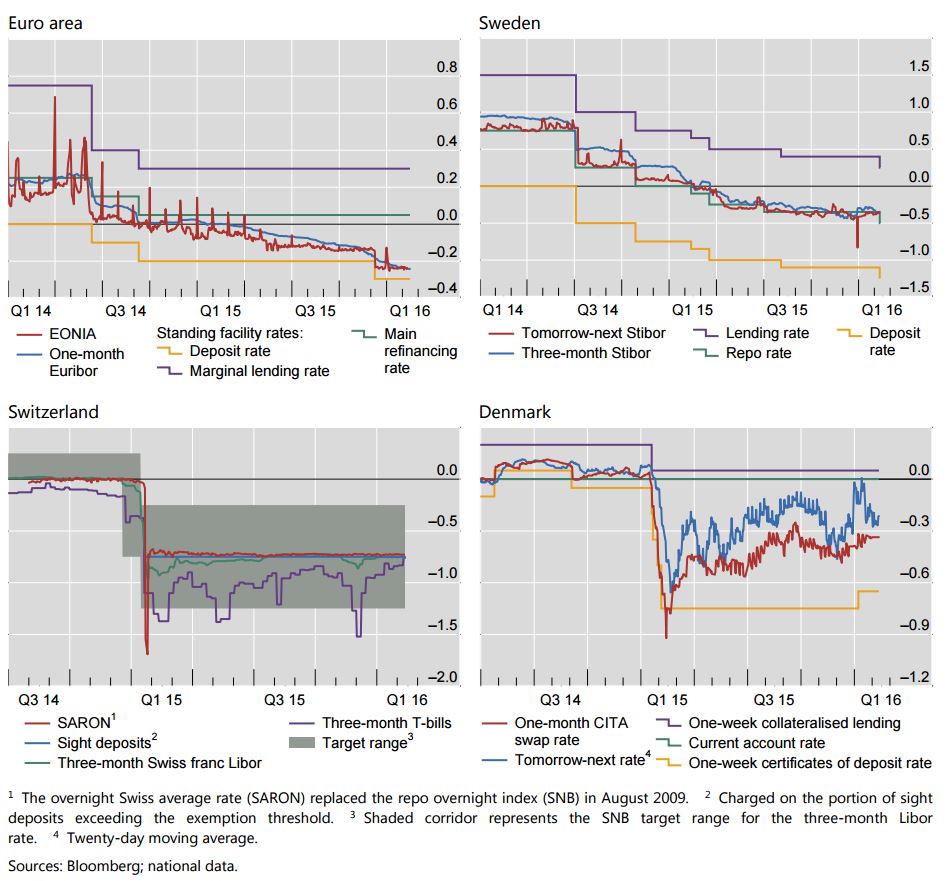
The ultimate objective of negative interest rates is to get savers to spend and business to respond by investing. But negative interest rates have so far largely been confined to long-term bond and money markets and on deposits parked with the central banks.
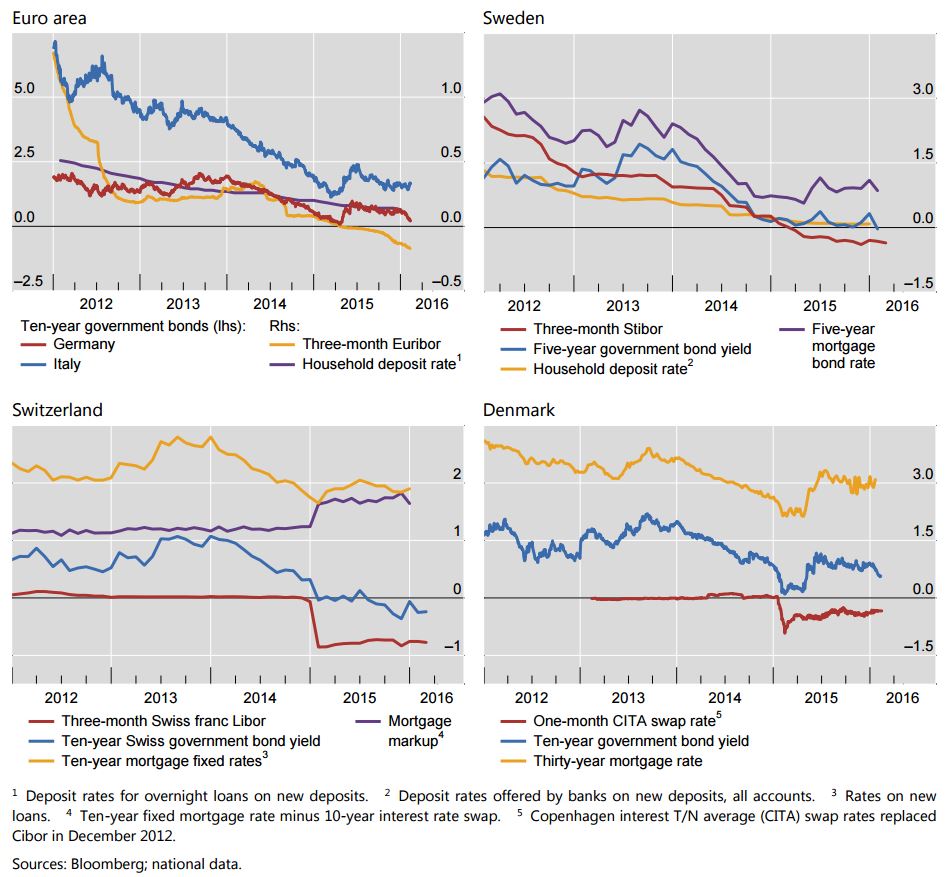
The experience so far suggests that modestly negative policy rates are transmitted through to money market rates in much the same way as positive rates are. It also appears that they are transmitted to longer-maturity and higher-risk rates, although this assessment is clouded by the impact of complementary monetary policy measures. By contrast, so far retail deposit rates have remained insulated, partly by design. And, at least in Switzerland, negative rates have actually raised, rather than lowered, mortgage rates... there is great uncertainty about the behaviour of individuals and institutions if rates were to decline further into negative territory or remain negative for a prolonged period. It is unknown whether the transmission mechanisms will continue to operate as in the past and not be subject to "tipping points".
Uncertainty about banks' earnings prospects have been heightened by the expectation that negative policy rates and exceptionally low interest rates out the yield curve may prevail for longer than originally anticipated. Interest margins have been squeezed, given banks' reluctance to pass negative rates on to depositors. Banks seem to have coped with the operational challenges so far, but this offers limited comfort if rates move lower and stay negative for a prolonged period.
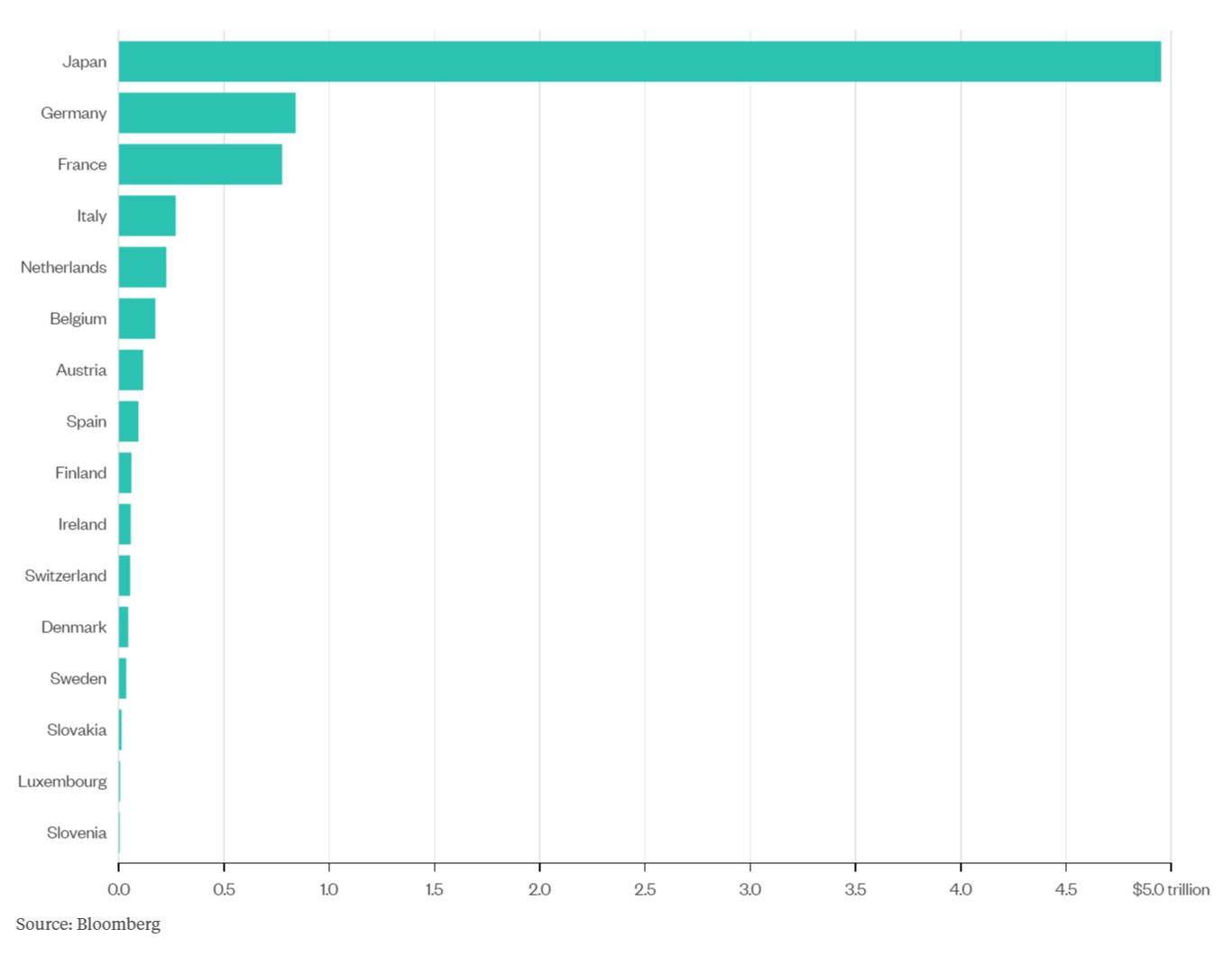
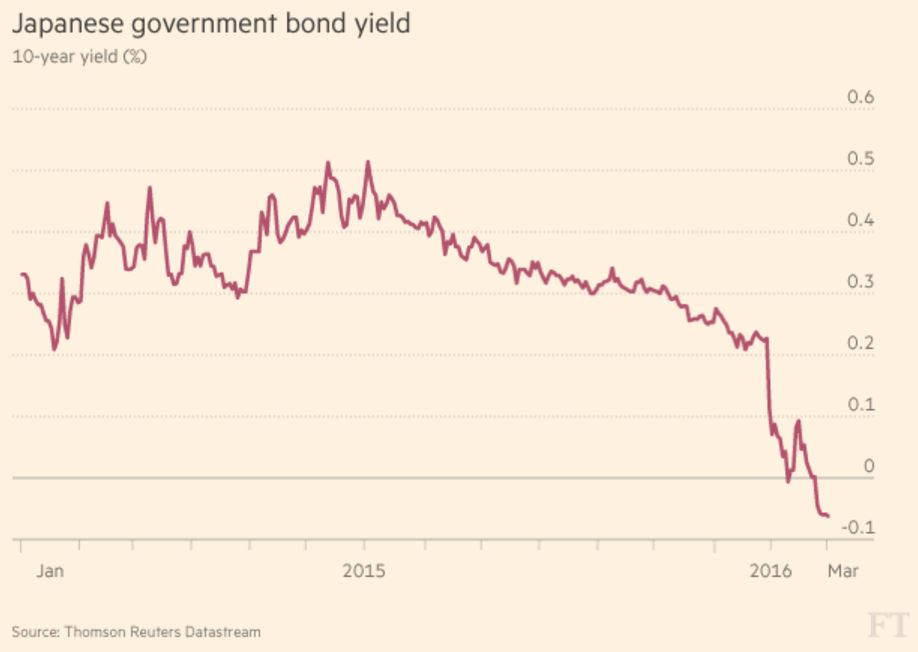
The buying appears to have been almost entirely dealers and speculators looking to hold the paper for a brief time or covering short sales accumulated in expectation of the yield dropping into negative territory. Traders expect much of it to be flipped directly back to Japan’s central bank in a few weeks as part of a bond-buying programme, also designed to stimulate the economy... As well as forcing wholesale adjustments to the structure of many investment products, analysts at Nomura have warned that the JGB market could now be prone to regular phases “where fair prices are no longer obvious”... Another motive behind the dealers’ buying appears to be a straightforward play on the BoJ’s upcoming “rinban” bond purchases and the opportunity to sell to the central bank at a profit.
Update 1 (21.03.2016)
Gavyn Davies has concerns about the negative rates on bank profitability given the difficulty of lowering deposit rates below zero.
Update 2 (18.04.2016)
Excellent primer on negative rates here and the IMF on the beneficial effects of negative rates.
The Investment Consulting steps
Latticework of Mental Models: Network Effect
I clearly remember the day, it was in July 1999, when I was first introduced to the internet. I was so excited to get a brand new email address. I could now send and receive emails.
However, the excitement didn’t last very long. I quickly realized that the email address wasn’t of much use to me because none of my family or friends had any email addresses at that time. Who would I mail?
But slowly as more and more people started using internet, my email address became increasingly valuable.
Similarly, I remember the time when the social networking bug bit me and I signed up for Orkut. But within few years when all my friends had moved to Facebook, I was forced to abandon Orkut and climb on the Facebook bandwagon.
So you’d notice that the utility of certain products and services is directly proportional to its number of users. Another recent example that comes to mind is the social messaging app Whatsapp. There are quite a few other messaging services which offer better features than Whatsapp but majority of people continue to use Whatsapp because all their friends are on Whatsapp.
This is called Network Effect. Now the idea may sound very simple, but it’s actually fairly unusual.
When you board an airplane, do you get excited when you see that the flight is completely full? Or when you visit your favourite restaurant, do you prefer it to be crowded? In these cases, as a consumer you don’t get any benefit if the product or service is also being used by others.
But when it comes to social networks like Facebook, Linkedin and Twitter, members join these networks because other members are in this network.
These are the businesses that benefit from the network effect. The value of their product or service increases with the number of users. When network effects kicks in people feel compelled to use it, or are forced to use it because of its popularity.
For instance Microsoft Word is more commonly used because it’s packaged with Windows and comes free with windows PC. Since so many businesses and individuals utilize Word, their customers and suppliers are compelled to have it as well. The network effect leads to positive feedback in which the product’s presence in the market increases.
It’s not that Microsoft Office doesn’t have a competitor. “OpenOffice” offers almost all the features of MS Word and it’s free. In spite of that it hasn’t been able to make any dent to MS Word’s market share. Because of minor issues related to compatibilities between OpenOffice and MS Word, people just don’t bother using OpenOffice.
Bob Metcalf, the inventor of ethernet, stated that if there are ‘N’ people in a network, and the value of the network to each of them is proportional to the number of users, then the total value of the network (to all users) is proportional to N*(N-1).
If the value of a network to single user is Rs.1 for each other user on the network, then a network of size 10 has a total value of roughly Rs. 100. In contrast, a network of size 100 has a total value of roughly Rs 10,000. A tenfold increase in the size of the network leads to a hundredfold increase in its value.
Which means, as the network grows, the rate of growth of the network value (represented by number of connections between different nodes) is faster than the rate of growth of network (represented by number of nodes in the network).
The image below illustrates the ideas very well.
Not all connections in a network are equally meaningful and valuable but it’s fair to say that the value of a network to its users is more closely tied to the number of connections than it is to the number of nodes.
A market can sustain only few network for a given kind of product or service. You don’t find many social networking sites out there. Facebook, Twitter and LinkedIn pretty much dominate the industry. In fact Orkut, in spite of having the first mover advantage, had to shut down when it was squeezed out by Facebook.
So we can say that network based businesses tend to create natural monopolies and oligopolies.
Look at the world of credit card networks. It’s dominated by VISA, Mastercard and Amex. That’s a huge amount of market concentration. The barrier to entry in this industry is a result of network effect. Even if a competitor showed up on the scene next week, it has to first convince millions of merchants to accept the new card which require the competitor to first have millions of customer using the new card. In simple words it’s classic catch-22 problem for any new player to enter this market.
“A competing firm would need to replicate the network —or at least come close”, says Pat Dorsey, author of wonderful book The Little Book That Builds Wealth, “- before users would see more value in the new network and switch away from the existing one.”
Talking about common characteristics shared by businesses having network effect, Dorsey writes –
…you’re most likely to find the network effect in businesses based on sharing information, or connecting users together, rather than in businesses that deal in rival (physical) goods…this is not exclusively the case, but it’s a good rule of thumb.
That means you’re more likely to find the network effect in businesses which are heavy on technology. So businesses like eBay come out like text-book examples of network effect. Dorsey writes in his book –
As of this writing, eBay had at least an 85 percent share of Internet auction traffic in the United States…The buyers are on eBay because the sellers are there, and vice versa.
Even if a competing site were to launch tomorrow with fees that were a fraction of eBay’s, it would be unlikely to get much traffic—no buyers, no sellers, and so forth. And the intrepid first users wouldn’t have the benefit of eBay’s feedback ratings, telling them which other users they can trust to fulfill a transaction, nor could they be assured of getting the best price, given the paucity of other users. (I once asked a candidate applying for an analyst job at Morningstar what he would do if I played venture capitalist, gave him huge amounts of financial backing, and told him to go beat eBay at its own game in the United States. He thought for a minute and then replied, “I’d return the money.” Good answer.)
Similarly, in e-commerce space it’s almost impossible to displace Amazon from its position. It’s not just the network of buyers and sellers but imagine the immense value that the accumulated information about product ratings and reviews creates for the buyers. The product reviews on Amazon are tremendously useful for the buyers to make purchase decisions. And bigger the network of buyers and sellers grows, bigger is the value of the whole Amazon platform.
Once a certain critical mass is achieved the network effect starts riding on positive feedback loop and this self reinforcing virtuous cycle creates a winner-takes-all scenario.
Network effect can be seen in newspaper business also. More readers for newspaper attracts more advertisers and hence more valuable it becomes for the readers as a source of information about new products and services.
Warren Buffett wrote in his 2006 letter –
Advertisers preferred the paper with the most circulation, and readers tended to want the paper with the most ads and news pages. This circularity led to a law of the newspaper jungle: Survival of the Fattest.
Thus, when two or more papers existed in a major city (which was almost universally the case a century ago), the one that pulled ahead usually emerged as the stand-alone winner. After competition disappeared, the paper’s pricing power in both advertising and circulation was unleashed. Typically, rates for both advertisers and readers would be raised annually – and the profits rolled in. For owners this was economic heaven.
MCX, the multi-commodity exchange in India, which accounts for more than 85% of total value traded in the Indian commodity futures markets (2013), is another business which benefits from network effect. As more buyers and sellers utilize the MCX, the alternative exchanges become less attractive in terms of pricing and liquidity.
Another example is Info Edge, where the key business of Naukri benefits from a virtuous cycle –
Network effect is an important attribute to look for while evaluating the presence of economic moat, a metaphor for durable competitive advantage, in a business.
Network effect, according to Pat Dorsey, is an important sources of structural competitive advantage. The other being switching costs, cost advantage and intangible assets.
So if you can find a company with solid returns on capital and a presence of network effect in its business, you’ve likely found a company with a moat. In fact network effect and switching costs are related because network effect creates a switching costs for the consumer.
Here’s an interesting insight about Tesla Motors.
I am guessing that Tesla Motors are also on their way to creating a very strong moat using network effect. Like Google’s driverless cars, Tesla is also working on self-driving cars (it’s available as part of the latest software upgrade for Tesla cars). As thousands of Tesla electric cars are being driven around, each car is charting the roads. So each Tesla automobile effectively becomes a data gathering agent. The data is sent to Tesla (every car is connected to central Tesla server for downloading upgrades to its software) which helps in mapping the roads around the world.
Watch this video where the driver talks (at 5:20) about this feature.
As more and more people use Tesla and longer they use it, the data about geography (the road quality, unexpected curves on the road, real time traffic conditions, even proximity with rash drivers etc) will benefit the Tesla owners to rely more and more on the autopilot.
This looks like a moat in creation. The more robust the Tesla’s geographical data becomes, more the value of Tesla vehicle for the users. The more users drive Tesla cars the bigger and better Tesla’s data.
Isn’t this a network effect?
I am not sure if this is an intentional move by Elon Musk but if it is, then any other electric car company will find it very tough to replicate this competitive advantage.
Conclusion
So we have seen how network effect can create an extremely powerful competitive advantage. It’s a very powerful type of economic moat that can lock out competitors for a long time.
The great scientist Isaac Newton once said, “If I have seen further than others, it is by standing upon the shoulders of giants.”
By learning the big ideas from multiple disciplines and developing a latticework of mental models, we are allowing ourselves to stand on the shoulders of giants. People who have come before us and developed useful ideas in different subjects have already done the groundwork required for improved thinking. What remains to be done on the path to worldly wisdom is to learn these ideas, master them and begin using them in our decision making process.
The first and foremost beneficiary of this Latticework series is me. So do let me know what other mental models would you like to learn together.
Take care and keep learning.
The post Latticework of Mental Models: Network Effect appeared first on Safal Niveshak.
Forthcoming risk in PPF: aka legislative risk
Russia’s demographic puzzle – falling birth rates and rising death rates…
Austrian Province Offers 75 Cents on Guaranteed Bonds: Sovereign Guarantee Means Nothing
Just as we think things are getting stable in the rest of the world, Austria has fallen into a strange situation. There was a bank, Heta. It failed. Six years ago.
And when it did, its bonds were guaranteed by the province, Carinthia, which now has to pay back around 11 billion euros worth (Bloomberg) After years of status quo, the province has offered 75 cents on the Euro for the senior bonds (and 30 cents on the junior bonds) to the creditors. Meaning, people who’ve given them 100 euros should settle for 75.

Tower in Carinthia
Except they’re not happy. Carinthia gave a guarantee, one that the Austrian government too said was as good as sovereign debt, and therefore they should make good that obligation, say the creditors, which are largely German banks. They’ve rejected the deal, and the group that’s vocally done so owns 5.5 billion euros worth of bonds which can stymie any forced deal (which needs 2/3rd or more of bondholders to accept). … (Read On...)
Weekend reading links
In the next 15 years India will see more people come online than any other country. Last year e-commerce sales were about $16 billion; by 2020, according to Morgan Stanley, a bank, the online retail market could be more than seven times larger. Such sales are expected to grow faster in India than in any other market. This has attracted a flood of investment in e-commerce firms, the impact of which may go far beyond just displacing offline retail.
Kyaukphyu links the Middle Kingdom to seaways towards south Asia, Africa, the Gulf and beyond. It cuts the long and sometimes perilous journey round the Strait of Malacca, which has long been a piracy hotspot. It also reduces China’s reliance on this crucial channel, to which the US Navy has access through its Southeast Asian regional allies.
I work as a casual labourer on my own land. I am doing it just to survive... I can only eat when I work now. I have to wish that someone will ask me to come and work for them. When I had my own land, I didn’t have to feel that way.
Despite a significant decline in input costs, particularly in 2012-13 and 2013-14, prices were kept higher, which could not have been possible without an agreement among these companies. The presence of conducive conditions in the market facilitated a cartel among the companies... Despite slack tyre demand in in 2012-13 and 2013-14, the companies were able to significantly enhance operating margins, a strong indication of coordinated action... The increase and decrease by similar magnitude during 2011-12 to 2013-14 indicated tyre prices moved in tandem.
6. Finally, Edward Luce,
Nations, it seems, suffer from similar disorders to humans — what happens in their formative years shapes their character for evermore. Just as India sees foreign investors as potential colonisers, and Britain confuses Brussels with the papacy, so the US is enchained to its original sin of slavery. Half a millennium after the first Africans were shipped across the Atlantic, the US still has one foot in its past.
They Can’t Help You
Before I start this evening, I want to add one follow-up to last night’s piece on Berkshire Hathaway. My summary was that it wasn’t a great year, and the profit margins are likely to shrink in insurance, because BRK is being conservative there. So why do I still own it for my clients and me?
BRK is trading maybe 8% over the level at which it would begin buying back stock. Even in a pessimistic year, I expect BRK’s book value to rise to the level that triggers the buyback. Thus, I think the floor for the stock is pretty close below me, and there is a decent possibility that Buffett could do some things with the cash that are even better than buybacks, especially if the market falls into bear territory.
It is positioned well for most market environments, even one where insurance gets hit hard. BRK is “the last man standing” in any insurance crisis — they have the ability to prosper when other companies will have their capital impaired, and can’t write as much business as they want.
That’s why I own it.
Long BRK/B for my clients and me
=-=-=-=-=-=-=-=-=-=-=-=-=-=-
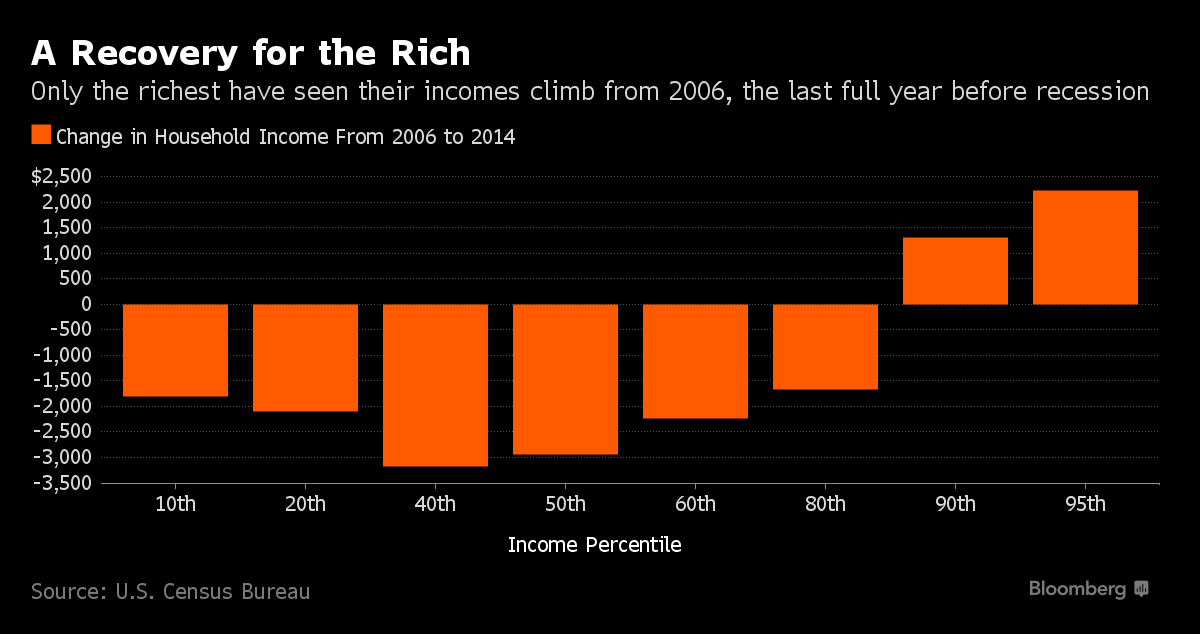
Onto tonight’s topic. This is partially spurred by an article at Bloomberg.com entitled Angry Americans: How the 2008 Crash Fueled a Political Rebellion. There was one graph that crystallized the article. Here it is:
Incomes have not improved for the bottom 80% of Americans over the last decade. Before I go on, recognize that the income distribution is not static. The same people are not in each decile today, as were in 2006. Examples:
- Highly skilled students in a field that is in demand graduate and get jobs that pay well.
- Highly skilled immigrants in a field that is in demand come to the US and get jobs that pay well.
- Less skilled people who relied on the private debt culture to keep getting larger no longer have jobs that pay well in finance, construction, real estate, etc.
- Workers and businessman who expected the commodities and crude oil boom to go on forever have seen their prospects diminish.
- Some people have retired and their income has fallen as a result.
- Layoffs have come in some industries because many people did not realize that they were lower skilled workers, and as such the work that they did could be automated or transferred to other countries.
- Manufacturing continues to get more efficient, and we need fewer jobs in manufacturing to produce the same output (or more). This is true globally; manufacturing jobs are being reduced globally.
- Technology firms that apply the advantages of the internet gain value, while legacy firms lose value. Whole classes of goods go away because they are replaced, and in other cases, some firms find that they can’t price their products to make a decent profit, while other firms can.
- Some effects are demographic, like mothers ceasing work to raise children, or industries with a lot of older workers becoming uncompetitive because their pension plans are too expensive to fund.
- Divorce usually ruins the prospects of the wife, if not the husband.
- Throw in death, disability, substance abuse, and serious diseases.
- And more…
Thus there is a lot of reason to look at the graph and not say, “The rich are getting richer,” but, “Those who are getting rich today are doing so faster than those who were getting rich back in 2006.”
My life is even an example of that… I make less than 30% of what I was making in 2006. On an income basis, I’ve gone from the top of the graph to the middle. I’m not upset, because I’m debt free, and manage my finances well. I’m grateful to have my own little firm, and every client that I have.
Resentment
That said, many feel that the comfortable life that was theirs has been denied to them by forces beyond their control. They think that shadowy elites want to turn previously well-off people into modern serfs.
It’s a tempting thought, because most of us don’t like to blame ourselves. Myself included, we all make mistakes. Here is a sampling:
- Did we make a bad decision in the industry in which we chose to work? The particular firm?
- Did we choose a bad field of study in college? Rack up too much student loan debt?
- Did we borrow too much money at the wrong time? (Remember, debt is always a risk. If you don’t know that, you shouldn’t borrow money.)
- Did you make bad decisions regarding your assets, and get too greedy or fearful at the wrong times?
- Did you spend too much during your good years, and not save enough for the future?
- Did you not buy the insurance that would have protected you from the disaster that hit you?
- Throw in relationship errors, etc.
The truth is, changes in technology, and to a lesser extent demography, affect the entities that we work in, and affect our personal economics as a result. There are some politicians blaming immigrants for our problems, and that’s not a major source of our difficulties. Most people don’t want to do the work that unskilled immigrants do, and skilled immigrants get hired when there aren’t enough people seeking those positions.
There is a need for retraining, but even that has its difficulties, as technology is changing rapidly enough that more areas may face job reductions. Again, this is a global thing. Those that think that making trade less free will help matters are wrong. It’s not trade; it’s technology.
Some think that matters can be fixed by changing government taxes and spending. That would only help limitedly, if at all. Businesses and people can move to other countries. In an era of the internet, many more things can move than ever did previously.
Now, if the developed countries collaborated to unify tax policies, some of that would end. But cheating under such a regime is too tempting, just as Indiana and Wisconsin try to attract businesses to move out of Illinois. The relatively healthy governmental entities have advantages that allow them to prosper at the expense of the sick ones.
You’re Going to be Disappointed
Politicians live to promise. I can tell you right now that not one of the surviving candidates for President has a realistic proposal that could be voted up by the next Congress or the buyers in the US Treasury market. It’s all airy-fairy… just as most politicians have been since we stopped running balanced budgets.
I would encourage you therefore to look at your own situation and resources soberly, and assume that the next government will do nothing better for you than the current one. All of the main drivers of what could improve matters for the middle class are outside the power of any individual government, so plan your own situation accordingly and adjust your economic expectations down. After all, there is no place in the world that can promise its people prosperity. Why should the USA be any different in this matter?
Subtle Jealousy
Making a crisis count - disciplining the markets
Latticework of Mental Models: Liking Bias
It was March 2007 and I was desperately looking for a tax saving investment product. Until that year I had been sticking to the old fashioned conservative options like tax saving FDs and LIC policies. But the stock market frenzy of 2007 was rubbing off on me.
So when I received a call from a stranger who called himself a “financial advisor” and showed a great concern for my financial well being, I couldn’t say no to his request for a meeting.
Although the young chap seemed to have just a few years of experience in the industry but his demeanor were nothing less than that of a CEO of a large company. He was well dressed, tidy, confident and articulate.
When we met he took interest in my hobbies and complimented me about my reading habits. Needless to say I took an instant liking to him.
He told me about a new financial product called ULIP (unit linked insurance plan). I had never heard of ULIP, so before committing any money to it I borrowed some time from him and did a quick research on google. The reviews on the internet weren’t very encouraging. Some even claimed of unethical mis-selling by private banks and insurance companies as far as ULIP was concerned.
But my financial advisor seemed to know what he was talking and I liked him. He even told me that one of his elder cousin was from my college. So I went ahead and (mis) invested my money.
It turned out that I wasn’t the only one who lost money in toxic financial products which were indiscriminately peddled by many suit-tie wearing sales people.
So why did I succumb in spite of knowing that ULIP wasn’t the best option for me? I would like to put the blame on the so called “financial advisor”. But he was just doing his job i.e. selling stuff. Even today I can’t imagine him as a crook or unethical person.
It was much later, after reading Robert Cialdini’s book Influence, when the realization set in that I has been a victim of something called Liking Bias or Liking Tendency.
Because of liking tendency we tend to like who are physically attractive, popular, cooperative, or people we have positive associations with. Also, those who are similar to us in background, opinion, lifestyle, interest, attitude, looks, values, and belief. We also like and trust anything familiar.
Most people prefer to say yes to the requests of someone they know and like. It’s a natural tendency to ignore the faults of those we find likeable while doing just the opposite to the people we don’t like.
According to Charlie Munger…
Liking tendency acts as a conditioning device that makes the liker or lover tend:
- To ignore the faults of, and comply with the wishes of, the object of his affection;
- To favor people, products, and actions merely associated with the object of his affection (Influence from Mere Association Tendency); and
- To distort other facts to facilitate love.
Just as liking and loving make humans agree with each other despite their vices, the tendency to hate or dislike does the absolute reverse and leads to ignoring or refuting the person we dislike or hate despite the virtues.
Here is what Munger has to say on that:
Disliking/hating tendency also acts as a conditioning device that makes the disliker/hater tend to:
- Ignore virtues in the objects of dislike,
- Dislike people, products and actions merely associated with the objects of his dislike, and
- Distort other facts to facilitate hatred
Liking bias, due to its persuasion power, is widely used by negotiation experts and salespeople to tip the scale in their favour.
Since it is extremely profitable, there is a huge demand of people who can persuade other people to take desired actions and some people have a natural flair for it. There are numerous examples of war marshalls, CEOs, sports managers etc.
In fact the first thing any salesman is taught is to Be Likeable. Which means their sales training programs not only teach them all the nuances of communications skills but also teach them to dress well and create an impeccable first impression. Their aim is to be likeable even before they open their mouth. People who exploit this bias know that first impression is not only the last impression but the lasting impression too.
Joe Girard is considered the most successful car salesman in the world. His tip for success: There is nothing more effective in selling than getting the customer to believe, really believe, that you like him and care about him.
What Creates Liking Bias
According to Cialdini following factors cause one person to like another person –
- Physical Attractiveness – Research has shown that we automatically assign to good-looking individuals such favorable traits as talent, kindness, honesty, and intelligence. Good looking people are likely to receive highly favorable treatment in many setups including elections, employment interviews and even in judicial process. Experiments show that attractive criminals are seen as less aggressive and get a milder punishment than ugly criminals. In another study the better looking men and women received aid more often, even from members of their own sex. In short, good-looking people enjoy an enormous social advantage in our culture.
- Similarity – We like people who are similar to us. This similarity could be in the area of opinions, personality traits, background, or lifestyle. Salespeople can manipulate similarity to increase liking by claiming that they have backgrounds and interests similar to ours. They are trained to look for evidence of such things while interacting with the potential customer. There are techniques like mirroring and matching the customer’s body posture, mood and verbal style to subconsciously trigger the feeling of similarity. As a corollary we don’t like the ones we perceive as dissimilar to us.
- Being Liked – We like people who like us. If we feel that a person likes us, we tend to like them back. Remember Joe Girard? Do you know his trick to get his customers to like him? Each month he sent every one of his thousands of former customers a holiday greeting card containing just one line – ‘I like you’. Being liked and accepted is basic emotional need for all human beings. British Prime Minister and novelist Benjamin Disraeli said, “Talk to a man about himself and he will listen for hours.” We are phenomenal suckers for flattery. And we reciprocate the way others see us. If we perceive others dislike us, we tend to dislike them.
- Cooperation – We like people who cooperate with us. How do we get people to cooperate? Create an external common threat or an opportunity for mutual gain. A typical example could be a salesman pretends to be on our side and “negotiates with his boss“ to secure a good deal for us. Another example is the good cop/bad cop trick routinely employed by police to get a confession from a suspect. One police officer acts hostile and other, acting as a good cop, tries to calm down his angry partner and pretending a soft corner for the suspect. The suspect develops a subconscious liking for the good cop and cooperates.
Here’s another interesting trick. Asking a favor of someone is likely to increase that person’s liking for us. Counterintuitive right? But it works because people want to be seen as consistent with their behavior.
Benjamin Franklin tells us about an old maxim: “He that has once done you a kindness will be more ready to do you another, than he whom you yourself have obliged.”
In Business
In his book, The Art of Thinking Clearly, Rolf Dobelli writes –
Aid agencies employ the liking bias to a great effect. Their campaigns use beaming children or women almost exclusively. Never will you see a stone faced, wounded guerrilla fighter staring at you from billboards – even though he also needs your support. Conservation organizations also carefully select who gets the starring role in their advertisements. Have you ever seen a World Wildlife Fund brochure filled with spiders, worms, algae or bacteria? They are perhaps just as endangered as pandas, gorillas, koalas and seals – and even more important for the ecosystem. But we feel nothing for them. The more human a creature acts, the more similar it is to us, the more we like it.
Companies already understand this. Employees at Disney theme parks and Hilton Hotels wear name tags emblazoned with their hometowns. So the visitors feel comfortable when they see people from their own place.
In Investing
Almost all the financial news commentators on TV have great personalities and outstanding communication skills. You’ll never find them untidy or with unkempt hair. They’re articulate, confident, humourous and witty.
There’s no way you can’t like these talking heads on TV unless you have lost significant money following their advices and forecasts. Some of them are so likeable that people don’t mind losing money and still continue to like them. That’s the power of psychological biases. You can’t counter its force even if you know about it.
So the only way to save yourself from this is to stop watching financial news channels.
Many successful investors don’t talk to the management because they understand the power of liking bias. A direct talk with a management, especially a charismatic CEO with likeable personality, can trigger liking bias and create a prejudice in our minds.
The legendary investor Peter Lynch reminds us not to fall in love/get emotional with a stock. The stock doesn’t know that we own it, so falling in love with it only makes us susceptible to bad judgment.
Remaining detached enough from our investments to look at them objectively is a crucial skill to becoming a successful investor.
Overcoming Liking Bias
The biggest problem with behavioural biases is that their force is so strong that it’s extremely difficult to counter them. And the best strategy is to avoid being in such situations.
So this is what Guy Spier writes in his book, The Education of a Value Investor, about how he deals with such situations –
…I soon began to see that I made lousy decisions when I bought things that salespeople were hawking to me.
The problem is that my brain (and most likely your brain too) is awful at making rational decisions when confronted with a well-argued, detailed pitch from a gifted salesperson. So I adopted a simple rule that has proved extraordinarily beneficial. When people call to pitch me anything at all, I reply in as pleasant a manner as possible, “I’m sorry. But I have a rule that I don’t allow myself to buy anything that’s being sold to me.”
I may miss out in the short term. But over a lifetime I have no doubt that I’ll benefit much more by detaching myself from people with a self-interest in getting me to buy stuff.
So now whenever I get a call from these financial advisors, asking for a meeting, I just refuse to meet them.
Still you may find yourself in such situations where it’s unlikely that you could muster a timely protection against the unconscious effect of liking bias. First thing that needs to happen in that situation is to bring the awareness.
Ask yourself, “Have I come to like this person more than I would have expected in such a short time?”
If the answer is yes then it’s time for a quick counter maneuver, which doesn’t mean that you should look for reasons to dislike the person. That would be like fighting with natural force of behavioural bias which isn’t going to help much.
What you need to do is to put a conscious effort to separate the person from the deal. Concentrate exclusively on the merits of the deal. Try to look at the facts and situation objectively. This may save you.
Conclusion
We do things for people we like, because it’s a natural reciprocation to being liked.
William James said, “The deepest principle in human nature is the craving to be appreciated.”
Take care, keep learning and don’t forget that I like you. 
The post Latticework of Mental Models: Liking Bias appeared first on Safal Niveshak.
How to become a Crorepati
There Are No Called Strikes and Other Lessons You Learn in Business School
Matthew Frederick teams up with Michael Preis to offer some important learnings from the world of business — which isn’t really a discipline in and of itself but rather, as they write in the introduction to 101 Things I Learned in Business School, “a broad field of endeavor encompassing such diverse disciplines as accounting, communications, economics, finance, leadership, management, marketing, operations, psychology, sociology, and strategy.” Here are some lessons gleaned from a trip to business school. (Some of them, at least.)
***
A mission or vision statement driven by consensus is probably so watered down it becomes meaningless. Part of the reason this happens is that when you seek consensus you end up with something that no one at the table can disagree with so you don’t really end up saying anything important.
A mission statement describes the current central purpose and goal of an organization, to guide daily decision making and performance. A vision statement describes what an organization seeks to become, or the ideal society to which the organization seeks to contribute.
When drafting and evaluating potential mission and vision statements, ask if the opposite of a proposed statement is obviously undesirable. If it is, the statement is obviously undesirable. For example, a university mission statement that says the institution “seeks to produce highly effective productive citizens” is unlikely to have any real influence on employees or students, since no university seeks to produce its opposite—ineffective, unproductive citizens. A more meaningful statement will assert that which is truly specific to the organization; it describes what the organization seeks to do that many or most of its peers do not.
This is reminiscent of the approach Ken Iverson took at Nucor: The company needs a specific call to a specific action. Otherwise, you’re wasting everyone’s time with a watered down message.
There are no called strikes.
Billy Beane, who offers compelling insight on making better decisions and avoiding biases, is quoted in Moneyball to have said “You can always recover from the player you didn’t sign. You may never recover from the player you signed at the wrong price.” This is reminiscent of what Warren Buffett had to say on the same subject: “In investments, there’s no such thing as a called strike. You can stand there at the plate and the pitcher can throw the ball right down the middle, and if it’s General Motors at $47 and you don’t know enough to decide General Motors at $47, you let it go right on by and no one’s going to call a strike. The only way you can have a strike is to swing and miss.” Turns out we can learn a lot about decision making from baseball star Ted Williams and the fictional character Mr. Market, who was invented by Benjamin Graham.
Adding to our knowledge on Feedback Loops, Frederick and Preis distinguish the difference between positive and negative feedback loops.
In a negative feedback loop, the system responds in the opposite direction of a stimulus, thereby providing overall stability or equilibrium. The Law of Supply and Demand usually functions as a negative feedback loop: When the supply of a product, material, or service increases, its price tends to fall, which may lead to raising demand, which will drive the price back up.
In a positive feedback loop, the system responds in the same direction as the stimulus, decreasing equilibrium further and further. For example, a consumer who feels prosperous after making new purchases may end up making even more purchases and take on excessive debt. Eventually, the consumer (Ed. or Government) may face financial ruin and have to make a major correction by selling off assets or declaring bankruptcy (Ed. read A Parable About How One Nation Came To Financial Ruin). Because positive feedback loops restore equilibrium in their own, often dramatic way, it is sometimes suggested that positive feedback loops occur within a larger, if not directly visible, negative feedback loop.
Speaking of The Law of Supply and Demand: It doesn’t always apply.
The Law of Supply and Demand says that if the supply of a given product or service exceeds demand, its price will decrease; if demand exceeds supply, its price will increase. Rising and falling prices impact demand similarly. When supply and demand are exactly equal, the market is at an equilibrium point and acts most efficiently: Suppliers sell all the goods they produce and consumers get all the goods they demand.
Not all products have historically adhered to the Law. When the prices of some luxury or prestige items have been lowered, demand has fallen due to reduced cache. In other instances, rising demand for a product has led to improvements in technology, increases in production efficiency, and the perfection of distribution challenges, all of which have driven prices down. Electronic technologies have tended to follow this pattern.
Experts are not always the best people to solve problems – it’s more about combinatory play — A point not lost on Seneca, Steve Jobs and James Webb Young.
Experts are expected to know a lot, but often it is better to know how to organize and structure knowledge than to simply have knowledge. Innovative thinkers don’t merely retain and recite information; they identify and create new patterns that reorganize known information.
When you don’t think about what you’re doing, you tend to promote the best performer to manager, which is often a mistake. Echoing James March, Preis writes:
Employees who excel in one area of business are often promoted to supervisory positions. But in management, one’s achievements are measured through the actions of others. A first-rate lab researcher promoted to lab supervisor, for example, has to coach, mentor, manage, and help other researchers make discoveries—something that may be beyond his or her abilities or interests. Compounding the problem for the organization is that the department no longer has its best researcher making discoveries on the bench.
Contrary to conventional wisdom, the higher one rises in an organization the longer it takes to implement a decision. (The decisions are more consequential, though.)
Front-line managers can effect immediate changes by directly instructing workers. A sales manager can redirect the activities of sales people immediately, and an accounting manager can make immediate changes in bookkeeping practices. At higher levels of an organization, where employees are more concerned with strategic matters, decisions take more time to implement. If the vice president of marketing wishes to change the style of a product being produced, considerable time will be required to engage feasibility studies, explore design alternatives, investigate the technical methods required, and alter manufacturing practices.
Further to this, the higher one rises in an organization the more one must be a generalist. At the front-line level you often only need direct knowledge of specific activities. Managers need a broader understanding in addition to this knowledge, and they are often missing one or the other.
101 Things I Learned in Business School is a good read; however reading The Letters of Berkshire Hathaway (also freely available) is a better way to understand what an MBA should be teaching. This site, after all, wouldn’t exist without the failed education of an MBA.
--
Sponsored By: Siebels Research — Customized research featuring on the ground original insights at a great value!