Shared posts

19 Apr 06:14

Why You Must Not Quit Your Job to Become a Full-Time Investor

by Vishal Khandelwal

Short view – It could get lonely and frustrating, plus dangerous for your sanity and financial well-being.

Long view – First, a clarification. I am not a full-time investor i.e., me and my family are not dependent for our living on the stock market. I earn my living by teaching people how to invest sensibly in stocks. And I invest a large portion of my savings in stocks. But I won’t have sleepless nights if the stock market were to tank tomorrow and remain down for the next year or two, because that is not what earns me my oats and sprouts (I don’t eat “bread and butter” you see).

Anyways, the reason I am writing this post is because a lot of tribe members have asked me over the years – and especially recently through my Ask Vishal initiative – about how they could quit their jobs to become full-time investors in the stock market.

In most of my replies, I have asked people to avoid quitting their jobs to become full-time investors, and here are five reasons I have often mentioned to support my reasoning. In case you have had this question but were afraid to ask, I hope what follows below helps you take a decision.

Please do not consider my arguments as discouragement if you really want to become a full-time investor. I am just sharing what I have learned and experienced over the years, and you are welcome to ask more questions and share your thoughts or counter-arguments in the Comments section of this post.

5 Reasons You Must Not Quit Your Job to Become a Full-Time Investor

1. You don’t have to get rich through investing – With the last five years of reasonably good performance from the overall market, and with a lot of people flouting their multi-baggers on social media, it isn’t surprising that many people who want to quit their jobs to become full-time investors because they think they have a “knack for finding potential multi-baggers,” or to use a term in fashion these days, a “knack for identifying emerging moats.”

But such thoughts are often masked by survivorship bias, which is a logical error of concentrating only on people or things that “survived” some process and inadvertently overlooking those that did not. So, taking inspiration from other full-time investors who have made good money from “emerging moats” or “100-to-1 stocks” or “value trading” and ignoring others who followed similar processes but ended up with disasters can lead you to false conclusions about your own potential as a full-time investor.

What is more, like them, you don’t need to consider investing as a way to make you rich…but a way to keep you rich i.e., help you grow your purchasing power. Look at your work – job / profession / business – to make you rich and thus focus more energy and focus there than on the stock market. That is another reason most of us should consider owning only high-quality businesses where we don’t have to spend a lot of time answering a lot of questions.

2. Investing isn’t your passion – Yes, I know that the stock market gets you excited and that you think you have a passion for stocks. But if you could look deep within, you may realize that what gets you excited isn’t the idea of “investing in stocks,” but the idea of “investing in stocks that will rise and make you rich quick.” Or why else do you wait for Monday with great excitement if not for the kick that logging into your online portfolio tracker gives you? Yes, yes, I have been through that and thus could relate to it very well (now I don’t maintain an online portfolio tracker).

For a lot of people in the stock market, “I have a passion for equities” is often a result – and not a cause – of “I have made good money from stocks in the last 5 years.” Most of us fail to distinguish between luck and skill in stock investing – both for ourselves and for people who boast about their great picks on social media. And passion for equities often dies with a sliding stock market.

So please beware – know clearly what you are passionate about, and it may not have to be the stock market.

3. You haven’t experienced a deep/long bear market – When I say “experienced” it’s when you had 80%+ of your savings invested in stocks that went down 50%+. As I can assess from the emails people send me asking whether they should quit their jobs to become full-time investors, most of them have been investing/speculating in stocks for less than 5-7 years. This means, they have not experienced a long/deep bear market in equities with a large part of their money invested…which means their guts haven’t been tested for staying sane in a rough market.

If this is true for you too, please don’t get down to full-time investing before you gain this experience. In fact, if you seriously want to get down to becoming a full-time investor, first learn how to do it sensibly, test your skills (by investing part of your savings in stocks) and guts for owning stocks for a minimum of five years and check how you fared in this period. Only then make your decision.

4. You may not have a solid support system – It’s easier for you to convince your family as you start full-time investing without another regular source of income. You have the savings to survive for a couple of years (that’s very important), your spouse believes in your ability to do well, and your kids would love to see you spend some more time with them.

But then, this is easier compared to what? Well, it’s easier compared to keeping yourself and your family convinced for more than 1-2 years in case your investments do not earn well enough to help you maintain your living standards. Or if you do not have an adequate amount of capital invested that brings you sufficient income as dividends.

If that happens to be the case, your support system may be at a risk of breaking down, which may ultimately lead you to take bad, hasty investment decisions. It’s could become a vicious cycle then.

So, even if you aim to become a full-time investor, ensure that you have a regular source of income – maybe through a small business or a part-time job or if your spouse is ready to take the lead earner role happily. That would give you time, confidence, and savings to work towards your aim to become a full-time investor.

5. You haven’t handled loneliness and boredom well in the past – Being on your own can become terribly lonely at times. Plus, if you are an investor and have no new stock idea to work on – maybe the markets become expensive across the board – it could get very boring too. If you have never experienced such emotions of loneliness and boredom in the past, be forewarned, for these can lead you take bad investment decisions just because you don’t have a habit of inaction, or sitting still, when everyone around you is acting. The pressure to “do something” is often so great, that people do the wrong thing when they’d have been better doing nothing.

Of course, you can find investing partners or groups to curb your loneliness, the silence you experience from time to time of being a full-time solo investor can be deafening.

Still Wish to Quit Your Job?
Despite my discouragement, if you still wish to quit your job to become full-time investor, or pursue some other passion, here is a checklist that may help you. These are some lessons from my experience in quitting my job, so they may guide you in some way in case you are sailing in the same boat as I was five years back –

  • You don’t need to quit your job if you can work on your passion for investing or something else alongside. In fact, quitting your job must be the last resort, or when you find the burden unbearable and abusive.
  • Quitting a job and living a fulfilling life isn’t as easy as those who have done it would make out to be. Things get scary at times.
  • Quitting you job will affect others in your life, so it’s critical that you have an honest conversation with your family first and get their buy into the decision.
  • Learn an important and sellable skill before you quit your job to start on your own. You must have an alternate source of income to sustain your family, just in case the stock market doesn’t appreciate your decision and doesn’t reward you for the risk you took
  • Quitting a job to live as an investor can be a path to hell. Don’t expect investing to make you rich, but to keep you rich. It’s the earning from your work, and what you do with it, that will make you rich.
  • Practice minimalism and lean living at least a year or two before you plan to quit your job. Instant compromises are heart breaking!
  • Save money to use as initial capital for your business, and then keep your expenses low. Don’t borrow money for your business till the time you aren’t generating cash. As an investor, you hate cash guzzling businesses, right?
  • Don’t believe people who tell you – “How I quit my job, doubled my pay and cut my hours in half”…or something like this. They will not help you if you reach a point of no return.

All clear?

You have my best wishes if you still want to quit your job to become a full-time investor…or if you want to quit your job to pursue something else.

I will be happy to help, in case you wish to come over and meet me to discuss your questions and plans.

My fee – a cup of green tea. 😉

The post Why You Must Not Quit Your Job to Become a Full-Time Investor appeared first on Safal Niveshak.

    
19 Apr 06:14

Unconventional steps towards being rich

by subra
Assuming for a minute that you come from a rich family, these steps might sound odd, but these are  nice steps to take…see if you can do them… Visualize that you are rich: you are rich by the thoughts that you have, damn the excel sheet. So go and Visualize that you are rich. You […]
19 Apr 06:14

Luck Meets Perseverance: The Creation of IBM’s Competitive Advantage

by Farnam Street Team

On Monday October 28, 1929, the stock market took one of the worst single-day tumbles anyone alive might have seen, with the Dow Jones averages falling about 13%. The next day, October 29th, the market dropped yet again, a decline of 12%. By the end of the year, the Dow Jones average was down more than 45% from its high of 381. Market historians are familiar with the rest of the story: The sickening slide would not stop at 45%, but continue until 1932 to reach a low of 41 on the Dow, a decline of about 90% from peak to trough. American business was in a major Depression. But at least one businessman would decide that, like General Erwin Rommel would say years later, the path was not out, but through.

***

International Business Machines, better known as IBM, was created from the ashes of the Computing-Tabulating-Recording Company (C-T-R) in 1917 by Thomas J. Watson, who’d learned his business skills at the National Cash Register Company (NCR). Before Watson’s reorganization of C-T-R, the company was basically in three businesses: computing scales (to weigh and compute the cost of a product being weighed), time clocks (to calculate and record wages), and tabulating machines (which used punch cards to add up figures and sort them). Watson’s first act of genius was to recognize that the future of IBM was not going to be time cards or scales, but in helping businesses do their work more effectively and with a lot less labor. He set out to do just that with his tabulating machines.

The problem was, IBM’s products weren’t yet all that different from its competitors’, and the company was small. IBM’s main tabulating product was the Hollerith machine, created by Herman Hollerith in Washington D.C. in 1890 to improve the Census tabulating process, of all things. (It sounds mundane, but he saved the government $5 million and did the work in about 1/8th of the time.) By the late 1910s, the Hollerith machine had a major competitor in the Powers Accounting Company, which had a similar product that was easier to use and more advanced than the Hollerith.

Hollerith_Punched_Card
Hollerith Punch Card


HollerithMachine.CHM
Hollerith Machine


Watson knew he had to push the research and development of his best product, and he did, hiring bright engineers like Fred Carroll from NCR, who would go on to be known for his Carroll Press, which allowed IBM to mass-produce the punch cards which did the “tabulating” in the pre-electronic days. By the mid 1920s, IBM had the lead. The plan was set in late 1927.

Watson then pointed to where he wanted IBM to go. ”There isn’t any limit for the tabulating business for many years to come,” he said. “We have just scratched the surface in this division. I expect the bulk of increased business to come from the tabulating end, because the potentialities are greater, and we have done so little in the way of developing our machines in this field.”

Underneath that statement lay a number of reasons—other than the thrill of new technology—why Watson zeroed in on the punch card business. When seen together, the reasons clicked like a formula for total domination. IBM would never be able to make sure it was the world leader in scales or time clocks, but it could be certain that it was the absolute lord of data processing.

[…]

Watson had no epiphanies. No voice spoke to him about the future of data processing. He didn’t have a grand vision for turning IBM into a punch card company. He got there little by little, one observation after another, over a period of 10 to 12 years.

(Source: The Maverick and his Machine)

Watson’s logical, one-foot-at-a-time approach was reminiscent of Sir William Osler’s dictum: Our main business is not to see what lies dimly at a distance, but to do what lies clearly at hand. And with a strategy of patenting its proprietary punch-cards, making them exclusively usable with IBM tabulators and sorters, IBM was one of the market darlings in the lead-up to 1929. Between 1927 and 1929 alone, IBM rose about four-fold on the back of 20-30% annual growth in its profits.

But it was still a small company with a lot of competition, and the punch card system was notoriously unreliable at times. He had a great system to hook in his customers, but the data processing market was still young — many businesses wouldn’t adopt it. And then came the fall.

***

As the stock market dropped by the day and the Depression got on, the economy itself began to shrink in 1930. GDP went down 8% that year, and then another 7% the following year. Thousands of banks failed and unemployment would eventually test 30%, a figure that itself was misleading; the modern concept of “underemployment” hadn’t been codified, but if it had, it probably would have dwarfed 30%. An architect working as a lowly draftsman had a job, but he’d still fallen on hard times. Everyone had.

Tom Watson’s people wondered what was to become of IBM. If businesses didn’t have money, how could they purchase tabulators and punch cards? Even if it would save them money in the long run, too many businesses had cut their capital spending to the bone. The market for office spending was down 50% in 1930.

Watson’s response was to push. Hard. So hard that he’d take IBM right up to the brink.

IBM could beat the Depression, Watson believed. He reasoned that only 5 percent of business accounting functions were mechanized, leaving a huge market untapped. Surely there was room to keep selling machines, even in difficult times. Watson also reasoned that the need for IBM machines was so great, if businesses put off buying them now, certainly they’d buy them later, when the economy picked up. His logic told him that the pent-up demand would explode when companies decided to buy again. He wanted IBM to be ready to take advantage of that demand.

He’d keep the factories building machines and parts, stockpiling the products in warehouses. In fact, between 1929 and 1932, he increased IBM’s production capacity by one-third.

Watson’s greatest risk was running out of time. If IBM’s revenue dropped off or flattened because of the Depression, the company would still have enough money to keep operating for two years, maybe three. If IBM’s revenue continued to falter past 1933, the burden of running the factories and inventory would threaten IBM’s financial stability.

[…]

Watson’s logic led him to make what looked to outsiders like another insane wager. On January 12, 1932, Watson announced that IBM would spend $1 million—nearly 6 percent of its total annual revenue— to build one of the first corporate research labs. The colonial-style brick structure in Endicott would house all of IBM’s inventors and engineers. Watson played up the symbolism for all it was worth. He would create instead of destroy, despite the economic plague.

(Source: The Maverick and his Machine)

Most companies pulled back, and for good reason. Demand was rapidly shrinking, and IBM’s decision to spend money expanding productive capacity, research, and employment would be suicide if demand didn’t return soon. All of that unused capacity was costly and would go to waste. Watson took an enormous risk, but he also had faith that the American economy would recover its dynamism. If it did, IBM would come out on the other side untouchable.

Somehow, Watson had to stimulate demand. He had to come up with products that companies couldn’t resist, whatever the economic conditions. Again, thanks to Charles Kettering’s influence, Watson believed that R&D would drive sales. (ed: Kettering was chief engineer at General Motors.) So Watson decided to build a lab, pull engineers together, and get them charged up to push the technology forward.

Throughout the 1930s, IBM cranked out new products and innovation, finally getting its technology ahead of Remington Rand or any other potential competitors.

[…]

Within a few years, Watson’s gamble of manufacturing looked disastrous. As IBM pumped increasing amounts of money into operations and growth, revenue from 1929 to 1934 stalled, wavering between $17 million and $19 million a year. IBM edged toward insolvency. In 1932, IBM’s stock price fell to 1921 levels and stayed there—11 years of gains wiped out.

(Source: The Maverick and his Machine)

By 1935, IBM was still stagnating. Watson made the smart move to get out of the money-losing scale business and use the money to keep the remaining businesses afloat, but he was drowning in excess capacity, inventions be damned.

Then IBM got a stroke of luck that it would ride for almost 50 years.

After all of his pushing and all of his investment, after the impossible decision to push IBM to the brink, Tom Watson was rewarded with The Social Security Act of 1935, part of FDR’s New Deal. It was perfect.

No single flourish of a pen had ever created such a gigantic information processing problem. The act established Social Security in America—a national insurance system that required workers to pay into a fund while employed so they could draw payments out of it once they retired, or if a wage-earning spouse died. To make the system work, every business had to track every employee’s hours, wages, and the amount that must be paid to Social Security. The business then had to put those figures in a form that could be reported to the federal government. Then the government had to process all those millions of reports, track the money, and send checks to those who should get them.

Overnight, demand for accounting machines soared. Every business that had them needed them more. An officer for the store chain Woolworth told IBM that keeping records for Social Security was going to cost the company $250,000 a year. Businesses that didn’t have the machines wanted them. The government needed them by the boatload.

Only one company could meet the demand: IBM. It had warehouses full of machines and parts and accessories, and it could immediately make more because its factories were running, finely tuned, and fully staffed. Moreover, IBM had been funding research and introducing new products, so it had better, faster, more reliable machines than Remington Rand or any other company. IBM won the contract to do all of the New Deal’s accounting—the biggest project to date to automate the government…

This period of time became IBM’s slingshot. Revenue jumped from $19 million in 1934 to $21 million in 1935. From there it kept going up: $25 million in 1936, $31 million in 1937. It would climb unabated for the next 45 years. From that moment until the 1980s, IBM would utterly dominate the data processing industry—a record of leadership that was unmatched by any industrial company in history.

(Source: The Maverick and his Machine)

By combining aggressive opportunism and a great deal of luck, IBM was forged in the depths of the Great Depression. Like John D. Rockefeller before him, who bought up refineries during periods of depression in the oil industry, and Warren Buffett after him, who scooped up loads of cheap stocks when the stock market was crumbling in the 1970s, Watson decided that pushing ahead was the only way out.

History certainly didn’t have to go his way — FDR might not have been elected or might not have been able to enact Social Security. Even if he’d done it two years later, IBM still might never have made it.

But Watson’s courage and leadership did open the possibly of serendipitous fortune for IBM if the world didn’t end. Like oxygen combining with fuel to create internal combustion, those elements forged a monstrous competitive advantage when the match was finally lit.

Still Interested? Check out the excellent The Maverick and his Machine by Kevin Maney, where the excerpts above come from.

--
Sponsored by: Slack - Making teamwork simpler, more pleasant, and more productive.

19 Apr 05:26

Marketing in single-person operations

by SK

The density of E’ixample, the district of Barcelona I currently live in, is so high that there are at least six barbershops within 100m of the front door to my apartment. So when I had to get a haircut (for the first time in my life outside India), there was plenty of choice.

Cursory observations and price enquiries (some had listed prices on the door, while at others I’d to enquire) led me to this one-man barbershop called “Urban Cuts Barbershop” (the name is the only English thing about this barbershop – the barber spoke only Spanish). I think the barber has done a pretty good job, but while I had placed my head in his hands, I was thinking about his marketing.

One of the ways in which shops and restaurants advertise quality is through herding and display of crowds. Ceteris paribus, a full restaurant is seen as being better than an empty one – why else would so many others have made the choice to go there? When in doubt, people seek comfort in company; making the same bad choice as everyone else is seen as being less worse than going out of the way and making a bad choice.

So when you are seeking a barber, you seek a barber who others seem to approve of, and the only way you can find this out is by seeing how crowded it is every time you walk past (six barbershops in close proximity to your residence means it’s possible to collect sufficient data points before you make a decision). And if you see it consistently has customers, you are more likely to go there than to a barbershop that hardly has customers.

The problem with a one-seat barbershop is that its fullness is binary – the shop is either operating at 0% capacity (no customers), or at 100% (one customer). If there is no one in the shop, prospective customers walking past might assume this shop is not good. If there is one customer in the shop, prospective customers might reason more favourably about the quality of service, but might be put off by the possible waiting time (range of services barbers offer means that the service time can have a large range).

With more seats, on the other hand, there can be an “optimal level” of fullness, where the shop appears full to a customer walking past, but has enough room to serve a random customer who happens to walk in.

In other words, “marketing ability” is something to take into account while deciding the optimal number of servers. And there’s some food for thought here for consulting businesses like mine (though my fullness is not as binary as the barber’s since I work on longer term projects which can be multiplexed).

18 Apr 05:09

The Simplified Version of Why TCS has to Pay Epic $940 Million For Stealing Data

by Deepak Shenoy

TCS has been fined $940 million – around Rs. 6300 cr. at current USD to INR levels – for stealing documents belonging to Epic Systems. This includes punitive damages of $700 million, above a regular fine of $240 million.

Let’s simplify the case for you:

  • There’s a non-profit healthcare company called Kaiser Permanente (KP), which has 150,000 employees.
  • KP licensed software from Epic, a private company in the US that provided healthcare management systems. Epic has something called “Userweb” which is only available to customers, and where it restricts access to sensitive stuff from people who only “consult” with their customers. 
  • KP had TCS helping it test the Epic installation at KP, and had like 1000 employees working on that account
  • TCS people needed to access Epic release documents etc. but didn’t have direct access, so TCS signed a confidentiality agreement with Epic directly, saying they will use any documents from Epic only for use with KP.
(Read On...)
18 Apr 05:06

Crossing the river by feeling stones

by noreply@blogger.com (Gulzar Natarajan)
The Economist points to the urban social reforms being tried out in Chongqing, latest in the "crossing the river by feeling the stones" approach to reforms in China. The province-sized municipality (on a par with Shanghai and Beijing), with 30 million people in its urban core and surrounding villages, is experimenting with an ambitious social reform agenda that seeks to balance economic growth and urbanization with social and political stability. The Chongqing model has three initiatives,
First, the government said it would build 40m square metres of housing in the decade to 2020 for rent to the urban poor, including rural migrants. To be eligible, tenants had to earn less than 1,500 yuan (now about $230) a month. It was a big undertaking: governments elsewhere in China are reluctant to spend money on housing migrant workers. Chongqing set the rent at about 60% of comparable private properties and allowed tenants to buy their homes after living in them for five years. Next, the government said it would give full urban status to 10m migrants, meaning they would get access to subsidised urban health care and education (typically, these services are available only in the place of one’s household registration, or hukou—usually the place of birth of one’s mother or father). Third, the government announced changes to the urban-planning system to allow land left behind by migrants to be traded for use in building new houses and offices. That was a breakthrough in a country that still officially disapproves of selling farmers’ property.
The reforms are unique in scale and coherence. By providing housing, they aim to attract migrants and thus expand the urban labour force. By offering migrants better access to public services they aim to make life in cities fairer and thus more stable. By introducing a land market, they hope that migrants will arrive with cash in hand. If the reforms work, they should have a range of benefits, from reducing the loss of farm land to eroding age-old urban prejudice against farmers and, vitally for the economy, fuelling urban consumption.
The most remarkable reform involves the idea of selling farm lands through a system of trading land-use rights, a strict taboo given the still entrenched belief in "collective" ownership of rural property (villagers are entitled to use a family plot for farming and another for housing),
As people move, they often leave houses in the countryside unoccupied. Chongqing’s reform allows land used for housing in faraway villages to be converted to use for farming, and a corresponding amount of farmland near towns to be used for urban expansion. The aim is to promote urbanisation, while slowing the rate at which Chongqing loses arable land... The reform was intended to be of particular benefit to farmers in remote areas, who would otherwise have no opportunity to benefit from land appropriations, which usually occur on city margins. Sometimes the compulsory acquisition of rural land for construction is carried out violently, with farmers receiving little or no compensation. Chongqing’s system aims to make this fairer. Farmers who want to sell their rights to their village land are given what is called a land ticket, or dipiao. Developers who want to build, say, a 10-hectare (25-acre) project on farmland, can buy 10-hectares’ worth of dipiao. They do not have to be tickets owned by farmers on that very plot. The farmers get to keep 85% of the sale price of the dipiao. Their village administrations get the rest. 
And like Deng's famous Southern tour of 1992 which endorsed the SEZ experiments, the Chongqing model too appears to be finding acceptance in Beijing,
In January the finance minister, Lou Jiwei, said other places could try out dipiao trading. President Xi also paid a visit to Chongqing that month. It was the first by a Chinese president since the municipality’s reforms began, and was widely interpreted as a sign of his endorsement of Chongqing’s efforts.
Add to Technorati Favorites
17 Apr 14:21

Indian banking prospects

by T T Ram Mohan

I have a detailed paper in EPW on The changing face of Indian banking


My conclusions:

India’s banking sector is going through a period of stress. It is as if the global financial crisis is impacting the Indian economy and Indian banking with a lag. It would be unwise to draw conclusions or prescriptions about Indian banking by looking at performance indicators over the past three years of stress. One has to consider the post-reform period as a whole and, in particular, the decade of 2003-12. Over a long period, there has been a secular improvement in efficiency and stability. It is important to understand that public ownership has been an important factor underlying this trend.
While competition is set to increase in the coming years, it is unlikely to impact full-scope commercial banks in a significant way, except for PSBs that have lagged behind badly in technology and performance. There is scope for improvement in the performance of PSBs within the framework of public ownership. We need to strengthen management and governance at PSBs while recognising the uniqueness of the PSB model. The answer does not lie in getting PSBs to conform to practices of private banks.
It is important to find ways to deal with stressed assets in the system. This entails creation of an independent authority to vet restructuring agreements between PSBs management and promoters, infusion of greater capital into PSBs than is currently envisaged and resolution of various issues in the economy at large.


17 Apr 10:57

Negotiate your salary!

by subra
This actually started off as a talk to retiring military / defense people, but I realized that there are many people who do not negotiate their salary! Here is my take: You cannot afford to wait for your boss to find out that you are a great worker and increase your salary. Mathematically, in a […]
17 Apr 10:56

Good years are ahead

by Muthu

It was good to get in touch with each of you for the year end review. I’m pleased with the results. Other than those of you who started investing during last 2 years; everybody else has done well. Those of you who have started a year or two ago, would start seeing better results in next few years.

I’m grateful that all of you have internalised the concept of SIP and sticking to the discipline through ups and downs.

I wrote in January that we’ve entered a bear market. A 20% fall from the previous high is considered as a bear market. Markets lost heavily in January and February. The interesting thing is that the market has started rallying in March and at the time of writing this, has recouped the losses made during the first two months. I wouldn’t be surprised if it crosses it’s all time high this year itself.

Globally things are not looking bright. India is considered as a sole bright spot in an otherwise gloomy scenario. As explained before, budget was very good. Government is sticking to fiscal discipline. Inflation is continuing to come down. RBI is targeting 4% inflation over next 2 years. As inflation comes down, interest rate is also continuing to fall. Recently RBI reduced the interest rate further by 25bps (0.25%). Good monsoon may lead to further interest rate cut. RBI, through various measures, is increasing the liquidity in the economy.

After 2 years of insufficient rains, an excellent monsoon has been forecasted for this year. Rajan, a man who measures his words, mentioned last week that Indian economy is on the verge of a revolution. Growth has started picking up in certain pockets. Corporate earnings growth are expected to pick up before end of the current financial year. The industrial production has started picking up. The seeds sown by the government and RBI for the last 2 years have started showing results.

Someone on Twitter mentioned that markets are influenced in short term by liquidity, medium term by sentiments and long term by earnings. Being the bright spot and offering stable growth, India would attract both liquidity and positive sentiments. More than these two, as earnings pick up; the long term growth story would be intact.

If we look at long term, the future of India, its economy and companies is extremely bright. Before end of the next decade, we may see India becoming a $10 trillion economy from the current $2 trillion. Good companies grow at a better rate than the overall economy. So we can expect around 15% annualised return from equity funds in the next 15 years. This means wealth getting multiplied by 8 times.

I feel that the future performance of economy and markets would be much better than past. I wish that both Modi and Rajan get at least one more term. The growth in economy and earnings may be more stable and less volatile. However markets, by its very nature, would continue to be volatile. The journey would continue to be bumpy. You would see many bear markets as well in next 15 years. However continue to focus on the bigger picture.

In every bear market you would come across people who say ‘buy & hold’ no longer works, equity is dead and SIPs are no good. Learn to ignore them. They would change their tunes in the next bull market.

‘Buy & Hold’ of excellent companies and good funds would continue to work. In India, equity would be THE asset class for next 2 decades. SIP is the best way for an average investor to participate and reap the benefits of equity.

The sceptics would never make any meaningful money. By being optimistic on future of India, you would create good wealth and become financially independent.

All the best.


14 Apr 13:51

Global growth: medium-term prospects are tepid

by T T Ram Mohan
The world is not about to return to rapid growth in the medium-term. Recovery will be slow in both advanced and emerging economies. Because people don't see a rapid recovery in the future, demand will be depressed today. Those are the bleak messages from Olivier Blanchard, IMF's former Chief Economist.

Blanchard notes that estimates of long-term potential growth have come down by 0.5 to 1 per cent since 2007. The reasons? Ageing and low productivity growth. Blanchard writes:
Productivity growth has been much lower since 2007, more so in Europe where the rate has declined by over 1 per cent in major countries, than in the US, where it has only declined by 0.5 per cent. This decline reflects in part cyclical factors and the effect of lower capital accumulation. But there is more to it: for the US at least, the evidence points to a slowdown in underlying productivity, starting before the crisis and reflecting the end of a period of successful implementations of IT innovations. The safe assumption is that the high pre-crisis productivity growth rate was unusual, and we should expect lower underlying productivity growth in future.
Expectations of the future feed into the present. When people believe that things aren't going to be a lot brighter in future, they will cut back on spending, whether investment or consumption. That will affect the ongoing recovery in the advanced world. Lower growth in the advanced world will impact emerging markets through lower demand for exports and a drop in commodity prices. Add to this the slowdown in China because of problems internal to that country and the picture is complete.

Blanchard believes there's little that policy can do to change the picture- neither negative interest rates nor helicopter money can change the long-term reality.

If this is correct, we in India should be bidding goodbye to growth of over 8 per cent in the medium-term. For 2016-17, the upper end of the range forecast by the finance ministry, 7-7.75 per cent, should be a challenge.

14 Apr 08:23

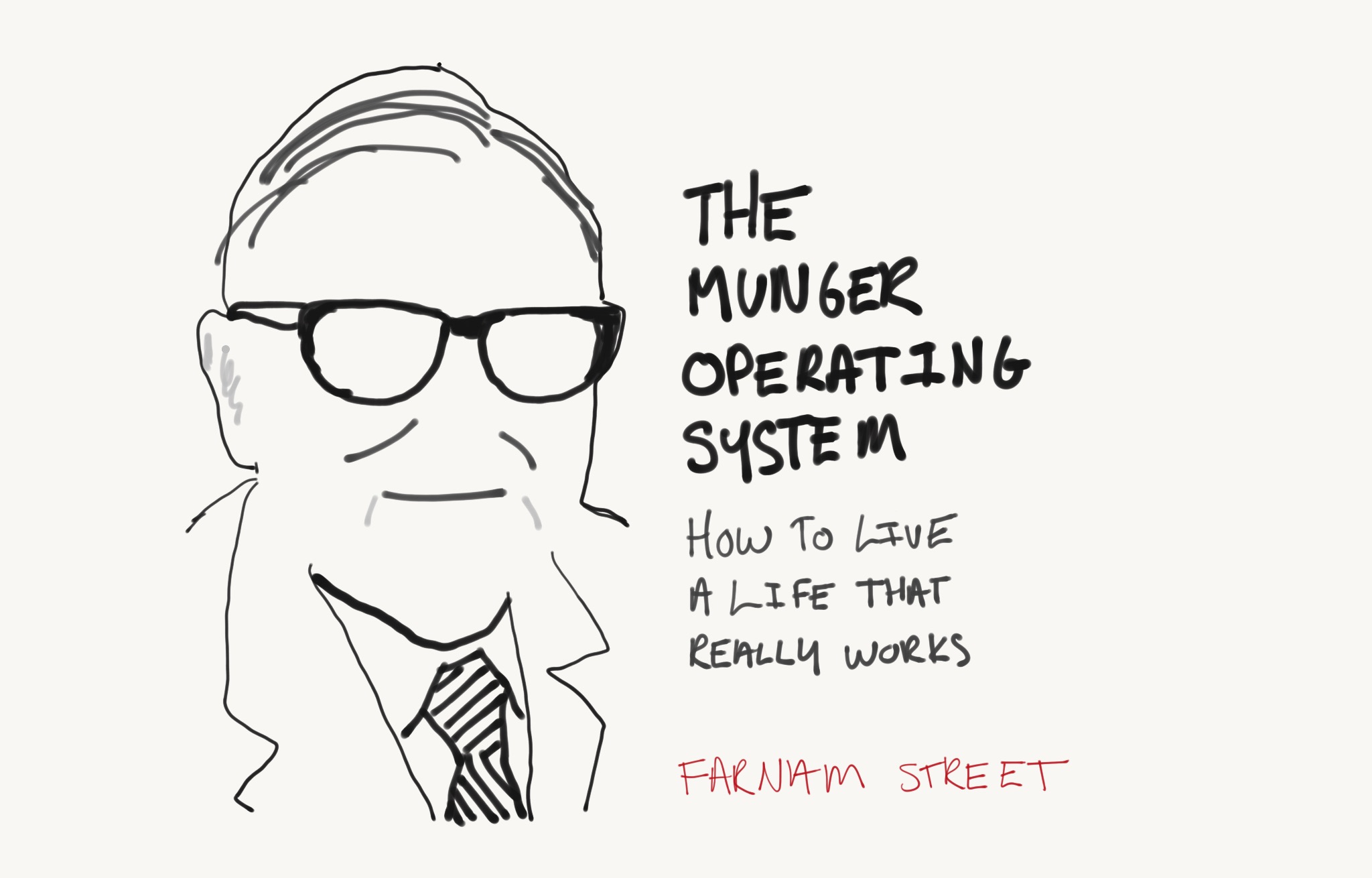
The Munger Operating System: How to Live a Life That Really Works

by Farnam Street Team

In 2007, Charlie Munger gave the commencement address at USC Law School, opening his speech by saying, “Well, no doubt many of you are wondering why the speaker is so old. Well, the answer is obvious: He hasn’t died yet.”

Fortunately for us, Munger has kept on ticking. The commencement speech is an excellent response to the Big Question: How do we live a life that really works? It has so many of Munger’s core ideas that we think the speech represents the Munger Operating System for life.

Munger Operating System

***

To get what you want, deserve what you want. Trust, success, and admiration are earned. 

It’s such a simple idea. It’s the golden rule so to speak: You want to deliver to the world what you would buy if you were on the other end. There is no ethos, in my opinion, that is better for any lawyer or any other person to have. By and large the people who have this ethos win in life and they don’t win just money, not just honors. They win the respect, the deserved trust of the people they deal with, and there is huge pleasure in life to be obtained from getting deserved trust.

Learn to love and admire the right people, live or dead.

A second idea that I got very early was that there is no love that’s so right as admiration-based love, and that love should include the instructive dead. Somehow, I got that idea and I lived with it all my life; and it’s been very, very useful to me.

Acquiring wisdom is a moral duty as well as a practical one. 

And there’s a corollary to that proposition which is very important. It means that you’re hooked for lifetime learning, and without lifetime learning you people are not going to do very well. You are not going to get very far in life based on what you already know. You’re going to advance in life by what you’re going to learn after you leave here…if civilization can progress only when it invents the method of invention, you can progress only when you learn the method of learning.

Learn to fluency the big multidisciplinary ideas of the world and use them regularly. 

What I noted since the really big ideas carry 95% of the freight, it wasn’t at all hard for me to pick up all the big ideas from all the big disciplines and make them a standard part of my mental routines. Once you have the ideas, of course, they are no good if you don’t practice — if you don’t practice you lose it.

So I went through life constantly practicing this model of the multidisciplinary approach. Well, I can’t tell you what that’s done for me. It’s made life more fun, it’s made me more constructive, it’s made me more helpful to others, it’s made me enormously rich, you name it, that attitude really helps.

Now there are dangers there, because it works so well, that if you do it, you will frequently find you are sitting in the presence of some other expert, maybe even an expert that’s superior to you, supervising you. And you will know more than he does about his own specialty, a lot more. You will see the correct answer when he’s missed it.

[…]

It doesn’t help you just to know them enough just so you can give them back on an exam and get an A. You have to learn these things in such a way that they’re in a mental latticework in your head and you automatically use them for the rest of your life.

Learn to think through problems backwards as well as forward.

The way complex adaptive systems work and the way mental constructs work, problems frequently get easier and I would even say usually are easier to solve if you turn around in reverse.

In other words if you want to help India, the question you should ask is not “how can I help India?”, you think “what’s doing the worst damage in India? What would automatically do the worst damage and how do I avoid it?” You’d think they are logically the same thing, but they’re not. Those of you who have mastered algebra know that inversion frequently will solve problems which nothing else will solve. And in life, unless you’re more gifted than Einstein, inversion will help you solve problems that you can’t solve in other ways.

Be reliable. Unreliability can cancel out the other virtues.

If you’re unreliable it doesn’t matter what your virtues are, you’re going to crater immediately. So doing what you have faithfully engaged to do should be an automatic part of your conduct. You want to avoid sloth and unreliability.

Avoid intense ideologies. Always consider the other side as carefully as your own.

Another thing I think should be avoided is extremely intense ideology, because it cabbages up one’s mind. You’ve seen that. You see a lot of it on TV, you know preachers for instance, they’ve all got different ideas about theology and a lot of them have minds that are made of cabbage.

But that can happen with political ideology. And if you’re young it’s easy to drift into loyalties and when you announce that you’re a loyal member and you start shouting the orthodox ideology out what you’re doing is pounding it in, pounding it in, and you’re gradually ruining your mind. So you want to be very careful with this ideology. It’s a big danger.

In my mind I have a little example I use whenever I think about ideology, and it’s these Scandinavian canoeists who succeeded in taming all the rapids of Scandinavia and they thought they would tackle the whirlpools in the Grand Rapids here in the United States. The death rate was 100%. A big whirlpool is not something you want to go into and I think the same is true about a really deep ideology.

I have what I call an iron prescription that helps me keep sane when I naturally drift toward preferring one ideology over another. And that is I say “I’m not entitled to have an opinion on this subject unless I can state the arguments against my position better than the people do who are supporting it. I think that only when I reach that stage am I qualified to speak.” Now you can say that’s too much of an iron discipline..it’s not too much of an iron discipline. It’s not even that hard to do.

Get rid of self-serving bias, envy, resentment, and self-pity. 

Generally speaking, envy, resentment, revenge and self pity are disastrous modes of thought. Self-pity gets pretty close to paranoia, and paranoia is one of the very hardest things to reverse. You do not want to drift into self-pity.

I have a friend who carried a big stack of index cards about this thick, and when somebody would make a comment that reflected self pity, he would take out one of the cards, take the top one off the stack and hand it to the person, and the card said, “Your story has touched my heart, never have I heard of anyone with as many misfortunes as you”. Well, you can say that’s waggery, but I suggest that every time you find you’re drifting into self pity, I don’t care what the cause — your child could be dying of cancer — self-pity is not going to improve the situation. Just give yourself one of those cards.

It’s a ridiculous way to behave, and when you avoid it you get a great advantage over everybody else, almost everybody else, because self-pity is a standard condition and yet you can train yourself out of it.

And of course self-serving bias, you want to get that out of yourself; thinking that what’s good for you is good for the wider civilization and rationalizing all these ridiculous conclusions based on the subconscious tendency to serve one’s self.

At the same time, allow for the self-serving bias in others who haven’t removed it.

You also have to allow for the self serving bias of everybody else, because most people are not going to remove it all that successfully, the human condition being what it is. If you don’t allow for self serving bias in your conduct, again you’re a fool.

I watched the brilliant Harvard Law School trained general counsel of Salomon lose his career, and what he did was when the CEO became aware that some underling had done something wrong, the general counsel said, “Gee, we don’t have any legal duty to report this but I think it’s what we should do it’s our moral duty.”

Of course, the general counsel was totally correct but of course it didn’t work; it was a very unpleasant thing for the CEO to do and he put it off and put if off and of course everything eroded into a major scandal and down went the CEO and the general counsel with him.

The correct answer in situations like that was given by Ben Franklin, he said, “If you want to persuade, appeal to interest not to reason.” The self serving bias is so extreme. If the general counsel had said, “Look this is going to erupt, it’s something that will destroy you, take away your money, take away your status…it’s a perfect disaster,” it would have worked!

Avoid being part of a system with perverse incentives.

Incentives are too powerful a controller of human cognition and human behavior, and one of the things you are going to find in some modern law firms is billable hour quotas. I could not have lived under a billable hour quota of $2,400 a year. That would have caused serious problems for me — I wouldn’t have done it and I don’t have a solution for you for that. You’ll have to figure it out for yourself but it’s a significant problem.

Work with and under people you admire, and avoid the inverse when at all possible.

And that requires some talent. The way I solved that is, I figured out the people I did admire and I maneuvered cleverly without criticizing anybody, so I was working entirely under people I admired. And a lot of law firms will permit that if you’re shrewd enough to work it out. And your outcome in life will be way more satisfactory and way better if you work under people you really admire. The alternative is not a good idea.

Learn to maintain your objectivity, especially when it’s hardest.

Well we all remember that Darwin paid special attention to disconfirming evidence particularly when it disconfirmed something he believed and loved. Well, objectivity maintenance routines are totally required in life if you’re going to be a correct thinker. And there we’re talking about Darwin’s attitude, his special attention to disconfirming evidence, and also to checklist routines. Checklist routines avoid a lot of errors. You should have all this elementary wisdom and then you should go through and have a checklist in order to use it. There is no other procedure that will work as well.

Concentrate experience and power into the hands of the right people – the wise learning machines. 

I think the game of life in many respects is getting a lot of practice into the hands of the people that have the most aptitude to learn and the most tendency to be learning machines. And if you want the very highest reaches of human civilization that’s where you have to go.

You do not want to choose a brain surgeon for your child among fifty applicants all of them just take turns during the procedure. You don’t want your airplanes designed that way. You don’t want your Berkshire Hathaways run that way. You want to get the power into the right people.

You’ll be most successful where you’re most intensely interested.

Another thing that I found is an intense interest of the subject is indispensable if you are really going to excel. I could force myself to be fairly good in a lot of things, but I couldn’t be really good in anything where I didn’t have an intense interest. So to some extent, you’re going to have to follow me. If at all feasible you want to drift into doing something in which you really have a natural interest.

Learn the all-important concept of assiduity: Sit down and do it until it’s done.

Two partners that I chose for one little phase of my life had the following rule: They created a little design/build construction team, and they sat down and said, two-man partnership, divide everything equally, here’s the rule; “Whenever we’re behind in our commitments to other people, we will both work 14 hours a day until we’re caught up.”

Well, needless to say, that firm didn’t fail. The people died rich. It’s such a simple idea.

Use setbacks in life as an opportunity to become a bigger and better person. Don’t wallow.

Another thing of course is life will have terrible blows, horrible blows, unfair blows, doesn’t matter. And some people recover and others don’t. And there I think the attitude of Epictetus is the best. He thought that every mischance in life was an opportunity to behave well, every mischance in life was an opportunity to learn something, and your duty was not to be submerged in self-pity but to utilize the terrible blow in a constructive fashion. That is a very good idea.

The highest reach of civilization is a seamless system of trust among all parties concerned. 

The last idea that I want to give you as you go out into a profession that frequently puts a lot of procedure and a lot of precautions and a lot of mumbo jumbo into what it does, this is not the highest form which civilization can reach. The highest form which civilization can reach is a seamless web of deserved trust. Not much procedure, just totally reliable people correctly trusting one another. That’s the way an operating room works at the Mayo Clinic.

If a bunch of lawyers were to introduce a lot of process, the patients would all die. So never forget when you’re a lawyer that you may be rewarded for selling this stuff but you don’t have to buy it. In your own life what you want is a seamless web of deserved trust. And if your proposed marriage contract has 47 pages, my suggestion is do not enter.


Still Interested?
Check our our Munger compendium.

--
Sponsored by: Slack - Making teamwork simpler, more pleasant, and more productive.

13 Apr 08:49

Defence Personnel: Give Power of Attorney….

by subra
If you are a defense person, you might stay for very long periods of time away from your home. There are times when your spouse and parents too do not know where you are. Should you give a Power of Attorney to do deals when you are away? Once you give a the power of […]
13 Apr 08:48

When to Choose a Not-So-Great Investment Strategy?

by Dev Ashish
Few years back when I was working in oil sector, I was posted in a very remote location in Rajasthan. Since there was not much to do there, I used to regularly undertake biking trips to explore the state with my adventure-seeking colleagues. (Good Old Days) :-) A frequently debated topic for us then was about the best strategy to reach our destinations. Some advocated driving at ‘really’
13 Apr 08:41

Human Exploration of Space is 55 years Old Today

by atanu

On April 12th, 1961, Yuri Gagarin became the first human in space. The first human space flight lasted 108 minutes. He became an instant hero, as is right since it was an extremely risky voyage and he could have ended up dead. There are many unsung heroes in any such venture. I feel most for the person who was the chief designer of the space vehicle — Sergey Korolev (1907 -1966). Because of the secrecy of the Cold War, he worked without any recognition. The video below is about Gagarin’s historic flight. It recognizes the work of Korolev. Deep respect to both the heroes of the Soviet Union.

I find it remarkable how talented the people of the erstwhile Soviet Union were. Trouble was that even talent could not overcome the self-imposed handicap of communism. Remember that the Soviet Union was not a very large union — only around 200 million people around 1960. They were very successful in science and technology. But communism/socialism forges very heavy chains. Without freedom, even talented people fail. Slavery is always harmful and freedom always the key to prosperity. Too bad India continues to labor under socialist slavery.


13 Apr 08:40

Wealthy Mindset or otherwise…

by subra
A wealthy mindset is what Kiyosaki calls Rich Dad behavior..how is it different from from a Poor dad mindset? I met rich people, very rich people and others..here is my observation: The rich earn far, far more than what they need and use As a corollary to that, their expenses are a small fraction of […]
11 Apr 10:39

How to achieve fiscal responsibility in India

by Ajay Shah
by Ajay Shah.

The FRBM Act has not delivered in reining in Leviathan. India continues to suffer from chronic fiscal problems. Recently, Montek Ahluwalia and Rathin Roy have written about the new thinking that must go into fiscal responsibility legislation.

Laws that protect against fiscal irresponsibility


It's hard to restrain Leviathan by using a fiscal responsibility legislation. In recent years, we have a procession of Finance Bills that disregarded the FRBM Act. The FRBM Act is a mere Act of Parliament, and can be amended each time a Finance Act is enacted.

There are a few success stories of very strong legal protections against fiscal irresponsibility, such as the `Debt Brake' constitutional amendment that was done in Germany and a few other places. Short of this, it's hard for Parliamentary legislation to make a significant difference. We in India are unlikely to summon the political capacity to do this.

The role of the bond market


It's also interesting to see that most countries have achieved superior fiscal responsibility than India, without a Debt Brake style constitutional amendment.  The key thing to focus on is financial repression. When the government faces a captive bond market, it feels it can get away with fiscal irresponsibility.

What has really mattered to advanced countries achieving fiscal discipline is not fiscal responsibility legislation but the pressure of the bond market. E.g. look back at how in recent years, the bond market stopped European governments in their tracks. The famous quotation by James Carville, sourced from the Wall Street Journal, 25 February 1993, says: I used to think if there was reincarnation, I wanted to come back as the president or the pope or a .400 baseball hitter. But now I want to come back as the bond market. You can intimidate everybody.

In the present Indian arrangement, we don't do public debt management in a serious sense of the term; we just force financial firms to buy government bonds. This is a tax on formal finance, which has far reaching adverse implications for the financial system and for the economy. It yields easy sale of bonds till the numbers associated with financial repression are exhausted, and an exceedingly difficult time beyond.

Exacerbating the marginal social cost of funds


It is useful to link up financial repression with the concept of marginal social cost of public funds. In OECD countries, this is generally thought to be 1.7: the cost to society of Rs.1 of government expenditure is ~ 1.7. In India, this needs to be adjusted upwards twice: first, for a badly designed and badly administered tax system, and second for financial repression. This demands a very high bar on what is a useful government expenditure: the gains to society for Rs.1 of government spending may have to be as large as Rs.3 for the expenditure to make sense.

As a side note, one of the most important questions in public economics in India is the estimation of the marginal social cost of public funds, and estimates about how this would change under reforms of tax policy, of tax administration, and of public debt management. It's embarrassing, how little we know about this.

The way forward


Hence, the first step in our fiscal journey is the establishment of the Public Debt Management Agency (PDMA), and getting bond market regulation out of RBI. We need to replace the forcible conscription of savings from institutional investors by sound debt management which knows how to sell bonds to voluntary buyers, into a liquid and well regulated market where the bond market regulation is arms length from either debt management or monetary policy or banking regulation.

Micro-prudential regulation should be technically sound. This involves ensuring that banks do not go bankrupt, as they have in India. It should not support and enable financial repression, as has been done. The European crisis has taught us the extreme dangers that come from hitching bank fragility to sovereign fragility. If we wanted banks to not take risk, and we were willing to use intrusive rules about portfolio composition, technically sound micro-prudential regulation should ask of them to hold short maturity bonds issued by high rated countries. Similar considerations apply with micro-prudential regulation of insurance and pensions.

The full picture of macro and finance policy


Israel is an inspiring story of a country that built modern macro and finance institutions, and was bountifully rewarded by the bond market. But it's useful for us to remember that even at the starting point of their reforms, they were never as bad as us; in other words, the gains to us of doing the orthodox macro and finance reforms are even greater than what was seen in Israel.

There are strong linkages between bond market development, price stability and debt management. Hence, we must see the overall strategy for fiscal, financial and monetary reform in a unified way. As an example, see the inter-relations between the three components which were begun in February 2015, of which two were shot down. The debates of March and April 2015 displayed a low appreciation of these inter-relationships, which led to the rollback of two out of the three components. We have begun with one piece, inflation targeting, but haven't done the rest of it. This is the heart of the question of fiscal prudence.
11 Apr 09:56

Wealthy people think Net worth not Income cash flow…

by subra
Rich people ‘realize’ less income than their ‘middle class’ counter parts, and they are happy about that. To live you need cash flow not necessarily ‘taxable’ income. So what is ‘realized’ income and what is ‘unrealized’ income? Realized income is for your salary, rent, interest, dividend, royalty, etc. or any money you have to pay […]
10 Apr 09:33

Estimating Future Stock Returns

by David Merkel
Idea Credit: Philosophical Economics Blog

Idea Credit: Philosophical Economics, but I estimated and designed the graphs

There are many alternative models for attempting to estimate how undervalued or overvalued the stock market is.  Among them are:

  • Price/Book
  • P/Retained Earnings
  • Q-ratio (Market Capitalization of the entire market / replacement cost)
  • Market Capitalization of the entire market / GDP
  • Shiller’s CAPE10 (and all modified versions)

Typically these explain 60-70% of the variation in stock returns.  Today I can tell you there is a better model, which is not mine, I found it at the blog Philosophical Economics.  The basic idea of the model is this: look at the proportion of US wealth held by private investors in stocks using the Fed’s Z.1 report. The higher the proportion, the lower future returns will be.

There are two aspects of the intuition here, as I see it: the simple one is that when ordinary people are scared and have run from stocks, future returns tend to be higher (buy panic).  When ordinary people are buying stocks with both hands, it is time to sell stocks to them, or even do IPOs to feed them catchy new overpriced stocks (sell greed).

The second intuitive way to view it is that it is analogous to Modiglani and Miller’s capital structure theory, where assets return the same regardless of how they are financed with equity and debt.  When equity is a small component as a percentage of market value, equities will return better than when it is a big component.

What it Means Now

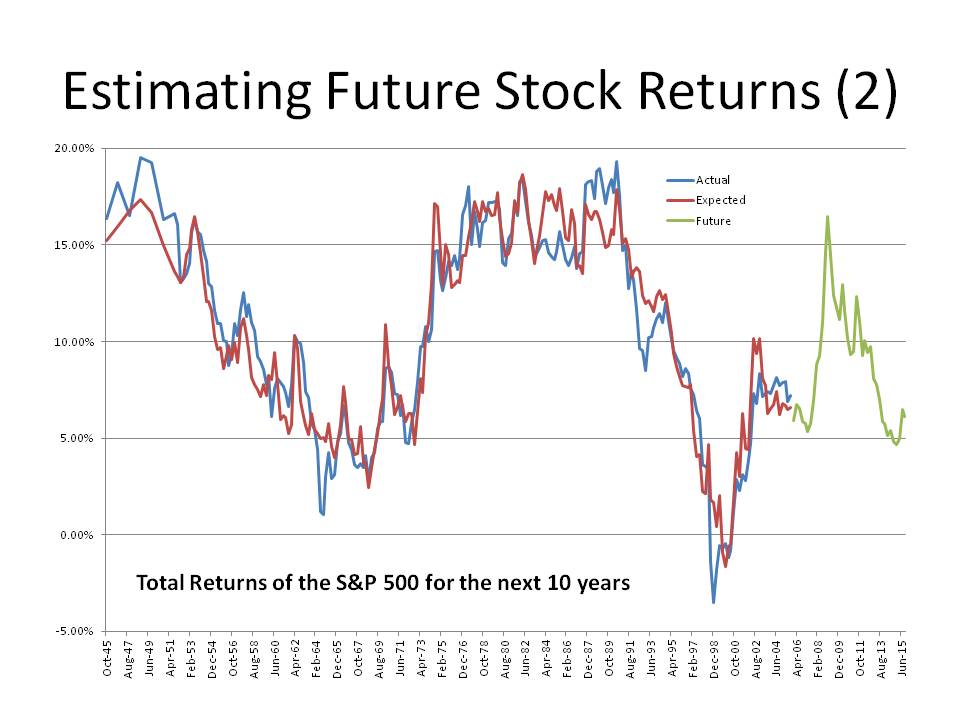
Now, if you look at the graph at the top of my blog, which was estimated back in mid-March off of year-end data, you can notice a few things:

  • The formula explains more than 90% of the variation in return over a ten-year period.
  • Back in March of 2009, it estimated returns of 16%/year over the next ten years.
  • Back in March of 1999, it estimated returns of -2%/year over the next ten years.
  • At present, it forecasts returns of 6%/year, bouncing back from an estimate of around 4.7% one year ago.

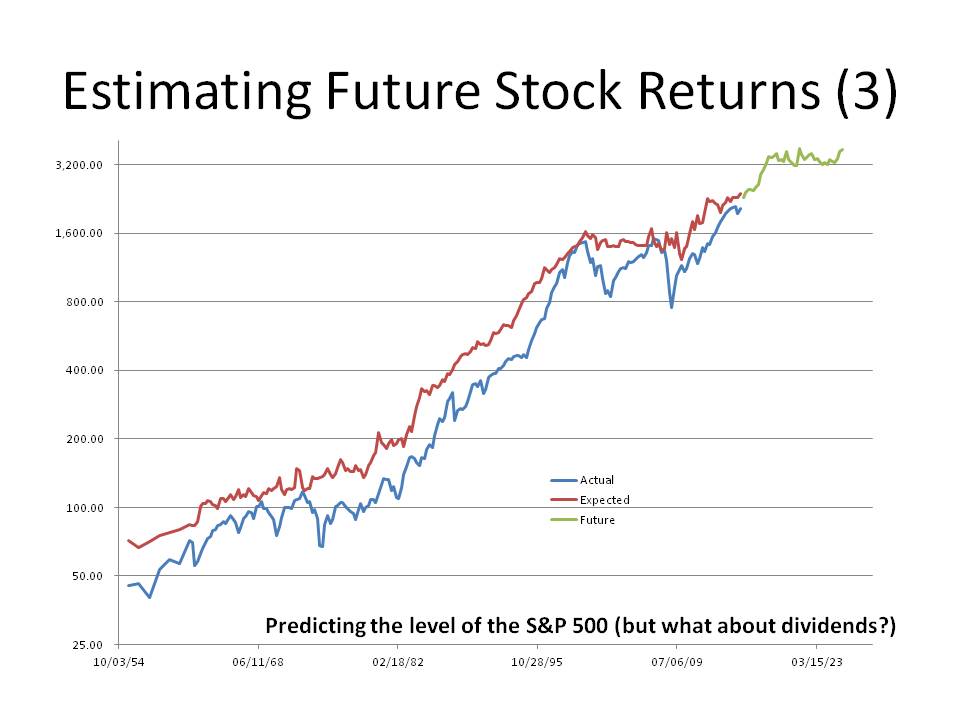
I have two more graphs to show on this.  The first one below is showing the curve as I tried to fit it to the level of the S&P 500.  You will note that it fits better at the end.  The reason for that it is not a total return index and so the difference going backward in time are the accumulated dividends.  That said, I can make the statement that the S&P 500 should be near 3000 at the end of 2025, give or take several hundred points.  You might say, “Wait, the graph looks higher than that.”  You’re right, but I had to take out the anticipated dividends.

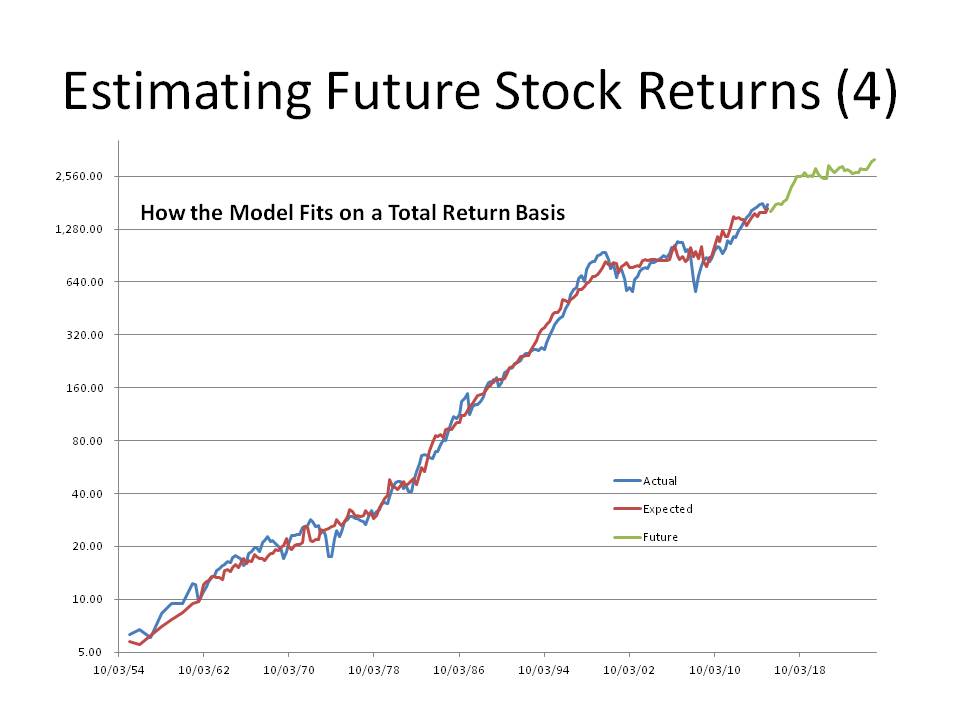
The next graph shows the fit using a homemade total return index.  Note the close fit.

Implications

If total returns from stocks are only likely to be 6.1%/year (w/ dividends @ 2.2%) for the next 10 years, what does that do to:

  • Pension funding / Retirement
  • Variable annuities
  • Convertible bonds
  • Employee Stock Options
  • Anything that relies on the returns from stocks?

Defined benefit pension funds are expecting a lot higher returns out of stocks than 6%.  Expect funding gaps to widen further unless contributions increase.  Defined contributions face the same problem, at the time that the tail end of the Baby Boom needs returns.  (Sorry, they *don’t* come when you need them.)

Variable annuities and high-load mutual funds take a big bite out of scant future returns — people will be disappointed with the returns.  With convertible bonds, many will not go “into the money.”  They will remain bonds, and not stock substitutes.  Many employee stock options and stock ownership plan will deliver meager value unless the company is hot stuff.

The entire capital structure is consistent with low-ish corporate bond yields, and low-ish volatility.  It’s a low-yielding environment for capital almost everywhere.  This is partially due to the machinations of the world’s central banks, which have tried to stimulate the economy by lowering rates, rather than letting recessions clear away low-yielding projects that are unworthy of the capital that they employ.

Reset Your Expectations and Save More

If you want more at retirement, you will have to set more aside.  You could take a chance, and wait to see if the market will sell off, but valuations today are near the 70th percentile.  That’s high, but not nosebleed high.  If this measure got to levels 3%/year returns, I would hedge my positions, but that would imply the S&P 500 at around 2500.  As for now, I continue my ordinary investing posture.  If you want, you can do the same.

=–==-=-=-=-=-=–=-=-=-=-=-=-=-=-=-=-=-=-=-=-=-=-==–=

PS — for those that like to hear about little things going on around the Aleph Blog, I would point you to this fine website that has started to publish some of my articles in Chinese.  This article is particularly amusing to me with my cartoon character illustrating points.  This is the English article that was translated.  Fun!

08 Apr 09:28

Viruses, Ideas and their Life Expectancy

by atanu

The wiki page about virus says that it “is a small infectious agent that replicates only inside the living cells of other organisms. Viruses can infect all types of life forms . . .” Ideas are analogous to viruses because they too are infectious agents that replicate in living brains. The evolutionary biologist Richard Dawkins coined the term meme to mean a unit of idea that can infect a brain and get transmitted to other brains. Viruses are responsible for genetic diversity through horizontal gene transfer. Analogously, ideas are responsible for diversity of human mentality.

Viruses of biological kind are generally bad for the organism, just like the software variety are bad for computers. There are no good viruses. In contrast, ideas come in two principle varieties: the benevolent and the malevolent. The good kind leads to overall benefits, both to the individual with the idea and to the collective of individuals that have that idea. The malevolent kind inflicts great harm but they eventually die out. There are two pathways. One, they just destroy the host collective, thus resulting in the extinction of the bad idea. Or, two, they mutate into a less malevolent form that does not kill the host, or even into a benevolent idea that benefits the host. Good ideas are forever and bad ideas are never forever.

The question then is: what is the lifespan of a bad idea and on what that? Let’s get back to biological viruses. Any virus that is very infectious (that is, it can be picked up very easily), easily transmitted (say through the air, water, or contact), and is extremely dangerous in that it kills the host within hours, will quickly destroy the host population and thus itself. It is self-limiting.

If the virus is very infectious and is not easily transmitted and it kills very quickly, then it will just kill the infected people and the virus will die out. The host population will survive.

Then there is the not very infectious virus, that is not easily transmitted, causes misery but does not kill the host individual — that can infect a large segment of the population. It causes much harm but does not kill the population.

So now let’s look in the life cycles of bad ideas. Really bad ideas that spread quickly end up destroying the population. But really bad ideas that do not kill immediately and that are hard to contract, spread slowly though the population and some sort of stable equilibrium is reached that persist for a while before the idea dies out.

What is the life expectancy of a particular bad idea is hard to say. But there is a rule of thumb that we can use to make an educated guess. The heuristic suggests itself from something that Nassim N. Taleb points out regarding the life expectancy of technologies. In his book Antifragile, he explains that technologies (and ideas) age in reverse. It basically says that the older an existing technology is, the longer it can be expected to survive. That is, suppose you have two technologies A and B in existence today. Suppose A has been around for 500 years, and B has been around for 50 years. You can reasonably conclude that A will last much, much longer than B will.

A collection of ideas is an ideology. Categorizing ideologies into good or bad, benevolent or malevolent, is a natural extension of the categorization of ideas. Ideologies that are routinely exposed to and subject to the stress of shocks, are continually tested consequently mutate and evolve are antifragile, to use Taleb’s terminology. The longer the time that they have had to evolve, the more antifragile they become and thus can be expected to have longer lives ahead of them.

This gives me hope. Consider destructive ideologies such as Nazism, communism (Marxism, Leninism), socialism, Islam. Nazism was very destructive. It did a great deal of harm, but died out rapidly. Communism is older than Nazism but over its lifespan it has killed in the hundreds of millions. It and its less virulent sister socialism are both terminally ill and will die soon. Contrast that with the idea of free markets. Humans have organized economic activities in free markets since even before settled agriculture. That is to say that the free market ideology has existed for around 10,000 years — and can be expected to be around in the indefinite future.

Now Islam. It’s the youngest of the monotheistic faiths, just 1400 odd years old. It is definitely not antifragile. It is never allowed to be stressed by shocks. It’s like a person who never gets off the couch and always avoids any exercise. Predictably, the person will suffer musculoskeletal atrophy and have a short life. Islam is fragile. Proof of that is all around in the form of the violence that its faithful unleash on the world whenever Islam is critically examined.

Judaism is the grand daddy monotheistic faith. Because it is non-proselytizing, it is not virulent at all. Being the oldest, my bet is that it will outlast the others. Christianity, child of Judaism, is proselytizing but has the ability to mutate, and has indeed mutated into less virulent varieties. It’s about 2000 years but will be resting in eternal peace in less than a century.

As I am a Hindu, I am biased towards the Indic religions — Hinduism, Buddhism and Jainism. Hinduism is really old. It is an amorphous collection of ideas that get continually examined, modified and tested for robustness. It follows the grand evolutionary pattern of heredity, mutation and selection. Buddhism, a descendant of Hinduism, around 2,500 years old. Unlike Hinduism, Buddhism got exported across the world. That makes sense if you take the view advocated by Alan Watts that Buddhism is Hinduism packaged for export. Jainism is equally old but is a much more austere ideology. Being less flexible and more demanding than Buddhism, it has limited acceptance in the rest of the world. Although it is a good for people, it can only serve a very specialized segment of the world population and thus is a niche ideology.

Hinduism, Buddhism and Jainism will survive because they are antifragile. Monotheism as a general idea is old (but not as old as pantheism, deism or polytheism) and will survive for a while but Islam as the most virulent recent strain will die out in the near future. The collapse could come surprisingly soon. The constant ratcheting up of global Islamic violence indicates it is thrashing about in its final death throes.

I describe myself as a short-run pessimist but a long-run optimist. That is so because the trend in universal human welfare is positive, even though there are short term variations in the trend. The world is getting better all the time. It used to be much worse in the past. Steven Pinker — Harvard linguist, public intellectual, scholar, and all-around good guy — in his outstanding book “The Better Angels of Our Nature” makes the point convincingly that there has been a secular decline in all types of violence across the world, and this is true across time scales of decades, centuries and millennia. A compelling case can be made that the world is getting better along many other dimensions, not just in terms of violence. People are better off in terms of education, nutrition, longevity, health, lifestyle choices, freedom of the individual, etc etc.

No doubt new and different viruses — biological, computer and ideological — will infect humans but they will only endure for a short while. The good will endure for much, much longer. And that is worth remembering and celebrating.


08 Apr 09:10

The RBI Policy: More Money Printing Needs Banks To Get Nimble Fast

by Deepak Shenoy

The RBI, in it’s policy yesterday(April 06, 2016), reduced rates by 0.25%. The new rates are:

  • The Repo rate is 6.5% (from 6.75%)
  • The Reverse Repo rate is 6% ( up from 5.5%)
  • The MSF drops from 7.75% to 7%.

The idea is both to reduce rates and the corridor of rates (which used to be 1% – Reverse repo was 1% below, MSF 1% above)

RBI policy april 2016

Read: What is the Marginal Standing Facility?

Liquidity Infusion by the RBI

Instead of maintaining large overnight borrowing from banks (money taken by them one evening and returned the next day) which has been going on for two years now,  RBI will add money to banks by directly buying bonds outright (or dollars) from the market. 

This does a complex things for banks – it gives them money in the same manner that QE works in the west – where the central bank prints money to buy bonds and gives money to banks (who they buy these bonds from).… (Read On...)

08 Apr 08:58

Latticework of Mental Models: Arbitrage

by Anshul Khare

In 1954, a temporary shortage of cocoa in US caused its price to increase from 5 cents to 60 cents per pound, a whopping 12 times.

As a result, Rockwood & Co., a brooklyn based chocolate products company, found itself in a sweet spot. They were sitting on 13 million pounds of excess inventory of cocoa which instantaneously became a huge asset because of cocoa price increase.

So selling the inventory to make a handsome profit was a no-brainer except that there was just one catch to it. Rockwood & Co. followed LIFO (last in first out) inventory valuation which would have created a 50% tax liability on profits from sale of inventory.

Young Warren Buffett

Buffett in his early 20s

So to avoid this tax, they came up with an ingenious way to exploit the temporary opportunity. They extended a share buyback offer which allowed the shareholder to tender a share in exchange for 80 pounds of cocoa. This maneuver, according to 1954 tax code, was perfectly legal and didn’t invite heavy tax liability.

This caught the attention of a 24 year old investment analyst who was working in New York for Graham Newman Corp. It was obvious to him that one could buy Rockwood shares for $34, sell them back to the company for 80 pounds of cocoa beans (worth $36), and then sell the cocoa beans making an instant profit of $2. Considering the transaction could be done in less than a week, it worked out to a sky-high annualized return.

“For several weeks I busily bought share, sold beans, and made periodic stops at Schroeder Trust to exchange stock certificates for warehouse receipts.”, recounts Warren Buffett, the protagonist in the story above, “The profits were good and my only expense was subway tickets.”

What Buffett did is called an Arbitrage. It’s a process of identifying market inefficiencies. The classic idea is that of buying an item in one place and selling it in another. In the very early days the word applied only to the simultaneous purchase and sale of securities or foreign exchange in two different markets.

Mohnish Pabrai, in his wonderful book The Dhandho Investor, explains –

Arbitrage is classically defined as an attempt to profit by exploiting price differences in identical or similar financial instruments. For example, if gold is trading in London at $550 per ounce and in New york at $560 per ounce, assuming low frictional costs, an arbitrageur can buy gold in London and immediately sell it in New York, pocketing the difference.

Here’s Salman Khan from Khan Academy explaining the idea in a very simple language.

Just like any other profitable opportunities, arbitrage plays don’t remain open for long. As people execute these arbitrage trades, the price spread collapses and the arbitrage opportunity eventually vanishes. While these arbitrage spreads seem virtually risk free and it is free money while it lasts, most of them are only available for fleeting moments.

For people who don’t know, Warren Buffett indulged in quite a few arbitrage kind of investments early in his career. He used to call them workouts. Explaining arbitrage, Buffett writes –

…arbitrage – or “risk arbitrage,” as it is now sometimes called – has expanded to include the pursuit of profits from an announced corporate event such as sale of the company, merger, recapitalization, reorganization, liquidation, self-tender, etc. In most cases the arbitrageur expects to profit regardless of the behaviour of the stock market. The major risk he usually faces instead is that the announced event won’t happen.

Arbitrage is a powerful construct and a fundamental tool in the arsenal of any value investor. Although many different types of arbitrage exist, here are few that Pabrai mentions in his book –

Traditional Commodity Arbitrage

This is the one we saw above where the price difference for a commodity like gold can create a short window of arbitrage opportunity.

Correlated Stock Arbitrage

A typical example is Berkshire’s class A and class B stocks. BRK.B is economically worth 1/30 of BRK.A. So these two stocks should trade in lockstep with each other – or perhaps BRK.B should trade at a small discount due to its inferior voting rights and one-way conversion feature. However, in reality, on many days the two stocks differ by up to 1 percent. Assuming minimal frictional costs, an arbitrageur can potentially benefit from this spread.

Another example is holding companies. Sometimes holding company stocks trade at a discount to a sum of the parts even if the parts are individually publicly traded.

Merger Arbitrage

Let’s say a public company A announces it is to buy public company B for Rs. 100 a share. Prior to the announcement, B was trading at Rs. 75 a share; immediately after the announcement, B goes to Rs. 95 a share. If an investor buys B at Rs. 95 and holds the stock until the deal closes, then the Rs. 5 spread can be captured for a tidy profit in a few months. However, there is always some risk that the deal doesn’t close. In that case, B’s stock price might head back down to Rs. 75 (or lower). So you see that this is not completely risk free, however the downside is limited.

Here’s Sal Khan again, explaining the Merger Arbitrage

There are well-documented statistics on percentages of announced mergers that never close, don’t get government approval, don’t get shareholder approval, or the like. If you don’t understand the business and these dynamics, it’s better to stay away from such transactions. These kind of corporate events – mergers, spin-offs, open offers, buybacks, restructuring etc. – are also known as special situation investing.

Buffett has practiced arbitrage for decades and according to his own estimates he has averaged annual pre-tax returns of at least 25% from arbitrage. In his 1986 letter to shareholders, Buffett wrote –

You will notice that we had significant holding in Beatrice companies at year end. This is a short-term arbitrage holding – in effect, a parking place for our money (though not a totally safe one, since deals sometimes fall through and create substantial losses). We sometimes enter the arbitrage field when we have more money than ideas, but only to participate in announced mergers and sales.

So how do you evaluate arbitrage opportunities? Here’s the blueprint from Warren Buffett –

To evaluate arbitrage situations you must answer four questions: (1) How likely is it that the promised event will indeed occur? (2) How long will your money be tied up? (3) What chance is there that something still better will transpire – a competing takeover bid, for example? and (4) What will happen if the event doesn’t take place because of anti-trust action, financing glitches, etc.?

If that’s not enough for you, Joel Greenblatt has written a wonderful book – You Can Be A Stock Market Genius – on this subject.

Now before you get too excited about arbitrage style of investing, you should note that in today’s world where information flows too quickly, you have to stay on top of your arbitrage bets all the time. It’s quite different from the long term value investing which requires you to buy good businesses and holding them for long time.

Mind you, even Buffett got into arbitrage deals only to utilize the uninvested cash. It wasn’t his first choice either. Explaining Berkshire’s take on arbitrage investing, Buffett writes –

Arbitrage positions are substitute for short-term cash equivalents, and during part of the year [1989] we held relatively low levels of cash. In the rest of the year, we had a fairly good-sized cash position and even so chose not to engage in arbitrage. The main reason was corporate transactions made no economic sense to us; arbitraging such deals comes too close to playing greater-fool game.

Another aspect of special situation investing you have to keep in mind is that usually the arbitrage opportunity arises out of corporate events and the quality of underlying business becomes irrelevant in this operation. Which means an adequate diversification is required to bring in the margin of safety. Because betting a significant part of your capital on a single arbitrage deal, even if it’s a short term bet, can be dangerous.

Buffett says –

Berkshire’s arbitrage activities differ from those of many arbitrageurs. First, we participate in only a few, and usually very large, transactions each year. Most practitioners buy into a great many deals perhaps 50 or more per year. With that many irons in the fire, they must spend most of their time monitoring both the progress of deals and the market movements of the related stocks. This is not how Charlie nor I wish to spend our lives. (What’s the sense in getting rich just to stare at a ticker tape all day?)

Here’s what Prof. Sanjay Bakshi mentioned in his interview with Safal Niveshak –

You can make a lot of money doing risk arbitrage where you have to monitor — perhaps 20 deals at any given point of time and be ready to react quickly when odds change. But it’s stressful.

The concept of arbitrage isn’t limited to investing only. The arbitrage mental model is based on the mis-pricing mindset and can be applied just as well in business. Outsourcing, for example, is the buying of labour in one location for sale in another.

The biggest indian IT companies like TCS, Infosys, and Wipro derive most of their revenues by exploiting the low-cost offshore arbitrage model. These businesses incurs most of their expenses in rupees (as salaries and other costs for offshore employees are borne in India) and revenues are billed in dollars.

Time Arbitrage

Here’s another interesting take on the idea of arbitrage. When you buy a good quality business for a cheap price and hold it for long time, what you are essentially doing is an arbitrage – buying cheaper from one place (present) and selling at higher price another place (future), thus pocketing the spread.

This is time arbitrage and it’s a huge advantage for a small investor who is willing to stay invested for long term. If Mr. Market and its other participants are discounting things 12-15 months down the line, and if you can look out 5-10 years, you will have a time arbitrage advantage, which is a structural advantage to have.

Time arbitrage is not easy. A few months of a falling market or seeing your stocks going nowhere can feel like years. The impulse to “do something” can be overwhelming. Unfortunately, that impulse, more often than not, would hurt your long-term returns.

Time arbitrage yields tremendous financial and psychological benefits for those with the discipline to hold fast against the noise. This is an edge worth cultivating. It costs nothing but time and can be applied by anyone, including you.

Conclusion

Speaking at Columbia Business School, Warren Buffett once said –

Because my mother isn’t here tonight, I’ll even confess to you that I’ve been an arbitrageur.

That should give you a clue that it’s not something even Buffett feels very proud of. The game of arbitrage is exciting but has the potential to derail your focus from long term investing.

Take this advice from Buffett, which he dispensed in his 1989 letter, seriously –

Arbitrage has looked easy recently. But this is not a form of investing that guarantees profits of 20% a year or, for that matter, profits of any kind. As noted, the market is reasonably efficient much of the time. An investor cannot obtain superior profits from stocks by simply committing to a specific investment category or style. He can earn them only by carefully evaluating facts and continuously exercising discipline. Investing in arbitrage situations, per se, is no better a strategy than selecting a portfolio by throwing darts.

Learning arbitrage gives you insights about its presence in different business models, but applying it in your own investing is something which needs a close evaluation of your own temperament.

If you want to learn more about arbitrage, go to Prof. Sanjay Bakshi’s blog and search for the word ‘arbitrage’. The results will keep you busy for weeks.

Take care and keep learning.

The post Latticework of Mental Models: Arbitrage appeared first on Safal Niveshak.

    
08 Apr 08:35

Media based investing and losses…

by subra
Some of the media based advice is so dangerous or simply useless, let us see them… Indexing works in the USA, but in India there are many funds that outperform the indices by a long margin: how useful unless you can say “Xyz is a good fund which will outperform the index over the next […]
07 Apr 12:22

VLS Finance sells stake in Relaxo Footwear to Jwalamukhi Investment

by Aakash

Relaxo Footwear

Relaxo Footwears Limited commenced its journey with the manufacture of Hawaii slippers. It has now grown into a large-scale entrepreneurship catering to the basic needs of the quintessential Indian citizen. Today, the company manufactures over 3 lakh pairs of footwear per day, which approximately adds up to over 10 million pairs per year at the 9 state-of-the-art manufacturing units in Northern India.

Relaxo Footwear Share Price April 2016

VLS Finance (also VLS Securities) which held 16,207,760 shares or 13.50% as of December, 2015 sold 1,770,969 shares or 1.48%.

Private equity (PE) firm WestBridge Capital, through its unit Jwalamukhi Investment Holdings purchased this stake of 1.48% and as well purchased an additional 95k shares thereby bringing its shareholding to 1,866,277 shares or 1.55%.

WestBridge Capital is a highly experienced investment firm, managing over $1.2 billion of capital, which focuses on investments in India. WestBridge was co-founded by KP Balaraj, Sumir Chadha, SK Jain and Sandeep Singhal.… (Read On...)

07 Apr 12:21

Fending off a boss who wants you to flout rules

by T T Ram Mohan
The Economist cites a recent survey that showed that 9% of employees faced pressure from their bosses to compromise on their ethical beliefs; 21% of employees who reported misconduct at work said they faced retaliation from their firms.

How to fend off a boss who wants you to do the crooked thing? One study shows that if you sport a religious symbol at work, bosses are less likely to ask you to do something is illegal or immoral. Maybe there's merit, then, in sporting a cross or having an image of a god at work or even wearing a tilak.

I nearly fell for this. Until I came to the end of the article. There's another study shows that those who make a show of righteousness are not likely to act more righteously:
In a further experiment, Ms Desai gave her participants the opportunity to behave ethically or unethically. Then, in what they believed was an unrelated study, they were given the option of appending a moral quotation to an e-mail to others in their group and/or to one sent just to themselves. Those who chose to signal their righteousness only to the outside world were more likely to have misbehaved in the first part of the experiment. 
There's the risk, therefore, that if you wear your religiosity on your sleeve, the boss will think there's a better chance of getting you to bend rules.

Moral of the story: do not expect academic studies to enlighten you in such matters. Trust your own instincts.
07 Apr 09:15

What are the three things that make a city smart? Walkability, Walkability and Walkability..

by Amol Agrawal
It is like this question – What are the three things that matter in retail trade? location, location and location. Likewise, what matters in any city or wannabe smart city is its walkability quotient. It is not that smart city means fancy buildings, technology and cars everywhere. It just means ensuring that walking is facilitated using the technologies. […]
07 Apr 09:11

Kotak Group again enters beleaguered Diamond Power Infra at Rs 23.65 ~ Why?

by Gaurav Parikh
Kotak Group enters beleaguered Diamond Power Infra at Rs 23.65 ~ Why? ~ their Mutual Fund  had been selling since August 2015 ! On March 30,2016 Kotak Mahindra (International) Ltd a FPI & a subsidiary of Kotak Mahindra Bank picked up 3868606 (6.787%) stake in Diamond Power Infrastructure at Rs 23.65 from Macquarie Bank.Deal Size […]
06 Apr 04:08

Think Half of a Cycle Ahead

by David Merkel
Photo Credit: Robert Tuck || Of course, in half a cycle here, the moon will look the same

Photo Credit: Robert Tuck || Of course, in half a cycle here, the moon will look the same


Financial markets are trendy and noisy in the short-run, sensible in the long-run, and perverse in the intermediate-term.

What do I mean?

Something like this: short-run movements are news-driven, and driven by people trying to catch up with the latest data.  Many people imitate the behavior of others, and over the intermediate-term, some stock prices get out of whack.  Some subset of industries, factors, and/or companies gets out of alignment, and are mispriced.  In the long run, those pricing errors get corrected, but it takes years to get there.

Here’s an example. to make this tangible and understandable.  As a factor, value has been bad for eight years or so, and as evidence I quote Rob Arnott, from his article entitled, ‘How Can “Smart Beta” Go Horribly Wrong?

The value effect was first identified in the late 1970s, notably by Basu (1977), in the aftermath of the Nifty Fifty bubble, a period when value stocks were becoming increasingly expensive, priced at an ever-skinnier discount relative to growth stocks. More recently, for the past eight years, value investing has been a disaster with the Russell 1000 Value Index underperforming the S&P 500 by 1.6% a year, and the Fama–French value factor in large-cap stocks returning −4.8% annually over the same period. But, the value effect is far from dead! In fact, it’s in its cheapest decile in history.

And then later he says:

How many practitioners who rely on the value factor take the time to gauge whether the factor is expensive or cheap relative to historical norms? If they took the time to do so today, they would find value is currently cheaper than at any time other than the height of the Nifty Fifty (1972–73), the tech bubble (1998–2003), and the global financial crisis (2008–09).

The underlining is mine, to give emphasis. Now I would like to quote from a very old article of mine, The Fundamentals of Market Tops that was originally published at RealMoney.com back in 2004:

You’ll know a market top is probably coming when:

a) The shorts already have been killed. You don’t hear about them anymore. There is general embarrassment over investments in short-only funds.

b) Long-only managers are getting butchered for conservatism. In early 2000, we saw many eminent value investors give up around the same time. Julian Robertson, George Vanderheiden, Robert Sanborn, Gary Brinson and Stanley Druckenmiller all stepped down shortly before the market top.

Point (b) is what I want to highlight… not that we have had many value managers forced into retirement recently, but value funds of all kinds have been losing clients. It’s like being fired fractionally, a sliver at a time, but it adds up to a lot.

Combine that with Arnott’s insight that the valuations of value stocks are at exceptionally low levels – this gives me some hope that we are in the seventh inning or later in this market cycle regarding value investing.

Going Back a Step

Value isn’t the only cheap area presently — European stocks and emerging market stocks look cheap as well.  When areas of the market with bad relative performance have a lot of people giving up on them to pursue recently successful strategies, that helps to put in the bottom on the underperformers, and the top on the outperformers.

You can’t tell exactly when the process will end, but those jumping from one strategy to another, chasing performance, will just add a new set of losses to the old ones.  The trick is to try to anticipate when the cycle will turn for a given market strategy, factor or industry.  No one can do it perfectly, but it makes sense to act when relative valuations are in your favor.

Minimally, those that stick with a valid strategy through thick and thin can benefit from the strategy over the long-term… and that takes some courage, because there are times when your strategy will be out of favor.  That’s what I do with value investing.

Maximally, you would sell a strategy that you were invested in that was topping out in relative terms to buy a strategy that has been trashed for a while, and might be ready to outperform.  That’s even more difficult than sticking with one strategy through thick and thin.  Everyone wants to buy a past winner, and nobody wants to buy a past loser. but that is what would offer large returns if the timing could be right.  Another way of phrasing it, is to always look half a cycle ahead, to where a strategy will be when the excesses correct, or as is more likely, overcorrect, and take the appropriate action now.

Doing that is beyond me.  I’m just grateful that the period of relative underperformance of value may be nearing its end.

06 Apr 04:05

Na Mo is on the right track….

by subra
came as a comment…posting it as it is..not checked / verified…take it as it is… Mr. Prime Minister is on right track: Check the highlights of Modi governments work: > India’s highest ever urea fertiliser production was achieved in 2015 > India’s highest ever production of ethanol as blended fuel, benefiting sugarcane farmers, was in […]
06 Apr 03:47

A Misplaced Sense of Pride

by atanu

One of the Founding Fathers of the United States, polymath, inventor, scientist, writer, diplomat, etc., etc., Benjamin Franklin (1706 – 1790) observed that “We are all born ignorant, but one must work hard to remain stupid.” An analogous statement about nations could be that all nations are born poor but it requires hard work to keep it in poverty. Not surprisingly that hard work is properly done by the politicians of poor countries. What’s surprising is the evident pride they appear to take in their dismal accomplishment. They obviously revel in the fact that the country is poor and proclaim it loudly for all to marvel at. A recent statement on twitter (image below) by the official spokesperson of the Ministry of External Affairs of India, retweeted over 1500 time no doubt approvingly by Indians, brought this to mind.

prideofindia

.

PM Modi is quoted as saying to expatriate Indian workers in Saudi Arabia that “your sweat and toil is the pride of India.” Really? The pride of India? A superficial reading of that statement suggests that he is proud of the work that expats are doing and commending them for it. I have a different perspective from that of Shri Modi’s because of my personal circumstances of being an expatriate and also because of my profession as a development economist.

Migrations always imply that subjectively and objectively some places are better than others. Most people do not migrate just for the fun of it; they are forced to do so. Leaving home is never easy and seldom undertaken frivolously. The clearest example is when people are forced to migrate en masse due to conflict. There are other reasons for migration such as famine, natural disasters, and the search for livelihood but it is always indicative of some failure in the native location. Mass migration, undertaken in search of safety or livelihood, is a matter to be pitied than to be celebrated.

The Indian migrant workers in Gulf states basically underlines the fact that the Indian economy has been a failure. Their sweating and toiling away in those inhospitable places is not just a metaphor but is literally true. They don’t sit around in air-conditioned offices busily typing on keyboards; they sweat it out in the desert heat working in construction jobs. They are abused and made to do dangerous jobs. And they die from accidents at the workplace, and many commit suicide.

Here’s an example: a graphic from the Washington Post quoted by the BBC (June 2015) about deaths related to the construction work for the scheduled 2022 World Cup in Qatar.

qatardeathtoll
.
.
From the BBC piece:

Living and working conditions for some migrants in Qatar are appalling. Long hours in the blazing heat, low pay and squalid dormitories, are a daily ordeal for thousands – and they cannot leave without an exit visa. . . .

[The numbers were] first published in 2013 in a report by the International Trades Union Confederation, called The Case Against Qatar.

The ITUC went to the embassies of Nepal and India, two countries which are the source of many of the migrant workers who go to Qatar. Those embassies had counted more than 400 deaths a year between them – a total of 1,239 deaths in the three years to the end of 2013.

Reading the report brings home the point that migrants have it tough. They are maltreated, abused and in many cases killed. Here’s more dismal statistics (“Indian worker’s body to be repatriated from Oman“. June 2015):

Bodies of over 503 Indian workers who died (killed) in Oman in 2014 were repatriated to their hometowns in India. How many bodies are hidden in the deserts, tortured for hours, and buried alive like those missing Indian workers found in Saudi Arabia in February 2014?

In the GCC countries, the “moderate” UAE tops the list with 2,513 deaths of Indians reported, Saudi Arabia comes second with 2,427, Qatar is fourth with 279 cases and Bahrain is in the last position with 175 cases.

The working conditions can only be described as brutal slavery. And yet Indian workers voluntarily go there. What does that say about their economic prospects in India? Further, what does that say about the Indian economy? And finally, what or who is responsible for this state of affairs?

That Indians sweat and toil abroad under inhuman conditions is not a matter of pride for India, however jingoistically it is uttered. That fact should call for some introspection and then appropriate action. But that is never ever done. Prime Minister Modi was in San Jose CA last year September. The hoopla of his public appearances then involved heavy servings of self-congratulatory “look how amazingly successful people of Indian origin are in the US and therefore how wonderful India is!” Nope.

The success of Indians abroad points to India’s failure. It is a systemic failure that denies talented, hardworking, competent people the opportunity to create wealth. Again, it should lead to critical self-examination, not unearned boastful chest thumping. Instead of bombast, Indian leaders need to ask what changes need to be done so that people — the ultimate resource — don’t choose to migrate out of India. The oh-so-successful Indian entrepreneurs abroad are a glaring indicator of the Indian dysfunctional system, and the Indian leaders’ lack of interest in figuring out the cause is a major part of the problem.

On the day of Modi’s visit to San Jose, I wrote this–

A lot of self-congratulatory speeches will be made, and the successes of NRIs in the US recounted. There is only one truth that will not be mentioned: that all these NRIs are in the US because they voted with their feet. They voted with their feet and came to the US because of what India is. This fact should actually shame Indians and its leaders. But instead they are oblivious to its implications. And it will be a cold day in hell when Indian leaders will ask themselves, these questions: “Why is it that so many hundreds of thousands of Indians vote with their feet? Why do they create wealth for themselves and for those foreign lands instead of creating wealth in India? Could it be because in India the government of India has put massive barriers to the creation of wealth?”

Dear PM Modi, when the circus is over, when the performers have done their song and dance, when the photos have been taken, when the NRIs have all patted themselves on a great event they made possible, do ponder the simple question of why are there so many NRIs? Because there is another phrase that describes these NRIs — economic refugees and economic migrants. When will India be such a place that there will be very few NRIs to welcome Indian politicians in foreign countries?
I don’t mean to rain on the parade but those questions need some attention if not a response.

I remain an NRI supporter of yours,
Atanu

Let there be no misunderstanding. Indians are like any other people. They seek a better way of life. Unfortunately, too many opportunities are denied to them and therefore those who can, move out. A small percentage (large in absolute terms) of the laboring classes go to the Gulf coast countries. Another small percentage (again significant in absolute terms) of the professionally trained class is able to move to the advanced industrialized countries. There they create wealth for themselves and naturally add wealth to the host countries. All that wealth is lost to India.

Talking of loss of wealth brings me to another class of migrants. The bottom and middle of the economic pyramid are not the only two sources of migrants. There is migration from the top layer as well. The so-called “high net worth individuals” (HNWI) also move out. See this March 2016 report Millionaire migration in 2015 (pdf) by the New World Wealth organization. It has interesting numbers. Such as that net inflow of millionaires into various cities in 2015: Sydney (4000), Melbourne (3000), Tel Aviv (2000), Dubai (2000), San Francisco (2000), etc.

In countries ranked by net inflows, Australia tops the list with 8000, followed by US (7000), Canada (5000), Israel (4000), UAE (3000) and New Zealand (2000). We should note that Canada, Israel, and NZ are small countries with a total population of less that 50 million, and they had a net inflow of over 11,000 millionaires in 2015.

Now let’s see the net outflows of HNWIs from countries.

putflowhnwi

The outflow of wealth represented by the over 4000 HNW individuals leaving India could easily be over $20 billion (assuming an average of $5 million per person). That estimate is for the year 2015 alone. Add that over the years since India’s independence, and you can easily reach over half a trillion dollars in losses. That’s a significant amount that a poor country like India can ill afford. Who or what is responsible for that loss of wealth to India?

To me, the government of India is criminally responsible for the loss to India. Government mismanagement of the economy lies at the foundation of India’s poverty. India loses wealth with every migrant — whether they end up toiling in the deserts, or working for high-tech corporations in the Silicon Valley, or moving their wealth abroad.

Shri Modi would do well to contemplate this fact when he gets some time out of congratulating NRIs abroad. The Indian government must stop working so hard at keeping India is such poverty.


05 Apr 07:29

Cleaning up construction - sub-contracting and resource misallocation

by noreply@blogger.com (Gulzar Natarajan)
The tragic collapse of the flyover in Kolkata which killed 26 people should be the right opportunity to focus on the role of sub-contracting in India's largest employment generating sector outside of agriculture. It has been reported that the main contractor, IVRCL, had sub-contracted out the affected stretch and there have been allegations of negligence by both the original contractor and sub-contractor.

Construction, especially its labor market, operates largely in the informal sector. All large construction contracts are typically executed through several sub-contractors. But regulatory layers discourages formal sub-contracting, thereby pushing it into the informal sector. Further, since informal sub-contracting helps evade many statutory obligations, apart from minimizing tax liability, it boosts the margins for both the original contractor and sub-contractor. It is no surprise that the share of construction in the total unorganized sector employment has doubled to 11.33% in the five years to 2009-10.

The vast majority of sub-contractors are local political leaders, like municipal councilors and sarpanches. Far from any engineering and construction expertise, their valued core competence is in being able to navigate the local land, labor, social and political markets at the lowest cost. Most often, they are predominantly labor contractors, leveraging their local influence with officials and in the society to supply labor and ease practical execution problems. Needless to say, the labor is overwhelmingly informal. 

In fact, a neat rent-seeking chain exists within the construction industry. While the local political leaders dominate the sub-contracting business, the bigger contractors are likely to be state level legislators, and the largest ones more likely to be national level politicians. Andhra Pradesh, with its out-sized share of infrastructure contractors among its national level political leaders, is the best example of this eco-system. 

This role of construction industry potentially presents a two-fold resource mis-allocation problem. On the one hand, capital (and entrepreneurs) is likely to find it far more attractive to invest in land-related construction-intensive infrastructure (real estate, roads, airports, power plants, ports etc) than in manufacturing. Why invest in establishing industrial units - with all the attendant labour, electricity, and regulatory problems - when you could potentially make many times more in much less time and with even less effort from construction and infrastructure? On the other hand, labor finds plentiful jobs in construction (in areas with lower living costs) and with limited incentive to exert the extra 'deferred gratification' skilling efforts required to succeed in manufacturing.

These trends square up with recent research on resource misallocation which finds labor misallocation towards financial sector and away from manufacturing etc in developed countries associated with the higher financial wages in the former.
Add to Technorati Favorites