Shared posts

13 Jun 14:52

When In Doubt, Please Don’t Predict

by Vishal Khandelwal

A leading Indian brokerage – let’s not take names here – is in the limelight these days for being consistent in revising its Sensex targets at the drop of a hat. In fact, it has been consistent in such revisions for almost the past two years. But the real beauty of all this lies in the fact that experts from this brokerage have no qualms about ditching their existing Sensex target to adopt the new one.

Just a month ago, its Head of Research appeared on CNBC and advised people to “take the market’s exit opportunity with both hands,” as he predicted “the Sensex is likely to touch 22,000 mark by the end of this year (March 2017).” He reiterated this target on 31st May.

Then, just a week later, he did a complete u-turn and raised the Sensex target to 29,500, again by the end of March 2017. On a lighter note, I suspect some superstition in this new target because unlike the earlier rounded-off targets of 36,000 (January 2015), 34,000 (March 2015), 32,000 (May 2015), 28,000 (August 2015), and 22,000 (March 2016), the new target is 29,500 (midway between 29,000 and 30,000). 😉

Superstition or not, I am sure the smart guys at the brokerage haven’t heard a wise man’s advice…

Never make predictions, especially about the future.

Wait, before you laugh and mock at the above mentioned brokerage’s predictions and wonder why do they continue their tradition despite getting it wrong at all times, know that, if you are a homo sapien, you are most likely sailing in the same boat – making and believing predictions that will most likely turn out to be wrong.

We are wired to be over-confident and over-optimistic, and we are mostly ignorant plus arrogant. Then, in the face of uncertainty like what lies in stock investing, we will cling to any irrelevant number as support and thus we cling to forecasts, despite their uselessness.

Forget highly uncertain things like stock prices, we can’t even get it right when estimating the cost of a building. The Sydney Opera House, for instance, which was budgeted at an initial cost of US$ 7 million in 1957, ended up costing more than US$ 100 million when it was constructed after a decade. Or consider the Bandra-Worli Sea Link in Mumbai that was originally estimated to cost US$ 98 million, and ended up costing US$ 240 million.
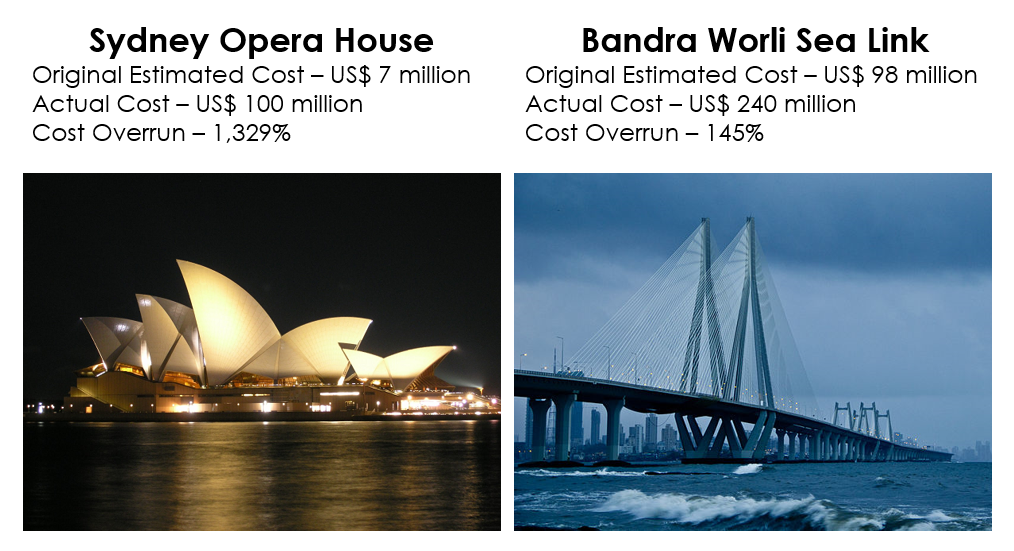
Cost Overruns at Sydney Opera House and Bandra Worli Sea Link
Yours truly has been at the forefront of such failed projections too. I recently renovated my house at a cost that was almost 3x my original estimate at the start of renovation just a couple of months ago. Now I do not want to bring in my multiple failed predictions (luckily, only known to me) on the stock market here, for that would embarrass me enough to stop writing this post.

We Hate Randomness
You see, we humans are bad at factoring in the possibility of randomness and uncertainty. We overestimate our own knowledge and forget about unpredictability when it is our turn to predict.

For instance, when researchers asked a group of students to choose a range for the number of lovers Catherine the Great had (the correct answer is 22 lovers), 45% of them got it wrong by trying to be precise even as most of them could have been right by picking a range – say, zero to ten thousand – instead of a specific number.

Consider intrinsic values of stocks. Most of us get it wrong calculating precise numbers for intrinsic values we assign to stocks or Sensex, even as most of us could get it right when calculating a range of values…

Sensex and stocks target prices
An alien may find our attachment to ‘precision’ funny when it comes to the stock market (though precision is must when you are a brain surgeon or an airline pilot), but this is an ailment that has no cure. We have an intrinsic and uncontrollable urge to be precise, for better or (all too often) worse, which often proves counter-productive when dealing with uncertainty.

This is how Jason Zweig described the human tendency to predict in his book Your Money and Your Brain

Just as nature abhors a vacuum, people hate randomness. The human compulsion to make predictions about the unpredictable originates in the dopamine centers of the reflexive brain. I call this human tendency ‘the predication addition’.

The ‘prediction addiction’, as Zweig explains, is the compulsive desire to try to make sense out of just about everything…even events that are not predictable. Like the direction of the stock market or the future price of a particular stock.

Investment writer Dan Solin, in an article for Huffington Post, wrote –

This addiction is a particularly bad one. Not only are our brains hard-wired to believe we can predict the future and make sense out of random acts, it rewards us for doing so. The brain of someone engaged in this activity experiences the same kind of pleasure that drug addicts get from cocaine or gamblers experience when they enter a casino.

Benjamin Graham put his dislike for stock market predictions this way –

If I have noticed anything over these 60 years on Wall Street, it is that people do not succeed in forecasting what’s going to happen to the stock market.

And this is what Warren Buffett has to say on the ability of stock market forecasters –

We’ve long felt that the only value of stock forecasters is to make fortune tellers look good. Even now, Charlie and I continue to believe that short-term market forecasts are poison and should be kept locked up in a safe place, away from children and also from grown-ups who behave in the market like children.

Despite such views from great investors on the futility of predictions, investors continue to get conned into engaging in this process, aided by their brokers, advisors and the financial media.

Now, how do you safeguard yourself against getting into the unending loop of predictions is simple – Ignore the uncontrollable, and control the controllable.

In simpler terms what I mean is this. Rather than devoting your time and energy to a ‘destined-to-fail’ attempt at finding the next Page Industries or figuring out where the Sensex is headed in 2016, focus on what you can control.

And what are the things you can control?

  • Expectations: Set realistic goals for the future performance of your stocks. If you think you can beat the market, or earn a return like 30% every year, you’re simply setting yourself up for a guaranteed disappointment.
  • Risk: In stock market investing, risk comes from not knowing what you are doing. So you can control risk by knowing what you are doing. Don’t just ask yourself how much you might make if you are right. Also ask how much you can lose if you are wrong. Knowing how much your predication can cost you is a good way to stay away from making one.
  • Behaviour: Leave your emotions aside while investing in the stock markets. Tighten the screws of your leaky brain, and promise yourself that you won’t predict where stock prices are headed.

Take a Break
If you are stuck with a prediction addiction, you need a break from the daily cacophony of business channels, financial websites and newspapers firing on their prediction cylinders. Stop looking at the stock ticker. Its constant beat can sometimes cause you to skip a heartbeat. Pursue an investment strategy that does not depend on predicting the unpredictable.

“If owning stocks is a long-term project for you,” warns psychologist Daniel Kahneman, “following their changes constantly is a very, very bad idea. It’s the worst possible thing you can do, because people are so sensitive to short-term losses. If you count your money every day, you’ll be miserable.”

Considering what we’ve learned about how dopamine system works, the ever-changing stock prices hit your brain like a can of kerosene dumped into a campfire.

So, instead of driving yourself crazy by constantly monitoring your stocks, just take a break. Constantly checking stock prices, getting ecstatic or worried about them, and making the next prediction will only hurt your personal life and financial returns in the long run.

The post When In Doubt, Please Don’t Predict appeared first on Safal Niveshak.

    
13 Jun 04:35

Automation, Robots and Planning

by Muthu

We’ve started hearing stories of people losing jobs in IT & BPO due to automation. Also, the pace of recruitment in these sectors is slowing down. The number of new jobs created in next few years would be far lesser than what was created in the past.  Many roles are becoming redundant. The starting salary for a fresher has been constant around 25K per month for last very many years.

Also many IT & BPO companies have started going for contract workers. In the coming decade, automation, robots and temporary staffing can change the way we look at jobs and career.

Soon factory floors may have more robots than human workers. There may not be any need to outsource manufacturing jobs to low wage countries.

Every month, in India, we are adding one million people to the job market. In 2020, we would have 900 million people of working age. Though as an economy we would continue to grow, the job growth may not be on par with economic growth. Skill development and providing employment opportunities would be a major challenge for the government.

We need to get used to temp employment. Temp employment means constant upgradation of skill and knowledge. This only would ensure that there are further opportunities after an assignment gets over. Investing in oneself would be the primary investment requirement. Without human capital, it would be difficult to generate and grow financial capital. We need to adjust ourselves to increasing life span and decreasing career span.

Normally we suggest having an emergency fund equivalent to at least one year of expenses. Considering the breaks one’s career may have, emergency fund need to be 2 to 3 years of expenses. Many do not take individual medical cover, as it is provided by the employer. Given the changing dynamics, individual medical cover would be mandatory. Otherwise any medical emergency can make us bankrupt.

At the moment, it is still difficult to envisage how job markets would be after 10 years.But those who would keep updating their skills and knowledge would always be in demand. Mere certifications or degrees would not be of much use. What matters is what you can ultimately deliver.

Financial planning would become all the more important as expenses are always certain while income may be uncertain. Not that people like me can take our profession for granted. Robo advisory is becoming very popular!

We are in for interesting times.

As I always say, the best antidote to uncertain future is financial independence.

Go for it.


13 Jun 04:34

Bad ideas never die

by Greg Mankiw
In the Silicon Valley suburbs, activists are pushing for laws that limit rents, even though, as the article says, "economists have an almost universally dim view of rent control."
13 Jun 04:34

Creating Wealth: Simple, but not easy steps

by subra
Here are a few more steps which will create an enormous amount of wealth for you: Get a good sensible degree: Get an Engineering degree from IIT, or say a CA degree, a law degree  – if you are an average student, the chances of making decent money improves with a good degree. While at […]
13 Jun 04:34

Guns are Instruments, Not Sentient Volitional Beings

by atanu

In yesterday’s Ask Me Anything, Abhay Rajan asked what I thought of the Second Amendment, no doubt prompted by the horrific mass shooting in a gay nightclub in Orlando, Florida, on Saturday night/Sunday morning at 2 AM Eastern. So far there are 50 people dead, and some from the critically injured may push that number up. The dead terrorist has been identified as Omar Mateen, a supporter of the Islamic State.

The 2nd amendment to the US constitution says, “A well regulated Militia, being necessary to the security of a free State, the right of the people to keep and bear Arms, shall not be infringed.” [See the Cornell University Law School page on the 2nd Amendment for a brief discussion of it.]

My view on “the right of the people to keep and bear arms” is based on the principle that people should have the right to protect themselves against aggression. My ethical and moral position is that initiating aggression or coercion is almost[1] never justified, and one is perfectly justified to resist, violently if necessary, anyone who initiates force against one. The right to bear arms is therefore instrumental in keeping the peace by deterring those who would initiate violence.

More specifically, I read the 2nd amendment’s phrase “the security of a free State” to mean the security of the individuals that constitute the free State. The government of the State is also an agency that needs to be deterred from initiating force against the individuals of the State. Therefore the individuals must have the right to bear arms to protect themselves from the government if ever the government itself becomes tyrannical.

Second Amendment issues aside, my position is that a peaceful society is preferable to one in which violence is unchecked. Violence cannot be eliminated, only minimized to some optimal level. This notion of an “optimum level” appeals to economists intuitively. While non-economists would want that violence (or pollution, or corruption, or accidents, or theft, or any “bad”) be brought down to zero, economists would stop when the costs of reducing violence exceeds the benefits. In short, “what’s worth doing, is worth doing well” means doing it only so well and not more than that.

Any positive analysis (that is, an investigation into what is) will reveal that some humans are prone to aggression and violence. The normative prescription (that is, what should be done) follows from that positive analysis: deterrence of violence by credibly guaranteeing swift and proportionate reprisals. That necessary deterrence is provided by the instrument of guns.

[In a followup post, I will explore the idea of how guns reduce violence through “credible commitments.”]

Now it may not be that every society needs to have everyone carrying guns to protect themselves. Societies in which people don’t traditionally use guns to initiate aggression or settle disputes will have little need for guns. But for whatever reasons, if guns are widely available in some society, prohibiting citizens from owning guns for their self-protection is unwise.

Guns cannot be banned in the US

For historical reasons, in the US there is a tradition of guns and they are widely owned. Is it practical to ban gun ownership? No. However there is a middle ground between absolutely no restriction on gun ownership and total prohibition: that of “gun control”. By control I mean who is prohibited from buying guns and what types of guns.

Guns for self-defense is fine. But automatic assault rifles that are required only if you are defending yourself against several attackers similarly armed are pointless because that’s unlikely even in the US. So handguns and small caliber weapons should be allowed but not the possession of assault weapons. Who should be allowed to have them? All competent people, and perhaps with a waiting period of a month.

But, one may object, wouldn’t that mean that there will be a lot of gun violence if almost everyone could possess guns? Not really. Guns are instruments that can be used for offense as well as defense. What they are actually used for depends on factors that are independent of mere possession. For example, even if I owned a gun, I would not go around shooting people because initiating force against people is not part of me. Even if I was armed to the teeth on a flight, no one need worry. But if someone is hell-bent on destruction, they can lay their hands on a range of things other than guns to do so, from cars and pressure cookers packed with explosives to box cutters.

The fact is that guns are merely one of the instruments of murder. Instruments provide the necessary means to an end but they are not sufficient in themselves for the outcome. Guns don’t go off by themselves. Guns are instrumental but the motivation is personal to the criminal. These days the most familiar cases of senseless violence are motivated by ideological reasons — most commonly Islamic fundamentalism. Islam, in the Orlando shooting, is clearly implicated. Islam’s injunction for the murder of homosexuals provided the motivation for Omar Mateen to kill dozens of innocents who had meant him no harm.

Drain the swamps, don’t fight the alligators

Framing the Orlando mass murder as a “gun control” matter is at best stupid and at worst a deflection of public attention from the real underlying cause of the mayhem which is Islamic ideology that abhors homosexuality. Certainly, killing homosexuals for their sexuality is illegal in civilized countries but in Islamic states, it is perfectly legitimate. Thousands of homosexuals are killed every year legitimately, and with the full force of the Islamic states involved in the killings.

The American adage to “drain the swamps instead of fighting alligators” makes a lot of sense. You could distribute personal bazookas to a population that is ideologically pacific without losing any sleep. But with the most stringent gun control laws, the Islamic terrorist will find a way to kill by the dozens, as we saw in the Brussels attacks of a few months ago. The Islamic swamp must be drained.

NOTES:

[1] I wrote, “initiating aggression or coercion is almost never justified”. There are exceptions. Example: Suppose someone was going to launch a deadly attack and I was convinced of that, I would aggressively attempt to stop that person from causing violence.


13 Jun 04:31

Stylized facts on public sector employment premium

by noreply@blogger.com (Gulzar Natarajan)
Frederico Finan, Ben Olken, and Rohini Pande have an interesting paper on "personnel economics" which examined data from 32 countries. In particular, they find a significant wage premium associated with public sector employees, more so in developing countries, which have important implication on selection, incentive structures and monitoring. Some interesting graphics on premiums enjoyed by public sector workers.

1. The public sector pay premium is among the highest in India, at about 65%.
2. The public sector worker is 55% more likely to receive health insurance or other benefits, highest among all the sample countries.
3. The public sector workers are 48% more likely to receive pension benefits, again among the highest among all countries.
So here is the problem. The public sector employee in poorer countries enjoys a significant wage premium, is far more likely to enjoy health benefits and pensions, attracts the more educated, has a higher tenure. But this premium is not reflected in their performance outcomes. 

The paper discusses the usual stuff about using screening applicants, and using incentives and monitoring to improve outcomes. I've blogged about this on several occasions and am not very sure about sustainable gains from these attempts. 
Add to Technorati Favorites
12 Jun 04:13

Complexity theory and "New Economics"

by noreply@blogger.com (Gulzar Natarajan)
Eric Beinhocker tries to go beyond the left-right distinction and economic orthodoxy to describe what he calls "economics for the real world". He describes the 'new economics',
Rather new economics is best characterised as a research programme that encompasses a broad range of theories, empirical work, and methods. It is also highly interdisciplinary, involving not only economists, but psychologists, anthropologists, sociologists, historians, physicists, biologists, mathematicians, computer scientists, and others across the social and physical sciences. It should also be emphasised that new economics is not necessarily new. Rather it builds on well-established heterodox traditions in economics such as behavioural economics, institutional economics, evolutionary economics, and studies of economic history, as well as newer streams such as complex systems studies, network theory, and experimental economics... The common thread running through this broad research programme is a strong desire to make economic theory better reflect the empirical reality of the economy. New economics seeks explanations of how the economy works that have empirical validity. Thus behavioural economists run painstakingly crafted experiments to explain actual human economic behaviour. Institutional economists conduct detailed field investigations into the functions and dysfunctions of real institutions. Complexity theorists seek to understand the dynamic behaviour of the economy with computer models validated against data.
He points to the use of the likes of agent-based models to analyze various markets. On policy making, he advocates eschewing the traditional mechanistic approaches (incentives, interventions to correct market failures, costs-benefits analysis etc) and embrace an approach that accommodates complexity, unpredictability, and reflexivity.

He outlines three principles of this approach. One, instead of going in with one design, experiment with multiple approaches and iterate and refine the ones that work best. Second, policies and institutions should be as adaptable as possible. Third, instead of being policy engineers, policy makers need to see themselves as stewards who "create the conditions in in which interacting agents in the system will adapt towards socially desirable outcomes". This would involve an evolutionary approach to execution. 

This is an addition to a growing body of literature that advocates an experimental and iterative approach to program design and implementation. 
Add to Technorati Favorites
11 Jun 05:22

Speaking of Freedom of Speech

by atanu

“If the freedom of speech is taken away, then dumb and silent we may be led like sheep to the slaughter.” –George Washington

The importance of the freedom of speech is underestimated by most people.

George Washington stressed the instrumental role of the freedom of speech — as a defense against oppression. But freedom of speech, like the right to be left alone, is also something of value in and of itself, even if there was no possibility of being oppressed.

I wrote this piece for India Current (June 2016 issue). I reproduce it here, for the record.

Speaking of Freedom of Speech

Many of my NRIs friends, generally a well-informed group, are often surprised to learn that their resident Indian cousins don’t have the kind of freedom of speech they routinely enjoy in the US. They assume quite reasonably that in India too, just like in the US — both celebrated as exemplars of robust democracy — there are constitutional guarantees against governmental restrictions on the freedom of speech and the press. This is unfortunately not so.

Some time ago, while discussing the details of the content the editorial staff of an Indian newspaper would expect in a column, I was told that I was free to write about anything I wanted. But I was cautioned to stay clear of any criticism of the powers that be. Not just in general terms, I was told not to find fault with two specific politicians in power, whom I cannot name here for obvious reasons (privacy being only one of them.)

That happens in India but will not happen in the US. Here’s why.

“Congress shall make no law . . . abridging the freedom of speech, or of the press . . .”
–US 1st Amendment

The difference arises from the constitutions of the two. The First Amendment to the US Constitution (the first of 10 items that is the US “Bill of Rights”) states, in part, that “Congress shall make no law . . . abridging the freedom of speech, or of the press . . .” The important bit is that the US constitution does not grant the freedom of speech because that freedom is not for it to grant or withhold. The freedom of speech exists prior to the constitution; the amendment merely recognizes that fact by explicitly prohibiting any law that may tamper with it.

As it happens, the First Amendment to the Indian constitution, introduced by Mr J. Nehru in 1950 also, among other matters, deals with the freedom of speech and of the press. There are two major distinctions, though. First, I cannot quote the Indian amendment in its entirety here. The US 1st amendment is only 45 words long and is in plain English; the Indian counterpart is around 1750 words of impenetrable legalese.

Second, the Indian amendment grants the right to free speech. What the constitution grants, the constitution can also take away. In the finer details it says in essence that Indians are free to speak or write whatever they wish — provided the government agrees with it.

In short, you may speak or write admiringly about the emperor’s new clothes but you cannot point out that perhaps the emperor is naked. In fact, you are tacitly urged by the emperor to write encomiums on the brilliance of his attire.

Ruling politicians have the power to financially ruin any newspaper by withholding ads.

You may wonder, what does “tacitly urged” mean here? It means that when money speaks, you don’t need to. The Indian Ministry of Information and Broadcasting has a very, very large budget. (Why India has to have what amounts to a ministry of government propaganda is a matter for another day.) Currently it’s about Rs 4000 crores or about US$ 600 million a year. That’s the central budget; I presume the states have their own I&B budgets. Part of that humongous amount is spent on government advertisements in newspapers. Ruling politicians have the power to financially ruin any newspaper by withholding ads.

Even cognitively challenged people — and people who run newspapers are not stupid — know which side the bread is buttered, if you get my drift. But even if you lay that carrot aside (pardon the mixed metaphor), you have to mind that heavy stick. There are literally thousands of pages of rules and regulations that apply to all kinds of organizations, including publishing. No one really knows everything about what they are but it is quite easy to run afoul of some regulation or the other, if an inquiry was to be initiated against any business.

“There’s freedom of speech, but I cannot guarantee freedom after speech.” –Idi Amin

Publishing anything that the government is likely to take serious offense to is akin to publishing an invitation to officialdom to please come and shut down the business on some pretext or the other; and also to audit the accounts; and to get an income tax raid done on your home immediately; and file a few cases against your business which the courts will take decades to settle.

The freedom of speech and of the press forms part of the foundation of a free society. The other rights such as the right to choose who shall be entrusted with governance — democracy and all that — are rendered meaningless if one is ignorant about the deeds and misdeeds of those who govern. The search for good governance is bound to be fruitless if one has to do it blindfolded, which is what it amounts to when people lack the freedom to examine the government critically, fearlessly and frankly.

Perhaps Indians need to fight and win some real freedom, and not just be satisfied with dubious nominal freedoms that are granted only provisionally and exercised rarely for fear of government reprisals.


11 Jun 05:20

Weekend reading links

by noreply@blogger.com (Gulzar Natarajan)
1. A new study of 23 drugs, eight of which were under patents, reveals that while prices are highest in the US and lowest in India...
... their affordability is reversed.
2. FT points to the irony of Germany's fixation with Walter Eucken's Freiburg school's focus on balanced budgets,
Germany’s economy, despite its size, is extremely open. The ratio of exports to gross domestic product is 46 per cent. In Japan, the figure is 18 per cent and 13 per cent in the US. This openness allows Germany to pursue a passive macroeconomic policy at home and benefit from active demand-side policies pursued in other countries. About 60 per cent of the German current account surplus is with the US, the UK, France and Italy, which all have relatively high fiscal deficits. In short, Germany’s economy is supported by the demand management policies of countries that are heavily criticised by German academics and policymakers.
3. The latest BrandZ annual report on the value of brands finds that the top 100 global brands command a valuation of $3.4 trillion an increase of 133% over the past 10 years. The leader board, lead by Google, consists of mainly technology companies. Reflecting the churn, just 54 of the top 100 global brands ten years back are still there. 
4. I was waiting for someone to call this. Livemint says that with its 20 trillion long-term capital base, LIC has become the Indian government's lender of last resort.

It is popping up everywhere, so much so that I would not be surprised if whole Ministries (like Railways and Roads) see them as more important than the Union Finance Ministry and its Budget! Livemint writes, 
Where is the independence of LIC? If it is independent, why does it bail out the government through investments in bonds, equity or infra funds? Interest of the policyholders is key. They should get the best returns for their money... For instance, LIC picking up non-voting shares in banks at a price which was not discounted is not fair to the policyholders. In state-run banks, the voting rights are capped at 10%. So, in instances where LIC picked up more than 10% stake in state-run banks and is not getting voting rights, one can question why LIC did not purchase these shares at a discounted price..
5. Krishnamurthy Subramanian lifts the veil on conflicts of interest among Indian credit rating agencies who offer non-rating services 
The study employs data on the rating and non-rating activities of all CRAs in India from 2010 to 2015. It finds that a CRA that provides non-rating services to an issuer provides higher ratings (designating lower default risk) to that issuer when compared to the rating provided to the same issuer by other agencies... After controlling for various confounding factors, the distribution of ratings of issuers with non-rating services clearly dominates that of issuers without non-rating services. Additionally, the study examines the amount paid for consulting and finds that issuers obtain higher ratings the more (non-rating) revenue they generate for an agency.
The most uncomfortable evidence, which clearly suggests conflicts of interest, comes from comparing the defaults among issuers that pay for non-rating services and issuers that don’t. If higher ratings assigned by agencies to those issuers that pay for non-rating services are warranted, then default frequencies should be similar for firms within a given rating category, whether or not these firms have a non-rating relationship with the rating agency. If such issuers instead are treated more favourably, their ex-post default frequency would be higher than for other issuers with the same rating. The study finds support for the latter case... within a given rating category, firms that pay for non-rating services have higher one-year default rates than other firms. The fact that issuers that obtain non-rating services have higher ratings but higher default rates clearly points towards significant conflicts of interest despite claims of objectivity and independence by CRAs.
6.  Contract workers are an increasing share of the workforce even among India's leading IT companies,
Wipro, the country’s third largest software company, hired more contract workers than full-time employees in each of the past six years... Their number has increased from 70-odd in 2010 to more than 20,000 at the end of March.
7. Amazon announced an additional $3 bn investment in India last week, adding to the $2 bn made over the last two years. The major share of spending for e-commerce firms has been on marketplace discounting,
(Discount) sales and their accompanying ads are among the biggest sources of expenditure as well the biggest drivers of revenue for Amazon and the other online retailers... Amazon ran through nearly $2 billion in India in less than two years since its chief executive Jeff Bezos announced the investment in July 2014...
But such spending may no longer be possible given the new FDI rules which while allowing 100% FDI in online retail of goods and services under the marketplace model, prevents e-commerce firms from influencing the pricing of products, directly or indirectly, and limits a single seller's share to 25% of sales on any marketplace. Evidently, this leaves Amazon and others with limited flexibility to offer deep discounts and leaves warehousing and logistics management as the major investment avenues. But there is only so much you can invest in e-commerce logistics. 

I believe that the FDI guidelines are a good example of industrial policy. In so far as the overwhelmingly large share of FDI in e-commerce went into deep discounting in the race to acquire customers, it had no productivity enhancing role. The FDI policy now limits that option and encourages these firms to invest in their supply chain infrastructure. In this context, can policy go one more step in channeling some share of these investments into establishing agriculture logistics infrastructure like cold storages? It may even be prudent to increase the seller's share beyond 25% in case of farm products.

8. Fascinating graphic that captures how twitter reveals the ideological preferences of Democrat and Republican Congressmen. The graphic points to a study that captures the science-related engagement as reflected in their respective Twitter accounts
The study's findings offer mixed news,
While the Senate’s interest in science is generally quite low, Senate Democrats are three times more likely than Republicans to follow science-related Twitter accounts like NASA or the National Oceanic and Atmospheric Administration. Interest in science, the authors conclude, “may now primarily be a ‘Democrat’ value”... (But) among the ten most scientifically engaged Republicans on Twitter, half were willing to cross the aisle in January 2015 to vote in favour of an amendment declaring that “climate change is real” and that “human activity contributes to climate change”. With a greater understanding of science, leaders in Congress may be more willing to break party ranks and find common ground.
Add to Technorati Favorites
10 Jun 04:27

The challenge with attracting foreign investors in infrastructure

by noreply@blogger.com (Gulzar Natarajan)
The Qatar Investment Authority, the country's sovereign wealth fund, is buying Singapore's Asia Square Tower One from BlackRock for a record $2.45 bn, or $1960 per square feet. This may be of relevance to India as it courts investments from countries like Qatar.

As I blogged earlier, investments will come if there are attractive commercial opportunities. Given the very high levels of risks associated with construction, it is almost certain that these investors will not look towards greenfield infrastructure projects. Further, since such investors are not entrepreneurs, they are unlikely to be attracted towards manufacturing and other desirable economic activities.

They are more likely to invest in either high return assets like real estate or functioning infrastructure assets with stable and low-risk returns. Given that there is already considerable economic activity in the former, and the government would want to avoid resource mis-allocation and bubbles, infrastructure appears the best destination to target.

The stressed assets present an opportunity to draw in such capital. But they are unlikely to invest at prevailing valuations. Bundling a few such assets sector-wise, especially in the power sector, and auction them by forcing haircuts on creditors may be a good platform to channel such capital.

Staying on the same issue, Livemint points a bullish report by Ambit Corporate Finance,
Global pension funds and sovereign wealth funds may invest up to $50 billion in India’s infrastructure sector over the next five years... To put things in perspective, infrastructure attracted a meagre $3.7 billion of investment, both domestic and foreign, in 2015, according to data from Equirus Capital Pvt. Ltd, another investment bank.
I am not sure whether such optimism is borne out by evidence. The latest Preqin report on unlisted infrastructure funds provides some answers. Unlisted funds, as against listed funds and direct investments, are the overwhelmingly preferred route to market of infrastructure investors like pension funds and sovereign wealth funds. At the start of Q2 2016, there was just $7 bn of Asia-focused (including China) unlisted infrastructure fund dry powder. In fact, the total amount raised by unlisted infrastructure funds across the world in 2015 was just $36 bn, the vast majority focused on US and Europe. The annual Asia focused unlisted infrastructure fund raising was in the $3-4 bn in the 2006-15 decade. And this includes China.
Assuming Asia focused funds to raise $6 bn each year on average over the next five years, half that flows into India, and unlisted funds form only three-fourth of total infrastructure investors (all very optimistic assumptions), the total inflows into India from infrastructure investors would not be more than $20 bn!
Add to Technorati Favorites
09 Jun 05:21

9, 8, 7, 6.7,... Speculating on China growth

by Antonio Fatas
The deceleration of China's GDP growth rate has been seen both as a natural transition towards more sustainable growth rates and a sign that the Chinese model of growth is coming to an end. How does this deceleration of growth rates compared to similar historical episodes for other countries? Is 6-7% a sustainable growth rate for China?

Let's frame these questions in the traditional model economists use to look at growth rates of emerging and low-income economies: the convergence model (based on the work of Robert Solow). The main prediction: countries that are lagging have more opportunities for investment and they are likely to grow faster than countries at the technology frontier. Because of faster growth rates we expect to see convergence in GDP per capita. As convergence happens, growth rates will naturally slowdown to reach those of the countries at the frontier. [The theory also states that not all countries might converge to the same level of GDP per capita but let's ignore that for a second and focus on the predictions of relative growth rates.]

Start with an example that nicely validates the theory: South Korea. Let's plot the level of GDP per capita of South Korea relative to the US at the beginning of each of the last three decades and then compare it to the growth rate of GDP per capita during the years that followed [I will treat the 2000-2014 period as the "decade of the 2000s"].


The plot above (click on it for a larger picture) shows that South Korea starts in 1980 with a level of GDP per capita below 20% of the US leading to annual growth during the 1980-90 period of about 7%). This allows the country to reach a level of 30% relative to the US by 1990. At that point growth is decelerating and during the next 10 years it goes below 5.5%. The transition continues with decelerating growth during the next decade (around 4%). Today South Korea has a GDP per capita of about 65% of the US level and it is likely that over the coming years we will see a further slowing down of its growth rate as it continues its convergence towards the US.

So far so good for our theory. How about China?


In 1980 China starts at a much lower level of GDP per capita and, consistently with our logic, a very fast growth rate of about 7%. But as the country converges towards the US growth rates accelerate to above 8% during the 90s. One potential explanation for this acceleration is that China was moving towards a more natural growth rate given how low its GDP per capita was relative to, say, South Korea. But the next decade  (2000-2014) will bring yet one more increase in growth rates towards 9%. At that point the growth rate looks spectacular compared to the case of South Korea. To put it in perspective, by 2015 China has reached a level of 25% of US GDP per capita (the vertical red line) and when South Korea had reached that level it was already growing at less than 6%. The comparison to South Korea makes clear that growth rates of 8-9% in China given its current development would have looked like a true miracle.

What if South Korea is used to benchmark future Chinese growth rates? Given the current GDP per capita of China, we are looking at a growth rate of slightly below 6% over the next decade. And a growth rate that will decelerate further as time passes. This number is slightly lower than the current target of the Chinese government, but not far given that we are talking about 10 years in a path that is likely to be one of decelerating growth rates. [Note that the growth rates above are in per capita terms. Working age population is currently not growing much in China so the GDP figures should not be too different].

Final question: is South Korea a good benchmark for China? Let's look at other potential fast-growing economies during the same years.


South Korea is clearly the best performer in the range of countries that are below 50% of the US GDP per capita (and, yes, there are plenty of failures!). So using South Korea as a benchmark is providing a very optimistic case on Chinese growth. There are a few other countries that look like outliers (from above) in this relationship but it is unclear that they are relevant examples for China. Hong Kong and Singapore are small city states. Ireland in the 90s is a very unique decade for a European country, and oil producing countries (such as Norway) have dynamics that cannot be replicated without that level of natural resources.

In summary, the deceleration of GDP growth rate in China seems like a natural evolution of the economy as it follows its convergence path. Growth rates around 6% still put China as the best performer among all countries in the world, conditional on its level of GDP per capita. There are plenty of other countries in the world that show China what low growth rates of GDP really look like. And they might be an example of what could happen to the country if it cannot keep its policies and institutions among the best in class for its current level of development.

Antonio Fatás
09 Jun 05:17

8 per cent growth in 2016-17 ? Unlikely

by T T Ram Mohan
The growth rate of 8 per cent in the last quarter has revived talk of a return to 8 per cent growth rate in the near future. Sorry to be a bit of a spoilsport but I'm afraid this is highly unlikely.

In 2015-16 the Indian economy grew at 7.6 per cent compared to 7.2 per cent in 2014-15. This was mainly on account of the steep fall in oil prices which translated into a surge in private consumption and also into higher government capital expenditure through higher taxes on oil products.

The hope was that this bonanza would continue in 2016-17 although in a muted form, with oil prices falling further to $30. This hope is being dashed by the rebound in oil prices to $50, which was the average for 2015-16. This takes away the whole of the contribution of 1-1.5 percentage points to growth that arose from the sharp fall in oil prices in 2015-16.

Some analysts think this will be compensated by greater rural consumption following better monsoons and better urban consumption because of the Pay Commission hike. I estimate the benefits on account of this two factors at 0. 3 per cent and 0.6 per cent of GDP respectively. As you can see, this doesn't compensate for the impact of oil prices.

Another blow is that the world economy is not only not reviving but is likely to slow down. The Economic Survey (2015-16) expected exports to contribute a solid 1.3 percentage points to growth. This looks likely to get washed out. In fact, export growth could slow down even further, dragging down economic growth.

Lastly, analysts have been making a hoopla over increased public capital expenditure. They overlook the fact that this is being offset by compression of government expenditure on other counts and also higher taxes. The fiscal deficit is going to shrink by 0.4 percentage points. That, basic economics should tell us, means a shrinkage in demand from the government. Using a multiplier of 1, this means minus 0.4 percentage points of growth.

I add up the numbers and find that the Indian economy is likely to grow at 7 per cent rather than 8 per cent in 2016-17- unless oil prices fall back to well below $50.

That's the short-run view. The medium-term outlook is just as sombre. Whoever is forecasting a return to 8 per cent growth has some explaining to do.

More in my article in the Hindu today, Tempering economic ebullience.


08 Jun 09:32

Sol Price on Becoming Your Customer’s Best Friend

by Farnam Street Team

Sol Price is a legend in the retail business. Price founded one of the first discount retailers, FedMart, in the 1950s, and then later the pioneer warehouse club Price Club, which he later sold to Costco, a business started by his former protege Jim Sinegal. Price’s innovations would go on to change the retail landscape dramatically and permanently. Costco now does $120 billion in sales and Sam’s Club, owned by Wal-Mart, does about $60 billion. Adding in other smaller operations, warehouse retailing is at least a $200 billion business in the United States alone.

Price innovated in several ways: Membership fees, way fewer product SKUs in stock, much larger sizes, extremely low profit margins bordering on break-even, low employee turnover and a lean labor model. But these were all mere symptoms of his overall stance: Price’s fundamental innovation was his approach to the customer relationship.

Whereas most retailers saw customers as adversaries, bodies to be sold to, Price saw the world differently. He felt he was on the customers’ side. He felt his job as a retailer was to become the customer’s greatest friend and advocate, and in return, the customer would pledge his loyalty back. He understood that trust given is trust earned.

Sol Price Price Club

The idea was very simple: See the world through the eyes of the customer. His son Robert, influential in his own right, describes Price’s unusual attitude (which is still uncommon) in a book called Sol Price: Retail Revolutionary & Social Innovator:

Sol’s experience as an attorney representing clients, and his own moral code, became a foundational feature of the FedMart business. Sol described his business approach as “the professional fiduciary relationship between us (the retailer) and the member (the customer). We felt we were representing the customer. You had a duty to be very, very honest and fair with them and so we avoided sales and advertising. We have in effect said that the best advertising is by our members…the unsolicited testimonial of the satisfied customer.”

This fiduciary relationship with the customer was similar to the Golden Rule; the way Sol put it—if you want to be successful in retail, just put yourself in the place of a cranky, demanding customer. In other words, see your business through the eyes of the customer.

Clearly, Sol Price followed Tussman’s dictum to understand the world and act accordingly, and understood the value of a win-win relationship. The success of Costco in his wake, and the continued loyalty of its customers in the face of a rapidly changing retail landscape, is a testimony to the value of his attitude.

Price had a few simple tenets in running FedMart and Price Club, which Sinegal would later adopt at Costco:

  1. Provide the best possible value to the customers, excellent quality products at the lowest possible prices.
  2. Pay good wages and provide good benefits, including health insurance to employees.
  3. Maintain honest business practices.
  4. Make money for investors.

Regarding the last point, it was clearly important to Price to make money, and if you look at Costco today, the model is obviously profitable. But it’s not that profitable. Costco makes solid returns but not incredible ones. And that is by choice.

Price — and Sinegal by extension — wanted a win-win relationship whereby he made his investors a reasonable return on their capital and the customer got a better deal than they could find elsewhere, while employees were paid well enough and treated well enough that they wouldn’t want to leave. In his words, “If you recognize you’re really a fiduciary for the customer, you shouldn’t make too much money.” This model has been tough to beat.

Price was so hardcore about his fairness philosophy that he wouldn’t even engage in loss-leader pricing, which is common in retail. Have you ever found yourself saying How can they make any money at this price? Well, they may not be — products are frequently priced below cost to induce you to buy other products at a more inflated profit margin. But Price wouldn’t do this: It meant he was selling some portion of his goods at inflated prices to make up for the loss leaders, and that he would not abide.

His customer advocacy went so far that if Price’s competitors were selling a competing product below cost, Price did one of the most unusual things I’ve ever heard: He put up signs telling his customers to go shop there.

In this way and many others, the life of Sol Price reinforces the truth of Munger’s philosophy for living a more effective life: “Take a simple idea, and take it seriously.”

***

Still Interested? Check out the book in its entirety.

--
Sponsored by: Slack - Making teamwork simpler, more pleasant, and more productive.

08 Jun 08:37

US Presidential election quote of the day

by noreply@blogger.com (Gulzar Natarajan)
The presidential debates between Hillary Clinton and Donald Trump will shatter all audience records... Tens of millions will tune in to watch our age’s most trigger-happy insulter denigrate one of the world’s most famous women. In ancient Rome gladiators slaughtered barbarians to keep the people entertained. In this case however, the barbarian has a shot at becoming emperor. Whether or not he succeeds, US democracy will never be the same.
Add to Technorati Favorites
08 Jun 08:37

Judicial delays fact of the day

by noreply@blogger.com (Gulzar Natarajan)
In the context of the Chief Justice of Supreme Court's recent appeal to the government to help the courts expedite case disposals by filling up vacancies, Livemint shines light on more egregious internal delays like that between reserving for judgement and actually delivering the judgement. It examined 487 judgements delivered by the Supreme Court in 2015 for which information was available and found a disturbing trend. In more than 17% of cases, orders were not delivered within the three month benchmark suggested by the Supreme Court itself.
The article says,
The relatively large number of cases where the judgement is delivered more than 90 days after being reserved by the bench suggest the absence of a system to keep track of how long a case has been reserved for judgement. From the information available on the Supreme Court website, it is not possible to determine with any accuracy how many judgements have been reserved and for how long. A recent Right to Information application seeking details of cases that have been reserved for judgement was denied by the Supreme Court.
It is impossible to imagine any other agency of the government being able to deny such basic information and get away without a public admonition by a Court. As the article says, "it is high time perhaps that the apex court adopts a system to keep track of reserved judgements in the interests of transparency and accountability to the litigating public".

This again underscores the point that I have blogged many times that the country's highest court needs to urgently embrace the advise of Justice Louis Brandies and disinfect judicial performance with the sunlight of transparency on case disposal information. It is worth reiterating,
Even the most basic data on the performance of judicial officers is currently difficult to obtain. How many orders have been passed by each judge annually, individually and in a bench? What is their average time between the final hearing (reserving for orders) and passing of orders? How many orders of the judge have been appealed against? How many of the orders have been reversed in appeal? How many orders have been passed in favor of the petitioner and how many rejected? How many orders have been passed against the government and how many in favor? What is the average number of adjournments in a case for each judge?
For a part of the government whose accountability largely rests on self-regulation, and one which has mostly refused to play by the same rules of the game that it administers on all else, transparency may be the only check against degeneration.
Add to Technorati Favorites
07 Jun 04:14

India banking sector update

by noreply@blogger.com (Gulzar Natarajan)
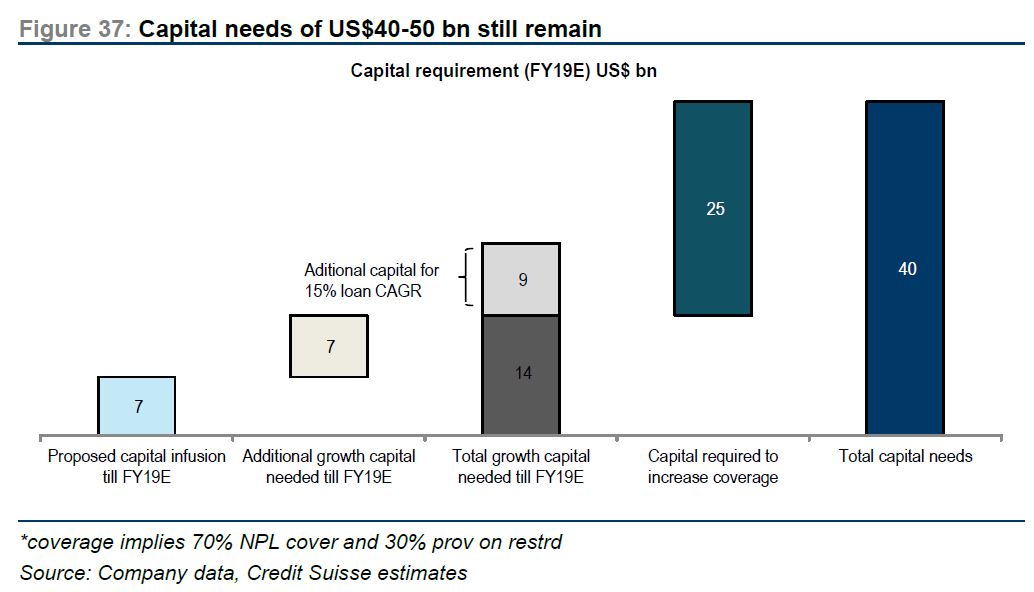
With the Q4 2015-16 results declared, the admirable folks at Credit Suisse have their latest update on India's banking sector. The non-performing loans have exploded by nearly Rs 3 trillion over the last two quarters to about Rs 6 trillion or 8.1%. Worryingly, coupled with stressed assets, the total figure may well be above 17%!
Given the scale of losses, the budgeted capital infusion looks like small change. Instead, at the least an additional $40 bn or Rs 2.7 trillion capital infusion would be required. 
Currently, the bank credit is flowing mainly on the back of private banks, who though made only 25% of the total banking loan book had over half the profits, and contributed four out of the five banks which had double digit loan book expansion in 2015-16. The Credit Suisse report estimates that PSU banks would need five years of profits to provide for all the stressed loans. In fact, including the stressed loans (assuming 30% go bad), just four of the 22 PSU banks covered have positive net worth!

In this context, the drip-by-drip capital infusion is simply too little. As the report points out, the losses in 2015-16 more than wiped out the capital infusion done by the government. Whatever other reforms are undertaken, and there are many required, there cannot be any substitute for massive capital infusion for the public sector banks. And this will have to be in the form of allocating about 0.5% of the GDP for recapitalization for the next three years. It may even be alright to have the fiscal deficit targets of 3.5%. 3.25%, and 3% each for the next three years to meet this objective. 
Add to Technorati Favorites
06 Jun 05:33

Help me name my book!

by SK

The more perceptive of you here would’ve known by now that I’ve finished the manuscript of a book on Liquidity. Having finished the draft, and one basic round of editing, I’m now sending it around to publishers, hoping to strike a deal.

One of these publishers wrote to me saying that while she loves the chapters I’ve sent her (a small sample), she doesn’t like the name of the book. “Liquidity”, she says, is too bland and doesn’t reflect the contents of the book, and has asked me to come up with a better name.

And I’m at a loss, in terms of coming up with a name. I don’t even know what kind of name I should pick for the book. So I need you to help out!

The book is about liquidity, in the context of different markets. Apart from the handful of obligatory chapters (my chapters are mostly tiny, and there are 21 of them) on financial markets, I have stories on markets in taxis, dating, footballers, real estate, agriculture, job hunting, food, etc.

Here is part of an introduction to the book I’ve written, which might help you help me!

Why do people with specialised skills find it hard to switch jobs? Why do transfer fees for footballers always seem either too high or too low? Why are real estate brokers still in business despite the large number of online portals that have sought to replace them?


[….]

… we analyse why the market for romantic relationships, both matrimonial and dating, is mostly broken, and none of the new platforms are doing anything to fix it. We take a look at how taxi regulation is inherently inefficient thanks to liquidity issues, and how Uber’s much- maligned surge pricing algorithm helps create liquidity by means of superior information exchange. We will also see how liquidity helped build up the credit derivatives market, and then ultimately led to the global financial crisis.

So if you have any cool ideas on what to name the book, or at least a framework I need to follow to name it, please do let me know in the comments here! It might help you to know that the “acknowledgements” part of the book hasn’t been written yet!

05 Jun 05:29

Lessons to my younger self…

by subra
The other way of saying ‘what would have I done differently’…. Read More books: clearly I would have read more books and on a much wider range of topics. Today I cannot bring myself to read books outside of finance, management, and fiction. ‘Being Mortal’ of course is a book I read, I read Gladwell, […]
02 Jun 05:24

Start-ups and me-too e-commerce are not innovation

by noreply@blogger.com (Gulzar Natarajan)
The Nobel laureate Robert Solow said in 1987, "We see the computer revolution everywhere, except in the productivity statistics". In the context of the excitement about India's IT startup companies, one could as well say, "People talk about Bangalore bubbling with young and smart entrepreneurs indulging in a vast array of innovations. While we can see bubbles of "me-too" startups everywhere, where are the innovations?"

Entrepreneurship demands creativity, risk appetite, diligence, and deferred gratification. I am not sure, whether any of these elements, in a reasonable magnitude, are at play in India's entrepreneurial eco-system. Consider the examples of the popular e-commerce and sharing economy firms. All of them borrow well-tested business models, work-flow processes, and technology platforms from developed markets. This naturally limits project risks, except commercial viability risks associated with any such ventures. Creativity and diligence is confined to finding ways to manoeuvre around the country's stifling and inhospitable bureaucracy. In line with modern shareholder capitalism, our entrepreneurs too prefer to pursue gratification which is instant than deferred. 

Unfortunately, despite the generic nature of the business models and processes, India's e-commerce story has not gone beyond the well-trodden paths of e-commerce, vehicle sharing, home stays, and e-payments. Where are the entrepreneurs who have taken the agricultural market place by storm with extension services or sharing of farm implements? Where are the tele-medicine and e-learning apps which have grown in scale and enabled access to high quality health care and school education for millions? Where are the killer apps that could have broken the stranglehold of middlemen by enabling farmers, fishermen, milkmen, and other producers of primary products to bridge information asymmetry by being able to access large enough markets? Where are the public grievance redressal or public systems monitoring apps that could have transformed governance delivery?

Given that each one of the above mentioned, if successful, could have transformed the global market itself, it is surprising that India has not had any homegrown global brands and market leader like the M-Pesa of Kenya. All these endeavors have the potential to constitute market opening innovations, and would actually demand significant doses of all the four aforementioned attributes. They would require patience and hard work, understanding the markets and iteratively designing appropriate business models. That would have been innovation. 

However, it may be unfair to blame the entrepreneurs alone for chasing low hanging profit opportunities, especially when there is plentiful investments chasing them. This takes us to the role of finance itself. It cannot be denied that venture capitalists like Kleiner Perkins, Sequoia and A12Z played the classic role of venture capital in catalyzing technology startups in the Silicon Valley. But, given that the Indian startups are merely replicating commercially validated models (and that too across several global markets), it is perhaps a fair point that this capital is more private equity than venture finance. This begs the question, where are the real venture capitalists in India? How do the venture capitalists see Indian market?

Worse still, none of the big domestic startups have been able to do at least the one thing that defines a successful startup, me-too or not - transition from customer acquisition to sustainability of commercial model. It is most likely that, given the dipping valuations and the contractual obligations like liquidation preferences, none of the Indian unicorns are much above the line for their original promoters. It is, therefore, not unlikely that ten years hence, the e-commerce and sharing economy landscape of India will be littered with Amazons, Ubers, Zillows, AirBnB's, Lending Clubs, Alipays, Expedias and so on with nary a sight of Flipkarts, Oyos, and Olas. 

As an ardent behaviouralist, I am one of those who subscribe to the view that you need to provoke in the extreme in the opposite direction to unsettle conventional wisdoms. It, therefore, follows that none of this is to overlook the significant achievements of start-ups in economic value addition and promotion of a culture of entrepreneurship. On the contrary, the objective is to initiate a debate on questioning the settled wisdom on our startups and innovation.
Add to Technorati Favorites
01 Jun 08:13

State of Indian Stock Markets - May 2016

by Dev Ashish
This is the monthly update of the state of Indian stock markets. As of now, it comprises only of Nifty50's P/E, P/BV ratios and Dividend Yield. The numbers are averages of P/E, P/BV and Dividend Yield in each month. The maps don't show the maximum and minimum values of each month. Caution - Please remember that relying solely on averages can be risky. Its like a 6-feet person drowning in a
31 May 15:20

Big 7.9% GDP Growth in Q4 on Manufacturing Revival

by Deepak Shenoy

How would you measure GDP Growth? By comparing it to last year. And when you get a GDP growth figure … (Read On...)

31 May 06:09

Committee to review FRBM targets

by T T Ram Mohan
I was on ET Now along with Prof M Govinda Rao to discuss this topic.

My view is that there is  a strong case for revisiting the targets. I give many reasons. Here I will mention two. One, our deviating from the FRBM target for nearly a decade past the deadline has not led to an unsustainable debt  situation. On the contrary, India is among the few economies whose debt to gdp ratio has declined over the past decade- at 67% of GDP today, it looks quite okay.

Two, we worry about the fiscal deficit because it can impact on interest rates. The impact on long-term rates of fiscal deficits is negligible, as empirical work has shown. However, the deficit can impact on short-term rates. On this count, concerns must be subdued at the moment given relatively low oil prices.

More fundamentally, I would question the idea that the way to reduce the fiscal deficit to GDP ratio is to attach the numerator, that is, reduce expenditure and, if possible, raise tax rates or increase the tax base. The point is that that is not how our ratio came down significantly in the first decade of the 2000s when we were almost close to attaining the 3% FRBM target at one point.

Rather, the numerator, the GDP, shot up due to exogenous factors, such as the global boom, and also due to the increase in the savings and investment rate over time. This also caused the numerator to decline because tax revenues rise with rising GDP.

The bottomline: the presumption that reducing the fiscal deficit is the key to better or stable growth must be questioned. It's very often the other way round. You do various things to boost growth - and the the fiscal deficit to gdp ratio takes care of itself. 


31 May 05:58

12 Things Lee Kuan Yew Taught Me About the World

by Farnam Street Team

“It’s no accident that Singapore has a much better record, given where it started, than the United States. There, power was concentrated in one enormously talented person, Lee Kuan Yew, who was the Warren Buffett of Singapore.”
— Charlie Munger

***

Singapore seemed destined for failure or subservience to a more powerful neighbor. The country is by far the smallest in Southeast Asia and was not gifted with many natural resources. Lee Kuan Yew thought otherwise. “His vision,” wrote Henry Kissinger, “was of a state that would not simply survive, but prevail by excelling. Superior intelligence, discipline, and ingenuity would substitute for resources.”

To give you an idea of the magnitude of success that Lee Kuan Yew achieved, when he took over, per capita income was about $400 and now, in only about two generations, it exceeds $50,000.

Here are 12 things I learned from Lee Kuan Yew about the world and the source of many of our present ills reading  Lee Kuan Yew: The Grand Master’s Insights on China, the United States, and the World

  1. You need a free exchange of ideas. “China will inevitably catch up to the U.S. in absolute GDP. But its creativity may never match America’s, because its culture does not permit a free exchange and contest of ideas.”
  2. Technology will change how governance operates. “Technology is going to make (China’s) system of governance obsolete. By 2030, 70% or maybe 75% of their people will be in cities, small towns, big towns, mega big towns. They are going to have cell phones, Internet, satellite TV. They are going to be well-informed; they can organize themselves. You cannot govern them the way you are governing them now, where you just placate and monitor a few people, because the numbers will be so large.”
  3. Don’t try to install a democracy in a country that has never had one. “I do not believe you can impose on other countries standards which are alien and totally disconnected with their past. So to ask China to become a democracy, when in its 5,000 years of recorded history it never counted heads; all rulers ruled by right of being the emperor, and if you disagree, you chop off heads, not count heads.”
  4. Welcome the best the world has to offer. “Throughout history, all empires that succeeded have embraced and included in their midst people of other races, languages, religions, and cultures.”
  5. It’s about results, not promises. “When you have a popular democracy, to win voices you have to give more and more. And to beat your opponent in the next election, you have to promise to give more away. So it is a never-ending process of auctions—and the cost, the debt being paid for by the next generation. Presidents do not get reelected if they give a hard dose of medicine to their people. So, there is a tendency to procrastinate, to postpone unpopular policies in order to win elections. So problems such as budget deficits, debt, and high unmployment have been carried forward from one administration to the next.”
  6. Governments shouldn’t have an easy way out. “American and European governments believed that they could always afford to support the poor and the needy: widows, orphans, the old and homeless, disadvantaged minorities, unwed mothers. Their sociologists expounded the theory that hardship and failure were due not to the individual person’s character, but to flaws in the economic system. So charity became “entitlement,” and the stigma of living on charity disappeared. Unfortunately, welfare costs grew faster than the government’s ability to raise taxes to pay for it. The political cost of tax increases is high. Governments took the easy way out by borrowing to give higher benefits to the current generation of voters and passing the costs on to the future generations who were not yet voters. This resulted in persistent government budget deficits and high public debt.”
  7. What goes into a standard of living? “A people’s standard of living depends on a number of basic factors: first, the resources it has in relation to its population . . .; second, its level of technological competence and standards of industrial development; third, its educational and training standards; and fourth, the culture, the discipline and drive in the workforce.”
  8. The single most important factor to national competitiveness … “The quality of a nation’s manpower resources is the single most important factor determining national competitiveness. It is a people’s innovativeness, entrepreneurship, team work, and their work ethic that give them the sharp keen edge in competitiveness. Three attributes are vital in this competition—entrepreneurship to seek out new opportunities and to take calculated risks. Standing still is a sure way to extinction. . . . The second attribute, innovation, is what creates new products and processes that add value. . . . The third factor is good management. To grow, company managements have to open up new markets and create new distribution channels. The economy is driven by the new knowledge, new discoveries in science and technology, innovations that are taken to the market by entrepreneurs. So while the scholar is still the greatest factor in economic progress, he will be so only if he uses his brains—not in studying the great books, classical texts, and poetry, but in capturing and discovering new knowledge, applying himself in research and development, management and marketing, banking and finance, and the myriad of new subjects that need to be mastered.”
  9. Earning your place in history … “A nation is great not by its size alone. It is the will, the cohesion, the stamina, the discipline of its people, and the quality of their leaders which ensure it an honorable place in history.”
  10. Weak leaders rely on opinion polls. “I have never been overconcerned or obsessed with opinion polls or popularity polls. I think a leader who is, is a weak leader. If you are concerned with whether your rating will go up or down, then you are not a leader. You are just catching the wind … you will go where the wind is blowing. . . . Between being loved and feared, I have always believed Machiavelli was right. If nobody is afraid of me, I am meaningless. When I say something … I have to be taken very seriously.”
  11. We are fundamentally competitive. “Human beings are not born equal. They are highly competitive. Systems like Soviet and Chinese communism have failed, because they tried to equalize benefits. Then nobody works hard enough, but everyone wants to get as much as, if not more than, the other person.”
  12. The value of history: “If you do not know history, you think short term. If you know history, you think medium and long term.”


***

Lee Kuan Yew: The Grand Master’s Insights on China, the United States, and the World offers Yew’s timeless wisdom.

--
Sponsored by: Slack - Making teamwork simpler, more pleasant, and more productive.

31 May 05:48

Results: Nifty Companies Show 8.7% growth in Net Profit for Q4 2016, Annual Growth at 0.7%

by Aakash

With this results report card, today marks the end of the Earnings Season for the financial year 2015-16. Not all … (Read On...)

31 May 05:46

Mis-selling by a bank

by subra
“In a recent incident, a senior citizen, a retired General Manager of a private sector company who had invested his retirement benefits in Fixed Deposits with one Private Sector bank was convinced by the bank’s representative to invest Rs. 2 lakh in an investment scheme assuring his funds would earn a minimum 11% interest and […]
30 May 06:06

Minimax capitalism

by noreply@blogger.com (Gulzar Natarajan)
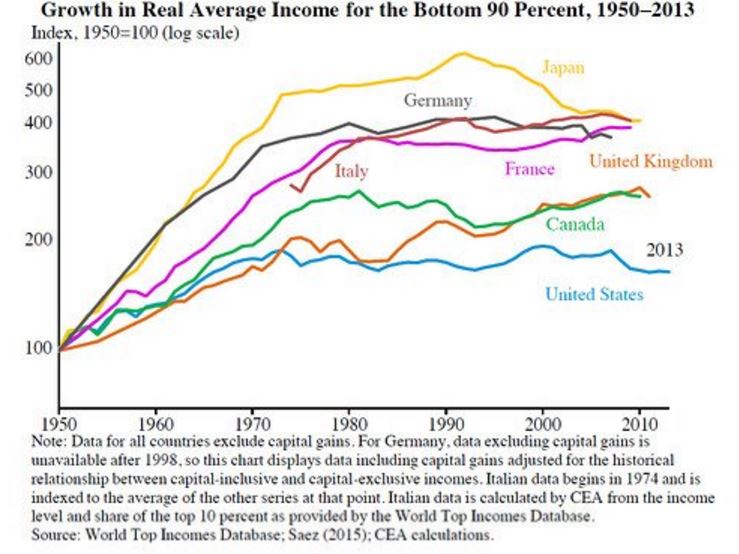
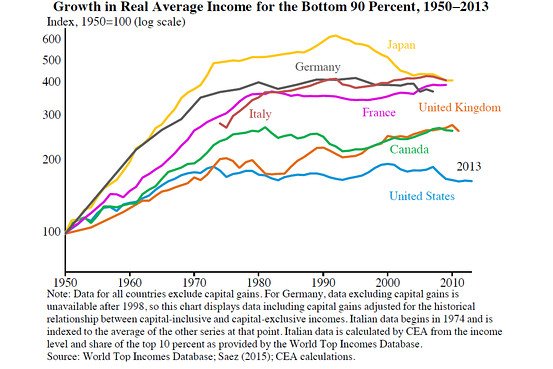
The second principle of justice enunciated by the late John Rawls involves the maximin rule (or difference principle). It states that social and economic inequalities should be arranged so that "they are to be of the greatest benefit to the least-advantaged members of society".

As an extrapolation, a maximin society would be one where the incomes of the least disadvantaged rises the most. So which are the maximin societies?
This gets amplified when we see the trends for income growth at the top of the income ladder, which is most likely to be a mirror image, but with the orders reversed and magnitudes scaled up significantly, especially in countries like the US. For another example see the trends with hourly minimum wage.
What is it about American capitalism that makes it so much inegalitarian, so much of a minimax society, than any other capitalist society? And given that the country has one of the lowest inter-generational mobility among developed economies, it is not even as though it is a meritocracy. 

But for all these flaws, it continues to remain the "land of opportunities", if only for those equipped with the skills to be able to compete and embrace them. In other words, it remains the go-to place for the elites. No wonder then that Andrew Sullivan calls the rise of Donald Trump as an "extinction-level" even for American democracy and liberal order. 
Add to Technorati Favorites
29 May 06:54

It is never easy

by Rohit Chauhan
The following note was sent out to our advisoryclients in February. This was in response to the jitters, some of them were experiencing after a 15% drop in the market. I think this is valid in all kinds of markets including the optimistic one we have now.


------------------------------------------


I am not feeling any better knowing that the model portfolio is down less than the overall indices. I increased the cash holding a bit in the last few months and avoided the momentum stocks in the later part of 2015. Inspite of these defensive measures, the portfolio is getting hit and it is not pleasant to see losses every day.


At the end of 2014, after a 100%+ rise, I had written the following


It is easy to feel smug and complacent after a 100%+ rise in the portfolio. However it is precisely at this stage that the risks are the highest. The various companies in our portfolio are performing quite well in terms of business performance (topline and profit growth). In addition, we exited a few companies where I felt that the performance depended more on the macro than the company specific condition such as the management or the target market


In effect my effort has been to reduce the business risk of our portfolio. This however does not mean we do not face a price or a quotation risk. If the stock market drops by 20% (just an example, I don’t know what will happen), then our portfolio will get impacted too.

If your time horizon is less than 3 years and you cannot bear a 15%+ drop in the portfolio, then you need to take action when the times are good (such as now) and not after the market drops due to some macro factor.

In my case, I consider my equity investments with 3-5 year perspective (or more) and will continue to hold the positions through any future volatility.


I did not know when a drop in the markets will happen, but was sure that it would occur as that is the nature of markets – greed and fear. We had a period of greed in 2014 and 2015, which has now turned to fear.


A repeat of history
The recent events and volatility we are seeing, is not new and has occurred from time to time. The reasons have been different, but the end result is the same – fear and rush to the exits.

At times like these, no one is looking at the company and its fundamentals. The selling is often driven by panic and a desire to reduce the pain.


My own portfolio is invested exactly the same as the model portfolio and hence it is not a theoretical loss for me. I have seen this happen several times, and still feel the same level of pain. Experience does not change the reaction to such losses.

The only difference is that I try to ignore the pain and focus on the individual companies, their business and the intrinsic value. That helps me in maintaining some level of rationality.


I have been asked by some on how bad this can get? I don’t know and anyone who claims otherwise is lying. It could get worse and it will not be easy to hold on to our positions when everyone around us is panicking and selling.

How to handle the volatility


Let me share how I am looking at the current situation (as I have done in the past)


Do not shorten your time horizon
Let’s say (and I hope that is the case), that you have invested your capital with a 2-3 year time horizon. As long as the market is rising, everyone is a long term investor. It is times like now that this belief is tested. There is no dial which increases or reduces the time horizon at an aggregate level. One needs to look at each holding and decide if you will be comfortable holding that position for the next couple of years.

I have been doing that for all the positions in the model portfolio and have exited some, where my level of confidence was not high . As the market crashes and causes some level of business risks, it is important to have a decent understanding of the companies in the portfolio.


We have held most of the companies in the model portfolio for atleast one or more years and have seen them go through their ups and down. I think most of these companies would be able to survive and manage the risks

Position size and diversification
I have often been asked about position size and the level of diversification one should have in the portfolio. I have a much simpler approach – size it to a point where you can sleep well. If the size of a position or the level of diversification causes you lose sleep, then it is too high.


The above is a very subjective point and varies from person to person. One way to think about it is to look at how much of your net worth is in equities and are you comfortable with it? Can you bear a 20%+ drop in your portfolio without losing your cool?

Look at the intrinsic value
I have always emphasized the important of intrinsic value and its growth for a company. One should always focus on that number. As a long as that number is stable or increasing, then one should stop worrying about the stock price.


Do not fixate on the turn
Another common feature at a time like this is the tendency of investors to call the bottom of the market. This is a toxic way of managing the portfolio. It leads to a focus on the short term and disappointment if the turn does not happen.

My approach during such times in the past has been to add to my positions slowly over time as they became cheaper (subject to size limits) and not expect to make a killing in the short term.


There is no pill for courage
The final point I have to make is that there is no magic pill for courage. There is a reason why equities have high returns – Volatility and risk.

My effort is to reduce the level of risk (of permanent loss of capital) in the portfolio. I have not tried to reduce volatility actively. Courage and ability to ignore the volatility comes down to temperament and that cannot be supplied by anyone.


To summarize
– Think long term and focus on the portfolio with a 2-3 year time horizon. This means you should not be investing any money which is needed in less than 3-5 years.
– Ensure that the position size for each stock and the overall diversification lets you sleep soundly at night
– Focus on intrinsic value and performance of each company
– Do not try to time the market (now or any other time)
– Avoid listening to forecaster, pundits and other doom and gloom guys. It will weaken your resolve
– If you manage to hold your nerves and plan to invest, stagger it over time. I am planning to do the same.

----------------
Stocks discussed in this post are for educational purpose only and not recommendations to buy or sell. Please contact a certified investment adviser for your investment decisions. Please read disclaimer towards the end of blog.
29 May 06:16

For the good of the investor

by subra
Once a bureaucrat, always a baboo(n). That does not change. Recently our MF regulator made a statement ‘the needs of the consumer are more important than that of the persons who are doing this as a business’. I wholly agree. “We should worry more about the investors than about those doing business of mutual fund […]
28 May 07:07

Modi’s report card of 2 years

by subra
Did Modi do well over the past 2 years? I am sure that the jury is still out on that and people are evaluating..and that will continue.. I was not happy at the pace at which Na Mo was moving, but having spoken to many bankers, I was convinced that he is a man in […]
28 May 07:07

Cornering the market for spelling bee championship

by atanu

Well, what do you know? Once again Indian American kids have won the spelling bee. We’ll come to that in a bit. But first, here’s Akash Vukoti of San Angelo TX, just six years old and was the youngest of 280 contestants of the 2016 Scripps National Spelling Bee finals. He’s been at it since he was 2 years old. He’s pretty amazing. Watch this short video of him on a sneak peak of the NBC primetime show, “Little Big Shots,” which premiered in March. The little guy is full of beans and is an absolute delight.

He can’t stay put for even a second. He’s a billboard for hyperactivity. “Stand up, like you do at the contest. Act like you have a number on,” Steve Harvey tells Akash.

Anyhow, Akash did not win the championship. (He’s got another 6 or 7 years to do that.) “The Scripps National Spelling Bee ended in a tie for the third consecutive year Thursday night, with Jairam Hathwar and Nihar Janga declared co-champions after a roller-coaster finish.” And for the third consecutive year, the winners were Indian Americans. They’ve been champions for nine straight years and 14 out of the past 19. In 2015, the champs were Gokul Venkatachalam and Vanya Shivashankar. Vanya’s sister was the 2009 champion! It apparently runs in the family.

Although Akash didn’t win the championship, he’s clearly a champ. The guy is a natural performer and a stand up comedian. Here, you can see for yourself. He’s hilarious. At the end he rattles out the spelling of the longest word in the dictionary.

Here’s another Indian American featured in the “Little Big Shot” program. Kedar is only 7 years old and is into coding.

All this is really heart warming. Although I am stressing the Indian-American bit in this post, I don’t really care about that aspect. What I am amazed at is the dedication, hard work and parental support these kids have. They are the lucky ones. I also note in passing that these successes point to some simple economics concepts such as learning by doing, the importance of role models, and the acquisition of comparative advantage leading to competitive advantage.