Shared posts

26 May 04:54

How to Retire and Not Outlive Your Money

by Dividend Mantra Team

It’s one of the biggest fears people have: outliving their money. An incredible 61% of baby boomers fear outliving their money more than they fear death! But so many are doing nothing about it or they’re simply not sure what to do.

Let’s first lay out the fundamental issue here. The problem is that most people will not have enough retirement income to cover their expenses.

It’s Not Easy to Generate Income in Retirement Today

Interest rates are historically low. That is probably the biggest problem when it comes to retirement income. With 30 year treasury yields barely beating inflation, how can anybody be expected to use bonds for retirement income?

And if you think that rates are going back up to the 5% level any time soon, take a look at Japan’s interest rate history.

JIR

It already almost seems like ancient history when most people could retire by age 65, move most of their money to treasury bonds, and sit back and enjoy the rest of their life without stressing out about their money. Simply stick to the budget that matches up expenses with interest income and all is well.

But that strategy is long gone now. It has become official policy of the Federal Reserve to keep interest rates low in order to push people into the stock market. Their thinking is that this will help prop up a fragile economy.

Bad theories aside, this is the world we live in now. Short of trying to get rid of the Federal Reserve, people need to take action.


Dividend-Growth Stocks for Retirement

Instead of low interest rate bonds or hidden-fee annuities, I recommend using dividend-growth stocks for generating enough income in retirement.

I have written before about how to retire early using dividend-growth stocks. They accomplish this by investing in great companies early on, and reinvesting the dividends.

The key is to find dividend payers who increase their dividends every year, even in recessions. At the very least, you don’t want companies that cut their dividend.

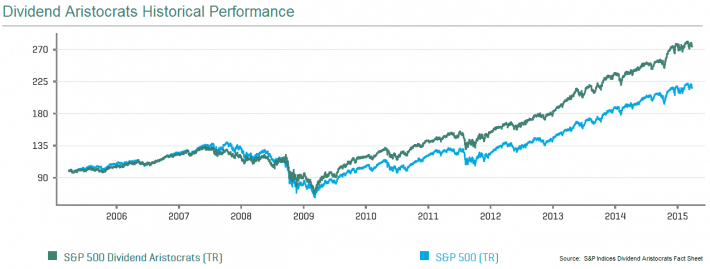
A good place to start your search for these companies is in the Dividend Aristocrats Index.

The companies in the Dividend Aristocrats Index are those which have increased their dividends by 25+ years in a row. These are seriously stable companies who have weathered many storms.

Dividend-Aristocrats-e1432730226193

Digging Into the Numbers

Let’s take a look at an actual case study. I ran a sample case in the WealthTrace Financial & Retirement Planner, which is available to the public as well.

I want to look at a married couple that is 52 years old today. Their goal is to live off of income in retirement. Initially they think they can use Treasuries for this. In this example they are switching all of their money to Treasuries when they retire. My assumptions are below:

Inflation (CPI) 2.5%
Current Age of Both People 52
Age Of Retirement 65
Life Expectancy 90
Social Security at age 67 (combined) $45,000 per year
Savings Rate 20% on Income of $200,000
Total Investment Balance Today $500,000
Recurring Annual Expenses in Retirement $57,000
Investment Mix 70% U.S. Value Stocks, 30% Treasuries. Switches to 100% Treasuries at Retirement
Investment Location 20% in taxable accounts, 80% in IRAs
Return Assumption Value Stocks 6% per year
Return Assumption Treasuries 2.6% per year


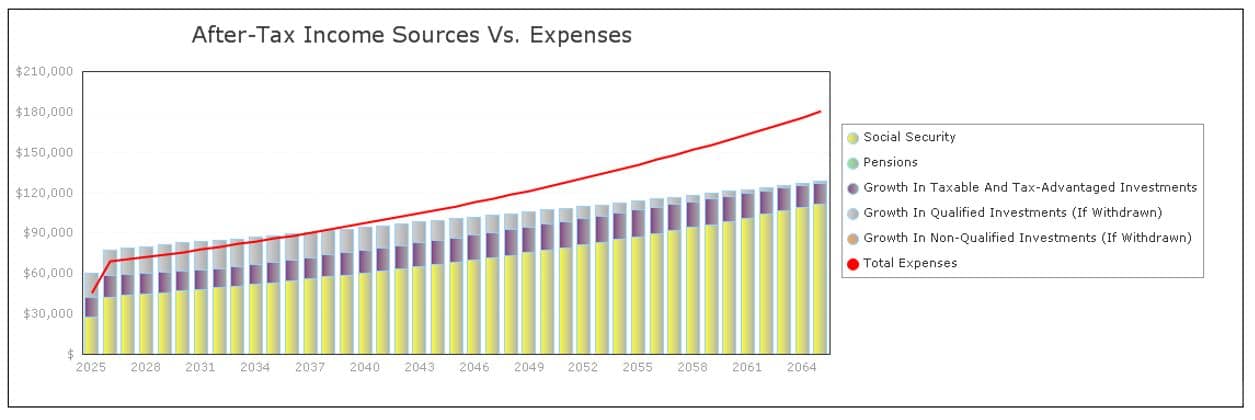
In the chart below you can see how their income in retirement is not keeping up with their expenses. This means they must be dipping into their investment principal.

ATISVE

Because they are dipping into their investment principal, they are projected to run out of money at age 86.

The Solution to This Problem

I propose moving half of their money to dividend-growth stocks. A few of my favorite dividend payers are Exxon (XOM), Altria (MO), Johnson & Johnson (JNJ), and Procter & Gamble (PG).

Company Div. Yield 5 Year Div. Growth

Rate (Annualized)

Exxon 3.4% 10.6%
Altria 3.6% 8.2%
Johnson & Johnson 2.8% 6.9%
Procter & Gamble 3.3% 7.5%


Keep in mind that I’m not saying investors should only be in four stocks. Everybody should diversify. You need to find several companies that have characteristics like the companies highlighted here.

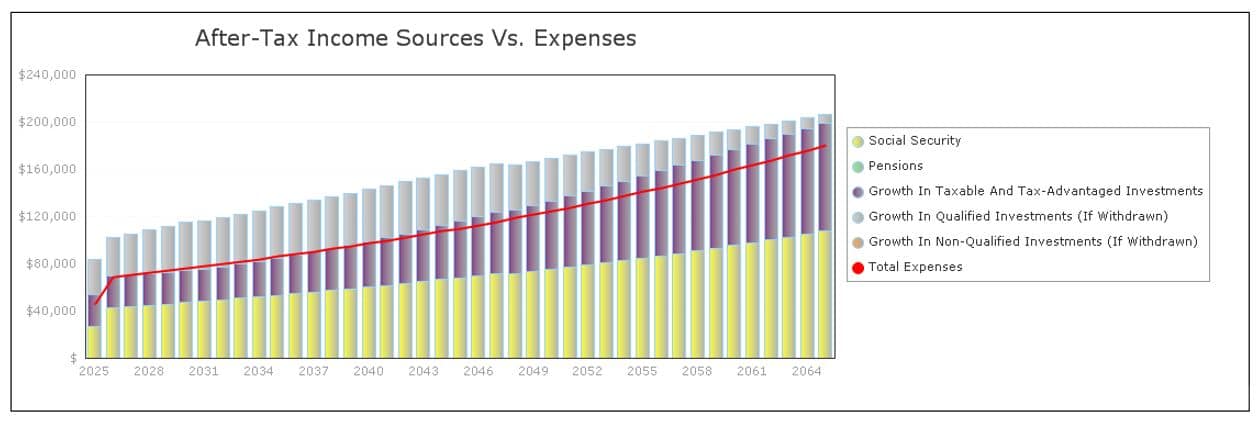
Let’s now take a look at their projections once we move half of their money out of Treasuries and into our dividend-growth stocks.

ATISVE2

This is looking better. Their income in retirement is now covering all of their expenses. This is where they want to be. If income can indeed cover their expenses, they are in no danger of outliving their money.

It takes some time and effort to find great dividend payers that can set you up for retirement. But it is well worth the effort. There are few places to return for relatively stable (and sizable) retirement income. Solid dividend-growth stocks are one of the last, best remaining choices.

Doug Carey is the owner and founder of WealthTrace, a financial planning and retirement planning software company. He has over 20 years of experience in the financial markets. He is a Chartered Financial Analyst with a Masters degree in Economics from Miami University in Oxford, Ohio.
http://www.mywealthtrace.com

The post How to Retire and Not Outlive Your Money appeared first on Dividend Mantra.

25 May 08:36

Encouraging bad behaviour

by SK

While flipping TV channels last evening (an activity I seldom undertake nowadays) I came across this new advertisement for Myntra.com:

I watched this advertisement 2-3 times, and to me the clincher seemed to be the fact that you can return goods to Myntra and get your cash back the same day.

The intention of the advertisement is clear – for someone who is uncomfortable with buying clothes online (like the woman in this advertisement), the fact that you can return the stuff and get your money back immediately can be a huge incentive to try.

The problem, however, is with the overall message it conveys. One of the biggest problems with online retail in India is the high rate of returns. Returns create friction in several ways – from the logistics cost to reversing payments to possible fraud to possible damage of goods. From this perspective, returns are undesirable behaviour as far as retailers are concerned.

In this context, it’s rather bizarre that Myntra is putting out an ad that promotes the use of returns. While it might be a decent incentive to attract new customers and expand the market, the problem is that it encourages your existing customers (who are likely to transact more than new customers) to misbehave!

In other words, Myntra’s latest ad actually encourages undesirable behaviour from customers! I find it quite puzzling.

PS: On the other hand, Myntra’s competitor Amazon is actually making returns less friendly. If you return an electronic product now, you can only get a replacement, and not your money back.

25 May 08:16

Civilization and its Fundamental Passions

by Farnam Street Team

“To describe a culture is to describe the structure of its institutions.”
— Joseph Tussman

***

In his book The Burden of Office, the educator and philosopher Joseph Tussman, who brought us profound wisdom, does a remarkable job, in just a few short pages, of describing one of the fundamental truths of human life: The same things we cherish are also the things that destroy us. It is exactly the qualities which give us vitality that create our problems. This is a fundamental truth. (Gary Taubes made a similar point recently, calling the thirst for knowledge a tightrope walk.)

Tussman breaks down the fundamental passions into five areas: Eros (Love), Indignation (Moral Righteousness), Curiosity, Acquisitiveness, and Pride. These are the things which bless and bedevil us, as Tussman puts it.

On Eros:

Powerful, necessary, the root of self-transcendence, of the varieties of love and all that we value flowing from that. And yet, a source of anguish, of misery, of torment, of unhappiness, of conflict, madness, murder, war. Half of wisdom is learning to tiptoe in the presence of eros.

On Moral Fervor:

A deeply instinctive reaction to something that threatens us, the social group, the basic human unit. Its absence–indifference, genuine carelessness–is a fatal disease. Its moderate presence supports the justice that makes trust and cooperation possible. Its raging presence brings fanatical or holy war, the horrors of unslaked vengeance, the interminable feud.

On Curiosity:

Without it, no knowledge, no science, no arts, no power. But feared today as the human passion that may bring us to the end of the world. In its grip we stop at nothing recognizing no forbidden fruit, undeterred by decency.

On Acquisitiveness:

If we do not leap to a pejorative sense, we see that it begins as a kind of prudent concern to get what we need to satisfy our wants, now and in the future, to provide for ourselves, our families, our friends, our fellows […] But carried away, we can become misers, acquire the Midas touch, turn ugly with greed, cupidity, avarice–transforming a virtue into a destructive vice.

On Pride:

At one end of the scale we find something desirable and necessary–proper pride, self-respect, a sense of dignity, the capacity to know shame, to feel disgrace. At the other end we encounter the thirst for fame, for status, for glory–the arrogance, the heedless autonomy, the pride that goes before a fall.

Civilizing Passion

In the face of these two-faced passions, the whole point of human civilization and culture is to harness them into being useful and safe. This reminds one of the English saying that Politics is the art of marshaling hatreds. In other words, we build our culture knowing full well what the passions are and what they’re capable of.

Some people, of course, hate the rule-making and the institutionalizing of passions. We all probably do, from time to time. Many political campaigns have been run on the idea that society is reigning in the glorious individual too much.

But rarely do we give society much credit for what it accomplishes by creating useful institutions to marshal our passions. Tussman points out a few that have been especially useful. The first one being the modern legal system, which provides a great example of how we tame the passion of moral fury for the sake of civilization.

Moral indignation gives way to legal argument; fury is tied in legal knots–trapped, confined, restrained, transformed, tamed. The passion finds itself institutionalized, learns to express itself in a set of appropriate habits. Impulse and intuition give way to bureaucracy. Morality bows to legality. War gives way to the rule of law. We become civilized.

The story of fury and its taming into law is the story of all the great passions. We develop the forms within which they are both recognized, acknowledged, satisfied, and nevertheless, banked, kept within limits, restrained.

We do this with Eros too — we find ways to tame and institutionalize love, one of the most fundamental biological passions of humanity:

In its most assertive mood, the institution of marriage aspires to a total monopoly of legitimate sexuality. A rather daring claim, not unlike the claim of the institutions of the sovereign to a monopoly of legitimate coercive power, honored only to a degree. But the point is that marriage and its ancillary institutions are cultural attempts to tame eros into a benign form The pattern may vary from culture to culture and time to time, but every human group will erect its temples to this deity.

It’s even true with the passion for knowledge — something we’d all consider a fundamental right and generally a positive passion for the world. It’s given us so much. But we rein it in all the same, recognizing its power to mislead.

The passion for knowledge might not seem to belong in this fevered company, and may not seem to need restraining. At least it may not seem so in the academic world where we commonly worry more about kindling the passion than dampening. But there is a long tradition of the fear of the mad scientist with his unquenchable thirst–Faust and all those restless probing minds uncovering the secrets of the atom, of the genetic code, of the mind, of the soul, of all that heady fruit the taste of which may threaten what remains of innocence. In spite of bold claims to freedom, however, even the pursuit of truth is subject to social and political constraint. Much of it could not even go on without governmental sanction and support.

Yuval Harari makes similar points in his awesome book Sapiens: There is a long marriage between governmental and capitalistic institutions and the pursuit of knowledge. These pursuits don’t exist independently of each other, but work as complements. Karl Popper also wrote deeply about the need for an Open Society–the need for proper institutions to support the growth of knowledge, which can be suppressed under the wrong conditions.

In the end, says Tussman, we are the sum of our passions and our institutions — every culture answers this problem in its own way.

Civilization requires the institutionalization of the necessary but dangerous passions. Any civilization is a particular way of doing so, achieving–growing into–its complex forms more or less by happy accident. To describe a culture is to map its institutions. To criticize or evaluate a culture is to judge the adequacy of its institutions in light of some conception of how the various passions can best be expressed or shaped or harnessed to serve a variety of human purposes.

***

Still Interested? Check out Tussman’s brilliant quote on understanding the world.

--
Sponsored by: Slack - Making teamwork simpler, more pleasant, and more productive.

25 May 08:13

On Slack: Japan’s Slow Economy, Oil for drugs deal, Confession of a Value Investor, Suzuki’s Indian White Knight and more…

by Suneel

On Slack header image

#macronomics: Socialism Lays Waste to Venezuela

Socialism is a gift that keeps on giving. The latest victim of this failed … (Read On...)

25 May 08:10

Payment Bank- Three down..

by Amol Agrawal
The eleven players that were licenced make a cricket team which was expected to do wonders playing the game of financial inclusion. But things are not going well at all and we. After the first wicket fell in March (Cholamandalam) and now very quickly two wickets have fallen. After Sanghvi/Telenor/IDFC became the second player, Tech Mahindra becomes the […]
23 May 17:00

Shaping expectations - taming inflation and corruption

by noreply@blogger.com (Gulzar Natarajan)
Both inflation and corruption are a function of expectations. Further, both have high levels of hysteresis and the resultant tendency to get entrenched. Once internalized, dismantling requires vigorous efforts to reshape expectations. In the process, collateral damage is inevitable.

In an environment where inflation expectations were unhinged, India's central bank Governor Raghuram Rajan has sought to cement low inflation expectations through an extended period of monetary tightening, even at the cost of economic growth. It has been acclaimed by experts, who have hailed him as India's Paul Volcker. 

On a similar vein, in an environment where corruption in senior level postings had become pervasive, the Government of India's Department of Personnel and Training has sought to reshape expectations by adopting an extremely rigorous process of screening. Unsurprisingly, the multiple levels of due-diligence for integrity and efficiency have come at the cost of causing delays and leaving many posts vacant/unfilled for long periods. Senior level positions in banks and public sector units have remained unfilled for long periods. The same experts complain that the delays in filling up posts have caused administrative paralysis.    

While the jury is still out on whether inflation has been slain or not, it can be fairly confidently asserted that the expectations on personnel deployments have been favorably reshaped. But not if you have been following the mainstream media. Clearly what is sauce for the goose is not sauce for the gander!
Add to Technorati Favorites
22 May 08:49

The Dead Model

by David Merkel
How Lucky Do You Feel?

How Lucky Do You Feel?

-=-=-=-=-=-=-

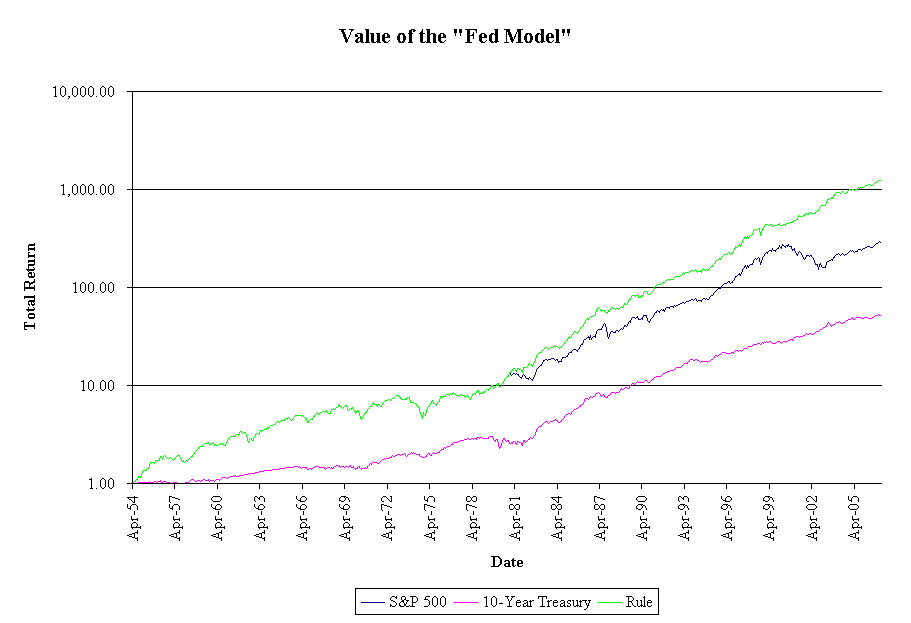
Nine years ago, I wrote about the so-called “Fed Model.” The insights there are still true, though the model has yielded no useful signals over that time. It would have told you to remain in stocks, which given the way many panic,, would not have been a bad decision.

I’m here to write about a related issue this evening.  To a first approximation, most investment judgments are a comparison between two figures, whether most people want to admit it or not.  Take the “Fed Model” as an example.  You decide to invest in stocks or not based on the difference between Treasury yields and the earnings yield of stocks as a whole.

Now with interest rates so low, belief in the Fed Model is tantamount to saying “there is no alternative to stocks.” [TINA]  That should make everyone take a step back and say, “Wait.  You mean that stocks can’t do badly when Treasury yields are low, even if it is due to deflationary conditions?”  Well, if there were only two assets to choose from, a S&P 500 index fund and 10-year Treasuries, and that might be the case, especially if the government were borrowing on behalf of the corporations.

Here’s why: in my prior piece on the Fed Model, I showed how the Fed Model was basically an implication of the Dividend Discount Model.  With a few simplifying assumptions, the model collapses to the differences between the earnings yield of the corporation/index and its cost of capital.

Now that’s a basic idea that makes sense, particularly when consider how corporations work.  If a corporation can issue cheap debt capital to retire stock with a higher yield on earnings, in the short-run it is a plus for the stock.  After all, if the markets have priced the debt so richly, the trade of expensive debt for cheap equity makes sense in foresight, even if a bad scenario comes along afterwards.  If true for corporations, it should be true for the market as a whole.

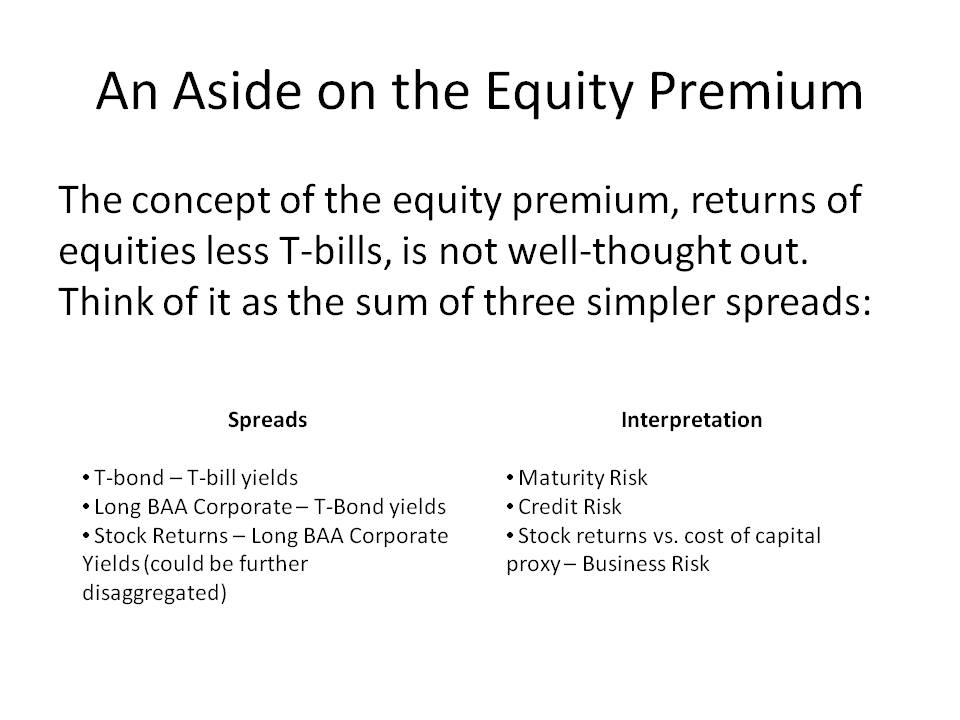
The means the “Fed Model” is a good concept, but not as commonly practiced, using Treasuries — rather, the firm’s cost of capital is the tradeoff.  My proxy for the cost of capital for the market as a whole is the long-term Moody’s Baa bond index, for which we have about 100 years of yield data.  It’s not perfect, but here are some reasons why it is a reasonable proxy:

  • Like equity, which is a long duration asset, these bonds in the index are noncallable with 25-30 years of maturity.
  • The Baa bonds are on the cusp of investment grade.  The equity of the S&P 500 is not investment grade in the same sense as a bond, but its cash flows are very reliable on average.  You could tranche off a pseudo-debt interest in a way akin to the old Americus Trusts, and the cash flows would price out much like corporate debt or a preferred stock interest.
  • The debt ratings of most of the S&P 500 would be strong investment grade.  Mixing in equity and extending to a bond of 25-30 years throws on enough yield that it is going to be comparable to the cost of capital, with perhaps a spread to compensate for the difference.

As such, I think a better comparison is the earnings yield on the S&P 500 vs the yield on the Moody’s BAA index if you’re going to do something like the Fed Model.  That’s a better pair to compare against one another.

A new take on the Equity Premium

A new take on the Equity Premium!

=-=-=-=-=-=-

That brings up another bad binary comparison that is common — the equity premium.  What do stock returns have to with the returns on T-bills?  Directly, they have nothing to do with one another.  Indirectly, as in the above slide from a recent presentation that I gave, the spread between the two of them can be broken into the sum of three spreads that are more commonly analyzed — those of maturity risk, credit risk and business risk.  (And the last of those should be split into a economic earnings  factor and a valuation change factor.)

This is why I’m not a fan of the concept of the equity premium.  The concept relies on the idea that equities and T-bills are a binary choice within the beta calculation, as if only the risky returns trade against one another.  The returns of equities can be explained in a simpler non-binary way, one that a businessman or bond manager could appreciate.  At certain points lending long is attractive, or taking credit risk, or raising capital to start a business.  Together these form an explanation for equity returns more robust than the non-informative academic view of the equity premium, which mysteriously appears out of nowhere.

Summary

When looking at investment analyses, ask “What’s the comparison here?”  By doing that, you will make more intelligent investment decisions.  Even a simple purchase or sale of stock makes a statement about the relative desirability of cash versus the stock.  (That’s why I prefer swap transactions.)  People aren’t always good at knowing what they are comparing, so pay attention, and you may find that the comparison doesn’t make much sense, leading you to ask different questions as a result.


22 May 08:46

Weekend reading links

by noreply@blogger.com (Gulzar Natarajan)
1. Excellent interactive in the Economist on incomes, annual economic growth, and inequality across several countries during the 1980-2015 period. China is already the second most unequal society in the world, after South Africa, even as its middle class has grown richer than Brazil's. In the 35 years, median income has growth at an annual average pace of nearly 12%, to just 3.5% in India. Assuming past growth rates, median incomes will catch up with the US in 10 years for South Korea, 25 years for China, 60 for Brazil, and 100 for India. 

2. Nice article on Venezuela. The decline has been stunning,
the government led first by Chavez and, since 2013, by Maduro, received over a trillion dollars in oil revenues over the last 17 years. It faced virtually no institutional constraints on how to spend that unprecedented bonanza... In the last two years Venezuela has experienced the kind of implosion that hardly ever occurs in a middle-income country like it outside of war.
3. Are debt-financed dividend payouts and share buybacks that boost stock prices a massive Ponzi scheme? Yes, says Rana Faroohar in her new book. ExxonMobil's ratings downgrade, first time since 1949 it is not AAA, has a lot to do with its stockpile of debt accumulated to finance share buybacks

4. More news of the damage from weak global economic prospects comes from the woes of container shipping liners,
The industry... is suffering what could well turn out to be the deepest and longest downturn in its 60-year history. Container shipping lines have made a series of investments in new, giant vessels, and this glut of capacity has sent freight rates tumbling. The Shanghai Containerised Freight Index — one of the few public sources of information on what lines are charging to ship a container — last month reached the lowest level since its inception in 1998... Amid a slowing world economy, 2016 could be the fifth straight year of subpar expansion in trade.
The industry which has expanded aggressively into larger sized ships is now undergoing a phase of consolidation,
In the first quarter of 2016, Maersk generated $1,857 of revenue for each 40ft container it carried on its ships, 25 per cent less than one year earlier, and $203 below the average cost of moving each box.
5. Fascinating pictorial essay chronicles life in the United States since 1870 as told in Robert Gordon's excellent new book. Here's a description of 1870s life,
They ate pork. Lots and lots of pork — 131 pounds of it per person per year in 1870 (that number was half as much by 1929 and is around 55 pounds today). Unlike other meat-producing animals, pigs could live almost anywhere and could survive largely on food scraps. Their meat, easily salted or smoked, could be preserved in an era without refrigeration. Fresh vegetables were scarce; farmers emphasized crops that could be stored or preserved, like turnips, pumpkins, beans and potatoes, instead of leafy greens that would deteriorate quickly... Instead of a toilet, you used a chamber pot or an open window in the city, an outhouse with an open pit underneath in the country... Boston had 700 horses per square mile. The average horse produced 40 to 50 pounds of manure and a gallon of urine daily, which made the streets of major cities no pleasant place to be.
By today’s standards, entertainment options were limited. Total circulation of newspapers was 2.6 million in a country of 40 million people. There was no telephone, record player, movie or radio. Men could go to the local saloon to drink; women generally couldn’t. Vacations and weekends were not really a thing.  
Childbirth usually took place at home, and deaths were common both at birth and during early years from diseases like yellow fever, cholera and many others. There was no licensing of doctors, so quacks were common.
And what changed in the 1870-1920 period,
The most fundamental shift over those decades was that the American home became, in Mr. Gordon’s word, “networked.” Houses that were once dark and isolated were becoming intertwined. They were starting to be connected to electric grids, providing clean, bright light without emitting smoke. Urban water networks supplied clean water, and sewer systems removed waste without the pungent odors of chamber pots and outhouses. Telephones allowed people to converse with distant friends. These advances were enabled not just by technological innovation in plumbing and electricity, but also by urbanization. In 1870, 23 percent of the United States population lived in cities, which rose to 51 percent by 1920.
6. The consortium hired to reconstruct and operate a new terminal at LaGuardia for 35 years secured $2.5 bn of financing through a municipal bond offering which attracted considerable interest. The Baa3 rated (one notch above junk) 30-year 2046 bond was priced with a yield of 3.27% and a 5% coupon. A Bank of America Merrill Lynch index of triple-B-rated munis across multiple maturity dates yielded 2.88%. This is against 2.6% yield for 30 year US Treasuries. The consortium, LaGuardia Gateway Partners, includes airport operator Vantage Airport Group, construction company Skanska, and Meridiam Infrastructure, an investor and asset manager of infrastructure projects.  

Two observations. One, the very low rates and spread between the Treasuries and risky bonds, despite the near-junk nature of the muni, underscores the point that this is a truly unprecedented opportunity for governments to borrow and invest in improving infrastructure. Two, the consortium presents the ideal mixture of contractor, operator, and financier, a partnership with clearly defined roles and risk allocation which allows for seamless changes in shareholding patterns. In contrast, in countries like India, the concessionaires are invariably construction contractors who develop and then try to either sub-contract maintenance or exit by selling stakes. Apart from creating perverse incentives, such arrangements may, ironically enough, end up increasing life-cycle costs.  

7. How can rising cash reserves and debt burden subsist together? A new Moody's report shows that the US corporate cash reserves rose to $.17 trillion by end-2015, with $1.2 trillion held overseas. For the first time ever, the top five cash hoarders with $504 bn were tech companies - Apple ($216 bn, 93% held overseas), Microsoft, Alphabet, Cisco, and Oracle. 
The rising hoard is a reflection of two trends - tax arbitrage and avoidance, and weak economic expectations and the consequent reluctance to invest. In fact, the report points out that expenditures on things like new equipment declined 3% to $885 bn on the face of lower commodity prices.  

Interestingly, the rising cash reserves have accompanied rising debt. Overall debt rose nearly $850 bn to $6.6 trillion by end-2015. In fact, over the past five years, while cash reserves increased by about $600 bn, debt obligations surged by $2.8 trillion. While the top tier firms too leveraged up, the increased indebtedness was concentrated in smaller and lower quality groups who took advantage of the record low borrowing costs.

8. Citylab points to stunning visualization of property price trends developed by Trulia of 100 largest US metros. The biggest increase was in San Francisco, where the percentage of million dollar homes rose by a staggering 37.8 percentage points from 19.6% to 57.4% of all houses in the 2012-16 period.
Some of the increases in the city neighborhoods have been jaw-dropping - in Westwood Park the percentage rose from 2.9% of homes to 96%!

9. Upshot puts New York's restrictive nature of zoning regulations in perspective by pointing to a study of 43000 buildings which found that 40% of buildings in Manhattan could not be built today. These restrictions include height, limits on residential and commercial space, limits on the number of dwelling units and parking lots, setback rule that mandates buildings to step back in order to rise (saw-tooth structure) etc.
Relaxation of zoning regulations is arguably one of the very few low hanging fruits in public policy space. It is also possibly the only way in which cities, especially in developing countries can avoid extreme gentrification and accommodate the millions of urban migrants.

10. Upshot reminds us about the critical role of luck in determining life outcomes,
According to a 2008 study, most children born in the summer tend to be among the youngest members of their class at school, which appears to explain why they are significantly less likely to hold leadership positions during high school and thus, another study indicates, less likely to land premium jobs later in life. Similarly, according to research published in the journal Economics Letters in 2012, the number of American chief executives who were born in June and July is almost one-third lower than would be expected on the basis of chance alone. Even the first letter of a person’s last name can explain significant achievement gaps. Assistant professors in the 10 top-ranked American economics departments, for instance, were more likely to be promoted to tenure the earlier the first letter of their last names fell in the alphabet, a 2006 study found. Researchers attributed this to the custom in economics of listing co-authors’ names alphabetically on papers, noting that no similar effect existed for professors in psychology, whose names are not listed alphabetically.
11. The growth dynamics of the newly constituted Bank Board Bureau (BBB) in India may be a teachable example of how institutions can go astray. The BBB was notified in February 2016 primarily to "recommend for selection of heads of financial institutions". The popular former Comptroller and Auditor General of India, Mr. Vinod Rai, was appointed its chairman.

After assuming charge, Mr. Rai has waxed on the bank bad assets resolution process, reassured that bank chiefs will not be questioned over the bad asset resolution decisions, and discussed consolidation of PSBs. I am confused. Is the BBB's mandate so wide enough to cover all these complex regulatory issues? If BBB, which advises on appointments, assumes a role in operational management, then isn't there a serious conflict of interest? If so, where do the BBB's role end and the banking regulator's begin?

Or is it a case of "Mission Creep" by BBB, a feature that, once the judiciary showed the way with its liberal interpretation of Public Interest Litigations (PILs), has come to characterize institutional development in India? The hyper-active media have obviously only been too eager to nudge a willing Mr. Rai into these transgressions.

12. Finally, Ananth links to Michael Lewis's review of Mervyn King's new book. Lewis describes the central idea of the book on regulation of banks, the King Rule,
Deposits and short-term loans to banks simply need to be separated from other bank assets. Against all of these boring assets, banks would be required to hold government bonds or reserves at the central bank in cash... The riskier assets from which banks stand most to gain (and lose) would then be vetted by the central bank, in advance of any crisis, to determine what it would be willing to lend against them in a pinch if posted as collateral... The banks would decide, before any crisis, which of their risky assets they would be willing to pledge to -- basically, pawn with -- the central bank. The riskier the asset, the less the central bank would be willing to lend against it. Any asset so complicated that it couldn’t be explained satisfactorily to the central bank in three 15-minute presentations wouldn’t be eligible as collateral. Everyone would know, if any given bank ever required a loan from the central bank, the size of the loan the central bank would be willing to extend. The central bank would go from being the lender of last resort to what King calls the pawnbroker for all seasons.
It would also have a handy, simple rule to determine if any given bank is solvent: the difference between its “effective liquid assets” and its “effective liquid liabilities.” The effective liquid assets would consist of the securities the bank held against its deposits (government bonds, cash), plus the collateral value of its riskier bets as judged by the central bank. The effective liquid liabilities would be the money that could run from the bank at short notice -- deposits and loans of less than one year made to the bank. The rule -- call it the King Rule -- would be that a bank’s effective liquid assets must exceed its effective liquid liabilities. If they don’t, the bank is insolvent, and its deposits would be moved without any panic or trouble to a bank that isn’t.
This is certainly going to generate much discussion in the days ahead. A few quick observations. Clearly, depositors are ring-fenced off and that takes bank runs off the table. Fundamentally, this is substantively the same as directly mandating higher capital reserves, though framed very differently. Is the framing, in terms of informing the creditors and shareholders their 'haircuts' upfront, likely to be more acceptable? Most importantly, the critical issue here would be the normal time price-discovery with riskier assets. It assumes that central banks can more accurately assess the real value, especially when they become stressed, of these assets than the financial institutions themselves. Further, it also assumes that the central banks can avoid the cognitive bias and environmental pressures that force banks to systematically under-estimate and underprice risks during good times. In fact, it assumes that the 'pawnbroking price' would be a more accurate signal than even those of rating agencies. 
Add to Technorati Favorites
22 May 08:40

Another day another taxi experience….

by subra
At the Mumbai Airport you have a choice of taking a black and yellow cab, a blue cab, a Meru or a Tab, or of course an Ola or Uber. At the location that I stay I do not have the choice of taking an auto, for Mumbaikars that is also a choice. All are […]
22 May 08:36

Mr Katju, here be dragons

by atanu

CfsW-fCUUAAkPmcMr Katju, who is a retired supreme court judge, provided his insights into “abolishing unemployment in India” on social media yesterday. According to him, Soviet Russia solved that problem by “raising the purchasing power of the masses, and thereby rapidly expanding the economy and consequently abolishing unemployment.”

Mr Katju explains in subsequent comments how the scheme is supposed to work. It’s about reducing prices to increase “purchasing power”, he says. I don’t think he understands what prices or purchasing power means.

MK1

I have appended at the end of the post a few screen captures of Mr Katju’s submission to facebook and a couple of comments from his readers.

Mr Katju notes the steps the Soviet government took included the steady lowering of commodity prices, stepping up production, and the creation of jobs that abolished unemployment. He further notes that while the US was suffering the Great Depression of 1929, the Soviet economy was “rapidly expanding.” While not endorsing the Soviet method for India, he says that India should do something so “we can raise the purchasing power of the Indian masses and thereby rapidly expand the Indian economy, which is the only way of abolishing unemployment in India.”

He ends by writing, “The central point, and therefore the main problem before India, is how to raise the purchasing power of the masses? Do we follow the method of socialist countries, or some other method?”

Soviet ex-Economy

All statements to the effect that the socialist economy is still a going concern, are inoperative. It’s an ex-economy

That Mr Katju speaks approvingly of Soviet socialistic methods is rolling on the floor funny for a start. Why? Last time I checked (and that was over 25 years ago), the Soviet Union, like the Monty Python parrot, was no more.

“The Soviet Union has passed on. It has ceased to be. It’s expired and gone to meet its maker. It’s shuffled off this mortal coil. It’s run down the curtain and joined the bleedin’ choir invisible. Vis-a-vis the metabolic processes, it’s had its lot. All statements to the effect that the socialist economy is still a going concern, are inoperative. It’s an ex-economy.”

But seriously, the Soviet Union collapsed not because the people were stupid or that the huge empire did not have natural resources (it was immensely rich.) Its economic collapse was the result of idiotic policies made by people who had no understanding of reality.

Water flows downhill. Legislation cannot make it flow uphill.

Reality is unforgiving. Go against nature and prepare to be obliterated.

Water flows downhill. No amount of government-made legislation can make it flow uphill — not even some legislation that says we will gradually slow the downhill flow by 5-10% every 2 years or so, until over time water starts flowing uphill. Reducing prices 5-10% every 2 years or so, as Katju appears to approve of, leads to only one thing: shortages.

Here’s a quick reminder. At any specific price, there is a quantity that gets produced, and therefore is available for sale. The quantity produced goes up with higher prices; and the quantity goes down when the price goes down. That’s the supply side. On the demand side, the opposite happens: when the price goes down, the quantity demanded goes up; and when the price goes up, the quantity demanded goes down.

In undistorted markets, the price of a commodity is the price at which the quantity demanded is roughly equal to the quantity supplied. Let’s call it the equilibrium price.

Economists know that reducing prices by government edict is the quickest and surest way to destroy productive capacity.

If the government mandates a price lower than that equilibrium price, the quantity supplied goes down, and simultaneously, the quantity demanded goes up. Result: shortages. Prices higher than the equilibrium price, conversely, produce excess supply.

Economists may or may not know much about the economy. But there is one thing they absolutely know: that reducing prices by government edict is the quickest and surest way to destroy productive capacity. It is as close to a “law of nature” as you can get in the social sciences.

In any well-functioning economy — the kind that we presumably wish to have, one in which people produce stuff in adequate quantities, in which there are no shortages, in which people are employed in creating wealth that they consume and save — prices are not arbitrarily determined by the whim of some all-controlling authority. Prices are critically important and cannot be tampered with without dire consequences.

Prices emerge from the decentralized activities of all economic agents (the producers and consumers), and it helps coordinate their activities. Those prices are the only reliable signals that economic agents use to decide what they have to do next. Without the accurate signals, the economy stumbles along like a blindfolded person who has no idea of which way to proceed.

Employment is a means, not an end.

If there is any, the basic function of an economy is production of stuff that people value — the production of wealth. The basic function of an economy is not employment. Employment is merely the means for a person to earn an income so that it enables him to buy stuff to consume. Production matters because we want to consume. And employment is merely a means to consumption (via production.)

The confusion of means and ends is rampant — as is evident with the idiotic obsession with employment. We don’t need employment. We need production.

Uncle Milt had some advice

In the 1960s, Milton Friedman on a visit to India, was taken to some public works site. An exchange went something like this. “Why were the workers using hand-held shovels to move earth instead of using mechanical shovels?” he asked. He was told that mechanical shovels would not employ as many people. He replied, “Then why don’t they use spoons instead of shovels? A lot more people would get employed.”

Because production matters, productivity matters. If 10 people can produce 100 units of stuff, each person “earns” 10 units of stuff. That’s their productivity (10 units per person) and that is also their income. If you want the income to rise, you have to increase their productivity. If they can produce 200 units, each worker’s income is 20 units. That’s what “purchasing power” means.

Futzing around with prices does not help

Purchasing power depends on the amount produced, and has nothing to do with futzing around with prices. The only way to increase the purchasing power is to increase production. That’s not quantum mechanics. If by changing prices one could increase the purchasing power of people, it would be a wonderful thing. There would be no poverty in any country which had a government that had the power to change prices.

All dictatorial regimes have the power to dictate prices. And they too frequently do. They futz around with prices and wages. The predictable result is always and inevitably increased poverty. Why? Because when you fix prices, you essentially blindfold the producers, and that leads to lower production, not higher.

The sun also rises

Even the mere suggestion that perhaps if the prices were reduced in minor steps that it would lead to some better outcome is insane. It’s as insane as thinking that by changing the compass directions, the sun would start rising from a different point on the horizon. The sun rises where it does and based on where the sun rises, we get our compass directions, not the other way around. Only an idiot would think otherwise.

Some idiots think that fixing prices will bring down poverty, or unemployment, or some such idiocy.

It’s my misfortune that I saw the tweet pointing to Mr Katju’s musings. I wrote a tweet expressing the hope that Mr Katju’s grasp of matters legal was better than his grasp of basic economics.

Someone, who clearly disagreed with my tweet, pointed out, “Katju was a supreme court judge. Seriously, let that sink in.”
sy488

That’s an example of an appeal to authority logical fallacy: an authority thinks something, it must therefore be true. What’s worse is that the authority being claimed is not even in the same domain. One can have justified confidence in the authority of a neurosurgeon’s opinion on brain surgery but not on his opinion on how to run an auto company. This is worse than appeal to authority; it’s an appeal to the wrong authority.

[The strike-through text above is a correction because Mr Krishna Reddy G subsequently told me that he was being sarcastic.]

I did appreciate the fact that Mr Katju was a supreme court judge. And that frightened me. It is shocking that a supreme court judge has so little grasp of what is essentially basic common sense — or at least it should be common sense.

The basic ideas of economics should form a part of everybody’s cognitive toolkit — including that of supreme court judges. Because not having them causes immense avoidable harm to society, as we can easily ascertain when we look at what happened to the Soviet Union, and what’s happening to Venezuela.

Among those basic economic ideas are those of division of labor and specialization. By dividing tasks, we become more productive, individually and collectively. That means a farmer can focus on growing corn, and trade his corn for all the various other bits he needs from others who themselves focus on their own various specializations.

Specifically, I can spend my energies mainly understanding economics by reading dozens of great thinkers who have spent their entire lives specializing in economics. I have to read the ideas of Smith, Ricardo, Mills, Bastiat, Menger, Mises, Schumpeter, Kizner, Knight, Hayek, Buchanan, Simon, Friedman, Coase, . . . (and others that non-economists have probably never heard of) in dozens of books and ponder their insights so that I can understand a little better what the nature of the beast is. It takes all my time, leaving me to rely on others for the fruits of their labor for my survival.

And if I need legal opinions, I would go check with some learned judge or lawyer about that because I don’t know that stuff, and what’s more, I know that I don’t know.

But if I get into the business of dishing out uninformed legal opinions, it would not be pretty — it would be as disastrous as when a learned judge starts pontificating on how to cure the various economic ills of a large economy.

My main point is that one should know the limits of one’s understanding and never stray out of it, for there be dragons.

OK, here’s a screen shot of the original submission.

MK4

One commenter brings in some economic sense.

MK2

But you can see that there are lots of others who really don’t know what they are talking about and what’s worse, they don’t know that they don’t know — somewhat like Mr Katju.

MK3

The moral of the story: get some basic economics literacy before offering solutions to nearly intractable macroeconomic problems.


21 May 07:41

Latticework of Mental Models: Winner’s Curse

by Anshul Khare

Consider this thought experiment –

A friend of yours is the Chairman of the Acme Oil Company. He occasionally calls with a problem and asks your advice. This time the problem is about bidding in an auction. It seems another oil company has gone into bankruptcy and is forced to sell off some of the land it has acquired for future oil exploration. There is one plot Acme is interested. Until recently, it was expected that only three firms would bid for the plot, and Acme intended to bid $10 million. Now they have learned that seven more firms are bidding, bringing the total to ten. The question is, should Acme increase or decrease its bid? What advice would you give?

Do you advise bidding more or less?

If you’re like me and seeing this case study for the first time you’d probably go with a higher bid. After all, there are additional bidders, and if you don’t bid more you won’t get this land. Isn’t it?

Unfortunately, if you decide to increase the bid, you’d be falling in a trap called Winner’s Curse. The above example of oil auction comes from Richard Thaler’s book The Winner’s Curse. Thaler writes –

Most people’s intuition in this problem is to bid more…However, there is another important consideration that is often ignored. Suppose that each participant in the auction is willing to bid just a little bit less than the amount he or she thinks the land is worth (leaving some room for the profits). Of course, no one knows exactly how much oil is in the ground: some bidders will guess too high, other too low. Suppose, for the sake of argument, that the bidders have accurate estimate on average. Then, who will be the person who wins the auction? The winner will be the person who was the most optimistic about the amount of oil in the ground, and the person may well have bid more than the land is worth. This is the dreaded winner’s curse.

In other words, the winner’s curse says that in a competitive auction, the highest bidder will typically overpay for the asset. Hence the bidder “wins” the auction but is “cursed” by the overpayment.

“Winning is an informative event, telling us whose estimate was most optimistic,” writes Peter Bevelin, in his book Seeking Wisdom “When we place a bid on a house, company, project, or negotiate to buy something, we don’t realize what is implied by an acceptance of our offer. That we may have overestimated its value and therefore paid too much.”

Following are the key characteristics of a winner’s curse situation –

  1. There are many bidders. That’s because auctions, by definition, are competitive. If there is only one bidder it is not an auction, it is a sale.
  2. No one is certain about the true value of the asset being auctioned.
  3. The winner is typically the one who is most optimistic about the value of the asset.

Winner’s curse becomes very important mental model in corporate mergers and acquisitions, because when companies bid against one another to buy a target corporation, the highest bidder frequently pays too much.

In his book, The Art of Thinking Clearly, Rolf Dobelli writes –

The Winner’s curse suggests that the winner of an auction often turns out to be the loser. Industry analysts have noted that companies that regularly emerged as winning bidders from these oilfields auctions systematically paid too much, and years later went under. This is understandable…The highest bid at an auction is often much too high – unless these bidders have critical information other aren’t privy to.

Today this phenomenon affects us all. From eBay to Groupon to Google AdWords, prices are consistently set by auction. Bidding wars for cell phone frequencies drive telecom companies to the brink of bankruptcy.

Initial public offerings (IPO) are also examples of auctions. And, when companies buy other companies – the infamous mergers and acquisitions – the winner’s curse is present more often than not. Astoundingly, more than half of all acquisitions destroy value, according to a McKinsey study.

So why do we fall victim to the winner’s curse?

First, the real value of many things is uncertain. Additionally, the more interested parties, the greater the likelihood of an overly enthusiastic bid.

Second, we want to outdo competitors. The buyer in an auction is no longer just purchasing a product, he or she is engaged in a test of will, trying to outdo other participants. Remember Warren Buffett’s words – It’s not greed that drives the world, but envy.

According to Charlie Munger, open-outcry auctions are a perfect setup for driving people to highly irrational behaviour.  Auction is a place where multiple psychological biases act together, creating a lollapalooza effect, and results in a series of bad decisions.

The list of cognitive biases that are at play in an auction is just mind boggling. Here’s a sample that I pulled out from Prof. Bakshi’s recent blog post

… an open-outcry auction situation is a very interesting social setting where multiple models from psychology like authority (where the auctioneer is a symbol of authority who not only certifies the authenticity of the object being auctioned, he also announces an initial big price which serves as an “anchor”, social proof (caused by observing other bidders bid up the price), the incentives of the auctioneer (the higher the price at which the object sold, the more the money made by the auctioneer), reciprocation/retaliation (resulting in competitive bidding), envy , low contrast effect (every new bid is a small increment over a previous bid), commitment bias (every bid and escalation of the bid is a public commitment), overconfidence, and deprival super reaction (caused by the countdown to end of auction) combine to turn this social setting into something like a death trap.

In Business

Many business acquisitions are justified using fancy jargons such as ‘synergistic benefits’ and ‘strategic advantage’. But what really happens in most acquisitions? The winning bid is largely a result of overestimation of future benefits and succumbing to the competitive pressures (with investment bankers adding fuel to the fire). One just has to look at the projected ‘synergistic benefits’ at the time of benefits and the actual results a couple of years down the line.

If you want see the proof, you don’t need to go very far. In his post, Prof. Bakshi quotes the example of Tata Steel’s disastrous acquisition of Corus in 2006 in a competitive open-outcry auction.

Just before Tata Steel’s first bid on 20 October, 2006, the market cap of the company was about Rs 26,000 cr. On 31 January, 2007 Tata Steel won its bid for Corus after offering 608 pence per share for the target company, valuing it for about $11 billion. Eight years later, Tata Steel’s market cap stands at Rs 23,000 cr. What an amazing case of value destruction! And Hindalco’s acquisition of Novelis was not different.

Knowing what happens to people who get into open-outcry, auction-like situations, psychologically astute people like Buffett and Munger have a no-fault rule when they get invited to auction situations.

The rule is: Don’t Go.

When you win an auction, what you win is the right to pay more (for the asset being auctioned) than everyone else thought it was worth. Explained in this way, it’s quite easy to see why Warren Buffett had this simple “Don’t Go!” advice for auctions.

Winner’s curse presents itself not just in auctions and large M&A activities but even in smaller business decisions.

Let’s say you are the business head who has limited resources to execute only one project among many. All your 10 reporting managers have presented their plans to you. Which one would you pick? Of course, the one that looks most attractive. Isn’t it? But all managers have an incentive to make their own project the most attractive one. The risk is therefore that you end up choosing the project with the most optimistic forecast. Which means you selected the one which has higher chances of turning out to be more expensive and time consuming than it was initially projected to be.

In Investing

The winner’s curse does not need a fancy auction. The same curse may be visited on an investor in a hurry to buy a stock on which someone has provided a hot tip. During bull markets, the rising prices and increasing demand for the stocks creates an auction like environment. As the price of equities climb, more and more people get enticed into making higher bids and driving the prices even higher.

In effect, people who agree to buy stocks at inflated prices are being overly optimistic, just like an auction winner, about the future prospects of the businesses which those stocks represent.

If you want to participate in the stock market auctions, you must ascertain the true value of what’s being offered. Peter Bevelin, in his book Seeking Wisdom, writes (emphasis mine)-

Research shows that the more bidders there are competing for a limited object, each having the same information, and the more uncertain its value is, the more likely we are to overpay. Instead, if our objective is to create value, the more bidders there are, the more conservative our bidding should be. This also implies that the less information we have compared to other bidders or the more uncertain we are about the underlying value, the lower we should bid. 

It’s the winner’s curse that Warren Buffett warns us against when he says, “Be fearful when others are greedy.”

So how do you save yourself from Winner’s curse?

First, acquire as much information as you can. If you can determine what an item (or a stock) is worth, you will avoid overspending. And second, know your limits. If you do not have enough information, wait and get some more, and if you think long and hard to establish a top price, stick to it.

Additionally, thinking about following questions can help you in making a rational decision.

  1. How would I reason if I think it through from the viewpoint of the other person?
  2. Why are they selling? Don’t forget that the seller might have an informational advantage. So why would I make a better decision than someone who has all the information?
  3. The other person is most likely to accept our offer when it’s least favourable to us, especially when he or she is anonymous (typical in stock market transactions). What are the chances that the other person’s decision is being made under pressure and is irrational?

In fact, a practitioner of value investing tries to find a situation which is reverse of an auction.

“In value investing,” writes Chetan Parikh in his blog, “you are buying a stock where in many cases sellers are bidding to sell you a company at lower levels (how else do you explain the fact that even 70 years after Benjamin Graham’s Security Analysis, one gets to buy companies at less than cash on the balance sheet). Also most of the estimates are working in your favour if like all good value investors, you insist on a good margin of safety.”

Conclusion

To summarize, in an auction with many bidders, the winning bidder is often a loser. A key factor in avoiding the winner’s curse is bidding more conservatively when there are more bidders. While this may seem counterintuitive, it is the rational thing to do.

Remember, when the applause of the auction is over, you want to make sure you are still happy with the deal.

When we come out, after spending 15-20 years, from our traditional education systems we have pretty narrow slices of knowledge. Most occupations encourage a degree of specialization. Which is why many people view diverse thinking as something that’s nice to have, not something that’s essential to success. But I firmly believe that finding a connection between different disciplines plays a crucial role in advancing our investment skills. In fact, cognitive diversity is a pre-requisite for solving complex problems in every sphere of life, investing being one of them.

Take care and keep learning.

The post Latticework of Mental Models: Winner’s Curse appeared first on Safal Niveshak.

    
19 May 10:51

Understanding judicial delays in India: Evidence from Debt Recovery Tribunals

by Ajay Shah
by Prasanth Regy, Shubho Roy and Renuka Sane

The Insolvency and Bankruptcy Code passed by the Lok Sabha last week envisages Debt Recovery Tribunals (DRTs) as the adjudicating authority for individuals and partnership firms. When originally set up, DRTs were expected to resolve cases within a limit of 180 days. But experience tells us that judicial delay is as much of a problem in the DRTs as with other courts.

There is a great uproar about judicial delays in India today. We are now a country where it is widely felt that we know how to run elections but we don't know how to run courts. A commonly touted solution is to hire more judges. However, if the institutional arrangements in which judges operate is faulty, adding more judges is not likely to help.

In fact, little is known about why delays occur. The present approach of collecting information about judicial delays concentrates on a few macro-level statistics of pendency and disposal rates. There is very limited information or research that uses micro data about the time taken for judicial proceedings, and the reasons for the delay. In this article, we bring a novel research strategy to bear on understanding the issue of judicial delays. While this strategy is general, we apply it to Debt Recovery Tribunals (DRTs), and present our findings.

1  Debt recovery tribunals


Debt Recovery Tribunals (DRTs) are statutory bodies established under the Recovery of Debts Due to Banks and Financial Institutions Act, 1993. They were created because the existing mechanisms of debt recovery were ineffective. DRTs were expected to enable the "expeditious adjudication and recovery of debts" within one hundred and eighty days of filing the case. Subsequently, DRTs have also been tasked with enforcing some provisions of the Securitisation and Reconstruction of Financial Assets and Enforcement of Security Interest Act (SARFAESI), and of the Insolvency and Bankruptcy Code, 2015.

DRTs have not been successful in realising the objective of efficient disposal of debt-related disputes. We knew, at the time of the creation of DRTs, that the previous debt-resolution mechanisms were slow and ineffective. The DRTs were meant to be an antidote to this problem. But now, more than 20 years after DRTs were set up, we know (Committee on Financial Reforms, 2009) that the DRTs have not been any faster than other courts in resolving issues.

2  Questions


If DRTs suffer from long delays, they will not be able to fulfil the new Insolvency and Bankruptcy Code-related responsibilities placed on them. So how can DRTs work better and faster? An answer to this question depends upon the answers to many other questions: Who causes delays at DRTs? What is the immediate cause of these delays, and what is their root cause? What is the role of the tribunal in enabling delays? And importantly, what are the incentives of the different stakeholders that lead to delays? Answering these questions is key to designing and implementing reforms to make our courts work better.

3  A dataset about the working of debt recovery tribunals


We hand-constructed micro data for a sample of cases disposed by the Debt Recovery Tribunal (DRT) in Delhi. We obtained complete information for 22 cases disposed between February and April 2014. The earliest of these cases had been instituted in 2006, and the last in 2013. We captured information about who filed the case, against whom, and the key issue at stake. At the end of each hearing, an order is passed. We analysed each hearing and each order. This yielded observations of 474 orders over these 22 cases, an average of 21.5 orders per case. We captured data about the date of the order, the content of the order and the date of the next order. If there was an adjournment, we noted who asked for it and why.

The data files have been released here.

4  How large are the delays


When a hearing resulted in an avoidable and unpenalised adjournment, we classified it as a failure. Most often, these adjournments were requested by one of the parties, but sometimes they are caused by the tribunal itself. On average, each failure adds about a month of delay to the case.

The cases we examined went on for about 2.7 years on average. This conceals a lot of variance — the duration varied from as few as 5 months to as many as seven and a half years. See Figure 1 below:

Figure 1: Histogram of the case duration

How much of this was necessary? In other words, if the system had functioned well, how much delay could have been avoided? It turns out that of these 474 hearings, 279 hearings (about 60%) were failures. These failures induced half the delay.

Can we envision a world where trial failures are eliminated? At first blush, it seems that we could reduce the duration of the average case by roughly half if we are able to eliminate trial failures. The full gain is, however, larger than this. If there were fewer trial failures, cases would finish sooner, freeing up slots on the judicial dockets. This would let other cases have more frequent hearings. So the delay would drop by more than half if these failures were avoided.

5  Who causes delays: borrower or lender?


At DRTs, there are broadly two kinds of cases: those filed by the lender, and those filed by the borrower. The cases filed by borrowers typically ask the tribunal to stop action taken by the lenders under SARFAESI. In these cases, one would expect that the borrowers would have an incentive to delay: they already have use of the money, and they would like to repay as late as possible. This is indeed what's seen in the data. For the cases filed by borrowers, adjournments due to the borrower account for 46% of the total time lost, while about 21% is lost due to the lender, and about 17% due to the tribunal (see Figure 2).

Figure 2: Who delayed?

In the cases filed by the lender, one would expect that the lender-petitioner would want a quick disposal of the case. After all, it has lent the money, and would presumably like it back as soon as possible. Besides, these lenders are sophisticated institutions that maintain proper documentation and have expensive lawyers in their service.

Remarkably enough, in these cases, the petitioner is the major cause of delays. The lender-petitioner accounts for 37% of the delay, compared to 20% caused by the defendant and 26% by the tribunal. Many of these delays are because the lender asks for adjournments while it locates and files documents. This clearly violates our expectation that the lender would want his money back quickly. Given that they have good documentation and good quality legal counsel, it is not clear why they would take so long to perform tasks that lie well within their control.

6  Looking deeper into the delays


This raises several questions. Why do lenders file cases in courts, and then ask for so many adjournments? Is it possible that their objective in filing the case is not to obtain a judicial mandate in their favour, but to exert pressure on the borrower to come to a negotiated settlement? The large number of cases that seem to be settled outside the court-room (about half of the cases we studied) would seem to indicate so.

It is likely that the cost of prolonging a legal fight is lower for a financial institution than for most borrowers. Financial institutions have legal departments and lawyers on retainers, while for most small borrowers, the legal system is a source of anxiety and expense. Perhaps banks delay, in the expectation that the borrower would wilt under the pressure and would be willing to come to a negotiated agreement.

But if we look at Figure 2, about 70% of the delays are due to the lawyers. The large number of times the lawyers (on both sides) ask for more time to file documents, as well as the many instances where one or the other (often both) lawyers are absent, or both lawyers request adjournments, suggests another possibility: that the lawyers are in no hurry to finish the case. If the incentives of the lawyers are perverse — for instance, if they get paid not on the basis of prompt resolution of the case in favour of their client, but on the basis of the number of hearings — then it is reasonable to expect that they would prefer to have more hearings.

An important weak link is the behaviour of the court. Those asking for repeated adjournments are imposing a cost on the judiciary. Judicial time and capacity are scarce public resources, and repeated delays are a waste of these precious resources. In spite of this, we have seen very little evidence of the court imposing penalties on the parties for causing delays. There is emotion about hiring more judges, but not about cracking down on delaying tactics.

Another facet of the data is how often the tribunal itself causes delays. Figure 2 shows that more than a quarter of the time lost is attributable to the court. The reasons are many: the registrar might be on leave, the judge may be attending a conference, or the bar association might have requested a holiday. Most other institutions find ways to ensure that work is not held up due to such reasons. As an example, a railway station or a stock exchange or a bank branch works all the time.

7  Conclusions


To summarise, our study has shown that more than half the time of a case is lost in avoidable and unpenalised adjournments. The parties to the case, the lawyers, and the tribunals, all participate in this delay. The study indicates that lenders may use court delays as a strategy to pressure the borrower to come to a negotiated agreement. Lawyers may have perverse incentives to draw out cases, and tribunals often contribute to delay themselves due to administrative reasons.

These results suggest two clear directions for reform:

  1. Laws must provide incentives for litigants, lawyers, and judges to reduce litigation time. For an example, see here on how smart drafting of rules can create incentives to quickly resolve disputes.
  2. Poor administrative processes also contribute to delays. Judicial time gets wasted because the administrative functions of a case (like serving notices) have not been completed. The solution to this is better administration, through investment in the court infrastructure, as well as through the separation of administrative and judicial functions of the tribunal.

This approach differs from the commonly advocated solution of increasing the number of judges. If the incentives of judges and lawyers do not change, it is unlikely that more judges will reduce delays. In fact, it may be counter-productive: more judges might lead to a greater willingness on their part to grant adjournments. If judges have discretion in admitting cases (as in the Supreme Court), more judges might also mean the admission of more cases, leading to even greater delay. The approach to reforms we have presented here also differs from that of other authors (for instance, Levin 1975, and Posner 1973) in that we focus on administrative inefficiencies as much as on the behaviour of the actors. This is because the business processes around administering justice in our country are primitive. Fixing incentives alone will not solve the problem --- administration needs to be revamped as well. There is a wide consensus in India that courts work badly, and that deep reform is required.

Such reform should be grounded in a sophisticated understanding of the value (to a protagonist) and the cost (to society) of judicial delays, and it should be guided by the principles of law, economics, and public administration. The work we have presented above is a step in this direction. Future work will aim to derive rigorous inferences about the causes of delay, the incentives of the various stakeholders, and how these incentives could be modified.

References


Committee on Financial Sector Reforms. A Hundred Small Steps: Report of the Committee on Financial Sector Reforms. Planning Commission, Government of India, 2009.

Martin A. Levin. Delay in Five Criminal Courts. The Journal of Legal Studies, Vol. 4, No. 1, pp. 83-131, January 1975.

Richard A. Posner. An Economic Approach to Legal Procedure and Judicial Administration. Journal of Legal Studies, 399--458, 1973.

Shubho Roy. Reducing delays in litigation by reshaping the incentives of litigants. Ajay Shah's Blog, January 8, 2016.

Pratik Datta and Ajay Shah. How to make courts work? Ajay Shah's Blog, February 22, 2015.

Pratik Datta. Transforming the operational efficiency of tribunals and courts. Ajay Shah's Blog, February 8, 2016.


Prasanth Regy and Shubho Roy are researchers at the National Institute of Public Finance and Policy. Renuka Sane is an academic at the Indian Statistical Institute. We thank Anirudh Burman, Pratik Datta, Kushagra Priyadarshi and Sanhita Sapatnekar for their participation and contributions in the early stages of this research project.
19 May 10:49

Incentives Gone Wrong: Cobras, Severed Hands, and Shea Butter

by Farnam Street Team

There’s a great little story on incentives which some of you may already know. The tale may be apocryphal, but it instructs so wonderfully that it’s worth a repeat.

During British colonial rule of India, the government began to worry about the number of venomous cobras in Delhi, and so instituted a reward for every dead snake brought to officials. In a wonderful demonstration of the importance of second-order thinking, Indian citizens dutifully complied and began breeding venomous snakes to kill and bring to the British. By the time the experiment was over, the snake problem was worse than when it began. The Raj government had gotten exactly what it asked for.

***

There’s another story, much more perverse, from the Congolese massacre in the late 19th and early 20th century under Belgian rule — the period Joseph Conrad wrote about in Heart of Darkness. (Some of you might know the tale better as Apocalypse Now, which was a Vietnam retelling of Heart of Darkness.)

As the wickedly evil King Leopold II of Belgium forced the Congolese to produce rubber, he sent in his Force Publique to whip the natives into shape through genocidal murder. (Think of them as a Belgian Congo version of the Nazi’s SS.) Fearful that his soldiers would waste bullets hunting animals, Leopold ordered that the soldiers bring back the severed hands of dead Congolese as proof that they were enforcing the rubber decree. (Leopold himself never even visited his colony, although he did cause at least 10 million deaths.)

Given that Leopold’s quotas were impossible to meet, shortfalls were common. And with the incentives placed on Belgian soldiers, many decided they could get human hands more easily than meeting rubber quotas, while still conserving their ammo for hunting. An interesting result ensued, as described by Bertrand Russell in his book Freedom and Organisation, 1814-1914.

Each village was ordered by the authorities to collect and bring in a certain amount of rubber – as much as the men could collect and bring in by neglecting all work for their own maintenance. If they failed to bring the required amount, their women were taken away and kept as hostages in compounds or in the harems of government employees. If this method failed, native troops, many of them cannibals, were sent into the village to spread terror, if necessary by killing some of the men; but in order to prevent a waste of cartridges, they were ordered to bring one right hand for every cartridge used. If they missed, or used cartridges on big game, they cut off the hands of living people to make up the necessary number.

In fact, as Peter Forbath describes in his book The River Congo, the soldiers were paid explicitly on the number of hands they collected. So hands gained in demand.

The baskets of severed hands, set down at the feet of the European post commanders, became the symbol of the Congo Free State. … The collection of hands became an end in itself. Force Publique soldiers brought them to the stations in place of rubber; they even went out to harvest them instead of rubber… They became a sort of currency. They came to be used to make up for shortfalls in rubber quotas, to replace… the people who were demanded for the forced labour gangs; and the Force Publique soldiers were paid their bonuses on the basis of how many hands they collected.

Looking to bolster an economy of rubber, Leopold II got an economy of severed hands. Like the British Raj, he got exactly what he asked for.

***

Joseph Heath describes another case of incentives gone wrong in his book Economics Without Illusions, citing the book Out of Poverty: And Into Something More Comfortable by John Stackhouse.

Stackhouse spent time in Ghana in the 1990s, and noticed that the “socially conscious” retailer The Body Shop was an enormous purchaser of shea nuts, which were produced in great quantities by Ghanians. The Body Shop used shea butter, produced from the nuts, to produce a variety of skin products, and as a part of its socially conscious mission, and its role in the Trade, Not Aid campaign, decided they were willing to pay above-market prices to Ghanian farmers, to the tune of an extra 50% on top of the going rate. And on top of that premium price, The Body Shop also decided to throw in a bonus payment for every kilogram of shea butter purchased, to be used for local development projects at the farmers’ discretion.

Thinking that the Body Shop’s early shea nut orders were a harbinger of a profitable boom, farmers began to rapidly up their production of shea butter. Stackhouse describes the result in his book:

A shea-nut rush was on, and neither the British chain nor the aid agencies were in a position to absorb the glut. In the first season, the northern villages, which normally produced two tonnes of shea butter a year, churned out twenty tonnes, nearly four times what the Body Shop wanted….Making matters worse, the Body Shop, after discovering it had overestimated the international market for shea products, quickly scaled back its orders for the next season. In Northern Ghana, it wasn’t long before shea butter prices plunged.

Unfortunately, in its desire to do good in a poor part of the world, the Body Shop created a situation which was worse than when they began: Massive resources went into shea butter production only to find that it was not needed, and the overproduction of nuts ended up being mostly worthless.

These three cases above, and many more, lead us to the conclusion that people follow incentives the way ants follow sugar. It’s imperative that we think very literally about the incentive systems we create. Remember that incentives are not only financial. Frequently it’s something else: prestige, freedom, time, titles, sex, power, admiration…all of these and many other things are powerful incentives. But if we’re not careful, we do the equivalent of creating an economy for severed hands.

***

Still Interested? Learn about one company that understood and harnessed incentives correctly, or re-read Munger’s discussion on incentive-caused bias in his famous speech on human psychology. Also, check out the Distorting Power of Incentives.

--
Sponsored by: Slack - Making teamwork simpler, more pleasant, and more productive.

19 May 10:44

Domestic Predation began in 1947

by atanu

If you were an employer, and your employee was inefficient, incompetent, irresponsible and arrogant, you would fire him. There are other people who can do the job. If you were an employee, and the work was demeaning, the boss irascible, the pay miserly, you would quit. There are other jobs in other companies. If you were a customer, and the product was faulty, expensive, unreliable and badly designed, you would take your business elsewhere. There are other suppliers of goods and services. If you were in a partnership, and your partner was insulting, domineering, lazy and greedy, you would dissolve the partnership. We can associate with others. We all have the freedom to do the best we can and deserve our just deserts. But all bets are off when it comes to the government.

When you are dealing with the government, you have little or no choice. The government is inefficient, incompetent, wasteful, arrogant, demanding, and demeaning. Its products and services are faulty, expensive, ill-designed, and unreliable. It is greedy, wasteful, irrational and unintelligent. It occupies a monopoly position in nearly everything it deals with. The ordinary person does not have the freedom to walk away. Therefore for the ordinary citizen there is no escape from the government’s predation, plunder and the destruction of general welfare. It is mean, petty, nasty and evil to a degree that no private person or corporation is capable of or even inclined to be. The government plunders with impunity because it holds the monopoly on the use of violence against the citizens and the citizens are not free to leave.

The government is mean, petty, nasty and evil to a degree that no private person or corporation is capable of or even inclined to be.

The most dire indictment of governments is that they are the primary cause of the poverty of poor nations.

The empirical evidence makes that conclusion absolutely inescapable. Large governments — those that control large parts of the economy, the civil society, and interferes in the domestic and social affairs of citizens — are invariably implicated in the poverty of nations. China and India are classic examples of government-induced poverty.

India has suffered the consequences of foreign invasions, and colonial rule. Although the period of foreign predation (I repeat the word because its meaning of an organism feeding on others is so apt in this context) ended in 1947, that year marked the formal beginning of domestic predation. The predation of Indians by the Indian governments for the benefit of politicians, bureaucrats and their minions started with Nehru and continues unbroken to this day.


19 May 10:42

Rajan controversy generates more heat than light

by T T Ram Mohan
A fair bit of dust has been kicked up by Subramaniam Swamy's letter to the PM asking that RBI Governor Raghuram Rajan not being given another term in office. However, it's disappointing that much of the analysis focuses on personalities and does not attempt an objective analysis of Rajan's performance. There are three areas in which Rajan needs to be judged: monetary policy, bank regulation and foreign exchange management.

Most of the controversy is over Rajan's handling of monetary policy. The charge against him is that he reduced interest rates too late and too little. But the reluctance to cut interest rates arises from the more fundamental policy of inflation targeting and the particular band - 4 to 6 per cent- to which the RBI has committed itself. This leaves little room for flexibility on interest rates and its inevitably corollary is a certain loss of output in the short-run. Since the finance ministry agreed to this policy, it would not be correct to fault Rajan alone for this policy. I believe there is room to revisit this policy.

On bank regulation, Rajan has moved to open up space for niche players such as payment banks and small banks while also promising on-tap licenses. Foreign banks have been noticeably reluctant to come in through the subsidiary route given the requirement of capital. The cumulative impact of these policies on the competitive situation  will not be significant in the medium term.

In respect of public sector banks, it is the finance ministry that has called the shots even on matters of governance. The overhauling of bank boards and the appointment of new CEOs for banks is yet to happen- and it will happen under the auspices of the Bank Board Bureau on which the RBI will be represented through a Deputy Governor. My own view is that having the RBI Governor head the appointments process would have been a better bet for now if only because the Governor (and I don't mean this particular governor) is more capable of exercising the necessary independence in this matter. Rajan must given due credit for not having bought the line on bank privatisation- I am surprised that his remarks on the need to improve governance in the private sector first have not got the attention these deserved. Rajan has also been circumspect on PSB consolidation- he has indicated that it may not be appropriate to burden PSBs with mergers at a time when they face several other challenges.

Finally, forex management. There is a school that believes that the RBI has helped shore up the rupee unduly and that this has hurt exports. This could be true but there are serious risks to rupee depreciation at a time when emerging markets have faced large outflows of capital. On balance, it appears that erring on a slight over-valuation was worthwhile.

We must also give Rajan due credit for upholding the stature and independence of RBI and for his efforts at communicating with audiences in India and abroad. For Rajan, it must be some consolation that he's not the only central banker under fire at the moment. In the UK, politicians have asked for Bank of England governor ( a Canadian by the way) to be sacked for saying that Brexit could have serious short-term implications for the British economy. ECB chief Mario Draghi has been bashed by the German finance minister for his unconventional monetary policies. And Janet Yellen, the Fed chief, would not have been pleased to hear that Donald Trump would replace her if re-elected.


17 May 09:59

The HP Way: Dave Packard on How to Operate a Company

by Farnam Street Team

In 1960, David Packard gave an informal speech that wasn’t originally intended for publication. In fact the speech only surfaced again during the debate over the merger between Hewlett Packard and Compaq. At the time the leadership of HP portrayed themselves as doing exactly “what Dave Packard would have done.”

As a rebuttal to this dubious use of language, David Packard Jr. published a full-page ad in the Wall Street Journal (March 15, 2002) reprinting a wonderful speech his father gave in the ’60s to a group of HP managers. Nothing could be better evidence of the philosophy than the words, delivered on the job from his father.

The speech, which can be found in The HP Way: How Bill Hewlett and I Built Our Company, dealt with a number of subjects including why a company exists, the difference between management by objective and management by control, how to manage people, the importance of financial responsibility and more.

Packard opens his speech by saying “I think this is going to be crucial in determining whether we are able to continue to grow and keep an efficient organization and maintain the character of our company”.

***

When discussing why a company exists in the first place, Packard writes:

I think many people assume, wrongly, that a company exists simply to make money. While this is an important result of a company’s existence, we have to go deeper and find the real reasons for our being. As we investigate this, we inevitably come to the conclusion that a group of people get together and exist as an institution that we call a company so they are able to accomplish something collectively which they could not accomplish separately. They are able to do something worthwhile— they make a contribution to society (a phrase which sounds trite but is fundamental).

[…]

So with that in mind let us discuss why the Hewlett-Packard Company exists. I think it is obvious that we started this company because Bill and I, and some of those working with us in the early days, felt that we were able to design and make instruments which were not as yet available. I believe that our company has grown over the years for that very reason. Working together we have been able to provide for the technical people, our customers, things which are better than they were able to get anywhere else. The real reason for our existence is that we provide something which is unique. Our particular area of contribution is to design, develop, and manufacture electronic measuring instruments.

[T]he reason for our existence and the measure of our success is how well we are able to make our product.

***

As for how the individual person fits into these efforts, Packard hits on the difference between management by objective and management by control:

The individual works, partly to make money, of course, but we should also realize that the individual who is doing a worthwhile job is working because he feels he is accomplishing something worthwhile. This is important in your association with these individuals. You know that those people you work with that are working only for money are not making any real contribution. I want to emphasize then that people work to make a contribution and they do this best when they have a real objective when they know what they are trying to achieve and are able to use their own capabilities to the greatest extent. This is a basic philosophy which we have discussed before— Management by Objective as compared to Management by Control.

***

Continuing, Packard hits on the notion of what it means to supervise someone:

In other words when we discuss supervision and management we are not talking about a military type organization where the man at the top issues an order and it is passed on down the line until the man at the bottom does as he is told without question (or reason). That is precisely the type of organization we do not want. We feel our objectives can best be achieved by people who understand what they are trying to do and can utilize their own capabilities to do them. I have noticed when we promote people from a routine job to a supervisory position, there is a tremendous likelihood that these people will get carried away by the authority. They figure that all they have to do now is tell everyone else what to do and quite often this attitude causes trouble. We must realize that supervision is not a job of giving orders; it is a job of providing the opportunity for people to use their capabilities efficiently and effectively. I don’t mean you are not to give orders. I mean that what you are trying to get is something else. One of the underlying requirements of this sort of approach is that we do understand a little more specifically what the objectives of the company are. These then have to be translated into the objectives of the departments and groups and so on down.

***

While Steve Jobs famously said that focus is the ability to say no, Packard approached focus from another angle:

The other objective which is complementary to this and equally important is to try to make everything we do worthwhile. We want to do our best when we take on a job. … The logical result of this is that as we concentrate our efforts on these areas and are able to find better ways to do the job, we will logically, develop a better line of general purpose measuring instruments.

***

Getting the product to the customer is only half the job.

In engineering, there are two basic criteria that are uppermost in the definition of what we hope to be able to do. As we develop these new instruments, we hope they will be creative in their design, and they will provide better ways of doing a job. There are many examples of this— the instruments our engineers have developed this last year give us some good examples. The clip-on milliammeter, the new wave analyzer, the sampling scope— all are really creative designs. They give people who buy them methods of making measurements they could not make before those instruments were available. However, creative design alone is not enough and never will be. In order to make these into useful devices, there must be meticulous attention to detail. The engineers understand this. They get an instrument to the place where it is about ready to go and the job is about half done. The same applies in the manufacturing end of the program. We need to produce efficiently in order to achieve our slogan of inexpensive quality. Cost is a very important part of the objective in manufacturing, but producing an instrument in the quickest manner is not satisfactory unless at the same time every detail is right. Attention to detail is as important in manufacturing as it is in engineering.

***

It’s not about what you sell, it’s about the problems you solve.

We certainly are not anxious to sell a customer something he does not want, nor need. You may laugh, but this has happened— in other companies of course, not ours! Also, we want to be sure that when the instrument is delivered, it performs the function the customer wanted.

***

Packard, ever the financial conservative, offers a timeless lesson on financial responsibility:

Financial responsibility is equally important, however different in nature. It is essentially a service function to see that we generate the resources which make it possible for us all to do our job.

These things translated mean that in addition to having the objective of trying to make a contribution to our customers, we must consider our responsibilities in a broader sense. If our main thought is to make money, we won’t care about these details. If we don’t care about the details, we won’t make as much money. They go hand in hand.

***

On the company’s responsibility to employees:

We are not interested only in making a better product. We feel that in asking you people to work for us, we in turn have an obligation. This is an important point and one which we ask each of you to relay to all the employees. Our first obligation, which is self-evident from my previous remarks, is to let people know they are doing something worthwhile. We must provide a means of letting our employees know they have done a good job. You as supervisors must convey this to your groups. Don’t just give orders. Provide the opportunity for your people to do something important. Encourage them.

***

On the contentious question of whether a manager needs to understand the realities of their people, Packard offers a clear rebuttal of the argument that management skills are sufficient.

Some say you can be a good manager without having the slightest idea of what you are trying to manage, that the techniques of management are all important. There are many organizations which work that way. I don’t argue that the job can’t be done that way but I do argue strongly that the best job can be done when the manager or supervisor has a real and genuine understanding of his group’s work. … I don’t see how a person can even understand what proper standards are and what performance is required unless he does understand in some detail the very specific nature of the work he is trying to supervise.

***

As to what traits management should exhibit

Tolerance is tremendously significant. Unless you are tolerant of the people under you, you really can’t do a good job of being a supervisor. You must have understanding— understanding of the little things that affect people. You must have a sense of fairness, and you must know what it is reasonable to expect of your people. You must have a good set of standards for your group but you must maintain these standards with fairness and understanding.

***

Lest you think Packard was a socialist, he argues that profits are the only path towards achieving the management philosophy he laid out.

I want to say that I have mentioned our primary objectives, but none of these can be accomplished unless the company makes a profit. Profit is the measure of our contribution to our customers— it is a measure of what our customers are willing to pay us over and above the actual cost of an instrument. Only to the extent that we can do something worthwhile, can provide more for the customer, will he year in and year out pay us enough so we have something left over. So profit is the measure of how well we work together. It is really the final measure because, if we cannot do these things so the customer will pay us, our work is futile.


If you liked this you’ll love:

11 Simple Rules For Getting Along With Others — More timeless advice from David Packard deepening our understanding of his philosophy on work and life.

The Four Types of Relationships and the Reputational Cue Ball — Thinking about the fundamental lesson of biology — the need to survive — offers a potent lens through which we can view our relationships.

--
Sponsored by: Slack - Making teamwork simpler, more pleasant, and more productive.

15 May 10:25

Investment Must dos if you are in your 20s or 30s…

by subra
I just did a post saying why young people are not investing. Here is an article on what you should do… you have heard it before – start early, use the power of compounding, get more equity when you are young…etc… read on http://www.forbes.com/sites/samanthasharf/2016/05/09/11-things-to-do-with-your-money-in-the-first-five-years-after-college-graduation/?ss=personalfinance#2c33a52d3507 Post Footer automatically generated by Add Post Footer Plugin for wordpress.
15 May 10:24

China robot fact of the day

by noreply@blogger.com (Gulzar Natarajan)
FT points to a study by Mirae Asset Management which finds a remarkable similarity between the robot penetration trends in China and Japan.
It calculates that robots will displace 3.5 million Chinese workers over the next five years. This comes on the back of other findings that three-quarters of China's jobs are at a "high risk" of computerization. And given the rapidly increasing Chinese wages - rising at an annual rate of 17% in the decade to 2012 - its manufacturers believe that automation is the only way to increase productivity and retain their competitiveness. 
Add to Technorati Favorites
15 May 09:28

Simple Stuff: What is Risk?

by David Merkel

Photo Credit: GotCredit

Photo Credit: GotCredit

This is another piece in the irregular Simple Stuff series, which is an attempt to make complex topics simple.  Today’s topic is:

What is risk?

Here is my simple definition of risk:

Risk is the probability that an entity will not meet its goals, and the degree of pain it will go through depending on how much it missed the goals.

There are several good things about this definition:

  • Note that the word “money” is not mentioned.  As such, it can cover a wide number of situations.
  • It is individual.  The same size of a miss of a goal for one person may cause him to go broke, while another just has to miss a vacation.  The same event may happen for two people — it may be a miss for one, and not for the other one.
  • It catches both aspects of risk — likelihood of a bad event, and degree of harm from how badly the goal was missed.
  • It takes into account the possibility that there are many goals that must be met.
  • It covers both composite entities like corporations, families, nations and cultures, as well as individuals.
  • It doesn’t make life easy for academic economists who want to have a uniform definition of risk so that they can publish economics and finance papers that are bogus.  Erudite, but bogus.
  • It doesn’t specify that there has to be a single time horizon, or any time horizon.
  • It doesn’t specify a method for analysis.  That should vary by the situation being analyzed.

But this is a blog on finance and investing risk, so now I will focus on that large class of situations.

What is Financial Risk?

Here are some things that financial risk can be:

  • You don’t get to retire when you want to, or, your retirement is not as nice as you might like
  • One or more of your children can’t go to college, or, can’t go to the college that the would like to attend
  • You can’t buy the home/auto/etc. of your choice.
  • A financial security plan, like a defined benefit plan, or Social Security has to cut back benefit payments.
  • The firm you work for goes broke, or gets competed into an also-ran.
  • You lose your job, can’t find another job as good, and you default on important regular bills as a result.  The same applies to people who run their own business.
  • Levered financial businesses, like banks and shadow banks, make too many loans to marginal borrowers, and find at some point that their borrowers can’t pay them back, and at the same time, no one wants to lend to them.  This can be harmful not just to the banks and shadow banks, but to the economy as a whole.

Let’s use retirement as an example of how to analyze financial risk.  I have a series of articles that I have written on the topic based on the idea of the personal required investment earnings rate [PRIER].  PRIER is not a unique concept of mine, but is attempt to apply the ideas of professionals trying to manage the assets and liabilities of an endowment, defined benefit plan, or life insurance company to the needs of an individual or a family.

The main idea is to try to calculate the rate of return you will need over time to meet your eventual goals.  From my prior “PRIER” article, which was written back in January 2008, prior to the financial crisis:

To the extent that one can estimate what one can reasonably save (hard, but worth doing), and what the needs of the future will cost, and when they will come due (harder, but worth doing), one can estimate personal contribution and required investment earnings rates.  Set up a spreadsheet with current assets and the likely savings as positive figures, and the future needs as negative figures, with the likely dates next to them.  Then use the XIRR function in Excel to estimate the personal required investment earnings rate [PRIER].

I’m treating financial planning in the same way that a Defined Benefit pension plan analyzes its risks.  There’s a reason for this, and I’ll get to that later.  Just as we know that a high assumed investment earnings rate at a defined benefit pension plan is a red flag, it is the same to an individual with a high PRIER.

Now, suppose at the end of the exercise one finds that the PRIER is greater than the yield on 10-year BBB bonds by more than 3%.  (Today that would be higher than 9%.)  That means you are not likely to make your goals.   You can either:

  • Save more, or,
  • Reduce future expectations,whether that comes from doing the same things cheaper, or deferring when you do them.

Those are hard choices, but most people don’t make those choices because they never sit down and run the numbers.  Now, I left out a common choice that is more commonly chosen: invest more aggressively.  This is more commonly done because it is “free.”  In order to get more return, one must take more risk, so take more risk and you will get more return, right?  Right?!

Sadly, no.  Go back to Defined Benefit programs for a moment.  Think of the last eight years, where the average DB plan has been chasing a 8-9%/yr required yield.  What have they earned?  On a 60/40 equity/debt mandate, using the S&P 500 and the Lehman Aggregate as proxies, the return would be 3.5%/year, with the lion’s share coming from the less risky investment grade bonds.  The overshoot of the ’90s has been replaced by the undershoot of the 2000s.  Now, missing your funding target for eight years at 5%/yr or so is serious stuff, and this is a problem being faced by DB pension plans and individuals today.

The article goes on, and there are several others that flesh out the ideas further:

Simple Summary

Though there are complexities in trying to manage financial risk, the main ideas for dealing with financial risk are these:

  1. Spend time estimating your future needs and what resources you can put toward them.
  2. Be conservative in what you think you assets can earn.
  3. Be flexible in your goals if you find that you cannot reasonably achieve your dreams.
  4. Consider what can go wrong, get proper insurance where needed, and be judicious on taking on large fixed commitments to spend money in the future.

PS — Two final notes:

On the topic of “what can go wrong in personal finance, I did a series on that here.

Investment risk is sometimes confused with volatility.  Here’s a discussion of when that makes sense, and when it doesn”t.

14 May 13:41

Dividend taxation in India: Need more conceptual clarity and less tinkering

by Ajay Shah
by Shreya Rao

India follows a version of the `classical system' of dividend taxation, where companies pay corporate tax of up to 34.61% on their income and a dividend distribution tax ( "DDT" ) of 20.47% on distributable post tax profits.

In the last week of February, the Finance Bill, 2016 ("Finance Bill" or "Bill") introduced an additional dividend tax ("ADT") over and above these levies. The ADT applies for resident individuals, partnerships and trusts if they receive dividends in excess of Rs.1 million in a year. The rate is 10% calculated on a gross basis.

In this article, we examine the ADT and DDT from the wider lens of taxation of corporations and  dividend tax policy in India.

We start by analysing the economics: the rate applied, arguments for or against the levy and its impact on different categories of actions. We go on to legal analysis: where does the new provision fit within the legal framework, how is it drafted and will the legal form enable the levy to meet its economic objective?

My primary argument is that dividend tax policy in India is based on insubstantial economic rationale in how it determines tax rates and is fraught with legislative inconsistencies. We need to think more deeply about the rate and method of taxing corporate profits and dividends, and urgently address the legislative issues with the ADT and DDT, irrespective of whether or not we reevaluate our dividend tax from an economic perspective.

The Economic Critique


The economic analysis of taxation of dividends focuses on three questions:

  1. What is the appropriate aggregate tax rate for profits earned through a corporate vehicle?
  2. How should the rate derived under (a) be split between undistributed corporate profits at the company level, versus distributed corporate profits?
  3. What structure should be adopted for application of the rate split derived at under (b), particularly in relation to distributed corporate profits?

Let's start with the first two questions.  What is the appropriate aggregate tax rate for profits earned through a corporate vehicle? How should the rate derived under (a) be split between undistributed corporate profits at the company level, versus distributed corporate profits?

When modern day corporate income tax systems were first introduced, one of their primary objectives was to act as prepayment of personal income taxes due by the shareholders, also referred to as the "gap-filling" function (Bird, 2002). Therefore, when corporate tax was levied, the company was chosen as the taxable unit in order to prevent potentially indefinite deferral by the individual taxable units i.e. the shareholders who existed behind the corporate veil.

To put this differently, corporate tax systems were intended to maintain neutrality between individuals investing through a company or directly, by treating both sets of persons similarly. The implications of this were twofold: firstly, profits were intended to be taxable irrespective of whether they were generated individually or through a company. Secondly, the aggregate rate on profits received through a corporate vehicle was intended to approximate the personal slab rate to the extent possible.

Table 1 provides a flavour of international experience with corporate and personal rates. This shows that the dividend tax rate is often structured in a manner that adjusts for the difference between the effective corporate tax and personal tax rates, so as to achieve neutrality between an incorporated versus unincorporated structure.

Country Highest personal tax Highest corporate tax Dividend tax band
Iceland 46.24% 20% 20%
China 45% 25% 0-20%
Japan 45% 33.06% 20%
Australia 45% 30% Credit allowed for taxes paid at company level
UK 45% 20% 7.5 - 38.1%
Greece 42% 29% Dividends from Greek domestic companies are exempt
South Africa 40% 28% 15%
US 39.6% 35% 0-39.6%
Canada 33% 38% subject to a federal tax abatement of 10% on domestic Canadian income Credit allowed for taxes paid at company level
Brazil 27.5% 34% Dividends from Brazilian domestic companies are exempt
Russia 13% 20% 9%

What structure should be adopted for application of the rate split derived at under (b), particularly in relation to distributed corporate profits?


The third question relates to the specific issue of designing dividend taxes. As shown above, most countries apply some form of corporate tax on undistributed corporate profits. In addition, most provide some relief for dividends, either by taxing them at a lower rate and/or allowing credit for corporate tax. This calls for a dividend tax framework which will bridge the divide between corporate and personal tax rates. The following mechanisms are the design choices:
  1. Reduced rate of tax: This method applies a lower rate of tax to dividends than the maximum marginal rate applicable to individuals. Japan (personal income tax rate of 5-45% & dividend tax at 20%), China (personal income tax rate of 3-45% & dividend tax at 20% on 50% of dividend income) and South Africa (personal income tax rate of 18-40% & dividend tax at 15%) are examples of countries adopting this system.
  2. Imputation system: This method allows shareholders the benefit of corporate taxes paid by the company. Since imputation credit mechanisms are complex to administer, countries apply them either wholly or partly depending on what they find workable. Australia and Canada are examples.
  3. Exemption system: Dividends are exempted from personal tax, on the basis that corporate taxes have already been paid. The exemption can either be whole or partial. The Indian dividend tax system is not an exemption system even though it exempts shareholders, because it still imposes a DDT at the company level. True exemption systems, such as the ones followed in Greece and Brazil, allow for an exemption when distributions are made out of post-tax profits.
  4. Deduction system: The company's taxable profits are reduced to the extent that distributions are made to shareholders. This option evidently involves timing issues i.e. a reconciliation of the taxable year of the company and the shareholder, which is why it is not as common. Iceland currently follows a version of this system.
  5. Full integration: In its most extreme form, an imputation system would disregard the tax form of the company entirely and only levy taxes at a single level (similar to how we tax partnerships, for example). This method, known as the "full integration" approach is understandably not commonly used, due to the differences in characteristics of partnerships and companies. Its application is typically limited to companies with partnership like features, such as US S-Corps or limited liability companies (LLCs). One variant of this is the exempt-exempt-tax system for the treatment of corporate profit and dividends proposed by Kelkar & Shah, 2012.

Each of these systems has its pros and cons. Exemption systems are a blunt tool and generally preferred for administrative simplicity only. Reduced rate systems are unable to consider the effective tax rate at the corporate level. Full integration systems are practically impossible to apply. A partial integration system such as imputation is therefore preferred to the extent that it is administratively feasible to match credits. One must also emphasise here that:

  1. Most of the relief systems described above are in the context of distributions to individuals. Countries typically allow more relief for intercorporate distributions, recognising the cascading effect of the double tax as distributions move up a corporate chain.
  2. The reliefs are likely to perform differently in a cross border context. Dividend distributions to non-residents are often subject to a higher withholding tax (as in the case of Russia or the US) while dividends received from offshore sources are sometimes exempt (as in the case of Singapore). Further, there is some discussion around how a classical system may perform better and create fewer distortions in a cross border context as compared to relief based systems.
  3. Some countries may apply one or more versions of these relief systems

The Indian situation


With this backdrop, let's look at the Indian dividend tax system. Unfortunately, there is no clear answer to any of the three questions.

  1. Fixing the aggregate tax rate: Until the introduction of the DDT in 1997, our corporate and dividend taxes seem to have been designed in a manner that factored in their connection to personal tax rates. However, since 2000, dividend tax rates have been increased (2000), reduced (2001) and increased (2007) again, with the ADT being the most recent addition. Their autonomous movement suggests a lack of strategy on the aggregate tax rate. Corporate and personal tax rates have remained broadly unchanged at 30% since 1997, with some variations to surcharge/cess and a couple of outlier years such as 2001.
  2. Choosing a dividend tax structure : The dividend tax structure should not be seen distinctly  from the decision on aggregate rates. Our dividend tax structure followed a coherent policy so long as our aggregate tax rates paid heed to personal tax slabs, although we have tended to emphasise the importance of administrative concerns. We went from an imputation based dividend relief system prior to 1959, to a withholding credit system in 1959, to a reduced rate dividend distribution tax in 1997, each time citing administrative reasons - see the Explanatory Notes to the Finance Act 1959 and the Explanatory Notes to the Finance Act 1997 for details.

    In comparison, the Explanatory Notes to the Finance Act 2016 justified the levy of an ADT by referring to the vertical inequity of taxing shareholders at 15%, where those with high dividend income would have otherwise been subject to the 30% slab. The notes do not examine the issue in further detail, and the logic leaves us hanging as it does not consider the broader issues relating to corporate tax structure.

The Legislative Critique


We now turn to legal issues associated with the structure of the DDT. Since it is a company level transaction tax which exempts shareholders, it does not mesh well with the larger structure of our income tax act and international tax provisions. It results in incompatibility with treaty provisions, denial of foreign tax credit to non-resident shareholders on DDT paid in India and disallowance issues under section 14A of the Income Tax Act. These issues exacerbate the problems created by an ill thought out corporate tax rate (for example, by increasing the preference for debt over equity). Some of these issues have led people to argue that the DDT should be replaced by a dividend withholding tax at the company level.

Let's look at the incompatibility with treaty provisions, for instance. At a time when international cooperation on tax matters is taken seriously, the DDT unilaterally overrides the international tax treaties India has committed to, since none of these treaties were written with a company level transaction tax in mind. This is a demonstration of bad faith and may be also considered an abuse of pacta sunt servenda. We should note that Estonia and India are the only two countries amongst the OECD and BRICS countries that apply a dividend distribution tax instead of a traditional form of shareholder taxation. This means that we no longer fall within the purview of most double tax treaties, and have unilaterally taken a bigger piece of the pie. Estonia does not levy a tax on undistributed corporate profits though, unlike India which does. Also instructive, is that South Africa used to have a version of the DDT, known as the secondary tax on companies (STC) which was done away with to align the taxation of dividends in South Africa with the international norm.

The stacking up of the ADT over an already imperfect DDT makes matters worse -- it has lead practitioners to argue that the form of the new levy results in economic "triple taxation" (See
here, here and here). It may be tempting to pose a counter that, if the dividend tax was paid at the shareholder level, and high income shareholders were asked to pay an aggregate tax higher than personal rates, it would still result in economic double taxation of corporate profits and not "triple taxation". However, this is not a valid counter because the difference in taxable units results in legal anomalies that effectively convert the ADT into a third layer of tax. For example, a shareholder receiving dividends subject to DDT would face disallowance issues under section 14A, while the shareholder paying ADT may not necessarily be, since ADT distributions are not "exempt" under section 10(34). This difference doesn't seem to be grounded in a considered or logical basis.

A host of questions remain open. If the DDT was introduced to bring about administrative simplicity, we need to ask whether the benefit still holds with the introduction of the ADT? If not, shouldn't technologies such as e-filing and comprehensive equity ownership records at NSDL/CDSL enable us to shift to a dividend withholding mechanism without significantly adding to administrative complexity? We follow a withholding mechanism for other forms of income such as interest on securities, and there doesn't appear to be a compelling reason why it should not be possible in the context of dividends.

As a broader level comment, our tax laws seem to suffer most from myopic drafting, brought about through these piecemeal annual changes that Nani Palkhivala referred to as "precipitous tinkering". Their amendments often ignore the larger conceptual framework of tax policy, creating more confusion than an introduction of a levy should involve. We need to find ways to defend the conceptual integrity of tax policy in each year.

References


RM Bird, 2002 c.f. OECD. (2014), "Fundamental principles of taxation", in OECD., Addressing the Tax Challenges of the Digital Economy, OECD Publishing, Paris. DOI

M. Govinda Rao & Kavita Rao, "Trends and Issues in Tax Policy and Reforms in India", in Bery, Suman, B. Bosworth and A. Panagariya, (eds.) India Policy Forum 2005-06, Sage Publications, New Delhi, pp.55-121.

Vijay Kelkar & Ajay Shah, "Indian social democracy: The resource perspective", NIPFP Working Paper, 2011.

Acknowledgements


I thank Jonathan S. Schwarz for his comments on the UK and South African position, and Sriram Govind for valuable discussions. I also thank the anonymous referee for thought provoking comments.


Shreya Rao is a lawyer who lives in Bangalore.
14 May 13:36

Diversity and sorting by last name

by SK

So the wife graduated today. The graduation ceremony was in threes – three graduates were called at a time and presented their degrees (the wife now claims that she has one more degree than me, since my B-school gave me a Post Graduate Diploma and not a Masters).

It was reminiscent of swearing in of Ministers of State in India, who take oath four at a time. My graduation ceremonies, where we collected our degrees one at a time, was more like the swearing in of Cabinet Ministers. This simultaneous award of degrees worked well in finishing the ceremony in good time, though.

As is usual in such ceremonies, the graduates had been sorted by name. Except that since this is a global business school, the sorting was done by <Last Name> followed by <First Name> (at all my schools, sorting has been in the opposite order).

This related to fairly hilarious bunching of graduates from different countries at the same point in time. One batch of three was a set of three Lee’s, for example (rather amazingly, there was not a single Wang in the graduating class). They were followed by two more Lee’s/Li’s. Another set of three were three Japanese who had the same prefix to the last name.

And the wife was one of three Indians in the batch whose last name started with “Bha-“. It’s a rather unique Indian construct, and the three were listed consecutively for graduation. It was only because of a “cut” that occurred in the middle that the three didn’t go simultaneously to receive their degrees.

Different countries have different name forms and the same words might occur as a prefix of a large number of last names from the country. Such prefixes might also be unique to certain countries, thanks to which sorting by last name results in the occurrence of several “country clusters” through the course of the list.

It got me wondering if the diversity of the batch (more than 50 countries were represented in the graduating class of ~300) mgiht have been exhibited better, and people of the same nationality been spread apart more widely through the list had they done (what is to us Indians) the conventional thing and sorted by first name instead!

12 May 05:17

Big data at HDFC Bank?

by SK

I had a bit of a creepy moment today – I must admit that, despite being a “data guy” and recommending clients to use data to make superior decisions (including customisations), it does appear creepy when you as a customer figure that your service provider has used data to customise your experience.

I’m in Barcelona, and wanted to withdraw cash from my Citibank account in India. Withdrew once, but when I wanted to withdraw more, the transaction didn’t go through (this happened multiple times, at multiple ATMs).

Frustrated, I figured that this might be due to some limits (on how much I could transact per day), and then decided to get around the limitations by transferring some money to my HDFC Bank account (since I’m carrying that debit card as well).

An hour after I’d transferred the money by IMPS, I put my HDFC Debit Card in my wallet and walk out, when I see an email from the bank informing me that my Debit Card is valid only in India, and with a link through which I could activate international transactions on it.

I’d never received such emails from HDFC Bank before, so this was surely in the “creepy” category. It might have been sent to me by the bank at “random”, but the odds of that are extremely low. So how did the bank anticipate that I might want to use my debit card here, and send me this email?

I have one possible explanation, and if this is indeed the case, I would be very very impressed with HDFC Bank. Apart from my debit card, I also have a credit card from HDFC Bank, which I’ve been using fairly regularly during my time in Europe (that my only other credit card is an AmEx, which is hardly accepted in Europe, makes this inevitable).

My last transaction on this credit card was to pay for lunch today, and so if HDFC Bank is tracking my transactions there, it knows that I’m currently in Europe (given the large number of EUR transactions recently, if not anything else).

Maybe the bank figured out that if I’m abroad, and have transferred money by IMPS (which implies urgency) into my account, then it is for the purpose of using my debit card here? And hence they sent me the email?

The counterargument to this is that this is not the first time I’ve IMPSd to my HDFC Bank account during this trip – the Income Tax and Service Tax websites don’t accept Citibank, so I routinely transfer to HDFC to make my tax payments. So my argument is not watertight.

Yet, if the above explanation as to why HDFC Bank guessed I was going to use my debit card is true, then there are several things that HDFC Bank has got right:

  1. Linkage between my bank account and credit card. While I’ve associated both with the same customer ID, my experience with legacy systems in Indian financial institutions means actually associating them is really impressive
  2. Tracking of my transactions on my credit card to know my whereabouts. If HDFC has done a diligent job of this, they know where exactly I’ve been over the last few months (provided I’ve used my card in these destinations of course).
  3. Understanding why I use my account. While I’ve IMPSd several times in the past (as explained above), it’s all been in either the “service tax season” or “advance/self-assessment income tax season”. Mid-May is neither. So maybe HDFC Bank is guessing that this time it may not be for tax reasons?
  4. Recognising I might want to use my debit card. If I’ve put money into my account and it’s not tax season, maybe they recognised I might want to use my debit card?

Maybe I might be giving them too much credit, and it just happened that the randomly sent out email came at the time when I’d just put the money into the account.

And the link they sent to enable international transactions worked! I had to use my laptop (it didn’t work on either the app or mobile web, so that’s one point deducted for them), but with a few clicks after logging into my bank account, I was able to enable the transactions!

So maybe there is reason to be impressed!


11 May 06:09

An Investor’s Best Friend

by Vishal Khandelwal

In one of his most dramatic investment outlooks yet, Bill Gross wrote in May 2015 about fears of his looming death –

Having turned the corner on my 70th year, like prize winning author Julian Barnes, I have a sense of an ending. Death frightens me and causes what Barnes calls great unrest, but for me it is not death but the dying that does so . . .

What I fear most is the dying . . . the suffering that . . .will accompany most of us along that downward sloping glide path filled with cancer, stroke, and associated surgeries which make life less bearable than it was a day, a month, a decade before.

He then went on to relate this to the coming death of the investment super-cycle the world over.

Another investment legend, Jeremy Grantham – who correctly predicted bubbles in Japanese stocks in 1989, US stocks in 2000, and most risk assets in 2007 – has been extremely vocal about things investors should be worried about –

  1. A new era of lower trend GDP growth
  2. Resource scarcity
  3. Oil
  4. The environment
  5. Food shortages
  6. Income inequality
  7. The death of “majoritarian electoral democracy”
  8. The Fed
  9. Asset bubbles
  10. The limits of humankind

Then, another investing superstar Stanley Druckenmiller has been predicting quite often that things in the investment world “could end very badly.” In fact, he has recently warned that the current situation reminds him of the period before the 2008 financial crisis.

Now, what’s the common theme that you find in the comments and outlook from Bill Gross, Stanley Druckenmiller, and Jeremy Grantham? Or for that matter, even George Soros who has been talking about the coming collapse in the US, China and Europe? Or then India’s value investing great Chandrakant Sampat who was largely bearish on the economy and equities towards the end of his career?

Here’s a quote from the famous American magician, juggler, and comedian Penn Fraser Jillette that may give you a clue –

Two things have always been true about human beings. One, the world is always getting better. Two, the people living at that time think it’s getting worse.

It’s Pessimism, Stupid!
If you are a Hindi-speaking Indian and remember spending time with your grandparents, you may remember their constant repent – “Hamaare zamaane me to aisa hota tha….waisa hota tha. Lekin ab toh….” – which was their way to tell how things have gotten from good (when they were young) to bad (now when they have grown old).

It may have something to do with age, but we human beings, thanks to culture and genetics, are inclined to become more pessimistic, fearful, skeptical and believers in conspiracy theories as we grow old. We also don’t like change, and especially when change is rapid.

Now pessimism is a good thing because it encourages people to live more carefully, taking health and safety precautions, and also play it safe when it comes to their investments. But undue pessimism is a great enemy if you are looking to build wealth through equities.

Always fearing the coming market crash, or an economic collapse, and thus remaining on the sidelines waiting for “more clarity” is an investor’s worst enemy. The fears and pessimism gets even more compounded when you switch on the television or read business papers that have a habit of sensationalizing things out of proportions.

After all, it’s far easier and more profitable to create fear than to soothe it, far easier to argue for a conspiracy than to prove that one doesn’t exist.

But if you care and dare to look at the other side of the picture wearing an optimist’s glasses, there is enough to make you wonder about the things that are right with the economy, the world, and the stock market.

Consider, for example –

  • Science and technology continue to give us more computing power at ever-lower cost, which is spawning new industries and creating new investment opportunities across the world and in India.
  • Revolutionary change is also showing up in networks, sensors, cloud computing, 3-D printing, genetics, artificial intelligence, robotics and dozens more industries.
  • New drugs and medical devices are saving and extending our lives. Thanks to advances in medical science, we can expect to live far longer than any previous generation.
  • Indian economy continues to chug along well, though jerked by a few speed-bumps that are part of every journey, and well-managed companies continue to do reasonably well.
  • We have had some of the most sensible central bankers in the world – for several decades now – which gives ample hope that we won’t see a currency-led bubble or crisis in India and which also makes us more resilient against a similar crisis globally.
  • Indian stock market is getting better regulated (thanks to SEBI), more open and liquid. Wrongdoers are getting punished faster.
  • Companies are disclosing more information, and good ones are getting better at dealing with minority shareholders (of course, the bad still fudge numbers).
  • Indian consumers are becoming amongst the biggest spenders worldwide – in good times or bad – which is good for the economy and a whole host of consumer companies.
  • Life in semi-urban and rural India too is getting better, more people are educated, and people are living better lifestyles.

I’m an Optimist
There is no denying the fact that we stare at things like grave water crisis and drought like situation, rising pollution levels, uncertain job environment, continued political bickering, corporate and other scams etc., which create some pessimism about the future.

But I remain on the side of Warren Buffett who is utterly optimistic about the future of the world, and thus continue to invest more and more in businesses that I believe are going to become better going forward.

Not many investors would have benefited by betting against India over the past 5, 10, 15, 20, or 25 years. And I am optimistic enough to not bet against India and her businesses over the next these many years.

Wait, I am not projecting any mother or father of bull runs going forward. I believe that’s all bunkum, and an easy way to talk up your books when you are heavily invested and have a lot of influence on others.

But I would rather be an eternal optimist if I were to build wealth through investments going forward, than go by what the old bears are predicting about the end of the world.

“Optimism is the most important human trait,” says Seth Godin, “because it allows us to evolve our ideas, to improve our situation, and to hope for a better tomorrow.”

I surely am hoping for a better tomorrow. Are you?

The post An Investor’s Best Friend appeared first on Safal Niveshak.

    
11 May 06:07

Fresh storm over executive pay

by T T Ram Mohan
Executive pay has been  a subject of controversy for several years but nothing has come out of it all- CEOs are still laughing they way to the bank.

Small wonder that a fresh storm has erupted over some of the most recent news on executive pay. British Petroleum boss was given a 20% rise in a loss making year for the company. Although this was rejected by shareholders, the vote was non-binding. And VW's recently departed CEO got 6 million pounds as performance-related award despite the scandal that has sent the company's stock plummeting.

In the UK, hedge fund TCI  has taken a stake in VW in order to shake up its governance, FT reports. 
The reason put forward by its head is an interesting one. It's not the cost of CEO pay itself; it is that aggressive incentives lead to bad behaviour that impose costs on shareholders. Think of what happened at the leading banks in the world in the financial crisis of 2007.

Norway's oil fund, the world's biggest sovereign fund, has decided to take a position on executive pay. By this it means, the level of pay, not just the structure of the pay package.

The moves by the two funds are a good start. CEOs can get away with outrageous pay packages thanks to boards packed with yes-men. Also because institutional investors are not willing to invest the time and effort required for reform of pay. One reason is that those at the head of institutional investors themselves command huge packages, so it's a case of  birds-of-a-feather. Who wants to invite attention to their own obscene packages?

A third reason for soaring CEO packages is that investors don't really mind as long as the going is good- they are certainly not concerned about things like equity that angers social activists.

The best argument to make is not a moral one. It is that outsized pack packages are not in shareholders' own interests. They will lead, one way or another, to under-performance in the long run  because performance is the result of collective effort, it's not magic wrought by one person. If you focus too much of the reward one person, the collective effort is undermined.


11 May 06:06

Private and public valuations

by SK

HSBC seems to have set a cat among the private market pigeons by recommending that Zomato’s “real valuation” is half of the stated headline valuation (my apologies for not “covering” Zomato in my piece on startup valuations two weeks back).

This was part of HSBC’s analyst report on InfoEdge (Naukri), which is Zomato’s largest investor. All possible parties concerned have hit back at HSBC for this valuation. Most of them (Sanjiv Bikhchandani (founder of InfoEdge), Zomato founder Deepinder Goyal, investor Sequoia, etc.) have been simply talking their book.

But you see several completely unrelated people in the Indian startup world commenting about HSBC’s valuation, including allegations that HSBC doesn’t understand how private companies are to be valued.

The interesting thing about this discussion is that you seldom see such debates about public companies. Nobody questions analyst reports of public companies on methodology. At worst, company PRs might issue statements challenging some of the assumptions that have gone into the analyst reports.

What differentiates public and private market analyst reports is the ability to trade – if you have a view on the valuation of a public company, it is rather easy for you to turn this view into a profit (with the risk of a loss) by trading on it. If you think a company is undervalued, you buy shares, and profit when its valuation corrects.

With private companies such as Zomato, on the other hand, there is no way for someone who is not already an investor to profit from their views on the company’s valuation. Shorting is out of the question. Even going long happens in different “series”, and is not a continuous process.

If Zomato were a public company, investors acting on HSBC’s report might have tried to push down the price of the stock, and the extent of money on the “other side” would have quickly shown whether HSBC’s view was correct. With the company being private, such objective means of agreeing on valuations don’t exist. And so concerned parties bicker.

To me, the most telling line in the Mint report on the spat between HSBC and InfoEdge is where they quote Bikhchandani.

“We value our investments at cost and Info Edge has not marked down Zomato at all,”said Bikhchandani.

Speaking of ostriches with their heads buried in the sand…

11 May 05:59

How (Supposedly) Rational People Make Decisions

by Farnam Street Team

There are four principles that Gregory Mankiw outlines in his multi-disciplinary economics textbook Principles of Economics.

I got the idea for reading an Economics textbook from Charlie Munger, the billionaire business partner of Warren Buffett. He said:

Economics was always more multidisciplinary than the rest of soft science. It just reached out and grabbed things as it needed to. And that tendency to just grab whatever you need from the rest of knowledge if you’re an economist has reached a fairly high point in Mankiw’s new textbook Principles of Economics. I checked out that textbook. I must have been one of the few businessmen in America that bought it immediately when it came out because it had gotten such a big advance. I wanted to figure out what the guy was doing where he could get an advance that great. So this is how I happened to riffle through Mankiw’s freshman textbook. And there I found laid out as principles of economics: opportunity cost is a superpower, to be used by all people who have any hope of getting the right answer. Also, incentives are superpowers.

So we know that we can add Opportunity cost and incentives to our list of Mental Models.

Let’s dig in.

Principle 1: People Face Trade-offs

You have likely heard the old saying, “There is no such thing as a free lunch.” There is much to this old adage and it’s one we often forget when making decisions. To get more of something we like we almost always have to give up something else we like. A good heuristic in life is that if someone offers you something for nothing, turn it down.

Making decisions requires trading off one goal against another.

Consider a student who must decide how to allocate her most valuable resource—her time. She can spend all of her time studying economics, spend all of it studying psychology, or divide it between the two fields. For every hour she studies one subject, she gives up an hour she could have used studying the other. And for every hour she spends studying, she gives up an hour that she could have spent napping, bike riding, watching TV, or working at her part-time job for some extra spending money.

Or consider parents deciding how to spend their family income. They can buy food, clothing, or a family vacation. Or they can save some of the family income for retirement or for children’s college education. When they choose to spend an extra dollar on one of these goods, they have one less dollar to spend on some other good.

These are rather simple examples but Mankiw offers some more complicated ones. Consider the trade-off that society faces between efficiency and equality.

Efficiency means that society is getting the maximum benefits from its scarce resources. Equality means that those benefits are distributed uniformly among society’s members. In other words, efficiency refers to the size of the economic pie, and equality refers to how the pie is divided into individual slices.

When government policies are designed, these two goals often conflict. Consider, for instance, policies aimed at equalizing the distribution of economic well-being. Some of these policies, such as the welfare system or unemployment insurance, try to help the members of society who are most in need. Others, such as the individual income tax, ask the financially successful to contribute more than others to support the government. Though they achieve greater equality, these policies reduce efficiency. When the government redistributes income from the rich to the poor, it reduces the reward for working hard; as a result, people work less and produce fewer goods and services. In other words, when the government tries to cut the economic pie into more equal slices, the pie gets smaller.

Principle 2: The Cost of Something Is What You Give Up to Get It

Because of trade-offs, people face decisions between the costs and benefits of one course of action and the cost and benefits of another course. But costs are not as obvious as they might first appear — we need to apply some second-level thinking:

Consider the decision to go to college. The main benefits are intellectual enrichment and a lifetime of better job opportunities. But what are the costs? To answer this question, you might be tempted to add up the money you spend on tuition, books, room, and board. Yet this total does not truly represent what you give up to spend a year in college.

There are two problems with this calculation. First, it includes some things that are not really costs of going to college. Even if you quit school, you need a place to sleep and food to eat. Room and board are costs of going to college only to the extent that they are more expensive at college than elsewhere. Second, this calculation ignores the largest cost of going to college—your time. When you spend a year listening to lectures, reading textbooks, and writing papers, you cannot spend that time working at a job. For most students, the earnings they give up to attend school are the single largest cost of their education.

The opportunity cost of an item is what you give up to get that item. When making any decision, decision makers should be aware of the opportunity costs that accompany each possible action. In fact, they usually are. College athletes who can earn millions if they drop out of school and play professional sports are well aware that the opportunity cost of their attending college is very high. It is not surprising that they often decide that the benefit of a college education is not worth the cost.

Principle 3: Rational People Think at the Margin

For the sake of simplicity economists normally assume that people are rational. While this causes many problems, there is an undercurrent of truth to the fact that people systematically and purposefully “do the best they can to achieve their objectives, given opportunities.” There are two parts to rationality. The first is that your understanding of the world is correct. Second you maximize the use of your resources toward your goals.

Rational people know that decisions in life are rarely black and white but usually involve shades of gray. At dinnertime, the question you face is not “Should I fast or eat like a pig?” More likely, you will be asking yourself “Should I take that extra spoonful of mashed potatoes?” When exams roll around, your decision is not between blowing them off and studying twenty-four hours a day but whether to spend an extra hour reviewing your notes instead of watching TV. Economists use the term marginal change to describe a small incremental adjustment to an existing plan of action. Keep in mind that margin means “edge,” so marginal changes are adjustments around the edges of what you are doing. Rational people often make decisions by comparing marginal benefits and marginal costs.

Thinking at the margin works for business decisions.

Consider an airline deciding how much to charge passengers who fly standby. Suppose that flying a 200-seat plane across the United States costs the airline $100,000. In this case, the average cost of each seat is $100,000/200, which is $500. One might be tempted to conclude that the airline should never sell a ticket for less than $500. But a rational airline can increase its profits by thinking at the margin. Imagine that a plane is about to take off with 10 empty seats and a standby passenger waiting at the gate is willing to pay $300 for a seat. Should the airline sell the ticket? Of course, it should. If the plane has empty seats, the cost of adding one more passenger is tiny. The average cost of flying a passenger is $500, but the marginal cost is merely the cost of the bag of peanuts and can of soda that the extra passenger will consume. As long as the standby passenger pays more than the marginal cost, selling the ticket is profitable.

This also helps answer the question of why diamonds are so expensive and water is so cheap.

Humans need water to survive, while diamonds are unnecessary; but for some reason, people are willing to pay much more for a diamond than for a cup of water. The reason is that a person’s willingness to pay for a good is based on the marginal benefit that an extra unit of the good would yield. The marginal benefit, in turn, depends on how many units a person already has. Water is essential, but the marginal benefit of an extra cup is small because water is plentiful. By contrast, no one needs diamonds to survive, but because diamonds are so rare, people consider the marginal benefit of an extra diamond to be large.

A rational decision maker takes an action if and only if the marginal benefit of the action exceeds the marginal cost.

Principle 4: People Respond to Incentives

Incentives induce people to act. If you use a rational approach to decision making that involves trade offs and comparing costs and benefits, you respond to incentives. Charlie Munger once said: “Never, ever, think about something else when you should be thinking about the power of incentives.”

Incentives are crucial to analyzing how markets work. For example, when the price of an apple rises, people decide to eat fewer apples. At the same time, apple orchards decide to hire more workers and harvest more apples. In other words, a higher price in a market provides an incentive for buyers to consume less and an incentive for sellers to produce more. As we will see, the influence of prices on the behavior of consumers and producers is crucial for how a market economy allocates scarce resources.

Public policymakers should never forget about incentives: Many policies change the costs or benefits that people face and, as a result, alter their behavior. A tax on gasoline, for instance, encourages people to drive smaller, more fuel-efficient cars. That is one reason people drive smaller cars in Europe, where gasoline taxes are high, than in the United States, where gasoline taxes are low. A higher gasoline tax also encourages people to carpool, take public transportation, and live closer to where they work. If the tax were larger, more people would be driving hybrid cars, and if it were large enough, they would switch to electric cars.

Failing to consider how policies and decisions affect incentives often results in unforeseen results.

--
Sponsored by: Slack - Making teamwork simpler, more pleasant, and more productive.

11 May 05:57

Delays at the police

by Ajay Shah
by Renuka Sane and Neha Sinha.

The Chief Justice of India's recent emotional outburst over judicial delays has reignited the discussion on India's criminal justice system. The focus of much of this discussion has been on judicial delays. Policy reform discussions range from increasing the number of judges, and improving the basic infrastructure in courts, to deeper reforms in the form of separating out the administrative function from the judicial function. These discussions are important.

Our ultimate objective, however, is to create deterrence against crime. The criminal justice system is the interlocking institutional infrastructure of laws, police, courts, public prosecutors and prisons. We must, therefore, look at all delays from the date of the crime to the date of the conviction. Judicial delays are one part of this. Delays at the police are an equally important problem.

After a crime takes place, the very ability to conduct an investigation and identify the criminal degrades with time. Witnesses forget, evidence is lost. Delays in investigation drive up the probability of a failed investigation. The urgency of reducing delays here is, in some sense, even greater than the problem of delays at courts.

What do we wish to measure?


In an ideal world, we should see the delays associated with all the steps from the date of the crime to the date of the conviction. The units for this measurement are in days. Fine-grained data is required, at the level of a sample of cases or the population of cases, in order to make statements such as `On average, when a complaint is filed under IPC S.300 (murder), there is a conviction with $x$% probability, and this takes place with a lag of $y$ days.' Two useful metrics are:


  1. The age of the case: measured from the date of the FIR registration.

  2. The amount of time devoted to each process: measured as the start and end date for each step from crime to conviction. For ongoing cases, many elements of this pipeline would be NA, and one would be censored.

Such measurement will help understand where delays occur, what kinds of cases take more time, how lags in the process vary based on the crime involved, and how police resourcing can change various elements of the lag. Answers to such questions can be the basis for improved management of the police.

The current state of measurement on police pendency


Data on reported crime and response by the police is published by the National Crime Records Bureau (NCRB). Information from individual police stations registered as the First Information Report (FIR) is reported to the District Crime Records Bureaus, flowing up to the State Crime Record Bureau which is finally consolidated by the NCRB. The consolidated data processed by the NCRB is published in their annual publication "Crime in India" providing consolidated numbers for crime registered and status of police as well as judiciary responses at the state and national level. Within this, "Disposal of IPC cases by Police" for the states and union territories provide data on cases reported to the police, pending cases, and cases charge sheeted during the year.

Police pendency in year $t$ in the NCRB is defined as the number of cases pending investigation at the end of year $t$ divided by the sum of cases pending investigation from the previous year and cases reported during the year. This pendency rate was 28.10 per cent at an all-India level in 2014 (Table 4.1). As the previous discussion suggests, this is a pretty bad way to measure pendency at the police.

The North Eastern states of Manipur, Meghalaya, Arunachal Pradesh and Assam reported highest pendency rates amongst all states at 84.75 per cent, 69.91 per cent, 57.91 per cent and 55.29 per cent respectively. On the lowest end of reported pendency were Rajasthan, Madhya Pradesh and Chhattisgarh with pendency rates of 7.13 per cent, 7.27 per cent and 9.88 per cent. Does this mean the latter states have a better functioning police force? When data is so aggregated, it is hard to make such inferences.

Conclusion


What you measure is what you can manage. In India, we do not do a good job of collecting and disseminating facts about the criminal justice system, down the full pipeline from the crime that citizens experience through all the steps of government systems going all the way to convictions. What data is available is highly aggregated, and therefore not very useful in studying police actions. For a contrast, consider the data portal of the police in UK. This provides detailed information on each crime that took place in each county in each month, and the latest outcome on the crime. We need to move towards better data collection and dissemination as we embark on the reform of our criminal justice system.


Renuka Sane is a researcher at the Indian Statistical Institute, Delhi. Neha Sinha is a researcher at IDFC Institute in Bombay. We thank Rithika Kumar for valuable discussions.
11 May 05:56

This time was no different - picking pieces from the deflated African bond bubble

by noreply@blogger.com (Gulzar Natarajan)
This post may well be worth revisiting once every few years. I had earlier cautioned about the irrational exuberance (Zambia raised $750 m in 2012 at a yield lower than Spain!) surrounding African Eurobond issuances. In particular, my concern was that, apart from misuse and pilferage, depreciating currencies, revenues-repayment currency mismatch due to investments in infrastructure, and inadequate due-diligence posed insurmountable credit risks.

Now the African sovereign Eurobond bubble has burst and the consequences are becoming evident. The poster child was Mozambique's $850 m Tuna Bond issue of 2013 to finance state-backed fishing fleet to develop a fishing industry. The bond was issued by Ematum, a tuna-fishing company, backed by the government and attracted considerable global interest and is currently held by some of the world's most reputed institutional investors. Instead, atleast $500 m was used to procure naval boats and other logistics for maritime security, with the inevitable associated rents. The result,
Mozambique was viewed latterly as a burgeoning African success, partly in anticipation of production at vast, offshore gasfields. It now stands among the first instances of fallout from the boom in emerging market debt which has driven billions of dollars into countries with poor credit profiles. Foreign reserves are dwindling, the fiscal deficit is yawning and devaluation of the metical could drive debt to gross domestic product ratios above 100 per cent this year
The expected problems surfaced. The currency depreciated,
... and the yields surged
In March this year, in the first round of inevitable restructuring, $700 m worth of 2020 Tuna Bonds were swapped for 2023 sovereign bonds. In the process, it came to light that certain state entities had assumed $1.4 billion worth of undisclosed external debt. It adds another 10% of GDP to the country's debt burden. Donors, including the IMF, were predictably furious. The IMF temporarily suspended ongoing lending. The prognostications could not have been any more accurate!

Much the same is happening or likely to happen with the others in Africa. The expected oil bonanza has not happened, economic growth has tanked, and the yields have risen. And, most likely, the money has been misspent or even siphoned away. This is also confirmation that the original sin hypothesis is alive and strong.
Add to Technorati Favorites
11 May 05:54

Laziness is costing you money

by subra
Laziness is costing you money, and it is benefiting the BFSI participants, so they are loving you for that. Let us say you have a reasonably high net-worth and you have Rs. 1 million in the savings bank account. And your father, mother, wife, son and daughter too have another 2.5 million Rs. in the […]
11 May 05:52

Risk vs Return — The Dirty Secret

by David Merkel

I’m thinking of starting a limited series called “dirty secrets” of finance and investing.  If anyone wants to toss me some ideas you can contact me here.  I know that since starting this blog, I have used the phrase “dirty secret” at least ten times.

Tonight’s dirty secret is a simple one, and it derives mostly from investor behavior.  You don’t always get more return on average if you take more risk.  The amount of added return declines with each unit of additional risk, and eventually turns negative at high levels of risk.  The graph above is a vague approximate representation of how this process works.

Why is this so?  Two related reasons:

  1. People are not very good at estimating the probability of success for ventures, and it gets worse as the probability of success gets lower.  People overpay for chancy lottery ticket-like investments, because they would like to strike it rich.  This malady affect men more than women, on average.
  2. People get to investment ideas late.  They buy closer to tops than bottoms, and they sell closer to bottoms than tops.  As a result, the more volatile the investment, the more money they lose in their buying and selling.  This malady also affects men more than women, on average.

Put another way, this is choosing your investments based on your circle of competence, such that your probability of choosing a good investment goes up, and second, having the fortitude to hold a good investment through good and bad times.  From my series on dollar-weighted returns you know that the more volatile the investment is, the more average people lose in their buying and selling of the investment, versus being a buy-and-hold investor.

Since stocks are a long duration investment, don’t buy them unless you are going to hold them long enough for your thesis to work out.  Things don’t always go right in the short run, even with good ideas.  (And occasionally, things go right in the short run with bad ideas.)

For more on this topic, you can look at my creative piece, Volatility Analogy.  It explains the intuition behind how volatility affects the results that investors receive as they get greedy, panic, and hold on for dear life.

In closing, the dirty secret is this: size your risk level to what you can live with without getting greedy or panicking.  You will do better than other investors who get tempted to make rash moves, and act on that temptation.  On average, the world belongs to moderate risk-takers.