Shared posts

24 Jun 04:01

India needs drones

by Ajay Shah
by Shefali Malhotra and Shubho Roy.

The two vital raw materials that went into the Indian software miracle was access to computer hardware and access to data communications. The first became possible when customs tariffs were removed, and the second became possible by opening up to private and foreign telecom companies. When thinking about another new industry, drones, it's useful to imagine: What would have happened to the Indian software industry if the coercive power of the State was deployed to ban computer usage by civilians? Registering to fly a drone in Nigeria costs \$4,000 and \$5 in the US. So far,  India has banned all civilian use of drones, i.e. the cost of registration to fly a drone in India is much higher than that in Nigeria.

Drones have a variety of civil/commercial applications. In areas like crop insurance, soil mapping, disaster, conservation, traffic management, crowd management, photography and filming, drones may be a game changer. All these applications are hobbled by the ban.

The DGCA has come up with draft regulations which is designed to allow civilians to use drones. These draft regulations are not accompanied by an analysis of the costs of complying with the regulations. Moreover, these regulations do not seem to consider the needs of a nascent industry. Consequently, drone applications will remain extremely expensive in India. Capabilities in technology flow from a vibrant user community which demands increased sophistication; as long as India does not avidly use drones, we will not become designers and makers of drones. India's expertise in software and technology gives India an edge in this important emerging area. However, if the regulatory regime is hostile to the development of technology; India will soon fall behind.

One example of an application of drones: Crop insurance


Insurance depends on verifying two facts. Did the insured event actually occur? And how much was the damage (monetary terms) to the insured? Today, when a Haryanvi farmers' crop gets ruined by hail, there are two problems for the insurance company and the farmer. First, did the hail storm actually take place? India does not have accurate village/taluka level weather data. Second, how much of the crop was actually damaged by the hail storm and not removed by the farmer to inflate the insurance claim? Answering these questions in rural Haryana is not easy.

While these facts could be ascertained by sending persons called "claim verifiers/processors" to farms, it is very costly to send individuals to each insured farm on repeated visits to verify claims. As farm sizes are small, the transaction costs of settling insurance claims become very high. This in turn makes insurance commercially unviable for insurers or the premium is too high for farmers to pay.

Drones can change this industry for the better and make crop insurance much cheaper for the insurance company and the farmer. Here is the arrangement that can be used.

When the farmer makes the initial purchase of insurance, an agent of the insurance company would map the latitude-longitude of borders of the farm. The insurance company can charter high altitude drones to collect accurate weather data. Lower flying drones can take high resolution pictures of the farm right after an insured event (hail storm) takes places. These photographs can allow an insurance company to establish if the hail storm actually damaged the crops and also the extent of damage.

Drones will be substantially faster, cheaper and probably more accurate than human verifiers. Drones can also cover much larger areas in much lesser time than individual human claim verifiers. The high quality aerial images can be processed by computers to determine whether the damage was by hail (rather than being a false claim where the crop had been harvested) and even the extent of damage. The insurance company can process the information and transmit the insurance payout directly to the farmers account. No human intervention. In future disputes about insurance claims, these high quality images can form the best evidence to determine the truth.

This is not just a hypothetical illustration. It is coming about in India.

Some other application areas


Farmers in other countries are already using drones to identify soil conditions, health of crops, watering needs, etc. Some of these drones cost less than Rs.5000 [link].

Farmer in China spraying crops using a drone

India has one of the lowest police to citizens ratio. Drones can increase the effectiveness of the few policemen. Common policing work like crowd management, traffic, security in large events can be helped by drones. In such areas drones are force multipliers where the Indian state can provide basic public goods like security to more citizens at lower costs. The Andhra Pradesh police has begun moving in this direction.

The need for regulation


Any proposal to regulate must be backed by a full articulation of the underlying market failure. In the case of drones, there are two dimensions. One element of the market failure is the possibility of negative externalities in the form of harm to innocent bystanders. The other element is the possibility that drones are new weapons for committing old (IPC) crimes.

Drones are aircraft without pilots and passengers. Therefore, regulations governing certification of safety for pilots and passengers are not applicable for drones. However, just like an aircraft, drones can fly over properties and persons without their consent. Badly made or badly flown drones crashing into people or property is a concern. This justifies basic safety/quality standards for drones, and some level of competence for the drone operator.

Drones can now enable a class of crimes which were previously hard to organise. Drones have fundamentally changed the nature of privacy in ones home. High walls and thick screens are no protection against snooping by a drone which could be operated by a media company, government agency or a personal enemy. Drones can also be used to carry out attacks by dispersing chemicals or mounting weapons. Drones can be used to spy on military establishments or carry out attacks on industrial/nuclear installations. While the easy answer for a lazy government is to ban drones, this is a very intrusive intervention. A better tradeoff in security would be to create checks and balances which permit society to gain from applications of drone technology while avoiding the problems. A natural point of departure is the registration system for cars.

India should develop the regulatory framework for drones now. Other countries are already doing this. Delaying the process will impede innovation in drones and derail development of the drone market. India will fall behind in the global drone market. One day, when India wakes up to civilian applications, we will then be a mere importer of drone technology as this knowledge will not have spread deeply in the country.

Approach to regulation


There are three approaches to regulating drones:
  1. Banning them: Prohibit the civilian use of drones. This is where we are today.
  2. Regulating them: Regulate civilian use of drones to minimise the harm to others and prevent the potential misuse of drones.
  3. Regulating and encouraging them: Positive interventions by the government to facilitate innovation.  

Regulating drones


This approach requires drone operators to comply with safety and security standards. At the same time, the cost of compliance should be borne in mind so as to not make investment in the drone industry unviable. Other jurisdictions are balancing these two competing interests through a multi-pronged approach.

Risk based regulation
The riskier the drone operation, the greater propensity it has to cause harm to others. It follows that risky drone operations must have higher standards of compliance with safety and security requirements. For example, the US law creates a distinction between drone operations conducted for research or recreational purpose (in demarcated areas) and drone operations conducted for non-recreational/commercial purpose; which may fly over strangers who did not consent to drone over-flight. In the former case, the drone operator does not require US Federal Aviation Authority (FAA) approval, but must operate safely and in accordance with law. In the latter case, the drone operator requires specific authorisation from the FAA.
The EU and UK categorise drone operations depending on the level of risk. For example, a drone operating over the open sea is less risky than a drone operating over spectators in a stadium. In the former case, a drone operation may not require any approval but may have operational limitations, such as, the drone operator should maintain visual line of sight with the drone and the drone operation should not be conducted above 400 feet. In the latter case, the drone operation may require multiple approvals, such as, design and production approval, air worthiness approval, operational approval and proof of pilot competency.
No-fly zones
Certain areas, like nuclear installations and ammo-dumps, are sensitive. Drone accidents in such areas may cause widespread devastation. There are other sensitive areas where any breach of the security protocol may cause a national security threat, like the border of a country. Hence, there is a need for airspace restrictions to minimise the perceived harm in sensitive areas. For example, the US FAA prescribes fly and no-fly zones based on airspace-centric security requirements. These airspace restrictions are used to protect special security events, sensitive operations, high-risk areas, etc. As an example, Raisina Hill may be classified as a restricted airspace area.
Drones as weapons
Drones may be used for criminal activity, such as a terrorist attack. Developing some standards of compliance will help minimise the risk of such criminal use. For example, drone operators in the US are mandated to display the registration number of the drone, on the drone. This enables easy identification of the drone operator in the event of a criminal activity. Singapore criminalises carriage of prohibited items, like a weapon, on a drone and discharging anything, whether gaseous, liquid or solid, from a flying drone.
Privacy
Drones have been used to track unsuspecting individuals and trespass into private property or a restricted area. To prevent this, Singapore has criminalised taking photographs of a protected area (as declared by the Singapore Government) using drones. In the US, any government operated drone operation is required to comply with the provisions of the US Constitution, Federal law and other applicable regulations and policies on privacy, like the Privacy Act, 1974. The US FAA has also formulated guidelines to encourage private parties to advance privacy, transparency and accountability during commercial and non-commercial drone operations and prevent unintentional violation of the privacy of others. For example, a drone operator is encouraged to provide prior notice to individuals of the time frame and area where the drone is intentionally collecting data and develop a privacy policy for the collected data. The UK CAA has also framed similar guidelines.

Encouraging drones


Alongside these enforcement perspectives, there is a need for positive interventions by the government to facilitate drone innovation. This approach recognises that the drone industry is in a nascent stage. The quality and pace of innovation in drones will not only depend on the players involved, but also the regulatory framework within which the innovation is taking place. These interventions may not be in the form of fiscal incentives (the most commonly used in India) but more in the nature of creating an enabling environment for the private sector to innovate and operate.

This may require a change in laws that discourage the suppliers and users of the drone industry. For example, drones actively interact with other users of airspace and should operate without causing harm to these users. To ensure this, the US FAA carries out safety studies to support safe integration of drones in the national airspace system. It may also require some institutional changes to facilitate the development of the drone industry. For example, the US FAA allocates research and test sites within the US to allow drone testing and enable development of drone technology in a safe environment.

The UK Civil Aviation Authority (CAA) supports the research and development process in the drone industry by facilitating full and open consultation with the developers of drone technology so that the CAA can provide guidance on the applicable rules and regulations. The US FAA coordinates with other Federal Agencies and the international community to designate permanent areas in the Arctic where small drones can operate 24 hours for research and commercial purposes. The US FAA has recently entered into a partnership with the drone industry to explore next steps in drone operations beyong the scope of the applicable law.

Next steps


The DGCA draft guidelines is a step in the right direction. However, the guidelines leave much to be desired. India needs to move on to formulating a regulatory framework which regulates and encourages the drone industry. It has some natural advantage (expertise in software technology and IT) which may allow it to be a key player in the global drone market. However, if India squanders away the lead by not creating a conducive environment for drones, it will end up lagging behind other nations.

Minimising the regulatory burden


There is a need to regulate the drone industry to minimise the risk of harm that it may cause to third parties. On the other hand the cost of compliance should not be higher than the profits/benefits. High regulatory cost will discourage players (especially small firms) from entering the market and will nip the industry in the bud. The draft regulations (in some places) have very high costs of compliance, without any attendant benefit to the society. This is a result of the vague language used in the draft regulations.

An example of vague language increasing the cost of the compliance is the requirement of permission for low drone flights. Regulation 5.3 of the draft regulation states:

the operator shall obtain permission from local administration, the concerned ADC.

The guidelines are silent on what is 'local administration'. Is it the district magistrate, local police station, local court? No one knows. It is also not clear whether you need permission from "local authorities" and "the concerned ADC" or "the concerned ADC" is the "local authority". The abbreviated term ADC is not expanded or explained anywhere in the guidelines.

Such vagueness drives up the cost of technology adoption by small firms. These firms would have to  run from pillar to post to get the above "permission". Since these local authorities will also not know whether they are the right "local authorities", and lack a guidance document based on which they can to analyse applications, they will probably take inordinately long or refuse.

The draft guidelines is peppered with other technical terms, like "Temporary Segregated Areas (TSA)" and "Temporary Reserved Areas (TRA)", which are also referred to but not defined. There is also no cross-reference in the guidelines allowing a reader to find what they mean and which areas they apply to. They may be the terms of art for airlines, but such opacity hampers the large technology community who must tinker with drones.

Making regulations user-friendly


Till now, the airspace was used by a niche population, pilots. Hence, if airspace regulations were not easily available and were technical, it was not a problem. With the coming of drones, airspace will become accessible to a large section of the population from a 16 year old kid to hobbyists, researchers, companies large and small, government, etc. Airspace regulations must now become comprehensible and reader-friendly. For example, it is crucial for a drone operator to know areas where a drone can be used and areas where it cannot. The draft guidelines state that drone operations cannot be carried out in notified prohibited area, restricted area, danger area, TSA and TRA.

However, the draft guidelines do not provide much guidance on what constitutes these areas or even where one can find these areas. Although, the regulations refer to the Aeronautical Information Publication (AIP) regarding details of these terms, the AIP is not readily accessible to the general public. In contrast, the US FAA has developed an app (B4UFLY) illustrating the fly and no-fly areas for ready reference of drone operators. Using this app, a 12 year old child can understand where to fly a drone.
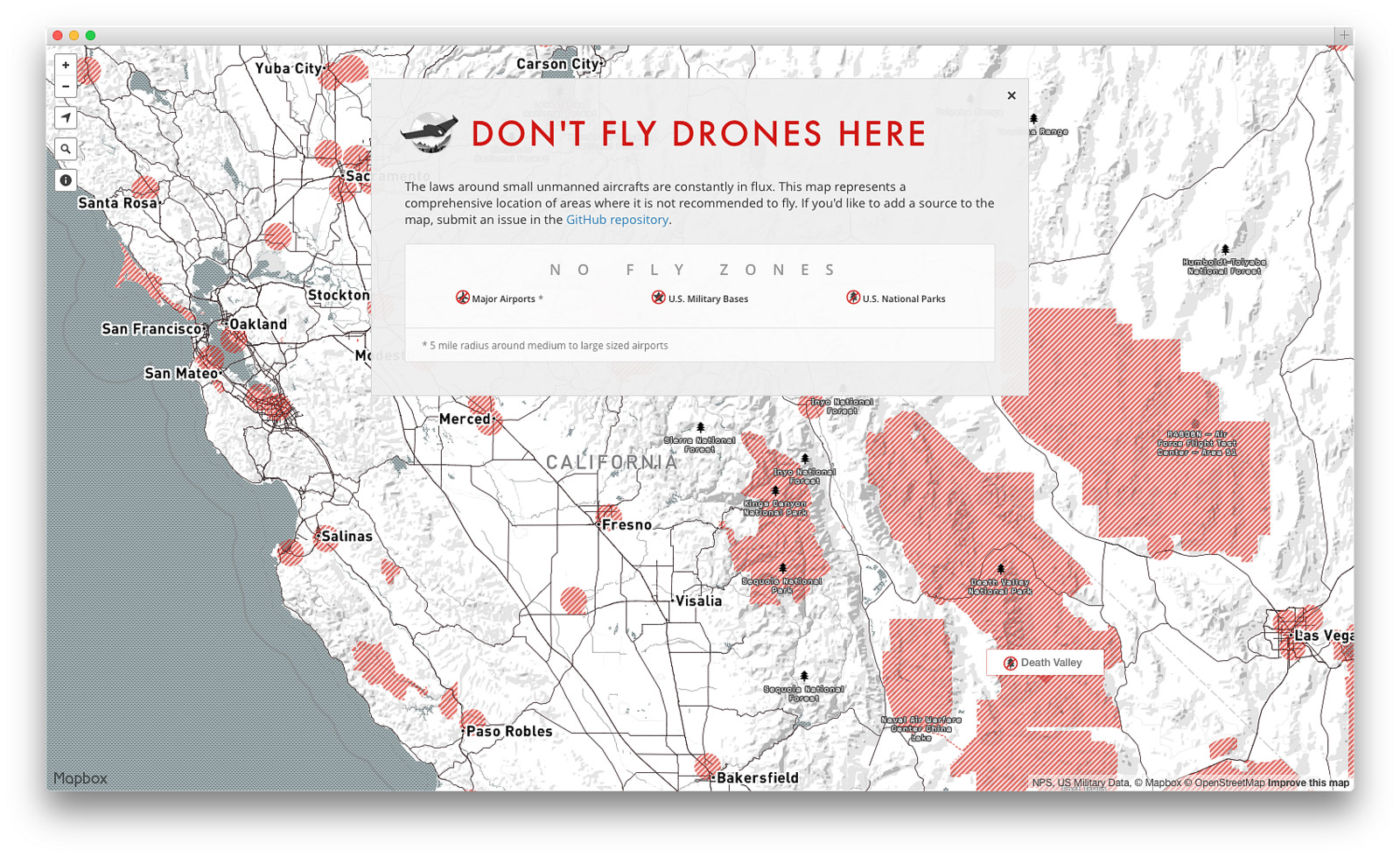
Screen showing no fly zones in the US

Conclusion


Induction of drone technology into India is, at present, very costly. When authorities, processes and systems are unclear in a law, the potential cost of getting a drone permission can literally be infinite. There is no way to know which authority to apply and the authority itself does not know whether he/she has the power to grant an application. We need clearer regulations, and we need a regulatory framework to support the industry.

References


Subtitle B, Title III of the US FAA Modernisation and Reform Act, 2012.

EASA Proposal to Create Common Rules for Operating Drones in Europe (September 2015).

CAA CAP 722: Unmanned Aircraft System Operations in UK Airspace: Guidance (March 2015).

Singapore Unmanned Aircraft (Public Safety and Security) Act 2015 (No. 16 of 2015).

Johan Hauknes and Lennart Nordgren, Economic rationale of government involvement in innovation and the supply of innovation-related services, STEP Report Series R-08 (1999).


The authors are researchers at the National Institute for Public Finance and Policy. They thank Sumant Prashant, Bhargavi Zaveri and Pratik Datta for discussions.
23 Jun 04:17

You must buy real estate…

by subra
Surprised? do not be..what I am going to say is not what the title says. Many people (including the author of the article at the bottom of this post) tell you how you should buy property …and you will make a lot of money..Lets see what they forgot to tell you: You had a nice […]
23 Jun 04:14

Prediction: Will Britian Exit? No.

by atanu

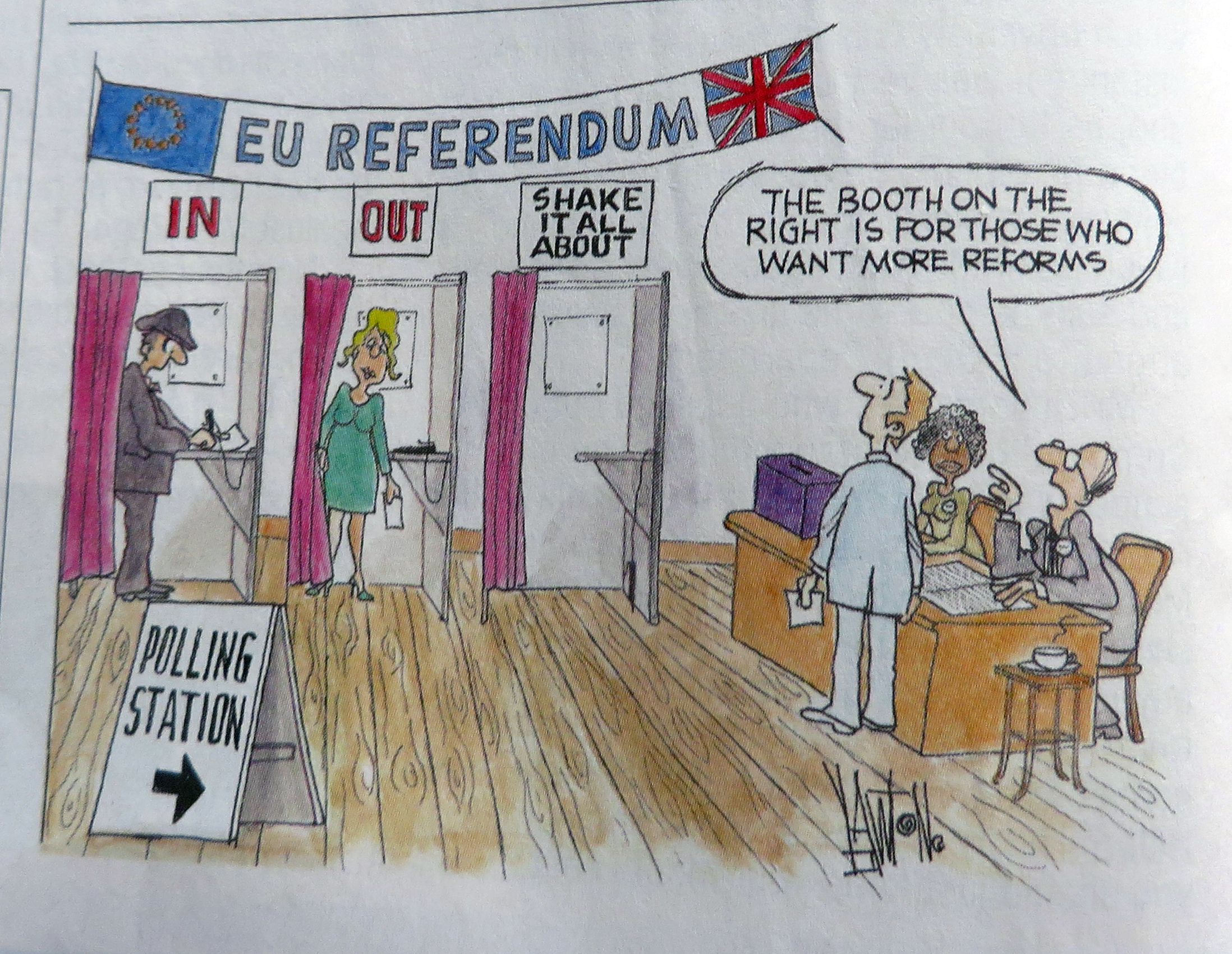
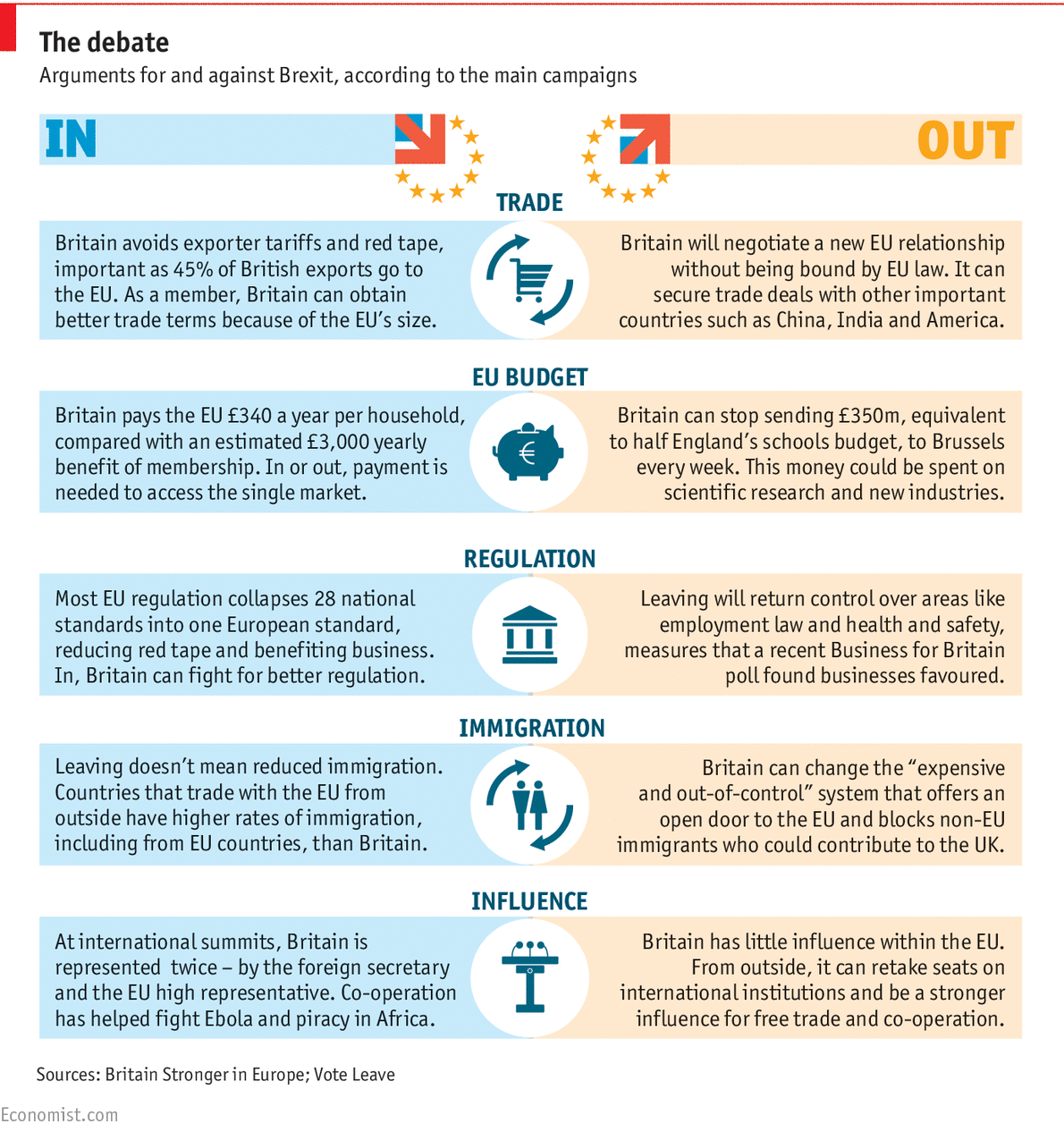
EU So tomorrow (I am writing this on Wednesday at 4 PM Pacific), Thursday, British voters would choose to remain or leave the European Union. I think it should leave. I don’t think it will.

The reason I think it should leave is summed up in this piece over at HumanProgress.org: Britain’s Democracy is a Sham. Reason I think that it will remain is that I don’t hold voters (all voters, not just British) in very high regard. They are generally ignorant, myopic and gullible.

Ignorance, like mortality, is universal. All of us are mortal, all of us are ignorant. We are necessarily ignorant because the amount that is collectively known exceeds the capacity of any individual to know by several orders of magnitude. Each of us probably knows about 10 billionth of what there is to be known. My claim about voters being ignorant, though, has a different emphasis.

I think voters are ignorant about the specific issues that they are usually asked to indicate their preferences through their votes. Some of the smarter voters understand that they don’t understand the issues. That is they are not ignorant of their ignorance.

Richard Dawkins falls into that group. He confessed that he is not qualified to vote on the EU matter: “I don’t have a degree in economics. I’ll try to make up the deficiency by reading. But in a representative democracy we pay MPs to do such detailed homework for us. There may be simple issues for which a plebiscite is appropriate (fox hunting, perhaps). But why does anyone think an issue as complex as membership of EU is one of them?”

So there.


22 Jun 09:08

Latticework of Mental Models: Lindy Effect

by Anshul Khare

“Many happy returns of the day Anshul!” One of my old friend wished me on WhatsApp. Dropping a message on WhatsApp is more convenient these days than calling up. It was still better than the standard birthday wishes you get on Facebook, which you know have come as a result of constant pestering from Facebook notifications – “Hey! It’s Anshul’s birthday today. Write something on his wall.”

“Thanks man. I am glad you remember.” I replied. I still didn’t believe that he actually remembered my birthday. May be Facebook sent him a customized birthday wish to be forwarded to me from WhatsApp. After all Facebook now owns WhatsApp.

“You know what? You just wasted another premium of your life insurance!” He joked.

“Well, that’s an interesting way to look at it. But I am glad that it was wasted. After all life is perishable and can end at any moment – insured or uninsured.” I told him with a smiley.

But that got me thinking about insurance (especially term insurance) and life. On one hand, every additional year I live on, the insurance premium seems to go waste. But on the other, as I grow older, since my life insurance premium remains fixed, I get more and more value for each rupee spent on insurance. How?

For anything that’s perishable, including human life, every additional day in its life translates into a shorter additional life expectancy. Isn’t it?

Well, isn’t everything perishable? Including humans, animals, plants and the planet earth itself? Even the sun will die one day. But let’s not get far too ahead into cosmic future. We are talking relatively here. Sun may perish one day but compared to human life, sun’s life is close to being infinite i.e. nonperishable. I mean what are the chances that any person who is alive today, outlives the sun?

Zilch! And how do we know that? Actuarial tables.

I’ll take help from Nassim Taleb, author of wildly popular books including Fooled By Randomness, to explain it. He writes –

Say I have for sole information about a gentleman that he is 40 years old and I want to predict how long he will live. I can look at actuarial tables and find his age-adjusted life expectancy as used by insurance companies. The table will predict that he has an extra 44 to go. Next year, when he turns 41 (or, equivalently, if applying the reasoning today to another person currently 41), he will have a little more than 43 years to go. So every year that elapses reduces his life expectancy by about a year (actually, a little less than a year, so if his life expectancy at birth is 80, his life expectancy at 80 will not be zero, but another decade or so).

The actuarial tables for the sun (as prepared by astronomers based on their decades of experience of stargazing) speculate that sun has been there for billions of years and the history of human life is barely few million years. However, when you see a young and an old human, you can be confident that the younger will survive the elder. But with something nonperishable, say a technology, that is not the case.

This brings us to a very interesting observation about predicting the future durability of things. Taleb calls it the Lindy Effect.

According to Lindy Effect, there are certain things, where every additional day may imply a longer life expectancy. Lindy Effect is applicable to anything that is non-perishable like a technology. The longer a technology lives, the longer it can be expected to live. A simple technology like spoon has been there, unchanged, for thousands of years. People have been using the spoons and forks for eating since Roman times.

Rolf Dobelli, in his book The Art of Thinking Clearly, writes –

You’re sitting in a chair, an invention from ancient Egypt. You wear pants developed about 5000 years ago and adapted by Germanic tribes around 750 B.C. The idea behind your leather shoes comes from the last ice age. Your bookshelves are made of wood, one of the oldest building materials in the world.

Lindy effect isn’t an iron law but it’s a good rule of thumb to use when you’re thinking about the prospects of a shiney killer app that claims to revolutionise the world. Think about it, email was used before SMS technology came in, and email is still there whereas SMS is almost at the brink of extinction.

Taleb argues that most of the technology that has existed for the past fifty years will serve us for another half century. And the recent technology will be passé in a few years’ time.

Think of these inventions as if they were species, writes Taleb, “Whatever has held its own throughout centuries of innovation will probably continue to do so in the future, too. Old technology has proven itself; it possesses an inherent logic even if we do not always understand it. If something has endured for epochs, it must be worth its salt.”

Because what survives must be good at serving some (mostly hidden) purpose that time can see but our eyes and logical faculties can’t capture. Apart from technologies you can extend this idea to think about objects like software, companies, business, books etc, where each one more year of survival helps in adding more years to lifespan and increases the survival strength.

Similarly, Lindy effect is a great mental model to decide what books to read. Taleb explains –

If a book has been in print for forty years, I can expect it to be in print for another forty years. But, and that is the main difference, if it survives another decade, then it will be expected to be in print another fifty years. This, simply, as a rule, tells you why things that have been around for a long time are not “aging” like persons, but “aging” in reverse. Every year that passes without extinction doubles the additional life expectancy.

…The best filtering heuristic, therefore, consists in taking into account the age of books and scientific papers. Books that are one year old are usually not worth reading (a very low probability of having the qualities for “surviving”), no matter the hype and how “earth-shattering” they may seem to be. So I follow the Lindy effect as a guide in selecting what to read: books that have been around for ten years will be around for ten more; books that have been around for two millennia should be around for quite a bit of time, and so forth.

The ROI on reading and understanding a concept from 500 years ago is highly likely to be exponentially greater in the long run than one presented only 5 years ago. Unfortunately if you were to look at a typical person’s reading list, the vast majority of books would be the recent bestsellers (low value) while fewer books would be the older classics (high-value).

Neomania Pitfall

According to Taleb, people who don’t understand Lindy effect and love change for its own sake, fall for neomania. These are the so-called early adopters, the breed of people who cannot survive without the latest iPhone. May be they are ahead of their time but chances are high that they suffer from neomania.

You might give counterexample of a technology that we currently see as inefficient and dying, like telephone lines, print newspapers, etc. But understand that Lindy effect doesn’t say that it’s true for everything. It talks about life expectancy which is simply a probabilistically derived average.

If I know that a forty-year-old has terminal pancreatic cancer, argues Taleb, “I will no longer estimate his life expectancy using unconditional insurance tables; it would be a mistake to think that he has forty-four more years to live, like others in his age group who are cancer-free. Likewise someone (a technology guru) interpreted my idea as suggesting that the World Wide Web, being currently less than about twenty years old, will only have another twenty to go—this is a noisy estimator that should work on average, not in every case. But in general, the older the technology, not only the longer it is expected to last, but the more certainty I can attach to such a statement.”

In Business and Investing

Unlike us humans where the probability of dying rises as we age, it’s mostly opposite in case of businesses. Of course, most businesses go through a cycle of birth, growth, maturity, decay, and death. In fact, while humans are experiencing increased life expectancy i.e., the gap between birth and death, a lot of businesses are experiencing a shortened lifecycle.

As you can see from the chart below, 44% of startups fail by the third year, and the mortality is across all industries, especially IT and communication where only 37% and 45% of startups cross the age of four.

Source: Statisticbrain.com

Source: Statisticbrain.com

On the other hand, there are businesses that last for decades and centuries. DuPont is 214 years old, JP Morgan is 60, Colgate is 210. In India, Dabur is 132 years old, Britannia is 124, Indian Hotels is 114, ITC is 106, and L&T is 78. For such businesses that cross a significant threshold in their lives, their life expectancy increases as they get older – the Lindy effect at work you see.

I am sure you may be smelling survivorship bias here because a lot of other companies that started 50-100 years ago are now resting in their graves, but that’s not the point here. The point here is that the longer a company has been around, the higher is the ‘probability’ that it will stay around for even longer. This is because companies that manage to survive the longest – by seeing through several business cycles and competitors – are the most robust and, hence, least likely to die. And this is one important aspect you should consider while going through your investment checklist – how long a business has been in operations and how well or badly it has done during these years.

Lindy effect, however, also comes with exceptions. When using this effect as a mental model, you will need to be on the lookout for disabling technological change. Kodak and Nokia did not. In India, managers at MTNL and HMT seemed to have been too impressed by the Lindy Effect to ignore the changes that sweeping by them. For businesses to keep living, first they must be built around simple products and services that do not go through a lot of technological disruptions or changes (IBM at 105 years is an exception here) and even then, they must keep evolving. Like Britannia or Dabur of today are highly evolved versions of their earlier years.

These are helpful checkpoints for you as an investor. Excluding investors who focus solely on micro caps or penny stocks or startups, for most of us considering a long past track record of the company is paramount. A company may remain small even after 50 years of operations – largely because the industry/market it serves is small, like tractor parts, speciality chemicals, local area banking etc. but such companies may also have the probability of keep on living and prospering for another 50 years. So a long track record of the business, and of the management is what you must look out for.

Lindy effect can help you filter out the latest overhyped management strategy from an author who is also a tenured professor at an international business school. Majority of those management theories aren’t going to survive beyond few years. In fact, odds are that the author himself will come up with another book touting his next discovery with a potential to transform the business practices all over the world.

Conclusion

So don’t get too excited about the latest revolutionary trading strategy. The odds are usually stacked against the brand new. Fifty years into future will not look like a scene from the latest sci-fi movie. We’ll still be sitting on chair, eating with spoons and using automobile (driverless or electric) for personal commute.

Things that have lasted a long time tend to last longer still.

One of the primary reasons for most people to lose money in stock market is their inability to make decisions independently. But there is class of people who have an advantage as investors because they can think independently and avoid psychological errors. Charlie Munger, the inimitable partner of Warren Buffett, heads that class.

He is one of the world’s most successful investors and known for having an interesting mind. What makes him interesting is not his success as an investor but the way he thinks and keeps his emotions under control. He thinks deeply about why things happen and works hard to learn from the experience.

Munger is a proponent of the idea of vicarious learning. According to him learning from the success and failure of others is the fastest way to get smarter and wiser without a lot of pain. He quips, “I observe what works and what doesn’t and why.”

So take care, keep observing and keep learning.

The post Latticework of Mental Models: Lindy Effect appeared first on Safal Niveshak.

    
22 Jun 05:19

Premier Padmini’s everlasting contribution to Indian mobility..

by Amol Agrawal
This blog pointed to a brief history of the iconic Premier Padmini car popularly called as Fiat. Here is another one by Arushi Vats of Scroll.. Though its use as a private car was on the wane in post-1991 India as international models entered the market, the Padmini continued to dominate public transport, especially in Mumbai, till at […]
21 Jun 09:12

Competition and the Creation of Wealth

by atanu

This is a continuation of the brief piece about what’s wealth and where does it come from. Wealth, defined broadly, is important to us because it’s useful for our material well-being. Material well-being is not an end in itself but it is instrumental in providing the irreducible basis for our happiness and therefore it is a means to all other higher human aspirations and goals. Without a sufficiently wealthy foundation, it is hard if not impossible to live in peace and harmony with oneself and with others.

The creation of wealth involves competition. As it happens, one of the most potent forces in nature is a process we call competition. It’s a creative process, meaning that both — creation and competition — ultimately are nearly synonymous. You cannot have one without the other. These processes occur not only in the man-made world but more generally in the natural world of living things. Seeing how they work in the natural world helps us appreciate their workings in the world of people and their artifacts.

In the natural world, there is competition for resources. Life evolves from simpler forms to more complex forms. That evolution to ever greater complexity is driven by the need for all organisms to get more resources for itself and thus it has to compete with all other organisms in the same niche. Note that competition is always among others that inhabit the same niche. Lions don’t compete with gazelles; they compete with their own kind and more generally with other predators. Gazelles compete with other gazelles since the slower gazelles fall prey to their predators.

In economics terms, gazelles are resources for lions. The competition is not between the resource user and the resource since they are dissimilar. The fact that lions induce the gazelles to evolve into faster gazelles — and vice versa — does not mean that lions and gazelles compete. The imperative to survive is common to both prey and predator but that does not involve the kind of competition as between predators competing with other predators, and preys competing with other preys.

This is not pointless hairsplitting. Here’s why that distinction is important. Consider the world of producers (entrepreneurs, firms, corporations, etc), products (cars, phones, potatoes, etc), and consumers (you, I, Joe Schmoe, etc). Each firm competes with other firms producing the same product. The competition is never between producers of cars and potatoes. Nor is a firm in the business of competing with its customers. A firm is only in competition with its rival firms. Samsung competes with Apple Inc in the marketplace for phones and tablets. That competition drives the evolution of phones and tablets.

The analogy of predators and prey has served its limited purpose. But before we move on, here’s a connection between biology and economics that I find very interesting. It involves the English cleric Rev. Thomas Malthus (1766 – 1834), professor of political economy and Fellow of the Royal Society, and author of An Essay on the Principle of Population (revised 1826). I consider him a proto-economist.

I had written about it a few years ago. So I’ll quote from that piece here. Begin quote:

Evolution.

It is hard to escape the gravitational pull of the idea of evolution. The idea goes back into antiquity. But it was only recently (in terms of historical time) in the mid-1800s that Charles Darwin (1809 – 1882) pondered the biological variant of evolution and figured out the mechanism. It was natural selection. That is one of the superstar ideas that populate the core of our ideas galaxy. Everything that is known about biological evolution can be explained through natural selection.

Natural Selection

Darwin had patiently observed nature and cataloged a heap of facts during his voyage on the HMS Beagle which ended in 1837. Then another idea pushed him to an inspired guess on the mechanism which produced the diversity of species in the world. That idea came from a professor of political economy and Fellow of the Royal Society, Thomas Malthus (1766 – 1834).

Malthus had considered the matter of how societies function and concluded that the struggle for food is critically important. The competition for food would result in winners and losers. Populations would increase till the standards fell to subsistence levels for the most fecund segment of society. The biological imperative to reproduce as profligately as possible lead inexorably to a situation where natural resource limits are reached and the weakest sorted out of the race. At the center of the drama of life was competition for resources.

Darwin had observed the natural world, pondered the evidence, and read Malthus. That’s what he needed to figure out natural selection. But then so had another contemporary of his: Alfred Russell Wallace (1823 – 1913). Like Darwin, he studied the natural world, pondered the puzzle of the diversity of species and he too had read An Essay on the Principle of Population (final revision published 1826), by Thomas Malthus, and arrived independently at natural selection. Darwin was about to be scooped by Wallace and rushed to publish On the Origin of Species by Means of Natural Selection in 1859.

Competition

The centrality of competition in the natural world is immediately understandable to anyone who has observed nature. Economists appreciate the power of competition and it is not surprising at all that natural scientists like Wallace and Darwin incorporated competition in their explanation of the biological world. (Darwin and Wallace were competitors!) They realized that there was no divine designer involved in the creation of variety in the natural world. There was no grand planner and consequently no grand plans.

The biological world evolves autonomously. There was only competition for resources and the universe was supremely indifferent to who were the winners and who the losers. Natural selection is the mechanism which all living systems rely on for their evolution.

The twin ideas of evolution through natural selection and competition are inseparable. I find it unsurprising that the central organizing principle of biology owes something to economics.

It should be noted that natural selection and competition are descriptive rather than normative features of the world. We are merely noting how things are, and no claim has been made so far on how they ought to be. The universe is neither moral or immoral; it is amoral. That eventually it gave rise to sentient beings that are capable of making moral judgments is itself a result of amoral processes.

End of excerpt from the 2008 piece, “On Competition and Ideas.” On re-reading that piece, I note that it holds up pretty well. In this piece, I am going to advance the argument into new territory next time.


21 Jun 09:00

These FDI Reforms Look Like They’ve Been Borrowed From Sergei Bubka’s Playbook

by Aakash A

FDI Reforms

Yesterday the Department of Commerce brought about some “Radical” changes to the FDI Regime. Here is a quick summary of … (Read On...)

The post These FDI Reforms Look Like They’ve Been Borrowed From Sergei Bubka’s Playbook appeared first on Capital Mind.

21 Jun 08:50

A common central bank and finocracy tool to make one obey their orders : Fear Mongering

by Amol Agrawal
We were told all hells will break lose on Indian markets last Saturday. But nothing of this sort happened. It does not require a lot of economics education to realise that most investors do not have any other place to dump their money but India. But fears have to be raised as that is how […]
21 Jun 06:27

Going to an old age home

by subra
I will want to spend my last days in an old age home or in geriatric care depending on when the end comes. If it comes even before I go to an old age home, I might be happier, but one needs to plan, right? I have done some research and seen a few practical […]
21 Jun 06:19

The office cubicle was invented by a Christian company…

by Amol Agrawal
Religion and economics or Religion and shaping of business practices is always a fascinating area of study. Darren E. Grem has a piece on 7 things you may not know about conservative Christian businesses. He discusses the the culture and history of Christian business. I liked this bit on office cubicle culture: 7. The office cubicle […]
20 Jun 04:42

China higher education story of the day

by noreply@blogger.com (Gulzar Natarajan)
Times has a very interesting article on how China is trying to redistribute the benefits of higher education across the country. The annual nation-wide Gaokao examinations which determine admissions to college seats is now widely seen as reinforcing urban-rural, coastal-hinterland, and rich-poor disparities. A recent decision, therefore, reserves a certain number of seats in all the major colleges to students from less developed regions. The decision has resulted in widespread protests across the coastal areas from parents of local children. 
Top schools are concentrated in big prosperous cities, mostly on the coast, and weaker, underfunded schools dominate the nation’s interior. Placement is determined almost exclusively by a single national exam, the gaokao, which was administered across China starting on Tuesday. The test is considered so important to one’s fate that many parents begin preparing their children for it before kindergarten... The exam gives the admissions system a meritocratic sheen, but the government also reserves most spaces in universities for students in the same city or province, in effect making it harder for applicants from the hinterlands to get into the nation’s best schools.
The authorities have sought to address the problem in recent years by admitting more students from underrepresented regions to the top colleges. Some provinces also award extra points on the test to students representing ethnic minorities. 
This spring, the Ministry of Education announced that it would set aside a record 140,000 spaces — about 6.5 percent of spots in the top schools — for students from less developed provinces. But the ministry said it would force the schools to admit fewer local students to make room... 

Over the past two decades, the government has opened hundreds of new institutions of higher education, and university enrollment surged to 26.2 million in 2015 from 3.4 million in 1998, though much of the growth has been in three-year polytechnic programs. At the same time, job prospects for college graduates in China have dimmed in recent years. That has left parents worried about wasting their life savings on substandard schools and even more desperate to get their children into the better ones.
Dissatisfaction with the gaokao is also rising. The test, modeled after China’s old imperial civil service exam, was intended to enhance social mobility and open up the universities to anyone who scored high enough. But critics say the system now has the opposite effect, reinforcing the divide between urban and rural students. The top universities in big cities like Beijing, Shanghai and Nanjing are the most likely to lead to jobs and the hardest to get into. Students from less developed regions are vastly underrepresented at these colleges. That is because they attended schools with less money for good teachers or modern technology and because the admissions preference for local applicants means they often need higher scores on the gaokao than urban students.
This is a dynamic that echoes with India's own reservation and other affirmative action programs, both in terms of the specific actions as well as the popular emotions it generates. At a more fundamental level, this is one more story of how extreme forms of competitive pressures (a merit based selection exam), which initially have a benign nature, accumulates anti-competitive strains (the better off have access to the resources necessary to compete on equal terms), and ends up being captured by the beneficiaries. 
Add to Technorati Favorites
20 Jun 04:29

Problems in direct equities investing

by subra
Whenever I do a program on investments or personal finance, people rush to me, and ask “Are you saying direct investment in equities is so difficult, that we should not do it ourselves?” My answer is normally yes. That is because for most of the people I meet – whether they be Relationship Managers in […]
20 Jun 04:26

On premature deindustrialization and other things

by noreply@blogger.com (Gulzar Natarajan)
Tyler Cowen peeks into the economic prospects of a world buffeted by declining productivity, secular stagnation, stagnating global trade, premature deindustrialization, increasing automation, and so on.

On how little of the world economy is connected with trade,
Only a small fraction of firms export or even consider trying to export; the actual percentage of exporting firms is estimated at eighteen percent. Most firms which do export are selling a single product to a single country, and even the average magnitude here is to sell to only 3.5 countries. Most nations are not active competitors in most global economic sectors... We see also that exporting firms are much larger than nonexporting firms – 4.4 times larger as measured by sales – and that fact is consistent with the notion of a relatively high fixed cost to trading internationally.  
On the importance of manufacturing,
The lack of manufacturing exports for an economy also may feed into domestic growth by taking away potential economies of scale. Without the chance to export Toyotas, Japanese domestic cars probably would have been more expensive and of lower quality. Internally-driven growth would have less of a jump start from the export sector and also less of an ongoing surplus to draw from for future domestic investment. Manufacturing appears to create strong backward and forward linkages, whereby one set of successful manufacturing companies helps to fund input sectors and complementary sectors, also full of middle class jobs. For the United States, for instance... manufacturing accounts for about seventy percent of the country’s business research and development.
Cowen points to a "cell phones instead of automobile factories" growth path, wherein increasing returns to scale activities like IT, where research and innovation are increasingly focused, though largely produced in developed countries, will diffuse quickly and widely across developing countries, and become the drivers of economic growth there,
The new imbalance would be based on increasing returns to scale goods, which would trickle down to poorer countries, vs. constant and increasing cost goods, which would not trickle down. Developing nations thus would be very well supplied with (cheaper versions of) increasing returns to scale goods, but have relatively stagnant supplies of constant and decreasing returns to scale goods. In practice this would mean that cell phones, software, web sites, movies and television shows, pharmaceuticals, and ideas more generally would be plentiful in developing nations. Similarly, housing and many basic foodstuffs will have higher relative prices. “Living in the past,” so to speak, will become increasingly expensive, and living on or near the technological frontier may become relatively cheap, even in countries which are not thought of as especially technologically advanced. This probably would mean that younger individuals would gain more from economic growth than would older individuals, at least relative to a model of balanced growth; the younger individuals are more likely to use the newer technologies.
On the enclaves model of economic and social development, with the attendant implications for inequality,
Indian outsourcing activities, as practiced in Bangalore, Chennai, or Hyderabad, are examples of enclave construction. The outsourcing centers typically produce much of their own infrastructure, including electricity, water, web connections, and even roads. The goal is for the environment inside the firm, often set in walled-off medieval-style compounds, to approximate that of a fully developed nation. At the same time, the enclave is set in India and takes advantage of the lower wages there. It is another way of blending developed and developing country features, and future development models likely will involve a good deal of such blends, rather than the more straightforward construction of middle class societies as we have witnessed in South Korea, Japan, and Taiwan.
On India's growth prospects,
India is a striking example of a country which has been underinvesting in manufacturing. As we have seen in section two of this paper, the likely implication is that India will fail to develop a large (in percentage terms) middle class and thus will continue to develop along a path of extreme income inequality, with gains unevenly distributed and to the long-run detriment of the nation... India is not a natural candidate to succeed China as the world’s low cost manufacturing center. 
The world economy, especially for emerging economies, is at an intriguing point in their development trajectory. Apart from premature de-industrialization, there are several forces with very uncertain dynamics at play. The increasing use of robots and attendant automation of economic activities is likely to disrupt the labor market. The dynamics of modern capitalism, with skill-biased technologies and wage premiums for the higher income levels, appears to support widening inequality. 

Similar trends are visible within countries too. Consider urbanization. In contrast to the gradual and planned urbanization in developed countries, cities are developing countries are undergoing very rapid and massive, but extremely chaotic growth. This has had the effect of engendering sprawls and gentrification, both of which threatens to leave such cities with pockets of affluence and modernity in a sea of less than desirable living conditions. It is possible that most cities in developing world will never achieve the quality and vibrancy of cities like London and New York even if incomes reach the same levels.
Add to Technorati Favorites
19 Jun 04:42

Responding to the latest AMA

by atanu

sz253I got asked a few questions in the latest “ask me anything“, including some via email. “You have questions, I have answers” is my motto:)

I will address the emailed questions later.

Q: Can you please share your thoughts on the Second Amendment? Is the horriffic gun violence in the US directly attributable to the law? Is it an anachronism that should be repealed?

A: I answered that at some length in here, “Guns are instruments, not sentient beings with volition.

Q: Do you have any reasons against education-voucher system?

A: Just to be sure that we are talking about the same beast, let me state what I understand to be “education vouchers.” The matter is related to public support for education.

We all pay for private goods out of our own pockets. Food, clothing, shelter, gadgets and gizmos, etc, are private goods. Depending on your means and your preferences, you choose how much of what to buy.

There is some justification for believing that education (as a service) is not a private good. We will not go into that here. But the upshot is that a case can be made for financially supporting primary and secondary education for those who are unable to pay for it. One way is to fund some schools out of public funds (taken from taxpayers). In this scheme, there are private schools that charge a tuition and there are free public schools.

An alternative to allocate the public funds into vouchers and distribute them to all students. That is, there are no free schools at all. All schools are private, fee-charging schools. Under this scheme, people choose the school and pay with the vouchers (either in full or in part.) This scheme funds students instead of funding schools. Students (or usually their guardians) choose the school much as they would choose which store to buy their groceries from. This has the advantage of inducing market competition and therefore greater efficiency and accountability. I would support a voucher system over a public school system.

Q: What are your thoughts on Universal Basic Income in lieu of the Welfare State?

A: False dichotomy alert. A welfare state is what provides a “universal basic income” (UBI). Perhaps the questioner refers to this choice: (a) Have a whole bunch of subsidy schemes for food, education, housing, etc etc, or (b) Dismantle the whole complex mechanism for subsidies and replace it with a cash-transfer to everyone regardless of economic status and let them choose how they spend the cash.

Naturally, I prefer the unconditional cash-transfer scheme over a rat’s nest of complex subsidy schemes. The latter are prone to massive leakage and corruption; the former less so. However, a cash transfer scheme has major pitfalls too in the case of a poor economy. I define a poor economy as one in which not sufficient amount of stuff gets produced. If the economy produces so little that there’s not enough to go around, the cash transfer scheme will not do much at all.

But overall it is better to simply transfer the cash directly to every person (which means Mukeshbhai would get it too) instead of the current system. A more detailed analysis will have to wait.

Q: A list of suggested readings for youth here in India?

A: This is hard to answer since it is too open-ended. “Youth in India” is a very, large, heterogeneous group. The age group would range from five to 25 years. Areas of interest would be diverse too: art, social sciences, hard sciences, etc.

If I were to narrow it down to just undergraduates who are familiar with English, I would recommend books that are consistent with what some label “a 21st century liberal education”. The Association of American Colleges & Universities defines it thus:

Liberal Education is an approach to learning that empowers individuals and prepares them to deal with complexity, diversity, and change. It provides students with broad knowledge of the wider world (e.g. science, culture, and society) as well as in-depth study in a specific area of interest. A liberal education helps students develop a sense of social responsibility, as well as strong and transferable intellectual and practical skills such as communication, analytical and problem-solving skills, and a demonstrated ability to apply knowledge and skills in real-world settings.

As I am more familiar with English-language authors (primarily American) than with Indian authors, my recommendations will be biased. But this is an important topic that requires more time. So stay tuned.

Q: Do you really think that 1st amendment protects free speech in USA?H . . . How can a constitution guarantee anything that the people themselves don’t believe in?

A: I replied to this over in the comments section. Here it is.

Constitutions are not engraved in stone. When the popular sentiment changes, then constitutions can also change. If most Americans don’t like a certain provision, it will (eventually) be reflected in the constitution.

As it happens, the constitution provides guarantees against the restriction of free speech. But there are mechanisms for changing the constitution. It could well be that if the population wants the freedom of speech to be restricted, then the 1st Amendment can be repealed, just as the 18th amendment was repealed.

The constitution is not an unalterable law of nature. It is just an artifact of human understanding and will.

~ ~ ~ ~ ~

That’s it until the next AMA. Thanks.


19 Jun 04:33

PSA: Use the Wayback Machine, Luke

by atanu

sz255One of the occasionally useful but not very well known resource on the web is related to the web itself. It’s the Internet Archive Wayback Machine.

As the name indicates, it saves snapshots of the internet content as it appeared at some times in the past. As of now, it has saved 487 billion pages. The wiki has more details, which is definitely worth a read. Where is it physically located? Wiki says:

“The Archive has data centers in three Californian cities, San Francisco, Redwood City, and Richmond. Its collection is mirrored for stability and endurance at both the Bibliotheca Alexandrina in Egypt and at another facility in Amsterdam.”

One of the features of the archive is its “Save Page Now” function. It captures a web page as it appears at a specific time for use as a trusted citation in the future. sz254

I use that feature every so often. I recently used it to capture a case of possible plagiarism. Following a search yesterday, I landed on this page, “Civilizations die by suicide, not by murder“. It relates to the famous British historian Arnold Toynbee’s summary statement about how civilizations perish, in his 12-volume magnum opus, “A Study of History.”

After reading that, I came across another page on the same subject, titled, “A Study of History – Arnold J. Toynbee“. This was a much longer and fuller treatment. And I realized that the previous page had plagiarized content from it. Compare the two to see what I mean.

And here’s where the Wayback Machine comes in. I have saved both pages. It establishes the plagiarism occurred even if the contents of the pages are changed. Here is the Stefan Zenker page in the WB machine and the partly copied page.

In case you are wondering, I did write to Mr Zenker and he responded. I have also written to the author of the shorter piece but have not got a reply yet.

This public service announcement has been brought to you by a generous contribution from friend of this blog. Maybe you should too. That reminds me — I have to put up that “DONATE” button.:)


18 Jun 05:08

An open challenge

by subra
here is an open challenge.. here is a list of companies which owe a lot of money to a lot of bankers. The open challenge is that NONE OF THESE companies will repay their lenders in full. It is amazing that these companies are going around raising money (Imagine Reliance Mutual Fund is in the […]
18 Jun 05:06

Weekend reading links

by noreply@blogger.com (Gulzar Natarajan)
1. Ajay Shah has an excellent column examining the issue of unbundling of commercial activities,
Consider the New Pension System (NPS). Project OASIS, saw that the overall pensions problem contained three distinct industries: managing money, owning customers, and record-keeping. It suggested an unbundled architecture, where pension fund management was separated from interaction with customers. Record-keeping was centralised to harness economies of scale and ensure that it was easy for consumers to switch from one pension fund manager to another. This design caters to heightened competition. On the strength of better fund management, a new pension fund manager can steal customers, as switching is always possible. Similarly, the front end firms would live or die based on their friendliness to customers, and not on the quality of their fund management. In the conventional world, finance professionals generally focus on the deal-making required to get a new product to the customer. These finance professionals are a little shocked when, in the NPS environment, incumbent manufacturers do not control the distribution. All distributors are equally keen to push all products; all manufacturers have equal access to all distributors.
Though Shah sees unbundling as having worked in only NPS, electricity, and net-neutrality, I am inclined to cast the net wider. In particular, one could think of looking at many financial market activities in this way.

The only observation is that with the emergence of IT solutions, the entry barriers from an incumbent's entrenched presence in the downstream side of selling a service may not be as important as earlier.

2. The underlying signatures of Indian economy continue to remain weak. The capex index from IIP data comes in at the lowest since April 2010.
The RBI's latest Industrial Outlook Survey shows that the business expectations index is lowest since at least 201-11
Much the same story about expectations on industrial production, order books, and job creation. Not a happy picture at all.

3. Mexico City's air pollution levels fall back to the nineties. This stat about its vehicle population is stunning,
Developers erect skyscrapers with a dozen floors reserved for parking. The Mexican Institute for Competitiveness, an economic think tank, estimates that 42 percent of space in new developments built between 2009 and 2013 was designated for parking.
4. Livemint points to BIS data for the 2007-15 period for 18 countries which finds that housing prices in India rose the highest at 72.3%.
As the article points out, for whatever reason, housing market in India does not respond to over-supply and piling inventory by price corrections. Developers prefer to hold tight. It may just be that the margins are large enough (or supply small) to provide them the comfort to hold on to vacant units long enough.

5. Very good analysis of India's new Bankruptcy Code here. This is more likely to be an evolutionary process where the fruits will start appearing only 5-8 years hence. A very important reform though.

6. When in China Capitalists sing the Chinese tune! Consider the example of Disney. Disney opened its $5.5 bn Shanghai Disney Resort, its first facility in China, a joint venture with Shanghai Shendi Group. Times has a nice essay, which describes what Aswath Damodaran calls the "China trade-off",
In addition to handing over a large piece of the profit, the control-obsessed company would give the government a role in running the park. Disney was also prepared to drop its longstanding insistence on a television channel... Disney is sharing the keys to the Magic Kingdom with the Communist Party. While that partnership has made it easier to get things done in China, it has also given the government influence over everything from the price of admission to the types of rides at the park...


The partnership structure puts Disney in a complicated spot. Shendi is really a consortium of four powerful government-owned companies: the Shanghai Radio, Film and Television Development Company; Jin Jiang Hotels; Bailian retail shops; and a property developer, the Lujiazui Group. And each of those companies has separate business ties to Disney’s new resort. The Jin Jiang Group has a contract to provide tourism services for the park. The Lujiazui Group helped develop the world’s largest Disney Store. The Shanghai Media Group, a division of the development company, is positioned to capture a big share of the park’s television and advertising budget, since it controls the city’s biggest television stations, as well as major newspapers, magazines and radio properties.
7. Germany followed Japan and Switzerland into having its 10 year sovereign bond yield slip into negative territory. It is estimated that 40% of the $6.4 trillion Euro region debt is now trading below zero, which as one analyst said,  
Nobody buys bunds at these yield levels thinking they are attractive. Demand for haven assets is being driven by fear of Brexit and growth concern. Investors are buying bunds as a hedge against uncertainty.
Another analyst had this to say,
Every day you own a bond like that you compound a loss, and the only way to make money is when someone else is willing to pay a higher price. As a store of value I don’t see it as a very good investment.
Former PIMCO head, Bill Gross has already described negative bonds as a "supernova that will explode one day". Since retail deposit rates have not become negative anywhere, the direct impact of negative rates is not being felt by citizens. Also, since yields have been continuously on the decline, prices have been rising and investors have been making profits.

8. More evidence that we may have reached "peak ship size". With 18% of world's container capacity anchored and idled, and global shipping capacity rising by 7% last quarter even as demand grew by 1%, the shipping industry is staring down the barrel,
A study last year by the OECD found that economies of scale from today's mega-boats are four to six times smaller than those in previous periods of up-sizing. Around 60 percent of cost savings now comes from engine technologies. In other words: Building smaller boats with better engines would offer more savings than going bigger. Then there's risk. Today's largest container vessels can cost $200 million and carry many thousands of containers -- potentially creating $1 billion in concentrated, floating risk that can only dock at a handful of the world's biggest ports. Such boats make prime targets for cyberattacks and terrorism, suffer from a dearth of qualified personnel to operate them, and are subject to huge insurance premiums. 
Yet the biggest costs associated with these floating behemoths are on land -- at the ports that are scrambling to accommodate them. New cranes, taller bridges, environmentally perilous dredging, and even wholesale reconfiguration of container yards are just some of the costly disruptions that might be needed to receive a Benjamin Franklin and service it efficiently. Even when taxpayers foot the bill for such upgrades, the costs can be passed on to vessel operators in the form of higher port fees. In recent years, mega-vessels have caused traffic jams in the water and on-shore as overwhelmed ports struggle to offload thousands of containers. The expense in worker overtime and cargo delays can be significant. Making matters worse, the bigger ships make fewer port visits, leaving operators wondering if they should invest in costly renovations for what would amount to infrequent stopovers.
9. Business Standard chronicles Lavasa, the five-town smart city complex being developed independently by Hindustan Construction Company (HCC), on the foothills of the Western Ghats in Maharashtra. The project which was launched in 2004 and has so far incurred a cost of Rs 6600 Cr in the partial development of two towns (on 8000 and 2400 Acres respectively) follows the pattern of a very dense central core with sparse radial developments.

Despite the investments made, Lavasa continues to be largely a holiday destination with limited investments in services employment and other non-recreational commercial investments. Lavasa is a test case for the belief, which underpins a large part of Chinese urbanization, that "build it and they'll come". I am inclined to believe that Lavasa will be a success in the next 8-10 years and a great example for planned urbanization in India. And if that happens, the reasonable sizes of each development (a few thousand acres), will have had no small a role to play.

10. Finally, Goldman Sachs has been all over the news this week with two scandals. First, came news that Goldman Sachs advised the 2014 sale of BHS, the UK Department store chain, for £1 to Retail Acquisitions, a group of investors led by Dominic Chappell, an ex-bankrupt with no retail experience. Now with BHS with its 11000 odd employees facing bankruptcy amidst allegations of swindling and fraud, the ex-BHS chairman Sir Phillip Green has effectively blamed Goldman for clearing the sale to a person like Chappell. 

If the first was not scandalous enough, the second would put even the most unscrupulous corporates to shame. The Libyan Investment Authority (LIA), the country's sovereign wealth fund (SWF), has initiated a $ 1bn suit for damages on Goldman at London. It accuses Goldman of exploiting its limited experience in 2008 to sell nine risky derivative trades that ultimately lost the SWF $ 1.2 bn, by using "undue" influence over LIA's own employees, including delivering the services of prostitutes and providing luxurious hospitality. Goldman is accused of using one of its executives, Youssef Kabbaj, to lobby and dine LIA officials concerned to purchase the products. The description of the trial here is downright lurid and despicable. 

These come as Goldman is recovering from its role in raising upto $3 bn money for 1MDB, the Malaysian state fund at the center of a corruption scandal involving the country's Prime Minister. Goldman apparently received $300 m for this and $200 m for the LIA purchases. 
Add to Technorati Favorites
17 Jun 06:47

Lee Kuan Yew on the Proper Balance Between Competitiveness and Equality

by Farnam Street Team

Lee Kuan Yew, the former Prime Minister of Singapore and the one responsible for its rise from third world to first in only a generation, is a great source of wisdom.

In this excerpt from, Lee Kuan Yew: The Grand Master’s Insights on China, the United States, and the World, he talks about the necessary balance between competitiveness and equality.

To be successful, society must maintain a balance between nurturing excellence and encouraging the average to improve. There must be both cooperation and competition between people in the same society.

If everybody gets the same rewards, as they do under communism with their iron rice bowl, nobody strives to excel; society will not prosper, and progress will be minimal. That led to the collapse of the communist system. On the other hand, in a highly competitive society where winners get big prizes and losers paltry ones, there will be a great disparity between the top and the bottom layers of society, as in America. … At the end of the day, the basic problem of fairness in society will need to be solved. But first, we have to create the wealth. To do that, we must be competitive and have a good dose of the “yang.” If we have too much of the “yin” and over- redistribute the incomes of the successful, then we will blunt their drive to excel and succeed, and may lose too many of our able, who will move to other countries where they are not so heavily taxed. On the other hand, if too many at the lower end feel left out, then our society will become divisive and fractious, and cohesiveness will be lost. Communism has failed. The welfare state of Western democracies has also failed.

There is a continual need to balance between a successful, competitive society, and a cohesive, compassionate one. That requires judgment, to strike a bargain or social contract. Each society must arrive at that optimum point for itself. Between the two ends, the highly competitive and the excessively equal, lies a golden mean. This point will move with time and changing values.

I can best explain the need for balance between individual competition and group solidarity by using the metaphor of the oriental yin and yang symbol. … The more yang (male) competitiveness in society, the higher the total performance. If winner takes all, competition will be keen, but group solidarity will be weak. The more yin (female) solidarity, with rewards evenly distributed, the greater the group solidarity, but the weaker the total performance because of reduced competition…. We have arranged help, but in such a way that only those who have no other choice will seek it. This is the opposite of attitudes in the West, where liberals actively encourage people to demand entitlements with no sense of shame, causing an explosion of welfare costs.

--
Sponsored by: Slack - Making teamwork simpler, more pleasant, and more productive.

17 Jun 06:09

Denmark and negative rates

by noreply@blogger.com (Gulzar Natarajan)
Bloomberg has an article on negative interest rates in Denmark. Unlike others who use negative rates as a tool of monetary accommodation to restore economic growth, the country had embraced negative rates as early as 2012 to maintain the kroner's peg against a depreciating euro.
Apart from highlighting the apparent normalcy associated with negative rates, the article points to atleast two interesting features of the Danish economy that goes against the grain of orthodox Econ 101. One, high taxation and high minimum wages may not always be bad,
Despite a minimum wage not far below $20 an hour and some of the world’s steepest taxes, unemployment is almost the lowest in Europe.
Second, despite the persistent low rates, the country's real estate market has suffered only a "froth" and not "bubbles" as would have been expected. Strict mortgage lending regulations may, after all, be effective
the country regulates the housing market to a degree unimaginable in the U.S. It’s nearly impossible for a foreigner with no connection to Denmark to buy property, preventing inflows of overseas money. Banks apply stringent financial criteria to mortgages for buy-to-let properties; it’s hard for Danes to purchase homes they don’t intend to live in. Regulatory guidelines require minimum down payments of 5 percent and stress tests of borrowers’ finances against runups in rates. With the encouragement of regulators, banks have hiked fees on flexible-rate loans, nudging buyers into fixed-rate mortgages. The rules are even tighter for properties in Copenhagen... Compared with New York, London, and even Stockholm, Copenhagen real estate is still a bargain: $500,000 buys a decent two-bedroom.
However, it should not be construed that such policies can be replicated to similar effect elsewhere. Denmark's unique social and political history and their attendant forces have undoubtedly played a critical role in the apparent relative lack of problems, maybe even success, with negative rates. But a more definitive conclusion is that this is yet more evidence that countries need to embrace a more heterodox approach and carefully select policies keeping in mind their local context and requirements. This, more than blind administration of economic orthodoxy, even with negative rates, is more likely to help economies forge successful growth paths.

As to negative rates itself, in a week when Germany joined Japan and Switzerland with negative rates on 10 year sovereign bonds, its future may well depend on the answers to at least five questions.

1. How much low can the rates fall? Beyond a point, the transmission of rates into retail and all other parts of the economy will be felt, with potentially very disruptive consequences. Fundamentally, at a certain point, the negative rate would exceed the cash storage cost.

2. How much longer can the banks hold out? Apart from having to pay the central bank for holding their reserves, banks have been constrained from passing on negative rates to depositors. This has been eroding their profitability as reflected in declining Net Interest Margins (NIMs).

3. How much long will it be before the savers revolt? These low rates are exacerbating the woes of the already insolvent pension funds in many parts of the world. Insurers are struggling for returns on their investments and asset managers are fighting to retain their investors. And, coupled with negative retail deposit rates, the cumulative effects low rates may become onerous enough to force savers out into the streets.

4. How much more skewed can the risk allocation become? As returns on conventional assets decline, it is only natural that investors move into newer and riskier areas in search for yields. But this in turn invariably amplifies risk by inflating bubbles. The more time markets stay in these regions, the steeper the fall.

5. How much longer can the markets sustain central bank purchases? The negative rates owe a lot to the massive sovereign bond (and now corporate too) purchases by central banks, especially the ECB and BoJ. But there are portfolio limits to how much of each category that the central banks can purchase. In Europe, since the ECB can buy no more than a third of any individual bond issue, there may be only 3 months worth of German bonds left to purchase at the current rate of nearly 20 bn euros a month. The Bank could be left owning a fifth of the sovereign bond market in Eurozone area by end-March 2017. In Japan, thanks to the BoJ's ETF purchases, the Japanese government is a top 10 holder in 90% of Japanese stocks.
Add to Technorati Favorites
16 Jun 05:20

Stable Investor Mid-Monthly

by Dev Ashish
Its extremely hot here in North India and I don’t know when the rain gods will send their blessings. I envy those who have permanently settled in mountains – and I gave it a serious thought myself when I visited Bhutan few months back. By the way, it’s a lovely country and if you are a traveller at heart and one who seeks peace, then it can be a great place to visit sometime. Nevertheless
16 Jun 05:20

On Slack: Drought Bites, Brexit Stress, P-notes norms, Delhi Power Woes, Patanjali Empire, Faux Doomsday Call, New Stock Exchange, Stressed Assets, FCNR redemption, Brexit Watch Indicators and much more…

by Shreesh

The Slack Discussions

The Slack group at Capital Mind Premium has been extremely active and if you haven’t been there, … (Read On...)

The post On Slack: Drought Bites, Brexit Stress, P-notes norms, Delhi Power Woes, Patanjali Empire, Faux Doomsday Call, New Stock Exchange, Stressed Assets, FCNR redemption, Brexit Watch Indicators and much more… appeared first on Capital Mind.

16 Jun 05:19

Why West Bengal continues to be a place for unauthorised money raising (This time is hardly different)?

by Amol Agrawal
In the same event when certain players were blamed for being too optimistic while bidding for payment banks, there was another development. SEBI chief (who never really get much media space despite stellar work) UK Sinha made a statement about illegal deposits/funds raising in West Bengal: U K Sinha, chairman of the Securities and Exchange Board of […]
16 Jun 05:19

Macronomics: Indian Corporate Debt market no longer attractive to Foreign Portfolio Investors (FPIs)

by Deepak Shenoy

macronomics header image

Today we look at a strange situation in corporate debt investments by Foreign Portfolio Investors (FPIs). While they continue to … (Read On...)

The post Macronomics: Indian Corporate Debt market no longer attractive to Foreign Portfolio Investors (FPIs) appeared first on Capital Mind.

16 Jun 05:18

Cafe Coffee Day doesn’t serve Espresso!

by SK

Yeah, you read that right!

A weird thing happened this evening. I was at the Cafe Coffee Day outlet on Richmond Road this evening meeting someone, and asked for an espresso. The lady at the counter said that espresso wasn’t available, and if I could have Americano instead.

Now, while the coffee at CCD is generally not of the highest quality (it’s basically a meeting space for rent, and the coffee is incidental), I like to have coffee that is of at least somewhat reasonable quality, and on that count their espresso generally does well. When they have it of course.

When the lady told me that espresso wasn’t available, it was hard to believe, and I pressed to find out why that was the case. They could serve Americano (which is Espresso with hot water), or Cappuccino (Espresso with steamed and foamed milk), but not Espresso.

How were they able to make Americano or Cappuccino without the ability to make Espresso. It turned out that the coffee machine was working fine, and they could turn out an Espresso, except that the cup in which Espresso is served was out of stock.

A short argument later (they agreed to make a “cappuccino without milk” but they’d charge the cappuccino price for that), I demanded to see the manager. And then I decided to take down the name of the person at the counter on my phone. At which point an even more bizarre thing happened.

She suddenly fled to take cover behind the counter! She just wouldn’t let me see her name tag, and she wouldn’t come out from behind the counter. And that also effectively meant that the cafe was refusing to serve us, since nobody was willing to take our order – thus forcing us to deny them of their business!

The person I was meeting presently mentioned that there was a Barista not far from there, and a quick walk later, I was sitting down with a cup of double shot espresso there (it’s one of the very few Baristas still operational in Bangalore).

The funny thing is that Barista served me the espresso in a mug that is not normally used to serve Espresso! Maybe there’s really a shortage of Espresso cups in Richmond town!

If anybody from the company is seeing this, this happened today (15th June 2016) at around 5:30 in the evening at the Richmond Road outlet (opposite HDFC Bank). It seems like it’s the result of some messed up incentive structure for employees. 

I have experience in designing salesperson compensation structures, and would be happy to structure a better incentive scheme for the company (for a fee of course)! 

16 Jun 05:17

Squandering India’s Greatest Opportunity

by atanu

sz191 “There is a tide in the affairs of men. Which, taken at the flood, leads on to fortune . . .” Shakespeare used a sailing metaphor of tides for what in modern terminology we call “a window of opportunity” or ” an inflection point”. There are inflection points in the affairs of countries too.

India has had a number of those. One was in 1947. Then came another when Nehru died (and not a day too soon.) Then another when Indira Gandhi lost the elections following the imposition of “Emergency” and assuming dictatorial powers. Then another when she paid for her misadventures in Punjab by being shot by her bodyguards. Then another when her son Rajiv was killed by a suicide bomber. All of them were inflection points, amazing opportunities for India to change tack. All were not taken at the flood and India continued to be bound in shallows and miseries.

Two non-Nehru/Gandhi politicians did somewhat successfully make some changes: first Narasimha Rao of the Congress and later Atal Bihari Vajpayee of the BJP. But alas. It did not last. The greatest opportunity ever in the history of modern India came in mid 2014. Way back in 2010 I had sensed the coming of that tide, and I wrote about it in the first chapter of my book — Transforming India — in 2011.

Change has been postponed–indefinitely

Narendra Modi won an unparalleled mandate for the BJP in May of 2014. I was sure that he would make structural change, a break away from all that had hindered India’s prosperity. Now at last, it seemed to a lot of serious people, now India will move ahead. We were convinced that good things will happen.

But a new realization began to dawn. The hoped-for change was going to be delayed. Postponement dates were assigned: after the first budget. No, after this state elections. No, after that state elections. No, after a cabinet reshuffle. No, after this . . . or that . . . After one year, it was clear that Modi like all politicians is mostly concerned with enlarging governmental power and control of the economy, and not with actually making those changes that will most benefit the economy. There’s hardly any difference in substance between Modi and the Congress although the show is spectacularly different.

It is likely that India’s economy will be smaller than one single mega-region of China.

This was the last and final chance. And it was squandered. India is, in my considered opinion, done. In 1978, India was neck and neck with China. Today China’s GDP is around five times that of India, and it’s wealth probably 10 times that of India. Think of it this way. In terms of power, prestige and wealth, China is to India what India is to Pakistan. The gap between India and China will continue to widen and accelerate. In another 10 years, China’s economy will probably be 10 times larger than India’s and its wealth about 20 times larger. It is likely that India’s economy will be smaller than one single megaregion of China.

Modi could have changed India’s fortune and gone down in history as the man who transformed India. He has demonstrated that he cannot.

For the record, here’s an op-ed I wrote for the New Indian Express (June 14th, page 8):

India is still on same old policy path

The second anniversary of the NDA government of Prime Minister Modi is an appropriate milestone to reflect on its performance. In May 2014, the possibility that India would embark on a path to prosperity was real. The BJP led by Shri Modi was given an unprecedented mandate by the people and expectations were high that the new government would break from the dismal past. A move from what I call the PPP (perpetually planned poverty) policies of the past to policy reforms necessary for wealth creation was expected.

A politically-incorrect truth

The sad truth is that instead of change, India in essence is still on the same old path India has been on since 1947. Heavy handed and inept government interference into the economy had prevented India from reaching anywhere close to its full economic potential. Though the realization that the needed structural reforms are unlikely to happen has dawned on most serious observers, it is politically incorrect to voice that concern for fear of antagonizing the powers that be.

Governments, central and state, have immense power and control over all aspects of the economy, as is the norm for socialist countries. That leaves very little room for the expression of dissatisfaction by the people and the private sector. Industry leaders, for instance, may (and they do) privately bemoan the lack of reforms but they know that it would be foolish to say so publicly since the fate of their commercial enterprises are in government hands. They wisely choose to rate every budget a solid 11 on a 1 to 10 scale. They just grin and bear it because they have to, and if possible they vote with their feet.

An all powerful, anti-freedom, exploitative, extractive government

A powerful government is a two-edged sword. It can implement growth-inducing policies that are the engines of prosperity. But if instead the government chooses growth-retarding policies, because of its power it can also prevent any challenge to its bad policies and therefore be immune to any possibilities of reform. India’s government is unfortunately too powerful for India’s welfare. The reason is that the structure and nature of government is a continuation of the British colonial government. Although Indians democratically choose their government now, that fact is consistent with an all-powerful, anti-freedom, exploitative and extractive government like before.

Economic prosperity is built on a few basic building blocks such as good rules, urbanization of the economy, free markets, property rights, and individual freedom. Instead, the government has focused on their anti-thesis, and perpetuated poverty rather than prosperity.

Not the creation of wealth but mere redistribution

Like the previous governments, Modi’s government continues to focus on villages, which necessarily implies rural poverty and therefore the continuance of fruitless rural poverty alleviation programs like MNREGA and Jan Dhan. Those don’t create wealth but merely redistribute what little there is. The stress is always on subsidies and dole, instead of freeing people to create wealth. The poor need freedom and opportunities to use their labor to create wealth, not Rs 2 per kilo rice as handouts.

Lack of property rights, unclear land titles and regressive labor laws limit employment in urban India. Add to that the lack of investible funds. The financial institutions are in dire distress with massive non-performing assets (NPA). Estimates of stressed assets in the banking sector top 15%. Almost every public sector bank is broke multiple times over. The only avenue appears to be the injection of even more money into them. That is not the solution.

Lack of vision and commitment

In short, the government has demonstrated neither the vision nor commitment to structural changes. What kind of changes? For instance, it could have liberalized the education sector, instead of introducing even more onerous requirements.

Lack of availability of land has hamstrung industrial growth, and thus the growth of manufacturing jobs. Public sector undertakings and defense occupy prime real estate in urban areas. These could have been made available to industry for growth. Furthermore, land that the government holds is urgently needed for affordable housing. The housing sector can be another powerful engine of growth.

The government must vacate the spaces in which the private sector can and does do a much better job than the public sector can. Why must the government run Air India, BSNL and the like when the losses made by these have to be suffered by taxpayers who have no control over them?

An unaccountable bureaucracy absolutely opposed to change

There have been no administrative reforms. The British Raj-inherited bloated bureaucracy continues to thrive. It is an unaccountable mass of people absolutely resistant to change and whose main output is red tape. Another neglected area is judicial reforms. Certainly, the Modi government did not create the system but it has done nothing to address the problem of over three crore pending court cases.

Has Modi’s NDA government done anything at all? Of course it has. Any government in power, especially an all-powerful government, always does things. But did it make the right choices in doing what it did? Did the promised acche din materialize? I think the answer is no, and I believe most observers think so too but are unwilling to come out and say so.

Indians lack what creates wealth — economic freedom

With three years still to go, there is time for the Modi government to change tack. That will only happen if it understands why India has not prospered so far. No country has become rich without the right rules, without urbanizing, without economic freedom. No country has become rich without letting markets function or by pandering to special interest groups. The numbers speak for themselves that India is mired in poverty. When the realisation dawns on the Indian people and their leaders that it is possible to create wealth with the right rules and policies will India’s trajectory really change. Until then, it is futile to expect any real change.


16 Jun 04:41

7 Things I Learned in Architecture School

by Farnam Street Team

“Always design a thing by considering it in its next larger context
—a chair in a room, a room in a house,
a house in an environment, an environment in a city plan.”

— Eliel Saarinen

***

Things I learned in Architecture School

“The following lessons in design, drawing, creative process, and presentation first came to me as barely discernible glimmers through the fog of my own education,” writes Architect Matthew Frederick in the insightful book 101 Things Things I Learned in Architecture School. The series of books, which we’ve covered before, includes law school, business school, and engineering school. Like others in the series, the book on architecture offers many lessons in thinking and design that transcend one discipline.

Here are some ideas and nuggets of wisdom that stood out as I read the book.

  1. Be specific. “The more specific a design idea is, the greater its appeal is likely to be. Being nonspecific in an effort to appeal to everyone usually results in reaching no one. But drawing upon a specific observation, poignant statement, ironic point, witty reflection, intellectual connection, political argument, or idiosyncratic belief in creative work can help you create environments others will identify with in their own way.”
  2. Ideas can take away from or add to the essential idea. “When designing a stair, window, column, roof, lobby, elevator core, or any other aspect of a building, always consider how its design can express and reinforce the essential idea of the building.”
  3. Throw away your best loved ideas. “A good designer isn’t afraid to throw away a good idea.”
  4. The most important skill for a designer to develop. “Being process-oriented, not product-driven, is the most important and difficult skill for a designer to develop.”
  5. Think about how you think. “The most effective, most creative problem solvers engage in a process of meta-thinking, or “thinking about the thinking.” This means you’re aware of how you’re structuring your thoughts while you’re thinking. You want to test ideas, challenge yourself, see if you understand the other side of the argument, criticizing, and redirecting your thought process.
  6. Don’t make it too complex. “Create architectural richness through informed simplicity or an interaction of simples rather than through unnecessarily busy agglomerations.”
  7. Consistent and repeatable results come from a process. “True style does not come from a conscious effort to create a particular look. It results obliquely—even accidentally—out of a holistic process.”


--
Sponsored by: Slack - Making teamwork simpler, more pleasant, and more productive.

15 Jun 04:30

Ego is the Enemy: The Legend of Genghis Khan

by Farnam Street Team

In his new book, Ego is the Enemy, Ryan Holiday tells the story of Genghis Khan and how his openness to learning was the foundation of his success.

By Ryan Holiday

The legend of Genghis Khan has echoed through history: A barbarian conqueror, fueled by bloodlust, terrorizing the civilized world. We have him and his Mongol horde traveling across Asia and Europe, insatiable, stopping at nothing to plunder, rape, and kill not just the people who stood in their way, but the cultures they had built. Then, not unlike his nomadic band of warriors, this terrible cloud simply disappeared from history, because the Mongols built nothing that could last. Like all reactionary, emotional assessments, this could not be more wrong. For not only was Genghis Khan one of the greatest military minds who ever lived, he was a perpetual student, whose stunning victories were often the result of his ability to absorb the best technologies, practices, and innovations of each new culture his empire touched. In fact, if there is one theme in his reign and in the several centuries of dynastic rule that followed, it’s this: appropriation.

Under Genghis Khan’s direction, the Mongols were as ruthless about stealing and absorbing the best of each culture they encountered as they were about conquest itself. Though there were essentially no technological inventions, no beautiful buildings or even great Mongol art, with each battle and enemy, their culture learned and absorbed something new. Genghis Khan was not born a genius. Instead, as one biographer put it, his was “a persistent cycle of pragmatic learning, experimental adaptation, and constant revision driven by his uniquely disciplined and focused will.”

He was the greatest conqueror the world ever knew because he was more open to learning than any other conqueror has ever been.

Khan’s first powerful victories came from the reorganization of his military units, splitting his soldiers into groups of ten. This he stole from neighboring Turkic tribes, and unknowingly converted the Mongols to the decimal system. Soon enough, their expanding empire brought them into contact with another “technology” they’d never experienced before: walled cities. In the Tangut raids, Khan first learned the ins and outs of war against fortified cities and the strategies critical to laying siege, and quickly became an expert. Later, with help from Chinese engineers, he taught his soldiers how to build siege machines that could knock down city walls. In his campaigns against the Jurched, Khan learned the importance of winning hearts and minds. By working with the scholars and royal family of the lands he conquered, Khan was able to hold on to and manage these territories in ways that most empires could not. Afterward, in every country or city he held, Khan would call for the smartest astrologers, scribes, doctors, thinkers, and advisers—anyone who could aid his troops and their efforts. His troops traveled with interrogators and translators for precisely this purpose.

It was a habit that would survive his death. While the Mongols themselves seemed dedicated almost solely to the art of war, they put to good use every craftsman, merchant, scholar, entertainer, cook, and skilled worker they came in contact with. The Mongol Empire was remarkable for its religious freedoms, and most of all, for its love of ideas and convergence of cultures. It brought lemons to China for the first time, and Chinese noodles to the West. It spread Persian carpets, German mining technology, French metalworking, and Islam. The cannon, which revolutionized warfare, was said to be the resulting fusion of Chinese gunpowder, Muslim flamethrowers, and European metalwork. It was Mongol openness to learning and new ideas that brought them together.

As we first succeed, we will find ourselves in new situations, facing new problems. The freshly promoted soldier must learn the art of politics. The salesman, how to manage. The founder, how to delegate. The writer, how to edit others. The comedian, how to act. The chef turned restaurateur, how to run the other side of the house.

This is not a harmless conceit. The physicist John Wheeler, who helped develop the hydrogen bomb, once observed that “as our island of knowledge grows, so does the shore of our ignorance.” In other words, each victory and advancement that made Khan smarter also bumped him against new situations he’d never encountered before. It takes a special kind of humility to grasp that you know less, even as you know and grasp more and more. It’s remembering Socrates’ wisdom lay in the fact that he knew that he knew next to nothing.

With accomplishment comes a growing pressure to pretend that we know more than we do. To pretend we already know everything. Scientia infla (knowledge puffs up). That’s the worry and the risk—thinking that we’re set and secure, when in reality understanding and mastery is a fluid, continual process.

The nine-time Grammy– and Pulitzer Prize–winning jazz musician Wynton Marsalis once advised a promising young musician on the mind-set required in the lifelong study of music: “Humility engenders learning because it beats back the arrogance that puts blinders on. It leaves you open for truths to reveal themselves. You don’t stand in your own way. . . . Do you know how you can tell when someone is truly humble? I believe there’s one simple test: because they consistently observe and listen, the humble improve. They don’t assume, ‘I know the way.’”

No matter what you’ve done up to this point, you better still be a student. If you’re not still learning, you’re already dying.

It is not enough only to be a student at the beginning. It is a position that one has to assume for life. Learn from everyone and everything. From the people you beat, and the people who beat you, from the people you dislike, even from your supposed enemies. At every step and every juncture in life, there is the opportunity to learn—and even if the lesson is purely remedial, we must not let ego block us from hearing it again.

Too often, convinced of our own intelligence, we stay in a comfort zone that ensures that we never feel stupid (and are never challenged to learn or reconsider what we know). It obscures from view various weaknesses in our understanding, until eventually it’s too late to change course. This is where the silent toll is taken.

Each of us faces a threat as we pursue our craft. Like sirens on the rocks, ego sings a soothing, validating song— which can lead to a wreck. The second we let the ego tell us  we have graduated, learning grinds to a halt. That’s why Frank Shamrock said, “Always stay a student.” As in, it never ends.

The solution is as straightforward as it is initially uncomfortable: Pick up a book on a topic you know next to nothing about. Put yourself in rooms where you’re the least knowledgeable person. That uncomfortable feeling, that defensiveness that you feel when your most deeply held assumptions are challenged—what about subjecting yourself to it deliberately? Change your mind. Change your surroundings

An amateur is defensive. The professional finds learning (and even, occasionally, being shown up) to be enjoyable; they like being challenged and humbled, and engage in education as an ongoing and endless process.

Most military cultures—and people in general—seek to impose values and control over what they encounter. What made the Mongols different was their ability to weigh each situation objectively, and if need be, swap out previous practices for new ones. All great businesses start this way, but then something happens. Take the theory of disruption, which posits that at some point in time, every industry will be disrupted by some trend or innovation that, despite all the resources in the world, the incumbent interests will be incapable of responding to. Why is this? Why can’t businesses change and adapt?

A large part of it is because they lost the ability to learn. They stopped being students. The second this happens to you, your knowledge becomes fragile.

The great manager and business thinker Peter Drucker says that it’s not enough simply to want to learn. As people progress, they must also understand how they learn and then set up processes to facilitate this continual education. Otherwise, we are dooming ourselves to a sort of self-imposed ignorance.

Source: Ego is the Enemy and used with permission from the author.

--
Sponsored by: Slack - Making teamwork simpler, more pleasant, and more productive.

15 Jun 04:30

Brexit Boogeyman

by David Merkel
Photo Credit: Gwydion M Williams

Photo Credit: Gwydion M Williams || They do the Hokey Pokey ;)

=-=-=-=-=-=-=-=-=-=–=

Investors need things to scare them, or they don’t have a normal life.  This is kind of like the bachelor uncle who tells little nieces and nephews about scary things that lurk under their beds, and only come out at night for mischief and mayhem.  (Then the parents pick up the pieces later, when they wonder why William or Elizabeth no longer sleep well at night.)

That’s the way I feel about US & international market reactions to the possibility of UK/Britain exiting the EU, otherwise called “Brexit.”  It’s overblown.  Quoting from an older article of mine:

Governments are smaller than markets; markets are smaller than cultures.

What I am saying is that almost everything affecting the needs of people will get done when there is sufficient freedom.  If Brexit occurs, the UK will negotiate some agreement that is mutually beneficial to the UK and the EU, and most things will go on as they do today.  Even with a subpar agreement, perfidious Albion is very effective at getting what they need completed.  This is especially true of their very effective and creative financial sector in the City of London without which most effective international secrecy, taxation avoidance and regulatory avoidance business could not be done.

There are other reasons not to worry as well if you live outside the UK.  The biggest reason is that the UK is only a small part of the global economy, and the economic effects on non-EU trade and finance are smaller still.  And unlike the idea was small but “contained,” in this case, large second order effects aren’t there.  Yes, someday other nations may wise up and decide to leave the EU, but no major countries are likely to do that over the next decade, absent some crisis.  (Crises in the EU? Those aren’t allowed to happen; ask any Eurocrat, they’ll tell ya.)

A second reason not to worry is that leaving the EU ends a second level of regulation of UK economic activity.  This will enable better growth in the longer term.  Are there things that the UK will lose?  Sure, they won’t have as good of a trade deal with the EU, but they will have the ability to try to craft better deals elsewhere, like a Transatlantic Free Trade Area.

The Economist had a decent summary of the good and bad for the UK over leaving the EU.  Here’s their summary table:

Looking over this, the UK already depends less on the EU than most member states, making the exit less of a big deal for the UK and the EU.

My view is this: leaving the EU won’t be a big thing in the long run for the UK.  In the short-run, there will be some uncertainty and volatility as things get worked out.  For the rest of the world, it will be a big fat zero, so ignore this, and focus on something with more meaning, like bizarre monetary policy, and the twisting effects it is having on our world, or the global entitlements crisis — too many people retiring, too few to support them, especially medically.

So, be willing to take some additional risk if people mindlessly panic if the UK/Britain exits the EU.

15 Jun 04:27

How will Amazon spend the $3 bn?

by noreply@blogger.com (Gulzar Natarajan)
I had blogged earlier raising doubts on how Amazon would be able to deploy the $ 3bn it proposes to invest in India, in addition to the $2 bn committed two years back. Now, $ 3 bn or Rs 200 bn is a huge amount of money.

It was easy to burn through $2 bn by offering heavy discounts to acquire customers. But now, with deep-discounts and all forms of indirect support to sellers off the table, the likes of Amazon will have to confine their expenditures to logistics management. But here the story may be different.

The IT applications in logistics management would largely be a replication of its proprietary solution and hardly cost much. This leaves them with investments in warehousing and building transportation fleet. It more likely that e-commerce firms would contract in transportation as a service and invest in warehousing. The former would therefore become part of the operating expenditure.

That leaves us with warehousing. But how much can this soak up? Consider this. There are currently just 5381 cold storages in India with a capacity of 24.45 MT. Assuming the average prevailing cost of cold storage at Rs 15 million per 5000 tonnes, the total investment made till date would be less than Rs 50 bn. In other words, the cumulative cold storage investment in the country is just a fourth of what Amazon alone proposes to invest in the country over the next few years!

One estimate of India's organized industrial and retail warehousing capacity in 2015 was 178 million sqft. This market has been growing at 25-30% or adding about 54 million sqft each year. Assuming a cost of Rs 1000 per sqft, organized retail capacity addition investment each year would be about Rs 54 bn. But e-tail formed just 1.7% of all retail sales in 2015 (or about 8-10 million sqft of warehouse space) and is expected to reach 4.4% by 2019. From this very low baseline, even with a 50% increase in e-commerce warehousing capacity (or 5 million sqft each year), the total annual investments would be about Rs 5 bn. All these figures are orders of magnitude off from what just Amazon alone proposes to bring in.

Am I missing something here? Or is it that for an economy of India's level of capital accumulation, Rs 200 bn is a huge amount? Is this then an opportunity to signal to investors like Amazon that India will allow unhindered automatic foreign investment in areas like farm produce retailing, where the likelihood of external sourcing is likely to be minimal?
Add to Technorati Favorites
14 Jun 05:04

Stalled projects graph of the day

by noreply@blogger.com (Gulzar Natarajan)
Indian Express points to the lack of promoter interest and unfavorable market conditions as accounting for more than half the projects which were reported as stalled in 2015-16 according to CMIE. This was 19% last year and in single digits the previous year. 

Interestingly, since 2012-13, even as the share of projects stalled due to government related issues (clearances, raw material supply, land acquisition etc) have declined precipitously, those due to promoter's problems have risen. I am inclined to the view that this is a case of the deliberately suppressed real problems surfacing.  
In this context, I had blogged some time back arguing that a vast majority of stalled projects were ab-initio either fully unviable or had to be restructured significantly to regain commercial viability. The high proportion of projects which were shown as ostensibly stalled due to land acquisition and clearances would most probably not have gone ahead in any case for commercial considerations. Blaming site acquisition and clearances gave the promoters an excuse to absolve themselves and kick the can down the road in the expectation that something would happen to salvage the project. 

This also means that the bad loans and strained balance sheets faced by the country's banks and corporates respectively are not going to disappear anytime soon. Painful restructuring may be necessary with the majority of these projects, with both banks and promoters taking hits.
Add to Technorati Favorites