Shared posts

09 Jul 06:06

Chilcot report: Blair is not the only guilty one

by T T Ram Mohan
Former British PM Tony Blair has been justifiably skewered by all and sundry following the publication of the Chilcot report on the Iraq war.

To me, the most striking part is not Blair's role- that was plain enough even without the report. It is the role played by the rest of the British establishment- the spineless characters in the cabinet, the acquiescent bureaucrats, the willingness of MI6 to oblige a war-mongering PM and, not least, a jingoistic and baying media (supposedly the 'free press' of Great Britain). Every part of the establishment was party to the American effort to oust Saddam Hussein by force and in defiance of the United Nations.

Leaving aside a few luminous exceptions such as Robin Cook, the foreign secretary who made a terrific speech in the House of Commons and then resigned, the barbarity and manifest injustice of what the British government embarked upon did not evoke outrage or protest. After the horrors of the Third Reich became known and the Nuremberg trials highlighted the enormity of the atrocities perpetrated, the question was asked: how could a whole nation have been complicit in such thing?

Well, after the Chilcot report, it is worth asking: how was the behaviour of the British establishment different from that of the Germans in the time of Hitler? That was a totalitarian regime and dissent would have carried a huge price. But what about democratic Britain? Is the price of dissent so high that nobody is willing to pay it? Or is it simply that even the modest price that dissent involves- such as losing a ministerial job or lack of career progression in the bureaucracy- something that supposedly decent people are not willing to pay?  For all the claims that democracies make, a culture of dissent is noticeably absent in all walks of life- politics, the bureaucracy, the corporate world, the media and even academics. It's so much easier to simply toe the line.

I was thrilled, therefore, to read the story of a whistle-blower from GCHQ, the British equivalent of the National Security Agency in the US. The whistle-blower, a lady, received an email from somebody in NASA asking for information on countries on the UNSC that were holding out against a vote in favour of a war. She leaked the email and ended up getting charged by the government for violation of the Official Secrets Act. The charge was dropped when it became clear that pursuing the case would not be rewarding for the government. The leak of the email should have prompted scrutiny from parliamentarians and others of what the Blair government was up to. It didn't happen:

I believed that on receiving the email, UK parliamentary members might question the urgency and motives of the war hawks, and demand further deliberations and scrutiny. I thought it might delay or perhaps even halt the march towards a war that would devastate Iraqi lives and infrastructure already crushed by a decade of unrelenting sanctions. A war that would send UK and US service men and women into harm’s way, leaving hundreds of them dead, disfigured and traumatised. Unfortunately, that did not happen. It couldn’t, for now we know via Chilcot that Blair promised George W Bush he would be “with him, whatever”.
Amidst the yes-men and sycophants everywhere, there is the odd brave soul that is willing to speak up. There were a few other heroes and heroines-  amongst them, the head of MI5 who warned Blair of the dangers of Muslims everywhere being radicalised.

How do we nurture a society where more people are emboldened to express dissent? Unless we do so, all so-called democracies are seriously flawed. The mindset is essentially totalitarian with only one difference- you get a chance to vote every few years.

There's one other aspect of the Chilcot report that Robert Fisk, the well-known journalist, highlights. We do not hear the voices of the victims, the people of Iraq. The Chilcot enquiry did not seek their testimony:
The Arabs of Iraq – and now Syria – endure human disaster on an unprecedented scale because of the Blair-Bush lies, yet all Chilcot can produce with his seven years of literary endeavour and volumes to break the strength of any library shelf is a puny little domestic report on British politics and the self-righteousness of the midget who got it all wrong.


08 Jul 06:45

Women are like edge triggered flipflops

by SK

Every once in a while, we talk about (in some wonder and amazement) how we came to meet each other, and eventually got married. Most of it is usually the same story, (chinese-whispers induced much-mauled) versions of which are known to quite a few people. But each time we talk about it, there’s something new that comes forth, which makes the discussion enlightening.

So the part about how we first got talking is well-established. Priyanka was excited to find Manu, a distant relative of hers, on Orkut. From his Orkut page, she landed at his website, where back then there was a list of “blogs I follow” (in the standard of mid-2000s websites).

And from there she ended up at my blog (the predecessor of this blog), where she chanced upon this one-line post:

noticed a funny thing at the loo in office today. a number of people tie their janavaaras (sacred thread) around their ears while peeing or crapping!!

She got interested and started reading, and presently landed at this post. Then she started her own blog, scrapped me on Orkut and then disappeared after I’d scrapped her back. And so it went.

A year and half later I saw her at Landmark Quiz, and she messaged me a few days later (when I didn’t know it was the same cute chick I’d seen at the quiz) asking if I remembered her and giving me a puzzle, and then we got added to each other on GTalk, and got talking.

Cut the story two years forward, and we met for the first time in Gandhi Bazaar in 2009. A day later, I wrote this blogpost on “Losing Heart“.

Yesterday I met a friend, an extremely awesome woman. Once I was back home, I sent a mail to my relationship advisor, detailing my meeting with this friend. And I described her (the awesome friend) as being “super CMP”. I wrote in the mail “I find her really awesome. In each and every component she clears the CMP cutoff by a long way”. That’s how I’ve become. I’ve lost it. I’ve lost my heart. And I need to find it back. And I don’t know if I should continue in the arranged scissors market.

And a couple of days later I apparently told her I liked her (I don’t remember this, and our GTalk conversations had gone “off the record” then, so there is no evidence).

And today’s conversation revealed that Priyanka completely misunderstood my “losing heart” post and assumed that I didn’t like her. In her hurry of reading my post (perhaps), she had assumed that I had “lost heart” after meeting her, and had taken it to mean that she was unattractive in whatever way.

Then, when I told her a couple of days later that I liked her, it was a massive boost to her confidence, which had been (rather unintentionally) “pushed down” by way of my blog post.

She had been skeptical of meeting me in the first place, afraid that I’d turn out like “another of those online creeps who hits on you the first time he meets you”, and said that if I’d directly told her I liked her after meeting her, she would’ve got similarly creeped out and never married me. But coming after the blog post that had pushed her confidence down, my telling her that I liked her was enough of a confidence boost to her that she stopped seeing me as “yet another online creep”. There’s more to the story, but we ended up getting married.

From my point of view, the moral of this story, or at least the part that I discovered during our conversation today, is that women are like edge-triggered rather than level-triggered flipflops (the wife is an electrical engineer so I can get away with making such comparisons in normal conversation).

The reason Priyanka liked me is that something I told her caused an instant and massive boost in her self-esteem. The level to which it was raised to wasn’t as important as the extent by which it was raised. And she said that it’s a standard case with all women – it’s the delta to their self-esteem that turns them on rather than the level.

She went on to say that this is a rather standard trick in “the game” – to push down the potential partner’s self-esteem or confidence so that you can raise it by a large extent in the next move and win them over. I admit to having no clue of this back in 2009 (or even now). But like in a typical comedy movie, I had unwittingly stumbled into a great strategy!

07 Jul 06:35

Financing India's Roads Investments

by noreply@blogger.com (Gulzar Natarajan)
Business Standard reports that private investment will fund 55% of the investment in roads sector in India this year. The government has set a target of 25000 km for development in 2016-17, with 55% under various forms of BOT and 45% as EPC, compared to 10,098 km last year. The investment proposed,
On an average cost of Rs 13 crore per kilometre, projects roughly worth Rs 3.25 lakh crore would be up for bidding this year.
Assuming 75% of this to come as credit, the requirement would be about Rs 2.4 trillion. Given the limited capital markets (the total capital market issuance by all non-government public limited companies for 2015-16 was just Rs 267 billion by 96 issuers), the vast majority of this has to come through bank loans. Again assuming three-quarters from bank credit (itself an optimistic estimate), the total bank credit for the projects of 2016-17 alone will be around Rs 1.8 trillion! 

To get a sense of the magnitude of such credit requirements, it is worth keeping in mind that the total incremental non-food bank credit for the May 27, 2016 to May 29, 2015 period was just Rs 5.077 trillion. Of this, incremental industrial credit was just Rs 0.244 trillion and that to infrastructure and construction sectors expanded by just Rs 27 billion! As a share of total outstanding non-food bank credit, infrastructure and construction formed just 15%.

As a measure of the total outstanding bank credit stock, infrastructure and construction made up Rs 10.039 trillion. But the most stunning statistic is that of total outstanding bank credit to the roads sector, which at Rs 1.827 trillion, was exactly the same as the estmated requirement for 2016-17 alone!

In other words, the total bank credit required to finance the 25,000 km of roads proposed in 2016-17 would be the same as the total outstanding bank credit to the road sector itself!
Add to Technorati Favorites
07 Jul 06:30

Are you really ready to retire?

by subra
So many of us who have a choice about when we want to retire keep saying “I want to retire”. Do we really mean it? Many of us just mouth it. We may have no clue about what to do when we retire. Lost 2 friends recently – both under 60 – they had no […]
06 Jul 13:36

The collective debt monetization solution?

by noreply@blogger.com (Gulzar Natarajan)
John Mauldin's latest newsletter draws attention to the common problem of ballooning debt across developed and developing world and has this to say,
If I had come on to this stage four years ago and told you, my friends, that we were going to have 40% of the world’s governmental debt at negative interest rates, $10 trillion on central bank balance sheets, and $10 trillion worth of dollar-denominated emerging-market debt, and that global GDP growth would average only 2%, unemployment would be below 5%, and interest rates would be negative in much of the world and less than 50 basis points in the US, you would have laughed me out of the room. You would have all hit the unsubscribe button. Today’s world was unthinkable a mere four to five years ago.
He describes the Fed's quantitative easing policy as akin to St George fighting to slay the Dragon of Deflation, 
They have manipulated the system and set the wrong price of money. They have created a world where savers are penalized, companies are paid to buy their competition rather than compete, and only the participants on Wall Street are rewarded with appreciation of their assets. My Austrian and monetarist economics school friends, who predicted inflation from all the QE that we saw, have actually seen inflation – it has just been in asset prices that benefited Wall Street and not Main Street.
His denouement, a controlled simultaneous collective monetization and devaluation,
Could we, the major developed countries of the world, all monetize our debts together... We need to do it in a coordinated fashion so that no one major country gets an advantage in terms of currency valuation. It’s a controlled currency war... Central banks and their governments have painted themselves into the mother of all corners, and they are going to paint themselves into more corners because their belief system and their presuppositions are fundamentally wrong. I think they will continue to make the system worse until they have to do something drastic. At that point the only thing they will be able to do collectively is rationalize the debt. One country cannot do that without every country doing it, too. One country doing it alone creates a massive dislocation and a preference for its own currency, which devalues its currency. Without a collective devaluation, we will have currency wars that make the ’30s look like a spring picnic.
It may have sounded unthinkable even a few months back, but central banks now own an increasing share of national debt. This means that a simultaneous collective debt monetization, one which leaves everyone relatively at the same position with respect to the others, is logically possible, notwithstanding the massive moral hazard it would engender. However, the collective action problem is likely to come in the way of its execution, unless the crisis is simultaneously so severe among all major economies that force them into biting the bullet on this course of action. But some of the large economies like Germany do not have a large debt problem and would have no reason to agree to such solutions.
Add to Technorati Favorites
06 Jul 06:22

Pay commission bonanza what to do?

by subra
The public servants (country’s damaad) are treated very differently than how the country’s sons of the soil (farmers and defense personnel) are treated. So all of them have now received a small lump sum from the government. Obviously the first question to ask is what to do with the small bonanza amount. First of all […]
06 Jul 06:18

Happy 4th of July

by atanu

alt="We hold these truths to be self-evident, that all men are created equal, that they are endowed by their Creator with certain unalienable Rights, that among these are Life, Liberty and the pursuit of Happiness."

“We hold these truths to be self-evident, that all men are created equal, that they are endowed by their Creator with certain unalienable Rights, that among these are Life, Liberty and the pursuit of Happiness.–That to secure these rights, Governments are instituted among Men, deriving their just powers from the consent of the governed, –That whenever any Form of Government becomes destructive of these ends, it is the Right of the People to alter or to abolish it, and to institute new Government, laying its foundation on such principles and organizing its powers in such form, as to them shall seem most likely to effect their Safety and Happiness.”

Thus wrote Thomas Jefferson in the Declaration of Independence. The 13 British colonies in North America had been at war with Britain for over a year by June 1776. At the urging of John Adams, between the 11th and 28th of June, Thomas Jefferson had drafted the “Declaration of Independence” which was adopted by the Continental Congress on July 4h, 1776. Adams went on to became the 2nd president of the US and Jefferson the 3rd. Curiously, both died on the same day — Independence day, 4th of July, 1826.

The US is a large country today with a population of over 300 million. The population of the United States in 1776 was only 4 million — or about 0.33 percent of India’s population today (take a guess before highlighting the preceding blank space).

Well, today evening I am going to be up in the Los Altos Hills watching the Independence Day fireworks in the Silicon Valley. Perhaps I will take my camera and post some pictures tomorrow. Happy 4th of July!!

PS: Did you know Swami Vivekanand passed away on a July 4th? July 4th, 1902.


06 Jul 06:16

Why Myntra abandoned its app-only strategy…

by Amol Agrawal
Myntra made headlines by deciding to go only the app way and shut its website. The headlines had to rewritten soon as it had to relaunch its website. What explained this move? Well, people continue to prefer desktop shopping.. Earlier this year, a K@W article titled “Can an App-only E-commerce Model Succeed in India?” looked […]
06 Jul 06:11

Sudha Murty, IIIT Dharwad and institutional autonomy

by T T Ram Mohan
This is one item I have been following with disbelief- and, of course, I am assuming that ET has got the facts right.

The story, as you can see for yourself, is that IIIT Dharwad has plans for constructing buildings which were to be financed by MHRD (50%), the state government (35%) and Keonics, a state PSU (15%). After Sudha Murty was appointed Chairperson, she proposed that Keonics be replaced as a partner by Infosys Foundation. In return for the funds that Infosys Foundation would provide, the buildings at IIIT would be named after Infosys.

The MHRD referred the proposal to the law ministry. The law ministry objects on grounds of conflict of interest involving Ms Murty. I have a more fundamental objection: how can an institution funding 15% of a project want its name to be assigned to the project? At best, there could be a plaque in the buildings thanking Infosys Foundation for its contribution.

The story doesn't end there. Ms Murty apparently wants the mentoring institution, NIT Suratkal, to be replaced by IIIT Bangalore of which she happens to be a board member- another conflict of interest.

This little episode reinforces a point that I have long been making and that readers will be familiar with: it is most unwise to leave the governance of public educational institutions entirely to boards of governors in the name of autonomy. Those sitting on these boards have little stakes in these institutions and cannot be expected to take care of the long-term interests of the institutions. The government needs to keep a watchful eye through its own representatives and by requiring the institutions to obtain government approval in important matters.

This is the reason I favour the IIM Bill. TOI reports the Bill is being held up following objections raised by the PMO to certain provisions. The PMO does not want the HRD minister to head the IIM council and it also has reservations about the President being the Visitor to the IIMs. The PMO does not think that the IIT model is appropriate for the IIMs.

I'm afraid the PMO is mistaken on these counts. Matters cannot be left to the IIM boards- there has to be an independent authority to oversee the boards of the IIMs. This is because there would otherwise be no checks and balances otherwise on the functioning of the boards. Boards are ineffective even when they are subject to the discipline of the financial market. Where market discipline is absent, boards can become seriously dysfunctional and harmful.

This is not just my view. Matters haven't been put to vote at the leading IIMs but my sense is that a majority of faculty feel that way. We feel that faculty autonomy is better safeguarded by having the ministry watch over the boards than by leaving matters entirely to boards. Our greatest apprehension is that faculty autonomy will be undermined if matters are left to IIM boards as, in practice, this would result in unchecked powers for the directors of the IIMs. We see the government as the saviour and protector of faculty autonomy, not as a threat. As long as we are governed by the rules of service of the government of India, we believe we can express ourselves freely as academics.

It would be worthwhile for MHRD and the PMO to engage faculty at IIIT Dharwad and at the IIMs in these conversations. The PMO may be well-intentioned but it seems unware of the facts on the ground. It would benefit by eliciting faculty views on these matters.


06 Jul 05:37

In Human Affairs “Never Say Never”

by David Merkel
Picture Credit Bloomberg

Picture Credit: Bloomberg

=-=-=-=-=-=-=-=-=-

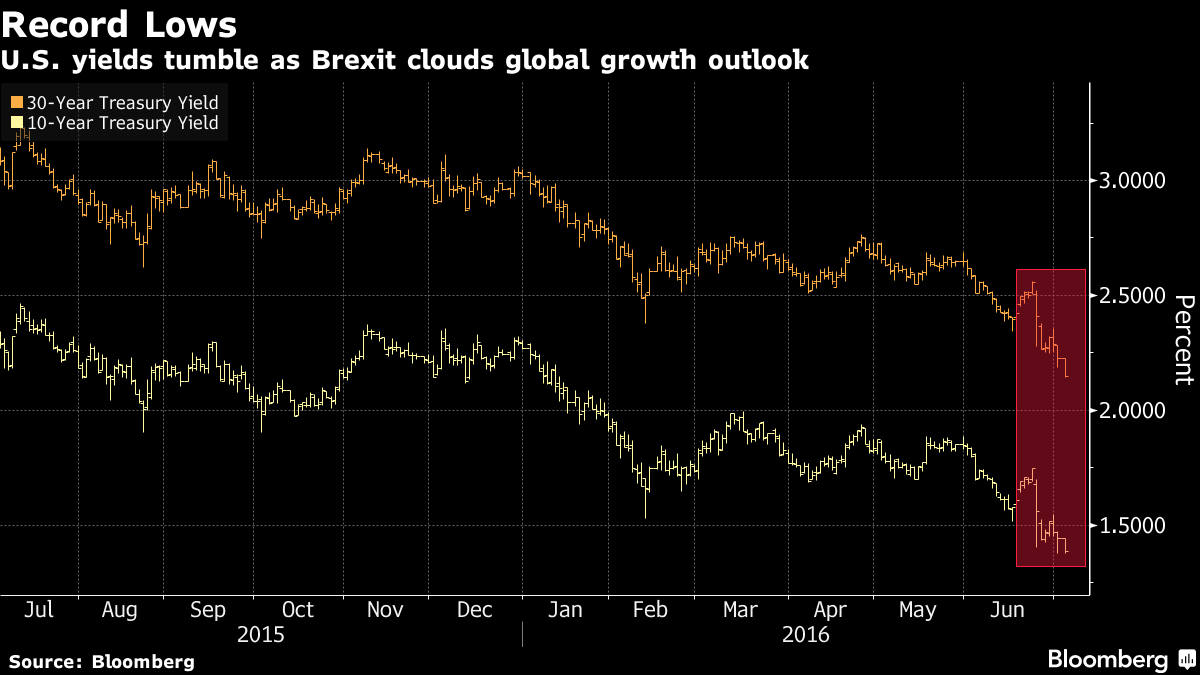
Rates can go lower from here.  For as long as I can remember, I have been told by many experts that rates can’t go lower, or, that they must go up — there is no way they can go lower.  I have argued with that idea, as has Hoisington (Lacy Hunt), Gary Shilling and a few others.

Note also that the Fed and most central banks have been on the wrong side of this as well.  They keep saying that inflation will come, economic activity will pick up, and that interest rates will rise.

The Fed keeps saying that they will tighten policy.  I’ll tell you this — with only 0.82% between the yields on 10- and 2-year Treasuries, the Fed is not tightening.

WIth debt levels as high as they are (both government and private), trying to influence economic activity though interest rates is a dumb idea.  Incenting borrowers to borrow more is difficult, aside from the government — and they rarely do anything with the money that helps produce opportunities for greater economic activity.

We would be better off without “policymakers” trying to “stimulate” the economy, “manage” it, “stabilize” it, etc.  (But where is the political will to change things — the populace wants easy prosperity, and who is there to tell them to accept a rough world where work and competition is tough, and there is no “Big Daddy” to make life easy?  The people are the problem.  The politicians are only a symptom.)

There is one thing that could change this, but it would lay bare the intellectual and moral bankruptcy of what policymakers have been trying to do, which is try to maintain the real value of debt claims while still trying to “stimulate” the economy.  They could burn away the value of debt claims through an inflation greater than that of the 1970s.

So far, they aren’t willing to do that.  But their existing policies will prolong the stagnation.

And as such, rates can fall further — with a lot of noise/variation around it.

06 Jul 05:31

Planning Works but not Always

by atanu

Walter E Williams “Wealth comes from successful individual efforts to please one’s fellow man … that’s what competition is all about: “outpleasing” your competitors to win over the consumers.”
— Walter E Williams.

Part II.

I ended the previous bit of this essay with these questions: First, why is it that central planning appears to work in familial situations and in firms but not in economies? Second, does planning really work for firms and corporations? Finally, if it is indeed true that centralized planning does not work at the economy level, why do petty despots (like Nehru) go for it despite the ruin it causes?

I will address the first two questions here and the third question in the next part.

Let’s see why planning works in families. The parents are emotionally motivated to do what’s best for the family and are best placed to plan for the family simply because they care. They know the preferences of family members, know the means available, the tradeoffs involved, and so on. The information and computing power required to get to an approximate solution to meet the objectives are well within their cognitive capacity. Though not trivial, planning for a family is a manageable task.

Planning at the firm level is non-trivial and therefore there are significant failures. We should remember that most firms fail. We get to know only of those that survive in the competition. Their plans worked. Furthermore, like all things, firms are not immortal. They are born, live for a while and then die. Most die in infancy and only a few grow up to be mega-successes. The relentless force of market competition weeds out those that are unable to plan successfully.

The corporate plans that work are due to a combination of perseverance, diligence and a great deal of luck. It is hard to pick winners. It has to be so because if you could pick winners, you would be fabulously rich by investing in those firms that win and make it big. This is lesson number one: that you never know with any certainty which plans would work and which won’t. Fortunately for us, even though most firms fail, we can be certain that some will work and that’s what is important for the economy. The corollary to that is when anyone is deluded enough to think that they can pick winners, you can safely bet they can’t. Economy-wide central planners engage in trying to pick winners, and end up picking losers. The numbers are against them.

It is a numbers game, start to finish. Assuming that a startup’s survival into the next year is, say, 10%, then out of a 1000 firms that started on a particular year, you would expect only one to be around after year three. Further assume that after three years, the infant stage is over and with maturity, the survival rate climbs. Of these surviving firms, some go on to become large firms and some become humongous.

In the Silicon Valley, an area of about 25-mile radius in the San Francisco bay area, there are many fabulously successful firms (Apple, Google, Facebook) and hundreds more big, important firms. These helped push the economy of California to be the 6th largest economy in the world. How successful is California’s economy? California’s population is around 3% of India’s but California’s GDP is 125% of India’s.

Part of the reason for the Silicon Valley’s successful corporations is that it is relatively easy to start a company here. There are tens of thousands of startups every year, which guarantees that a handful will win the numbers game. No central planning board of wise men from some government agency is needed to choose winners. The market picks winner.

Let’s dig a bit into what “the market picks winners” means. There are two major market forces involved: the investors and the consumers. The investors are motivated to pick winners because it’s their money on the line. If they choose wisely, they win — meaning that the company they invested in is profitable. Being profitable means that the company’s products are bought — chosen — by the consumers, and that the cost of making those products is less than the benefits. It’s profits all around: the investors, the firm, and the consumers.

Note that all this is decentralized decision making. Investors choose which firms to back, firms choose what to make, and consumers choose what to buy. There is no compulsion involved. That’s what is meant by the “free market” — people freely choose what they do in the marketplace. They are all motivated by the single-minded pursuit of profits. But wait, that’s not all. The carrot of profits in the market is balanced with the stick of losses in that same market. The free market is a “profit and loss” system. The discipline of losses keeps all marketplace participants from making rash decisions. Those who err systematically are weeded out by the impersonal judgement of the market.

I am the average consumer, not an entrepreneur or an investor. All I care about are my own needs and whether I have choices in the marketplace. I don’t care what goes on in the insides of corporations, how they make their decisions, etc. When I think of buying a tablet, for example, I choose among the various producers. I cannot make or break a tablet company but if enough consumers feel one way or the other, the company can go belly up. The consumer is the king in a free market, and the company merely a serf trying its best to please the king.

This is what I mean when I say that planning appears to work in firms. Firms that are incompetent in their planning, fail. Eventually, every firm fails but there are others to take the space so vacated. A modern, advanced, industrialized society depends on firms successfully competing to produce goods and services that consumers value enough to buy them.

In the next bit, we’ll see why centralized planning cannot work in any modern economy. Let’s close with another quote from Walter E. Williams:

“What we call the market is really a democratic process involving millions, and in some markets billions, of people making personal decisions that express their preferences. When you hear someone say that he doesn’t trust the market, and wants to replace it with government edicts, he’s really calling for a switch from a democratic process to a totalitarian one.”


06 Jul 05:20

One man took on a bank…oops banking system

by subra
when we have a problem…we just give up. My RM for example calls me and asks ‘you have sent me this reminder no. 234 this is for which matter’. They actually do not care a fig about what you need…so you do give up..but this man did not..read on You need to take on the […]
06 Jul 05:14

Accounting Sub-standards- Disclosure is sin

by Bala

I do not know why the CA Institute calls them ‘Accounting Standards”. See this latest leeway given to companies

http://www.thehindubusinessline.com/markets/stock-markets/new-accounting-standards-sebi-extends-timeline-for-reporting-results/article8812121.ece?homepage=true

The leeway has been given by SEBI, but surely, it is what the industry wants. Soon we will come to a stage where the company will be given an option to just say that accounts have been audited and disclosing numbers is optional.

Consolidation of accounts, doing away progressively with information disclosure and increasing level of obfuscation has been the trend in accounting disclosures over the last three decades. The story telling in the annual reports now extend to almost a 100 pages and numbers are mere annexures with minimal information.

The ICAI is not to be blamed. After all , they have to serve the masters that pay them. It is only on paper that ‘shareholders’ appoint the auditor. In reality it is the promoter who does. And fees has many components. Soon we will just do with ‘directors’ statements. After all, not even analysts read annual reports.


04 Jul 14:39

The ignored sector of 1991 reforms: Agriculture..

by Amol Agrawal
Prof. Ashok Gulati, (perhaps) the lone agricultural voice in media writes on how 1991 reforms have barely touched agriculture sector: Unfortunately, there was no reform package for agriculture as a sector — unlike industry and trade policy. There was only minor tinkering with agriculture policies, as in the case of fertiliser pricing or opening up exports […]
04 Jul 14:29

Figuring the shifting tectonic plates due to Brexit..

by Amol Agrawal
Prof Sanjay Reddy of New School has a piece on the topic: The Brexit referendum is nothing less than an earthquake. But when an earthquake happens, seismologists try to understand how and why the tectonic plates had been shifting, and the pressures that had been building to bring about the event. The causes underlying every earthquake […]
04 Jul 14:28

Goal setting: some real hard questions

by subra
One of the main reasons why the Goal setting exercise is difficult is that we do not give importance to the thought process of goal setting. Let us look at some questions that we should be really asking: are our goals really OUR goals or goals laid down by society? for e.g. do you really […]
03 Jul 06:01

So much credit for so little output?

by noreply@blogger.com (Gulzar Natarajan)
A feature of China's recent economic growth has been the central role of debt. Real estate and now stock markets are sustained by ever increasing volumes of debt.

The graphic below captures the scale of capital misallocation without proportionate increase in output.

Total social financing, a broad measure of funds secured by households and non-financial companies, topped $22 trillion in March, more than twice China’s $10.4 trillion GDP, according to official data. There’s no equivalent metric in the U.S., but household debt stood at $14.3 trillion while non-financial debt totaled $13 trillion at the end of the first quarter, according to the Federal Reserve. The combined tally of $27.3 trillion is roughly 1.5 times the U.S. GDP.
The scale and speed of credit expansion has been staggering!

Update 1 (05.07.2016)
Bloomberg captures the scale of credit growth in China in terms of the difference between its present rate and trend rate. It is atleast a quarter more than the trend rate.
China analyst Charlene Chu estimates that as much as 22% of all China's outstanding credit may be non-performing by the end of 2016, compared with the official bad-loan number for banks in March of 1.75%. Recognition of bad loans is clearly an area where India trumps China!
Add to Technorati Favorites
03 Jul 06:00

Speaking of Freedom of Speech

by atanu

In my view, freedom of speech is a non-negotiable right that free people have. It is a natural right, not a right that is artificially conjured. Human dignity is lost when the right to express what you think is restricted. I regret the fact that Indians don’t have genuine freedom of speech. Here’s a piece I wrote for the June issue of India Currents. Excerpt:

Publishing anything that the government is likely to take serious offense to is akin to publishing an invitation to officialdom to please come and shut down the business on some pretext or the other; and also to audit the accounts; and to get an income tax raid done on your home immediately; and file a few cases against your business which the courts will take decades to settle.

For the record, I reproduce the full piece below.

Speaking of Freedom of Speech

Many of my NRIs friends, generally a well-informed group, are often surprised to learn that their resident Indian cousins don’t have the kind of freedom of speech they routinely enjoy in the US. They assume quite reasonably that in India too, just like in the US — both celebrated as exemplars of robust democracy — there are constitutional guarantees against governmental restrictions on the freedom of speech and the press. This is unfortunately not so.

Some time ago, while discussing the details of the content the editorial staff of an Indian newspaper would expect in a column, I was told that I was free to write about anything I wanted. But I was cautioned to stay clear of any criticism of the powers that be. Not just in general terms, I was told not to find fault with two specific politicians in power, whom I cannot name here for obvious reasons (privacy being only one of them.)

That happens in India but will not happen in the US. Here’s why.

The difference arises from the constitutions of the two. The First Amendment to the US Constitution (the first of 10 items that is the US “Bill of Rights”) states, in part, that “Congress shall make no law . . . abridging the freedom of speech, or of the press . . .” The important bit is that the US constitution does not grant the freedom of speech because that freedom is not for it to grant or withhold. The freedom of speech exists prior to the constitution; the amendment merely recognizes that fact by explicitly prohibiting any law that may tamper with it.

As it happens, the First Amendment to the Indian constitution, introduced by Mr J. Nehru in 1950 also, among other matters, deals with the freedom of speech and of the press. There are two major distinctions, though. First, I cannot quote the Indian amendment in its entirety here. The US 1st amendment is only 45 words long and is in plain English; the Indian counterpart is around 1750 words of impenetrable legalese.

Second, the Indian amendment grants the right to free speech. What the constitution grants, the constitution can also take away. In the finer details it says in essence that Indians are free to speak or write whatever they wish — provided the government agrees with it.

In short, you may speak or write admiringly about the emperor’s new clothes but you cannot point out that perhaps the emperor is naked. In fact, you are tacitly urged by the emperor to write encomiums on the brilliance of his attire.

You may ask, what does “tacitly urged” mean here? It means that when money speaks, you don’t need to. The Indian Ministry of Information and Broadcasting has a very, very large budget. (Why India has to have what amounts to a ministry of government propaganda is a matter for another day.) Currently it’s about Rs 4000 crores or about US$ 600 million a year. That’s the central budget; I presume the states have their own I&B budgets. Part of that humongous amount is spent on government advertisements in newspapers. Ruling politicians have the power to financially ruin any newspaper by withholding ads.

Even cognitively challenged people — and people who run newspapers are not stupid — know which side the bread is buttered, if you get my drift. But even if you lay that carrot aside (pardon the mixed metaphor), you have to mind that heavy stick. There are literally thousands of pages of rules and regulations that apply to all kinds of organizations, including publishing. No one really knows everything about what they are but it is quite easy to run afoul of some regulation or the other, if an inquiry was to be initiated against any business.

Publishing anything that the government is likely to take serious offense to is akin to publishing an invitation to officialdom to please come and shut down the business on some pretext or the other; and also to audit the accounts; and to get an income tax raid done on your home immediately; and file a few cases against your business which the courts will take decades to settle.

The freedom of speech and of the press forms part of the foundation of a free society. The other rights such as the right to choose who shall be entrusted with governance — democracy and all that — are rendered meaningless if one is ignorant about the deeds and misdeeds of those who govern. The search for good governance is bound to be fruitless if one has to do it blindfolded, which is what it amounts to when people lack the freedom to examine the government critically, fearlessly and frankly.

Perhaps Indians need to fight and win some real freedom, and not just be satisfied with dubious nominal freedoms that are granted only provisionally and exercised rarely for fear of government reprisals.


03 Jul 05:59

The less than benign effects of PE investments

by noreply@blogger.com (Gulzar Natarajan)
Fascinating investigative report in the Times on the increasing role of private equity firms in the delivery of essential public services, especially emergency services, in the US since 2008. It documents the problems faced by ambulance service providers TransCare and Metro/Rural whose promoters aggressive cost cutting, revenues increasing, and financial efficiency driven strategies  not only led to their bankruptcies but also seriously compromised emergency services. It writes,
Unlike other for-profit companies, which often have years of experience making a product or offering a service, private equity’s primary expertise is in making money. And in many of these businesses, The Times found, private equity firms applied a sophisticated moneymaking playbook: a mix of cost cuts, price increases, lobbying and litigation. In emergency care and firefighting, this approach creates a fundamental tension: the push to turn a profit while caring for people in their most vulnerable moments. For governments and their citizens, the effects have often been dire. Under private equity ownership, some ambulance response times worsened, heart monitors failed and companies slid into bankruptcy... Private equity gained new power and responsibility as a direct result of the 2008 crisis. As cities and towns nationwide struggled to pay for basics like public infrastructure and ambulance services, private equity stepped in... Since the 2008 financial crisis, private equity firms have gone from managing $1 trillion to managing $4.3 trillion — more than the value of Germany’s gross domestic product — according to the advisory firm Triago. Retirement nest eggs are fueling the growth and sharing in private equity’s risks and returns: Nearly half of private equity’s invested assets come from pensions...
Warburg Pincus, Kohlberg Kravis Roberts & Company, and other major private equity firms have invested in emergency services, a business that routinely holds the lives of customers in its hands. While this represents one small corner of private equity, which traditionally used debt to seize underperforming companies, it captures the industry’s newfound pervasiveness. K.K.R. — a firm memorialized in “Barbarians at the Gate,” a book that chronicled a defining 1980s Wall Street deal — also invested in public water services. Blackstone is now America’s largest landlord of rental houses. And in the mortgage industry, until recently the province of banks, the Fortress Investment Group controls a huge bill collector.
Another article documents similar problems in the housing market by tracking the activities of three of the dozen or so largest PE firms. Their entry was facilitated in the aftermath of the sub-prime crisis when the Federal government agencies sold tens of thousands of discounted mortgages to PE investors, with limited safeguards and protections for homeowners. Further, big banks and regional lenders too pulled back after regulatory backlash for aggressive foreclosures. The PE firms that swept into that space, mopping these houses up as another one of their distressed assets, applied their standard industry practices on individual homeowners, with less than benign consequences. The Times writes,
The rising importance of private equity in the housing market is one of the most consequential transformations of the post-crisis American financial landscape. A home, after all, is the single largest investment most families will ever make. Private equity firms, and the mortgage companies they own, face less oversight than the banks. And yet they are the cleanup crew for the worst housing crisis since the Great Depression...


Lone Star Funds’ mortgage operation has aggressively pushed thousands of homeowners toward foreclosure, according to housing data, interviews with borrowers and records obtained through a Freedom of Information request. Lone Star ranks among the country’s biggest buyers of delinquent mortgages from the government and banks. Nationstar Mortgage, which leaped over big banks to become the fourth-largest collector of mortgage bills, repeatedly lost loan files and failed to detect errors in other documents. These mistakes, according to confidential regulatory records from a 2014 examination, put “borrowers at significant risk of servicing and foreclosure abuses.” Unlike the banks, Nationstar wears many hats at once: mortgage bill collector, auction house for foreclosed homes and lender to new borrowers. By working every angle, and collecting fees at each step, the company faces potential conflicts of interest that enable it to make money on what is otherwise a costly foreclosure process.
In the rental market, The Times found, other big private equity firms largely bypassed the nation’s poorest neighborhoods as they scooped up and renovated foreclosed homes across the country. Those firms include Blackstone, a huge private equity firm and the nation’s largest private landlord of rental houses. These decisions point to shortcomings of the government’s response to the housing crisis. Rather than enact sweeping changes to housing policy, the government largely handed the problems to a new set of companies.
The script that invited PE firms into the housing market has not played out as expected,
In 2012, America was still in the grips of the worst housing crisis in decades. Foreclosure signs lined the American landscape, casting a shadow on more than 3.5 million homes... And soured mortgages made by banks were weighing on the government because it had insured them against default. The government, eager to stem its own losses, decided to ramp up the sale of distressed mortgages to investors. In all, it has sold more than 100,000 soured mortgages to investors — one of the largest such series of sales. The mortgage sales enticed private equity firms like Lone Star into the mortgage market, where they saw bargains.
Housing officials reckoned that private equity firms would bring about change. For one thing, these firms were among the only investors with pockets deep enough to take on billions of dollars worth of ailing mortgages. And they could be more flexible than the banks in keeping Americans in their homes because they had bought the mortgages at steep discounts. But instead of showing greater flexibility, Lone Star — much like the banks before it — has often remained rigid about modifying mortgages. And in some cases it has moved quickly to foreclose, taking possession of homes to sell them, according to dozens of court proceedings, as well as interviews with borrowers and housing advocates.
Further, as Rana Faroohar has written in her recent book, the concentrated entry (into a few markets) of PE firms may have forced up property prices in those areas, a fact reflected in the continuing decline in share of Americans who call themselves homeowners, and spawning a widening inequality in the market,
PE investors have become the single largest group of buyers in the residential housing market, purchasing $20 bn worth of steeply discounted properties between 2012 and 2014 alone and reaping huge rewards as housing prices have slowly risen from their troughs. Blackstone, the biggest PE firm, with more than $330 bn in assets under management, has become the richest investor landlord in the country, with a portfolio of 46,000 homes and other properties that generated $1.9 bn worth of income in 2014, making real estate the largest profit center for the firm... One study of the housing market in cities and towns across America found that the top 10% richest markets, ranked by the aggregate value of owner-occupied homes, held 52% of total housing wealth, equivalent to nearly $4.4 trillion. The bottom 40%, by contrast, held only 8%. It's a stark statement about who has profited, and who hasn't, from the housing recovery. 
The causal chain has played perfectly to script. As the flush of institutional money has raised property prices, housing has become unaffordable for an increasing number, who have sought to rent than own, thereby forcing up rents, and increasing the profitability of PE investments,
Not since 1986 have fewer rental properties been empty in the US, and rents are rising sharply in many cities as a result. According to Harvard's Joint Center for Housing Studies, the share of moderately to severely cost-burdened renters (meaning those who pay at least 30% of their income in rent) grew to represent half of all American renters in 2013, up from 38% in 2000. "We get losts of people coming to us saying, we wanted to own, but all the affordable properties have been bought up, so now, we're renting from Blackstone for more than the price of a mortgage," says Atlanta-based Tony Romano, the organizing director for the nonprofit Right to the City alliance , which has produced a number of studies on the consequences of PE moving into the housing market. 
Add to Technorati Favorites
30 Jun 06:08

Markets in education - Growing too large and too fast is hard

by noreply@blogger.com (Gulzar Natarajan)
The publicly financed but independently run Charter Schools are often thought as the solution to addressing quality in school education in the US. It was, therefore, with great expectations that Michigan embraced Charter Schools a few years back in an effort to improve its schools. As a Times investigation indicates, the results have been less than benign, with less than 10% of high school seniors being "college ready" on reading tests,
Detroit schools have long been in decline academically and financially. But over the past five years, divisive politics and educational ideology and a scramble for money have combined to produced a public education fiasco that is perhaps unparalleled in the United States. While the idea was to foster academic competition, the unchecked growth of charters has created a glut of schools competing for some of the nation’s poorest students, enticing them to enroll with cash bonuses, laptops, raffle tickets for iPads and bicycles. Leaders of charter and traditional schools alike say they are being cannibalized, fighting so hard over students and the limited public dollars that follow them that no one thrives. Detroit now has a bigger share of students in charters than any American city except New Orleans, which turned almost all its schools into charters after Hurricane Katrina. But half the charters perform only as well, or worse, than Detroit’s traditional public schools...
To throw the competition wide open, Michigan allowed an unusually large number of institutions, more than any other state, to create charters: public school districts, community colleges and universities. It gave those institutions a financial incentive: a 3 percent share of the dollars that go to the charter schools. And only they — not the governor, not the state commissioner or board of education — could shut down failing schools. For-profit companies seized on the opportunity; they now operate about 80 percent of charters in Michigan, far more than in any other state. The companies and those who grant the charters became major lobbying forces for unfettered growth of the schools, as did some of the state’s biggest Republican donors... Even as Michigan and Detroit continued to hemorrhage residents, the number of schools grew. The state has nearly 220,000 fewer students than it did in 2003, but more than 100 new charter schools. As elsewhere across the country, charters concentrated in urban areas, particularly Detroit, where the public schools had been put under state control in 1999. In 2009, it was found to be the lowest-performing urban school district on national tests... Detroit was soon awash in choice, but not quality.
It has this on the dynamics of choice, 
Nationally, some charter school groups praise Michigan for allowing so many institutions to grant charters. But the practice has also allowed bad schools to languish: When universities have threatened to close them, other universities have granted another charter. By 2015, a federal review of a grant application for Michigan charter schools found an “unreasonably high” number of charters among the worst-performing 5 percent of public schools statewide. The number of charters on the list had doubled from 2010 to 2014. “People here had so much confidence in choice and choice alone to close the achievement gap,” said Amber Arellano, the executive director of the Education Trust Midwest, which advocates higher academic standards. “Instead, we’re replicating failure.”
The campaign to attract students would not be out of place even in Kota in Rajasthan,
With all the new schools, Detroit has roughly 30,000 more seats, charter and traditional public, than it needs. The competition to get students to school on count day — the days in October and February when the head count determines how much money the state sends each school — can resemble a political campaign. Schools buy radio ads and billboards, sponsor count day pizza parties and carnivals. They plant rows of lawn signs along city streets to recruit students, only to have other schools pull those up and stake their own.
And about the inequitable effects of such unfettered markets and choice in Detroit,
Charter schools are concentrated downtown, with its boom in renovation and wealthier residents. With only 1,894 high school age students, there are 11 high schools. Meanwhile, northwest Detroit — where it seems every other house is boarded up, burned, or abandoned — has nearly twice the number of high school age students, 3,742, and just three high schools. The northeastern part of the city is even more of an education desert: 6,018 high school age students and two high schools to serve them. In a city of 140 square miles, transportation adds another layer to school selection. Few schools offer busing. And Detroit, long defined by the auto industry, never invested much in public transportation. A mile and a half to school can become an hour-and-a-half journey. 
 The verdict after nearly two decades of markets and competition,
For parents, the search remains for good schools — charter or public.
Several lessons from this excellent long form. The point that unfettered markets, or even any unregulated market, can help achieve learning outcomes is pure logical fantasy and does not need any reiteration. I have also blogged several times that over a long enough period, greater choice is more likely to generate sub-optimal outcomes. 

The more important point here is that Michigan tried to expand Charters across the State is quick time and it failed. Doubtless Michigan's already weak education system had made the original challenge even more daunting. But even good school systems will struggle to cope up with the scope of what Michigan did. 

This has great relevance to public policy at large. The challenge is not so much as to produce islands of excellence as to use public policy to improve the general standards across entire systems. And, as the example of choice and vouchers has shown, the two are not exactly similar, maybe even contradictory, set of challenges. Governments in many parts of the world, especially in developing countries, face the challenge of turning around poor performing education and healthcare systems. They are attracted by innovations like Charter schools, vouchers, capitation payment model, health insurance, PPPs and so on in the belief that such initiatives can quickly help improve general standards. But as the example of Michigan and several others from across the world and over time show, the desired transformations rarely ever happen. 

Thailand did not develop its capitation model of healthcare in a few years. It carefully built up its primary care and other public facilities over decades so that when it embraced the capitation model at the turn of the millennium, it had in place the foundations to support the model. Similarly, Finland developed its impressive school system over decades of effort. It struggled over generations to create the present eco-system which values education and teaching.

Transforming poor quality education and health systems take time and are generational projects. It requires careful design, persistent and laborious efforts, close engagement among stakeholders, flexibility in implementation that allows local initiative, enormous patience, and deep tolerance for failures. Unfortunately, the political and administrative dynamics of change are not readily amenable to such long drawn approaches. 

In the circumstances, the best that can be done is to understand the challenge in its true perspective. Then a two-track approach would have to be followed. At one level, the long-term enablers have to be gradually eased in to achieve the transformation. At the more immediate level, there has to be a steady stream of initiatives that respond to political and administrative exigencies and imperatives. I'll try to outline the specifics of such a strategy in coming posts. 
Add to Technorati Favorites
29 Jun 07:47

The Four Tools of Discipline

by Farnam Street Team

“The life of wisdom must be a life of contemplation combined with action.”

***

Life is full of problems. We can moan about them or we can solve them. Scott Peck argues in The Road Less Traveled: A New Psychology of Love, Traditional Values and Spiritual Growth that discipline is the toolbox for solving problems.

Peck’s argument is based on the notion that most of us want to avoid problems – they are painful and often lead us to confront our humanity. They are frustrating. There are false starts. We lack consistent frameworks for improvement. They cause us to feel sad and lonely; things we’d rather avoid. The mental pain and strain often rivals physical pain. Yet Peck argues it is in this “whole process of meeting and solving problems that life has meaning.”

Problems call forth our courage and our wisdom; indeed, they create our courage and our wisdom. It is only because of problems that we grow mentally and spiritually. When we desire to encourage the growth of the human spirit, we challenge and encourage the human capacity to solve problems, just as in school we deliberately set problems for our children to solve. It is through the pain of confronting and resolving problems that we learn.

As Benjamin Franklin said, “Those things that hurt, instruct.”

This is why some of us come to welcome problems. Most of us, however, fear them.

Fearing the pain involved, almost all of us, to a greater or lesser degree, attempt to avoid problems. We procrastinate, hoping that they will go away. We ignore them, forget them, pretend they do not exist. We even take drugs to assist us in ignoring them, so that by deadening ourselves to the pain we can forget the problems that cause the pain. We attempt to skirt around problems rather than meet them head on. We attempt to get out of them rather than suffer through them.

Ultimately however the suffering from avoiding reality is more painful than reality itself. You can see where this goes right? Now we want to avoid the pseudo-reality that we created to avoid the reality. And so it builds, layer on layer.

Avoiding problems avoids the growth opportunity. Most of the time problems don’t go away, rather they grow.

This inclination to ignore problems is once again a simple manifestation of an unwillingness to delay gratification. Confronting problems is, as I have said, painful. To willingly confront a problem early, before we are forced to confront it by circumstances, means to put aside something pleasant or less painful for something more painful. It is choosing to suffer now in the hope of future gratification rather than choosing to continue present gratification in the hope that future suffering will not be necessary.

The Four Tools of Discipline

What are these tools, these techniques of suffering, these means of experiencing the pain of problems constructively that I call discipline? There are four: delaying of gratification, acceptance of responsibility, dedication to truth, and balancing.

Easy to learn and yet hard to employ. These are the tools to confront problems and thus pain.

1. Delaying Gratification

Delaying gratification is a process of scheduling the pain and pleasure of life in such a way as to enhance the pleasure by meeting and experiencing the pain first and getting it over with. It is the only decent way to live.

2. Accepting Responsibility

The extent to which we will go to avoid responsibility should come as no surprise. Accepting responsibility is emotionally uncomfortable. We often feel, incorrectly, that we can solve a problem by saying “That’s not my problem.” Other times we hope that someone else will just solve it for us.

I can solve a problem only when I say “This is my problem and it’s up to me to solve it.” But many, so many, seek to avoid the pain of their problems by saying to themselves: “This problem was caused me by other people, or by social circumstances beyond my control, and therefore it is up to other people or society to solve this problem for me. It is not really my personal problem.”

There are extremes of responsibility.

The neurotic assumes too much responsibility; the person with a character disorder not enough. When neurotics are in conflict with the world they automatically assume that they are at fault. When those with character disorders are in conflict with the world they automatically assume that the world is at fault.

Just remember …

Whenever we seek to avoid the responsibility for our own behavior, we do so by attempting to give that responsibility to some other individual, organization, or entity.

3. Dedication to Reality

This sounds a lot like Joseph Tussman’s wise advice. Most of us have problems confronting reality because it does not line up with how we want the world to work. The rise of a political figure that we don’t support baffles us because in our mind the world shouldn’t work that way.

What Peck outlines below is a version of the map and terrority problem.

Superficially, this should be obvious. For truth is reality. That which is false is unreal. The more clearly we see the reality of the world, the better equipped we are to deal with the world. The less clearly we see the reality of the world— the more our minds are befuddled by falsehood, misperceptions and illusions—the less able we will be to determine correct courses of action and make wise decisions. Our view of reality is like a map with which to negotiate the terrain of life. If the map is true and accurate, we will generally know where we are, and if we have decided where we want to go, we will generally know how to get there. If the map is false and inaccurate, we generally will be lost.

While this is obvious, it is something that most people to a greater or lesser degree choose to ignore. They ignore it because our route to reality is not easy. First of all, we are not born with maps; we have to make them, and the making requires effort. The more effort we make to appreciate and perceive reality, the larger and more accurate our maps will be. But many do not want to make this effort. Some stop making it by the end of adolescence. Their maps are small and sketchy, their views of the world narrow and misleading. By the end of middle age most people have given up the effort. They feel certain that their maps are complete and their Weltanschauung is correct (indeed, even sacrosanct), and they are no longer interested in new information. … Only a relative and fortunate few continue until the moment of death exploring the mystery of reality, ever enlarging and refining and redefining their understanding of the world and what is true.

This biggest problem isn’t that our maps are inaccurate but rather that we fail, especially as we age, to revise them. The world is always changing. As Heraclitus said, No man can step in the same river twice.

The world itself is constantly changing. Glaciers come, glaciers go. Cultures come, cultures go. There is too little technology, there is too much technology. Even more dramatically, the vantage point from which we view the world is constantly and quite rapidly changing.

When we’ve worked so hard over so many years to create a map that we believe represents the world, we tend to ignore information that would suggest we need to redraw our map. We become defensive. Often we don’t even passively ignore this information. We go further. We denounce it or crusade against it. We feel that people who listen to it are idiots and we are the only ones who see the truth. Rather than change our map, we often try to (mentally) destroy the new reality and those that subscribe to it.

Pride and ego come into play.

Truth or reality is avoided when it is painful. We can revise our maps only when we have the discipline to overcome that pain. To have such discipline, we must be totally dedicated to truth. That is to say that we must always hold truth, as best we can determine it, to be more important, more vital to our self-interest, than our comfort. Conversely, we must always consider our personal discomfort relatively unimportant and, indeed, even welcome it in the service of the search for truth.

Openness to Challenge

What does a life of total dedication to the truth mean? It means, first of all, a life of continuous and never-ending stringent self-examination. We know the world only through our relationship to it. Therefore, to know the world, we must not only examine it but we must simultaneously examine the examiner.

The only way we can ensure our map is correct and accurate is to expose it to the criticism of others. There might be a better answer than the one you have. We need an outside view, otherwise we live in a closed system. The tendency to avoid being challenged is a characteristic of human nature.

4. Balancing

Balancing is the discipline that gives us flexibility. Extraordinary flexibility is required for successful living in all spheres of activity.

[…]

To function successfully in our complex world it is necessary for us to possess the capacity not only to express our anger but also not to express it. Moreover, we must possess the capacity to express our anger in different ways. At times, for instance, it is necessary to express it only after much deliberation and self-evaluation. At other times it is more to our benefit to express it immediately and spontaneously. Sometimes it is best to express it coldly and calmly; at other times loudly and hotly. We therefore not only need to know how to deal with our anger in different ways at different times but also how most appropriately to match the right time with the right style of expression. To handle our anger with full adequacy and competence, an elaborate, flexible response system is required. It is no wonder, then, that to learn to handle our anger is a complex task which usually cannot be completed before adulthood, or even mid-life, and which often is never completed.

[…]

Balancing is a discipline precisely because the act of giving something up is painful.


The Four Tools of Discipline.
Click To Tweet


***

The Road Less Traveled is a fascinating exploration of what it means to be human and to struggle to get better.

--
Sponsored by: Slack - Making teamwork simpler, more pleasant, and more productive.

28 Jun 06:41

The Panama Canal Locks and perils of low-ball bids

by noreply@blogger.com (Gulzar Natarajan)
As the new Locks to the 50 mile long Panama Canal, constructed at a cost of $5.4 bn, opened for traffic on Sunday, the Times has a fascinating account of the problems faced during construction
On July 8, 2009... after an intense two-year competition, a consortium led by a Spanish company in severe financial distress learned that its rock-bottom bid of $3.1 billion had won the worldwide competition to build a new set of locks for the historic Panama Canal... Disputes quickly erupted over how to divide responsibilities. Some executives appeared not to fully grasp how little money they had to complete a complex project with a tight deadline and a multicultural team whose members did not always see things the same way. Internal arguments soon gave way to bigger problems. There would be work stoppages, porous concrete, a risk of earthquakes and at least $3.4 billion in disputed costs: more than the budget for the entire project.
Seven years later, and nearly two years late, the locks have finally been declared ready to accept the new generation of giant ships that carry much of the world’s cargo but cannot fit in the original canal. To mark the occasion, Panama has invited 70 heads of state to watch on Sunday as a Chinese container ship becomes the first commercial vessel to attempt the passage from the Atlantic Ocean to the Pacific through the larger locks.
The bid process that led to the developer selection appears to have been flawed,
Three consortiums — including one led by Bechtel, an American company with an international reputation for taking on big, difficult projects — pursued the contract. The financially weakest consortium was led by a Spanish company, Sacyr Vallehermoso, which American officials called “nearly bankrupt” in one cable and “technically bankrupt” in another. Sacyr’s consortium included a Panamanian company owned by the family of the canal administrator at the time, Alberto Alemán Zubieta. The company, Constructora Urbana, in which Mr. Alemán himself previously owned stock, had already done millions of dollars in business with the canal. The other two members were Impregilo, a large Italian contractor, and Jan De Nul, a Belgian company that specializes in dredging and excavation. In March 2009, after 15 months of contentious negotiations, the three consortiums submitted their sealed bids... That July, with the nation watching on television, the bids were opened, and the result was a shocker: The underdog Sacyr group had won... When one of the bidders makes a bid that is a billion dollars below the next competitor, then something is seriously wrong
And the rock-bottom bid has thrown up the expected deficiencies,
In simple terms, to be successful, the new canal needs enough water, durable concrete and locks big enough to safely accommodate the larger ships. On all three counts, it has failed to meet expectations, according to dozens of interviews with contractors, canal workers, maritime experts and diplomats, as well as a review of public and internal records. The low winning bid, a billion dollars less than the nearest competitor’s, made “a technically complex mega-project” precarious from the outset, according to a confidential analysis commissioned by the consortium’s insurer, Hill International... 
Among the biggest risks is the concrete that lines the walls of the six mammoth locks punctuating the path between the seas. Last summer, water began gushing through concrete that was supposed to last 100 years but could not make it to the first ship. The Hill analysts had warned that the consortium’s budget for concrete was 71 percent smaller than that of the next lowest bidder. The budget also allotted roughly 25 percent less for steel to reinforce that concrete. Then there is the lock design. Tugboat captains say they cannot safely escort the larger ships because the locks are too small with too little margin for error, especially in windy conditions and tricky currents. In fact, in a feasibility study... the Panama Canal Authority had earlier concluded that the tugs needed significantly more room. The tugboats themselves are a problem, especially the 14 new boats purchased from a Spanish company, mostly for the expanded locks. To maneuver safely, they must be precisely controlled, but according to captains, they are so unstable that they operate best going backward, something that cannot be done while towing ships through the canal... the canal authority bought the tugboats for $158 million from a company later represented by the son of Jorge L. Quijano, the canal’s administrator.
The new locks exist for one reason: so that huge “neo-Panamax” ships can move far greater quantities of cargo through the canal. For them to do that, the waterway must remain deep enough so that fully laden ships do not hit bottom. But canal officials discounted warnings that they needed new sources of water, and during a recent drought, shippers had to significantly lighten their loads. Canal officials had assured the country that no new reservoirs were needed.
Poor quality of concrete and other materials, skimping on standards, and cronyism appear pervasive in the project. And then there are the standard issues of emergent project risks, like water availability in the Gatun Lake which supplies water to the Locks and design challenges with the size of locks, numbers of tugboats, and so on.

This is yet more evidence that in large infrastructure projects, it is always better to structure the bid process in a manner that emphasizes the importance of technical proficiency and financial capability of the bidder over merely the lowest bid amount. In fact, in mega projects like the Panama Canal extension, with several unknown unknowns, and where cost over-runs are inevitable, it may even be appropriate to have internal benchmark pricing for major components and disqualify bids that low-ball estimations below a certain floor threshold on each of those major heads. 
Add to Technorati Favorites
26 Jun 04:56

Slow growth world

by Muthu

You would all have read about Brexit (Britain’s exit from European Union).

It would take years for us to understand its impact on the global economy. The majority view is that it would be negative.

The general feeling across the world, especially among poor and middle class is that of anti-globalisation and anti-immigration.

After 2008 crisis, global economy is plagued by deflation, slow growth, unemployment and rising inequality. So there is lot of fear and uncertainty in the minds of the people.

China, which was growing at higher rate for last 3 decades has fallen to around 4% growth rate now (nobody  believes the data Chinese government provide).

There have been questions around even our own GDP data but even the critics acknowledge that we would be growing around 6%. Our official rate of growth is around 8%.

In a slow or no growth world, even 6% is an excellent growth rate.

This government has been doing a lot to ensure that we continue to grow at a good rate. I was having a very high opinion of this government and it has come down few notches after seeing the way they handled Raghuram Rajan issue.

We are an extremely poor nation with only $2 trillion GDP and around $1500 per capita. We need to grow at 8% to 9% for next 2 decades to catch up with where even China is now.

I’m fairly confident that the government would continue to work to make this happen.

Hopefully, if all goes well, we may be a $10 trillion economy with $7500 per capita in 2030. We would then be a middle income country. A majority of our population would be out of poverty.

The biggest challenge would be generation of employment. We are able to create only 5 million jobs a year whereas the requirement is 12 million. On the other hand, many countries in the world face labour shortage.  The best option would be to focus on skill development (no country would want unskilled labour) and encourage emigration. If the employment gap continues to persist, it would become both a major social and economic problem.

As I’ve mentioned before, the journey from $2 trillion to $10 trillion provides us excellent opportunity to grow our wealth through equity investments. In a slow growth world, our growth at a higher rate (though from a very low base) is a boon for equity investors like us.

It is very difficult to guess how Brexit would play on our stock markets in the months to come. Though Brexit has less impact on our economy, it may have a significant impact on the markets, if foreign investors decide to pull the money out.

However, as always, please do remember that in the long run markets grow in line with earnings. As long as the economy and corporate earnings are growing, these short term blips can be completely ignored.

There is nothing new you need to do now. Stick to your SIPs and stay the course.


26 Jun 04:56

Fixing the banking system

by T T Ram Mohan
The banking system is floundering. The NPA burden, which seemed manageable a few months ago, threatens to get out of hand partly because the government has not moved decisively to fix the problems in the banking sector.

We are in a situation where public sector banks (PSBs) don't want to lend or are not in a position to lend to corporates. At the most, they may provide working capital. Project finance is a no-no. Like private banks, they are happy to seek to retail loans.

PSBs don't want to lend because they don't have enough capital and because of a pervasive fear psychosis. They don't have enough capital because they are unable to effect recoveries on loans (on which they have made provisions), because the government is not infusing enough capital into them and because they are not generating enough earnings for want of adequate credit growth.

How to get out of this low-level equilibrium? First, the government must provide them enough capital- and the Rs 70,000 crore earmarked under Indradhanush just isn't enough. Secondly, they must be empowered to effect recoveries but taking suitable hair-cuts on loans and seeing viable projects through to conclusion. This isn't happening because any banker who takes a loss on a loan exposure will be implicated as a 'scamster'.

Bankers are not going to do what it takes to get projects completed and effect recoveries until they have the assurance that they won't be hauled for writing off some portion of loan dues. I have been saying for long that an apex authority which vets all loan proposals is required, otherwise bankers aren't going to lift their little fingers. The news is that such an authority is being constituted. It will have to get cracking on large loans quickly.

Some banks don't have chairmen or MDs. The Bank Board Bureau must remedy these lacunae as fast as it can. Amidst all this comes the talk of the decision to merge SBI with its associate banks. This could well go down as one of the worst decisions in banking ever. SBI needs to focus on sorting its bad loan problem first. Trying to assimilate associate banks will drain the energies of the bank for at least two or three years- and even after that one is not sure of the outcome.

Make no mistake: the SBI merger has the potential to weaken one of the strongest banks in the country and a key pillar of the banking system. A good way for the next RBI governor to give an early demonstration of his independence and assert the RBI's autonomy would be to dissuade the government from staying with this ill-advised course.

More in my article, Banking revival must be a priority.

Also read Montek Ahuliwalia's article on the subject.


26 Jun 04:56

The Nature of Wealth

by atanu

This is a work in progress. It is my take on what is wealth, how it is created, what motivates that creation, what are the barriers to it, and what can be done to remove them. The series so far:

Part 1. What’s wealth and where does it come from.
Part 2. Competition and the creation of wealth.
Part 3. The Nature of wealth. (The current part below.)

The topic is very exciting if you are the kind of person who like me is interested in figuring out how the world works, and are not that interested in the shenanigans of politicians and other such lowlife. Otherwise all this is very boring stuff that you’d be well advised to give a miss. So with that warning . . .

The Nature of Wealth

We care about wealth because it helps us meet our needs. Food, clothing, shelter are the usual categories of goods that partly constitute wealth. Two broad generalizations apply to them. First, these are essential for our survival. Second, like all wealth, they are human creations and do not exist in nature. They are unlike other two essential items for our survival because they are found in nature — air and water. Clean breathable air and drink water are there for our use without our intervention. With a few minor exceptions in the plant kingdom (coconuts, for example) and some animals (fish or deer), unaided nature did not “create” the food we eat. Certainly, the wild ancestors of the food we eat were provided by nature but nearly all of what we eat at present has been “created” through human effort. Clothing, shelter and nearly all the food we eat are clearly man-made.

Let’s call air, water, food, clothing and shelter primary wealth to distinguish it from “secondary wealth.” Primary wealth is what we directly consume. Secondary wealth is everything else that is of use but not directly or are not essential for basic survival. One category within that group is “producer goods.” These are tools like shovels and computers. They are valuable because they help in the production of primary goods or other producer goods. Secondary wealth also has another group we’ll call “quality goods“. They improve the quality of life. Quality goods and services are those we do not absolutely need for survival but without them the quality of life would suffer. These are things we need for play, entertainment and recreation.

So there we are with a rough taxonomy of wealth: primary and secondary, and within the latter, producer goods and quality goods. All wealth is produced by human beings and involves effort. The effort merely goes to re-arrange the basic matter that is provided by nature. How much effort is involved in creating wealth depends on what we know. This know-how is called knowledge or technology. Three words that are nearly interchangeable are know-how, knowledge and technology.

We’ll go into why creating a taxonomy of wealth is helpful a bit later. For now, let’s make a few generalizations about wealth. To repeat, wealth is man-made. It does not arise unbidden from nature. At some point in the life history of the planet, there was no wealth. Then one particular life-form evolved on earth — humans — that was capable of creating wealth. They began to create wealth slowly and learned how to do so with less effort. That is, they learned how to create wealth. That is what we call technology.

Electronics is technology but it comes much later in the story. The first technologies were quite primitive: how to plant what seeds, how to hunt game, how to make a fire, how to build a shelter, and so on. There’s a word for “how to do something” — recipe. Technology is a recipe or a collection of recipes.

So we have wealth creation, and that depends on technology. Technology is what we call an “information good.” If you know how to do something, and I learn it from you, I too know how to do that but it does not diminish your ability to do that something. Information good can be shared indefinitely without reducing the amount available. This is quite distinct from other goods whose stock goes down with use.

With time the stock of technology grew and with it the ability of humans to create wealth. More people meant more recipes got discovered and eventually shared. New recipes got discovered that built on previously known recipes. For example, someone discovered how to use flint to build a fire. Someone else discovered how to fire to make a durable pot out of clay.

The wealth produced by humans grew in parallel with their discovery of novel and better recipes. That wealth gets created has an important implication: there is no fixed amount of wealth that exists in nature. Human agency and effort is involved in the creation of wealth. The creation of wealth is not a zero-sum game. Meaning when someone creates wealth, it is not at the expense of other people’s wealth.

If you figure out how dig a well and collect the oily stuff to use as fuel, you have created wealth where none existed before.

Of course, one can enrich oneself by taking away other people’s wealth. That’s not creation of wealth but a transfer of wealth, and thus a zero-sum game. Creating wealth is a morally and ethically superior way of enriching oneself than stealing. No doubt the world is plagued with quite a bit of theft but fortunately it is not catastrophic. Worse than stealing is the destruction of wealth — which is a negative-sum game. Someone breaking window destroys but without enriching himself. Destruction of wealth is immoral and stupid. But there’s one activity that is even worse than that: preventing people from creating wealth.

If we consider creating wealth good and destroying wealth bad, then preventing wealth creation is evil. We’ll go down that path later.

Here we’ll focus on wealth creation. And a related topic of wealth distribution. Wealth is unevenly “distributed.” What does that mean? If there was a fixed number of something — say, 10 apples — and someone were to distribute them among two people, we recognize it as a distribution and we can judge whether the distribution was fair, or equitable, or justified. Given that there was some agency that was doing the distributing of the fixed amount, we can instruct (or force, or require) that agency to make the distribution fair or equitable for some other than that which was obtained.

But what if there is no fixed or a given amount of something, and what if that something has to be produced through the effort of some people, and that there is no one that is charge of distributing the produced amount among them? In that case, it is possible that the amounts of the production (wealth) held by different individuals to be different. In what sense can this distribution of wealth be said to be not right? And since we have posited that no one was in charge of this uneven distribution, what agency can be employed to correct the unevenness? Those matters need to be discussed at some length.

There’s another matter related to the distribution of wealth that’s worth our attention. Whenever wealth is created, everyone within that trading area where the wealth was created gains. Wealth cannot be contained and necessarily gets distributed to one and all, though certainly not evenly. Moreover, there is not way to spread the newly created wealth evenly because no agency is in charge of doing the distribution anyway. The distribution of wealth is a natural process which cannot be interfered or improved upon in any orderly way. I find this the most enchanting feature of the nature of wealth.

Let’s briefly examine my claim that whenever any wealth is created everyone within the trading area where that wealth was created gains. The gains from the creation of wealth do not reach everyone instantaneously but eventually it leaves no one unaffected. The time required for a part of the gains to reach someone depends on his physical and logical proximity of the wealth creator.

Imagine that someone in the Silicon Valley invents an awesome music player. The players fly off the shelf. That implies that the benefits to consumers must be greater than the price they pay for the player. Let’s estimate how much wealth was created. Suppose the average buyer paid $100 for it, and gained $150 worth of music listening pleasure. (This assigning a dollar value to pleasure is a handy mechanism to quantify something but is not critical to the argument that follows.)

Assume further that the cost of production of the players is $80 each. So for each player sold, the total surplus of value (the benefit $150 minus the cost $80) is $70. The total surplus is divided between the producer ($20) and the consumer ($50.) Suppose ten million units were sold. That means the inventor’s wealth increased by $200 million, and the consumers enjoyed an aggregated $700 million of net wealth.

So far we’ve only included the inventor, the manufacturer, and the buyers of those players. How does everyone else in the larger trading area (the whole world) figure in this? The fact is that each of us is connected with every other person on earth through a network of trades. What you produce, consume, buy or sell has an effect on others although that effect may be infinitesimally small, it is non-zero and those effects add up.

Ah, but one may say here, this was merely re-distribution of wealth, not really creation of net wealth. Each consumer paid $100, of which $20 went to the inventor and $80 toward the cost of production — which was given to the various factors of production such as the factory workers, etc. This argument is not correct. Why? Because there is a monotonic increase in total wealth in the world. There is more of everything in this world (with one caveat, we can go into later). There is more of everything that we collectively use: computers, cars, houses, shoes, roads, planes, clothes, or whathaveyou. There is no doubt that all of those things were produced by human effort and through a process not unlike the made-up story about a music player. A similar story can be told about everything.

Just to repeat the main point of this piece: Wealth is created by people, and does not fall out of the sky. At some point in the distant past there was very little wealth on earth. At some point there were very few people on earth. (A few hundred thousand years ago, it is estimated that the human race went through a bottleneck when the total world population was down to fewer than a thousand individuals and that the population did begin to increase until around Neolithic times.) Both facts are related.

Now there are seven billion humans, and growing. And the amount of wealth is clearly incalculable but orders of magnitude larger than it was when the human population was orders of magnitude smaller than today. Mere rearrangement of wealth could not have been the process which increased the total amount of wealth.

I will continue with my obsession with wealth the next time.


26 Jun 04:38

Brexit explained in graphics

by noreply@blogger.com (Gulzar Natarajan)
Correlation is not causation. But this set of graphics from FT (HT: MR) may be a good place to look for the underlying factors that contributed to the victory of Leave. Analysis of data from the UK's 382 counting areas (local government districts) revealed that there were five strongly correlated indicators.
The areas with large proportion of degree-educated voters and jobs requiring degrees were the biggest votaries of Remain. In contrast, those who had never left UK, were among the strongest supporters of Leave, 
In the recent London Mayoral Election, we carried out a similar analysis and found that areas where many people did not hold a passport — indicating they would not have been abroad recently — tended to yield high votes for the far-right Britain First party. The same pattern emerges here. After education and occupation, the share of people not holding a passport was the next most strongly correlated characteristic with the Leave vote.
And going against the conventional wisdom that economic integration is the path towards political integration, the Leave vote was strongest in those areas which were economically most dependent on EU, in terms of economic output exports.
Analysis of British Election Survey found that the strongest predictor of this counter-intuitive result comes from the attitudes towards immigration. Very interestingly, these are also the regions where immigration is perceived as most damaging. 
Citizens of regions where immigration is perceived as damaging are much more likely to vote for Brexit. Presumably, the unifying forces of economic dependency are more than offset by those of competition for jobs from migration and by more latent suspicions of immigration (the Survey question was "‘Do you think that immigration undermines or enriches Britain’s cultural life?")

I am inclined to agree with David Goodhart that the persistent economic weaknesses, widening inequality, and the "disappearance of a once familiar industrial working class culture and the declining status of much non-graduate employment" may have increased the attachment to the symbols and benefits of national citizenship. This squares up with much of the public commentary on the support base of Donald Trump, Front National, Five Star Movement, and others across Western Europe. 

This goes back to a theme that I have written about on numerous occasions. A robust national social safety net which assures a basic dignified human life consistent with the country's economic and social development is an absolute necessity to pacify the losers from globalization and liberalization and thereby prevent populist backlashes. This is as much sound politics as it is economics. And there are very few such areas where there is political and economic convergence. 
Add to Technorati Favorites
25 Jun 03:57

Brexit Boogeyman Bellows “Boo!”

by David Merkel

Picture Credit: Peanuts Reloaded || Perhaps today Brexit; Monday an exit from Italy or Spain; [then] Europe dismantles

Picture Credit: Peanuts Reloaded || Roughly: “Perhaps today Brexit; Monday an exit from Italy or Spain; [then] Europe dismantles”

=-==-=-=-=-=-=-=-=-=-=-=-=-=-==-=-

At a time like this, when the Brexit Boogeyman goes “Boo!” it’s time to take stock of the situation amid panic.

Though the UK will face some political unrest as the Prime Minister resigns, and article 50 is likely but not certainly invoked, the nature of political discourse hasn’t shifted in full.  Though an important question, it is only one question, and more things will remain stable than change.

At least that is most likely.  If you think of “real options” theory, you could say, “Okay, a door opened today that was previously locked.  What new doors beyond that one could be opened?”  Other countries could leave the EU and/or Eurozone [EZ].  The EU/EZ could dissolve.  The odds of other countries leaving isn’t that high.  For the EU or EZ to dissolve would take a lot of doing, and the odds of that happening is very low, though higher than the odds yesterday.

As I said a week ago:

Governments are smaller than markets; markets are smaller than cultures.

What I am saying is that almost everything affecting the needs of people will get done when there is sufficient freedom.  If Brexit occurs, the UK will negotiate some agreement that is mutually beneficial to the UK and the EU, and most things will go on as they do today.  Even with a subpar agreement, perfidious Albion is very effective at getting what they need completed.  This is especially true of their very effective and creative financial sector in the City of London without which most effective international secrecy, taxation avoidance and regulatory avoidance business could not be done.

Whatever happens, it will happen slowly.  Leaving a complex multinational group like the EU takes two years at least.  How it all works out in detail is not predictable.

I can say that human systems tend toward stability.  People act to preserve the things that they like.  Only under severe conditions does that cease to be true, and even then typically only for short periods of time.

I can also say something a little more controversial.  Wealth, assets, and money [WAM] act like they are alive and have more votes than people do under most conditions.  Why am I saying this?

Governments come in, and go out, but for the most part, the same things get done.  Those thinking that radical change will come are usually deeply disappointed.  WAM tend to maintain the status quo, not because their owners bribe politicians and suborn regulators pay political action contributions,  but because people want the streams of goods and services that help make WAM valuable.  Only a genuine crisis at least as large as the Great Depression or the Civil War can create truly radical change that reshapes the basic desires of most of the people in a nation.

Capitalist democracies that respect the rule of law (e.g., the government is also governed by a higher law) are usually pretty stable; systems that don’t have significant capitalism or democracy may last a couple generations, but tend to fall apart.

All that said, there is significant economic pressure to do two things after the Brexit:

  • Rethink the single currency and common laws
  • Maintain a free-ish trade zone in goods and services

The Eurozone does not allow for the necessary economic adjustments across nations in a fiat monetary system.  Nations need their own currencies, central banks, etc.  They also need to govern themselves via their local culture, not someplace far away with misguided idealists who think they know what’s best for all.

Free-ish trade maintains most of what is needed for human needs.  The European Union is a political construct meant to prevent war from ever recurring in Europe.  The best way to do that is through trade.  Severe wars rare start between nations that rely on each other and interact through commerce.

My view is that ten years from now, the goods and services that people want will get delivered, regardless of the governmental structures in Europe.  I will invest accordingly.

Practical Implications

Things will be rocky in the short run, and there will be more bumps along the road as the Brexit negotiations go on.  I will be resisting panic and euphoria in modest ways.  This isn’t the sum total of my strategies, but I expect that profitable business will continue, and that people and nations will pursue generally intelligent long-term self-interest as events unfold.

When I say modest, I tweak my portfolios at the edges.  Brexit does not comprise more than 5% of what I would do with assets.  As with any investment idea, spread your bets, diversify, don’t bet the farm.

And, I would say the same even to governments — if you don’t have contingency plans for the possibility of the EU shrinking or even disappearing, you are not truly prepared for all contingencies.  As Warren Buffett once said (something like) “We’re paid to think about the things that ‘can’t happen.'”

In closing, many thought that Brexit could not happen.  Now, what else “can’t happen?” 😉

25 Jun 03:49

Hawa Badlo abhiyaan – Pilot Programme to run two wheelers on CNG

by Aakash

CNG-Honda-Activa-1

In a major step to curb rising air pollution in Indian cities, the centre has launched first of its kind … (Read On...)

The post Hawa Badlo abhiyaan – Pilot Programme to run two wheelers on CNG appeared first on Capital Mind.

25 Jun 03:48

Brexit — Yes, it is exiting. Good for them!!

by atanu

brexitYesterday I predicted that Britain will vote to remain in the EU. I also said that it would be better for them to leave. I am thrilled that the popular vote proved me wrong. A little ray of sunshine in the general doom and gloom.

There’s too much news coverage of the decision. So let me point to two excellent voices that were arguing that Britain should and must leave. Watch these, not just for understanding a point of view but also how that point of view was expressed. These are object lessons in persuasion and oratory.

The shorter one first — Daniel Hannan, Member of the European Parliament. Yes, Hannan is an MEP and he argues that Britain must leave. I feel sorry for the person who has to make his/her opposing case after Hannan’s impassioned argument. It is part of the Spectator debate on “Should Britain Leave the EU?” held in April.

The other video is from a hero of mine, Pat Condell. This was recorded in May.

Pat Condell lists other videos related to Brexit at his “The Moment of Truth” page..

The issue of Brexit is a mix of politics and economics. It’s been fun and instructive for me. I hope you will take the time to enjoy the two videos.


25 Jun 03:46

Weekend reading links

by noreply@blogger.com (Gulzar Natarajan)
1. On the US Pharma industry,
A recent Plos One study found that about 36 percent of all new drugs approved in the United States between 1988 and 2005 were protected solely by secondary, or trivial, patents.
There are as many as 8.2m assault-style weapons at large in the US, which almost certainly exceeds that of any uniformed armoury in the world, barring the Russian and Chinese militaries. That is without mentioning the more than 300m estimated smaller firearms in US homes.
3. Is Uber leading a race to elimination in the car aggregator market? The company plans to undertake more fund-raising, bringing its total mobilization to $15 bn since starting out in 2009 and its valuation to $68 bn, and it has no plans in the foreseeable future to go public. To put this in perspective, when Amazon went public in 1997, it raised $54 million and was valued at $438 million! So what is the game plan?
Every time Uber raises another $1 billion, venture capital investors and others may find it less attractive to back one of Uber’s many rivals: Didi Chuxing, Lyft, Gett, Halo, Juno. In other words, Uber’s fund-raising efforts have seemingly become part of the contest: It’s not just a rivalry over customers and drivers; it’s a war of attrition, a mad scramble to starve the competition of cash. At the moment, Uber’s success has had the opposite effect: It has spawned a long list of rivals, big and little guys who say, “We can do it too.” But over time, as the smaller competitors run out of cash — after heavily subsidizing riders in an effort to steal business from Uber — venture capitalists should be less inclined to put up even more cash to go up against Fortress Uber. 
Uber’s fund-raising arms race comes against the backdrop of falling valuations for many Silicon Valley unicorns — private companies worth $1 billion or more. So there’s clearly a rush to take the money while it’s still available... So far, Uber is clearly winning the valuation game: It is worth more than virtually all of its rivals combined... Uber is currently on track to lose about $2 billion annually in China and India as it heavily subsidizes customers and drivers to gain market share.
This is clearly a race to the bottom, where only those with enough firepower will survive. But the end game could turn out different than anticipated, especially if the markets itself shrinks considerably once the subsidies are removed. 

4. More on this from this fascinating essay on Uber's challenges in China, where Didi Kuadi dominates, and where ride-sharing apps and aggregators are still not fully legal, and Uber China is an independent entity,
Typically, Uber takes a cut of about 25 per cent of the passenger’s fare and passes the rest of the fare on to the driver. Costs are kept low because Uber doesn’t employ the drivers, or own the cars. However, in China, Uber pays drivers a multiple of the passenger’s fare, meaning that the company loses money on most rides. Other Chinese ride-hailing companies employ a similar strategy... Many drivers for Uber say they would not be driving if it weren’t for the bonuses, while passengers also say they would ride less if the services became more expensive... While Uber’s services include luxury cars, cheaper rides are a bulwark of Uber’s business in China. Uber’s carpool service, with fares as low as Rmb2 (21 pence) accounts for more than half of rides in several key cities... removing subsidies altogether will not be easy. Examples from other markets show that heavily subsidised businesses sometimes just evaporate once the subsidies disappear. The taxi-hailing business of Didi and Kuaidi, which was initially fuelled by subsidies, is now a tiny fraction of their merged business and generates no revenues. Smaller ride-hailing companies in other markets, such as EasyTaxi in Jakarta, found that their business dried up completely when subsidies ended.
5. Livemint points to an India Ratings report on the asset quality of the country's top 500 corporate borrowers. It classifies their loans into four categories - stressed, elevated risk of refinance (ERR), medium ease of refinance (MER) and high ease of refinance (HER). The stressed loans form a counter-party to the Rs 5.8 trillion stressed loan book of the country's banks as on end-March 2016. The report says,
240 of the top 500 borrowers belong to the stressed and ERR (elevated risk of refinance) categories and will remain exposed to significant refinancing risk during FY17. These 240 borrowers hold about 42% of the total outstanding debt of Rs.28.1 trillion i.e. Rs.11.8 trillion, of which Rs.5.1 trillion is stressed and another Rs.6.7 trillion falls in the ERR (elevated risk of refinance) category
 And the larger share of refinancing requirement in 2016-17 is for stressed and ERR loans.
6. Livemint, again, points to the elevated debt to equity ratios and decadal low of return on equity on 303 manufacturing firms in the BSE 500.
One observation from this is that indebtedness is pervasive among the country's corporate and not the exclusive preserve of infrastructure firms.

7. Livemint feels that the "key to affordable and egalitarian housing ought to unlock India’s vacant houses first". As per census 2011, there were 2.47 vacant houses in India, or 90% of the number of rented houses in the country.
8. The Times points to the latest EPI study of income inequality in the US. The picture is very alarming.
Between 2009 and 2013, for example — a period that encompasses most of the post-Great Recession era – the top 1 percent captured all of the income growth in 15 states (Connecticut, Florida, Georgia, Louisiana, Maryland, Mississippi, Missouri, Nevada, New Jersey, New York, North Carolina, South Carolina, Virginia, Washington and Wyoming)... In all, the top 1 percent in the United States captured 85.1 percent of total income growth from 2009 to 2013. In 2013, the 1.6 million families in the top 1 percent made 25.3 times as much on average as the 161 million families in the bottom 99 percent. Those and other figures are reminiscent of conditions in the Roaring Twenties. In 1928, the peak year of that decade’s boom, the top 1 percent took home 24 percent of the nation’s income. In 2013, the top 1 percent nationally took home 20.1 percent of all income, while in five states (New York, Connecticut, Wyoming, Nevada and Florida) the income share for the top 1 percent exceeded the peak from 1928.
9. Bloomberg points to the shifts in the source and volume of US oil imports.
While Canada has become the country's largest source of oil imports, Middle East continues to play an important role.

10. The World Bank's latest report on Private Participation in Infrastructure (energy, transport, and water projects) in low and middle-income countries reveals that total investment in 2015 was $111.6 bn, compared to $111.7 bn in 2014 and $124.1 bn over the previous five years. Transportation and energy, as usual, dominated the investment destination by sector. Excluding Brazil, China, and India, investment rose 92%, on the back of Turkey’s US$35.6 billion IGA Airport (New International Airport) investment commitment. Solar energy investment rose 72% over the previous five-year average to reach US$9.4 billion and renewables captured nearly two-thirds of energy investments with private participation.
11. Ian Bremmer has this nice illustration of the web of geopolitical relationships in the Middle East.
12. Finally, on the Brexit vote, one commentator in the FT draws attention to the class divide by arguing that "the lower down the social and educational ladder you descend the greater likelihood that someone will have voted to Leave, while the best markets for Remainers is having a degree and being aged 18-29". This class divide largely replicates itself in the rise of people like Donald Trump and anti-Establishment and Far Right parties across continental Europe. But the British vote must be among the most surprising outcomes of the populist backlash against globalization, cross-national integration, and economic liberalization.

In any case, now the challenge would be about firming up the British relationship with the EU. In order to send out a strong signal to potential similar exits, the EU leaders would want to ensure that the costs of an exit are prohibitive enough. An accommodative exit for UK could encourage similar movements in other member countries. Here is a good graphic of the options available.
Another concern would be the dynamics of independence movements in Scotland, surely, and maybe Northern Ireland. The Brexit vote could well be the starting of the dissolution of the United Kingdom.

While the British exit would undoubtedly set back the European project, if the continent can weather it without further member exits or substantive reversals, it may well strengthen the Project's multi-track pathway towards integration.
Add to Technorati Favorites