Shared posts

01 Aug 04:45

CAG concerns about public debt management

by Ajay Shah
by Radhika Pandey and Bhargavi Zaveri.

The CAG report on public debt management tabled in Parliament on 26th July, 2016, has made several adverse observations on the current state of public debt management in India.

  1. It found the legal framework governing public debt lacking in several respects. The present legal framework on public debt does not define basic concepts such as 'public debt', does not indicate the objectives of public debt or the purposes of borrowing. It does not require the formulation of a strategy for the management of public debt.
  2. Over the past two decades, all expert committees have recommended setting up a public debt management agency (PDMA) for performing the debt management function. However, except for a middle office (which also does not perform the functions assigned to it), no progress has been made on this front.
  3. There is no entity that performs functions relating to the external debt of the Central Government such as analysing and monitoring risks and assessing the performance of debt managers against strategic targets or benchmarks.

Apart from the desire of the government to make more-than-incremental reforms, there are two other reasons why it is an opportune time to resume the long-delayed work of reforming the framework for public debt management in India. One, RBI has formally adopted inflation-targeting as the objective of its monetary policy, which heightens the conflict of interest between its role as the investment banker for the Government and the inflation target. All mature market economies separate debt management from monetary policy. As an example, the IMF guidelines on public debt management have emphasised that there should be separation of debt management policy and monetary policy objectives and accountabilities.

Two, RBI has formulated a road map for progressive reduction in SLR (the funds that banks are forced to keep invested in government securities). The SLR is proposed to be brought down by 0.25% every quarter till March 31, 2017. Reducing this `financial repression' is a good thing. But simultaneously, this makes life more difficult for public debt management. We need new institutional arrangements alongside breaking with the old, distortionary ways. Greater diversification of the investor base of government securities, in the quest for voluntary buyers, is required. The cosy arrangements of today for debt management and the bond market will not work in the emerging world.

It is poor policy analysis to proceed with inflation targeting, but not give the central bank the tool of a liquid bond market through which the inflation target will be achieved. It is poor policy analysis to  reduce financial repression, but not plan for the complexities of public debt management in that new environment. This article summarises the problems with the prevailing framework on public debt management in India and sketches the broad countours of a stand-alone law that should govern the same.

Problems with our public debt management framework


  1. The elephant in the room is the lack of an independent public debt management agency (PDMA). This has formed the subject of much discourse in academic and policy circles. From the mid 1990s onwards, all expert committees in India have advocated setting up the PDMA. A recent IMF Working Paper on designing legal frameworks for public debt management has advocated ``centralisation of all debt functions in one single unit to reduce fragmentation and enhance coordination in debt managment''.
  2. When a principal engages an agent to undertake a specific task, the contract between the principal and agent must be tight enough to build in accountability, performance measures, and at the same time allow the agent to perform its task without interference in transactions. While there is a lot of talk of "independence" for government agencies in India, this needs to shift to a mix of accountability on performance and autonomy on transactions. The current legal framework dealing wth public debt management in India is scattered across several laws such as the RBI Act (which obligates the Central Government to entrust the debt management function to the central bank), the Government Securities Act, 2006 (which deals with manner in which RBI will hold government securities, terms and conditions of government securities, etc.) and the Public Debt Act, 1944 (which continues to apply to Jammu and Kashmir). None of these laws codify performance measures or build accountability mechanisms for the agent to perform its task.
  3. As the RBI only deals with marketable debt, a single repository containing all the data which is required for an overall picture of the outstanding liabilities, including contingent liabilities, of the Central Government is not available. As this information is absent, it is not possible to formulate or implement a strategy for public debt management. What we do in public debt management is all transactions and no strategy.
  4. Market infrastructure for the government bond market (the exchange and clearing house) is owned and managed by RBI. The weaknesses in how this management is done has been an important source of failure in bond market development. Decisions about the appropriate market infrastructure for government bonds are best placed at the PDMA, which would be accountable for delivering low cost financing for the government, and would thus have the incentive to think about how to organise these markets.

What should a law governing public debt management look like?


The Financial Sector Legislative Reforms Commission (FSLRC) which recommended the establishment of a PDMA also drafted the blueprint of a law, the Indian Financial Code, that will govern its functioning. The key elements of the Indian Financial Code governing the functioning of PDMA are summarised below:

  1.  It defines 'public debt' to mean internal and external borrowings of the Central Government. This would ensure that there is one single entity that has an overall picture of the outstanding liabilites of the Central Government, both internal and external.
  2.  It codifies the objectives of the PDMA, namely, to minimise the cost of raising and servicing public debt over the long term and to keep the public debt within an acceptable level of risk at all times. For the first time, the manager of the public debt has clearly defined objectives which also translate into measures by which its performance may be judged.
  3. It entrusts the management of existing and contingent liabilites on the PDMA. This ties in with the requirement of having a single manager who will manage all outstanding liabilties of the Central Government. The concrete output will be a single repository of liability-related information.
  4. It codifies the relationship between the principal (Central Government) and the agent (PDMA, as the debt manager) in precise terms. For example, it obligates the PDMA to formulate an annual debt plan and a medium term (three year) debt plan, get the same approved from the Central Government and then implement it. The law also codifies detailed requirements for publication of the debt plan as well as a calendar for issuance of government securities.
  5. It obligates the PDMA to foster a liquid and efficient market for government securities. It empowers the PDMA to advise the Central Government on market design and allow equal access to this market, as an integral part of this market design. Contrast this with the existing framework which is lacking in details on the market structure for government debt.
  6. The entire machinery of governance, such as annual reports of defined standards, performance evaluation, external audits, etc. have been made applicable to the PDMA.

Conclusion


A short while ago, this work was done, but then it was rolled back. The Finance Bill, 2015 tabled in the Parliament proposed the establishment of a PDMA and its functioning broadly on lines described above. Subsequently, the reform was rolled back with a promise that the "...Government in consultation with RBI, will prepare a detailed roadmap separating the debt management functions and market infrastructure from the RBI, and having a unified financial market." It is a big missing link in the Indian reforms.


The authors are researchers at the National Institute for Public Finance and Policy.
01 Aug 04:44

The Antrix-Devas self goal

by noreply@blogger.com (Gulzar Natarajan)
The Antrix-Devas case should be a teachable moment for India's trigger-happy government auditors. 

In brief, Antrix, the commercial arm of Indian Space Research Organization (ISRO), signed a contract in 2005 with Devas Multimedia, a firm promoted by two retired ISRO scientists, whereby Devas acquired a 12 year lease of two ISRO satellites to be operated in the S-band spectrum (which was reserved for defence sector, though India does not possess the technology to use it) to broadcast high speed internet on mobile devices. Devas was to pay $300 million over the contract duration. A CAG report in 2010 found the deal vitiated. In response to the public outcry and media trial, in 2011, an embattled government cancelled the deal saying that the spectrum was necessary for defence purposes. Devas initiated two international arbitration proceedings against the contract cancellation. The International Chamber of Commerce tribunal in Paris imposed a penalty of $855 million, and the UN Commission on International Trade Law at Hague imposed another penalty. The latter ruled that the cancellation constituted "expropriation" and India breached its Bilateral Investment Treaty (BIT) commitments with Mauritius to accord "fair and equitable treatment" to foreign investors. 

The CAG in its report says it is a ‘classic case of public investment at private profit.’ It finds conflicts of interest, disregard for rules and procedures and Cabinet apparently being misled into approving the agreement... When CAG said the Devas-Antrix deal was vitiated, the beleaguered Manmohan Singh government gave in to pressure from the Opposition and baying TV channels to abruptly cancel the contract citing strategic interests... The CAG has been wrong earlier too. In 2005, it faulted the sale of two hotels of Hotel Corporation of India ─ Juhu Centaur and Airport Centaur – to single bidders. It had pointed fingers at Arun Shourie, then minister for disinvestment in the Vajpayee government. The CAG alleged the government had suffered losses because the company that won the bid for Airport Centaur for Rs 83 crore had sold it a few months later to the Sahara Group at a profit of Rs 32 crore. The bidder of Juhu Centaur could not pay the full fee of Rs 153 crore and the hotel was shuttered in 2005. An investigation by the Central Bureau of Investigation was ordered, but in 2008, the investigative agency told the government it could not find any irregularities.

The CAG had also said the treasury had been put to a loss of Rs 10.8 lakh crore by the allocation of coal blocks between 2004 and 2009. In 2015, the Modi government claimed it earned more than that amount by auctioning 20 of the 204 coal blocks whose allocation the Supreme Court had cancelled. The claim is misleading because the money will flow in over 30 years if the mines are worked to rated capacity. These cash flows have to be discounted at an interest rate to arrive at their ‘present value’ (because today’s money will not buy the same amount 30 years later).
In all these cases, the CAG has sought to expand its jurisdiction on performance audit and passed judgement on the merits of public policy actions. This is surprising since the National Audit Office (NAO) of UK, which is the model for India's CAG, has this to say about its remit
We do not comment on the merits of policy but aim to conclude on whether value for money has been secured
Consider the Devas case where the CAG definitively describes it as a "classic case of public investment at private profit". Consider the leap. It has found procedural lapses, may be even conflicts of interest. But, how does it establish malafide? Or more specifically, how does the auditor establish that these lapses are not genuine omissions or those dictated by exigencies of decision making? In any case, isn't this the jurisdiction of vigilance officials and investigators? If the CAG is competent to pronounce guilty, what is left for the departmental proceedings and criminal investigators? Finally, it is surely an extremely sweeping conclusion to describe it as a "classic case" of crony capitalism. 

The CAG is plagued by the same disease that afflicts the Chief Information Commission, the Central Bureau of Investigations, the Chief Vigilance Commission, and most disturbingly the Judiciary. All these regulatory institutions, none of which have to take any decisions on managing a public agency, have been swept into populist grand-standing. In the process, they have compromised professional integrity, eroded their own long-term institutional credibility, and paralyzed public policy decision making. The lack of leadership in these institutions has never been so missing. 
Add to Technorati Favorites
01 Aug 04:42

Gurgaon Floods: State remaining blind to private interests overruling public good?

by Amol Agrawal
The last week was a great reality check on the hyped India story. India’s two major cities and one upcoming smart city were flooded due to rains in three different parts of the country.We have already witnessed shocking scenes in another major city Chennai last year.  These were not untimely rains but pretty timely as South West Monsoons happen this […]
30 Jul 05:13

The coming EM "debt default bulge"?

by noreply@blogger.com (Gulzar Natarajan)
Bloomberg points to the pace of debt accumulation among emerging economies,
Overall, the external debt of developing economies has tripled in the last 10 years, with the volume growing faster than both gross domestic product and foreign exchange reserves in the last five years
Another article highlights the spectre of non-financial corporate defaults in Asia,
A bulge in Asian defaults is a certainty between now and the end of the decade.
A third article highlights the relative attractiveness of EM, in this case Indian, debt despite their much higher risks,
Glenmark Pharmaceuticals, which sold its first straight dollar bond on Monday. The coupon was 4.5 percent, which translates to a spread of about 325 basis points over Libor, well inside the regulatory limit. The low yield for a company rated two notches below investment grade happened even as the borrower failed to detail its other debts in the prospectus -- "description of material indebtedness," a standard (albeit not mandatory) feature of junk bonds was missing. No worries, the $200 million of notes still received bids equivalent to more than $1.6 billion. With so much cash around, who cares for disclosure, risks or ratings? If it's from India and it pays more than zero, it's good.
All said and done, despite all its risks, given the very low exposure of high-yield Indian corporates to foreign debt, is is tempting to argue that this may be an opportunity to mobilize low-cost capital. But then, in a country with weak general corporate governance standards, high yield corporate offerings are most likely to signal lemons. For a corporate sector already reeling from high levels of leverage, such increased external exposure may tick more negatives than positives.
Add to Technorati Favorites
29 Jul 04:47

Latticework of Mental Models: Straw Man Fallacy

by Anshul Khare

A policeman, while on his usual late night patrol, finds a well dressed gentleman squatting under a streetlight.

“Is there a problem sir? Are you looking for something?” Policeman asked the man.

“I lost my car keys officer.” Replied the gentleman.

“Do you need some help?”

“Thanks. I sure could use some help. It’s been an hour since I lost my keys and can’t find them.”

So they both started looking under the streetlight together. After about half an hour, the policeman asks, “Where exactly did you lose your keys?”

“Oh, I actually lost them in the park, half a kilometre down this road.”

“Then why in the world are you searching here under the streetlight?”

“Because this is where the light is.” The gentleman replies with shrug and a look of obviousness on his face.

This might look like a party joke but it has important clues about human behaviour. Please allow me to explain.

Answering an Easier Question

The great mathematician George Polya said –

If you can’t solve a problem, then there is an easier problem you can solve: find it.

Polya’s strategy is pretty good as far as maths problems are concerned. But it may not necessarily work in real life. Unfortunately, most of us use Polya’s strategy routinely and make serious logical mistakes.

Like the gentleman under the streetlight, most humans tend to substitute a hard problem with an easier one. The real problem was “find the lost keys” however it was substituted with another problem – “find an easier way to search.”

In fact, this behavioural quirk is more prevalent when people are debating something and losing an argument. In this situation, instead of trying to solve the original problem i.e. presenting a rational counter argument to opponent’s viewpoint, we find an easier problem i.e. addressing a weaker version of opponent’s argument.

It’s a natural human tendency to use a variety of deceptive techniques to reinforce our opinion and prove our point. So when we get into an argument about either something personal or something more public and abstract, we often resort to constructing a character i.e. an invisible man loosely made of straw, who you find easier to refute, argue, and disagree with. In other words, you portray a position the other person isn’t even suggesting or defending. This is called Straw Man Fallacy.

The name comes from the practice of using human figures or dummies made of straw for military training. It’s always easier to practice shooting your opponent when it’s made up of straw. Besides that, the name is memorable and vividly illustrates the nature of the fallacy.

People believe that when they argue, they do stick to the facts. But the truth is that in any argument, anger will tempt you to reframe your opponent’s position. The straw man fallacy occurs in the following pattern of argument:

  • Person 1 asserts proposition A.
  • Person 2 argues against a superficially similar proposition B, falsely, as if an argument against B were an argument against A.

The straw man fallacy follows a familiar pattern. You first build the straw man, then you attack it, then you point out how easy it was to defeat it, and then you come to a conclusion. So while giving the impression of refuting an opponent’s argument, what you’re actually doing is refuting an argument that was not advanced by that opponent. In other words, oversimplifying an opponent’s argument, then attacking this oversimplified version.

The straw man fallacy takes the facts and assertions of your opponent and replaces them with an artificial argument you feel more comfortable dealing with. Quoting an opponent’s words out of context—i.e., choosing quotations that misrepresent the opponent’s actual intentions, also falls under the scope of straw man fallacy.

Prime Time Debate

It’s pretty common these days to see a host of panelists debating on recent social or political issues on prime time TV news. Amidst the chaos created by incessant shouting and mud slinging, if you some how do manage to understand what they are saying, you’d realise that in most cases their arguments don’t seem to make any sense. The news reporter, whose job is to ensure a civil debate in front of national audience, ends up just time boxing every participant’s screen time. Unfortunately, the subject of national political and social issues is pretty complex and you can’t convincingly present your argument in few minutes, so most speakers are left with no choice but to use straw man argument and put up a show about how they decimated their opponent.

MM-PrimeTimeDebate

In public debates, straw man argument can be annoyingly effective. In response to straw man argument your opponent may be lured into clarifying what his position is not instead of talking about what his position is. And studies have shown that when a lie is repeated, even if the repetition is to refute it, it can make people more likely to believe that it is true.

An ancient proverb says –

Never debate the ignorant in front of the uninformed: the crowd can’t tell who won the argument.

Most viewers are usually uninformed about the issues being discussed. In fact, to be successful, a straw man argument requires that the audience be ignorant or uninformed of the original argument. Which means even an ignorant and lousy thinker can create a false impression of an intelligent and coherent argument by standing up a straw man and then knocking it down. Irony is that even if that person succeeds, he doesn’t really win. At the same time a person who seem to be losing the argument may not necessarily be wrong.

In his book, You Are Not So Smart, David McRaney writes –

It happens so often, professional debaters and science advocates are trained to look for the straw man fallacy both in themselves and opponents when asserting their opinions or shooting down the claims of others….Within any debate over a controversial topic, you will see straw men tossed out by both sides. Sometimes people morph the straw man into a warning about a slippery slope where allowing one side to win would put humanity on a course of destruction. Any time someone begins an attack with “So you’re saying we should all just . . .” or “Everyone knows . . . ,” you can bet a straw man is coming.

Nassim Taleb, author of Antifragile, observed –

The difference between the politician and the philosopher is that, in a debate, the politician doesn’t try to convince the other side, only the audience.

And that’s one more reason for you to stay away from prime time news. The news in popular media is almost useless for creating any kind of informed opinion about world events. It’s even dangerous. The conclusions you arrive at based on the prime time debate can lead you to expensive mistakes especially in stock market. News only creates an illusion of understanding.

Reminds me of Richard Feynman’s words –

It’s much more interesting to live not knowing than to have answers which might be wrong.

Flavours of Straw Man

Straw man fallacy has few subtle flavours to it. Here are three of them –

The first is the basic representative form in which the offender tries to misrepresent opponent’s position.

Second is selection form. It focuses on a partial and weaker (and easier to refute) representation of the opponent’s position. When you easily refute this weaker position, you can claim that you have refuted the opponent’s complete position. Selection form is similar to the fallacy of hasty generalization, where the refutation of an opposing position that is weaker than the opponent’s is claimed as a refutation of all opposing arguments.

Hollow man argument is another flavour of straw man fallacy. It is one that is a complete fabrication, where both the viewpoint and the opponent expressing it do not in fact exist, or at the very least the arguer has never encountered them. Such arguments frequently take the form of vague phrasing such as “some say,” “someone out there thinks” or similar weak words, or it might attribute a non-existent argument to a broad movement in general, rather than an individual or organization.

Strawman-MM

Fooling Yourself

We saw the examples above where straw man fallacy is intentional like in politics. But straw man argument isn’t always a deliberate choice. In fact, it’s largely a cognitive bias. Most people don’t even realise that they are making a severe logical mistake by addressing a different problem.

In his book, Thinking Fast and Slow, Daniel Kahneman writes –

You will not be stumped, you will not have to work very hard, and you may not even notice that you didn’t answer the question you were asked. Furthermore, you may not realise that the target question was difficult, because an intuitive answer to it came readily to mind.

So it’s not just about fooling others. Remember the gentleman under streetlight? In a way, he created an amusing and rational looking argument to fool himself. And, the first rule, says Feynman, “is that you shouldn’t fool yourself because you’re the easiest person to fool.”

In Investing

Evaluating the quality of a business rests on judging the intentions and honesty of the management running the business. A crooked management, in spite of being able and intelligent, often takes the minority shareholder for a ride.

Learn to spot the straw man fallacy in management communication and public statements. It will help you find out if the management is talking sense or just covering up their mistakes/misdeeds with intelligent sounding reasons.

Here’s another example where straw man fallacy manifests itself. We often replace a question like “should I invest in Tata Motors stock?” with an another question i.e. “Do I like Tata cars?” Notice that the latter is easier to answer. So we get busy finding answers to the easier one and that sows the seeds for severe mistakes.

Conclusion

Don’t forget to pay attention next time you disagree with someone. Observe, if your mind is creating a man out of straw. Whenever answering a difficult question, or listening to some’s view point, ask yourself – are we still discussing the original question? Or have we substituted an easier one?

In history, you’ll find use of straw man technique repeatedly throughout all sorts of debates. Particularly in arguments about highly charged emotional issues. In these cases a fiery, entertaining “battle” and the defeat of an “enemy” is valued more than critical thinking or understanding both sides of the issue. Clearly, a deliberate attempt of using straw man argument represents a wilful refusal to engage in a genuine argumentation.

What if you find yourself on the receiving end of straw man argument? You should point out the logical fallacy and try to bring back the discussion on the right track. However, if opponent keeps pulling out straw men from his hat, heed the advice of the wise man who said –

If you wrestle with a pig, both of you will get dirty and the pig will love it.

Well, to that I have nothing to add.

Take care and keep learning.

The post Latticework of Mental Models: Straw Man Fallacy appeared first on Safal Niveshak.

    
28 Jul 06:34

Democracy and the Economics of Politics

by atanu

Lord Acton“Power tends to corrupt and absolute power corrupts absolutely. Great men are almost always bad men . . .”

The truth of Lord Acton’s observation gets confirmed with sickening regularity. Here I explore that point in the context of democracy. Why do democracies, particularly those with powerful governments, tend to elect bad people? What’s the analytical relationship between power, politics, money and corruption?

Politics and power are intimately linked, the link being money. That observation is trite but still worth noting because the triad of politics, power and money inevitably gives rise to corruption. Corruption is toxic because it destroys wealth and leads to significant avoidable human misery.

It was the English historian, author and politician, Lord Acton (1834 – 1902) who in 1887 noted the relationship between power and corruption. Power has a tendency to corrupt but only “absolute power corrupts absolutely.” The fuller quote reveals even greater insight — the relationship between the powerful and their moral standing. He wrote this in 1887:

“Power tends to corrupt and absolute power corrupts absolutely. Great men are almost always bad men, even when they exercise influence and not authority: still more when you superadd the tendency or the certainty of corruption by authority.”

His phrase “great men” was a reference to popes and kings, but in our modern and more politically correct times, it has to be understood to include women as well, and in democracies it must refer to powerful politicians and bureaucrats. Lord Acton’s claim that great men are almost always bad men appears to be empirically accurate.

Which raises the question: why do democracies, particularly those in which the government is powerful, tend to elect bad people? What’s the analytical relationship between power, politics, money and corruption?

An economics analysis may be instructive. The short version of the argument starts with the observation that political power affords one opportunities to enrich oneself (and one’s cronies and family members) through the ability to tilt the economic game to one’s advantage. Generally speaking, the greater the political control of the economy, the greater the opportunity for financial rewards of being in politics. Consequently, those rewards attract the least principled and the most avaricious to politics, and to power.

-- Lord Acton
Lord Acton

Here’s the logic of the argument. Suppose having a certain political position gives one the opportunity to make an enormous amount of money. Then it is clear that a person who intends to actually make use of that money-making opportunity will spend a large amount to win elections that no honest opponent can hope to match. The corrupt can outspend the honest in any elections because only the corrupt will recover the expenses (and more) upon assuming office.  It would be pointless to fight for political power if that did not translate into economic power.

Since India is a socialist country, government control of the economy is by intent and design. Being in government gives one immense discretionary powers — to grant or deny licences, to block and prevent legitimate economic activity, to extract rents wherever possible. Therefore political power translates into economic power. This politicizes the economy, meaning economic policies are dictated by what is politically expedient or what is most financially rewarding to the policymaker. That leads to poor economic outcomes.

Politicization of the economy then leads to the corruption and criminalization of politics because ultimately money determines who wins elections. The lesson here is that corruption is not just an unintended side effect but actually the designed objective of a command and control economy.

Politicians routinely proclaim that they are motivated by the public interest and benevolence but that rarely translates into policies that are actually socially beneficial. The reason this is so lies at the heart of the mechanism of democracy. There are two assumptions inherent in the idea of democracy: first, that the general public knows what kind of policies are good for its welfare, and second, that the political leaders are motivated to make policies in accordance with the public will.

Both assumptions are questionable. The public often systematically errs in judging policy, and even when they don’t, policymakers have other interests than public welfare in their policy decisions. That is not to say that good policies are never made but that in those rare instances of good policies, doing good is not the primary or the only objective.

Clinton_Family_CorruptionThe US is the richest (and therefore the most powerful) democracy, and India is the largest democracy. In both places, elections are high stakes games because those elected to political power wield enormous economic control. So it is predictable that the intensity of the competition to be in government will increase in tandem with the increase in the size and scope of government.

Elections are the most visible aspect of democracy that lends itself to popular diversion and entertainment. In that regard, the US presidential elections in November this year promises to be the most expensive show on earth. Billions of dollars will be spent over the next few months because trillions of dollars are at stake.

The “Founding Fathers” of the United States (the only country that had “founding fathers”) were very wary of big government because they understood the corrupting influence of power. The constitution they wrote was primarily aimed to limit government. Despite that, over time the government has grown to gargantuan proportions and threatens the freedom of the people. But that’s the natural tendency of democracy.

Let Ludwig von Mises have the last word. He wrote this in his magnum opus Human Action way back in 1949:

“Democracy guarantees a system of government in accordance with the wishes and plans of the majority. But it cannot prevent majorities from falling victim to erroneous ideas and from adopting inappropriate policies which not only fail to realize the ends aimed at but result in disaster.”

The US is deviating from the constitutional ideal of a limited government.  It’s a worrisome development that does not bode well either for the US or the world in general.

{A version of this piece appeared in the New Indian Express print edition of July 26th.}

dontwritehistoryBonus material:

More wisdom from Lord Acton.

  • Advice to persons about to write history: Don’t.
  • The danger is not that a particular class is unfit to govern. Every class is unfit to govern.
  • Limitation is essential to authority. A government is legitimate only if it is effectively limited.
  • It is easier to find people fit to govern themselves than people fit to govern others.
  • Democracy generally monopolizes and concentrates power.
  • Liberty is not a means to a higher political end. It is itself the highest political end.


28 Jul 06:25

A vertical development action agenda

by noreply@blogger.com (Gulzar Natarajan)
Zoning regulations, especially limits on vertical development, impose prohibitive costs on urban development. It can be safely said that housing has become priced out of range for all but the richest 0.5% in the metropolitan cities. A striking manifestation of the problem comes from a nice article by Shanu Athiparambath,
In 1984, the average floor space consumption in Shanghai was 3.6 square meters. By allowing tall buildings, Shanghai raised average floor consumption to 34 square meters by 2010. Cities across the world have raised floor space consumption by allowing tall buildings. In 1910, 16 people lived on a typical floor of 920 square feet in Manhattan. In 2010, four people lived on a typical floor, because floor space consumption had risen four times...
In Mumbai... the average person consumes less floor space than an American prisoner... in 2009, the average floor space consumption in Mumbai was merely 48 square feet... Over half the households have only one room. As early as 1978, a draft of the Department of Justice had accepted that prisons in United States should offer single rooms of at least 80 square feet per man.
It is increasingly evident that affordable housing could be the biggest hurdle to India's urban development aspirations. There are only two approaches to alleviating the constraints - vertical development and unlock vacant public lands. While both would be necessary to address the problem in the long-run, it may be prudent to significantly liberalize vertical development before unlocking vacant government lands so as to realize full value from these last remaining vacant spaces in the largest cities. 

Two fundamental reforms to zoning regulations in Indian cities are essential. One, cities should move away from the present system of single Floor Area Ratios (FAR) across the city to a system of graded FAR. Second, there should be a two-tier FAR arrangement, with certain basic FAR which comes with the property right and the rest to be purchased from the local authority and freely tradeable. In many respects, the still-born Mumbai DP 2034 is a very good example that embraces these principles, though the FAR should have been even higher. These reforms should be complemented with at least four critical policy support initiatives.

1. Cities should then revise their Master Plans based on these principles. Certain areas like the central business district, transit corridors, important transit stations, and newer developments should have much higher FARs. In fact, while the basic FAR can be constant, the sellable FAR can gradually increase with time, based on certain objective considerations.

2. FAR should become an instrument to achieve important urban development objectives. For example, the older and blighted areas of cities, as well as any other strategically valuable areas, should be targeted with very high FAR so as to encourage urban renewal and redevelopment. Similarly, affordable housing developments can even be allowed to purchase the additional FAR at concessional rates. 

3. The local authority should simultaneously invest heavily in upgrading infrastructure so as to increase the carrying capacity of the areas undergoing vertical development. It may be useful to consider ring-fencing such areas and use the proceeds from the sales of FAR in infrastructure improvements there. It can be supplemented with various value-capture techniques to mobilize local area resources to finance such investments.

4. Finally, there should be a trading platform with an enabling regulatory framework to support the trade in FARs. This should capture both the mechanisms for transparent and efficient price discovery and trading of FARs. The Government of India could support the States in the establishment of a platform by preparing model legal and other documents as well as the development of requisite IT applications.
Add to Technorati Favorites
27 Jul 05:06

Equity Investing: The theory and how it happens

by subra
When you have lived long enough on the planet, you have one great thing – the ability to look back. Obviously I can look back on investing and can look back about 37 years – when I started. It is also the same age as the relationship with my friend / philosopher / guide / […]
26 Jul 10:26

Daniel Dennett’s Most Useful Critical Thinking Tools

by Farnam Street Team

We recently discussed some wonderful mental tools from the great Richard Feynman. Let’s get some more good ones from another giant, Daniel Dennett.

Dennett is one of the great thinkers in the world; he’s been at the forefront of cognitive science and evolutionary science for over 50 years, trying to figure out how the mind works and why we believe the things we believe. He’s written a number of amazing books on evolution, religion, consciousness, and free will. (He’s also subject to some extreme criticism due to his atheist bent, as with Dawkins.)

His most recent book is the wise and insightful Intuition Pumps and Other Tools for Critical Thinking, where he lays out a series of short essays (some very short — less than a page) with mental shortcuts, tools, analogies, and metaphors for thinking about a variety of topics, mostly those topics he is best known for.

Some people don’t like the disconnected nature of the book, but that’s precisely its usefulness: Like what we do here at Farnam Street, Dennett is simply trying to add tools to your toolkit. You are free to, in the words of Bruce Lee, “Absorb what is useful, discard what is useless and add what is specifically your own.”

***

The book opens with 12 of Dennett’s best “tools for critical thinking” — a bag of mental tricks to improve your ability to engage critically and rationally with the world.

Let’s go through a few of the best ones. You’ll be familiar with some and unfamiliar with others, agree with some and not with others. But if you adopt Bruce Lee’s advice, you should come away with something new and useful.

Making mistakes

Mistakes are not just opportunities for learning; they are, in an important sense, the only opportunity for learning or making something truly new. Before there can be learning, there must be learners. There are only two non-miraculous ways for learners to come into existence: they must either evolve or be designed and built by learners that evolved. Biological evolution proceeds by a grand, inexorable process of trial and error–and without the errors the trials wouldn’t accomplish anything. As Gore Vidal once said, “It is not enough to succeed. Others must fail.”

[…]

The chief trick to making good mistakes is not to hide them–especially not from yourself. Instead of turning away in denial when you make a mistake, you should become a connoisseur of your own mistakes, turning them over in your mind as if they were works of art, which in a way they are. The fundamental reaction to any mistake ought to be this: “Well, I won’t do that again!”


“You should become a connoisseur of your own mistakes.”
Click To Tweet


Reductio ad absurdum

The crowbar of rational inquiry, the great lever that enforces consistency, is reductio ad absurdum–literally, reduction (of the argument) to absurdity. You take the assertion or conjecture at issue and see if you can pry any contradictions (or just preposterous implications) out of it. If you can, that proposition has to be discarded or sent back to the shop for retooling. We do this all the time without bothering to display the underlying logic: “If that’s a bear, then bears have antlers!” or “He won’t get here in time for supper unless he can fly like Superman.”

Rapoport’s Rules

Just how charitable are you supposed to be when criticizing the views of an opponent? […] The best antidote I know for [the] tendency to caricature one’s opponent is a list of rules promulgated by the social psychologist and game theorist Anatol Rapoport (creator of the winning Tit-for-Tat strategy in Robert Axelrod’s legendary prisoner’s dilemma tournament).

How to compose a successful critical commentary:

1. You should attempt to re-express your target’s position so clearly, vividly, and fairly that your target says, “Thanks, I wish I’d thought of putting it that way.”
2. You should list any points of agreement (especially if they are not matters of general or widespread agreement).
3. You should mention anything that you have learned from your target.
4. Only then are you permitted to say so much as a word of rebuttal or criticism.

Sturgeon’s Law

The science-fiction writer Ted Sturgeon, speaking at the World Science Fiction Convention in Philadelphia in September 1953, said,

When people talk about the mystery novel, they mentioned The Maltese Falcon and The Big Sleep. When they talk about the western, they say there’s The Way West and Shane. But when they talk about science fiction, they call it “that Buck Rogers stuff,” and they say “ninety percent of science fiction is crud.” Well, they’re right. Ninety percent of science fiction is crud. But then ninety percent of everything is crud, and it’s the ten percent that isn’t crud that’s important, and the ten percent of science fiction that isn’t crud is as good as or better than anything being written anywhere.

This advice is often ignored by ideologues intent on destroying the reputation of analytic philosophy, evolutionary psychology, sociology, cultural anthropology, macroeconomics, plastic surgery, improvisational theater, television sitcoms, philosophical theology, massage therapy, you name it. Let’s stipulate at the outset that there is a great deal of deplorable, stupid, second-rate stuff out there, of all sorts.

Occam’s Razor

Attributed to William of Ockham (or Occam), the fourteenth century logician and philosopher, this thinking tool is actually a much older rule of thumb. A Latin name for it is lex parsimoniae, the law of parsimony. It is usually put into English as the maxim “Do not muliply entities beyond necessary.” The idea is straightforward: Don’t concoct a complicated, extravagant theory if you’ve got a simpler one (containing fewer ingredients, fewer entities) that handles the phenomenon just as well. If exposure to extremely cold air can account for all the symptoms of frostbite, don’t postulate unobserved “snow germs” or “arctic microbes.” Kepler’s laws explain the orbit of the planets; we have no need to hypothesize pilots guiding the planets from control panels hidden under the surface.

Occam’s Broom

The molecular biologist Sidney Brenner recently invented a delicious play on Occam’s Razor, introducing the new term Occam’s Broom, to describe the process in which inconvenient facts are whisked under the rug by intellectually dishonest champions of one theory or another. This is our first boom crutch, an anti-thinking tool, and you should keep your eyes peeled for it. The practice is particularly insidious when used by propagandists who direct their efforts at the lay public, because like Sherlock Holmes’ famous clue about the dog that didn’t bark in the night, the absence of a fact that has been swept off the scene by Occam’s Broom is unnoticeable except by experts. 

Jootsing

…It is even harder to achieve what Doug Hofstadter calls joosting, which stands for “jumping out of the system.” This is an important tactic not just in science and philosophy, but also in the arts. Creativity, that ardently sought but only rarely found virtue, often is a heretofore unimagined violation of the rules of the system from which it springs. It might be the system of classical harmony in music, the rules for meter and rhyme in sonnets (or limericks, even), or the canons of good taste or good form in some genre of art. Or it might be the assumptions and principles of some theory or research program. Being creative is not just a matter of casting about for something novel–anbody can do that, since novelty can be found in any random juxtaposition of stuff–but of making the novelty jump out of some system, a system that has become somewhat established, for good reasons.

When an artistic tradition reaches the point where literally “anything goes,” those who want to be creative have a problem: there are no fixed rules to rebel against, no complacent expectations to shatter, nothing to subvert, no background against which to create something that is both surprising and yet meaningful. It helps to know the tradition if you want to subvert it. That’s why so few dabblers or novices succeed in coming up with anything truly creative.

Rathering (Anti-thinking tool)

Rathering is a way of sliding you swiftly and gently past a false dichotomy. The general form of a rathering is “It is not the case that blahblahblah, as orthodoxy would have you believe; it is rather that suchandsuchandsuch–which is radically different.” Some ratherings are just fine; you really must choose between the two alternatives on offer; in these cases, you are not being offered a false, bur rather a genuine, inescapable dichotomy. But some ratherings are little more than sleight of hand, due to the fact that the word “rather” implies–without argument–that there is an important incompatibility between the claims flanking it.

The “Surely” Operator

When you’re reading or skimming argumentative essays, especially by philosophers, here is a quick trick that may save you much time and effort, especially in this age of simple searching by computer: look for “surely” in the document, and check each occurrence. Not always, not even most of the time, but often the world “surely” is as good as a blinking light in locating a weak point in the argument….Why? Because it marks the very edge of what the author is actually sure about and hopes readers will also be sure about. (If the author were really sure all the readers would agree, it wouldn’t be worth mentioning.)

The Deepity

A “deepity” is a proposition that seems both important and true–and profound–but that achieves this effect by being ambiguous. On one reading it is manifestly false, but it would be earth-shaking if it were true; on the other reading it is true but trivial. The unwary listener picks up on the glimmer of truth from the second reading, and the devastating importance from the first reading, and thinks, Wow! That’s a deepity.

Here is an example. (Better sit down: this is heavy stuff.)

Love is just a word.

[…]

Richard Dawkins recently alerted me to a fine deepity by Rowan Williams, the Archbishop of Canterbury, who described his faith as a

silent waiting on the truth, pure sitting and breathing in the presence of a question mark.

***

Still Interested? Check out Dennett’s book for a lot more of these interesting tools for critical thinking, many non-intuitive. I guarantee you’ll generate food for thought as you go along. Also, try checking out 11 Rules for Critical Thinking and learn how to be Eager to be Wrong.

--
Sponsored by: Slack - Making teamwork simpler, more pleasant, and more productive.

26 Jul 10:23

The challenge with development - the curse of standards

by noreply@blogger.com (Gulzar Natarajan)
There are very few development challenges that do not come with trade-offs. And on most first-order determinants of development, the trade-offs raise disturbing and difficult questions. This is so even when the change is morally, socially, and economically desirable. But trade-offs invariably mean acceptance of second-best standards. 

Accordingly, the imposition of a rigorous patent regime in a least developed country runs the risk of curtailing local enterprise. In countries without any alternatives, outright bans on market intermediaries like money lenders and agriculture middle-men, howsoever fleecing they are, adversely affects the vast majority. In all these cases of regulatory reforms, the costs of formality often outweigh its benefits, leaving the system as a whole worse off than without the reform. I had blogged earlier about how the high cost of regulation and standards that accompany manufacturing for export markets prices such manufacturers out from India's domestic markets. 

Consider four examples of such trade-offs that India is currently grappling with. The first two involve the pursuit of formulating standards, while the last two involves the problems associated with enforcing laid down standards. 

The Employees Provident Fund Organization (EPFO), a public sector entity that manages the gratuity and pension of India's central government employees, is apparently considering the enrollment of unorganized sector workers into EPFO. For a start, this is a contradiction in terms since the unorganized sector workers are not in EPFO precisely because they are not part of any formal network. And they prefer to stay informal because the costs of formality are prohibitive. For example, the total salary deductions for an employee with monthly income below Rs 15,000, ones who form the overwhelming share of the informal sector, is about 32%, with EPFO alone claiming 25%. Such massive deductions alone are enough to deter employees. For employees, apart from the costs, there are the compliance requirements and inspections, all of which would leave them commercially unviable. 

In fact, the growing demand for globally harmonized labor standards may have far-reaching effects on the economic growth trajectories of developing countries. Consider the example of domestic and construction workers, two categories who suffer badly from extremely poor working conditions. It is therefore the natural response of well-intentioned people to demand regulation of working conditions and higher standards. Most often, if not always, they advocate state-of-art labor protections for these workers. But in an extremely price-sensitive markets where the margins are very small (the layers of sub-contracting in construction dissipates margins are all levels), the cumulative cost of these protections almost always make them non-starters. In such circumstances, the result of higher standards is almost always regressive - workers forced out of the market, more informality, more harassment, and more corruption. 

The second example is the recently promulgated real estate regulation legislation. It introduces many consumer protection standards, including complete transparency in transactions and escrowing of the amounts collected from buyers. While undoubtedly laudable, they are likely to increase the cost of development for developers, who are most certain to pass on the costs to the buyers, thereby forcing up an already prohibitive real estate market. Its impact on the government's objective of making housing affordable may be less than benign.  

The third example comes from the field of medical education regulation. The Medical Council of India (MCI), responsible for the accreditation of medical colleges across the country, has just denied permissions for the establishment of 83 new medical colleges, expansion of MBBS seats in 47 existing medical colleges, and starting super-specialty courses in 39 medical colleges. The MCI's argument is that these colleges do not have the requisite qualified personnel and physical infrastructure to run such courses or offer more degrees. Who can fault the MCI for adhering to minimum standards? After all who in their right mind would want less than qualified medical doctors roaming around and killing people?

But what if the standards are too high given the context. We need to keep in mind that India is a country with 0.7 doctors per 1000 of population, one-fourth of that in UK. It surely needs a few times more than the 381 existing medical colleges and 63,800 MBBS seats each year, enough to meet just 1% of the demand among aspiring medical students. 

Staying on in the field of medical care, India proudly declaring that it adheres to the World Health Organization (WHO) standards on primary care. It has sanctioned a Primary Health Center (PHC) for each 25000 population and have an Auxiliary Nurse Midwife (ANM) for each 5000 population. But current standards need the heavily over-burdened (just for illustration, in rural areas, just imagine visualizing the distances that need to be covered in field visits to scattered households) ANMs to keep elaborate and state-of-art documentation of each ante-natal case, irrespective of the nature of the case. This forces her to maintain more or less the same standards of monitoring for normal and high-risk ante-natal cases, though the latter with just 10% of all cases contribute 80-85% of all maternal and child morbidity and mortality.  

At some level, there is also a need to question the prevailing standards on even more mundane things like blood pressure and diabetes in a culture where people are used to taking far higher quantities of salt, spice, and oil even in their staple diets when compared to those for whom the standards were originally formulated.  

The final example is that of primary education where it is now well acknowledged that learning outcomes are extremely poor. Here too, the obsession with standards may have done more harm than good. The National Council for Education Research and Training (NCERT), which lays down the grade and subject specific competency standards, in its politically correct wisdom has laid down minimum national learning standards which are comparable to global benchmarks. But for a country with massive antecedent learning gaps and numerous other capacity constraints, such standardize-and-pretend approach does enormous harm.  

I can already hear people mumbling their discontent at this. I understand their concerns. But they need to appreciate that development rarely ever happens in a straight and neat path. These are real world trade-offs that need to be acknowledged and policy design should accommodate them. Most often, this would necessitate decidedly second-best choices and unsatisfactory compromises. Development is always a process of gradual transition where multiple states of being necessarily co-exist, rarely one of abrupt shift from one condition to another. 

So here is my simple smell test. If we stand a far higher chance of saving the lives of a significant number among the 90% of those at risk, but at the cost of, maybe, increasing the risks for 10% of the cases, by revising ante-natal care standards, then so be it. I am willing to accept that trade-off any day. 
Add to Technorati Favorites
25 Jul 03:28

Which Countries Win the International Mathematical Olympiads

by atanu

IMOI was asked on twitter how students of Indian origin do in the maths equivalent of the US spelling bee contests. (I had written a blog post on how students of Indian origin appear to have cornered the market on US spelling bee contests.)

I guess they do well in math too. I did a bit of searching on the web and here’s what I found. The USA Mathematical Olympiad (USAMO) is the preeminent high school mathematics contest administered by the MAA’s American Mathematics Competitions program (AMC). The 2016 competition results selected 12 out of 325 contestants from across the US. Of the 12 winners, going by their names, two were clearly of Indian origin: Ankan Bhattacharya and Mihir Singhal.

The USAMO is a national competition. There’s an international competition too. “The International Mathematical Olympiad (IMO) is the World Championship Mathematics Competition for High School students and is held annually in a different host country. The first IMO was held in 1959 in Romania, with seven countries participating. Today more than 100 countries from six continents participate.”

How did US students do in the International Mathematical Olympiad? In 2016, more than 100 countries competed in July in Hong Kong. and the US team won the first prize. That US team of six high school students, again going by their names, had two of Indian origin: (the aforementioned) Ankan Bhattacharya and Ashwin Sah.

(For the kind of questions that feature in the IMO, see this. Example:

Let P = AA2 … Ak be a convex polygon on the plane. The vertices A1, A2, …, Ak have integral coordinates and lie on a circle. Let S be the area of P. An odd positive integer n is given such that the squares of the side lengths of P are integers divisible by n. Prove that 2S is an integer divisible by n.)

This was the second year in a row that the US team placed first in the IMO. The 2015 competition was held in Chiang Mai, Thailand. The team of six students had one of Indian origin: Shyam Narayanan.

The US teams appear to do OK in the IMO, just like they do in the regular Olympic games. That’s understandable considering that it is a big, rich, industrialized country. How do other countries do? Here’s a bit from the wiki page on IMO.

The following nations have achieved the highest team score in the respective competition:

China, 19 times (from the first participation in 1985 until 2014)
Soviet Union, 14 times
Hungary, 6 times
United States, 6 times
Romania, 5 times
West Germany, 2 times
Russia, 2 times
Bulgaria, Iran, South Korea, East Germany: once each

The following nations have achieved an all-members-gold IMO with a full team:

China, 11 times
United States, 3 times
Russia, 2 times
South Korea, Bulgaria, once each

How about India? India predictably does not show because it has never won the IMO. India is poor and has perhaps the worst educational system of the large countries of the world. India’s educational system is a disaster because of incompetent government control. Just as an aside, I believe that the Ministry of Human Resource Development is the biggest enemy of the Indian educational system.

The bottom line. The IMO and the Spelling Bee successes of students of Indian origin reinforce one fact: Indians do better outside India than in India. Indians in the US form a tiny fragment of the US population: less than 1%. Yet they are over-represented among the top performers in several domains such as science, engineering, medicine, business, education, social sciences, etc (with the exception of music and entertainment.)

I think Prime Minister Modi should spend some time pondering this fact during one of his many trips abroad cheering the NRIs.


25 Jul 03:22

Why does Estonia and Poland score so well in PISA?

by noreply@blogger.com (Gulzar Natarajan)
From the Economist, the correlation between teacher salary and teaching hours, and learning outcomes (as measured by PISA score).
The variation is very interesting. The surprises are Estonia (526) and Poland (521), both of whom achieve close to the scores of PISA leaders (outside the Greater China), South Korea (542) and Japan (540). So the question should be, how do Estonian teachers achieve better PISA outcomes than their counterparts in Holland who are paid five times more, or in Canada, who also work a third more? Is there a cultural dimension to teaching and education in Estonia and Poland, like with Finland, that contributes to their disproportionately superior performance? Or, is it more institutional design and governance improvements that are behind this success?

Staying with education, check out this really cool site. 
Add to Technorati Favorites
24 Jul 05:50

Mutual fund manager Fables

by subra
Fund Managers/ Fund gatherers aka Asset management companies and their agents need stories to sell the fund to the investor. Will they ever, ever say sell equity funds and wait in liquid funds? No. Will they sell equities and wait in cash on your behalf. NO. They cannot and should not. This is exactly where […]
24 Jul 05:45

Land title reform story of the day

by noreply@blogger.com (Gulzar Natarajan)
Land title across large parts of developing world are a serious constraint on economic development. So, if this is indeed true, then it should count as one hell of an achievement,
Rwanda, for example, rolled out a programme over three years, whereby local surveyors worked with land owners and their neighbours to demarcate and register 10.3m parcels of land. By the time the scheme was completed in 2013, 81% of plots had been issued with titles, at relatively low cost; investment and women’s access to land have both improved.
This is bigger than anything that any Indian State has achieved with similar projects over a far longer period of time. 
Add to Technorati Favorites
24 Jul 05:45

The costs of informality

by noreply@blogger.com (Gulzar Natarajan)
Ananth has an excellent article that cautions the romanticism of small enterprises. He points to the Annual Survey of Industries 2013-14 report which shows that 72.68% of the 1,85,690 operating factories employ less than 50 workers, makes up 15.62% of all factory employment, utilize only 7.06% of fixed capital, produce 11.18% of gross output, and generates 7.71% of net manufacturing value added. And those with more than 200 employees forms a mere 9.06% of factories, utilize 78.61% of fixed capital, provide 61.44% of employment, produce 71.15% of gross output, and generate 75.78% of net manufacturing value added.

The figures would be even more disturbing if we take into account the respective shares among all economically active 58 million odd enterprises. It is very clear that Indian industry has a massive problem of "smallness". But its origins can be traced back the challenges posed by pervasive informality. The evidence is overwhelming that small enterprises in India start and remain informal, with limited productivity gains throughout its life. See the numerous graphics here and you'll realize that among developing or even the poorest countries, India's level of informality is simply extraordinary. Given this, encouraging more such small enterprises, howsoever much politically appealing, without addressing the root causes of informality may be a medication that worsens the disease.

The debate in India about job creation has become anchored around entrepreneurship. Incentivize innovation and entrepreneurs and jobs will follow. Unfortunately, that is unlikely to happen. Instead, for the vast majority of Indians, like those elsewhere in the world across history, the pathway to a good livelihood would most likely have to come through formal jobs in medium and large enterprises. In other words, we need more numbers of enterprises, which start formal and small, and grow into medium size or bigger, thereby creating large numbers of jobs.

A WTO study on informality quantifies the magnitude of certain costs,
Countries with larger informal economies experience lower export diversifi cation – an increase in the incidence of informality by 10 percentage points is equivalent to a reduction in export diversifi cation of 10 per cent... countries analysed in this study lose up to 2 percentage points of average economic growth due to their informal labour markets... countries with above-average sized informal economies are more than three times as likely to incur the adverse effects of a crisis as those with lower rates of informality... Countries with above average sized informal economies are almost twice as likely to experience extreme economic events, compared to countries with less informal employment.
In the specific area of trade, the paper makes the distinction between de jure and de facto trade openness. The former is a measure of implementation of trade reforms which immediately results in labor and other market readjustments, while the latter represents the actual flow of goods and services from and into the country. The paper says that "de jure trade reforms may be expected to require some time before they achieve de facto trade openness."
Empirical analysis carried out for the purpose of this study shows that more open economies tend to have a lower incidence of informal employment. By contrast, trade reforms, such as cuts in tariff rates, tend to be associated with higher informal employment. Likewise, larger inflows of FDI tends to be associated with higher informal employment. These findings may suggest that even if trade and investment reforms hold the promise of more and better jobs in the long run, such reforms tend to be associated with negative labour market developments in the short run. ƒDecent work policies can help to improve this trade-off between the short and long-term effects of trade reforms. Evidence in this chapter suggests that the incidence of informal employment is lower in countries that enjoy: a) better enforcement of the rule of law, including core labour standards, b) well-designed social protection and labour regulations, notably appropriately set minimum wages; and c) more transparent business regulations and a more supportive environment for sustainable enterprise creation.
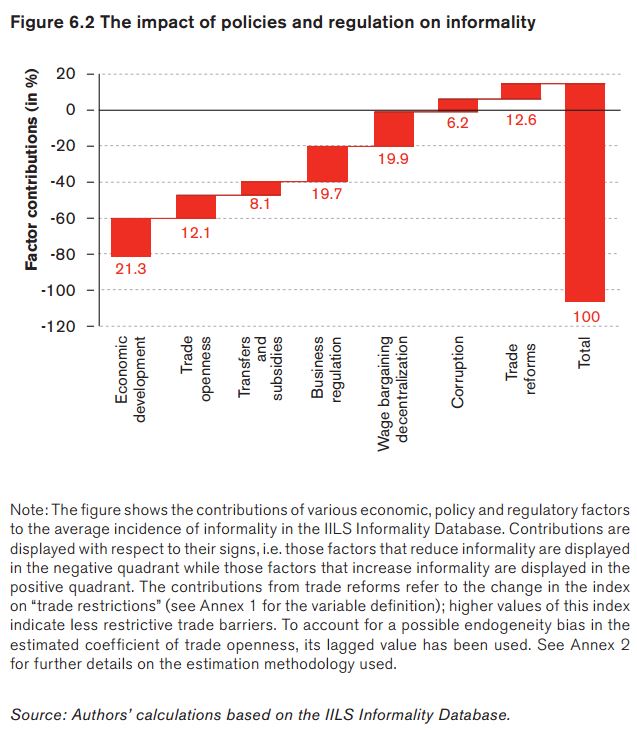
The paper tries to quantify the effect of various policies and regulation on informality.
It is unsurprising that economic development is the biggest contributor to reducing informality. The surprises are that business regulation and subsidies and transfers (read, universal social safety net) do not appear to have the expected impact. Interestingly, decentralized wage bargaining is the second largest contributor to reduction of informality. 
Add to Technorati Favorites
23 Jul 05:33

Wikileaks is upsetting the whole (rotten) apple cart

by atanu

wikileaksWikileaks.org has set a cat among the pigeons. Or you may say it has upset the (rotten) apple cart with what it calls its “Hillary Leaks Series.” Follow the @wikileaks twitter account to get interesting bits. However if you are a real political junkie, you can search through the entire collection of “19,252 emails and 8,034 attachments from the top of the US Democratic National Committee.”

I am no Bernie Sanders supporter. (That’s an understatement considering that I can’t stand socialists.) But I do feel sorry for him that he had as his opponent HRC. I have no love for Trump but I’d pick the crude, crass, bloviating blowhard as the POTUS over She Who is Crooked. As it happens, I am a citizen of California, which always votes Democrat. So I guess I will just vote for the Libertarian party candidate.

In any case, this gives me an opportunity to present my views on Wikileaks. I have written approvingly of wikileaks. Read my wikileaks posts. Here are links to a few of them.


22 Jul 14:50

Mind over Matter- Stock Picks in a Bull Run

by Bala

(This appears in today’s Hyderabad edition of Deccan Chronicle)

Please read the comments thread also.. Nilesh makes an interesting observation..

MIND OVER MATTER- STOCK TAKING


As the markets keep getting more expensive, the brokerage house analysts ensure that they keep revising the ‘earnings estimates’ upwards. Similarly, all comparisons now become selective and one expensive stock will be compared to a more expensive stock.


However, the market is in a blind zone- all heads are turned north and every bit of news is interpreted with a positive bias. Every stock keeps moving up just as you hear some recommendation and you think to yourself “Missed it this time. Next recommendation from XXX and let me put some money in to it”. This is the classical story that happens every few years.


Forget our valuations. Now the mood is that the US Markets are leading the way. Since they have fought of all worries and the Dow is chasing new highs, we also follow them. We will of course ‘de-couple’ when it is convenient for the analysts to do so.


It is very likely that in this phase of the market, most of us would be buying and selling stocks with a view to take advantage of the momentum and the bullishness rather than reasoned out investments. Valuations are rich, but our minds are more receptive when the noise is all around us. Most of us are happy to make a quick buck and get out. There will be plays where we think we will make upwards of fifty percent in double quick time. Your success or otherwise is dependent on actions of others, including manipulators. Volumes are suddenly happening in stocks that the world seemed to have forgotten.


There are many of us who would own stocks for the only reason that they fell far below our buying price. The present market conditions are the typical one in which we acquire such stocks. We simply start chasing ‘relative’ affordability or valuations and end up owning stocks that would not make it to any good investment short list. Financial and fundamental analysis takes a back seat in these happy market conditions.


I will just remind you of a simple math. If you buy a stock at, say, Rs.20/- expecting to exit at, say, Rs.25/- you are playing for a 25% gain. Ideally you want this to happen in a couple of weeks or less. Let us forget the brokerage and other transaction costs. You ‘spotted’ this stock or a friend told you about it. If you look at the price chart, it was probably closer to Rs.10 less than three months ago. However, your sources are reliable. You buy the stock at Rs.20 and keep holding it. You watch it go to, say 24 in a week or ten days. You still want one more rupee. The stock then starts to fall and in the next three months it stays in this range between 20 and 25. You lose interest and then suddenly six months down the road, you see the stock is trading at Rs.10. Now, you have lost 50% on the stock. You now think that you will sell it once it goes back to Rs.20/- so that at least you are not ‘out of pocket’. In other words, you are now looking at this stock ‘doubling’ or giving you a return of 100%. Now step back and think. If you are so sure about this happening, should you not be raising your bet manifold? Or is it that you are not sure, but your mind refuses to accept the loss and this stock becomes part of your long-term holding?


The key to surviving in this market is to follow strict rules. Keep a stop loss and a maximum holding time limit for these kind of ‘punts’ in the market. Learn to accept losses as a part of the game you are playing. You are now in the realm of pure speculation. You are banking on someone following up on your buying so that you can get your exit. You will find that you also seem ‘wise’. Enough noises about positive happenings, sector changes etc are flowing. No one will ring a bell at the exact top. After all, it is your money. You have to make choices. Understand where you are at each stage as you lay bets in the stock markets.


R Balakrishnan


21 Jul 13:56

Global energy market fact of the day

by noreply@blogger.com (Gulzar Natarajan)
The most stunning anecdote about how the shale dynamics have upended the global energy market comes from this reversal of hydrocarbon trade,
Two cargoes of US liquefied natural gas from Cheniere Energy’s Sabine Pass plant in Louisiana have been delivered to Kuwait and Dubai in recent months to meet the rapidly growing demand for energy. 
And more on how the US shale exports have been transforming the global hydrocarbons market,
The Sabine Pass plant shipped its first cargo in February, and has already sent LNG to seven countries: Argentina, Chile, Brazil, India and Portugal, as well as Dubai and Kuwait... Those additional supplies are depressing prices, making LNG a more attractive fuel for power generation, and low-cost floating regasification plants have made it easier for countries to become importers. Kuwait’s LNG imports tripled from 1m tonnes in 2012 to 3.04m tonnes last year, according to the Middle East Economic Survey. Egypt and Jordan became LNG importers for the first time last year. Qatar is the world’s largest LNG exporter, but over the next few years it is set to be toppled by Australia and rivalled by the US. The International Energy Agency has forecast that by 2040 gas demand in the Middle East will almost double, so the region could become an increasingly important market for US LNG.
As regards oil, US continues to import about 1.6 million barrels a day from the Middle East, down from 2.4 mbd in 2003-04.

I think an even bigger transformation will be when more liquefaction terminals on the US east coast come on-line. It could lead to the emergence of a single global market in natural gas
Add to Technorati Favorites
19 Jul 07:04

Liberalizing India’s urban thinking…

by Amol Agrawal
Sanjeev Sanyal has a superb piece on how 1991 has not changed India’s thinking on urban development. It remains socialist and centralised: A quarter of a century ago, India threw off the shackles of Nehruvian socialism and embarked on economic liberalization. Since 1991, socialist-era thinking has been steadily discarded in a growing number of areas […]
18 Jul 05:07

China debt fact of the day

by noreply@blogger.com (Gulzar Natarajan)
From a Bloomberg article on China's fascination with high speed rail, whose network has grown to nearly 12000 miles in just under a decade,
In May, state-owned China Railway Corporation, the operator of China's rail network, reported that its debt had grown 10.4 percent in the past year and now exceeded $600 billion; in 2014, roughly two-thirds of that debt was related to high-speed rail construction. That’s more than the total public debt of Greece. The company runs only one profitable line -- the massively traveled Beijing-Shanghai corridor.
That is a staggering number. The debt of just China Railway Corporation is 30% of India's GDP!

Update 1 (15.08.2016)

IMF's Article IV consultation had this to say about China's ballooning debt pile outside the banking system,
International Monetary Fund staff said that 19 trillion yuan ($2.9 trillion) of Chinese “shadow” credit products are high-risk compared with corporate loans and highlighted the danger that defaults could lead to liquidity shocks. The investment products are structured by the likes of trust and securities companies and based on equities or on debt -- typically loans -- that isn’t traded... The “high-risk” products offer yields of 11 percent to 14 percent, compared with 6 percent on loans and 3 percent to 4 percent on bonds, the commentary said. The lowest-quality of these products are based on “nonstandard credit assets,” typically loans.
These products are mainly issued by banks and attract retail investors with their high returns. Such products grew nearly 50% last year to 40 trillion renminbi ($ 6 trillion). The FT writes,
Shadow banking emerged as a force five years ago, ranging from interbank transactions through to wealth management products. By recording the products off-balance sheet, or by classifying them as “investments” rather than loans, banks are able to report higher capital adequacy ratios and set aside smaller provisions against bad loans.
The Times describes these wealth management products,
China’s wealth management products are neither stocks nor bonds nor mutual funds. A typical wealth management product offers a fixed rate of return over a set period. Many Chinese investors treat them like bank savings deposits because many are sold by state-controlled banks that give the funds the appearance of government backing. But unlike bank deposits, they are uninsured. They are also typically structured so that the banks are not responsible if the investments fail. Among the biggest issuers of wealth management products are hundreds of banks and other financial institutions in poor, inland provinces. These banks are under intense pressure from provincial political bosses to keep lending and help sustain big employers like state-owned enterprises, at a time when the entire country’s economy is slowing. To raise money for large-scale lending, banks have ramped up issuance. They sold 187,000 separate wealth management products by the end of last year, up 56 percent from a year earlier, according to official statistics.
Add to Technorati Favorites
18 Jul 05:07

Corporate subsidy fact of the day

by noreply@blogger.com (Gulzar Natarajan)
FT has this article on the struggle to increase minimum wages in the US,
Walmart’s founding family, worth a net worth $130bn according to Forbes, has been a target in the debate over inequality, which has gained traction in this presidential election year. It has also highlighted the extraordinary wealth of one family while many of its staff struggle to make ends meet. Nita Fischer, a single mother, says she was coerced into leaving her Walmart job paying $10.14 an hour when she was pregnant and to reapply after three months. She said she is earning $9 an hour and is reliant on the US government to pay her $294 a month in food stamps — which are spent at Walmart.
Such transfers must constitute one of the largest corporate subsidies in the history of the world!

In this context, I have blogged earlier that, contrary to conventional wisdom, even including all the direct welfare subsidies, the rich benefit disproportionately more from government spending than the poor. In fact, even leaving aside the things that people like Mariana Mazuccato talk about, a very large proportion of corporate fortunes are directly built on the foundations of tax payer financed systems. And this is true for countries across the world - developed and developing, democratic and autocratic, capitalist and socialist, eastern and western. 
Add to Technorati Favorites
18 Jul 05:06

What is Success?

by atanu
Alt text
Ralph Waldo Emerson

The good life has to be a happy life. I am much in favor of Bertrand Russell’s view on the good life: “The good life, as I conceive it, is a happy life. I do not mean that if you are good you will be happy – I mean that if you are happy you will be good.” The good life also has to be the successful life. But what is a successful life? The definition must vary from person to person. I like the simplicity of Ralph Waldo Emerson’s operational definition: 

What is Success?

To laugh often and much;

To win the respect of intelligent people
and the affection of children;

To earn the appreciation of honest critics
and endure the betrayal of false friends;

To appreciate beauty;
To find the best in others;

To leave the world a bit better, whether by
a healthy child, a garden patch
or a redeemed social condition;

To know even one life has breathed
easier because you have lived;

This is to have succeeded.

Here are some bits about Ralph Waldo Emerson (1803 -1882) excerpted from the wiki entry.

Waldo Emerson, was an American essayist, lecturer, and poet who led the Transcendentalist movement of the mid-19th century. He was seen as a champion of individualism . . .

He remains among the linchpins of the American romantic movement, and his work has greatly influenced the thinkers, writers and poets that have followed him. When asked to sum up his work, he said his central doctrine was “the infinitude of the private man.” Emerson is also well known as a mentor and friend of fellow Transcendentalist Henry David Thoreau.

. . . Emerson was introduced to Indian philosophy when reading the works of French philosopher Victor Cousin. In 1845, Emerson’s journals show he was reading the Bhagavad Gita and Henry Thomas Colebrooke’s Essays on the Vedas. Emerson was strongly influenced by Vedanta, and much of his writing has strong shades of nondualism. One of the clearest examples of this can be found in his essay “The Over-soul”:

We live in succession, in division, in parts, in particles. Meantime within man is the soul of the whole; the wise silence; the universal beauty, to which every part and particle is equally related, the eternal ONE. And this deep power in which we exist and whose beatitude is all accessible to us, is not only self-sufficing and perfect in every hour, but the act of seeing and the thing seen, the seer and the spectacle, the subject and the object, are one. We see the world piece by piece, as the sun, the moon, the animal, the tree; but the whole, of which these are shining parts, is the soul.

To me, it is always a source of immense pleasure and comfort to meet a kindred soul across space and time. Some very bright minds, ages ago in India, had insights into the nature of reality. These ideas resonate with other brights minds in distant lands and centuries later. It really is a wonderful world.


15 Jul 05:26

How India’s concretising cities are becoming heat islands..

by Amol Agrawal
There is little doubt that most of us mention about the huge heat factor in India especially during summers. But taking a look at temperatures, one would see near similar temperatures across years. One big factor is our heat toleration has declined considerably thanks to air conditioners everywhere. The second bit could be this construction madness […]
14 Jul 11:46

Fun with Logical Fallacies

by Farnam Street Team

We came across a cool book recently called Logically Fallacious: The Ultimate Collection of Over 300 Logical Fallacies, by a social psychologist named Bo Bennett. We were a bit skeptical at first — lists like that can be lacking thoughtfulness and synthesis — but then were hooked by a sentence in the introduction that brought the book near and dear to our hearts:

This book is a crash course, meant to catapult you into a world where you start to see things how they really are, not how you think they are.

We could use the same tag line for Farnam Street. (What was that thing about great artists stealing?)

Logically Fallacious a fun little reference guide to bad thinking, but let’s try to highlight a few that seem to arise quite often without enough recognition. (To head off any objections at the pass, most of these are not strict logical fallacies in the technical sense, but more so examples of bad reasoning.)

Logical Fallacies

No True Scotsman

This one is a favorite. It arises when someone makes a broad sweeping claim that a “real” or “true” so and so would only do X or would never do Y.

Example: “No true Scotsman would drink an ale like that!”

“I know dyed-in-the-wool Scotsmen who drink many such ales!”

“Well then he’s not a True Scotsman!”

Problem: The problem should be obvious: It’s a circular definition! A True Scotsman is thus defined as anyone who would not drink such ales, which then makes them a True Scotsman, and so on. It’s non-falsifiable. There’s a Puritanical aspect to this line of reasoning that almost always leads to circularity.

Genetic Fallacy

This doesn’t have to do with genetics per se so much as the genetic origin of an argument. The “genetic fallacy” is when you disclaim someone’s argument based solely on some aspect of their background or the motivation of the claim.

Example: “Of course Joe’s arguing that unions are good for the world, he’s the head of the Local 147 Chapter!”

Problem: Whether or not Joe is the head of his local union chapter has nothing to do with whether unions are good or bad. It certainly may influence his argument, but it doesn’t invalidate his argument. You must approach the merits of the argument rather than the merits of Joe to figure out whether it’s true or not.

Failure to Elucidate

This is when someone tries to “explain” something slippery by redefining it in an equally nebulous way, instead of actually explaining it. Hearing something stated this way is usually a strong indicator that the person doesn’t know what they’re talking about.

Example: “The Secret works because of the vibration of sub-lingual frequencies.”

“What the heck are sub-lingual frequencies?”

“They’re waves of energy that exist below the level of our consciousness.”

“…”

Problem: The claimant thinks they have explained the thing in a satisfactory way, but they haven’t — they’ve simply offered another useless definition that does no work in explaining why the claim makes any sense. Too often the challenger will simply accept the follow up, or worse, repeat it to others, without getting a satisfactory explanation. In a Feynman-like way, you must keep probing, and if the probes reveal more failures to elucidate, it’s likely that you can reject the claim, at least until real evidence is presented.

Causal Reductionism

This reflects closely on Nassim Taleb’s work and the concept of the Narrative Fallacy — an undue simplifying of reality to a simple cause–> effect chain.

Example: “Warren Buffett was successful because his dad was a Congressman. He had a leg up I don’t have!”

Problem: This form of argument is used pretty frequently because the claimant wishes it was true or is otherwise comfortable with the narrative. It resolves reality into a neat little box, when actual reality is complicated. To address this particular example, extreme success on the level of a Buffett clearly would have multiple causes acting in the same direction. His father’s political affiliation is probably way down the list.

This fallacy is common in conspiracy theory-type arguments, where the proponent is convinced that because they have some inarguable facts — Howard Buffett was a congressman; being politically connected offers some advantages — their conclusion must also be correct. They ignore other explanations that are likely to be more correct, or refuse to admit that we don’t quite know the answer. Reductionism leads to a lot of wrong thinking — the antidote is learning to think more broadly and be skeptical of narratives.

“Fallacy of Composition/Fallacy of Division”

These two fallacies are two sides of the same coin: The first problem is thinking that if some part of a greater whole has certain properties, that the whole must share the same properties. The second is the reverse: Thinking that because a whole is judged to have certain properties, that its constituent parts must necessarily share those properties.

Examples: “Your brain is made of molecules, and molecules are not conscious, so your brain must not be the source of consciousness.”

“Wall Street is a dishonest place, and so my neighbor Steve, who works at Goldman Sachs, must be a crook.”

Problem: In the first example, stolen directly from the book, we’re ignoring emergent properties: Qualities that emerge upon the combination of various elements with more mundane innate qualities. (Like a great corporate culture.) In the second example, we make the same mistake in a mirrored way: We forget that greed may be emergent in the system itself, even from a group of otherwise fairly honest people. The other mistake is assuming that each constituent part of the system must necessarily share the traits of the whole system. (i.e., because Wall St. is a dishonest system, your neighbor must be dishonest.)

***

Still Interested? Check out the whole book. It’s fun to pick up regularly and see which fallacies you can start recognizing all around you.

--
Sponsored by: Slack - Making teamwork simpler, more pleasant, and more productive.

14 Jul 10:56

APMC monopoly being broken?

by subra
There is a move by the Fadnavis Government to remove the APMC and allow the farmers to sell directly to the end customer. The MSM says this will increase inflation – because of the TRADER’S STRIKE and the internet media says that the farmer’s income will go up 300 to 400%. The truth obviously lies […]
13 Jul 03:33

India’s Prosperity is Made in India

by atanu

prosperity2 I am not a fan of the Modi government’s “Make in India” advertising drive. My view is certainly unpopular. I think that advertising cannot (and must not) replace real changes in policies that could make India attractive to domestic and foreign manufacturers. As it happens, the prevailing sentiment, even among many domestic manufacturers, is that India is really a very hard place to make things. Which partly explains why so much of what’s consumed in India is made in China. So trying to woo foreign manufacturers through advertising slogans is pointless.

I wrote this piece for the July edition of India Currents. Here it is, for the record.

India’s Prosperity is Made in India.

Many superlatives have been applied to India. Some are laudatory—the largest democracy;  some are appalling—home to the largest number of illiterates; and some whose overall value is hard to assess. In that last category must be the designation of India’s prime minister Narendra Modi as the most foreign-traveled Prime Minister (PM) in world history. He is, as some have remarked, India’s first non-resident Indian (NRI) prime minister.

Globe Trotting Prime Minister
Since becoming the PM, Modi has visited 38 countries. Between June 2014 and June 2016, Modi has traveled abroad 42 times, or close to two foreign trips per month, including four visits to the United States, and two visits each to Afghanistan, France, Nepal, Russia and Singapore. Compared to him, his predecessors preferred to stay home. Vajpayee had only six foreign visits during his first two years, and during his entire tenure as PM from 1999 to 2004, he went abroad only 19 times, including just twice to the United States.

All this globetrotting would have earned Modi an enviable truckload of frequent flyer miles had he been flying commercial. Unfortunately since he takes the state owned and taxpayer funded Air India, he does not get miles credit. The taxpayers, instead, get saddled with the cost of his travels, an informed estimate of which, to date, is around US $400 million at an approximate average of $10 million per trip.

Selling India Abroad
One could object to that kind of bean counting by noting that the expenditure is investment into India’s economic growth. With his foreign visits, so the argument would go, Modi has elevated India’s image globally and cemented vital relationships. This enables significant investment flows into India, it would seem.

There are two reasons why this argument is problematic. The first is that it is basically an advertising and sales job. The second is that India is a large economy and therefore its prosperity is internally driven and cannot be predicated on external factors.

Not Easy to Make in India
The “Make in India” initiative is a marketing job. Bombastic rhetorical claims that India is the prime destination for global investment sound hollow and tired when the facts on the ground speak differently. The World Bank ranks economies on the ease of doing business (www.doingbusiness.org) in 189 countries. Methodological and precision issues of the ranking aside, it does reflect an underlying reality.

As one would expect, the high ranks go to open, free enterprise economies like Singapore (#1), Hong Kong, United States, Taiwan, Germany, etc. Bringing up the rear are South Sudan, Libya and Eritrea (#189). India comes in at #130, a solid 46 places behind China (#84). That’s a terrible place to be for a country that has delusions of becoming a giant in world commerce.

Marketing and sales jobs, though valuable, are ultimately futile if the product doesn’t work as advertised. Like all of us, multinational corportations are rationally self-interested. Their investment decisions depend entirely on how easy it is to do business in India and have practically nothing to do with PM Modi’s sincere entreaties to “make in India.” A nice paint job may draw in the curious buyer but the car ultimately gets sold based on what’s under the hood, not on the shiny hood ornament.

Is the United States an Indispensable Partner?
The second problem with the view that Modi is attracting investment into India by frequently selling India abroad is that India’s prosperity, like that of any large economy, depends on what Indians and Indian firms do, which in turn depends on government policies. Certainly, a few tens of billions of foreign investment could not hurt but that all amounts to rounding errors in the spreadsheet of real growth.

In his speech to the U.S. Congress, Modi said, “In every sector of India’s forward march, I see the United States as an indispensable partner.” That mindset is not that of winners. Given that India is clearly not indispensable to United States’ prosperity, that attitude reflects a reliance on an unhealthy relationship of asymmetric power. Did Modi really mean, for instance, that India’s domestic affairs are now open for U.S. administrations to interfere in? Does that “partnership” extend to the United States making interventions in Indian rural and urban administration, labor laws, agricultural and industrial policies, law and order, banking and finance —all sectors that are critically important to India’s “forward march?”

His assertion to the Congress about non-resident Indians in the United States speaks volumes:  “Today, they are among your best CEOs, academics, astronauts, scientists, economists, doctors, even spelling bee champions. They are your strength. They are also the pride of India. They symbolize the best of both our societies.”

Mr Modi’s pride is misplaced and frankly pathetic. With all due respect to him, those facts actually speak to what’s wrong with India and symbolize the worst failures of Indian governments. Talented people were forced to migrate abroad because they could not do in India what they were evidently good at. India embraced socialism and is paying heavily for that by seeing human capital flight. That’s nothing for India to crow about. At the very least Mr. Modi should get better speech writers.

The Answer is at Home, Not Abroad
The United States did not become what it is by partnering with some large industrialized nation or dancing to foreign tunes. It marched to its own drumbeat of freedom and free enterprise that created unprecedented prosperity. It crafted its own constitution—not its colonial master’s rules—which guaranteed freedom of speech and private property rights to its citizens and which was (note the past tense) implacably opposed to socialism. Thus the United States attracted talented people from all across the world, not just from India, in the recent decades. Modi needs to ask what it is that compels so many highly productive people to leave at the first opportunity they can.

An honest answer to that could easily form the backbone of the structural reforms that are urgently needed for India to succeed. The key to India’s development is freedom. No country whose citizenry are bound by the arbitrary will of government functionaries empowered to implement needless, incomprehensible, vitality-sapping, senseless rules and regulations that inhibit enterprise—in short socialist policies—has ever escaped poverty.

Indians have had the utter misfortune of being forced to live in virtual serfdom under the licence-control-permit-quota-inspector raj, a legacy of the British Raj that impoverished India, for nearly seven decades. There was some hope that Modi would dismantle the horror that imprisons India because he did talk loudly about “minimum government.” After two years, that hope is vanishing fast. Government is not only becoming more intrusive but it is expanding its vice-like grip on Indian entrepreneurship and enterprise.

United States prosperity was built in the United States, not abroad. That’s par for the course, not some outlandish exception. India’s progress does not depend on the United States or any other external entity. India is an independent, sovereign nation and that fact places its destiny within it, and only within it. Mr Modi needs to demonstrate that understanding and act accordingly.

Genghis Khan, the great Khagan, reportedly said, “Conquering the world on horseback is easy; it is dismounting and governing that is hard.” Flying around the world on state-owned Air India promoting India is easy; it is disembarking and staying at home to free India from the controls of an oppressive government that is hard.


12 Jul 04:03

The resource mis-allocation problem during credit booms

by noreply@blogger.com (Gulzar Natarajan)
FT chronicles the success of Jon Gray, the head of Blackstone's real estate business, which has made the private equity firm the largest real estate owner in the world,
Blackstone owns more offices in the US and India than anyone else. It is also the largest residential landlord in the US, with a portfolio of 50,000 rental homes that it would like to take public by next year... When Mr Gray joined Blackstone in 1992 straight from college, the young firm had only $1bn under management; today it has about $335bn. He is responsible for the greatest part of that pile of money, entrusted to find profitable opportunities for the $100bn he has received from investors. Mr Gray’s business has made as much money as all of KKR, a rival in private equity, in the past three years. And he can boast of 17 per cent annualised net gains over 25 years, according to public filings from Blackstone... (In India) has since (2011) invested a total of $1.2bn. Some of purchases came from developers who were forced to sell, either because of regulatory pressure or as a way to raise badly needed cash. Acquisitions included a partially completed Goldman Sachs project in Bangalore. Today Blackstone is the largest owner of office parks in the country, often bought at bargain prices, with a market value of $4.2bn.
Buoyed by cheap debt, PE firms in general have been very large investors in real estate,
Blackstone and the other alternative investment groups have been among the biggest beneficiaries of the US Federal Reserve’s quantitative easing policies. Low borrowing costs, combined with depressed asset prices, were a godsend for these companies, whose lifeblood is debt. The Fed’s policies may not have led to a robust economy, but they were the major reason asset prices in financial markets — including property — recovered so quickly.
This is a clear example of the resource misallocation towards low productivity growth and high pledgeability sectors (like construction and real estate) that happens when credit is plentiful. I have blogged about this earlier. In this context, Claudio Borio and the folks at BIS examined a sample of 21 countries over the period from 1969 and have these findings,
First, credit booms tend to undermine productivity growth as they occur. For a typical credit boom, a loss of just over a quarter of a percentage point per year is a kind of lower bound. Second, a large part of this, slightly less than two thirds, reflects the shift of labour to lower productivity growth sectors – this is the only statistically significant component. Think, for instance, of shifts into a temporarily bloated construction sector. The remainder is the impact on productivity that is common across sectors, such as the shared component of aggregate capital accumulation and of total factor productivity (TFP). Third, the subsequent impact of labour reallocations that occur during a boom is much larger if a crisis follows. The average loss per year in the five years after a crisis is more than twice that during a boom, around half a percentage point per year. Put differently, the reallocations cast a long shadow. Taking the 10-year episode as a whole, the cumulative impact amounts to a loss of some 4 percentage points. 
This is a clear market failure and one which requires regulatory action. It is also a strong reminder of the need to have robust macro-prudential norms and even some form of capital controls during credit booms that can prevent such resource misallocations. 
Add to Technorati Favorites
10 Jul 09:16

More "crossing the river by feeling the stones"

by noreply@blogger.com (Gulzar Natarajan)
FT points to one more example of reform with Chinese characteristics in agriculture sector. This time it is with contract farming in Xiaogang village. Incidentally, it is the same place where the experiment on decollectivization by way of breaking up commune land and allotting them to individuals was initiated successfully before its nationwide scale up.

Even today Chinese law does not recognize rural land ownership. All lands are owned by the village collective and are contracted to households with 30-year farming rights for an average 6-10 mu (1-1.5 acres) of land. There are also large swaths of reclaimed "wasteland" belonging to enormous state farms. Since 2008, Beijing has legalized the transfer of this right, or "renting". Accordingly, nearly half the land in places like Anhui province is "rented".

These trends have led some farmers in Xiaogang to experiment with "renting" in land, hiring labor, and effectively doing contract farming. But such experiments have to be carried out discreetly without attracting the glare of Beijing. Further, in the absence of property rights, they suffer from significant risks arising from land owners demanding their lands back and the 30 year rights expiring.

It helps that such examples coincide with a period of massive urban migration, especially by the youth who have left their old parents to till the lands. Increasing swaths of rural areas are left with such people who are too old to work. The country therefore needs to transition into a new trajectory of agricultural development, one which is more capital intensive. 

President Xi Jinping, recently visited Xiaogang, like Deng did decades back to bless the decollectivization experiment, and endorsed the transfer of rural lands to create modern state farms.
Add to Technorati Favorites
09 Jul 06:05

Harshad Mehta’s long ongoing case and how Ketan Parikh’s portfolio still doubled investors’ wealth…

by Amol Agrawal
Two people played a huge role in Indian stock markets – Harshad Mehta and Ketan Parikh – albeit for all the wrong reasons. They became catalysts for huge changes we have seen in Indian capital markets. Indian capital market is one heck of a story which is hardly given the attention. Post 1991, this is one […]
09 Jul 06:05

lessons Madoff taught us and more learning.

by subra
The Madoff’s scam happened in 2009..when I wrote a piece for Reuters.in. This article is based on that piece. Madoff scam was really big and took the 2009 Christmas look terrible…the lessons are important..and VALID even in 2016. Once in a while a man comes along and takes people for a ride. What is amazing […]