Shared posts

24 Sep 21:48

How affluent people can end their mindless overconsumption

by Jag Bhalla
A new report from Oxfam and the Stockholm Environment Institute shows the strikingly unequal way rich people are depleting the global carbon budget. | Getty Images

Every energy reduction we can make is a gift to future humans, and all life on Earth.

If 2020 teaches us anything, it’s that the next crisis we could have prevented is probably right around the corner, and it will be painful. A pandemic that scientists warned was very likely to occur arrived and has already killed well over 214,000 people in the US. Dozens of predicted, large wildfires — the latest evidence of the climate emergency — are torching the American West, their smoke more damaging to health than almost any fire season on record.

But it’s not too late to intervene and limit climate chaos.

A June paper in Nature Communications clarifies whose actions in this moment are “central to any future prospect of retreating to safer environmental conditions.” Yes, government and industry leaders are on the hook to decarbonize operations and infrastructure. But it’s also the affluent who use far more resources than the poor — more energy and more material goods per capita than the planet can sustain.

“Highly affluent consumers drive biophysical resource use (a) directly through high consumption, (b) as members of powerful factions of the capitalist class and (c) through driving consumption norms across the population,” the authors write.

The rich or merely affluent, it turns out, are actually the ones blowing through the world’s carbon budget — the maximum amount of cumulative emissions that can be added to the atmosphere to hit the Paris agreement’s 1.5 degrees Celsius of warming goal.

According to a September report from Oxfam and the Stockholm Environment Institute, the richest 10 percent of the world’s population — those who earned $38,000 per year or more as of 2015 — were responsible for 52 percent of cumulative carbon emissions and ate up 31 percent of the world’s carbon budget from 1990 to 2015.

Meanwhile, the richest 1 percent of people — who made $109,000 or more per year in 2015 — alone were responsible for 15 percent of cumulative emissions, and used 9 percent of the carbon budget.

The rapidly accelerating growth in total emissions worldwide isn’t mainly about an improvement in quality of life for the poorer half of the world’s population, either. Instead, the report finds, “nearly half the growth has merely allowed the already wealthy top 10 percent to augment their consumption and enlarge their carbon footprints.” Another recent study found that affluent frequent fliers who make up just 1 percent of the global population are responsible for 50 percent of carbon dioxide emissions from commercial aviation.

In sum, as Tim Gore, head of climate policy at Oxfam, said in a statement, “The over-consumption of a wealthy minority is fueling the climate crisis yet it is poor communities and young people who are paying the price.”

Somehow, in all the campaigns to inspire climate action, the onus on well-off people to take the lead on sustainable consumption has been lost. But the Covid-19 pandemic may turn out to be the best opportunity — especially for the affluent among us — to shift consumption habits.

Here’s why: When we cut back on energy-intensive travel and shopping in the spring, it was easier to see the mindlessness, and even lack of satisfaction, in these patterns. For some people, “the Covid-19 crisis has shown that maybe we can do things differently, that a simpler life can be more fulfilling and provide more happiness,” says Tommy Wiedmann, a professor of sustainability research at UNSW Sydney and a co-author of the Nature Communications paper.

Permanently reducing air travel, driving, home energy use, food waste, and shopping to protect our kids and grandkids from climate chaos need not lead to any reduction in quality of life. In fact, it may even go a long way toward improving it (for ourselves and others). As Vox’s Sigal Samuel reported in June, the top change readers she surveyed said they wanted to maintain after quarantine was “reducing consumerism.” “A long period of being shut in and not spending as much has led to the realization that so much of our consumer behavior is about instant gratification, not lasting happiness,” she writes.

We can also use lessons from our new Covid-constrained life for further economic reforms tailored to the climate emergency reality we find ourselves in. As Pope Francis put it in a Saturday speech on climate change, “The current economic system is unsustainable. We are faced with a moral imperative ... to rethink many things,” including means of production, consumerism, waste, indifference to the poor, and harmful energy sources, according to Reuters.

In particular, degrowth is a promising framework for meeting basic needs and improving well-being while staying within the carbon budget and planetary boundaries.

While individual contributions to climate change may be dwarfed by the contributions of fossil fuel companies and heavy industry, individual changes can also spread by “behavioral contagion,” social tipping points, and positive feedback loops.

Here we’ll lay out some of the key opportunities for fellow fortunates who have the economic freedom to choose how and what they consume. Individual, grassroots changes are essential to a bigger systemic change; personal growth and flourishing can happen through resource degrowth.

 Getty Images/Cavan Images RF
Optional consumption in the form of long-distance travel is imposing unoptional burdens on future humans for centuries.

Yes, individual choices matter, especially if you’re affluent

From a global perspective, middle-class Americans are in the top 10 percent income-wise. “A $59,000 income in the United States has enough buying power to put you in the 91st percentile globally for per-person income,” according to the Washington Post. And beyond that, our fellow fortunates all have “optional consumption” that we engage in, often unreflectively.

Given that leverage, every energy reduction we can make is a gift to future humans, and all life on Earth. And we should be on guard for excuses to avoid changing individual consumption behaviors; they’re often based on logical, arithmetic, and moral errors.

For instance, affluent people sometimes argue that their consumption choices don’t matter because they’re just one person on a planet of more than 7 billion. But consider the physics of tipping points using an analogy from a 2019 piece we wrote, “12 excuses for climate inaction and how to refute,” which helps explain why our decisions today are so much more critical than they were a decade ago — or even this time last year.

A useful image here is a pile of sand on one side of a weighing scale; at or near the tipping point, it’s easy to see that every tiny grain of sand contributes to when that side of the scale ultimately falls. Your seemingly tiny contribution — the optional flight, the round-the-clock air conditioning, the thrice-weekly portion of beef — can, arithmetically, add up to make a critical difference. And “the bigger your carbon footprint, the bigger your moral duty,” Greta Thunberg said in her widely cited 2019 speech at the World Economic Forum in Davos, Switzerland.

Where the weighing scale image fails is that there isn’t just one tipping point or one single outcome, but rather a spectrum. The fewer greenhouse gases we emit, the nearer to the safer end of the spectrum we can stay, and the less climate chaos we will create.

We usually have options where we can choose to have more or less climate impact. Every time we choose more and not less, we’re imposing compounding burdens on others and on our descendants. Our choices will determine whether the future is “merely grim, rather than apocalyptic,” as New York’s David Wallace-Wells writes in his book The Uninhabitable Earth.

Restrained consumption is also a way to prevent the deepening of racial and economic injustice and inequality — low-income people and people of color are among the first to lose the most in climate disasters. Working toward justice means being a resource-responsible consumer.

“I think it is important for people to say that they will not do certain types of consumption anymore,” Julia Steinberger, a professor of ecological economics at the University of Leeds and a co-author of the Nature Communications paper, tells Vox. “It’s about making this way of life more visibly unacceptable. The rich could show their status and prestige with other things than lots of cars and huge houses and lots of material wealth.”

With all this in mind, here are five potential resource-responsible actions to commit to, in no particular order:

  1. Drive and fly less, since the top 10 percent uses around 45 percent of land transport energy and 75 percent of air transport energy, per a 2020 paper by Steinberger in Nature Energy.
  2. Retrofit your house and purchase clean energy, since roughly 20 percent of US energy-related greenhouse gas emissions come from heating, cooling, and powering households.
  3. Buy food mindfully (less meat and dairy, don’t waste what you buy), since meat and dairy account for around 14.5 percent of global greenhouse gas emissions, according to the UN’s Food and Agricultural Organization.
  4. Shop less, since the fashion industry generates at least 5 percent of global emissions.
  5. Ditch status-signaling SUVs, since SUVs were the second-largest source of the global rise in emissions over the past decade, eclipsing all shipping, aviation, heavy industry, and even trucks.

The pleasures of much of our consumption are fast forgotten, but the costs are slow and will be felt by generations for centuries to come

Despite what consumption enthusiasts and their enablers (marketers, economists, etc.) preach, the benefits and pleasures of much of our consumption are fleeting. Many of us have an inkling of this from our own experience, but we’re trapped on the treadmill of unthinking hedonic habits.

That enduring lack of true satisfaction is confirmed by much ancient wisdom: Enlightenment, or Nirvana, is the “ the absence of greed, absence of dislike, and absence of egoism,” as the Buddhist writer and scholar Stephen Batchelor notes in an interview with On Being’s Krista Tippett. And one of the most robust findings in social science, according to economist Robert Frank at Cornell, is the research on how emotional well-being doesn’t improve above an annual (individual) income of $75,000.

Some of our least effective consumption occurs in the form of self-soothing habits. When we’re feeling bad, or anxious, or bored, we often seek relief in impulsive shopping, a.k.a. retail therapy.

What longer-lasting reliefs beat fleeting fun? You may have experienced part of the answer in these Covid-constrained conditions. For many, an activity as simple as a walk has been their day’s treat.

That’s especially true if you find beauty or curiosity on your walk, where you notice things interesting enough to achieve what Iris Murdoch called “unselfing” — taking you out of your self-centered anxieties, even if only temporarily. (Here’s some background on this idea from Maria Popova.)

These spirit-supporting pleasures typically take more effort than reaching for “junk” treats (like a quick online purchase). But, in addition to being more satisfying, they often lack negative knock-on effects, like putting more carbon into the atmosphere. This carbon cost isn’t just about you — it is our collective legacy to our children and all future humans.

Hopefully, Covid-19 can teach us to pay attention to planetary boundaries and other collective threats we’ve long ignored. On climate, we should wake up to the intergenerational zero-sum game we are playing, where the carbon-generating and resource-depleting consumption we indulge in now compromises the safety of future humans.

Every physical resource is limited, or is renewable within certain limits. And this logic means there is no “green growth” solution here unless we reduce consumption: the approach known as “degrowth.”

Degrowth, explained

Even before Covid-19, a fundamental restructuring of the economy was very clearly needed to right the gaping inequities, the shockingly lopsided accumulation — nay, hoarding — of wealth. The factors that led to that are only being exacerbated by Covid-19. But as we recover from the pandemic, richer countries and citizens have a tremendous opportunity to remold under another paradigm.

Degrowth, as the economic anthropologist Jason Hickel puts it, is about rich countries “actively scaling down resource use and energy use.”

On a recent episode of the Freakonomics podcast, he clarified: “When people hear ‘degrowth,’ they think that sounds like a recession. But here’s the thing ... a recession is what happens when a growth-oriented economy stops growing. It’s a disaster. People lose their jobs. They lose their houses. Poverty rates rise, etc. ‘Degrowth’ is calling for a shift to a fundamentally different kind of economy altogether.”

As Wiedmann, Steinberger, and their co-authors describe it, degrowth is a “downscaled steady-state economic system that is socially just and in balance with ecological limits.”

Taking advantage of this opportunity also requires going beyond a focus on carbon emissions. Clean energy, for example, won’t deliver a sustainable economy by itself. It’s about our resource use more broadly. (Even preexisting sweeping proposals like the Green New Deal often don’t address material limits.)

As Hickel wrote in June in Foreign Policy:

Ecologists say that the planet can handle maximum annual resource use of about 50 billion metric tons per year. We crossed that planetary boundary in the late 1990s, and today we’re overshooting it by more than 90 percent. This is what’s driving ecological breakdown: Every additional ton of material extraction has an impact on the planet’s ecosystems.

The outer limit works out to be about 6 metric tons per human per year. The current US average is 35 metric tons, with those toward the top of the income scale consuming vastly more. This means there is no avoiding the urgent need for deep cuts in energy and material use in rich nations, especially among those countries’ richest citizens.

Since we may not be able to remove much of the carbon that has already been emitted, or return the materials that have already been extracted, it’s best now to adopt a forward-looking redemption stance. What matters most is reducing impacts from here on out, rather than prosecuting past “sins,” often committed unwittingly, or by rich-mimicking rather than explicit choice. And that means choosing not to mindlessly add more grains of sand to the scale.

There are green shoots visible of the vast changes needed. China committed Tuesday to achieve carbon neutrality by 2060 and peak its emissions by 2030. Night trains are coming back in Europe partially in response to people demanding low-carbon alternatives to flying. A group of European central bankers wrote in the Guardian in June that “the pandemic offers a unique chance to green the global economy” and is mobilizing businesses, investors, banks, and governments “to ensure climate risks are effectively managed in the financial system.”

You, too, can bank on bettering your personal economy by creating a new normal of mindful consumption and making it visible to others in the affluent class, as Steinberger advises. You’ll be a better, and probably happier, person. And other humans, including your kids, will thank you.

24 Sep 04:34

The Best (And Worst) States For Solution Providers In 2020

by Rick Whiting
Managing their way through the current business climate, amid a global pandemic and a national recession, is a challenge for solution providers. Here’s a comprehensive state-by-state look at everything from state economic performance and tax rates to labor costs and workforce education that solution providers can use to help navigate the economic turbulence.
24 Sep 04:02

Amazon will make it easier to buy sustainable products with new climate label

by Nick Statt
Photo by Michele Doying / The Verge

Amazon is launching a new environmental program called Climate Pledge Friendly that will label certain products that meet one of 19 certifications for sustainability. The goal is to help climate-conscious consumers make a better decision about whether to buy one product over another by letting them know when a brand has made an effort to reduce its carbon footprint. Amazon says more than 25,000 products should now display the program’s label.

“Climate Pledge Friendly selection includes grocery, household, fashion, beauty, and personal electronics products, as well as items from a range of other categories,” reads Amazon’s press release. “Climate Pledge Friendly products are clearly labeled in shopping results, have additional...

Continue reading…

24 Sep 04:02

The new 2020 iPad isn’t enough for Zoom school

by Dieter Bohn

It’s really great, but the limitations are becoming grating

Continue reading…

24 Sep 04:00

Cisco Diversity Plans Revealed as Tech Giant Pledges $100M To Further Social Justice Causes

by Gina Narcisi
The tech giant is making good on its pledge to be a leader in social justice reform, diversity, and equality with a handful of new commitments to enact meaningful change, Cisco tells CRN.
23 Sep 18:55

Houseparty partners with Michelle Obama nonprofit to get out the vote

by Makena Kelly

Popular video chatting app Houseparty is partnering with Michelle Obama’s nonprofit, When We All Vote, to launch a new in-app game to get out the vote ahead of the November election.

Houseparty’s new game, Pick Me!, is a superlative game that needs at least three people to play at a time. The game lets users decide which of their friends is the most likely to become an artist or win the lottery, among other questions, similar to yearbook superlatives. At the end of the game, Houseparty links out to When We All Vote’s website so users can check their registration status.

“Our goal and our mission is to increase participation in each election and change the culture rapidly,” Crystal Carson, When We All Vote’s vice president of...

Continue reading…

23 Sep 17:36

US economic recovery weakens with election and pandemic presenting new risks, IHS Markit says

by bwinck@businessinsider.com (Ben Winck)
factory
Industrial output is contracting.

Bill Pugliano/Getty Images

  • IHS Markit's US Composite Output Index sank to 54.4 in September from 54.6, signaling the nation's economic recovery continued into the fall, albeit at a slowing pace.
  • The research firm's services purchasing managers' index weakened to 54.6 from 55, according to a Wednesday report. Its manufacturing gauge edged higher to 53.5 from 53.1.
  • Still-heightened COVID infection rates and uncertainty around the US presidential election are the biggest factors skewing economic risks to the downside, Chris Williamson, chief business economist at IHS Markit, said in a statement.
  • "The question now turns to whether the economy's strong performance can be sustained into the fourth quarter" after outsized third-quarter gains, he added.
  • Visit Business Insider's homepage for more stories.


The US service and manufacturing industries recovered slower in September from the previous month as the third-quarter bump gave way to new obstacles, IHS Markit said Wednesday.

The research firm's Composite Output Index fell to 54.4 from 54.6 this month, its lowest point in two months, according to a Wednesday morning report. IHS's purchasing managers' index for US services businesses declined to 54.6 from 55. The PMI for US manufacturing firms edged higher to 53.5 from 53.1.

Readings above 50 indicate growth, while those below the threshold signal industry contraction. IHS's gauges posted sharp declines and subsequent rebounds earlier in the pandemic as lockdowns halted activity.

While September's services reading points to continued growth, its retreat from August levels suggests the pace of the economic bounce-back is weakening. Services make up roughly 70% of the US economy.

Read more: Buy these 15 stocks right now before they rally higher, says the Morgan Stanley equity chief who nailed his call for a short-term market meltdown

Revived COVID-19 fears and the upcoming US presidential election are the two biggest roadblocks through the end of the year, Chris Williamson, chief business economist at IHS Markit, said in a statement. Infection rates remain at elevated levels as reopenings steadily continue, threatening another rebound in case counts and potential lockdowns. Uncertainties surrounding the election's outcome are also weighing on business optimism.

"The question now turns to whether the economy's strong performance can be sustained into the fourth quarter," Williamson said, adding risks "seem tilted to the downside."

Businesses remained confident toward the economy's path over the next year, but the overall level of optimism fell to a four-month low, according to IHS. New business growth for US services accelerated to an 18-month high. Employment in the industry increased, though at a slower pace than in August.

IHS's manufacturing gauge was mostly lifted by a faster increase in production and improved new orders. The industry's expansion in new export orders slowed to marginal growth. Employment at manufacturers also grew at a slower pace compared to last month.

Overall, the PMIs point to the third quarter's outsized gains shifting to mixed results heading into the fall, Daniel Silver, economic researcher at JPMorgan, said in a note. The move "looks broadly consistent with many economic indicators that point to a loss of momentum lately," he added. While retail spending and housing market gauges have almost fully recovered from the virus' hit, weekly jobless claims and reopening gauges show some damage lingering.

Read more: Anthony Scaramucci told us his contrarian views on the risks investors face after the elections regardless of who wins — and shared how his $7.5 billion SkyBridge Capital is navigating the market's volatility

Read the original article on Business Insider
23 Sep 17:35

Verizon’s Samsung Galaxy S20 Fan Edition 5G Ultra Wideband has finally dethroned Sprint’s Samsung Galaxy S II Epic 4G Touch for all-time worst phone name

by Chaim Gartenberg

The history of smartphones is riddled with absolutely awful phone names. The Acer Liquid Zest Plus, the HTC ChaCha, the LG G8X ThinQ, the iPhone 11 Pro Max, the Sony Xperia 1 II. And of course, the legendary Samsung Galaxy S II Epic 4G Touch, a breathtaking display of buzzwords, numbers, and letters that somehow form the full name of one of 2011’s better Android phones.

But almost nine years to the day, there is a new champion for all-time worst Android phone name: the newly announced Verizon Samsung Galaxy S20 Fan Edition 5G Ultra Wideband (or the S20 FE 5G UW, for short).

Continue reading…

23 Sep 17:34

Google Assistant’s new Workday routine can bug you to take care of yourself

by Cameron Faulkner
Google

Google is introducing a new Workday routine that makes Google Assistant audibly remind you of calendar events and, notably, to take moments for self-care throughout the day.

Since most of us are still stuck working from home, it can be easy to forget about caring for your physical and mental needs. So in addition to ensuring you make every meeting in that busy calendar, the routine comes configured to remind you to do a few small but important things in between, like getting water and standing up to stretch at different points throughout the day. It’ll also alert you to start wrapping things up with work at the end of the day. You can adjust the content of each alert to your needs, as well as the timing of when they go off.

The routine...

Continue reading…

23 Sep 17:34

Zoom’s latest accessibility features let you pin and spotlight multiple videos during calls

by James Vincent
Zoom’s latest update will let you pin or spotlight multiple videos during a call. | Image: Zoom via Mashable

Zoom has added new accessibility features that should make the videoconference app easier to use for individuals who are deaf, hard of hearing, or who have visual impairments.

As reported by Mashable and USA Today, the first change to the app is the ability to pin or spotlight multiple videos at once, instead of just one as is currently allowed. This will let people who require sign language interpretations to pin the interpreter’s video during meetings, keeping it visible at all times even when the call is in speaker mode. Only nine people on each call can pin multiple videos, which may constrain larger meetings.

Alternatively, the host can choose to spotlight multiple videos for all users, making up to nine different videos visible at...

Continue reading…

23 Sep 17:33

Coronavirus fallout has erased $3.5 trillion in workforce income, UN agency says

by bwinck@businessinsider.com (Ben Winck)
florida reopening restaurants coronavirus

Octavio Jones/Getty Images

  • A new report from the International Labour Organization details worse-than-expected damage in the global labor market and forecasts pain lasting through the fourth-quarter of 2020.
  • The United Nations agency expects working-hour losses to remain elevated through the third quarter at 12.1%, or 345 million full-time-equivalent jobs.
  • Global labor income is expected to shrink over the first three quarters of 2020 by 10.7%, or $3.5 trillion, the ILO added.
  • The bulk of the fallout landed among middle-income nations, the agency said.
  • The ILO projected fourth-quarter working-hour losses to reach 8.6%, up from the previous estimate of 4.9%.
  • Visit Business Insider's homepage for more stories.

The coronavirus's labor-market hit has mostly been quantified by the amount of jobs lost and a rising unemployment rate. The International Labour Organization — a United Nations agency — now projects the pandemic erased roughly $3.5 trillion in worker income year-to-date.

The agency laid out its latest reading of the global labor market in a Wednesday report, highlighting lasting pain in the workforce while other economic indicators return to pre-pandemic highs.

Working-hour losses are expected to remain elevated through the third quarter at 12.1%, or 345 million full-time-equivalent jobs, the ILO said. Those losses signal a global drop in labor income of 10.7% over the first three quarters of 2020 compared to the year-ago period.

Second-quarter working-time losses landed above estimates. While the agency expected losses to reach 14%, or 400 million FTE jobs, Wednesday's report pegs the total at 17.3%, or 495 million FTE jobs.

Read more: Legendary trader Randy McKay turned $2,000 into $70,000 in just 7 months. Here are the 7 trading rules that contributed to his multi-year run of million dollar-plus returns.

Labor income losses were highest in middle-income countries, the agency said. Lower-middle-income countries saw losses reach 15.1%, while upper-middle-income countries' losses hit 11.4%. 

To be sure, ILO's tally of wages lost doesn't include income regained from government support measures, such as the US's expansion of unemployment benefits. The agency estimates that increases to stimulus spending by 1% of gross domestic product would've shaved 0.8 percentage points from working-hour losses.

Had no stimulus been passed, global working-hour losses could've rocketed as high as 28% in the second quarter, ILO added.

Read more: Buy these 15 stocks right now before they rally higher, says the Morgan Stanley equity chief who nailed his call for a short-term market meltdown

A global stimulus gap is also dragging lower- and middle-income nations' economies at a disproportionate rate, according to the report. ILO estimates that such countries need to pass another $982 billion in relief spending to match the aid seen in high-income nations. The stimulus gap is just 1% of the total value of stimulus packages passed by high-income countries, the agency noted.

ILO's fourth-quarter outlook doesn't leave much room for optimism. ILO estimated working-hour losses to total 8.6% from the year-ago period, or roughly 245 million FTE jobs. That's up from a previous estimate of 4.9%, or 140 million FTE jobs.

The worsening outlook comes as Congress all but entirely gives up on passing new stimulus. Democrats and Republicans failed to reach a compromise through September as both parties stood apart on bill sizing and program allocations. Senate Republicans' push to confirm a new Supreme Court justice also overshadowed plans to pass new fiscal relief.

Read more: A Wall Street expert explains why the market's ongoing turbulence could end within 2 weeks — and pinpoints 3 stocks to grab cheaper now as big investors buy the dip

Read the original article on Business Insider
22 Sep 23:24

New emoji approved to help express the anguish of 2020

by Russell Brandom
spiral eyes emoji

This year has been hard. Wildfire smoke has engulfed the West Coast, hundreds of thousands are dead from an ongoing pandemic, and the US government is deadlocked to the point of illegitimacy, incapable of taking action against the economic, political, ecological, and medical devastation that threatens to engulf us. Even for those not directly affected, the perception of the ongoing crises has turned into a kind of psychic assault, challenging the limits of what we can express.

Fortunately, a new crop of emoji has just been approved by the Unicode Consortium to help out. They probably won’t reach your phone until 2021, but they’re clearly influenced by the chaos of the year, whether it’s “face exhaling” (clearly exhausted), “face in...

Continue reading…

22 Sep 23:18

Cisco certified for Microsoft Teams Cloud Video Interop

by Tom Arbuthnot

image

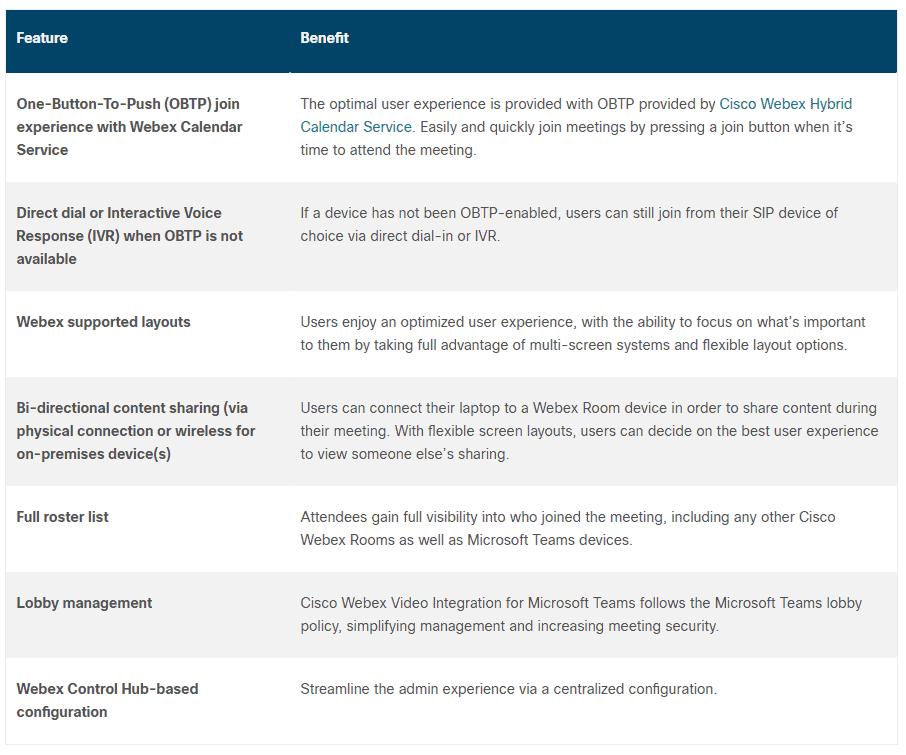
Thanks to my friend Michael LaMontagne for the heads up on this one. Cisco Webex Video Integration for Microsoft Teams is now officially certified as a Cloud Video Interop provider.

Cloud Video Interop (CVI) is the name for Microsoft certified third-party gateway services that allow standards-based room video systems to join Microsoft Teams meetings. They do this by inserting additional “dial in” details to a meeting invite to allow standards-based systems to connect via the CVI providers gateway service. Some will also enable “click to join” on standard room systems.

Without CVI there is no way for standards-based video endpoints to join Microsoft Teams meetings

We first heard about Cisco CVI coming at Ignite 2019 and just before Ignite 2020 it’s here.

Cisco CVI features

image

Microsoft documentation here

Cisco details here

22 Sep 23:15

Microsoft’s giant 85-inch Surface Hub 2S will arrive in January 2021 for $21,999.99

by Tom Warren
Microsoft’s 85-inch Surface Hub 2S. | Microsoft

Microsoft is starting to take preorders for its 85-inch Surface Hub 2S today. The large screen device, originally unveiled in April 2019, will now go on sale in January 2021, just missing Microsoft’s initial target of releasing the hardware at some point in 2020. Microsoft is pricing the 85-inch model starting at $21,999.99.

A $21,999.99 collaboration display might not seem like the type of device that businesses are rushing to buy in 2020 as a pandemic has kept a large number of people working remotely. Microsoft acknowledges that reality and claims the Surface Hub 2S has helped bridge remote teams and central response locations for hospitals, health care providers, and even in education.

Photo by Vjeran Pavic / The...

Continue reading…

22 Sep 23:14

Arm Says New Neoverse V1, N2 Server CPUs Faster Than Intel, AMD

by Dylan Martin
‘We know the alternative architecture isn’t standing still, but we’re very confident that Neoverse N2 will continue to represent the ultimate in per socket performance and Neoverse V1 will offer the ultimate per thread performance into the future,’ Arm executive Chris Bergey says of the newly disclosed server CPU designs.
22 Sep 23:13

Microsoft Teams gets breakout rooms, custom layouts and virtual commutes

by Frederic Lardinois

Unsurprisingly, Teams has become a major focus for Microsoft during the COVID-19 pandemic, so it’s no surprise that the company is using its annual Ignite IT conference to announce a number of new features for the service.

Today’s announcements follow the launch of features like Together Mode and dynamic view earlier this summer.

Together Mode, which puts cutouts of meeting participants in different settings, is getting a bit of an update today with the launch of new scenes: auditoriums, coffee shops and conference rooms. Like before, the presenter chooses the scene, but what’s new now is that Microsoft is also using machine learning to ensure that participants are automatically centered in their virtual chairs, making the whole scene look just a little bit more natural (and despite what Microsoft’s research shows, I can never help but think that this all looks a bit goofy, maybe because it reminds me of the opening credits of The Muppet Show).

Image Credits: Microsoft

Also new in Teams is custom layouts, which allow presenters to customize how their presentations — and their own video feeds — appear. With this, a presenter can superimpose her own video image over the presentation, for example.

Image Credits: Microsoft

Breakout rooms, a feature that is getting a lot of use in Zoom these days, is now also coming to Teams. Microsoft calls it the most requested feature in Teams and, like in similar products, it allows meeting organizers to split participants into smaller groups — and the meeting organizer can then go from room to room. Unsurprisingly, this feature is especially popular with teachers, though companies, too, often use it to facilitate brainstorming sessions, for example.

Image Credits: Microsoft

After exhausting all your brainstorming power in those breakout rooms and finishing up your meeting, Teams can now also send you an automatic recap of a meeting that includes a recording, transcript, shared files and more. These recaps will automatically appear on your Outlook calendar. In the future, Microsoft will also enable the ability to automatically store these recordings on SharePoint.

For companies that regularly host large meetings, Microsoft will launch support for up to 1,000 participants in the near future. Attendees in these meetings will get the full Teams experience, Microsoft promises. Later, Microsoft will also enable view-only meetings for up to 20,000 participants. Both of these features will become available as part of a new “Advanced Communications” plan, which is probably no surprise, given how much bandwidth and compute power it will likely take to manage a 1,000-person meeting.

Image Credits: Microsoft

Microsoft also made two hardware announcements related to Teams today. The first is the launch of what it calls “Microsoft Teams panels,” which are essentially small tablets that businesses can put outside of their meeting rooms for wayfinding. One cool feature here — especially as businesses start planning their post-pandemic office strategy — is that these devices will be able to use information from the cameras in the room to count how many people are attending a meeting in person and then show remaining room capacity, for example.

The company also today announced that the giant Surface Hub 2S 85-inch model will be available in January 2021.

And there is more. Microsoft is also launching new Teams features for front-line workers to help schedule shifts, alert workers when they are using Teams off-shift and praise badges that enable organizations to recognize workers (though those workers would probably prefer hard cash over a digital badge).

Also new is an integration between Teams and RealWear head-mounted devices for remote collaboration and a new Walkie Talkie app for Android.

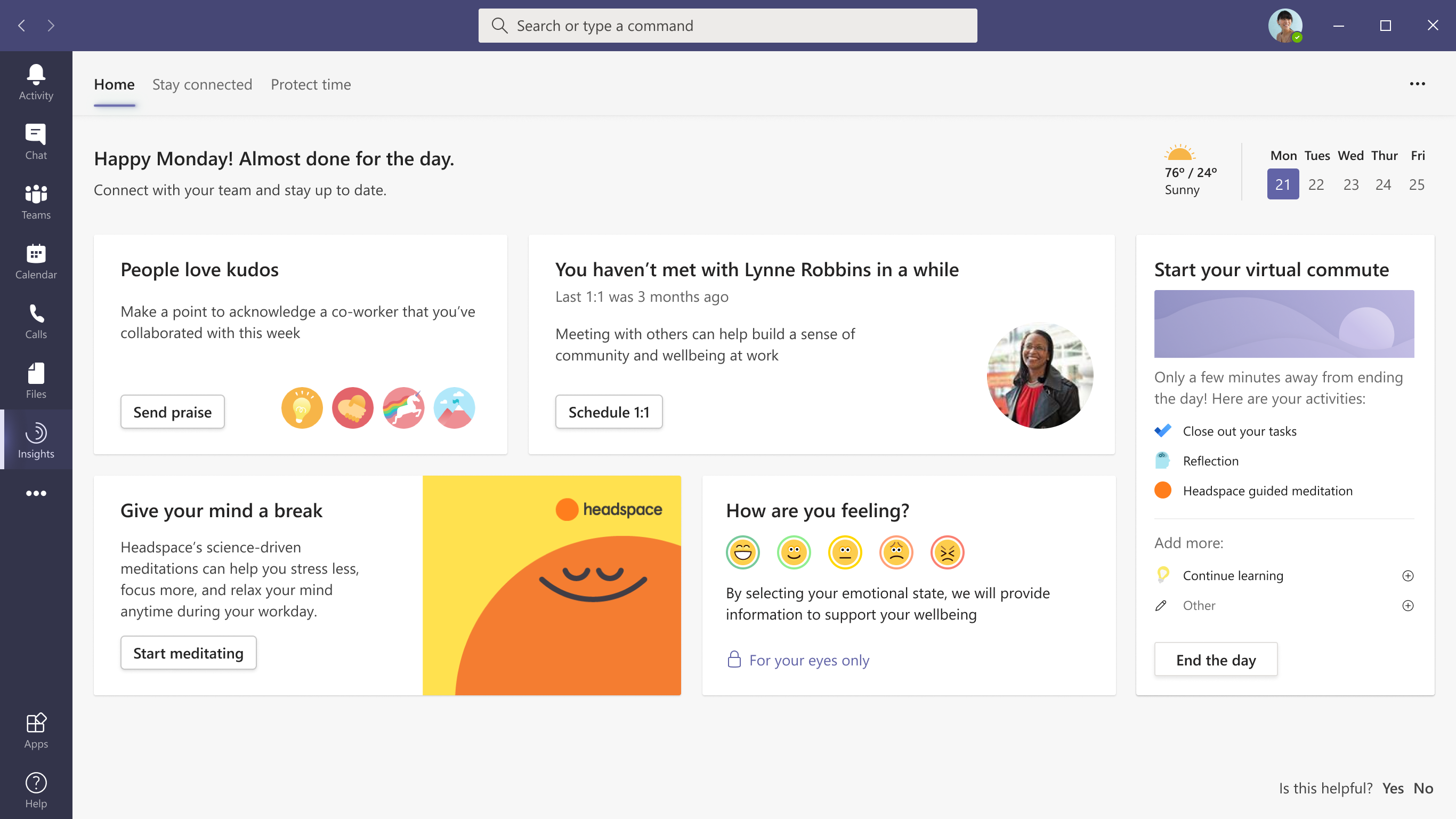
And since digital badges aren’t usually enough to improve employee well-being, Microsoft is also adding a new set of well-being features to Teams. These provide users with personalized recommendations to help change habits and improve well-being and productivity.

Image Credits: Microsoft

That includes a new “virtual commute” feature that includes an integration with Headspace and an emotional check-in experience.

I’ve always been a fan of short and manageable commutes for getting some distance between work and home, but that’s not exactly a thing right now. Maybe Headspace works as an example, but there’s only so much Andy Puddicombe I can take. Still, I think I’ll keep my emotional check-ins to myself, though Microsoft obviously notes that it will keep all of that information private.

And while businesses now care about your emotional well-being (because it’s closely related to your productivity), managers mostly care about the work you get done. For them, Workplace Analytics is coming to Teams, giving “managers line of sight into teamwork norms like after-hours collaboration, focus time, meeting effectiveness, and cross-company connections. These will then be compared to averages among similar teams to provide managers with actionable insights.”

If that doesn’t make your manager happy, what will? Maybe a digital praise badge?

22 Sep 22:50

The 20 Wealthiest Tech Billionaires In 2020: Forbes

by Gina Narcisi
Despite many industries taking a hit as a result of the COVID-19 pandemic, 20 tech and telecom executives cracked the top 100 of the richest people in the world since 2019.
22 Sep 22:49

Tesla announces ‘tabless’ battery cells that will improve range of its electric cars

by Andrew J. Hawkins

Tesla unveiled plans Tuesday to develop a “tabless” battery that could improve an electric car’s range and power. The company will produce its new batteries in-house, which Tesla CEO Elon Musk predicts will help dramatically reduce costs and allow the company to eventually sell electric vehicles for the same price as gasoline-powered ones.

The battery is expected to lower Tesla’s cost per kilowatt-hour, the unit of energy most commonly used to measure the capacity of the battery packs in modern electric vehicles. Many experts believe that lowering these costs would allow Tesla to dramatically lower the price of its cars, thereby making them far more accessible. The news of the new battery was announced during the company’s much-hyped...

Continue reading…

22 Sep 19:43

Newly released documents show Amazon is a $3.9 billion-per-year customer the Post Office can't afford to lose

by esully@businessinsider.com (Evan Sully)
usps

Justin Sullivan/Getty Images

  • Newly released documents obtained by American Oversight show that Amazon produced nearly $3.9 billion in revenue and $1.6 billion in profit for the USPS in the fiscal year of 2019.
  • USPS delivered 1.54 billion packages for Amazon during that time, or roughly 30% of the technology company's total volume.
  • While President Donald Trump has been critical about USPS doing business with Amazon, the numbers make it clear that the retail giant is generating much-needed profit for the Post Office.
  • Visit Business Insider's homepage for more stories.

Recently released documents show that Amazon accounted for a good chunk of the money the USPS brought in just one year ago.

A slew of financial statements and emails obtained by American Oversight show that Amazon accounted for nearly $3.9 billion in revenue and $1.6 billion in profit for the postal service in the fiscal year of 2019, the Washington Post reported

USPS delivered 1.54 billion packages for Amazon during the time period, or roughly 30% of the technology company's total volume, according to the documents, which also show that deliveries and revenue increased in fiscal year 2019.

Amazon's delivery network relies on the USPS for higher-cost deliveries, and the Post Office is required to delivery to every household in the US, even rural and hard-to-reach areas. But the government agency doesn't receive a dime in tax money, and has been struggling financially amid the pandemic.

The specific financial numbers released by American Oversight come as US President Donald Trump has consistently fueled the notion that Amazon is bad business for the Post Office; however, the numbers paint a different picture.

"Amazon and other companies like it, they come and they drop all of their mail into a post office," Trump said while appearing on "Fox & Friends" on August 17. "They drop packages into the post office by the thousands and then they say, 'Here, you deliver them.' We lose $3 and $4 a package on average. We lose massive amounts of money."

Business Insider previously reported on the multidimensional relationship between Amazon and the USPS. Trump is correct in that the USPS does subsidize Amazon deliveries by charging the company below-market rates, although it's not clear where he's getting the $3 to $4 per-package loss numbers from (Citi analysts in 2017 estimated it was around $1.46 per package).

But Trump's criticisms of the below-market rates misses a key point: Losing Amazon as a customer would be a brutal blow to the Post Office, with the newly released fiscal 2019 numbers pegging that value at $3.9 billion in revenue.

Simply put, in return for the lower rates, the USPS keeps a large customer, and staves off a possible future in which Amazon builds out its own delivery fleet, including drone deliveries for rual areas, to the extent it doesn't need the USPS's delivery network — or even begins competing with USPS to deliver some non-Amazon packages as well.

"For more than two decades, Amazon has partnered closely with the United States Postal Service to invent and deliver for our customers, which has resulted in significant revenue for the USPS and thousands of American jobs," Rena Lunak, a company spokesperson for Amazon, said in a statement. "USPS continues to be a great partner in serving Amazon customers."

Trump's rhetoric regarding Amazon has heated up in 2020 with the presidential election on the horizon and his Democratic opponent, former US Vice President Joe Biden, maintaining a solid lead in the polls in battleground states such as Wisconsin and Nevada. 

The President's attacks on the online retailer aren't anything new. In 2018, he said that Amazon had cost the USPS "billions" of dollars.

Trump, however, isn't alone on skepticism of Amazon's in-house delivery network that began being built out in earnest in 2013. A report in December by Morgan Stanley wrote that Amazon is "disproportionately servicing" the densest areas in the US in order to keep their costs low.

But as the newly released numbers reveal, the USPS isn't in a position right now to increase its rates and risk losing Amazon. It's hurting like many other businesses amid the pandemic, and it can't afford to lose a customer that generated $1.6 billion in much-needed profit last year.

Read the original article on Business Insider
22 Sep 19:42

The hell that is remote learning, explained in a comic

by Aubrey Hirsch
A cartoon of a woman wearing a shirt that reads “super mom” sitting at a desk looking at an open laptop and a tablet on a stand.

Here’s what one week of online school is like for my 7- and 5-year-old kids.

I’m a freelance writer and illustrator living in the Bay Area with my 7-year-old and 5-year-old. On August 17, the kids started school, which is 100 percent remote, at least until January but likely longer depending on how the pandemic develops this winter. Here’s what one week of attempting online school looks like.

Aubrey Hirsch is a writer and illustrator in Berkeley, California. Her work has appeared in the Nib, the New York Times, the Rumpus, and elsewhere.


Help keep Vox free for all

Millions turn to Vox each month to understand what’s happening in the news, from the coronavirus crisis to a racial reckoning to what is, quite possibly, the most consequential presidential election of our lifetimes. Our mission has never been more vital than it is in this moment: to empower you through understanding. But our distinctive brand of explanatory journalism takes resources. Even when the economy and the news advertising market recovers, your support will be a critical part of sustaining our resource-intensive work. If you have already contributed, thank you. If you haven’t, please consider helping everyone make sense of an increasingly chaotic world: Contribute today from as little as $3.

22 Sep 19:37

Satya Nadella’s 5 Biggest Statements At Microsoft Ignite 2020

by Kyle Alspach
Nadella uses his keynote at Ignite to tout Microsoft’s latest launches and momentum across cloud, productivity and security.
22 Sep 19:37

Google is shutting down paid Chrome extensions

by Jay Peters
Illustration by Alex Castro / The Verge
Google is shutting down paid Chrome extensions offered on the Chrome Web Store, the company announced today. That means that developers who are trying to monetize their extensions will have to do so with other payment-handling systems.

As of Monday, developers can no longer make new paid extensions, according to Google — though that’s cementing a policy that has already been in place since March. And that policy follows a temporary suspension of publishing paid extensions in January after Google noticed an uptick in fraudulent transactions that “aim[ed] to exploit users.”

Google will gradually phase out other functionality over the coming months, and on February 1st, Google says that existing extensions can no longer charge customers...

Continue reading…

22 Sep 19:36

How to share your iCloud storage with friends or family, using an iPhone, iPad, or Mac

by insider@insider.com (Dave Johnson)
Apple iPhone 11 Pro Max
It's easy to share iCloud storage with a Family Sharing plan.

Hollis Johnson/Business Insider

  • To share your iCloud storage with others, you'll need to set up Family Sharing on your iPhone, iPad, or Mac.
  • When you activate Family Sharing, you'll also have the chance to share App Store purchases, an Apple Music account, and more.
  • If you need more iCloud storage space for the entire family, you can upgrade your storage plan.
  • Visit Business Insider's Tech Reference library for more stories.

While the 5 GB of storage that Apple gives users for free might not be enough for even one person, upgrading to 200 GB can be overkill.

If this is the case, you might want to share your storage space with others. You can use iCloud's Family Sharing feature for just this purpose. A Family Sharing group can share either the 200 GB or 2 TB storage plan while keeping all their own files and photos separate and private. 

Here's how to set up iCloud storage sharing, using any iCloud-capable device.

How to set up iCloud storage sharing on an iPhone or iPad

1. Start the Settings app and tap your account name at the top of the screen.

2. Tap "Family Sharing."

How to share iCloud storage 1
The Family Sharing menu is where you can enable iCloud sharing.

Dave Johnson/Business Insider

3. If you're not already using Family Sharing, add yourself as the organizer and tap next. 

4. Tap "iCloud Storage" and make sure you have a compatible iCloud subscription — you'll need either 200 GB or 2 TB.

5. Add family members by tapping "Add Member" and sending invitations to the other members via text message. When they accept, their names will appear below your name on this page. 

How to share iCloud storage 2
You'll need at least 200 GB to enable Family Sharing — you can't share at the 5 GB or 50 GB levels.

Dave Johnson/Business Insider

6. Once you've set this up and added your family members, you can add the other Family Sharing benefits, like group App Store purchases.

How to set up iCloud storage sharing on a Mac

1. Click the Apple icon at the top-left of the screen and choose "System Preferences…" 

2. Click "Family Sharing" in the top-right.

How to share iCloud storage 3
Go to "Family Sharing" to share your iCloud storage.

Dave Johnson/Business Insider

3. If you're not already using Family Sharing, add yourself as the organizer and click next. 

4. Follow the instructions to indicate if you want the family to share purchases and location information. 

5. Add family members by clicking "Add Family Member…" and sending invitations to the other members via email. When they accept, their names will appear below your name on this page. 

6. Once they do, click "iCloud Storage" in the sidebar and make sure you're subscribed to either the 200 GB or 2 TB plans. If you're not, select "Upgrade" and pick a new plan.

How to manage your family's iCloud storage 

Once iCloud Family Sharing is set up, you can monitor, change, and upgrade your storage sharing at any time. 

1. On an iPhone or iPad, start the Settings app and tap your account name at the top of the screen. If you're using a Mac, click the Apple icon at the top left of the screen and choose "System Preferences…" 

2. Tap "Family Sharing."

3. Tap "iCloud Storage."

How to share iCloud storage 4
You can see how much of your iCloud storage is being used by every family member.

Apple

You can now see a list of all your family members, and how much iCloud storage they're using. You can stop sharing or change your plan from here as well. 

Related coverage from Tech Reference:

Read the original article on Business Insider
21 Sep 17:04

We Will Not Have a Vaccine by November

by Shannon Palus
21 Sep 17:04

TikTok's Chinese owner contradicted 2 of Trump's key boasts about its deal with Walmart and Oracle

by insider@insider.com (Isobel Asher Hamilton)
donald trump
US President Donald Trump.

JIM WATSON/AFP via Getty Images

  • TikTok parent ByteDance released a statement Monday about the app's US deal with Oracle and Walmart that contradicted two statements made by the president.
  • It asserted that Beijing-headquartered ByteDance will maintain 80% control of the newly formed TikTok Global despite Trump saying it would have "nothing to do with China."
  • The company also denied knowledge of the president's claim that $5 billion would go to the US Treasury to set up an education fund.
  • Oracle on Saturday announced that it would become a minority investor in TikTok, in an 11th-hour deal that ByteDance will be hoping allays US fears about the app's threat to national security.
  • Visit Business Insider's homepage for more stories.

TikTok may have got the White House greenlight for a US tie-up with Oracle and Walmart, but its parent firm ByteDance would like to check some of President Trump's boasts about the deal.

In statements on Monday, ByteDance appeared to fact-check Trump, who on Saturday gave his "blessing" to the Oracle-Walmart deal.

ByteDance on Monday put out a press statement titled "clarifying groundless rumors about TikTok" (per Bloomberg's translation).

Although ByteDance did not explicitly identify President Trump as the source of these "rumors," it contradicted two statements from him about the deal.

1. "It will have nothing to do with China"

The president asserted on Saturday that the deal struck between Oracle, Walmart, and ByteDance would create a new company with no connection to China.

"It'll be a brand new company. It will have nothing to do with any outside land, any outside country, it will have nothing to do with China," Trump said.

While it is true that the deal will involve setting up a new entity called TikTok Global which will be headquartered in the US, ByteDance — which is based in Beijing — said it will retain an 80% stake in the company.

Oracle and Walmart will own up to 20% of the company, with Oracle designated as ByteDance's "trusted technology provider" in the US and Walmart as a "commercial partner."

In public statements, Oracle and Walmart have said TikTok Global will be an "independent American company," and that four out of five board members will be US citizens.

2. No $5 billion  for Trump's 'real history' education fund

Trump told reporters on Saturday the companies involved in the deal had agreed to pay a $5 billion fee to the US Treasury which would be used to set up an education fund.

He repeated this claim later the same day at a rally in Fayetteville, North Carolina. He told attendees he told the dealmakers: "Do me a favor, could you put up $5 billion into a fund for education, so we can educate people as to the real history of our country — the real history, not the fake history."

In its statement on Monday, ByteDance said the $5 billion figure was not a one-off fee but an estimate of the income tax the company could potentially pay over several years.

"TikTok is confident in its future but the actual tax amount will have to be determined in accordance with the actual state of the business and American tax structures," ByteDance said per Bloomberg's translation. The company already contradicted news of the fee in a post on its domestic news platform Toutiao on Sunday, Reuters reported.

This isn't the first time Trump has made claims about taking a slice of the Oracle-TikTok deal. The president asserted back in August that the US Treasury would get a "large percentage" of any sale price concerning TikTok, although he was not clear exactly which side of the deal the money should come from. Sources told The Financial Times last week that the final deal did not include any sort of cut for the Treasury.

Two sources told Bloomberg that Trump had told Oracle and Walmart's CEOs that he wanted a cut to go to the US government on Friday. A ByteDance spokesperson said the company first learned about the supposed $5 billion fee from press reports.

Read the original article on Business Insider
21 Sep 16:58

Security Minute: 5 Essential Tools To Manage Remote Workforces

by CRN Staff
Nearly three in four companies plan to permanently shift more employees to remote positions post-COVID-19. Find out the opportunity RSA is offering its partners to help their customers manage the increased security threat.
21 Sep 16:55

Fauci: We'll likely be wearing masks for most of 2021, even after a vaccine rolls out

by hbrueck@businessinsider.com (Hilary Brueck)
coronavirus task force fauci
Director of the National Institute of Allergy and Infectious Diseases Dr. Anthony Fauci watches as Vice President Mike Pence speaks after leading a White House Coronavirus Task Force briefing at the Department of Health and Human Services on June 26, 2020 in Washington, DC.

Joshua Roberts/Getty Images

  • Dr. Anthony Fauci says a vaccine alone is not going to "get us to the point where we want to be, by the end of 2021."
  • We'll need to vaccinate, social distance, continue hand hygiene, and use masks in order to get the level of coronavirus circulating between people down so low that outbreaks become a thing of the past.
  • The first coronavirus vaccines will likely not protect people from getting sick at 100%, but may provide somewhere around 70% protection against symptomatic infections. 
  • Visit Business Insider's homepage for more stories.

Just getting vaccinated is not going to be enough to end this pandemic. 

Dr. Anthony Fauci made it clear during our interview earlier this week: There is no singular, winning public health intervention that will wipe out this novel coronavirus all on its own. 

"I said a combination of an effective vaccine and adherence to certain public-health principles will get us to the point where we want to be, by the end of 2021," Fauci said during a lunchtime call over pizza on Wednesday. "I never said just the vaccine. You never should abandon the public-health measures."

It is going to be a long road to get everybody vaccinated

Fauci mask coronavirus testimony
Dr. Anthony Fauci at a Senate Health, Education, Labor and Pensions Committee hearing on June 30, 2020 in Washington, DC.

Al Drago/Getty Images

Part of the reason for Fauci's caution is because the very first coronavirus vaccines that roll out will probably not be perfectly protective against infections.

We don't know yet how effective the first coronavirus vaccines are going to be, but already, more than 30 coronavirus vaccine candidates are being tested out in people around the world. Data on exactly how safe and useful some of the most promising shots — being tried out now in thousands of vaccine study volunteers in US and abroad — should start trickling out in either October, November, or December of this year.

That would, in an ideal scenario, make it possible to have a vaccine (or, a few different vaccines) approved for use across the US by 2021. 

"I feel cautiously optimistic that we will have a safe and effective vaccine by the end of this calendar year," Fauci said. "I said November-December, others say October. I think it's unlikely in October, but maybe, you never know." 

Still, in a best-case scenario, we'll likely be well into 2021 before every American who wants a coronavirus vaccine can get it.

We will need to be masking and distancing throughout 2021, even if a vaccine exists

In all likelihood, the initial coronavirus vaccines on the market may provide something along the lines of 70% efficacy against symptomatic infections. At that potency, they will help reduce disease levels in the population at large, but they won't prevent every instance of COVID-19, the disease caused by the virus. 

"You still need to wear that mask," Paul Offit, director of the Vaccine Education Center and The Children's Hospital of Philadelphia, recently told Business Insider. "What worries me is people are going to see this vaccine as a magic dust that's going to go over our country and make this virus stop. It doesn't work that way."

Maria Elena Bottazzi, a vaccine developer at Baylor College of Medicine, agreed.

"The moment you get a vaccine doesn't mean you're going to put your mask in the trash," Bottazzi recently told Business Insider. "That is not going to happen."

Vaccines have the potential to provide just the right kind of bubble protection to make coronavirus outbreaks a thing of the past, but that is so much more likely if we adhere to other public health measures as they are rolled out. 

Together with widespread masking when indoors in public spaces, keeping vigilant about hand hygiene, and respecting social distancing protocols, vaccines could make quite a dent in disease transmission.

"I don't think we're going to eradicate it," Fauci said of the coronavirus. "We may not completely eliminate it, but if you get it down to such a very low level, and enough of the population is protected — either by a vaccine or by previously having been infected — then you'll develop a degree of herd immunity that you won't have an outbreak."

Save your big get-togethers for 2022

Fauci is not saying that you'll have to wear a mask forever.

COVID-19 Vaccine test 4
Pharmacist Michael Witte, left, gives Rebecca Sirull, right, a shot in the first-stage safety study clinical trial of a potential vaccine for COVID-19, the disease caused by the new coronavirus, Monday, March 16, 2020, at the Kaiser Permanente Washington Health Research Institute in Seattle.

AP Photo/Ted S. Warren

If most people get vaccinated, and wear masks, and continue social distancing well into 2021, he says it's "quite reasonable" to assume we may be able to go back to having big, carefree gatherings, almost like in the pre-pandemic days.

Scheduling big parties and weddings for 2022 is a "pretty safe bet," he said. 

"If there's almost no infection in the community, together with the vaccine, you might want to be able to say "I can safely congregate with people," he said. "You may want to do it with a mask, or without a mask." 

Coronavirus vaccines will likely continue to improve in years to come, resulting in different generations of COVID shots which may provide increasingly better protection over time. But at first, caution will be important.

"By the time we get to the end of 2021, if everyone gets vaccinated and we continue to implement the public-health measures that I have been talking about incessantly over the last several months — they're not universally adhered to — if we do that, plus the vaccine, we'll get to the point where the level of virus will be so low, and maybe even, you know, close to absent," Fauci said.

Andrew Dunn contributed reporting to this story. 

Read the original article on Business Insider
21 Sep 16:53

Google is planning to add new 'hub' offices to provide flexibility for employees, and experts say these networks of satellite offices are the future in Silicon Valley

by ahartmans@businessinsider.com (Avery Hartmans)
Amazon Boulder headquarters offices
Amazon's office in Boulder, Colorado.

Helen H. Richardson/The Denver Post via Getty Images

  • The future of the tech office isn't clustered in Silicon Valley, experts told Business Insider.
  • Instead, tech companies will likely adopt a "hub-and-spoke" model, with satellite offices peppered across the US.
  • In a post-coronavirus era, employees may have a "remote-first" work schedule, and commute to a satellite office when they need to from wherever they live. 
  • Amazon, Apple, and Uber have already started to adopt something similar. Amazon recently announced a $1.4 billion investment in expanding its offices in six US cities outside of Seattle, while Uber and Apple have each made major expansions in Texas.
  • This model allows companies to keep the "prestige" of a Bay Area headquarters, but expand their talent pools outside Silicon Valley and save money on labor costs, says one expert.
  • This could be good for employees, too: It allows workers to live outside of major cities while still being able to access the perks of an office, like technology or socialization. 
  • Visit Business Insider's homepage for more stories.

When will it be safe for tech employees to return to the office? What happens to employees who want to leave Silicon Valley? And what does the future of the office look like? 

These are the questions that major tech companies are grappling with as the coronavirus crisis stretches into the fall. Many large tech firms, including giants like Facebook and Google, have pushed back plans to return to the office until summer 2021, and have said they anticipate a rise in remote work.

But experts told Business Insider that the office — and Silicon Valley — will look very different by then. With workers leaving the Bay Area and companies wary to have thousands of employees all in one place, San Francisco may not be the central tech headquarters it's been for decades.

Instead, the experts say, tech companies are going to expand outward, with small satellite offices peppered throughout the US.

"We're going to start to see satellite locations rather than singular HQs," Melissa Hanley, CEO of the Bay Area design firm Blitz, told Business Insider. "We might say, 'Hey, you don't have to commute two hours. We're going to have a little satellite office with all the resources you need out in the 'burbs.'" 

Google Boulder Colorado office worker
A Google employee at the company's office in Colorado.

AAron Ontiveroz/The Denver Post via Getty Images

A hub-and-spoke model

Adam Segal, the CEO of workplace management technology company Cove, said he expects most companies will start to adopt a "remote-first approach," meaning that working at home is the norm, not the exception. While workers might have worked remotely one or two days per week in pre-coronavirus times, in the future, that will be reversed, Segal said.

"So what does that mean? You just have less dedicated desks," Segal told Business Insider. "No one misses their desk — that's not why you go to the office. You miss people, the socialization."

Segal agrees with Hanley that the future of the office will be a so-called "hub-and-spoke" model: Companies would have a "hub," or headquarters, in a major city, then have "spokes" anywhere in America connected by the same technology system. With Cove's system, for example, you'd be able to look up office locations in your area, see which of your colleagues was working there, and book a desk of your choice for the day. 

Google is planning on a future that includes office hubs, according to leaked audio obtained by Business Insider's Hugh Langley. During an October 1 all-hands meeting, Google CEO Sundar Pichai said the company is planning on adding new, smaller hub offices, which will give employees more flexibility around where they live. 

"In the future when we think about it, we do see the majority of Googlers' roles will continue to be tied to a particular office and that they will live within some reasonable distance of that office," Pichai said during the all-hands. "What we are doing is expanding the number of offices we see as hubs so that people will have a lot more choice in their lives."

Pichai also used the phrase "hybrid-flexible" to describe how Googlers will work going forward, which could mean that employees will have the option to both work remotely and report to the office. 

Twitter CEO Jack Dorsey recently hinted at a satellite model for Twitter's workers. Dorsey told "The Boardroom: Out of Office" podcast host Rich Kleiman that he's been working on "decentralizing" Twitter's workforce, and that many entrepreneurs he talks to aren't interested in a big San Francisco headquarters anymore. "Here we are, an internet company, that's completely centralizing in San Francisco," Dorsey said. "We're not living up to the ideals of what the internet inspired us to be and what it can show." 

Companies like Amazon are already starting to meet employees where they are. The company recently announced a $1.4 billion investment to expand its physical offices in six cities across the US: Dallas, Detroit, Denver, New York, Phoenix, and San Diego. It's also hiring 3,500 new employees, but not at its main headquarters in Seattle — these workers will report into those hubs spread across the US. 

Tracy Brower, a sociologist and principal in the applied research and consulting group at furniture manufacturer Steelcase, said she's already hearing from clients who are mulling a switch to satellite offices, in part because they would save on real estate costs in major cities.

But she also sees benefits for employees. For one, satellite offices may be safer; workers wouldn't have to worry about commuting in crowded downtowns or trying to socially distance in the elevator of a high-rise building. 

There would also be an improvement in quality of life. "Satellites are really more convenient," Brower told Business Insider, arguing that they give workers more choice in how they work. "I might come to a satellite for great technology that my company offers, and I don't have the same thing at home."

For workers sick of staying at home or feeling creatively stuck without the ability to easily work with others, a satellite office could satisfy some of those feelings, Brower said. "A lot of times, the reason we want to get together is for new ideas, for new thinking, to be stimulated by the people around us."

Cove office tech examples
An example of Cove's software in action.

Cove

Bay Area vs. anywhere else

Satellite offices aren't a new concept. In the era after 9/11, for example, the banking industry went the route of satellite offices, setting up hubs outside of lower Manhattan and New York City. 

The coronavirus may have just sped up a trend that was already percolating in the tech industry over the last few years.

John Boyd, a principal at corporate location consultancy The Boyd Company, used Uber as an example. In August 2019, Uber announced plans to build a new hub for 3,000 employees in the Dallas area. The new office is expected to become Uber's largest outside of the Bay Area.  

Similarly, in November 2019, Apple broke ground on a brand-new, $1 billion Austin campus that spans 3 million square feet. It's expected to open in 2022 and will house 5,000 employees to start. 

Apple Austin satellite office
Apple's campus in Austin, Texas.

Drew Anthony Smith/Getty Images

Boyd says that while companies may keep headquarters in the Bay Area for prestige, lower labor costs also make satellite offices appealing.

"Labor costs in Raleigh, North Carolina, or Tampa, Florida, can be 25 to 30% less than in Palo Alto, California," Boyd said. Moving 4,000 or 5,000 jobs to these markets can mean millions in savings for tech firms.

Tech companies, however, would need to make those satellite offices desirable for people who don't already live there — or who want the lifestyle of places like Palo Alto. "They need to offer the type of lifestyle amenities that Tesla employees in Palo Alto view as favorable or desirable," Boyd said.

Boyd said there wes a slew of cities well-positioned to welcome a tech workforce: Nashville, Raleigh, Tampa, Miami, Austin, Salt Lake City, Las Vegas, and Phoenix.

One thing all the experts agreed on: The office isn't going away, it's just changing.

"I don't think the office is dead, I think that's hyperbole and sort of ridiculous," Hanley of Blitz, the design firm, said. "People need community, people need culture, they need contact, and that will not go away."


The Business Insider Global Trends Festival will take place on the 19th-23rd of October. Join us for a virtual conference of ideas featuring live, on demand content, workshops, and key speakers from around the world. Find out more.

Read the original article on Business Insider
21 Sep 16:53

The CDC has acknowledged the coronavirus can 'remain suspended in the air' and float beyond 6 feet, especially indoors

by hbrueck@businessinsider.com (Hilary Brueck)
one of the first sneeze pictures
This photo of a sneezer caught in the act was taken by Professor Marshall Jennison from MIT, and published in a 1941 research paper.

Bettmann/Getty Images

  • The CDC has acknowledged, for the first time, that the coronavirus can 'remain suspended in the air.'
  • When we're indoors, six feet might not be enough distance from others to keep us safe, the CDC said in updated guidance. 
  • The new phrasing lines up with what studies from around the world have suggested: the virus spreads easily between people through the air, even when they're not snuggled closely together.
  • Being loud, by singing, shouting, talking, and spitting, can all help the virus spread better.
  • Visit Business Insider's homepage for more stories.

Six feet may not be enough to protect you from the coronavirus, especially indoors. 

The Centers for Disease Control and Prevention is acknowledging, for the first time, that the coronavirus "can remain suspended in the air and be breathed in by others, and travel distances beyond six feet."

The updated language, which has been on display on the federal agency's website since Friday, is backed by a large and growing body of evidence that the coronavirus spreads well between people who are indoors, shouting, singing, karaoke-ing, eating, and breathing together, even at a distance. 

People, and the tiny particles that they breathe, shout, sing, sneeze, and cough out are the greatest viral threat right now. Not surfaces, and not contaminated groceries or mail

As Americans head into the chillier fall and winter months, with the novel coronavirus still in circulation, it'll be an important point to remember: Being inside with this virus is dangerous, and wearing a mask when indoors is an important infection prevention technique. 

The CDC's previous guidance may not be enough in every setting

Screen Shot 2020 09 21 at 10.00.41 AM
The CDC's previous guidance was updated last on June 16, 2020.

CDC

Since the CDC last updated its guidance on how the virus spreads, in June, scientists have learned much more about the best ways that the coronavirus hops from person to person, as the illness has continued to move around the world.

In a now-infamous choir practice investigated in Washington state, 53 people got COVID-19, the illness caused by the coronavirus, from one sick choir member, even though they were all social distancing (but not wearing masks) during practice. Two people died. 

In May, the CDC even issued "interim guidance for communities of faith" warning against group singing activities during the pandemic, but the guidance was yanked off the agency's website after only a day, because the White House hadn't approved the change.

In July, the World Health Organization, which like the CDC is constantly reviewing new scientific evidence about how the virus spreads, acknowledged that the virus may float beyond six feet, especially indoors. 

The new guidance pressed that certain high-transmission indoor settings — "during choir practice, in restaurants, or in fitness classes" — have all shared some common features: they're crowded, poorly ventilated places where people have spent a "prolonged period of time" with infected individuals.

It's very similar to the CDC's updated information on 'How COVID-19 spreads.'

Now the CDC says the virus 'can remain suspended in the air' and 'travel distances beyond 6 feet' 

Screen Shot 2020 09 21 at 10.00.58 AM
The new guidance, dated September 18, 2020.

CDC

Being outdoors with others is better than hanging out inside. There's infinite room for the virus to dissipate and disappear after leaving a sick person's nose or mouth, as long as you're not getting too close. 

It also helps to have a good ventilation system, as many hospitals and airplanes already do. Or, open a window. 

"If ventilation is good, it is not a threat, because the virus is not in the air," professor Lidia Morawska, a leading aerosol scientist in Australia, recently told Insider.

Wherever you are, keeping a good measure of distance between yourself and others is still a good idea, but if you're indoors, or in a crowded space, keeping your mask on, staying quiet, and making interactions brief can all help mitigate the spread. 

"It's not rocket science to work out what needs to be done to minimize the risk of infection transmission," Morawska said.

Read the original article on Business Insider
21 Sep 16:48

Costco's founder once told the company's current CEO, 'if you raise the [price of the] effing hot dog, I will kill you,'

by ijiang@businessinsider.com (Irene Jiang)
Costco food court hot dog
A Costco hot dog smothered in mustard.

Irene Jiang / Business Insider

  • Costco has charged $1.50 for its hot dog and soda combo since 1985, and a quote from Costco founder Jim Sinegal explains why that is.
  • When Costco's now-CEO Craig Jelinek approached Sinegal about raising the price of the combo, Sinegal told him "I'd kill you" if Jelinek raised the price.
  • So Jelinek figured out a solution: stop buying hot dogs from Hebrew National and build factories to make Kirkland Signature brand hot dogs.
  • In a January shareholders meeting, Jelinek said Costco has "no plans to take that hot dog above a buck fifty."
  • Visit Business Insider's homepage for more stories.

Costco has charged $1.50 for its iconic hot dog and soda combo since 1985.

An old quote from Costco founder Jim Sinegal about why that is has resurfaced on Twitter after a user posted screenshots from a 2018 Mental Floss article.

When Costco's current CEO Craig Jelinek once approached Sinegal, then CEO, about raising the price of the hot dog, Sinegal told him, "If you raise the [price of the] effing hot dog, I will kill you. Figure it out."

In 2009, Jelinek did figure it out. Costco stopped using its longtime hot dog supplier, Hebrew National and built a Kirkland Signature hot dog factory in Los Angeles, and later built another one in Chicago. The new factories reduced the production costs for the hot dog, allowing Costco to continue selling the menu item for $1.50.

Jelinek told local Seattle Eastside publication 425Business in 2018 that he expected people would still buy the hot dog if the price were raised to $1.75. 

"It would not be that big of a deal. People would still buy [it]," Jelinek told 425Business. "But it's the mindset that when you think of Costco, you think of the $1.50 hot dog."

Jelinek took over as CEO when Sinegal retired in 2012, and the hot dog's popularity has only grown. In fiscal 2019, Costco sold 151 million hot dog combos for a total of about $226.5 million. And Jelinek said in Costco's shareholder meeting in January that he now has no intention of raising the price of the hot dog. 

"We have no plans to take that hot dog above a buck fifty," he told shareholders. "End of story."

Read the original article on Business Insider