Shared posts

01 Feb 06:54

Canada’s Cineplex closes more theaters as omicron spreads

by Catie Keck

Cineplex, the largest theater chain in Canada, is preparing to temporarily shutter its Ontario auditoriums in response to a government mandate limiting indoor business to help curb the spread of omicron.

The theater chain said that all 67 of its theaters in Ontario will close beginning Wednesday, January 5th, adding that the cinemas will reopen “as soon as we are allowed.” The measure comes as Ontario enacts restrictions on schools, dining, and entertainment venues to prevent what Ontario Premier Doug Ford characterized during a Monday news briefing as “a tsunami of new cases in the days and weeks ahead.”

“To make it as easy as possible, we have already begun processing ticket refunds back to our guests’ original method of payment....

Continue reading…

01 Feb 06:49

Lenovo’s new smart clock swaps the Google Assistant for Alexa

by Emma Roth
Image by Lenovo

Lenovo has a new smart clock, and unlike its prior models, the updated Smart Clock Essential comes with Alexa instead of Google Assistant — basically making it an Echo Dot turned smart clock. Most of the major changes to the clock have to do with Lenovo passing the baton to Alexa, but there are still some smaller changes worth noting as well.

You can still set an alarm, timer, and reminders, as well as control your smart home with the device; any product that’s compatible with Alexa will also work with the Smart Clock Essential. Additionally, you can stream audio from Amazon Music and other streaming platforms, which the smart clock plays from its 3W speaker, a spec that remains unchanged from the previous model.

The fabric case that...

Continue reading…

01 Feb 06:44

2600Hz Rebrands Popular Telecom Podcast to In the Cloud w/2600Hz

by Amy Ralls

2600Hz’s podcast, In the Cloud w/2600Hz, relaunched today with an insightful new episode featuring cloud communications pioneer Mike Tessler of True North Advisory.

HENDERSON, NV – January 12, 2022 – 2600Hz, a leading provider of unified business communications and the award-winning KAZOO platform, relaunched its popular telecom podcast today with the episode “How to Scale Your Cloud Communications Business with Mike Tessler.” In the Cloud w/2600Hz, hosted by 2600Hz’s own Alisa Bartash and Clint Mohs, features interviews with industry experts, inside looks at what’s happening at 2600Hz, and fun “did you know?” chats about what’s going on in the world of cloud communications.

In the Cloud w/2600Hz is a one-stop podcast for insight into industry trends, news, and everyone’s favorite telecom acronyms, including UCaaS, CPaaS, and CCaaS. The podcast, which debuted in 2019 under the name Free UC w/2600Hz, will celebrate its third anniversary in April.

“Over the past three years, the telecom landscape has changed dramatically. We felt it was time to revamp our podcast to reflect not only industry changes, but also the changes our listeners have experienced, such as the shift to working remotely in 2020 and the emergence of the hybrid workplace in 2021,” said Alisa Bartash, co-host of In the Cloud w/2600Hz and Head of Marketing for 2600Hz. “We have an exciting lineup of guests scheduled for 2022 and can’t wait to bring our listeners crucial conversations and information about telecom, cloud communications, and more.”

With new episodes releasing the second Wednesday of every month, In the Cloud w/2600Hz is available widely on most podcast platforms including Spotify, Apple Podcasts, Google Podcasts, iHeart, Overcast, and more.

About 2600Hz: 2600Hz’s cloud communications platform KAZOO modernizes how businesses provide communications services to their customers. With thoughtfully engineered tools built by leaders in the telecom industry, KAZOO offers feature-rich UCaaS, CPaaS, and CCaaS solutions. For developers building their own telephony apps, 2600Hz offers 300+ APIs and provides access to the building blocks of the platform. For more information, visit http://www.2600Hz.com. 2600Hz is a privately owned company with a distributed team worldwide.

The post 2600Hz Rebrands Popular Telecom Podcast to In the Cloud w/2600Hz appeared first on Cloud Communications Alliance.

29 Jan 18:42

Neil Young says he ‘felt better’ after leaving Spotify and its ‘shitty’ sound quality

by Chris Welch
South By Southwest Interactive Festival - Day 5
Photo by Gary Miller/FilmMagic

Even after departing the platform, Neil Young isn’t done criticizing Spotify yet. Today, the rock legend has published another letter on his website, describing Spotify as a purveyor of “more songs and less sound.” Young says that he “felt better” after pulling his music catalog from the leading streaming music service earlier this week while noting that he’s strongly opposed to censorship and that “private companies have the right to choose what they profit from, just as I can choose not to have my music support a platform that disseminates harmful information.”

Throughout the latest post, Young — a longtime advocate of hi-fi sound — heavily criticizes Spotify for its lossy audio quality. “Amazon, Apple Music, and Qobuz deliver up to...

Continue reading…

28 Jan 22:42

Microsoft launch Microsoft Teams global device trade in program with Network-Value

by Tom Arbuthnot

image

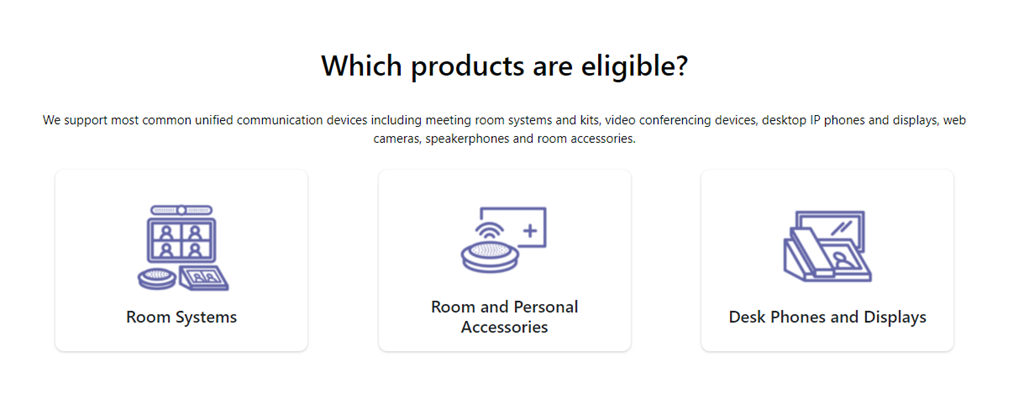
Microsoft is partnering with Network-Value, a US-based company specialising in device trade-in programmes to offer a global device trade in program. Customers can trade in “most common unified communication devices” including meeting room systems and kits, video conferencing devices, desktop IP phones and displays, web cameras, speakerphones and room accessories.

The programme will be fully managed by Network-Value and customers will request and receive quotes, payments and sign agreements directly with Network-Value.

How does it work?

  • Provide a list of devices including manufacturer, model numbers, quantities and condition via the trade in form or wizard
  • Network-Value will deliver a report summarising the estimated value of your devices.
  • Network-Value covers the cost of return delivery for all trade-in equipment.
  • The client is responsible for packaging the equipment correctly to prevent damage in transit. Packaging materials can also be provided if required. On-site decommissioning services or packaging services are available upon request. Cost of on-site services can be deducted from your total trade-in value
  • Once your devices have been received and processed, Network-Value will issue payment via cheque or bank transfer within 30 days of receiving the devices.

Check out more at the trade in program website: Microsoft Device Trade-in (network-value.com)

You can contact Network-Value customer service via email at support@network-value.com or +1-855-638-8258.

28 Jan 00:53

Vonage Delivers WhatsApp COVID Chatbot

by Tom Wright

Vonage has partnered with WhatsApp and Johns Hopkins to create a Chatbot for delivering reliable COVID-19 information over WhatsApp.

The Vaccine Information Resource Assistant, or VIRA, is powered by the Vonage Messages API and uses IBM technology to digest questions and provide accurate answers.

Joy Corso, Chief Marketing Officer at Vonage, said: “With the Vonage Messages API for WhatsApp, we are helping institutions like Johns Hopkins connect and engage with users from virtually anywhere, on-demand.

“Access to up-to-date healthcare and protective guidance information is crucial to staying safe and healthy”

“Vonage is proud to be partnering with Johns Hopkins on such an important public service.”

VIRA started as a web chatbot and has been expanded to WhatsApp using Vonage technology. It understands a range of topics including vaccine effectiveness, safety and eligibility.

The chatbot is designed specifically for US-based users, although the service works in other countries. The phone number is +1 410-401-0306.

Christina LoNigro, WhatsApp Social Impact Initiatives Lead, said: “We’re honoured to partner with Vonage and Johns Hopkins to support this critical work connecting people with authoritative information around the COVID-19 vaccines during the biggest public health crisis of our time.

“We are working with health ministries and governments around the world to help get their populations registered for vaccinations directly within WhatsApp.”

WhatsApp said that it has partnered with more than 350 health authorities over the course of the pandemic to create helplines – through which more than four billion messages have been sent.

Last year, Ericsson revealed plans to acquire Vonage for over $6bn.


28 Jan 00:49

ServiceNow CEO Bill McDermott: We’re ‘Executing On All Cylinders,’ Setting Sights On $15B By 2026

by Joseph F. Kovar
‘We’re growing like a fast-moving startup with the profitability of a global market leader. We’re on a clear growth trajectory to $15 billion-plus by 2026. ... While rising interest rates challenge others, ServiceNow’s business model is built to flourish in any economic environment,’ says ServiceNow President and CEO Bill McDermott.
28 Jan 00:45

Musk's Starlink Continues To Struggle With Very Basic Customer Service

by Karl Bode

We've noted a few times that Elon Musk's Starlink satellite broadband service is going to have a hard time meeting expectations. One, while the service is often sold as a near-magical cure for the estimated 20-42 million Americans without broadband access, it only has the capacity to serve somewhere between 500,000 and 800,000 users. Due to additional supply chain issues, only about 150,000 users have received access so far. And those who've paid the company $100 to wait in line say the company is incapable of giving them any kind of timeline of when they can expect service.

Last fall, reports emerged showing how many of these users had been waiting months for any update whatsoever on the progress of their orders, and that Starlink customer service was utterly nonexistent. Nearly four months later and another report indicates that things haven't seemingly improved much. Customers who've been waiting a year for service say they've seen complete and total radio silence from the company:

"Insider spoke to more than ten people who have waited nearly 12 months for Starlink's internet service. However, they have received no updates from Elon Musk's company on when Starlink will be available in their area and if the kit is on its way."

Much like Musk's Tesla solar division, and Tesla itself on occasion, installations, repairs, and fundamental customer service are often no shows. You're apparently supposed to pretend this isn't happening for innovation's sake, but there's little use for innovation for products that don't work, or simply never arrive. In Starlink's case, users who've ordered see absolutely no contact for Starlink for a year, then when they ask for refunds that doesn't go much better:

"Jason Kirkpatrick, who is based in Michigan, told Insider that he paid $100 to secure Starlink in March but decided to request a refund in December because of the lack of contact from SpaceX. Kirkpatrick said that when he logs onto his Starlink account, it says his deposit was refunded. However, he said he never got the money back, adding that he can't get through to SpaceX to alert them of the issue."

As with many issues at Musk's companies, these problems could be mitigated if it had an actual PR department willing to discuss what's going on with the press and public. But motivated by Musk's animosity to the press, the general response to inquiries is usually snark by Musk or dead silence by the company, which doesn't add much to the overall ambiance of dysfunction. Again, you'll notice a bit of a pattern if you've read about the experiences of Tesla solar customers, where the company's response has generally been either apathy or silence.

As for Starlink, I imagine more disappointment lays over the horizon. Starlink's inability to offer service to more than 500-800k subscribers depends greatly on the success of the Space X's Raptor engine, a development process that's not going well. If Starlink can't boost its capacity dramatically it can't gain the kind of critical mass necessary to make a profit, something that even the reality-challenged Musk has been forced to acknowledge. This is before you even get to the whole light pollution scientists say is being caused by Starlink deployments.

The problems are one of several reasons why folks complained when the Trump FCC threw nearly one billion in subsidies at Starlink, despite both Musk's professed disdain for subsidization, and the fact the service -- even if everything goes perfectly well, will barely put a dent in the U.S. broadband problem. Again, 20-42 million Americans lack access to broadband, and another 83 million live under a monopoly (usually Comcast). Fixing that problem is going to take a lot more than just a capacity-constrained, delay-plagued solution from a company that's heralded for innovation but seemingly can't answer the phone.

25 Jan 22:03

How CIOs can shape customer experience

by Roberto Torres

A sweeping digital shift means CIOs now touch more critical components of a business. Their influence can ripple all the way down to CX.

25 Jan 03:55

Dell’s videoconferencing monitor has a 4K webcam, USB-C hub, and more

by Mitchell Clark

Dell’s new 32-inch UltraSharp videoconferencing monitor supports 4K in more ways than one — the first, obvious for a display, is its 3840 x 2160 panel. But it also has a built-in 4K webcam, perfect for the age of Zoom meetings and working from home. Better still, you can connect to the monitor with a single USB-C cable, which will provide a video signal to the screen and send 90W of power back to your laptop.

The monitor’s official name is the U3223QZ (Dell’s naming is catchy as ever), and its webcam uses a Sony 4K HDR STARVIS CMOS sensor. That’s similar to the imaging tech that Dell uses for its $200 external UltraSharp webcam, but unlike that device, the monitor has two built-in microphones. Dell also says that you’ll be able to...

Continue reading…

25 Jan 03:50

5 New Cisco Webex Features You Need To Know About

by Gina Narcisi
The tech giant is shooting for expanded usability, inclusivity and accessibility so that Webex meetings and events are successful for more collaborators and meeting attendees, regardless of language barriers or disability, Cisco said.
25 Jan 03:40

Not Dead Yet: IBM’s revenue growth accelerates in Q4

by Ron Miller

IBM reported revenue for Q3 2021 — and the news wasn’t just “good.” For a company that has seen negative or low revenue growth for almost a decade, it was great. Big Blue reported $16.7 billion in revenue for the quarter, up 6.5% year over year (8.6% on a constant-currency basis; the strengthening dollar is making a number of companies deal with FX fluctuations).

The solid results come a quarter after IBM posted far more modest 0.3% growth in the third quarter of 2021, on slightly higher $17.6 billion. The good news also comes in the wake of the company spinning out its $19 billion infrastructure services business. It may seem slightly counterintuitive to see a company lose a large chunk of business and have it work out in its favor so quickly, but that would appear to have been a big part of CEO Arvind Krishna’s thinking in making that move to focus almost entirely on the cloud.

We watched the company flounder for years, at one point recording 22 straight quarters of negative revenue growth. When former CEO Ginni Rometty left in 2019 and was replaced by Krishna, he made it clear there were changes coming and he was going to cut the parts of the business that were not part of his vision.

That included kicking Kyndryl to the curb and selling the bulk of the company’s Watson Health division, an area where Rometty had made a big bet and spent billions to build it into a substantial business. When it didn’t work out, Krishna was not afraid to cut his losses, selling off the assets on Friday to Francisco Partners in a deal that was far below the money Rometty had plowed into the division, with reports putting the deal at around $1 billion.

Krishna has made it clear he wants to build the company around Red Hat now, the company IBM bought in 2018 for $34 billion. Hybrid cloud revenue, the division where Red Hat lives, reported $6.2 billion in revenue for the quarter — up 18% year over year, giving the company the kind of growing revenue it was hoping for.

The CEO has made it known he’s looking for steady growth moving forward, not eye-popping, but the kind of steady growth you would expect from a mature company like IBM, and certainly not quarter after quarter of negative growth. This would appear to put them on that road.

That’s three straight quarters of positive growth for fiscal 2021 — 3%, 0.3% and 6.5% — and while those are not the type of growth numbers that make you scream from the rooftops, they are a positive trend for a venerable corporation that desperately needs it

Patrick Moorhead, founder and principal analyst at Moor Insight & Strategies, says the report is at the very least a good sign for the company. “While one good quarter doesn’t make a trend, I believe three do and at a minimum, I believe we will see mid-single-digit growth in the near future.”

Other bright spots

While hybrid cloud revenue growth was the obvious outlier result from the company’s matrix of Q4 outcomes, there were other bright spots worth considering. Software revenues were up 8% (10%, constant currency), and consulting-derived top line was up a strong 13% (16%, constant currency).

The result of the generally positive results was a strong profit outcome. IBM reported gross profit of $9.5 billion, up a slim 2.5%. However, that figure converted into $2.9 billion in net income at Big Blue, up a shocking 183% on a pre-tax basis. The company’s profit, after taxes, still came to a strong $2.5 billion, up a slightly more modest 107% compared to the year-ago quarter.

In simple terms, IBM’s business remains a very lucrative one. And one that, finally, after years and years of stagnation and decline from a volume (revenue) basis, has not only managed a string of growth, but, in its most recent quarter, pretty solid top line expansion, to boot.

IBM did not survive this long by accident, so perhaps we should have had more faith. But its epic run of negative growth did engender a pretty strong cadre of doubters. Investors are impressed, at least, with IBM shares up sharply in after-hours trading.

Now let’s see if the company can repeat the feat this year. Then we can really call it a comeback.

23 Jan 06:09

Cisco introduces digital accessibility features for Webex

23 Jan 06:05

End Of The Line For Google Cloud’s G Suite Legacy Free Edition

by Donna Goodison
The cloud provider is requiring users to upgrade to paid Google Workspace subscriptions.
23 Jan 04:08

WhatsApp may soon let you transfer your chats from Android to iOS

by Emma Roth
Illustration by Alex Castro / The Verge

WhatsApp might be working on a feature that lets you migrate your chat history from Android to iOS, as reported by WABetaInfo via (Android Central).

The feature was first spotted in the latest WhatsApp beta version 22.2.74 for iOS, and appears to corroborate WABetaInfos previous discovery in beta version 2.21.20.11 for Android. Both updates point towards a feature that may let you transfer your WhatsApp chats from Android to iOS using the Move to iOS app.

Image by WaBetaInfo

WABetaInfo also shared a couple of screenshots that show what the feature may look like. Judging by the images, it appears WhatsApp will ask for permission before starting the transfer process, and will then instruct you to keep the app open and...

Continue reading…

21 Jan 07:55

HBO Max is doing great, according to HBO Max

by Catie Keck
The HBO Max logo against a dark background with white circles around it.
Illustration by Alex Castro / The Verge

AT&T’s latest subscriber figures make it seem like HBO and its sister service HBO Max are doing pretty well — great, even! In a regulatory filing this week, AT&T revealed that it beat its projected year-end goal with 73.8 million total subscribers between HBO and HBO Max (even after its breakup with Amazon). Not too bad, right?

But that win comes after a year of highly anticipated movie debuts meant to balloon subscriber numbers, and it’s still tens of millions of subscribers behind rivals like Disney Plus and Netflix. The numbers also come with some pretty big caveats. In other words, hold the applause.

For one, AT&T’s figures (earlier reported by Variety) conflate two separate services — HBO, its cable business, and HBO Max, its...

Continue reading…

21 Jan 07:40

How Signal is playing with fire

by Casey Newton
In this photo illustration the Signal logo seen in the...
Photo Illustration by Rafael Henrique/SOPA Images/LightRocket via Getty Images

Today, let’s talk about a little-discussed story that I worry could someday have big implications: the encrypted messaging app Signal’s introduction of anonymous cryptocurrency payments, and the opportunity it could create for regulators around the world who have been looking for an excuse to eliminate end-to-end encryption altogether.

A year ago, Platformer was the first to report that Signal was considering adding cryptocurrency payments to the platform, and it started with MobileCoin. Signal CEO Moxie Marlinspike has served as an adviser to the MobileCoin cryptocurrency, which is built on the Stellar blockchain and is designed to make payments as anonymous as cash. As Wired described it in 2017, “the idea of MobileCoin is to build a...

Continue reading…

21 Jan 07:35

I Can't Stop Playing This Wikipedia History Game

by Matthew Gault

WikiTrivia is a deceptively simple game that has consumed my entire morning. Wordle is fun, but it’s over quickly. WikiTrivia you can play over and over again. Players sort random events in history along a timeline. When the game opens, you have one event and you’re asked to place another either before or after the first event occurred. Did Philip the Apostle die before or after the sitcom New Girl completed its run?

WikiTrivia starts easy, but as the game goes on the dates get tighter and things get harder. It’s also punishingly random. I had one game that asked me to order the start date of three game consoles before plunging into the depths of history. How was I to know that the Mughal Empire was founded after the founding of the Stavnger municipality in Norway?

The game lets you make three mistakes before it ends. It also keeps track of your best streaks. My current streak is 12. Both of my editors have streaks of 13. This eats at my guts and forces me to play another round after every sentence I type, yearning to beat them at the game before I publish this blog. I just lost another game because I didn’t know that journalist Theodor Herzl was born after the publishing of The Lady of Shalott but before the birth of Javier Bardem.

This game also eats your time by sending you down Wikipedia rabbit holes. It generates each game pulling data from Wikipedia and Wikidata, so every entry has an attendant article you can dive into. I just learned a little about Constantine XI Palaigos, the last reigning Byzantine Empire thanks to WikiTrivia.

WikiTrivia is rough around the edges. In one of my games, it dated the Spanish conquest of the Aztec Empire as occurring in year 1. In another game, a colleague was told that the Puma clothing brand was founded in the year 0. Sometimes pictures or factoids don’t load. The game is the work of software engineer Tom James Watson, and he keeps track of the game's various bugs on a Github page. He’s slowly working through them, always improving it.

As Watson seeks to refine and improve WikiTrivia, I too seek to improve my streak. The small bugs don’t stop me from playing it. Every time I tab over to the screen to pull a piece of information, find a link, or take a screenshot for this blog, I find myself playing another round. I'm convinced, if I try one more time, I can beat my bosses’ streaks.

Just one more game.

19 Jan 07:16

How to send private messages and make calls in Slack

by Aliya Chaudhry
Illustration by Samar Haddad / Photo by Amelia Holowaty Krales

While Slack began as a workplace instant-messaging tool, over the last few years it has become popular as a way for anyone to keep in contact with a group of friends, colleagues, or family. It now even offers a way for groups to create in-the-moment “huddles,” in which two or more people can move from text to audio — if you’re on a paid plan.

Although Slack is largely intended for group collaboration, it also has tools if you just want to chat one-on-one with somebody. Here, we’re going to go over some of the ways you can have a private text, audio, or video conversation with one other person via the free version of Slack.

Text conversations

Using the Slack desktop app:

  • If you’ve recently sent a personal message to someone, you’ll find...

Continue reading…

14 Jan 07:20

Cash App integrates Bitcoin Lightning Network for faster BTC transfers

by Arijit Sarkar
The layer-two protocol addresses the historic limitations of Bitcoin to improve speeds while reducing transaction fees.
14 Jan 07:15

Vonage Explains Why Video Is Here to Stay

By Dana Casielles
CMO explains why the demand for integrated, embedded, and programmable capabilities will continue to rise as the emphasis grows on customer experience across channels.
14 Jan 07:15

Microsoft Teams’ Walkie Talkie feature is now widely available

by Tom Warren

Microsoft is making its Walkie Talkie feature of Microsoft Teams generally available to all users of its communications app today. Walkie Talkie lets Microsoft Teams users turn smartphones or tablets into a walkie-talkie that works over cellular data or Wi-FI. It was originally announced two years ago and has been available mostly in preview ever since. The feature launched widely on Android in September of 2020, but now Microsoft says it’s available for Zebra mobile devices as well as iPhones and iPads.

Microsoft has primarily pitched this at frontline workers, employees who are customer-facing and run day-to-day operations inside companies. The software maker’s collaboration with Zebra Technologies makes it work with a dedicated...

Continue reading…

12 Jan 06:21

It fills me with glee that Canon printers now think Canon’s own toner is fake

by Sean Hollister
Sadly, not for consumer inkjets like this one.

Printers are the worst. They’re unreliable, they guzzle reportedly $12,000-a-gallon ink, and their manufacturers have been known to use dirty tricks, scare tactics, and DRM to strongly encourage you to buy cartridges exclusively from them. But Canon is now getting a taste of its own medicine. Some of Canon’s own toner cartridges are now being detected as fakes — and they’re forcing the company to teach customers how to bypass its own DRM (via Techdirt).

According to Canon’s own support website (Europe, Germany), the company is “currently facing challenges in sourcing certain electronic components that are used in our consumables for our multifunction printers.” In other words, Canon’s been hit by the great chip shortage, too — only the...

Continue reading…

11 Jan 06:41

Atos CEO Vows ‘Swift Turnaround’ After Issuing New Profit Warning

by Donna Goodison
Investors sent the French solution provider’s stock down 16.82 percent Monday to close at 32.10 euros per share.
03 Jan 04:55

Bitcoin ‘died’ 45 times in 2021 as media still eager to post BTC obituaries

by Helen Partz
438 Bitcoin obituaries have been counted since 2010, and the year 2017 still remains to account for most “deaths.”
03 Jan 04:53

BlackBerry will die on January 4th — for real this time

by James Vincent
QWERTY and quirky — Blackberry’s later Android incarnations retained the famous keyboard. | Photo by Amelia Holowaty Krales / The Verge

Dear friends, we’re gathered here today to mourn the death of that once-beloved monarch of the mobile world: BlackBerry. And, yes, I realize that this is not the first time we’ve announced the death of the company or its devices (and, for reasons I’ll explain below, it likely won’t be the last) but this is a very definite ending for legacy BlackBerry hardware.

As of January 4th, any phones or tablets running BlackBerry’s own software — that’s BlackBerry 7.1 or earlier, BlackBerry 10, or its tablet operating system BlackBerry PlayBook — will “no longer reliably function,” says the company. Whether on Wi-Fi or cellular, there’ll be no guarantee you can make phone calls, send text messages, use data, establish an SMS connection, or even...

Continue reading…

30 Dec 06:50

Those Who Don't Understand Section 230 Are Doomed To Repeal It

by Mike Masnick

It remains somewhat surprising to me how many people who have ideas for Section 230 reforms clearly do not understand the law and how it works. Perhaps much more surprising is that, when experts try to highlight where their analysis has gone wrong, these "reformers" double down rather than correct their previous faulty assumptions. Dean Baker is a fairly well-known economist whose views on copyright we've highlighted in the past for being quite insightful. Unfortunately, Baker seems to feel that his insight in these other areas allows him to skip the basics on Section 230, defamation law, internet business models and the like. A year ago he wrote two separate very wrong and very confused blog posts advocating for the full repeal of Section 230. Both of them misunderstand how 230 works, its interplay with the 1st Amendment, and how defamation law works.

I had planned to write a response to them last year, but never got around to it. However, Baker is still at it, and after Jeff Kosseff and I spent some time trying to explain some fairly basic principles that you need to understand in order to explore the trade-offs in any Section 230 reform proposal, Baker wrote a long thread ignoring the points we raised, and insisting that his plan for 230 reform wouldn't run into any issues. He's wrong, and despite my going back and forth with him over a dozen times, it's become clear that he has no interest in exploring or correcting the mistakes in his analysis. That said, I do think that he makes so many fundamental errors, that it might be useful to go through his thread to explain to other, more open-minded folks, the very significant challenges in these plans to reform Section 230.

Baker's latest proposal is apparently no longer the full "repeal" of Section 230 he wanted a year ago, but now just that only subscription supported sites (with no advertising) get the benefits of Section 230. As laid out in his thread, the underlying theory is that Facebook is too big, and by removing Section 230, this would force Facebook to downsize. This is wrong for a bunch of reasons, some of which we've explained before, but we'll get there. He seems to no longer support a full repeal of Section 230 because people highlighted how it harms other sites. So his new version is that Section 230 is only removed for sites that have advertising as their main business model under the (incorrect) theory that this will magically create a world where every site other than Facebook moves away from ads to subscription only, and that somehow makes Facebook smaller. Substacks for everyone!

So, again, the keys to Baker's plan seem to be that by removing Section 230 for ad supported sites, it somehow (1) forces Facebook to shrink and (2) forces paywalls all over the internet. And this is somehow good. Both assumptions are fundamentally wrong -- but it's important to understand why, because this mistake is made by too many people who haven't bothered to take the time to understand Section 230.

Section 230 does not provide an outsized benefit to Facebook -- instead, it protects everyone else significantly more than it protects Facebook.

This is one thing that many, many people fundamentally misunderstand about Section 230. They think that because Section 230 "protects" Facebook and Facebook is so big, that Section 230 protects Facebook more than it protects others, and therefore any removal of 230 protections will have a greater impact on Facebook than other sites.

The problem with this is that the real benefit from Section 230 is not the underlying protection from liability, rather it's the procedural benefits that 230 provides that help companies get out of frivolous lawsuits at an earlier stage. We've discussed this before a few times, but many people seem to miss it. There are two important issues as it relates to liability for websites in cases that try to drag them in: (1) what is the likelihood of any underlying cause of action actually leading to liability (outside of Section 230) and (2) how expensive is it to find out whether or not that liability sticks.

In the vast majority of cases, there is no underlying cause of action that will create liability. We've actually seen this in action in the few cases that get past the Section 230 hurdle. One of the most famous cases that chipped away at Section 230 protections was Fair Housing v. Roommates, in which the court determined that, while Section 230 protected Roommates.com from content that other users created, it did not protect the company from liability for the pull down menus that it created itself.

Many people think this means that Roommates.com lost the case, and very, very few people realize that years later Roommates.com still won, when the courts determined that even though 230 didn't kick the case out early, Roommates.com still didn't actually violate the law. The same is true of the other big 230 exception case, the more recent Enigma Software v. Malwarebytes case, in which the court (somewhat bizarrely) argued that Malwarebytes doesn't get Section 230 protections in cases where a malware designation might be deemed anti-competitive. But, in the end, many years later, Malwarebytes still won.

Again, the key benefit to Section 230 is not that it removes all liability, but rather that it gets cases dismissed very early on, cases that would have almost no chance if they went through the full litigation process. In other words, it's a form of protection against frivolous lawsuits, and the main mechanism involved is getting cases dismissed earlier, rather than years (and millions of dollars later). That helps smaller companies way more than it helps Facebook. Facebook has all the money in the world and it can afford to litigate these cases all the way through. It would cost the company pocket change, but the company would likely still win in the end.

Smaller companies, on the other hand, cannot afford the costs. Getting a case dismissed on 230 grounds might cost six figures. Having to go all the way through the full litigation is more like 7 or 8 figures (depending on circumstances). Facebook can find that money in the seat cushions of their office couches. Smaller companies cannot.

Dean also appears to not understand how defamation law works at all. In his thread, he seems to think that without Section 230, if someone posted something defamatory that would automatically make Facebook liable for the defamation:

Except, that's wrong. First off, the actual bar for defamation is quite high, especially for public figures. Baker, incorrectly, seems to think that merely saying something false about a public figure is defamatory. That's not how it works. It has to meet the standard of defamation, including the actual malice standard (which is not just that you were really mad when you said it). Second, and much more important for this situation, is that if the speaker was liable, that does not automatically mean that the intermediary would be liable. Under the two key cases prior to Section 230 becoming law, Cubby v. Compuserve and Stratton Oakmont v. Prodigy, the courts had to wrestle with what makes 3rd party intermediary liability consistent with the 1st Amendment.

And the ruling in both cases would go directly against Baker's ideas here. In Cubby, the court determined that the website needed to know about the content before it became liable for it. So, in Baker's hypothetical above, Facebook wouldn't face automatic liability unless it was first provided notice that the content was potentially defamatory. And, in Stratton Oakmont, the court said that any moderation meant you were admitting to knowledge of what you left up -- thereby encouraging no moderation at all (if you don't look, you wouldn't be liable). So Baker's insistence that he'd want more moderation to happen under his plan isn't necessarily supported by the historical precedents under the 1st Amendment.

If the courts (as would be most likely) followed a Cubby-like precedent, then all it would do is create a very expensive process for any website to handle moderation, because each "notice" would likely require adjudication. As we've seen in the copyright space, this greatly favors big companies who can hire teams to review takedown notices, meaning... it favors Facebook and would destroy smaller competitors. On the other hand, if courts actually moved to a Stratton Oakmont style standard, then it would create massive incentives for every website to do no moderation at all, filling websites with garbage (which goes against Baker's desired situation in which Facebook took down more content). But in such a world, there would be so much garbage on any site that inevitably users would rely much more on recommendation algorithms to find the content they actually want to see -- and that again favors the largest companies who can invest in such tools. Like Facebook.

I asked Baker privately why he ignored these historical precedents, and he insisted that since he's talking about a new law, it doesn't matter. But any law has to comply with the basic principles of the 1st Amendment, and if you're going further than this in automatically placing liability (rather than simply removing the procedural benefits of 230) as Baker seems to want, well, that's not going to survive any level of 1st Amendment scrutiny. The NY Times v. Sullivan sets the bar for defamation very, very high. You can't just wipe that out and claim that your new lower standard ("someone said something false!") automagically applies to third party distributors.

And, in fact, we know how this plays out in practice because we've seen it in the copyright context. Given Baker's earlier research and writings into copyright, you'd hope he'd understand this, but he seems to have not bothered. In the early days of user-generated video content online, there were a large number of companies that rushed into the space. YouTube took an early lead, but there were many others, including Veoh. Both YouTube and Veoh were sued for copyright infringement. In copyright, there's no Section 230. Rather there's the DMCA 512 safe harbors, but (unlike Section 230) you have to fight out in court as to whether or not you comply with the factors to get the 512 safe harbors.

In YouTube's case, with the help of Google money, it had to fight Viacom in court for seven whole years, and it would have gone on longer, but after Viacom kept losing every single legal argument it made, the company finally agreed to settle without any money changing hands. Veoh, on the other hand, a site founded by Hollywood insiders like former Disney boss Michael Eisner, fought for many years in its similar lawsuit which it eventually won, but only three years after the company had shut down, citing the expensive litigation as driving the company out of business.

So, to recap: Section 230 gets you out of frivolous litigation much sooner, saving smaller companies millions of dollars. Without 230, the internet websites would likely still win most such cases (as they have basically every time a plaintiff gets around 230), but it would be a lot more expensive. That's a nuisance to Facebook, but it's deadly to many, many other websites.

So, Baker's initial assumption that more lawsuits from the removal of Section 230 would somehow force Facebook to shrink and aid smaller competitors is simply wrong. Beyond explaining all the reasons why above, we have practical examples from the copyright realm with YouTube and Veoh. And if that doesn't convince you, we even have examples from Section 230 itself. In 2018, as you'll recall, FOSTA became law -- the first major attempt to chip away at Section 230. We've spent tons of time explaining the societal damage that FOSTA has created, but it also didn't "shrink" Facebook. Instead, it did the opposite.

Right after FOSTA passed, a bunch of dating websites closed down, including Craigslist shutting down its dating vertical -- explicitly stating that the threat of liability from FOSTA made it too expensive to run. A year later, Facebook jumped in to launch its own dating app. So, smaller competitors get out of the market, and Facebook gets to jump in.

The same would happen under Baker's "reform" plan here. Smaller ad supported providers would shut down, because the cost of litigation risk would be too high. Facebook would corner the market from the few competitors out there.

Subscriptions don't magically solve any of this, they mostly make it worse

But Baker insists none of this is an issue, because his plan would encourage an internet of paywalls and subscriptions, and by incentivizing that business model, mighty Facebook would be brought to its knees. Except there's no evidence to support that either. His entire basis for arguing that this would happen is that historically people subscribed to newspapers.

But that fundamentally misunderstands the nature of the internet, social media, what makes them work, and what makes this all so important for speech.

He later suggests that if sites couldn't get enough subscription support, then that fundamentally shows they're not valuable and it's okay for them to go away.

But all of that is mixing up some very, very basic concepts. First of all, social media only works well thanks to network effects. Metcalfe's Law matters. If I subscribed to the NY Times, it makes no difference to me if you subscribe to the NY Post. There is no fundamental value difference in that case.

But for the vast majority of incredibly valuable online services -- especially those involving user-generated content that need Section 230 -- a huge part of the value is proportional to how many other people are also using that service. And that doesn't work in a subscription world. Right now, I already use a half a dozen different messaging services because different friends and family tend to rely on different ones. If I had to pay $5 to $10 a month for each one, that would not work at all. Instead, the most likely scenario is that everyone would standardize on the one that everyone uses the most. And, horrifically for me (as someone who minimizes my use of Facebook), that would mean Facebook.

Also, I really wish that Dean spoke to someone who actually had some experience in the ad business and in the subscription business. Going back a decade or so it was common for people with experience in neither to insist that the two were somehow interchangeable, and you could easily convert ad-based businesses to subscription models. Except that's not true at all, in part because of the network effects point above. For the vast, vast majority of users of any particular online service, the value they get out of the site is way below $5/month. Relatedly, the value they provide to those sites by themselves is way less than $5/month in terms of ad revenue. But the collective aspect of their usage of the site, combined with the aggregate advertising model, is what makes it work.

If you had to go subscription, you'd wipe out tons of useful services that today rely on Section 230: I can't see how Reddit, Craigslist, Nextdoor, Glassdoor, Pinterest, Yelp, Travelocity, Eventbrite, Stack Overflow, Ravelry, DuoLingo, Fandom, WikiHow, Glitch and tons of other websites would survive. Baker seems to think that you'd just need one "social media" website, and so people would subscribe to the one they like best. But so much of the internet relies on Section 230 and ads to survive, and changing them all into subscription services would be untenable for the vast majority.

End result? Again, you wipe out most of the more innovative competition, and especially clear the field for new entrants. Under this model, new entrants would need to start with a subscription model, and it's difficult to get people to subscribe to a service that has no track record... and has no users.

And, of course, Baker brushes off the idea that another impact of this is that it would only serve to help the wealthy at the expense of the poor, but it's absolutely true. There's so much value on the internet that is readily available to everyone, and Baker's plan would lock that all up... because he's mad at the amount of control Mark Zuckerberg has. But locking up all those useful services, and leaving it so that Facebook can clean up and provide all those services for free (while paying the pesky litigation costs to show that it's not liable) seems like a great long term deal for Facebook.

Just as it helped get competing dating services, like Craigslist's, shut down before opening its own service, this is why Facebook is running ads and telling Congress that it's time to "update Section 230." Facebook knows that the long-term impact of such things may raise some direct costs (litigation) in the short run, but over the long run, it wipes out the thing that Mark Zuckerberg has always feared the most: disruptive innovation that competes with Facebook and takes away their userbase.

Baker's reform plan misunderstands how and why Section 230 works and where it provides the most benefit. And he misunderstands how and why network effects work online, and what his plan would do to much of the open internet. His plan would, clearly, provide Facebook significantly more power, while wiping out a stunning amount of competition. It's a dangerous plan.

30 Dec 06:42

Hot Doges and Bitcoinana Splits on offer at Florida crypto restaurant

by Brian Quarmby
The Crypto Street Restaurant accepts all crypto assets for food payments at its store, and has nothing but five star reviews so far.
29 Dec 08:16

Another T-Mobile cyberattack reportedly exposed customer info and SIMs

by Mitchell Clark
Illustration by Alex Castro / The Verge

T-Mobile has suffered another cyberattack after being rocked by a massive data breach in August. This time around, attackers accessed “a small number of” customers’ accounts, according to documents posted by The T-Mo Report.

According to the report, customers either fell victim to a SIM swapping attack (which could allow someone to bypass SMS-powered two-factor authentication), had personal plan information exposed, or both. The document shows that the customer proprietary network information that was viewed could’ve included customers’ billing account name, phone and account number, and info about their plan, including how many lines were attached to their account.

The person who took credit for the summer hack called T-Mobile’s...

Continue reading…

29 Dec 08:14

FCC win clears the way for a massive Wi-Fi 6E upgrade

by Richard Lawler
Illustrator by Alex Castro / The Verge

A ruling (pdf) on Tuesday by the U.S. Court of Appeals for the District of Columbia Circuit has backed up an April 2020 decision by the FCC to open up 1,200MHz of spectrum in the 6GHz band for unlicensed use. Unlicensed means anyone can use it, as long as they do so responsibly, covering uses like your future Wi-Fi 6E home network.

While Wi-Fi 6 connections make more reliable and efficient use of the same spectrum that’s been in use for the last couple of decades, especially when multiple devices are connected, Wi-Fi 6E routers will work at 2.4GHz and 5GHz plus the new 6GHz band. That has enough room for up to seven maximum capacity Wi-Fi streams to broadcast in the same area at once without interfering with each other or using any...

Continue reading…