8×8 has secured a contract that sees 6,500 users move to its XCaaS platform.
The UK-based accountancy firm has deployed 8×8’s contact centre and voice offerings for Microsoft teams to improve employee and customer experience.
XCaaS, or experience communications as a service, is what 8×8 dubs its combined UC and CC platform.
BDO said it wanted a platform that could reduce its phone bills and provide high-quality video calls, along with Microsoft Teams integration.
Stuart Walters, Chief Information Officer at BDO, said:
“It became clear that we needed an enterprise-grade cloud telephony platform that could integrate with Microsoft Teams, and offer high-quality global calling in a seamless and cost-effective way.
“8×8 provided everything we needed, helped reduce our mobile costs, and, as an added bonus, was one of the smoothest implementations I’ve ever witnessed.”
The key features of 8×8 to XCaaS are team chat, video meetings, voice and contact centre. Within the contact centre, there are analytics tools that improve customer service and the ability for its many workers to connect across the globe using Microsoft Teams.
Jamie Snaddon, Managing Director, EMEA at 8×8: “Hybrid and remote work has transformed the professional world, requiring enterprises to adapt and provide their employees with solutions that meet both business and personal requirements.
“Our customer-first culture allows us to strengthen our partnership with BDO and provide the smooth, cost-effective support they need while also enabling them to continue operating within the familiar Microsoft Teams user interface their employees have come to know and expect.”
8×8 revealed its quarterly numbers earlier in January, with sales climbing 15 percent year on year. The vendor said the growth was driven by its focus on Microsoft Teams and the enterprise space.
If you’re a Google Workspace user, the classic Hangouts messaging service will start to disappear next month as part of the transition to Google Chat. Google has announced that it’ll make Google Chat its default chat application beginning March 22nd, meaning users will be redirected to Chat when they try to visit Hangouts in Gmail on the web, or try to use the old Hangouts mobile apps.
The shift from Google Hangouts to Google Chat is the latest step in Google’s constantly evolving messaging strategy, which generally gets more confusing the more you read about it. This particular migration kicked into gear in June 2020, and focusses on the messaging service integrated with Gmail. Google Chat should not be confused with GChat, the...
‘We’re still monitoring the situation,’ the San Francisco-based company said on the company’s status page. ‘We’ll confirm once this issue is fully resolved.’
They made a Covid-19 vaccine in less than a year, but I still get robocalls.
Someone out there really, really wants to help me avoid expensive car problems.
Their recorded voice tells me that they’ve been trying to reach me about an extended warranty my car doesn’t have, yet which is somehow about to expire. I just have to press 1 to learn more. They’re persistent: I get multiple calls a day from multiple phone numbers across the country.
If you own a phone, you’ve probably had a similar experience. Maybe the call was about something else, like the IRS warning you that your arrest is imminent unless you buy a bunch of gift cards right now, or Amazon asking you about a large purchase you never made, or Marriott offering you a free vacation. (In case it wasn’t clear: These calls did not come from the IRS, or Amazon, or Marriott.) Or maybe it wasn’t a call at all, but a text message about a hold on an account with a bank you don’t even have an account with or a prize for a contest you didn’t enter. Just click on a link or call a phone number to learn more. Maybe you’ve noticed that you’re getting a lot more of those texts than you used to.
By “you,” I mean pretty much everyone in the US who has a phone. Americans are barraged with tens of billions of unwanted robocalls and robotexts every year. As a result, many of us have stopped picking up the phone at all when it rings. According to a recent robocall report from Transaction Network Services (TNS), which offers robocall identification and mitigation services, people accept calls from unknown numbers only 10 percent of the time. Like a hiker in Colorado, who was missing for 24 hours last October because he wouldn’t answer calls from an unknown number (in this case, that number happened to be the Search and Rescue Team).
The Colorado hiker is an extreme, if relatable, example. But unwanted robocalls and texts are more than just a pervasive annoyance or a reason a man was lost for longer than he might have been. They cost me a little bit of time and patience, but they cost the millions of people who fall for robocall- and text-related scams money — a lot of it. Truecaller, a call blocking app, estimates Americans lost nearly $30 billion to phone scams in 2021 (it’s difficult to know the real number, as most people don’t report being scammed).
How can this possibly be a problem, still, in this modern world of technological wonders? Our phones have become tiny computers that are more powerful than what NASA used to land people on the moon. Why can’t they stop an unsolicited phone call? How hard can it possibly be?
Pretty hard, it turns out. Those technological advances apply to phones, too. Robocalls and texts are one of the unintended consequences.
What made the robocall invasion possible
Calling and texting anyone anywhere in the world has become relatively cheap and easy. There was a time when you had to go through a switchboard to be connected to another person. Up until a few decades ago, there were only a few phone companies in the country, and they owned all the phone lines. And long-distance calls cost a lot. This made it difficult and prohibitively expensive to embark on mass-calling operations at the scale we see today.
“Congress passed a law that broke up all the monopolies,” Jim Dalton, CEO of the robocall prevention software company TransNexus, told me.
“The good news is it allowed all these different companies to come in and create all kinds of innovation, which drove down the price to basically nothing,” Dalton said.
“It’s a free-for-all. You can do whatever the heck you want.”
Innovations like Voice over Internet Protocol (VoIP) services, which transmit calls over the internet rather than over wires. The bad news is, VoIP makes spoofing phone numbers — telling your phone’s caller ID that the call comes from a different number than it actually does — very simple, while autodialers that can call many people at the same time cost very little. It’s also a lot harder to track down and go after the people who do it, as is often the case with internet-based bad behavior. There are thousands of VoIP providers in this country alone, and someofthem don’t care if their services are used by scammers.
That means there are lots of scammers using lots of services and technologies to make lots of calls and texts to run lots of scams on lots of us. Trying to stop them is a constant game of whack-a-mole; when one avenue of reaching us is shut down, another pops up. And when regulators tried to crack down on spoofed calls, scammers shifted to other means of reaching us. That’s why you’re getting more scam texts than you used to.
Or, as Dalton put it: “There is no integrity in the telephone network. It’s a free-for-all. You can do whatever the heck you want.”
To put that free-for-all in numbers: TNS says Americans got almost 80 billion in 2021; YouMail, a robocall blocking app, puts it at about 50 billion. Some truly unfortunate people get hundreds of calls a day. And if you think the number of scam calls you get on your mobile phone is bad, it’s even worse for landlines. TNS says that nearly half of all calls to landlines are unsolicited, compared to a fifth to wireless numbers. And then there are the texts. Robokiller, which makes a robocall blocking app, estimates that Americans got 86 billion spam texts last year — 55 percent more than the year before.
So we’re trying again. The latest effort is 2019’s Telephone Robocall Abuse Criminal Enforcement and Deterrence, or TRACED, Act. Despite these times of deep political divides, the TRACED Act passed with overwhelming support in the House and Senate: Only four members of Congress between both houses and both parties voted against it. Presumably, three of them are the only people in the country who don’t get robocalls. The fourth is Sen. Rand Paul (R-KY).
TRACED gives the FCC the power to do several things, including mandating that service providers implement measures to authenticate their callers, better police their customers, and put their robocall mitigation efforts in the FCC’s new Robocall Mitigation Database. If they don’t enter their information in the database, they could be fined. Perhaps worse, other providers can block all of their calls — unsolicited or wanted, from spoofed numbers or legitimate. That’s a big problem for a provider because you don’t have much of a business if your customers’ calls don’t go through to anyone else’s networks.
So how are these providers supposed to authenticate those callers? The FCC is requiring them to use STIR/SHAKEN, which stands for Secure Telephone Identity Revisited and Signature-based Handling of Asserted information using toKENs (yeah, it’s a bit of a stretch to get to SHAKEN from there, but they really wanted to make this James Bond-inspired acronym work). STIR is the set of standards to add digital signatures to calls, verifying that they’re coming from the number on the caller ID, while SHAKEN is the framework to implement those standards, telling voice providers how to handle that certificate as it travels across networks from the origin to the endpoint (you).
“Until there is SHAKEN everywhere, it’s a joke”
This isn’t meant to stop robocalls or spoofed numbers. For one thing, not all of them are illegal or unsolicited. A pharmacy might use robocalls to tell you that a prescription is ready, or a food delivery person might use a spoofed number to let you know your food is here without having to reveal their personal mobile number. Rather, it just tells you and your provider if the phone numbers the calls are coming from are spoofed in the first place. That makes it easier to screen or block them, and it makes it easier for law enforcement and regulators to trace them back to their origin.
Dalton called STIR/SHAKEN “a whole different level of accountability and liability,” but only if it’s implemented by every provider. Right now, it isn’t. The FCC’s deadline to implement STIR/SHAKEN was June 30, 2021, but only for large providers, like Verizon and AT&T. Companies with fewer than 100,000 subscribers have until June 30, 2023. STIR/SHAKEN also doesn’t yet work on calls that come from or pass through older networks (a.k.a. wires). Dalton described this as not a “loophole” but a “loopchasm,” perhaps even a “loopcanyon.”
And there’s still the problem of gateway providers, or the middlemen that scammers based in other countries route their calls through to get to the US. The FCC is working to make STIR/SHAKEN and other rules apply to US-based gateway providers, who may be looking the other way when scammers abuse their services or don’t have the resources to correctly police their own services.
“Until there is SHAKEN everywhere, it’s a joke,” Dalton said. “It’s a joke until the federal government gets serious and makes everybody implement SHAKEN.”
After Dalton and I spoke, the government did, in fact, “get serious.” The FCC decided to move the STIR/SHAKEN deadline up to June 30, 2022, for the types of providers that were found to be a major source of illegal robocalls. An FCC official told Recode that the agency expects we’ll see a significant decrease in bad calls after that.
Or the scammers will find new ways to get through to our phones. Like this: Jim Tyrrell, senior director of product marketing at TNS, says his company has found that scammers are increasingly buying up blocks of real phone numbers and making calls from them. Those aren’t spoofed, and they’re less likely to be flagged by your provider.
“They’ll make very few calls across hundreds of thousands of telephone numbers to try to avoid detection,” Tyrrell said. “It’s a constant battle. If I didn’t know better, I would think they have their own data science team trying to figure out what works and what doesn’t work.”
Guess what else STIR/SHAKEN doesn’t apply to? Texts. So scammers are turning to them, and the FCC is working on ways to stop them. Chair Jessica Rosenworcel said the agency is looking for ways that mobile carriers could identify and block texts before they reach consumers’ phones. In the meantime, be very careful about clicking on links in texts. Some of them can be pretty convincing.
I have taken matters into my own hands
Don’t give up on your phone just yet. Experts are optimistic about STIR/SHAKEN, and regulators and lawmakers are still working on the problem. In the meantime, there are things you can do to reduce the number of calls and texts you get.
Sens. John Thune and Ed Markey, who sponsored TRACED, recently introduced another robocall bill: the Robocall Traceback Enhancement Act. This bill would make it easier for members of the private industry group that TRACED set up to trace back scam calls, to share information about calls and callers. It would also let the group and the FCC publish a list of providers that don’t cooperate with anti-robocall efforts.
Thune told Recode that he thinks the new bill is “another important step toward holding these bad actors accountable,” and that he hopes his colleagues pass it “without delay.” Thune and Markey recently urged the FCC to get more data on which providers are recurring subjects of traceback orders.
Do not answer robocalls or respond to scam texts
One good thing about the rise of robotexts is that they might be easier to stop than calls, Alex Quilici, CEO of YouMail, told Recode. Because texts are, well, text, they’re easier for providers to identify and filter out than audio phone calls. That’s what email providers do with spam. You probably don’t get fewer spam emails than you did 20 years ago (some estimates say more spam emails are sent every day than Americans get robocalls per year), but you don’t see the vast majority of them because email providers have gotten better at identifying and filtering them out. If you don’t believe me, check your spam folder.
But Quilici expects the number of robotexts to increase for a while, as it takes time for mitigation measures to be put in place.
“During that time, the bad guys scale, “ he said, “and they learn what to do to get through — making it harder to shut them off.”
There are things you can do, too. Most mobile carriers now offer spam call identification services for free, which are activated by default. (That’s why I get so many calls from “Scam Likely,” who is not, in fact, a real person but T-Mobile’s label for calls it believes to be from scammers.) They also offer free spam-blocking apps that have paid “premium” tiers. I will note that these services aren’t foolproof, as scammers continuously evolve to counter them. I still get plenty of scam calls with no Scam Likely label, while a call I received from a source for this very story was falsely labeled Scam Likely.
Many landlines and VoIP providers also offer spam blockers or filters, and there are third-party services you can use. Again, some are free and some aren’t. Your Apple or Android device may also have onboard features that help you screen out scam calls. The FCC has a helpful list of services, as does the FTC. Both agencies also haveways to report scam calls, so you can add your voice to the millions of robocall complaints they get every year. You can also forward spam texts to 7726 (SPAM).
One thing the FTC, FCC, and pretty much everyone else says you shouldn’t do is respond to scam texts or answer robocalls, no matter how tempting it is to yell at them. That only tells them that your number is valid, and you’ll get a bunch more calls and texts.
This is worth repeating: Do not answer robocalls or respond to scam texts. In the interests of journalism, I decided to disregard this good advice to see what would happen if I pressed 1 on a car warranty call. Eventually, I was put through to a “specialist,” who gave me the name of the company she said she worked for. But I asked one too many questions and she hung up on me.
Turns out that the company she named does exist, and it does claim on its website to sell “aftermarket protection products” for cars. (Not all extended warranties are scams, but some verymuchare. Either way, it’s illegal for them to call me at all.) The website had a phone number, so I called it. A woman actually answered, but said the man I needed to talk to wasn’t there. When I tried again the next day, he was in a meeting. I felt bad; it’s so annoying when people disturb you with unexpected phone calls at inconvenient times.
I left my name and number for him to call back. As I hung up the phone, I realized that, for the first time ever, I wanted to get a call about my car’s extended warranty.
Skype announced this week that its US users can use it to dial 911 from their home computer, and that its software can share their location with emergency services if needed. The US is the latest addition to the list of regions with Skype emergency service calling; until now it was only available in Australia, Denmark, Finland, and the UK.
Skype’s move to enable 911 calls comes with a few limitations, but could be crucial for users who still have an adequate Internet connection when they lose access to a cellphone or landline in an emergency.
In a “Notice & Disclosures” warning that appears before opting in to location-sharing, Skype cautions that the service doesn’t operate the same as a traditional phone call. Users are encouraged...
Sonantic’s demo pairs an AI generated voice with a real human actor. | Image: Sonantic
The quality of AI-generated voices has improved rapidly in recent years, but there are still aspects of human speech that escape synthetic imitation. Sure, AI actors can deliver smooth corporate voiceovers for presentations and adverts, but more complex performances — a convincing rendition of Hamlet, for example — remain out of reach.
Sonantic, an AI voice startup, says it’s made a minor breakthrough in its development of audio deepfakes, creating a synthetic voice that can express subtleties like teasing and flirtation. The company says the key to its advance is the incorporation of non-speech sounds into its audio; training its AI models to recreate those small intakes of breath — tiny scoffs and half-hidden chuckles — that give real...
Audi RS E-tron GT has an option for the company’s Digital Matrix LED, an Adaptive Driving Beam technology that’s not currently available in the US model. | Photo by Andrew Hawkins / The Verge
The National Highway and Traffic Safety Administration (NHTSA) announced a final ruling this week that permits automakers to finally add Adaptive Driving Beams (ADB) for vehicles on US roads.
Adaptive headlights, available on many vehicles in Europe, Canada, and Japan, have been prohibited in the US due to rigid and outdated federal regulations. Federal Motor Vehicle Safety Standards (standard no. 108) specified requirements for lamps and reflectors dating back to 1967, which standardized binary hi / low beams, which as a result stifled newer headlight technology.
But now, after the passage of President Joe Biden’s $1 trillion infrastructure bill late last year, NHTSA was directed to amend FMVSS no. 108. The agency was given two years to...
A patient with the Argus II. | Photo by Dunyagoz Hospital/Anadolu Agency/Getty Images
More than 350 blind people around the world have implants in their eyes made by the company Second Sight Medical Products, which could help partially restore aspects of sight. But the company abandoned the technology a few years ago when it was teetering on the verge of bankruptcy, according to a new investigation from IEEE Spectrum. Now, if something goes wrong with the implants, users are left stranded.
“It is fantastic technology and a lousy company,” Ross Doerr, a Second Sight patient, told IEEE Spectrum.
Second Sight’s implants, the Argus I and the Argus II, don’t restore normal vision; people see things in shades of gray that disappear when they move their heads. And results vary from person to person. Some users of the implants,...
Zoom meetings are a part of everyday life for many of us. Whether you’re a middle schooler learning remotely or an executive with back-to-back meetings, or if it’s just that your book club still meets virtually, most of us have to grapple with the video conference company at some point in our week. Having another option for joining meetings other than your computer or squinting at your smartphone is a nice bonus, and if you have an Echo Show at home, it can make a useful hands-free Zoom machine.
Video calling with Zoom is currently available on the Echo Show 8 (first- and second-gen) and the Echo Show 10 (the one that rotates). Amazon has said Zoom will be coming to the Echo Show 15 later this year.
A farmer harvests avocados at an orchard in Uruapan, Michoacan State, Mexico. | Ronaldo Schemidt/AFP via Getty Images
The real cost of that Super Bowl guacamole.
For some of us, the best part of the Super Bowl is the bowl filled with guacamole. By one estimate, football fans eat their way through 105 million pounds of avocados during the big game, making it the biggest day of the year for these fatty, nutritious, and delicious fruits.
But Americans don’t need the excuse of football to eat avocados. In the past decade, consumption has doubled as the nation demands more guac, more avocado toast, and more avocado smoothies.
Most of those avocados begin their journey in Mexico. The country is the world’s topgrower and exporter of the fruit, and the US is by far its largest customer. For every four avocados that Mexico exports, three are gobbled up in the US. It’s perhaps for this reason that the marketing organization Avocados From Mexico was the first agriculture brand to pay millions of dollars for a Super Bowl commercial spot, back in 2015, according to the scholar Manuel Ochoa Ayala.
That nearly insatiable appetite comes at a cost. To meet surging demand in the US, farmers in Mexico have cut down swaths of forest in the western state of Michoacán, one of the most important ecosystems in the country. By some estimates, as many as 20,000 acres of forest — the area of more than 15,000 American football fields — are cut down each year and replaced with avocado plantations. The rapid expansion of orchards will threaten forests in Mexico for years to come, according to a study published this week.
That doesn’t mean you should stop buying avocados altogether, experts say. Avocado farming in Mexico is a lifeline for a low-income part of the country, and simply boycotting the produce would likely do more harm than good.
There are ways to limit your impact on ecosystems when shopping for these fruits. And the true responsibility to improve the industry, experts say, falls on what could be called Big Avocado — the handful of major corporations that import and sell these beloved superfoods.
The emerging link between Mexican avocados and deforestation
As recently as a few decades ago, Mexican avocados were nowhere to be found in the US. Not in grocery stores. Not even in Mexican restaurants. For most of the 20th century, the US prohibited companies from importing them from Mexico because government officials feared that avocados might introduce insect pests into American orchards.
Ronaldo Schemidt/AFP via Getty Images
An avocado farm in the Mexican state of Michoacán. Some farmers cut down native forests to plant avocado trees.
That all changed in 1997 when the US, after reviewing Mexico’s practices, lifted its ban. Avocados started streaming northward. Between 2000 and 2018, exports of avocados from Michoacán, one of Mexico’s poorest states and the origin of nearly all of its avocados, grew 60-fold.
Much of that growth has come at the expense of forests. Although it’s often illegal, farmers sometimes cut down trees to clear space for avocado orchards — either because there’s no existing farmland to grow the crops or because it’s cheap, experts say. Forested lands in Michoacán contain nutrient-rich soil, so farmers don't need to spend as much money on fertilizers, according to Antonio González-Rodríguez, a forest researcher at Universidad Nacional Autónoma de México. Demand for avocados also makes them a lucrative crop, so farmers have an incentive to continue planting.
No organization specifically tracks forest loss from the avocado industry, but a handful of researchers have made troubling estimates in recent years. One paper published in early 2021, for example, found that farmers in Michoacán planted about 36,000 acres of avocado farms in areas where trees were cut down between 2001 and 2017. A few years earlier, government officials in Mexico estimated that Michoacán was losing between 15,000 and 20,000 acres of forest each year — a third or more of the region’s total deforestation — to avocado cultivation. (It’s worth noting that while experts consider these numbers substantial, other food industries, including beef and soybeans, are a much bigger problem for the world’s forests.)
Farmers are still cutting down trees to grow avocados today, said Audrey Denvir, a doctoral researcher at the University of Texas at Austin. In a study this week co-authored by Denvir, researchers estimated that avocado orchards in Michoacán will expand by roughly 250,000 acres through 2050. In a worst-case scenario, that expansion would come at the expense of native forests, she said. A portion of these future farms will likely spread into federally protected areas that harbor a diversity of plant and animal life, the researchers concluded.
Fernando Llano/AP
Avocado farmers will often drain streams to fill manufactured ponds that they use to water their crops.
Millions of migrating monarch butterflies amass every winter in the forests of Michoacán, after flying more than 2,000 miles south from the US and Canada. Avocado orchards have begun cutting into parts of the Monarch Butterfly Biosphere Reserve, “where native vegetation is paramount for the insect’s survival,” researchers from the nonprofit World Resources Institute (WRI) wrote in 2020. Pesticides from avocado farms could also endanger the iconic insects.
Replacing forests with avocado farms also draws down the precious water supply. Avocados suck up more water than fir and pine trees, and farmers will often drain streams to fill retention ponds that they use to water their crops, the Associated Press’s Mark Stevenson recently reported. As a result, the water that reaches downstream communities is often lower in quantity and higher in chemicals such as pesticides, said Diego Pérez-Salicrup, another researcher at UNAM.
Researchers are now worried that avocado plantations are expanding outside of Michoacán. Late last year, the US government struck a deal with Mexico that will allow Jalisco, a state just north of Michoacán, to begin exporting to the States. “The patterns are repeating themselves,” said Valeria López-Portillo, a researcher at WRI Mexico.
“Let’s not confuse the knife with the murder”
How these fruits get from point A to point B shows just how complex today’s avocado industry has become. A single fruit may pass through the hands of growers, packers, exporters, and importers before it reaches retailers such as grocery stores. Drug cartels in Mexico are also involved in the avocado trade, experts say, largely because there’s a lot of money to be made.
Major US firms that import avocados from Mexico and sell them to chain retailers must be aware that growing these fruits is harming ecosystems, López-Portillo said. It’s easy to see the problem if you spend any time in Michoacán, she added. Producers of soy and oil palm have pledged to eliminate forest loss from their supply chains, but no such pledges exist among major avocado firms, according to Denvir.
Avocados From Mexico, the marketing group, said in a statement to Vox that farmers follow all US and Mexican regulations, including those related to pest control and deforestation. “The avocado industry in Mexico is committed to the environment and sustainable development of the region,” the statement said. It did not respond to a question about how it ensures that growers are not deforesting land.
The US, meanwhile, doesn’t ban imports of avocados tied to illegal deforestation, Denvir said. Vox also reached out to several major avocado importers, including Mission Produce, West Pak Avocado, and Calavo; those that responded to our request declined to comment.
Avocado farms themselves are not the root of the problem, Pérez-Salicrup said. Only some farmers actually cut down trees to grow avocados, he said, and most of the profits go to the corporations exporting, importing, and selling the avocados in the US and Canada. “Let’s not confuse the knife with the murder,” he said. There are examples of farmers using revenue generated from an avocado orchard to fund forest conservation, Pérez-Salicrup added.
Some researchers say that avocados should be certified for sustainability so that consumers can assess the impact of their purchases. “What I would love to see is an eco-label for avocados,” Denvir said. The industry could model such a label after certification programs for other commodities, similar to what the Forest Stewardship Council does for pulp and paper, researchers wrote in a 2021 paper led by Denvir. Alternatively, companies could apply existing labels — like Rainforest Alliance, marked by the green frog you can find on bars of chocolate and bags of coffee — to avocado growing, she added. (Existing sustainability standards are far from perfect.)
Nick Wagner/AP
Avocados in a market in Mexico City.
In the meantime, what should you do at the grocery store? If you have the financial means, it’s better to choose organic, experts say. In general, “the producers who farm organic care more,” González Rodríguez said. Yet even with organic products, it can be difficult to know exactly where they’re coming from, Denvir said.
Most importantly, researchers told Vox, don’t swear off all Mexican avocados. That will only harm communities in Michoacán whose livelihoods depend on them. Though corporations reap most of the profits, growing the fruits still brings much-needed income to rural Mexico.
The Key Light Mini is compatible with Elgato’s Stream Deck. | Elgato
If you want to appear your best during a video call, or in any kind of video appearance, investing in a key light is a smart move (in addition to getting a good webcam, of course). And there’s a new, versatile option available starting today from Elgato called the Key Light Mini. Priced at $99.99, it’s a portable, rechargeable option that can be mounted magnetically to any surface, or attached via its 1/4-inch tripod mount to a camera’s hot shoe mount adapter, or onto a tripod (one isn’t included, though).
Having multiple ways to mount the Key Light Mini is a distinguishing feature, but there’s more to this model, which helps to justify its somewhat high price. It has physical controls for adjusting its brightness or color temperature....
So we've noted that a lot of the U.S. politician accusations that Huawei uses its network hardware to spy on Americans on behalf of the Chinese government are lacking in the evidence department. The company's been on the receiving end of a sustained U.S. government ban based on accusations that have never actually been proven publicly, levied by a country (the United States) with a long, long history of doing exactly what it accuses Huawei of doing.
To be clear, Huawei is a terrible company. It has been happy to provide IT and telecom support to the Chinese government as it wages genocide against ethnic minorities. It has also been caught helping some African governments spy on the press and political opponents. And it may very well have helped the Chinese government spy on Americans. So it's hard to feel too bad about the company.
At the same time, if you're going to levy accusations (like "Huawei clearly spies on Americans") you need to provide public evidence. And we haven't. Eighteen months of investigations found nothing. That didn't really matter much to the FCC (under Trump and Biden) or Congress, which ordered that U.S. ISPs and network operators rip out all Huawei gear and replace it to an estimated cost of $1.8 billion. Yet just a few years later, the actual cost to replace this gear has already ballooned to $5.8 billion and is likely to get higher:
"The FCC has told Congress that applications to The Secure and Trusted Communications Networks Reimbursement Program have generated requests totaling about $5.6 billion – far more than the allocated funding. The program was established to reimburse providers with 10 million or fewer customers who must remove Huawei Technologies Company and ZTE equipment."
That's quite a windfall for companies not named Huawei, don't you think?
My problem with these efforts has always been a nuanced one. I have no interest in defending a shitty global telecom gear maker with an atrocious human rights record which very well may be a proven to be a surveillance lackey for the Chinese government. Yet at the same time, domestic companies like Cisco have, for much of the last decade, leaned on unsubstantiated allegations of spying to shift market share in their favors. DC is flooded with lobbyists who can easily exploit both xenophobia and intelligence worries to their tactical advantage, then bury the need for evidence under ambiguous claims of national security:
"What happens is you get competitors who are able to gin up lawmakers who are already wound up about China,” said one Hill staffer who was not authorized to speak publicly about the matter. “What they do is pull the string and see where the top spins.”
But some experts say these concerns are exaggerated. These experts note that much of Cisco’s own technology is manufactured in China."
So my problem here isn't necessarily that Huawei doesn't deserve what's happening to it. My problem here is generally a lack of transparency in a process that's heavily dictated by lobbyists, who can hide any need for evidence behind national security claims. This creates an environment where decisions are made on a "noble and patriotic basis" that wind up being beyond common sense, reproach, and oversight. That's a nice breeding ground for fraud.
My other problem is the hypocrisy of a country that doesn't believe in limitations on spying, complaining endlessly about spying, without modifying any of its own, very similar behaviors. AT&T has been proven to be directly tethered to the NSA to the point where it's literally impossible to determine where one ends and the other begins. Yet were another country to ban AT&T from doing business there, the heads of the very same folks breathlessly concerned about surveillance ethics would explode. What makes us beyond reproach here? Our ethical track record?
And my third problem is that the almost myopic, focus on Huawei has been so massive, we've failed to take on numerous other privacy and security issues, whether that's the lack of a meaningful federal privacy law, the rampant security and privacy issues inherent in the Internet of things space (where Chinese-made hardware is rampant), or election security with anywhere close to the same level of urgency. These all are equally important issues, all exploited by Chinese intelligence, that see a small fraction of the hand-wringing and action reserved for issues like Huawei.
Again, none of this is to defend Huawei or deny it's a shitty company with dubious ethics. But the lack of transparency or skepticism creates an environment ripe for fraud and myopia by policymakers who act as if the entirety of their efforts is driven by the noblest and most patriotic of intentions. And, were I a betting man, I'd wager this whole rip and replace effort makes headlines for all the wrong reasons several years down the road.
Currents was introduced in 2019. | Image: Google Currents
Update April 12th, 2023, 5PM ET: Google announced it will begin winding down Currents on July 5th, with data available for export until August 8th, 2023, when it will no longer be available.
Google has announced that it’ll shut down Currents, which was introduced in 2019 as a replacement for Google Plus for G Suite. In a blog post, the company says it’s “planning to wind down” Currents, and that it’ll push the people who were using it to Spaces, which is sort of like Google Chat’s version of a Slack channel or Discord room.
Google says that it’s making the change so users won’t have to work in a “separate, siloed destination” — instead, they’ll be using Chat and Spaces, which will soon be prominently integrated into Gmail. The company...
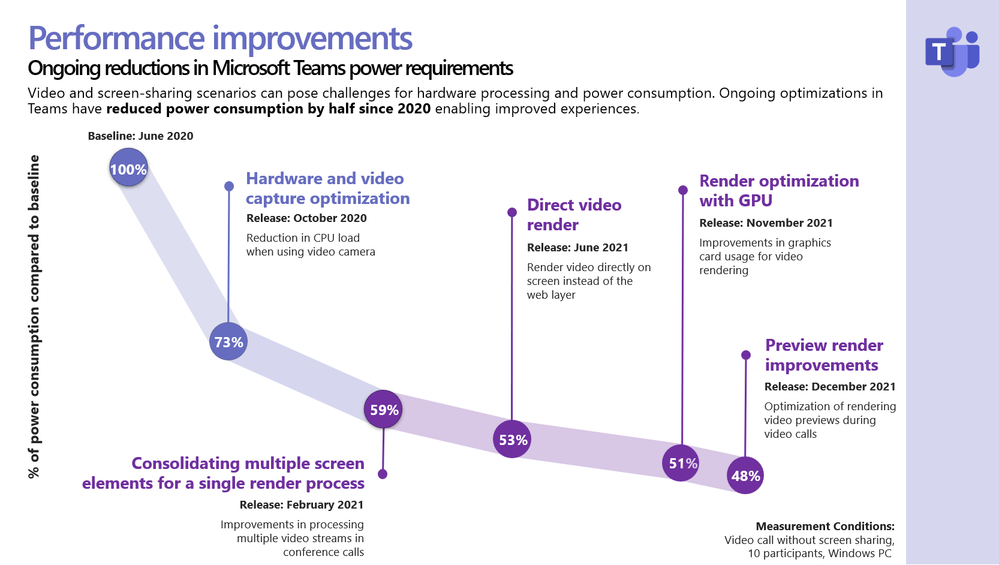
In a previous post, we shared how Microsoft ensures efficient use of device resources such as CPU and memory during Microsoft Teams calls and meetings. In this article, we want to dive deeper into how our goals and measurement methodology has been used to cut power consumption in Teams meetings.
Why is this important? In addition to reduced energy costs, these optimizations lower the burden on an organization’s hardware and improve the consistency and efficiency of Teams meetings and calling experiences across devices.
One of the challenges brought on by the ubiquity of Teams is the need to create equitable experiences across an incredibly diverse Windows device ecosystem. We’re committed to ensuring great calling and meeting experiences for users on low-end hardware as well as those on high-end workstations and high-resolution monitors. One of the factors we’ve addressed is the difference in power requirements for different customer profiles by ensuring Teams meetings are as energy-efficient as possible, regardless of setup.
First, we created a test framework to accurately measure power consumption for important meeting scenarios such as group video calls and screen sharing, which often involve energy-intensive processes such as content capture, encoding, and rendering. The next step was to evaluate these processes and identify opportunities to optimize the efficiency of each. Isolating and optimizing each of these processes enabled us to reduce power consumption up to 50% for energy-intensive scenarios such as having over 10 users in a meeting when everyone has their video turned on (see figure below).
During our evaluation of the video capture process, we focused on camera optimization to reduce demands on the CPU when using video in meetings, improving configurations, reducing code complexity for auto-exposure, auto-white balance, auto-aliasing, resulting in power draw reduction from the onboard camera and stability enhancements, and face detection processes. Then, we turned to video rendering, particularly for meetings with many participants, where the users receive a video stream for each participant displayed in the Teams client. Incoming videos can have different resolutions that require the client to rescale each. A simple 3x3 video grid once required nine distinct rendering operations. By combining the streams and composing them into a single video, we have been able to consolidate operations in video rendering and significantly reduce the power requirements for each device used.
A couple of the optimizations we released in 2021 focused on using the native resources of operating systems to improve how image fragments are transferred during the rendering process, as well as allowing Teams to tap the device’s graphic processing unit (GPU) dedicated to support improve rendering performance. This approach has also been extended to the user's video preview. Looking forward, we’ll continue to work closely with CPU and GPU chipset vendors to ensure the next generation of silicon is further optimized for Teams video conferencing.
Recently, we released rendering optimizations targeting individual screen components that have led to additional reductions in power consumption for video and application sharing. More screen-sharing optimizations are planned for later this year.
Similar to our other performance improvement initiatives, these power consumption improvements are subjected to progressive testing to validate the intended benefits across customers and environments. Additionally, we evaluate each new planned Teams feature to ensure existing processing efficiencies are not compromised.
So while we continue to launch innovative Teams features to help people connect and collaborate in new ways, we’re also dedicated to making sure these experiences are optimized for all users, regardless of their network and devices.
Continue to watch this blog to learn about new Teams features and optimizations designed to improve the quality of your calls and meetings.
You can now record and listen to past talks. | Image: Reddit
Reddit Talk, the platform’s audio-only chatrooms, now support recordings. As outlined in a post on Reddit’s blog, this means you can now listen to previous talks as well as use playback tools that let you jump to certain timestamps, pause / unpause recordings, and fast-forward or rewind them. This should make it even easier for users to record and distribute live podcast-like sessions.
Image: Reddit
Talk is coming to Reddit’s desktop app “later this month.”
Reddit also announced that it’s expanding Talk to the web and is bringing some handy features (that are already available on mobile) along with it. This includes the ability for listeners to raise their hands to speak and a way for moderators to mute users...
Florida’s manatees are dying in record numbers. | James R.D. Scott/Getty Images
Florida’s beloved “sea cows” shouldn’t have to eat lettuce. Yet here we are.
Heads of romaine lettuce might seem like empty calories for starving “sea cows” that weigh 1,000 pounds. But for Florida’s manatees, they’re just what the vet ordered.
In parts of eastern Florida, seagrass — the primary food source for these hulking marine mammals — is disappearing. So for the first time in history, state officials have started feeding manatees huge quantities of leafy greens. A single manatee can crunch its way through about 100 pounds of lettuce in a single day.
Last year, Florida lost a record 1,100 manatees, or more than 12 percent of its total population. And more than 130 manatees have died already in 2022, according to the nonprofit Save the Manatee Club, which is far above average for this time of year. The Florida manatee is a subspecies of the vulnerable West Indian manatee.
“It’s like nothing we’ve ever seen before,” said Michael Walsh, a professor of aquatic animal health at the University of Florida. Manatee rehab centers across the state are now overrun, as more and more of the animals come in with visible signs of starvation — flat undersides, a loss of neck fat, and even exposed ribs, Walsh said.
Avery Bristol/Florida Fish and Wildlife Conservation Commission
A state wildlife official tosses a head of romaine lettuce into the Indian River Lagoon.
US Fish and Wildlife Service
Florida manatees in the Indian River Lagoon munch on leaves of romaine lettuce.
Florida is running out of physical space to house manatees in need of care, Walsh added, forcing rehabbers to triage. And the stakes are high: Manatees are beloved in Florida and a linchpin of the ecotourism industry — and of the ecosystem itself.
The mass die-off of a cherished species that’s closely watched and meticulously cared for is a symptom of bigger problems that are plaguing many ocean environments: coastal development and pollution. More than a decade of human impacts has weakened the entire ecosystem, making manatees far more vulnerable to threats — starting with a plague of algae.
The link between thriving algae and starving manatees
While manatees are famously rotund, they actually have relatively little body fat. They can only survive in water above about 68 degrees Fahrenheit, which is why you often find them in winter around sources of warm water, such as pipes that release discharge from power plants.
One such manatee hot spot is the Indian River Lagoon, which spans 156 miles between mainland Florida and a barrier island along the eastern shore. The lagoon is home to hundreds of animal species and several kinds of seagrass. They might not look like much, but meadows of seagrass are among the most important features in any coastal ecosystem. They prevent erosion, clean the water, and provide shelter for fish that are a crucial part of the state economy. And for a wide range of animals, including manatees, they’re food.
Algae pose a problem because seagrasses need sunlight to grow. Fed by nutrients in pollution, such as septic discharge and farm runoff, algae can become so abundant that they actually block light from reaching the lagoon’s floor. When the seagrass dies, it can become yet another nutrient that fuels the algae.
Jeffrey Greenberg/Universal Images Group via Getty Images
Pollution from homes and businesses near the Indian River Lagoon in Florida is fueling algae that kill seagrass, the main food source for manatees. Here, a community in Hutchinson Island, Florida.
Parts of the Indian River Lagoon, where hundreds of manatees congregate to ride out the winter, are now choked with pollution and algae, which means seagrass can’t grow and manatees can’t eat. “Tens of thousands of acres of normal grass are missing,” Walsh said. The animals can’t easily escape to richer, grassier pastures because it’s chilly outside the lagoon. “They are hemmed in by an invisible fence of cold.”
The state now faces a record die-off so severe that it’s been dubbed an “unusual mortality event,” a rare designation that calls for immediate attention under the federal Marine Mammal Protection Act. The starvation-related deaths are on top of a smaller number of deaths attributed to a related algae problem, known as red tide, and boating accidents.
The conditions for mass starvation have been brewing for years
Ecosystems don’t usually fall apart all at once. The damage builds gradually, often without anyone noticing, and may eventually reach some kind of tipping point, said Patrick Rose, executive director of Save the Manatee Club.
There wasn’t some big chemical spill in the Indian River Lagoon, Rose said, but rather slow and steady pollution that accumulated in these waters for at least a decade, throwing the ecosystem out of whack and making it more prone to blooms of algae. In 2011, for example, a “superbloom” of algae erupted in the lagoon, covering roughly 131,000 acres and nearly wiping out its seagrass.
The grass started to recover — until the lagoon was struck by yet another bloom a few years later. By 2017, a staggering 95 percent of seagrass had disappeared in the northern and central portions of the lagoon, and it hasn’t recovered much since.
Courtesy of Florida Fish and Wildlife Service
A box containing an adult female manatee, en route to Palm Bay with her calf, is lowered to the ground near a transport truck.
Healthy ecosystems can bounce back from occasional disturbances like an exceptionally cold winter, said Duane De Freese, executive director of the Indian River Lagoon Council. But when they’re damaged, they become volatile and less resilient, and even seemingly minor changes can cause dramatic effects. “The system today is unstable,” De Freese said. “Our oceans and our estuaries can’t take every pressure and stressor that we throw at them.”
“If you’re a coastal community anywhere in the US, you’re fighting the same battle we are,” De Freese said. Indeed, blooms of algae linked to pollution have damaged ecosystems and economies from the Chesapeake Bay in Maryland to the Gulf of Mexico. “We’re just an example of things starting to go wrong,” De Freese said.
What it would take for the lagoon — and its manatees — to heal
State officials in Florida plan to feed manatees through March, but lettuce is not exactly a long-term solution. Ultimately, experts told Vox, the state has to reduce the amount of pollution flowing into its coastal waters.
The problem is “fixable,” Walsh said. What’s so frustrating, experts say, is that many manatee deaths could have been avoided altogether.
Courtesy of Sea and Shoreline
Restoring seagrass in coastal Florida will help manatee populations recover, experts say. Here, grass from a commercial seagrass nursery in Florida.
Courtesy of Sea and Shoreline
Seagrass growing at a farm run by the company Sea and Shoreline.
The main source of pollution is a few hundred thousand septic systems from nearby homes and businesses, which leak nutrients like nitrogen into the lagoon, according to a recent study published in the journal Marine Pollution Bulletin. The region urgently needs to modernize its wastewater treatment facilities, De Freese said. He added that Florida also needs a better way to treat stormwater runoff that sloshes into the lagoon along with pollution.
Planting seagrass can help, too. It’s not easy or cheap, but reintroducing native grasses in coastal waters can speed up the ecosystem’s recovery, in part by helping purify the water. Companies like Sea and Shoreline grow seagrasses in a nursery for restoration, not unlike organizations that raise seedlings to restore forests on land.
The lagoon needs about $5 billion for restoration over the next two decades, De Freese said, to make it livable again for manatees and other important species. Last fall, Florida Gov. Ron DeSantis committed $53 million in grants to improve the lagoon’s water quality. “It’s a start,” De Freese said — though he warned that even with enough money, “the recovery isn’t going to happen overnight.”
Residents who want to help can also play a role, he added, such as by limiting the use of lawn fertilizers or avoiding them entirely. One thing they shouldn’tdo, state officials have said, is feed the manatees themselves. They may be learning to like lettuce, but leave the sea cow salad bar to the professionals.
Neil Young has told Spotify workers that the company’s CEO — not Joe Rogan — is the real problem, and is urging them to “get out of that place before it eats up your soul” (via Variety). This comes after Young pulled his music from Spotify, claiming the company was “spreading fake information about vaccines” through Joe Rogan’s podcast.
Young’s recent fight against Spotify initially targeted Rogan’s podcast, but now he seems to be blaming Spotify’s leadership instead. In an open letter posted to his website on Monday, Young says that CEO Daniel Ek is all about “numbers - not art, not creativity.”
Neil urges people to “ditch the misinformers” in his letter.
Young ended Monday’s letter by urging Spotify employees to “be free and take the...
If you’re looking to upgrade your current webcam or you’re buying your very first one, prepare to be overwhelmed by options. Webcams come in all shapes, sizes, and prices, but not many of them are worth your money. If you just want a few pointers to get better video quality than your average plug-and-play webcam can likely provide, we’ve got you covered.
In this video, we dig into exactly why the Opal C1 is a great webcam if you’re someone who values good video quality. What sets it apart from other webcams is its reliance on software and machine learning — not just hardware — to provide a good picture. It’s close to being the ideal gadget for those who can’t put down several hundreds (or thousands) of dollars on a high-end...
The 2022 Winter Olympics in Beijing mark the first time the Games are using entirely artificial snow. | Tim Clayton/Corbis via Getty Images
It will be hard to host the Winter Games when winter isn’t cold.
For decades, Jeremy Jones has explored unique and pristine winter slopes around the world on his snowboard. He’s found new routes accessible only via helicopter and snowmobile, making a name for himself as a big mountain snowboarder, filmmaker, and entrepreneur. In the process, he developed a sense for subtle variations in wind, snow, ice, and water.
“The type of snowboarding I do requires me to have an incredibly intimate relationship with winter,” said Jones, who is 47. “I snowboard in the backcountry where the difference between a slope being stable and avalanching has lots of nuanced signs.”
But the ground beneath his feet started to shift, and so did his thinking. Resorts that used to have reliable snow started closing more frequently. Some mountains started getting more rain than snow as glaciers retreated up their slopes. For Jones and many fellow winter enthusiasts, climate change became impossible to ignore. “I was like, man, this problem is not going away without us doing something about it,” Jones said.
It’s not just snowboarding — climate change is already having an impact on several winter activities, including many of the outdoor sports on display at the 2022 Beijing Olympics. On average, winters are warming faster than summers and northern latitudes are warming faster than regions closer to the equator. Sports that count on outdoor snow and ice are especially vulnerable. In a warming world, precious few cities may be reliably cold with enough snow and ice to host Winter Olympics of the future.
In 2007, Jones founded the advocacy group Protect Our Winters with the aim of uniting winter sports enthusiasts in the fight against climate change. With the world’s eyes on the Winter Games, athletes-turned-advocates are hoping to channel some of that attention toward the ways climate change threatens their sports. And the group’s latest report, “Slippery Slopes: How Climate Change is threatening the 2022 Winter Olympics,” warns that without drastic action, many of the sports that thrill fans and athletes are endangered.
Warmer winters aren’t just leading to mushier snow, the authors write. The places where winter sports can be played at all are becoming fewer and farther between. That makes it harder for athletes to train and makes winter sports more expensive and exclusive, throttling the pipeline for new skiers, snowboarders, and skaters. It’s an early warning sign for the future of winter itself.
The Winter Olympics may never be the same
This is the first year in history that the Winter Games will have to manufacture all of its own snow. Organizers expected as much, given that Beijing has never been known for especially snowy winters. But winter sports have been increasingly reliant on artificial conditions for years. “Things have been trending in this direction for quite some time,” said Timothy Kellison, director of the Center for Sport and Urban policy at Georgia State University.
Artificial snow is designed in part to level the playing field and deliver consistent conditions for sports. But it’s also a sign that the ideal conditions for outdoor events like alpine skiing are getting harder to find in nature. Rising temperatures mean that more winter precipitation falls as rain rather than snow, and the snow that does fall can be less substantial.
Covering a mountain slope in synthetic powder can harm the environment and add to the already enormous costs of large-scale winter sports (the Beijing Winter Olympics reportedly cost $3.9 billion, though some estimates show the cost is much higher). Snow-making has massive energy appetite and stresses water sources. And the snow itself is a pale imitation of what falls from the sky. Artificial snow is about 30 percent ice and 70 percent air, whereas natural snow is 10 percent ice and 90 percent air. That changes the texture of the snow, creating a harder snowpack that alters how skis and snowboards slide, so courses require further grooming.
In addition, snow machines still require cold temperatures to operate. In the 2010 Winter Olympics in Vancouver, snowmaking equipment couldn’t keep up with the unusually warm weather, so organizers used trucks and helicopters to bring in snow from elsewhere.
And there’s only so much snow you can keep on the ground when temperatures get too high, regardless of where it comes from. The snow quickly softens, forms ruts, and creates a spray when athletes cut through it. That can impair visibility and lead to accidents, explained Daniel Scott, a professor of geography and environmental management at the University of Waterloo in Canada.
Yet the option of artificial snow has allowed Winter Olympics organizers to select host cities that are far from ideal. The 2014 Winter Olympics in Sochi, Russia set a record for the highest temperature at a Winter Olympics: 68 degrees Fahrenheit. That was also a problem for the Winter Paralympic Games that came after. “In Sochi, [the injury rate] was six times what it was in Vancouver for the Paralympians,” Scott said. “These are the best in the world, so if they’re struggling with those kinds of conditions and many of them are getting hurt by it, that should tell you something.”
The impacts of climate change stretch beyond the Games as well. As training sites deal with rising temperatures, athletes need to spend more money and time finding reliable locations. Otherwise, they arrive at the slopes less prepared. “We also see more injuries caused by the lack of practice on snow and the added pressure to perform when there is a window of opportunities,” Philippe Marquis, a two-time Winter Olympian from Canada, wrote in the “Slippery Slopes” report. “Athletes feel the urge to push their limits even if the conditions are suboptimal.”
Many candidate cities for the Winter Olympics — including past hosts — won’t be consistently cold or snowy enough to hold the games in the future. This means the pool of host cities will shrink drastically, or hosts will have to spend far more time, money, and energy to prepare for future Winter Olympics. For example, Chamonix and Innsbruck in the Alps — a mountain range that lends its name to the Olympic event of Alpine skiing — may have to be ruled out for good if greenhouse gas emissions continue spewing unchecked.
Climate change could become a crisis for winter sports
Beyond the Olympics, winter recreation areas like ski resorts are becoming more expensive to operate or are struggling to stay open, increasingly making winter sports the purview of the privileged elite. By one estimate, the winter recreation season in the US will be cut in half by 2050.
Without direct experience, fans may have a harder time getting interested in and following professional winter sports, according to Kellison. “I do think as participation goes down in these sports, there will be concerns about the [fandom] of that sport at the highest levels,” he said.
The love of winter sports poses a dilemma for some fans and athletes. “To face a future without these sports is challenging, but it’s equally challenging to wrestle with the massive environmental footprint that our sport can have, from the emissions involved in getting to the mountain, to snowmaking, and the energy involved in operating lifts and lights and all the rest,” said Madeline Orr, founder of the Sport Ecology Group and a lecturer Loughborough University London, in an email. “That said, I have full confidence the industry and snow sports community will find ways to continue innovating on this issue and finding ways to adapt, because snow sports are central to our culture.”
For Jones, the big mountain snowboarder, climate change has made him rethink how he pursues his career. “My approach drastically changed to the point of way less travel, and no longer embracing helicopters and snowmobiles,” Jones said. He said he’s “really focusing on human power — foot-power snowboarding where I’m hiking these mountains.”
He acknowledged that in the big picture, losing places to ski, snowshoe, and snowboard are less devastating than other impacts of climate change. Rising winter temperatures are slowing the accumulation of snowpack in key watersheds, and in areas like the Sierra Nevada, that’s leading to patterns of flooding in the winter and drought in the summer. Declining snowpack is a key factor in wildfire risk and recovery in the Western US. Warmer winters are also fueling more severe allergy seasons, helping disease-carrying critters spread further, and creating a mismatch between flowering plants and their pollinators.
But winter sports also help create more than $800 billion in economic activity in the US, support more than 7 million jobs, and inspire millions to head outdoors into chilly weather, according to Protect Our Winters. The Winter Olympics are a prime opportunity to channel the world’s attention toward a threat and motivate people to find solutions.
“To me, it’s this opportunity to collectively come together around trying to save winter,” Jones said. “We need urgency on climate action.”
Working too much might stifle innovation. Working remotely is just fine. | Getty Images
Going back to the office won’t change the fact that we have too much work.
Employees want to work from home. Their bosses, however, can’t wait to get back to the office. Knowledge workers think being remote makes their jobs better, while managers worry the arrangement could cause the quality of work to suffer. But in scapegoating remote work, companies may be disguising the real scourge of creativity right now: too much work.
Executives were nearly three times more likely than non-executives to say they want to return to the office full time, according to Slack’s Future Forum Pulse survey. The report found that while nearly 80 percent of knowledge workers want flexibility in where they work — citing benefits ranging from work-life balance to lower anxiety at work and a better sense of belonging — their employers think that the arrangement will lead to a variety of ills, diminishing the company’s collaboration, creativity, and culture. These concerns track with another recent report from Northeastern University that found that more than half of C-suite executives were concerned about their workforce’s ability to be creative and innovative in a primarily remote work environment.
As the worst effects of the omicron variant start to wane, companies will again start to make noise about bringing people who’ve been working from home on their computers for the last two years back to the office. Thanks to an incredibly tight labor market, however, these employees have more leverage than they typically do to get what they want. How this plays out will shape how work is done for years to come.
One issue is that some employers’ concerns with remote work may be baseless.
“It seems to be the prevailing consensus, at least if you ask managers, that, ‘Oh, if you’re all remote, it has to be bad,’ and hence you have to bring people back to the office,” said Christoph Riedl, an associate professor at Northeastern University who’s been studying team collaboration and processes for nearly a decade. “We can directly compare the performance of teams that work remotely versus teams that work face to face, and we generally find no difference with regard to team performance.”
What is certain, and what’s the cause for a lot of this concern, is that our work networks are shrinking. Observed data from both Microsoft and employee engagement platform Time is Ltd. has found that workers are communicating with fewer people at work outside their direct teams. While not a silver bullet for innovation, this type of cross-department conversation can help break down silos and encourage novel solutions. But remote work isn’t the main reason keeping these interactions from occurring: The problem is there’s not enough time for them to happen. In other words, we’re talking to fewer people not because we’re working from home, but because we’re working too much.
Time is Ltd.
“More directly causal of people’s use of time and available hours in the day is the workload, and not the being remote,” Denise Rousseau, a professor of organizational behavior at Carnegie Mellon University, told Recode.
“I do think there’s a tendency for people to attribute one problem to another cause just because they co-occur, saying, ‘We’re working at home, that’s why we’re not innovating,’” Rousseau said. “Our task lists are high, and our headcount is down. That’s another really good reason for not innovating.”
As people have quit their jobs or stepped out of the workforce, in what’s called the Great Resignation or the Great Reshuffling, those left behind have had to pick up the slack. Two-thirds of workers said their workload has increased “significantly” since they started working remote (read: since the start of the pandemic). More than half of those who stayed at their jobs reported taking on more responsibility when their coworkers left, with 30 percent struggling to get the necessary work done, according to a survey last summer by the Society of Human Resource Management (SHRM). People are putting in longer hours, sending and reading more email, and have less time to focus, according to data from Time is Ltd.
“Even before the Great Resignation, if someone were to leave in a department, oftentimes the key tasks would get shared among others in the department until they found a replacement,” SHRM knowledge adviser John Dooney told Recode. “The challenge [now] is there’s a higher percentage of folks resigning, therefore there’s more work to be distributed, and it’s just taking longer to hire people.”
That shortfall can be seen in our communication with wider networks of people at work.
“There’s no time for chitchat, there’s not a time for that interaction that would occur naturally,” Dooney said.
As if increased work-related work weren’t enough, pandemic-related obstructions like lack of child care and smaller social support systems have caused many people to have more work outside of paid work.
“They have more work from their job, and they have an extra role of armchair public health experts,” said Dana Sumpter, associate professor of organization theory and management at Pepperdine University, referring to the many new hats the pandemic has forced people to don. The situation is especially severe among women, who are more likely to take on an outsized share of child care and labor at home. “They’ve made the sacrifice of allowing work relationships to decay or even end because they have finite time and energy and attention.”
People everywhere are burnt out from the pandemic and are doing their best to get by. As Brandy Aven, a professor of organizational theory, strategy, and entrepreneurship at Carnegie Mellon, put it, “When we’re under threat and everybody’s still filled with dread, people will retreat and get very tribal and they hunker down. That’s what we’re seeing.”
Responses indexed on a scale of -60 (very poor) to +60 (very positive). Source: Future Forum Pulse survey
What does seem to be providing workers some solace, according to the Slack survey, is the very thing executives are worried about: remote work. While there’s certainly room to make remote work better as far as maintaining collaboration, creativity, and innovation, the more pressing issue is lightening our workloads.
That means either hiring more people or lessening the amount of work for existing employees. It would require separating the mission-critical from the nice-to-haves in order to give people the breathing room to talk to those outside those it’s absolutely necessary to talk to.
Once we have a little more time and space, we can focus on how to encourage collaboration, creativity, and innovation in a remote setting. If executives want to make the quality of work better, they might want to take a look at the quantity of work they expect. If they want to make remote work better, there are better places to start than the office.
Google parent company Alphabet hit a new record for annual revenue in 2021, showing no ill effects from the lingering coronavirus pandemic or ongoing issues with the global supply chain. For full-year 2021, the company saw a 41 percent year-over-year jump in revenue to $257 billion. The company reported revenue of $75.3 billion in the fourth quarter of 2021, up 32 percent from the year earlier.
“Q4 saw ongoing strong growth in our advertising business, which helped millions of businesses thrive and find new customers, a quarterly sales record for our Pixel phones despite supply constraints, and our Cloud business continuing to grow strongly,” Alphabet and Google CEO Sundar Pichai said in a statement accompanying the earnings release....
Two new proposed laws have been introduced in the House of Representatives that aim to make it easier for people to fix their own stuff. One focuses on cars, the other on copyright restrictions on electronics. This, in addition to legislation that was proposed in the Senate that would enshrine farmers’ right to repair their equipment.
After years of inaction, repair is now a hot topic in Congress. The legislation covering electronics is a bipartisan bill filed Tuesday from Reps. Mondaire Jones (D-NY) and Victoria Spartz (R-IN). It’s called the Freedom to Repair Act and would carve a permanent exemption out of the 1998 Digital Millennium Copyright Act (DMCA). Currently, the DMCA makes it a crime to circumvent copyright on electronics for the purpose of repair.
The archaic law has led to a situation where digital rights activists must petition the Library of Congress every few years to carve out specific exemptions to the DMCA. It’s a laborious and silly process that the Freedom to Repair Act would end permanently.
“For far too long, federal copyright law has allowed the most powerful corporations in the world to control who repairs what we own,” Rep. Jones said in a statement. “By entrenching the power of these major corporations, repair restrictions threaten our economy, including the economic well-being of American consumers and small businesses.”
The same day, Rep. Bobby Rush (D-IL)—chairman of the House Energy and Commerce Subcommittee on Energy—introduced the Right to Equitable and Professional Auto Industry Repair (REPAIR) Act. The act would make sure independent repair shops and consumers have access to the same tools and data that dealerships have. The act is similar to one passed in Massachusetts that car companies are currently claiming is unconstitutional and unenforceable.
“Americans should not be forced to bring their cars to more costly and inconvenient dealerships for repairs when independent auto repair shops are often cheaper and far more accessible,” Rep. Rush said in a statement. “But as cars become more advanced, manufacturers are getting sole access to important vehicle data while independent repair shops are increasingly locked out. The status quo for auto repair is not tenable, and it is getting worse.
"Right to Repair has passed a threshold. We've gone from frustrated tinkerers, repair shop owners, farmers and other technicians, to a globally recognized issue,” Nathan Proctor, the head of USPIRG's Right to Repair Campaign, told Motherboard. “Congress moving on multiple Right to Repair bills is just another sign that it's a common sense idea whose time has come."
After multiple rebrands, congressional hearings, and several high-profile staff departures, the Meta-backed cryptocurrency known as Diem is calling it quits.
The association behind Diem confirmed Monday that it sold its assets for around $200 million to Silvergate, a crypto-focused bank it was working with last year to launch a stablecoin pegged to the U.S. dollar. The decision to sell was made after it “became clear from our dialogue with federal regulators that the project could not move ahead,” Diem CEO Stuart Levey said in a press release. (It’s already known that the U.S. Federal Reserve was a key opponent to Diem launching.)
The sale of Diem’s assets marks the end of an effort that, in retrospect, was doomed from the start.
You’ll be able to easily switch between Gmail, Chat, Spaces, and Meet. | Image: Google
Google has announced that Gmail’s new layout, which changes how Google Chat, Meet, and Spaces are integrated, will be available to try starting in February; become default by April; and become the only option by the end of Q2 2022. The view makes it so Google’s other messaging tools, which are part of (but not necessarily limited to) its business-focused Workspace suite, are no longer just little windows floating alongside your emails, but get their own screens in Gmail that are accessible with large buttons on the left-hand side.
Google calls this the integrated view, and it’ll soon be familiar if you (or your employer) are a Workspace customer, or if you use Chat and Meet personally. Starting February 8th, Google says you’ll be able...





/cdn.vox-cdn.com/uploads/chorus_asset/file/23232685/GettyImages_620942176.jpeg) Ronaldo Schemidt/AFP via Getty Images
Ronaldo Schemidt/AFP via Getty Images
/cdn.vox-cdn.com/uploads/chorus_asset/file/23226205/AP22025009189222.jpg) Fernando Llano/AP
Fernando Llano/AP
/cdn.vox-cdn.com/uploads/chorus_asset/file/23227256/1_s2.0_S0301479720314079_gr4_lrg.jpg)
/cdn.vox-cdn.com/uploads/chorus_asset/file/23226208/AP19193581029895.jpg) Nick Wagner/AP
Nick Wagner/AP




/cdn.vox-cdn.com/uploads/chorus_asset/file/23226033/51817315739_8b5ce7413d_o.jpg) Avery Bristol/Florida Fish and Wildlife Conservation Commission
Avery Bristol/Florida Fish and Wildlife Conservation Commission
/cdn.vox-cdn.com/uploads/chorus_asset/file/23217286/51833791981_af61f3e57f_o.jpg) US Fish and Wildlife Service
US Fish and Wildlife Service
/cdn.vox-cdn.com/uploads/chorus_asset/file/23223797/GettyImages_982645056.jpg) Jeffrey Greenberg/Universal Images Group via Getty Images
Jeffrey Greenberg/Universal Images Group via Getty Images
/cdn.vox-cdn.com/uploads/chorus_asset/file/23217292/7591363006_4e4cb89d04_o.jpg) Courtesy of Florida Fish and Wildlife Service
Courtesy of Florida Fish and Wildlife Service
/cdn.vox-cdn.com/uploads/chorus_asset/file/23223775/Homosassa_Seagrass_Grow_Out_at_Farm_3.jpg) Courtesy of Sea and Shoreline
Courtesy of Sea and Shoreline
/cdn.vox-cdn.com/uploads/chorus_asset/file/23223781/Aquaculture_Nursery10__2_.jpg) Courtesy of Sea and Shoreline
Courtesy of Sea and Shoreline


/cdn.vox-cdn.com/uploads/chorus_asset/file/23218058/Screen_Shot_2022_02_04_at_11.17.48_AM.png)

/cdn.vox-cdn.com/uploads/chorus_asset/file/23208093/strongWeakTies.png) Time is Ltd.
Time is Ltd.
/cdn.vox-cdn.com/uploads/chorus_asset/file/23208712/Screen_Shot_2022_01_31_at_6.14.43_PM.png) Responses indexed on a scale of -60 (very poor) to +60 (very positive). Source: Future Forum Pulse survey
Responses indexed on a scale of -60 (very poor) to +60 (very positive). Source: Future Forum Pulse survey


