We are excited to announce that the Walkie Talkie app in Teams with a dedicated push-to-talk (PTT) button on Sonim XP8 will be generally available starting April 2022. Walkie Talkie is the digital push-to-talk solution in Teams that enables clear, instant, and secure voice communication over the cloud. Read more about Walkie Talkie here.
Sonim XP8 is the ultra-reliable, ultra-rugged smartphone that’s built to provide frontline workers with the smart communication they need, regardless of situation or environment. Sonim XP8 is used broadly across industries with key focuses in public safety, healthcare, construction, and manufacturing.
Sonim XP8
Ultra-rugged design that exceeds military durability standards ensures operation in any environment
Easy operation with integrated PTT button and Glove hand/Wet finger screen operation
Hear every word even in the noisiest places with Extremely Loud & Clear Audio
Voters leave an early voting poll site in San Antonio, Texas, on February 14. | Eric Gay/AP
Thousands of mail-in ballots were thrown out in the Texas primaries due to new ID requirements.
This story has been updated to include new Associated Press data and reporting.
You might remember the uproar last year over Texas’s new voting law: Democratic lawmakers in the GOP-controlled legislature fled the state for weeks in an attempt to block the bill, which they said would disenfranchise voters, and Republicans threatened them with arrest upon their return. The law eventually did pass, and with Texas’s primary earlier this month, we got our first look at whether the worst fears of Democrats and voting rights advocates were warranted.
Thousands of votes were, in fact, thrown out, directly as a result of a new requirement in the law. A new AP analysis of data from Texas found that a whopping 13 percent of the state’s absentee ballots were discarded or uncounted.
“It’s been every bit as catastrophic as we feared it would be,” said James Slattery, a senior staff attorney at the Texas Civil Rights Project. “I think the onus is on the legislature to acknowledge the harm that it did to Texas voters by passing Senate Bill 1 and make amends by repealing it next year.”
But that probably won’t happen given that key Republicans who pushed for the law have continued to defend it.
Here’s what we saw in the primary and what it could mean for other states that have enacted or are considering similar laws.
Thousands of mail-in ballots were thrown out in Texas
The new law does a few things: It bans 24-hour and drive-through voting, prevents officials from mailing unsolicited mail-in ballot applications, requires monthly voter roll checks, and gives more latitude to poll watchers. It also adds a requirement that voters provide their driver’s license number or the last four digits of their Social Security number when applying for a mail-in ballot and write that same number on their mail-in ballot when sending it in.
Democrats and voting rights advocates were adamant that the new ID requirement for mail-in ballots introduced huge room for human error, and huge amounts of human error occurred. Some 27,000 mail-in ballots were initially flagged for rejection across 120 counties in the state. The secretary of state’s office has yet to publish statewide mail-in ballot rejection figures, but the AP data, collected from 187 of Texas’s 254 counties, found 22,898 were rejected.
The statewide rejection rate for mail-in ballots has typically been between 1 and 2 percent in past elections and was about 1 percent in the 2020 general election when mail-in voting rates were much higher. But in the 2022 primaries, county-level rejection rates ranged from 6 to 22 percent, according to data compiled by the Texas Civil Rights Project and shared with Vox.
Sergio Flores/Getty Images
A poll worker stamps a voter’s ballot before dropping it into a secure box at a ballot drop-off location in Austin, Texas, during the 2020 election.
In four counties that reported the reason they had rejected mail-in ballots, those identification requirements were to blame over 90 percent of the time. In Harris County, which encompasses Houston and is the most populous county in the state, it was 99.6 percent.
This was foreseeable. Even some Republican officials were worried about mail-in ballot rejections ahead of the primary. Texas Secretary of State John Scott said during a February town hall that it was his “biggest concern” of this election cycle. In a statement Tuesday, Sam Taylor, a spokesperson for Scott, acknowledged the issues with mail-in ballots during the primaries and said his office is devoting a significant portion of its voter education efforts to the new ID requirements.
“We are confident we will have all the information we need to apply any lessons learned during the primary to an even more robust voter education campaign heading into the November general election,” Taylor said.
But others have continued to defend Senate Bill 1. Gov. Greg Abbott has blamed local election officials for misinterpreting the new law. And state Rep. Briscoe Cain, the law’s leading proponent, has argued that it had no adverse effect on the chaotic vote counting process in Harris County — if anything, he said it made it a “whole lot easier” to fire the county election administrator who oversaw it.
Voters whose mail-in ballots were flagged for rejection did have the opportunity to correct them to ensure that they were counted. But the process proved confusing and looked different depending on when the problem with a voter’s ID number was discovered.
“You can see all the different ways that this can go wrong. What if the ballot never gets back to the voter? Or they don’t see it and think it’s junk mail? Or they correct the number issue online but don’t realize they need to send the ballot back?” Slattery said.
For some voters, the process was just too arduous.
“A lot of voters get these letters of rejection, and they just don’t bother,” said Michele Valentino, a Democratic election judge in Dallas.
Some flaws can be expected when implementing a new system for the first time, but this bodes poorly considering how low turnout was relative to general elections: Fewer than 1 in 5 voters cast ballots in the primaries, which is higher than in the past six midterm primaries but still a lot lower than the roughly 46 percent of Texans who showed up for the last midterm general election in 2018.
“I can see this issue compounding and worsening as we reach the midterms this year,” said Jasleen Singh, counsel in the democracy program at the Brennan Center for Justice, where she focuses on voting rights and elections. “That there’s even this much hardship that voters are encountering at this stage is incredibly concerning and dangerous for democracy.”
The AP analysis showed a higher rate of rejections in Democratic than Republican counties (15.1% to 9.1%). That was also predictable: Voters of color typically bear the biggest burden from any restrictions on voting, and they make up a large share of many of those Democratic-leaning counties.
But there are reasons for Republicans to be concerned too. Mail-in voting was already restricted primarily to people over age 65, people with disabilities, and college students. That means that the population of people who vote by mail in Texas has historically skewed older, whiter, more rural, and more conservative, and the new voting law isn’t likely to change that. Some smaller counties were not yet accounted for in the AP data.
Sergio Flores/Getty Images
A poll worker helps a voter at a mail-in ballot drop off location in Austin, Texas, on October 13, 2020.
There are already staggering rates of mail-in ballot rejections in urban centers such as Harris County, and there are still a lot of rural counties in Texas that have yet to report their own rejection data, but it’s possible that the new ID requirements might end up hurting the constituents of the Republicans who wrote the law more so than others, Slattery said.
What this means for states that have already implemented similar laws
Florida and Georgia have already enacted similar bills, both passed by party-line votes, that impose new restrictions on mail-in voting. It’s part of Republicans’ national push to curtail access to mail-in voting and discredit the results of the 2020 presidential election, when many states expanded mail-in voting due to the pandemic.
Florida now requires voters who are requesting mail-in ballots to provide a driver’s license number, another non-driver identification number, or the last four digits of their Social Security number on their application. It doesn’t go as far as requiring that information to be written on the ballot itself, as Texas has. But Texas did reject thousands of mail-in ballot applications over its new ID requirements. Florida could encounter similar issues, though the state has a much bigger and more established mail-in voting operation that could make it easier for voters to adjust. Voting rights groups have sued over the law, and a federal judge is expected to rule in the case before the state’s primaries in August.
Georgia’s Senate Bill 202 similarly requires a voter to provide their driver’s license number or other ID number and date of birth when requesting a mail-in ballot and write that information on the mail-in ballot before sending it in. It has drawn legal challenges from the Biden administration and civil rights groups arguing that it makes it harder to vote for people of color and people with disabilities.
“What we’re seeing with [the Texas law], and I think with many of the laws passed last year, are these layering effects. In places where it was already harder to vote, it’s now even harder to vote,” Singh said.
Other states are still considering similar measures, and though the outcome of the Texas primaries should make them wary of doing so, Republicans pushing those bills haven’t shown any signs that they intend to reverse course.
According to the Brennan Center, at least 18 bills in five states would newly require voters to provide their Social Security number, driver’s license number, or voter record number when applying for a mail-in ballot. An Arizona bill would require voters to present an ID when returning a mail-in ballot and reduce the list of acceptable forms of voter ID to those that include a signature, a fingerprint, or a unique security code. And three bills in Missouri, New Jersey, and Washington propose new grounds for rejecting a mail-in ballot, including if the signature “does not appear to be valid,” though the New Jersey and Washington bills are unlikely to pass.
“These cookie-cutter laws that a national organization has drafted without close consultation with local election officials and that are jammed through without really serious and careful debate could end up blowing up,” Slattery said.
Google and Meta are being investigated by antitrust regulators in the EU and UK over “Jedi Blue” — a deal between the two firms that critics say allowed them to block smaller tech companies from gaining a foothold in the online ad market.
In a press statement, the European Commission said it was concerned that the September 2018 agreement “may form part of efforts to exclude ad tech services competing with Google’s Open Bidding programme, and therefore restrict or distort competition in markets for online display advertising.” It’s therefore opening a formal antitrust investigation.
The UK’s Competition Market Authority said it was also investigating the deal, with CMA chief Andrea Coscelli stating: “We’re concerned that Google may...
With gas prices surging across the country, many Americans are seeking alternatives. And the White House knows this, which is why it is encouraging people to switch to electric vehicles.
There is just one problem with this advice: It’s not practical to solve the problem at hand. Electric vehicles are very expensive and not widely available for purchase or delivery soon, in part because of the microprocessor shortage and high demand. For example, Tesla’s cheapest car, the Model 3, starts at $45,000 and has an estimated delivery date of July. More expensive versions of the Model 3 and Model Y are available around May at the earliest. (According to Electrek, you can get bumped up the line if you purchase the $12,000 add-on that lets you cosplay as a self-driving car safety driver.)
The picture isn’t much better with other EVs sold by traditional dealers. Although information there is harder to come by due to the decentralized dealer system, EVs are typically working through the backlog of reservations from when they were first announced. It is possible, but difficult, to get an EV right now if you didn’t place a reservation months or years ago. And the used market, like for all types of cars, is not much better unless you’re willing to buy a much older generation with lower range. But even if EVs were more available, most Americans cannot simply buy a new car at the drop of a hat.
The White House obviously knows this—it does say this is the “long term” solution—but Americans are looking for quick fixes to ease the pain. Fortunately, there is an electric vehicle that is widely available and much more affordable. It is not going to get you absolutely everywhere you need to go, but for millions of Americans it could probably substitute for several trips a week if not more. It doesn’t require any special equipment to charge and costs just pennies in electricity every month. It’s an electric bike.
E-bikes, which have a battery and motor to make pedaling easier and the bike move a bit faster, come in all shapes and sizes. You can get a crazy expensive one that looks like a road bike or a giant cargo bike that can carry kids and groceries. You can get an electric mountain bike for extra comfort and versatility or a stylish urban e-bike with all the bells and whistles. Most have a top speed of somewhere between 17 and 25 mph. Your local bike shop may well have e-bikes in stock right now. They are easy to ride. Hills require no additional effort to pedal. They make you feel really good. And they are enjoyable as hell, so much so that people all over the world ride them just for fun.
Most Americans do not live in areas with decent bicycle infrastructure. That is unfortunate because that would be incredibly useful right now. But even without those measures, it’s still possible to e-bike places. People bike on roads all the time. Maybe there’s one store you go to that would be easy and relatively safe to bike to. Or the gym is a few miles away via back roads.
Replacing just one or two trips a week with an e-bike would not only have a measurable impact on your gasoline consumption, but it would also be better for the environment. It would almost certainly be more fun, and you just may find you want to e-bike more places, too, like New York Times opinion columnist Jamelle Bouie did. He lives in Charlottesville, Virginia, which is a college town but not exactly unrepresentative of many small cities across the country.
Don’t want to take Bouie’s word for it? Here are morestories of North Americans who ditched their cars for e-bikes in places like Edmonton, San Francisco, Albuquerque, and Raleigh. Here is a whole Reddit thread of people raving about ditching their cars for e-bikes. Here is an article specifically with tips for commuting on an e-bike in the suburbs on roads without bike lanes. The verdict of all of these articles: It’s great, e-bikes are great, they wish they had made the switch a long time ago.
But you don’t have to completely ditch your car with an e-bike. Most people don’t. They buy an e-bike, ride it some places when it makes the most sense, and find it works for more trips than they previously thought. If you’re paying an extra $50 per fill-up now than you were two weeks ago, it won’t take long to pay off that e-bike in saved gas costs, even if you’re only using the bike for a few trips a week.
I wish the Biden administration took e-bikes more seriously. I wish e-bike subsidies were a pillar of his climate goals as they are in other countries rather than the first thing that always gets cut from any proposal. But the good news is most Americans don’t need that. We can go out and buy a great e-bike right now that will make our lives better and save money. Or you could take the bus. That’s good too.
CEO Rory Read and Other Vonage Executives to Lend Thought Leadership Across Several Panels; Company to Showcase Solutions and Technology on Expo Show Floor
HOLMDEL, NJ – March 10, 2022 – Vonage (Nasdaq: VG), a global leader in cloud communications helping businesses accelerate their digital transformation, will be sharing its perspective on how innovations in the cloud communications space enable businesses to capture the digital transformation and intelligent communications wave and the future of the industry during multiple speaking engagements at Enterprise Connect 2022. Enterprise Connect, the premier event for the enterprise communications and collaboration technology industry, will take place March 21-24 at the Gaylord Palms Convention Center in Orlando, FL.
On Wednesday, March 23, Vonage CEO Rory Read will participate in a fireside chat hosted by program co-chair Eric Krapf – Perspectives on Industry Transitions. Read will provide insights on the state of the industry, a vision of what’s essential for successful digital transformations and how the next wave of the communications revolution will enable businesses to build more meaningful connections, conversations and engagement.
Additional Vonage speaking engagements at Enterprise Connect include:
Vonage will also host a booth (#2113) on the expo show floor, where attendees will have the opportunity to connect with the Company’s executive team and experience interactive product demos showcasing Vonage’s latest technology.
About Vonage
Vonage, (Nasdaq:VG) a global cloud communications leader, helps businesses accelerate their digital transformation. Vonage’s Communications Platform is fully programmable and allows for the integration of Video, Voice, Chat, Messaging and Verification into existing products, workflows and systems. Vonage’s fully programmable unified communications and contact center applications are built from the Vonage platform and enable companies to transform how they communicate and operate from the office or remotely – providing the flexibility required to create meaningful engagements.
Shenzhen, China – March 10, 2022 – Fanvil, a leading global Audio & Video -IoT device provider, today announced globally its brand new V series, the groundbreaking desk phones with a perfect combination of elegant outside and powerful inside.
Louis Chen, Executive President of Fanvil, said, “Intelligent business communication is ushering in an exciting new time in smart IoT technology. Fanvil has invested a significate amount of time and effort into coming up with a more high-efficiency and integrated approach to the communication devices and solutions in wider application scenarios. We believe, Fanvil V series will bring the business communication experience to a new level.”
Among the greatest innovations were the newest flagship video phone with adjustable touch screen and cool lighting keypad, Fanvil V67 brings a new approach to intelligent business communication and offers a refreshed user experience.
Cool Lighting Color, Show Off Your Keypad
The inspiration for a cool lighting keypad in V67 comes from the luxury car interior. The flow lighting not only pleases your eyes but also improves your work efficiency as a status indicator.
Adjustable Touch Screen, Enjoy Your View
Find a comfort angle by yourself! The adjustable touch screen can easily adapt to the different visual angles of users. Featuring a built-in HD 5-megapixel camera, Fanvil V67 delivers you an enjoyable video communication experience.
Antibacterial Surface Protection
Antibacterial material of the handset and keypad surface effectively inhibits more than 99.5% of bacteria growth. We protect your health during the special period.
Built-in WiFi and Bluetooth, Wireless and Limitless
Don’t limit yourself in the seat! Stand up and continue your work with a wireless desk phone and a wireless Bluetooth headset. Moreover, you can enjoy your video conference on a bigger screen via Miracast.
Audio/ Video Mixed Conferencing, Connect More
With HD audio and video, Fanvil V67 supports 10-party audio conferencing (including 2-party video call) or 3-party video conferencing at most, providing high-efficient team communication and collaboration.
Available to Link with Security Products
Compatible with SIP standards and major mainstream platforms, the new V67 can be easily customizable in various security solutions.
About Fanvil
Fanvil Technology Co., Ltd. (Fanvil) is a leading global provider of A&V-IoT devices. With three R&D centers in Beijing, Shenzhen, and Suzhou, China, Fanvil has compiled an effective team of R&D, production, sales, and service staff to innovate and add value to our business partners. As the pioneer in applying SIP and Audio & Video technologies to build A&V-IoT, Fanvil is boosting the digital transformation for multiple industries.
‘In Ukraine, we have been in constant touch with our local teams and continue to provide assistance that includes relocation and financial support,’ Krishna says. ‘The safety and security of IBMers and their families in all areas impacted by this crisis remains our top priority.’
Cisco CEO Chuck Robbins announces that the company is stopping all business in Russia and Belarus following Russia’s unprovoked invasion of Ukraine, as well as lending its security assistance to the country through its Talos threat intelligence team to help protect Ukraine from cyberattacks.
Lumen, a US firm that provides essential internet services, says it’s pulling out of Russia in response to the country’s invasion of Ukraine. It’s the second major company of its kind to do so in less than a week, following a similar announcement from rival Cogent last Friday, and is the latest example of a ‘digital Iron Curtain’ growing between Russia and the West.
In a blog post, Lumen said it was shutting down all business in Russia “due to increased security risk” in the country.
“We have not yet experienced network disruptions, but given the increasingly uncertain environment and the heightened risk of state action, we took this move to ensure the security of our and our customers’ networks, as well as the ongoing integrity of the...
Ukrainian civilians fleeing the city of Irpin. | Marcus Yam/Los Angeles Times
What about the next crisis?
The internet is global. But tech companies do business in individual countries. So tech companies have to obey those countries’ rules, even if they’re onerous or worse.
That’s the rubric that Big Tech companies — almost all of which are based in the United States — have used for years, even when it’s been uncomfortable for the companies, their employees, or their customers. Now that’s over: Following the Russian invasion of Ukraine, Big Tech has finally taken a side. It’s a move that has real-world consequences today but may be even more meaningful down the line.
One by one, Google, Meta, TikTok, and every other consumer tech company have sided with Ukraine in some way. The size and impact of their moves has varied: Soon after the invasion, for instance, platforms like YouTube and Facebook stopped distributing Russia’s state-owned propaganda services outside of the US, but continued to try to operate within Russia. TikTok has stopped uploading new posts and livestreams from Russia; earlier this week, Netflix announced that it stopped streaming video in Russia. Spotify announced that it was shutting down its Russian offices but would keep its audio streaming service running in that country.
The tech industry certainly isn’t alone in trying to signal its distaste for the death and destruction Russia is creating. Everyone from Disney to McDonald’s to Levi Strauss has stopped or paused business there. Sometimes the companies say they’re doing so because it’s no longer safe for their employees to work there — like the New York Times and Bloomberg have done in recent days, citing a new Russian law that effectively criminalizes independent journalism. And some moves aren’t up to individual companies, like banking bans meant to cut off Russia from international finance. Now the US is banning Russian oil imports, too.
The difference between those companies and tech, though, is partly ideological: The current breed of tech giants was birthed in an era when the idea of a global internet, unconstrained by borders and local rules, was taken as a given. So any retreat from any country is a meaningful concession of many of their founding principles.
In practical terms, dropping out of Russia or levying other restrictions on services and products there won’t hurt Big Tech that much in the near term. Google’s YouTube won’t notice the ads it can’t run against Russia’s RT, and Netflix’s CFO announced that its Russia pullout won’t be material to its business, since Russians comprise less than 1 percent of the company’s subscriber base.
Instead, this is more of a long-term issue for Big Tech. The premise of most tech companies is that their products are so valuable because they can be made once and distributed anywhere, to an unlimited number of buyers. Which is why, up until now, most of them have taken great pains to accommodate countries that object to their product in some way. Sometimes that means taking down an episode of a TV show or social media post critical of a despot or the country’s leaders — like Netflix did in Saudi Arabia a few years ago, or Twitter and Facebook have done in India. Sometimes it means literally redrawing a map to reflect the way a country would like to be seen — like both Apple and Google did at Russia’s behest after it annexed Crimea. And tech companies have twisted themselves into knots trying to figure out how to accommodate both fact-based public health messaging in the pandemic with dangerous and delusional proclamations from the heads of some governments (see, for instance, Brazil and the United States).
The most prominent exception to this balancing act has been China, where Big Tech companies once expected to make great inroads but have either pulled out of the country — like Google did in 2010 — or found themselves unwelcome from the get-go, like Facebook and Netflix did. Countries that have been able to work in China — most notably Apple — often do so by making degrading concessions, like Apple’s move to ban an app used by Hong Kong protesters.
The question now is whether Big Tech’s departure from Russia is a one-off or a precedent. The tech companies will certainly argue that it’s the former. Note that even as Facebook and other tech platforms have cut off Russian state media, they have argued that they should continue to operate within Russia, to provide citizens there a chance to communicate among themselves and with the rest of the world. Russia, meanwhile, is trying to throttle their efforts.
But now that the tech giants have acknowledged that they do indeed have lines they won’t cross — in this case, a deadly incursion that raises the specter of nuclear war — the companies willbe asked to explain why they’re okay with other compromises, in, say, Turkey or other authoritarian states. Those will be uncomfortable discussions, but that’s not a bad thing: Even neutrality is a stance, and it’s worth asking if you’re picking it because it’s moral, or simply convenient for your brand of capitalism.
Last year robotic process automation (RPA) was all the rage, as we saw market leader UiPath go public at a huge valuation, while larger more established players began to scoop up smaller vendors. Yet RPA has always felt like an interim automation solution to deal with legacy processes before shifting to a more intelligent no-code approach.
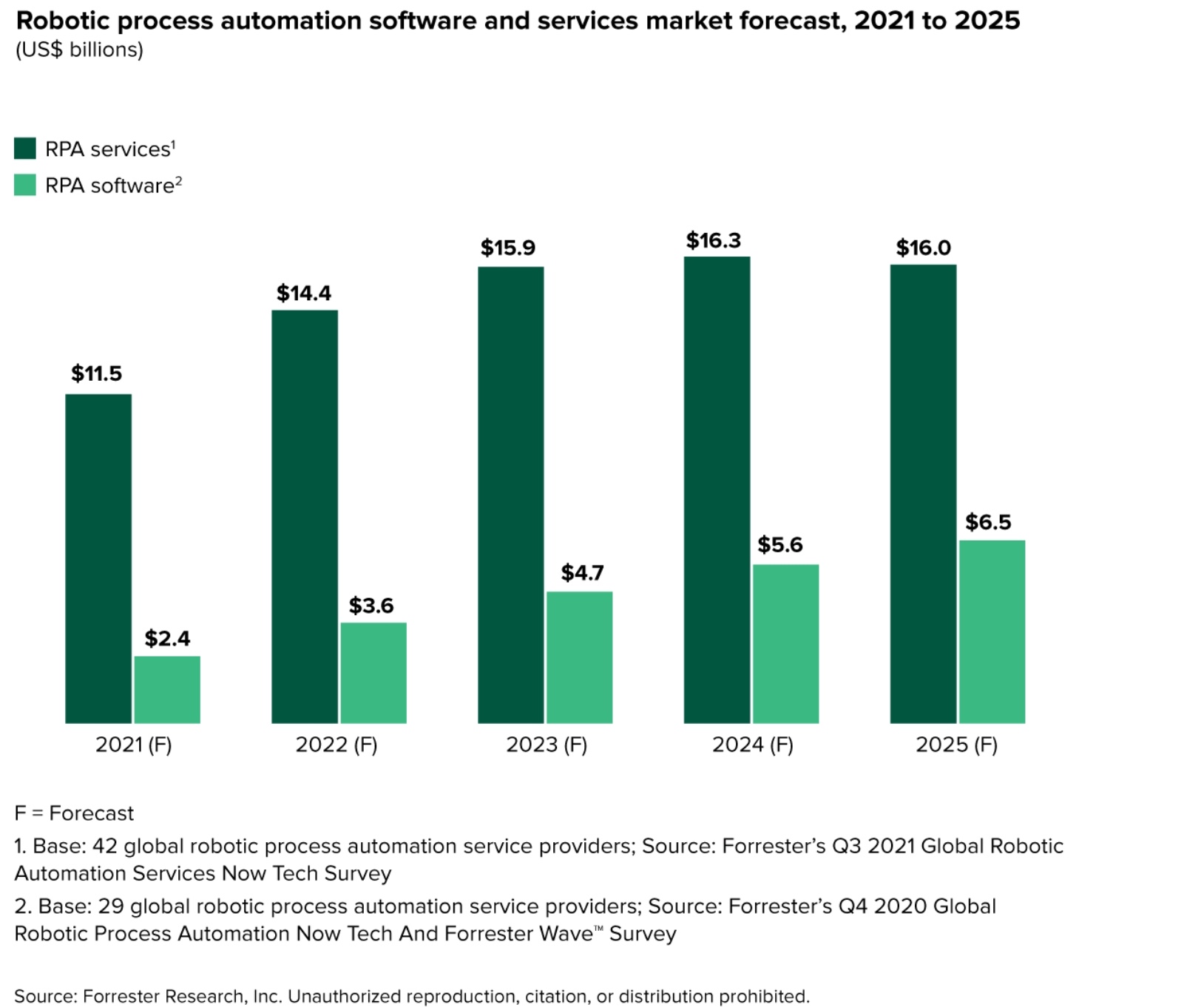
Forrester Research’s latest data appears to back this up, predicting the RPA software market will reach $6.5 billion by 2025, but with the caveat that growth will start to flatten as soon as next year as companies shift to more AI-fueled automation solutions.
“While we expect the tremendous market growth in 2021 to continue throughout 2022, fueled by pandemic-induced automation demand and ongoing digital transformation programs, growth rates will begin to flatten in 2023,” the company wrote in its latest RPA market report.
While $6.5 billion is up significantly from it’s 2018 report when the firm predicted the market would reach $1.1 billion in 2019, it is still a fairly small amount overall when you consider Salesforce just completed a quarter in which it reported over $7 billion in revenue on its own.
The services part of the market, helping implement these complex solutions, is expected to grow much more robustly compared to RPA software revenue. According to Forrester, RPA-related services could reach $16 billion by 2025, almost three times the software it’s trying to help implement. If you combine the services and software, it’s a much more impressive $25 billion market by 2025.
Image Credits: Forrester Research
Forrester analyst Leslie Joseph explained services revenue this way: “Services revenue counts the revenue that services vendors make by providing consulting, development, implementation, maintenance and support services around these products.” Service vendors include global systems integrators, consulting and advisory firms such as Accenture, IBM and EY, who may be partners or resellers of RPA software.
Forrester is predicting that some of the money going to RPA software today will begin to shift to broader AI automation solutions. It’s worth noting that while RPA has robotic in its name, it’s not really AI in a true sense. The bots in this case are more like scripts completing a set of highly manual tasks. By comparison, no-code automation solutions make it easy to create a workflow, presumably without consulting help. AI provides a way to intelligently implement tasks and take steps based on the data instead of moving through a set of highly defined hard-coded work.
This decline is coming in spite of investor enthusiasm for the market from investors who valued UiPath at $35 billion when it raised $750 million last year, its last private fundraise prior to its IPO. Today the company’s market cap sits at close to $15 billion, certainly a precipitous drop in value, even taking into consideration the big hit software companies have been taking in the stock market over the last year.
When TechCrunch surveyed five investors last year about the RPA market, we asked them specifically about how RPA technology can stay relevant in the long term. For the most part, investors saw a market that could continue to expand, but if Forrester is correct, the market may be shifting as customers look to more modern AI automation services.
‘The mantra is one program, one team – that’s gonna take a while to fully come to fruition, but we’re pretty far along that path,’ Richard Hasslacher, Slack’s vice president of alliances and channels, tells CRN in an interview.
As the war in Ukraine continues, companies as varied as Exxon, Visa, McDonald’s and Coca-Cola have suspended sales in Russia. Tech companies like Adobe, Apple and PayPal have joined in over the last couple of weeks.
We queried the world’s top cloud infrastructure vendors (including Amazon, Microsoft, Google, IBM and Cloudflare) to find out how each was reacting to Russia’s attack on Ukraine. Each company let their public blog posts stand as the message they wished to share, with the exception of Google Cloud, which sent a brief statement stating its position.
In a blog post on March 4, AWS indicated that it has no data centers in Russia, and as a matter of policy, it does not do business with the Russian government. It stated that while it had Russian customers, they were all headquartered outside of the country, though it stopped short of saying it would suspend sales. That changed on March 8, when the company updated the blog post to indicate it had “stopped allowing new sign-ups for AWS in Russia and Belarus.”
Microsoft also took the action of suspending sales to Russia. “We are announcing today that we will suspend all new sales of Microsoft products and services in Russia,” Brad Smith wrote in a blog post on March 4 announcing the action. That presumably includes Azure infrastructure services.
As for Google, the last of the big three cloud infrastructure vendors, it said, “We can confirm we are not accepting new Google Cloud customers in Russia at this time. We will continue to closely monitor developments.”
IBM has taken a similar position, announcing in a March 7 blog post written by CEO Arvind Krishna that it was suspending sales in Russia. “I’ve heard from many of you in response to last week’s announcement regarding the war in Ukraine, and I appreciate your feedback. First, let me be very clear — we have suspended all business in Russia,” Krishna wrote in the post.
Cloudflare, which is not a pure cloud infrastructure vendor, helps provide secure internet access via hundreds of data centers around the world, including Russia and Ukraine. As an internet provider, the company thinks it’s important to keep the internet running in the country in spite of calls to shut down service there:
“Beyond this, we have received several calls to terminate all of Cloudflare’s services inside Russia. We have carefully considered these requests and discussed them with government and civil society experts. Our conclusion, in consultation with those experts, is that Russia needs more Internet access, not less,” the company wrote in a blog post.
It’s worth noting that in a report published this week, IDC found that the economic impact on cloud companies taking these actions will likely be minimal. “While IDC expects a steep decline and slow recovery for ICT spending in Russia and Ukraine, the global impact of this decline will be somewhat limited. Combined the two countries only account for 5.5% of all ICT spending in Europe and 1% worldwide,” the firm reported.
After seemingly forgetting that Android tablets existed for a while, Google is suddenly very invested in the market. Android 12L is in development to support larger-screened devices, and one of the platform’s co-founders, Rich Miner, has rejoined the team with the title “CTO of Android tablets.” Now, speaking to developers during an episode of Google’s The Android Show, Miner explained the opportunity the company is seeing (via 9to5Google).
Miner references the introduction of Android tablets in 2011 and how apps like media players scaled to fit them easily without much investment, but then growth “kind of stagnated.” Now, he cites data showing growth took off pre-COVID in late 2019 and has continued to rise, with more keyboard...
By Ryan Daily In the latest edition of the No Jitter Roll, we cover Microsoft closing the deal on Nuance and recap some of the latest articles previewing Enterprise Connect sessions.
You can type out a response, or choose from pre-written responses. | Image: Google
Google’s latest feature drop for its Pixel phones supercharges its Live Caption feature for phone calls, allowing you to avoid having to speak entirely. There are also new custom sticker options, YouTube watch party support in Duo, and a night photography mode for Snapchat. Google says the features are rolling out starting today on the Pixel 3A to 5A and will be coming to the Pixel 6 and 6 Pro later this month.
Google’s Live Caption feature could previously turn incoming phone call audio into text, but it’s now being updated to work the other way around, so you’ll be able to type text and have Google’s software read it out in the phone call. A short GIF released by the company shows how the feature can be accessed from the volume button...
Toyota will idle lines in several factories, producing about 13,000 fewer vehicles than expected. | Photo by Amelia Holowaty Krales / The Verge
A cyberattack has forced Toyota to shut down its factories in Japan, forcing the automaker to lose about 13,000 cars of output, Reuters reports. The attack was directed at a key supplier of plastic and electronic components to the company.
There was no immediate information as to who was behind the cyberattack, with Japanese Prime Minister Fumio Kishida telling reporters that his government would investigate whether Russia was involved. “It is difficult to say whether this has anything to do with Russia before making thorough checks,” he said, according to Reuters.
“It is difficult to say whether this has anything to do with Russia before making thorough checks”
Japan is backing the US and other Western allies that are seeking to impose...
Cisco partners are praising the tech giant’s African American Cisco Partner Community, which is giving Black-owned partners access to resources that is translating into financial growth and business success.
Defenses like levees and seawalls are important ways to adapt to climate change, but there are limits to what they can withstand. | Christopher Furlong/Getty Images
There are still effective ways to adapt that can also lower emissions, the latest report from UN scientists finds.
Climate change is already testing the limits of what human communities can survive, and if warming isn’t kept in check, some of the most crowded parts of the planet will become practically unlivable. The temperatures are already getting too hot, disasters are becoming too severe, and the costs of staying put are becoming unbearable for millions of people. And the greatest impacts are on those least able to cope.
These are some of the stark conclusions in the latest comprehensive assessment from the United Nations’ climate change research group, the Intergovernmental Panel on Climate Change (IPCC). The 3,600-page report published Monday focuses on the practical impacts of climate change, on humans and on nature. It follows the first installment of the assessment, released last August, that covered the basic science behind global warming.
“Today’s IPCC report is an atlas of human suffering and a damning indictment of failed climate leadership,” said UN Secretary-General Antonio Guterres during a press conference Monday.
Global average temperatures have already risen by 1.1 degrees Celsius, roughly 2 degrees Fahrenheit, leaving perilously little room for meeting the targets of the 2015 Paris climate agreement. The accord set a goal of limiting global warming to less than 2 degrees Celsius/3.6 degrees Farenheit compared to average temperatures before the industrial revolution in the 1800s. The agreement also set a more ambitious target of staying below 1.5°C/2.7°F.
Global warming has already raised global sea levels by 9 inches. It has left a distinct mark on extreme weather too, worsening heat waves, storm surges, and rainfall. Scientists can even quantify how much human-linked emissions of heat-trapping gases have made these events worse.
That means regardless of how much greenhouse gas emissions come down, a certain amount of warming is here to stay. “Near-term actions that limit global warming to close to 1.5°C would substantially reduce projected losses and damages related to climate change in human systems and ecosystems, compared to higher warming levels, but cannot eliminate them all,” according to the new report.
Around 3.5 billion people around the world already have no choice but to adapt to the warming that’s underway because they live in vulnerable hotspots, said Debra Roberts, co-chair of the team that produced the report, during a press conference.
Adaptation might entail building seawalls, planting different types of crops and trees, and improving governance. But these and other efforts are already proving to be a challenge, and some of those boundaries are already being surpassed. “Adaptation cannot prevent all losses and damages,” Roberts said. “Even with effective adaptation, limits will be reached with higher levels of warming.” And if people fail to adapt, much more suffering is in store.
We’re already hitting the “hard” limits of what we can adapt to
IPCC reports generally don’t reveal new information but summarize and evaluate the strength of existing research. Since the last major IPCC report was released in 2013, the IPCC has developed a much better read of how warming will play out for the planet.
The new report defines two categories of limits to adaptation. “Soft” adaptation limits are scenarios where there may be options to cope with the impacts of climate change, but aren’t available due to cost or technological limitations. “Hard” limits are those where physical changes are so drastic that there is no way to reduce risks.
Fabrice Coffrini/AFP via Getty Images
IPCC Chair Hoesung Lee warned that climate change will cause “irreversible” impacts, even if the world meets the goals of the Paris climate agreement.
The natural world is passing some of the hard limits of what it can handle from climate change right now, leading to irreversible changes like extinction of species. “Ecosystems already reaching or surpassing hard adaptation limits include some warm water coral reefs, some coastal wetlands, some rainforests, and some polar and mountain ecosystems,” according to the report. Humans who are dependent on these ecosystems are deeply affected as well.
Coral reefs, for instance, are valuable ecosystems for tourism and coastal fisheries. They support more species per area than any other marine ecosystem and contribute about $375 billion to the global economy each year. Climate change causes several major problems for corals. Increased carbon dioxide dissolved in the water is making the ocean more acidic, harming the growth of corals. They also depend on a narrow range of optimal temperatures, between 73° and 84° Fahrenheit (23° to 29° Celsius), and warming water is pushing some species past their threshold of survivability.
There are hard limits to climate change adaptation that directly affect people too. Sea level rise is forcing residents of small islands to permanently evacuate. At least five islands in the Pacific Ocean have been lost to higher water levels. Rising temperatures are changing rainfall patterns and melting snowpacks, limiting freshwater for drinking and agriculture. This is driving migrations around the world.
One of the most important hard limits is the heat and humidity that people can endure. Scientists measure this using wet-bulb temperature, the highest temperature under a given amount of humidity where water will not evaporate. It serves as a proxy for how well the human body can cool itself off. For humans, the maximum tolerable wet-bulb temperature is 35 °C, or 95 °F, for six hours. Above that, even healthy people start experiencing severe, often fatal, health problems.
There are now regions in Iran, Pakistan, and India , all highly populated countries, that have approached or climbed above this threshold on several occasions. As climate change is raising global average temperatures, it’s also increasing the number and severity of extreme heat event. The frequency of places around the world approaching the human wet-bulb temperature limit has doubled since 1979.
Some communities simply need more money to adapt to climate change
In many parts of the world, it’s still possible for communities to adapt to higher temperatures and changing weather patterns, but they haven’t received enough resources to do so, according to the IPCC. Money in particular is one of the biggest soft barriers to adaptation.
For developing countries, adapting to climate change will cost around $127 billion per year by 2030, according to Edwin Castellanos, one of the IPCC report’s authors.
But investment in adaptation is falling woefully short, especially compared to efforts to curb emissions. “The overwhelming majority of global tracked climate finance was targeted to mitigation while a small proportion was targeted to adaptation,” according to the report.
While it’s critical to avert future warming by drawing down emissions now, researchers say that there is alarmingly little money to deal with harms occurring in the present. “People are suffering and dying right now from climate change,” said Kristie Ebi, an IPCC author, during a press conference. “The major constraint for adaptation options in health is the insignificant investment in this area.”
Money is not the only barrier, however. Millions of people are experiencing unprecedented changes and have little training or guidance for dealing with them. Many governments may not be up to the task either, lacking the political will or urgency to help their people deal with the changes to the climate they can’t avoid.
Some of the worst consequences are playing out for people with the fewest resources. “For soft limits, we are particularly seeing them in low-lying coastal areas and for smallholder farmers,” said Adelle Thomas, and one of the lead authors of the report, during a press briefing. “They don’t have the resources to adapt any further and they are experiencing devastating impacts of climate change now.”
The report highlights how some subsistence farmers in South America, Africa, and Asia have suffered costly crop losses from extreme weather worsened by climate change, forcing them out of business. In the Philippines, Typhoon Rai in 2021 caused more than $215 million in damages to crops and farmland. These types of losses in turn are fueling migration, poverty, disease, and political strife.
The upshot is that soft limits to adaptation are solvable problems. Improvements in technology, more funding, and better governance could allow people who were suffering the impacts of climate change to thrive.
“Soft limits might become hard ones in the future”
As bad as the situation is right now, climate change can still get much worse. Rising temperatures mean that many more areas of the world, spanning some of the most populated regions, will experience times when it’s too hot to survive.
“High-resolution climate change simulations suggest that due to deadly heat waves projected in some of the densely populated agricultural regions of South Asia (i.e. Ganges and Indus river basins), are likely to exceed the critical threshold of wet-bulb temperature of 35 °C under the business-as-usual scenario of future greenhouse gas emissions,” according to the report.
Parts of central Asia and China are also poised to see wet-bulb temperatures above what people can tolerate in the coming decades. That will likely result in millions more deaths, particularly in dense urban areas.
“For example, at 1.5°C warming, without adaptation, annual heat-related mortality in 27 major cities across China is projected to increase from 32.1 per million inhabitants annually in 1986–2005 to 48.8– 67.1 per million,” according to the report. “This number increases to 59.2–81.3 per million for 2°C warming.”
Sea level rise is also poised to become unbearable for many. More than 150 million people currently live on land that will be below the high-tide line by 2050.
And if the world doesn’t move quickly enough, the window to adapt may close. “[W]hen compounded with lack of finance, and high costs associated with disasters and poverty and environmental degradation, soft limits might become hard ones in the future,” the report notes.
Scientists also note that the full scale of economic damage from the changes the world cannot adapt to remains unknown. “The loss and damage associated with the future climate change impacts, beyond the limits to adaptation, is an area of increasing focus, although yet to be fully developed,” according to the report.
We already have many effective adaptation measures (though some could backfire)
One of the key findings of the previous installment of this round of reports is that it’s still technically possible to meet the 1.5 degree Celsius target of the Paris climate agreement, but every scenario considered overshoots this mark. Only the most aggressive cuts to greenhouse gas emissions bring global temperatures back below this line.
IPCC authors say their goal is not to prescribe specific policies. But the immense harm they highlight that’s underway and the more severe damage that lies ahead point toward the need for an economy-wide effort to prepare for changes the world can’t avoid.
“Adaptation and mitigation must be pursued with equal force and urgency,“ Guterres said. “Delay means death.”
The new IPCC report also warns that some adaptation measures can backfire. High temperatures may increase the demand for air conditioning powered by fossil fuels. A coastal seawall could damage protective ecosystems and create a false sense of security, encouraging more construction in vulnerable areas.
“There is increasing evidence of adaptation that has caused unintended consequences, for example destroying nature, putting peoples’ lives at risk or increasing greenhouse gas emissions,” according to the report.
Indranil Mukherjee/AFP via Getty Images
Restoring ecosystems like mangrove forests help people adapt to climate change and mitigate it.
But there are effective ways to adapt. Rebuilding damaged natural systems like wetlands, forests, and coral reefs can help cushion the blow of higher temperatures and rising seas. These measures have the added benefit of helping mitigate climate change, absorbing carbon dioxide or providing local cooling. So adaptation to climate change and mitigation work hand-in-hand, and the more that’s done to avert warming, the lower the needs for adaptation.
“Keeping climate change down to the lower levels is going to rely on getting natural systems in better shape to suck up carbon,” said Camille Parmesan, a lead author of the report, during a press conference. “Emissions reductions alone are not going to do it; it’s going to take carbon reduction as well.”
Another key element to adapting to climate change is addressing the inherent injustice of the problem. The people who contributed the fewest greenhouse gas emissions stand to suffer the most, while the countries that became wealthy from burning fossil fuels have the tools to insulate themselves.
So far, some of the wealthiest countries have hesitated to even acknowledge their disproportionate responsibility for climate change, let alone paying for the damages and losses already taking place.
This may be one of the biggest challenges of climate change adaptation. Negotiations on how to pay for adaptation measures across borders were not resolved at the last major international climate meeting in Glasgow, Scotland, and are on the agenda for the next meeting this year in Egypt.
All the while, global greenhouse gas emissions are continuing to rise. Adaptation will only become more essential, and more difficult.
Dozens of cameras suspended from the store’s ceiling track customers and their purchases. | Image: Amazon
Amazon has brought its cashierless Just Walk Out technology to a Whole Foods store for the first time, allowing customers to shop and leave the store with their items without having to interact with any kind of cashier. The revamped store opened on February 23rd in Washington, DC’s Glover Park neighborhood, where there’s been a Whole Foods store for over 20 years.
Although Amazon has been operating cashierless grocery stores in increasinglylarge Amazon Go and Amazon Fresh-branded stores, this is the first time it’s bringing the technology to a Whole Foods store. Amazon bought the grocery chain for $13.7 billion in 2017, but until now the brand’s integration with Amazon has been more minimal, consisting of discounts and free delivery...
8×8 sets a record with its new cloud-based operations in the Philippines, as new updates are rolled out.
8×8 refers to its platform as “XCaaS” (Experience Communications as a Service) which is essentially a blend of UCaaS (Unified Communications as a Service) and CCaaS (Contact Centre as a Service).
The Philippines now has a cloud phone and contact centre which is an industry first, according to 8×8. This increases 8×8’s PSTN (Public Switch Telephone Network) replacement services to 48 countries.
Denise Lund, Research Director, WW Telecom and Unified Communications at IDC, said:
“Being able to offer multinational enterprises in the Philippines a single integrated cloud communications and contact centre solution, like 8×8 XCaaS, will allow global organizations, especially those with customer-facing operations, to ensure business resilience, reduce complexity, and deliver enhanced service.”
8×8 have been expanding technologically, as well as globally, and they have shared some of the new features on its platform.
8×8 Frontdesk has new functionality including, shared notes, parking modes and directory filter options.
Video meetings can now have break rooms, polls, moderation controls and post-meeting summaries.
8×8 released a list of successful implementations of their technology which include Kubota, ALS, Inpro and Hays County.
Kubota combines a workforce of 1,200 using 8×8’s platform. ALS added 800 users with MS Teams integration and Inpro have implemented 8×8 technology to connect its 600 staff. Hays County in Austin, Texas uses 8×8’s cloud communications with Voice for MS Teams to serve 240,000 people.
Charles Bonomo, Chief Information Officer at Infinite Electronics, said:
“Managing teams across multiple countries and continents creates unique communications, collaboration, and customer engagement challenges.”
“8×8 XCaaS allows us to have our more than 500 employees in the US, Mexico, and China on a high availability, single, integrated cloud communications and contact centre platform to provide resilient employee communications and customer engagement capabilities globally.”
With more than 270 million monthly active users and a leadership position in the Gartner Magic Quadrant for UCaaS, there’s no denying Microsoft Teams has taken the world by storm. Over the last couple of years, Microsoft Teams has evolved from a simple tool for team collaboration into the new central “hub” of work for countless professional teams.
With Microsoft Teams, employees can join meetings and work together with their colleagues regardless of where they are in the world. Teams is paving the way for a new future of hybrid work while ensuring staff members in the modern world can enjoy a better level of productivity and wellbeing. Yet, somehow, there are still companies out there who haven’t tried the Teams experience.
Fortunately, if you’ve been considering making the switch into a Microsoft Teams environment, but you’re not ready to pay for a license yet, there is a solution. Rather than relying on the Microsoft Teams free version, users of Microsoft Azure AD can “explore” Microsoft Teams using the Teams Exploratory license.
What is the Microsoft Teams Exploratory License?
Microsoft Teams Exploratory is a solution built by Microsoft to help companies discover the benefits of Microsoft Teams. If you already have an Azure Active Directory account and you’re not yet licensed to use Microsoft Teams, you can initiate an “Exploratory” experience for no cost.
For 12 months, companies on the Microsoft Teams Exploratory license can discover all the unique benefits that Teams offers, as though they were using a paid license. However, to continue accessing Teams after those 12 months are up, you will need to transition into a Microsoft 365 package which includes Teams.
When Microsoft Teams Exploratory is enabled, you’ll have access to:
Microsoft Teams
Microsoft Stream
Microsoft StaffHub
Microsoft Planner
Microsoft Forms
Microsoft Search
Exchange Online (Plan 1)
Insights by My Analytics
Flow for Microsoft 365
Office mobile apps for Microsoft 365
Mobile Device Management for Microsoft 365
ToDo
Yammer Enterprise
Sway
Office Online
SharePoint Online (Plan 1)
Whiteboard (Plan 1)
Unlike the simple free version of Teams, Microsoft Teams Exploratory provides a full premium access trial to Microsoft Azure AD users for free. If an administrator in a Microsoft instance enables the “Exploratory” license for their users, all users in the organisation can then self-assign Teams licenses if they don’t have one already.
Who Can Use Microsoft Teams Exploratory?
Microsoft Teams Exploratory is a free-to-use experience for those interested in the Teams ecosystem – but it’s unavailable for everyone. To be eligible for this trial experience, you’ll need to have an Azure Active Directory account. To fit the criteria for a Teams Exploratory account, you should:
Not have an active Teams license
Not be part of a tenant where a license assignment policy is in place
Belong to a tenant with a paid subscription
Have a managed Azure AD email address
Eligible users can visit the Teams Microsoft website to sign up for the Exploratory experience. You can access the Exploratory license by signing into Microsoft Teams using your Azure Active Directory domain email address.
This will automatically assign your address to the Teams Exploratory experience. Members of a team signing into the Exploratory experience should know that organisation administrators will be automatically notified by email when someone logs in for the first time. Administrators of a team will be able to finalise their license by clicking on “Finish setting up Microsoft Teams Exploratory” within the Microsoft 365 admin centre.
How Can Admins Manage Teams Exploratory Mode?
One attractive feature of the Microsoft Teams Exploratory license is that it was designed to be initiated by end-users without having an administrator enable the service on their behalf. This should mean any user in an applicable organisation can access the Exploratory experience.
However, administrators can enable and disable the Exploratory license option within the Microsoft 365 admin centre. To do this, go into the Settings and Org Settings of your Microsoft 365 admin centre and click on “Services”. From there, go to “User owned apps and services”.
You should see two options within the “user-owned apps and services” section. Check the box which allows users to install trial apps and services if you want your users to access the Exploratory license. If you want to remove access to Microsoft Teams Exploratory, leave this box unchecked.
While the Exchange Online license is included in the Exploratory experience, administrators must assign this feature to users.
How Long Can You Use Teams Exploratory?
The Teams Exploratory license will last for up to 12 months in total from the moment your initial user signs up. The Exploratory subscription will start when the first user in a company signs up for Teams Exploratory, and the expiry date will apply to all users in the same tenant.
At the end of the 12-month subscription, administrators will have to decide whether to convert their Teams Exploratory user to a paid license. If you convert to a paid license before the subscription expires, then you can continue using Microsoft Teams with no disruption to your service.
You can check how long you have left on your Exploratory Trial License within the Microsoft 365 admin centre by visiting the “Billing” section and clicking on “Your Products”. You can also choose to upgrade from the Exploratory License in this section if you’re an administrator.
Will You Lose Your Data?
Notably, users will have to actively upgrade to a licensed version of Microsoft Teams within the Exploratory license period to continue using the service. The license doesn’t automatically upgrade after the trial period is over.
While Microsoft does offer a 30 day grace period, your team will automatically lose access to Teams after this, and Teams data will be deleted following another 30 days. Since your data should still be stored in Azure Active Directory, you can still recover the information if you upgrade within the correct time frame.
“Like the rest of the world, we are horrified, angered and saddened by the images and news coming from the war in Ukraine and condemn this unjustified, unprovoked and unlawful invasion by Russia,” Microsoft President Brad Smith said in a blog post.
Google has begun rolling out a new fast emergency dialer (FED) feature designed tohelp users traveling internationally quickly access police, fire, and medical services, 9to5Google reported. The dialer was reportedly first seen last year through the Pixel’s emergency app, but Google confirmed toAndroid Policethat FED is currently rolling out to a wider release.
Accessing the Fast Emergency Dialer when your phone is unlocked will vary by device
Though it’s designed for international traveling, anyone can use it at any location. According to theGoogle Support page, the emergency dialer will show options relevant to your location:
Quick access: To call an emergency number with one action, use the slider.
The United States Postal Service authorized the replacement of its mail truck fleet with nearly all gasoline-powered vehicles, rejecting a plea from President Joe Biden to include more electric vehicles in its purchase.
The move, which was announced Wednesday, signals the independent agency’s decision to move forward with a controversial plan to purchase 165,000 next-generation mail trucks, only 10 percent of which will be battery-electric vehicles (BEV). The USPS determined there was no legal reason to delay its plans.
“the process needs to keep moving forward”
In a statement, Postmaster Louis DeJoy said the agency would consider adding more EVs to its fleet sometime in the future. “[W]e will continue to pursue the acquisition of...
Bandwidth has secured Anthony Bartolo, the former Executive Vice President at Avaya, as their COO (Chief Operating Officer).
The newly created role of COO at Bandwidth has been setup to capture new enterprise customers. With his experience in business relations, Bartolo appears well placed to lead the operation.
David Morken, Bandwidth’s Chief Executive Officer said:
“Anthony is a unique combination of disciplined operator and cross-functional team leader who has led billion-dollar P&Ls around the world. He has a strong track record of successfully building new revenue streams, transforming product portfolios and driving global customer acquisition at world-class companies in our space,”
“In this new position, Anthony will drive our day-do-day mission to win new enterprise customers and become the best global communications platform-as-a-service for app developers.”
Bartolo comes directly from Avaya where he reportedly oversaw an 11-fold increase in annual revenue from his position as Executive Vice President and Chief Product Officer.
Anthony Bartolo brings 30 years of experience at Avaya, Tata Communications and Nortel, among others, to Bandwidth.
Anthony Bartolo, the newly appointed Chief Operating Officer at Bandwidth said:
“Bandwidth is exceptionally well-positioned to win as the enterprise platform of choice in the digital communications transformation.”
“The company has a reputation for excellence that I’ve admired for many years. Bandwidth’s solid customer base, strong leadership, dedicated and motivated team, and a mission-first, customer-centric culture are a winning combination that creates tangible value for customers. I’m very excited to join this team and help drive the next stage of global growth.”
Before joining Avaya, Bartolo is said to have had various roles at Tata Communications, such as Chief Product Officer and President of Mobility.
At Tata Communications, Bartolo reputedly forged important partnerships and expanded the company globally and into new markets.
Anthony Bartolo has also acted as President and CEO of Skyrider, Vice President and General Manager at Symbol Technologies, and various roles at Nortel Networks, where he first started.
Bandwidth has recently poached Microsoft Teams, RingCentral and Gensis as customers through its BYOC (bring-your-own-carrier) offerings.
Bandwidth describes itself as a global communications software, operating in over 60 countries. Cisco, Google, Microsoft, RingCentral and Zoom are some of the major companies using Bandwidth’s API.
Bandwidth claims to be the first CPaaS (Communications Platform-as-a-Service) provider with APIs built on their own network.


/cdn.vox-cdn.com/uploads/chorus_asset/file/23319013/GettyImages_1229054763.jpg) Sergio Flores/Getty Images
Sergio Flores/Getty Images
/cdn.vox-cdn.com/uploads/chorus_asset/file/23319029/GettyImages_1229054446.jpg) Sergio Flores/Getty Images
Sergio Flores/Getty Images








/cdn.vox-cdn.com/uploads/chorus_asset/file/23277081/GettyImages_1160294381.jpeg) Fabrice Coffrini/AFP via Getty Images
Fabrice Coffrini/AFP via Getty Images
/cdn.vox-cdn.com/uploads/chorus_asset/file/23277093/GettyImages_1170576798.jpeg) Indranil Mukherjee/AFP via Getty Images
Indranil Mukherjee/AFP via Getty Images