Shared posts

19 Apr 00:18

Rep. Ken Buck Threatens To Use Antitrust To Attack ‘Woke’ Apple

by Karl Bode

We’ve noted for a while that DC, and particularly the GOP’s, interest in “antitrust reform” is somewhat hollow. For one, while the United States is rife with heavily monopolized business sectors (insurance, health care, telecom, banking, airlines), this recent batch of “reform” only specifically targets large technology companies. It’s as if these other sectors (most notably telecom) simply… don’t exist.

Even then, the bills we’ve seen so far are often clumsily written, and include weird limitations on which companies should fall under scrutiny. For example, several of the heavily hyped bills being promoted over the last year set an arbitrary market cap of $600 billion. Amusingly when Facebook scared investors away with its lame Meta pivot, it fell below that scrutiny threshold.

The GOP side of “antitrust reform” has been particularly hollow. Even Ken Buck, who has been the cheerleader for narrow antitrust reform on the GOP side, generally likes to ignore that telecom monopolies like AT&T and Comcast exist. Buck has literally supported every consolidation and deregulatory pipe dream of AT&T and Comcast for decades. You’re apparently supposed to ignore that.

And like much of the GOP, Buck’s head has been filled with pudding thanks to divisive culture war bullshit being used to agitate low information voters. For example, over the weekend in a since deleted Twitter thread (screenshotted text below), Buck threatened to utilize the government’s antitrust enforcement power to “smash woke capital” — specifically Apple — to punish the company for its opposition to anti-LGBTQ bills in Florida and elsewhere:

If you can’t read the screenshot, it says:

THREAD: Antitrust is the best way to smash woke capital and protect our kids.

Companies that grow to colossal size, monopoly size, use their power to change politics to make more profit.

This power is a function of their wealth and control over the economy.

At some point, they start to control the information flow in our democracy.

We end up being governed by the CEOs of monopolies and their hard-left employee base.

Simple solution: restore competition by ending the monopoly.

Again, while Buck is routinely held up as a Republican who “gets” the need for antitrust reform, he doesn’t, really. Buck, (like most of the GOP) will be first in line to oppose antitrust reform should it be applied to genuinely monopolized sectors like telecom. Yet here he’s suggesting that U.S. antitrust enforcement should be leveraged against Apple simply because it wants to engage in some light lobbying opposition to bills that would harm Apple LGBTQ employees and customers.

He’s since deleted the tweet, suggested he understood the stupidity of it, or at least understood that threatening to punish a company for its lobbying activity would violate the First Amendment. But the dumb tirade was also notable given that Rep. David Cicilline, one of Buck’s key allies in the “bipartisan antitrust reform” effort, is openly gay:

For years, experts pointed out that U.S. antitrust reform had grown toothless and frail, our competition laws need updating in the Amazon era, and “are consumers happy?” (the traditional consumer welfare standard) doesn’t actually measure all aspects of potential harm in complex markets. Like so many issues, this shouldn’t be a bipartisan fight for better policy and law. Yet it’s often framed as a partisan issue to sow division.

What we should have gotten was a serious examination of all industries and proposals that fairly targeted very clear monopolization, market failure, and anti-competitive behavior across the board. Instead we got a bunch of weird, hollow promises and performances. Specifically by the GOP, whose 40 year track record of coddling monopolies at nearly every turn (again, just look at telecom) is undeniable.

Beyond that, threatening to use the government’s antitrust authority to attack a company for taking an ethical position on ignorant and backward policies in states teetering toward authoritarianism is ignorant policy malpractice itself.

For the GOP, extremism, victimization porn, and culture war performances have utterly displaced serious policymaking. Yet somehow much of the mainstream press and policy punditry haven’t gotten the memo, and continue to help the GOP pretend their interest in “antitrust reform” is genuine. It’s not. It never was.

As we’ve noted previously, much of the GOP’s assault on “big tech censorship” (including the fracas over Section 230) is an attempt to force tech companies to carry race-baiting propaganda, a cornerstone of modern GOP power in the face of unfavorable demographics and a sagging electorate.

And while surely there are a few GOP representatives (like Buck) who care a tiny bit about monopoly power, the Trump GOP’s clear goal at the moment isn’t meaningful policy, healthier markets, or consumer protection, it’s in further filling the heads of targeted voters with pebbles and hate. Which, if you hadn’t been paying attention (see: Fox News) is working extremely well.
18 Apr 08:23

New Salesforce AI chief eyes a future with voice-driven coding

by Ron Miller

As we start to see AI advance in business, the ways in which we interact with machines are beginning to change. Companies like Salesforce are looking for new opportunities for AI to have a more direct impact on customers.

While using AI to surface the customer most likely to churn or most likely to buy is certainly useful, it’s just a step in the process, and it’s only the start of how AI could change how we work in the future.

Salesforce’s AI journey began in 2016 when it launched its AI framework called Einstein. In reality, Einstein was never meant to be a product so much as a set of intelligence capabilities that had the potential to touch every aspect of the Salesforce stack. The original crew that brought that to life has mostly moved on, but the work continues.

The company brought in former Stanford professor Silvio Savarese to be its chief scientist a year ago. One of the reasons he was willing to leave academic life behind was the ability to pursue advanced research with vast datasets, a big staff and the resources of a company like Salesforce.

He said that he wanted to continue to pursue the research he had been doing for the last two decades with the goal of putting skills within reach of people who lacked specific training. “One of the major directions that I’m pushing here is really to bring AI to empower people in business in new ways, and I’m really excited to deliver that power with experiences that are so simple that anyone can use them,” Savarese explained.

To achieve that broad goal, one of the main initiatives he and his 100-person research team have been pursuing is the voice-driven programming approach the company has dubbed CodeGen. The idea is to let people simply describe in plain spoken language what they want to do, and the AI will produce code based on the natural language instructions.

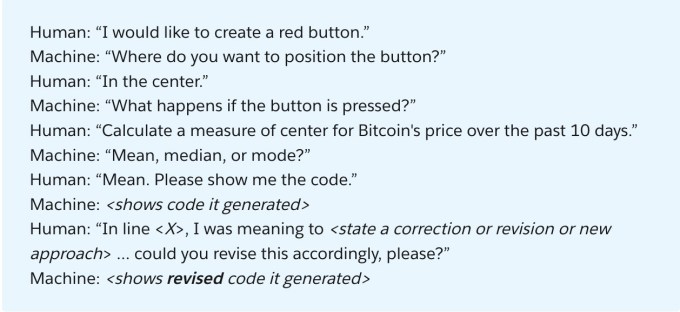
But it’s not simply telling the AI tech what you want; Savarese said it’s more of a conversation. “CodeGen really provides a new way of developing software. Rather than writing code directly, users would simply describe the problem they’re trying to solve in plain English in a conversation. So the conversation part is very, very important,” he explained.

What he means is that you may ask for something and the AI will ask for clarification and there will be a back and forth as in the example provided in a Salesforce blog post explaining CodeGen:

Example of conversational coding from Salesforce using CodeGen tool.

Example of conversational coding from Salesforce using CodeGen tool. Image Credits: Salesforce

While this is very much in the experimental stage of development, they are making progress in building models that would be suitable for two distinct audiences. “The goal is to address a couple of users. One is more experienced developers, which in this case CodeGen will assist them with writing the code and take over those manual portions of the processing, those parts that aren’t that interesting from the coding perspective. The second user is those people with no coding experience, so almost zero expertise in coding, but CodeGen can still give them a way to build software to solve real problems,” he said.

Salesforce is trying to achieve something with conversational coding that hasn’t been done before. While Microsoft is working on something similar with the GPT3 framework, this is what Savarese calls deep learning at scale and it involves extremely complex models.

“This is a foundational model for coding, so CodeGen is built on a massive autoregressive model with 16 billion parameters, which are trained with a very large amount of data,” he said. Here it bifurcates the use cases with samples for the model based on whether the user is experienced or a non-coder.

While the project is still in the proof-of-concept stage, the next step is to release it to the internal developer community at Salesforce, which will happen when Savarese presents his findings to an internal conference later this month.

If the project moves beyond experimental stage, the idea would be to empower data scientists and business analysts using Tableau, the company Salesforce acquired in 2019 for almost $16 billion, to create programs on top of the data and make it more accessible from a business perspective.

Voice-driven coding could be just the first step here as other capabilities like creating content, website layout and other tasks could be similarly reduced to simply describing them. “The inspiration comes from the need for having an easy way to communicate with AI systems, and the ability to use language to create better communication to inform certain processes.”

18 Apr 08:22

Vitalik Buterin quietly donates $5M ETH to aid Ukraine as total tracked crypto donations reach $133M

by Zhiyuan Sun
No official public announcement was made regarding the large sum donation.
17 Apr 20:29

Twitter Loses Elon Musk the Board Member, Regains Elon Musk the Shitposter

by Maxwell Strachan

The world’s richest shitposter made it about four days before deciding that he wanted to be able to tweet whatever he wants and take over whatever company he should choose. On Saturday morning, mere days after Twitter revealed Elon Musk would join the company’s board, Musk informed Twitter that he would not be joining after all, CEO Parag Agrawal said in a statement shared publicly on Sunday night. 

“I believe this is for the best,” said Agrawal, who added that he would “remain open” to Musk’s input, as he remains the company’s top shareholder.

News that Musk wouldn’t join the board led to wild speculation about why he had reversed course, with some zeroing in on Agrawal and noting that his approval had been “contingent” on him passing a background check. One Twitter employee suggested that the company had made the decision, not Musk, and publicly thanked them Monday morning. 

“I’ve kept quiet since the announcement because I wanted to give Twitter leadership a chance to do right by it’s [sic] employees, and they did,” Twitter Director of ML Ethics, Transparency, and Accountability Rumman Chowdhury wrote Monday. 

But Musk’s own amended SEC filing on Monday morning offered another explanation: Forgoing a board seat meant Musk could continue posting about Twitter and potentially increase his stake in the company or even take it over in the future. In exchange for the board seat, Musk had agreed not to increase his stake in the company above 14.9 percent through the company’s 2024 annual stockholder meeting, according to SEC filings, which effectively meant he wouldn’t take over the company for at least two years.

The Monday filing states that going forward, Musk may “acquire additional shares of Common Stock” and “express his views to the Board and/or members of the Issuer’s management team and/or the public through social media or other channels” (which is corporate speak for tweet whatever he wants). 

Heroic as it might have been for Twitter to stand up to Musk, or hilarious as it would have been if the world’s richest man simply wanted to avoid (or even failed) a background check, it seems more likely that Twitter had offered Musk a seat as a way to placate and defang him, and that Musk decided in recent days that he didn’t want to be contained.  

Twitter had announced the decision to appoint Musk to the board last Tuesday, soon after it was revealed that Musk has taken a 9.2 percent ownership stake in the company, which made him the company’s largest shareholder.

It was immediately clear that the news could be a problem for leadership. For a while now, Musk had made a hobby out of criticizing Twitter, suggesting in one series of March posts that Twitter did not adhere to free-speech principles and “fundamentally undermines democracy.” (“Is a new platform needed?” he added.)  After his new stake was revealed, Musk almost immediately started trouble again, asking his followers in a tweet last Monday whether Twitter should add an edit button, a terrible idea some Twitter users have nevertheless desired for years.

Musk’s newfound power was readily apparent, though, as Agrawal responded to Musk’s poll that same day: “The consequences of this poll will be important. Please vote carefully.” 

Retrospectively, Twitter leadership was already springing into action by then. Because by the next morning, Agrawal was announcing Musk was joining the board, saying that the company was “excited” and that he believed Musk would bring “great value” to the company.

The company had understood the risks inherent in inviting the occasionally erratic Tesla CEO onto the board but decided it “was the best path forward” as it meant Musk would have a fiduciary duty to “act in the best interest of the company,” Agrawal said Sunday evening. It also meant his tweet’s about the company could have fallen under SEC review, which has already caused him trouble (and cost him $40 million) in the past. 

Nevertheless, news of Musk’s new role had reportedly led to outcry inside Twitter, and the company announced internally on Thursday that they would be invited to ask Musk about his intentions during an unusual and forthcoming open session. That didn’t seem to reduce the anger. After someone asked Chowdhury if she feared a hostile takeover on Monday morning, she replied, “It would be interesting to see how he’d run a company with no employees.”

Free from the shackles of the board, Musk got back to doing what he does best over the weekend: posting. He wrote tweets that asked "Is Twitter dying?", suggested Twitter removed ads and converted its headquarters into a homeless shelter, and polled followers about whether the company should  "Delete the w in twitter?" After Agrawal released his statement, Musk also appeared to respond with that emoji of the face with a hand over a mouth. 

Like a true poster, he has since deleted most of the tweets. 

11 Apr 03:11

Robinhood rolls out wallets to 2M waitlisted users, plans to integrate Lightning

by Turner Wright
The crypto wallet will not support Ethereum-based services like nonfungible tokens and ERC-20 tokens.
11 Apr 03:10

Bitcoin 2022: Thiel calls Buffett 'sociopathic', Mexican billionaire has 60% in BTC

by Tom Mitchelhill
The Bitcoin 2022 conference was packed with new announcements, however Peter Thiel stole the show by throwing $100 bills into the crowd and calling Warren Buffe...
11 Apr 03:05

I tried the pixel-flavored Coke, and it Bytes

by Mitchell Clark
At least I didn’t further my sugar addiction.

Coke recently announced that it was making a limited-edition soda, called Coca-Cola Zero Sugar Byte. The flavor, according to the company, was “born in the metaverse” and “inspired by the playfulness of pixels, rooted in the experiences that gaming makes possible.” It’s hard to imagine better bait for The Verge, so I asked Coke if it could send me a can. And it delivered.

The can for Coke Byte (as I’ll be calling it for brevity’s sake) is a fun purple color, and has a sort of retro-game aesthetic — it says “recycle me to play again” on the side, and it is adorned with cubes meant to represent pixels. I stuck it in the fridge until my wife Becky got home, and we cracked it open to finally discover what pixels taste like.

...

Continue reading…

10 Apr 01:11

Five9 Recognized as a Certified Transparent Company™

by Amy Ralls

Five9 meets the highest levels of organizational transparency and is ranked among the top 100 most transparent companies in the world following a thorough, independent analysis by Transparency Global.

SAN RAMON, CA – April 7, 2022 – Five9, Inc. (NASDAQ: FIVN), a leading provider of the intelligent cloud contact center, today announced that it has been named a Certified Transparent Company™ by Transparency Global. Transparency Global provides research, indexes, and certification programs to accelerate the world’s adoption of transparency – a continuum of corporate trust, alignment, simplicity, honesty, openness, and clarity.

After a thorough, independent analysis, Transparency Global awards this certification to companies that meet the highest levels of organizational transparency, as measured by six Key Performance Indicators (KPIs): Transparency Standards®, Terms, Total Accountability, Transparent Cost™, Truth, and Trust. The KPIs are derived from publicly available information, including corporate reputation rankings, terms and conditions agreements, and organizational guidelines and values. This helps ensure the objectivity of the data collected.

“Certified Transparent Companies like Five9 meet the highest standards of trust and accountability,” said Paul Pagnato, Chairman and Founder of Transparency Global. “These organizations have superior cultures and greater innovation, and they create impact that results in higher level growth and industry transformation. We are proud to recognize Five9 for embracing transparency and demonstrating its dedication to reliability, security, and customer success.”

Transparency Global also named Five9 to its most recent Transparency 100 Index,™ which quantifies the level of transparency in every single publicly traded company globally and identifies the top 100.

With thousands of successful customer implementations, including migrations from premises environments to the cloud and net new cloud deployments, Five9 has built a reputation for providing superior professional services and customer service in the cloud contact center industry. The company received the highest overall vendor satisfaction score from customers surveyed as part of the DMG Consulting 2021/2022 Cloud-Based Contact Center Infrastructure Product and Market Report, earning 33 perfect scores out of a possible 34. Additionally, Five9 Professional Services and Customer Support teams consistently achieve average Net Promoter Scores (NPS) of +85.

“We pride ourselves on making CX work for our customers so they can grow their businesses, and we believe trust is the foundation for every successful relationship,” said Andy Dignan, Executive Vice President of Service Delivery & AI Solutions, Five9. “We are honored to be recognized by Transparency Global for this commitment, and for our mission to be the most transparent, reliable, secure, and scalable cloud contact center solution in the industry.”

To read more about Five9 transparency standards and certification, visit our Five9 Trust site.

About Five9

Five9 is an industry-leading provider of cloud contact center solutions, bringing the power of cloud innovation to more than 2,500 customers worldwide and facilitating billions of call minutes annually. The Five9 Intelligent Cloud Contact Center provides digital engagement, analytics, workflow automation, workforce optimization, and practical AI to create more human customer experiences, to engage and empower agents, and deliver tangible business results. Designed to be reliable, secure, compliant, and scalable, the Five9 platform helps contact centers increase productivity, be agile, boost revenue, and create customer trust and loyalty. For more information, visit www.five9.com.

About Transparency Global

Transparency Global operates a digital platform accelerating the world’s adoption of Transparency. The platform includes certifications, financial indexes, rankings, research, education, and surveys. Transparency Global certifies companies that meet the highest levels of organizational transparency analyzing over 60,000 globally traded public companies creating the world’s largest Transparency database of both public and private companies. For more information, please visit transparency.global.

The post Five9 Recognized as a Certified Transparent Company™ appeared first on Cloud Communications Alliance.

10 Apr 01:11

Google Will Sell Pixel Batteries, Repair Parts to Customers

by Jason Koebler

Google has become the latest major electronics manufacturer to announce that it will sell some smartphone repair parts to consumers, meaning many of the largest companies in the world have at least partially reversed course on right to repair. Google says that, like Samsung, it will partner with iFixit to sell repair parts to consumers.

 “We want you to have a great experience with your Pixel phone, and that includes easy access to high-quality and safe device repair if your phone is ever damaged,” Google wrote in a blog post. “That’s why we’re working with iFixit to make it easier for independent repair professionals and skilled consumers with the relevant technical experience to access the genuine Google parts they need to repair Pixel phones.”

Google said it will begin selling repair parts for Pixel 2 through Pixel 6 Pro phones, as well as parts for any future Pixel devices. Google’s parts program is slightly more expansive than that of other manufacturers: Notably, it will sell original replacement batteries, which can have the effect of significantly extending the life of a smartphone. It will also sell cameras, replacement displays, “and more,” the blog post says. 

Google wrote that it is also looking to expand the repair program to other devices it sells, and has pushed manufacturers of Chromebook to sell replacement parts for those devices, too.

In recent months, companies like Apple, who spent years saying that letting consumers repair smartphones is a dangerous endeavor that would void your warranty and cause widespread hacking have softened their stances amid a right to repair push that increasingly has momentum from consumers, state lawmakers, and, perhaps most crucially, the Joe Biden administration and his Federal Trade Commission. Perhaps fearing strict regulations or a right-to-repair law at the state or federal level, Apple, Samsung, Microsoft, and now Google have all announced that they will begin selling repair parts directly to consumers. Motorola also sells parts to consumers and has for years. The Samsung, Google, and Motorola programs are all run through iFixit.

The announcement also shows a willingness to compromise and partner with iFixit, which has sold (largely) third-party repair parts on its website for years and has created independent repair guides for thousands of devices. iFixit has been one of the leading advocates for right-to-repair, pushing for repair laws in states around the country alongside consumer rights groups like US PIRG and repair trade groups like Repair.org. 

“It’s straightforward for iFixit to help these companies out because we’ve been doing this for years, and we’re the best in the world at it,” iFixit CEO Kyle Wiens told Motherboard. 

10 Apr 01:02

Google Fi cuts unlimited plan pricing while increasing high-speed data

by Emma Roth
Illustration by Alex Castro / The Verge

Google Fi is cutting the prices across its two unlimited cellular plans, in addition to adding more high-speed data (via 9to5Google). The Simply Unlimited plan has dropped from $60 / month to $50 / month for one line, while the full-featured Unlimited Plus plan now sits at $65 / month for one line, compared to its previous $70 / month price. This marks the first price cut for the Unlimited Plus and Simply Unlimited plans since their debuts in 2019 and 2021, respectively.

The cheaper cost comes with more high-speed data

The cheaper cost comes with more high-speed data on both plans, increasing from 22GB to 50GB with the Unlimited Plus plan and from 22GB to 35GB with Simply Unlimited. As noted on the MVNO’s updated plans page, Google Fi...

Continue reading…

10 Apr 01:01

The era of fixing your own phone has nearly arrived

by Sean Hollister
Inside a Pixel 5 smartphone. | Image: iFixit

Fresh off big wins with Google, Samsung and Valve, iFixit says more parts deals are nigh

Continue reading…

08 Apr 23:52

Here Are The 6 Designations Replacing Microsoft’s Gold And Silver Competencies

by Wade Tyler Millward
CRN breaks down what partners need to do to earn a new designation. The six new designations are in infrastructure; data and artificial intelligence; digital and application innovation; modern work; security and business applications.
08 Apr 23:51

Amtrak Is Streaming an Empty Railroad on Twitch to Beef With Freight Rail Companies

by Aaron Gordon

Amtrak set up a Twitch stream in Bay St. Louis, Mississippi, on Wednesday that shows an empty railroad track in front of a parking lot. Birds can be heard chirping in the background, and otherwise nothing happens. The stream was up for a few minutes and then died twice. “We’re having tech difficulties but will be back on soon,” Amtrak said in the chat. “It’s our first time streaming, so bare [sic] with us, gamers.” 

Amtrak getting into Twitch is the latest salvo in an ongoing fight between the passenger rail network and freight companies CSX and Norfolk Southern (NS) over restoring service between Mobile, Alabama, and New Orleans. Amtrak, a government-chartered corporation, was created in 1971 from the ashes of private carrier passenger service. As part of the deal, freight rail companies generally inherited ownership of the tracks, along with the responsibility of maintaining them and running service. Amtrak received the rights to run trains along those tracks. By law, Amtrak’s passenger trains also have priority over freight traffic. But in practice this doesn’t happen, and freight traffic is the leading source of delays on Amtrak trains outside the Northeast Corridor, one of the only places Amtrak retains ownership of tracks (along with sections owned by state governments that also operate commuter rails). 

While there has long been tension between Amtrak’s passenger service and freight rail operations, the Gulf Coast fight has turned particularly ridiculous. Amtrak wants to run two round-trip trains a day between those cities, which stopped service after Hurricane Katrina. CSX and NS are trying to block this, claiming it would “impair unreasonably” freight operations and without infrastructure improvements there would be “a near catastrophic meltdown of freight operations.” Those upgrades, the railroads say, would cost some $440 million.

As part of the ongoing beef, CSX has said Amtrak running two trains a day on this “very busy corridor” would be problematic for its own freight service. Which is why Amtrak decided to start the Twitch stream, to find out how busy the corridor really is.

Between 8 a.m. and 12:49 Central Time, Amtrak says it counted three trains on CSX’s tracks.

Update: After publication, in response to a Motherboard request for comment, CSX dismissed the Amtrak stunt. “It takes a freight train about 8-10 hours to travel between New Orleans and Mobile,” a CSX spokesperson said in a statement. “Focusing on one point of a line that traverses approximately 138 single track miles, major ports and Interchange points and then purporting that it is indicative of the operational realities of the entire line is grossly misleading. Anyone that understands railroad operations, including Amtrak, would know that.”

An Amtrak spokesperson responded, “If CSX would answer questions to the media about how many through trains are on this route, then we wouldn’t have to set up these cameras.”

CSX has not responded to a Motherboard inquiry about how many through trains are on this route per day. We will keep providing updates on this beef as the situation develops.

Update #2: CSX responded to Motherboard’s question about how many through trains it runs on this route per day: 8-10 through trains, 1-3 coal and grain trains, and “numerous” local trains. The CSX spokesperson also noted Amtrak wants to run two round-trips per day, so four trains altogether.

07 Apr 04:26

Meta is reportedly making ‘Zuck Bucks’

by Jay Peters
Libra / Diem may be shut down, but “Zuck Bucks” could be coming next. | Illustration by William Joel / The Verge

Meta may have given up on its Diem cryptocurrency, but the company is still exploring finance products, according to a new Financial Times report. The parent company of Facebook and Instagram reportedly has a few irons in the fire, including virtual currency employees have apparently taken to calling “Zuck Bucks.”

Zuck Bucks, seemingly named for Meta founder, chairman, and CEO Mark Zuckerberg, are “unlikely” to be a cryptocurrency. “Instead, Meta is leaning towards introducing in-app tokens that would be centrally controlled by the company, similar to those used in gaming apps such as the Robux currency in popular children’s game Roblox,” according to the FT. Roblox has built a huge business selling Robux, and Meta could try to emulate...

Continue reading…

06 Apr 06:54

Florida Has Already Wasted Over $700k Of Taxpayer Funds Defending Its Unconstitutional Content Moderation Bill

by Mike Masnick

We’ve already talked about how Georgia looks to be moving forward with its clearly unconstitutional content moderation bill. Back when Florida signed its content moderation bill into law (which actually put in a few things to pretend to appear more constitutional, unlike Georgia’s…), we noted that the state was going to waste a ton of taxpayer funds before losing. And, that’s exactly what’s happened. Florida’s bill was tossed out as unconstitutional, fairly easily. While an appeal on that ruling will be heard soon, all this is doing is racking up Florida’s expensive legal bills.

CCIA has a post up effectively warning Georgia not to go down this same path, and in the middle of that post it notes that, via some public records requests, Florida has apparently already spent somewhere around $700,000 of taxpayer dollars defending the law in court. And that’s even before the appeal is heard — meaning that it’s quite likely that Florida will set over a million dollars of taxpayer money on fire in an attempt to violate the 1st Amendment rights of internet websites.

As states around the country continue to pass these kinds of laws, it makes me wonder at what point supposedly “small government” elected officials who are “concerned about the budget” will realize that wasting taxpayer funds on a quixotic attack on the 1st Amendment just isn’t worth it? Or do they not care, since it’s not their money that’s being spent?

06 Apr 05:11

AT&T Dumps Time Warner Business Four Years After $85B Deal

by Gina Narcisi
After the hard-fought $85.4 billion deal for Time Warner was finally closed in 2018, AT&T is now spinning off its resulting WarnerMedia business unit as the carrier continues to focus on its legacy telecom business and boosting its balance sheet.
06 Apr 04:55

Crypto billionaires increase by 60% in a year: Who made Forbes annual list?

by Martin Young
There are now 19 billionaires on the crypto-rich list as seven more join the ranks of the industry’s wealthiest executives and founders.
04 Apr 16:33

Best Microsoft Teams Backgrounds in 2023

by UC Today Team

As demand for video conferencing tools continues to skyrocket, companies like Microsoft are going above and beyond to make people feel as comfortable as possible in front of a camera. Virtual backgrounds, one of the most popular solutions in the video conferencing landscape, can help people maintain their privacy, and portray the right image to contacts.

One study found about 60% of respondents cared about having the right background in their video meetings. The challenge for most people is in finding the best backgrounds to leave a lasting impression on clients, colleagues, and stakeholders.

Fortunately, there are no shortage of options out there for business users to choose from. Whether they want to position themselves in front of a beautiful media wall, answer calls from a sandy beach, or transport themselves into space for video conferences, there are backgrounds for every need.

Airbnb Homes and Hotels

Airbnb offers a range of gorgeous backgrounds for video meetings, designed to motivate, and inspire users, while optimising their professional image. Users can choose from a variety of some of the most attractive views Airbnb hosts have to offer. There are images from Norway, Ireland, France, and New Mexico, all available in stunning high-definition. Users can even choose a different “space” for every meeting, based on their preferences for the day.

Find them here.

Beautiful Libraries

Few things make someone look more sophisticated and highly-educated than sitting in front of a wall of stunning books. Fortunately, the New York Public library has some brilliant backgrounds on offer to help with this. Users can position themselves in front of a stack of books, or meet users from the Rose meeting room, with its gorgeous high ceilings. There’s something for every taste.

Find them here.

Meeting Rooms from Out of this World

For people who want to break out of the traditional meeting room environment, there are few things better than diving head-first into the beauty of space. Fortunately, the Star Wars website allows Microsoft Teams users to connect to any meeting from a galaxy far, far away. Options range from the Sheev Palpatine throne, to Wampa and even a starry night sky.

Find them here.

Gorgeous Nature Backgrounds

Getting in touch with nature can be a great way to unwind and relax during a meeting. A little extra greenery can even help to boost productivity levels, and inspire creativity. The Pericror collection of stunning nature backgrounds is ideal for people who enjoy the great outdoors. There are high-resolution images of forests, mountain tops, and field or mountain ranges.

Find them here.

Microsoft Pride Backgrounds

Diversity, equity, and inclusion are everything in today’s business landscape. For companies to build a strong culture, they need to support a diverse range of different team members. Fortunately, it’s easy to allow employees to showcase their personality with Microsoft’s collection of dedicated “Pride” backgrounds. There are various bright and artistic options to choose from, all in high-resolution.

Find them here.

Marvel Backgrounds

The Marvel cinematic universe is one of the most popular (and stunning) landscapes in the cultural landscape today. To ensure anyone can show their appreciation for some of the best new movies in the cinema, Marvel shares a range of popular video call backgrounds on its website. Options range from Wakanda skylines, to Asgard, the Sanctum Sanctorum from Dr Strange, and even classic comic book strips.

Find them here.

Warner Bros Backgrounds

Marvel isn’t the only content creator offering a wide selection of backgrounds for Teams users today. Fans of the Warner Bros network can also explore a variety of stunning background options. There are countless choices available, from images taken straight from Steven Universe to DC Universe images, and scenes from the set of friends.

Find them here.

BBC Backgrounds

The British Broadcasting Corporation has a great selection of video backgrounds on offer too. There are hundreds to choose from, in a variety of genres. For instance, users can choose an empty set from Doctor Who for their background, or play around with images taken from BBC Earth. There are some stunning wildlife shots to choose from, as well as classic images from BBC pop culture.

Find them here.

Disney Pixar

Disney introduced some fun ways for users to brighten up their video conferencing experience in 2020, with a range of Pixar and Disney-focused background options. Users can place themselves in front of the iconic wallpaper from the Toy Story movie, or hang out in Edna’s house from the Incredibles. There are also backgrounds for other popular Disney properties, like the Simpsons.

Find them here.

NASA

For people who love the beauty and mystery of outer space, but don’t want to specifically reference a franchise like Star Wars, NASA has the perfect solution. The organisation offers users a huge selection of beautiful galactic backgrounds they can download for free. There are images of a Mars parachute, aerial shots from various parts of the world, and snapshots of some of planets like Jupiter and Saturn too.

Find them here.

IKEA Backgrounds

Employees working from home don’t have to spend a fortune on an office redesign to make their space look incredible during video meetings. IKEA allows users to download various outdoor, office-based, and living room backgrounds straight to Microsoft Teams or Zoom. The images include products taken directly from the IKEA catalogue, so they’re great for inspiration too.

Find them here.

Lego Backgrounds

Finally, for people looking to make their video meetings a little less formal, and a lot more fun, Lego has the answer. There are various beautiful Lego backgrounds available to download from the Lego website, complete with playful characters. Users can even download images of some of the most amazing landmarks in the world, recreated in Lego format. For instance, employees can sit in front of a Lego version of the Eiffel tower.

Find them here.

03 Apr 05:16

Apple Airplay Coming Soon to Webex 

by James Stephen

The integration of Apple Airplay is one of a series of updates and new partnerships which Webex has announced. 

Apple Airplay, which will enable users to wirelessly share content from their Apple devices, will be globally supported on Webex devices from June 2022. 

Webex’s latest changes aim to improve the hybrid working experience on its platform, including an industry-first partnership with Ford, which paves the way for Webex Meetings in vehicles. 

Jeetu Patel, EVP and GM, Cisco Security and Collaboration, said: “We’re amid one of the biggest shifts of how we work in decades. To attract and retain prized workers, organizations must better align with workers’ desires and values including how, where and when to work.” 

“As we march toward our vision of powering a hybrid work experience that is inclusive and empowering for everyone, our new Webex innovations best position our customers to put their people first.” 

Another noteworthy change is Webex Go’s release to facilitate cloud calling on your mobile phone. Webex Connect has also been integrated with Webex Contact Centre, enabling communications channels like Whatsapp and Facebook Messenger. 

Vidcast has several new features, and there is lots of news surrounding embedded apps; Notion, StandOut, Miro, MURAL, Slido, InVision, and more. 

New to Webex

Apple Airplay: With Airplay, users will be able to wirelessly connect and share content from iPhones, iPads, and Macs and mirror their screens, whether they are remote or in close proximity. Airplay will be accessible via Desk, Room, and Board series, and its security features include a PIN challenge managed by admins to safeguard company data. 

Ford integration: A new partnership with Ford is engineering solutions to convert cars into mobile offices using Webex Meetings and Ford EVs (electric vehicles). What began as a security investigation, as it was believed people were already attempting meetings in their cars, turned into a new solution. With Webex Meetings, users will simply need to push a button to connect. The rollout is expected later this year. 

Webex Go: From March 31st, Webex Go will be available for users to add a business line, via Webex Calling, to a mobile phone, as well as access collaboration features. Webex Go was launched in October

Webex Connect: CPaaS businesses can implement Webex Connect, which has been integrated with Webex Contact Center and facilitates the use of WhatsApp, Facebook Messenger, and SMS. 

Vidcast: Webex’s video messaging software, Vidcast, will now be able to edit, share, and import demos from Webex. Vidcast can also be embedded into a Slido poll or Webex Events. UC Today discussed Vidcast with the VP and GM of Webex Growth in September. 

Embedded apps:  

  • Notion and StandOut: Notion provides an all-in-one project management solution with customer workflows, while StandOut facilitates employee engagement, building team connections. 
  • Miro, MURAL, Shared Timer, and Slido: This in-app software will now be available directly from Webex devices to make them more accessible. 
  • CLEAR: Webex Events is partnering with CLEAR, a software that displays an attendee’s vaccination or test results. 
  • InVision: InVision, a visual whiteboarding software, is now accessible through Webex’s Embedded Apps Framework. 

WebexOne first announced iPad’s integration with the Webex platform in October. According to Webex, it has a dedicated in-house Apple development team that has been finding ways to add to this. 

The release of Webex’s new hybrid work solutions coincides with Webex Calling reaching a new milestone of six million users. Last September, Webex hit eight billion calls a month on its platform.


02 Apr 05:03

Microsoft rebrands its Android Your Phone companion app to Phone Link

by Tom Warren
Phone Link is the new Your Phone. | Image: Microsoft

Microsoft is rebranding its Your Phone app to Phone Link and updating it with a Windows 11 design overhaul. Your Phone launched more than three years ago as a key way to link an Android phone to Windows and avoid picking up your device to check calls or notifications. Phone Link is naturally a better description for the app, and it has now been updated to match the Windows 11 design changes.

Phone Link now places the notification panel upfront, and the notifications tab is now pinned to the left-hand side panel. Microsoft has also moved the Messages, Photos, Apps, and Calls sections into a navigation bar that sits at the top of Phone Link. The notifications section has also been cleaned up to make it easier to see the notifications that...

Continue reading…

02 Apr 05:03

US will now offer gender-neutral X option on passports

by Kim Lyons
passport (SHUTTERSTOCK)
US passports will soon offer an X gender marker

US citizens will have the option to choose the gender-neutral X marker on passports beginning April 11th, the Department of State announced. The agency said the X option will be available for other forms of documentation next year, according to a statement from Secretary of State Antony Blinken.

“After thoughtful consideration of the research conducted and feedback from community members, we concluded that the definition of the X gender marker on State Department public forms will be ‘Unspecified or another gender identity,’” Blinken said. “This definition is respectful of individuals’ privacy while advancing inclusion.”

The State Department first said last June that it would add a third gender marker to passports, but it didn’t provide...

Continue reading…

01 Apr 03:51

Pentagon Now Eyes December For $9B Cloud Contract

by Wade Tyler Millward
The department could end up awarding all four competing cloud vendors the combined value of the contracts, which could last over five years.
31 Mar 00:19

Chrome OS 100 brings new Launcher design to Chromebooks

by Monica Chin

Like its Chrome browser counterpart, Chrome OS has finally reached its 100th version. Google fully updates its operating system every four weeks or so. The new release comes with a new design for Chrome OS’s launcher meant to make it more intuitive and customizable for Chromebook users.

The launcher (for Windows users, it’s the equivalent of the start menu) has a friendlier design than previous launchers have, with more rounded corners. It now opens from the side of the screen rather than the center. (This is around where the Windows start menu was for ages — it has, funnily enough, moved to the center in Windows 11).

There are new options for sorting icons as well — you can manually arrange them and can organize them by name or color....

Continue reading…

30 Mar 23:44

WhatsApp is getting better voice messages in the next few weeks

by Mitchell Clark

WhatsApp announced on Wednesday that it will roll out some improvements to voice messages over the coming weeks, including the ability to listen to a message while reading other chats and play messages at 1.5 or 2 times speed (yes, please, put this feature everywhere).

The experience of recording messages is also improving. WhatsApp now lets you pause and resume your recording, so you don’t have to leave large gaps of silence if you’re thinking of what to say next or redo a recording if you need to have a brief conversation in real life. You’ll also be able to listen to a message before you send it to make sure you didn’t accidentally get cut off or include something you didn’t want to.

Image: WhatsApp
An...

Continue reading…

30 Mar 23:42

I’m done with Wyze

by Sean Hollister
Image: Wyze

I just threw my Wyze home security cameras in the trash. I’m done with this company.

I just learned that for the past three years, Wyze has been fully aware of a vulnerability in its home security cameras that could have let hackers look into your home over the internet — but chose to sweep it under the rug. And the security firm that found the vulnerability largely let them do it.

Three years

Instead of patching it, instead of recalling it, instead of just, you know, saying something so I could stop pointing these cameras at my kids, Wyze simply decided to discontinue the WyzeCam v1 this January without a full explanation. But on Tuesday, security research firm Bitdefender finally shed light on why Wyze stopped selling it: because...

Continue reading…

29 Mar 22:58

Elon Musk’s Starlink Gets Even More Expensive

by Karl Bode

We’ve noted for a while now how Elon Musk’s Starlink low-orbit satellite broadband service isn’t going to be the miraculous revolution many people think. For one thing, the service can currently only provide service to a maximum of around 800,000 subscribers globally. For context, around 20-40 million people in the U.S. lack broadband, and 83 million live under a broadband monopoly (usually Comcast).

Another issue: for millions of Americans the real issue is broadband affordability (see this OTI report on the subject). Starlink already wasn’t cheap, launching at a price point of $100 a month, with a $500 first month down payment for hardware. The company is now bumping the monthly price to $110 per month, and users will now have to shell out $600 for the same hardware:

“SpaceX’s internet-from-space program Starlink is increasing prices for both the purchase of Starlink kits and for the monthly service, according to a new email sent out to customers this afternoon reviewed by The Verge. The company says the “sole purpose of these adjustments is to keep pace with rising inflation.”

The service currently has around 250,000 active users worldwide. Roughly 500,000 people have pre-ordered, many of whom have been waiting for more than a year for service. Those users were already pissed off because Starlink customer service (or even a basic email update on shipping status) is basically non-existent.

Now, not only are new customers having to pay more for service, customers who already pre-ordered are being told they have to pay $550 for the hardware (instead of the $500 originally stated), and they’re understandably not particularly happy about it at forums like Reddit:

Went to bed early last night not feeling the best. Woke up this morning feeling better and checked my phone. EMAIL FROM STARLINK. YES! THE WAIT MUST BE OVER!

Nope. Still waiting… but here’s a $50 price increase for the dish and a $11 per month increase. What a kick in the nuts.

To be clear, Starlink is a nifty service if you can get it. Reviews so far have been decidedly average, though for many rural users gigabit service with low latency is going to be a huge upgrade from nothing, crappy DSL, or pricey, slow, and capped traditional satellite broadband.

Starlink’s obstacles are several fold. Musk has already made it clear that the service won’t have the capacity to disrupt existing duopolies, and may be tricky to keep financially viable even with a focus on underserved areas. Obtaining the scale needed to be profitable also requires fixing Dragon engine production woes and ramping up satellite production despite ongoing supply chain issues.

Even if everything goes perfectly smoothly, and the company launches its full array of 42,000 low orbit satellites, the maximum global reach is still estimated to be only around 6 million subscribers — which would still only be a drop in the bucket for demand in the U.S. alone. The uncertainty of whether Starlink will even survive means the FCC likely should stop subsidizing the billionaire-backed effort.

The other issue: as more users flood to the network, the inherent physics of limited satellite capacity means the company will likely start implementing restrictions on usage, whether that’s the throttling of HD video, or the imposition of usage caps and overage fees, driving up already high prices further.

And this is all before you even touch on the fact that scientific researchers say the Starlink constellation is creating significant light pollution that harms scientific research and cannot be mitigated (Musk stated in 2020 Starlink would “not cause any impact whatsoever in astronomical discoveries.”).

So again, while Starlink is a great niche option if you can actually get and afford it, anybody acting as if it’s going to disrupt a broken U.S. telecom market isn’t living in reality. It’s taking a year for many people to get it, it’s not affordable for a large swath of the people who need it most, and even at maximum potential it will struggle to have any meaningful impact on the US broadband market.

It’s a nifty niche product with a lot of obstacles to overcome to succeed and survive. Most broadband policy experts I talk to still think it makes better sense to spend the majority of investment cash on deploying “future proof” fiber to more places, and plugging any remaining holes with fifth-generation (5G) technology.

25 Mar 00:42

Cisco bolsters Webex flexibility as hybrid work looms

19 Mar 05:16

Google Chrome Enterprise Recommended Track Expands Contact Center Partners

By Dave Michels
CCaaS providers Dialpad and UJET are now verified to meet the technical and support standards for the Chrome browser and Chrome OS.
16 Mar 16:55

Slack overhauls iPad app with interface inspired by its desktop app

by Jon Porter
Slack’s upgraded iPad interface. | Image: Slack

Slack is giving its iPad app a much needed upgrade that will see it inherit many features of its desktop version, the company has announced. The app is getting a new two-column layout that shows a list of available channels and messages on the left, and their contents on the right. The left-hand sidebar is also being updated, and the app is getting better support for accessibility features like Apple’s VoiceOver screen reader.

None of these are particularly revolutionary features, but they’re welcome additions to an iPad app that can sometimes feel more like a giant iPhone app. Slack is marketing the update as serving the needs of newly emerging hybrid workplaces, which should hopefully make it easier to keep up with workplace...

Continue reading…

16 Mar 16:54

RingCentral Announces New Webinar Solution Offering an Exceptionally Simple and Stress-Free Experience

by Amy Ralls

Integrated into RingCentral Message Video Phone and available as a stand-alone solution, RingCentral Webinar is easy to set up, easy to use, and easy to manage

Key Highlights

  • Provides customization, APIs, integrations, and analytics to simplify registration, promotion, and tracking
  • Simplifies webinars from set up, to hosting, and measuring events for up to 10,000 attendees at initial beta launch
  • No download required – Attendees can join via their browser, any mobile device, desktop app, or dial in options

BELMONT, CA – March 15, 2022 – RingCentral, Inc. (NYSE: RNG), a leading provider of global enterprise cloud communications, video meetings, collaboration, and contact center solutions, today announced the beta launch of RingCentral Webinar™, available to customers as an add-on to RingCentral’s flagship offering – RingCentral Message Video Phone (MVP®). The new product, which can be accessed through a web browser or through RingCentral’s unified application, has been built from the ground up to ensure radical simplicity when it comes to set-up, use, and management to democratize the webinar experience – a critical channel of communications enabling today’s hybrid work.

Kira Makagon, chief innovation officer, RingCentral, said, “We’ve all been part of webinars and they’re not the easiest to join and when it comes to hosting them, they can be even more nerve wracking. At RingCentral our focus is to simplify communications and collaboration technology so it’s easy to set-up, use, and manage – with RingCentral Webinar, we’re doing exactly that. By leveraging people’s muscle memory of hosting and joining RingCentral Video meetings and by adding Webinar capabilities directly to our unified communications app – that already offers team messaging, video meetings, and a cloud phone system – we’ve made it easier for businesses to deploy and for users to join RingCentral Webinar.”

Webinar software is often complex and daunting for new users to get the hang of. RingCentral Webinar is a secure solution that makes it easier than ever to plan and host a variety of webinars – whether for all-company meetings, a training session, or a marketing event.

Jim Lundy, CEO and lead analyst, Aragon Research, said, “RingCentral’s new innovative Webinar offering shows ease of use and simplicity, positioning it well to compete in the market. Traditionally, services like Webinar have been offered as a separate product and have never been easy to join or even schedule. Because RingCentral Webinar looks and feels just like RingCentral MVP™, it gives end users and line of business decision-makers the ability to dive right in with zero ramp-time needed.”

Key capabilities of RingCentral Webinar include:

  • Run webinars with confidence: RingCentral Webinar brings simplicity and ease of use to hosts, panelists, and attendees. RingCentral Webinar is tightly integrated and available as an add-on to RingCentral MVP to run large internal events or marketing events in the same experience and can be hosted and attended on the same app. Additionally, hosts can start webinars using the RingCentral desktop app or through a browser such as Google Chrome or Microsoft Edge. Panelists can join directly from the desktop, mobile app, and/or a web browser (even on mobile).
  • Simple set-up:
    • Takes seconds to start: Gives users the ability to set up a webinar in just two clicks directly from the RingCentral app or a web browser.
    • Familiar look and feel: Set up and run webinars with the same confidence of hosting and running meetings – all within the RingCentral app.
    • Asynchronous environment: Move seamlessly between messaging, video, and phone to plan and coordinate your webinar before or after it takes place with internal or external collaborators.
  • Integrations: RingCentral Webinar will offer simple integrations that enable users to easily track webinar registrations and capture leads in the systems they use. These integrations will be available in the coming quarters and enable users to streamline end-to-end webinar experiences across the CRMs they depend on for easier registration, promotion, and performance tracking. Furthermore, RingCentral Webinar offers integrations for popular Marketing Automation Systems such as Marketo and Task Automation products such as Zapier.
  • Analytics: RingCentral is building an ecosystem of solutions – from analytics to APIs. RingCentral Webinar will deliver Quality of Service (QoS) analytics for real-time and historical reporting of webinars for both host and panelist roles. With analytics at their fingertips, hosts can ensure the highest quality experience of their organization’s all-hands webinars with detailed service, quality monitoring, and reporting.

Kris Kleinschmidt, IT Specialist at Pacific Fishery Management Council, said, “Setting up a webinar, inviting presenters, running test sessions, and ultimately putting on the show has been streamlined in RingCentral Webinar. It couldn’t be easier. RingCentral Webinar also provides optimal security for us, a necessity as our organizations host publicly attended meetings. With RingCentral Webinar, the granular controls to limit who has access to screen share, enable their microphones, and overall participation gives us confidence in successfully broadcasting our conferences without incident. We also love the flexibility – RingCentral has made it easy for our attendees and stakeholders to join via browser, mobile app or whatever device they are running – their choice.”

The initial launch of RingCentral Webinar is geared towards use cases including – but not limited to – all-hands company meetings, trainings, team celebrations, and company culture events. In summer 2022, webinar features will expand to support marketing use cases and include more features to support and track webinar success across the lead generation lifecycle.

RingCentral Webinar is available in beta to all customers in the US, Canada, United Kingdom, Europe, and Australia. RingCentral Webinar is expected to be generally available in Summer 2022. To learn more about RingCentral Webinar click here.

About RingCentral

RingCentral, Inc. (NYSE: RNG) is a leading provider of business cloud communications and contact center solutions based on its powerful Message Video Phone (MVP®) global platform. More flexible and cost effective than legacy on-premises PBX and video conferencing systems that it replaces, RingCentral empowers modern mobile and distributed workforces to communicate, collaborate, and connect via any mode, any device, and any location. RingCentral offers three key products in its portfolio including RingCentral MVP™, a Unified Communications as a Service (UCaaS) platform including team messaging, video meetings, and cloud phone system; RingCentral Video®,  the company’s video meetings solution with team messaging that enables Smart Video Meetings; and RingCentral cloud Contact Center solutions. RingCentral’s open platform integrates with leading third-party business applications and enables customers to easily customize business workflows. RingCentral is headquartered in Belmont, California, and has offices around the world.

The post RingCentral Announces New Webinar Solution Offering an Exceptionally Simple and Stress-Free Experience appeared first on Cloud Communications Alliance.