Shared posts

07 Sep 19:36

Google announces October 6th event to launch the Pixel Watch, Pixel 7, and new Nest devices

by Mitchell Clark
Image: Google

Google has started sending out invites for its fall hardware event, which is set to take place on Thursday, October 6th, at 10AM ET. The event will launch the upcoming Pixel 7 phones, as well as the Pixel Watch — the company showed off both devices at its I/O event earlier this year, announcing they’re coming in the fall. Google also says it’ll use the event to announce new additions to the Nest smart home portfolio.

Google’s announcement comes just one day before Apple’s Far Out event, where it will reveal the iPhone 14 — you can follow all the news about those announcements here. Since Google’s last event, purported leaks have revealed even more about the devices, with both the Watch and phones seemingly making their way into people’s...

Continue reading…

06 Sep 04:03

Enreach launches Operator Connect for Microsoft Teams in Europe 

by George Malim

As adoption of Microsoft Teams continues to grow, exceeding 270 million users worldwide, there is increasing appetite among businesses to connect Teams to PSTN using their preferred voice provider. Users benefit because they can continue to utilise their existing numbers and telephony services within Microsoft Teams by adopting Microsoft’s Operator Connect for Microsoft Teams service. This allows users to make and receive calls beyond the Microsoft domain, enabling the seamless blending of telephony services with Teams. 

Among the first providers to gain certification for Operator Connect for Microsoft Teams in Europe, Enreach is launching its service in the Netherlands, Germany and Spain this month. The move follows the company’s partnership with Microsoft, announced in March 2022, that saw Enreach and its partner AudioCodes became one of the earlier participants in the Microsoft Operator Connect programme. Enreach selected AudioCodes as its official Microsoft Operator Connect Accelerator partner to provide Enreach resellers and customers with a complete connectivity solution for Microsoft Teams Phone System. 

“Microsoft decided to create the Operator Connect programme to evolve direct routing and enable operators to provide higher quality Teams calling experiences,” says Taimoor Husain, the Modern Workplace Strategy and GTM lead for Telcos at Microsoft. “With Enreach’s extensive knowledge and experience in the field of providing voice services thanks to its own fixed and mobile networks, it offers the perfect fit to provide Operator Connect for Microsoft Teams.” 

Enreach, thanks to its heritage providing telecommunications services across Europe, can easily and rapidly add Operator Connect for Microsoft Teams, enabling customers with greater flexibility for their communication and collaboration services. “We believe that the Enreach Voice solutions are an ideal fit with the Microsoft Productivity portfolio, boosting our customers’ Microsoft Teams experience,” explains Martin Classen, the chief product officer of Enreach.

“The launch of Operator Connect for Microsoft Teams is part of Enreach’s continued strategy to work with best-of-breed technology partners like Microsoft, so partners and customers benefit the most from the convergence of different communications, collaboration and productivity tools into seamlessly integrated solutions. We are really pleased to strengthen our relationship with Microsoft while servicing our customers’ needs.” 

Following the launches in the Netherlands, Germany and Spain, Enreach plans to extend the service to other countries. “We are very proud that we have passed the certification by Microsoft,” adds Joep Lecluse, the Head of Cloud Workspace Productivity at Enreach.

“We are now able to launch the Operator Connect for Microsoft Team service in three countries because of the partnership we have with Microsoft through the programme. We will continue our roll-out into the other European countries.” 


04 Sep 18:48

Twitter’s edit button is a big test for the platform’s future

by David Pierce
Illustration by Alex Castro / The Verge

Twitter seems to have handled adding an edit button about as well as possible. The edit button biases toward transparency, adding an edit history for every tweet and a big notice saying a tweet has been edited. Users will only have 30 minutes to edit their tweet, and will only be able to do so “a few times.” Twitter’s surely going to be looking closely at those numbers in its testing to see exactly how editable tweets should really be. It’s only coming to paying subscribers of Twitter Blue, and the test is going to start out small. Twitter is being as careful as can be on this one, and seems to have landed in the right place.

Whether Twitter should have an edit button is still a fun and controversial debate. Will some users abuse the...

Continue reading…

02 Sep 06:56

ENREACH CERTIFIED FOR OPERATOR CONNECT FOR MICROSOFT TEAMS IN PARTNERSHIP WITH AUDIOCODES

by Amy Ralls

Almere – September 1, 2022 – Enreach,the fast-growing European group providing converged contact solutions is delighted to announce its certification by Microsoft of Operator Connect for Microsoft Teams. Enreach is now ready to launch the service in the Netherlands, Germany, and Spain this month. In March this year, Enreach announced its partnership with Microsoft, this included Enreach being one of the early participants in the Operator Connect program, together with AudioCodes as its partner.

Enhanced user experience

With Operator Connect for Microsoft Teams, users benefit from seamlessly blending regular phone services (PSTN) with Microsoft Teams. This allows users to make and receive calls outside of the Microsoft domain. This milestone for Enreach is the latest stage in its strategy to enhance the Microsoft Teams user experience through the group’s extensive background and product portfolio in both telecommunications and IT.

With more than 270 million Microsoft Teams users globally, many businesses want to connect Microsoft Teams to PSTN in a convenient way using their voice provider of choice. The user can benefit from using their existing number and telephony services within Microsoft Teams, without having to migrate. Enreach is an established telecommunications service provider in Europe – e.g., providing phone lines and numbers – and can add Operator Connect for Microsoft Teams easily and rapidly, giving customers even more flexibility around their communication and collaboration choices.

Joep Lecluse, Head of Cloud Workspace Productivity at Enreach says, “We are very proud that we have passed the certification by Microsoft. We are now able to launch the Operator Connect for Microsoft Teams service in 3 countries because of the partnership that we have with Microsoft through the program. We will continue our roll-out into the other European countries.”

Martin Classen, Chief Product Officer of Enreach adds: “The launch of Operator Connect for Microsoft Teams is part of Enreach’s continued strategy to work with best-of-breed technology partners like Microsoft, so partners and customers benefit the most from the convergence of different communications, collaboration and productivity tools into seamlessly integrated solutions. We also believe that the Enreach Voice solutions are a perfect fit with the Microsoft Productivity portfolio boosting our customers Microsoft Teams experience. Something our European customers look for when using our solutions. As Enreach we are therefore really pleased to strengthen our relationship with Microsoft while servicing our customers to their needs.”

Taimoor Husain, Modern Workplace Strategy and GTM lead for Telcos at Microsoft says, “Microsoft decided to create the Operator Connect program to evolve Direct Routing and enable operators to provide higher quality Teams calling experience. There are many deployment options for Direct Routing, but we identified a need for operators to provide this as a service to customers. With Enreach’s extensive knowledge and experience in the field of providing Voice Services thanks to its own Fixed and Mobile networks, they make the perfect fit to provide Operator Connect for Microsoft Teams.”

Partnership with AudioCodes

To speed up time to market, Enreach has chosen AudioCodes as its official Microsoft Operator Connect Accelerator partner to provide Enreach resellers and customers with a complete connectivity solution for Microsoft Teams Phone System that meets and exceeds Microsoft’s SLA and quality metrics standards.

Andy Elliot, VP Global Marketing at AudioCodes says, “AudioCodes is delighted to partner with Enreach. As an approved Operator Connect for Microsoft Teams Accelerator partner, AudioCodes enables Enreach to offer their customers both Direct Routing and Operator Connect services as an integral part of their Microsoft Teams offering, all underpinned by the AudioCodes assurance of quality, flexibility, and affordability.”

About Enreach

Enreach is the European converged contact solutions leader with a strong presence in the Netherlands, Germany, France, United Kingdom, Spain, Denmark, Finland and the Baltic States. Enreach provides collaboration technology and telecom services through its resellers, service provider partners and direct channels. All operations contribute to intelligent, integrated IT and communication solutions that ensure optimal communication and workflow between organizations. Enreach’s mission is to give companies access to the best communication and collaboration tools with a simple, user-centric interface built around their specific needs and systems. The group’s products place powerful features within reach of all companies, regardless of industry or size, so their employees can focus on getting great things done. Enreach operates in over 25 countries and has over 1,100 employees working in 25 different European offices.

For more information, please visit: www.enreach.com.

About AudioCodes

AudioCodes is a leading vendor of advanced communications software, products and productivity solutions for the digital workplace. AudioCodes enables enterprises and service providers to build and operate all-IP voice networks for unified communications, contact centers, and hosted business services. AudioCodes offers a broad range of innovative products, solutions and services that are used by large multi-national enterprises and leading tier-1 operators around the world.

For more information, please visit http://www.audiocodes.com.

The post ENREACH CERTIFIED FOR OPERATOR CONNECT FOR MICROSOFT TEAMS IN PARTNERSHIP WITH AUDIOCODES appeared first on Cloud Communications Alliance.

02 Sep 06:55

The T-Mobile / Sprint merger hasn’t created jobs — it’s cut thousands

by Jasmine Hicks
T-Mobile has promised that the merger would be “jobs-positive.” | Illustration by Alex Castro / The Verge

The Wall Street Journal reports T-Mobile’s engineering and network operations teams are experiencing waves of layoffs, which have included managers and executives, on top of thousands of jobs eliminated by restructuring after the company merged with Sprint in 2020. T-Mobile execs promised then that the merger was “all about creating new, high-quality, high-paying jobs, and the new T-Mobile will be jobs-positive from Day One and every day thereafter.”

In April 2020, the companies had about 80,000 workers combined; however, as the Journal points out, T-Mobile’s most recent annual report (pdf) said it ended 2021 with 75,000 full- and part-time employees.

Employees

As of December 31, 2021, we employed approximately 75,000 full-time and...

Continue reading…

01 Sep 15:44

I Had Nothing Better to Do Than Vacation in Mark Zuckerberg’s Metaverse. Or So I Thought!

by Josh Gondelman
30 Aug 18:36

French government uses AI to spot undeclared swimming pools — and tax them

by James Vincent
Daily Life In Changzhou
Photo by Yang Bo/China News Service via Getty Images

The French government has collected nearly €10 million in additional taxes after using machine learning to spot undeclared swimming pools in aerial photos. In France, housing taxes are calculated based on a property’s rental value, so homeowners who don’t declare swimming pools are potentially avoiding hundreds of euros in additional payments.

The project to spot the undeclared pools began last October, with IT firm Capgemini working with Google to analyze publicly available aerial photos taken by France’s National Institute of Geographic and Forest Information. Software was developed to identify pools, with this information then cross-referenced with national tax and property registries.

The project is somewhat limited in scope, and...

Continue reading…

28 Aug 16:52

Google Meet is stealing Zoom’s trick to easily unmute

by Emma Roth
Illustration by Alex Castro / The Verge

As Google carries out the needlessly complex process of combining both the Meet and Duo apps, now it’s throwing a feature copied from Zoom in the mix. In an update on the Google Workspace blog, the company announced that Google Meet will soon give you the ability to unmute yourself by holding down the spacebar and to mute yourself again by releasing it.

If you frequently use Zoom, this feature might sound a lot like its push-to-talk feature — and that’s because it’s essentially the same thing. Zoom obviously didn’t revolutionize this feature (we have walkie-talkies to thank for that), but it conveniently makes it available during video conferences, which comes in handy whenever you want to chime in during a meeting but don’t want to stay...

Continue reading…

28 Aug 04:44

Foreign automakers are big mad about the new EV tax credit

by Andrew J. Hawkins
Photo by Andrew Hawkins / The Verge

The auto industry is still processing the new and confusing electric vehicle credits signed into law by President Joe Biden as part of the Inflation Reduction Act of 2022. Foreign automakers, in particular, are scrambling to find some loophole through the new rules that would seem to disqualify the vast majority of their EV fleets, while others are speeding up plans to build new factories in the US.

EVs built outside North America are not eligible for the $7,500 tax credit. The law also includes provisions aimed at preventing use of battery components or critical minerals derived from China, which currently controls around three-fourths of the global battery market.

EVs built outside North America are not eligible for the $7,500 tax...

Continue reading…

28 Aug 04:42

Huge News: Biden Administration Announces All Publicly Funded Research Should Be Available For Free To The Public

by Mike Masnick

Here’s some amazingly good news amidst all of the nonsense of late. On Thursday, the Office of Science and Technology Policy (OSTP) at the White House announced that they were updating policy guidance to mandate that all taxpayer-supported research should be immediately available to the public at no cost. According to the actual policy guidelines, US departments and agencies have until the end of 2025 to make this change (though, it’s not clear that there’s any remedy if they don’t). This is really huge — and it seems to have come out of nowhere.

Long term Techdirt readers know this is an issue that we’ve talked about for ages. All the way back in 2008, we wrote about how research journals were locking up publicly funded research. And, that’s kind of crazy, because if the public funded it, then the public should have access to it. There has been a back and forth in the government over the years, with a general movement towards making more government funded research open-access, but often after an embargo period (usually, private journals can publish it for a period of 12 months, and then it goes open).

Some in Congress (at the behest of the academic publishers) have tried to pass legislation that would go in the other direction and lock up more federally funded research.

But, with this move today, the government is going fully open. And — this part is incredibly refreshing — they talk up how this should actually lead to much greater innovation:

This policy will likely yield significant benefits on a number of key priorities for the American people, from environmental justice to cancer breakthroughs, and from game-changing clean energy technologies to protecting civil liberties in an automated world.

This is a nice rebuke for all the people who insist that locking up ideas and research is necessary for innovation. It’s great to see this White House recognize otherwise.

“When research is widely available to other researchers and the public, it can save lives, provide policymakers with the tools to make critical decisions, and drive more equitable outcomes across every sector of society,” said Dr. Alondra Nelson, head of OSTP. “The American people fund tens of billions of dollars of cutting-edge research annually. There should be no delay or barrier between the American public and the returns on their investments in research.”

This is really big. And really good. And should help innovation tremendously, and provide more access to useful ideas and data that the American public has been funding.

In the actual guidance document, OSTP notes that part of the reason for this is what was learned during the early part of the COVID pandemic, when open and free access to research proved tremendous helpful:

Americans were offered a window into the great benefits of immediate public access to federally funded research at the outset of the COVID-19 pandemic. In the wake of the public health crisis, government, industry, and scientists voluntarily worked together to adopt an immediate public access policy, which yielded powerful results: research and data flowed effectively, new accessible insights super-charged the rate of discovery, and translation of science soared. The shift in practice during COVID-19 demonstrated how delivering immediate public access to federally funded research publications and data can provide near real-time returns on American taxpayer investments in science and technology. Immediate public access to COVID-19 research is a powerful case study on the benefits of delivering research results and data rapidly to the people. The insights of new and cutting-edge research stemming from the support of federal agencies should be immediately available—not 3 just in moments of crisis, but in every moment. Not only to fight a pandemic, but to advance all areas of study, including urgent issues such as cancer, clean energy, economic disparities, and climate change. American investment in such research is essential to the health, economic prosperity, and well-being of the Nation. There should be no delay between taxpayers and the returns on their investments in research.

This is both unexpected and… wonderful?

Next up: hey OSTP, can we do the same for federally funded patents too?

Of course, it also wouldn’t surprise me if Congress comes back with bills to lock up such research again — or a future administration flip flops on this. But… for now… good news!

28 Aug 04:38

Verizon’s Visible customers are missing calls, texts, and data after ‘upgrades’

by Mitchell Clark
The big changes have come with big problems. | Image: Visible

Last week, Verizon’s budget-focused carrier Visible announced some sweeping changes, introducing new plans that utilize an entirely different network infrastructure. The carrier told customers that if they chose to upgrade, they’d get better roaming coverage and latency as well as extra features if they sprung for the $45 a month Visible Plus plan.

Reviews among those who have successfully upgraded or signed up seem to be largely positive — most report seeing better speeds and significantly improved latency. (Though there are a few who say they don’t really notice any difference between the legacy plan and the new one.) But for many other customers, the switch has been fraught with service and customer support issues.

“Just swapped the...

Continue reading…

27 Aug 22:04

Satellite-to-phone companies are thrilled about SpaceX and T-Mobile, actually

by Mitchell Clark
There are a few companies that want to keep you connected when you’re in remote areas. | Image: SpaceX

On Thursday, Elon Musk got on stage with T-Mobile CEO Mike Sievert to announce that SpaceX is working with the carrier to completely eliminate cellular dead zones. The companies claim that next-generation Starlink satellites, set to launch next year, will be able to communicate directly with phones, letting you text, make calls, and potentially stream video even when there are no cell towers nearby. What’s more, Musk promised all this is possible with phones that people are using today, without consumers having to buy any extra equipment.

It’s a bold proclamation from the carrier — Verizon and AT&T don’t offer anything like it. However, SpaceX and T-Mobile aren’t the only companies looking to use satellites to directly communicate with...

Continue reading…

26 Aug 05:46

T-Mobile and SpaceX Starlink say your 5G phone will connect to satellites next year

by Mitchell Clark
Illustration by Alex Castro / The Verge

T-Mobile says it’s getting rid of mobile dead zones, thanks to a new partnership with SpaceX’s Starlink satellite internet, at an event hosted by T-Mobile CEO Mike Sievert and Elon Musk. With their “Coverage Above and Beyond” setup, mobile phones could connect to satellites and use a slice of a connection providing around 2 to 4 Megabits per second connection (total) across a given coverage area.

That connection should be enough to let you text, send MMS messages, and even use “select messaging apps” whenever you have a clear view of the sky, even if there’s no traditional service available. According to a press release from T-Mobile, the “satellite-to-cellular service” will be available “everywhere in the continental US, Hawaii, parts...

Continue reading…

25 Aug 23:45

Twitter is becoming a podcast app

by Ariel Shapiro
Illustration by Samar Haddad / The Verge

Twitter is officially getting into podcasts. The app will launch a test version of Twitter Spaces today that includes podcasts, letting you listen to full shows through curated playlists based on your interests.

The redesigned Spaces tab opens with Stations, topic-based playlists combining podcast episodes pulled from RSS with Twitter’s social audio events and recordings. It functions like a Pandora station but for spoken word and is pretty different from the a la carte listening podcast consumers are used to on Apple Podcasts or Spotify. Live and upcoming spaces are still in the tab, further down the page. The test will roll out to a random group of users across the world, initially only in English.

Image: Twitter ...

Continue reading…

25 Aug 23:43

California is ready to drag the rest of the US into the EV age

by Andrew J. Hawkins
Gas Prices Rise As Americans Hit Road For Peak Driving Season
California is about to ban the sale of new gas-powered vehicles. | Getty

California is poised to ban the sale of new gas-powered vehicles — a far-reaching policy that is likely to reverberate throughout the rest of the country and the world.

On Thursday, the California Air Resources Board will issue the new rules that were first rolled out by Governor Gavin Newsom in 2020, which would require 100 percent of new cars sold in the state to be free of carbon emissions, according to The New York Times.

The rule would phase in over time

The rule would phase in over time, with 35 percent of new passenger vehicles sold by 2026 and 68 percent by 2030. California says that over 16 percent of new car sales were “zero-emission vehicles” in 2022 — up from 12.41 percent last year and 7.78 percent in 2020.

Continue reading…

25 Aug 23:43

Apple's hybrid work plans draw worker pushback

25 Aug 23:42

How India runs on WhatsApp

by Alex Heath
Illustration by Alex Castro / The Verge

If you live in the US, chances are you’ve at least heard of WhatsApp, the messaging app that Meta acquired in 2014.

But if you live in other parts of the world, like India, the service is more than just an app for communicating with friends and family.

“WhatsApp in India is a way of life,” said Rajeev Khera, founder of food tech business Chakki Peesing, which operates outside of New Delhi.

Khera is one of the millions of Indians who run businesses mainly through WhatsApp. And it’s not just businesses: roughly 400 million people in India use WhatsApp to keep in touch with relatives overseas, send money, access critical medical information, and more.


WhatsApp’s simple design helped make it a hit internationally, especially in countries...

Continue reading…

25 Aug 17:38

Ethereum’s long-awaited proof-of-stake transition set to start on September 6th

by James Vincent
Nick Barclay / The Verge

The Ethereum Foundation has announced that September 6th will be the starting date for the system-wide transition known as the Merge. The first domino will be toppled on the 6th with the activation of the Bellatrix upgrade, which will then set the rest of the Merge process in action, with a completion date expected between September 10th and 20th.

The Merge refers to the switchover of Ethereum from proof-of-work to proof-of-stake — two different methods of validating transactions on the blockchain. If you’re not particularly interested in world of crypto, then the technical differences between the two approaches are a little arcane (The Guardian has a good explainer here). But the big upshot is that the new proof-of-stake method will...

Continue reading…

24 Aug 19:22

Twitter Whistleblowing Report Actually Seems To Confirm Twitter’s Legal Argument, While Pretending To Support Musk’s

by Mike Masnick

We already wrote a long story looking at many of the eye-opening claims from Peiter “Mudge” Zatko in his whistleblower report regarding Twitter’s security operations, and the possibility that the company both has shit security practices and violated its FTC consent decree regarding those security practices. As I noted, the report is a mixed bag of things that sure sound pretty serious, and a few that are greatly lacking in context. Some of them might be really bad, but might not be quite so bad if we knew the full context.

This post just focuses on the first claims in Mudge’s report, which (honestly) seem to have been written more to jump on the current news cycle than to address an actual issue at Twitter. It’s entirely unrelated to the other claims in the report, but instead is focused on the question of Twitter and spam/bot reporting. And… it’s weird. It is framed as though it supports Musk’s claims that Twitter is lying about spam. But, the details actually show the opposite.

The media is, unfortunately, falling for the spin. The media is covering it as if the claims about spam and bots help Musk.

But that’s just reporters buying into the framing, and apparently not really understanding the details.

The lawsuit is not about spam:

So, let’s dive into those details. The first and most important thing to remember is that, even as Musk insists otherwise, the Twitter lawsuit is not about spam. It just is not. I’m not going to repeat everything in that earlier story explaining why not, so if you haven’t read that yet, please do. But the core of it is that Musk needed an escape hatch from the deal he didn’t want to consummate and the best his lawyers could come up with was to claim that Twitter was being misleading in its SEC reporting regarding spam. (As an aside, there is very strong evidence that Musk didn’t care at all about the SEC filings until he suddenly needed an escape hatch, and certainly didn’t rely on them).

But — and this is kind of important — many of Musk’s claims were based on either misunderstanding or deliberately misreading Twitter’s SEC filings. As I’ve explained multiple times now, what Twitter reports to the SEC is how much spam is likely included in their “monetizable daily average user” (mDAU) accounting. This is not, and has never been, about “how much spam is on the platform.” The company came up with this other metric — mDAU — that is a segment of the total Twitter population. As Mudge’s report notes, an mDAU is defined as a “valid user account that might click through ads and actually buy a product.”

That’s not every account. There are accounts that are inactive. There are accounts that are automated (but useful — such as those tweeting out the weather or earthquakes or whatnot). There are lots of accounts that may exist on the platform, but may not be counted in mDAU. And that includes some spam/bot accounts. That has always been clear for anyone who reads the details.

Spam in the mDAU is not the same as spam on Twitter:

Next, Twitter’s filings with the SEC are only about how much spam is in their mDAU number. This takes place after Twitter has made use of other processes to try to eliminate spam accounts from the mDAU, and then they do a daily spot check of 100 accounts. That creates a sample size of 9000 over the course of a quarter (the time period between Twitter reports), and is statistically significant for declaring that less than 5% of the mDAU is spam.

Again, this has never meant that less than 5% of all accounts, or all tweets, or all activity is spam or bots. It just means that less than 5% of what is counted in their mDAU number is.

On top of this, Twitter caveats its SEC filings around this admitting that this process is highly subjective and could be inaccurate. It does this at great length:

While these numbers are based on what we believe to be reasonable estimates for the applicable period of measurement, there are inherent challenges in measuring usage and engagement across our large number of total accounts around the world. Furthermore, our metrics may be impacted by our information quality efforts, which are our overall efforts to reduce malicious activity on the service, inclusive of spam, malicious automation, and fake accounts. For example, there are a number of false or spam accounts in existence on our platform. We have performed an internal review of a sample of accounts and estimate that the average of false or spam accounts during the fourth quarter of 2021 represented fewer than 5% of our mDAU during the quarter. The false or spam accounts for a period represents the average of false or spam accounts in the samples during each monthly analysis period during the quarter. In making this determination, we applied significant judgment, so our estimation of false or spam accounts may not accurately represent the actual number of such accounts, and the actual number of false or spam accounts could be higher than we have estimated. We are continually seeking to improve our ability to estimate the total number of spam accounts and eliminate them from the calculation of our mDAU, and have made improvements in our spam detection capabilities that have resulted in the suspension of a large number of spam, malicious automation, and fake accounts. We intend to continue to make such improvements. After we determine an account is spam, malicious automation, or fake, we stop counting it in our mDAU, or other related metrics. We also treat multiple accounts held by a single person or organization as multiple mDAU because we permit people and organizations to have more than one account. Additionally, some accounts used by organizations are used by many people within the organization. As such, the calculations of our mDAU may not accurately reflect the actual number of people or organizations using our platform.

Musk’s entire complaint is that he relied on the SEC mDAU filings, and that THOSE are wrong

As we’ve described, this is a weak sauce argument that is meaningless. Musk claims publicly (and sort of gets at it in some of the legal filings) that he believes “spam on the platform” is more than 5%. But the (already weak and irrelevant) legal argument he is making is that Twitter lied to the SEC in saying that the spam in the mDAU is less than 5%, and that this lie will create a “material adverse event” (MAE) that allows him to scuttle the deal (again, the spam issue is not an excuse to violate the deal — only an MAE).

As we’ve discussed, all of this is nonsense. Musk seems to be — either deliberately as an excuse to get out of the deal or because he doesn’t understand some fairly basic things — conflating “spam on the entire platform” with “spam remaining in the mDAU.”

He has done this multiple times in public, and it has influenced at least the court of public opinion — many of whom actually believe that Twitter only reports that less than 5% of the platform is spam (something it has not reported at all).

Mudge’s whistleblowing report actually confirms Twitter’s position, while pretending otherwise:

And here we get into the specifics of Mudge’s report. He first trashes the entire mDAU concept, noting that it’s a scam in and of itself, in that it basically allows Twitter to fudge the numbers.

Until 2019, Twitter reported total monthly users, but stopped because the number was subject to negative swings for a variety of reasons, including situations such as the removal of large numbers of inappropriate accounts and botnets. Instead, Twitter announced a new, proprietary, opaque metric they called “mDAUor “Monetizable Daily Active Users,” defined as valid user accounts that might click through ads and actually buy a product. From Twitter’s perspective “mDAU” was an improvement because it could internally define the mDAU formula, and thereby report numbers that would reassure shareholders and advertisers. Executives’ bonuses (which can exceed $10 million) are tied to growing mDAU.

Okay, there’s a bit of editorializing here, and I can see there are reasons to be skeptical of mDAU in general. But there are also reasons to think that (as Mudge admits) not including “large numbers of inappropriate accounts and botnets” is actually… good for shareholders and advertisers in not confusing them that those accounts might actually be monetizable. Yet there are definitely questions about how Twitter might be able to goose the mDAU numbers to its own advantage and maybe “smooth out” bumps in the road or whatnot. Not saying that’s definitely the case, but it’s a risk when you get to define stuff.

That said, Mudge also admits that Twitter is incentivized to not count spam in mDAU:

Executives are incentivized to avoid counting spam bots as mDAU, because mDAU is reported to advertisers, and advertisers use it to calculate the effectiveness of ads. If mDAU includes spam bots that do not click through ads to buy products, then advertisers conclude the ads are less effective, and might shift their ad spending away from Twitter to other platforms with higher perceived effectiveness.

So, as a start, that contradicts the claims of Musk and his fans that Twitter has incentive to look the other way when reporting spam in the mDAU because it benefits the numbers. As Mudge notes, Twitter has incentives not to count spam in the mDAU.

And then he puts forth his argument for why he thinks Musk is correct — even though it’s actually confirming that Twitter is correct:

However there are many millions of active accounts that are not considered “mDAU,” either because they are spam spam bots, or because Twitter does not believe it can monetize them. These millions of non-mDAU accounts are part of the median user’s experience on the platform. And for this vast set of non-mDAU active accounts, Musk is correct: Twitter executives have little or no personal incentive to accurately “detect” or measure the prevalence of spam bots.

So… I’m really confused by this section, and the claims that “Musk is correct.” Because in court they’re not arguing about how much spam is on the overall platform. They’re arguing about how much is in the mDAU. So, rather than supporting Musk, this paragraph simply confirms exactly what Twitter has been saying in SEC filings and in court. What it reports to the SEC is an estimate of how many spam accounts slip through other processes, and are inadvertently counted in the mDAU.

That is all Twitter has ever claimed in a legally binding way.

And here, Mudge is confirming that Twitter is not just exactly correct, but also that it is incentivized to behave exactly this way, and not at all how Musk has described.

The fact that Mudge is saying that there are spam accounts outside the mDAU… is the very point that Twitter has been making and that Musk keeps misrepresenting. mDAU does not include all accounts on the platform. And the only way in which the spam counting could even be remotely relevant to the case (and, again, it’s not) is if Twitter made a material misstatement to the SEC.

And Mudge doesn’t claim that at all. Rather he backs up Twitter’s claims that mDAU is not all user accounts and that Twitter has incentives to keep spam out of mDAU to keep advertisers happy. That supports Twitter’s legal argument and kicks the legs out from under Musk’s.

I simply don’t understand why anyone — including Mudge — thinks all this supports Musk.

I also question the claim that Twitter has no incentive to remove the spam accounts that are outside the mDAU. It seems fairly obvious why they still have incentive to try to tackle that problem as well: because if the platform is overrun with spam and bots then that will drive users away. Those users are in the mDAU and so having too much spam on the platform (even outside the mDAU) drives down the mDAU. That’s just kinda common sense.

Mudge then tries to justify how this supports Musk, but it… just gets worse and again seems to support Twitter. Mudge is a great security researcher, but when it comes to spam stuff, it’s not clear he has a firm grasp on how some of this works.

In fact, Mudge learned deliberate ignorance was the norm amongst the executive leadership team. In early 2021, as a new executive, Mudge asked the Head of Site Integrity (responsible for addressing platform manipulation including spam and botnets), what the underlying spam bot numbers were. Their response was “we don’t really know.” The company could not even provide an accurate upper bound on the total number of spam bots on the platform. The site integrity team gave three reasons for this failure: (1) they did not know how to measure; (2) they were buried under constant firefighting and could not keep up with reacting to bots and other platform abuse; and, most troubling (3) senior management had no appetite to properly measure the prevalence of bot accounts–because as Mudge later learned from a different sensitive source, they were concerned that if accurate measurements ever became public, it would harm the image and valuation of the company.

This also seems really odd. First of all, points one and two are basically life for every site integrity team in every company ever. It’s the nature of the role that it’s mostly all firefighting, and little time for larger perspective. But, more importantly the first point is key. If Twitter knew how to count all the spam on the platform, it would know how to eliminate all the spam on the platform. The company has a bunch of methods that try to limit spam, and as we’ve discussed it kills hundreds of thousands of accounts every day.

Clearly, some make it through, but “not knowing” how much spam is on the overall platform is not the smoking gun people seem to think it is. I have no idea how much spam makes it through into the Techdirt comments. It’s not as easy to count as some people think. If I did know, the answer would be zero, because I’d delete it all.

As for the claim that senior management has no appetite to measure it because it would harm the valuation, that could be, but still seems kind sketchy. First, without details on the “sensitive source,” it’s difficult to judge the credibility of the claim. Second, given that the company has spent years focusing on mDAU for exactly this reason, it’s not at all clear how revealing how much spam was on the actual platform would… impact anything? After all, the company is already focused on reporting the numbers of the users that matter for revenue purposes.

Even the Board of Directors understood the counterproductive incentives in place: In or about the Q3 2021 Board Risk Committee meeting, a Director asked why more progress has not been made around bots and related harmful content on the platform. Our client remembers an executive of the company admitting to Board members that the company had “intentionally and knowingly deprioritized” platform health to focus on growing mDAU. Afterwards, a different Twitter leader who had witness the exchange commented to Mudge, in reference to this admission, “it is very strange what this company does not share with board members, and then some of the statements that they do.”

Again, I’m confused as to what this is supposed to reveal. Wall Street — mainly Elliott Management, had literally forced Twitter to change its plans to increase its mDAU growth numbers. And that included Elliott Management’s seat on the Board. If the Board is forcing the company to grow its users, then of course the company is going to focus on growing the userbase over issues that seem secondary like “platform health.” We can argue if that was the right decision — and whether it makes sense in the long term — but the fact is that the Board and the company’s largest investors were ordering management to focus on user growth, not things like dealing with spam.

I mean, literally, the agreement with Elliott was that Twitter promised “to grow its average number of daily users who see ads by 20%.” That’s mDAU. The Board told Twitter’s top execs “grow mDAU or you’re out,” so Twitter prioritized growing mDAU. That’s… not a scandal. That’s not a bombshell. That’s not revealing anything the Board wouldn’t have already known.

There’s a bit more like this, and then Mudge claims that Agrawal’s somewhat infamous tweets responding to Musk were designed to mislead him. He’s got it almost entirely backwards.

The rest of Agrawal’s May 16 tweets aren’t out-and-out lies but they rely on wordplay to distract and mislead Mr. Musk, and everyone else. Musk appears to be asking a valid and intuitive question, what percent of accounts encountered by the media user are actually bots?

Except it’s Musk here who is using clever wordplay to distract and mislead everyone. As we’ve described over and over again, the 5% number that Musk repeats in these screenshots is about mDAU. The 5% number is what Twitter reports is the amount of spam they believe incorrectly gets counted in mDAU. It’s Musk who keeps pretending the 5% number implies spam across the entire platform, which Twitter has never said it does. As we’ve explained multiple times now, Musk is trying to distract by pretending that the 5% claim is about spam on the entire platform. It never has been. It has always been an estimate of the amount that makes it through and is still counted in the mDAU.

That is clear to anyone who’s actually read Twitter’s filing (both in the Chancery Court and at the SEC).

From there, Mudge claims that Agrawal was misleading in response by accurately detailing how Twitter narrows down the entire platform to focus just on mDAU and to figure out how much spam is there. But, he’s not. Agrawal knows that Musk keeps referring to the 5% number, and that Musk believes that’s the relevant number that has been somehow falsified in the SEC report. Agrawal’s Twitter thread is an explanation of the mDAU process.

Indeed, Mudge more or less admits this, though again he thinks it’s Agrawal being misleading, rather than the other way around.

While pretending he is answering Musk’s question, in fact Agrawal is answering a very different one, namely, Are there fewer than 5% bots in the set of mDAU accounts, as defined in secret by Twitter? Agrawal’s reasoning might appear a bit circular since, by definition, mDAU is more or less Twitter’s best approximation of the set of accounts that aren’t bots. And Agrawal is not exactly trying to help readers understand the bait-and-switch nature of his answer:

I mean, again, those tweets directly counter Mudge’s own claims that Agrawal is not trying to help readers understand. He literally says in the first tweet shown that he’s just talking about how much gets into the mDAU. And this thread was helpful to those who read it. This thread is the key reason why I understand the shell game that Musk is playing here, by pointing to the mDAU reported number as false, but talking about the total amount of spam on the platform.

In this thread, as you can see above, Agrawal is literally clarifying that point for everyone reading — not obfuscating, as Mudge implies.

So I really don’t understand this next claim from Mudge:

Unless you’re a Twitter engineer responsible for calculating mDAU, you probably wouldn’t know what Agrawal is talking about. He is not saying that fewer than 5% of all accounts on the platform are spam. He’s saying, more or less, that Twitter starts with all the accounts on the platform, tries to automatically put all the accounts that could be convinced by advertisers to buy products (but no spam accounts) into mDAU, and then uses humans to estimate the error rate of spam accounts that nevertheless slip through into mDAU. And naturally, Twitter “can’t share” its special sauce for determining mDAU.

And, um, I’m not a Twitter engineer, and not only did I understand that (in large part due to Agrawal’s thread) I think explained it to lots more people in two separate posts, because it seemed very clear to me what he was saying — and it seemed much clearer that Musk was the one misrepresenting things to his adoring fans, pretending that the 5% number is about spam on the total platform, and that Agrawal was explaining “no, the 5% (the number Twitter reports to the SEC and the only one that might sorta, kinda have some legal issues tied to it) is not the total number on the platform, but the bit that inadvertently slips through.” I mean, that’s literally what Agrawal tweeted.

As for the final line of the paragraph, which I read as sarcasm about Twitter’s inability to share its “special sauce”, is a really weird line for a security professional to include in such a filing. As Agrawal made quite clear in his thread, part of the human determination involves looking at private information, including IP addresses and other information that Twitter cannot give out because it would be a huge privacy violation that would certainly violate the consent decree that Mudge claimed was so important elsewhere.

Reading through all of this, anyone who actually understands the details — including what’s at play in the lawsuit — should see that Mudge is actually confirming the only thing that matters for the lawsuit: that the numbers Twitter reported to the SEC for mDAU involves estimating how much spam they mistakenly include in mDAU and not how much spam is on the platform as a whole. If the actual total amount of spam on the platform is higher than that, it doesn’t help Musk, because Musk’s legal argument is predicated on the <5% reported to the SEC.

Mudge is a smart dude, so I’m confused as to how he got this as mixed up as he did.

Oddly, Mudge’s report may help Musk — but in a totally different way

Incredibly, despite all of this, Mudge’s whistleblowing may actually help out Musk in a much bigger way. Musk’s entire legal argument for getting out of the deal is that (1) Twitter refused to provide him with the relevant info to calculate spam and (in his counterclaims) that (2) Twitter is committing fraud by lying to the SEC, and that could create a material adverse event (MAE) that it hid from him, allowing him to get out of the deal.

That’s all nonsense, as discussed above and previously.

However, the new whistleblower report is kicking off an FTC review, apparently EU data protection regulators are looking into it as well, and it’s possible that others are investigating too. Those investigations, and the possibility of a consent decree violation, might… actually… be an MAE that allows him to escape the deal! In addition, Mudge is alleging fraud (though that’s mostly redacted, so no idea how credible it is). And if that’s shown to be the case as well, it might also be an MAE.

Of course, there are a lot of questions before all of that is settled, and I’m not sure it would actually help Musk out. But even as Mudge, Musk, and the media all seem to think the spam stuff helps the case, anyone who actually understands what has been said, what issues are at play in the lawsuit, and how all this works knows that… it doesn’t.

24 Aug 18:11

The Worst Parts of the Twitter Whistleblower Complaint

by Josephine Wolff
24 Aug 01:02

Microsoft NCE Changes Will ‘Reduce Risk At The Partner Level:’ Pax8’s Nick Heddy

by C.J. Fairfield
Pax8 Chief Commerce Officer Nick Heddy says he expects Microsoft to announce NCE changes in October that will ease partner ‘fear’ and ‘tension’ and at the same time ‘reduce risk’ as partners bring on new customers.
24 Aug 00:55

Twitter Is Facing a Truly Grave Threat—From a Man Called “Mudge”

by Nitish Pahwa
Why the company’s whistleblower can’t be ignored.
23 Aug 18:35

New tools for integrating Microsoft Teams calling capabilities into applications

by tchladek

As organizations look for new ways to connect staff, customers, and partners, we’re excited to share news about increased interoperability of Azure Communication Services with Microsoft Teams with the general availability of Azure Communication Services support for Teams users. This enables the development of applications that connect people to the Teams platform and the potential to realize even more from communication investments.


This new capability makes it possible to:

  • Develop specialized business applications that enable calling experiences for Teams users directly within the app.
  • Create new workflows for apps that require custom management of incoming and outgoing Teams phone calls.
  • Bring Teams calling capabilities into devices that are not supported with the standard Teams client.

And, by matching with the Graph API, developers can build custom communications apps for Teams users on any endpoint, with opportunities to add and manage chats, channels, and Teams Meetings, as well as server and client-side calling bots, and to integrate information about people in the organization.

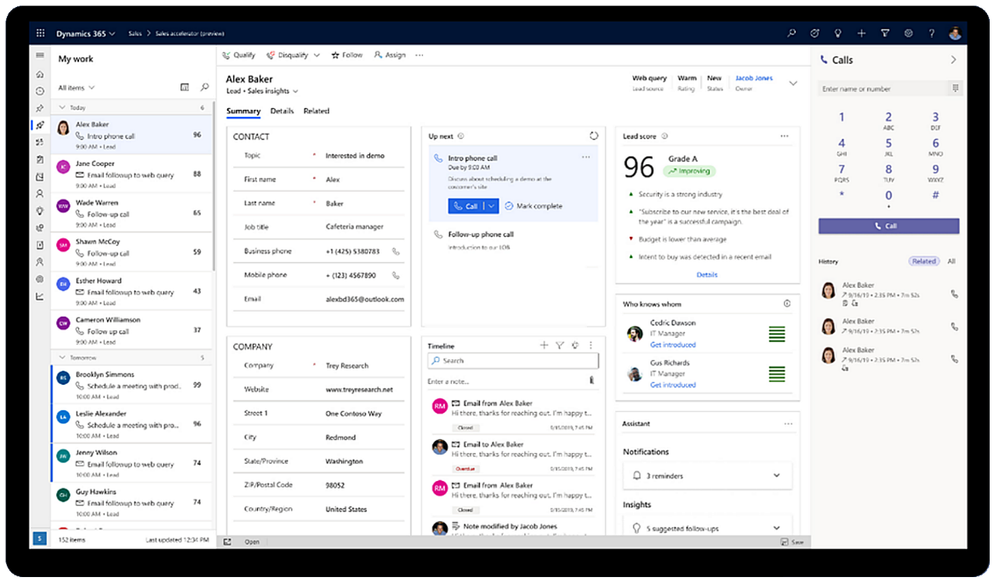
Azure Communication Services support for Teams identities enables built-in calling capabilities for Dynamics 365 SalesAzure Communication Services support for Teams identities enables built-in calling capabilities for Dynamics 365 Sales

 

Integrate Teams calling capabilities into applications

This news highlights two new capabilities available for application development:

  1. Get access tokens for Teams users with Azure Communication Services Identity SDK
  2. Manage Teams Voice over IP calls, Teams phone calls, and Teams meetings with Azure Communication Services JavaScript Calling SDK

These features enable applications that:

  • Make and receive Teams calls as a Teams user
  • Join Teams meeting as a Teams user
  • Manage incoming and outgoing phone calls based on Teams Phone System and integration with Teams auto attendants and call queues
  • Honor assigned Teams user policies

Enable new use cases

Developers can use Azure Communication Services’ support for Teams identities together with Graph API features and other Azure services for a range of customer scenarios.

  • Collaboration within line-of-business applications so employees won’t need to switch applications to collaborate with people within and outside of the organization
  • Enhanced customer and employee communications experience including attendant consoles to call center scenarios
  • New industry-specific collaborative applications that go beyond the boundaries of the standard Teams interface
  • Single communication platform for enterprises

How can you get started?

Check out these resources to learn more:

We are excited to see what new apps developers will build, unlocking new scenarios and experiences building on top of the existing capabilities of Microsoft Teams and Azure Communication Services.

22 Aug 16:15

FTC Right To Repair Push Continues With Weber Grill Settlement

by Karl Bode

Following through on a request by the Biden administration to defend right to repair, the FTC recently demanded that Harley Davidson and Westinghouse stop voiding customer warranties over repairs. An FTC announcement noted how both companies told consumers that using cheaper, third-party parts or repair shops to repair equipment violated warranty in a bid to monopolize repair.

The FTC has also taken action against Weber for also claiming that third-party parts and repair violate user warranties:

The FTC’s complaint charges that Weber’s warranty included terms that conveyed that the warranty is void if customers use or install third-party parts on their grill products. Weber is being ordered to fix its warranty by removing illegal terms and recognizing the right to repair and come clean with customers about their ability to use third-party parts.

Three cases in as many weeks suggest there are likely more complaints and settlements like these waiting in the wings. The actions come on the heels of an FTC report, Nixing The Fix, showcasing how companies increasingly use warranty, DRM, and other underhanded tactics to erode consumer repair choice.

Last June, New York State became the first state to pass right to repair legislation, though it failed to include vehicles, home appliances, farm equipment or medical devices. Meanwhile, right to repair activists continue to go after one of the biggest offenders, John Deere, using a new tactic claiming the company is violating the Clean Air Act. Companies attempting to monopolize repair are feeling the heat all over.

In the U.S. there hasn’t been a whole lot of good news on the consumer protection front, but the shift of the “right to repair” movement from nerdy niche to mainstream has been a major exception to the rule.

22 Aug 15:43

Meeting fatigue is an IT problem. Here’s how async can help

by Paul D'Arcy, Chief Marketing Officer at Miro

Examine how IT can take the lead in reducing an organization’s reliance on meetings. 

19 Aug 03:27

A Tool That Monitors How Long Kids Are in the Bathroom Is Now in 1,000 American Schools

by Joseph Cox

e-HallPass, a digital system that students have to use to request to leave their classroom and which takes note of how long they’ve been away, including to visit the bathroom, has spread into at least a thousand schools around the United States.

The system has some resemblance to the sort of worker monitoring carried out by Amazon, which tracks how long its staff go to the toilet for, and is used to penalize workers for “time off task.” It also highlights how automated tools have led to increased surveillance of students in schools, and employees in places of work.

“This product is just the latest in a growing number of student surveillance tools—designed to allow school administrators to monitor and control student behavior at scale, on and off campus,” Doug Levin, co-founder and national director for the K12 Security Information eXchange, a non-profit focused on cybersecurity for schools, told Motherboard. “While the problems they purport to solve are real, they also introduce other risks to students—including the risks of spurious accusations and targeted harassment by school officials and law enforcement.

Do you know anything else about e-HallPass? We'd love to hear from you. Using a non-work phone or computer, you can contact Joseph Cox securely on Signal on +44 20 8133 5190, Wickr on josephcox, or email joseph.cox@vice.com.

Levin further noted that the increased scrutiny offered by surveillance tools “has been shown to be disproportionately targeted against minorities, recent immigrants, LGBTQ kids,” and other marginalized groups.

On Monday, a since deleted tweet went viral in which someone claimed that their school was preparing to introduce e-HallPass, and described it as “the program where we track how long, at what time, and how often each child goes to the restroom and store that information on third party servers run by a private for-profit company.”

Motherboard then identified multiple schools across the U.S. that appear to use the technology by searching the web for instruction manuals, announcements, and similar documents from schools that mentioned the technology. Those results included K-12 schools such as Franklin Regional Middle School, Fargo Public Schools, River City High School, Loyalsock Township School District, and Cabarrus County Schools. Also schools Motherboard found that appear to use e-HallPass include Mehlville High School, Eagle County School District, Hopatcong Borough Schools, and Pope Francis Preparatory School. These schools are spread across the country, with some in California, New York, Virginia, and North Carolina.

Sign up for Motherboard’s daily newsletter for a regular dose of our original reporting, plus behind-the-scenes content about our biggest stories.

Eduspire, the company that makes e-HallPass, told trade publication EdSurge in March that 1,000 schools use the system. Brian Tvenstrup, president of Eduspire, told the outlet that the company’s biggest obstacle to selling the product “is when a school isn’t culturally ready to make these kinds of changes yet.”

The system itself works as a piece of software installed on a computer or mobile device. Students request a pass through the software and the teacher then approves it. The tool promises “hall omniscience” with the ability to “always know who has a pass and who doesn’t (without asking the student!),” according to the product’s website.

Admins can then access data collected through the software, and view a live dashboard showing details on all passes. e-HallPass can also stop meet-ups of certain students and limit the amount of passes going to certain locations, the website adds, explicitly mentioning  “vandalism and TikTok challenges.” Many of the schools Motherboard identified appear to use e-HallPass specifically on Chromebooks, according to student user guides and similar documents hosted on the schools’ websites, though it also advertises that it can be used to track students on their personal cell phones.

EdSurge reported that some people had taken to Change.org with a petition to remove the “creepy” system from a specific school. Motherboard found over a dozen similar petitions online, including one regarding Independence High School signed nearly 700 times which appears to have been written by a group of students.

“We are expected to be young adults and by this E-HP system taking place this year we have a great amount of freedom and independence being taken away,” the petition reads. “Many students that attend Indy have come together and decided to petition against this new system that has been created. We, as the students feel as if we’re being watched and monitored at all times throughout our school day, which is extremely uncomfortable.”

Eduspire did not immediately respond to a request for comment.

“Every dollar spent on these solutions is a dollar less that can be spent on hiring school counselors and teachers,” said Levin “Ultimately, the choice schools are facing is about the type of community they are seeking to foster: one focused on defending and punishing vs. one focused on supporting and uplifting. By its very nature, increased digital student surveillance leads to the former.”

He added that “The real issue/risks here, I think, are not so much broad cybersecurity risk but are ethical: about the type of environment schools are creating and whether it is humane and just.”

Subscribe to our cybersecurity podcast, CYBER. Subscribe to our new Twitch channel.

19 Aug 03:26

Lego’s new motorized lighthouse has a working fresnel lens

by Sean Hollister
Image: Lego

In 1822, Augustin Fresnel invented a lens made of ringed prisms that could concentrate beams of light more effectively than reflectors or huge convex pieces of glass. These days, they’re used in spotlights and even most VR headsets. But originally, he designed them for lighthouses — it’s the invention that’s said to have saved a million ships — and today, Lego has announced a motorized lighthouse with its very own fresnel lens.

Image: Lego

Make no mistake: it’s a toy — and, at $300 for the 2,065-piece set, a pretty expensive one, too! But Lego’s new light-up Motorized Lighthouse is packed with clever touches, like most of its modern sets aimed at adult budgets. It’ll go on sale on September 1st.

I’m particularly...

Continue reading…

19 Aug 03:25

It looks like streaming ruled monthly TV viewing for the first time ever

by Mitchell Clark
XClass 4K TV
There are many, many streaming services that people are spending their time with. | Image: Comcast

More people spent their TV time watching a streaming service than cable or broadcast last month, according to a report from Nielsen (via The Wall Street Journal). The audience measurement company says that this is the first time ever that streaming services have accounted for the biggest chunk of people’s viewing habits.

The report says that services like Netflix, YouTube, and Hulu made up 34.8 percent of people’s watch time, while cable made up 34.4 percent. Broadcast TV made up for 21.6 percent. Added together, traditional TV services still beat streaming, but streaming had the biggest piece of the pie.

Image: Nielsen
No one streaming service came close to beating cable on its own.

Neilson says that part of...

Continue reading…

18 Aug 15:34

Cisco Isn’t ‘Demand-Constrained’ Amid Supply Chain Pressures

by Gina Narcisi
‘We’re not demand-constrained, we’re supply constrained. If we could get more supply, we’d be growing more quickly,’ says Cisco CFO R. Scott Herren.
18 Aug 15:30

Say goodbye to custom-built apps — the vertical software market is booming

by Lindsey Wilkinson

Industry-specific, on-premise applications have holes that vertical software applications can fill as businesses modernize and migrate to the cloud.