Tim Cook at the recent iPhone 14 launch. | Photo by Kevin Mazur/Getty Images
While Meta funnels billions into CEO Mark Zuckerberg’s pitch for the metaverse, Apple CEO Tim Cook thinks most people couldn’t even define the metaverse, let alone spend long periods of time living their lives inside of it.
“I always think it’s important that people understand what something is,” Cook told Dutch publication Bright (via Google Translate). “And I’m really not sure the average person can tell you what the metaverse is.” In other words, despite persistent reports of Apple’s interest in building all manner of AR and VR hardware, Cook isn’t ready to claim that the company is working towards any so-called “metaverse.”
Mark Zuckerberg has a different view. Earlier this year, the Meta CEO told his employees that the company is...
We’re getting even closer to the launch of the Pixel 7 phone and Pixel Watch, with Google’s fall launch event set to take place on Thursday, October 6th, at 10AM ET.
While we have an idea of what to expect, Google may still have a few surprises in store. Here’s everything we’re looking forward to at the upcoming Google Pixel event.
The Google Pixel 7 and 7 Pro to arrive with incremental upgrades
There wouldn’t be a Pixel launch event without a new generation of Pixel smartphones. We’re going to see what Google has in store for the Google Pixel 7 and 7 Pro, which Google offered a brief glimpse of during I/O back in May.
At the event, Google showed off renders of the devices, which each come with an aluminum camera bar and the upgraded...
Get ready to start seeing edited tweets in the wild. | Illustration by Alex Castro / The Verge
Twitter is rolling out the ability to edit tweets to Twitter Blue subscribers in Canada, Australia, and New Zealand. According to a tweet from the company, it’ll be coming to subscribers in the US “soon.”
Last week, we got to see an example of what edited tweets would look like when the company made one of its own. The tweet will appear as normal, but there will be a pencil icon next to the date, along with text that lets readers know the last time the tweet was edited. Clicking on the icon shows you a page with the edited tweet, as well as a history of the edits. The person who tweeted will have up to 30 minutes to make changes and will only be able to make five edits, according to a Twitter support document.
Following the launch of comm.land, the toolkit marketplace across the suite of 2600Hz solutions, Head of Marketing, Clint Mohs, has announced he will be speaking at Cavell Cloud next month.
The fireside chat at the Cloud Comms Summit US will focus on the trend toward bringing together what have traditionally been siloed pillars of cloud communications. Specifically, Mohs will be talking attendees through the way 2600Hz has decided to bundle UC with CC, using CPaaS to bring together UC and CC features, and integrate non-communication applications into their solutions.
Assessing the current communication market, Mohs told UC Today that businesses are still coming to terms with hybrid working because of the siloed way in which different departments use the platforms they need to carry out their work.
As vendors like 2600Hz merge their communication solutions into one platform, Mohs says there is a huge opportunity to appeal to businesses who are yet to embrace cloud technologies.
“We are moving toward bringing together the features that have historically been separate pillars of cloud comms,” said Mohs. “Therefore 2600Hz has created one platform that can do all of the UC functionality for internal communications, as well as call centre functionality for external communication.
“Along with the continuing adjustment to hybrid working, I would say these are the big trends in the UC market today. But if we take a step back and look at the broader industry, Cavell earlier this year released their most recent market research which said that the big players like Microsoft, RingCentral, Zoom, and Cisco only have about a 34% market share of cloud communications, and in fact, over 80% of the global market still hasn’t moved to the cloud.
“So there’s a huge opportunity for smaller service providers and regional telecom providers because Microsoft Teams is not going to meet the needs of everybody, and if they can have a customised, differentiated solution, there’s a big opportunity to continue growing, expanding their business.”
People don’t work in silos
The move to hybrid has afforded employees many advantages that we are well aware of by now. More flexible hours, no more commuting, allowing for more time with the family, even if that does mean home schooling, are all great advantages for the individual but businesses may well have reservations.
As Mohs sees it, these reservations may be due to the way that the platforms for different functions are siloed, requiring different logins, adding time-consuming complexity to an already busy day.
“People don’t work in silos,” said Mohs, “if the person who is connecting an incoming call needs to jump between a UC platform to check someone’s availability, and then hop back to a Contact Centre solution to transfer the call over it’s a logistical nightmare.
“Employees can be much more efficient in one UI, and the customer on the other end of the line is going to experience that efficiency. We’ve all been on really long waits during a call to a call centre line, if businesses were able to take advantage of combining unified communications and the contact centre, they could seamlessly patch you over to a different department, or pull in somebody on a three way call with much greater ease.”
How 2600Hz can do it
2600Hz have been able to unite the different facets of their communications suite due to the fact their solutions are built on the same underlying technology.
Mohs said that bringing together the 2600Hz communications solutions just makes sense in terms of how business communications has evolved over time. He added that any new solution or feature that is introduced is driven by a desire to improve reliability and decrease cost for businesses, which 2600Hz are providing.
“When our founders started building KAZOO, our flagship platform, they had the foresight to build it as a single platform with one code base for the call centre, contact centre and CPaaS functionality,” said Mohs.
“When we talk about different silos and the industry coming together, the point where UC and CC meet is what is going to feel the strain, so that point will test whether the all-in-one solutions are going to work.
“We’ve got a great architecture that is reliable at scale, and now we’re working on the inbuilt integrations and functionalities that enhance the end users’ experience. That means equipping our partners to go out into the market with a really unique solution, that is not just going to keep them competitive, but it’s also going to help them win new business in the years to come.”
Lumen has offloaded its ILEC business in 20 states to Apollo-owned Brightspeed in a deal that the carrier hopes will give it the financial fortitude to go after its multifaceted enterprise growth strategy.
Elon Musk is a lot of things: an engineer, a successful entrepreneur, clearly a "smart guy" by many measures, and yet there’s one thing he is emphatically not—a great negotiator.
There is a popular image of Musk among his millions of fans of the brilliant tactician always playing 12-D chess, and always a few steps ahead of his competition. He can, in the minds of many, do no wrong. That myth shouldn't have a leg to stand on after Tuesday's announcement that Musk will buy Twitter at his originally-proposed price of $44 billion after a protracted series of events where he tried, very clearly, to wriggle out of the deal.
The deal is contingent on stopping an ongoing lawsuit over the sale, because Twitter alleged that Musk was obligated to buy the company at the original price of $54.20 a share in an offer (again, made by Musk) that gave him no real way out. And he did try just about everything—an offensive on multiple fronts that leveraged his own Twitter account and celebrity, as well as accusations of the platform being overrun with bots, despite fixing the bot problem being one of his stated reasons for buying the website. Two days from now, on Thursday, Musk was scheduled to sit down for a deposition with Twitter's lawyers that promised to have all the charm of a root canal.
Facing an unwinnable lawsuit and the near-certainty of public embarrassment, Musk is now forced to follow through with the $44 billion purchase of a website that he seemingly offered to buy on a whim, carried away by the thought of becoming a hero in the culture wars around "free speech" online. Maybe Musk was never serious about the deal. It doesn't matter. After trying very hard to get out of it, he must now pony up billions of dollars provided by himself and his financiers.
That Musk does not possess a brilliant tactical mind—with the usual caveat that SpaceX is indeed a very successful company that has developed great technology—is no big secret. That, too, was on display this week when he made an ill-advised tweet about ending the war in Ukraine by recognizing occupied and annexed Crimea as Russian that ended up becoming a talking point in the hands of Putin's press spokesperson and Russian state media, despite his follow-up protestations of being "pro-Ukrainian."
Indeed, tweeting things that land him in hot water is something of a hallmark of Musk's, which is incredible to consider since he will now own the website after a long series of embarrassing strategic missteps.
Musk is powerful, wealthy, charismatic, and he is the CEO of a company that is now the U.S.'s only real shot at having a truly independent national space program amid deteriorating relations with Russia. For these reasons, it's unlikely that the cult around him will tone it down even a little bit, and they are likely to see the Twitter acquisition in the light that he wants them to against all evidence: as a win for free speech by a powerful guy who is on their side. Brilliant, sir!
But what this whole sordid affair should do is finally, at long last, kill the idea that Elon Musk is really the smartest person in any given room, a genius negotiator, a brilliant strategian, and generally a person who epically owns anyone who tries to stop him. This time, as in many previous times and surely future ones, Elon Musk owns himself.
Swipe up for more videos — where have I heard that before? | Image: Twitter
Twitter is joining the bandwagon of social media companies copying TikTok’s everlasting scroll of videos. In a blog post on Thursday, the company announced that it’s updating its video player to be “immersive” — tapping on it will make the video full screen, and if you scroll up, you’ll “start browsing more engaging video content.” The company is also adding a video carousel to its Explore tab, which will show you “some of the most popular videos being shared on Twitter.”
The company says its “immersive media viewer” will start to roll out in the iOS Twitter app over the next few days and that the videos on the Explore tab are “currently available to people in select countries” who are using iOS or Android. Both updates are coming to...
Bengaluru, India – September 28, 2022 – Mavenir, the Network Software Provider building the future of networks with cloud-native software that runs on any cloud and transforms the way the world connects, today announced to have commenced the production of 2G, 4G and 5G Open RAN Radios for the OpenBeamTM portfolio in India, for Indian and other prominent worldwide bands.
OpenBeam offers an innovative radio portfolio, cost-efficient, intelligent radios that meet the critical demands placed on today’s networks including massive MIMO, mmWave and multi-band remote radio heads (RRHs) allowing improved network capacity as the network expands. The OpenBeam Open RAN radio solutions are available across all frequency bands and can be used for a wide range of use cases, including enterprises and public settings across urban or rural environments.
Mavenir’s robust set of radio options address the needs of the CSPs to be agile and cost-efficient with low power consumption, low wind load, and built with integrated intelligence and automation. Designed for the growing needs of private enterprises to public networks, the portfolio supports both new and legacy radio access technologies. All radios have a modular design, using proven technology to support both MIMO beamforming and multi-band needs.
“Our manufacturing partner network is very well positioned for the sustainable and rapid scaling of Open RAN volumes and made in India requirements. With these new production sites coming online, we have reached another important milestone in our strategy to expand and evolve the Open RAN ecosystem”, said Ramnik Kamo, EVP, CIO and CPO of Mavenir.
The OpenBeam radio portfolio will be on display at upcoming India Mobile Congress on Mavenir Stand No. 4.4 – click here to request a meeting.
About Mavenir:
Mavenir is building the future of networks and pioneering advanced technology, focusing on the vision of a single, software-based automated network that runs on any cloud. As the industry’s only end-to-end, cloud-native network software provider, Mavenir is focused on transforming the way the world connects, accelerating software network transformation for 250+ Communications Service Providers and Enterprises in over 120 countries, which serve more than 50% of the world’s subscribers. www.mavenir.com
Danish Defense shows the gas leaking at Nord Stream 2 seen from the Danish F-16 interceptor on Bornholm, Denmark, on September 27. | Danish Defence/Anadolu Agency via Getty Images
The undersea explosions in two gas pipelines from Russia exposed Europe’s vulnerabilities — just as the continent faces a looming energy crisis.
European and NATO officials are blaming sabotage for three leaks in the Nord Stream 1 and 2 undersea pipelines running from Russia to Germany under the Baltic Sea. EU officials did not accuse anyone directly, but the allegation underscored the uncertainty around Europe’s energy standoff with Russia, and how volatile the continent’s energy security is as winter approaches.
Officials detected significant drops in pressure in the Nord Stream 2 pipeline on Monday, and then detected another pressure drop on the Nord Stream 1 pipeline, which were ultimately determined to come from three separate leaks. Swedish seismologists have said underwater explosions caused these leaks. The Danish military released footage of gas from the pipeline bubbling to the surface of the Baltic Sea.
One leak in a major pipeline is a singular event; another from a twin pipeline in an entirely different location is even more unprecedented. Add to that the fact that both of these pipelines are the source of geopolitical tension spilling over from the war in Ukraine, and it makes it very difficult to interpret this as an accident or coincidence. Oh, and in case you weren’t convinced, the Nord Stream leaks happened as officials inaugurated the Baltic Pipe, a new gas route from Norway to Poland.
“Deliberate disruption of European energy infrastructure is utterly unacceptable and will be met with a robust and united response,” Josep Borrell, the EU’s foreign policy chief, tweeted. “Deliberate disruption of European energy infrastructure is utterly unacceptable and will be met with a robust and united response.”
Damaging the Nord Stream pipelines is a warning that any disruption to energy, whether by accident, an act of nature, or intentional, could deepen and prolong the energy crisis in Europe and beyond. “These attacks show that Europe does not have spare capacity in the energy system. It was already running up against that to begin with. Now this is an enormous vulnerability,” said Emily Holland, an assistant professor in the Russia Maritime Studies Institute at the US Naval War College.
What we know (and don’t know) about the Nord Stream leaks
The leaks — two in Nord Stream 1 and one in Nord Stream 2 — were detected in the Baltic Sea, off Bornholm, a Danish island. According to the Financial Times, German seismologists detected a spike in activity shortly before Danish officials detected the Nord Stream 2 leak. Swedish seismologists also registered activity, which they said was in keeping with an explosion, and not a natural event.
It didn’t take long for officials in European states to conclude an act of sabotage, backed up by NATO. It probably wasn’t too hard of a conclusion to come to: Damages like these to undersea pipelines are rare, and for three to happen at the same time, on the same day, at the same time another gas delivery route to Europe opened? It’s hard to imagine this is all a big coincidence.
Publicly, officials have cautioned against rushing to conclusions on who and why. “This is something that is extremely important to get all the facts on the table, and therefore this is something we’ll look closely into in the coming hours and days,” said NATO Secretary-General Jens Stoltenberg.
Privately, many officials have a culprit: Russia. Experts emphasized that we still don’t know for sure, and it may be hard to fully know Moscow’s motivation.
But there are a few hints that point to the Kremlin. For one, Russia likely has the technical capabilities and equipment to pull off such an act, including potentially by divers or undersea drones.
Russia is also intensifying its war effort in Ukraine; Putin implemented a mobilization effort that is facing resistance and chaos at home. Russia is still under heavy sanctions from Western countries, and the Kremlin has already used energy infrastructure — Nord Stream 1 specifically — as a tool to pressure the West.
Russia may be trying to make clear that Europe won’t be getting gas from Russia — not this winter, not in the near future, and maybe not ever again. “It’s a signal that Russia is saying, ‘Fine, you don’t want our energy, find it somewhere else,’” Holland said. It would be Russia’s final break in the relationship with Europe, to indicate now it has no choice but to get its energy elsewhere.
Of course, Europe was largely doing that, and everyone knew Russia wasn’t sending any gas this winter. The Nord Stream pipelines are basically offline, so the immediate effects on supply are minimal. But the act of sabotage underscores the risk to other European infrastructure, like the now all-important pipelines from Norway. Norway and Denmark, for example, have increased security around their own oil and gas infrastructure.
Stefan Meister, an expert in EU-Russian relations at the German Council on Foreign Relations, pointed out that while European gas prices had gone down recently, a shock like the Nord Stream leaks could potentially rattle the energy markets once again, less for what it actually means and more for the reminder of how fragile the energy situation is.
After all, the Nord Stream pipelines are, right now, pretty useless to Russia, too. “That means [the way] to make use of it is to blow it up to impact the gas market,” Meister said. “It’s not on the current situation of the gas supply, but it’s more on psychology.”
The US had reportedly warned allies this summer that intelligence suggested Nord Stream pipelines might be attacked, and has, of course, backed up European allies as they investigate. Some have floated Ukrainian sabotage, as a kind of false flag, but experts said Ukraine likely doesn’t have the technical know-how or equipment to do that.
But, again, in some ways, the Nord Stream damage matters more for the risk it signals for Europe. “The supply situation is very tight. Every single molecule that we can find, we bring into Europe, at whatever price at the moment,” said Andreas Goldthau, an energy expert at the Willy Brandt School of Public Policy at the University of Erfurt.
Europe has no choice but to do that because Russian gas made up about 40 percent of Europe’s gas supply at the start of the war; now it’s down to about 9 percent. Europe had to replace that gas from somewhere, and so it sought out alternative sources. That includes more pipeline gas from Norway and liquefied natural gas from around the world.
But it doesn’t leave Europe with much room if another backup goes offline. Gazprom warned Wednesday it might cut off natural gas flowing through a Ukrainian pipeline to Europe. Other disruptions can happen, sometimes by accident. As Goldthau pointed out, US hurricanes could disrupt the LNG market, too. “There’s so much else that can go wrong, and now, on top of that, there is the pipeline situation,” he said. “And all of that is something that at least will, at some point, have an impact on the risk premium and on the futures market.”
The fears that other energy infrastructure could go down may affect the markets, and that makes it pricier for Europe to get gas — but also has a destabilizing effect on the rest of the world, as energy prices rise, and lower-income countries have to compete for even more expensive gas. (And for the world: The full climate and environmental impacts of these leaks are still unclear, but the methane leaching from those pipes is a “powerful greenhouse gas.”)
Beyond energy, infrastructure sabotage is the kind of hybrid warfare that many in the West worried about ahead of Russia’s invasion — cyberattacks, or other hacks on critical infrastructure. It’s unclear if Russia really has opened up a new front with the West as it wages its months-long war in Ukraine. But the Nord Stream leaks hint at an even more uncertain winter in Europe.
RingCentral ranks #1 in analytics capabilities across leading UCaaS vendors
BELMONT, CA – September 27, 2022 – RingCentral, Inc. (NYSE: RNG), a leading provider of global enterprise cloud communications, video meetings, collaboration, and contact center solutions, today announced that The Tolly Group, a leading global provider of testing and third-party validation and certification, found RingCentral MVP™ (Message Video Phone™) to be the clear leader across multiple categories in an independent research study that compared its analytics capabilities to those of other Unified Communications as a Service (UCaaS) vendors, including 8×8, Microsoft Teams, and Zoom. In a feature-by-feature comparison, RingCentral met 100% of the specification criteria outlined in 13 categories; the next-closest vendor only met 100% in four of the 13 categories.
Tolly’s criteria covered several key areas including monitoring, optimization, analysis, alerting, and APIs. Tolly concluded that RingCentral’s analytics solution provided a comprehensive approach to analytics that span communications across phone, video, conference rooms, and messaging. The study also highlighted RingCentral’s powerful reporting and analytics for calls placed across devices, integrations into third-party apps such as Salesforce, and custom built apps in its rankings.
“The breadth and depth of RingCentral’s analytics solutions is impressive,” said Kevin Tolly, founder of the Tolly Group. “RingCentral led in performance, measurement, and ease-of use, and provided the most cost-effective solution. Because RingCentral integrates its analytics into its core product and interface, no separate integration is required. Analytics functions are accessed seamlessly from the main interface, as well as mobile devices. Implementing RingCentral analytics is simple. The analytics offerings of the other UCaaS solutions are not delivered in as simple and straightforward fashion.”
Key findings of RingCentral Analytics in the report
Tolly Group evaluated each vendor’s capabilities against a range of criteria Tolly then assigned an approximate percentage result based on how much of the requirement the solution fulfilled. The study concluded:
1. RingCentral MVP is the leading solution designed explicitly to address multiple audiences, including line of business users and IT professionals. RingCentral MVP combined with a rich analytics capabilities addresses multiple line-of-business use cases. For example, inbound sales teams can measure call volume to make critical staffing decisions. Marketers can use special assigned phone numbers to track the success of their campaigns. Also, customer service managers can monitor live call queues and reallocate resources on the fly to keep customers happy.
2. Extensive QoS analytics automatically included without the need for integrations or fees. According to the study, RingCentral analytics allow IT staff to access data from both video and voice call data separately or intermingle it in one place, providing a better level of detail and insight–at no additional cost. Also, the analytic capabilities allow IT staff to customize device and IP address mapping to more easily identify, locate, and resolve issues.
3. Provides a single, simple, powerful interface for summary views and drill-to-detail across message, video, and phone. According to the study, RingCentral provides a single interface for summary statistics, intuitive drill-to-detailed, and real-time insights that do not require extensive training or skills. This makes it easy for IT and business users to access their data all in one place.
4. Custom KPIs and intuitive drag-and-drop interface provides superior flexibility. The study concluded RingCentral analytics allow customers to develop custom KPIs, dashboards, and insightful views of their data, which can be delivered right to their inbox, browser, or mobile device. Users can rearrange columns and create custom summary statistics and custom dashboards to develop taxonomies that use naming conventions specific to their business–a great benefit to vertical industries.
“Tolly’s findings validate one of our longstanding goals – provide our customers with powerful analytics that enable them to better run their businesses, while being easy-to-set-up, easy-to-use, and easy-to-manage,” said Esther Yoon, vice president, industry and product marketing, at RingCentral.
“RingCentral’s reporting gives us more visibility into our call-queue teams than we’ve ever had. We use data points such as percentage of calls answered, and average hold time, both to improve agent performance and to support requests for more resources,” said Travis Cook, executive director of telecommunications, Texas Christian University.
Download a complimentary copy of the Tolly Group report here to review the complete test details and results. For more information on RingCentral analytics solutions, go here.
About The Tolly Group
The Tolly Group provides IT users and vendors alike with independent, objective, hands-on testing, benchmarking services and consulting designed to illuminate differences between strategic products/services and help IT buyers make informed technology decisions. For additional information, visit https://www.tolly.com.
About RingCentral
RingCentral, Inc. (NYSE: RNG) is a leading provider of business cloud communications and contact center solutions based on its powerful Message Video Phone (MVP®) global platform. More flexible and cost effective than legacy on-premises PBX and video conferencing systems that it replaces, RingCentral empowers modern mobile and distributed workforces to communicate, collaborate, and connect via any mode, any device, and any location. RingCentral offers three key products in its portfolio including RingCentral MVP™, a Unified Communications as a Service (UCaaS) platform including team messaging, video meetings, and cloud phone system; RingCentral Video®, the company’s video meetings solution with team messaging that enables Smart Video Meetings™; and RingCentral Contact Center™ solutions. RingCentral’s open platform integrates with leading third-party business applications and enables customers to easily customize business workflows. RingCentral is headquartered in Belmont, California, and has offices around the world.
“The pando'' has become a casual way to refer to the COVID-19 pandemic, but deep in the woods of central Utah, the Pando is the name for what scientists regard as the largest living organism in the world:over 40,000 massive aspen trees that are actually a single organism thought to stem from the same root. And despite thriving for several centuries, perhaps even millenia, this 106-acre beast is "breaking up" due to human influence.
“To the untrained eye, it looks like deer and cattle are the villains here, but both of those species are highly manipulated by humans,” Paul Rogers, an ecologist at Utah State University who published a recent study on the disintegrating Pando in the journal of Conservation Science and Practice, told Motherboard.
Although it appears as if these hungry herbivores have been eating away at the Pando’s “world's largest organism” title for decades, after analyzing 64 plots of it, Rogers found that these animals are not to blame for depleting the Pando. Rather, government efforts to remove predators like bears and wolves from states like Utah, Montana and Wyoming have thrown the natural system off balance.
Such interventions, including killing off wolf populations through poisoning, aren’t new, and occurred throughout the early 1900s. Since states make money from selling hunting licenses, and more deer means better hunting conditions and more profit, the issue remains politically and economically controversial, and more difficult to solve.
“We took away the predators and elevated the numbers [of prey animals] so that people who like to hunt or see animals will be more successful,” Rogers says. Unfortunately, this has resulted in greater numbers of deer, that are more domesticated and sedentary than wild deer left to their own devices. “Too many deer is a big problem,” Rogers warns.
Instead of reintegrating wolves back into the environment, or taking other steps to reduce the population of deer, Utah has opted to use fencing as a way to keep animals away and preserve the Pando. While this may appear to be an effective short term solution, due to the unique way these aspen grow, fencing can hinder natural regrowth that used to occur when the trees die off.
“It's like putting a bandaid on a really big wound,” he says. “We still have a bleeding problem.”
If the Pando is strained to the point of no longer being the world’s largest living organism, it may not be the end of the world. But because the Pando problem is such a microcosm, that makes it an example of how to address the deleterious effects of human activity on natural systems and could hold lessons for addressing other issues like global warming. Still, its shrinkage, and the mishandling of measures to stop it, is a bad sign for the future of humanity.
“We have the ability to change course, that’s what the data and information point out,” Rogers said. If not, another contender for the world’s largest living organism is the “Humongous Fungus,” a honey mushroom that has swelled throughout Oregon, again, as a result of humans manipulating the environment.
In the end, Rogers’ research concludes that if the Humongous Fungus dethrones the Pando one day, it’s not the deers’ fault. “The finger points back at us, pretty obviously.”
Airlines would have to provide more transparency about all the fees you pay to fly under new proposed rules. | Photo by AaronP/Bauer-Griffin/GC Images
Airlines would have to refund passengers for services they paid for that aren’t actually provided, like broken Wi-Fi, under new rules proposed by the Biden administration. Also, airlines and travel search websites would have to disclose upfront any added fees for changing or canceling your flight and for checked or carry-on baggage.
The new rules are part of a slate of changes the US Department of Transportation is proposing to make flying more transparent and consumer-friendly after a particularly rocky summer travel season, in which flight cancellations spiked. The administration has previously sought stricter rules for passenger refunds, arguing that it wants to make air travel more competitive.
Some UCaaS platforms allow users to send and receive mobile/cell phone SMS (Short Message Service).
Microsoft Teams Personal/Consumer/Home/for life does have SMS. Although we have had an “SMS use” report in Teams Admin Center for more than a year and the feature is rumoured to be coming, today you can not natively send SMS in Microsoft Teams for Business/Enterprise/Commercial.
Bandwidth, more commonly known for being the telco platform behind many UC platforms/providers, including some of Microsoft’s native Calling plans, and offering Direct Routing and E911 service, recently announced a new “Send-To” app that allows SMS messages to be sent from Microsoft Teams Channels.
How Bandwidth Send to SMS for Microsoft Teams App Works
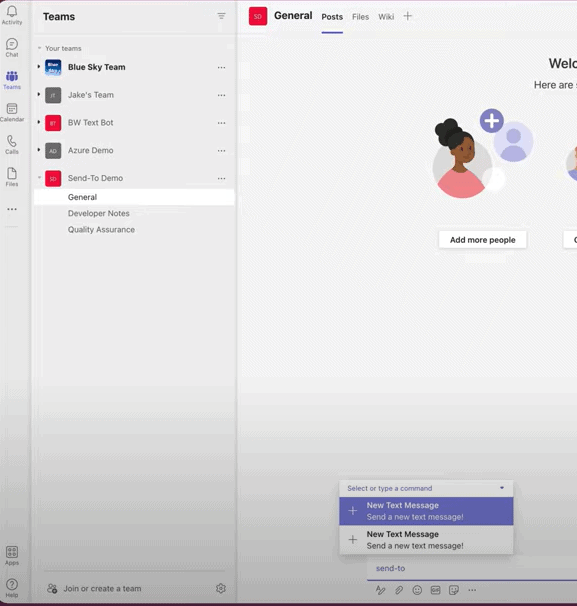
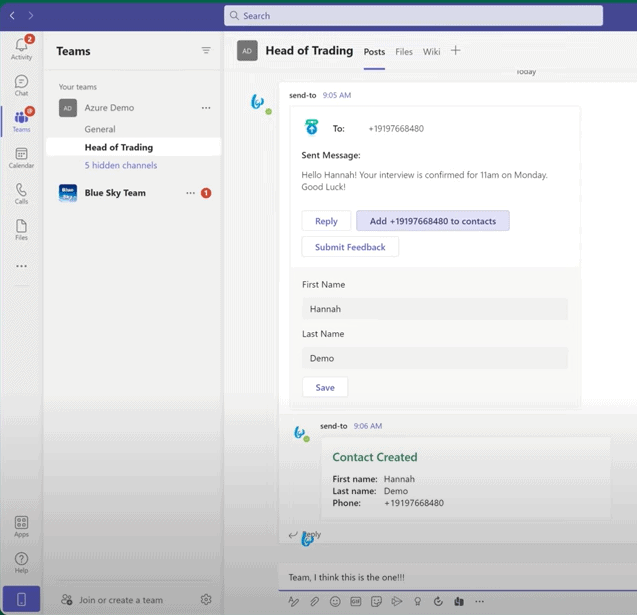
The app works as a simple channel app/bot. You just add the app to a channel. Bandwidth provides the dedicated SMS cell number to send and receive SMS messages in the Teams channel. Each SMS becomes a thread in the channel so multiple channel members can view it and engage.
Send a new SMS in Microsoft Teams Bandwidth Sent-To appAuthoring a new Send-To SMS messageSMS Thread in Teams Channel
You can create contacts for the SMS users which are held in Teams.
This is not SMS enabling an individual Teams user’s phone number or bringing their existing cell/SMS into Teams; it is a dedicated group SMS number. Therefore technically it works regardless of Tams PSTN connectivity type (Operator Connect, Direct Routing or Microsoft Calling Plan). All the SMS messages are going via Bandwidth. However, Bandwidth only sells Send-To in conjunction with their Duet for Teams SIP trunking and Emergency Services offerings. I think they are missing a wider addressable market here as many customers may want this solution alongside another operator/Microsoft Calling plans.
Right now, it is only US SMS numbers, but the US numbers send and receive messages to international numbers. I got to have a quick demo/test, and it sent and received SMS to/from my UK mobile number fine.
Bandwidth Microsoft Teams Send-To Pricing
Pricing varies depending on usage, but generally includes a platform fee plus standard messaging rates; in addition to carrier surcharges. The messaging pricing is available here. Pricing varies per message, from $.004 per SMS outbound to .015 per MMS outbound.
Microsoft Surface tablets have been taking a beating at football events these past two weekends. During the Buffalo Bills game against the Miami Dolphins this afternoon, Bills offensive coordinator Ken Dorsey took his frustration out on his tablet as the Dolphins secured a win during the final moments of the game.
Dorsey’s reaction may have been warranted, although he probably could’ve chosen another outlet for his anger (like a stress ball perhaps?). The Bills had a chance to run one more play to win the game, but the team ultimately ran out of time, losing to the Dolphins 19-21. When cameras turned to the booth where he was watching the game, Dorsey ripped off his headset and tossed his hat before he picked up the tablet and started...
comm.land unites all of 2600Hz telephony applications into one UI so end users have all their communication tools in one place. The portal is currently a desktop application, but 2600Hz have the goal to make it accessible on mobile and web platforms.
The new portal is the perfect way to maximise employee productivity and unify 2600Hz’s suite of communications solutions. With comm.land, the goal is to bring all of an end user’s business tools into one UI rather than having to jump between myriad open windows. As 2600Hz Software Development Manager, Ashley Vernon elaborates, the vision for comm.land is to bring all of their communication tools into one UI so that any sort of communication and collaboration can be done within one desktop window whether in the office, on the road, or at home.
“We have been noticing that the industry has been trending toward a convergence of what have historically been distinct products. The model of having one UCaaS platform for internal communications, another CPaaS platform for SMS, and a third platform for Contact Center is breaking down. Enterprises are looking for solutions that simplify their workflows, not multiple solutions to monitor and work in.
“This is one of the key things that comm.land achieves. It brings our UCaaS, CPaaS, and CCaaS offering together natively in a really tight integration and one UI. Not only can end user have access to all of their 2600hz telephony applications but also have the ability to embed third party applications and other websites, so that they can have really rich collaboration all in one place.”
comm.land
The new portal provides a customisable communications platform for all business departments, and can integrate easily with 3rd party business applications.
This feature is particularly in keeping with the industry trends that Vernon speaks to. As businesses look to ensure productivity wherever an employee is, the best way to achieve this is to provide one place for colleagues to carry out day to day responsibilities, communicate, and collaborate.
“The cultural and industry trends have been towards hybrid work models are here to stay, people are going to be working in the office and sometimes at home. What hasn’t changed is they need to be able to collaborate and work efficiently, and we’re giving folks a tool where they can collaborate and access all of their business tools in one place.
“One of the complaints that we hear from end users or issues that we see in different solutions on the market is a general lack of customization. That’s why we have made sure comm.land can be customized by the Service Provider.
“The idea of being able to customize to an individual end user is also huge. No matter what role you have, the number of business application that someone uses has grown exponentially over the last 5-10 years. By allowing each individual end user to customize their own UX, they can choose the tools they’re going to need at their fingertips.”
New Chapter
Speaking to UC Today, Vernon added that this focus on the end user sees 2600Hz buck a 12 years trend of focusing on backend systems and admin tools for partners.
However, the Software Development Manager assures partners that they are focussed on maintaining quality standards, and maintaining the same level of dedication to business administrators, as comm.land is designed to lighten the number of platforms they need to manage.
“We have spent 12 years working on the backend, and bringing amazing admin tools like User Portal, SmartPBX, and Advanced Provisioner to businesses,” said Vernon. “That has been where the focus has been, in empowering regional telecom resellers and service providers to quickly and easily do the admin tasks that has historically taken a ton of time and labor.
“comm.land is this exciting new chapter, we’re taking that same sort of dedication and focus but now turning it on to the end user. What businesses are going to have at the end of the day is Admins that are happy, because 2600Hz has been looking out for them and designing with their needs in mind.
“Now we’re turning that same sort of dedication and focus on to the end user with the feature-rich efficient user experience that we have historically provided for Admins.”
Meta has been ordered to pay almost $175 million in fines to app developer Voxer for violating live-streaming patents | Illustration by Alex Castro / The Verge
Meta has been ordered to pay Voxer — creator of the Walkie Talkie messaging app — over $174 million in damages after a jury in Texas federal court found the social media giant guilty of violating two live-streaming patents with Facebook Live and Instagram Live.
The patents in question were developed by Voxer co-founder Tom Katis, a US Army veteran seeking to fix the shortcomings he experienced in battlefield communications after his combat unit was ambushed in Kunar Province in 2003. Katis and his team began developing communications solutions in 2006, resulting in new technology that enabled the transmission of live voice and video communications. Voxer was then formed in 2007, and the Walkie Talkie app was launched in 2011.
A person visits an art installation titled “Garden of Eden” representing an abandoned workspace. | Emanuele Cremaschi/Getty Images
“Productivity theater” is getting worse.
People who work from home say they’re working, and numerous objective studies show that’s true. But many managers are still worried that they aren’t.
In a new study by Microsoft, nearly 90 percent of office workers reported being productive at work, and objective measures — increased hours worked, meetings taken, and amount and quality of work completed — prove them out. Meanwhile, 85 percent of bosses say hybrid work makes it hard to be confident that employees are being productive.
That uncertainty, coupled with a looming recession and many companies moving back to more time in the office, is prompting workers to increasingly show that they’re working — which is decidedly not the same as actually working. Rather, it’s what some have called “productivity theater.”
Productivity theater is when workers frequently update their status on Slack or toggle their mouse to make sure the status light in Microsoft Teams is green. They say hello and goodbye, and they drop into different channels throughout the day to chitchat. They check in with managers and just tell anyone what they’re working on. They even join meetings they don’t need to be in (and there are many more meetings) and answer emails late into the night.
On their own, these are small expenditures of time, and some of them are useful. En masse, they’re a dizzying waste of time. In addition to their regular working hours, office workers said they spend an average of 67 extra minutes online each day (5.5 hours a week) simply making sure they’re visibly working online, according to a recent survey from software companies Qatalog and GitLab. Workers everywhere are feeling burnt out by this behavior. In other words, fears about lost productivity could cause lost productivity.
Of course, this sort of productivity theater is as old as the office.
At the office, people used to come in early and stay late to signify a good work ethic. Or colleagues would gather at the coffee station to recount just how busy they were, regardless of how much work they were actually doing. George on Seinfeld would just act annoyed to make his boss think he was busy doing work when he was actually doing the crossword.
But with remote work and now the specter of bosses taking away remote work, the situation has gotten more exaggerated. Add to that company belt-tightening and headlines about quiet quitting — a poorly named term for when people refuse to overwork, but that managers interpret as working less than they should be — and you have a lot more performing going on these days.
“Getting my work done is not a problem,” said a Minnesota-based writer, who asked to remain anonymous so as not to jeopardize his job. “I just want receipts that I’m not quiet quitting.”
About a third of all workers said they feel more pressure now to be visible to leadership than they did a year ago, regardless of their work accomplishments, according to unpublished August data from experience management company Qualtrics.
Who’s driving all this productivity theater? Employees and employers, but mostly employers. Workers feel as though they’re paying for the privilege of working from home and don’t want to get axed in a coming recession. Bosses are signaling that they prefer in-office work — requiring it, overlooking some remote workers, and overburdening others — and they hold a lot of the strings.
“I would say a great deal of it has to do with — and this probably isn’t fit to print, but — shit rolls downhill,” Monica Parker, founder of human analytics company Hatch Analytics, said. “The reality is that the most senior people in organizations have had the freedom to work the way that they want, and many of them are older and simply don’t feel comfortable with this new paradigm, so there is this downward pressure.”
The Qatalog and GitLab survey report found that C-suite executives were working on their own schedule while not providing the same freedom to junior staff members, a behavior that signifies a disconnect between employer and employees’ work and personal lives.
“He gets to work in 15 minutes. I come from Jersey, and it takes me an hour and a half on a good day,” a mother who works as a vice president at a media company based in Manhattan said, referring to her boss. She asked to remain anonymous to keep from losing her job. She said her company is still expecting the same amount of productivity employees were able to eke out when they were trapped at home earlier in the pandemic, but is now requiring them to also come in two days a week. Starting next month, it’s three.
She wants to continue working from home most of the time in order to be able to care for her son, so she says she’s doing the equivalent of two people’s jobs. She’s also signaling that she’s working by answering emails right away, even late at night. “There are no more boundaries,” she said.
The tension is less at companies where a majority or all of the employees are remote, but there’s still plenty of performance going on. Kassian Wren, a programmer at web framework company Gatsby, said things are much better at their current job since it’s fully remote.
“I’ve always had to like show up to prove my illness and disability aren’t taking away from my work,” they said. “It’s just even more so remotely.”
At a previous job, Wren spent up to 30 percent of their working hours “performing” work, while also getting their actual work done.
“I call it performative because it usually takes extra time away from the work that I was actually doing to write all these reports to people about what I was doing,” Wren said.
It’s widely understood that remote work doesn’tsapproductivity. What’s more open to discussion is whether people are particularly collaborative or creative from home — or whether they’re doing too much work to be either. Creating an environment where workers spend extra time showing that they’re working is not helping anything.
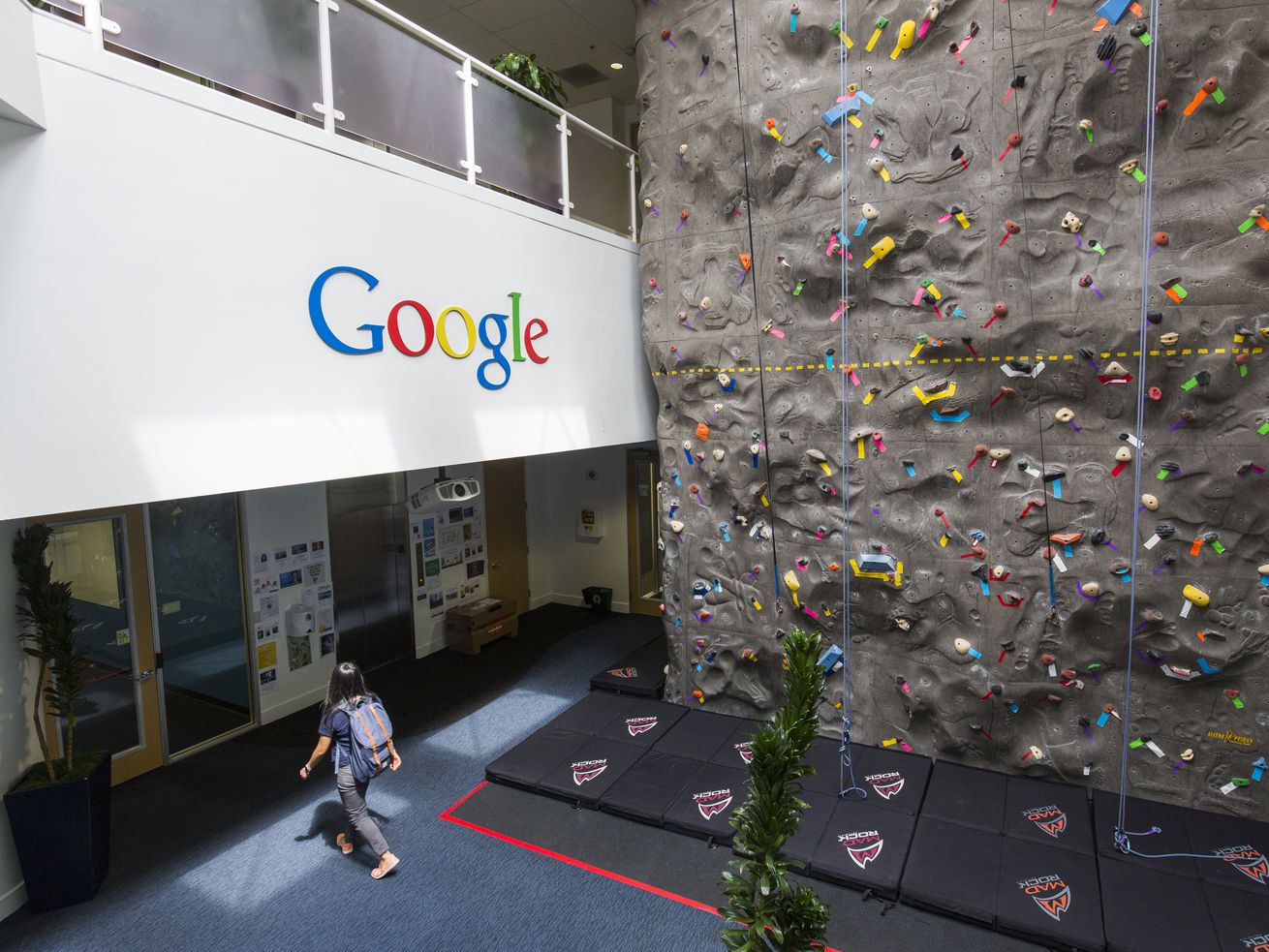
An interior view of office space with an indoor climbing wall at the Googleplex, the corporate headquarters of Google, in Mountain View, California. | Brooks Kraft LLC/Corbis via Getty Images
It looks like the boom days are fading in Big Tech, even if the cash is still flowing.
For nearly two decades, top-tier tech companies like Google and Facebook (now Meta) were known for their rapid hiring, luxurious perks, and corporate cultures of abundance.
But now, as rising inflation, the war in Ukraine, and other macroeconomic factors have caused marketers to slash their advertising budgets, Big Tech’s work culture is changing. In recent months, Google and Meta have drastically slowed down hiring, cut back on perks like employee travel and laundry service, and begun reorganizing departments. Employees fear deeper staff cuts are ahead. Some economists say these moves are a sign that we’re heading into a “white-collar recession,” or a decline in job growth and security for professional workers, not just in tech, but also in other high-skilled industries.
There’s more to these shifts, though. The external economic pressures are real — but it’s also a good excuse for behemoths like Google and Meta to clean house.
As Google’s parent company Alphabet and Meta have grown into corporate giants worth $1 trillion and $385 billion, respectively, they’ve swelled their staffing to over 150,000 and 80,000. Now, economic circumstances are giving management an opportunity to reset expectations, pressure staff to start working harder with smaller budgets, and show some workers the door.
“At companies like Facebook and Google, for the longest time expenses were unlimited,” said one Meta executive who recently left the company and spoke under the condition of anonymity for fear of professional repercussions. “There was a lot of fat in the organizations. It’s very healthy to cut that fat. … The party is over.”
“There was a lot of fat in the organizations. It’s very healthy to cut that fat.”
It’s not only executives who think that some Big Tech companies have become too bloated, but some rank-and-file employees too. Ahead of the 2020 presidential primary elections, Recode reported that Google and Facebook employees donated the most to candidates like Elizabeth Warren and Bernie Sanders who wanted to break up Big Tech, arguing that making these companies smaller could return them to their more scrappy and productive early startup days.
Google and Facebook are still two of the most profitable companies in the world, whose annual revenue rivals that of the entire GDP of some countries. Unlike smaller tech companies, they can afford to make payroll and weather times of economic downturn. But, some industry insiders said, it could be to these firms’ advantage to cut more than necessary to drive productivity and demonstrate to shareholders that they’re being financially responsible. Meta’s share prices have dropped by about 60 percent in the past year, and Google parent company Alphabet is down by about 30 percent in the same time period.
Both Google and Facebook have candidly warned employees that for those who remain, the company will start demanding more of them. Google CEO Sundar Pichai said in an internal memo in July, reported by CNBC, that Googlers “need to be more entrepreneurial” and work with “greater urgency, sharper focus, and more hunger than we’ve shown on sunnier days.” Meta CEO Mark Zuckerberg put it more bluntly in a company all-hands in June, according to the New York Times, saying “I think some of you might decide that this place isn’t for you, and that self-selection is okay with me … Realistically, there are probably a bunch of people at the company who shouldn’t be here.”
For employees on the receiving end of this executive pressure, the sense is that overnight, their job security is no longer so secure. Even though the cuts at Facebook and Google have only recently started, many employees are already feeling the change.
One current Google employee told Recode that just a few months ago, employees came to Google’s regular all-hands meetings, which the company calls TGIFs, with regular questions about whether they would get raises to match inflation. Now, the employee said, a more common question among employees is whether there will be layoffs.
“All the talk about compensation goes away because people are scared,” they said.
One Google employee Recode spoke with said most of their colleagues accept management’s cost-cutting measures.
“People have been really understanding,” they told Recode. “because at the end of the day we still have it so much better than other people.” Still, they added that the company’s recent cuts and emphasis on productivity “has created a sense of nervousness and uncertainty in what we can expect from the company going forward.”
That nervousness and uncertainty extends to employees’ future job prospects, too. Usually, Google employees unhappy with their job could easily seek an offer from Meta, Apple, or other nearby tech giants jockeying for talent; these days, most tech companies have slowed new hiring.
“There’s definitely a sense of ‘wait, there may not be a chair at another tech company if the music stops here,’” said one Google employee.
The fact that in just a few months, the dynamics of the tech industry have turned upside down, and that employees now have less leverage over their employers, represents one of the most significant shifts the sector has seen since the dot-com bust of the early 2000s.
In a cynical way, that Google employee mused, even if management’s talk about productivity doesn’t amount to more actual efficiency, it is effectively working to get workers to stop pushing for more benefits. And it shows shareholders that Google is serious about its stock performance.
“Maybe they’re not making the best business decisions, but they don’t know that”
“When recessions come along or when things are softening, I think these companies that are very well run take that as an opportunity to streamline things internally,” said Keval Desai, a former Google executive from 2003 to 2009 who now runs a venture capital firm he founded, SHAKTI. “I do believe that smart companies take opportunities and make unpopular decisions.”
But unpopular decisions can be difficult to implement. And improving productivity at massive corporations like Facebook or Google isn’t as easy as simply that demanding employees work harder.
Some Google employees Recode spoke with said that they think in order to be more productive, executives should focus on giving teams clearer direction.
“There is that fear that people aren’t working hard enough, but what I see is a lot of people working hard with unclear business priorities,” said a Google employee. “Maybe they’re not making the best business decisions, but they don’t know that.”
One example: Google seems to be unclear about how much it wants to prioritize its hardware line. The company seemed to be moving forward with developing its next Pixelbook laptop product until it canceled the latest planned release and disbanded the team working on it earlier this month, The Verge reported.
And in March, Google laid off 100 Google Cloud workers, giving them 60 days to find new jobs within the company — which some employees petitioned against, asking for more time. The layoffs came despite the fact that Google Cloud, while still an unprofitable division, is growing its revenue considerably.
Laszlo Bock, co-founder of workplace software company Humu, who headed Google’s People Operations teams from 2006 to 2016, said he agrees with the idea that some major tech companies aren’t as operationally disciplined today as they could be, and that it could be time for change.
“I think there is a way for companies to navigate that, though, which is you need to have a clearly articulated set of principles about how and why you want to change.” said Bock.
At Google, the company is increasingly focusing its research efforts on AI, and at Meta, the company is prioritizing VR/AR work to support its metaverse plans, as well as its TikTok competitor, Reels.
Google recently made major cuts to its in-house research lab, Area 120, on projects that weren’t directly focused on AI. Meta has also reportedly scaled back its new experimental product division to refocus exclusively on Reels. More broadly, Meta is planning to cut workplace spending by 10 percent, the Wall Street Journal recently reported, in part through staff reductions — and has started quietly disbanding some teams, giving employees 30 days to find new jobs within the company.
Some Meta employees are trying to find new positions on metaverse-related projects, which is what Zuckerberg has made his highest priority, said one employee who recently left the company.
“Definitely over the past six to nine months there’s been a mad dash toward [Reality Labs], and particularly within the metaverse product group,” said a former Meta employee who recently left the company. “It feels like everything else is less secure in terms of the company’s future.”
Some employees and industry experts worry that too much cost-cutting could backfire by stifling employee innovation: the very kind of creativity that made these companies great.
“Traditionally, the way you drive productivity is you manage more tightly, you set goals, you cut costs. And the way you drive innovation is you give people more freedom and some flexibility and room to experiment and fail,” said Bock. “So I’m not sure how you increase productivity and increase innovation at the same time.”
Framework and Google have announced the new Framework Laptop Chromebook Edition. As the name implies, this is an upgradable, customizable Chromebook from the same company that put out the Framework laptop last year.
User-upgradable laptops are rare enough already, but user-upgradable Chromebooks are nigh unheard of. While the size of the audience for such a device may remain to be seen, it’s certainly a step in the right direction for repairability in the laptop space as a whole.
Thin and customizable.
Multiple parts of the Framework are user-customizable, though it’s not clear whether every part that’s adjustable on the Windows Framework can be adjusted on the Chromebook as well. Each part has a QR code on it which,...
Service teams can leverage the latest telephony innovations from Five9 to power agent, supervisor and customer experience
SAN RAMON, CA – September 20, 2022 – Five9 (NASDAQ: FIVN) today announced the availability of Five9 Service Cloud Voice for Partner Telephony, the latest evolution of its integration with Salesforce. The integration with Service Cloud Voice meets the growing demand to connect the broader customer experience ecosystem, enhance the contact center experience, and improve agents and supervisors access to rich data, including CRM and omnichannel insights.
Customers can now connect certified telephony solutions into Service Cloud Voice with Service Voice for Partner Telephony, creating a unified agent and digital channel experience that delivers faster, smarter and more personalized service.
Using the Five9 for Service Cloud Voice adaptor contact center leaders can:
Enable agents to utilize the core telephony controls blended within the Salesforce Omni-channel widget to empower an intelligent agent and customer service experience.
Receive inbound screen pops with the ability to search for previous interactions to enable quicker means time to resolution for the customer and less frustration for the agent.
Access call logging information so agents have full context to previous interactions helping personalize customer experience.
Create a powerful and productive engine for sales, marketing, customer service, support and ticket management where data is shared across systems helping to reduce friction for the agent and the customer.
“With Service Cloud Voice Partner Telephony, Five9 is building our proven track record of success and leadership to implement, add value, and support innovations with Salesforce,” said Dan Burkland, President, Five9. “The integration between Five9 and Salesforce enables customers to benefit from continuous product innovation. We are pleased to place the power of the Five9 portfolio at the fingertips of users to help them reimagine their customer experience.”
“With Five9 for Service Cloud Voice for Partner Telephony, the company affirms its commitment to ensure that joint customers can provide enhanced customer journeys and provide connected, personalized service from anywhere on one digital engagement platform,” said Sheila McGee-Smith, founder, and principal analyst at McGee-Smith Analytics. “The integration also enables businesses to reimagine their employee experience by enhancing agent productivity, efficiency, and engagement.”
“The Five9 Service Cloud Voice for Partner Telephony integration is a welcome addition to the Service Cloud Voice ecosystem,” said Ryan Nichols, SVP and GM of Service Cloud Contact Center at Salesforce. “The expansion of Service Cloud Voice for Partner Telephony enables customers to integrate the telephony experience natively within the agent work space, combined with CRM data, process and voice intelligence.”
The Service Cloud Voice integration is an extension to the current Five9 and Salesforce adapter, which is already trusted by Five9 customers. The Five9 for Service Cloud Voice BYOT integration is available on AppExchange in addition to the Five9 integration with Open CTI via the Salesforce Plus Adaptor, which is also available on AppExchange at: https://appexchange.salesforce.com/appxListingDetail?listingId=a0N30000001gGgIEAU
Stop by the Five9 Booth #1640 at Dreamforce September 20-22, 2022 to learn more about how Five9 and Salesforce are helping customers succeed in EX and CX.
About Salesforce AppExchange
Salesforce AppExchange, the world’s leading enterprise cloud marketplace, empowers companies, developers and entrepreneurs to build, market and grow in entirely new ways. With more than 7,000 listings, 10 million customer installs and 117,000 peer reviews, AppExchange connects customers of all sizes and across industries to ready-to-install or customizable apps and Salesforce-certified consultants to solve any business challenge.
About Five9:
Five9 is an industry-leading provider of cloud contact center solutions, bringing the power of cloud innovation to more than 2,500 customers worldwide and facilitating billions of call minutes annually. The Five9 Intelligent Cloud Contact Center provides digital engagement, analytics, workflow automation, workforce optimization, and practical AI to create more human customer experiences, to engage and empower agents, and deliver tangible business results. Designed to be reliable, secure, compliant, and scalable, the Five9 platform helps contact centers increase productivity, be agile, boost revenue, and create customer trust and loyalty. For more information visit: www.five9.com.
The solution is designed to improve communication for fast-moving workforces and improve day-to-day operations.
The companies have developed the app for industries such as manufacturing, mining, energy, sports, events, utilities, and more.
Wes Wells, Product Director at Instant Connect, commented: “The key is any device, any network interoperability, our automated talk channels can run on virtually any voice-enabled device, operating system, or network: LTE/5G, Wi-Fi, radio, IP.
“This unified voice environment gives Webex subscribers a direct, unbroken line of communication with frontline workers for the first time.”
The app works by connecting an unlimited number of subscribers who can use any device that they wish to create group talk channels within the software.
Voice, data, alerts, IoT workflows, and other information can be shared with interoperability across any device and network via the push-to-talk platform.
When the task is complete, the software will shut down the group talk channel to allow members to focus on other tasks.
Alyson Hoagland Pace, Director of Strategy and Partnerships at Cisco, added:
“Solutions like this show how older legacy technology can co-exist with newer IP networks to provide hybrid work solutions across many different sectors and applications.”
Earlier this year, Webex launched Webex Go to allow users to link their Webex contact details to their carrier plan, enabling calls using their device’s native dialer over a cellular network.
It converts your smartphone into a business telephony device without a separate softphone application.
With Webex Go, users can reduce their reliance on desk phones while benefiting from their organisation’s enterprise voice solution features.
Users may utilise this technology to integrate their Webex Calling business line directly onto their mobile phones, saving them from carrying multiple devices.
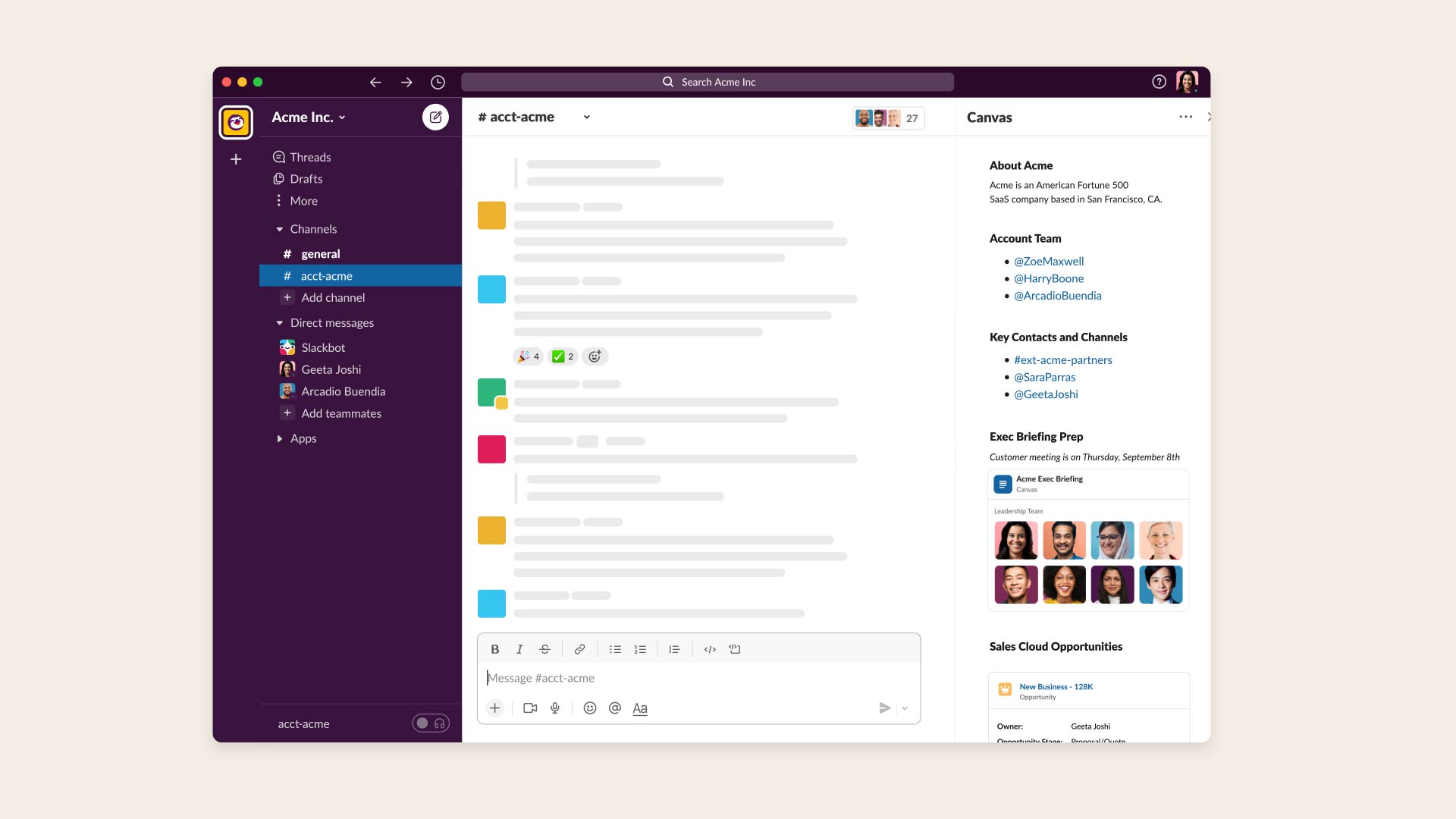
Slack has succeeded in large part in the enterprise by allowing people to communicate in a number of ways while integrating with many common enterprise applications. This lets you stay in Slack to get your work done without dreaded task switching. But what Slack has lacked until now was a way to share information about a project in a persistent way.
If you wanted to find the content related to a project, you might start a channel to narrow it down, and share some documents, links and other information, but to find them again requires searching or a lot of scrolling. Slack recognized this limitation and decided to combine Quip’s collaborative tooling with Slack’s communication capabilities in a new tool Slack is calling Canvas.
Quip is the company that Salesforce bought in 2016 for $750 million (and which brought co-CEO Bret Taylor to the company). Salesforce has always seemed to struggle with how to make good use of Quip across the platform. With Slack, the company it bought in 2020 for almost $28 billion, it’s found a way to solve the persistent content problem.
Slack CPO Tamar Yehoshua describes it this way to TechCrunch: “Canvas is taking the collaborative components of Quip and integrating them natively into Slack. It’s a persistent layer of information that is a complement to the real-time nature of channels.”
For companies that do the majority of their work in Slack, and rely on it to share information, Canvas can be a kind of missing link to help people find the information they need much faster. It sits alongside a channel’s conversation stream and gives people access to information such as data and charts, text, tasks, internal and external links, training videos and so forth.
“So you have a channel with the real-time nature of the information that’s flowing and then you can have a persistent layer where you can find things very easily,” she said.
Image Credits: Slack
You also can include workflows you create in Slack, and add those in the form of buttons into the canvas, and you can add comment threads just as you can with Quip. “So all of the functionality that you have in threads in Slack you have for comments in your canvas,” she explained.
Early customers have used it for new employee onboarding and marketing campaigns, as a couple of examples.
In addition to Canvas, Slack announced it enhanced Huddles, the tool for quick audio-based meetings with video capabilities for those users who want it. Slack is also opening up the Slack platform, a way for developers to build modular and reusable building blocks in Slack to create more customized workflows. That is going from private to public beta this week.
Slack Canvas is being announced today at Dreamforce in San Francisco, and is expected to be generally available some time next year.
“It’s fair to say over the next 18 months every SI (systems integrator) and ISV (independent software vendor) solution will have Slack as a part of it,” Slack channel chief Richard Hasslacher tells CRN in an interview.
DirecTV’s NFL Sunday Ticket stream has gone down for the second week in a row. Football fansacrossTwitter complained that they were unable to log in or received an error message when trying to load the stream.
Former Deadspin reporter Timothy Burke said on Twitter the service started having issues at about 2PM ET, and all streams when dark after that. DirecTV acknowledged the issue in a tweet, and later shared an update at around 4PM ET saying that the games went back online, but that it would “continue to monitor” the streams.
It looks like subscribers continued to have problems after this. Manyuserssaid the Sunday Ticket app blacked out certain games even though they weren’t available locally.
Tom Brady might as well have been practicing his touchdown spike when he whipped a Microsoft Surface tablet into the ground during the Tampa Bay Buccaneers game against the Saints on Sunday night. The quarterback was visibly frustrated following an incomplete pass, tossed his helmet onto the field, and stormed back to the sidelines where he chucked the tablet.
The Buccs were losing when Brady threw the tablet, but they ended up coming back and defeating the Saints 20-10. This isn’t Brady’s first documented case of tablet abuse — he threw the thing so hard against the bench after losing a Saints game last year that it actually bounced.
Microsoft Surface chief Panos Panay responded to the incident on his Instagram story this time around,...