Shared posts

31 Jan 19:28

Astronomy Events – February 2016

by yaska77

by Adam Welbourn

As much as dark skies are what stargazers crave, and the longer the darkness the more gazing that can be done, it’s nice that afternoons are now noticeably lighter for longer!

Apart from a week or so of cold snowy weather affecting most of the northern UK it has been one of the mildest winters on record, so with the luck of some drier weather (let’s face it, we’re due) February could be a great time to get outside under the stars.

To help we’ve picked out some heavenly happenings for the upcoming month below, so peruse at your leisure and get out and enjoy the night!

Keep watching those skies…

Monday 1st February  – This morning our Moon will be seen at Last Quarter phase

If you have some binoculars you may be able to catch Comet Catalina close to Polaris the Pole Star over the first few evenings of February. It will drift away (towards the west) and decrease in magnitude as the month passes, so catch it while you can!

Saturday 6th February – Early risers with a flat enough horizon (and the luck of clear skies of course!) will be in for a treat just before dawn this morning. The sliver of crescent Moon sits over a bright Venus, with a faint Mercury just below and to the left

A beautiful celestial triangle appears just before sunrise this morning, look to the south east at 06:30 (UTC) to see the thin crescent Moon over Venus and Mercury - (click to enlarge) - Credit: Sky-Watching/Stellarium

A beautiful celestial triangle appears just before sunrise this morning, look to the south east at 06:30 (UTC) to see the thin crescent Moon over Venus and Mercury – (click to enlarge) – Credit: Sky-Watching/Stellarium

Sunday 7th February Mercury is at greatest western elongation today, and may be visible just before sunrise to the left of much brighter Venus, appearing to be a faint star in comparison

Monday 8th February – Today the New Moon rises and sets with the Sun, so now is a good time to observe deep sky objects like galaxies and nebulae, or get a clearer look at objects usually blurred and faint in light polluted skies

A nice object to try and locate at this time of year is the Rosette Nebula, which contains open cluster NGC 2244. If your skies aren’t too light polluted you should be able to locate it to the left of Orion, look to the south at 21:00 UTC

The stars of the open cluster shine brightly, surrounded by the gas and dust that make up the Rosette Nebula (click to enlarge) - Credit: Sky-Watching/A.Welbourn

The stars of the open cluster shine brightly, surrounded by the gas and dust that make up the Rosette Nebula (click to enlarge) – Credit: Sky-Watching/A.Welbourn

Thursday 11th February – Today the Moon is at Perigee at a distance of 364,355 km (226,400 miles) from the Earth, the closest it will come on it’s current orbit

Monday 15th February – This morning the Moon will be seen at First Quarter phase

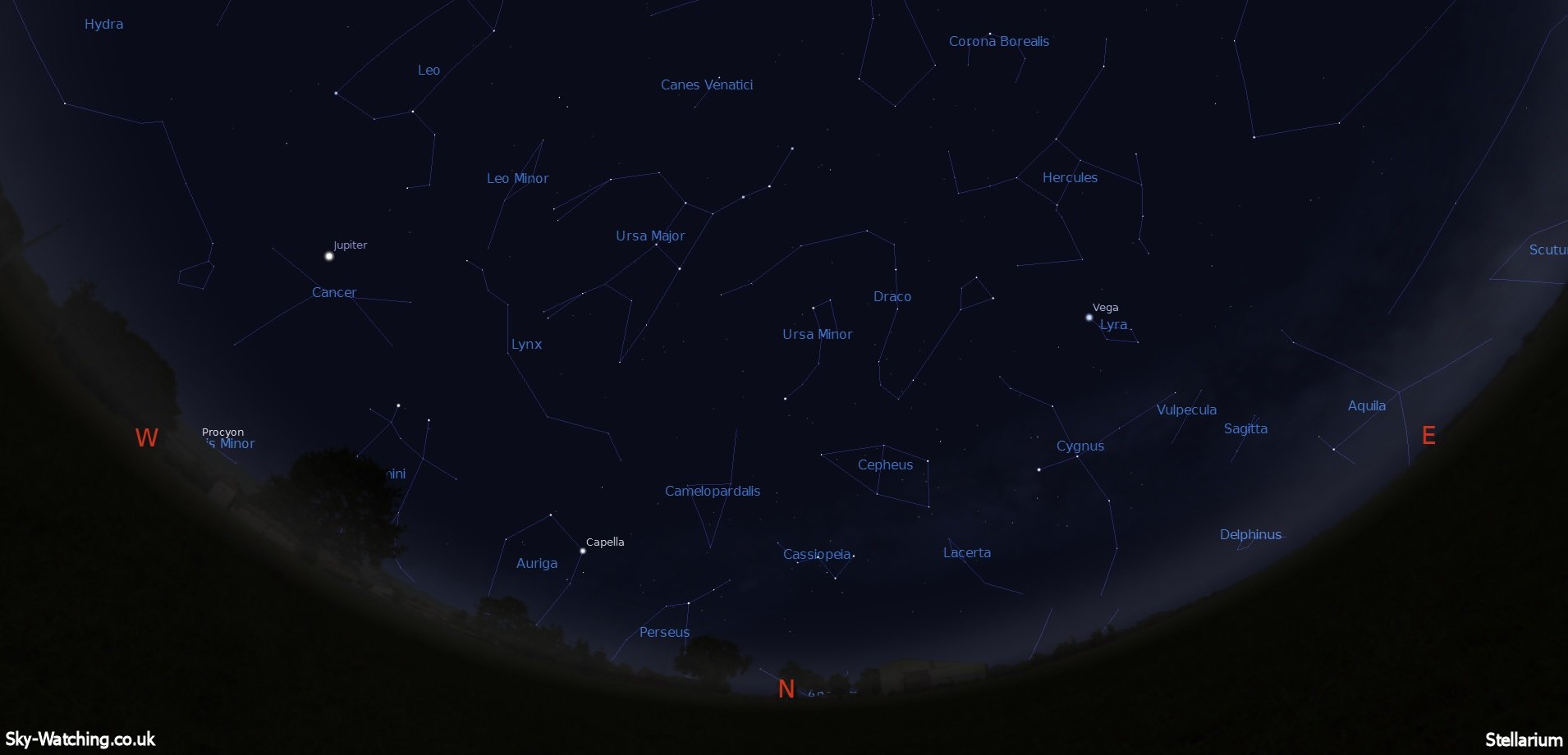
And to help you identify the constellations you can see throughout the month, below we’ve provided guide images for both southern and northern skies in February

Shown at 00:00 UTC on 15th February, both these images are a handy guide for the whole month. This is the view you’ll get looking South (click to enlarge) – Credit: Sky-Watching/Stellarium

Shown at 00:00 UTC on 15th February, both these images are a handy guide for the whole month. This is the view you’ll get looking South (click to enlarge) – Credit: Sky-Watching/Stellarium

Displaying the night sky midway through the month, this image can help you identify the constellations you’ll see in the northern sky in February (click to enlarge) – Credit: Sky-Watching/Stellarium

Displaying the night sky midway through the month, this image can help you identify the constellations you’ll see in the northern sky in February (click to enlarge) – Credit: Sky-Watching/Stellarium

Monday 22nd February – This evening’s Full Moon is sometimes known as the Budding Moon, Storm Moon or Snow Moon

Tuesday 23rd February – Gas giant Jupiter joins our Moon in the sky tonight, can you catch it in an image despite the brightness of its companion? They will travel together for the whole evening, appearing closest in the early hours of the 24th
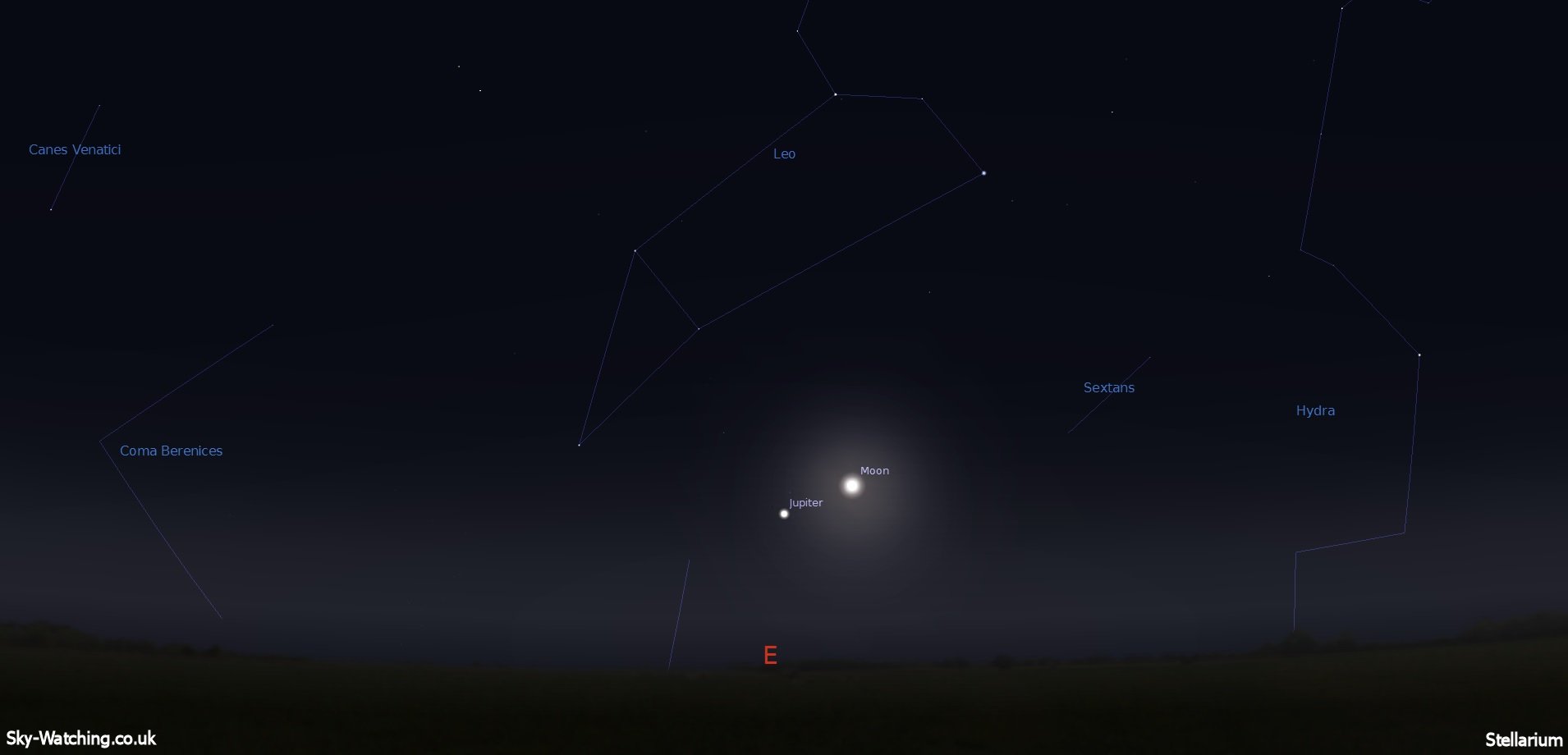
Shown above at 19:30 UTC, the Moon and Jupiter cross the sky as close companions all evening (click to enlarge) - Credit: Sky-Watching/Stellarium

Shown above at 19:30 UTC, the Moon and Jupiter cross the sky as close companions all evening (click to enlarge) – Credit: Sky-Watching/Stellarium

Sunday 27th February – The Moon is at Apogee today at a distance of 405,380 km (251,376 miles), the furthest point its orbit will take it away from the Earth this month

Monday 28th February – Often elusive Neptune is in conjunction with the Sun today, and is actually unobservable throughout the month

As usual, if you take any photos throughout February you’d like to show us, please tweet them to us using the link below! We’d love to see your efforts and we’ll re-tweet them to your fellow sky-watchers!

Planets visible this month:

Venus
Saturn
Mars
Uranus
Jupiter
Mercury

Remember, it can take your eyes up to 20 minutes to become properly dark adapted, and anything up to an hour for a telescope to reach ambient temperature outside (to ensure the best image), so give yourself plenty of time to get set up!

To make it easier to find this list of astronomical happenings you can also locate it in the “Monthly Guide” section in the menu bar to the right. Handy! 🙂

Guide images created with Stellarium

Archive:
Astronomy Events – January 2016
Astronomy Events – December 2015
Astronomy Events – November 2015
Follow @sky_watching


Filed under: Astronomy, Comet, Earth, Image gallery, Jupiter, Mars, Mercury, Moon, Neptune, Night sky, Planets, Resources, Saturn, Space, Stars, Venus, yaska77 Tagged: 2016, astronomical, Astronomy, astronomy guide, astrophotography, Canon, comet, EOS, February, full moon, Moon, Night sky, photography, planets, postaweek, space, stargazing, Stars, telescope, UK, Winter
01 May 18:51

Astronomy Events – May 2015

by yaska77

by yaska77

I am so eager to dust off the scope and have another night out under the stars imaging away it’s starting to make me twitchy. The plan is to get some of the Sky-Watching founders (that makes us sound far grander than we could ever hope to be) together the first clear evening we’re all free.

As ever though work commitments (and life commitments in general) make this kind of get together a bit difficult to arrange…

But with plenty to see, and to stop our scopes and cameras feeling so terribly neglected, we will bring you some new images! If there’s anything you’d like us to try target please feel free to make your suggestions in the comments below.

Stay safe fellow stargazers, keep watching those skies…

Friday 1st May – If you have a flat western horizon the planet Mercury may be visible close by the Pleiades cluster soon after sunset this evening. Look towards the west around 20:00 UTC (21:00 BST) and see if you can spot them before they dip below the horizon an hour later

Monday 4th May – The Full Moon today is sometimes known as the Dragon Moon, Hare Moon or Grass Moon

Tuesday 5th May – This evening sees the peak of the annual Eta Aquarids meteor shower. The near full Moon will wash out all but the brightest of meteors however, but you may see a few if you persevere

Thursday 7th May Mercury is at Greatest Eastern Elongation today, and forms a nice line with Venus and Jupiter as the skies darken

Venus is currently the brightest object in the night sky, and over the course of the month will move slowly towards Jupiter as it heads towards a fantastic conjunction with the gas giant at the end of next month (watch out on the 30th June!)

Mercury is notoriously difficult to image, but if we can get to somewhere with a flat horizon we'll be trying to image this cosmic line up (click to enlarge) - Credit: Sky-Watching/Stellarium

Mercury can be difficult to image, but if we can get to somewhere with a flat horizon we’ll be trying to photograph this cosmic line up, shown above at 20:50 UTC/21:50 BST (click to enlarge) – Credit: Sky-Watching/Stellarium

Monday 11th May – This morning our Moon will be seen at Last Quarter phase

Friday 15th May – Today the Moon is at Perigee (the closest point of its orbit to the Earth) at a distance of 366,025 km (227,437 miles)

Saturday 16th May – To help identify the constellations you can see throughout the month, below we’ve provided guide images for both southern and northern skies in May

Shown at 00:00 UTC (01:00 BST) on 16th May, both these images are a handy guide for the whole month. This is the view you’ll get looking South (click to enlarge) – Credit: Sky-Watching/Stellarium

Shown at 00:00 UTC (01:00 BST) on 16th May, both these images are a handy guide for the whole month. This is the view you’ll get looking South (click to enlarge) – Credit: Sky-Watching/Stellarium

Displaying the night sky midway through the month, this image can help you identify the constellations you’ll see in the northern sky in May (click to enlarge) – Credit: Sky-Watching/Stellarium

Displaying the night sky midway through the month, this image can help you identify the constellations you’ll see in the northern sky in May (click to enlarge) – Credit: Sky-Watching/Stellarium

Monday 18th May – Today the New Moon rises and sets with the Sun, so now is a good time to observe deep sky objects like galaxies and nebulae which can be difficult to spot when the Moon is lighting up the sky

Thursday 21st May – Tonight Venus and the waxing crescent Moon can be seen low down together to the west northwest around 22:00 UTC (23:00 BST)

Saturday 23rd May Saturn appears at opposition in the constellation Libra this evening, and can be located fairly low down to the south around midnight

Sunday 24th May – Now is about the time of year to start looking for noctilucent clouds, which sometimes appear low down in the northwest (after sunset) and northeast (just before sunrise)

Noctilucent clouds as captured over Sweden (click to enlarge) – Credit: P-M Hedén

Noctilucent clouds as captured over Sweden (click to enlarge) – Credit: P-M Hedén

These clouds are in the upper atmosphere and are usually too faint to see, becoming visible only when illuminated by sunlight from below the horizon while the lower layers of the atmosphere are in the Earth’s shadow

Monday 25th May – This evening the Moon is at First Quarter phase

Tuesday 26th May – The Moon is at Apogee today at a distance of 404,245 km (251,186 miles), the furthest point its orbit will take it away from the Earth this month

Saturday 30th May – Inner planet Mercury is in Inferior Conjunction today

As usual, if you take any photos throughout May you’d like to show us, please tweet them to us using the link below! We’d love to see your efforts and we’ll re-tweet them to your fellow sky-watchers!

Planets visible this month:

Jupiter
Mercury
Saturn
Venus

Remember, it can take your eyes up to 20 minutes to become properly dark adapted, and anything up to an hour for a telescope to reach ambient temperature outside (to ensure the best image), so give yourself plenty of time to get set up!

To make it easier to find this list of astronomical happenings you can also locate it in the “Monthly Guide” section in the menu bar to the right. Handy! :)

Guide images created with Stellarium

Archive:
Astronomy Events – April 2015
Astronomy Events – March 2015
Astronomy Events – February 2015

Follow @sky_watching
Filed under: Astronomy, Earth, Image gallery, Jupiter, Mars, Mercury, Meteor, Moon, Nebula, Night sky, Planets, Resources, Saturn, Space, Stars, Sun, Venus, yaska77 Tagged: 2015, astronomical, Astronomy, astronomy guide, astrophotography, full moon, may, Moon, Night sky, photography, planets, postaweek, space, Spring, stargazing, Stars, telescope
01 Apr 07:34

Astronomy Events – April 2015

by yaska77

by yaska77

As much as I love the longer dark winter evenings I’ll admit I am now thoroughly bored of the cold. The clocks going forward an hour at the end of March has helped give us the first hints of the lighter summer evenings to come, and it’s a good feeling!

So while dreaming of that summer barbecue with friends leading in to a long evening sky-watching, below I’ve listed some spring astronomical events to encourage you to become reacquainted with the great outdoors. Have fun and stay safe all.

Keep watching the skies…

Wednesday 1st April – Our Moon is at Apogee today at a distance of 406,010 km (252,282 miles), the furthest point out in its orbit around the Earth this month

Saturday 4th April – Today’s Full Moon is sometimes known as the Flower Moon, Seed Moon or Pink Moon

It also sees a Total Lunar Eclipse occur, visible from eastern Asia, Australasia, the Pacific Ocean and western parts of North America, but sadly not to those of us in the UK (our last partially visible eclipse was in April 2013)

On 25th April 2013 the Full Moon also experienced penumbral eclipse, shown above at 20:22 UTC (21:22 BST) with the Earth’s shadow visible across the northern edge (click to enlarge) – Credit: Sky-Watching/A.Welbourn

On 25th April 2013 the Full Moon experienced penumbral eclipse, shown above at 20:22 UTC (21:22 BST) with the Earth’s shadow visible across the northern edge (click to enlarge) – Credit: Sky-Watching/A.Welbourn

Monday 6th April – The planet Uranus is in Conjunction with the Sun and is currently unobservable

Friday 10th April – Inner planet Mercury is in Superior Conjunction today

Saturday 11th April – Venus is still present as a spectacularly bright object in the early evening sky. Tonight it will appear to pass close to the Pleiades or “Seven Sisters” (so it should be a great photographic target!)

Look low to the west soon after sunset and you can't fail to spot Venus near the fainter but equally beautiful Pleiades cluster, shown above at 20:00 UTC / 21:00 BST (click to enlarge) Credit: Sky-Watching/Stellarium

Look low to the west soon after sunset and you can’t fail to spot Venus near the fainter but equally beautiful Pleiades cluster, shown above at 20:00 UTC/21:00 BST (click to enlarge) – Credit: Sky-Watching/Stellarium

We managed to get a few shots when Venus made a similar pass by the Seven Sisters in 2012. If you have some binoculars to help get a closer look it will be well worth your time!

The bright planet Venus shines next to the Pleiades cluster, and the setting Jupiter is accompanied by some of her moons (click to enlarge) - Credit: Sky-Watching/A.Welbourn

The bright planet Venus shines next to the Pleiades cluster, and the setting Jupiter is accompanied by some of her moons at bottom right (click to enlarge) – Credit: Sky-Watching/A.Welbourn

Sunday 12th April – This morning our Moon will be seen at Last Quarter phase

Thursday 16th April – To help identify the constellations you can see throughout the month, below we’ve provided guide images for both southern and northern skies in April

Shown at 00:00 UTC (01:00 BST) on 16th April, both these images are a handy guide for the whole month. This is the view you’ll get looking South (click to enlarge) – Credit: Sky-Watching/Stellarium

Shown at 00:00 UTC (01:00 BST) on 16th April, both these images are a handy guide for the whole month. This is the view you’ll get looking South (click to enlarge) – Credit: Sky-Watching/Stellarium

Displaying the night sky midway through the month, this image can help you identify the constellations you’ll see in the northern sky in April (click to enlarge) – Credit: Sky-Watching/Stellarium

Displaying the night sky midway through the month, this image can help you identify the constellations you’ll see in the northern sky in April (click to enlarge) – Credit: Sky-Watching/Stellarium

Friday 17th April – Today the Moon is at Perigee (the closest point of its orbit to the Earth) at a distance of 361,025 km (224,331 miles)

Saturday 18th April – Today the New Moon rises and sets with the Sun, so it’s a good time to observe deep sky objects like galaxies and nebulae which are usually harder to see when the Moon is shining in the sky

Wednesday 22nd/
Thursday 23rd April 
– The annual Lyrid meteor shower peaks this evening, with the radiant (the point all meteors appear to originate from) in the constellation Lyra which you’ll find low to the north east around 22:00 UTC/23:00 BST

This one shows a nice long clear Perseid tail, with more definition to the shap at the end of the streak (click to enlarge) - Credit: Sky-Watching/A.Welbourn

We’re hoping to capture some Lyrid meteors this year, as they can give you some nice shots like this Perseid meteor we caught streaking away from the smudge of the Andromeda galaxy (click to enlarge) – Credit: Sky-Watching/A.Welbourn

The best time to see the meteors will be after midnight when the Moon has set, so if your skies are clear and you can face the late night it has got to be worth a look hasn’t it? Get outside and crane your necks!

Sunday 26th April – This morning the Moon is at First Quarter phase

Wednesday 29th April – The Moon is at Apogee today for the second time this month, at a distance of 405,085 km (251,708 miles)

As usual, if you take any photos throughout April you’d like to show us, please tweet them to us using the link below! We’d love to see your efforts and we’ll re-tweet them to your fellow sky-watchers!

Planets visible this month:

Jupiter
Mars
Mercury
Saturn
Venus

Remember, it can take your eyes up to 20 minutes to become properly dark adapted, and anything up to an hour for a telescope to reach ambient temperature outside (to ensure the best image), so give yourself plenty of time to get set up!

To make it easier to find this list of astronomical happenings you can also locate it in the “Monthly Guide” section in the menu bar to the right. Handy! :)

Guide images created with Stellarium

Archive:
Astronomy Events – March 2015
Astronomy Events – February 2015
Astronomy Events – January 2015

Follow @sky_watching
Filed under: Astronomy, Earth, Eclipse, Image gallery, Jupiter, Mars, Mercury, Meteor, Moon, Nebula, Night sky, Planets, Resources, Saturn, Space, Stars, Sun, Venus, yaska77 Tagged: April, astronomical, Astronomy, astronomy guide, astrophotography, eclipse, full moon, Moon, Night sky, photography, planets, postaweek, space, Spring, stargazing, Stars, telescope