
ACS Nano
DOI: 10.1021/acsnano.8b02770
We demonstrate how hybridization between a two-dimensional material and its substrate can lead to an apparent heavy doping, using the example of monolayer TaS$_2$ grown on Au(111). Combining $\textit{ab-initio}$ calculations, scanning tunneling spectroscopy experiments and a generic model, we show that strong changes in Fermi areas can arise with much smaller actual charge transfer. This mechanism, which we refer to as pseudodoping, is a generic effect for metallic two-dimensional materials which are either adsorbed to metallic substrates or embedded in vertical heterostructures. It explains the apparent heavy doping of TaS$_2$ on Au(111) observed in photoemission spectroscopy and spectroscopic signatures in scanning tunneling spectroscopy. Pseudodoping is associated with non-linear energy-dependent shifts of electronic spectra, which our scanning tunneling spectroscopy experiments reveal for clean and defective TaS$_2$ monolayer on Au(111). The influence of pseudodoping on the formation of charge ordered, magnetic, or superconducting states is analyzed.
We investigate the spatial evolution of Yu-Shiba-Rusinov (YSR) states resulting from the interaction between Copper phthalocyanine molecules and a superconducting Vanadium (100) surface with submolecular resolution. Each molecule creates several YSR states at different energies showing distinctly different spatial intensity patterns. Surprisingly, on the molecules the largest YSR intensities are found not at the metal center, but close to one of the pyrrolic N-atoms, demonstrating strong molecular substrate interactions via the organic ligands. Energy resolved YSR maps reveal that the different YSR states originate from different molecular orbitals. We also follow the YSR states well-beyond the extent of the molecules and find clear oscillations of the YSR intensities without strong particle hole scattering phase differences. This is in contrast to expectations from a point scattering model and recent experimental findings on atomic impurities on superconductors. Our results can be explained by treating the molecular system as extended scatterer. Our findings provide new insights that are crucial to interpret the effects of a variety of magnetic systems on superconductors, in particular also those discussed in the context of Majorana bound states, which because of their size can not be considered point like as well.
A large enough piece of ferromagnet is usually not magnetized uniformly, but develops a magnetization texture. In thin films these textures can be doubly-periodic. Such are the well known magnetic bubble domains and the recently observed "skyrmion" magnetization textures in MnSi. In this paper we develop a theory of periodic magnetization textures, based on complex calculus to answer the question -- is there a difference between those two textures even if they seem to carry the same topological winding number (or topological charge) ? We find that such difference exists, facilitated by a different role played by the magnetization vector's in-plane phase. We separate classical-like and quantum-like features of magnetization textures and highlight the role of magnetic anisotropy in favouring either of these cases.
Author(s): M. Moro-Lagares, J. Fernández, P. Roura-Bas, M. R. Ibarra, A. A. Aligia, and D. Serrate
Using a combination of scanning tunneling spectroscopy and atomic lateral manipulation, we obtained a systematic variation of the Kondo temperature TK of Co atoms on Ag(111) as a function of the surface-state contribution to the total density of states at the atom adsorption site ρs. By sampling the...
[Phys. Rev. B 97, 235442] Published Tue Jun 26, 2018

Author(s): Marie Hervé, Timofey Balashov, Arthur Ernst, and Wulf Wulfhekel
The tunneling anisotropic magnetoresistance (TAMR) effect, which is caused by a change in the tunneling density of state of a magnetic layer with change of magnetization direction, has great potential in application in magnetic data storage devices as it only requires one of the electrodes of a tunneling junction to be magnetic. Unfortunately, experimental TAMR values are currently limited to about 10%, requiring improvement for practical use. Here, the authors show that the TAMR in hcp Co can be boosted to 30% by magnetization-dependent hybridization of surface and bulk states. This effect is a general property of hcp Co and can be used in structures suitable for applications.
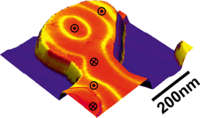
[Phys. Rev. B 97, 220406(R)] Published Wed Jun 27, 2018
Topological modes in one- and two-dimensional systems have been proposed for numerous applications utilizing their exotic electronic responses. The zero-energy, topologically protected end modes can be realized in the Su-Schrieffer-Heeger (SSH) model, which has been experimentally implemented in atomic-scale solid-state structures and in ultra-cold atomic gases. While the edge modes in the SSH model are at exactly the mid-gap energy, other paradigmatic 1D models such as trimer and coupled dimer chains have non-zero energy boundary states. However, these chains have not been realized in an atomically tuneable system that would allow explicit control of the edge modes. Here, we demonstrate atomically controlled trimer and coupled dimer chains realized using chlorine vacancies in the c$(2\times2)$ adsorption layer on Cu(100). This system allows wide tuneability of the domain wall modes that we experimentally demonstrate using low-temperature scanning tunneling microscopy (STM). In the future, these modes may be used to realize well-defined fractional charge states or find applications in exotic quantum devices with atomically well-defined geometries.
Author(s): Zheng Zhu, Itamar Kimchi, D. N. Sheng, and Liang Fu
We investigate the non-Abelian topological chiral spin-liquid phase in the two-dimensional Kitaev honeycomb model subject to a magnetic field. By combining density matrix renormalization group and exact diagonalization we study the energy spectra, entanglement, topological degeneracy, and expectatio...
[Phys. Rev. B 97, 241110(R)] Published Fri Jun 15, 2018
Magnetic insulators are a key resource for next-generation spintronic and topological devices. The family of layered metal halides promises varied magnetic states, including ultrathin insulating multiferroics, spin liquids, and ferromagnets, but device-oriented characterization methods are needed to unlock their potential. Here, we report tunneling through the layered magnetic insulator CrI3 as a function of temperature and applied magnetic field. We electrically detect the magnetic ground state and interlayer coupling and observe a field-induced metamagnetic transition. The metamagnetic transition results in magnetoresistances of 95, 300, and 550% for bilayer, trilayer, and tetralayer CrI3 barriers, respectively. We further measure inelastic tunneling spectra for our junctions, unveiling a rich spectrum consistent with collective magnetic excitations (magnons) in CrI3.
The emerging field of superconductor (SC) spintronics has attracted intensive attentions recently. Many fantastic spin dependent properties in SC have been discovered, including the observation of large magnetoresistance, long spin lifetimes and the giant spin Hall effect in SC, as well as spin supercurrent in Josephson junctions, etc. Regarding the spin dynamic in SC films, few studies has been reported yet. Here, we report the investigation of the spin dynamics in an s-wave superconducting NbN film via spin pumping from an adjacent insulating ferromagnet GdN layer. A profound coherence peak of the Gilbert damping is observed slightly below the superconducting critical temperature of the NbN layer, which is consistent with recent theoretical studies. Our results further indicate that spin pumping could be a powerful tool for investigating the spin dynamics in 2D crystalline superconductors.

Author(s): A. M. Shikin, A. A. Rybkina, D. A. Estyunin, D. M. Sostina, V. Yu. Voroshnin, I. I. Klimovskikh, A. G. Rybkin, Yu. A. Surnin, K. A. Kokh, O. E. Tereshchenko, L. Petaccia, G. Di Santo, P. N. Skirdkov, K. A. Zvezdin, A. K. Zvezdin, A. Kimura, E. V. Chulkov, and E. E. Krasovskii
Possibility of in-plane and out-of-plane magnetization generated by synchrotron radiation (SR) in magnetically doped and pristine topological insulators (TIs) is demonstrated and studied by angle-resolved photoemission spectroscopy. We show experimentally and by ab initio calculations how nonequal d...
[Phys. Rev. B 97, 245407] Published Mon Jun 11, 2018
Conventional scanning tunneling microscopy (STM) is limited to a bandwidth of circa 1kHz around DC. Here, we develop, build and test a novel amplifier circuit capable of measuring the tunneling current in the MHz regime while simultaneously performing conventional STM measurements. This is achieved with an amplifier circuit including a LC tank with a quality factor exceeding 600 and a home-built, low-noise high electron mobility transistor (HEMT). The amplifier circuit functions while simultaneously scanning with atomic resolution in the tunneling regime, i.e. at junction resistances in the range of giga-ohms, and down towards point contact spectroscopy. To enable high signal-to-noise and meet all technical requirements for the inclusion in a commercial low temperature, ultra-high vacuum STM, we use superconducting cross-wound inductors and choose materials and circuit elements with low heat load. We demonstrate the high performance of the amplifier by spatially mapping the Poissonian noise of tunneling electrons on an atomically clean Au(111) surface. We also show differential conductance spectroscopy measurements at 3MHz, demonstrating superior performance over conventional spectroscopy techniques. Further, our technology could be used to perform impedance matched spin resonance and distinguish Majorana modes from more conventional edge states.
We theoretically investigate the transport properties of a quasi one dimensional ferromagnet-superconductor junction where the superconductor consists of mixed singlet and triplet pairings. We show that
the relative orientation of the stoner field ($\bf{\tilde{h}}$) in the ferromagnetic lead and the $\bf{d}$ vector of the superconductor acts like a on-off switch for the zero bias conductance of the device.
In the regime, where triplet pairing amplitude dominates over the singlet counterpart (topological phase), a pair of Majorana zero modes appear at each end of the superconducting part of the nanowire. When $\bf{\tilde{h}}$ is parallel or anti-parallel to the $\bf{d}$ vector, transport gets completely blocked due to blockage in pairing while, when $\bf{\tilde{h}}$ and $\bf{d}$ are perpendicular to each other, the zero energy two terminal differential conductance spectra exhibits sharp transition from $4e^2/h$ to $2e^2/h$ as the magnetization strength in the lead becomes larger than the chemical potential indicating the spin selective coupling of pair of Majorana zero modes to the lead.
We have developed a broadband scanning tunnelling microscope capable of conventional, low frequency (<10 kHz), microscopy as well spectroscopy and shot-noise detection at 1 MHz. After calibrating our AC circuit on a gold surface, we illustrate our capability to detect shot-noise at the atomic scale and at low currents (<1 nA) by simultaneously measuring the atomically resolved differential conductance and shot-noise on the high temperature superconductor Bi$_{2}$Sr$_{2}$CaCu$_{2}$O$_{8+x}$. We further show our direct sensitivity to the temperature of the tunnelling electrons at low voltages. Our broadband probe opens up the possibility to study charge and correlation effects at the atomic scale in all materials accessible to STM.

Author(s): Toru Hirahara and Shuji Hasegawa
Zhu et al. [Phys. Rev. B 94, 121401(R) (2016)] recently reported an experimental work that claims that epitaxial Bi(111) films grown on Si(111) are (1) topologically nontrivial, and (2) metallic only at the surface and insulating in the interior bulk, consistent with the old prediction of a semimeta...
[Phys. Rev. B 97, 207401] Published Mon May 21, 2018
Author(s): Marco Perini, Sebastian Meyer, Bertrand Dupé, Stephan von Malottki, André Kubetzka, Kirsten von Bergmann, Roland Wiesendanger, and Stefan Heinze
We use spin-polarized scanning tunneling microscopy and density functional theory (DFT) to study domain walls (DWs) and the Dzyaloshinskii-Moriya interaction (DMI) in epitaxial films of Co/Ir(111) and Pt/Co/Ir(111). Our measurements reveal DWs with fixed rotational sense for one monolayer of Co on I...
[Phys. Rev. B 97, 184425] Published Thu May 24, 2018
Single-ion magnetic anisotropy in molecular magnets leads to spin flip excitations that can be measured by inelastic scanning tunneling microscope (STM) spectroscopy. Here I present a semi ab initio scheme to compute the spectral features associated with inelastic spin flip excitations and Kondo effect of single molecular magnets. To this end density functional theory calculations of the molecule on the substrate are combined with more sophisticated many-body techniques for solving the Anderson impurity problem of the spin-carrying orbitals of the magnetic molecule coupled to the rest of the system, containing a phenomenological magnetic anisotropy term. For calculating the STM spectra an exact expression for the dI/dV in the ideal STM limit, when the coupling to the STM tip becomes negligibly small, is derived. In this limit the dI/dV is simply related to the spectral function of the molecule-substrate system. For the case of an Fe porphyrin molecule on the Au(111) substrate, the calculated STM spectra are in good agreement with recently measured STM spectra, showing the typical step features at finite bias associated with spin flip excitation of a spin-1 quantum magnet. For the case of Kondo effect in Mn porphyrin on Au(111), the agreement with the experimental spectra is not as good due to the neglect of quantum interference in the tunneling.


Author(s): Niklas Romming, Henning Pralow, André Kubetzka, Markus Hoffmann, Stephan von Malottki, Sebastian Meyer, Bertrand Dupé, Roland Wiesendanger, Kirsten von Bergmann, and Stefan Heinze
Using spin-polarized scanning tunneling microscopy and density functional theory we demonstrate the occurrence of a novel type of noncollinear spin structure in Rh/Fe atomic bilayers on Ir(111). We find that higher-order exchange interactions depend sensitively on the stacking sequence. For fcc-Rh/F...
[Phys. Rev. Lett. 120, 207201] Published Mon May 14, 2018
Author(s): Michael Schecter, Olav F. Syljuåsen, and Jens Paaske
We propose utilizing the Cooper pair to induce magnetic frustration in systems of two-dimensional (2D) magnetic adatom lattices on s-wave superconducting surfaces. The competition between singlet electron correlations and the RKKY coupling is shown to lead to a variety of hidden-order states that br...
[Phys. Rev. B 97, 174412] Published Thu May 10, 2018
Author(s): Shuyi Liu, Akitoshi Shiotari, Delroy Baugh, Martin Wolf, and Takashi Kumagai
Molecular hydrogen in a scanning tunneling microscope (STM) junction has been found to enhance the lateral spatial resolution of the STM imaging, referred to as scanning tunneling hydrogen microscopy (STHM). Here we report atomic resolution imaging of 2- and 3-monolayer (ML) thick ZnO layers epitaxi...
[Phys. Rev. B 97, 195417] Published Fri May 11, 2018

Author(s): Krisztián Palotás, Levente Rózsa, and László Szunyogh
Tunneling spin transport characteristics of a magnetic skyrmion are described theoretically in magnetic scanning tunneling microscopy (STM). The spin-polarized charge current in STM (SP-STM) and tunneling spin transport vector quantities, the longitudinal spin current and the spin transfer torque, a...
[Phys. Rev. B 97, 174402] Published Thu May 03, 2018
Plasmon-induced chemical reactions of molecules adsorbed on metal nanostructures are attracting increased attention for photocatalytic reactions. However, the mechanism remains controversial because of the difficulty of direct observation of the chemical reactions in the plasmonic field, which is strongly localized near the metal surface. We used a scanning tunneling microscope (STM) to achieve real-space and real-time observation of a plasmon-induced chemical reaction at the single-molecule level. A single dimethyl disulfide molecule on silver and copper surfaces was dissociated by the optically excited plasmon at the STM junction. The STM study combined with theoretical calculations shows that this plasmon-induced chemical reaction occurred by a direct intramolecular excitation mechanism.
We demonstrate that a two-dimensional finite and periodic array of Ising spins coupled via RKKY-like exchange can exhibit tunable magnetic states ranging from three distinct magnetic regimes: (1) a conventional ferromagnetic regime, (2) a glass-like regime, and (3) a new multi-well regime. These magnetic regimes can be tuned by one gate-like parameter, namely the ratio between the lattice constant and the oscillating interaction wavelength. We characterize the various magnetic regimes, quantifying the distribution of low energy states, aging relaxation dynamics, and scaling behavior. The glassy and multi-well behavior results from the competing character of the oscillating long-range exchange interactions. The multi-well structure features multiple attractors, each with a sizable basin of attraction. This may open the possible application of such atomic arrays as associative memories.