26 Apr 13:01
by Andrey M. Tokmachev
Emerging two-dimensional ferromagnetism in silicene materials
Emerging two-dimensional ferromagnetism in silicene materials, Published online: 26 April 2018; doi:10.1038/s41467-018-04012-2
Exploring the magnetism in 2D materials paves the way to low-dimensional spintronics. Here the authors report evolution of bulk antiferromagnetism to intrinsic 2D in-plane ferromagnetism in layered structures of silicene functionalized by rare-earth atoms as they are scaled down to one monolayer.

25 Apr 13:33
by Meizhuang Liu, Mengxi Liu, Zeqi Zha, Jinliang Pan, Xiaohui Qiu, Tao Li, Jiaobing Wang, Yue Zheng, Dingyong Zhong

The Journal of Physical Chemistry C
DOI: 10.1021/acs.jpcc.8b02565

23 Apr 14:36
by K. T. Yamada, M. Suzuki, A.-M. Pradipto, T. Koyama, S. Kim, K.-J. Kim, S. Ono, T. Taniguchi, H. Mizuno, F. Ando, K. Oda, H. Kakizakai, T. Moriyama, K. Nakamura, D. Chiba, and T. Ono
Author(s): K. T. Yamada, M. Suzuki, A.-M. Pradipto, T. Koyama, S. Kim, K.-J. Kim, S. Ono, T. Taniguchi, H. Mizuno, F. Ando, K. Oda, H. Kakizakai, T. Moriyama, K. Nakamura, D. Chiba, and T. Ono
Electric field effects on magnetism in metals have attracted widespread attention, but the microscopic mechanism is still controversial. We experimentally show the relevancy between the electric field effect on magnetism and on the electronic structure in Pt in a ferromagnetic state using element-sp...
[Phys. Rev. Lett. 120, 157203] Published Thu Apr 12, 2018
23 Apr 12:56
by José A. Garrido Torres, Grant J. Simpson, Christopher J. Adams, Herbert A. Früchtl, Renald Schaub

Nano Letters
DOI: 10.1021/acs.nanolett.8b00336

23 Apr 08:50
by Arthur Yu, Shaowei Li, Hui Wang, Siyu Chen, Ruqian Wu, W. Ho

Nano Letters
DOI: 10.1021/acs.nanolett.8b00613

23 Apr 08:32
by Qian Shen, Eugene J. Larkin, Colm Delaney, Yingchun Cheng, Chunyang Miao, Xiong Zhou, Lacheng Liu, Wei Huang, Hongying Gao, Sylvia M. Draper, Harald Fuchs

The Journal of Physical Chemistry C
DOI: 10.1021/acs.jpcc.8b00696

19 Apr 09:01
by Lacheng Liu, Henning Klaasen, Alexander Timmer, Hong-Ying Gao, Dennis Barton, Harry Mönig, Johannes Neugebauer, Harald Fuchs, Armido Studer

Journal of the American Chemical Society
DOI: 10.1021/jacs.8b02599

18 Apr 11:29
by Michael Scherbela, Lukas Hörmann, Andreas Jeindl, Veronika Obersteiner, and Oliver T. Hofmann
Author(s): Michael Scherbela, Lukas Hörmann, Andreas Jeindl, Veronika Obersteiner, and Oliver T. Hofmann
The rich polymorphism exhibited by inorganic/organic interfaces is a major challenge for materials design. In this work, we present a method to efficiently explore the potential energy surface and predict the formation energies of polymorphs and defects. This is achieved by training a machine learni...
[Phys. Rev. Materials 2, 043803] Published Tue Apr 17, 2018
14 Apr 09:00
by Joachim E. Sestoft, Thomas Kanne, Aske Nørskov Gejl, Merlin von Soosten, Jeremy S. Yodh, Daniel Sherman, Brian Tarasinski, Michael Wimmer, Erik Johnson, Mingtang Deng, Jesper Nygård, Thomas Sand Jespersen, Charles M. Marcus, and Peter Krogstrup
Author(s): Joachim E. Sestoft, Thomas Kanne, Aske Nørskov Gejl, Merlin von Soosten, Jeremy S. Yodh, Daniel Sherman, Brian Tarasinski, Michael Wimmer, Erik Johnson, Mingtang Deng, Jesper Nygård, Thomas Sand Jespersen, Charles M. Marcus, and Peter Krogstrup
Topological protection in hybrid semiconductor-superconductor materials largely relies on the hybrid electronic properties. This paper presents growth and characterization of epitaxial InAs1−xSbx/Al nanowires where both composition and crystal structure of the semiconductor is varied. Among the findings are a strong spin-orbit coupling at intermediate compositions, large effective g factors, induced hard-gap superconductivity in nanowires with both zincblende and wurtzite structure, and signatures of topological superconductivity
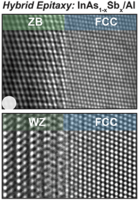
[Phys. Rev. Materials 2, 044202] Published Thu Apr 12, 2018
12 Apr 20:12
by Moreno, C., Vilas-Varela, M., Kretz, B., Garcia-Lekue, A., Costache, M. V., Paradinas, M., Panighel, M., Ceballos, G., Valenzuela, S. O., Pena, D., Mugarza, A.
Nanosize pores can turn semimetallic graphene into a semiconductor and, from being impermeable, into the most efficient molecular-sieve membrane. However, scaling the pores down to the nanometer, while fulfilling the tight structural constraints imposed by applications, represents an enormous challenge for present top-down strategies. Here we report a bottom-up method to synthesize nanoporous graphene comprising an ordered array of pores separated by ribbons, which can be tuned down to the 1-nanometer range. The size, density, morphology, and chemical composition of the pores are defined with atomic precision by the design of the molecular precursors. Our electronic characterization further reveals a highly anisotropic electronic structure, where orthogonal one-dimensional electronic bands with an energy gap of ~1 electron volt coexist with confined pore states, making the nanoporous graphene a highly versatile semiconductor for simultaneous sieving and electrical sensing of molecular species.
12 Apr 20:11
by Zhang, P., Yaji, K., Hashimoto, T., Ota, Y., Kondo, T., Okazaki, K., Wang, Z., Wen, J., Gu, G. D., Ding, H., Shin, S.
Topological superconductors are predicted to host exotic Majorana states that obey non-Abelian statistics and can be used to implement a topological quantum computer. Most of the proposed topological superconductors are realized in difficult-to-fabricate heterostructures at very low temperatures. By using high-resolution spin-resolved and angle-resolved photoelectron spectroscopy, we find that the iron-based superconductor FeTe1–xSex (x = 0.45; superconducting transition temperature Tc = 14.5 kelvin) hosts Dirac-cone–type spin-helical surface states at the Fermi level; the surface states exhibit an s-wave superconducting gap below Tc. Our study shows that the surface states of FeTe0.55Se0.45 are topologically superconducting, providing a simple and possibly high-temperature platform for realizing Majorana states.
12 Apr 07:23
by O. J. Clark, M. J. Neat, K. Okawa, L. Bawden, I. Marković, F. Mazzola, J. Feng, V. Sunko, J. M. Riley, W. Meevasana, J. Fujii, I. Vobornik, T. K. Kim, M. Hoesch, T. Sasagawa, P. Wahl, M. S. Bahramy, and P. D. C. King
Author(s): O. J. Clark, M. J. Neat, K. Okawa, L. Bawden, I. Marković, F. Mazzola, J. Feng, V. Sunko, J. M. Riley, W. Meevasana, J. Fujii, I. Vobornik, T. K. Kim, M. Hoesch, T. Sasagawa, P. Wahl, M. S. Bahramy, and P. D. C. King
We study the low-energy surface electronic structure of the transition-metal dichalcogenide superconductor PdTe2 by spin- and angle-resolved photoemission, scanning tunneling microscopy, and density-functional theory-based supercell calculations. Comparing PdTe2 with its sister compound PtSe2, we de...
[Phys. Rev. Lett. 120, 156401] Published Mon Apr 09, 2018
12 Apr 07:17
by Michael Ruby, Benjamin W. Heinrich, Yang Peng, Felix von Oppen, and Katharina J. Franke
Author(s): Michael Ruby, Benjamin W. Heinrich, Yang Peng, Felix von Oppen, and Katharina J. Franke
Magnetic adsorbates on superconductors induce local bound states within the superconducting gap. These Yu-Shiba-Rusinov (YSR) states decay slowly away from the impurity compared to atomic orbitals, even in 3D bulk crystals. Here, we use scanning tunneling spectroscopy to investigate their hybridizat...
[Phys. Rev. Lett. 120, 156803] Published Wed Apr 11, 2018
12 Apr 07:06
by Christian Wäckerlin, Fabio Donati, Aparajita Singha, Romana Baltic, Silvio Decurtins, Shi-Xia Liu, Stefano Rusponi, Jan Dreiser

The Journal of Physical Chemistry C
DOI: 10.1021/acs.jpcc.7b10941

12 Apr 07:05
by Katherine A. Cochrane, Tanya S. Roussy, Bingkai Yuan, Gary Tom, Erik Mårsell, Sarah A. Burke

The Journal of Physical Chemistry C
DOI: 10.1021/acs.jpcc.8b01396

12 Apr 07:01
by Philippe Faist and Renato Renner
Author(s): Philippe Faist and Renato Renner
A new theoretical analysis derives a precise fundamental lower limit to the work cost for processing information in any type of system, thereby cornering a new microscopic formulation of thermodynamics and shedding light on how far the second law can be applied.

[Phys. Rev. X 8, 021011] Published Tue Apr 10, 2018
05 Apr 16:48
by Shaoxiang Sheng, Runze Ma, Jiang-bin Wu, Wenbin Li, Longjuan Kong, Xin Cong, Duanyun Cao, Wenqi Hu, Jian Gou, Jun-Wei Luo, Peng Cheng, Ping-Heng Tan, Ying Jiang, Lan Chen, Kehui Wu

Nano Letters
DOI: 10.1021/acs.nanolett.8b00289

04 Apr 12:46
by Wenhui Zhao, Hao Zhu, Huanjun Song, Jing Liu, Qiwei Chen, Yuan Wang, Kai Wu

The Journal of Physical Chemistry C
DOI: 10.1021/acs.jpcc.7b12673

03 Apr 07:44
by Yi Liu, Ziqiao Wang, Xuefeng Zhang, Chaofei Liu, Yongjie Liu, Zhimou Zhou, Junfeng Wang, Qingyan Wang, Yanzhao Liu, Chuanying Xi, Mingliang Tian, Haiwen Liu, Ji Feng, X. C. Xie, and Jian Wang
Author(s): Yi Liu, Ziqiao Wang, Xuefeng Zhang, Chaofei Liu, Yongjie Liu, Zhimou Zhou, Junfeng Wang, Qingyan Wang, Yanzhao Liu, Chuanying Xi, Mingliang Tian, Haiwen Liu, Ji Feng, X. C. Xie, and Jian Wang
New experiments show how an unconventional form of superconductivity can be induced in an ultrathin lead film by engineering the interface between the film and its substrate.
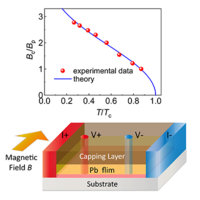
[Phys. Rev. X 8, 021002] Published Mon Apr 02, 2018
28 Mar 19:31
by Hao Wang, Xue Zhang, Zhuoling Jiang, Yongfeng Wang, and Shimin Hou
Author(s): Hao Wang, Xue Zhang, Zhuoling Jiang, Yongfeng Wang, and Shimin Hou
Electron confinement in fractal Sierpiński triangles (STs) on Ag(111) is investigated using scanning tunneling spectroscopy and theoretically simulated by employing an improved two-dimensional (2D) multiple scattering theory in which the energy-dependent phase shifts are explicitly calculated from t...
[Phys. Rev. B 97, 115451] Published Wed Mar 28, 2018
28 Mar 19:30
by Yan-Feng Zhou, Zhe Hou, Ying-Tao Zhang, and Qing-Feng Sun
Author(s): Yan-Feng Zhou, Zhe Hou, Ying-Tao Zhang, and Qing-Feng Sun
The Majorana fermion can be described by a real wave function with only two phases (zero and π) which provide a controllable degree of freedom. We propose a strategy to regulate the phase of the chiral Majorana state by coupling with a scanning tunneling microscope tip in a system consisting of a qu...
[Phys. Rev. B 97, 115452] Published Wed Mar 28, 2018
28 Mar 12:31
by Anna Rosławska, Pablo Merino, Christoph Große, Christopher C. Leon, Olle Gunnarsson, Markus Etzkorn, Klaus Kuhnke, Klaus Kern
Excitons and their constituent charge carriers play the central role in
electroluminescence mechanisms determining the ultimate performance of organic
optoelectronic devices. The involved processes and their dynamics are often
studied with time-resolved techniques limited by spatial averaging that
obscures the properties of individual electron-hole pairs. Here we overcome
this limit and characterize single charge and exciton dynamics at the nanoscale
by using time-resolved scanning tunnelling microscopy-induced luminescence
(TR-STML) stimulated with nanosecond voltage pulses. We use isolated defects in
C$_{60}$ thin films as a model system into which we inject single charges and
investigate the formation dynamics of a single exciton. Tuneable hole and
electron injection rates are obtained from a kinetic model that reproduces the
measured electroluminescent transients. These findings demonstrate that TR-STML
can track dynamics at the quantum limit of single charge injection and can be
extended to other systems and materials important for nanophotonic devices.
28 Mar 07:51
by Qing Li, Biao Yang, Jonas Björk, Qigang Zhong, Huanxin Ju, Junjie Zhang, Nan Cao, Ziliang Shi, Haiming Zhang, Daniel Ebeling, Andre Schirmeisen, Junfa Zhu, Lifeng Chi

Journal of the American Chemical Society
DOI: 10.1021/jacs.7b12278

26 Mar 17:04
by Giulia Avvisati, Claudia Cardoso, Daniele Varsano, Andrea Ferretti, Pierluigi Gargiani, Maria Grazia Betti

Nano Letters
DOI: 10.1021/acs.nanolett.7b04836

26 Mar 16:29
by Jinjie Chen, Hironari Isshiki, Clemens Baretzky, Timofey Balashov, Wulf Wulfhekel

ACS Nano
DOI: 10.1021/acsnano.7b07927

26 Mar 12:00
by Jiaxing Qu, Jun Hu
Search for single-molecule magnets with large magnetic anisotropy energy
(MAE) is essential for the development of molecular spintronics devices used at
room temperature. Through systematic first-principles calculations, we found
that an Os-Os or Ir-Ir dimer embedded in the (5,5'-Br2-Salophen) molecule gives
rise to large MAE of 41.6 or 51.4 meV which is large enough to hold the spin
orientation at room temperature. Analysis of electronic structures reveals that
the top Os and Ir atoms are most responsible for the spin moments and large
MAEs of the molecules.
26 Mar 11:09
by Tomáš Neuman, Ruben Esteban, David Casanova, Francisco J. García-Vidal, Javier Aizpurua

Nano Letters
DOI: 10.1021/acs.nanolett.7b05297

20 Mar 16:50
by Mohammad Rashidi, Robert A. Wolkow
Atomic scale characterization and manipulation with scanning probe microscopy
rely upon the use of an atomically sharp probe. Here we present automated
methods based on machine learning to automatically detect and recondition the
quality of the probe of a scanning tunneling microscope. As a model system, we
employ these techniques on the technologically relevant hydrogen-terminated
silicon surface, training the network to recognize abnormalities in the
appearance of surface dangling bonds. Of the machine learning methods tested, a
convolutional neural network yielded the greatest accuracy, achieving a
positive identification of degraded tips in 97% of the test cases. By using
multiple points of comparison and majority voting, the accuracy of the method
is improved beyond 99%. The methods described here can easily be generalized to
other material systems and nanoscale imaging techniques.
20 Mar 16:29
by De-Liang Bao, Yu-Yang Zhang, Shixuan Du, Sokrates T. Pantelides and Hong-Jun Gao

The Journal of Physical Chemistry C
DOI: 10.1021/acs.jpcc.8b00086

17 Mar 10:04
by Shawulienu Kezilebieke, Marc Dvorak, Teemu Ojanen and Peter Liljeroth

Nano Letters
DOI: 10.1021/acs.nanolett.7b05050


