22 Jun 15:39
by D. Marchenko, A. Varykhalov, J. Sánchez-Barriga, O. Rader, C. Carbone, and G. Bihlmayer
Author(s): D. Marchenko, A. Varykhalov, J. Sánchez-Barriga, O. Rader, C. Carbone, and G. Bihlmayer
The interface of graphene with ferromagnets is highly relevant for spintronics, because graphene on Co(0001) shows a largely intact Dirac cone and strong hybridization with Co 3d states breaking the sublattice symmetry that had been considered mutually exclusive. Here we show by spin- and angle-reso…
[Phys. Rev. B 91, 235431] Published Thu Jun 18, 2015
22 Jun 07:29
by D. Bischoff, M. Eich, F. Libisch, T. Ihn, K. Ensslin
We have investigated electronic transport in graphene nanoribbon devices with
additional bar-shaped extensions ("wings") at each side of the device. We find
that the Coulomb-blockade dominated transport found in conventional ribbons is
strongly modified by the presence of the extensions. States localized far away
from the central ribbon contribute significantly to transport. We discuss these
findings within the picture of multiple coupled quantum dots. Finally, we
compare the experimental results with tight-binding simulations which reproduce
the experiment both qualitatively and quantitatively.
20 Jun 09:05
by David Bléger, Stefan Hecht
Abstract
The ability to influence key properties of molecular systems by using light holds much promise for the fields of materials science and life sciences. The cornerstone of such systems is molecules that are able to reversibly photoisomerize between two states, commonly referred to as photoswitches. One serious restriction to the development of functional photodynamic systems is the necessity to trigger switching in at least one direction by UV light, which is often damaging and penetrates only partially through most media. This review provides a summary of the different conceptual strategies for addressing molecular switches in the visible and near-infrared regions of the optical spectrum. Such visible-light-activated molecular switches tremendously extend the scope of photoswitchable systems for future applications and technologies.

Let there be light: This Minireview outlines different conceptual strategies for the design of photochromic compounds that can be toggled between their two switching states by employing only low-energy visible (or near-infrared) light. All-visible-light photoswitches are promising candidates for future biomedical and material applications.
19 Jun 21:28
by Alejandro de la Peña Ruigómez, David Rodríguez-San-Miguel, Kyriakos C. Stylianou, Massimiliano Cavallini, Denis Gentili, Fabiola Liscio, Silvia Milita, Otello Maria Roscioni , Maria Luisa Ruiz-González, Carlos Carbonell, Daniel Maspoch, Rubén Mas-Ballesté, José Luis Segura, Félix Zamora
Abstract
We report herein an efficient, fast, and simple synthesis of an imine-based covalent organic framework (COF) at room temperature (hereafter, RT-COF-1). RT-COF-1 shows a layered hexagonal structure exhibiting channels, is robust, and is porous to N2 and CO2. The room-temperature synthesis has enabled us to fabricate and position low-cost micro- and submicropatterns of RT-COF-1 on several surfaces, including solid SiO2 substrates and flexible acetate paper, by using lithographically controlled wetting and conventional ink-jet printing.

Printed crystals: An efficient, fast and simple synthesis of an imine-based porous covalent organic framework (COF) at room temperature is reported. The room-temperature synthesis enables fabricating micro- and submicropatterns of this COF on a variety of surfaces by ink-jet printing and wet lithographically techniques.
19 Jun 17:11
by F. Schwarz, Y. F. Wang, W. A. Hofer, R. Berndt, E. Runge and J. Kröger

The Journal of Physical Chemistry C
DOI: 10.1021/acs.jpcc.5b03392

19 Jun 17:08
by Yu-Hsun Chu, Chuang-Han Hsu, Chun-I Lu, Hung-Hsiang Yang, Tsung-Han Yang, Chi-Hung Luo, Kai-Jheng Yang, Shih-Hao Hsu, Germar Hoffmann, Chao-Cheng Kaun and Minn-Tsong Lin

ACS Nano
DOI: 10.1021/acsnano.5b03117

19 Jun 07:35
by Gaël Reecht, Hervé Bulou, Fabrice Scheurer, Virginie Speisser, Fabrice Mathevet, César González, Yannick J. Dappe, Guillaume Schull
A scanning tunnelling microscope is used to pull a polythiophene wire from a
Au(111) surface while measuring the current traversing the junction. Abrupt
current increases measured during the lifting procedure are associated to the
detachment of molecular sub-units, in apparent contradiction with the expected
exponential decrease of the conductance with wire length. \textit{Ab initio}
simulations reproduce the experimental data and demonstrate that this
unexpected behavior is due to release of mechanical stress in the wire, paving
the way to mechanically gated single-molecule electronic devices.
18 Jun 19:16
by Philipp Erler, Peter Schmitt, Nicole Barth, Andreas Irmler, Samuel Bouvron, Thomas Huhn, Ulrich Groth, Fabian Pauly, Luca Gragnaniello and Mikhail Fonin

Nano Letters
DOI: 10.1021/acs.nanolett.5b01120

17 Jun 22:02
by Jens Kügel, Michael Karolak, Andreas Krönlein, Jacob Senkpiel, Pin-Jui Hsu, Giorgio Sangiovanni, and Matthias Bode
Author(s): Jens Kügel, Michael Karolak, Andreas Krönlein, Jacob Senkpiel, Pin-Jui Hsu, Giorgio Sangiovanni, and Matthias Bode
We present a detailed investigation of spectroscopic features located at the central metal ion of MnPc (where Pc represents phthalocyanine) on Ag(001) by means of scanning tunneling spectroscopy (STS) and first-principles theory. STS data taken close to the Fermi level reveal an asymmetric feature t…
[Phys. Rev. B 91, 235130] Published Wed Jun 17, 2015
17 Jun 19:28
by Ryuji Takahashi and Naoto Nagaosa
Author(s): Ryuji Takahashi and Naoto Nagaosa
Berry curvature of Bloch wave functions in solids plays important roles in a variety of phenomena, and its integral over the Brillouin zone defines the topological index. However, the direct observation of the Berry curvature in momentum space has been missing. Here we show theoretically that the Be…
[Phys. Rev. B 91, 245133] Published Mon Jun 15, 2015
17 Jun 19:24
Sexism has no place in science
Nature 522, 7556 (2015). doi:10.1038/522255a
The comments about women in the laboratory made by Nobel laureate Tim Hunt are a reminder that equality in science is a battle still far from won.

17 Jun 15:05
by Giulia E. Pacchioni, Luca Gragnaniello, Fabio Donati, Marina Pivetta, Gabriel Autès, Oleg V. Yazyev, Stefano Rusponi, and Harald Brune
Author(s): Giulia E. Pacchioni, Luca Gragnaniello, Fabio Donati, Marina Pivetta, Gabriel Autès, Oleg V. Yazyev, Stefano Rusponi, and Harald Brune
Fe atoms adsorbed on Cu(111) have been used as an atomic-scale model system for performing spin-based logic operations and to build the smallest stable magnet. In pursuit of understanding the strength of the adatom/substrate hybridization in this system, small Fe clusters down to single atoms adsorbed on a Cu(111) surface were studied using X-ray Absorption Spectroscopy and X-ray Magnetic Circular Dichroism experiments. The spin and orbital moments as well as the magnetic anisotropy energies were extracted experimentally and compared with density functional theory and multiplet calculations. The results show an unexpectedly sharp atomic-like multiplet feature for single Fe atoms which disappears with increasing coverage and cluster size. This indicates a surprisingly weak hybridization of the Fe 3d states to the electronic states of the Cu(111) substrate.
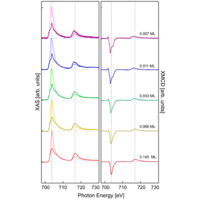
[Phys. Rev. B 91, 235426] Published Tue Jun 16, 2015
17 Jun 07:29
by Alejandro Ferrón, Jose Luis Lado, Joaquín Fernández-Rossier
We study the nature of spin excitations of individual transition metal atoms
(Ti, V, Cr, Mn, Fe, Co and Ni) deposited on a Cu$_2$N/Cu(100) surface using
both spin-polarized density functional theory (DFT) and exact diagonalization
of an Anderson model derived from DFT. We use DFT to compare the structural,
electronic and magnetic properties of different transition metal adatoms on the
surface. We find that the average occupation of the transition metal d shell,
main contributor to the magnetic moment, is not quantized, in contrast with the
quantized spin in the model Hamiltonians that successfully describe spin
excitations in this system. In order to reconcile these two pictures, we build
a multi-orbital Anderson Hamiltonian for the d shell of the transition metal
hybridized with the p orbitals of the adjacent Nitrogen atoms, by means of
maximally localized Wannier function representation of the DFT Hamiltonian. The
exact solutions of this model have quantized total spin, without quantized
charge at the d shell. We propose that the quantized spin of the models
actually belongs to many-body states with two different charge configurations
in the d shell, hybridized with the p orbital of the adjacent Nitrogen atoms.
This scenario implies that the measured spin excitations are not fully
localized at the transition metal.
16 Jun 07:19
by Sujoy Karan, David Jacob, Michael Karolak, Christian Hamann, Yongfeng Wang, Alexander Weismann, Alexander I. Lichtenstein, Richard Berndt
A Mn-porphyrin was contacted on Au(111) in a low-temperature scanning
tunneling microscope (STM). Differential conductance spectra show a zero-bias
resonance that is due to an underscreened Kondo effect according to many-body
calculations. When the Mn center is contacted by the STM tip, the spectrum
appears to invert along the voltage axis. A drastic change in the electrostatic
potential of the molecule involving a small geometric relaxation is found to
cause this observation.
13 Jun 17:45
by Peter Schweyen, Kai Brandhorst, Richard Wicht, Benedikt Wolfram, Martin Bröring
Abstract
The reaction of 5,10,15-trimesitylcorrole (H3cor) with tungsten hexachloride and tungsten hexacarbonyl resulted in the unexpected formation of the 3,17-dichloro-5,10,15-trimesitylcorrole radical (H2cor*) as an air-stable product. X-ray crystallography proved the planarization of the corrole radical structure, which was rationalized by the reduced steric hindrance of two versus three hydrogen atoms inside the N4 cavity. Although the aromaticity was lost, no specific changes in C![[BOND]](http://onlinelibrarystatic.wiley.com/undisplayable_characters/00f8ff.gif) C or CN bond distances could be observed. The regioselectivity of the two-fold chlorination is the result of the nucleophilic attack of chloride ions to an oxidized corrole macrocycle, and is supported by DFT results. The corrole radical acts as a dianionic ligand and allows the insertion of the divalent zinc(II) cation, which usually does not form neutral corrole complexes.
C or CN bond distances could be observed. The regioselectivity of the two-fold chlorination is the result of the nucleophilic attack of chloride ions to an oxidized corrole macrocycle, and is supported by DFT results. The corrole radical acts as a dianionic ligand and allows the insertion of the divalent zinc(II) cation, which usually does not form neutral corrole complexes.

Surprisingly radical was the outcome of an attempt to prepare sterically protected tungsten corroles. Instead of a heavy-metal chelate, a chlorinated corrole radical (see picture) was formed as an air-stable and easy-to-handle open-shell 17π (4n+1) porphyrinoid. The loss of one inner H atom results in a planar molecular structure with the ability to bind divalent metal ions, such as zinc(II).
13 Jun 17:41
by Janina N. Ladenthin, Leonhard Grill, Sylwester Gawinkowski, Shuyi Liu, Jacek Waluk and Takashi Kumagai

ACS Nano
DOI: 10.1021/acsnano.5b02147

13 Jun 17:39
by Rui Shang, Laurean Ilies and Eiichi Nakamura

Journal of the American Chemical Society
DOI: 10.1021/jacs.5b04818

13 Jun 17:38
by Baojie Feng, Hui Li, Sheng Meng, Lan Chen, Kehui Wu
We have performed scanning tunneling microscopy/spectroscopy (STM/STS) study
and first-principles calculations to investigate the atomic structure and
electronic properties of silicon nanoribbons (SiNRs) grown on Ag(110). Despite
of the extensive research on SiNRs in the last decades, its atomic structure is
still not fully understood so far. In this report we determine that the
structure of SiNRs/Ag(110) is armchair silicene nanoribbon with reconstructed
edges. Meanwhile, pronounced quantum well states (QWS) in SiNRs were observed
and their energy spectrum was systematically measured. The QWS are due to the
confinement of quasiparticles perpendicular to the nanoribbon and can be well
explained by the theory of one-dimensional (1D) 'particle-in-a-box' model in
quantum mechanics.
13 Jun 15:17
by Joel Röntynen and Teemu Ojanen
Author(s): Joel Röntynen and Teemu Ojanen
Inspired by the recent experimental observation of topological superconductivity in ferromagnetic chains, we consider a dilute 2D lattice of magnetic atoms deposited on top of a superconducting surface with a Rashba spin-orbit coupling. We show that the studied system supports a generalization of px…
[Phys. Rev. Lett. 114, 236803] Published Fri Jun 12, 2015
11 Jun 18:02
by Andrea Nava, Luca Rigamonti, Ennio Zangrando, Roberta Sessoli, Wolfgang Wernsdorfer, Andrea Cornia
Abstract
Tetrairon(III) single-molecule magnets [Fe4(pPy)2(dpm)6] (1) (H3pPy=2-(hydroxymethyl)-2-(pyridin-4-yl)propane-1,3-diol, Hdpm=dipivaloylmethane) have been deliberately organized into supramolecular chains by reaction with RuIIRuII or RuIIRuIII paddlewheel complexes. The products [Fe4(pPy)2(dpm)6][Ru2(OAc)4](BF4)x with x=0 (2 a) or x=1 (2 b) differ in the electron count on the paramagnetic diruthenium bridges and display hysteresis loops of substantially different shape. Owing to their large easy-plane anisotropy, the s=1 diruthenium(II,II) units in 2 a act as effective seff=0 spins and lead to negligible intrachain communication. By contrast, the mixed-valent bridges (s=3/2, seff=1/2) in 2 b introduce a significant exchange bias, with concomitant enhancement of the remnant magnetization. Our results suggest the possibility to use electron transfer to tune intermolecular communication in redox-responsive arrays of SMMs.

One electron makes the difference: Functionalized single-molecule magnets (SMMs) can be lined up into infinite chains by diruthenium(II,II) or (II,III) paddlewheel complexes. Whereas the reduced dimer (s=1) allows no magnetic communication between adjacent SMMs, the mixed-valent dimer (s=3/2) affords weak intrachain coupling (see hysteresis loops).
11 Jun 12:45
by Jill A. Miwa, Maciej Dendzik, Signe S. Grønborg, Marco Bianchi, Jeppe V. Lauritsen, Philip Hofmann and Søren Ulstrup

ACS Nano
DOI: 10.1021/acsnano.5b02345

11 Jun 12:45
by Hongjun Liu, Hao Zheng, Fang Yang, Lu Jiao, Jinglei Chen, Wingkin Ho, Chunlei Gao, Jinfeng Jia and Maohai Xie

ACS Nano
DOI: 10.1021/acsnano.5b02789

11 Jun 12:44
by Ke Zhu, Yaobiao Xia, Miru Tang, Zhi-Tao Wang, Bryan Jan, Igor Lyubinetsky, Qingfeng Ge, Zdenek Dohnálek, Kenneth T. Park and Zhenrong Zhang

The Journal of Physical Chemistry C
DOI: 10.1021/acs.jpcc.5b04781

10 Jun 16:03
by Rui-Qiang Wang, L. Sheng, M. Yang, Baigeng Wang, and D. Y. Xing
Author(s): Rui-Qiang Wang, L. Sheng, M. Yang, Baigeng Wang, and D. Y. Xing
We investigate the effect of spin-inelastic scattering of Dirac electrons off a high-spin nanomagnet adsorbed on a topological insulator (TI) surface, in which transitions of the nanomagnet between its internal magnetic levels are taken into account, beyond the classic spin theory. It is found that …
[Phys. Rev. B 91, 245409] Published Tue Jun 09, 2015
10 Jun 06:17
Phys. Chem. Chem. Phys., 2015, 17,21837-21844
DOI: 10.1039/C5CP03060A, Paper
Aizhu Wang, Mingwen Zhao
The electronic properties of fractal frameworks based on carbon nitrides have stable ferromagnetism accompanied by half-metallicity, which are highly dependent on the fractal structure.
The content of this RSS Feed (c) The Royal Society of Chemistry

09 Jun 19:10
by N. Kocić, P. Weiderer, S. Keller, S. Decurtins, S.-X. Liu and J. Repp

Nano Letters
DOI: 10.1021/acs.nanolett.5b00711

08 Jun 20:31
by Can Onur Avci
Nature Physics.
doi:10.1038/nphys3356
Authors: Can Onur Avci, Kevin Garello, Abhijit Ghosh, Mihai Gabureac, Santos F. Alvarado & Pietro Gambardella

05 Jun 17:20
by Juan Bartolomé, Fernando Bartolomé, Adriana I. Figueroa, Oana Bunău, Ivan K. Schuller, Thomas Gredig, Fabrice Wilhelm, Andrei Rogalev, Peter Krüger, and Calogero R. Natoli
Author(s): Juan Bartolomé, Fernando Bartolomé, Adriana I. Figueroa, Oana Bunău, Ivan K. Schuller, Thomas Gredig, Fabrice Wilhelm, Andrei Rogalev, Peter Krüger, and Calogero R. Natoli
The observation of an anomalous quadrupolar signal in x-ray magnetic circular dichroism (XMCD) at the Fe K-edge of iron phthalocyanine (FePc) films is reported. All ground states previously suggested for FePc are incompatible with the experimental data. Based on ab initio molecular orbital multiplet…
[Phys. Rev. B 91, 220401(R)] Published Tue Jun 02, 2015
05 Jun 15:03
by M Houssa, A Dimoulas and A Molle
Silicene is the silicon counterpart of graphene, i.e. it consists in a single layer of Si atoms with
a hexagonal arrangement. We present a review of recent theoretical and experimental works on this
novel two dimensional material. We discuss first the structural, electronic and vibrational
properties of free-standing silicene, as predicted from first-principles calculations. We next
review theoretical studies on the interaction of silicene with different substrates. The growth and
experimental characterization of silicene on Ag(1 1 1) is next discussed, providing insights into
the different phases or atomic arrangements of silicene observed on this metallic surface, as well
as on its electronic structure. Recent experimental findings about the likely formation of hexagonal
Si nanosheets on MoS2 are also highlighted.
05 Jun 14:55
by Fabrizio Moro
We report on an example of confined magnetic ions with long spin coherence near room temperature. This was achieved by confining single Mn2+ spins in colloidal semiconductor quantum dots (QDs) and by dispersing the QDs in a proton-spin free matrix. The controlled suppression of Mn–Mn interactions and minimization of Mn–nuclear spin dipolar interactions result in unprecedentedly long phase memory (TM ~ 8 μs) and spin–lattice relaxation (T1 ~ 10 ms) time constants for Mn2+ ions at T = 4.5 K, and in electron spin coherence observable near room temperature (TM ~ 1 μs).
Scientific Reports 5 doi: 10.1038/srep10855


