30 Sep 08:31
by P. Merino
Article
Electrons and holes trapped in a molecular crystal couple to form excitons. Here, the authors use scanning tunnelling microscopy to inject current with submolecular precision into structural defects in solid C 60 and demonstrate single photon emission from the excitons trapped there.
Nature Communications doi: 10.1038/ncomms9461
Authors: P. Merino, C. Große, A. Rosławska, K. Kuhnke, K. Kern

29 Sep 10:56
by Jun Hong Park, Hema C. P. Movva, Evgeniy Chagarov, Kasra Sardashti, Harry Chou, Iljo Kwak, Kai-Ting Hu, Susan K. Fullerton-Shirey, Pabitra Choudhury, Sanjay K. Banerjee and Andrew C. Kummel

Nano Letters
DOI: 10.1021/acs.nanolett.5b02429

29 Sep 10:55
by D. Di Castro, C. Cantoni, F. Ridolfi, C. Aruta, A. Tebano, N. Yang, and G. Balestrino
Author(s): D. Di Castro, C. Cantoni, F. Ridolfi, C. Aruta, A. Tebano, N. Yang, and G. Balestrino
CaCuO2/SrTiO3 heterostructures show interface superconductivity at 40K due to extra oxygen ions in the interface Ca plane, which act as doping holes.
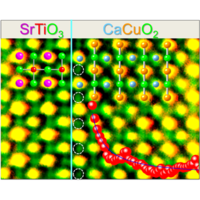
[Phys. Rev. Lett. 115, 147001] Published Mon Sep 28, 2015
29 Sep 10:55
by S. Omar, M. Gurram, I. J. Vera-Marun, X. Zhang, E. H. Huisman, A. Kaverzin, B. L. Feringa, and B. J. van Wees
Author(s): S. Omar, M. Gurram, I. J. Vera-Marun, X. Zhang, E. H. Huisman, A. Kaverzin, B. L. Feringa, and B. J. van Wees
In graphene spintronics, interaction of localized magnetic moments with the electron spins paves a new way to explore the underlying spin-relaxation mechanism. A self-assembled layer of organic cobalt porphyrin (CoPP) molecules on graphene provides a desired platform for such studies via the magneti…
[Phys. Rev. B 92, 115442] Published Fri Sep 25, 2015
27 Sep 12:24
by Mads Engelund
Tunneling spectroscopy of close-spaced dangling-bond pairs in Si(001):H
Scientific Reports, Published online: 25 September 2015; doi:10.1038/srep14496

27 Sep 09:32
by N. Mikuszeit, O. Boulle, I. M. Miron, K. Garello, P. Gambardella, G. Gaudin, L. D. Buda-Prejbeanu
We show that the spin-orbit torque induced magnetization switching in
nanomagnets presenting Dzyaloshinskii-Moriya (DMI) interaction is governed by a
chiral domain nucleation at the edges. The nucleation is induced by the DMI and
the applied in-plane magnetic field followed by domain wall propagation. Our
micromagnetic simulations show that the DC switching current can be defined as
the edge nucleation current, which decreases strongly with increasing amplitude
of the DMI. This description allows us to build a simple analytical model to
quantitatively predict the switching current. We find that domain nucleation
occurs down to a lateral size of 15 nm, defined by the length-scale of the DMI,
beyond which the reversal mechanism approaches a macrospin behavior. The
switching is deterministic and bipolar.
26 Sep 07:49
by Hua Zhang

ACS Nano
DOI: 10.1021/acsnano.5b05040

26 Sep 07:42
by Chendong Zhang, Yuxuan Chen, Amber Johnson, Ming-Yang Li, Lain-Jong Li, Patrick C. Mende, Randall M. Feenstra and Chih-Kang Shih

Nano Letters
DOI: 10.1021/acs.nanolett.5b01968

24 Sep 23:33
by Conor Hogan, Stefano Colonna, Roberto Flammini, Antonio Cricenti, and Fabio Ronci
Author(s): Conor Hogan, Stefano Colonna, Roberto Flammini, Antonio Cricenti, and Fabio Ronci
Using a combination of scanning tunneling microscopy (STM) imaging and total-energy calculations within density functional theory, we evaluate a range of new and existing reconstruction models for Si nanoribbons that form on Ag(110). We propose two models that are consistent with experimental estima…
[Phys. Rev. B 92, 115439] Published Thu Sep 24, 2015
24 Sep 23:26
by Matthew Yankowitz, Devin McKenzie, and Brian J. LeRoy
Author(s): Matthew Yankowitz, Devin McKenzie, and Brian J. LeRoy
Tunneling spectroscopy exhibits suppression of intervalley electronic scattering in the valence band of a monolayer of the transition metal dichalcogenide WSe2.
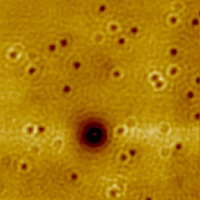
[Phys. Rev. Lett. 115, 136803] Published Thu Sep 24, 2015
24 Sep 22:14
by Letian Dou
Organic-inorganic hybrid perovskites, which have proved to be promising semiconductor materials for photovoltaic applications, have been made into atomically thin two-dimensional (2D) sheets. We report the solution-phase growth of single- and few-unit-cell-thick single-crystalline 2D hybrid perovskites of (C4H9NH3)2PbBr4 with well-defined square shape and large size. In contrast to other 2D materials, the hybrid perovskite sheets exhibit an unusual structural relaxation, and this structural change leads to a band gap shift as compared to the bulk crystal. The high-quality 2D crystals exhibit efficient photoluminescence, and color tuning could be achieved by changing sheet thickness as well as composition via the synthesis of related materials.
Authors: Letian Dou, Andrew B. Wong, Yi Yu, Minliang Lai, Nikolay Kornienko, Samuel W. Eaton, Anthony Fu, Connor G. Bischak, Jie Ma, Tina Ding, Naomi S. Ginsberg, Lin-Wang Wang, A. Paul Alivisatos, Peidong Yang
24 Sep 22:07
by Hung-Hsiang Yang, Yu-Hsun Chu, Chun-I Lu, Christopher John Butler, Raman Sankar, Fang-Cheng Chou and Minn-Tsong Lin

Nano Letters
DOI: 10.1021/acs.nanolett.5b02811

24 Sep 14:43
by Cui-Zu Chang, Peizhe Tang, Xiao Feng, Kang Li, Xu-Cun Ma, Wenhui Duan, Ke He, and Qi-Kun Xue
Author(s): Cui-Zu Chang, Peizhe Tang, Xiao Feng, Kang Li, Xu-Cun Ma, Wenhui Duan, Ke He, and Qi-Kun Xue
The existence of a gapless Dirac surface band of a three dimensional (3D) topological insulator (TI) is guaranteed by the nontrivial topological character of the bulk band, yet the surface band dispersion is mainly determined by the environment near the surface. In this Letter, through in situ angle…
[Phys. Rev. Lett. 115, 136801] Published Wed Sep 23, 2015
24 Sep 14:20
by Dongzhe Li, Cyrille Barreteau, Seiji Leo Kawahara, Jérôme Lagoute, Cyril Chacon, Yann Girard, Sylvie Rousset, Vincent Repain, Alexander Smogunov
The understanding of orbital hybridization and spin-polarization at the
organic-ferromagnetic interface is essential in the search for efficient hybrid
spintronic devices. Here, using first-principles calculations, we report a
systematic study of spin-split hybrid states of C$_{60}$ deposited on various
ferromagnetic surfaces: bcc-Cr(001), bcc-Fe(001), bcc-Co(001), fcc-Co(001) and
hcp-Co(0001). We show that the adsorption geometry of the molecule with respect
to the surface crystallographic orientation of the magnetic substrate as well
as the strength of the interaction play an intricate role in the
spin-polarization of the hybrid orbitals. We find that a large
spin-polarization in vacuum above the buckyball can only be achieved if the
molecule is adsorbed upon a bcc-(001) surface by its pentagonal ring. Therefore
bcc-Cr(001), bcc-Fe(001) and bcc-Co(001) are the optimal candidates.
Spin-polarized scanning tunneling spectroscopy measurements on single C$_{60}$
adsorbed on Cr(001) and Co/Pt(111) also confirm that both the symmetry of the
substrate and of the molecular conformation have a strong influence on the
induced spin polarization. Our finding may give valuable insights for further
engineering of spin filtering devices through single molecular orbitals.
Donate to arXiv
24 Sep 08:16
by J. L. Lado and J. Fernández-Rossier
Author(s): J. L. Lado and J. Fernández-Rossier
Skyrmions are topologically protected spin textures, characterized by a topological winding number N, that occur spontaneously in some magnetic materials. Recent experiments have demonstrated the capability to grow graphene on top Fe/Ir, a system that exhibits a two-dimensional skyrmion lattice. Her…
[Phys. Rev. B 92, 115433] Published Mon Sep 21, 2015
24 Sep 07:55
by Cui-Zu Chang, Peizhe Tang, Xiao Feng, Kang Li, Xu-Cun Ma, Wenhui Duan, Ke He, Qi-Kun Xue
The existence of gapless Dirac surface band of a three dimensional (3D)
topological insulator (TI) is guaranteed by the non-trivial topological
character of the bulk band, yet the surface band dispersion is mainly
determined by the environment near the surface. In this Letter, through in-situ
angle-resolved photoemission spectroscopy (ARPES) and the first-principles
calculation on 3D TI-based van der Waals heterostructures, we demonstrate that
one can engineer the surface band structures of 3D TIs by surface modifications
without destroying their topological non-trivial property. The result provides
an accessible method to independently control the surface and bulk electronic
structures of 3D TIs, and sheds lights in designing artificial topological
materials for electronic and spintronic purposes.
24 Sep 07:41
by A. O. Leonov
Article
Skyrmions—magnetic vortices with an additional twist—have only been observed in a small number of chiral magnets, all with specific non-centrosymmetric structure. Here, the authors suggest that skyrmions can be found in many frustrated magnets as long as they meet a specific set of criteria.
Nature Communications doi: 10.1038/ncomms9275
Authors: A. O. Leonov, M. Mostovoy

23 Sep 09:09
by Cui-Zu Chang, Min-Hao Liu, Zuo-Cheng Zhang, Yayu Wang, Ke He, Qi-Kun Xue
High quality chromium (Cr) doped three-dimensional topological insulator (TI)
Sb2Te3 films are grown via molecular beam epitaxy on heat-treated insulating
SrTiO3(111) substrates. We report that the Dirac surface states are insensitive
to Cr doping, and a perfect robust long-range ferromagnetic order is unveiled
in epitaxial Sb2-xCrxTe3 films. The anomalous Hall effect is modulated by
applying a bottom gate, contrary to the ferromagnetism in conventional diluted
magnetic semiconductors (DMSs), here the coercivity field is not significantly
changed with decreasing carrier density. Carrier-independent ferromagnetism
heralds Sb2-xCrxTe3 films as the base candidate TI material to realize the
quantum anomalous Hall (QAH) effect. These results also indicate the potential
of controlling anomalous Hall voltage in future TI-based magneto-electronics
and spintronics.
23 Sep 09:04
by Zhe Wang
Article
Routes towards inducing strong spin–orbit coupling in graphene have been hindered by detrimental effects on its electronic properties and material quality. Here, the authors demonstrate a possible solution by exploiting interfacial interactions between graphene and a tungsten disulfide substrate.
Nature Communications doi: 10.1038/ncomms9339
Authors: Zhe Wang, Dong–Keun Ki, Hua Chen, Helmuth Berger, Allan H. MacDonald, Alberto F. Morpurgo

23 Sep 08:59
by Bart Ludbrook, Giorgio Levy, Pascal Nigge, Marta Zonno, Michael Schneider, David Dvorak, Christian Veenstra, Sergey Zhdanovich, Douglas Wong, Pinder Dosanjh, Carola Straßer, Alexander Stohr, Stiven Forti, Christian Ast, Ulrich Starke, Andrea Damascelli
Monolayer graphene exhibits many spectacular electronic properties, with
superconductivity being arguably the most notable exception. It was
theoretically proposed that superconductivity might be induced by enhancing the
electron-phonon coupling through the decoration of graphene with an alkali
adatom superlattice [Profeta et al. Nat. Phys. 8, 131-134 (2012)]. While
experiments have indeed demonstrated an adatom-induced enhancement of the
electron-phonon coupling, superconductivity has never been observed. Using
angle-resolved photoemission spectroscopy (ARPES) we show that lithium
deposited on graphene at low temperature strongly modifies the phonon density
of states, leading to an enhancement of the electron-phonon coupling of up to
$\lambda\!\simeq\!0.58$. On part of the graphene-derived $\pi^*$-band Fermi
surface, we then observe the opening of a $\Delta\!\simeq\!0.9$ meV
temperature-dependent pairing gap. This suggests, for the first time, that
Li-decorated monolayer graphene is superconducting at 3.5 K.
23 Sep 07:49
by Chenjia Tang, Chong Liu, Guanyu Zhou, Fangsen Li, Ding Zhang, Zheng Li, Canli Song, Shuaihua Ji, Ke He, Xi Chen, Lili Wang, Xucun Ma, Qi-Kun Xue
Alkali-metal (potassium) adsorption on FeSe thin films with thickness from
two unit cells (UC) to 4-UC on SrTiO3 grown by molecular beam epitaxy is
investigated with a low-temperature scanning tunneling microscope. At
appropriate potassium coverage (0.2-0.3 monolayer), the tunneling spectra of
the films all exhibit a superconducting-like gap larger than 11 meV (five times
the gap value of bulk FeSe), and two distinct features of characteristic phonon
modes at 11 meV and 21 meV. The results reveal the critical role of the
interface enhanced electron-phonon coupling for possible high temperature
superconductivity in the system and is consistent with recent theories. Our
study provides compelling evidence for the conventional pairing mechanism for
this type of heterostructure superconducting systems.
22 Sep 08:32
by Jonathan P. Trinastic, Iek-Heng Chu and Hai-Ping Cheng

The Journal of Physical Chemistry C
DOI: 10.1021/acs.jpcc.5b06885

22 Sep 08:23
by S. P. Jarvis
Article
Manipulation of single molecules can be achieved using scanning probe microscopy but the influence of molecular conformation on this process has, until now, been unclear. Here, the authors probe two different types of porphyrin conformer on a surface and see strong differences in their mechanochemical response.
Nature Communications doi: 10.1038/ncomms9338
Authors: S. P. Jarvis, S. Taylor, J. D. Baran, N. R. Champness, J. A. Larsson, P. Moriarty

22 Sep 08:21
by D. Lock
Article
Hot electrons—electrons with very high kinetic energies—are important in many processes but difficult to observe due to their short lifetimes. Here, the authors analyse STM based nonlocal manipulation of organic molecules on a surface, showing that the measurements probe hot electron dynamics in real space.
Nature Communications doi: 10.1038/ncomms9365
Authors: D. Lock, K. R. Rusimova, T. L. Pan, R. E. Palmer, P. A. Sloan

22 Sep 08:19
by Wolfram Steurer
Article
Detection and manipulation of single charges in molecules are fundamental cornerstones in molecular electronics. Here, Steurer et al . demonstrate a technique with the use of an atomic force microscope that is able to resolve charge states and single electron charge transfer between molecules.
Nature Communications doi: 10.1038/ncomms9353
Authors: Wolfram Steurer, Shadi Fatayer, Leo Gross, Gerhard Meyer

21 Sep 07:48
by Samuel K. Gorman, Matthew A. Broome, William J. Baker, Michelle Y. Simmons
We present an analysis of electron transport through two weakly coupled
precision placed phosphorus donors in silicon. In particular, we examine the
(1,1) to (0,2) charge transition where we predict a new type of current
blockade driven entirely by the nuclear spin dynamics. Using this nuclear spin
blockade mechanism we devise a protocol to readout the state of single nuclear
spins using electron transport measurements only. We extend our model to
include realistic effects such as Stark shifted hyperfine interactions and
multi-donor clusters. In the case of multi-donor clusters we show how nuclear
spin blockade can be alleviated allowing for low magnetic field electron spin
measurements.
18 Sep 18:24
by S. K. Panda, I. Dasgupta, and T. Saha-Dasgupta
Author(s): S. K. Panda, I. Dasgupta, and T. Saha-Dasgupta
We theoretically investigate the electronic and magnetic structure of vacancy bearing K-intercalated Fe chalcogenides (Ch=Se and Te) using first-principles calculations. Motivated by experimental report on the compositions and suggested Fe valences of the parent insulating and superconducting phases…
[Phys. Rev. B 92, 104421] Published Fri Sep 18, 2015
18 Sep 18:23
by Madhab Neupane, Nasser Alidoust, Ilya Belopolski, Guang Bian, Su-Yang Xu, Dae-Jeong Kim, Pavel P. Shibayev, Daniel S. Sanchez, Hao Zheng, Tay-Rong Chang, Horng-Tay Jeng, Peter S. Riseborough, Hsin Lin, Arun Bansil, Tomasz Durakiewicz, Zachary Fisk, and M. Zahid Hasan
Author(s): Madhab Neupane, Nasser Alidoust, Ilya Belopolski, Guang Bian, Su-Yang Xu, Dae-Jeong Kim, Pavel P. Shibayev, Daniel S. Sanchez, Hao Zheng, Tay-Rong Chang, Horng-Tay Jeng, Peter S. Riseborough, Hsin Lin, Arun Bansil, Tomasz Durakiewicz, Zachary Fisk, and M. Zahid Hasan
Rare-earth hexaborides have attracted considerable attention recently in connection to a variety of correlated phenomena including heavy fermions, superconductivity, and low-temperature magnetic phases. Here, we present high-resolution angle-resolved photoemission spectroscopy studies of trivalent C…
[Phys. Rev. B 92, 104420] Published Fri Sep 18, 2015
18 Sep 17:46
by Jay D. Sau and P. M. R. Brydon
Author(s): Jay D. Sau and P. M. R. Brydon
We consider the problem of bound states in strongly anisotropic ferromagnetic impurities in a superconductor, motivated by recent experiments that claim to observe Majorana modes at the ends of ferromagnetic wires on a superconducting substrate [S. Nadj-Perge et al., Science 346, 602 (2014)]. Genera…
[Phys. Rev. Lett. 115, 127003] Published Fri Sep 18, 2015
18 Sep 12:54
by Antoine Hinaut, Rémy Pawlak, Ernst Meyer and Thilo Glatzel
Abstract
Large organic molecules are of important interest for organic-based devices such as hybrid photovoltaics or molecular electronics. Knowing their adsorption geometries and electronic structures allows to design and predict macroscopic device properties. Fundamental investigations in ultra-high vacuum (UHV) are thus mandatory to analyze and engineer processes in this prospects. With increasing size, complexity or chemical reactivity, depositing molecules by thermal evaporation becomes challenging. A recent way to deposit molecules in clean conditions is Electrospray Ionization (ESI). ESI keeps the possibility to work with large molecules, to introduce them in vacuum, and to deposit them on a large variety of surfaces. Here, ESI has been successfully applied to deposit triply fused porphyrin molecules on an insulating KBr(001) surface in UHV environment. Different deposition coverages have been obtained and characterization of the surface by in-situ atomic force microscopy working in the non-contact mode shows details of the molecular structures adsorbed on the surface. We show that UHV-ESI, can be performed on insulating surfaces in the sub-monolayer regime and to single molecules which opens the possibility to study a variety of complex molecules.
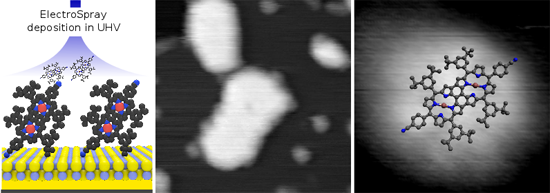
Beilstein J. Nanotechnol. 2015, 6, 1927–1934. doi:10.3762/bjnano.6.195
