ACS Nano
DOI: 10.1021/acsnano.6b08374
The frontier orbital sequence of individual dicyanovinyl-substituted oligothiophene molecules is studied by means of scanning tunneling microscopy. On NaCl/Cu(111) the molecules are neutral and the two lowest unoccupied molecular states are observed in the expected order of increasing energy. On NaCl/Cu(311), where the molecules are negatively charged, the sequence of two observed molecular orbitals is reversed, such that the one with one more nodal plane appears lower in energy. These experimental results, in open contradiction with a single-particle interpretation, are explained by a many-body theory predicting a strongly entangled doubly charged ground state.
Nature Nanotechnology 12, 308 (2017). doi:10.1038/nnano.2016.305
Authors: Niko Pavliček, Anish Mistry, Zsolt Majzik, Nikolaj Moll, Gerhard Meyer, David J. Fox & Leo Gross
Triangulene, the smallest triplet-ground-state polybenzenoid (also known as Clar's hydrocarbon), has been an enigmatic molecule ever since its existence was first hypothesized. Despite containing an even number of carbons (22, in six fused benzene rings), it is not possible to draw Kekulé-style resonant structures for the whole molecule: any attempt results in two unpaired valence electrons. Synthesis and characterization of unsubstituted triangulene has not been achieved because of its extreme reactivity, although the addition of substituents has allowed the stabilization and synthesis of the triangulene core and verification of the triplet ground state via electron paramagnetic resonance measurements. Here we show the on-surface generation of unsubstituted triangulene that consists of six fused benzene rings. The tip of a combined scanning tunnelling and atomic force microscope (STM/AFM) was used to dehydrogenate precursor molecules. STM measurements in combination with density functional theory (DFT) calculations confirmed that triangulene keeps its free-molecule properties on the surface, whereas AFM measurements resolved its planar, threefold symmetric molecular structure. The unique topology of such non-Kekulé hydrocarbons results in open-shell π-conjugated graphene fragments that give rise to high-spin ground states, potentially useful in organic spintronic devices. Our generation method renders manifold experiments possible to investigate triangulene and related open-shell fragments at the single-molecule level.
The structural transformation of supramolecular nanostructures with constitutional diversity and adaptability by dynamic coordination chemistry would be of fundamental importance for potential applications in molecular switching devices. The role of halogen doping in the formation of elementary metal–organic motifs on surfaces has not been reported. Now, the 9-ethylguanine molecule (G) and Ni atom, as a model system, are used for the structural transformation and stabilization of metal–organic motifs induced by iodine doping on Au(111). The iodine atoms are homogeneously located at particular hydrogen-rich locations enclosed by G molecules by electrostatic interactions, which would be the key for such an unexpected stabilizing effect. The generality and robustness of this approach are demonstrated in different metal–organic systems (G/Fe) and also by chlorine and bromine.

Safe harbor: The 9-ethylguanine molecule (G) and Ni atoms are used for the structural transformation and stabilization of metal–organic motifs induced by iodine doping on Au(111). The iodine atoms are homogeneously located at particular hydrogen-rich locations enclosed by G molecules by electrostatic interactions. C gray, H white, O red, N blue, I purple, Ni light blue.
Author(s): Leonardo Banchi, Joaquín Fernández-Rossier, Cyrus F. Hirjibehedin, and Sougato Bose
The flow of information through a wire of coupled magnetic atoms can be shut off by tuning the intrinsic quantum fluctuations in the system with a magnetic field.
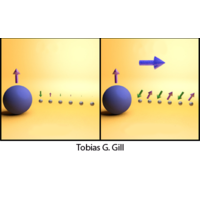
[Phys. Rev. Lett. 118, 147203] Published Wed Apr 05, 2017

Nature Physics. doi:10.1038/nphys4084
Authors: Gil-Ho Lee, Ko-Fan Huang, Dmitri K. Efetov, Di S. Wei, Sean Hart, Takashi Taniguchi, Kenji Watanabe, Amir Yacoby & Philip Kim
On-surface synthesis of aligned functional nanoribbons monitored by scanning tunnelling microscopy and vibrational spectroscopy
Nature Communications, Published online: 3 April 2017; doi:10.1038/ncomms14735
On-surface synthesis, in which molecular units assemble and couple on a defined surface, can access rare reaction pathways and products. Here, the authors synthesize functionalized organic nanoribbons on the Ag(110) surface, and monitor the evolution of the covalent reactions by an unorthodox vibrational spectroscopy approach.


Suppression of quantum tunneling at zero field and field-induced quantum tunneling of magnetization are observed in an extremely rare holmium(III) single-ion magnet and discussed by J.-L. Liu, M.-L. Tong, and co-workers in their Communication on page 4996 ff. These dramatic dynamics are attributed to the combination of a favorable pentagonal-bipyramidal crystal-field environment and the hyperfine interactions arising from 165Ho (I=7/2) with a natural abundance of 100 %.


Nature Physics. doi:10.1038/nphys4080
Authors: Robert Drost, Teemu Ojanen, Ari Harju & Peter Liljeroth
Topological materials exhibit protected edge modes that have been proposed for applications in, for example, spintronics and quantum computation. Although a number of such systems exist, it would be desirable to be able to test theoretical proposals in an artificial system that allows precise control over the key parameters of the model. The essential physics of several topological systems can be captured by tight-binding models, which can also be implemented in artificial lattices. Here, we show that this method can be realized in a vacancy lattice in a chlorine monolayer on a Cu(100) surface. We use low-temperature scanning tunnelling microscopy (STM) to fabricate such lattices with atomic precision and probe the resulting local density of states (LDOS) with scanning tunnelling spectroscopy (STS). We create analogues of two tight-binding models of fundamental importance: the polyacetylene (dimer) chain with topological domain-wall states, and the Lieb lattice with a flat electron band. These results provide an important step forward in the ongoing effort to realize designer quantum materials with tailored properties.
We present a simplified density functional theory (DFT) method to com- pute vertical electron and hole attachment energies to frontier orbitals of molecules absorbed on insulating films supported by a metal substrate. The adsorbate and the film is treated fully within DFT, whereas the metal is treated implicitly by a perfect conductor model. As illustrated for a pentacene molecule adsorbed on NaCl films sup- ported by a Cu substrate, we find that the computed energy gap between the highest and lowest occupied molecular orbitals - HOMO and LUMO -from the vertical attach- ment energies increases with the thickness of the insulating film, in agreement with experiments. This increase of the gap can be rationalized in a simple dielectric model with parameters determined from DFT calculations and is found to be dominated by the image interaction with the metal. However, this model overestimates the down- ward shift of the energy gap in the limit of an infinitely thick film. This work provides a new and efficient strategy to extend the use of density functional theory to the study of charging and discharging of large molecular absorbates on insulating films supported by a metal substrate.
Halogenated buckybowls or bowl-shaped polycyclic aromatic hydrocarbons (BS-PAHs) are key building blocks for the “bottom-up” synthesis of various carbon-based nanomaterials with outstanding potential in different fields of technology. The current state of the art provides quite a limited number of synthetic pathways to BS-PAHs; moreover, none of these approaches show high selectivity and tolerance of functional groups. Herein we demonstrate an effective route to BS-PAHs that includes directed intramolecular aryl–aryl coupling through C−F bond activation. The coupling conditions were found to be completely tolerant toward aromatic C−Br and C−Cl bonds, thus allowing the facile synthesis of rationally halogenated buckybowls with an unprecedented level of selectivity. This finding opens the way to functionalized BS-PAH systems that cannot be obtained by alternative methods.

Efficiency that will bowl you over: The activation of aromatic C−F bonds in the presence of more labile C−Br and C−Cl bonds enabled the fully controlled synthesis of halogenated bowl-shaped polycyclic aromatic hydrocarbons through intramolecular aryl–aryl coupling (see picture). Besides its simplicity and high reproducibility, the technique provides access to halogenated bowl-shaped systems that are not accessible by other methods.
4,4′-Bis(2,6-difluoropyridin-4-yl)-1,1′:4′,1′′-terphenyl (BDFPTP) molecules underwent dehydrocyclization and covalent coupling reactions on Au(111) according to scanning tunneling microscopy (STM) measurements and density functional theory (DFT) calculations. Self-assembly of the reactants in well-defined molecular domains prior to reaction could greatly enhance the regioselectivity of the dehydrocyclization reaction and suppress defluorinated coupling, demonstrating that self-assembly can efficiently steer on-surface reactions. Such a strategy could be of great importance in surface chemistry and widely applied to control on-surface reactions.

Surface-enhanced selectivity: Randomly distributed 4,4′-bis(2,6-difluoropyridin-4-yl)-1,1′:4′,1′′-terphenyl (BDFPTP) undergoes both dehydrocyclization (DHC) and coupling reactions on Au(111). However, the DHC regioselectivity is greatly enhanced and the coupling reaction is completely suppressed when BDFPTP self-assembles on the surface prior to its reactions.
Author(s): Benjamin Doppagne, Michael C. Chong, Etienne Lorchat, Stéphane Berciaud, Michelangelo Romeo, Hervé Bulou, Alex Boeglin, Fabrice Scheurer, and Guillaume Schull
A scanning tunneling microscope is used to excite the fluorescence of single molecules, leading to the observation of well resolved vibronic features. The work opens the way to vibronic spectroscopy with atomic-scale resolution.
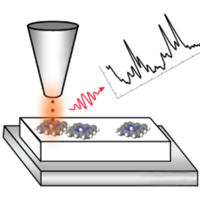
[Phys. Rev. Lett. 118, 127401] Published Tue Mar 21, 2017

Topological states emerge at the boundary of solids as a consequence of the nontrivial topology of the bulk. Recently, theory predicts a topological edge state on single layer transition metal dichalcogenides with 1T' structure. However, its existence still lacks experimental proof. Here, we report the direct observations of the topological states at the step edge of WTe2 by spectroscopic-imaging scanning tunneling microscopy. A one-dimensional electronic state residing at the step edge of WTe2 is observed, which has a spatial extension of about 2.5 nm. First principles calculations rigorously verify the edge state has a topological origin, and its topological nature is unaffected by the presence of the substrate. Our study supports the existence of topological edge states in 1T'-WTe2, which may envision in-depth study of its topological physics and device applications.
The interaction of electrons with a periodic potential of atoms in crystalline solids gives rise to band structure. The band structure of existing materials can be measured by photoemission spectroscopy and accurately understood in terms of the tight-binding model, however not many experimental approaches exist that allow to tailor artificial crystal lattices using a bottom-up approach. The ability to engineer and study atomically crafted designer materials by scanning tunnelling microscopy and spectroscopy (STM/STS) helps to understand the emergence of material properties. Here, we use atom manipulation of individual vacancies in a chlorine monolayer on Cu(100) to construct one- and two-dimensional structures of various densities and sizes. Local STS measurements reveal the emergence of quasiparticle bands, evidenced by standing Bloch waves, with tuneable dispersion. The experimental data are understood in terms of a tight-binding model combined with an additional broadening term that allows an estimation of the coupling to the underlying substrate.

Nature Materials. doi:10.1038/nmat4875
Authors: K. Medjanik, O. Fedchenko, S. Chernov, D. Kutnyakhov, M. Ellguth, A. Oelsner, B. Schönhense, T. R. F. Peixoto, P. Lutz, C.-H. Min, F. Reinert, S. Däster, Y. Acremann, J. Viefhaus, W. Wurth, H. J. Elmers & G. Schönhense
Author(s): C. E. Ekuma, V. Dobrosavljević, and D. Gunlycke
We present a first-principles-based many-body typical medium dynamical cluster approximation and density function theory method for characterizing electron localization in disordered structures. This method applied to monolayer hexagonal boron nitride shows that the presence of boron vacancies could…
[Phys. Rev. Lett. 118, 106404] Published Fri Mar 10, 2017

Author(s): J. Brand, P. Ribeiro, N. Néel, S. Kirchner, and J. Kröger
Charge transport has been examined in junctions comprising the normal-metal tip of a low-temperature scanning tunneling microscope, the surface of a conventional superconductor, and adsorbed C60 molecules. The Bardeen-Cooper-Schrieffer energy gap gradually evolves into a zero-bias peak with decreasi…
[Phys. Rev. Lett. 118, 107001] Published Thu Mar 09, 2017
Author(s): Taner Esat, Rico Friedrich, Frank Matthes, Vasile Caciuc, Nicolae Atodiresei, Stefan Blügel, Daniel E. Bürgler, F. Stefan Tautz, and Claus M. Schneider
We have studied by means of low-temperature scanning tunneling microscopy (STM) and spectroscopy (STS) single molecular spin hybrids formed upon chemisorbing a polycyclic aromatic, threefold symmetric hydrocarbon molecule on Co(111) nanoislands. The spin-dependent hybridization between the Co d stat…
[Phys. Rev. B 95, 094409] Published Thu Mar 09, 2017
Use of molecular electron spins as qubits for quantum computing will depend on the ability to produce molecules with weak but measurable interactions between the qubits. Here we demonstrate use of pulsed EPR spectroscopy to measure the interaction between two inequivalent spins in a hybrid rotaxane molecule.

Use of molecular electron spins as qubits for quantum computing will depend on the ability to produce systems with coherent quantum states and with appropriate interactions between these spins. A pulsed EPR spectroscopy RIDME sequence was used to measure a very weak interaction between two inequivalent spins in a hybrid rotaxane.
Reading and writing single-atom magnets
Nature 543, 7644 (2017). doi:10.1038/nature21371
Authors: Fabian D. Natterer, Kai Yang, William Paul, Philip Willke, Taeyoung Choi, Thomas Greber, Andreas J. Heinrich & Christopher P. Lutz
The single-atom bit represents the ultimate limit of the classical approach to high-density magnetic storage media. So far, the smallest individually addressable bistable magnetic bits have consisted of 3–12 atoms. Long magnetic relaxation times have been demonstrated for single lanthanide atoms in molecular magnets, for lanthanides diluted in bulk crystals, and recently for ensembles of holmium (Ho) atoms supported on magnesium oxide (MgO). These experiments suggest a path towards data storage at the atomic limit, but the way in which individual magnetic centres are accessed remains unclear. Here we demonstrate the reading and writing of the magnetism of individual Ho atoms on MgO, and show that they independently retain their magnetic information over many hours. We read the Ho states using tunnel magnetoresistance and write the states with current pulses using a scanning tunnelling microscope. The magnetic origin of the long-lived states is confirmed by single-atom electron spin resonance on a nearby iron sensor atom, which also shows that Ho has a large out-of-plane moment of 10.1 ± 0.1 Bohr magnetons on this surface. To demonstrate independent reading and writing, we built an atomic-scale structure with two Ho bits, to which we write the four possible states and which we read out both magnetoresistively and remotely by electron spin resonance. The high magnetic stability combined with electrical reading and writing shows that single-atom magnetic memory is indeed possible.