ACS Nano
DOI: 10.1021/acsnano.7b02449


We report on the on-surface synthesis of 7 armchair graphene nanoribbons (7-AGNRs) substituted with nitrile (CN) functional groups. The CN groups are attached to the GNR backbone by modifying the 7-AGNR precursor. While many of these groups survive the on-surface synthesis, the reaction process causes the cleavage of some CN from the ribbon backbone and the on-surface cycloisomerization of few nitriles onto pyridine rings. Scanning Tunneling Spectroscopy and Density Functional Theory reveal that CN groups behave as very efficient n-dopants, significantly downshifting the bands of the ribbon, and introducing deep impurity levels associated to the nitrogen electron lone pairs.
Author(s): C. W. Nicholson, C. Berthod, M. Puppin, H. Berger, M. Wolf, M. Hoesch, and C. Monney
High-resolution angle-resolved photoemission spectroscopy data reveal evidence of a crossover from one-dimensional (1D) to three-dimensional (3D) behavior in the prototypical charge density wave (CDW) material NbSe3. In the low-temperature 3D regime, gaps in the electronic structure are observed due...
[Phys. Rev. Lett. 118, 206401] Published Thu May 18, 2017
Nature Materials. doi:10.1038/nmat4875
Authors: K. Medjanik, O. Fedchenko, S. Chernov, D. Kutnyakhov, M. Ellguth, A. Oelsner, B. Schönhense, T. R. F. Peixoto, P. Lutz, C.-H. Min, F. Reinert, S. Däster, Y. Acremann, J. Viefhaus, W. Wurth, H. J. Elmers & G. Schönhense


A mentor’s acid test
Nature 545, 7654 (2017). doi:10.1038/nj7654-377a
Author: W. Larry Kenney
Mutual respect, guidance and support are key to a fruitful relationship with trainees, says W. Larry Kenney.
Nature Nanotechnology 12, 420 (2017). doi:10.1038/nnano.2017.18
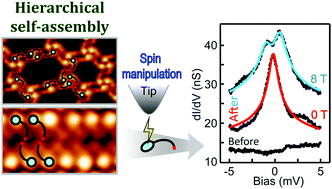
Authors: Taeyoung Choi, William Paul, Steffen Rolf-Pissarczyk, Andrew J. Macdonald, Fabian D. Natterer, Kai Yang, Philip Willke, Christopher P. Lutz & Andreas J. Heinrich
Spin resonance provides the high-energy resolution needed to determine biological and material structures by sensing weak magnetic interactions. In recent years, there have been notable achievements in detecting and coherently controlling individual atomic-scale spin centres for sensitive local magnetometry. However, positioning the spin sensor and characterizing spin–spin interactions with sub-nanometre precision have remained outstanding challenges. Here, we use individual Fe atoms as an electron spin resonance (ESR) sensor in a scanning tunnelling microscope to measure the magnetic field emanating from nearby spins with atomic-scale precision. On artificially built assemblies of magnetic atoms (Fe and Co) on a magnesium oxide surface, we measure that the interaction energy between the ESR sensor and an adatom shows an inverse-cube distance dependence (r−3.01±0.04). This demonstrates that the atoms are predominantly coupled by the magnetic dipole–dipole interaction, which, according to our observations, dominates for atom separations greater than 1 nm. This dipolar sensor can determine the magnetic moments of individual adatoms with high accuracy. The achieved atomic-scale spatial resolution in remote sensing of spins may ultimately allow the structural imaging of individual magnetic molecules, nanostructures and spin-labelled biomolecules.
Electrons in two-dimensional graphene sheets behave as interacting chiral Dirac fermions and have unique screening properties due to their symmetry and reduced dimensionality. By using a combination of scanning tunneling spectroscopy (STM/STS) measurements and theoretical modeling we have characterized how graphene's massless charge carriers screen individual charged calcium atoms. A back-gated graphene device configuration has allowed us to directly visualize how the screening length for this system can be tuned with carrier density. Our results provide insight into electron-impurity and electron-electron interactions in a relativistic setting with important consequences for other graphene-based electronic devices.
Abstract
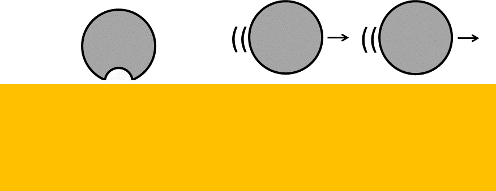
We report on the formation of fullerene-derived nanostructures on Au(111) at room temperature and under UHV conditions. After low-energy ion sputtering of fullerene films deposited on Au(111), bright spots appear at the herringbone corner sites when measured using a scanning tunneling microscope. These features are stable at room temperature against diffusion on the surface. We carry out DFT calculations of fullerene molecules having one missing carbon atom to simulate the vacancies in the molecules resulting from the sputtering process. These modified fullerenes have an adsorption energy on the Au(111) surface that is 1.6 eV higher than that of C60 molecules. This increased binding energy arises from the saturation by the Au surface of the bonds around the molecular vacancy defect. We therefore interpret the observed features as adsorbed fullerene-derived molecules with C vacancies. This provides a pathway for the formation of fullerene-based nanostructures on Au at room temperature.
Beilstein J. Nanotechnol. 2017, 8, 1073–1079. doi:10.3762/bjnano.8.109

The Rashba effect, a spin splitting in electronic band structure, attracts much attention for the potential applications in spintronics with no requirement of external magnetic field. Realizing one-dimensional (1D) Rashba system is a big challenge due to the difficulties of growing high-quality heavy-metal nanowires or introducing strong spin-orbit coupling (SOC) and broken inversion symmetry in flexible materials. Here, based on first-principles calculations, we propose a pathway to realize the Rashba spin-split by adsorbing Gd atom on zigzag graphene nanoribbons (Gd-ZGNR) and further investigate the magnetic anisotropy energy (MAE). Perpendicular MAE and unconventional MAE contributions in k-space are found in the self-assembled Gd-ZGNR system, which present a remarkable Rashba effect (the estimated strength is 1.89 eV {\AA}) attributed to strong SOC (~65.6 meV) and the asymmetric adsorption site at the nanoribbons edge. Moreover, first-order MAE is connected to the intrinsic Rashba effect beyond the traditional second-order MAE, which is confirmed based on the analysis of electronic structures perturbed with SOC in comparison with metastable Gd-ZGNR at central symmetric adsorption site. The dependence of first-order MAE as well as Rashba effect of Gd-ZGNRs on the ribbon width are also examined. This work offers new perspective to achieve 1D Rashba system and provides fundamental understanding on the magnetic anisotropy, which would be of great significance for searching Majorana fermions and promoting the potential applications in spintronics.
Airbnb, an online marketplace for accommodations, has experienced a staggering growth accompanied by intense debates and scattered regulations around the world. Current discourses, however, are largely focused on opinions rather than empirical evidences. Here, we aim to bridge this gap by presenting the first large-scale measurement study on Airbnb, using a crawled data set containing 2.3 million listings, 1.3 million hosts, and 19.3 million reviews. We measure several key characteristics at the heart of the ongoing debate and the sharing economy. Among others, we find that Airbnb has reached a global yet heterogeneous coverage. The majority of its listings across many countries are entire homes, suggesting that Airbnb is actually more like a rental marketplace rather than a spare-room sharing platform. Analysis on star-ratings reveals that there is a bias toward positive ratings, amplified by a bias toward using positive words in reviews. The extent of such bias is greater than Yelp reviews, which were already shown to exhibit a positive bias. We investigate a key issue---commercial hosts who own multiple listings on Airbnb---repeatedly discussed in the current debate. We find that their existence is prevalent, they are early-movers towards joining Airbnb, and their listings are disproportionately entire homes and located in the US. Our work advances the current understanding of how Airbnb is being used and may serve as an independent and empirical reference to inform the debate.
Author(s): Eduardo Mendive-Tapia and Julie B. Staunton
We describe a disordered local moment theory for long-period magnetic phases and investigate the temperature and magnetic field dependence of the magnetic states in the heavy rare earth elements (HREs), namely, paramagnetic, conical and helical antiferromagnetic (HAFM), fan, and ferromagnetic (FM) s...
[Phys. Rev. Lett. 118, 197202] Published Thu May 11, 2017


We use Ca doping during growth of one and two monolayer thick MgO films on Ag(100) to identify the adsorption sites of individual adatoms with scanning tunneling microscopy. For this we combine atomic resolution images of the bare MgO layer with images of the adsorbates and the substitutional Ca atoms taken at larger tip-sample distance. For Ho atoms, the adsorption sites depend on MgO thickness. On the monolayer, they are distributed on the O and bridge sites according to the abundance of those sites, 1/3 and 2/3 respectively. On the MgO bilayer, Ho atoms populate almost exclusively the O site. A third species adsorbed on Mg is predicted by density functional theory and can be created by atomic manipulation. Au atoms adsorb on the bridge sites for both MgO thicknesses, while Co and Fe atoms prefer the O sites, again for both thickness.


Author(s): Jonathan Reiner, Abhay Kumar Nayak, Nurit Avraham, Andrew Norris, Binghai Yan, Ion Cosma Fulga, Jung-Hyun Kang, Torsten Karzig, Hadas Shtrikman, and Haim Beidenkopf
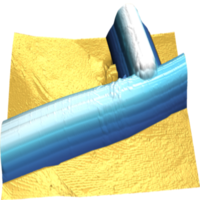
Understanding the behavior of electrons in semiconducting nanowires is hindered by difficulties in probing these delicate structures. Development of a portable chamber, which keeps the nanowires under ultrahigh vacuum from growth to measurement, allows for the first thorough study of electron phase coherence in a semiconducting nanowire.
[Phys. Rev. X 7, 021016] Published Fri May 05, 2017
Author(s): Jiaqi Guan, Jian Liu, Bing Liu, Xiaochun Huang, Qing Zhu, Xuetao Zhu, Jiatao Sun, Sheng Meng, Weihua Wang, and Jiandong Guo
We prepared superconducting and nonsuperconducting FeSe films on SrTiO3(001) substrates (FeSe/STO) and investigated the superconducting transition induced by charge transfer between organic molecules and FeSe layers by low temperature scanning tunneling microscopy and spectroscopy. At low coverage, …
[Phys. Rev. B 95, 205405] Published Thu May 04, 2017