Shared posts

26 Dec 17:17

The greatest keyboard never sold

by Ross Rubin

Even as the latest phones and wearables tout speech recognition with unprecedented accuracy and spatial computing products flirt with replacing tablets and laptops, physical keyboards remain beloved for their efficiency. Earlier this year, for example, sci-fi novelist Robert J. Sawyer created a comprehensive archive of files that enables modern PCs to run WordStar 7, the DOS program’s final version. He favors the once-dominant word processor, also used by Game of Thrones author George R. R. Martin, in part because of its effective use of “home row” keyboard shortcuts to speed navigation and editing.

The keyboard is also a vibrant target for tinkering. Crowdfunding campaigns over the past year or so have included Mobile Pixels’ Tetra, a split keyboard with a repositionable screen; Naya Create, a sloping, modular keyboard; the Clevetura CLV1, which integrates trackpad functionality into the keys themselves; and the Flux, a keyboard that combines control modules and a display under the keys for infinite combinations of appearance and function.
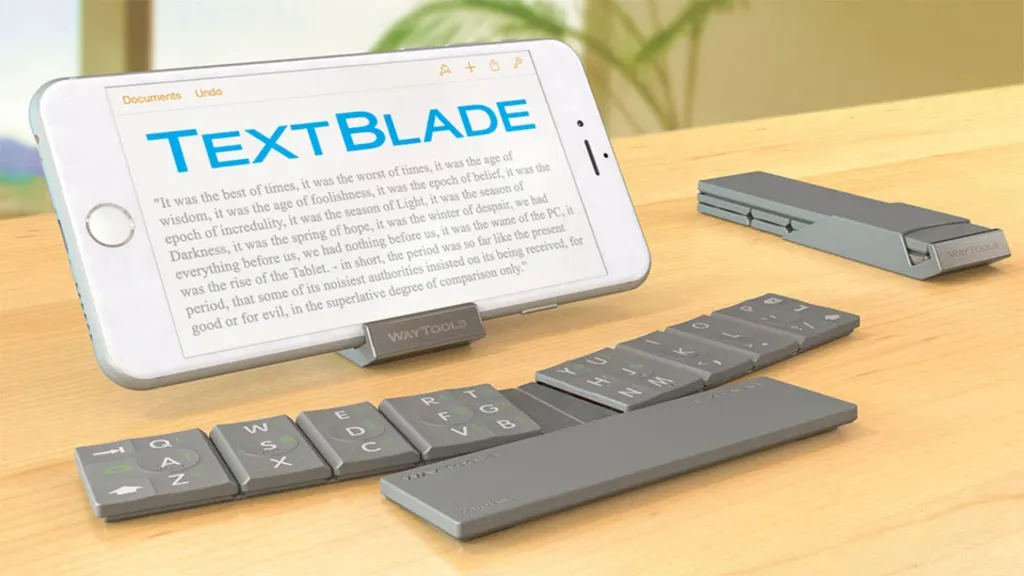
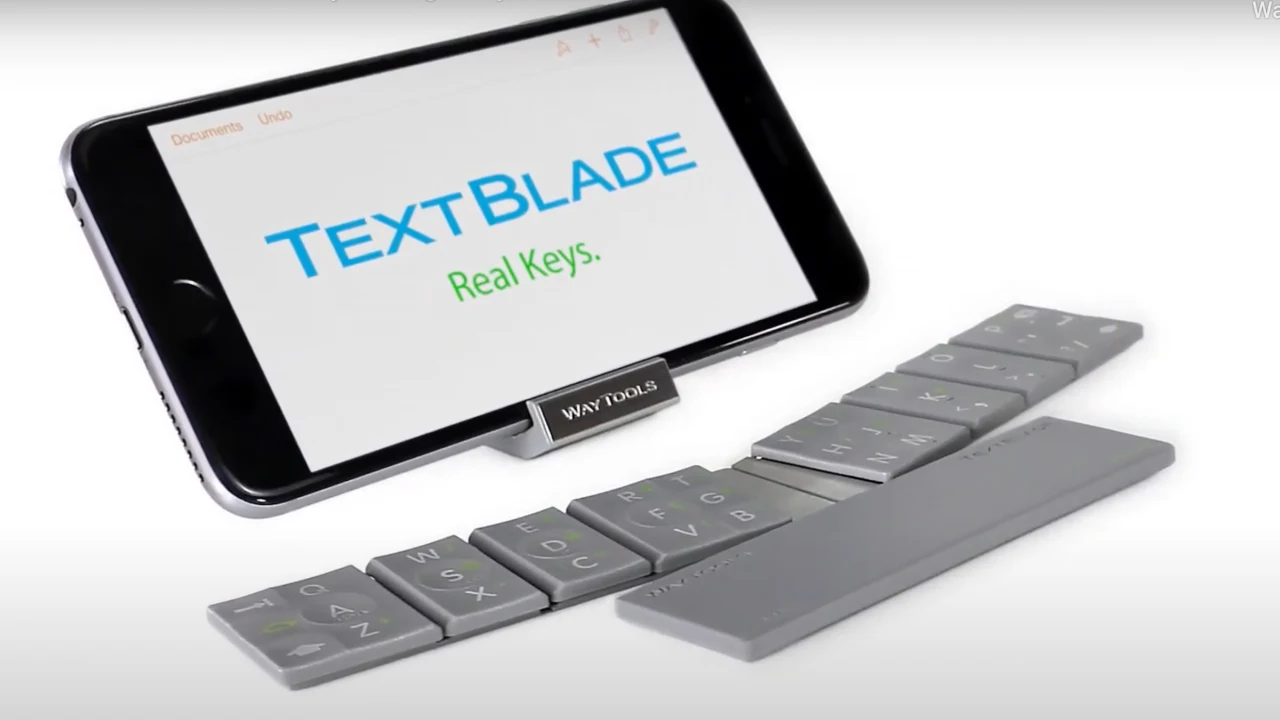
The TextBlade setup, including a stand that could prop up a phone or tablet.

Alas, neither WordStar nor these daring designs are well-suited to mobile usage. On that front, Michael Fisher (aka Mr Mobile) and Kevin Michalu (aka Crackberry Kevin)—two tech media veterans with keyboard phone nostalgia coursing through their thumbs—teamed up to launch the Clicks keyboard for iPhones this year. While a well-designed accessory, it adds significant height to what can already be a large phone. And like the Blackberry keyboards that inspired it, it can be uncomfortable for extended text-entry sessions.

Such have long been the compromises of typing on the go. But in 2015, a keyboard that looked and worked like nothing before or since went up for preorder. It claimed to capture the holy grail of a comfortable and familiar typing experience in a pocket-friendly package. It promised to turn phones into text-entry powerhouses and halve the thickness of tablets paired with keyboard covers. And as it got close to release, the company solicited feedback from a community of passionate testers who loved the product and pleaded with the company to release it. But this breakthrough device never shipped to customers.
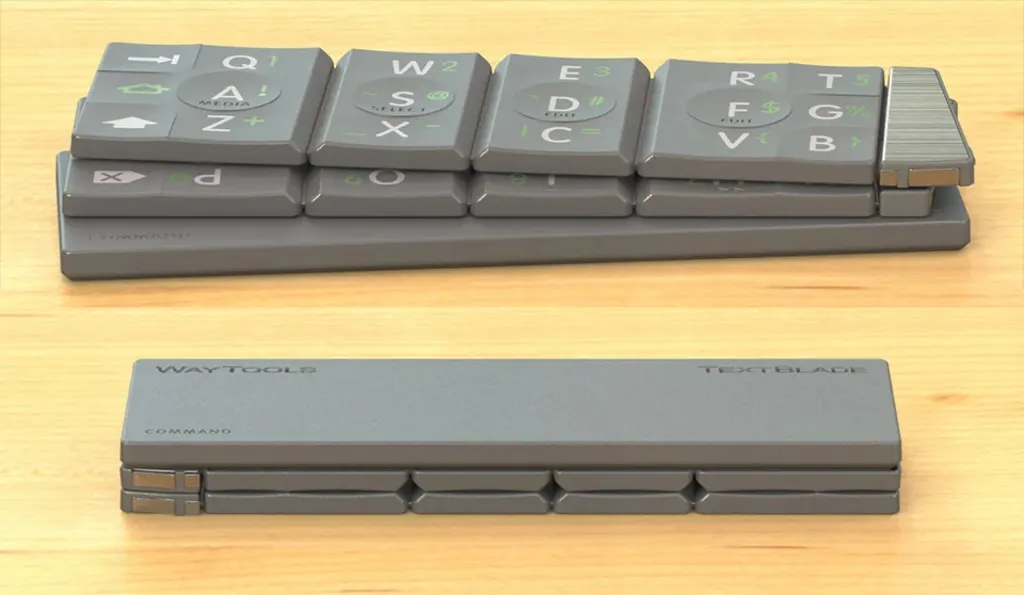
TextBlade managed to squeeze a remarkably pleasant typing experience into three gum-stick-sized slivers of hardware.

WayTools’s TextBlade consisted of three rectangular sections, each about the size of a stick of gum. Its “KeyBlades,” which split the letters of a QWERTY layout, attached magnetically to each other and an oversize space bar called the SpaceBlade. The heart of the product, the SpaceBlade included the device’s battery, Bluetooth radio, and a line of 10 LEDs that indicated the device’s status and modes. When not in use, the three sticks neatly stacked magnetically, sliding into a plastic brace that doubled as a stand for a smartphone or tablet.

WayTools even sweated the details when it came to charging the TextBlade. Lightly knocking the SpaceBlade against a surface such as the side of your hand dislodged a half-height USB “nano charger” adapter with metal contacts that connected to the SpaceBlade. After charging, the adapter could be docked back into the SpaceBlade like the stylus in a Samsung Galaxy Note or S24 Ultra.

But the TextBlade’s Voltron-like assembly setup was just the beginning of its bag of tricks. Despite being a fraction of the size of a standard laptop keyboard with its segments all connected, it offered a shockingly comfortable typing experience that included 19 mm key width for most keys and a competitive 1.5 mm of key travel. Instead of each key sitting atop a separate switch, vertically adjacent keys shared a butterfly switch, and the TextBlade detected which character was being typed.

Layers and chords

The TextBlade also defied expectations with its functionality. Despite having only 37 keys (including the space bar) on nine switches, it could produce far more characters by combining layers and chords. Layers (modes) expanded the concept of modifier keys (like the Mac’s Option key that changes the output of the “G” key to a copyright symbol). Chords, long used by stenographs, assistive text input devices, and gamers looking to maximize on-screen actions while minimizing finger movements, allowed triggering different outputs when multiple keys are held down at the same time. For example, when using the TextBlade with an Apple device, holding down C and V together before pressing F would enter Command-F. And holding down Z, X, and V equated to pressing Control and Alt together on a larger keyboard.

Activating the TextBlade’s Edit layer turned the I, J, K, and L keys into gaming-style cursor keys. This layer also included one-key shortcuts for Clipboard operations, undo and redo. Adding “S” in this mode turned text cursor movements into cursor-based selection. And adding the space bar to the mix allowed you to navigate or select by paragraph or even across a whole document. Holding down A, S, D, and F activated a Media layer that turned other keys into controls playback and volume. Adding the space bar activated an App layer that allowed switching among windows or apps. Pressing K and L activated the Function layer, enabling other keys to act as up to 20 function keys, the ones typically located above the number row on a desktop keyboard. And holding down the J and K keys activated a Macro layer that could enter snippets of text triggered by any other TextBlade key.

While elegant and powerful, mastering layers and chords did have something of a learning curve. To help with the journey, WayTools developed an iOS on-screen keyboard that reflected the dynamic functions changing in response to chord presses. It also developed a companion iOS app that included a guide, a way to tweak many settings, and the ability to update the keyboard’s firmware. The app saved settings, macros, and custom keymaps in a cloud account so that they wouldn’t be lost if the TextBlade was lost or damaged.

Living up to the hype

For months after the preorder launch, a calendar on waytools.com kept shifting when orders from which batch would ship. Then, in 2016, WayTools welcomed some customers to test TextBlades in development through a program called TREG (Test Release Group) along with an online forum to discuss feedback. I joined TREG late in the game in 2019. Admittance included a one-hour tour of the TextBlade in a phone call with the company’s founder and CEO, Mark Knighton, who clearly relished peeling back each layer of cleverness that had gone into the product’s design. His infectious enthusiasm notwithstanding, the proof was in the pressing.

The TextBlade lived up to the hype. I took it everywhere and found myself typing things into my phone in locations such as a small cafe table where a keyboard simply wouldn’t fit. Nonetheless, when I checked in with Knighton by phone after a few weeks, he seemed disappointed that I wasn’t using the TextBlade as my primary keyboard. He firmly believed that the TextBlade was not just the best mobile keyboard—which it clearly was—but so superior to other options that users would want to use it with all of their devices. After all, it could switch among six paired devices on the fly.

I would also visit the TREG message boards, which were filled with discussions about bugs and potential features. But by far the most prevalent sentiment offered there was that the TextBlade was amazing, even revolutionary, and that WayTools should ship the damn thing already. Trace Rogers, a former TREG participant who produced an exhaustive two-hour YouTube tour of the TextBlade in 2020 after more than three years in the program, wraps up his presentation by saying, “I love my TextBlade. I use it all the time. I wish it was for sale right now at Best Buy.” Despite also crediting the TextBlade with relieving his carpal tunnel pain, he says in the video that he wouldn’t recommend prepurchasing it until it shipped, given the unclear release timeline. 

Such a timeline would never arrive. WayTools continued to add and revise software features, so much so that it ran out of room in the TextBlade’s firmware. Its solution was to rewrite the firmware completely, a huge engineering effort coming years after accepting preorders from people who hadn’t received the device. The rewrite would open the door to even more advanced capabilities, a head-scratching possibility for a product that already had far more features than many of its users would ever discover. More of those who had preordered the product took the company up on its promise of an unconditional refund and some who criticized WayTools had their preorders refunded involuntarily.

Missing in action

Unlike some device startups, WayTools survived COVID and the pandemic’s supply chain havoc overhang. At some point, though, the WayTools TREG forum disappeared, followed by the rest of the website. The Wayback Machine’s last snapshot of a functioning waytools.com was taken on February 24, 2023.

Theories abound on why WayTools refused to ship a product that clearly exceeded the expectations of its testers and which it could have improved over time via firmware updates. A former employee with whom I spoke refuted the notion that WayTools never wanted to sell the TextBlade and instead wanted to sell or license the intellectual property behind it, noting that the company rebuffed multiple acquisition offers in the early days.

Rather, he notes, an undisclosed fire at a supplier that wiped out much of WayTools’s inventory was the most significant blow to the company, which had already spent much of its funding to develop the product. A former staffer notes, “We lost a lot of people and talent after that. It was heartbreaking to work so hard on a product and be so close and then have a natural disaster come and basically wipe it out.”

However, former WayTools staffers also lay some blame at the feet of Knighton, whom I was unable to reach for comment. One described him as “a perfectionist who cared deeply about the customer experience” but who lost sight of customers’ patience. Knighton, who admired icons like Steve Jobs and Elon Musk, would reportedly wax on about his positive experience as a Tesla owner and not wanting to risk a disappointing first impression. Indeed, like Musk with Tesla and SpaceX and Jobs with Apple and Pixar, Knighton was also running a second company, a developer of 3D scanners called NextEngine that met the same fate as WayTools after much of the former’s inventory was destroyed in the same fire.

Knighton also felt the heat of legal issues. Since 2009, Knighton and NextEngine have been embroiled in litigation with an investor, Bigfoot Ventures. Last year, Bigfoot Ventures sued Knighton for personal injury and included WayTools as a defendant. According to one of the former staffers I contacted, the lawsuits crippled Knighton’s ability to do creative work.

While the delay needed to re-create inventory prompted the decision to rewrite the firmware, the impact of the fire and the distraction and expense of the litigation ultimately proved overwhelming.

Final cut

While there’s little evidence that WayTools still exists, Knighton never acknowledged the end of the company. There were no farewell web pages or Medium mea culpas about lessons learned. But nine years after TextBlade promised to reinvent the mobile typing experience, nothing has come close to capturing its geeky genius. One former WayTools employee who still uses a TextBlade calls it an “incredibly useful product [that] was ready to ship. It would have made a lot of people very happy.” Like others with whom I spoke, he hopes some party will one day bring the TextBlade to market, adding, “I would love to see this come to the world.”

Today, the closest product in spirit to the TextBlade is the CharaChorder X, a crowdfunded and shipping USB dongle that lets any external keyboard become a chording keyboard. CharaChorder, a company that uses the slogan “typing at the speed of thought,” has also created its own text input devices. All use CharaChorder Engine, an operating system for input devices it hopes to license to laptop makers. But while CharaChorder X shares many of the TextBlade’s nods to efficiency and customization and preserves the standard QWERTY layout, it doesn’t provide the integration and extreme portability of the TextBlade.

There’s also the TapXR, a wrist-worn Bluetooth text input and XR controller device that generates characters via chords generated by finger-tapping combinations. It’s small and even allows one-handed input but isn’t nearly as efficient as the TextBlade was and has a steeper learning curve. 

I still have my TextBlade TREG unit, which developed an issue that caused it to type garbled text after being paired to a device; repeating the pairing process fixes the issue. Its three stacked layers remain a brilliantly engineered sandwich of efficiency and execution. It’s a shame WayTools couldn’t serve it to a hungry user base.
18 Jan 00:27

Holy Basil (Los Angeles, CA)

by kevinEats
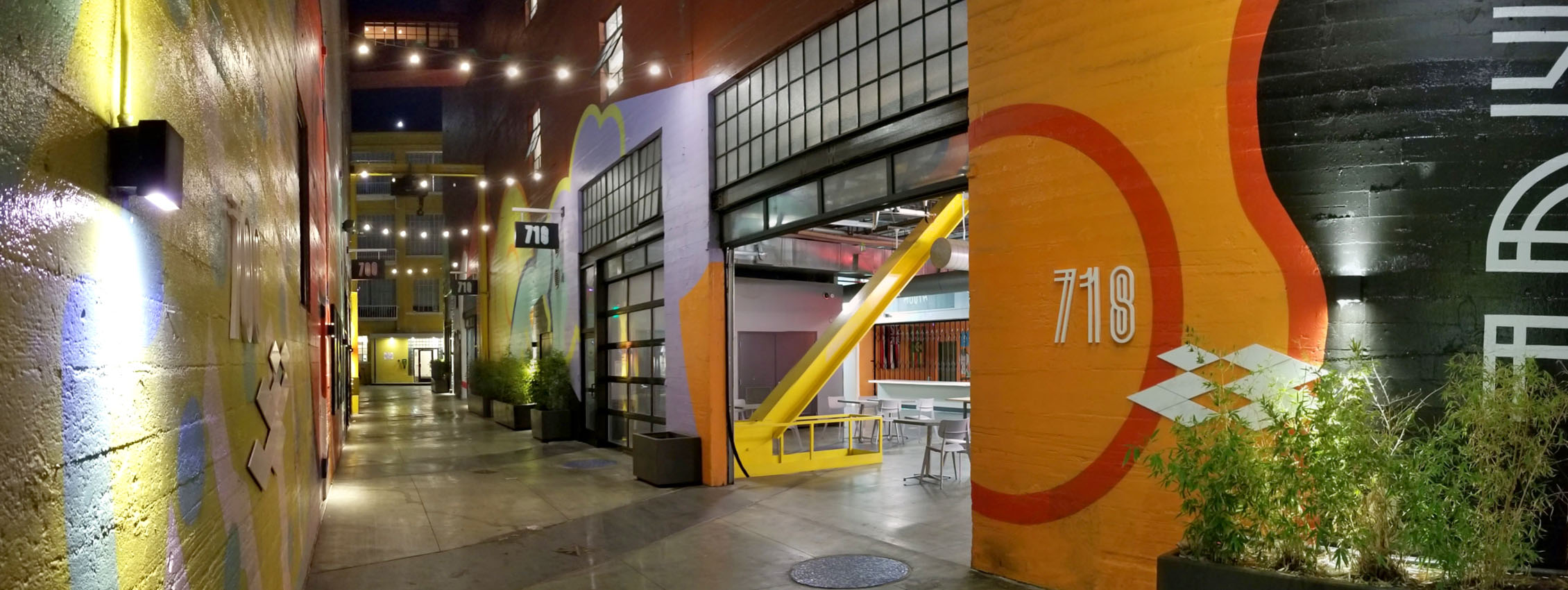
Holy Basil DTLA at Santee Passage
718 S Los Angeles St, Los Angeles, CA 90014
213.559.4994
www.holybasildtla.com
Sun 01/02/2022, 07:45p-09:20p


Holy Basil Food Stall

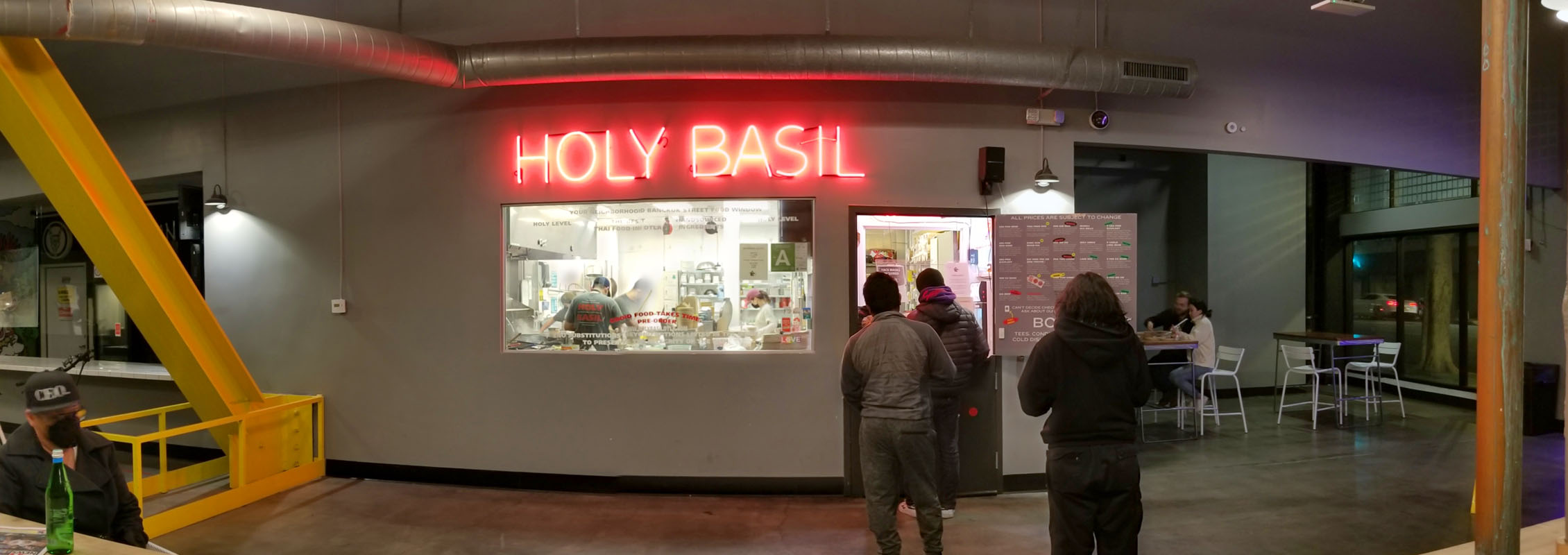
It turns out that it's been years since I last reported on a Thai restaurant, so I recently decided that I wanted to change that. After considering a few options, I ended up getting takeout from Holy Basil, which seems like the most bandied about Thai eatery as of late. Situated on the edge of the Fashion District, adjacent to Downtown's Historic Core, the stall is located in a sort of proto-food court and specializes in Bangkok-style street food. Meanwhile, the people behind this place are Chef Wedchayan "Deau" Arpapornnopparat and Tongkamal "Joy" Yuon, as well as Methawee Greebmalai.

A bit of history: The story of Holy Basil begins with Wedchayan Arpapornnopparat, a Bangkok native from a food-loving family who relocated to Bangalore, India in 6th grade. He attended high school at The International School Bangalore from 2002 to 2006, and after finishing up there, soon found his way to the United States. After settling in Southern California, he quickly began working part-time at Chan Dara, a now-departed Thai eatery in Sawtelle, which is where he first met fellow Bangkokian Tongkamal Yuon. He started out as a busboy, while she was the bartender, but they slowly made their way up the ranks; the pair were there for roughly eight years. During this time, Arpapornnopparat also studied fine arts at Santa Monica City College, but later transferred to ArtCenter College of Design in Pasadena in 2014, where he majored in graphic design (c/o 2017). Around this period, he and Yuon attempted to sell various Thai food products at festivals, but were not successful in their endeavors.

However, they eventually founded The Base Co, a natural sweetener brand (its design/packaging was actually one of Arpapornnopparat's school projects), which later spawned its own ready-to-drink beverage pop-up called Happiness Capsule. The Base Co started out at Smorgasburg LA before spreading to other events, and its success allowed the Chef to quit his design job at Snap Inc. In 2019, the duo began serving Thai drinking food next to Chinese Laundry in Highland Park (having known Chinese Laundry's owners from Smorgasburg). After deciding to locate The Base Co's headquarters in the Santee Court complex, they moved their operation there, and during the pandemic, commenced cooking in an alley next to their future restaurant space (Sundays only, for three hours). By late 2020, Arpapornnopparat was able to move his kitchen indoors, and Holy Basil finally grand-opened in early 2021; it also joined the line-up at Smorgasburg in July. In November last year, the place was deemed one of the LA Times' "101 Best Restaurants," while not long after, The Infatuation named it one of "LA's Best New Restaurants of 2021."

Holy Basil Menu
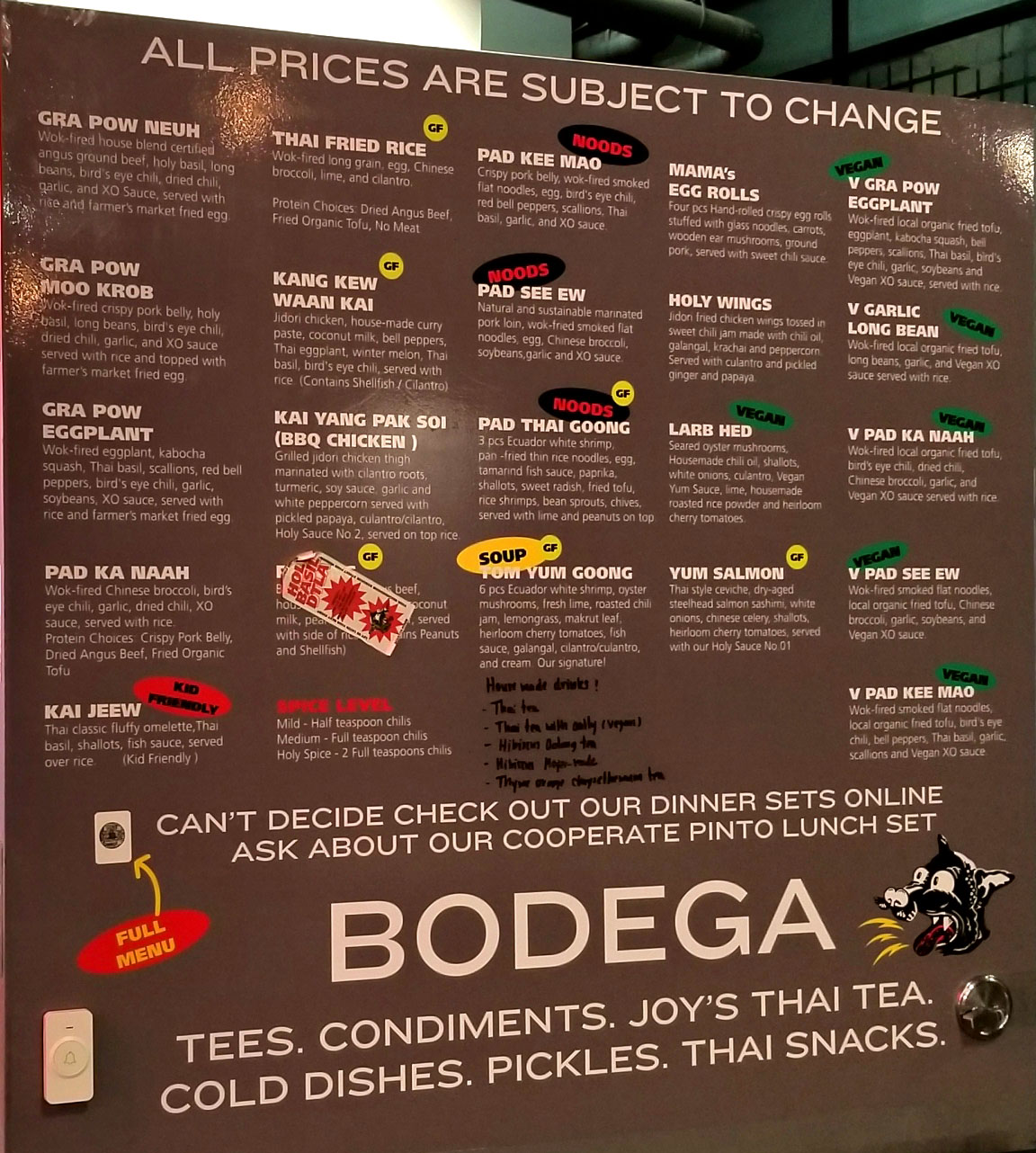
Pictured above is Holy Basil's refreshingly compact menu, which is focused on Arpapornnopparat's interpretations of central Thailand street food and other staple dishes. Click for a larger version.

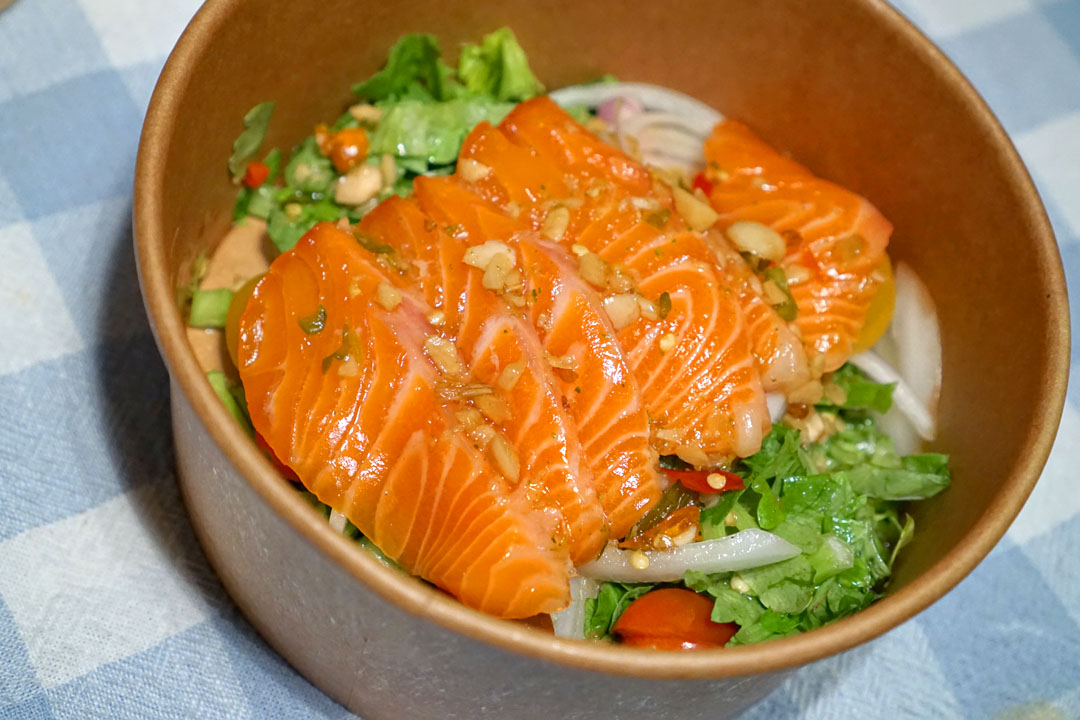
Yum Dry Aged Salmon
Yum Salmon [$18.00] | Thai style ceviche, dry-aged steelhead salmon sashimi, white onions, chinese celery, shallots, heirloom cherry tomatoes, served with our Holy Sauce No.01
Cuts of salmon showed off a smooth, silky consistency, while the fish's lush, fatty flavors worked just about perfectly with the sting of the dish's acidity and multipronged spice. Of particular note was the astringency of the celery-onion combination, and I also enjoyed the contrast in texture provided by the veggies. A fantastic start to the meal, and one that really acted as a statement of purpose.

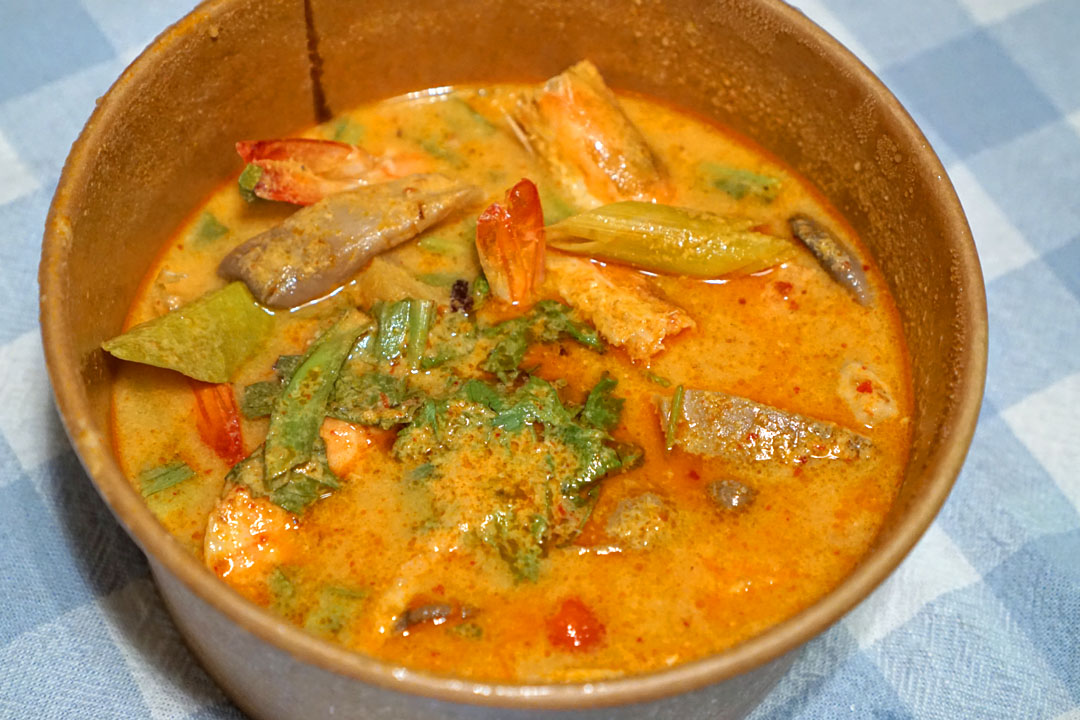
Tom Yum Goong
Tom Yum Goong [$16.00] | 6 pcs Ecuador white shrimp, oyster mushrooms, fresh lime, roasted chili jam, lemongrass, makrut leaf, heirloom cherry tomatoes, fish sauce, galangal, cilantro/culantro, and cream. Our signature!
In the Chef's take on the iconic tom yum soup, we had a wonderfully fragrant, heady broth that was simultaneously powerful yet elegant, balancing its sweetness with both heat and an herbaceous pungency. As for the shrimp, they were a bit more cooked than I would've liked, though they did deliver a blast of saline that really did meld with the potency of the soup.

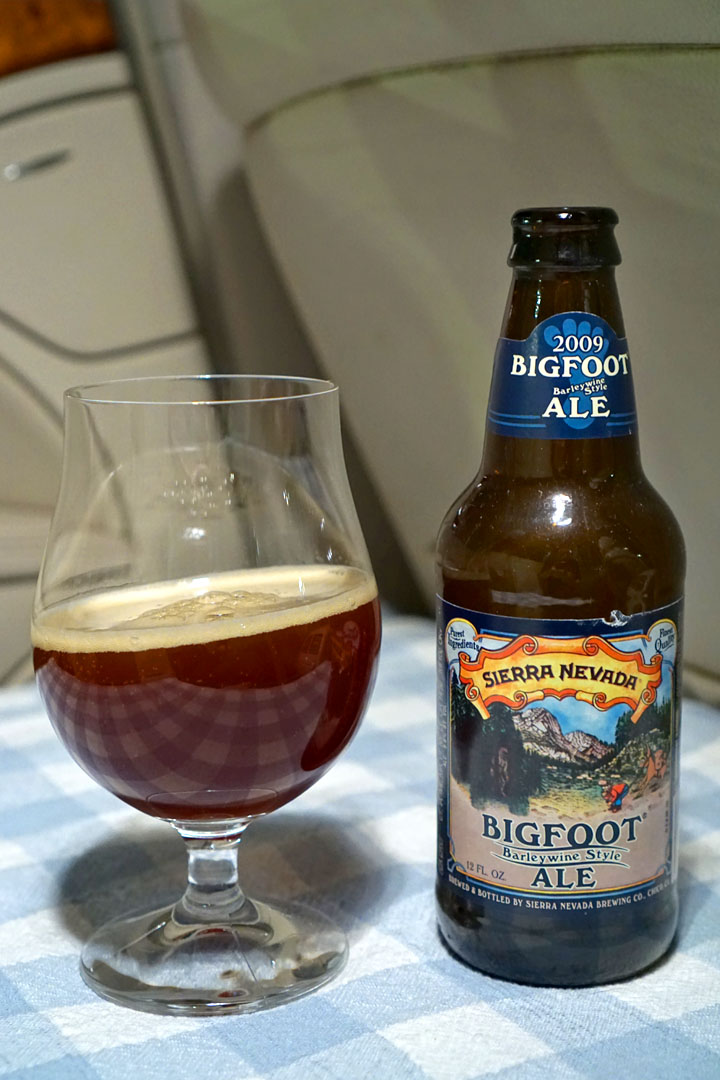
2009 Sierra Nevada Bigfoot Barleywine Style Ale
Beverage-wise tonight, I wanted to drink something old and something new, and for the former, I opted for the 2009 Sierra Nevada Bigfoot Barleywine Style Ale. The beer smelled of robust dried dark fruit commingled with malt and toffee, with a tinge of metallic in there. In terms of taste, I got tangy prunes up front, leading to flavors of brown sugar and chocolate-y malt, while the finish was unexpectedly hoppy. I found this pretty easy-drinking overall, and I'd say that it's held up rather well over the years.

Handmade Mama's Egg Rolls
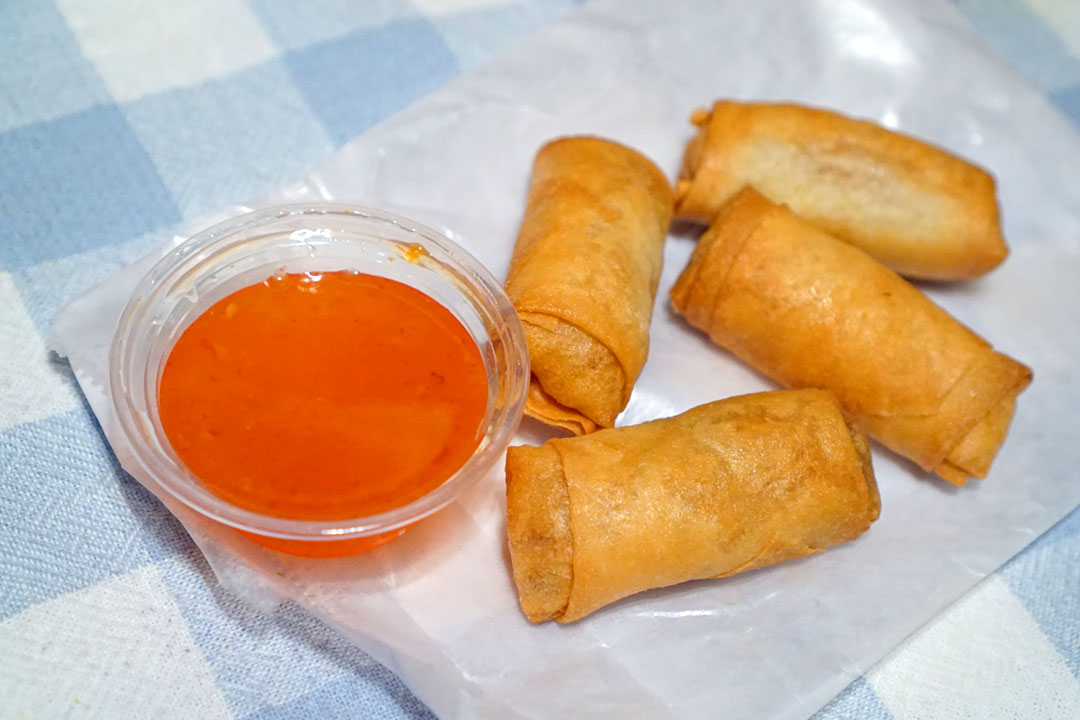
Mama's Egg Rolls [$6.00] | Four pcs Hand-rolled crispy egg rolls stuffed with glass noodles, carrots, wooden ear mushrooms, ground pork, served with sweet chili sauce
Egg rolls featured surprisingly thick, substantial wrappers, while the filling did a nice job playing glass noodles against wood ear and pork, though unfortunately, it was also drier than I wanted. Thus, the included sweet chili condiment was absolutely key, adding another dimension that really enlivened the dish.

Gra Pow Neuh
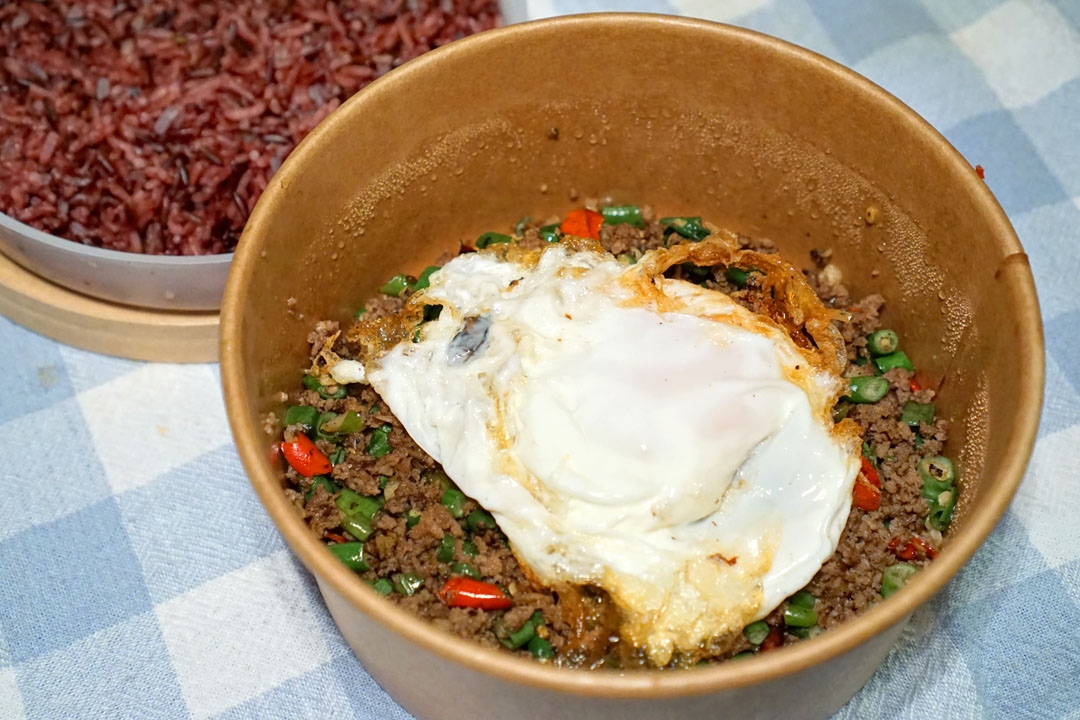
Gra Pow Neuh [$15.00] | Wok-fired house blend certified angus ground beef, holy basil, long beans, bird's eye chili, dried chili, garlic, and XO sauce, served with rice and farmer's market fried egg
The kaphrao was one of the most intense dishes of the night. The heat was real, and it was a piercing, vegetal one that combined beautifully with overarching aromatics of holy basil and the depth of XO. Given the robustness of everything going on here, the runny egg and nutty, purple-tinted rice were absolutely crucial to keep things in check.

Kai Jeew
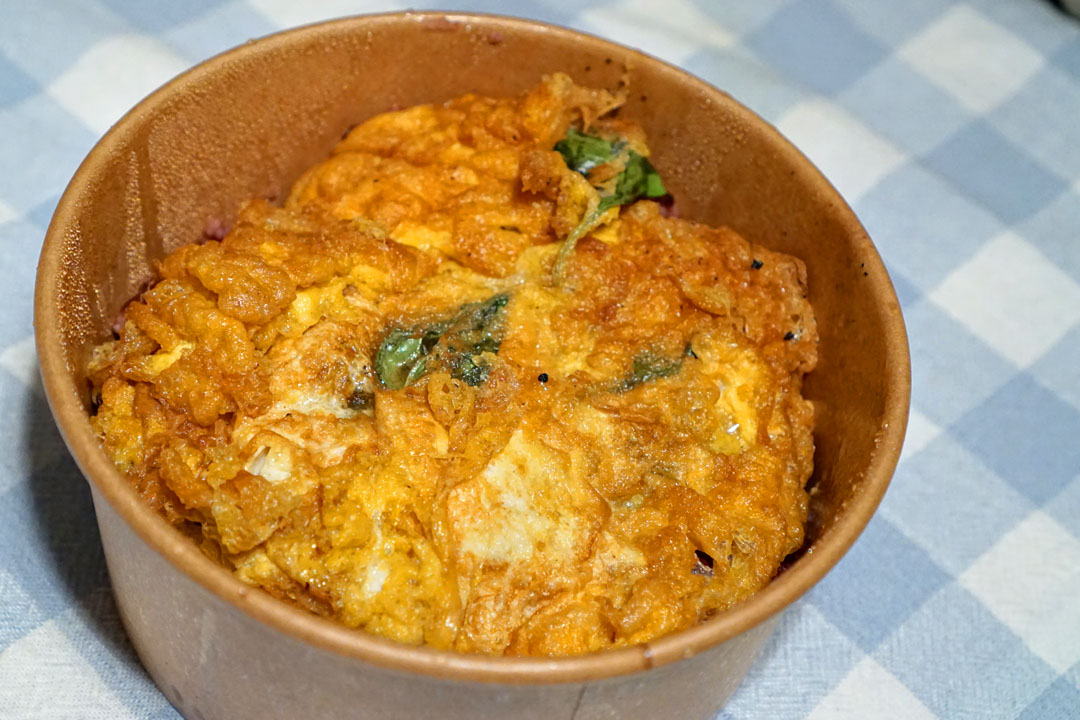
Kai Jeew [$12.00] | Thai classic fluffy omelette, Thai basil, shallots, fish sauce, served over rice.
The khai chiao was something that I could just eat all the time. The omelet was indeed as fluffy as advertised, and had a fish sauce-fueled savoriness that meshed flawlessly with the Thai basil folded in.

Pad See Ew
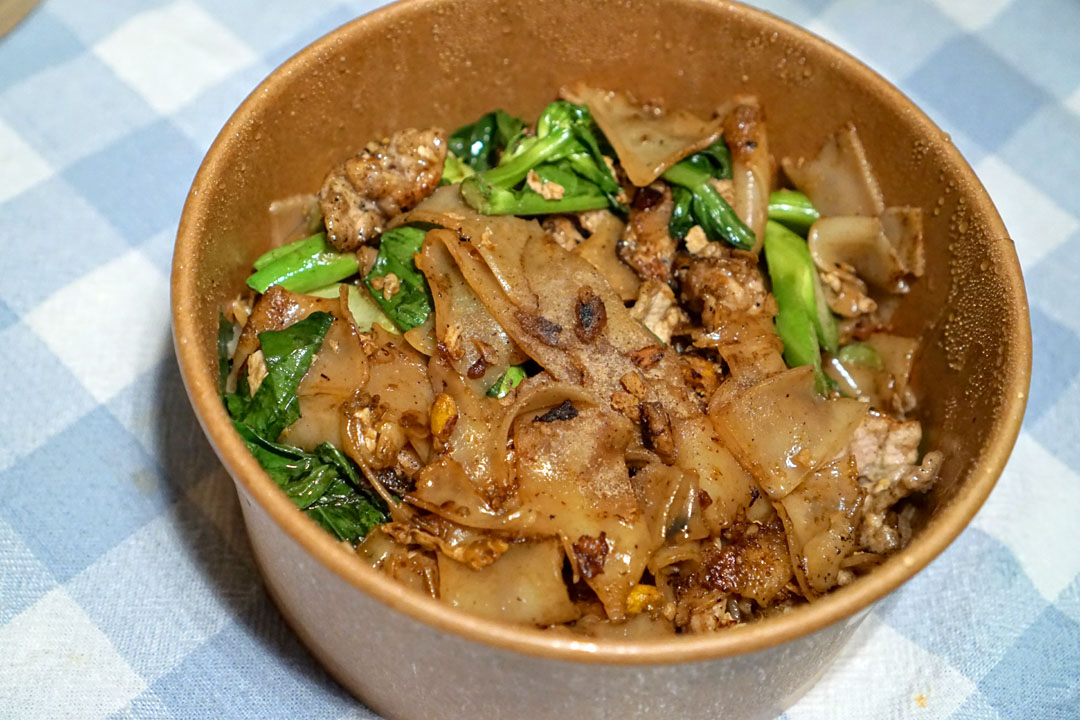
Pad See Ew [$15.00] | Natural and sustainable marinated pork loin, wok-fried smoked flat noodles, egg, Chinese broccoli, soybeans, garlic and XO sauce
Our first noodle dish was certainly a crowd pleaser. The kuaitiao sen yai had a slick, slightly chewy texture that I enjoyed, while the pork ate properly tender, and displayed a touch of sweetness that married easily with the crunchy, bitter greens and the boatloads of savory depth from the soy. My favorite part? All the charring and caramelization going on from the effective use of wok hei. It's hard to go too wrong with this one.

2021 Bottle Logic Currant War
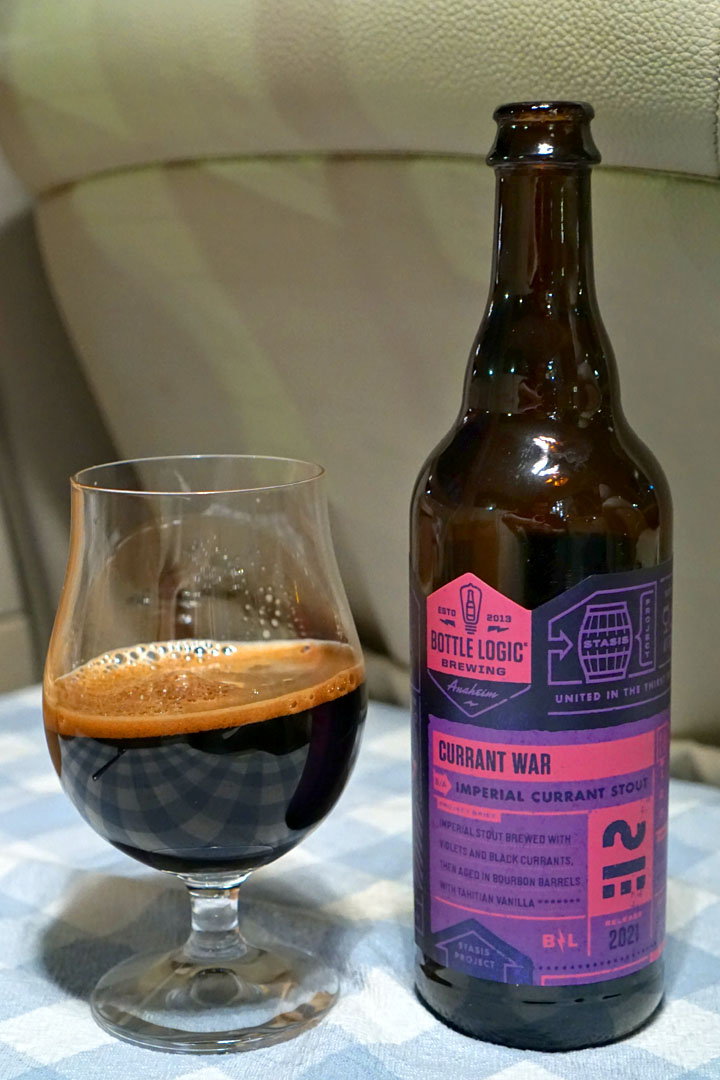
And now for something new: the 2021 Bottle Logic Currant War. Created in collaboration with Homage Brewing, this was an imperial stout brewed with violets and black currants, then aged in bourbon barrels with Tahitian vanilla. Nose here was huge chocolate and jammy berries. On the palate, I found more robust dark fruit combined with a distinct floral character, set over a base of cocoa, light oak, and a trace of heat. The beer was ostensibly inspired by French macarons, and I got the reference for sure.

Larb Hed
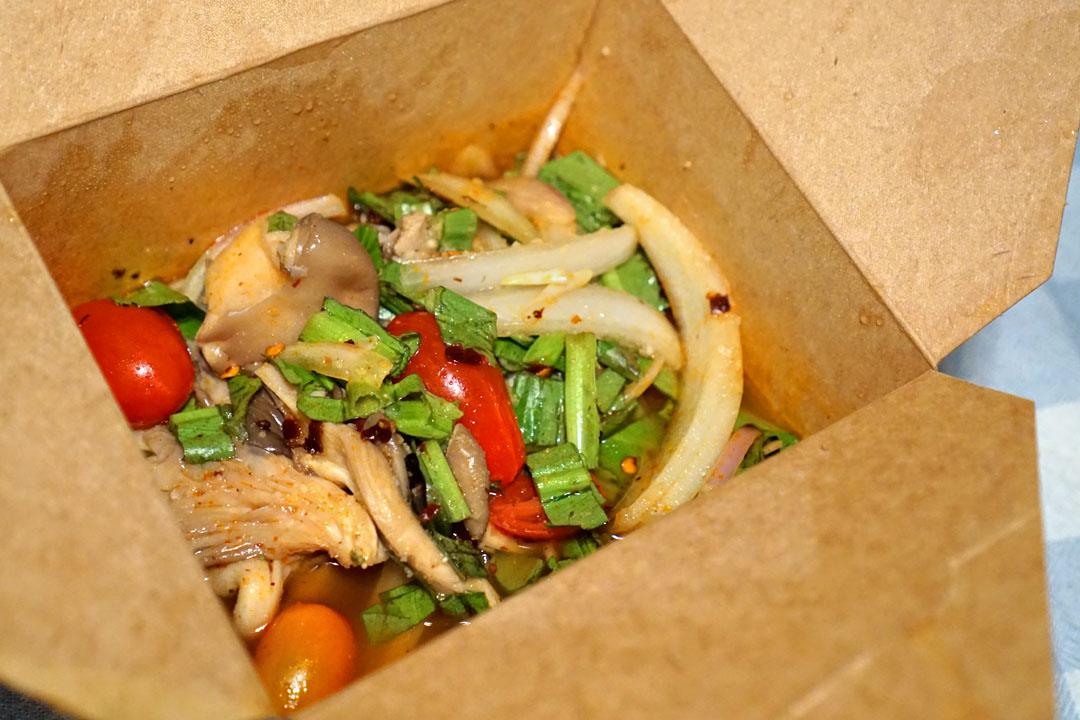
Larb Hed [$12.00] | Seared oyster mushrooms, Housemade chili oil, shallots, white onions, culantro, Vegan Yum Sauce, lime, housemade roasted rice powder and heirloom cherry tomatoes
This next dish may have been vegan, but it certainly didn't leave me wanting. In fact, this was probably the spiciest dish of the night; it actually hurt a bit, but I kept going back for more. Fortunately, the juiciness of those tomatoes and the 'shrooms especially helped temper the flavors at play, and I liked the bitter crunch from those raw onions, too.

Pad Thai Goong
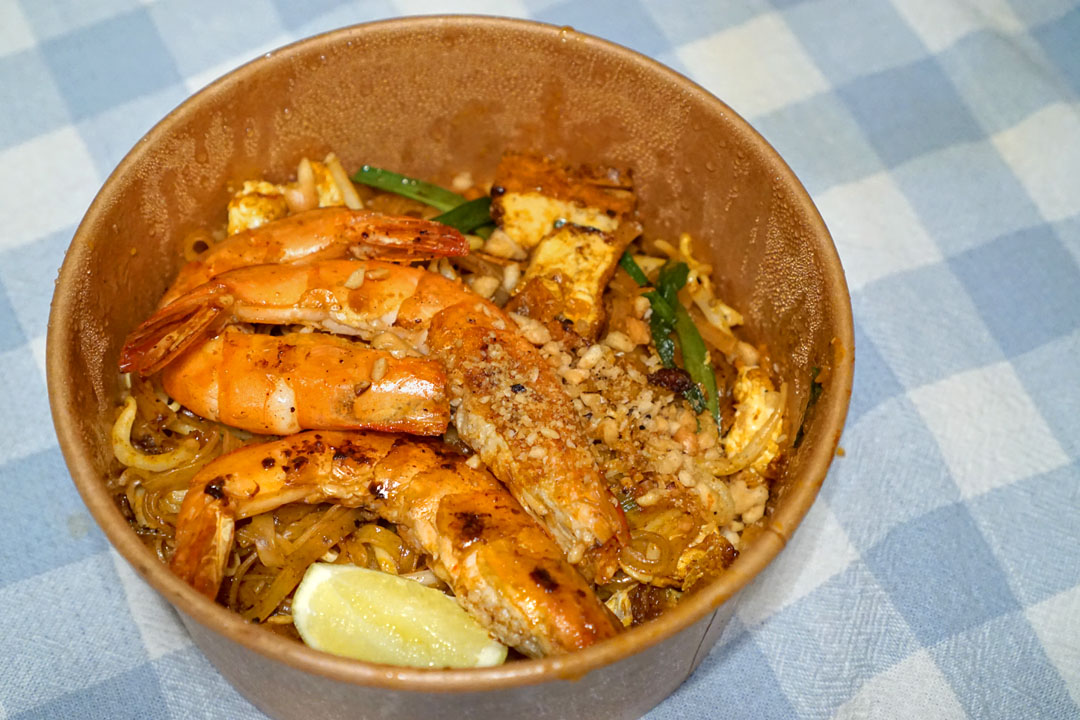
Pad Thai Goong [$15.00] | 3 pcs Ecuador white shrimp, pan-fried thin rice noodles, egg, tamarind fish sauce, paprika, shallots, sweet radish, fried tofu, rice shrimps, bean sprouts, chives, served with lime and peanuts on top
I typically don't eat too much pad thai, as I often find the dish's general sweetness a bit overwhelming. Fortunately, that simply wasn't the case with Arpapornnopparat's. What struck me first here was the dish's intensely nutty, briny aroma; this continued on to the taste, which was multifaceted in its presentation of sour, savory, saline, and yes, sweet flavors. As for the noodles themselves, they were nicely springy, and I also liked the textural contribution from the tofu and egg, not to mention the crunch of those sprouts. My one concern was that I wanted more aggressive seasoning on the shrimp.

Pad Kee Mao
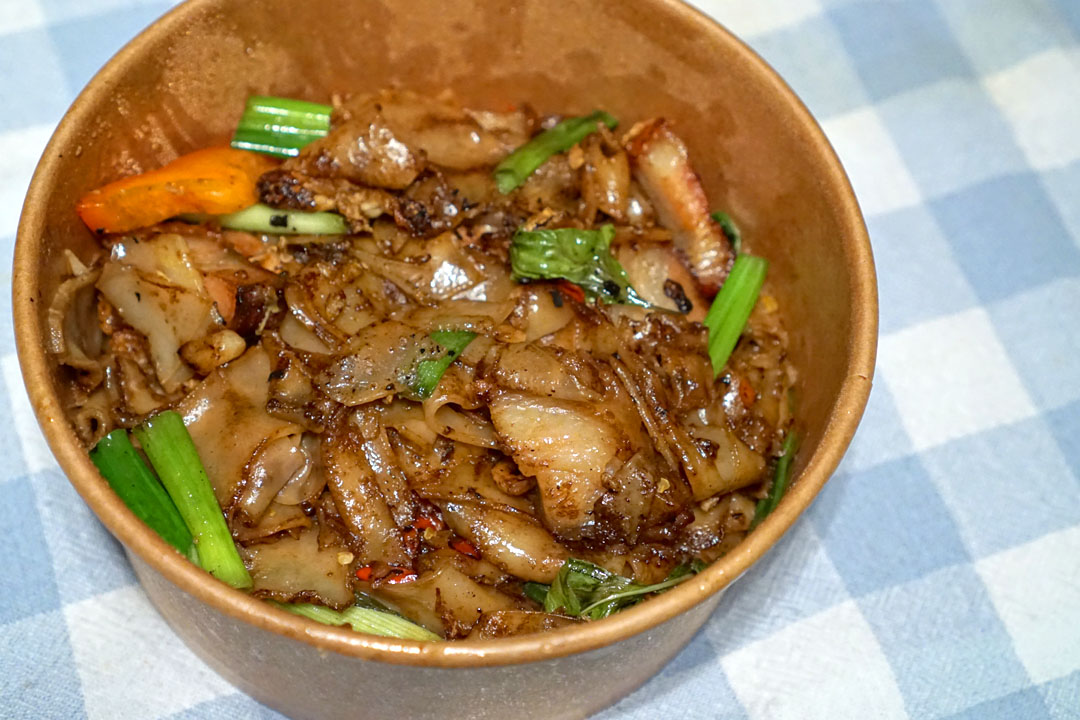
Pad Kee Mao [$16.00] | Crispy pork belly, wok-fired smoked flat noodles, egg, bird's eye chili, red bell peppers, scallions, Thai basil, garlic, and XO sauce
The drunken noodles were a must-try for me, since it's one of the most common dishes I order at Thai restaurants. The sole complaint I had here was that the pork belly, though advertised as crispy, was far from it. However, the taste was there, and I loved how all those fatty, porcine flavors combined with the basil and veggies, as well as the dish's creeping heat and XO-sourced depth. Meanwhile, the actual noodles had a welcomed "bounce" to them, and I also enjoyed the moderating effect of the egg.

Kang Kew Waan Kai
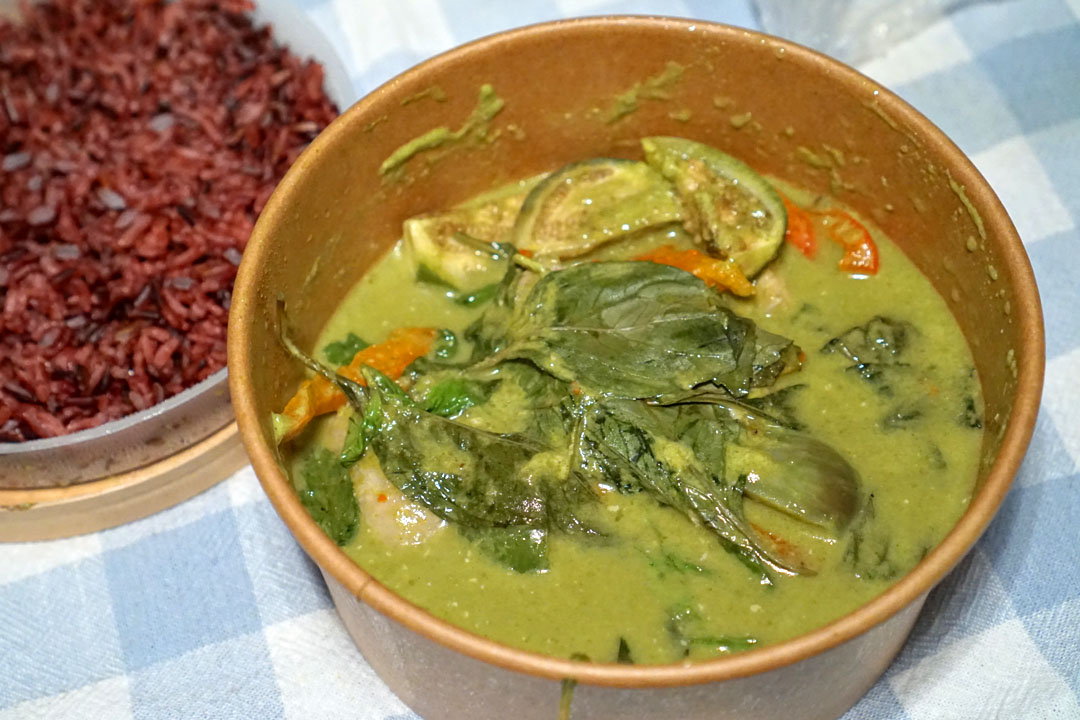
Kang Kew Waan Kai [$16.00] | Jidori chicken, house-made curry paste, coconut milk, bell peppers, Thai eggplant, winter melon, Thai basil, bird's eye chili, served with rice (Contains Shellfish / Cilantro)
Last up was the Chef's version of kaeng khiao wan, or green curry. The dish showed off a spot-on balance of sweetness and pungent, punchy herbs, and the curry paired well with the super tender cuts of chicken utilized. I also appreciated the Thai eggplants and how they interacted with all the flavors happening here, while again, the chewy purple rice was key as a counterpoint.

Holy Basil was my first real meal of 2022, and it was a great way to kick off the year, as Arpapornnopparat and his team served me some of the tastiest Thai I've had in a while. The cooking is largely familiar at its core, but there's just an extra level of goodness that you don't typically find, and I'm looking forward to what the Chef has in store for us next. Speaking of which, he's already started this pop-up series called Yum, which apparently happens a couple times a month and is focused on the drinking food that Holy Basil first started out with; I may just have to check it out. There's also an upcoming expansion to Atwater Village, but potentially more exciting, though, is a project called "700dtla," which looks to be a new restaurant that's in the works. I don't even know what it's going to be, but I'm keeping an eye on it.

Santee Passage
02 Aug 15:34

Modern Animal Snags $75.5M For Veterinary Care

Los Angeles-based Modern Animal, a new startup which offers up veterinary care, has raised $75.5M in funding. The company is developing what it calls a "modern" veterinary clinic. The funding included both a $35.5M Series A funding, led by True Ventures, and a $40M Series B funding led by Founders Fund. The funding also included Upfront Ventures. According to the company, the funding will be used for rapid expansion, plus continued development of the company. As part of the funding, Tony Conrad of True Ventures, Karen Boone former CFO of Restoration Hardware, and David Bowman of Atmosphere/previously of Blue Bottle Coffee, have joined the company's board. The company currently has one pet clinic, in West Hollywood, in addition to "virtual" service.
12 Aug 23:20

New Yorker Electronics Inks Deal With AMFAS International

by News Desk

Global distributor New Yorker Electronics and product developer AMFAS International have announced a new distribution agreement. AMFAS International is a start-to-finish product development source which manages manufacturing engineering and injection molding projects. Founded in 2002, AMFAS is an ISO 9001 certified enterprise with factories certified on ISO9001, TS16949 and AS9100. It stresses product diversity, scalability and logistics for large and small requirements.

The agreement unites New Yorker Electronics’ extensive market knowledge in embedded space with AMFAS’ complete logistics and expansive manufacturing which follow all client technical requirements and business protocols. American owned and managed, AMFAS International brings its domestic engineering, quality assurance and logistics experience – combined with its expansive manufacturing pool on the Pacific Rim – to fully provide customers with an engineering and supply chain solution.

With personnel in Asia and the Americas, AMFAS manufactures nearly any part while keeping cost a priority. It is capable of rapid manufacturing using all modern techniques, which is perfect for developing one part for a proof of concept or for generating a small run to get out of a pinch. AMFAS will manage the inventory of critical parts in strategic warehouses to save time, money and space. It can train customer quality management personnel or handle it directly. By leveraging its international footprint and engineering team, AMFAS bridges the gaps that are often experienced in a fast-paced manufacturing environment.

AMFAS excels at Speed to Market, Supply Base Optimization, Flight Critical Products, Rapid Large-Scale Outsourcing, Complex World-Class Tooling and Explosive-Proof Castings. New Yorker Electronics is an AS9120B and ISO 9001:2015 certified source of passive components, discrete semiconductors, electromechanical devices, Flash & DRAM modules, embedded board solutions, power supplies and connectors. It operates within many industries but functions exclusively at heightened military and aerospace performance levels.

“AMFAS will give our customers the freedom to accomplish an entire design and solution while fully focusing resources elsewhere. AMFAS can design it, manufacture the parts, assemble it and test it for a high-quality turnkey product design,” said Barry Slivka, President of New Yorker Electronics. “We are excited to be partnering with such an innovative technology company in the Product Development space, particularly one which advances the industry through its unique network of design and manufacturing under one roof,” he added.

Offerings:

  • Dimensional Report w/ Ballooned Drawing
  • Process Flow Chart
  • Quality Control Plan
  • Process FMEA
  • Capability Studies
  • Material Certification
  • Finishing Certification
  • Heat Treatment Testing
  • Material Lot Traceability

As a franchise partner, New Yorker Electronics offers AMFAS International’s product development, reverse engineering services and 3D capabilities as well as specific testing for the Automotive, Aerospace and Military Industry like compliances to BAC, Nadcap, MIL specs and more.

New Yorker Electronics is a certified franchised distributor of electronic components, well known for its full product lines, large inventories and competitive pricing since 1948. It is an AS9120B and ISO 9001:2015 certified source of passive components, discrete semiconductors, electromechanical devices, Flash & DRAM modules, embedded board solutions, power supplies and connectors, and operates exclusively at heightened military and aerospace performance levels. New Yorker Electronics operates in strict accordance with AS5553 and AS6496 standards in its everyday procedures to thwart the proliferation of counterfeit parts. It is a member of ECIA (Electronics Component Industry Association) and of ERAI (Electronic Resellers Association International).


The post New Yorker Electronics Inks Deal With AMFAS International appeared first on EPS News.

30 Apr 17:57

ECIA Compiles Best Practices for Infection Control

by News Desk

ECIA’s Global Industry Practices Committee (GIPC) has compiled a comprehensive list of best practices in COVID-19 Infection control to aid companies as they adapt to the unexpected challenges associated with the pandemic. As the world emerges from the peak of infections, a recovery process will begin, requiring substantial changes across the supply channel. It is anticipated that many of the items in the best practices document may become permanent in day-to-day operations.

“We have identified best practices that have been implemented in a collective sampling of operations,” said Don Elario, ECIA VP Industry Practices. “For the next steps, the industry needs to be looking down the road to what the new normal will be for daily operations.”

This document was developed by GIPC Subject Matter Experts (SME), who come from ECIA member companies, but also included inputs from non-member companies.

The COVID-19 Infection Best Practices List includes information for gatherings, protocols, cleaning and enforcement, and employee morale.

The complete document is available to members and non-members on ECIA’s Coronavirus Resources page.  There are several links to pertinent information for the electronics industry. 

The post ECIA Compiles Best Practices for Infection Control appeared first on EPS News.