Shared posts

27 Jan 21:28

Secret Audit Of Baltimore's Speed Cams Says Up To 70,000 Tickets Were Issued In Error In 2012 Alone

by Tim Cushing

God bless the drivers of Maryland, whose government officials have been experimenting on them for years by placing their driving records and insurance rates in the hands of unreliable private contractors for years. We've already covered one major traffic camera firm (ATS - American Traffic Solutions) in the Maryland-DC area whose response to questionable photos captured by its cameras was to crop out anything that might make the ticket challengeable, like calibration lines or other vehicles.

Now, it appears another major contractor, Xerox State and Local Solutions, has been caught operating faulty cameras -- and issuing tens of thousands of questionable citations. (via Reason)

Consultant URS Corp. evaluated the camera system as run by Xerox State and Local Solutions in 2012 and found an error rate of more than 10 percent — 40 times higher than city officials have claimed. The city got those findings last April but never disclosed the high error rate, refusing calls by members of the City Council to release the audit.

The city issued roughly 700,000 speed camera tickets at $40 each in fiscal year 2012. If 10 percent were wrong, 70,000 would have wrongly been charged $2.8 million.
Xerox's contract ended in 2012, and the city tried out a couple of new contractors after the Baltimore Sun reported that the city's cameras were producing faulty citations. Previous to the Sun's investigative work, city officials claimed the cameras had a "one-quarter of one percent error rate." Xerox performed its own audit and found 5 cameras with a 5.2% error rate, but said it took those offline upon discovery.

Neither claim matches up with the URS audit. Not only were 10% clearly erroneous, but another 26% were declared "questionable," meaning the system Xerox ran for three years was only unquestionably "right" less than two-thirds of the time.

To top this all off, members of the city government still hadn't seen this audit until the Baltimore Sun managed to secure a copy of it.
City Council members reacted with dismay and anger when told Wednesday of the audit's results, asking why the Rawlings-Blake administration didn't reveal the high error rate months ago and take steps to fully refund fines paid by motorists.
The administration has one good reason not to release the report: it doesn't want to get sued.
Despite calls from the City Council to release the audit, the administration does not plan to do so, Harris said. City Solicitor George Nilson, the administration's chief lawyer, has said releasing the audit would violate a settlement agreement with Xerox and "create obvious risks and potential exposure for the city."

In the settlement, the city agreed to pay Xerox $2.3 million for invoices from late 2012. The city also agreed to keep confidential any documents "referring or relating to, or reflecting, each party's internal considerations, discussions, analyses, and/or evaluations of issues raised during the settlement discussions."
The documents are no longer "confidential" at this point (and can be viewed here), and what's been uncovered may cause future problems for Xerox, which was selected by a city panel last year to take over Chicago's traffic cams. This happened in August of 2013, after Baltimore had already cut the contractor loose, but well before URS' report surfaced. Knowing it had buried the company's ineptitude by contractually obligating Baltimore's administration to keep its mouth shut, Xerox officials had the confidence to make the following claim when reached for comment last August:
Xerox officials have said the problems in Baltimore accounted for less than 1 percent of all the tickets issued there.
So, that's clearly untrue. Xerox kept burying itself, though, much like it thought it had buried that report.
"The majority of our camera programs are extremely well run and our customers are very satisfied," Xerox Corp. spokesman Carl Langsenkamp said. "That's really all I have to say about Baltimore."
Well, its "customers" were as satisfied as anyone can be when the truth has been contractually bound and gagged. The Chicago mayor's office defended doing business with Xerox by pointing out it had done its due diligence, noting no Baltimore official had declared Xerox barred or ineligible for city contracts. That's what NDA's do. They keep people from telling you bad things.

In even more "good" news for Chicago's drivers, the story also contains this bit of info:
Xerox Corp., best known for its onetime domination of the photocopier market, is a relative newcomer to the automated camera industry. In 2009 it purchased Affiliated Computer Services Inc. — well-known in the industry — for $6.4 billion.
"Well-known" has lots of different meanings. ACS is "well-known" for its close relationship with New Orleans cops, who formed their own company in order to cash in on ACS' traffic cam photo backlog, along the way violating NOPD ethics rules, laundering their funds through a police charity, and generally reinforcing the negative image of a corrupt New Orleans police force in many people's minds. In fairness, ACS accidentally outed the officers' unethical sideline by paying the controlling officer directly through his company, rather than obscuring the transaction through the charity.

ACS is also "well-known" for being careless with the personal info of millions of private citizens. ACS lost a data CD containing the personal info of 2.9 million Georgia residents back in 2007. Prior to that, it had a computer stolen (500k-1.4 million Colorado residents' data contained therein), suffered a website glitch that exposed 21,000 students' info, and had seven years of credit card data stolen from one of its computers at the Denver airport.

What Chicago may have watching over its drivers is a set of malfunctioning cameras overseen by a company that can't seem to stop coughing up people's personal data. Good times.

Permalink | Comments | Email This Story


27 Jan 20:04

If You Used This Secure Webmail Site, the FBI Has Your Inbox

by Kevin Poulsen
If You Used This Secure Webmail Site, the FBI Has Your Inbox
While investigating a hosting company known for sheltering child porn last year the FBI incidentally seized the entire e-mail database of a popular anonymous webmail service called TorMail. Now the FBI is tapping that vast trove of e-mail in unrelated ...


27 Jan 13:19

Purdue Cops Throw Student Journalist To Ground, Seize His Camera And Detain Him For Three Hours

by Tim Cushing

Cops vs. cameras: the apparently never ending battle continues. A student photojournalist at Purdue found himself on the receiving end of a little extra "attention" while attempting to cover Tuesday's on-campus shooting.

In the midst of Tuesday’s shooting, an Exponent employee was detained by the police while trying to fulfill his journalistic duties.

Exponent photo editor Michael Takeda, a junior in the College of Technology, was slammed to the ground by the Purdue Police after being found in the Electrical Engineering Building taking photos. The area had not been closed off to the public at the time.

The officers confiscated Takeda’s camera and photos, detained and questioned his whereabouts within the building, which was then on lockdown after being held by the police for roughly three hours.
While it's somewhat understandable that the campus police might be a bit on edge while looking for a shooter, that doesn't excuse any of the actions they took when they came across Takeda. (You can see his article on the shooting here.) It shouldn't have taken three hours to determine whether Takeda was involved in the shooting and his presence in a building that hadn't been "locked down" should not have been greeted with the use of force. Those who say people who are "doing nothing wrong" shouldn't fear police officers might want to reexamine that assertion in light of Takeda's experience. One also wonders whether the presence of the camera escalated the officers' physical response.

The police finally let Takeda go after detaining him for three hours but they had no interest in returning his equipment to him until someone higher up the ladder at Purdue interceded on his behalf.
[I]it was only after Frank LoMonte, executive director of the Student Press Law Center, prodded the University that Takeda’s belongings were bequeathed to him.

“They were very cooperative, and they recognized right away that this was a serious situation that required their immediate attention,” LoMonte said.

LoMonte said, though the University was helpful in releasing Takeda’s belongings, it was just the police’s instinct to retrieve his belongings, despite the possible infringement of a federal law.
By "retrieve," I assume LoMonte means "seize." Notwithstanding this oral typo, what LoMonte says next is both unsurprising and sad.
“Honestly I think almost nobody knows that is the law, not even lawyers,” LoMonte laughed.
LoMonte may be laughing but I don't think I'll be joining him. People who are charged with enforcing laws or keeping clients out of jail should be familiar with the laws that are an integral part of their jobs. The law LoMonte refers to isn't a recent development prompted by the ubiquity of smartphone cameras. It's been on the books for more than 30 years and was crafted in response to an incident at another college, Stanford University.
“(It) specifically says that the police cannot confiscate or search where journalists keep their unpublished work product unless they first go in front of a judge and give the journalist the chance to argue his side,” LoMonte said
Now, police have ways around this limitation -- the always-useful "exigent situation" exception. This is supposed to be used only when the safety of officers or the public is immediately threatened. In reality, the exception is most frequently used to ask for post-rights violation "forgiveness." The Purdue officers didn't cite this exception, but it will probably be deployed if Takeda decides to make some more noise about his treatment. Is it really too much to ask for law enforcement officers to know and respect the laws governing their actions?

Permalink | Comments | Email This Story


25 Jan 19:25

The Muen Separation Kernel

The Muen Separation Kernel is the world's first Open Source microkernel that has been formally proven to contain no runtime errors at the source code level. It is developed in Switzerland by the Institute for Internet Technologies and Applications (ITA) at the University of Applied Sciences Rapperswil (HSR). Muen was designed specifically to meet the challenging requirements of high-assurance systems on the Intel x86/64 platform. To ensure Muen is suitable for highly critical systems and advanced national security platforms, HSR closely cooperates with the high-security specialist secunet Security Networks AG in Germany. The webpage contains instructions for building the kernel yourself, for installing it in a virtual machine, and for running it on real hardware.
25 Jan 17:08

Sheriff's Dept. Hopeful Wishes A 'Holocaust And Gas Chambers' On CopBlock.org's Writers And Readers

by Tim Cushing

Today's cautionary tale of How Not to Use the Internet comes to us courtesy of a man who someday hopes to carry a badge and gun. His target? CopBlock.org. For those not familiar with Cop Block, it's a site that tracks police misconduct. Much of what's collected is anecdotal evidence, submitted by readers, but there's also coverage of other, media-covered incidents as well as book reviews, organized events and educational material.

But what Cop Block does that some other police misconduct-oriented sites don't is make an active effort to film police. More controversially, site members have also been known to take to the roadside to warn drivers of speed traps and seatbelt checkpoints. Not surprisingly, law enforcement members who interact with Cop Block members are usually less than cordial.

A post to the Cop Block Facebook page by a former soldier who's currently pursuing a degree in order to join the Washoe (NV) Sheriff's Dept. managed to exceed anything these members have seen before. In fact, much of what is included in this person's (Darren Redding) post is simply abusive, with a couple of comments tracing the edges of the "threat" category.

Here's Redding's post in its entirety (screenshots captured for posterity here, here, here, here and here).

Your page is pathetic and offensive. The pictures you post and the comments you make seem like you're trying to incriminate and deface ALL police officers, when 99% of them are great at what they do, it's the 1% you should be posting about, not the vast majority you pathetic, ignorant, liberal pussy.

You're just like all the liberals striving for gun control because the actions of a few, insane individuals are fucking it up for the other 99% of gun owners who are responsible with their weapons.

Or let me put it into perspective for a drug using, liberal, hippy pussy like yourself: 99% of people who smoke pot do it responsibly and safely, but 1% of the people who use participate in violent crime, or crash their cars when theyre high and kill others or themselves, but I don't see you posting about how ALL pot smokers should be punished.

If you were a law abiding citizen you wouldn't have any problem with 5-0, but something tells me you were probably being a jackass towards a police officer and you got what was coming to you, and that inspired you to make a page giving a bad name to all law enforcement.

You might as well bad mouth the military and veterans like myself because of those marine scout snipers that pissed on some dead Taliban a few years back. According to your logic that means ALL active duty and veterans are heinous heathens right?

You're a fucking bitch and I hope some cop beats your ass next time you're "protesting" or filming them or whatever. In fact I'm about to start the training academy for the washoe county sheriffs dept in reno, Nevada and I can't wait to deal with punk ass bitches like you. I would beat your fucking liberal ass just for the sheer joy of it.

Suck my fucking dick you waste of breathable air, you should have been aborted. But I guess your mother was a dumb ass waste of life like you. You're the reason that there's no hope for the human race, I can't believe people like you exist, if I had my way, there would be another holocaust with camps and gas chambers full of fucking cunt scabs like you.

I hope you die
What's amazing about Redding's post is the sheer amount of violent imagery deployed. Not content to merely "beat" members' "liberal asses," Redding escalates it into Godwin Territory by wishing a "holocaust with camps and gas chambers" on Cop Block's 90,000+ fans and members.

Redding complains about the attitude of those at Cop Block, specifically mentioning how it supposedly paints all cops as bad cops. Whatever point he was trying to make about the good cop/bad cop ratio is completely destroyed by his next several dozen words. The attitude on display here would put Redding (should he actually make the cut as an officer) clearly on the "bad" side. You can't defend good cops by wishing degradation, pain and death on those you disagree with

Hopefully, Redding's own self-destructive behavior will keep him from acquiring the power he needs to torment "liberals," "pussies" and other people who are severely in need of "getting what's coming to them."

Tempering all of this is the fact that this is a Facebook post, a venue where stupid things are "said" all the time. A quick rundown of the comments on Cop Block's Facebook page shows there are plenty of people with the same mindset as Redding's, only coming at it from the opposite direction. Sure, these commenters aren't aspiring to go into law enforcement, but it doesn't make their comments any less terrible.

At this point, Redding is still in school (presumably pursuing a criminal law degree) according to this comment at the Bad Cop No Donut subreddit. (This bare bones LinkedIn account seems to verify that.) If he's looking for a job in law enforcement, he's greatly sabotaged that chance. Contacting the Sheriff's Dept. seems to be a waste of time since he's a few years away from applying. Should "the internet" decide whether Redding is allowed to chase his dream? Perhaps not, but Redding's own words seem perfectly capable of undermining that. The greater problem is, if this is Redding's mindset, that his attempt to join the law enforcement ranks is still a few years off (his LinkedIn page estimates a 2016 graduation date). By that time, any outrage will have long since died down and his scrubbing efforts will have become nearly invisible. And maybe, just maybe, Redding will join a force that won't tolerate his violent urges towards law enforcement critics. Who knows? Stranger things have happened.

But the underlying message here is clear: if you are perceived as painting all cops as bad cops, you'll very easily draw the attention of the worst cops, even those who are still in the aspirational phase.


Permalink | Comments | Email This Story


25 Jan 17:06

Google releases Mini-Games, their new video game compilation for Google Glass [VIDEO]

by Chris Chavez
Brindle

@Spencer...

While we patiently wait for our monthly software update, Glass Explorers are being treated to some new Glassware from the Project Glass team by way of a video game compilation dubbed Mini-Games. “Hacked together” by the Google Glass team themselves, the mini games more or less serve as a proof-of-concept or basic framework to help get developers’ creative juices flowing when it comes to gaming on Glass. With all those sensors and a screen always attached to your head — it’s easy to see how Glass can provide for a gaming experience matched only by more “extreme” VR headsets like the Oculus Rift or Epson’s Moverio Smartglass.

Mini-Games is a bundle of 5 pick-up-and-play games designed to get Glass users in and back to the real world with a swipe of the touchpad. Featuring simple graphics, musical soundtrack, and gameplay — Skyrim this is not — but then again, it’s not supposed to be (at least not yet). Games can be pulled up in Glass by speaking the command, “Ok Glass, play a game with… (and then the corresponding game). Here’s the lineup.

Tennis

Google Glass Mini-Games - Tennis

Your face is the racket, and simply point your head in the direction the ball is moving to volley the ball back to the opponent. In our brief time with the game, it seemed to work well, only there wasn’t much of a challenge involved.

Shape Splitter

Google Glass Mini-Games - Shape Splitter.jpg

Like a simplified Fruit Ninja, players swipe their hands in front of their Glass camera to cut blocks, avoiding bombs that occasionally pop up during play. The game definitely doesn’t have as much precision as Fruit Ninja as big, long swipes will cut everything in sight. Still kind neat to see a game working in conjunction with the camera.

Balance

Google Glass Mini-Games - Balance

One of our favorites, the players tilts their head in the real-world in order to keep the falling blocks balanced on the virtual head. One wrong move, and they topple over. This was definitely one of the more difficult games of the bunch.

Clay Shooter

Google Glass Mini-Games - Clay Shooter

Using voice commands, players shout “PULL” and launch a clay pigeon, and aim their sites by tilting their head, shouting “BANG” once they’ve lined up their shot. While this sounds like it’d be the funnest out of the 5, lag issues on Glass kept everything from working smoothly.

Matcher

Google Glass Mini-Games - Matcher

A simple game of match 2, players move their heads around a 3D prism, selecting cards by tapping on their touchpad. The Glass team mentions they used the Photosphere camera mode to map everything in 3D which makes us wonder — where the heck is Photosphere for Google Glass?

More to come?

While games on Glass aren’t anything new (back in August, we showed you guys a Missile Defense-inspired game called Psyclops for Google Glass), it’s nice to see Google officially making even the smallest push in that direction. Hopefully this is only the beginning, and soon Glass will catch the eye of gaming bigwigs like EA, Sony, and/or Microsoft where they’ll include some level of second-screen connectivity in games like GTA or Halo. Maps, HUDs — just think of the possibilities..

Google Glass users can activate Mini-Games in their usual Glassware web portal (or through the MyGlass app).

25 Jan 00:44

Ultra Impressive Joker Themed Medieval Leather Armor

Brindle

Whoa. Want.

joker-leather-armor-1.jpg This is the Joker themed leather suit of armor and mask made by Prince Armory (of Batman and Aquaman armor fame). It looks amazing. I think Facebook commenter Christopher R. really hit the nail on the head when he said, "I would like to be buried in this, even if it meant still being alive." Prince Armory responded, "Nice." Getting buried alive: Prince Armory is totally cool with it happening to you. Medieval as f***! Keep going for a couple more shots of the impressiveness. joker-leather-armor-2.jpgjoker-leather-armor-3.jpgjoker-leather-armor-4.jpg Thanks to Shamus, who wants a set of Two-Face themed armor because, "That would be badass." His words, not mine (although I do half agree with him).
23 Jan 18:50

Police Officers' Lawyer Claims Being Tased Is Hilarious

by Tim Cushing

Oddly enough, cops (and lawyers for cops) from halfway around the world are no different than our local variety. This isn't solely an "American" problem. Excessive force is used, the victim complains, and once the court battle ensues, the justifications for the use of force are presented, which often sound completely insane to those not well-versed in the art of defending abusive cops.

This story starts out like countless others (via The Honest Courtesan).

Aaron Strahan and Troy Tomlin are on trial accused of assaulting Kevin Spratt by repeatedly tasering him in August 2008.

Sergeant Strahan, who was a Senior Constable at the time, had arrested Mr Spratt in Bayswater...

The officers have denied any wrongdoing and today Sergeant Strahan testified he tasered Mr Spratt because he was acting violently and had broken free from four other officers.

The officer testified he feared that he or somebody else was going to get hurt.
The "somebody else" of course being him or one of his fellow officers. Spratt was tased 13 times, and all of it (including audio) was captured by the station's cameras. Spratt reportedly refused to head into a holding cell for a strip search and was under the influence of drugs and alcohol. So, the officers tased him. And did it again and again while Spratt screamed.

But appearances (and audio) can be deceiving. Much like homeless man Kelly Thomas died of a drug-weakened heart condition instead of by being beaten and subdued by six Fullerton police officers, Mr. Spratt's screams were the result of him being under the influence of something else as well: FUN!
Their lawyer, Karen Vernon, has argued that five of the seven charges against her clients should be thrown out because the evidence does not support the allegations against them.

The Magistrate questioned Ms Vernon about hearing Mr Spratt screaming in anguish, but she said people responded differently to pain, and the screams could have been with joy or laughter.
It seems ridiculous to those of us who haven't read The Joy of Tasing or 1001 Taser Jokes cover-to-cover, but the possibility remains that Spratt might have recoiled in laughter and screamed in abject joy as the four cops repeatedly pulled the trigger on their department-issued Fun Guns.

It seems ridiculous to us. More importantly, it seemed ridiculous to the judge, who dismissed Vernon's imbecilic argument. The case, however, will be allowed to continue. Whether Vernon will still be handling the defense remains to be seen.

Remember kids, electricity is fun, especially when deployed by cops fearing for their safety… or yours. If you're really lucky, the Fun Sticks will make an appearance and you'll be able to tell your friends about the "discussion" you had with the officers and how your sides still hurt from screaming with laughter.


Permalink | Comments | Email This Story


23 Jan 18:46

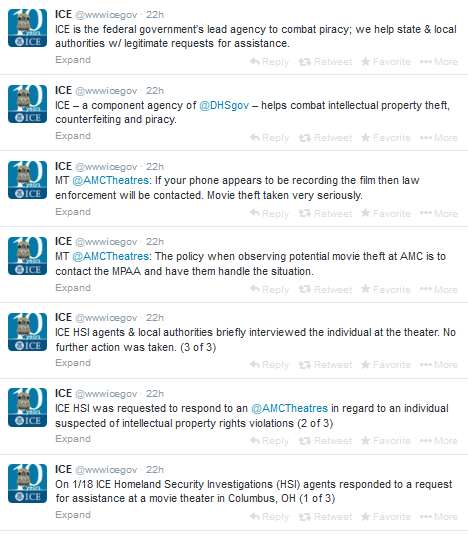
ICE Takes To Twitter In Ridiculous Attempt To Defend Interrogating A Man In A Movie Theater For Wearing Google Glass

by Mike Masnick
Earlier this week there was a report about a guy being yanked out of his seat in a movie theater for wearing Google Glass during the movie. Glass was turned off, and the guy kept them on because he had prescription lenses installed and wears them as his regular glasses. Both the MPAA and federal agents were called to interrogate the guy for a few hours, asking him a bunch of ridiculous questions until late in the night, before someone finally realized he hadn't done anything. Both the MPAA and ICE confirmed the incident happened, and yesterday folks at ICE -- who have recently been transitioned into the new Homeland Security Investigations (HSI) organization -- decided to take to their bizarrely named twitter account, @wwwicegov, to further "defend" these actions, by talking up how they're in charge of dealing with "movie theft." Because, apparently, Homeland Security Investigations doesn't understand the law, and doesn't realize that (1) infringement is not, and has never been, "theft" and (2) a dude wearing a powered-off Google Glass is not doing anything wrong. Here are the tweets: As you can see, there's a lot of ridiculousness there -- just the fact that they repeatedly refer to it as "theft," as mentioned above. The problem is that ICE's role as "the lead agency to combat piracy" is a joke. As ICE, it was supposed to focus on stopping counterfeit physical products from crossing the border. But with the help of Joe Biden and Hollywood, that mandate has been twisted repeatedly, so that what started as a very narrow mandate is now being treated as this broad mandate from an organization that doesn't even understand the issues. For years now, the group has made sure to conflate the very, very different issues of counterfeits at the border with copyright infringement, as it tries to expand its own mandate.

And now that's reached the absolutely insane point of yanking people out of their movie seats for doing nothing wrong, entirely on the say so of the MPAA -- a private group which has a long history of overreacting badly to new technologies.

What comes out of this is that ICE/HSI now appears to be incredibly gullible, falling for basically every bullshit claim from the MPAA. Just imagine if ICE/HSI had been around and had this sort of broad stupid made-up power over "intellectual property theft" during the introduction of the VCR -- back when the MPAA was declaring it illegal? ICE would be out there raiding and shutting down electronics stores for selling the devices. All because the MPAA said so.

Permalink | Comments | Email This Story


23 Jan 16:39

Woman's Terrifying Horror Makeup Transformations

Brindle

Whoa.

makeup-transformations-1.jpg These are the terrifying, predominately zombie/horror themed makeup transformations Stephanie Fernendez created for herself (links to her website with tutorials). Clearly she has the skills to pay the bills. Me? My water's already been shut off and they're coming to cut my electricity if I can't come up with $160 by 4PM. Help me out a little? "Burn in hell." At least I won't have to pay for hot water. Keep going for twelve more, the last of which is my favorite. makeup-transformations-2.jpgmakeup-transformations-3.jpgmakeup-transformations-4.jpgmakeup-transformations-5.jpgmakeup-transformations-6.jpgmakeup-transformations-7.jpgmakeup-transformations-8.jpgmakeup-transformations-9.jpgmakeup-transformations-10.jpgmakeup-transformations-11.jpgmakeup-transformations-12.jpgmakeup-transformations-13.jpg Thanks to V, who tries to put on her makeup as un-terrifying looking as possible.
23 Jan 00:26

The NYPD Sent Two Officers To The Kenyan Mall Shooting And Their Findings Are Directly Contradicted By The FBI's Report

by Tim Cushing
Brindle

Umm... NYPD sending officers around the world?!

Just recently, we covered the NYPD's insistence on playing police force to the world by sending officers to foreign nations to impede investigations and damage international relations. Not only were these officers' presence unwelcome, but they were in no position to gather local intel as they lacked the security clearance needed to work directly with local law enforcement and intelligence agencies.

The biggest motivator of the NYPD's Ugly American program was its feeling that the FBI wasn't sharing enough intel with it. Or doing it fast enough. Or competently enough. So, to beat the FBI at its own investigative game, Police Chief Ray Kelly sent NYPD officers to various locations around the world to gather better, faster intel for the city's anti-terrorist division. As Kelly himself noted as he exited office, the FBI just "can't be trusted" to protect New York from terrorist attacks. That's why local police officers have been stationed overseas for more than a decade at this point.

Inside officials, however, declared the program to be a waste of money that generated no useful intelligence, hardly an equitable exchange for arriving unbidden at crime scenes and annoying local agencies.

The flow of useless intelligence is still ongoing. As The Guardian reports, an FBI official's statement on the Kenyan Mall attack directly contradicts an earlier report compiled by officers sent by the NYPD.

Dennis Brady, the FBI legal attache in Nairobi, said in an interview posted Friday on the bureau's website: "We believe, as do the Kenyan authorities, that the four gunmen inside the mall were killed."

"Our ERT [Evidence Response Team] made significant finds, and there is no evidence that any of the attackers escaped from the area where they made their last stand," he said. A very secure crime scene perimeter made an escape unlikely, Brady added.

"Additionally, had the attackers escaped, it would have been publicly celebrated and exploited for propaganda purposes by al-Shabaab. That hasn't happened.”
This statement diverges greatly from the report compiled by two NYPD officers sent unbidden to Kenya while the siege was still underway. According to that report, the four attackers most likely escaped after turning away cameras recording their ad hoc HQ and making their way through the "loose perimeter" set up by the Kenyan military.

The State Dept. wasted very little time distancing itself from this report, stating the NYPD's report "did not reflect the US government position."

The FBI, which beat the NYPD to the scene (arriving on day one), maintains that the perimeter was "secure." The NYPD claims the opposite. So, who's right? Well, if you consider the sources and what they respectively have to lose if they're wrong, it would appear that the FBI's conclusions are more apt to be accurate. After all, it does have an international presence and the clearances needed to work with local intelligence officials. The NYPD has none of these advantages and, as was noted earlier, a tendency to offend local agencies with their very existence. It's kind of hard to compile useful intel if the locals won't talk to you.

Worse, though, is the fact that the NYPD's overseas deployments tend to show up uninvited, giving law enforcement and intelligence agencies one more thing to worry about when securing a scene or, in this case, hunting down four terrorists in a crowded mall. Even if the NYPD's investigators are more skilled than the FBI's, the simple fact that they're uninvited renders them mostly useless. People expect the FBI -- a federal agency -- to appear at occurrences like these. What they don't expect to run into is an officer from a police department halfway around the world. The NYPD's foreign placements aspire to out-FBI the FBI, but undercut their own goal simply by existing.

Permalink | Comments | Email This Story


23 Jan 00:23

Man Subjected To Multiple Rectal Searches And Enemas By Police Officers Receives $1.6 Million Settlement

by Tim Cushing

David Eckert, the Deming, NM man who was subjected to hours of invasive anal "searches" by two police officers (and a very compliant hospital staff), has received a settlement from two of the entities named in his lawsuit. For those of you who don't remember what Eckert went through in order to "produce" drugs he simply didn't have, here's the rundown.

  1. Eckert's abdominal area was x-rayed; no narcotics were found.
  2. Doctors then performed an exam of Eckert's anus with their fingers; no narcotics were found.
  3. Doctors performed a second exam of Eckert's anus with their fingers; no narcotics were found.
  4. Doctors penetrated Eckert's anus to insert an enema. Eckert was forced to defecate in front of doctors and police officers. Eckert watched as doctors searched his stool. No narcotics were found.
  5. Doctors penetrated Eckert's anus to insert an enema a second time. Eckert was forced to defecate in front of doctors and police officers. Eckert watched as doctors searched his stool. No narcotics were found.
  6. Doctors penetrated Eckert's anus to insert an enema a third time. Eckert was forced to defecate in front of doctors and police officers. Eckert watched as doctors searched his stool. No narcotics were found.
  7. Doctors then x-rayed Eckert again; no narcotics were found.
  8. Doctors prepared Eckert for surgery, sedated him, and then performed a colonoscopy where a scope with a camera was inserted into Eckert's anus, rectum, colon, and large intestines. No narcotics were found.
Every search was nonconsensual and Eckert was detained for a total of 14 hours by the police, who also apparently mocked him before, during and after the medical procedures. The "justification" for these searches was one officer's "observation" that Eckert stance when he exited his vehicle was a bit "too erect" for an innocent man. The drug dog alerted on Eckert's car seat and at that point, the "evidence" was apparently too much to be ignored. When everything was said and done, the Gila Regional Medical Center presented Eckert with a bill for the procedures performed on him against his will and sent collection agencies after him when he refused to pay.

Eckert sued the city of Deming, Hildalgo County, the doctors involved, the Gila Regional Medical Center (which performed the searches after doctors at the Deming hospital refused to) and the District Attorney. So far, he's received a settlement from the city and county.
In December, Hidalgo County and the City of Deming settled.

Through a records request, 4OYS learned that settlement amount is set at $1.6 million.

"The gratifying aspect of this case is the media attention that it has gotten and the opportunity for discussions in the law enforcement and medical communities about how to deal with these opportunities and what to do with requests from law enforcement about medical exams for people in custody," Eckert's attorney Joseph Kennedy said.

Here is the settlement breakdown: Hidalgo County will pay $650,000 and the City of Deming will pay $950,000.
If the other entities involved "refuse to take responsibility," Eckert's lawyer will push for a jury trial. This ends the financial bleeding for the city and county, the latter of which has already spent $55,000 in taxpayer funds fighting the lawsuit. There's always the slim hope that large settlements will encourage the overseers of police departments (city and county governments) to realize that preventative measures are likely the cheaper option. Officers, like the two involved in this case, should be ousted before they cost taxpayers millions of dollars in settlements. (It's unlikely this was either officer's first abusive act.) Failing that, the penalties for the officers involved should be severe enough that it discourages other officers from engaging in abusive acts -- for instance, holding the individuals involved financially responsible for the reimbursing the cost of the settlements.

As it stands now, Eckert has received $1.6 million and the implicit admission that he was wronged by the city and county via the officers' actions. Now, he needs the same from the hospital that was so willing to aid these officers in tormenting him in search of drugs he didn't possess.

Permalink | Comments | Email This Story


22 Jan 14:05

Google Glass Wearer Claims He Was Yanked Out Of Movie, Held In Office For Hours, Over Filming He Didn't Do [Updated]

by Mike Masnick
Brindle

"Theater management should determine whether a theater employee or any other competent authority is empowered to confiscate recording devices" --- No private citizen has the right to confiscate anything from another private citizen... the MPAA's above-the-law mentality is disgusting...

Just a couple months ago, we wrote about the MPAA's insane "zero tolerance" policies that it was sending to movie theaters, telling them to be extra vigilant in stopping anyone from filming movies:
The MPAA recommends that theaters adopt a Zero Tolerance policy that prohibits the video or audio recording and the taking of photographs of any portion of a movie.

Theater managers should immediately alert law enforcement authorities whenever they suspect prohibited activity is taking place. Do not assume that a cell phone or digital camera is being used to take still photographs and not a full-length video recording. Let the proper authorities determine what laws may have been violated and what enforcement action should be taken.

Theater management should determine whether a theater employee or any other competent authority is empowered to confiscate recording devices, interrupt or interfere with the camcording, and/or ask the patron to leave the auditorium.
As we noted at the time, these kinds of policies seem more likely to piss off movie viewers than to actually stop any form of "piracy." And, indeed, as pretty much every one of you has sent in this morning, a story over at The Gadgeteer appears to show these overreaching policies in action, as a guy wearing his Google Glass (with the power off) was summarily yanked out of the theater in the middle of a movie and held in an office while a bunch of people posing as officials quizzed him about who he was recording for.

The story is a little short on some key details. For example, it's never clear who the people interrogating him actually are associated with. The article title claims "the FBI" and other reports have similarly claimed the FBI was involved, but that seems unlikely. Apparently someone claimed to be with the "federal service" which is not what anyone would say if they were actually a federal employee. Someone is claimed to be from "the Movie Association" -- which might mean the MPAA (the Motion Pictures Association of America), but that's hardly clear. It's especially odd since the person who went through the experience claims that he got the business card of this guy -- named "Bob Hope" -- from "the Movie Association" so if it was actually the MPAA, you'd think he'd look at the business card and properly state where the guy came from. Or, you know, send in a picture of the business card (perhaps with contact info redacted).

To be honest, all of those factors make me question the legitimacy of the entire story -- though there have been other similar stories in the past that we've seen involving mobile phones. And it does fit with the MPAA's guidelines on "zero tolerance."

Update: AMC has confirmed that "a guest with a potential recording device inside the auditorium was questioned at our AMC Easton 30. Another report says that the MPAA was on site and interrogated the guy and then contacted DHS, claiming they have "oversight for movie theft." I'd be curious to see where or how DHS has authority over "movie theft." I'm guessing people will claim it's an ICE issue, but that goes way beyond what ICE is supposedly working on.
Separately, the guy begged the "police" or whoever was there to look at his Google Glass and go through his private things. While that has no bearing on the legitimacy of his story, as Popehat recently reminded people, this is monumentally stupid for a whole variety of reasons.

Whether or not this turns out to be a legitimate story, this issue is going to come up again and again as Google Glass and a flood of similar products heading to market become more popular. The MPAA's "zero tolerance" attitude and its general antipathy towards any new technology it can't control or quash is going to lead to this sort of scenario playing out one way or another eventually. If the MPAA and the theaters had any vision at all, they'd be working out a better way to deal with it, but since they seem to see everything as a black and white situation, expect an even more extreme version of how they've treated mobile phones -- even to the point of (at times) requiring them to be confiscated before people can go into the theater -- thereby encouraging fewer people to actually go to the theater.

Permalink | Comments | Email This Story


21 Jan 02:53

FBI snatches Google Glass off the face of innocent AMC movie-goer

by Rob Jackson

Love it or hate it,   Google Glass has been the cause for a lot of excitement lately. Last week it was pronounced legal to wear but not use while driving in the state of California. Shortly after, Glass was making waves again with the launch of an app called “Sex with Glass“, allowing participants to essentially create their own sex tapes with the facial tech. Apparently, the FBI felt left out of all the fun.

Screen Shot 2014-01-20 at 6.01.05 PMAt an AMC theater in Easton Mall in Columbus, Ohio, one Google Glass Explorer went to see Jack Ryan: Shadow Recruit, but got a rude awakening instead. An hour into the movie he was approached by a federal agent who, without hesitation, snatched the Google Glass off the man’s face and removed him from the theater.
Outside there were 5 to 10 officers and agents who proceeded to allegedly badger and question him for over 3 hours, suggesting he was illegally recording the movie. Let’s get a few facts out of the way:

  • It’s probably not smart to bring a recording device into a movie theater, but let’s not forget mostly everyone takes a mobile phone into a theater that is perfectly capable of recording
  • The man’s Google Glass were the prescription version, so he essentially needed them on to see the movie (maybe he should have worn other glasses)
  • The man had his Google Glass powered off in advance to avoid any misunderstandings

The authorities eventually let the man go, but not without hours of intimidation and a frightening story that has him shaking – literally – even a day after the event. A Movie Association representative compensated the Glass Explorer with 2 free movie tickets for his night of troubles.

The authorities certainly have the right to remove a patron from the theater suspected of recording the screen, but should wearing Google Glass be suspicion enough? The Explorer cooperated with the authorities, but considering his rights and his innocence, would you have acted differently or pursued a better outcome?

As Google Glass and other wearable tech become more prevalent, you can bet we’ll hear a lot more of these stories popping up across the world.

Read our full Google Glass Review and discuss Google Glass on  Android Forums.

UPDATE: We’ve been in touch with the subject of this story and received some additional information, shared below, although the man has asked to remain anonymous.

Asked whether or not his Google Glass were damaged in the process:

My glasses were not damaged. After I explained to them how much they cost, they touched them in a gentler way. The only rough part was when they took them off my face in the theater.

Asked how other movie-goers reacted:

People around me were all looking in my direction. Being dark in the theatre, I didn’t see how the other people react. And it happened rather fast. I followed my glasses – I wouldn’t let somebody just take them and leave without me following.

Asked if  he could confirm the identities and/or organization of the officers:

I didn’t get the contact information for the officers. I was too shaken to remember the names, and I didn’t ask for business cards. The IDs they showed me looked legit – but what do I know?

The guy that said he represented the Movie Association gave me his business card, which I photographed with my phone and gave back, as I do with all business cards that are given to me (I am very good at losing little pieces of paper). I wrote him an email today (EMAIL ADDRESS REDACTED) asking him for the names of the federal agents and he didn’t reply
yet.

I also tried a different avenue. Until April of last year I worked at (REDACTED) where I have been in contact with an
agent from the bureau from the internet crimes division (NAME REDACTED), and I asked him to help me find out his colleagues names. He asked me so far if I am sure they were the FBI, or maybe DHS, Columbus PD or RIAA, and all I could do was to describe their IDs (they looked white with two horizontal light blue stripes on them).

I expect (REDACTED) will help me, and when I find their names I will probably file a complaint with their supervisors. My wife told me that while I was in the room with the two officers, she was in another room where nobody paid any attention to her and a long-haired guy that apparently was in the movie theater with us was talking to two cops about how is it to
be “under cover”.

From what (REDACTED) said, they were having known issues on that theatre, and they had suspicions there would be attempts to pirate that particular movie. Columbus is not a big city, and I think it was about an hour after the movie started until they snatched me out.

Asked why he didn’t wear regular glasses that day:

After I got my prescription lens for Glass, I wore Google Glass exclusively, including at the movies. As the prior couple of times there was no issue with me wearing glass at the very same movie theater, I didn’t even think about wearing my old pair of glasses to the movie, and I didn’t have my old glasses with me.

I always carry an ”emergency pair” in my car, but the car was in the parking lot. So the short answer is no, i didn’t consider wearing regular glasses.

Asked if this experience will change the way he wears Glass or handles authorities that approach him about the use of Glass:

This experience doesn’t change the way I wear Glass. I will just have another pair with me when I am going to the movies.

In the event somebody else shoves a badge in my face in the future (not in a traffic situation), my plan is to say “lawyer” and then nothing else. If I am in a traffic situation I plan to just be polite, and if the traffic officer decides to give me a ticket for wearing Glass I plan to fight it in court.

He then insisted he never wanted to make a big deal about this, simply wanting to warn fellow Glass Explorers about his experience and how they might learn from it. He topped it off with a rather interesting observation about the “fear” of new technology and how perceptions change over time:

I still remember the days when people didn’t want to put pictures of themselves on the Internet, and now that’s all there is on the internet.

Don’t forget about all those 6-second Vines and animated GIFs.

The original account of the event can be seen on the-gadgeteer.com.

18 Jan 23:22

Rating Obama’s NSA Reform Plan: EFF Scorecard Explained

by Cindy Cohn and Parker Higgins

Earlier today, President Obama announced a series of reforms to address abuses by the National Security Agency. We were heartened to see Obama recognized that the NSA has gone too far in trampling the privacy rights of people worldwide. In his speech, the President ensured that National Security Letters would not come with perpetual gag orders, brought new levels of transparency and fairness to the FISA court, and ended bulk collection of telephone records by the NSA. However, there is still much more to be done.

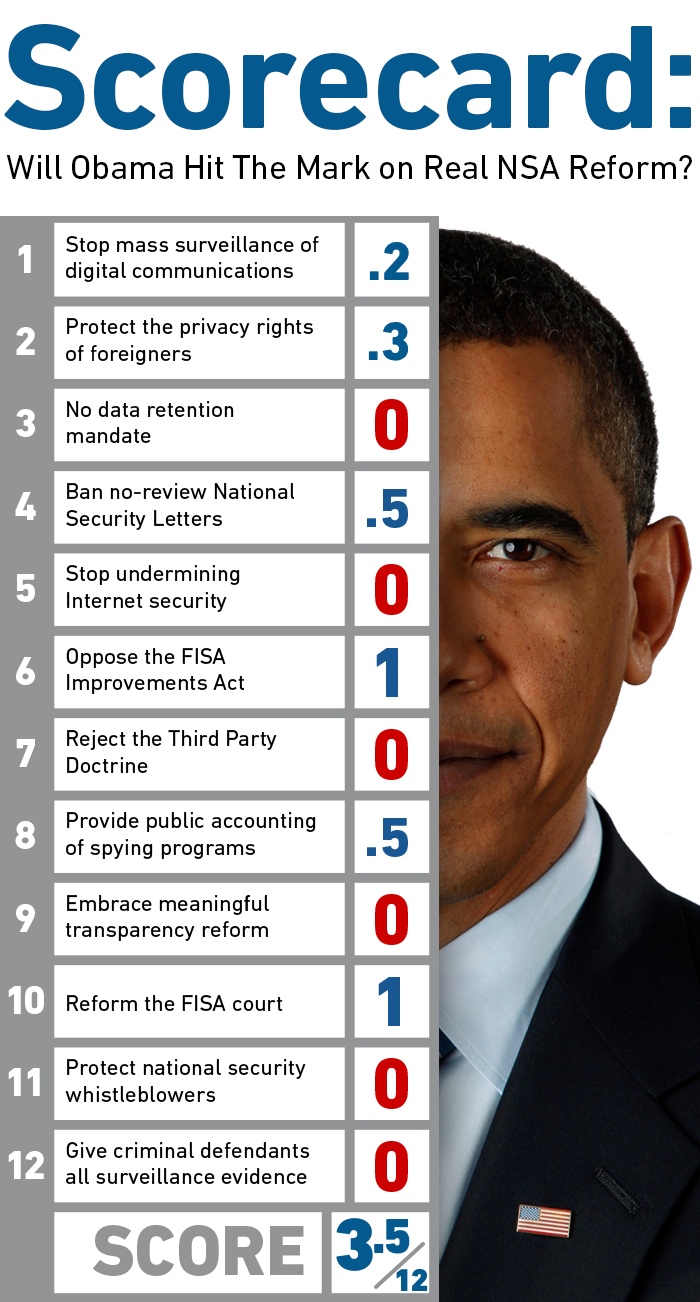
We’ve put together a scorecard showing how Obama’s announcements stack up against 12 common sense fixes that should be a minimum for reforming NSA surveillance. Each necessary reform was worth 1 point, and we were willing to award partial credit for steps in the right direction. On that scale, President Obama racked up 3.5 points out of a possible 12.

1. Stop mass surveillance of digital communications and communication records.

Score: .2

There are three types of mass surveillance that we know about that we were using to evaluate Obama’s promises in this category: surveillance of millions of phone records under Section 215 of the PATRIOT Act; surveillance of Internet communications internationally under Section 702 of the FISA Amendments Act; and surveillance of communications overseas under Executive Order 12333.

In order to score a full point in this category, Obama would have needed to declare that the executive branch would no longer be using any of these authorities to engage in mass surveillance. He tackled only one of these issues somewhat: the surveillance of telephony metadata under Section 215 of the Patriot Act. Specifically, he acknowledged the recommendations of his review group that the government cease to collect and maintain a database of all Americans’ telephone records. He is ending that program, which is laudable. However, he left open the door to having telecom companies or another third party maintain a similar set of mass data, so even as to 215, we could not give him the full ⅓ of the point.

2. Protect the privacy rights of foreigners.

Score: .3

All too often, the NSA’s official position is that foreigners—or anybody deemed sufficiently likely to not be a “U.S. person”—are not given any legal protections under surveillance laws. This situation is unacceptable and out of line with international human rights law, as we’ve put forth in our Necessary and Proportionate Principles, now supported by over 300 organizations worldwide. We demanded that individualized targeting be conducted for non-US persons.

Obama nodded a bit to this situation, and proposed that some reforms be made, but did not give real specifics. While he also did not acknowledge any legal obligations, he did recognize a “special obligation” on U.S. intelligence agencies, and specifically called out a new, higher standard on eavesdropping on foreign leaders. But that’s not enough: privacy consideration should not be a privilege afforded only to top officials. Given these small steps forward but ongoing problems, we’ve given Obama .3 points in this category.

3. No data retention mandate.

Score: 0

Obama’s review group recommended that the telephone metadata surveillance program be taken away from the government, suggesting that a third party or even telecom companies themselves be responsible for maintaining a searchable list of our calling records. This approach—mandating companies act as Big Brother’s little helper—won’t alleviate the serious privacy concerns with maintaining a digital record of every call we make.

We had hoped that Obama would make clear that he would reject any form of mandatory data retention. Instead, Obama acknowledged some of the concerns with a data retention mandate but called for  “options for a new approach that can match the capabilities and fill the gaps that the Section 215 program was designed to address, without the government holding this metadata itself.” He never specifically rejected the idea of forcing companies or a third party to hold this data, and so he does not receive a point in this category.

4. Ban no-review National Security Letters.

Score: .5

The President gets half a point here, since he endorsed ending the permanent gag orders that accompany administrative subpoenas known as National Security Letters, under which the FBI can on its own demand information about you from your communications service providers. We still need specifics, and the details really matter—even fixed-length gags would violate the First Amendment, for example, and gags would still need to be approved by courts—but this was a good and necessary step. Obama didn’t get the other half, though, because he did not agree with EFF and his own review panel that NSLs should only issue after judicial approval. Early in 2014, EFF will ask the 9th Circuit Court of Appeals to find, like the District Court for the Northern District of California already did, that the NSL statute is unconstitutional in its current form.

5. Stop undermining Internet security.

Score: 0

The NSA’s systematic efforts to weaken and sabotage the encryption and security technology make us all less safe. But in contrast to his review group’s recommendations to stop those practices, Obama was silent on the issue. That silence is disappointing, as this is a critical problem that has not just undermined the privacy of millions around the world, but poisoned our collective trust in institutions that depend most on it. Zero points.

6. Oppose the FISA Improvements Act.

Score: 1

The FISA Improvements Act seeks to codify into law the NSA’s controversial and illegal practice of collecting and storing the telephone records of hundreds of millions of Americans. While Obama’s administration had earlier indicated support for the bill, today’s announcement made clear that Obama was not going to support this program going forward and thus was not supporting the FISA Improvements Act. We would have preferred it if Obama had stated clearly that he would veto any bill that attempts to codify mass telephone metadata surveillance, but we felt this was good enough to merit a point.

7. Reject the third party doctrine.

Score: 0

The third party doctrine is an outdated and deeply problematic legal theory that wipes out many of the privacy protections we could otherwise enjoy. It’s the shaky foundation on which some of the most invasive programs by the NSA and other law enforcement agencies rest. Obama should have said that we have a reasonable expectation of privacy in data even though we’ve trusted third party service providers with it—instead, he was silent on the issue.

8. Provide a full public accounting of our surveillance apparatus.

Score: .5

In our criteria, we asked that Obama “appoint an independent committee to give a full public accounting of surveillance programs that impact non-suspects around the world” and that this committee “directly engage whistleblowers like Thomas Drake, William Binney, Edward Snowden and others, and include independent technological experts.”  For this category, we awarded Obama with a half point because he did appoint his counsel, John Podesta, to lead “a comprehensive review of big data and privacy.” However, it remains to be seen whether this committee will actually provide a full public accounting or engage with the whistleblowers who have much to contribute.

9. Embrace meaningful transparency reform.

Score: 0

Fundamental to all of the problems surrounding NSA spying is the fact that the government’s notorious secrecy shields it from any sort of meaningful oversight or accountability. This appears, among other places, in the overclassification of documents that should not actually be secret, in the executive branch’s ruthless campaign against whistleblowers, and in its continued abuse of the “state secrets” privilege in the courtroom. Obama could have announced changes to these secrecy standards, embracing transparency as a default, and making some good on his now laughable election promise to be “the most transparent administration in history.” Instead we got nothing.

10. Reform the FISA court.

Score: 1

We gave Obama a full point for these reforms, since he embraced both independent advocates for the FISA court and an annual process of review of FISC decisions for declassification. While we would like the review to be more current, and there is much to be done to ensure that the independent advocacy panel has a real, unfettered role, Obama’s announcement indicated a good direction on both.

11. Protect national security whistleblowers.

Score: 0

Obama was clear: “One thing I’m certain of, this debate will make us stronger.” And there is little question that this debate would not have happened without the evidence brought to light by Snowden and other whistleblowers. It might seem that Obama would have some recognition that, but for these individuals, we would not be having this important debate.

Sadly, Obama’s speech today gave no indication of a change in strategy in his administration’s war on whistleblowers. If Obama welcomes this debate, he should stop his attack on the people who have risked so much to help make it happen.

12. Give criminal defendants all surveillance evidence.

Score: 0

It’s a cornerstone of our justice system that the accused have the right to see all the evidence against them. That made it very alarming when we learned that the NSA was collecting intelligence and then laundering it into criminal investigations by the Drug Enforcement Agency and other law enforcement groups. This practice conflicts with the protections enshrined in the Fifth and Sixth amendments, and should be stopped immediately. While Attorney General Holder has promised to review the cases, the Administration has not promised to ensure that everyone whose information was shared with law enforcement agencies by the NSA ultimately gets notice. Obama didn’t mention this necessary measure in his speech, and gets no points.

Related Issues: 

Share this: Share on Twitter Share on Facebook Share on Google+ Share on Diaspora  ||  Join EFF
18 Jan 23:18

The sum of 1 + 2 + 3 + 4 + 5 + ... until infinity is somehow -1/12

by Casey Chan on Sploid, shared by Casey Chan to Gizmodo
Brindle

Not neat. This is what happens when you let Physicists do math... No good comes from it.

The sum of 1 + 2 + 3 + 4 + 5 + ... until infinity is somehow -1/12

Here's a fun little brain wrinkle pinch for all you non-math people out there (that should be everyone in the world*): the sum of all natural numbers, from one to infinity, is not a ridiculously big number like you would expect but actually just -1/12. Yes, the sum of every number from one to infinity is some weird negative fraction. What the heck?

Read more...


18 Jan 02:27

Growing Number Of People Agree That Ed Snowden Is A Whistleblower

by Mike Masnick
A new poll from Quinnipiac University suggests that, despite widespread efforts by politicians to attack and demonize Ed Snowden, a growing percentage of the American population views him as a whistleblower. It's now up to 57% from what had been 55% in the last poll. The same poll also showed that a majority of people now think that the US government's anti-terrorism policies have "gone too far." It cracked 51%, up from 45% right after the first Snowden revelation, and way up from the 25% who felt that way back in 2010. The poll also suggests that fewer and fewer people support the Section 215 bulk metadata collection program, even when it's framed with this question, which I would imagine most people are biased towards agreeing with:
"Do you support or oppose the federal government program in which all phone calls are scanned to see if any calls are going to a phone number linked to terrorism?"
After the Snowden leaks, 51% of people supported that description of the program, while 45% opposed. Now it's down to 48% support and up to 47% opposed. Similarly, the percentage of people who claim this program "is necessary to keep Americans safe" has dropped from 54% down to 48%. Perhaps it helps that multiple studies have now shown that the program has not helped.

It's certainly slow going, but it certainly appears that the trend in public opinion is moving against these programs and increasingly in support of Snowden.

Permalink | Comments | Email This Story


18 Jan 02:15

USTR Refuses To Show Up For Senate Hearing On Fast Track

by Mike Masnick
One of the biggest concerns that we've heard from Congress about the USTR's desire for fast track authority is the fact that the USTR has been positively dismissive of Congressional attempts at transparency. While the USTR pretends that getting fast track actually means great cooperation with Congress, apparently USTR boss Michael Froman decided to bend over and tell Congress to kiss his ass by not even bothering to show up for the Senate's hearing on fast track authority.

Several committee members said they were puzzled and disappointed that USTR Michael Froman passed on an opportunity to convince some skeptical lawmakers they need to establish Fast Track authority for President Barack Obama’s priority Trans-Pacific Partnership (TPP) agreement.

“I wish they were here,” said Portman, a member of the committee and a former US trade representative under President George W. Bush.  “It’s important.”

This shows the kind of disdain that the USTR appears to hold Congress in. Congress remains a mere nuisance in the USTR's ongoing efforts to put forth the best agreement possible for a bunch of crony friends who will soon be offering USTR staffers new jobs as lobbyists.

If the USTR can't even bother to show up to argue for fast track, while arguing how important it is, perhaps it suggests that Congress really ought not to give the USTR that kind of power. So far, the USTR has not been transparent. It has directly lied, repeatedly, to the American public about what it's trying to do, and when given the chance to explain itself to the Senate committee in charge of the very bill it wants to give it more power over the TPP and TTIP/TAFTA, it blows it off.

Permalink | Comments | Email This Story


17 Jan 17:28

Congressional Reps Ask Bruce Schneier To Explain To Them What The NSA Is Doing, Because The NSA Won't Tell Them

by Mike Masnick
This is both depressing and good news at the same time. A group of Congressional Representatives (who are among the most critical of the NSA) apparently asked Bruce Schneier to come brief them on what the NSA is doing because the NSA won't tell them:
This morning I spent an hour in a closed room with six Members of Congress: Rep. Logfren, Rep. Sensenbrenner, Rep. Scott, Rep. Goodlate, Rep Thompson, and Rep. Amash. No staffers, no public: just them. Lofgren asked me to brief her and a few Representatives on the NSA. She said that the NSA wasn't forthcoming about their activities, and they wanted me -- as someone with access to the Snowden documents -- to explain to them what the NSA was doing. Of course I'm not going to give details on the meeting, except to say that it was candid and interesting. And that it's extremely freaky that Congress has such a difficult time getting information out of the NSA that they have to ask me. I really want oversight to work better in this country.
There's really not much more to be said about that, other than it shows what a complete joke it is for anyone to claim that Congress has real oversight over the NSA. It's great that these Reps would reach out to someone with qualifications like Schneier to have this kind of conversation. It's depressing that such a thing was necessary.

Permalink | Comments | Email This Story


17 Jan 02:31

Hacker Who Exposed Rapists Facing More Jail Time Than Offenders

Brindle

This is the world we live in, folks.

17 Jan 01:21

The Corruption Of Power: President Obama Trusts Himself Not To Abuse NSA Info

by Mike Masnick
We've pointed out in the past that President Obama's views on the surveillance state shifted completely from when he was Senator to when he was President. As Senator, he supported a bunch of reforms that are very much like the ones his panel have suggested -- and which he's about to ignore. The NY Times has a long article talking about President Obama's path from an NSA critic to a supporter, and this is the key line, delivered by a nameless "former aide:"
...he trusts himself to use these powers more than he did the Bush administration.
This is not the first time we've seen this attitude of "I'm trustworthy, so it's okay" from President Obama. Remember, back during the last election, President Obama instructed his staff to come up with explicit rules concerning the use of killer drones -- rules that the military under Obama did not have -- because he was worried how a President like Romney might use the program. Of course, once it became clear that Obama would win re-election, those plans to create rules were put on the shelf.

This is the corruption of power. It's a belief that we don't need explicit rules and protections because "I'm trustworthy and I won't abuse this stuff." But just about everyone thinks of themselves as trustworthy -- and then an extreme situation comes up... and they abuse that trust just a little bit, because they can, and, hey, they're trustworthy. And then they abuse it some more. And some more. Or, the next guy abuses it. And the next guy abuses it some more, because there's a precedent set. If you're really trustworthy on issues like this, then you would have an even stronger support for the rules, because you know you'll never abuse them. It's actually only if you're in power and you're not trustworthy that you fear such rules.

The Times coverage also suggests, as President Obama himself has, that the other big difference is that once he was in power, he "better understood the threats," as well as how these programs protected us. But that position is undermined by much of the rest of the article, which suggests that the reality is that, once in power, President Obama just didn't care any more:
Feeling little pressure to curb the security agencies, Mr. Obama largely left them alone until Mr. Snowden began disclosing secret programs last year. Mr. Obama was angry at the revelations, privately excoriating Mr. Snowden as a self-important narcissist who had not thought through the consequences of his actions.

He was surprised at the uproar that ensued, advisers said, particularly that so many Americans did not trust him, much less trust the oversight provided by the intelligence court and Congress. As more secrets spilled out, though, aides said even Mr. Obama was chagrined. They said he was exercised to learn that the mobile phone of Chancellor Angela Merkel of Germany was being tapped.
This fits with earlier claims we've heard about how President Obama keeps finding out about what the NSA is doing from the Snowden leaks, and then having to go ask the NSA what's really going on. The idea that the President didn't know that the NSA was tracking the phone of the leader of one of our largest allies suggests a complete disinterest and hands off approach to the surveillance state -- which is another recipe for allowing widespread abuses.

Similarly, as we were among the first to point out, the FISC ruling that noted the NSA had abused section 215 of the PATRIOT Act for years, came just weeks after President Obama took power. He claims that as he studied the programs, he found that they were important and vital and weren't being abused. Yet, just weeks after he became President the court in charge of oversight found exactly the opposite. You'd think that if he were actually concerned about the surveillance state, he would have taken an interest. But he didn't:
But when Mr. Obama was briefed, the case did not stir consternation. The president’s team instructed the Justice Department to fix the problem, but “this was not a central concern and he was very quick in knowing how to deal with it,” said a former administration official.
Because even if the program wasn't in line, it's okay, because, hey, the Preisdent is a "trustworthy guy." And that's exactly how you end up with an abused and overreaching surveillance state. I'm sure that the President believes he is a trustworthy guy. And there's plenty of truth to that old line that "we judge ourselves by our intentions, and others by their actions." He may have the best of intentions, but when you're in charge of the most powerful government in the world, being a "trustworthy guy" doesn't cut it. The corruption of power is too clear and too easy. There needs to be real and significant controls, and not just because you think you won't abuse the system -- or because the guys before or after you might. There need to be real and serious controls because the natural direction of a surveillance state is to abuse civil liberties, whether intended or not.

The president's statements when he was a Senator may have just been political posturing. But now he's President and all he's done has shown that he doesn't understand how a true leader handles such situations. Instead, he's succumbed to the corruption of power.

Permalink | Comments | Email This Story


15 Jan 20:52

Blackphone vows to put privacy ahead of everything else using custom version of Android

by Quentyn Kennemer

An interesting new phone has found its way out of the shadows and into the light. It’s called the Blackphone, and its creators — a joint effort between Geeksphone and Silent Circle — hopes it’ll change mobile privacy for the better. Blackphone aims to “prioritizes the user’s privacy and control, without any hooks to carriers or vendors.”

They’ll do it using a custom version of Android that they call PrivatOS, which will apparently have a framework built-in for securing everything about your mobile communications. Here’s a quick summary of things it’ll be able to do for you:

blackphoneYou can make and receive secure phone calls; exchange secure texts; exchange and store secure files; have secure video chat; browse privately; and anonymize your activity through a VPN.

Blackphone vows to give power back to the user. While they aren’t specific on how any of this will be done, we’re told we should be learning more about it at Mobile World Congress in Barcelona next month. For what it’s worth, they say the phone will be just as powerful and capable as the top smartphones from major manufacturers. We won’t take their word for it just yet, but they definitely have our attention from this point forward.

Blackphone is something that is sure to turn the heads of many in a time where more and more folks are conscious about their basic rights to privacy. With the likes of the NSA potentially monitoring communications using backdoor protocols and advanced surveillance techniques, privacy buffs everywhere will have to seriously consider the proposition Blackphone is making. They’re hoping the video you see above will convince you, so go ahead and give it a quick viewing and see how you feel about it.

[via Blackphone]

15 Jan 00:41

Detailed Study Suggests NSA Rarely Useful In Stopping Terrorism

by Mike Masnick
While we've already seen multiple detailed analyses of why the NSA's bulk collection of email data under Section 215 of the PATRIOT Act hasn't been particularly helpful in stopping any real terrorist attacks on the US, there are still other NSA programs as well. The folks over at the New America Foundation have put out a detailed new report looking at whether any of the NSA's programs have been effective. The report finds, exactly as everyone else has, that the Section 215 effort was only helpful in finding one guy who sent some money to Somalia. However, more importantly, it also looks at the other big NSA program, the one that comes under Section 702 of the FISA Amendments Act which includes (among other things) the PRISM program that got a lot of attention. Once again, the evidence of 702's usefulness is fairly minimal. The report finds that it was used in less than 5% of investigations of people charged with terrorism since 9/11.

The full report looks at all 225 individuals who were either part of Al Qaeda or an associated group and charged with terrorism since 9/11. In looking over every plot they were involved in, you see that much more traditional means of catching terrorists were involved in almost every case. There are community/family tips, informants, other non-NSA intelligence, routine law enforcement, self-disclosed by publicizing his own extremist activity, "suspicious activity" reports... and of course, plots that weren't actually prevented. There is, to be fair, a large number of plots where the discovery is from "unclear" means -- and it's entirely possible that some of those were discovered under the Section 702 programs. However, at the very least, this calls into question just how valuable either of these key NSA efforts really are.

Permalink | Comments | Email This Story


15 Jan 00:20

Jury Finds Two Officers Charged In Beating Death Of Homeless Man Not Guilty

by Tim Cushing

The verdict has come back on the trial of two officers charged in the beating death of schizophrenic homeless man Kelly Thomas. Not guilty on all charges. The Orange County jury heard three weeks of testimony and returned this verdict in less than a day.

The incident, which began with Officer Ramos putting on gloves and announcing to Thomas that his "fists" were getting ready to "fuck him up," and ended with Thomas in an irreversible coma, was caught on surveillance tape and synched to Ramos' body mic recording. The tortured screams and gasps of the 135-lb. Thomas were unable to convince the jury find one of the cops guilty of lesser charges (Officer Cicinelli -- charged with involuntary manslaughter and use of excessive force). Even Cicinelli's own words -- "I ran out of options and just started bashing the hell out of [Thomas'] face [with the butt end of his taser]" -- failed to persuade the jury that the force used was excessive.

But as the Orange County Register presciently noted a couple of weeks ago, juries in Orange County tend to be "law and order" juries.

Orange County juries historically have given police officers carte blanche to use deadly force even against unarmed citizens and to lie in official reports that cover up police corruption.
The defense argued that Thomas died of causes unrelated to the physical force applied by six responding officers. They also argued that any force that might have been "excessive" was demanded by Thomas' supposedly violent resistance. But that seems a little unlikely when you take into account the defense's medical expert, who maintained Thomas died of a "weakened heart" brought on by "years of meth abuse." How does a 135-lb. man with a "weak heart" (who "could have died sitting in a closet" according to the medical expert) put up enough of a struggle that officers (six of them) fear for their safety? It doesn't add up, especially when you consider the fact that Officer Ramos, who initiated the attack and spent most of the incident on top of Kelly Thomas, outweighed the homeless man by at least 100 pounds. Add to that the weight of other officers who responded to calls for backup. Suddenly, this guy with a heart so weak he could have died "at any time" looks almost superhuman.

If there's anything that seriously undercuts the arguments that these officers responded with appropriate force to a threatening situation, it's the comparison of post-altercation photos of Kelly Thomas [warning: photo is extremely gruesome] and Officer Ramos, who sustained the following injury during the "dangerous" struggle.

The jury's verdict sends a message to Orange County law enforcement: you can threaten a person with a beating, follow that threat up with a six-officer beatdown -- including "beat[ing] the hell" out of them with the butt of your Taser -- all while being caught on tape and walk out of the courtroom free men. Kelly Thomas' father rightfully calls this a "miscarriage of justice."

For what it's worth, the federal government seems to find this verdict questionable.

"With the conclusion of the state court trial, investigators will examine the evidence and testimony to determine whether further investigation is warranted at the federal level," FBI spokeswoman Laura Eimiller in Los Angeles said in a statement.

While it's somewhat encouraging to see that the FBI thinks something is amiss here, there's really no reason for the federal government to step in and find some other way to punish these two cops. The only thing that should be looked for is evidence of misconduct that occurred during the trial which would stipulate throwing the verdict out and retrying the case. Anything else would be the government sending the unwelcome message (one it has sent previously, following the trial of George Zimmerman) that if the administration doesn't like a verdict a jury has reached, it will subvert the judicial system and render one of its own.

Permalink | Comments | Email This Story


13 Jan 20:47

DriveSafe for Google Glass helps you stay awake behind the wheel

by Quentyn Kennemer

“OK Glass, keep me awake” is the phrase you’d use in the app we’re about to talk about. It’s called DriveSafe, a Google Glass app that acts as a road companion while you’re driving. The app’s primary purpose is to help you keep your eyes open behind the wheel while you search for a place to stop and rest. The app uses Google Glass’s various sensors to detect when you might be falling asleep, and will buzz you using the bone conduction speaker (or mono earbud) to keep you going.

drivesafe-for-glass

Beyond that particular alert, you’ll also get functions for finding nearby rest stops in case you can’t handle being awake and need to take a roadside nap. We would never condone getting behind the wheel without proper rest, but if you find yourself in that situation then you’ll be glad to have something like DriveSafe available to you.

DriveSafe reminds folks that your safety is your own responsibility, and that you should take proper care behind the wheel. This handy little disclaimer at their website absolves them of any future accident that might occur:

 DriveSafe is alpha software – it is not guaranteed to stop you from falling asleep while driving and should not be relied on to do so. DriveSafe is not liable for any accidents or injuries that may occur while using DriveSafe. Be sure to be well rested and comfortable before driving,  and keep your eyes on the road (DriveSafe can be used simply with your voice).

They shouldn’t have to say that, but there it is anyway. I guess it’s not a terribly bad idea to have Google Glass on when you’re driving, eh highway patrolmen? Always practice safe driving folks, and try to put yourself in a position where you won’t need a handy little companion like this. We’ll be contacting the folks at DriveSafe to see how they use Google Glass’s sensors to detect whether or not you’re falling asleep. In the meantime, download it to your Google Glass unit if you’re interested.

13 Jan 19:57

I Spent Two Hours Talking With the NSA’s Bigwigs. Here’s What Has Them Mad

by Steven Levy
I Spent Two Hours Talking With the NSA’s Bigwigs. Here’s What Has Them Mad
My expectations were low when I asked the National Security Agency to cooperate with my story on the impact of Edward Snowden’s leaks on the tech industry. Imagine my surprise when they agreed to let me behind the fence.


12 Jan 17:42

Planning for 802.11ac

by Jonathan Morin
Brindle

hrm... seems complicated, think I'll stick with dixie cups and string

As the latest wireless standard, 802.11ac, is expected to be ratified by the IEEE in the next few months, it is an inevitable force in the world of wireless.  The standard promises more bandwidth for wireless users, and as support in user devices is expected to increase over the next year, more network admins are now considering when and how to make the migration.

But for those who are familiar with the technology already know, upgrading the wireless network won’t be as simple this time as it was in the past.  Due to some of the ways that 802.11ac managed to increase bandwidth, as well as the fact that only the 5 GHz band is supported, wireless networks will need to be planned a bit differently, taking new considerations into account.  At Extreme Networks, we’ve put together an infographic to hopefully help simplify and better understand what those considerations are by comparing 802.11ac to previous 5 GHz technologies.  We hope you find it useful, and look forward to helping make this migration a smooth and seamless one, leveraging the boost in user experience without the pain of unexpected re-planning tasks during and after the migration.

6694-Planning-for-802.11ac

Additional thoughts?  Questions?  Reach out to us – @JonathanMorin

12 Jan 03:15

Pharmacy Group Lies To Registrars: If We Complain About A Site, It Must Be Taken Down No Questions Asked

by Mike Masnick
This is incredible. Just yesterday we wrote about how EasyDNS won its arbitration case, saying that a registrar cannot takedown and block the transfer of a domain name just on the say so of law enforcement or anyone else not carrying a court order. And, the very next day, EasyDNS is reporting on an absurd letter it has received from the National Association of Boards of Pharmacy, which argues exactly the opposite of what the arbitration panel told EasyDNS.

Incredibly, it says that if it complains about a domain, the registrar must take it down:
"Upon receipt of an abuse notification, some Registrars claim that a court order is required or that they are not violating the laws of the Registrar’s country. Both assertions are wrong."
Except, as EasyDNS points out, the arbitration ruling says that it's the NABP that's wrong, and that a court order is required. Similarly, the NABP claims that registrars must freeze the domains, even without a court order.
You should not allow domain names engaged in the illegal sale or distribution to transfer to another Registrar: the question of legality does not relate to where the Registrar is located, but rather to the activity of the Web site.
But, again, the arbitration ruling, which merely read from ICANN's own rules, says the exact opposite -- noting that you clearly need a court order

The NABP also tries the same direct misreading of ICANN's rules that Public Domain Registry used, to pretend that "fraud" is a reason to deny transfer, but as the arbitration ruling found, that claim is simply incorrect. The "fraud" referenced in the rules is only fraud concerning transfers not fraud in terms of what the website was used for.

There's much more in the letter as well. There is some history here. The NABP is basically an organization designed to artificially inflate the price of drugs in the US, cynically using highly questionable claims to pretend that they're focused on "public safety." For years, the NABP has worked hard to keep legitimate but cheaper versions of drugs outside the US, so that US pharmacies (and the drug companies they work with) can charge increasingly insane prices for drugs. Because they can use the specter of "fake drugs killing people!" they're able to do all sorts of nasty attacks on foreign pharmacies that are selling perfectly legitimate drugs to willing buyers, by claiming that they put people's lives at risk.

And, now, it appears they're going even further in trying to basically create a "SOPA-like" setup, whereby registrars are required to pull down any domain based solely on NABP's say so without any judicial review at all. The fact that this is happening at the same time that City of London Police are doing the same exact thing (at the urging of the legacy music/movie industries) isn't an accident. While the supporters of SOPA insist that there's no new legislation coming, they're all trying to do an end run around all of it, creating something that's even more extreme than SOPA by getting registrars to simply kill sites they don't like based on nothing but a complaint.

EasyDNS's Mark Jeftovic says it all in his blog post about it, noting that this is why they fought back against COICA/SOPA/PIPA:
It really is getting creepy out there.

We now know that we live in a total surveillance society, governments are printing money, going broke, manufacturing consent and lying about nearly everything; while quasi-governmental agencies all over the world are now asserting they have the authority to overturn legal process and basically dictate everybody else's business.

This script is playing out almost verbatim what we wrote only three years ago in "First They Came For The File Sharing Domains".

Who will be the next batch of clowns who tell us they can use liberally interpreted language in a couple of agreements that they aren't even party to to compel us to takedown your website? Let's start a betting pool.
This is why pushing back and standing up for internet freedom is so important. The attempts to control, to censor, to block and to silence are only increasing. The legacy players who can't stand competition or innovation are looking for any way to hold back the future, and that means attacking the public's ability to make use of the internet and to speak freely.

Permalink | Comments | Email This Story


12 Jan 03:12

Former Judge Who Was Caught Texting Instructions To Prosecutors Now Running For District Attorney Post

by Tim Cushing
Brindle

what a joke... judges that don't quite understand what being a judge means has pretty horrible ramifications.

Judges are supposed to be impartial arbiters of justice. However, former Texas judge Elizabeth Coker felt the prosecution needed a helping hand now and then to ensure "justice" was done and provided hints via text messages to district attorneys. Once evidence of her ex parte communications became public knowledge after an investigation, Coker resigned -- or as she put it, "took one for the team."

While I could have fought these allegations, it would have involved significant time, significant expense, and disruption to everyone involved. I did not feel that was in the best interests of the taxpayers, our court system, my family or myself" Coker stated.
With Coker graciously stepping aside rather than facing the consequences of her actions, many people thought the Texas judicial system was finished with the disgraced judge. And maybe it was. Unfortunately, it appears Coker's not quite finished with the Texas judicial system.
Her resignation became effective Dec. 6. Her campaign to become the district attorney of Polk County became effective Dec. 8.

“I am running for Polk County Criminal District Attorney!!!” she wrote in a Facebook post. “The support and encouragement I am receiving has been overwhelming and humbling. I want to thank all my family, friends and supporters who still want me as a public servant."
This move makes it painfully apparent where Coker's allegiances laid during her tenure as a judge. In her mind, justice is punishing alleged wrongdoers and little else. The defense of the accused runs a very distant second. Her press release posted at Polk County Today makes this even more explicit.
My reputation as a judge was being tough on crime. However, a prosecutor not only has to be tough but also smart on crime. I have the experience, knowledge and expertise to not only continue to be tough on crime but also be fiscally responsible while protecting the citizens of Polk County.
Judges are there to help ensure wrongdoers are punished, but being "tough on crime" isn't part of the job description. Apparently, Coker feels it is. She was "tough on crime" as a judge, so she pitched in and offered assistance to prosecutors and attorneys who might have otherwise made her appear slightly less "tough on crime."

Her ethics violations were enough to get her stripped of her title. Coker can't even officiate a wedding at this point, but somehow feels her very recent past should have no bearing on her future as a "tough on crime" district attorney. This is a pretty bold move for a person in her position, one that should further call into question the cases she presided over as a judge. As the Commission noted back in October, Coker showed "a bias in favor of certain attorneys and a prejudice against others in both her judicial rulings and her court appointments." This is hardly the sort of person that should be elected to another post within the judicial system. If she was willing to break rules to help ensure convictions as a judge, there's no reason to believe she'll be any better behaved as a district attorney.


Permalink | Comments | Email This Story


12 Jan 03:10

Members Of Congress Ask Eric Holder To Try Again In His Explanation Of The Prosecution Of Aaron Swartz

by Mike Masnick
Tomorrow is the anniversary of the unfortunate passing of Aaron Swartz. Senators John Cornyn and Al Franken, along with Rep. Darryl Issa, have now sent Attorney General Eric Holder yet another request for an explanation concerning the investigation and prosecution of Swartz. This follows on a similar request from last year, but these elected officials note both that the DOJ's response was inadequate, and that it was also contradicted by the eventual report on the prosecution that came out of MIT.
We regret that the information your Department has provided to date has not been satisfactory -- among other things, it painted a picture of prosecutors unwilling or unable to weigh what charges to pursue against a defendant, something which you have instructed federal prosecutors is "among [their] most fundamental duties."

The account also is inconsistent with findings in the report prepared by MIT about the prosecution of Mr. Swartz, dated July 26, 2013 ("MIT Report"). A letter provided by the Department in May states that "the charging and sentencing decisions made by Department. lawyers were properly based on the law and the facts of the case . . . and not on inappropriate considerations, such as Mr. Swartz's exercise of his legal rights as a citizen." The MIT Report indicates that Assistant U.S. Attorney Stephen Heymann considered other factors in advance of the return of the superseding indictment. He told MIT that "the straw that broke the camel's back" was an internet webpage soliciting signatures on Mr. Swartz's behalf by Demand Progress, an activist group founded by Mr. Swartz.
In other words, despite the claims from Holder that the charges against Aaron were not based on Swartz exercising his right to free speech, Stephen Heymann has since admitted that, in fact, Swartz's friends speaking out on his behalf were what made him decide to try to throw the book at Swartz. The letter points out further claims from Holder that appear to be contradicted by the MIT report and note:
Inconsistencies such as these require serious responses to the original letter, and indeed raise more questions about the prosecution of Mr. Swartz. One year ago, we sought the basis for the U.S. Attorney Carmen Ortiz's determination that her office's conduct was "appropriate." We have received no such information, not even the sentencing memoranda that surely were prepared in a case such as this.

In March, you testified that Mr. Swartz's case was "a good use of prosecutorial discretion." We respectfully disagree. We hope your response to this letter is fulsome, which would help re-build confidence about the willingness of the Department to examine itself where prosecutorial conduct is concerned.
Given how Holder and the DOJ have responded to these issues in the past, I wouldn't expect any real response to be forthcoming any time soon.

Permalink | Comments | Email This Story