Brindle
Shared posts
Google just made it really easy for strangers to email you
BrindleOh Boy! Just what I was hoping google would do...
$200, Feb 1st: Details On The New LEGO Simpsons Set
Brindlewill @gfree23 buy this?
 Remember the leaked pics of the new LEGO Simpsons set? Well here are the actual details. Per official press release and not the bullshit my cat made up and tried to tell me over lunch:
The Simpsons House is scheduled to launch February 1st in LEGO stores and via the LEGO Shop at Home catalog and website for $199.99 (USD). The Simpsons house consists of the entire family: Homer, Marge, Bart, Lisa and Maggie along with neighbor Ned Flanders. The line of LEGO The Simpsons minfigures will launch in May 2014 in all major toy retailers for $3.99 (USD) each. FOX is scheduled to air a special LEGO episode of The Simpsons in May 2014 featuring Springfield and its cast of characters in LEGO form.Damn, $200? That's like two months of cell phone service. And how else am I supposed to entertain myself on a date? "I dunno, actually talk to her?" But what if we find out we don't have anything in common? "Then maybe it wasn't meant to be." But she smells soooooo good. "That's not a reason to be in a relationship." Let's just agree to disagree. Keep going for a bunch of detail pics and a video.


 Thanks to tagger, J.P. and Chris A, who promised to go quartersies with me because they love me and want to see me happy unlike SOME PEOPLE I KNOW (I'm talking about you).
Liberals And Conservatives Switch Positions On NSA Surveillance Depending On If 'Their Guy' Is In Power
That's troubling on any number of levels, but hopefully it serves as a point to a useful tool in convincing those who trust "their guy" not to abuse the system: just ask them how comfortable they'll be when "the other guy" is in power after the next election?
Permalink | Comments | Email This Story

    
|
Internal Affairs Divisions Dismissing 99% Of Misconduct Cases Against New Jersey Police Officers
Not all cops are bad, but the insulation from accountability begins with the departments themselves, which often go out of their way to defend the actions of abusive officers. In some cases, pressure from police unions has kept unruly officers on the job despite the departments' efforts to remove them. Other times, the insulating force is also the first line of officer accountability: Internal Affairs. Often depicted as a hated entity within the force, the Internal Affairs division is supposed to be the public's first line of defense against cops who abuse their power. As documents obtained by the Courier News and Home News Tribune show, dozens of complaints against central New Jersey police officers are dismissed every year without ever making it past these departments' internal review mechanisms.
From 2008 to 2012, citizens filed hundreds of complaints alleging brutality, bias and civil rights violations by officers in more than seven dozen police departments in Central Jersey…Nationwide numbers aren't all that encouraging, with only 8% of complaints being sustained, but the New Jersey police departments are pitching near shutouts. These numbers can be taken to mean that either these departments only staff exemplary officers -- or that many cases boil down to not much more than the complainant's word against the officer's, something that rarely goes the complainant's way.
Just 1 percent of all excessive force complaints were sustained by internal affairs units in Central Jersey, the review found. That’s less than the national average of 8 percent, according to a federal Bureau of Justice Statistics report released in 2007.
Elizabeth, for example, processed 203 such complaints in the five-year period and not once sided with a complainant. Woodbridge had 84 complaints, New Brunswick had 81, Perth Amboy had 50 and Linden had 33. In all those cases, these agencies either “exonerated” the officers, dismissed the complaints as frivolous, determined that they did not have sufficient evidence or simply never closed the investigations.
On a positive note, the journalists were able to compile the numbers thanks to New Jersey's Open Public Records Act which requires police departments to tally and track complaints, including how each case is disposed. On the downside, almost all information related to the officers involved is redacted.
Except in race cases, complaints against officers and how officers were disciplined — which can range from spoken or written reprimands to suspensions or termination — are kept confidential.As Sergio Bachao of My Central Jersey points out, this provides public officers with more protection than it does private citizens. Complaints and disciplinary rulings against licensed professionals in the private sector are posted by the state using these citizens' full names. Obviously, doing so makes these professionals more accountable and provides other members of the public with info they can use to avoid potential scams, etc.
The tallies of complaints and how they were disposed are public records, as are use of force reports, which officers are required to file whenever they use bodily force or weapons to subdue a suspect. The public also has the right to read synopses of all complaints where a fine or suspension of at least 10 days was assessed. But the identities of officers, as well as the complainants, have to be redacted from these documents.
The redactions work the opposite way in these public records, protecting those who have been accused of wrongdoing. It's often not until a case has finally made its way to the courtroom that these officers' "rap sheets" are exposed. And in most cases, officers accused of deploying excessive force or abusing their power will be serial violators -- something that would have been noticed earlier if not for these redactions.
In the wake of the Deloatch investigation, then-Sgt. Richard Rowe was charged with mishandling 81 internal affairs in New Brunswick from 2003 to 2007. He was sentenced in August to two years of probation. The Home News Tribune also reported that Berdel had been investigated at least seven times by internal affairs, including once for an excessive force complaint. The complaints either were not sustained or never resolved.One NJ assemblyman thinks he has a solution.
Assemblyman Peter Barnes III, D-Middlesex, said that all internal affairs investigations should be handled by county prosecutors or the state Attorney General’s Office.Barnes has a bit too much confidence that prosecutors and state AGs will be a more "neutral" force than Internal Affairs. These entities operate in concert with police officers to prosecute accused wrongdoers. The close relationships with police departments are often hard to disentangle when an officer is facing potential criminal charges. It's not unheard of for misconduct cases to finally reach the AG level only to find the AG unwilling to pursue charges.
“It’s long since past the day where you can say with a straight face that it’s OK to have officers investigate their own. It just isn’t a good system,” Barnes said.
AGs and prosecutors often believe they're in the business of "fighting crime" (some even run for election using a "tough on crime" platform) when in reality they're only part of a system aimed at providing justice. Because of this misconception, prosecutors and AGs consider police officers to be allies in the war on crime and tend to be rather lenient when charged with prosecuting officer misconduct.
There's probably no perfect solution for this problem but some extra steps could mitigate a lot of these concerns. To be sure, there are a large number of complaints that fall into the "frivolous" category, meaning the percentage of misconduct cases that result in any sort of disciplinary action will still remain rather low. But requiring some sort of independent oversight would be a start. As it stands now, an internal division reviews these cases and, should it believe criminal charges might be in order, it forwards them to state AGs and prosecutors -- who are often as reluctant to pursue charges as the department itself.
Another suggestion would be the use of body cameras by police officers. Although officers and police departments still retain some control over the footage collected, early use has indicated that they tend to reduce complaints of misconduct or excessive force. Citizens are less likely to file frivolous complaints knowing there's footage of the incident, and officers are less likely to deploy excessive force for the same reason.
At this point though, with only 1% of complaints being sustained, citizens have very little reason to believe the system will hold bad cops accountable. Likewise, bad cops can look to the 99% "clearance rate" as an indicator that their bad behavior will go unpunished, if not unnoticed.
Permalink | Comments | Email This Story

|
|
ACLU Sues City Of Omaha, 32 Police Officers For Use Of Excessive Force, Warrantless Search And Seizure
BrindleHoly crap.. how many cops in Omaha had nothing better to do right then...
If there's any question as to whether the officers subduing Octavius Johnson (who was apparently asking why a vehicle was being towed) applied excessive force (looks like the officer gets a few swings in before other witnesses arrive), it was answered by the 20+ cops who stormed the house (without a warrant, obviously) in order to seize and destroy the footage of the arrest contained in Jaquez Johnson's cell phone. The fact that their wheelchair-bound aunt was thrown to the ground during this altercation is nothing more than a side effect of her inadvertently being between dozens of cops and the person they were pursuing.
The cops that stormed the Johnson house to destroy evidence failed to comprehend that everyone has a camera these days -- like, say, the neighbor across the street who obtained this footage of the excessive force and the blitzkrieg of Omaha cops that followed.
Omaha.com has a timeline of the incident, which begins at 5:23 pm when an officer responds to a call to check on an unoccupied vehicle. Two hours later, the aunt is on the way to the hospital while three of the Johnson brothers are being booked on a variety of charges. All three have one charge in common: the rather meaningless "obstructing an officer."
The neighbor's recording made it impossible for the Omaha PD to sweep this under the rug (not that it didn't try). The officers' own admission that they had seized Jaquez Johnson's phone and erased his recording made it impossible for the department to pretend everything that happened was purely legal. In the end, four officers were fired for their involvement in this situation. As PINAC reported back in May, even the county attorney was unable to find anything less than damning to say about the incident.
“The conduct inside after the officers went inside (the house) is much more disturbing” than what’s on the YouTube video.Now the ACLU is joining the Johnson family in suing the city of Omaha, along with the 32 police officers involved.
Kleine on memory card: He said the knowledge that the memory card was taken by Officer James Kinsella “comes from Officer Kinsella himself and what he said to other officers.”
Kleine: ”The officer’s conduct in taking that memory card is so out of line, it’s criminal conduct. We don’t know what’s on that memory card” and that’s what we want to find out.
On OPD trying to hide misbehavior: ”It’s of tremendous concern to the chief and it’s a concern to us. We can’t have this type of conduct. It’s a betrayal of public trust.”
Members of an Omaha family filed a lawsuit in federal court today alleging that excessive force and a warrantless search and seizure were used in response to a parking incident in March 2013. The Johnson family has never received compensation for the damages to their property or their medical expenses resulting from the incident. All charges against the Johnsons were dropped. An internal investigation resulted in the termination of four officers and criminal charges being brought against two of the officers for either tampering with evidence or being an accessory.Unbelievably, the entire situation was ignited by nothing more than a parking violation. By the end of it, the Johnson house had been swarmed by Omaha police officers, something the ACLU claims is not simply a misuse of public funds but a clear violation of citizens' rights.
"Despite the fact that no crime, drugs, or weapons were involved, more than twenty officers arrived at the Johnson's home, invaded their privacy, confiscated their property and unnecessarily injured four members of the family," said cooperating attorney Diana Vogt. "You do not lose your right to be treated with respect by law enforcement simply because of where you live in Omaha or the color of your skin."According to the ACLU's statement, the Omaha PD's actions have generated several reports of officer misconduct and racial bias over the past few years. The PD also seems to have a problem understanding that citizens have a right to record on-duty officers. The ACLU hopes this lawsuit will help change the PD's underlying culture.
"Pulling over twenty officers away from other parts of the city should sound an alarm for taxpayers," said ACLU of Nebraska Legal Director Amy Miller. "Omaha Police have already been warned by the ACLU about their failure to respect the rights of those filming law enforcement. This incident further reinforces that independent oversight is needed to help evaluate training practices and provide for responses when officers depart from their training and standards."
In the lawsuit, the Johnsons ask for monetary damages for their medical bills, damages to property, lost time from work and other expenses. Additionally, the ACLU hopes for punitive damages against four officers along with mandatory training for all OPD officers in de-escalation and First Amendment rights of those filming police.The firing of the four officers directly involved with the destruction of evidence is a good start. The fact that this escalated from a parking violation to 20 officers storming a house is a clear indictment of the mindset guiding Omaha's law enforcement entities. At no point did anyone try to defuse the situation or ask themselves why 32 officers were needed to arrest one man disputing his vehicle being towed. Notably, the first call for backup went out solely because "people were coming out of the house." If that's all it takes to shake an officer's confidence, any arrest happening in public is going to be a problem -- both for the skittish officer(s) and for any citizens who happen to be in the area, especially if they're carrying cell phones or cameras.
Permalink | Comments | Email This Story

|
|
Average Wait Time For A Response At Administration's 'We The People' Petition Site At 298 Days
The We the People site set up by the Obama administration gave American citizens a more direct way to petition their government. The ideal propelling it was noble, but it has failed spectacularly in execution. As we've noted before, various petitions have gone unanswered for months after hitting the signature threshold.
The threshold itself has been raised a handful of times as well (from 5,000 to 25,000 to 100,000 as the site increased in popularity), ostensibly to weed out petitions that weren't truly representative of the population. This should have made the administration's job easier. A higher threshold means fewer petitions requiring an answer, and those that surpass the threshold should (although it's not always the case) be of higher quality.
Counterintuitively, as the threshold has increased, so has the response time. (h/t to Techdirt reader Neppe)
Of the 30 unanswered petitions currently posted to We the People, 11 were posted after the threshold was raised to 100,000 signatures and 19 were posted before the threshold was raised to that level.What the site was supposed to be (responsive) and what it's turned out to be (a mostly empty gesture) tracks with the administration's continual failure to uphold its own stated ideals. The "most transparent administration in history" has advanced and expanded Bush-era policies that added layers of opacity to the government's inner workings in order to further subvert the notion that a government should be accountable to its constituents. The administration has also prosecuted more whistleblowers than all other administrations combined, further widening the gap between those who govern and those that are governed.
Unanswered petitions posted after the threshold hike have been waiting 103 days for a response on average.
Unanswered petitions posted before and after the threshold hike have been waiting 298 days, on average, for a response.
It appears that any petition not deemed a "softball" or that can't be handled by a canned policy statement is backburnered. One of the first petitions to gather enough signatures (requiring labeling of genetically modified foods) has been waiting since September 2011 for an answer. More recent petitions appear to headed down that same road.
The unanswered petitions include one asking the president to fire the U.S. Attorney who led the prosecution of Internet activist Aaron Swartz and one to pardon the National Security Agency documents leaker Edward Snowden.The Swartz petition will hit a year of being ignored within a month. The Snowden petition is headed into its seventh month without an answer.
It's not as though it's impossible for the administration to answer these in a timely fashion. While the answers given to each of these petitions would probably be unpopular, the point of the site is not for the administration to "look good" but rather to increase its direct communication with the public. The administration also needs to keep in mind that canned policy statements that ignore or only very indirectly address the petitions' subject matter is not "communication."
When petitioners are waiting nearly a year to have their issues addressed, the "offer" of a direct line to the government is effectively empty.
Permalink | Comments | Email This Story

|
|
Senator Leahy Tries To Sneak Through Plans To Make Merely Talking About Computer Hacking A Serious Crime
BrindleThis would not bode well for me :\
Officially, this is Leahy reintroducing his Personal Data Privacy and Security Act -- a bill he's tried to introduce a number of times before. The crux of that bill makes some sense: requiring companies that have had a security breach to inform those who were impacted. State laws (most notably, California's) already include some similar requirements, but this is an attempt to create a federal law on that front. There are some reasonable concerns about such a law, but the general idea of better protecting the public from data breaches, by at least letting them know about it, is an idea worth considering.
The problem is that Leahy has inserted a couple of other dangerous bits and pieces into the bill, including a couple of "reforms" to the parts of the CFAA that have raised significant concerns, and burying them deep within this bill. Section 105 of the bill, for example, simply repeats the same change that the House Judiciary tried to include last year in an attempt at bad CFAA reform. It's basically part of the DOJ's wishlist, changing the CFAA to make you guilty of violating the law if you merely "conspire or attempt to commit" the offense, rather than if you actually do commit the offense. It may be difficult to understand if you just read the proposed bill (this is on purpose), but the bill says it wants to include the term "for the completed offense" so that the CFAA now reads:
Whoever conspires to commit or attempts to commit an offense under subsection (a) of this section shall be punished as provided for the completed offense in subsection (c) of this section.Right now, the law does not include those four words. Why is that a big change? As we explained last year:
All they did was add the "for the completed offense," to that sentence. That may seem like a minor change at first, but it would now mean that they can claim that anyone who talked about doing something ("conspires to commit") that violates the CFAA shall now be punished the same as if they had "completed" the offense. And, considering just how broad the CFAA is, think about how ridiculous that might become.While the proposed bill does include a further change that notes that merely violating a terms of service agreement does not make you subject to the CFAA, it's not just the TOS issue that concerns so many people about the CFAA.
The CFAA needs to be greatly scaled back, not expanded, no matter what the DOJ wants. It's ridiculous that Senator Leahy is not only proposing this, but then trying to hide it in this bill about security breach reporting, tying it to a news event.
Permalink | Comments | Email This Story

|
|
The NSA Views Privacy As Damage And Routes Around It
Bruce Sterling, sci-fi author and wearer of assorted other hats (public speaker, design theorist, journalist) recently got together (so to speak -- the conversation was a messaging give-and-take facilitated by seminal internet entity The WELL) with Jon Lebkowsky (a "future-focused social polymath") to discuss 2013 and gaze into the upcoming year.
No discussion of the year's events would be complete without including Ed Snowden's NSA document leaks. Sterling's opening salvo addressed the NSA, pointing out how its ethos directly contradicts the utopian internet ideal.
Is it any wonder that the NSA took a page from Google, and started throwing money in the direction of anything that even LOOKED like it might be surveillance? The NSA interpreted privacy as damage and routed around it. Why not give that a try? The NSA has no effective civilian oversight. Whoever does?Contrast the NSA's goals with the internet in general, which has always perceived censorship as damage and routed around it. The openness that has been fostered is now threatened by an agency that views this ideal as a gift. The internet does most of its work for it, circumventing censors and providing a platform for unlimited and unfettered sharing of information. The people behind the sharing are not interested in giving up their privacy, which may seem at odds with the free flow of information.
The people propelling this free flow aren't important -- or rather, they're not where the focus should be. The NSA changes this. Where it flows from -- and whom it reaches -- is of chief interest to it. The agency's ability to pull communications right from the "trunk" of the internet undercuts the anonymity of the "transactions" and chills future sharing.
Sterling also calls out the agency for its lack of oversight, something it continues to claim is protecting the American public from its powerful capabilities. The talking points always route back to the Congressional oversight, but as Sterling points out, not only is the oversight ineffective, but being composed of politicians, it's extremely susceptible to being humored, rather than respected.
Suppose the entire US Congress came to your house in a body, to you, as a citizen, and they told you, well, anything at all -- in their collective wisdom -- something minor maybe, say they recommended a roach insecticide, for instance. Would you take that act at face value? Would you listen to the Congress with the respect due legally elected officials, and do what they said?The oversight can't be trusted as its internal workings are particularly fallible. Legislators mainly exist to be reelected. Tough decisions and meaningful legislative change aren't effective ways to remain employed. And so the agency lies to the oversight. And the oversight (for the most part… until very recently) accepts the lies, because doing so allows it to appear "effective." In fact, those involved may have had no idea until recently that they were being lied to. They just accepted the NSA's statements because to do otherwise would mean questioning a large variety of surveillance programs that have been extended and expanded over the last dozen years with little to no discussion.
"Hey," you might say, "the US Congress is the legitimate, elective legislative body of a superpower; so they can't be that bad! I'd better buy that aerosol can and spritz it around some!" Would you do that? Really? Wouldn't you pull an NSA, and pretend to do it, and then lie to them, lying as minimally as you could?
So, the agency lies to Congress. And Congress lies to itself. The problem now is that the American public is engaged in the debate, and some of those people vote. It's no longer acceptable to simply accept the agency's inaccuracies, misdirection and flat out lies. But to those truly paying attention, the truth is clear. Congress allowed the agency to run rampant for multiple years, and now it's finding it's a lot harder to roll things back than it is to let them spiral out of control.
The fixes needed, unfortunately, will be routed through the same people that took a hands-off approach to national security for so many years. Some adjustments will be made. There are a handful of legislators who have been attempting to hold the NSA accountable for years, but for the most part, the assumption that it was "fighting the good fight" was reason enough to not ask too many questions.
At the moment, it's politically expedient to pressure the agency to change. In a few years, this uproar may be all but forgotten. If changes are going to be made, they need to be made now, before leak fatigue sets in or the business-as-usual-brigade steers everyone back onto the path of least resistance. If the NSA manages to weather this unprecedented situation without sustaining any serious "damage," it will emerge stronger -- and more willing to overstep its bounds -- than ever.
Permalink | Comments | Email This Story

|
|
Activists Push For Utah To Cut Off Public Utility Service To The NSA's Data Center
Brindlelol... NSA going to start a power company soon :P
Plenty of legislation is currently aimed at the NSA's collection programs. The agency also has the recommendations of various committees to contend with should the administration actually decide to hold up its end of the "debate" on intelligence gathering.
Of course, those that feel the government itself is irreversibly broken (and there are very many people who feel that) find these solutions inadequate -- or at the very least, prone to subversion by career-minded bureaucrats or skittish policy makers who have last-second changes of heart in the face of "the terrorists will win" fearmongering.
So, another solution has been proposed, one that changes the field of play from politics to logistics.
The Tenth Amendment Center is encouraging passage of a model law it calls the Fourth Amendment Protection Act, which would go as far as barring the provision of water to the NSA's $1.5 billion computing center in Bluffdale, Utah. At least one Utah lawmaker has agreed to support the bill, according to a Tenth Amendment Center spokesperson, who declined to identify the lawmaker before the bill is introduced.The rationale behind the Tenth Amendment Center's push to turn NSA officials into this game's protagonist is the following:
1. Wait on Congress: They’ve already had plenty of chances to shut it down. Our representatives and senators keep rubber stamping it.There's a fair amount of cynicism present here, not that all of it is unearned. This legislation would leverage public utilities (as an arm of the government) against its own kind -- another government agency. The center hopes to turn every publicly-controlled utility against the NSA. No water means no speedy, powerful data centers. The center also asks electric utilities, sanitation services and the highway department to join Utah's government in fostering the spirit of non-cooperation that made this country great. (Or rather, has a chance to make this country great again.)
2. Wait for the Courts: When was the last time those black-robed federal employees did anything to limit federal power? They rubber stamp it too.
3. Wait for the President: Maybe the president will save the day. But the commission Obama formed to review NSA surveillance was packed with government insiders. More rubber stamps.
4. Follow the Advice of Madison and Jefferson: Act NOW on a state and local level, whether congress, the courts, or the President want us to or not.
It's an interesting tactic, albeit one that's no more assured of success than anything else currently on tap, legislation-wise. As it stands right now, Utah's governing body probably considers the data center a win for local economics. That would explain the cut rate its giving the NSA's information center on the millions of gallons of water it uses every day.
The city of Bluffdale successfully competed to supply water to the new NSA data center with an eye toward future economic development and offered discounted rates, The Salt Lake Tribune reported Nov. 30. The city is reportedly charging the NSA a rate of $2.05 for every 1,000 gallons of water, significantly less than the typical rate for high-volume consumers of $3.35 per 1,000 gallons.The "nullification" gambit the Tenth Amendment Center is deploying aims to block out the NSA by utilizing the state's innate right to combat overreaching federal power. The center claims one (unnamed) state rep has signed on, but the chances of widespread support are limited. A certain amount of self-interest is in play when a federal agency builds a multi-million dollar facility in the neighborhood. The promise of further riches down the road via federal programs and further agency expansion (not to mention the arrival of private government contractors looking to open offices nearer to the "heat") will steer many legislators from denying service to a cash cow, no matter how unpopular that particular cow is.
Permalink | Comments | Email This Story

|
|
The Internet of Things Is Wildly Insecure — And Often Unpatchable


|
|

NSA More Or Less Admits To Spying On Congress
NSA’s authorities to collect signals intelligence data include procedures that protect the privacy of US persons. Such protections are built into and cut across the entire process. Members of Congress have the same privacy protections as all US persons. NSA is fully committed to transparency with Congress. Our interaction with Congress has been extensive both before and since the media disclosures began last June.The key line: "Members of Congress have the same privacy protections as all US persons." Meaning, basically, that they have no privacy protections when it comes to the NSA collecting data.
We are reviewing Senator Sanders’s letter now, and we will continue to work to ensure that all members of Congress, including Senator Sanders, have information about NSA’s mission, authorities, and programs to fully inform the discharge of their duties.
Permalink | Comments | Email This Story

|
|
FBI Admits It's Not Really About Law Enforcement Any More; Ignores Lots Of Crimes To Focus On Creating Fake Terror Plots
 Of course, I thought we already had a "national security" agency -- known as the "National Security Agency." Of course, while this may seem like a minor change, as the article notes, it is the reality behind the scenes. The FBI massively beefed up resources focused on "counterterrorism" and... then let all sorts of other crimes slide. Including crimes much more likely to impact Americans, like financial/white collar fraud.
 The article correctly notes that this has had a big impact:Between 2001 and 2009, the FBI doubled the amount of agents dedicated to counterterrorism, according to a 2010 Inspector's General report. That period coincided with a steady decline in the overall number of criminal cases investigated nationally and a steep decline in the number of white-collar crime investigations.
"Violent crime, property crime and white-collar crime: All those things had reductions in the number of people available to investigate them," former FBI agent Brad Garrett told Foreign Policy. "Are there cases they missed? Probably."
The reductions in white-collar crime investigations became obvious. Back in 2000, the FBI sent prosecutors 10,000 cases. That fell to a paltry 3,500 cases by 2005. "Had the FBI continued investigating financial crimes at the same rate as it had before the terror attacks, about 2,000 more white-collar criminals would be behind bars," the report concluded. As a result, the agency fielded criticism for failing to crack down on financial crimes ahead of the Great Recession and losing sight of real-estate fraud ahead of the 2008 subprime mortgage crisis.The article accurately notes how the FBI has basically started ignoring a tremendous amount of financial/white collar crime, but unfortunately never bothers to do the flipside: to look at whether or not the FBI has been even remotely effective in the whole "national security" aspect that is now its "primary function." Because, from the evidence we've seen, it seems like a disaster. Rather than tracking down and capturing actual terrorists (remember how the FBI knew all about the Boston bombers, but did nothing about them?), it seems like the FBI has been coming up with ways to keep itself busy that have nothing to do with really protecting national security.
So... what has the FBI been doing? Well, every time we hear anything about the FBI and counterterrorism, it seems to be a case where the FBI has been spending a ton of resources to concoct completely made up terrorism plots, duping some hapless, totally unconnected person into taking part in this "plot" then arresting him with big bogus headlines about how they "stopped" a terrorist plot that wouldn't have even existed if the FBI hadn't set it up in the first place. And this is not something that the FBI has just done a couple times. It's happened over and over and over and over and over and over and over and over and over and over and over and over again. And those are just the stories that we wrote about that I can find in a quick search. I'm pretty sure there are a bunch more stories that we wrote about, let alone that have happened.
All of these efforts to stop their own damn "plots" screams of an agency that feels it needs to "do something" when there's really nothing to be done. Thousands of agents were reassigned from stopping real criminals to "counterterrorism" and when they found there were basically no terrorists around, they just started making their own in order to feel like they were doing something... and to have headlines to appease people upstairs. The government seems to have gone collectively insane when it comes to anything related to "terrorism."
Permalink | Comments | Email This Story

|
|
NVIDIA made a crop circle to advertise their new Tegra K1 processor
BrindleAwesome.
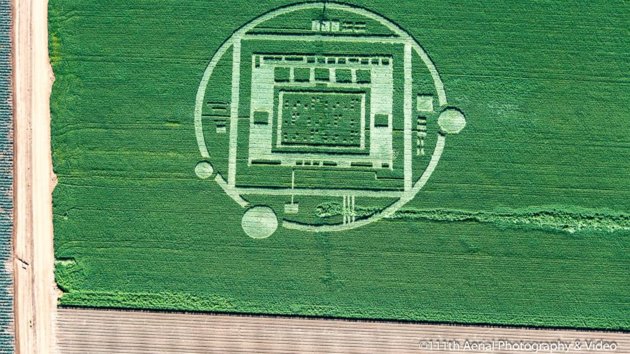
NVIDIA thinks their newly announced K1 processor, based on Kepler technology and aiming to bring the most insane gaming performance ever to a mobile device, is out of this world. How out of this world? So out of this world that they created a crop circle to advertise it — not that anyone knew it at first.
The crop circle made headlines earlier this week when it appeared in a field in Salinas, CA (and was subsequently destroyed by the property owner) mostly because it was, as are most crop circles, quite mysterious in origin. Unfortunately for UFO enthusiasts, this one wasn’t crafted by E.T.. Instead, it was the handiwork of NVIDIA, and it’s purpose was to function as a bit of a viral campaign for the aggressive mobile CPU unveiled tonight at CES.
Stay tuned as we bring you even more coverage of the all new Tegra K1 chip through the coming days as CES grinds into full gear. Don’t forget your aluminum foil hat.
Weird California Incident Last Year Points To The Real Threat To The Power Grid (Hint: It's Not Cyberattacks)
BrindleAh... threat models...
Via Bruce Schneier's blog, we learn of the following intriguing story published in Foreign Policy: Around 1:00 AM on April 16, at least one individual (possibly two) entered two different manholes at the PG&E Metcalf power substation, southeast of San Jose, and cut fiber cables in the area around the substation. That knocked out some local 911 services, landline service to the substation, and cell phone service in the area, a senior U.S. intelligence official told Foreign Policy. The intruder(s) then fired more than 100 rounds from what two officials described as a high-powered rifle at several transformers in the facility. Ten transformers were damaged in one area of the facility, and three transformer banks -- or groups of transformers -- were hit in another, according to a PG&E spokesman.
Oil then leaked from the transformers, causing them to overheat and shut down. However, there were no major power outages, and no long-term damage. The Foreign Policy post gives a good summary of what we do and don't know, and is well-worth reading in full. As Schneier comments: The article worries that this might be a dry-run to some cyberwar-like attack, but that doesn't make sense. But it's just too complicated and weird to be a prank.
Feel free to theorize in the comments about what happened last April. Absent further information, I'd like to focus here on the following perceptive analysis from the article:
Anyone have any ideas?At the very least, the attack points to an arguably overlooked physical threat to power facilities at a time when much of the U.S. intelligence community, Congress, and the electrical power industry is focused on the risk of cyber attacks. There has never been a confirmed power outage caused by a cyber attack in the United States. But the Obama administration has sought to promulgate cyber security standards that power facilities could use to minimize the risk of one.
This fixation on "cybersecurity" is something that Techdirt has been pointing out for a while. It seems largely driven by canny defense and security companies hungry for profitable contracts, which are able to take advantage of politicians intimidated by technology and worried about seeming "soft" on "cyberterror." Kudos, then, to Jon Wellinghoff, the chairman of the Federal Energy Regulatory Commission, who seems to have more common sense than most of his colleagues: A shooter "could get 200 yards away with a .22 rifle and take the whole thing out," Wellinghoff said last month at a conference sponsored by Bloomberg. His proposed defense: A metal sheet that would block the transformer from view. "If you can't see through the fence, you can't figure out where to shoot anymore," Wellinghoff said. Price tag? A "couple hundred bucks." A lot cheaper than the billions the administration has spent in the past four years beefing up cyber security of critical infrastructure in the United States and on government computer networks.
Quite.
Follow me @glynmoody on Twitter or identi.ca, and +glynmoody on Google+
Permalink | Comments | Email This Story

|
|
I'd Try It: Young Dolphins Chew Puffer Fish To Get High
Brindlelol, we need to do something about this! pass laws, put those dolphins in prison!
 I'm so high I'm gonna eat this.
In news that shouldn't surprise anybody who's ever dreamed of being a drug-abusing teenage dolphin, scientists have discovered groups of young dolphins chew puffer fish to get high. Me? I chew puffer fish because I like the way their spines tickle the roof of my mouth.
I'm so high I'm gonna eat this.
In news that shouldn't surprise anybody who's ever dreamed of being a drug-abusing teenage dolphin, scientists have discovered groups of young dolphins chew puffer fish to get high. Me? I chew puffer fish because I like the way their spines tickle the roof of my mouth.
Scientists found that dolphins apparently had learned just how much of the toxin would safely intoxicate them, and they carefully chewed the fish and then passed it among themselves. The dolphins then entered what appeared to be a trancelike state. "This was a case of young dolphins purposely experimenting with something we know to be intoxicating," said Rob Pilley, a zoologist who worked as a producer for the series. "After chewing the puffer gently and passing it round, they began acting most peculiarly, hanging around with their noses at the surface as if fascinated by their own reflection."Whoa whoa whoa -- everybody knows rule number one of doing drugs is NEVER LOOK AT YOUR REFLECTION. No good ever comes from that. If I had a nickel for every hour I've spent watching my face melt in the mirror and telling myself what a worthless piece of shit I am, I could afford to go out tonight. Thanks to PYY, who agrees there's no porpoise getting high if you're not going to enjoy yourself.
Senator Bernie Sanders Asks The NSA If It's Spying On Congress
I am writing today to ask you one very simple question. Has the NSA spied, or is the NSA currently spying, on members of Congress or other American elected officials? "Spying" would include gathering metadata on calls made from official or personal phones, content from websites visited or emails sent, or collecting any other data from a third party not made available to the general public in the regular course of business.While many will focus on the basic question of "is the NSA spying on Congress," what's much more important here is the definition that Sanders supplies of "spying." Because we already know the answer is yes. We know that the NSA is gathering metadata on pretty much every phone call that is on a major mobile phone network, meaning that, yes, the NSA is collecting metadata on the phone calls of elected officials.
Knowing the NSA's general history, if it responds at all, it will answer a different question. It will not address the gathering of metadata at all, but rather note that it does not "target" members of Congress. And, of course, even if the NSA claimed it wasn't spying on Congress (which, under Sanders' definition is clearly a lie) why would anyone believe them? President Obama has already made it quite clear that he's fine with senior intelligence community lying to Congress.
Permalink | Comments | Email This Story

|
|
Man Stopped By Cops For Supposedly Voluntary NHTSA 'Survey' Sues City And Police Dept. For Violating His 4th Amendment Rights
As has been noted earlier here at Techdirt, the NHTSA (National Highway Traffic Safety Administration) has been collaborating with law enforcement agencies around the nation to collect blood and saliva samples from drivers. This collection is part of a NHTSA "survey" which is looking to determine how often drivers drive while possibly impaired by drugs or alcohol. Providing the NHTSA with either of these fluids is completely optional (citizens are rewarded monetarily for their contribution), but the use of uniformed officers (supposedly solely for crowd control and security of the payment funds) and patrol cars has given many drivers the impression that these stops (and collections) are actually mandatory -- or at the very least, highly recommended.
The Fort Worth, TX police department found itself on the receiving end of a considerable amount of criticism for its participation in the blood/saliva collections. The PD first attempted to deflect the criticism by offering standard excuses. When that failed to work, the police chief offered a very contrite apology for participating in the survey and "jeopardizing the public trust."
This backlash hasn't slowed the NHTSA which has taken its blood and saliva survey to Reading, Pennsylvania. While the outrage wasn't nearly as pronounced as it was in Ft. Worth, it was still notable. However, Police Chief William Heim hasn't seemed too concerned by citizen complaints. He called the whole thing "innocuous" and made this laughable assertion:
"People are not pressured by police presence to do something they don't want to."Au contraire, Chief Heim. Police presence is often all it takes to make voluntary experiences seem mandatory. Ricardo Nieves, one of those flagged down by Reading police officers, felt the experience was anything but voluntary, and that attempting to leave would have been greeted by a possible arrest.
The Reading city council and the mayor himself also expressed concern about the use of police officers to acquire "voluntary" blood and saliva samples. For his part, Chief Heim appears to be ready to just ride out this outrage without offering any concession towards the offended public.
But if that's what Heim had planned, Nieves just threw a legal wrench into the works. Nieves has sued the city of Reading, Chief Heim, Mayor Vaughn Spencer, two unnamed employees of the private contractor (Pacific Institute for Research & Evaluation [PIRE]) performing the fluid collections, as well as PIRE itself
Nieves claims his Fourth Amendment rights were violated by the supposedly voluntary collection, which felt much more mandatory thanks to the police presence. Here's his description of the incident.
On Friday, December 13, 2013, plaintiff was traveling on the Bingham Street Bridge into the City of Reading, Pennsylvania, a public roadway. A cruiser owned and operated by the City of Reading Police Department was parked by the side of the street with its lights flashing where plaintiff was. Bright orange security cones lined the lane where plaintiff was driving. Plaintiff was in the right hand lane and the lane to plaintiff’s left was full of traffic such that he could not pull over to change lanes.Finally, a Reading police officer waved Nieves towards where he had been originally flagged down and indicated he should re-enter traffic there.
Defendant Doe stepped out into plaintiff’s lane of traffic, blocked his further advance, and flagged him to pull off the public road into a parking lot on Laurel Street. Having no ability to advance further on the road, and with no ability to move into the left-hand lane because of traffic, plaintiff drove into the parking lot. In the parking lot were five to seven improvised parking spaces outlined on three sides with orange security cones. Nieves pulled into one of these security cones.
Nieves reasonably believed under the totality of the circumstances that he was being stopped by the Reading Police Department because of the flashing lights of the police car on the street, the fluorescent orange cones on the street and in the parking lot, and the presence of a police car in the parking lot that was occupied by a police officer.
Jane Doe, a woman with a clipboard came up to plaintiff’s car and began to speak to him.
Jane Doe spoke quickly and said several things, including that plaintiff was not being cited, that plaintiff had done nothing wrong and that plaintiff was not being “pulled over.”
The last statement was clearly false, because plaintiff had only pulled over after John Doe had stepped into the middle of plaintiff’s lane of traffic on the public street and flagged plaintiff into the parking lot, all while lights were flashing on the police car parked at the location.
Defendant Doe stated that the purpose of the stop was a survey of drivers’ behavior and that she wanted to take a cheek swab to check for the presence of prescription drugs. She also stated that plaintiff would be paid if plaintiff agreed to the same.
Plaintiff refused to provide the cheek swab she requested.
Jane Doe then tried a second time to convince plaintiff into providing a cheek swab. Plaintiff again refused to provide a swab.
A third time Jane Doe again tried to coerce plaintiff into giving a cheek swab. At this point plaintiff stated to her very firmly, “No. Thank. You.”
Jane Doe then tried to hand plaintiff a pamphlet, which plaintiff did not accept. Jane Doe then walked away from plaintiff’s car. Plaintiff then tried to exit the parking lot but found no means of egress. Other cars had by then also apparently been pulled off the road.
Nieves is asking for a permanent injunction preventing the Reading PD (and others) from utilizing "suspicionless seizures" like the NHTSA's fluid collection survey. He's also seeking unspecified damages for Fourth Amendment violations and false imprisonment.
As he points out in the filing, at no time did Nieves feel he could leave without being subjected to arrest and prosecution. Such is the power of law enforcement officers and their vehicles, even if they are supposedly off-duty and serving only as "security."
That's one way the Reading PD's compliance with the NHTSA may come back to haunt them. As Scott Greenfield points out, this voluntary checkpoint being staffed with police officers and their flashing lights also hurts the chances of future police checkpoints running unchallenged.
The use of police to conduct this NHTSA survey has fundamentally altered the equation of a car stop, and the cops have done this to themselves. Aside from the absurd Georgia decision, there was never a suggestion that a driver had authority to ignore the “command” to pull over from a cop with lights blazing. That can no longer be said as a matter of law now that the police have squandered their authority to assist in a “voluntary survey.”Of course, this is hardly a victory for citizens. Greenfield notes that bypassing a set of flashing lights that could be taken either way (voluntary/mandatory) may just net citizens brand new sets of bullet holes.
Flashing lights look no different when it’s a lawful sobriety checkpoint than when it’s a voluntary survey conducted by private contractors for a government agency. While the former requires compliance, the latter is of no consequence whatsoever. To borrow from Prouse’s rationale, just as there is no law preventing police from chatting you up like anyone else on the street, there is no law requiring you to chat ‘em back. Not in the mood to chat? Keep walking.
Not in the mood to take a survey? Keep driving. Forget those flashing lights. This is the message that comes of the extension of authority without any lawful basis or judicial approval.
Chief Heim claims it's all voluntary and not a big deal, but anyone arriving at these not-mandatory checkpoints won't know that until he or she has repeatedly refused to surrender blood or saliva. This whole situation could have been avoided by either a) not allowing law enforcement officers to participate (off-duty or not) or b) posting signage well in advance of the stop that participation was completely voluntary and indicating clearly where those wishing to bypass the stop could route themselves. Instead, these agencies lent their reputations and implied "color of law" to private contractors fronting for a regulatory agency and now, everyone involved -- cops and citizens -- is worse off for it.
Permalink | Comments | Email This Story

|
|
Supreme Court May Not Review Conflicting NSA Phone Spying Rulings
Brindleinteresting... did not know that 215 was going to sunset in 2015


|
|

I Just Want To Know Where Babies Come From: UK's P0rn Filters Blocking Sex-Ed Sites
 In news that shouldn't surprise anyone who's stumbled across a sexual well-being website while on the hunt for p0rn, the filters that the UK's major internet service providers have installed to curtail internet p0rn in the country are also blocking sexual education sites. A shame for the zero kids that were using the internet to read sexual education websites.
"It's really frustrating because I'm trying to provide a sex education site for young people and it's hard enough directing young people to good quality information on the internet," said BishUK.com's Justin Hancock. Now, now, Justin, we can't have teens getting their info from anywhere but whispered locker-room conversations.Call me old fashioned, but what's the matter with getting all your sex-ed info from whispered locker-room conversations? That's where I learned almost everything I know about sex. The rest? The rest I learned from experience. Jk jk, the rest I learned from watching p0rn videos on the internet like a normal person. "That's not normal." Neither is masturbating with a sock puppet, but you do it, don't you? "Who told you that?" You just did. Now everybody point and laugh. Thanks to PYY, who agrees sexual education is quite possibly the most important form of education. There should be no shame in talking about penises (trust me, I'm a pro).
After 20 Years, It's Clear NAFTA Has Failed To Deliver Promised Benefits; So Why Trust TPP, TTIP Will Be Better?
Given the difficulty of saying anything definite about the future, it makes sense to look back at how past trade agreements have actually worked out for those involved. One of the most important, the North American Free Trade Agreement (NAFTA), has been operational for 20 years, and so offers us a wealth of hard facts. Public Citizen has just released an excellent analysis of what happened (pdf). As it points out: NAFTA was fundamentally different than past trade agreements in that it was only partially about trade. Indeed, it shattered the boundaries of past U.S. trade pacts, which had focused narrowly on cutting tariffs and easing quotas. In contrast, NAFTA created new privileges and protections for foreign investors that incentivized the offshoring of investment and jobs by eliminating many of the risks normally associated with moving production to low-wage countries. NAFTA allowed foreign investors to directly challenge before foreign tribunals domestic policies and actions, demanding government compensation for policies that they claimed undermined their expected future profits. NAFTA also contained chapters that required the three countries to limit regulation of services, such as trucking and banking; extend medicine patent monopolies; limit food and product safety standards and border inspection; and waive domestic procurement preferences, such as Buy American.
This makes NAFTA the clear model for TPP and TAFTA, both of which hand enormous power to corporates, at the expense of the public and governments. In 1993, NAFTA was sold to the U.S. public with grand promises. NAFTA would create hundreds of thousands of good jobs here -- 170,000 per year according the Peterson Institute for International Economics. U.S. farmers would export their way to wealth. NAFTA would bring Mexico to a first-world level of economic prosperity and stability, providing new economic opportunities there that would reduce immigration to the United States. Environmental standards would improve.
Techdirt has already discussed how NAFTA has proved disastrous for the US in basic financial terms; here we'll look at some of the other effects, not just in the US, but for Mexico too. NAFTA has contributed to downward pressure on U.S. wages and growing income inequality. According to the U.S. Bureau of Labor Statistics, two out of every three displaced manufacturing workers who were rehired in 2012 experienced a wage reduction, most of them taking a pay cut of greater than 20 percent.
Taken together, these facts represent the reality for much of the US public: wages have fallen, the cost of food has risen, and even though consumer good prices have dropped, overall US workers are worse off than they were before NAFTA came into force. People have lost out in non-monetary ways, too:
…
Despite a 188 percent rise in food imports from Canada and Mexico under NAFTA, the average nominal price of food in the United States has jumped 65 percent since the deal went into effect.
…
The reductions in consumer goods prices that have materialized have not been sufficient to offset the losses to wages under NAFTA. U.S. workers without college degrees (63 percent of the workforce) have likely lost an amount equal to 12.2 percent of their wages under NAFTA-style trade even after accounting for the benefits of cheaper goods. Scores of NAFTA countries' environmental and health laws have been challenged in foreign tribunals through the controversial investor-state system. More than $360 million in compensation to investors has been extracted from NAFTA governments via "investor-state" tribunal challenges against toxics bans, land-use rules, water and forestry policies and more. More than $12.4 billion are currently pending in such claims.
NAFTA has been the test-bed for corporations to use investor-state dispute settlement (ISDS) to resist or even undo improvements in health and environmental laws that reduce their profits. Even the European Commission, a big fan of corporate sovereignty, has been forced to recognize that ISDS is a danger to the public for this reason. In many ways, Mexico has fared even worse than the US under NAFTA: The export of subsidized U.S. corn did increase under NAFTA, destroying the livelihoods of more than one million Mexican campesino farmers and about 1.4 million additional Mexican workers whose livelihoods depended on agriculture.
That last point is important: one of the selling points of NAFTA was that it would help stem the flood of Mexican migrants into the US. As the Public Citizen document reports:
The desperate migration of those displaced from Mexico's rural economy pushed down wages in Mexico's border maquiladora factory zone and contributed to a doubling of Mexican immigration to the United States following NAFTA's implementation.Then-Mexican President Carlos Salinas de Gortari claimed NAFTA would reduce the flow of migrants from Mexico into the United States, saying: "Mexico prefers to export its products rather than its people." Salinas infamously added that the U.S. decision over NAFTA was a choice between "accepting Mexican tomatoes or Mexican migrants that will harvest them in the United States."
As in the US, overall, Mexicans have lost out under NAFTA: Real wages in Mexico have fallen significantly below pre-NAFTA levels as price increases for basic consumer goods have exceeded wage increases. A minimum wage earner in Mexico today can buy 38 percent fewer consumer goods as on the day that NAFTA took effect.
Public Citizen has performed an invaluable service by pulling together the figures for NAFTA in this rigorous, fully-referenced document. That's not least because the TPP negotiations are at a critical point, with President Obama desperate to obtain Fast Track trade authority that will allow him and his negotiators to push through TPP (and TAFTA/TTIP) with no real Congressional scrutiny and a simple yes/no vote at the end. As Public Citizen points out: the administration and corporate proponents of the TPP will have difficulty getting the controversial deal through Congress. Twenty years of NAFTA's damage has contributed to a groundswell of TPP opposition among the U.S. public and policymakers. In November 2013, a bipartisan group of 178 members of the U.S. House of Representatives stated their early opposition to any attempt to Fast Track the TPP through Congress, while other members expressed similar concerns about the TPP and the Fast Track trade authority scheme.
Follow me @glynmoody on Twitter or identi.ca, and +glynmoody on Google+
Congressional rejection of the TPP stands to intensify as the 20th anniversary of NAFTA provides a fresh reminder of the damage that such past pacts have wrought. It was the initial outcomes of NAFTA that sank previous attempts at massive NAFTA expansions, such as the Free Trade Areas of the Americas and the Asia-Pacific Economic Cooperation (APEC) FTA.
NAFTA's two-decade legacy of tumult and hardship for millions of people in North America could similarly hasten the downfall of the attempt to expand the NAFTA model via Fast Track and the TPP. If so, it would constitute a unique benefit of an otherwise damaging deal.
Permalink | Comments | Email This Story

|
|
Court Upholds Willy-Nilly Gadget Searches Along U.S. Border


|
|

Court Says Border Searches Of Your Computer Are Okay Because You Shouldn't Keep Important Info On Your Computer
BrindleThis judge ought to be thrown out - "Plaintiffs must be drinking the Kool-Aid ..."
And, now there's another one. A judge in NY has dismissed a challenge to the searches brought by the ACLU. The judge, Edward Korman, repeatedly quotes former head of Homeland Security, Michael Chertoff, who now makes money by hyping up the threats the country faces, so it's not like he's the most unbiased of folks to be relying on for how important these border searches really are. Judge Korman claims that the defendants have no standing to bring the case in the first place. There is one individual (a PhD. student) who actually had his computer searched, and then some professional organizations who worried about their members having their computers searched. The judge is simply not impressed by their arguments... at all. He notes that Customs and Border Patrol appears to search so few laptops that it's highly unlikely that any individual will have theirs searched -- and thus these groups can't really allege a likely harm. He points out that it's wrong to use a declaratory judgment case to address "a claim of alleged injury based on speculation as to conduct which may or may not occur at some unspecified future date."
As for the one guy, Pascal Abidor, who did have his laptop searched, Judge Korman is also not impressed, noting that he's not suing over that particular search, but the possibility of future searches. The judge seems a bit perplexed by this decision, but notes that it takes away his ability to get standing:
Abidor could have established standing in this case by adding a cause of action for damages based on his claim that he was subject to an unreasonable search. Such a cause of action would have provided the occasion for a trial or a motion for summary judgment that would have fully developed the record with respect to both the initial quick look search and subsequent forensic search. No such action is alleged.But, as Judge Korman notes, if he can't show any real likelihood of future harm, he can't show standing.
Even after dismissing for lack of standing, the judge decides to take on the issue anyway, and this is where he starts to get really insulting to anyone who thinks that perhaps they should have some privacy rights at the border. He openly mocks the plaintiffs for arguing for the need for a "reasonable suspicion" standard for searches, noting that this bar is so low that it's not like they'd get much more privacy out if it anyway:
Plaintiffs must be drinking the Kool-Aid if they think that a reasonable suspicion threshold of this kind will enable them to "guarantee" confidentiality to their sources.He goes on to suggest that since traveling internationally involves going into other countries, these same people would probably have even less privacy over their data, since other countries may be even more willing to search their computers. He even cites the situation of David Miranda having his electronics searched in the UK.
Surely, Pascal Abidor cannot be so naive to expect that when he crosses the Syrian or Lebanese border that the contents of his computer will be immune from searches and seizures at the whim of those who work for Bassar al-Assad or Hassan Nasrallah. Indeed, the New York Times recently reported on the saga of David Michael Miranda who was detained for nine hours by British authorities "while on a stop in London's Heathrow airport during a trip from Germany to Brazil."While the judge's point is correct that other countries are unlikely to protect the privacy of travelers as well, and that means that any information on a laptop may be inherently unsafe, it seems like a bit of a weak copout to argue that since other countries have no respect for your electronic privacy, that the US shouldn't either.
He goes even further, arguing that because there's a "special need" at the border to stop bad people, that it's perfectly fine to ignore things like probable cause or reasonable suspicion -- again quoting Michael Chertoff to suggest that border laptop searches have stopped "bad people" from entering the US.
But then he argues that since everyone knows they may be searched at the border, there isn't really an invasion of privacy:
The invasion of privacy occasioned by such a border search, however, like the search of luggage, briefcases, and even clothing worn by a person entering the United States, is mitigated by other factors..... As Professor LaFave observes, because "the individual crossing a border is on notice that certain types of searchers are likely to be made, his privacy is less invaded by those searches." .... Thus, "[t]he individual traveler determines the time and place of the search by his own actions, and he thus has ample opportunity to diminish the impact of that search by limiting the nature and character of the effects which he brings with him."... Indeed, because of the large number of laptop computers (close to a million per year) that are lost by travelers--numbers that far exceed the comparative handful of laptops that are searched at the border--the sensible advice to all travelers is to "[t]hink twice about the information you carry on your laptop," and to ask themselves: "Is it really necessary to have so much information accessible to you on your computer."This seems problematic on multiple levels. First, if we go by the idea that there's less of a privacy violation because you know it's coming, then that gives the government the right to ignore the 4th Amendment so long as it tells you ahead of time that it's going to ignore the 4th Amendment. Even the Supreme Court in Smith v. Maryland -- the infamous case concerning the 3rd party doctrine -- states that such a scenario is ridiculous, and that just because you know that you're going to be searched, it doesn't automatically make the search reasonable.
As for the suggestion that you shouldn't store stuff on your computers, I'm sure that's great in theory, but I'd like judges to make decisions based in reality. This suggestion is basically "don't use your computer for what it's designed for, because we might search it." That's not exactly compelling.
Again, given past precedents, and the specific facts of this case, it's not entirely surprising. That doesn't mean it's not disappointing to see yet another middle finger given to the 4th Amendment to close out the year.
Permalink | Comments | Email This Story

|
|
Dell's Twitter Account Apologizes For The 'Inconvenience' Of Helping NSA Install Spyware
 In case you can't read that, Wismeijer complained on Twitter about finding out that his Dell server is bugged by the NSA (which might be an exaggeration...) and included the @DellCares account in his tweet. That account wrote:
 Thank you for reaching out and regret the inconvenience. Our colleagues at @dellcarespro will be able to help you out.Wismeijer responded with an expected level of anger. Not only is "regret the inconvenience" probably the inappropriate response to a customer complaining about the NSA installing malware, but the idea that Dell support "will be able to help you out" is similarly questionable.
Permalink | Comments | Email This Story

|
|
The Complete List of Everything Banned by Mayor Michael Bloomberg
Brindleholy crap...

Michael Bloomberg leaves office tomorrow after 12 years as New York City's mayor. No mayor in recent memory has added so much to a city. Or taken so much away. To remember him properly, here's a list of everything Bloomberg banned during his time in office.

|
|
Ruling In Favor Of NSA's Program Relied On Claims In 9/11 Report That Aren't Actually In That Report
As we've discussed in the past, the NSA and its defenders keep pointing to the story of Khalid al-Mihdhar, a terrorist who was in San Diego and made a call to a known Al Qaeda safe house in Yemen. Except, as was widely reported, the intelligence community had collected all the necessary info and was even intercepting calls between the US and the safe house. The problems was that the CIA "lost" al-Mihdhar, didn't tell the FBI that he was in the US (even though it knew he'd received a Visa) and no one put him on a watch list. None of that would have changed with the metadata collection.
However, as Pro Publica notes, not only does Judge Pauley ignore all of this, he claims the 9/11 Commission report talks about the NSA being unable to "capture al-Mihdhar's telephone number identifier" -- but that's not true:
In fact, the 9/11 Commission report does not detail the NSA's intercepts of calls between al-Mihdhar and Yemen. As the executive director of the commission told us over the summer, "We could not, because the information was so highly classified publicly detail the nature of or limits on NSA monitoring of telephone or email communications.”So when you have a judge using this as a key part of his ruling, and it appears that he simply did not read the report he's citing, but rather accepted the government's misrepresentation of the report, it should call into question what Judge Pauley was doing with this case. Others are noticing this same thing. The NY Times has an editorial, noting that Pauley's reasoning is "perplexing" in that it assumes that the government never breaks the law:
Judge Pauley's opinion is perplexing in its near-total acceptance of the claim by the government that it almost always acts in accordance with the law and quickly self-corrects when it does not. For example, Judge Pauley said the N.S.A.'s director, Gen. Keith Alexander, was being "crystal clear" when he responded to charges that the agency was mining data from phone calls by saying: "We're not authorized to do it. We aren't doing it."Over at the New Yorker, Amy Davidson, goes even deeper in exploring the differences between Judge Pauley's ruling and Judge Leon's ruling (which found the NSA's metadata collection unconstitutional), and has pointed out multiple other "perplexing" elements in Pauley's ruling -- including the idea that the more completely the NSA spies on Americans, the more legal the program would be under his bizarre legal interpretation.
That shows an alarming lack of skepticism, particularly in light of the testimony of James Clapper Jr., the director of national intelligence, who falsely told the Senate Intelligence Committee in March that the N.S.A. was not collecting any type of data at all on hundreds of millions of Americans.
It is also incorrect to say, as Judge Pauley does, that there is "no evidence" that the government has used the phone data for anything other than terrorism investigations. An inspector general's report in September revealed at least a dozen instances in which government employees used the databases for personal purposes.
And yet if Pauley's opinion offers a single instruction for the N.S.A, it is this: go big. The more people whose data was swept up, the less this judge apparently thinks he has to say about it. Reading his fifty-four-page opinion, one wonders whether, if the intelligence community could only find a way to violate every single American's rights, and tell a story about how that protected them, he would look around and find that no one had been hurt. "This blunt tool only works because it collects everything," he writes.And yet, "collect everything" is exactly what the 4th Amendment was designed to not allow. It was put in place to end the concept of general warrants for the collection of everything. It's this very concept of "collect everything" that is why Judge Leon noted that the "third party doctrine" as established in Smith v. Maryland makes no sense to apply to this bulk metadata collection.
Furthermore, Davidson also notes how Pauley uncritically accepts the feds' blatantly misleading spin that even with all the metadata collection only a very small number of people are spied upon. Judge Leon actually breaks it down and does the math, while Pauley doesn't bother:
So there are huge problems with Pauley's decision. Not only does he quote a report that doesn't say what he claims it says, he further supports his argument by accepting a claim that another judge quickly showed to be clearly false just by doing some simple math. So far, we've got Judge Pauley failing to actually read or do math but simply accepting the government's claims of what the report and the math say, when anyone who's actually looked at either know the government is not being honest.The contrast can be seen in the two judges' responses to the way the government queries its database of phone records—those of almost every American. It starts with a "seed"—maybe a phone number of someone it suspects (and only suspects) is connected to a foreign terrorist group. It then makes three "hops": looks at all the numbers that the seed number has called or been called by, each number that those have been connected to, and each that those have been connected to. Leon does some calculations and sees that the number of phone numbers gets big very quickly (if you call a hundred friends, and they each call a hundred friends…). They also get attenuated: he cites the example of a suspect calling a pizza place, and the way every other pizza orderer is then inveigled. (I wrote about this “Domino's hypothetical” when Judge Leon's ruling was issued.) But just as interesting was Leon's response to the government's note that it has done this with three hundred seeds, yielding a number of American phone records “substantially larger than 300, but is still a very small percentage of the total volume of metadata records.”
The first part of this assertion is a glaring understatement, while the second part is virtually meaningless when placed in context…. It belabors the obvious to note that even a few million phone numbers is “a very small percentage of the total volume of metadata records” if the Government has collected metadata records on hundreds of millions of phone numbers.Pauley, looking at the same statement, repeats it primly and uncritically twice: “only a ‘very small percentage of metadata records…’ ” He is just relieved that terrorists, or those connected to them even by “filaments,” might be found. (Last week, a Presidential review panel found that the program was not, in fact, all that useful.)
You would think that a judge would actually review the source material, rather than accept one party's misrepresentations. Unfortunately, Judge Pauley appears to have failed in his job to do the most basic checking of what he was told. And, because of that, we now have a horrible ruling on the books.
Permalink | Comments | Email This Story

|
|
Glenn Greenwald Says NSA, GCHQ Dismayed They Don't Have Access To In-Flight Internet Communication
Glenn Greenwald gave a video keynote speech to the Chaos Communication Congress last Friday. Most of his talk revolved around the Snowden leaks, of which he says there's plenty more to come. (The most conservative estimate puts the total number of pages taken by Snowden at ~58,000, of which less than 900 have been released. Cryptome's running count puts it at 799 pages as of Dec. 24th -- 1.4% of the most conservative total.)
According to Greenwald, an upcoming story at his new venture will focus on one area the surveillance mesh has failed to cover -- one that's driving the NSA and GCHQ crazy.
He said he was working on a new story indicating that the NSA was “obsessed” by the idea that people could still use some Internet devices and mobile phones on airplanes without being recorded. “The very idea that human beings can communicate for even a few moments without their ability to monitor is intolerable.”I can imagine this must be very irritating for the two agencies. Somewhere someone (many someones) will be generating data that isn't immediately being harvested. I'm sure there's a "fix" on the way to plug this "security hole." It's not as if government intelligence agencies are going to sit idly by while a government regulatory agency (inadvertently) creates airborne data havens by loosening restrictions on electronic devices.
Whatever's preventing the NSA and GCHQ from making a grab for in-flight data and communications isn't a technological issue. In-flight WiFi and other internet connections have been available for years. All data necessarily flows in and out of airborne choke points, which would make it very easy for the agencies to collect, store and retrieve the data later.
No, what's holding the agencies back is likely a lack of justification for patching up this hole in its collections. The metadata being generated may not be protected by the Fourth Amendment, but there's no simple way to collect and minimize this very mobile form of domestic communication. International flights would perhaps provide some leeway for collection. Once the flight is out of domestic airspace or is connecting with foreign communications towers, etc., it could be argued that the data is fair game.
Playing the "national security" card is a non-starter. To claim potential terrorists are using in-flight connections to communicate without fear of surveillance is to call into question the skills of those providing security on the ground, putting the DHS in the awkward position of explaining why its TSA agents are allowing suspected terrorists to board planes. It also would require officials to believe that terrorists would be willing to risk discovery by airport security in exchange for a few hours of surveillance-free internet usage. None of this is very plausible, and deploying arguments along this line would paint the agencies as data-obsessed paranoiacs, not exactly the sort of image they wish to portray at this point in history.
We do know the NSA collects data on flyers via flight reservation systems and Passenger Name Records (PNRs) created and compiled by airlines. This would give the agency some idea who's flying and where, and there's little doubt it would like to take a look at any communications occurring during these flights. I suppose if it wanted to pull the data retroactively it could, provided it could convince the FISA court the data would be relevant to terrorism-related investigations. The TSA could be tasked with linking device info with passenger records, but there's probably no unobtrusive way to achieve this goal. Because of this, it would be simpler for the agencies to require the airlines to trap communications data and hold it for a certain length of time. PNRs could then be matched with flights and that specific data harvested and pored through for possibly "relevant" communications. Again, this would involve many more entities and tons of domestic citizens' metadata and communications, something that would have been a tough sell five years ago, much less in today's Security vs. Privacy climate.
Permalink | Comments | Email This Story

|
|
Citywide RFID Master House Key? Already Broken
BrindleWhat could go wrong?


|
|

Hacking Secrets into Art


|
|

From Snowden To Manning... To Ben Franklin And Sam Adams? A History Of Leakers Of Secret Gov't Documents
For all the talk from some about how terrible and "anti-American" Ed Snowden and Chelsea Manning are for distributing secret government documents that revealed misbehavior on the part of the government, the Digsby blog highlights a historical parallel that I hadn't heard about before: the Hutchinson Letters Affair, in which Benjamin Franklin essentially played the role of Snowden and Manning.
The short version is that Franklin obtained -- through means unknown -- a packet of letters written by Massachusetts Lieutenant Governor Thomas Hutchinson and Andrew Oliver to Thomas Whately, the assistant to UK Prime Minister George Grenville, concerning how to deal with the increasingly angry colonists in the late 1760s. This was at the time that colonists -- especially in Massachusetts -- were increasingly angry about moves by the UK to raise taxes and remove their rights. Hutchinson more or less suggested accelerating the process.
In the letters, Hutchinson made some damning comments about colonial rights. Even more provocative, Hutchinson recommended that popular government be taken away from the colonists “by degrees”, and that there should be “abridgement of what are called English liberties”. Specifically, he argued that all colonial government posts should be made independent of the provincial assemblies. Finally, he urged his superiors to send more troops to Boston to keep American rebels under control.Upon obtaining these (while in London), Franklin realized that they were somewhat explosive, and he quickly sent copies to some friends in the US, starting with Thomas Cushing (apparently no known relation to our own Tim Cushing), and told him to share them with others, but to not have them published. However, after Cushing and Sam Adams saw them, they figured out how to get them out:
The letters arrived in Massachusetts in March 1773, and came into the hands of Samuel Adams, then serving as the clerk of the Massachusetts assembly. By Franklin's instructions, only a select few people, including the Massachusetts Committee of Correspondence, were to see the letters. Alarmed at what they read, Cushing wrote Franklin, asking if the restrictions on their circulation could be eased. In a response received by Cushing in early June, Franklin reiterated that they were not to be copied or published, but could be shown to anyone.There was apparently then a huge hullabaloo over who leaked the letters, even leading to a duel in England, before Franklin stepped up and admitted to "leaking" the letters, and then defended that action, by noting that the letters were written by "public officials for the purpose of influencing public policy," and thus implying that it was reasonable for the public to know about them. In other words, the same basic reasons behind what Manning and Snowden did. Franklin did get punished for all of this, but it was nothing compared to the fates of Snowden and Manning. As Harry Blutstein writes in the link above:
A longtime opponent of Hutchinson's, Samuel Adams narrowly followed Franklin's request, but managed to orchestrate a propaganda campaign against Hutchinson without immediately disclosing the letters. He informed the assembly of the existence of the letters, after which it designated a committee to analyze them. Strategic leaks suggestive of their content made their way into the press and political discussions, causing Hutchinson much discomfort. The assembly eventually concluded, according to John Hancock, that in the letters Hutchinson sought to "overthrow the Constitution of this Government, and to introduce arbitrary Power into the Province", and called for the removal of Hutchinson and Oliver.[ Hutchinson complained that Adams and the opposition were misrepresenting what he had written, and that nothing he had written in them on the subject of Parliamentary supremacy went beyond other statements he had made. The letters were finally published in the Boston Gazette in mid-June 1773, causing a political firestorm in Massachusetts and raising significant questions in England.
On January 29, 1774, Franklin was hauled up before the Privy Council to explain why he had leaked letters in the ‘Hutchinson Affair’. He was accused of thievery and dishonor, called the “prime mover” of Boston’s insurgents and charged with being a “true incendiary”. Throughout the hearing, Franklin maintained a dignified silence. For his disloyalty to the Crown, he Privy Council held off sending Franklin the gallows or even sentencing him to an afternoon in the stocks. Instead, Solicitor General Alexander Wedderburn was satisfied with the tongue-lashing he meted out to Franklin and the next day the Board of Trade dismissed Franklin from his post as Deputy Postmaster General of the North America colonies.Perhaps those who are slamming Snowden and Manning as "traitors" ought to learn a little history about some of our most famous and respected founding fathers.
Had the Espionage Act been in place in Great Britain in 1774, Franklin would not have been around to lead the War of Independence, nor would he have been around to raise vital funds to support the rebellion and we would not have seen his signature on the Declaration of Independence or the United States Constitution.
Permalink | Comments | Email This Story

|
|