Shared posts

11 Mar 03:18

Border Patrol Given New Deadly Force Guidelines After Report Shows Officers Created Dangerous Situations To Justify Opening Fire

by Tim Cushing

The US Border Patrol has handed down new guidelines for use of deadly force after its agents killed 19 people in 67 shooting incidents between 2010-2012.

The U.S. Border Patrol has restricted border agents' authority to shoot at moving vehicles or at people throwing rocks, changing a controversial policy that has contributed to at least 19 deaths since 2010…

The new rules would bring the Border Patrol's practices closer to those used routinely by the nation's major urban police departments. They are a response, in part, to widespread complaints from immigrant advocates that border agents have shot and killed people in some cases when deadly force was not necessary to protect the lives of agents or the public.
Why did the CBP open fire on so many people? Well, it's because agents feared for their safety. Why did they fear for their safety? Because they put themselves deliberately in that position, according to a report commissioned by the CBP and written by law enforcement experts.
House and Senate oversight committees requested copies last fall but received only a summary that omitted the most controversial findings — that some border agents stood in front of moving vehicles as a pretext to open fire and that agents could have moved away from rock throwers instead of shooting at them…

"It is suspected that in many vehicle shooting cases, the subject driver was attempting to flee from the agents who intentionally put themselves into the exit path of the vehicle, thereby exposing themselves to additional risk and creating justification for the use of deadly force," the report reads. In some cases, "passengers were struck by agents' gunfire."
Judging from this, one would almost believe certain CBP agents were just looking for excuses to shoot someone. And the CBP agents' response has been to claim that new guidelines -- telling them not to stand in front of escaping vehicles and to move away from rock-throwing individuals -- will somehow make the job more dangerous.
The response, marked "Law Enforcement Sensitive," states that a ban on shooting at rock throwers "could create a more dangerous environment" because many agents operate "in rural or desolate areas, often alone, where concealment, cover and egress is not an option."

If drug smugglers knew border agents were not allowed to shoot at their vehicles, it argues, more drivers would try to run over agents.
The authors of the report had this to say in response to the CBP's speculative assertion (spearheaded by CBP union reps, who have stated that they will "oppose any restriction on CBP officers' use of force").
"It should be recognized that a half-ounce (200-grain) bullet is unlikely to stop a 4,000-pound moving vehicle, and if the driver … is disabled by a bullet, the vehicle will become a totally unguided threat," it says. "Obviously, shooting at a moving vehicle can pose a risk to bystanders including other agents."
So, while the new guidance lays out some common sense rules in hopes of decreasing the number of deadly shootings, some feel it still doesn't go far enough. The ACLU is recommending the use of body cameras to ensure each use of force is properly documented. Zoe Lofgren has called for more transparency from the agency itself, which has still refused to reveal how many officers (if any) received any sort of disciplinary action for inappropriate use of force.

The CBP obviously has transparency issues. Every effort was made to prevent this report from being made public, despite the CBP itself commissioning it. And, as we've covered earlier, the CBP has obscured the use of its drone "lending library" by failing to produce documents and heavily redacting those it did turn over in response to FOIA requests.

It's one thing for these agents to defend themselves against deadly force. It's quite another to put yourself in harm's way simply to justify the use of deadly force (the it's-coming-right-for-us loophole). If the agency is truly seeking to rid itself of its trigger-happy reputation, it needs to enforce these guidelines and open up its use of force track record to public scrutiny.

Permalink | Comments | Email This Story


10 Mar 15:16

Keurig Insists Coffee DRM Brings 'Interactive-Enabled Benefits' And Is For Your Own Safety

by Karl Bode
Brindle

hot cocoa, bitch!

As we recently discussed, Keurig is busy making plans to embed new technology in their new "Keurig 2.0" line of coffee makers that will reject unsanctioned (read: less expensive, competing) coffee pods. The technology would also presumably prevent the use of manual re-usable filters, which are usually found for between five and fifteen bucks online. Keurig's CEO announced the plans to reject "unlicensed pods" last fall, but somehow nobody seemed to really notice the effort until an annoyed competitor pointed it out in a lawsuit (pdf).

Needless to say, Keurig users and the general public weren't particularly enamored of Keurig's plans to lock down their brewing options, with countless users taking to Twitter to complain. The company didn't seem prepared to handle the media reaction to their plans for java-based "DRM." Nor did they seem prepared to give anybody a straight answer, even though their own CEO already confirmed the pod-blocking functionality. As such, Keurig simply started insisting to anyone that asked that the new technology delivered "interactive-enabled benefits":As you might be able to tell, it appears the company is unwilling to directly acknowledge the fact that they're locking out competitors' less expensive pods. More creative attempts to get Keurig to explain these advanced interactive benefits also proved fruitless:After a few days and clearly a few meetings, Keurig released a public statement that attempted to flesh out their non-answer. While still refusing to admit something their own CEO already acknowledged, Keurig decided to push the mystery added benefits angle a little harder, even going so far as to claim that blocking you from getting cheaper competing product is about your safety:
"To make brewing a carafe possible, and to continue to deliver everything Keurig lovers already enjoy – high-quality beverages, simplicity, and variety – our new Keurig 2.0 system will feature specially designed interactive technology allowing the brewer to read information about the inserted Keurig pack. With this interactive capability, Keurig 2.0 brewers will “know” the optimal settings for the inserted Keurig pack, for a perfect beverage every time, whether a single cup or a carafe. It’s critical for performance and safety reasons that our new system includes this technology. For those of you who currently own our K-Cup or Vue systems today, we are so happy to have you as part of our family. Rest assured that your brewers will still function as they always have and that your favorite beverages will still be available."
In other words, we must be able to lock competitors' pods (and manual refill units) out of the market to keep you safe from the dangers of potentially lower costs and dreaded coffee-related injury. It's also impossible for us to embed this obnoxious technology in older units, so those will continue to function as you prefer them to -- without us interfering in your purchase options. Sure, you're losing purchase options and will have to pay more for coffee, but isn't the security of knowing your family is safe from the dangers of coffee-related hazards worth it?

Permalink | Comments | Email This Story


07 Mar 22:06

Python And Crocodile Do Battle, Croc Loses, Gets Eaten

Brindle

Nature is scary... holy crap

croc-python-battle-1.jpg These are the photos from a battle between a python and a crocodile near Lake Moondarra in western Queensland, Australia. Apparently the battle went on for hours, with the python eventually choking the crocodile out, then swallowing it. For the record, that is not how I want to go. Or in a car accident. Fun fact: one time I went to a fortune teller and asked her how I was going to die. You know what she told me? Give me another $80 and I'll tell you. And that's when I produced a ninja sword and told her how she was going to die if I didn't get the reading for free. Keep going for a bunch more shots of the THERE CAN BE ONLY ONE. croc-python-battle-2.jpgcroc-python-battle-3.jpgcroc-python-battle-4.jpgcroc-python-battle-5.jpgcroc-python-battle-6.jpg Thanks to Sean, Argh and E V I L A R E S, who could have beaten both the croc and python at the same time because they were raised in the wild by Aborigines.
07 Mar 22:02

Disappointing: DMCA Being Used To Make Feynman Lectures On Physics Less Accessible

by Mike Masnick
I'm going to assume that many of you are familiar with Richard Feynman. If you're not, please get out from under the rock you've been living under and go learn something. While he's probably most well-known in the public for his (not always 100% truthful) collection of stories, Surely You're Joking, Mr. Feynman!, folks of a geekier persuasion are much more aware of his contributions to science and, in particular, the famed Feynman Lectures on Physics. It took way too many years to get those lectures online after (you guessed it) a fight over copyrights. However, online the lectures went and now it appears that publisher Perseus is unfortunately using the DMCA to block attempts to make the works accessible via Kindle or EPUB formats.

Eric Hellman posted the story at the link above, with this being the key part:
Vikram Verma, a software developer in Singapore, wanted to be able to read the lectures on his kindle. Although PDF versions can be purchased at $40 per volume, no versions are yet available in Kindle or EPUB formats. Since the digital format used by kindle is just a simplified version of html, the transformation of web pages to an ebook file is purely mechanical. So Verma proceeded to write a script to do the mechanical transformation – he accomplished the transformation in only 136 lines of ruby code, and published the script as a repository on Github.

Despite the fact that nothing remotely belonging to Perseus or Caltech had been published in Verma's repository, it seems that Perseus and/or Caltech was not happy that people could use Verma's code to easily make ebook files from the website. So they hauled out the favorite weapon of copyright trolls everywhere: a DMCA takedown.
You can see the DMCA here as well as the counternotice, which notes that the software doesn't contain any copyrighted materials (though there's some confusion over who owns the copyright, Caltech or Perseus). Hellman, while admitting he's not a lawyer, further suggests the DMCA takedown is invalid because it's just code... but then further notes that the Feynman Lectures website has put in some code to block the script -- and that Verma has coded around this:
In the meantime, the Feynman Lectures website has taken some steps to break Verma's script. For example, instead of a link to http://www.feynmanlectures.caltech.edu/II_28.html (my favorite chapter), the table of contents now has a link to javascript:Goto(2,18). This will take about 10 minutes for Verma to work around. In addition, the website now has a robot exclusion (except for Googlebot).
Of course, that introduces a new (and unfortunate) problem. As problematic as it is, the anti-circumvention clause of the DMCA, 17 USC 1201 makes it against the law to get around any "technological measure" no matter how stupid or weak, and thus the effort by the website to block it may introduce a new problem, though likely different than what Perseus initially claimed in its takedown.

Making things even more convoluted, the editor of the Feynman Lectures, Michael Gottlieb, jumped into the fray and made things even more confusing and misleading:
The online edition of The Feynman Lectures Website posted at www.feynmanlectures.caltech.edu and www.feynmanlectures.info is free-to-read online. However, it is under copyright. The copyright notice can be found on every page: it is in the footer that your script strips out! The online edition of FLP can not be downloaded, copied or transferred for any purpose (other than reading online) without the written consent of the copyright holders (The California Institute of Technology, Michael A. Gottlieb, and Rudolf Pfeiffer), or their licensees (Basic Books). Every one of you is violating my copyright by running the flp.mobi script. Furthermore Github is committing contributory infringement by hosting your activities on their website. A lot of hard work and money and time went into making the online edition of FLP. It is a gift to the world - one that I personally put a great deal of effort into, and I feel you are abusing it. We posted it to benefit the many bright young people around the world who previously had no access to FLP for economic or other reasons. It isn't there to provide a source of personal copies for a bunch of programmers who can easily afford to buy the books and ebooks!! Let me tell you something: Rudi Pfeiffer and I, who have worked on FLP as unpaid volunteers for about a decade, make no money from the sale of the printed books. We earn something only on the electronic editions (though, of course, not the HTML edition you are raping, to which we give anyone access for free!), and we are planning to make MOBI editions of FLP - we are working on one right now. By publishing the flp.mobi script you are essentially taking bread out of my mouth and Rudi's, a retired guy, and a schoolteacher. Proud of yourselves? That's all I have to say personally. Github has received DMCA takedown notices and if this script doesn't come down pretty soon they (and very possibly you) might be hearing from some lawyers. As of Monday, this matter is in the hands of Perseus's Domestic Rights Department and Caltech's Office of The General Counsel. 

Michael A. Gottlieb
Editor, The Feynman Lectures on Physics New Millennium Edition
www.feynmanlectures.info
www.feynmanlectures.caltech.edu
This is icky on multiple levels. First of all, Gottlieb is engaging in slight copyfraud in overclaiming what his copyright enables him to block. Further it is not necessarily the case that anyone, let alone "everyone" is "violating [Gottlieb's] copyright" merely by running the script. There are plenty of legitimate reasons why running that script may be perfectly legitimate, and legal cases that have suggested place and time shifting content is a legal fair use would certainly come into play here. Furthermore, the argument that Github is somehow contributorily liable is highly questionable, and Gottlieb really ought to talk to a copyright lawyer before making such a leap.

But from there to shift into how important it is to make the work available to the world... just seems strange. If that's the case, why is he freaking out so much?

Either way, the whole situation seems unfortunate, but once again, that's what you get with our crazy copyright law and the DMCA takedown process.

Permalink | Comments | Email This Story


07 Mar 21:53

CIA: We Only Spied On Senate Intelligence Committee Because They Took Classified Documents That Prove We're Liars

by Mike Masnick
Earlier this week, we wrote about the accusations that the CIA was spying on Senate staffers on the Senate Intelligence Committee as they were working on a massive $40 million, 6,300-page report condemning the CIA's torture program. The DOJ is apparently already investigating if the CIA violated computer hacking laws in spying on the Senate Intelligence Committee computers. The issue revolved around a draft of an internal review by the CIA, which apparently corroborates many of the Senate report's findings -- but which the CIA did not hand over to the Senate. This internal report not only supports the Senate report's findings, but also shows that the CIA has been lying in response to questions about the terror program.

In response to all of this, it appears that the CIA is attempting, weakly, to spin this as being the Senate staffers' fault, arguing that the real breach was the fact that the Senate staffers somehow broke the rules in obtaining that internal review. CIA boss John Brennan's statement hints at the fact that he thinks the real problem was with the way the staffers acted, suggesting that an investigation would fault "the legislative" branch (the Senate) rather than the executive (the CIA).
In his statement on Wednesday Brennan hit back in unusually strong terms. “I am deeply dismayed that some members of the Senate have decided to make spurious allegations about CIA actions that are wholly unsupported by the facts,” Brennan said.

“I am very confident that the appropriate authorities reviewing this matter will determine where wrongdoing, if any, occurred in either the executive branch or legislative branch,” Brennan continued, raising a suggestion that the Senate committee itself might have acted improperly.
A further report detailed what he's talking about. Reporters at McClatchy have revealed that the Senate staffers working on this came across the document, printed it out, and simply walked out of the CIA and over to the Senate with it, and the CIA is furious about that. Then, in a moment of pure stupidity, the CIA appears to have confronted the Senate Intelligence Committee about all of this... directly revealing that they were spying on the Committee staffers.
Several months after the CIA submitted its official response to the committee report, aides discovered in the database of top-secret documents at CIA headquarters a draft of an internal review ordered by former CIA Director Leon Panetta of the materials released to the panel, said the knowledgeable person.

They determined that it showed that the CIA leadership disputed report findings that they knew were corroborated by the so-called Panetta review, said the knowledgeable person.

The aides printed the material, walked out of CIA headquarters with it and took it to Capitol Hill, said the knowledgeable person.

“All this goes back to what is the technical structure here,” said the U.S. official who confirmed the unauthorized removal. “If I was a Senate staffer and I was given access to documents on the system, I would have a laptop that’s cleared. I would be allowed to look at these documents. But with these sorts of things, there’s generally an agreement that you can’t download or take them.”

The CIA discovered the security breach and brought it to the committee’s attention in January, leading to a determination that the agency recorded the staffers’ use of the computers in the high-security research room, and then confirmed the breach by reviewing the usage data, said the knowledgeable person.
There are many more details in the McClatchy report, which I highly recommend reading. And, yes, perhaps there's an argument that Senate staffers weren't supposed to take such documents, but the CIA trying to spin this by saying it was those staffers who were engaged in "wrongdoing" is almost certainly going to fall flat with Congress. After all, the intelligence committee is charged with oversight of the CIA, not the other way around. "You stole the documents we were hiding from you which proved we were lying, so we spied on you to find out how you did that" is not, exactly, the kind of argument that too many people are going to find compelling.

Still, the latest is that the CIA has successfully convinced the DOJ to have the FBI kick off an investigation of the Senate staffers, rather than of the CIA breaking the law and spying on their overseers.

Of course, the CIA may still have one advantage on its side: there are still some in Congress who are so supportive of the intelligence community itself that even they will make excuses for the CIA spying on their own staff. At least that seems to be the response from Senate Intelligence vice chair Senator Saxby Chambliss, one of the most ardent defenders of the intelligence community he's supposed to be watching over. When asked about all of this, he seemed to be a lot more concerned about the staffers supposedly taking "classified" documents than about the CIA spying on those staffers:
“I have no comment. You should talk to those folks that are giving away classified information and get their opinion,” Intelligence Committee Vice Chairman Saxby Chambliss (R-Ga.) said when asked about the alleged intrusions.


Permalink | Comments | Email This Story


06 Mar 20:11

Homeland Security Detained US Citizen Inside The US, Used Intercepted Emails To Quiz Her About Her Sex Life

by Mike Masnick
Just recently, we wrote about how the Department of Homeland Security's (DHS) Customs and Border Patrol (CBP) has been increasingly detaining and harassing people at the border (or near the border) under highly questionable circumstances -- and then refusing to comment on any of it. Instead, CBP has relied on a cloak of secrecy to live outside the law, acting out what we've come to expect from authoritarian police states. Recently, the ACLU filed a lawsuit on behalf of a woman, Christine Von Der Haar, who is a senior lecturer at Indiana University, after CBP detained her at the airport.

She was not entering or leaving the country. She was not even boarding a flight. She merely accompanied a friend to the airport so that he could retrieve some computer equipment that he had shipped separately a few days earlier. After detaining Von Der Haar, CBP officials, who clearly had access to some of the emails Von Der Haar and her friend had sent back and forth, quizzed her about her sex life and if she was planning to marry the friend.

CBP appeared to be concerned that the friend, a Greek national named Dimitris Papatheodoropoulos, was trying to stay in the country illegally. Von Der Haar had first met Papatheodoropoulos 40 years earlier while studying abroad, and the two had recently reconnected thanks to the internet. Papatheodoropoulos had obtained a B1/B2 business/leisure visa to the US which actually let him enter and leave the country for a period of 10 years. He came to the US for business, but while there also wished to visit Von Der Haar since they'd been catching up online.

After detaining and questioning Papatheodoropoulos for some time, CBP officials took Von Der Haar into another room and started asking questions specific to the emails between the two of them. According to the lawsuit:
Given that Mr. Papatheodoropoulos had retained his hard drive that contained the emails, the only way that the Customs and Border Protection Agents could have reviewed the emails is for someone to have surreptitiously monitored the communications between Dr. Von Der Haar and Mr. Papatheodoropoulos and reported those communications to the agents questioning her. Defendant Lieba admitted that employees of the United States had read email communications between Dr. Von Der Haar and Mr. Papatheodoropoulos.
This raises all sorts of serious questions. As the post at Papers Please (linked above) notes:
CBP officers grossly exceeded their jurisdiction. Dr. Dr. Von Der Haar’s US citizenship was never questioned; she wasn’t trying to enter, leave, or ship and goods in or out of the country; and she was never accused of any crime. In general, immigration (as distinct from customs) offenses are handled by Immigration and Customs Enforcement (ICE) and the Border Patrol, not CBP. We’re curious what basis CBP will claim for its officers’ authority to detain and interrogate Dr. Dr. Von Der Haar or obtain her email.
The post also wonders how or why CBP got access to those emails, wondering if they were shared by the NSA. There are, of course, other possible explanations as various investigations may have resulted in CBP getting access to the emails separately, but it still raises serious questions about under what authority those emails were obtained and why she was then quizzed about her sex life.

The claims that officials made about Papatheodoropoulos were equally questionable. Again, from the lawsuit:
Customs and Border Protection agents seized Mr. Papatheodoropoulos’ passport.

On June 8, 2012, Mr. Papatheodoropoulos was served with notice that a proceeding was initiated against him for removal from the United States. The notice stated, in relevant part:
You obtained your B1/B2 visa by misrepresenting your intentions to come to the United States to wit; It is your intention to immigrate to the United States, you abandoned your foreign residence, you intend to overstay your admission to the United States.
None of this was true.

Mr. Papatheodoropoulos consulted with lawyers and the Greek Consulate in Chicago and the removal action did not proceed.

His passport was returned to him and he left the United States at the end of August of 2012 and has not returned
The whole thing seems ridiculous yet again, and you can expect DHS to use its standard cloak of secrecy. I'm sure they'll argue some sort of state secrets or national security claim to try to get the entire case thrown out.

Permalink | Comments | Email This Story


06 Mar 19:50

UK Porn Filter Architect Arrested On Child Porn Charges

by Karl Bode
Brindle

Hardly surprising at all...

The UK government has spent years trying to impose its version of morality upon the Internet, demanding that ISPs impose mandatory opt-out porn filters, even if those filters have since been easily bypassed and often block entirely legitimate websites. Worse, the UK government has seemed intent on throwing itself face-first down the slippery slope of censorship, with plans to expand these filters to block arbitrarily-defined "extremist" content. Prime Minister David Cameron has repeatedly and loudly proclaimed to anyone who'll listen his sole mission is to "protect the children" from the beasts that dwell in the "darkest corners of the Internet." In the process he's blamed nearly everyone, including Google and Yahoo, for not doing enough to thwart child porn.

Apparently, people who live in glass houses should not throw thermonuclear warheads (I think that's how that saying goes). Reports have emerged that top Cameron aide Patrick Rock -- who helped draw up proposals for the country's Internet porn filters -- has been arrested on suspicion of possession of child pornography. There seems to be some heated criticism pointed Cameron's direction for keeping the issue quiet, with several UK news outlets also suggesting Rock was given a little extra time between his dismissal and his arrest:
"Mr Cameron's official spokesman has confirmed that No 10 was first made aware of the alleged offence regarding child abuse imagery on the evening of February 12. The matter was immediately referred to the National Crime Agency (NCA) and Mr Rock resigned his position as deputy head of the policy unit. In the early hours of the morning of February 13 he was arrested at his home in London."
So if this timeline is correct (and the Guardian seems a little murkier on those specifics) the government was made aware of Rock's offense on February 12, Rock "resigned" on February 12, but he wasn't arrested until February 13 after the government contacted the NCA. Presumed innocent and all that, but it seems a touch hypocritical and inconsistent to whine like a screaming banshee for years about how everybody else isn't doing enough to protect the children, while your own staff member and architect of your porn filters is storing child porn on his PC. It's of course notably worse if it's found the government gave Rock a little extra time before law enforcement came calling (though perhaps the NCA just moves slower when it's higher ranking officials).

Regardless, I think it's time for UK ISPs to begin developing sophisticated algorithms capable of filtering out David Cameron's bad ideas from the public discourse.

Permalink | Comments | Email This Story


06 Mar 15:40

'Candy' Trademark Bully King Gets Trolled In Exquisite Fashion By 'Trademarkville'

by Karl Bode
As recently noted, Candy Crush Saga maker King recently decided to back off their absurdly broad trademark on the word "candy." Instead, King chose to be obnoxious in other adventurous ways, recently acquiring an older, more specific trademark for the phrase "candy crush" that they're now using to bully other game makers for little to no coherent reason. The company is busy continuing their trademark abuses of the word candy over in the EU, and they're also continuing to bully Stoic, makers of the strategy-RPG The Banner Saga, for simply using the word saga.

We've also explored how some game makers have been creatively trolling King to bring greater attention to the absurdity of King's behavior. Like the indie developers behind the game Candy Jam, in which users are encouraged to create any sort of game with the word candy in it. But the award for most creative trolling attempt now has to go to the makers of Trademarkville, a game in which you're forced to decipher a King-lawyer crafted labyrinth of absurd trademark-constricted language for points. The game describes itself as such:
"In the magical town of TradeMarkVille every uttered word is instantly trademarked by the King's wizard-lawyers and banished from language. People are forced to devise increasingly bizarre ways to express their thoughts. Ordinary communication becomes a puzzle, prose becomes poetry. Will a new sense of understanding prevail against the sorcery of intellectual property?"
I'm not very good at it, but that appears to be the point makers Molleindustria and Mikhail Popov were trying to make about the royalmonarchnobodylikes.

Permalink | Comments | Email This Story


05 Mar 23:36

Middle Schoolers Win C-SPAN Prizes for NSA Documentaries

by Dave Maass

Remember when Rep. Mike Rogers likened opponents of pernicious cybersecurity legislation to 14-year-olds? It turns out that middle-school-age students are also well-prepared to debate him on the NSA's programs as well.

EFF congratulates students from two middle schools who took home top prizes in the C-SPAN StudentCam 2014 competition for young filmmakers with their documentaries on mass surveillance. Students were tasked with answering the question: “What’s the most important issue the U.S. Congress should consider in 2014?”

According to the C-SPAN press release:

Peter Jasperse, Antonia Torfs-Leibman and Madeleine Hutchins, eighth graders at Eastern Middle School in Silver Spring, Md., are national First Prize winners in the Middle School division. Peter, Antonia and Madeleine will share $3,000 for their First Prize documentary, 'The NSA: The Lengths of America's Security,' about NSA surveillance."

The video, featuring an interview with author James Bamford, will air on C-SPAN at 6:50 a.m. E.T. and throughout the day on April 23. You can also watch it online.

Ben Blum, a filmmaker at Saint Mark's School in San Rafael, California, scored second place in the same category for his documentary "Data Obsession," featuring EFF Activist Parker Higgins. It will air on Friday, April 11 and you can watch it below:

mytubethumbplay
Privacy info. This embed will serve content from youtube-nocookie.com

If you're a student interested in ways to join our fight against NSA surveillance, please visit https://supporters.eff.org/engage.

Share this: Share on Twitter Share on Facebook Share on Google+ Share on Diaspora  ||  Join EFF
05 Mar 23:35

Rep. Polis Asks Treasury To Ban Dollar Bills, Mocking Senator's Request To Ban Bitcoins

by Mike Masnick
Brindle

LOL.

Last week, we wrote about the technologically clueless grandstanding Senator Joe Manchin's bizarre request to the Treasury Department and the Fed that it figure out a way to ban Bitcoin. Almost everything in Manchin's letter was ill-informed, right down to his ridiculous assertion that we need to copy Thailand and China (who haven't really banned Bitcoin) to get ahead of this "trend." Of course, as we noted, along with a whole bunch of factual inaccuracies, almost all of Manchin's complaints applied equally to cash.

So, in response to a totally technologically clueless elected official, up steps Rep. Jared Polis, perhaps the most technologically knowledgeable elected official out there, with a counterproposal. He basically rewrote Manchin's letter, but replaced Bitcoin with the dollar bill, highlighting the sheer absurdity of Manchin's request.

I write today to express my concerns about United States dollar bills. The exchange of dollar bills, including high denomination bills, is currently unregulated and has allowed users to participate in illicit activity, while also being highly subject to forgery, theft, and loss. For the reasons outlined below, I urge regulators to take immediate and appropriate action to limit the use of dollar bills.

By way of background, a physical dollar bill is a printed version of a dollar note issued by the Federal Reserve and backed by the ephemeral “full faith and credit” of the United States. Dollar bills have gained notoriety in relation to illegal transactions; suitcases full of dollars used for illegal transactions were recently featured in popular movies such as American Hustle and Dallas Buyers Club, as well as the gangster classic, Scarface, among others. Dollar bills are present in nearly all major drug busts in the United States and many abroad. According to the U.S. Department of Justice study, “Crime in the United States,” more than $1 billion in cash was stolen in 2012, of which less than 3% was recovered. The United States’ Dollar was present by the truck load in Saddam Hussein’s compound, by the carload when Noriega was arrested for drug trafficking, and by the suitcase full in the Watergate case. 

Unlike digital currencies, which are carbon neutral allowing us to breathe cleaner air, each dollar bill is manufactured from virgin materials like cotton and linen, which go through extensive treatment and processing. Last year, the Federal Reserve had to destroy $3 billion worth of $100 bills after a “printing error.” Certainly this cannot be the greenest currency.

Printed pieces of paper can fit in a person’s pocket and can be given to another person without any government oversight. Dollar bills are not only a store of value but also a method for transferring that value. This also means that dollar bills allow for anonymous and irreversible transactions.

The very features of dollar bills, such as anonymous transactions, have created ubiquitous uses from drug purchases, to hit men, to prostitutes, as dollar bills are attractive to criminals who are able to disguise their actions from law enforcement. Due to the dollar bills’ anonymity, the dollar bill market has been extremely susceptible to forgers, tax fraud, criminal cartels, and armed robbers stealing millions of dollars from their legitimate owners. Anonymity, combined with a dollar bills’ ability to finalize transactions quickly, makes it very difficult, if not impossible, to reverse fraudulent transactions.

Many of our foreign counterparts already understand the wide range of problems that physical currencies can have. Many physical currencies have enormous price fluctuations, and even experience deflation.  20 years ago Brazil had an inflation rate of 6281%.  In 4 years (2001 to 2005), the Turkish Lira went from 1,650,000: $1 to 1.29 to $1. In 2009, Zimbabwe discontinued it’s dollar. Before it was eliminated, the Zimbabwe dollar was the least valuable currency in the world and their central bank even issued a $100 trillion dollar banknote. A person would starve on a billion Zimbabwe dollars and it took an entire wheelbarrow full of $100 billion dollars in notes to purchase a loaf of bread.

The clear use of dollar bills for transacting in illegal goods, anonymous transactions, tax fraud, and services or speculative gambling make me wary of their use. Before the United States gets too far behind the curve on this important topic, I urge the regulators to work together, act quickly, and prohibit this dangerous currency from harming hard-working Americans.

Sincerely,

Jared Polis
Member of Congress ​

This is, to put it mildly, absolutely hilarious. I imagine that we'll see some traditionalists bitch about a Congressional rep using satire to mock a colleague, but that's just silly. This makes the point better than any boring letter or speech would ever do. And, considering that Rep. Polis has no problem wearing this on the House floor, I get the feeling he really doesn't care at all what "traditionalists" think of his actions around Congress.

Permalink | Comments | Email This Story


05 Mar 22:38

The Soap smart router with Android gets us excited about managing our networks again [KICKSTARTER]

by Quentyn Kennemer
Brindle

Hrm... Another android router kickstarter...

Ever wanted an internet router that ran Android? Me neither, because the concept never existed in my mind. But now that someone actually introduced one, I’m salivating. Enter Soap, a router with a nice 7-inch display that runs Android.

Before you let your imagination run too wild, let me stop you right there: this isn’t some Android tablet / router combo that you can take with you and use for browsing the web or viewing videos. At least, that’s not how they intend for you to use it. They want this to be a supercharged home networking hub that is easy to use and powerful enough for any serious networking buffs to get excited for.

Soap’s Features

Soap’s touch-enabled interface is there for managing every part of the router experience in an easy, pain-free way. Gone are the days where you have to type in “192.168.0.1″ only to be taken to an ugly, cluttered and confusing user interface to change your network settings. Soap’s main goal is to give you easy-to-use settings and monitoring tools to make sure everything with your network is peachy keen.

Here’s a list of things you’ll be able to do with Soap:

  • Parental controls to block sites and set time limits on a device-by-device level, so you can make sure your kids are only accessing content appropriate for their age.
  • Block ads at a network-wide level, so there’s no need for plugins on each device you want to block ads on.
  • Gives you a detailed breakdown of how much data you’re using.
  • Ninja mode that allows you to connect to the router without broadcasting its existence (pretty much like hiding your SSID).
  • Spy mode will let you see what each device is doing on the network, and can even stream their screen in real-time to Soap’s display.
  • Built-in support for tons of popular automated home solutions.
  • Access to all these settings and information from your mobile device. When paired up with Soap’s home automation features, you will get a pain-free way of controlling all aspects of your connected home through the same app (whereas most solutions typically require an individual app for each component in your system).

Soap’s Android Specs

Whew, that was a lot. Powering all of this is a Freescale quad-core processor, 2 USB ports, 32GB of storage that can be expanded with any drive with a SATA2 connector, an SD card slot, NFC, Bluetooth 4.0, and more. Soap says they’ll throw in an embedded battery if they can hit their stretch goal of $200,000.

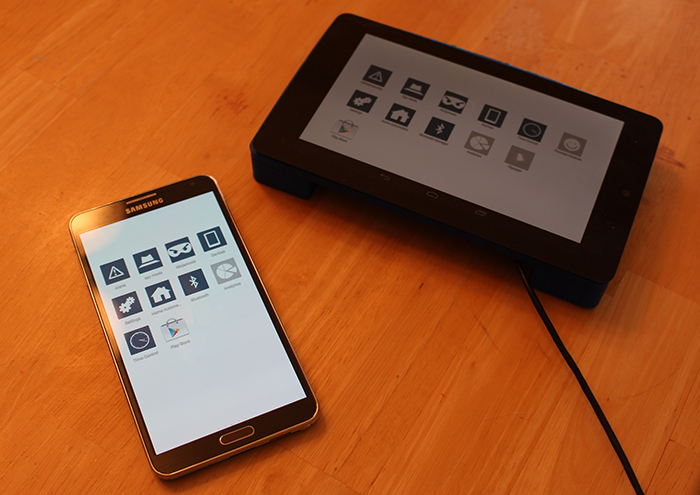
soap with phone 1

And that’s not even the end of it. Soap will support an open ecosystem and invite developers to create apps for the router, making the possibilities nearly endless. Some of Soap’s ambitious dreams include enabling folks to know if their children or pets have entered or exited the home, turn your TV on when you enter a room, know whether your dog is barking too loud and more.

Soap’s Networking Specs

Of course, being a router means that its networking capabilities are more important than anything else. It features 802.11/ac and is completely backwards compatible with a/b/g/n, 2.4GHz and 5GHz WiFi channels with simultaneous dual-band capabilities, 4 Gigabit LAN ports, WPA2, WPA-PSK, and 128-bit and 64-bit WEP for security.

You’ll also get AOSS and WPS for secure and easy one-press setup. Finally, they’ll have built-in support for DLNA streaming and universal plug-and-play, built-in tools for configuring VPN networks and Samba servers, and full port forwarding and management options.

Backing Levels, Pricing and Availability

I’m no expert in networking, but it seems like they have all their bases covered from where I’m sitting. The only questions left are pricing, availability and any stretch goals they’re looking to reach. For starters, the cheapest option for getting a Soap Touch (there’s a non-touch option called Soap Essential without a display or Android as well) is a $150 package, but only 67 of them are left as of the time of this writing.

soap awesome hardware software

There’s another $150 early adopters’ option that will get you your unit well ahead of anyone else (July 2014), though you’ll have to put up with a unit that is potentially buggy as they work out the kinks ahead of the large scale rollout in the fall. Otherwise, you can opt for the $210 option to get both a Soap Touch and a Soap Essential. This combo saves you $90 off the price of both units if you were to buy them individually at full retail.

Unfortunately there are no other current options for getting a lone Soap Touch unit, as they have only listed a limited amount of them. That’s not good news for those who don’t need the Soap Essential, but if you really want one of these once they’re available that’s the only way to get it. Units from the stable production line will be targeted for delivery as early as August, with some options requiring waits into September and October

Stretch Goals

Of course, the more money they can raise, the more this thing can evolve. Here’s a quick look at what they’re hoping to accomplish at each milestone they’ve set:

  • $100,000: Camera, Speaker, and Microphone for Soap Touch
  • $125,000: Optical Audio connector for Soap Touch and Essential
  • $150,000: Soap with Linux available
  • $175,000: Quantenna QAC2300 WiFi chip for Soap Touch
  • $185,000: Quantenna QAC2300 WiFi chip for Soap Essential
  • $200,000: Internal battery for Soap Touch and Essential
  • $275,000: Soap bubbles available as an upgrade
  • $400,000: Soap with no rope built-in

We honestly have no clue what those last two stretch goals are supposed to mean, so we’ve reached out for further clarification. It sounds like there’s plenty incentive to at least get this project up to that $200,000 mark, so be sure to pledge if you want to help drive the funding up.

Otherwise, take solace in the fact that we know we’re at least getting the base units promised as they have already surpassed their original goal of $80,000 by $18,000. Head right here for all the nitty gritty details (including a ridiculously detailed explanation on how it was made), and to take it all in and decide if you want to get behind this very interesting idea.

05 Mar 22:37

Supreme Court Takes A Pass On Challenging Legality Of Government Surveillance Programs

by Tim Cushing

The Supreme Court has just given the government (and the NSA's defenders) a little more breathing room on the issue of the legality of the agency's surveillance programs.

In a case very similar to a lawsuit brought by the American Civil Liberties Union (ACLU) against warrantless surveillance made “legal” by the FISA Amendments Act (FAA) of 2008, which the Supreme Court declined to grant “standing” in February 2013, the Center for Constitutional Rights (CCR) announced the Court had rejected their lawsuit against Bush-era warrantless surveillance.

“The Supreme Court’s refusal to review this case guarantees that the federal courts will never address a fundamental question: Was the warrantless surveillance program the NSA carried out on President Bush’s orders legal? The Court’s decision also guarantees that the Obama administration, which has for the last five years refused to take any position on that question, will now never have to answer either,” CCR declared.
This refusal will give those who claim the programs are "legal" another notch on the rhetoric belt, as if not discussing the legality (or illegality) of the program was the equivalent to being found legal by the highest court in the land. If the courts are unwilling to entertain surveillance-related cases, either by refusal to grant standing or refusal to hear the case at all, the defenders can continue to claim the programs are legal.

CCR has what would seem to be a pretty solid legal stake in challenging the legality of these programs, especially considering the recent revelations that the NSA signed off on the collection of privileged attorney-client communications. CCR is representing "hundreds" of Guantanamo Bay detainees, charged as "enemy combatants" and held indefinitely, each of which could be "legally" surveilled as they hold supposedly privileged conversations with their legal representation.
Lawyers have refused to take terrorism cases because they refuse to have their privacy violated by the government, and attorney have also warned their own clients that they should “self-censor” and assume they are being spied upon by the government when they communicate anything.

This is not some “speculative” issue. On February 20, the American Bar Association, which has around 400,000 members, expressed concerns about recent allegations that the “confidential communications” of American lawyers with “overseas clients” had been violated.
As the article points out, this isn't speculative. In addition to the above-mentioned leak, other evidence has been uncovered that points to the government listening in on privileged conversations. Nicolas Niarchos of The Nation reviewed classified documents related to terrorist suspect Adis Medunjanin. Medunjanin made 42 phone calls to his legal rep from mid-2009 to 2010. In the classified documents, Niarchos found a CD of these 42 phone calls.

Even if the NSA has no clear directive warning it away from attorney-client communications, it certainly should still be required to conform with the protections of the Constitution. Collecting evidence by listening in on conversations presumed to be privileged further subverts due process by giving the government access to info it normally (via any other agency) wouldn't have access to. You know, I don't want the terrorists to "win" either, but I'd rather not sacrifice my rights on the altar of "security" to achieve that goal.

The Supreme Court's disinterest in this case will only further insulate the government against the consequences of its own behavior.


Permalink | Comments | Email This Story


05 Mar 16:41

Keith Alexander Supports Law To Gag Press So He Can Get His Preferred Online Surveillance Bill Passed

by Mike Masnick
Oh, Keith Alexander, how we're going to miss your insane claims once you retire in a few weeks -- though, I'm sure that as you drift off into "retirement" only to be hired by some government contractor or lobbying organization at an insultingly high salary, that like your buddy Michael Hayden, you'll still be good for regular bullshit quotes to news organization. Still, while on the job, Alexander seems to want to go out with a bang, talking about how the UK was correct to detain Glenn Greenwald's partner David Miranda under an anti-terrorism law even though no one thinks he's a terrorist. However, even more troubling, is that Alexander, who has argued that the US government needs to figure out a way to silence reporters reporting on leaked documents, claims that there's an effort underway to create "media leaks legislation."
The general, who is due to retire in the next several weeks, said that the furore over Snowden’s surveillance revelations – which he referred to only as “media leaks” – was complicating his ability to get congressional support for a bill that would permit the NSA and the military Cyber Command he also helms to secretly communicate with private entities like banks about online data intrusions and attacks.

“We’ve got to handle media leaks first,” Alexander said.

“I think we are going to make headway over the next few weeks on media leaks. I am an optimist. I think if we make the right steps on the media leaks legislation, then cyber legislation will be a lot easier,” Alexander said.
In case you haven't been paying attention, Alexander has been pushing for years for laws like CISPA, which would give the NSA much greater control over "cybersecurity" -- and specifically knock down barriers towards getting companies to share information with the NSA. Alexander and CISPA supporters have been spinning this entirely about "protecting" companies from online attackers, leaving out how it's really about giving the NSA more backdoors into private companies' networks.

But think about what Alexander is saying above. He's flat out admitting -- as many have noted -- that his pet cybersecurity bills are dead right now because of all of the Snowden leaks, showing just how abusive the NSA has been. And his answer to that is not to fix the NSA, but to pass bills to stifle the free press from reporting on NSA efforts, which he then thinks will allow the government to pass legislation like CISPA.

As the report in the Guardian notes, no one seems to have any idea what this "media leaks legislation" is going to entail, as nothing has yet been proposed, and there haven't even been any real rumors of anything until now. However, with James Clapper recently referring to reporters as accomplices, and Rep. Mike Rogers making the out-of-left-field argument that reporters who are covering Snowden are thieves who traffic in stolen government property, you can connect a few dots and guess at what's coming down the pike.

Alexander's own comments seem to similarly suggest that reporters "have no standing" to report on these issues, because they're not insiders, using the Miranda detention as a launching pad:
“Recently, what came out with the justices in the United Kingdom … they looked at what happened on Miranda and other things, and they said it’s interesting: journalists have no standing when it comes to national security issues. They don’t know how to weigh the fact of what they’re giving out and saying, is it in the nation’s interest to divulge this,”
Still, a bill to stifle investigative reporting is going to face stiff opposition, and even bringing up such a concept suggests that Alexander still has no clue what current public perception is like concerning the NSA's surveillance activities. Just the fact that he's suggesting a bill to silence a free press, and he specifically admits he wants to do so in order to get his troubling surveillance bill approved, shows the depths of Alexander's thinking on these issues. A free press? Not important. More power for the NSA to spy on everyone? That's the priority.

Permalink | Comments | Email This Story


05 Mar 12:39

CIA Accused Of Spying On Senate Intelligence Committee Staffers

by Mike Masnick
Brindle

for anyone needing a history lesson on why this is bad see Hoover.

While at times, it's appeared that the Senate Intelligence Committee, led by Dianne Feinstein, serves more to prop up the intelligence community than to handle oversight, it has actually clashed quite a bit with the CIA. We've discussed a few times how the Committee has been pushing to release a supposedly devastating 6,000 page report about the CIA's torture program, which cost taxpayers an equally astounding $40 million to produce. However, the CIA has been fighting hard to block the release of the report, arguing that it misrepresents the CIA's actions.

However, things are getting even more bizarre, as the NY Times is reporting that the CIA is now accused of spying on the Intelligence Committee and its staffers in its attempt to keep that report from being released.

The details are still a little cloudy, but in December, Senator Mark Udall revealed that the Senate Intelligence Committee had come across an internal CIA study that apparently corroborated the information that is in the big Senate report -- and which directly contradicted claims by the CIA to the Committee about how the report was inaccurate -- suggesting that, on top of everything else, the CIA lied to the Intelligence Committee. Udall quizzed CIA boss John Brennan about that internal report. And according to the NY Times, it appears that CIA folks freaked out that the Intelligence Committee somehow got access to that internal study, and responded the way the CIA knows best: by starting to spy on Intelligence Committee staffers:
The agency’s inspector general began the inquiry partly as a response to complaints from members of Congress that C.I.A. employees were improperly monitoring the work of staff members of the Senate Intelligence Committee, according to government officials with knowledge of the investigation.

The committee has spent several years working on a voluminous report about the detention and interrogation program, and according to one official interviewed in recent days, C.I.A. officers went as far as gaining access to computer networks used by the committee to carry out its investigation.
On Tuesday, Udall sent a strongly worded letter to President Obama, pushing for the declassification and release of the big 6,300 page report, but also that internal CIA study, which would highlight how the CIA lied. On top of that, he made an oblique reference to this spying activity by the CIA:
As you are aware, the CIA has recently taken unprecedented action against the Committee in relation to the internal CIA review, and I find these actions to be incredibly troubling for the Committee's oversight responsibilities and for our democracy. It is essential that the Committee be able to do its oversight work -- consistent with our constitutional principle of the separation of powers -- without the CIA posing impediments or obstacles as it is today.
In many ways, the idea that the CIA is directly spying on the Senate Committee charged with its own oversight is a bigger potential scandal than many of the Snowden NSA revelations so far. Even more importantly, it may finally lead to Congress taking action against an out-of-control intelligence community.

Permalink | Comments | Email This Story


05 Mar 01:58

Google addresses Android 4.4.2 camera bug, says fix arriving in a future update

by Chris Chavez
Brindle

AHHA! This started happening on my Nexus 5 recently and I was very confused. Hopefully they'll get it fixed soon.

Nexus-5-camera-watermarked

There’s a nasty little bug some users have been experiencing since updating their Nexus 5′s (and other devices) to Android 4.4.2. The big involves the camera application in Android 4.4.2 that when either opened by the user or triggered in the background from another app (Skype for instance), causes the device’s CPU to max out, resulting in abnormally high battery drain.

It’s not a good time for anyone, but try not to worry too much because Google is hot on the case. They’ve officially acknowledged the issue in their bug tracking forum and have promised to address this issues (and others) in a future maintenance update (likely Android 4.4.3).

Keep in mind that Google was only able to verify this issue on the Nexus 5 and recommends that Android users with other devices report the bug to their respective manufacturers. This has to due to with custom Android software (Sense, TouchWiz) that could also be triggering the camera bug, and will need to be addressed separately.

Android 4.4.2 camera bug

To find out if you have the bug, you’ll need to jump into your Settings > Battery and check to see if “mm-qcamera-daemon” is consuming a good chuck of your battery percentage. If it is, a reboot is said to help but it’s only a temporary fix. Also, uninstalling apps like Skype, Tango, etc. that use the camera may also help. It’s not the best solution, but it might be your only option until Android 4.4.3 is pushed out sometime in the future.

Anyone notice camera hijinks affecting their device after updating to Android 4.4.2?

[Android Issue Tracker | via Reddit]

04 Mar 13:47

Police Chief Testifies Against Legalizing Marijuana With Parody Newspaper Article

by Timothy Geigner
Brindle

Is MD planning to legalize?

They say that really well done parody is close enough to the truth to be funny. That's certainly correct, but it can occasionally create some problems, as we've seen in the past. Parody can anger the target of the scorn, it can lead to charges of defamation, and parody news stories can occasionally infect even the, ahem, most fair and balanced cable news stations. I guess the point is that not everyone has enough of a sense of humor to find some parody funny, or even to realize that it is indeed parody.

The latter is the case with this story about Annapolis Police Chief Michael Pristoop, who had diligently prepared before testifying before a state panel on the potential for legalizing marijuana.

In researching his testimony against two bills before the Judicial Proceedings Committee, Pristoop said, he had found a news article to illustrate the risks of legalization: 37 people in Colorado, he said, had died of marijuana oversdoses on the very day that the state legalized pot.

“When he said it, everyone in the room dropped their laptops,” Sen. Jamie B. Raskin (D-Montgomery) said in an e-mail.
Proving, of course, that stupid can in fact cause physical harm and property destruction. See, the problem is that Pristoop's source for his marijuana massacre was The Daily Currant, which is a comedic parody magazine. The article and its claims were a joke. So, it appears, were Pristoop's efforts at vetting the sources he found on the always treacherous interwebz. Similar grades should be assigned to Pristoop's abilities at admitting error.
“I apologize for the information I provided concerning the deaths. I believed the information I obtained was accurate, but I now know the story is nothing more than an urban legend,” Pristoop said. “This does not take away from the other facts presented in opposition to legalization or the good work of the Maryland Chiefs and Maryland Sheriffs Associations.”
An urban legend is a fictional story circulated through a community that might be a tad unsure of whether it is indeed fiction. Ghost stories, in other words, or the threat of high school seniors hazing incoming freshman. Those are urban legends. The Daily Currant's article was a joke made up whole cloth for the purposes of making people laugh. Anyone with a modicum of interest and education into the health risks associated with marijuana use would know that immediate death simply isn't one of them.

Fortunately, others in the police departments of Maryland have a better handle on this whole humor thing, as evidenced by Maj. Scott Baker.
“His numbers are up in smoke,” Baker acknowledged Wednesday — a sly tip of the hat to Cheech & Chong’s 1978 stoner movie.
Funny, I was going to make a comment about how Pristoop's facts were half-baked...

Permalink | Comments | Email This Story


04 Mar 13:41

Australian Man Can't Get Parts Because His Super Generic Name Is On A US Terrorist Watchlist

by Timothy Geigner
Brindle

Wonder if @kernelhacker will be affected? :P

Let me let you into the helmet for a moment. Given all the nonsense surrounding the various United States alphabet agencies and their various watchlists, I've grown thankful that I have a fairly uncommon name. Between the potential for antagonistic abuse by scorned lovers, the opportunity for clerical errors to result in life-changing refusals of admittance to the United States, and the general crap-show that is the no fly list, it's somewhat nice to have a rather unique identifier. It almost cancels out the mispronunciations, lacking nicknames like "Geigner-counter", and seriously non-stop questions about what life is like running the Treasury Department. Almost.

But stories like this one offered by reader Richard really cement my gratitude for my evil-sounding German surname. I could, as this story goes, have an incredibly generic name and live in a foreign country and find myself having to wade through all kinds of red tape just to get a few electronics parts. This is the story of David Jones and his quest to get a couple of parts from a local distributor in Australia.

Through the website I ordered some local in-stock parts from the Element 14 warehouse in Sydney, for pickup at the trade counter. Usually they are very efficient and have the parts ready for collection before I have time to drive there. But this day I gave them a few hours extra. When I got there my parts weren't ready and it took them a bit of time to figure out that my order had been placed “on hold”.

But they enquired further with someone else and the word came back that it wasn't the parts that had been flagged, it was my NAME that was flagged. And they said it was a US government watch list of some description. I was stunned, and it seemed like they didn't quite understand why I was so shocked at this. Because, you know, the whole world has to just sit by and let the US government dictate everything at will.
Flagging David Jones? What could go wrong? I hear he has a really terrifying locker and was part of a terrible Beatles knock-off band a couple of decades ago. On the other hand, harassing foreign citizens with common names out of an over-abundance of name-recognizing caution is probably going to make everyone look foolish, on top of all the work it certainly must create. On top of that, the helpful employees of Element 14 were confident they could just work around the flag to begin with. So the efforts aren't just silly, they're futile on top of it. Oh, US government, don't ever change.

Not that Mr. Jones was as amused as I, of course.
So let's see if I have this straight – An Australian subsidiary, owned by a UK parent company, listed on the UK stock exchange, has an ordering system that automatically matches generic names against some US Government watch list, and flags those orders and puts them on hold, for parts that are already stocked in Australia, are likely not made in the US, and likely have come from the main UK warehouse. Call me stupid, but something doesn’t seem right with that…
No, Mr. Jones, we don't think you're stupid. We think you're cunning, an evil mastermind terrorist from Australia, because we've seen so many of those. Or maybe it's one of the other bazillion David Jones' plotting around the world. You can't expect us to know. It's not like we're reading everyone's emails or something...

Permalink | Comments | Email This Story


03 Mar 14:40

Keurig Will Use DRM In New Coffee Maker To Lock Out Refill Market

by Karl Bode
Brindle

Yay.

The single coffee cup craze has been rolling now for several years in both the United States and Canada, with Keurig, Tassimo, and Nespresso all battling it out to lock down the market. In order to protect their dominant market share, Keurig makers Green Mountain Coffee Roasters has been on a bit of an aggressive tear of late. As with computer printers, getting the device in the home is simply a gateway to where the real money is: refills. But Keurig has faced the "problem" in recent years of third-party pod refills that often retail for 5-25% less than what Keurig charges. As people look to cut costs, there has also been a growing market for reusable pods that generally run anywhere from five to fifteen dollars.

Keurig's solution to this problem? In a lawsuit (pdf) filed against Keurig by TreeHouse Foods, they claim Keurig has been busy striking exclusionary agreements with suppliers and distributors to lock competing products out of the market. What's more, TreeHouse points out that Keurig is now developing a new version of their coffee maker that will incorporate the java-bean equivalent of DRM -- so that only Keurig's own coffee pods can be used in it:
"Green Mountain has announced a new anticompetitive plan to maintain its monopoly by redesigning its brewers to lock out competitors’ products. Such lock-out technology cannot be justified based on any purported consumer benefit, and Green Mountain itself has admitted that the lock-out technology is not essential for the new brewers’ function. Like its exclusionary agreements, this lock-out technology is intended to serve anticompetitive and unlawful ends."
The plan was confirmed by Keurig's CEO who stated on a recent earnings call that the new maker indeed won't work with "unlicensed" pods as part of an effort to deliver "game-changing performance." "Keurig 2.0" is expected to launch this fall. French Press and pour-over manufacturers like Chemex have plenty of time to get their thank you notes to Keurig in the mail ahead of time as users are hopefully nudged toward the realization they could be drinking much better coffee anyway.

Permalink | Comments | Email This Story


03 Mar 14:40

Florida Cops’ Secret Weapon: Warrantless Cellphone Tracking

by Kim Zetter
Brindle

Wow! I'm baffled how lawyers could rationalize an NDA against the court system...

Florida Cops’ Secret Weapon: Warrantless Cellphone Tracking
Police in Florida used a controversial cellphone tracking gadget without telling a judge because they felt bound by a non-disclosure agreement with the manufacturer of the device, according to newly obtained court evidence.


01 Mar 13:35

Houston Issues 'Cease-And-Desist' To Uber To Stop Houston Residents From Communicating With Their Government

by Mike Masnick
We've covered for a while now how Uber -- the mobile phone-enabled car/taxi ordering service -- has run up against a bunch of obsolete laws in various cities, often leading to bizarre rebuttals from municipal officials. Uber quickly realized that each ridiculous response from a city government was something of a marketing opportunity to introduce itself to new cities. You would think, by now, city officials would learn that the proper thing to do is figure out how to work with Uber to provide better transportation for their citizenry, rather than immediately bowing to demands from taxi/limo companies who fear potential competition.

However, the response from Houston may be the most bizarre of all. Uber had set up a petition for Houston residents, emailing city officials of their support for allowing Uber in that city. In response to this, the city of Houston issued a cease-and-desist, effectively telling Uber to stop asking Houston residents to contact their own elected government about this issues any more.

From: Feldman, David M. – LGL Sent: Wednesday, February 26, 2014 8:46 AM
To: Miller, Robert
Subject: Uber Cease and Desist

Robert – Please consider this as a formal demand that your client, Uber, cease and desist from transmitting or aiding in the transmission of form e-mails to City officials regarding the adoption of an ordinance to accommodate their enterprise. Despite my informal request to you by telephone on Monday, the excessive number of e-mails has gone unabated, to the point that it has become harassing in nature and arguably unlawful. Failure to cease and desist will be met with appropriate action by the City.

David M. Feldman
City Attorney
City of Houston

It's ridiculous for Feldman to argue that citizens contacting their own elected officials is a form of harassment and somehow illegal. And, of course, the end result of this is that it just drives that much more attention to the issue (and probably even more emails).

Permalink | Comments | Email This Story


01 Mar 02:09

Dash-Cam Revelations In NJ Show Again The Importance Of Video As Evidence In Police Abuse

by Timothy Geigner
Brindle

All cops should have mandatory dash and body cams period.

Several weeks ago, Tim Cushing wrote about a case in New Jersey featuring an officer accused of abusing a cyclist who failed to engage his dash-cam during the incident. As noted in the piece, the value of having optional tape of any incident occurring between an officer and the public should be obvious. On the one hand, the public is already under a great deal of public surveillance, which can often times be used as evidence in any criminal proceedings. Tape featuring law enforcement action is valuable both ways, first in holding our public servants to account should they fail to behave appropriately and second to exonerate them if they are accused of wrong-doing.

In this latest story, also in New Jersey, we see an example of the former. Marcus Jeter was met by police at the home he shares with his girlfriend after a domestic violence call made to police. Once there, police reportedly spoke to Jeter, who says he left amicably after briefly talking to officers. It's worth noting that no charges were ever filed for that domestic incident. What happened next, however, is another matter entirely. Jeter was pulled over by officers shortly after leaving the site of his home.

The New Jersey DJ, 30, was arrested in a 2012 traffic stop and charged with eluding police, resisting arrest and assault. Prosecutors insisted that Jeter do prison time.
The plea deal offered to Jeter was five years of prison time, for resisting arrest and assaulting police officers. Those were the charges levied in the officers' report. Those charges, as would later be determined by an active police dash-cam, were utter bullshit.
The video, which prosecutors say they never saw before filing the initial charges, shows Jeter holding his hands above his head.

"The next thing I know, one of them busts the [car] door and there is glass all over my face," he told ABC News station WABC-TV about the arrest. "As soon as they opened the door, one officer reached in and punched me in my face. As he's trying to take off my seat belt, I'm thinking, 'Something is going to go wrong.'" Jeter says the cops continued hitting him, telling him not to resist arrest.
Oops. As it turns out, there wasn't any resisting of arrest and the only assault occurring was when the officers beat the hell out of Jeter. On top of that, the officers in question elected to omit surely-unimportant details of the arrest from their reports, such as when one of them careened over a median into Jeter's vehicle, which was also shown in the dash-cam footage. On top of that, police had their weapons drawn almost immediately, despite the fact that Jeter had pulled over to the shoulder as requested and remained in his vehicle, terrified.

Thanks to Jeter's attorney filing a request for records, which included the footage, the charges against Jeter were dropped and charges were instead filed against the officers. Those charges include aggravated assault, conspiracy, and official misconduct.

Now, we can and should respect law enforcement, but that respect doesn't come without the public's right to verify our public officials are behaving honestly and judiciously. Let there be no argument: the public has a right to the footage of officers in action.

Permalink | Comments | Email This Story


01 Mar 02:06

Two New Decisions Strengthen Cell Phone Privacy in Texas and Washington

by Hanni Fakhoury

On back-to-back days this week, residents in Texas and Washington received some extra legal protection for the contents of their cell phones. These decisions, while only binding on law enforcement within each respective state, could play an important role on the ongoing debate on cell phone privacy specifically, and applying legal protections against unreasonable searches and seizures to new technologies generally. 

Texas: a cellphone is not like a pair of pants or shoes

First, the Texas Court of Criminal Appeals ruled in State v. Granville that an inmate locked in jail maintained an expectation of privacy in the contents of his cell phone even when the phone was out of his custody and in the control of the jail guards. A Huntsville police officer arrested high-school student Anthony Granville on a misdemeanor charge, and he was locked up in jail. Three hours after his arrest, a different officer than the one who arrested him retrieved Granville's phone from the evidence locker and, without a warrant, looked through the contents of the phone for evidence of an unrelated crime.

The government attempted to justify the search by claiming that, similar to clothing worn by an inmate, once the phone was in the control of the jail officials, Granville no longer had any expectation of privacy in its contents. We filed an amicus brief explaining that a cell phone really isn't anything like a pair of pants given the immense amount of data stored on the phone, meaning that police needed to get a warrant to search it. The high court agreed with us, with Judge Cathy Cochran writing unequivocally:

[W]e conclude, as did the court of appeals, that a cell phone is not like a pair of pants or a shoe. Given modern technology and the incredible amount of personal information stored and accessible on a cell phone, we hold that a citizen does not lose his reasonable expectation of privacy in the contents of his cell phone merely because that cell phone is being stored in a jail property room.

Washington: A text message is like a phone call or letter

The next day, the Washington Supreme Court issued a pair of decisions in State v. Hinton and State v. Roden finding that police violated state law when, after seizing a cell phone from a suspect during a drug investigation, it monitored and responded to incoming text messages, arranging drug deals with defendants Hinton and Roden.

The state argued that neither Shawn Hinton or Jonathan Roden had an expectation of privacy in the text messages once they were sent to someone else's phone. Instead, the state argued both men had assumed the risk that their messages could be intercepted by someone else or that the person they thought they were communicating with was really someone else. EFF filed amicus briefs in both cases, explaining that the society's expectation that police won't intercept their phone calls or postal letters extends to the 21st century equivalent, the text message. The court agreed, ruling that police were unauthorized to intercept the conversation, noting that 

unlike letters, which are generally delivered to the home where they remain protected from intrusion, text messages are delivered to a recipient's cell phone instantaneously and remain susceptible to exposure because of a cell phone's mobility. Just as subjecting a letter to potential interception while in transit does not extinguish a sender's privacy interest in its contents, neither does subjecting a text communication to the possibility of exposure on someone else's phone.

Cell phone privacy spreading across the country

These decisions come at a time when cell phone privacy is a hot topic in courts across the country and hopefully the strides made in Texas and Washington will be felt elsewhere. State courts are taking a more aggressive approach to safeguarding privacy than federal courts, especially when it comes to law enforcement searching and tracking cell phones. Last week, the Massachusetts Supreme Judicial Court ruled that police needed a search warrant to obtain historical cell site records from a cell phone provider. New Jersey's Supreme Court reached the same result last year. The Rhode Island Supreme Court heard argument in early February in State v. Patino, a case similar to Hinton and Roden, that involves whether a person has an expectation of privacy in text messages found on someone else's phone. State legislatures have been active too, with Maine and Montana passing legislation last year protecting cell phone location data, and Maryland and Wisconsin considering similar legislation this year. This week's decisions could also go a long way to bringing the law into the 21st century. 

Most importantly, the topic of cell phone privacy will shortly be before the U.S. Supreme Court, which is considering two cases this term on whether police can search a person's cell phone incident to their arrest. The U.S. Supreme Court would be wise to follow the lead of Texas and Washington. This week's decisions both appreciated the breadth of data stored on a cell phone meant it was foolish to analogize to physical items like a pair of pants or old cases involving antiquated technologies. They rejected the false notion that the mere act of exposing a phone or text message to someone else gives the government free reign to intrude and search through the reams of data on a cell phone. Hopefully the U.S. Supreme Court will make the same conclusions, ensuring that the right to privacy in a cell phone isn't just a local right but a national one.


Share this: Share on Twitter Share on Facebook Share on Google+ Share on Diaspora  ||  Join EFF
01 Mar 01:55

MPAA Shifts Its Funding Efforts To Republicans After SOPA Defeat

by Mike Masnick
Brindle

this crap is ridiculous. when will we get smart and just get rid of privately funded campaigning?

You may recall that, as SOPA/PIPA were in their final death throes, MPAA boss Chris Dodd made a significant political faux pas in flat out warning politicians that if they refused to stay bought, the MPAA might not keep funding them:
"Those who count on quote 'Hollywood' for support need to understand that this industry is watching very carefully who's going to stand up for them when their job is at stake. Don't ask me to write a check for you when you think your job is at risk and then don't pay any attention to me when my job is at stake,"
Historically, of course, it has always been the Democrats that Hollywood has backed the most. While there are some high profile exceptions, Hollywood is a Democratic town. And, of course, with the Democrats failing to give Hollywood its desired censorship tool, the MPAA has apparently shifted strategies and has ramped up its funding of Republicans (possible paywall, depending on where you visit from):
Last year, the MPAA replaced its longtime lead lobbying firm, considered to be close with Democrats, with a lobbyist with ties to key GOP lawmakers. Its political-action committee now gives more donations to Republicans than Democrats. And it has sent money to a GOP super PAC, a conservative antitax entity and a business lobby helping Republicans in the 2014 elections.
Of course, this isn't so much the end result of Dodd's promise, rather it appears to be the MPAA recognizing that the party that bailed first (and most loudly) on SOPA and PIPA... were the Republicans, who have begun showing sparks that suggest that they may break from the bipartisan support for copyright maximalism.

While it's easy to be cynical about the MPAA here, it's more likely that this is all by design by Congress itself. For all the belief that lobbyists drive the agenda in Congress via money, when you dig down, you realize it's often the opposite, with the politicians themselves effectively extorting money from lobbyists by threatening to push certain laws.

In fact, right before SOPA blew up, a cynical, but knowledgeable (and all too prescient) friend of mine pointed out that the whole point of SOPA/PIPA was to pit two "rich" industries -- tech and Hollywood -- against each other to make donations rain from the sky. As this friend pointed out, for years, Congress would pit two other "rich" industries -- radio broadcasters and the recording industry -- against each other by pushing a performance rights bill, and both sides would donate heavily to various candidates in support of or against it. However, by 2010, it was quickly becoming clear that neither the radio industry, nor the recording industry were going to continue being huge successful industries with lots of money to throw around lobbying. So, folks on the Judiciary Committee looked around and sought a bill that would get the tech industry and Hollywood all riled up to start donating. It didn't much matter if the bills passed or not -- just that people got angry.

And that's more or less what happened.

And, now the MPAA is raining dollars on candidates it hasn't in the past:
In 2010, MPAA had a budget of about $50 million, down from $70 million in 2008, according to tax forms. In 2012, the last year for which tax forms are available, MPAA's budget was back to nearly $70 million....

The fastest-growing part of the MPAA budget is donations to interest groups and political organizations. It made $2.5 million in grants to third-party groups in 2012, up from just $120,000 in 2009. Many were routed to nonpolitical organizations that share Hollywood's interest in copyright protections or lower taxes. About $600,000 went to organizations that play a more political role.

MPAA gave $75,000 to the U.S. Chamber of Commerce, which is a top supporter of Republican candidates for Congress; $100,000 to Americans for Tax Reform, the antitax group run by conservative advocate Grover Norquist ; $25,000 to the large pro-Republican super PAC American Action Network; and $20,000 to Let Freedom Ring, whose mission is to "counter the attacks of anti-conservative groups," according to its website.
Cynical or not, if the plan all along with SOPA/PIPA was basically a fundraising plan for Congress, well, mission accomplished.

Permalink | Comments | Email This Story


28 Feb 23:01

Google Files Emergency Motion To Stop Censorship Ruling Over 'Innocence Of Muslims'

by Mike Masnick
As was fully expected, Google has quickly filed an "emergency motion for a stay" on the horrific 9th Circuit ruling that the company needed to take down all copies of the Innocence of Muslims film and block it from being re-uploaded anywhere. Google has made it clear that it will fight this decision, starting with asking the 9th Circuit for an en banc rehearing (appeals court cases are normally heard with 3 judges -- an en banc hearing, if the court agrees to hear it -- includes a larger slate of judges (in the 9th Circuit, it is almost always 11 judges, though in theory it could be all 29).

Appeals courts don't often grant requests for en banc hearings and, as such, often don't grant stays (basically holding off enforcing the order). However, with this case generating so much attention (and condemnation), hopefully enough of the judges in the 9th Circuit agree that it's worth rethinking Judge Kozinski's order.

Google's motion lays out the basic argument, highlighting that the ruling simply invents new law and ignores precedents that the court is bound by. It also highlights how the ruling seems to get some rather basic issues flat out wrong. Furthermore, it highlights that there is real harm from the censorship imposed by the ruling, while leaving the video up for a little more time is unlikely to create any additional harm (if it ever created any harm in the first place).
The panel majority's takedown order contravenes Circuit law by imposing a mandatory injunction—an injunction gagging speech, no less—even though the majority found the merits “fairly debatable.” ... The majority's novel copyright analysis is wrong on several fronts, creates splits in the Ninth Circuit, and will produce devastating effects: Under the panel's rule, minor players in everything from Hollywood films to home videos can wrest control of those works from their creators, and service providers like YouTube will lack the ability to determine who has a valid copyright claim. And absent a stay, Google, YouTube, and the public face irreparable harm because the panel's order will gag their speech and limit access to newsworthy documents—categorically irreparable injuries.
The full filing certainly highlights the likely arguments that Google is hoping to make should the court agree to an en banc hearing or, barring that, in an attempt to get the Supreme Court to hear the case.

Permalink | Comments | Email This Story


28 Feb 18:48

American Bar Assoc. Sends Letter To NSA Seeking Affirmation Of Attorney-Client Confidentiality

by Tim Cushing

The American Bar Association (ABA) has written a letter to the NSA addressing an issue that surfaced via a recent leak: namely, the agency signing off on the interception of privileged attorney-client discussions by Australian intelligence. To make matters worse, the intercepted communications included a US attorney who was representing the Indonesian government in a trade dispute.

While the original article didn't make it clear whether the NSA had accessed this collection, the agency did in fact authorize the surveillance. Even if the NSA chose not to "listen in," the underlying concern remains: are attorney-client communications considered off limits to the agency?

The laws governing this provide no specific exception for attorney-client communications, and the fact that this particular incident involved a foreign nation makes it that much easier for the NSA to justify its actions.

In its letter to the NSA, the ABA asks for assurance from the agency that it won't willingly target these communications, even if they do involve foreign entities or persons.

The ABA understands the critical role that NSA plays in gathering intelligence information and protecting our national security, and we acknowledge that during the course of these activities, it is inevitable that certain communications between U.S. law firms and their clients may be collected or otherwise obtained by the agency. However, irrespective of the accuracy of the recent press reports, we would like to work with NSA on this issue and urge the agency not to actively seek confidential communications between U.S. law firms and their clients. In addition, if NSA obtains such confidential information inadvertently—or such information is obtained by foreign intelligence services or others and then shared with NSA—we would expect NSA to respect the privilege and take all appropriate steps to ensure that any such privileged information is not further disseminated to other agencies or any other third parties.
If the ABA ever receives these assurances (beyond a canned statement reiterating the NSA's talking points), it likely won't make any lawyer feel any more secure. The agency doesn't have a great track record when it comes to accurately representing its activities. The NSA's response may do nothing more than note these communications aren't exempt from its surveillance efforts.

If so, this leaves the ABA in the same position it began in: reliant on a protection that may not actually exist.
The interception and sharing of attorney-client privileged communications by government agencies—or any third party—raises concerns, including chilling the full and frank discussion between lawyer and client that is essential for effective legal representation. Any government surveillance and interception of confidential communications between law firms and their clients threaten to seriously undermine and weaken the privilege, because as the U.S. Supreme Court noted in Upjohn Co. v. United States, 449 U.S. 383 (1981), “an uncertain privilege…is little better than no privilege at all.”
That's where we are as a nation -- "little better than no privilege at all." The Fourth Amendment is actively skirted by the NSA and any number of investigative and law enforcement agencies on a daily basis, using a very expansive reading of the Third Party Doctrine to access an immeasurable amount of data, some of which is just as revealing as the communications they can't grab.

The ABA is right to press the issue, considering the NSA only very minimally addressed this when the leak first hit. The NSA obviously cherishes the large amount of confidentiality it and its lawyers enjoy. It should at least have the decency to extend it to the rest of the legal profession.

Permalink | Comments | Email This Story


28 Feb 12:27

That Time Yelpers Took Revenge On A Bigot Restaurant Owner

by Timothy Geigner
Brindle

hrm... just talked about rights of business owners yesterday... interesting

We've seen several examples of how Yelp and online reviews can impact a company's behavior. Sometimes that impact takes the form of the company in question going nuclear on the reviewers and subsequently crying "hack." Other times companies attempt to get reviewers into hot water through criminal charges. Or a company can just attempt to charge negative reviewers a couple thousand bucks, because that makes business sense. Mind you, none of this has slowed down the practice of the internet punishing poor behavior through negative reviews, including times when those reviews take on a farcical and/or creative tone.

Such is the case with with the owner of the Chicaro Club, a restaurant and bar in Oklahoma. See, Gary isn't what you'd call the most progressive business owner on the planet.

Last week, when a KFOR-TV reporter asked the owner of an Enid, OK, restaurant/bar about allegations that he wasn't exactly the most open-minded businessman in town, he admitted, "I've been in business 44 years, I think I can spot a freak or a faggot... I really don't want gays around. If I reached over there and slapped the sh** out of you, you should be offended," he explained. "But to call someone a 'chink' or someone call me a bigot, that doesn't bother me."
Ha! Racism and bigotry! Good one, Gary! Now, while Gary's speech and behavior are wholly reprehensible, that whole freedom of speech thing protects such asshattery. But it's a good thing it also protects the creative reviewers of Gary's establishment over at Yelp, too, because they're going to town on him as a matter of protest. Some highlights for you:
The mandatory "pants check" at the entrance was a little off-putting at first, but I totally understood once I got to the men's room. Definitely the hottest underwear party I've ever been to, and Gary takes the cake (and the FROSTING) as the best pivot man in the history of circle jerks! - Bruce M.

As a polysexual demiromantic Peruvian atheist that physically identifies as handicapped and ethnically identifies as a Cambodian transgendered sea turtle, it's understandably hard for me to find a place to fit in. This place was my safe zone. I'll never forget my first time. As a young newly open entity (I don't believe in labeling myself), I was looking for a place to feel free. The chick-fil-a had recently been shut down by the board of health and I was heartbroken. I found this place by coincidence. I had met this wonderful man on grindr, and mid-coitus, he stopped and asked me if I had ever been to Chicaros club. I told him I hadn't, and off we went. - Alex R.

Awesome place. My girlfriend and I stopped in and at first we were a little worried that all of the gay guys there might not be down with a couple of lesbians hanging out. My fears were quickly dashed! Not only was everyone super nice, the owner joined us all in a rousing rendition of "We Are Family"! The best part is that, after he found out that I was on welfare, the owner comped my entire meal and gave us a complimentary steak! What a guy! - Allison B.
Yes, the reviews are sophomoric, delightfully so. And, yes, this is just trolling to piss off Gary. But this is the internet people. Protest via trolling with a little public shaming dashed in is what the internet is for. Fortunately, there are enough serious reviews mixed in with the jokes such that I wouldn't expect any unsuspecting homosexuals to accidentally go to the Chicaro Club to hit on Gary.

All that's left is to see how Gary chooses to react to his new-found fame and glory. If he's a man of his word, he won't care one bit. If my faith in humanity is justified, hopefully he'll keep on not caring as he goes out of business due to a chronic lack of customers.

Permalink | Comments | Email This Story


27 Feb 14:07

PrivatOS Blackphone protects privacy nuts for $629, aims for $60M in sales

by Rob Jackson
Brindle

Want.

Remember GeekPhone? In the early days of Android – 2009 to be exact – the Spanish company captivated hardcore Android enthusiasts with a device called the GeekPhone One. Seems like a different century: that device ran Android 1.5 and had a 3.2-inch resistive screen. Though they never reached critical mass, the Geekphone team is still at it, now teaming up with security firm Secure Circle to produce the Blackphone.

Blackphone

Some quick Blackphone specs:

  • 4.7-inch HD screen
  • 2GHz Quad-core processor
  • 16GB of memory
  • 8MP camera
  • Android 4.4

The Blackphone is a tough competitor when you place it against today’s upper midrange Android devices, suffice to say the specs aren’t what make the Blackphone “the Blackphone”. Dubbed with a name not unlike the strong, sturdy, unbreakable box found on airplanes, the Blackphone exists to be the most secure and privacy protected smartphone known to man.

How does the Blackphone keep you safe?

The Blackphone is a highly customized version of Android, locking down system level implementations as well as applications and stacks that sit above the operating system. At its core, Blackphone offers the following Secure Circle services:

  • Silent Phone: Secure and encrypted VoIP
  • Silent Text: Secure and encrypted text messaging
  • Silent Contacts: protects your phone from apps trying to read your contact list

Pretty interesting offers for folks especially concerned about the security of their data and privacy, but you don’t need the Blackphone for these, they’re already available as paid apps on iOS and Android. With the Blackphone you do get a 2-year subscription, but then you’ve got another problem: these apps are only secure when both users have a Blackphone and/or these Secure Circle apps.

To remedy this limitation, Secure Circle is giving Blackphone customers 3 invites for 1-year subscriptions to these services, presumably for the family and friends you call the most. Supposing you like the service, though, they’ll be left in the dust on that second year and have to pay for the service themselves.

PrivatOS vs Android

From one standpoint, you could consider the Blackphone as a marketing tool to gain better visibility for their Secure Circle apps. That being said, just as rooted Android Phones are able to accomplish more than non-rooted phones, the Blackphone has some capabilities that simply downloading the relating apps can’t offer.

PrivatOS vs Android

The Blackphone has a number of other incorporated services through various partnerships, outlined extensively by The Verge, but two additional services are of particular interest:

  • Security Center: allows users to enable/disable specific app permissions on an app-by-app basis after download
  • Ad Blocker: prevents ad tracking code found in certain apps from tracking personally identifiable information and data

Because most of the nefarious activity happening on Android phones comes directly from rogue apps, Security Center and Ad Blocker – in my opinion – should be the two biggest draws from consumers looking for a secure solution.

The Blackphone is now available for pre-order at $629 and the company hopes, within three years, to be selling $60 Million in phones each year.

Blackphone or Wackphone?

The debate on privacy and data security often has two camps:

  1. The paranoid on one side and the people who aren’t breaking the law so don’t care on the other
  2. The responsible people who value their freedom on the one side and the ignorant on the other

It’s all a matter of perspective, but given recent data breaches that have exposed millions of credit card numbers and social security numbers, there are a growing number of citizens who are concerned with securing their information. Unfortunately, not many people actually know how to do this. The Blackphone could be one fool-proof plug-and-play style option.

Is the Blackphone up your alley? Do you think it’s a waste of time capitalizing on people’s fears? Or maybe you already accomplish a bunch of this stuff with a rooted Android device and a mixture of your own favorite apps?

26 Feb 18:12

Venezuela Shuts Down Internet, TV Stations To Stifle Protests

by Timothy Geigner

At some point, governments around the world are going to start learning that attempting to stifle free speech and communication via protests and the internet is almost always going to backfire on the offending government. Previous iterations of this plotline have been demonstrated in Ukraine, Egypt, and several other Middle East nations that participated in the so-called "Arab Spring."

Well, welcome to South America, governmental hubris, because there are now reports of the government shutting down the internet in Venezuela, where protests against the government and threats of toppling it have been raging.

The Electronic Frontier Foundation made note that Venezuelans working with several different ISPs lost all connectivity on Thursday of this past week. Users lost connectivity to the major content delivery network Edgecast and the IP address which provides access to Twitter’s image hosting service while another block stopped Venezuelan access to the text-based site Pastebin.

CONATEL director William Castillo suggests that the internet cuts were not due to the protests directly. CONATEL is the country’s media regulation network, and Castillo suggested via Noticias24 that online attacks were being waged. CONATEL, he suggests, blocked linkes "where public sites were being attacked."
Even though the attempt to shift blame for internet shutdown on outside hack attacks is a very common kind of government bullshit, it might just be believable, if only that same government wasn't also going around and shutting down television stations that were saying things the government didn't like. In the case of NTN24, a Venezuelan cable news channel, the government isn't even trying to pretend the shutdown isn't politically motivated.
Venezuela’s president said that a Colombia-based cable news channel was ordered to be removed from cable lineups in Venezuela because of its coverage of an antigovernment protest. President Nicolás Maduro said Thursday that the channel, NTN24, had tried to “foment anxiety about a coup d'état.” He said that he gave the order to pull the channel because “No one is going to come from abroad and try to perturb the psychological climate of Venezuela.”
No, no, of course not Senor Maduro, you're perfectly capable of perturbing the psychological climate of Venezuela all by yourself. As with Egypt, and Tunisia, and most recently Ukraine, this won't work. In fact, it's likely again going to have the opposite effect of provoking the protesters even more than they've been already. At some point the lesson will eventually be learned that in an era where free speech and citizen press have been expanded exponentially, attempts to shut both down won't be tolerated.

Perhaps President Maduro would like to speak with Viktor Yanukovych, if he wasn't in hiding from people on whom he attempted to put these exact same restrictions.

Permalink | Comments | Email This Story


26 Feb 14:47

I Get The Feeling It's Low Enough Already: Woman Purposefully Lowering IQ To Be More Like Barbie

Brindle

idiocracy here we come!!

real-life-barbie-dumbing-down.jpg Meet Blondie Bennett (she legally changed her name), a woman who has taken her obsession with becoming a real life Barbie doll to the point she's undergoing hypnotherapy sessions to lower her IQ. Wait -- whoever said Barbie was stupid? And I don't remember her tits being that big either.
"Recently I went to pick a friend up at the airport and couldn't remember if I needed to go to departures or arrivals. "I also got lost for three hours driving to my mum's house - the house where I grew up." She added: "I want people to see me as a plastic sex doll and being brainless is a big part of that."
Whoa whoa whoa! Now listen -- we can argue all day about whether or not Barbie rode the short bus, but she is DEFINITELY not a sex doll. She doesn't even have privates. And a sex doll without privates is, at best, a cuddle doll. "Armpit sex." WOW. Honestly, if you never said another word again it would be too soon. Thanks to BBQ, who agrees the key to safely lowering your IQ is drinking gasoline. *raising glass* I love the smell, must taste good too.
25 Feb 02:31

Girl Plays Super Mario Theme On Ancient Chinese Instrument, It Sounds Like It Was MEANT TO BE

Brindle

that is awesome

ancient-chinese-instrument-mario-bros.jpg This is a video of a girl performing the Super Mario theme on a sheng, an ancient Chinese instrument that dates back as far as 1100 BC. It sounds like it was MADE to perform the theme. It wasn't though, because the Super Mario theme didn't exist until 1985. That's a 3,085 year difference. Unless -- UNLESS, the Super Mario theme is actually a riff on an ancient Chinese song. Boomshackalacka -- you like that?! "How you got so dumb so quick?" What? No, I was going to say how HARD I was thinking outside the box. Keep going for the worthwhile video. Thanks to Matticus, who once performed the Super Mario theme on a yo-yo. A YO-YO -- that isn't even an instrument! Mad skillz.