Brindle
Shared posts
US exhausts IPv4 addresses
Brindlewhoa, who saw this coming? :X
Court Shuts Down Government's Attempt To Claim An In-Car GPS System Is A 'Container'
Almost everyone gets from Point A to Point B in a vehicle. This works out well for police officers looking to perform Fourth Amendment-skirting searches. The "motor vehicle exception" allows law enforcement to search the interior of vehicles without a warrant as long as probable cause exists that contraband or evidence may be hidden inside it. This exception can be extended to cover the contents of locked trunks, as well as any "containers" located inside the vehicle.
This no-warrant loophole has been exploited thoroughly by law enforcement and granted credence by deferential courts. It nows extends to houseboats, airplanes and motor homes and can be used even if in the absence of exigent circumstances (i.e., enough time to obtain a warrant) or even if the vehicle itself is in no danger of going anywhere (i.e., locked in an impound lot).
In this particular case, the government not only deployed the "motor vehicle" exception, but also maintained that an in-vehicle GPS system was basically just a cardboard box full of detailed info about that vehicle's travel history. To a government that has previously asserted a cell phone full of personal information is pretty much the same thing as a pair of pants and the contents of its pockets, this sort of misrepresentation is nothing new. Unfortunately for it, this court was similarly unimpressed by the government's terrible, self-serving metaphors.
The State likens the GPS device in this case to a locked container and directs us to lower court decisions comparing computers and cell phones to locked containers. See Brief of Appellee at 21-22. Indiana does not have a case directly on point, but lower courts in other jurisdictions are split on the issue of whether a computer or cell phone may be treated as a container and subjected to a warrantless search under the automobile exception.So far, so good, but the lack of clear precedent doesn't help the state's case, not when the Riley decision is factored in.
It should be noted that the State’s persuasive authority comparing computers and cellphones to containers were all decided before the Supreme Court’s decision in Riley v. California, infra, which we believe is instructive.The state also argued that even if the warrantless search of the GPS system was a violation of privacy, it didn't violate that much privacy and the evidence gleaned from it is still admissible in court.
[...]
In our view, the GPS unit in this case is akin to a computer or cell phone. The device stores large amounts of information that could not possibly be stored in an ordinary physical container. For that reason, an electronic storage device cannot be treated as a container. Moreover, the location data it does store has been identified by the Supreme Court as private information. Just as the Supreme Court believed that treating a cell phone as a container was “a bit strained,” id. at 2491, we believe that treating the GPS device as a container under the automobile exception is inappropriate.
The State maintains that Wertz’s GPS device is not deserving of the same level of protection as a cell phone, because a GPS device does not contain the same amount of personal information. The GPS unit does not hold pictures, Internet history, text messages, a calendar, or several of the other features that a smart phone does.The court agrees that GPS devices contain less personal information than the cell phones of the Riley decision, but that doesn't mean there's no expectation of privacy in other devices.
No one will dispute that society considers a cell phone to be more private than the GPS device in this case. But that does not mean that electronic devices other than cell phones are not entitled to Fourth Amendment protections. It remains true that devices like Wertz’s GPS have an enormous storage capacity, and they store information that most people consider to be private. Any differences between the contents of a cell phone and a GPS device do not support treating the GPS device as a container.The state also pointed to the motor vehicle exception as allowing for the search of the GPS device. The court points out the logical error in this assertion:
The State’s proposed distinction would require us to conclude that a cell phone found next to a driver in the passenger seat of his vehicle could be searched without a warrant, regardless of the Supreme Court’s decision in Riley. But such an outcome is unthinkable if the Court meant what it said in Riley. Although the State is correct that Riley dealt only with the search-incident-to-arrest exception, Riley’s discussion of Fourth Amendment protections afforded to electronic devices that store private information transcends the search-incident-to-arrest exception. The analysis in Riley easily transfers to other circumstances where an exception to the warrant requirement would otherwise exist, including the automobile context.The state also attempted to use the Supreme Court's Jones decision to defend its actions, claiming this decision only found "long-term" monitoring of movements to be a violation of the Constitution. But the court points out that a search of a personal GPS device -- much like a search of location data stored on smartphones -- is still the same privacy violation, even if it doesn't include "real-time" monitoring.
The Fourth Amendment forbids real-time, long-term monitoring of a citizen’s location. See supra, ¶¶ 26-31 (discussing Jones concurrences). There is no logical basis for allowing the government to obtain the same information without a warrant by inspecting a citizen’s location information after-the-fact.The government has many ways to work around the supposed limitations of the Fourth Amendment, which it seems to prefer to use even when obtaining a warrant seldom requires any significant amount of effort. It's not as though the police involved here couldn't have obtained a warrant. The suspect was in the hospital, recovering from the traffic accident central to the vehicular homicide case. It just chose to use the exception, rather than the rule, and in doing so, lost the ability to use the evidence it obtained.
Permalink | Comments | Email This Story

Chart Of The 8 Voice Actors And The 202 Futurama Characters They Voiced
 This is a chart created by Phil Edwards over at Vox of the 8 voice actors and the 202 different Futurama characters they voiced (previously: the equally impressive Simpsons version). The top five actors voiced a total of 183 of the voices, and the top three 121 of the voices. That is a lot of voices. Me? I only have one voice. It is very deep and sexy. Just kidding, it is only deep. It is so deep that a lot of the time the human ear can't even perceive it. "NO, YOU JUST MUMBLE ALL THE F**ING TIME." My girlfriend, ladies and gentlemen! She hates it when I mumble which is all the time.
Thanks Phil, and keep up the chart and graphing.
This is a chart created by Phil Edwards over at Vox of the 8 voice actors and the 202 different Futurama characters they voiced (previously: the equally impressive Simpsons version). The top five actors voiced a total of 183 of the voices, and the top three 121 of the voices. That is a lot of voices. Me? I only have one voice. It is very deep and sexy. Just kidding, it is only deep. It is so deep that a lot of the time the human ear can't even perceive it. "NO, YOU JUST MUMBLE ALL THE F**ING TIME." My girlfriend, ladies and gentlemen! She hates it when I mumble which is all the time.
Thanks Phil, and keep up the chart and graphing.
Two Charts Show How the Drug War Drives US Domestic Spying
Brindledrug war bad, 0 stars

Nearly 9 out of 10 wiretaps in America today now target drug suspects.
The post Two Charts Show How the Drug War Drives US Domestic Spying appeared first on WIRED.

Samsung Pay trials begin in South Korea today
BrindleMay try this out...

Samsung today announced the beginning of trials for Samsung Pay in South Korea, marking the first time the new wireless payment service is being used by the public. Samsung says select Galaxy S6 and S6 Edge owners in their hometown have gotten going with it, with the serving already being supported in most South Korean stores.
The reason it’s already widely supported is because Samsung is using the first wireless payment solution that supports both NFC (near-field communication) and MST (magnetic secure transmission) technologies in the same package.

Users are greeted to a quick video intro to Samsung Pay showing them what it’s for and how it’s used. Set things up by adding your credit card information, and you’re ready to go within minutes. It’s secure, too, thanks to high-level encryption and the fact that Samsung doesn’t store any card information on your device whatsoever. Instead, your card is linked to an encrypted token which your bank uses to make the connection between your phone and your credit card.
Samsung Pay certainly has the technology to compete with Apple Pay and Android Pay, but it’s going to take a global deployment and some serious marketing muscle if they’re looking to compete with the two biggest mobile OS vendors in the game. They’re on the right track, though, and if things go well we should see this spread to more territories by the end of this year (hopefully in time for the launch of the Samsung Galaxy Note 5).
[via Samsung]
HTC says One M9 and ‘virtually all’ other Android devices with Snapdragon 810 are already using v2.1
BrindleThis is typical "according to what Qualcomm tells me..." Android phone ODM's don't even really know what they are putting into their phones :\

The internet has made much ado over the Snapdragon 810 and the overheating issues seemingly plaguing the processor. Even OnePlus was quick to address these concerns when they officially unveiled the S10 as the CPU powering their upcoming OnePlus 2. According to their marketing team, the 2 is using a special, newer version of the Snapdragon 810 — what they’re calling v2.1 — that somehow runs cooler and isn’t affected by the same issues as older models (no doubt hinting at the backlash HTC received with the One M9).
Well, in a strange plot twist, HTC Senior Global Online Communications Manager Jeff Gordon did some digging and according to him, all currently available devices employing the Snapdragon 810 are already using v2.1. Woah. This information was apparently provided to him by Qualcomm themselves, with Gordon going on to confirm that the HTC One M9 is, in fact, using the Snapdragon 810 v2.1 (for better or worse).
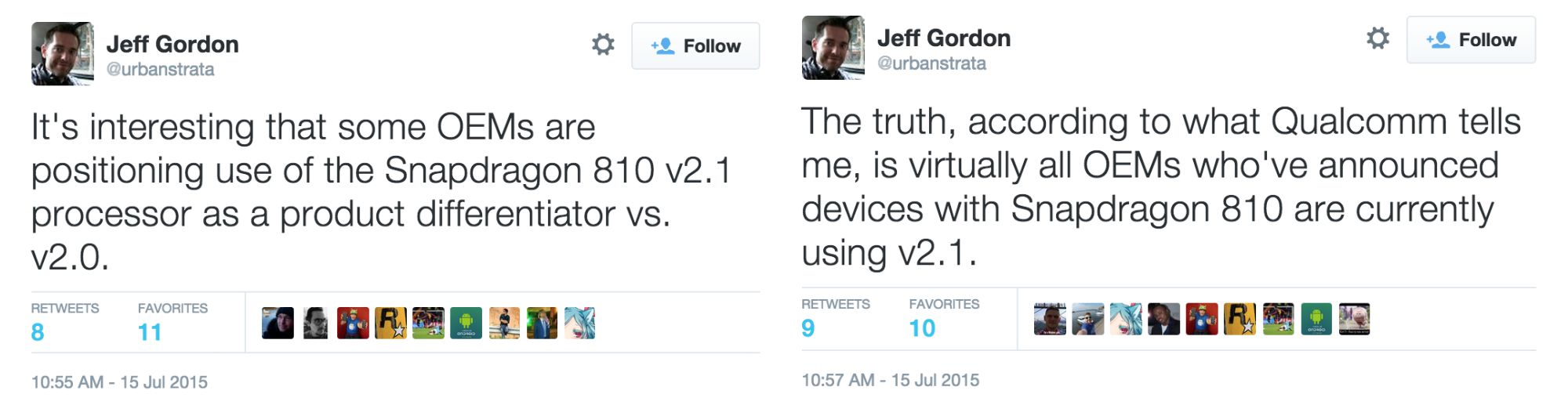
It’s an interesting statement, one that has HTC raining all over OnePlus’ parade. HTC is essentially saying, “You know how OnePlus was hyping up the S10 v2.1 in their phone as being so much superior to ours? Well, we’re using that too.” Or maybe it’s more like, “If you passed up on the HTC One M9 cuz of the S10, you might was well pass up on the OnePlus 2.”
Then again, perhaps Gordon was simply trying to make it known that HTC didn’t somehow skimp on using an older model of the Snapdragon 810 in the One M9. It’s the same one everyone else is already using. Whether or not this is good or bad news depends on how you look at it. We’ve since reached out to Qualcomm for further confirmation.
[Twitter]
Judge Orders Release Of Dashcam Footage City Officials Thought They Had Paid To Keep Buried
Brindletax payers pay millions, cops keep their jobs, and city buries evidence of wrongdoing. This won't end terribly at all...
A federal judge has ordered the unsealing of dashcam footage depicting several Gardena (CA) police officers shooting unarmed men (one of them inadvertently). The city's representatives fought the release of this video for several reasons, none of which appear to be the actual reason: that the video contradicts statements from the involved officers.
Here's the video:
One of the documents the city chose to release was the District Attorney's report on the shooting. This is where the contradictions begin. Obviously, the city thought this would be the last word in the civil suit. Statements from multiple officers all suggest the same thing: the man they intentionally shot (another caught bullet fragments to the spine during the hail of gunfire) made several "threatening" moves that left officers with no other choice but to open fire.
The 14-page report is an echo chamber. Officers, responding to a call about a bike theft, encountered three Hispanic males walking with bicycles. Having reached the unfounded conclusion that these were the suspects, they detained the men. ("Detained" being a fancy word for drew their weapons and shouted a lot.)
The report contains repeated claims by multiple officers that aren't matched by the events depicted in the video. Officers claim Ricardo Diaz Zeferino "ran towards them" and made "furtive movements" in the general area of his waistband. While the video does show Zeferino having problems keeping his hands above his head, it doesn't show much in the way of "furtive movements." It definitely doesn't show his hand "hovering" over his back pocket.
The document is a fascinating depiction of all the things that could possibly make an officer fearful -- an emotion that usually results in "discharged weapons," to use the deflective parlance of hundreds of officer-involved shooting reports: "furtive movements," other officers "seeming scared," right elbow "bowing out," "losing sight" of a hand, "big swinging motion" of Diaz's right hand, "manipulating something on the right side of his body," and so on. How a motion can simultaneously be "furtive" and "big and swinging" is beyond me, but then again, I rarely have to explain why I've shot an unarmed person.
Beyond that, there's additional claims made to buttress the righteous shoot. Diaz had a "maniacal grin." Diaz's movements became "faster and more deliberate." An officer expresses his disbelief that Diaz would ignore an order to keep his hands up, believing such disregard for authority to be indicative of Diaz's intent to kill. Another officer states he believes Diaz was "testing [the officers'] limits" and "closing the ground" between them.
Considering the official background of the shooting, it's hardly surprising the city spent several months fighting to keep this video from reaching the public. Now that it has been made public, the police department has gone into damage-control mode. At best, its efforts are inept.
Police have said the shooting was justified and that the dash cam videos from the squad cars don't tell the whole story. An attorney for the city said this week that one of the videos "looks bad" but that it was not taken from the perspective of officers.I have no doubt that if the video were more exonerating, the city would have never a) fought the release or b) claimed the video "didn't tell the whole story." And the claim that a dashcam video is somehow not a police officer's "perspective" is completely laughable.
Even more laughable is one of the city's arguments in favor of keeping the video sealed. It basically told the judge that the high-dollar settlement was offered in part to buy silence and secrecy.
The Court's rationale for sealing the subject videos was the parties' stipulated protective order—entered against the backdrop of stalled litigation. However, the parties cannot contractually agree to deprive the public of its strong First Amendment interest in accessing these videos, which were filed in connection with a dispositive motion. Defendants assert that the videos should remain sealed because they agreed to settle the case for $4.7 million—an amount above their liability insurance policy—specifically because they expected the protective order to continue and the videos to remain secret.The court is unimpressed by the city's "Hey, we paid good money to make this go away" argument:
However, Defendants' argument backfires here—the fact that they spent the city's money, presumably derived from taxes, only strengthens the public's interest in seeing the videos. Moreover, Defendants cannot assert a valid compelling interest in sealing the videos to cover up any wrongdoing on their part or to shield themselves from embarrassment. The only valid privacy interest in this case belongs to the Plaintiffs, who have made abundantly clear that they wish the videos to be made available to the public.Reason's Ed Krayewski points out that this is exactly why so many cities offer to settle cases like this so quickly.
Moreover, while the videos are potentially upsetting and disturbing because of the events they depict, they are not overly gory or graphic in a way that would make them a vehicle for improper purposes.
Generally such settlements include no admission of guilt by the city—the cops involved usually keep their job, and the settlement money always comes from taxpayers, not from police officers, their unions, or their pension funds. Settlements effectively end discussions on police brutality because many people view them as victories even though they come without admissions of guilt and with the punitive bill being picked up by taxpayers, not cops.But it didn't work here. The city paid out and still has to deal with the repercussions of its officers' actions. It has already filed an appeal with the Ninth Circuit Court. And it has received the most useless of temporary restraining orders in response:
After The Times published the videos online, 9th Circuit Judge Alex Kozinski issued an order that “the police car camera video footage shall remain under seal pending further order of this court.”And, as long as we're talking about transparency, let's discuss the other parties involved in this case. "Interested media organizations" -- including the Associated Press, the LA Times and Bloomberg News -- all filed motions in support of the video's release. And while all were more than happy to post the video as soon as it was released, not a single one of them could be bothered to post the court order that gave them access to this footage. Once again, media outlets continue to pretend public court records are somehow proprietary information. Articles quote from the order, but apparently the $1.30 they paid to download it from PACER (if these outlets paid anything at all) entitles them to interpret public documents on our behalf, rather than allow us to read them for ourselves.
Permalink | Comments | Email This Story

Maryland Court Says Police Misconduct Files Can Be Withheld From The Public
BrindleUgh!
A bad ruling has been handed down that will make it much more difficult for the Maryland citizens to find out the extent of misconduct performed by public employees. The court there is nodding to an expectation of privacy that really shouldn't exist in the public sphere and, in doing so, has provided that much more obscuring darkness for badly-behaving cops.
The Maryland appeals court has ruled that police departments' internal investigation documents are "personnel files" and thus exempt from public records requests. The decision came in response to a lawsuit filed by the ACLU on behalf of Taleta Dashiell, who was seeking a copy of documents related to her own sustained complaint against Sgt. John Maiello of the Maryland State Police.
Contributing to this bad decision is a handful of "extra rights" that have been granted to the state's law enforcement officers.
After the Court of Special Appeals determined that the Circuit Court erred by not requiring the State Police to create an index of the withheld documents and by not conducting an in camera review of the documents, the State filed a writ of certiorari asking us to consider the following question:Maryland, unfortunately, is somewhat of a pioneer in giving certain public servants more rights than other public servants, and more rights than the public itself, the latter of which has the dubious privilege of paying the salaries of these "more equal" police officers.
Did the Department of State Police properly invoke the Maryland Public Information Act’s (MPIA) exemptions for personnel records and records that are confidential under other law — here the Law Enforcement Officers’ Bill of Rights — to deny a request for the internal affairs records of an investigation into the conduct of a specifically identified state trooper?
Maryland was the first state to pass a LEOBR, in 1972, and by now many states have followed, invariably after lobbying from police unions and associations. Often the bills are sponsored by Republicans, who seem to forget their normal skepticism of public employees as an interest group when uniformed services are involved.Among other things, the LEOBR grants police officers the "right" to have up to 10 days to respond to misconduct allegations and to be able to appoint a lawyer of their choosing to represent them in what is normally just an employer-employee interaction anywhere else in the working world.
Dashiell was attempting to obtain documents related to her complaint against Officer Maiello, who was captured on her voicemail referring to her (twice) as a "nigger." From that point forward, the Maryland State Police did everything it could to keep her from seeing anything related to Maiello or her complaint.
Supposedly, the state provides an exception to the personnel records exception in the case of the "person of interest" -- which should have covered Dashiell's request. Despite existence of such records being confirmed by a letter from the MSP to Dashiell, the department refused to turn over the requested files. The MSP was creative in its stonewalling of Dashiell's request, treating the retirement of the officer charged with fulfilling requests as the end of the line for this inquiry.
The MSP returned the March 2, 2010 MPIA request to the ACLU stamped “addressee unknown.” Apparently, unbeknownst to Ms. Dashiell and the ACLU at the time the MPIA request was sent, Lieutenant Colonel Fischer had retired from the MSP.Dashiell sent a new request to the new custodian of records, which was denied in its entirety -- including her request for, if nothing else, an index of the records held.
The MSP returned the MPIA request, failing to even identify the new custodian, rather than deliver it to the current custodian of records.
The lower court granted the MSP summary judgment, claiming the files requested were exempt from disclosure, even considering Dashiell's "person of interest" status. She appealed, but the appeals court has now arrived at the same conclusion.
The court's opinion says that the law is law, no matter how stupid under these specific circumstances. The sustained complaint is treated no differently than an unsustained complaint and no matter how much information has been made public already, the officer's privacy trumps the public's interest. The court strains credulity by suggesting the release of such information would negatively affect future misconduct investigations.
The plain language of the Public Information Act, also, does not differentiate between “sustained” and “unsustained” complaints. A determination that a sustained finding requires disclosure of personnel information, though, would affect all public employees, not only the police force. Further, mandatory disclosure of personnel information related to sustained findings could chill the disciplinary process, rendering those in control less willing to sustain a finding of misconduct.It is insane that the court would actually believe that the public has the power to actually "chill" any government action. The state's laws -- combined with the Bill of Rights extended to police officers only -- create their own chilling effect. Police officers know that it's highly unlikely any record of their misconduct will ever reach the eyes of the public, which creates an incentive for future abuse. This has a chilling effect on citizens, who know that it's highly unlikely any officer will receive significant discipline for wrongdoing, as the entire process is allowed -- by law -- to be conducted in total darkness.
The court also points out that it agrees with lower courts' findings: despite Dashiell being the one to file the complaint, she is not the "person of interest." Officer Maiello is. So if anyone is ever going to make records of police misconduct complaints public, it can only be the officer against whom the complaint was filed. Which means this will NEVER HAPPEN.
Two judges offered their dissenting opinion, pointing out that the majority expressly dodged a question crucial to the determination of whether these files should be eligible for "personnel information" protection. There's a difference between "unsustained" and "sustained," and the court has chosen bypass this delineation and defer to the law's wording instead.
This result is far different from the circumstance of permitting unsubstantiated allegations of a complaint to be made public. In sustaining a complaint against one of its officers, a law enforcement agency acknowledges the truth of the very facts that “directly pertain to employment and [the officer]’s ability to perform [his or her] job.”This is how it should be. But it isn't. The state law allows misconduct to go unexamined and grants public employees a privacy expectation in their publicly-funded employment that simply shouldn't exist. Even records related to unsustained complaints are of value in terms of accountability, but at the very least, records of sustained complaints should be excluded from the law's personnel records exemption.
In contrast to such facts, the discipline that the law enforcement agency decides to administer to the officer does not directly pertain to employment or the officer’s ability to perform his or her job. Plainly put, the officer did what the officer did, regardless of how the law enforcement agency decided to respond. The administration of the discipline is an action of—and thus reflects the judgment of—the law enforcement agency, not the officer. Thus, a record of discipline based on a sustained complaint against a law enforcement officer is not a personnel record; instead, it is among the very types of document that the Public Information Act is designed to make available to the public: a document that reflects how a public agency responds to an employee’s proven misconduct.
Permalink | Comments | Email This Story

Oscar and Pulitzer Award-Winning Journalist Laura Poitras Sues U.S. Government To Uncover Records After Years of Airport Detentions and Searches
Washington, D.C. – Academy and Pulitzer Prize Award-winning documentary filmmaker Laura Poitras sued the Department of Justice (DOJ) and U.S. transportation security agencies today demanding they release records documenting a six-year period in which she was searched, questioned, and often subjected to hours-long security screenings at U.S. and overseas airports on more than 50 occasions. The Electronic Frontier Foundation (EFF) is representing Poitras in a Freedom of Information Act (FOIA) lawsuit against the Department of Homeland Security, DOJ, and the Office of the Director of National Intelligence.
“I’m filing this lawsuit because the government uses the U.S. border to bypass the rule of law,” said Poitras. “This simply should not be tolerated in a democracy. I am also filing this suit in support of the countless other less high-profile people who have also been subjected to years of Kafkaesque harassment at the borders. We have a right to know how this system works and why we are targeted.”
Poitras is a professional journalist who won an Academy Award this year for her documentary film “CITIZENFOUR” about NSA whistleblower Edward Snowden, shared in the 2014 Pulitzer for Public Service for NSA reporting, and is a recipient of a MacArthur Foundation “genius” grant. During frequent travel from 2006 to 2012 for work on her documentary films, Poitras was detained at the U.S. border every time she entered the country.
During these detentions, she was told by airport security agents that she had a criminal record (even though she does not), that her name appeared on a national security threat database, and, on one occasion, that she was on the U.S. government’s No Fly List. She’s had her laptop, camera, mobile phone, and reporter notebooks seized and their contents copied, and was once threatened with handcuffing for taking notes during her detention after border agents said her pen could be used as a weapon. The searches were conducted without a warrant and often without explanation, and no charges have ever been brought against Poitras.
After years of targeting by security agents, Poitras last year filed FOIA requests for records naming or relating to her, including case files, surveillance records, and counterterrorism documents. But the agencies have either said they have no records, denying or ignoring her appeals for further searches, or haven’t responded at all to her requests. For example, the FBI, after not responding to Poitras’ FOIA request for a year, said in May it had located only six pages relevant to the request—and that it was withholding all six pages because of grand jury secrecy rules.
“The government used its power to detain people at airports, in the name of national security, to target a journalist whose work has focused on the effects of the U.S. war on terror,” said David Sobel, EFF senior counsel. “In refusing to respond to Poitras’ FOIA requests and wrongfully withholding the documents about her it has located, the government is flouting its responsibility to explain and defend why it subjected a law-abiding citizen—whose work has shone a light on post-9/11 military and intelligence activities—to interrogations and searches every time she entered her country.”
The detentions ended in 2012 after journalist Glenn Greenwald published an article about Poitras’ experiences and a group of documentary filmmakers submitted a petition to DHS protesting her treatment.
“We are suing the government to force it to disclose any records that would show why security officials targeted Poitras for six years, even though she had no criminal record and there was no indication that she posed any security risk,” said Jamie Lee Williams, an EFF attorney and the organization’s Frank Stanton Legal Fellow. “By spurning Poitras’ FOIA requests, the government leaves the impression that her detentions were a form of retaliation and harassment of a journalist whose work has focused on U.S. policy in the post-9/11 world.”
Poitras’ documentary films include the 2006 Oscar-nominated “My Country, My Country”—a story about the Iraq war told through an Iraqi doctor and political candidate in Baghdad who was an outspoken critic of U.S. occupation. Poitras also directed and produced the Emmy-nominated “The Oath,” a 2010 documentary film about Guantanamo Bay prison and the interrogation of Osama bin Laden’s former bodyguard days after 9/11. Poitras’ latest film, “CITIZENFOUR,” about Snowden and NSA mass surveillance, earned her a Director’s Guild of America Award and an Oscar.
For the full complaint:
https://www.eff.org/document/poitras-foia-complaint


White House So Desperate To Get TPP Approved, It Agrees To Whitewash Mass Graves & Human Trafficking In Malaysia
Brindleholy crap :\
Some trade deal supporters in Congress tried to quietly remove this provision, but failed. And that left a big Malaysia-shaped problem in front of the TPP. But, the Obama administration is nothing if not resourceful in trying to make sure the TPP gets approved and big corporations get their expanded power over national governments around the globe.
It just decided to upgrade Malaysia from a tier 3 country to a tier 2 country. Because it could. Not because of anything done by Malaysia to improve its record on human trafficking. But because it was politically necessary. The details are simply nauseating:
Also sketchy: the State Department's report was actually due out last month, but was mysteriously delayed until after the whole mess with fast track was concluded. It's almost like the State Department chose to wait until it saw whether or not this provision was included to determine what Malaysia's status would be.There is essentially zero evidence Malaysia has done anything to earn this reclassification. Just two months ago, police found 139 mass graves along the Malaysian border that contained migrant workers that had been trafficked or held for ransom.
Since the 2014 TIP report, Malaysia has actually convicted fewer smugglers. As recently as mid-April, the US ambassador to Malaysia publicly criticized the government there for not doing more to combat trafficking.
And if you want further evidence that this late decision to magically upgrade Malaysia to tier 2 wasn't in the cards originally, how about this:
Menendez’s office said Friday that an interim report was delivered to the Senate Foreign Relations Committee in March on Tier 2 countries only, and Malaysia was not included.In short, the State Department does not really think that Malaysia has improved its terrible record on human trafficking. It did not think so in March when it released an interim report. And then it made the political decision to hold off on releasing its June report until the middle of July to see how the fast track path proceeded.
Finally, rather than take this tool and use it force Malaysia to actually improve things, it gave the country a total free pass, just for the sake of finalizing TPP. I don't care where you stand on the various other provisions of the TPP, but this sort of cynical move -- where real lives are at stake -- is horrifying. And it shows the "who gives a fuck, get it done" attitude of our government right now. This isn't a theoretical issue. This is one where it's clear that people right now are being harmed, and rather than do anything about it, the government has deliberately chosen to turn a blind eye to the problem just so it can get this questionable trade deal passed.
This, of course, also is likely to confirm the fears of many who were opposed to the TPP all along. The Obama administration and US Trade Rep Michael Froman keep insisting that the TPP has a number of features to help raise labor standards in various countries. Yet, if they're happily willing to not just look the other way over Malaysia's human trafficking, but to actively whitewash it, what does that say for the seriousness with which it will enforce any labor practice rules?
Permalink | Comments | Email This Story

Zombie Apocalypse Ready: The Action Mobil Offroad RV
Brindleokay, I definitely want one of these.
 Seen here looking like something you'd expect to find on the top of somebody's zombie apocalypse wishlist, an Action Mobil 4x4 RV prepares to escape the city and set up base in the woods. Action Mobil specializes in customizable 4x4 RV's, which come in 2, 3 and 4-axle varieties and cost a small fortune. There's even fancy hardwood bedroom and chef's kitchen options. Obviously, I just added the biggest one to my Christmas list this year and I will throw a tantrum and knock over the tree if I don't get it. It's happened before. "All the toy stores were out of Cobra Command Headquarters playsets that year!" WHATEVER, DAD.
Keep going for a couple more variations.
Seen here looking like something you'd expect to find on the top of somebody's zombie apocalypse wishlist, an Action Mobil 4x4 RV prepares to escape the city and set up base in the woods. Action Mobil specializes in customizable 4x4 RV's, which come in 2, 3 and 4-axle varieties and cost a small fortune. There's even fancy hardwood bedroom and chef's kitchen options. Obviously, I just added the biggest one to my Christmas list this year and I will throw a tantrum and knock over the tree if I don't get it. It's happened before. "All the toy stores were out of Cobra Command Headquarters playsets that year!" WHATEVER, DAD.
Keep going for a couple more variations.


 Thanks to Christian, who made me promise to pick him up in my offroad RV if shit really does hit the fan.
The Android-powered ZTE Spro 2 combination projector/hotspot now comes in a Verizon Wireless option
BrindleAndroid based hotspot... looks like it has google apps, meaning CTS... meaning SELinux...

It may not sound like it, but the ZTE Spro 2 is actually pretty capable mobile projector. More accurately, it’s a combination mobile hotspot/projector powered by Android and it won quite a few awards back when it was unveiled during CES 2015. The Spro 2 would eventually make its way to AT&T but starting today, ZTE has announced that they’re now offering a Verizon Wireless compatible unit for $600 full price. I know, it sounds a little steep and a full $100 more expensive than its AT&T counterpart. But considering all the Spro can do, this is more geared towards corporate board rooms than a projecting Barney on the wall.

The ZTE Spro 2 packs a 5-inch 720p touchscreen display, Snapdragon 800 processor, integrated 6,300mAh battery, HDMI, micro SD card slot, Bluetooth and runs on Android 4.4 KitKat. It’s pretty much everything you ‘d expect from a nice smartphone, but the Spro also comes equipped with 200 lumens projector. We were skeptical at first, but after taking it for a spin ourselves, walked away rather impressed. It’s not yet up on Verizon’s website, but for those of you looking to make a purchase can find it direct from ZTE via the link below.
CIA: Repeat After Me. The NYPD Is NOT A REAL Intelligence Agency.
Given the deeply-intertwined relationship of the CIA and the New York Police Department, it just makes sense that the CIA would need to periodically remind its personnel that the NYPD isn't the sort of intelligence agency they can share US persons information with.

[T]he law limits sharing of collected information about American citizens, resident aliens and other “US persons.” As one question on the quiz highlights, the CIA cannot share such information outside the intelligence community. It’s important, then, to know which agencies are within the fold.This comes from a CIA quiz obtained by the ACLU as part of an FOIA lawsuit. That the CIA would single out the NYPD on its test is significant. The NYPD likes to believe it's an intelligence agency on par with the FBI and CIA. Despite having zero reason to do so, the NYPD sends its officers all over the world to gather intelligence after terrorist attacks. No one has ever asked the NYPD to do this, but it continues to invite itself to various ground zeroes, where it is usually greeted with a mixture of befuddlement and anger.
The National Security Agency, Coast Guard and Department of Energy qualify as “IC elements”, the latter two via their intelligence arms. As a local police force, the NYPD does not make the cut.
The CIA, however, remains inextricably (and perhaps, willfully) entangled with the Little Intelligence Agency That Isn't. Two former CIA employees were instrumental in setting up its "Demographics Group," which engaged in pervasive surveillance of New York City Muslims. The privacy and civil liberties violations this group engaged in made the "intelligence" gleaned so toxic not even the FBI would touch it.
The CIA also expressed concerns about the gathered data -- not so much out of concern for violated rights, but because the data gathering seemed to be its own end. A senior CIA official discussed partaking in the NPYD's gathered info, but stated that the only thing "impressive" about the collection was its size, not its usefulness.
A 2011 CIA Inspector General report found that the uselessness of the data didn't stop at least one CIA employee from exploiting gaps in CIA policy to view "unfiltered" Demographics Group intelligence even though the collection contained "no clear foreign intelligence relevance."
Most likely due to relationships with the two former CIA employees heading the NYPD's Demographics Group, the CIA has made the most of its lax policies in order to work directly with this particular local law enforcement entity.
Since 2002, the CIA has assigned four officers to provide “direct assistance” to the NYPD. Their titles and duties ranged from “Special Representative to the NYPD” to training analyst on counterterrorism. An NYPD detective also received operational training at the CIA.The undated test is likely part of CIA rule changes as a result of the IG report. What little is left unredacted deals with legal authorities related to domestic surveillance, in addition to pointing out which domestic entities the CIA can lawfully share its intelligence with. The NYPD isn't one of them, no matter how much it believes its proximity to ground zero gives it the right to rub elbows with the intelligence community's big boys.
Permalink | Comments | Email This Story

The Hangouts Chrome app now lets you drag-and-drop photos directly into conversations
Brindleyay

One of the biggest ways people communicate online is simply by the sharing photos. Anything a messaging client can do to make this process an easier one is met with open arms. Luckily for Hangouts users, Google has (finally) gone ahead and made this as simple as possible in the web app by allowing users to simple drag and drop photos into a conversation. Thankfully, it doesn’t auto-send like it did before, so you can still review a photo and add some context in the message box before sending.
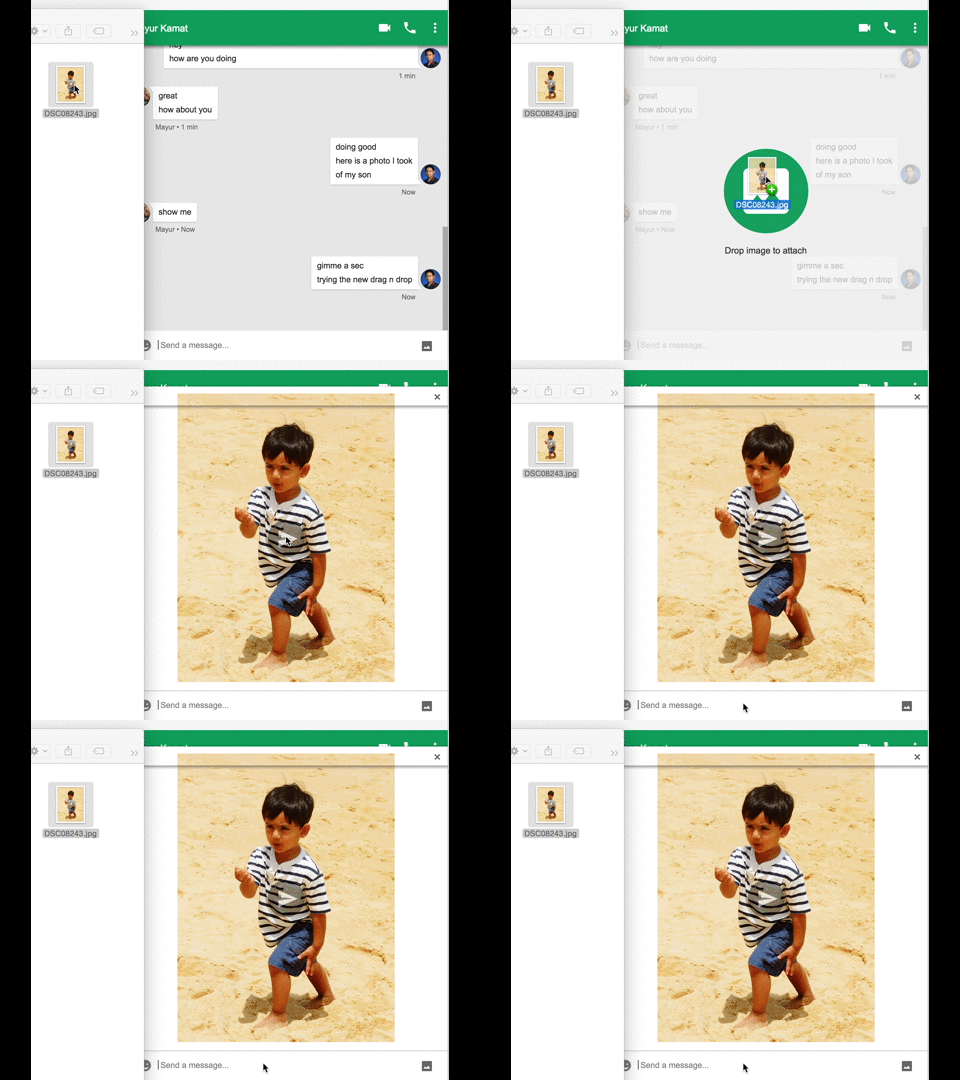
Googler Mayur Kamat brought this new change to light on his Google+ page and mentions you if you’re not a fan of drag and drop, you can even copy/paste images into the message box as well (this doesn’t seem to be working properly on the Mac). To get the update on your Hangouts app for Chrome, you’ll want to restart your Hangouts Chrome app and after that, you should have this new functionality enabled.
If you’re still using the Chrome extension, we recommend upgrading to the actual Chrome app. We’ve gone ahead and linked it down below. Happy sharing!
The Massive OPM Hack Actually Hit 21 Million People
Brindlegod damnit!

It's much worse than the government first announced.
The post The Massive OPM Hack Actually Hit 21 Million People appeared first on WIRED.

The Latest In The 'Collect It All' Collection: An Entire Nation's DNA
BrindleOh crap! Definitely not going to go live there :\
"Collect it all": for the NSA, it is communications data; for Kenya, it is information about every Wi-Fi user and device. For Kuwait, as Yahoo News reports, it's everyone's DNA: Kuwait's parliament, reacting to a suicide bombing last week that killed 26 people, adopted a law Wednesday requiring mandatory DNA testing on all the country's citizens and foreign residents.
Kuwait seems to be pretty serious about implementing this scheme. Refuse to give samples? That will cost you $33,000 and a year in jail. Try to pass off someone else's DNA as your own? Make that seven years in jail. Setting up the DNA database won't be cheap, but an extra $400 million has been allocated by Kuwait's parliament:
The legislation, requested by the government to help security agencies make quicker arrests in criminal cases, calls on the interior ministry to establish a database on all 1.3 million citizens and 2.9 million foreign residents.
"We have approved the DNA testing law and approved the additional funding. We are prepared to approve anything needed to boost security measures in the country," independent MP Jamal al-Omar said.
Following the high death toll in the suicide bombing, there is a natural desire to do something to stop it happening again, and to help catch those behind it. But the move to collect everyone's DNA seems to be born mostly from an opportunistic government desire to exploit tragic events to bring in extreme laws without much resistance.
After all, how exactly will having everyone's DNA in a database prevent future suicide bombings? Yes, it might help with the rapid identification of the bomber(s) and victims. That's useful, but hardly justifies an unprecedented collection of everyone's DNA. And it may help resolve other crimes, particularly rape, which will be welcomed by the victims. But if DNA becomes a standard tool in everyday criminal cases, having everyone's DNA may actually hinder investigations because of false positives. We are all shedding DNA everywhere we go, so the presence of somebody's genetic material at the scene of a crime probably means nothing (and could even be an attempt to frame someone, which becomes much easier.) But it will require the police to eliminate all those genetic bystanders, which is likely to slow down the investigation.
In this respect, it's the classic needle-in-a-haystack data problem, but applied to the world of genomes. Just as adding more hay does not help you find those proverbial needles, so increasing the size of the DNA database to encompass the entire population does not generally make it easier to find the perpetrator of a crime. In fact, smaller, more selective DNA databases are more sensible, just as targeted surveillance is more effective. With luck, Kuwait's future discovery of this fact, and its failure to draw much benefit from this massive intrusion into the most personal sphere of all -- the genome -- will make other governments think twice before following suit.
Well, I can dream, can't I?
Follow me @glynmoody on Twitter or identi.ca, and +glynmoody on Google+
Permalink | Comments | Email This Story

Spain Government Goes Full Police State; Enacts Law Forbidding Dissent, 'Unauthorized' Photography Of Law Enforcement
Brindleoh crap
Well, Spain's officially a police state now. On July 1st, its much-protested "gag" law went into effect, instantly making criminals of those protesting the new law. Among the many new repressive stipulations is a €30,000-€600,000 fine for "unauthorized protests," which can be combined for maximum effect with a €600-€300,000 fine for "disrupting public events."
This horrible set of statutes has arisen from Spain's position as a flashpoint for anti-austerity protests, the European precursor to the Occupy Wall Street movement. Fines, fines and more fines await anyone who refuses to treat authority with the respect it's forcibly requiring citizens to show it.
The law also extends its anti-protest punishments to social media, where users can face similar fines for doing nothing more than encouraging or organizing a protest. Failing to present ID when commanded is another fine. And then there's this:
Showing a "lack of respect" to those in uniform or failing to assist security forces in the prevention of public disturbances could result in an individual fine of between €600 and €30,000.Spain's legislators thought of everything. To ensure these crackdowns on protests go off with a minimum of public backlash, "respected" police officers are being given a blank check to use as much force as they feel necessary when breaking up "unauthorized protests." The law doesn't directly instruct police to behave badly, but it does provide a very helpful increase in opacity.
A clause in the wide-ranging legislation that critics have dubbed the "gag law" provides for fines of up to 30,000 euros ($33,000) for "unauthorized use" of images of working police that could identify them, endanger their security or hinder them from doing their jobs.Somehow, the Spanish government has managed to find an expectation of privacy within its public spaces and applied it to its public servants. While the law does make some provision for the public's "right to know," it also defers to law enforcement's judgment when it comes to what is or isn't "authorized use" of photographs/video depicting police performing their public duties.
Obviously, this small nod towards the public's rights is completely insincere. The government wants to clamp down on protests and it obviously can't be embarrassed by award-winning photographs/video of its police officers beating civilians wholly uninvolved with the protests that so angried up the cops' blood.
Those defending the law (sort of) think the built-in "protections" will at least protect some favored members of the media.
Victora Lerena, president of Spain's association representing visual journalists, thinks the language about freedom of information will protect journalists, but predicts anyone who tries to take images of police at protests without media organization credentials could be at risk.This is likely true, considering the "credentialed" press already blurs officers' faces when reporting. But the most damning images of police misconduct usually come from unofficial sources, and even the most aggressive of mainstream news outlets frequently defer to the government's judgment when reporting on alleged police abuse.
Spain has outlawed dissent and given the police extra protections and respect they haven't earned. That's as close to a police state as you can get without actually declaring martial law.
Permalink | Comments | Email This Story

Butterfly Pupae Looks Like Snake Head, Wiggles To Appear It's About To Strike When A Predator Nears
Brindlewhoa. that is a crazy adaptation
 This is the pupae stage of the Dynastor darius butterfly. It looks uncannily like a viper's head, and even moves to appear its going to strike when potential predators are around. Me? I have no natural defenses and get picked on all the time. If I were a butterfly my parents would have been eaten before I was even born.
Apart from its realistic impression of an alert viper, this creature has another trick up its sleeve - it is able to sense the world outside and react appropriately from inside its cover. So when a predator approaches, the pupa can sense movement and swing its shell back and forth, creating the illusion of a moving snake that's ready to attack.Mother Nature: she never ceases to shock and amaze. Or get wasted and drunk dial me asking to come rub her branches. I don't even know what that means, but I did hang a tire swing from her once. I asked her if I could carve my initials into her trunk but she said she wasn't ready for that commitment. That's when I told her I didn't care and I was really in love with the Giving Tree anyways. Keep going for a bunch more shots.


 Thanks to Lucas, who has a bear shaped sleeping bag for the exact same reasons.
Did you know Google stores a history of your voice searches? (and how to delete them)
Brindlegod damnit, more shit to go disable and delete

Google Voice Search is awesome, and you probably use it a lot more than is humanly healthy. But did you know that Google stores a history of all the queries you make on their servers? No, really, you can head right here and listen to every single search you’ve performed.
Don’t worry, we’re sure Google doesn’t use these recordings for anything malicious or ill-mannered, but in case you’re feeling a bit weird about it you’ll be glad to know that you can not only delete that history, but also opt out of saving future voice searches to your account. To delete, click this link and check the boxes next to all your audio recordings. At the top right, press delete. Done.
Opting out is just as easy. Click here, flip the switch to off. Boom. Keep these tips in mind if you ever search for something embarrassing and want to make sure you scrub every digital bit of its existence from the internet.
Cops Raid Marijuana Dispensary In Order To Play Darts, Sample Edibles And Offer To Kick Amputee Owner 'In The Nub'
If we accept the premise that law enforcement and intelligence agencies encroach on personal freedoms and rights in "the public interest" -- i.e., to ensure the safety of non-criminals -- then we have to ask ourselves how this raid of a medical marijuana dispensary fits into this thought process. [via CJ Ciaramella]
Santa Ana (CA) cops raided a pot dispensary -- not because the items for sale were illegal under local laws -- but simply because it was unlicensed. Sure, having the proper paperwork in place is important, but this dispensary was in line to receive authorization from the city -- a process delayed by the locality's faulty licensing "lottery" system, which was gamed by businesses who "stuffed" the selection box by purchasing multiple bids.
The PD performing the raid treated this lack of proper paperwork like it was the Zeta Cartel operating under its nose. The video captured by the dispensary's cameras shows heavily-armed cops -- some wearing ski masks -- smashing through two doors and yelling at the peaceably-assembled customers to lie on the floor. Then -- somehow -- it gets worse.
The cops tear the place apart, strip cameras from the walls and yank the DVR off the shelf in the back room. They play darts, sample the presumably-cannabis-laced goods, and otherwise fuck around. Why? Because there is absolutely no danger present, despite the use of ski masks, weapons and tactical gear. This is "public safety" being ensured by a raid on a sitting duck that threatened no harm to the surrounding community. The final result of all this noise and damage? Tickets for violating a city ordinance.
But despite their expertise, the cops missed a couple of cameras. And that's going to hurt them. Especially when one female cop is caught on camera disparaging one of the owners -- an amputee confined to a wheelchair -- by stating she wanted to kick her in the "nub." (Enjoy the first few seconds of this video, where a cop attempts to break down a set of metal PULL doors by hammering them in the wrong direction with his ram.)
The police department has responded to the recording that got away with nonsensical claims that the released footage is "non-chronological" and "edited." I can't even imagine what the full footage shows, other than there being a bit more breathing room between unprofessional actions and misconduct on the part of the raiding officers.
This is the charade of drug enforcement: cops raiding a dispensary for code violations, rather than its potential ability to diminish the safety of other Santa Ana residents. And doing it in full battle gear, as though it expected a hail of gunfire in response to its backdoor-smashing entry. The entire incident is pathetic, bordering on nauseating: a pointless, vulgar display of power that wreaked havoc on a local business simply in order to issue two citations.
Permalink | Comments | Email This Story

New Hampshire Legislators Propose Law Banning Warrantless Use Of Tracking Devices
BrindleThis looks like a good place to live :)
New Hampshire is continuing to lead the way in privacy. After becoming the first state to ban the use of automatic license plate readers, its legislators are now attempting to rein in warrantless tracking of cellphone users. A couple of false starts (dating back to last year) resulted in no changes (and complaints from app makers that the wording might make some of their offerings illegal).
But it now appears to be moving forward again after the implementation of some changes. The heart of the bill is this paragraph:
No government entity shall place, locate, or install an electronic device on the person or property of another, or obtain location information from such an electronic device, without a warrant issued by a judge based on probable cause and on a case-by-case basis.As Watchdog.org points out, the spirit of the law is somewhat undermined by the letter of the law.
There are noteworthy exceptions, many of which appeared in previous iterations.The other problem with the bill is a problem with all bills introduced by state legislators: it can't lock out federal intrusion, at least not in its present form. The bill states that it does not apply to "federal government agencies." So, if local law enforcement wants to engage in warrantless tracking of cellphones, all it has to do is partner up with a federal agency.
Tracking is permitted without a warrant with the informed consent of a device owner, unless the owner knowingly loaned it to a third party. You can track calls for 911 emergencies. A parent or legal guardian can provide informed consent to locate a missing child. The government can track its own property or employees in possession of that property. And alcohol ignition interlock control devices placed by court order would also be traceable without a warrant.
On top of that, there are the loopholes that have always been exploited. Stingray use -- one method of tracking location -- has routinely been hidden under more innocuous paperwork, like pen register orders. Obtaining cellphone records -- including location data -- is primarily done with subpoenas, considering most laws still treat these as third-party business records. While the law would force some of the latter requests to take the form of a search warrant, it doesn't make a clear distinction between real-time tracking and historical data.
What it does appear to outlaw is the warrantless, real-time tracking of GPS location, meaning tracking devices can only be deployed after obtaining a warrant. This is certainly a step forward, one perhaps partially prompted by the Supreme Court's US v. Jones decision. However, this would go against precedent in the First Circuit Court (which covers New Hampshire), which has found that warrantless GPS tracking devices may constitute a "search," but not to the extent that a lack of a warrant should automatically result in suppression of evidence. (Also somewhat aligned with the Supreme Court's reluctance to declare all GPS tracking worthy of a warrant.)
The court then held that it was reasonable for the agents to use the GPS device in Sparks’ case based upon reliance on clear precedent.Although this case appeared before the judges after the Supreme Court's US v. Jones decision, the events of the case proceeded that finding. This may change rulings in the future, but for now, the First Circuit has not made it expressly clear that tracking devices require warrants.
However, the court noted that they did not decide the issue of whether any exceptions to the warrant requirement exist for future installation use of the GPS device to monitor suspect’s movements. Therefore, future use of such GPS monitoring is governed under the United States v. Jones.
As such, the court of appeals affirmed the denial of the motion to suppress.
As the proposed law pertains to physical tracking devices, it's much more closely aligned with the Supreme Court's decision. Left unclear is its application to Stingray devices and obtaining historical cell site location information from telcos -- both forms of "tracking" that don't involve attaching a monitoring device to a "person or property."
Permalink | Comments | Email This Story

Let's Encrypt Releases Transparency Report -- All Zeroes Across The Board
 This is actually pretty important for a variety of reasons. First, it clearly acts as something of a warrant canary. And by posting this now, before launch and before there's even been a chance for the government to request information, Let's Encrypt is actually able to say "0." That may seem like a strange thing to say but, with other companies, the government has told them that they're not allowed to claim "0," but can only give ranges -- such as 0 to 999 if they separate out the specific government requests, or 0 to 249 if they lump together different kinds of government orders. Twitter has been fighting back against these kinds of rules, and others have argued that revealing an accurate number should be protected speech under the First Amendment.
 Let's Encrypt is, smartly, getting this first report out there -- with all the zeroes -- before the government can swoop in and insist that it has to only display ranges. In other words, this is getting in before any gag order can stop this kind of thing. Smart move. It's also nice to see them break down all of the different possible types of orders, rather than lumping them into more general buckets. That's an important step that it would be nice to see others follow as well.
Permalink | Comments | Email This Story

FISA Court Authorizes 'As-Is' Bulk Phone Collections For The Next Six Months
"The more things change, the more everything is just Smith v. Maryland (1979)."
Or so the FISA Court notes in its latest order authorizing the continued collection of bulk phone records under… well, not Section 215, which expired, but under a "non-hyper-literal evil genie" reading of the contradictory forces temporarily in play thanks to the passage of the USA Freedom Act.
"Plus ça change, plus c'est la même chose," well, at least for 180 days. This application presents the question whether the recently-enacted USA FREEDOM Act, in amending Title V of FISA, 2 ended the bulk collection of telephone metadata. The short answer is yes. But in doing so, Congress deliberately carved out a 180-day period following the date of enactment in which such collection was specifically authorized. For this reason, the Court approves the application in this case.The order notes that there was much more to consider in this renewal application. It nods to the expiration of Section 215 on May 31st and its brief return to its pre-Patriot Act form for roughly 24 hours before the passage of USA Freedom pushed the expiration date up until 2019. It notes the legal challenges brought against the bulk collection by Ken Cuccinelli and FreedomWorks, as well as the stipulations added to the collection by the surveillance reform bill.
The order denies Cuccinelli/Freedomworks' request to shut down the bulk collection entirely but does grant their request to serve as amicus curiae -- a new position provided for by the USA Freedom Act. This, however, is limited solely to motions already presented to the court by FreedomWorks and Center for National Security Studies. And the FISA Court finds the opposition to the government's claim of 180 days' worth of uninterrupted, unaltered bulk collections to be lacking in merit. The culprit is (partially) the USA Freedom Act itself.
The USA FREEDOM Act prohibits the FISC from issuing an order for production of tangible things without the use of a "specific selection term." USA FREEDOM Act§ 103(b), amending FISA § 501(c). This amendment and the related amendments set forth in sections 101 through 103 of the USA FREEDOM Act prohibit the government from acquiring tangible things in bulk under a FISA business records order. Crucially for purposes of this case, however, section 109(a) of the USA FREEDOM Act states that these amendments do not take effect until 180 days after enactment (November 29, 2015).The rest of the order is given over to dismissing a handful of other legal challenges to the bulk collection program, including the Second Circuit Court's finding that the program -- in its current form -- is not actually authorized by law.
[...]
And if that was not clear enough, the USA FREEDOM Act also states that "[n]othing in this Act shall be construed to alter or eliminate the authority of the Government to obtain an order [under the business records provisions of FISA] as in effect prior to [the ban on bulk acquisition taking effect after 180 days]." USA FREEDOM Act §109(b). In passing the USA FREEDOM Act, Congress clearly intended to end bulk data collection of business records and other tangible things. But what it took away with one hand, it gave back - for a limited time - with the other.
The FISA Court, however, finds the appeals court's analysis "flawed" and reliant on "mischaracterizations." While the Second Circuit found the program "had no endpoint," the FISA Court claims the USA Freedom Act gives it one: November 29, 2015. This is the FISA Court shifting back into "hyper-literal evil genie" mode. The Section 215 collection has always had an "endpoint." It's just always been renewed by Congress, up until 2015's expiration, which was more a result of Snowden's leaks than an autonomous decision to give the program a true endpoint. Without a doubt, the modified collection will go through the same cycle of endless renewals.
The government's access to American phone records is never going to end completely, not as long as the government and FISA Court continue to rely on the Third Party Doctrine, as defined by the 1979 Smith v. Maryland decision. The FISA order refers to this decision repeatedly in its justification of ongoing bulk collections, either in pre-USA Freedom Act form or with the new limitations in place. As long as the government can rely on this large Fourth Amendment loophole, domestic surveillance in the form of bulk collections (as well as subpoena and National Security letter abuse) will continue. There is effectively no "endpoint" for these collections, as the Second Circuit pointed out.
The only thing "correct" about the FISA Court's analysis of these collections -- including the convenient elasticity of the term "relevant" -- is that a new Fourth Amendment privacy right doesn't simply spring into existence because these programs harvest information on millions of Americans. If the government -- and the courts -- aren't willing to extend protections to certain "business records" for an individual, the same lack of protection remains in place when it's hundreds of thousands who are affected.
For what it's worth, Section 215 (now Section 501) will no longer be collected and stored by the NSA after this six-month wind-down. These records will reside with telcos and be returned only in exchange for specific searches based on "reasonable articulable suspicion."
Unfortunately, this order doesn't bode well for the newly-created position of amicus curiae. Everything examined here in ad hoc, interim form is dismissed completely by FISA judge Michael Mosman. Barring a Supreme Court examination of bulk domestic collections or a revisiting of the issues central to Smith v. Maryland, arguing the public's case against bulk harvesting is going to be an exercise in futility.
Permalink | Comments | Email This Story

City Claims It Will Take 9,000 Hours And $79,000 To Fulfill Gawker's Request Emails Related To Abusive Police Officer
Brindleseems legit...
The McKinney (Texas) Police Department is under lots of outside scrutiny, thanks to the racially-tinged antics of its police force -- namely the since-departed Officer Eric Casebolt, who barrel rolled into infamy in a cell phone-captured video that culminated in him pinning down a 14-year-old girl while waving a gun at two teens.
Since that point, multiple entities have filed public records requests with the police department. An interim response given to MuckRock's Shawn Musgrave lists 61 requests as of June 19th, a number that has certainly increased since that point. One of the early requesters was Gawker's Andy Cush, who sought "[Officer Eric] Casebolt’s records and any emails about his conduct sent or received by McKinney Police Department employees."
Cush just received a response from the city's legal representatives claiming it will cost nearly $80,000 to compile this information.
The city arrived at that extraordinary figure after estimating that hiring a programmer to execute the grueling and complex task of searching through old emails would cost $28.50 per hour, and that the search for emails about Casebolt would take 2,231 hours of said programmer’s time. That only comes to about $63,000; the bill also includes $14,726 “to cover the actual time a computer resource takes to execute a particular program.” In other words, the operating cost of the computer used to search the emails is nearly 15 grand on its own.Perhaps in an effort to make this stratospherically-high fee appear more reasonable, the law firm broke it all down in table form.

According to the city's lawyers, this exorbitant estimated fee is due to the police department switching over to a new email system on March 1, 2014. Apparently, every email created before then can't be searched without hiring a programmer to create a new program from the ground up. Whatever email software the city used prior to this apparently created email in an "unsearchable" format.
This estimate reeks of… well, several things (arrogance, obfuscation...), but mainly of bullshit. I find it hard to believe city personnel are unable to search older emails, especially considering "older" only means "slightly more than a year old," rather than "stored on punchcards." It boggles the mind that a move to a new email system would cut several years of emails irrevocably adrift from the rest of the city government's computing system -- or that the city would be fine with a lack of basic search options post-upgrade.
The city is claiming it will take a year of 40-hour work weeks for a programmer to create a search system for pre-2014 emails. Worse, it claims the same even if "an existing system" is used. That may just be boilerplate language for fee estimates, but it also could be closer to the truth than its "one year of programming" claim. No matter which system is used -- the "existing" or the bespoke -- the city still claims it will still take an unreasonable amount of time to search the system. According to the estimate, it will take roughly three years of 40-hour work weeks to "execute a particular program."
This appears to be nothing more than an attempt to dissuade requesters from pursuing information about Eric Casebolt or the McKinney Police Department. This "make 'em pay" strategy is as old as open records laws themselves. The city of Ferguson hit a number of journalists with exorbitant fees in the wake of the Michael Brown shooting. The Florida State Attorney's office told a requester seeking information on the alleged (and highly suspicious) suicide of her daughter that it would cost nearly $180,000 to fulfill her request.
Gawker's options here are pretty limited. It can either limit its request to post-March 2014 emails as suggested by the city's lawyers (pretty much useless if seeking a full representation of Eric Casebolt's career) or it can petition the state attorney general to take a look at the city's claims.
A person who believes the person has been overcharged for being provided with a copy of public information may complain to the attorney general in writing of the alleged overcharge, setting forth the reasons why the person believes the charges are excessive. The attorney general shall review the complaint and make a determination in writing as to the appropriate charge for providing the copy of the requested information.This particular avenue of recourse has been used frequently in the past. A 2012 examination of Texas open records requests by the Center for Public Integrity found McKinney ranked highest in the state in the number of fee complaints to the state attorney general (per 100,000 residents). Not all of these were fee-related, but the ratio of referred requests suggests the local government is more reluctant to turn over responsive documents than its neighbors. A spokeswoman for the city notes in the article that requests related to the police department are treated with "an overabundance of caution." This response to Gawker, however, seems not so much cautious as confrontational -- a "shut up and go away" response in the form of a thoroughly ridiculous $79,000 price tag.
I have reached out to the city employees listed in the letter to Gawker, asking for details on the current and pre-2014 email systems, as well as any methods used by city employees to access older emails. I'm not expecting an answer, but if one should materialize, it will be passed on.
Permalink | Comments | Email This Story

All Airlines Have the Security Hole That Grounded Polish Planes

"We're using state-of-the-art computer systems, so this could potentially be a threat to others in the industry."
The post All Airlines Have the Security Hole That Grounded Polish Planes appeared first on WIRED.

This Radio Bug Can Steal Laptop Crypto Keys, Fits Inside a Pita

The list of threats to your computer’s security grows daily: Keyloggers, trojans, ransomware...and now the rogue falafel sandwich.
The post This Radio Bug Can Steal Laptop Crypto Keys, Fits Inside a Pita appeared first on WIRED.

Chrome listening to you shows the importance of privacy
On OS X, why does sudo ls show hidden files?
Why is Android still the second platform developers work on?
Damn the Equities, Sell Your Zero-Days to the Navy!
BrindleHeh
Noted eagle eye and EFF Investigative Researcher Dave Maass happened on an interesting item from earlier this week on FedBizOpps, the site for government agencies to post contracting opportunities. The Navy put up a solicitation explaining that the government wants “access to vulnerability intelligence, exploit reports and operational exploit binaries affecting widely used and relied upon commercial software,” including Microsoft, Adobe, Android, Apple, “and all others.” If that weren’t clear enough, the solicitation explains that “the vendor shall provide the government with a proposed list of available vulnerabilities, 0-day or N-day (no older than 6 months old). . . .The government will select from the supplied list and direct development of exploit binaries.”

Although this solicitation was posted on a publicly accessible site, it seems the Navy didn’t want the attention and pulled it down the day after Dave tweeted about it. (We’ve uploaded the cached copy from Google.) Even so, the fact that the United States government is looking for vendors to sell it software vulnerabilities isn’t news—we’ve known for some time that the government uses software vulnerabilities, sometimes known as zero-days, for offensive intelligence-gathering and espionage. The media has also reported on the government’s purchases of zero-days from outside vendors.
What’s more noteworthy is how little regard the government seems to have for the process of deciding to exploit vulnerabilities. As we’ve explained before, the decision to use a vulnerability for “offensive” purposes rather than disclosing it to the developer is one that prioritizes surveillance over the security of millions of users. To its credit, the government has acknowledged that this decision is an extraordinarily important one in every case. It has even reportedly “established a disciplined, rigorous and high-level decision-making process for vulnerability disclosure,” which it calls the Vulnerabilities Equities Process (VEP). The government says the VEP is entirely classified, and EFF is suing to get it released.
We’re skeptical that any VEP that results in the “majority of cases, responsibly disclosing” the vulnerability to the vendor, as White House spokesman Michael Daniels claims, could possibly be consistent with a solicitation such as the one the Navy posted this week. It strikes us as unlikely that the Navy would spend a large sum of money to develop exploits only to turn around and disclose the underlying vulnerabilities back to the vendor. To put it simply, the government is soliciting information about security vulnerabilities no one knows about in products everyone relies on every day—but apparently not to fix them.
The Navy tried to send this particular solicitation down the memory hole, but we’re hopeful that through our FOIA suit, we can shed more light on the conflict between the government’s public statements and its apparent practices surrounding its stockpiling of zero-days.