
Shared posts
03 Apr 15:16
The giant fighting robots have left the Bay State
by Scott Kirsner
Last fall, Gui Cavalcanti made a big splash by suggesting that the next big action sport will involve giant robots, piloted by humans, shooting one another with paintballs. Cavalcanti and two co-founders began working on prototypes in Somerville and Worcester, and they offered a sneak peek at last year's New York Comic-Con show. But a Kickstarter fund-raising campaign didn't bring in the $1.8 million that Cavalcanti had set as his goal. Venture capitalists and angel investors were intrigued by the concept — but not quite ready to cut checks. Now Cavalcanti's MegaBots team has relocated to San Francisco, where they've attracted support from the CEO of a major design software company. Read More


31 Mar 14:00


Photo gallery: Highlights from the 2015 Trofeo Alfredo Binda
by Jessi Braverman
Jeffrey.bramhallsharing for photo of WC bike. pretty!
Lizzie Armitstead (Boels-Dolmans) handily beat out the Rabo Liv pair of Pauline Ferrand-Prevot and Anna van der Breggen to the finish line in Cittiglio to win Trofeo Alfredo Binda. Armitstead’s win in the second round of the ten-race Women’s World Cup series combined with a seventh place finish at Ronde van Drenthe two weeks ago put her in the World Cup leader’s jersey. It’s a familiar jersey to Armitstead. The Briton won the series overall last year.
The day undoubtedly belonged to Armitstead and her Boels-Dolmans teammates, but her story is far from the only one to emerge out of northern Italy. Here at Ella CyclingTips, we’re of the belief that every rider who starts a race has a story to tell by race end – and we’re using the Trofeo Binda photo gallery to share the tales told by the Lotto Soudal Ladies riders, who generously welcomed us into their fold on Sunday.
Looking for a traditional race report that includes quotes from Armitstead on her race win? You can find that here. This race highlights video hosted on the UCI YouTube channel does a great job of showcasing the main bits of action and includes an interview with The Suffer Prize presented by The Sufferfest winner Jolanda Neff (Switzerland).
Sarah Rijkes
The 23-year-old Austrian is riding with Lotto Soudal in her third season as a professional. Rijkes plays a support role for her team leaders – often in the earliest part of the race.
When the peloton split on the opening lap of the five lap race, Rijes missed out on the selection. She fought her way back to the leaders before the first of the four circuit laps, eventually retiring before the finish.
We had to chase really hard from the first climb until we crossed the finish line for the second time. It wasn’t easy. We were back in the cars on the climbs. There were a lot of riders from the small Italian teams in the chase group. They always want to perform well at home, so they did most of the chasing. We caught onto the front just before the small circuit laps began.
When I was back in the main peloton, I tried to do something to help Elena. I took her to the front before the climb. My legs were exploding after that. It was my job for the day.
I performed really bad here last year. I didn’t make it to the finish this year, but my performance was better. I’m happy to improve, but I really wanted to finish. Perhaps next year.
Anisha Vekemans
Vekemans finished in 46th place in Cittiglio, crossing the finish line with the second chase group more than six minutes behind Armitstead and company. The 23-year-old Belgian’s objective was to help her teammates. She reported that she accomplished her mission in some ways but had hoped for more out herself on Sunday.
I wanted to help Carlee and Elena do as good of a result as possible. I was good in the beginning, and I was able to help them. Toward the end, I was too far back to be helpful. I dropped off on the second to last lap when there was a bit split in the front group.
This year it was better than last year. It was an improvement. That is something I can feel happy about personally. I’m also happy that I was able to help my teammates for some of the race.
Carlee Taylor
The Australian climber played an important role in Elena Cecchini’s top ten result at Trofeo Binda. The only Lotto Soudal Ladies rider to make the first chase group alongside Cecchini, Taylor, 26, assumed responsibility for assisting Cecchini with positioning before leading her out in the finale. Taylor finished in 34th place, 1:36 behind the race winner.
I felt good today. Strong. I was the third one up the climb for climber’s points on the big opening lap.
I was comfortable on the smalls laps, but when Anna van der Breggen (Rabo Liv) attacked and the winning move went, I didn’t have the legs in the moment to go it. Six girls went up the road. I was in the next group behind the leaders with Elena.
My job today was to make sure Elena was in a good position leading up to the sprint. I did the best I could. It was a fast lead-in to the finish. I tried to make sure she was in a good position.
With a couple hundred meters to go, it’s a right-hand corner and an uphill sprint. It was a hectic finish. Elena’s really good in those tough finishes. For her to get top ten in a World Cup is still a big thing for the team.
I think we rode well. Those six girls that went up the road just rode better on the day.
Elena Cecchini
The Italian national road champion hopes to build on the consistency she demonstrated last season, taking her career best result in the Italian road championships and winning the best young rider classification in the World Cup series. The 22-year-old is off to a successful start. Cecchini has posted top ten finishes at Omloop Het Nieuwsblad (6), Le Samyn des Dames (10), Strade Bianche (10) and Trofeo Aldreda Bina (9).
The race exploded the third time up the climb. I just didn’t have the legs to follow the best girls. I’m maybe upset for this. I know I have to improve – in general but especially on the long climbs.
I’m really happy about the performance Carlee did. She was really strong. She helped me a lot.
I was third in the sprint from the chase group. I knew maybe van Dijk (Boels-Dolmans) and Brand (Rabo Liv) can sprint, so I tried to stay with them. It was a good performance for me in the sprint, but it’s not the same as sprinting for the win.
My ambition today was to do a top ten, and I finished in ninth place. I’m ok with the result, but I would be happier if I had been in the first group.
Dany Schoonbart, Lotto Soudal Ladies sport director
Schoonbart spent the afternoon behind the wheel of the Lotto Soudal Ladies team car. He shared information that we shared with you during our live race updates on CyclingTipsLive and provided his riders with critical information, insight and encouragement throughout the three hours of racing.
I thought the race would split up earlier than it did, but the riders make up the race, so you never know for sure. You see in the end the six strong girls went away. The group behind had Carlee and Elena. There were many groups behind them.
It was important for Carlee and Elena to sprint for seventh place in the chase group. We need the points for our UCI rankings and also for the order of the car in the caravan. Next week at Flanders, we want a good position for the car, and we need points to get the position we want. It’s very important.
It was a good day for the team. We had a top ten, so I’m happy. We had a top ten in Gent Wevelgem, too. Two times top ten. That’s happy for me.
Get to know Lotto Soudal Ladies
Visit the Lotto Soudal website.
Like Lotto Soudal Ladies on Facebook.
Follow Lotto Soudal Ladies on Twitter.
30 Mar 14:13


30Seven Heating Gloves, Insoles and Baselayer—ISSUE 27 SNEAK PEEK
by Andrew Reimann
Jeffrey.bramhall"the right thing"?

30Seven electric heated baselayer as reviewed in Issue 27. © Cyclocross Magazine
In Issue 27, we reviewed the European-based 30Seven company’s cycling products. The brand has begun to establish a name for themselves in the world of skiing, and we were wondering how well their products stood up to the riggers of cyclocross. As we head to Founders Brewing Barry-Roubaix today, with the gravel race starting in 13 degree weather, we can’t avoid forgetting about the 30Seven heating products that kept us warm in December. Be sure to see our huge list of product and bike reviews in Issue 27 (also available instantly on here and on iTunes).
30 Seven makes a wide variety of heated gloves in different thicknesses with different applications. We tested their waterproof cycling model. The lithium-ion battery is placed inside a zippered pouch at the bottom of the wrist, and the heat-control settings rest on the top of the wrist, with an LED display showing the current setting. The heat is dissipated to the back of the hand and fingertips.
For race-day applications, the 30 Seven waterproof gloves are impressive. To achieve the same level of warmth with standard gloves, you’ll need a lot more insulation, which translates to squishier brake feel and problematic shifting. The 30 Seven gloves can make cold weather more than just bearable, and while I wouldn’t describe it as a thin glove, it’s far thinner than the alternative. They come in five sizes (XS-XL), claim to last up to eight hours, and are priced at $225.
30 Seven has a solution for your other extremities—your feet—with their electric heated insoles. They utilize the exact same batteries as those that come with the gloves, only the system comes in two parts: an ankle bracelet that houses the battery and settings, and an insole connected by a detachable wire.
I won’t lie: I was extremely skeptical when I saw the detachable wire between the ankle and foot during testing, and made it my mission to separate them with exaggerated remounts and high strides over barriers. To 30 Seven’s credit, it never happened. Unlike the gloves, though, I would likely reserve the insoles for training rides and sub 30-degree race conditions. The heat and settings work wonders, but the weight of the system, and its ankle location, hampered my cadence and my attempts at clean remounts. Only its weight is the problem—I found that the device itself sat snug and secure around my ankle, never bobbing around.

30Seven gloves as reviewed in Issue 27. © Cyclocross Magazine
Riders who have fitted insoles, like myself, will have to replace them with the 30 Seven-supplied heating elements. I can’t complain too harshly about this because in New England’s December racing I would much prefer the ability to feel my toes than have a cold insole that conforms to my arches. The heated insole slipped into the length of my shoe perfectly, although the heater element tends to run wide, making it feel as if you have to force the side edges of the heated insole into your shoe. They come in seven sizes, from 40-48 EUR, and go for $210.
30 Seven’s electric heated base layer comes in three parts: an elastic open-mesh base layer, a removable heating element that lines the back of the base layer and two lithium-ion batteries. The heating element is extensive and warms the muscles of the shoulders, back, hip and neck. The heated base layer is a little more bulky than its traditional counterparts, and does feel strange under a skinsuit, but I was pleasantly surprised at how it didn’t seem to restrict fluid movements during dismounts. That being said, I would argue that 30 Seven’s electric heated base layer is better- suited as a companion on those long outdoor training days than on the cyclocross course for two reasons. The first is that the batteries, which are twice the size of the batteries that come with the gloves or insoles, rest on your hip bones. They are not obtrusive on a tempo or base-mile ride, but on several occasions, I butted the batteries against my saddle during a Wednesday Night World practice—to ill-effect.
The second problem is that the heat settings on the heating element are located directly on the batteries. While adjusting the temperature of your shoes would be hard during the intensity of a race, attempting to turn off the base layer underneath a skinsuit would be downright impossible. My shoulders and neck welcomed the heat on longer days in the saddle, and the base layer cuts down on a rider’s number of excuses for not going out for rides during the winter. The MSRP on the base layer is $245.
Video of 30Seven Cycling Line:
30 Seven Heated Gloves, Insoles, Baselayer Specs
MSRP: Baselayer ($245)
Gloves ($225)
Insoles ($210)
Sizes: Gloves (XS, S, M, L, XL)
Insoles (40-48 EUR)
For more information: 30seven.eu
The post 30Seven Heating Gloves, Insoles and Baselayer—ISSUE 27 SNEAK PEEK appeared first on Cyclocross Magazine - Cyclocross News, Races, Bikes, Photos, Videos.
26 Mar 17:17

CrossFit Somerville and Urban Farming
by Dave Leys
Jeffrey.bramhallYosh not there anymore!
CrossFit Somerville—located in densely populated Somerville, Massachusetts—appears to be a typical CrossFit affiliate. But look a little more closely and you’ll find a chicken coop, a beehive, flowers, plants, vegetables, herbs and more. The membership of CrossFit Somerville, led by affiliate owner J.T. Scott, started the urban-agriculture project to provide eggs and vegetables to the community.
“I built this community here in Boston, stocked with several hundred strong, capable people who are able to work together as a team, who are able to work together under adverse conditions, who are aware of what it takes, mindful of being prepared for every effort,” Scott says. “What they haven’t necessarily been prepared for is how to take care of themselves.”
Using the space surrounding the box was a matter of necessity, and the CrossFit Somerville community worked together to design and create the farm. With a few hundred square feet of area to plant, they also use the roof of the gym for the beehive, flowers and plants.
“All of this gets watered from our rain barrels that are hooked into a solar panel and a solar pump,” Scott explains. “So we’re not using any fresh water. We’re not using any electricity to take care of all this.”
Scott says the project has brought a whole new level of functionality to the lives of the gym members.
“I’m into CrossFit because I want to be functional so that I can be prepared for the rest of my life,” he says. “The reason I run the box here is so that I can help other people be functional.”
Video by Dave Leys
4min 44sec
Additional reading: “The Ground and the Fury” by Andréa Maria Cecil, published Feb. 15, 2015.
16 Mar 17:10
In The Philippines, Manny Pacquiao Is More Than A Boxer

“Manny has sort of, almost single-handily, elevated the profile of the Philippines on an international stage,” says Grantland’s Rafe Bartholomew. (Jeoffrey Maitem/Getty Images)
After years of speculation and anticipation, boxers Floyd Mayweather and Manny Pacquiao have agreed to fight on May 2 in Las Vegas. While the American Mayweather falls short of celebrity status outside of boxing circles in the U.S., Manny Pacquiao’s star long ago ascended beyond boxing in his home country of the Philippines.
Grantland editor Rafe Bartholomew lived in the Philippines from 2005 to 2008 and he joined Bill Littlefield.
BL: Rafe, soon after your arrival, you witnessed the country’s devotion to Manny Pacquiao firsthand. Tell me a little bit about that.
RB: You know, I went there on a Fulbright research grant to work on a book about the history of basketball there. And one morning, it was after one of Manny Pacquiao’s fights, and I went to the municipal court and the — sort of the entire staff of the local municipal hall was standing there, hands held, heads bowed in prayer, with one person on a megaphone leading a prayer saying, “Thank you, Lord, for the victory of Manny Pacquiao. He brought great honor to the Philippines and we wish him continued success.” And this was 10 years ago already.
BL: You have written that Pacquiao’s fight is “charged with meaning for the country” every time he steps into the ring. What baggage does he carry beyond the imperative to keep winning?
RB: Manny has sort of, almost single-handily, elevated the profile of the Philippines on an international stage, which is sort of a strange thing to think about given it’s a nation of over 100 million people now. And even though some of the sort of elite circles in the Philippines sort of quibble over whether they want an athlete representing them on such an international level, he’s beloved, really, by people who really don’t know anything about the Philippines because he puts such a friendly, humble face on the country as a sportsman.

After Manny Pacquiao (waving from truck) won his sixth world title in 2009, tens of thousands of Filipino fans gathered for a celebration in Manila. (Jay Directo/AFP/Getty Images)
BL: Well, let’s talk about some of the particulars. Pacquiao is also an actor and a singer. He owns a team in the Philippine Basketball Association’s development league. He’s suited up for a different team that he sometimes coaches. He’s currently in his second term as a Congressman in the Philippine House of Representatives. Can he possibly do all of these things well?
RB: No, and I don’t think that he expects to do all of them well — and few Filipinos do either. I mean there’s a long history of — once you become a celebrity in the Philippines, then you start seeping out into the other kinds of celebrity. So there are other famous basketball players in the Philippines who have recorded their own albums and none of them can sing. But it’s just sort of like, “I’m famous. I might as well make an album. I might as well have a sitcom.”
And so I think the two areas where Pacquiao is earnestly trying to succeed are boxing, of course, and he’s honestly trying to be a good politician. Now, he has a pretty bad record of attendance in Congress, but that’s sort of understood because the rest of the House wants him to train for his fights and continue winning.
BL: Pacquiao is 36. Floyd Mayweather is 38. Their bout is being billed as the “Fight of the Century” — no surprise there. Lots of fights are billed that way. But it’s tempting to suggest that it would have been a better fight if they’d met a little earlier in the century, isn’t it?
RB: Well, that’s what everyone sort of feels like. And it was very, very disappointing in 2009 when the negotiations first fell through and then every other time they fell through after that. And while I think most people who follow boxing closely would agree that they’ve slipped from their absolute athletic peaks — in their late 30s that’s not a surprise — they’re still considered the No. 1 and No. 2 best fighters in the sport.
PB: Manny Pacquiao is the underdog in this fight with Floyd Mayweather. Do you get the sense that Filipinos are happy that this fight is happening — or do they seem to you worried that Pacquiao’s image may take a hit?
RB: Oh, no. I mean I think the country — and I read the news and follow it pretty closely over there — is pretty elated that this fight is finally happening. I mean aside from being Filipino and Manny Pacquiao fans, they’re boxing fans too. And like everyone else, they’ve been waiting for this fight to happen. And Filipinos I think have a lot more confidence in Pacquiao’s chances in this fight than say the average American boxing fan or sports fan does. When you’re rooting from a place of national pride, it’s very easy to say, “Our guy is tougher, is stronger, he’ll bring the fight, so we’re not afraid at all.”
Related:

12 Mar 17:12

Surprise, Motherfucker
Jeffrey.bramhall:D :D :D
Greendinos, The Tober and one other like this
09 Mar 15:17
2014/2015 US UCI CX Season Race Quality Analysis
by Colin R
You know it's gonna be a nerdy post when the title is that dense.
I've spent the last month trying to pretend that I'm not delaying recovery from this IT band injury by cross-country skiing on the weekends, but it's time to face the facts, if it hurts I shouldn't be doing it, period. So this weekend instead of exercise I'm looking at databases! Wheeeee!
Paul Boudreau emailed me about two
26 Feb 13:37
 WikiMedia Commons
Episode 606: Spreadsheets!
Jeffrey.bramhallNERDS!
Episode 606: Spreadsheets!
Save this episode to Stitcher: Listen to this later on Stitcher
Note: This episode contains explicit language.
Spreadsheets used to be actual sheets of paper. Sometimes, a bunch of sheets of paper taped together.
Then, in the late '70s, a bored student invented the electronic spreadsheet. It transformed industries. But its effects ran deeper than that.
As one journalist wrote more than 30 years ago, "The spreadsheet is a tool, and it is also a world view — reality by the numbers."
Today's show was inspired by A Spreadsheet Way of Knowledge, a 1984 article by Steven Levy.
Music: Walk The Moon's "Tightrope." Find us: Twitter/ Facebook/ Spotify/ Tumblr.
Copyright 2015 NPR. To see more, visit http://www.npr.org/.9())
17 Feb 16:39
Incubator and accelerator update: Mobile, financial services, healthcare
by Scott Kirsner
Jeffrey.bramhallCLICK THRU FOR JEAN STUFF!
Three updates from the world of incubators and accelerators that offer a boost to fledgling businesses... Read More


17 Feb 16:24
LRB in the Dominican Republic
by noreply@blogger.com (Paul Carter)
Jeffrey.bramhallFavorite/least favorite Paul Carter thing - saying a science thing, then saying that science is dumb.
Prime example: As usual, I like to pit the women against the men because the men don't get that women are usually better at these because they tend to have more endurance fibers (regardless of what a "study" says I've seen this time after time).
Back in October of 2014, I travelled up to Montreal to hang out and learn from my mentor, Charles Poliquin. Charles and I have become close friends over the past year and it was a no brainer for me to make the trek up to Canada, aye, to finally meet him and hang out for 8 days.
Charles had a dude that was travelling with him for the Klokov/Poliquin tour named Juan Carlos, whom I met the first morning I finally met Charles.
I still laugh at meeting Juan, because upon initially meeting, he was very stoic, and intense. Saying few words, and scowling most of the time. Jolly, he was not. Juan was from the Dominican Republic and talked like, well, Scarface. When he did speak, I mean. He sounded like Scarface.
At breakfast that morning Juan asked me, "you do seminars?"
"Yes."
"Ho-kay. You come to Dominican Republic and do one."
"Ok."
That was it. That was how this all got settled. Twelve words.
Seems legit.
Over the next four days however, Juan loosened up dramatically and as it turns out, he's actually very funny and like most of the Dominican people as I would find out, very personable.
Before he departed from Montreal he told me he was going to be in touch with me to get things set up for me to come out. At first I was supposed to make the trek out right before Christmas, but the holidays made it too difficult to get everything together. So we ended up settling for February.
Juan wanted me to cover strength training, of course, and do a three day workshop going over the principles of strength training, the squat, the bench, and deadlifting. You know, the usual shit.
I covered my arrival day in this blog post, so I will go over my time there, what I covered, and some misc stuff that made the trip pretty damn amazing.
Day 1 - Teaching
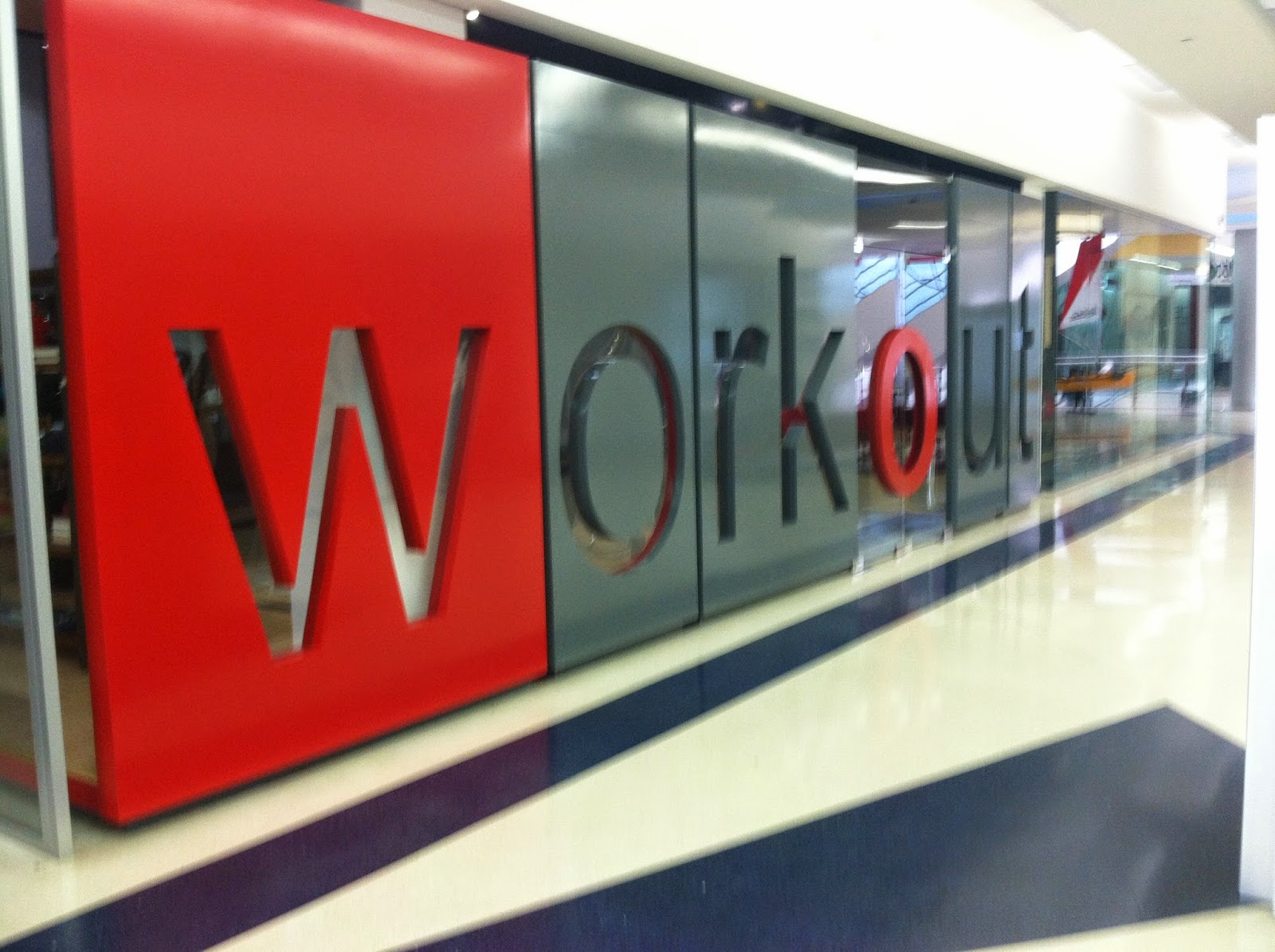
First off I have to talk about Juan's place, Workout Gym. It's in a mall, and is a really, really nice place. I also have to talk about the type of people that train there. It's mainly a bodybuilding gym. So most of the guys there are into training to get bigger, which is fine, but I would be selling them on training for strength, and why that was important as well.
For lifters that are into bodybuilding, it's not always obvious as to why getting stronger is so important. At the very core of what they know, lifting 405 for 10 reps is better than lifting 405 for 6 reps, but translating getting strong maximally on the big 3 would take some selling.
And speaking of translating, did I mention that none of the people attending spoke English? Or let me say, most of them didn't, and the ones that did spoke very little of it.
This threw me for a loop on my first day, as I would be working with a translator, and to say it made day 1 more stressful than usual would be quite the understatement.
But back to the gym for a moment.
Juan has a really awesome place. He has dumbbells that go up to 150+ pounds, but the catch here is, they are ALL thick handle dumbbells. All of them.
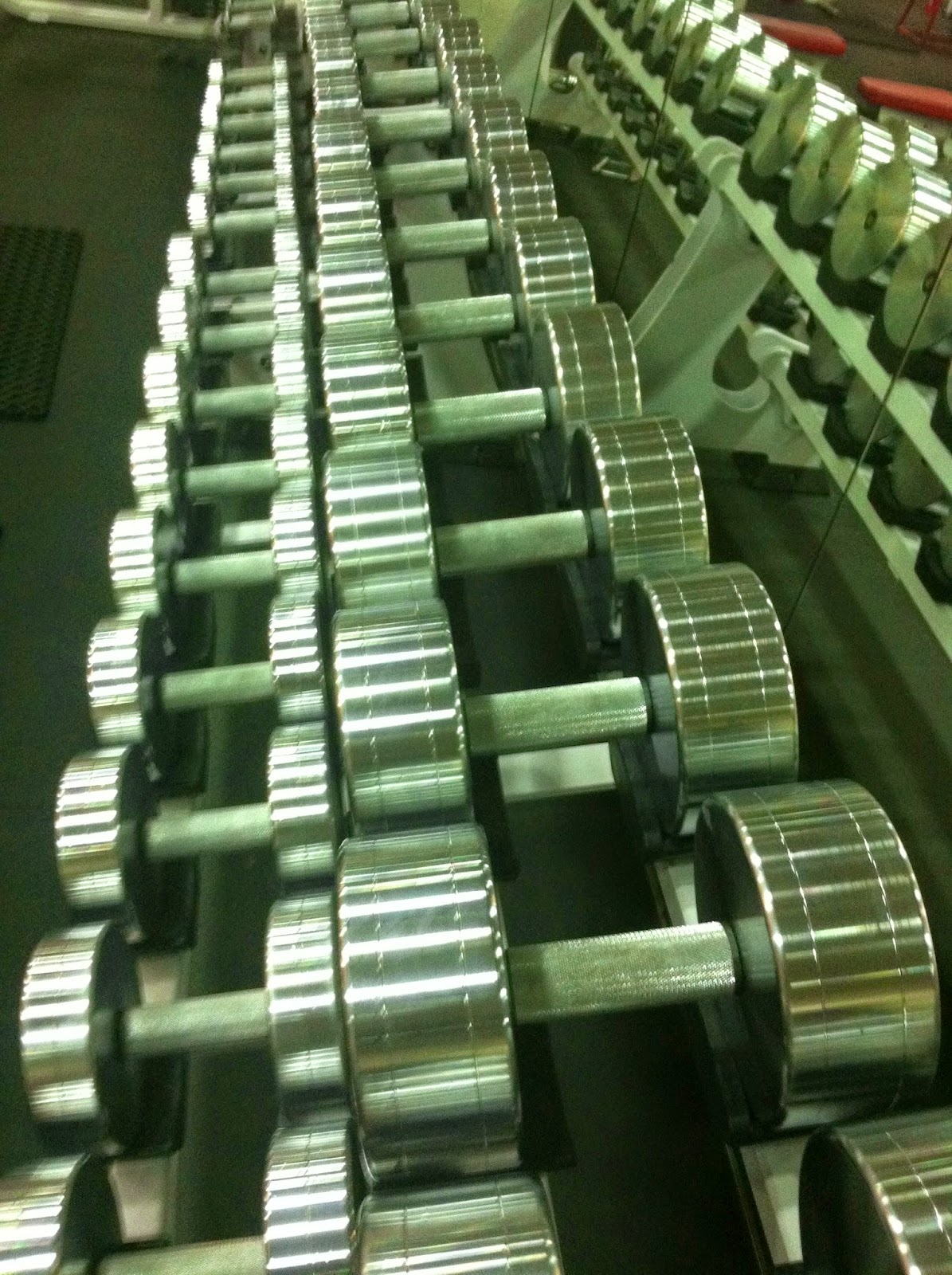
The knurling on them is quite fierce. And let's just say the knurling on the 150 pound thick handle dumbbells is not very worn. I'm telling you this, picking up 100+ pound thick bar dumbbells is not the same AT ALL as picking up regular handled dumbbells. It makes getting them into position for anything far more difficult.
Day 1 I covered concepts like everyday maxes, percentage based programming, rate of perceived exertion, compensatory acceleration, specific adaptation to imposed demands, and other basic principles of strength training.
As I lectured I was often interrupted (by this one particular guy more often than not) and through his Spanish I could make out the word "hypertrophy" over and over again. Basically, the gist of it was, how does any of this pertain to muscle growth?
To repeat, this is a gym mostly consisting of guys that do bodybuilding or men's physique competition. So to them, I'm basically speaking a foreign language. So technically, I was speaking two languages they didn't understand.
I knew it was of utmost importance that I get their "buy in" to what I was trying to talk to them about. After all, if the people you are speaking to don't understand how what you are saying can apply to them, they will lose interest and not give a shit.
After lunch I came back and more or less sat down and explained to them why it was important, even for bodybuilders, to get stronger. I asked them did they think I was bigger when I was moving 315 for 12 reps, or when I was moving 315 for 21 reps? Of course they understood this. I then explained that to move a weight for more reps, it needed to become a smaller percentage of their 1 rep max.
This has been something I have written and talked about since day 1. Strength cycles build on hypertrophy cycles. Then, a productive hypertrophy cycle will lead to better strength cycles. They both build on each other, and over time create a bigger and stronger lifter.
This helped with their buy in.
That afternoon we went over squatting. A lot of them had been squatting with a lot of knee forward action, not hinging at the hips (try explain the word "hinge" in Spanish in regards to squatting). Most of them did not understand how to get tight enough in the back (lots of elbow FORWARD action), and what to look at to know if the glutes were engaged properly. Again, because it's mostly bodybuilding, they saw the squat as a movement to build the quads, rather than understanding how to distribute the load as much as possible across the lower body. So they squatted in a very "bodybuilder" way.
This took a lot of correcting.
By the end of day 1 I was pretty fucking exhausted. Two more days to go.
Day 2 -
Because of how things went on day 1, I decided to change things up on day 2. I would teach bench in the morning and then deadlifting after lunch.
For benching we went over bar path, wrist and elbow alignment, and of course, how to setup on the bench with enough tension and tightness, and how to facilitate leg drive.
Teaching leg drive is always interesting because some people get it right out of the gate, and some people don't seem to grasp it at all. No matter how many different ways I teach it, or how many different mental cues I offer up, some people just can't "feel" what they are supposed to be doing. Strangely enough, women seem to get leg drive faster than most guys. I have no idea why, but in every seminar I've ever done this has been the case.
That afternoon we went over deadlifting. I explained that the deadlift really wasn't a "pull", but more of a push, then a pull to finish at lockout. I often say that the deadlift is the easiest lift to teach, but the hardest to "feel". Getting the motion down of pushing the bar off the floor via your legs is something people do struggle with. But once they get it, their deadlift starts flying.
I always tell people if your lower back gets sore from pulling, then you are "pulling" the entire movement. It means the low back is what you are using to break inertia from the floor. This is bad.
Once again, some people get this right away, and other struggle with it. However it is, in my opinion, the single most key component to getting your deadlift to move if it has been stuck. Once you learn how to do this, then the key from there is simply developing more leg strength to improve your strength/speed off the floor.
One thing I often like to do when I teach is actually let guys deadlift for the day. It breaks up the monotony of just learning technique and gets the juices flowing to end the day on a fun note.
I haven't pulled since November. Which was my meet. I've done stiff legged deadlifts every other week or so, but no conventional deadlifts. For fun I worked up to a super easy triple at 585 for the day, and another guy at the gym wanted to give it a go. Video below. Sorry for having it filmed on a potato.
Day 3 -
By day 3 I had found my groove in regards to the language barrier. It also seemed as if people brushed up on their English over the past two days because people were asking me questions in English or nodded at shit I said. Maybe they were just humoring my by doing that, but they legit seemed to understand what I was saying more often now than before.
Last day I covered combining all the programming and how to lay it out in a training split, some rehab and prehab stuff, and then for fun we finished with 100 rep barbell curls. As usual, I like to pit the women against the men because the men don't get that women are usually better at these because they tend to have more endurance fibers (regardless of what a "study" says I've seen this time after time).
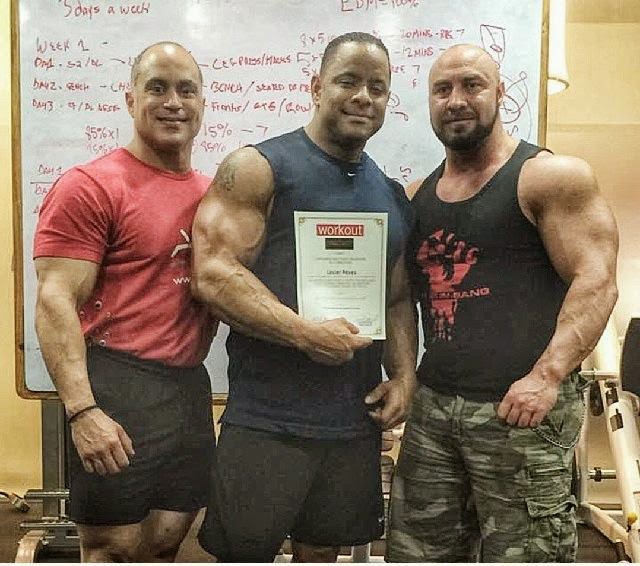
I went against Rocio, who is in her 50's, but jacked as fuck. I knocked out the first 100 really fast, then thought she was well behind me so I ended up pausing for a bit, not realizing she just kept going. I finished at 148....she did 160. God dammit.
Closing and misc. fun stuff -
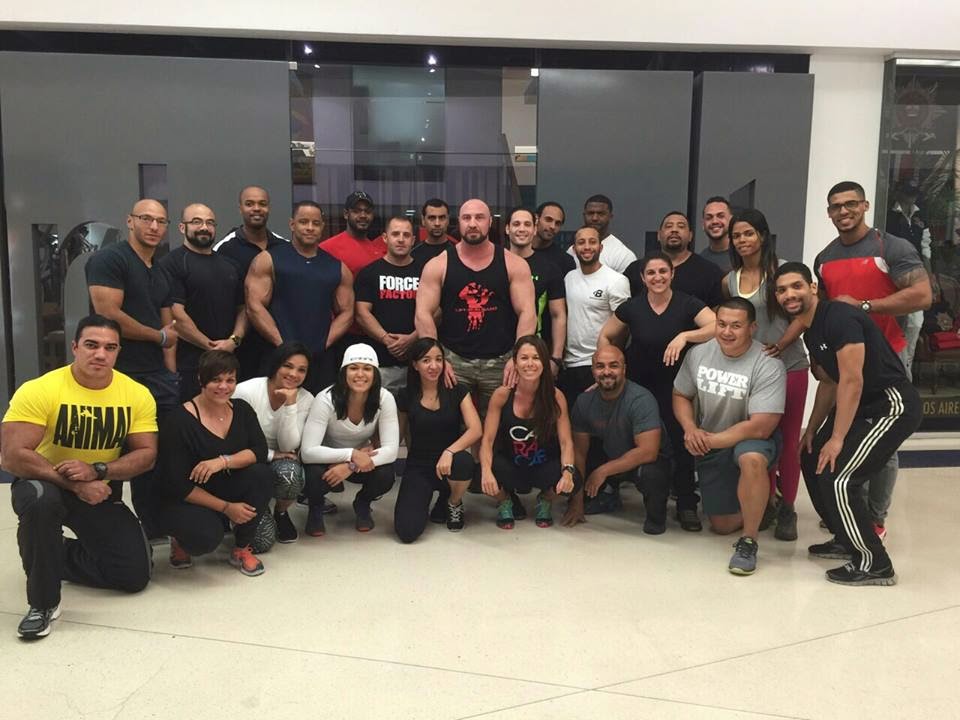
I can't say enough about Juan, his staff, his trainers and all the people that attended and the Dominican people in general. They are loving and big hearted people who have a sense of hospitality that is unparalleled to anywhere I've been. I am slated to return in June and am incredibly excited to get back, with more Spanish in tow, to do more teaching to the people there.
Now for some FUN stuff!
Get all LRB books on E-Junkie - http://www.e-junkie.com/263269
Follow LRB on Facebook - https://www.facebook.com/LiftRunBang
Follow LRB on IG - http://instagram.com/liftrunbang
Charles had a dude that was travelling with him for the Klokov/Poliquin tour named Juan Carlos, whom I met the first morning I finally met Charles.
I still laugh at meeting Juan, because upon initially meeting, he was very stoic, and intense. Saying few words, and scowling most of the time. Jolly, he was not. Juan was from the Dominican Republic and talked like, well, Scarface. When he did speak, I mean. He sounded like Scarface.
At breakfast that morning Juan asked me, "you do seminars?"
"Yes."
"Ho-kay. You come to Dominican Republic and do one."
"Ok."
That was it. That was how this all got settled. Twelve words.
Seems legit.
Over the next four days however, Juan loosened up dramatically and as it turns out, he's actually very funny and like most of the Dominican people as I would find out, very personable.
Before he departed from Montreal he told me he was going to be in touch with me to get things set up for me to come out. At first I was supposed to make the trek out right before Christmas, but the holidays made it too difficult to get everything together. So we ended up settling for February.
Juan wanted me to cover strength training, of course, and do a three day workshop going over the principles of strength training, the squat, the bench, and deadlifting. You know, the usual shit.
I covered my arrival day in this blog post, so I will go over my time there, what I covered, and some misc stuff that made the trip pretty damn amazing.
Day 1 - Teaching
First off I have to talk about Juan's place, Workout Gym. It's in a mall, and is a really, really nice place. I also have to talk about the type of people that train there. It's mainly a bodybuilding gym. So most of the guys there are into training to get bigger, which is fine, but I would be selling them on training for strength, and why that was important as well.
For lifters that are into bodybuilding, it's not always obvious as to why getting stronger is so important. At the very core of what they know, lifting 405 for 10 reps is better than lifting 405 for 6 reps, but translating getting strong maximally on the big 3 would take some selling.
And speaking of translating, did I mention that none of the people attending spoke English? Or let me say, most of them didn't, and the ones that did spoke very little of it.
This threw me for a loop on my first day, as I would be working with a translator, and to say it made day 1 more stressful than usual would be quite the understatement.
But back to the gym for a moment.
Juan has a really awesome place. He has dumbbells that go up to 150+ pounds, but the catch here is, they are ALL thick handle dumbbells. All of them.
The knurling on them is quite fierce. And let's just say the knurling on the 150 pound thick handle dumbbells is not very worn. I'm telling you this, picking up 100+ pound thick bar dumbbells is not the same AT ALL as picking up regular handled dumbbells. It makes getting them into position for anything far more difficult.
Day 1 I covered concepts like everyday maxes, percentage based programming, rate of perceived exertion, compensatory acceleration, specific adaptation to imposed demands, and other basic principles of strength training.
As I lectured I was often interrupted (by this one particular guy more often than not) and through his Spanish I could make out the word "hypertrophy" over and over again. Basically, the gist of it was, how does any of this pertain to muscle growth?
To repeat, this is a gym mostly consisting of guys that do bodybuilding or men's physique competition. So to them, I'm basically speaking a foreign language. So technically, I was speaking two languages they didn't understand.
I knew it was of utmost importance that I get their "buy in" to what I was trying to talk to them about. After all, if the people you are speaking to don't understand how what you are saying can apply to them, they will lose interest and not give a shit.
After lunch I came back and more or less sat down and explained to them why it was important, even for bodybuilders, to get stronger. I asked them did they think I was bigger when I was moving 315 for 12 reps, or when I was moving 315 for 21 reps? Of course they understood this. I then explained that to move a weight for more reps, it needed to become a smaller percentage of their 1 rep max.
This has been something I have written and talked about since day 1. Strength cycles build on hypertrophy cycles. Then, a productive hypertrophy cycle will lead to better strength cycles. They both build on each other, and over time create a bigger and stronger lifter.
This helped with their buy in.
That afternoon we went over squatting. A lot of them had been squatting with a lot of knee forward action, not hinging at the hips (try explain the word "hinge" in Spanish in regards to squatting). Most of them did not understand how to get tight enough in the back (lots of elbow FORWARD action), and what to look at to know if the glutes were engaged properly. Again, because it's mostly bodybuilding, they saw the squat as a movement to build the quads, rather than understanding how to distribute the load as much as possible across the lower body. So they squatted in a very "bodybuilder" way.
This took a lot of correcting.
By the end of day 1 I was pretty fucking exhausted. Two more days to go.
Day 2 -
Because of how things went on day 1, I decided to change things up on day 2. I would teach bench in the morning and then deadlifting after lunch.
For benching we went over bar path, wrist and elbow alignment, and of course, how to setup on the bench with enough tension and tightness, and how to facilitate leg drive.
Teaching leg drive is always interesting because some people get it right out of the gate, and some people don't seem to grasp it at all. No matter how many different ways I teach it, or how many different mental cues I offer up, some people just can't "feel" what they are supposed to be doing. Strangely enough, women seem to get leg drive faster than most guys. I have no idea why, but in every seminar I've ever done this has been the case.
That afternoon we went over deadlifting. I explained that the deadlift really wasn't a "pull", but more of a push, then a pull to finish at lockout. I often say that the deadlift is the easiest lift to teach, but the hardest to "feel". Getting the motion down of pushing the bar off the floor via your legs is something people do struggle with. But once they get it, their deadlift starts flying.
I always tell people if your lower back gets sore from pulling, then you are "pulling" the entire movement. It means the low back is what you are using to break inertia from the floor. This is bad.
Once again, some people get this right away, and other struggle with it. However it is, in my opinion, the single most key component to getting your deadlift to move if it has been stuck. Once you learn how to do this, then the key from there is simply developing more leg strength to improve your strength/speed off the floor.
One thing I often like to do when I teach is actually let guys deadlift for the day. It breaks up the monotony of just learning technique and gets the juices flowing to end the day on a fun note.
I haven't pulled since November. Which was my meet. I've done stiff legged deadlifts every other week or so, but no conventional deadlifts. For fun I worked up to a super easy triple at 585 for the day, and another guy at the gym wanted to give it a go. Video below. Sorry for having it filmed on a potato.
Day 3 -
By day 3 I had found my groove in regards to the language barrier. It also seemed as if people brushed up on their English over the past two days because people were asking me questions in English or nodded at shit I said. Maybe they were just humoring my by doing that, but they legit seemed to understand what I was saying more often now than before.
Last day I covered combining all the programming and how to lay it out in a training split, some rehab and prehab stuff, and then for fun we finished with 100 rep barbell curls. As usual, I like to pit the women against the men because the men don't get that women are usually better at these because they tend to have more endurance fibers (regardless of what a "study" says I've seen this time after time).
I went against Rocio, who is in her 50's, but jacked as fuck. I knocked out the first 100 really fast, then thought she was well behind me so I ended up pausing for a bit, not realizing she just kept going. I finished at 148....she did 160. God dammit.
Closing and misc. fun stuff -
I can't say enough about Juan, his staff, his trainers and all the people that attended and the Dominican people in general. They are loving and big hearted people who have a sense of hospitality that is unparalleled to anywhere I've been. I am slated to return in June and am incredibly excited to get back, with more Spanish in tow, to do more teaching to the people there.
Now for some FUN stuff!
- Traffic is fucking crazy. I mean crazy. Juan told me when I got there "if you can drive here, you can drive anywhere in the world." And I believe it. One night as we were sitting at a red light, a car raced around us, into the other lane, then made a right turn into oncoming traffic. No one noticed. There are no real speed limits, and people don't stop at stop signs. It's pretty "ok" to drink and drive, and motorcycles drive at breakneck speeds right on the sidewalk. So yeah, it's crazy. The best I heard it described was by a guy that picked me up one morning. He said "you know, if a red light goes out, traffic does not stop. It keeps going. There is no slow down. That's because everyday out here.......we fight." I laughed so hard at that.
- The food was amazing. What was interesting is that most of the food you get out, is very healthy. I mean, outside of the fried plantains. But it's generally roasted chicken, lots of rice everywhere, and beans. I also ate steak a lot, and all of it was amazing as hell. We went to this one place that also served this baked coconut pie thing for dessert and I could have eaten about 100 of those every evening.
- You can't get a bad cup of coffee anywhere. I mean no matter where you go, the coffee is the best coffee you will have. Ever. I was amazed at no matter what the place looked like, or how "poor" it seemed, the coffee was just spectacular. Everytime.
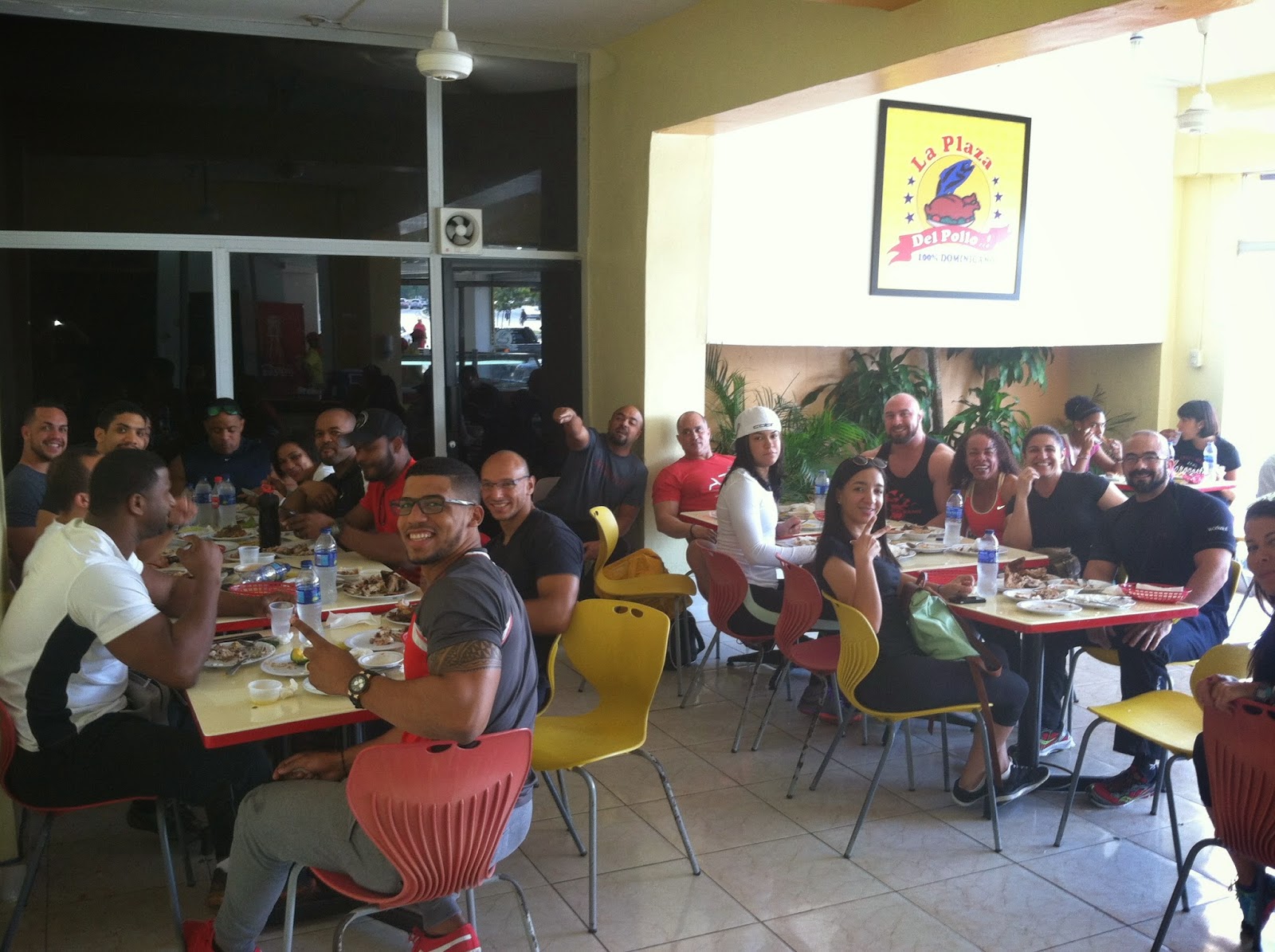
- One day while we were eating at the "Chicken Plaza" a preacher came in and started preaching. Loudly. After a long and enthusiastic sermon, he then asked for money to help build his new church. To which the group protested, more or less at this. I grabbed it on video.
- My second to last day there, I actually got to go to the beach. Juan drove me out and I ate fresh Lobster, shrimp, salmon, octopus, calamari, and oysters right there by the Ocean. This was the ultimate day of decompression and when I come back I intend to spend a few days here relaxing.
- Coming back was awful. It took hours and hours to get my ticket, get through immigration and customs, and then board. Then I had to do it all over again in Atlanta. I think I showed my passport, literally, 9 times in two stops. My cab ride to the airport was also interesting. Every indicator light in the cabbies dash was lit up. The speedometer did not work. At all. And apparently neither did the gas gauge because it looked like the car was on empty. So basically, I have no idea how the driver would know if something in the car was fucking up, until it was too late. The AC did not work, and of course, the window would barely roll down. It was 90 outside, so by the time I got to the airport, I looked like I had been cutting weight all night for a meet weight in.
I have so many people I'd like to thank but I'm sure I will miss someone. Thanks to Charles for introducing me to Juan. Thanks to Juan for having me out, and spoiling me (he arranged for me to have a massage while there as well), having me into his home to meet his family and eat at their table with them. Thanks to Alicia, Guillermo (who also translated and drove me around as needed, thank you sir!), Rocio, Natalia, and so many others who made my trip amazing and unforgettable. I hope to see you all soon!
Follow LRB on Facebook - https://www.facebook.com/LiftRunBang
Follow LRB on IG - http://instagram.com/liftrunbang
Death is winning...do something
30 Jan 14:51
 I love Interbike. Trade events are a chance to talk with smart people chasing their passions. Whether you’re speaking with pro athletes, number-crunching engineers or visionary branding experts, going to a trade event in the bike industry is a chance to talk with bike people about bike stuff. Ohmigod, it’s such fun. That said, Interbike is not without challenges. I could spend hours talking to most of the different characters I see, but I rarely have more than a half hour and I never have any appointments that don’t suffer at least one interruption. It’s not the end of the world—I’m still talking to amazing people, right?—but I’m not getting as much time as I’d like. For that reason, the PressCamp events are media nirvana. Okay, so our appointments are limited to 45 minutes, but you can stretch them to nearly an hour, and it’s a chance to look over a handful of products (rather than the whole line) and have a real, undivided conversation about a company’s work. Given that you can meet with six brands in a day, it’s a genius format. This winter’s event is in Westlake Village, at the Westlake Village Inn, a place that has played host to a number of bike industry events as well as hosting training camps by Cervelo Test Team and Liquigas-Cannondale. We are 15 minutes from the Santa Monica Mountains and great riding to check out the products. My day began with visits to Ridley and SRM. For 2015, Ridley has redesigned the Dean Fast and the Noah SL. The Dean Fast is Ridley’s TT/Tri bike and features some pretty compelling technology. The F-Splitfork features channels in the fork to direct air around the fork more smoothly. The front brake is integrated into the fork and uses the carbon’s natural flex as the brake’s spring. The F-Surface technology is a small crease that can be found in the down tube and the seatpost to help create a boundary layer for the air to move over. Not a single cable shows on this electronic-only bike. With Di2, the battery mounts in the seatpost, while with EPS, the battery mounts in the top tube just behind the stem. The frame set, which includes the frame, fork, front brake, seatpost, base bar and integrated stem, plus the aero extensions, goes for $5000. It can be built in a variety of configurations; the one show goes for $13k. Yeah. The Noah SL is a complete redesign of one of the oldest non-Cervelo aero bikes currently on the market. Though the bike still uses the F-Split fork design, the frame has gone on a pretty serious weight-loss regimen; the medium (56.5cm top tube) frame now weighs in at 980 grams. It is also considerably stiffer than its predecessor. I was able to ride the Noah SL on our morning ride. The F-Split fork is far stiffer than some might imagine. The feedback the André Greipel gave the team was that he was less concerned about having the lightest bike than making sure that his bike could be equipped with an SRM power meter and meet the UCI weight limit. Feedback from team mechanics was that because riders would use the Noah SL out on hectic road stages, they wanted to make sure it could be serviced from the open window of a team car—no chewed up fingers. The same F-Surface technology found in the Dean Fast is present in the down tube and seatpost of the Noah SL. SRM showed off the latest iteration of their Indoortrainer. This $5000 trainer features a new magnetic resistance unit and iPad control, along with infinitely variable fit. When asked just who they thought the target market was for the unit, they admitted lots of doctors and lawyers in very cold climates, but they also suggested that this was more appropriate for anyone hoping to do super-high intensity indoor workouts, particularly sprinters, thanks to its four-point base. Kinda ideal if you’re closing in on that 1400-watt sprint, which suggests I’m probably not what they were hoping for. Alas. The folks at SRM showed off the PC8 head unit, which they first showed this fall at the trade shows. The $750 head unit is easily the most feature-packed computer on the market, a point they are proud to push. It’s a bike computer made for cyclists by cyclists, they say. They are finalizing the last details in the keypad and expect units to begin shipping in May. They’ve been taking preorders, so the first units shipped are spoken for. They suggest placing a preorder now if you want one before the meat of the season. You may have noticed a few new flavors from Clif in their Bars, the Kit’s Organics and the Builder’s Bar. The addition of dark chocolate options broadens the flavor palette in Kit’s Organics. The Nuts and Seeds flavor takes the Clif Bar in a somewhat more savory direction. The bar that I’ve already found at retail and have tried is the Berry Pomegranate Chia, which is a delicious addition. The big news from Clif is the new Organic Energy line. These pouches are aimed at the endurance athlete market. The two smaller pouches steer toward the sweet side of things with Banana Beet Ginger and Banana Mango Coconut flavors. The 90g pouch provides 100 calories, so the same number of calories as a gel, but at 1/3 the concentration. They are meant for people who can’t take the sweetness of a gel or have experienced stomach issues as a result of the high concentration of gels. There’s solid science to suggest that the higher moisture content of the Organic Energy pouches will make them not just go down easier, but quicker for your body to process into energy. The two larger pouches head to savory territory with a little more robust profile. The Sweet Potato with Sea Salt comes in at 2oo calories in the 120g pouch. The Pizza Margherita pouches contain 160 calories, and both...
Winter PressCamp, Part I
by Padraig
Jeffrey.bramhallClick through for neat stuff from Clif.
22 Jan 20:28


Who is Fernando Gaviria?
by Klaus
Photo: Manual For Speed
After the first stage of the Tour de San Luis, Mark Cavendish made sure he congratulated Colombian sprinter Fernando Gaviria on his win. Though he'd never heard of the 20 year old sprinter, he was no doubt impressed by his speed. Still, at a post-race press conference, Cavendish said he hadn't seen the "200 meters to go" sign, and it was perhaps for that reason that Gaviria, who launched an early sprint at 300 meters to go, had won. But then it happened again in the 176 kilometer stage from Concoran to Juan Koslay. This time, Cavendish took to Twitter, and was more forthcoming.
"He has phenomenal acceleration that's hard to close a gap to. Impressive."
And while some might opine that Gaviria's win could say more about Cavendish than the young Colombian, it's worth mentioning that Lampre's Sacha Modolo (who had eight victories to this name last year) was also beaten, as were other capable sprinters. And with that, it's a Colombian sprinter, not a climber or GC rider, who is getting all the attention. Which of course brings up one obvious question. Who is Fernando Gaviria?
Fernando with his father (Photo: Nuestro Ciclismo)
A cycling academy and a family
As is often the case in Colombian sport, the story of one athlete uncovers a vast human network, which (as I've often argued) is one of the unique constructs that makes Colombian cycling what it is. This story is no different.
Fernando Gaviria Rendon was born in 1994 in La Ceja (making him a "Cejeño"), some 50 minutes away from Medellin. La Ceja has a population of 49,000, and sits at 7,200 feet in altitude, surrounded by the kind of rolling terrain and flower plantations that are common throughout southeastern Antioquia. He began riding a bike on his own at 3 years old, later taking up soccer, volleyball and basketball while attending La Paz school, where he proved to be a less-than-fantastic student, mostly due to small disciplinary matters that often required calls to his parents. Within his family, Gaviria is known as "El Niño" (the kid) and "Care-mico" (a contraction of two words that mean "monkey face") as terms of endearment .
I've written before about Colombian terms of endearment given by parents, which may sometimes sound negative when translated and taken out of context. Nairo Quintana's family, for example, refer to him as "little blackie". I assure you, these are somewhat standard things that parents call us Colombian kids, and no ill-will is meant by it. To the contrary.
At any rate, sports were always a part of Fernando's life, and it was speed skating that first got his attention . He was incredibly devoted to the sport, but once he found cycling, he put his speed skates aside for good. Gaviria then joined a cycling academy, which happened to be headed up by his father Hernando, himself once a sprinter who raced in many of Colombia's top races during his youth. As a kid, Fernando would often angrily ask his father why he'd been dropped on a climb during a race, unaware of the tough realities faced by sprinters in Colombian racing.
A young Gaviria becomes regional road champion (Photo: Nuestro Ciclismo)
The Clecilja Club, Escuela de Ciclismo, run by Hernando Gaviria, is one of countless cycling schools/academies that dot the Colombian countryside. Usually run by retired professionals, or parents with a history in the sport, it's in these institutions that nearly all competitive Colombian cyclists learn about the sport (I discussed this at length in a similar post about Julian Arredondo). Gaviria's initial focus was on the road, eventually shifting to the track, as he moved to Medellin. There, he became part of Colombia's cycling milieu, watching the grand tours attentively, and coming to idolize one rider in particular, Mark Cavendish.
Around the same time, his sister Juliana began racing on the track as well. She's now an olympian with several records to her name. Like her brother, Juliana also started on the road, but these days devotes herself fully to the track. In fact, this past October, while at Medellin's velodrome, she laughed as she told me how much she hates racing on the road.
Juliana Gaviria (Photo: Alps & Andes)
Better Colombians
Like Rigoberto Uran, Carlos Betancur, Sergio Henao, Julian Arredondo and many others, Gaviria's path then went through Indeportes Antioquia, a program created to develop regional sports talent that is fully funded by the department of Antioquia. This institution, whose headquarters are in Medellin, aims to spot talent, nurture it, and help it grow to the highest level. Aside from cycling, Indeportes Antioquia supports speed skating, track and field, boxing, soccer, wrestling, gymnastics, baseball, basketball, and even chess and bowling among many others.
Speaking with Mauricio Mosquera, the director of Indeportes Antioquia in Medellin, I asked about the specific aim of these programs. Without putting much thought into it, Mosquera answered, "to make better citizens, better Colombians. The wins and the championships will likely come. But that's not our focus. We see sport as having a greater purpose."
It was through this program that Fernando Gaviria began his cycling career in earnest (though he still worked with his father as a coach), leading to a win at 18 years of age that got him a fair amount of attention regionally. He became the U23 champion of Antioquia, urging his team that day to cover every break, in order to force a sprint. His team did just that, delivering Gaviria to the last kilometer. This win, along with several others that he earned, helped get him a contract with the local (UCI continental) Coldeportes-Claro team. By 2012, he was awarded the Breakout Star of the Year award in the same ceremony where Colombia's sportsman of the year is honored. On that occasion, it was mostly his performances on the track that earned him the award.
Partial list of his 2012 palmares:
National champion, TT
National champion, points race
National champion, team pursuit
National Champion, Madison
World Champion, Omnium
World Champion, Madison
Sprinter's jersey, Vuelta al Porvenir
News story (in Spanish) about the female riders from the Clecija cycling academy. Fernando's father Hernando (club president) is interviewed.
With time, Gaviria's stock within Colombian cycling continued to rise as he mostly focused on the track, while still competing in races like the Tour de l'Avenir in 2014, later winning the PanAmerican road race and then the Omnium at the World Cup in London.
Before going to San Luis, Gaviria admitted to the Colombian press that he was a bit nervous about the race. "There's a chance for sidewinds, something we don't experience where in Colombia. To race at that level will be a huge challenge." He also said that he was trying to be realistic about his goals, and stated several times that he was very much focused on several track events coming up, eventually leading to the next Olympics. In that sense, it's possible that his two wins against World Tour riders is almost as much a surprise to him as they have been to many others. Though if you look at his past accomplishments, it's easy to see that his star was on the rise.
Now, with these two victories in San Luis (racing for the state-backed and Postobon-sponsored Colombian national team), the 20 year old has most certainly gotten the attention of the cycling world. He's still under contract for 2015 with the Coldeportes-Claro team, though where he'll eventually end up is anybody's guess.
UPDATE (January 23, AM): Colombian journalist Pablo Arbelaez reports on Twitter that Etixx-Quick Step is the first team to have made contact with Gaviria. He has already turned in results from recent tests, and they are sending a representative to speak wit him.
You can follow Fernando on Twitter here, and his sister Juliana here.
20 Jan 18:20
Lucky Charms & Kool-Aid
by elisabethakinwale
Jeffrey.bramhallshopping list
The nutritional situation in my house growing up was pretty hilarious in hindsight. My mother was very loving and attentive in many ways, but she also worked approximately one million hours per week. Therefore, my sister and I fended for our selves quite a bit at mealtimes. I have so many awesome cereal related memories.
The post Lucky Charms & Kool-Aid appeared first on Elisabeth Akinwale.
20 Jan 17:08
Broccoli Cat
Jeffrey.bramhallTHANKS DAISY
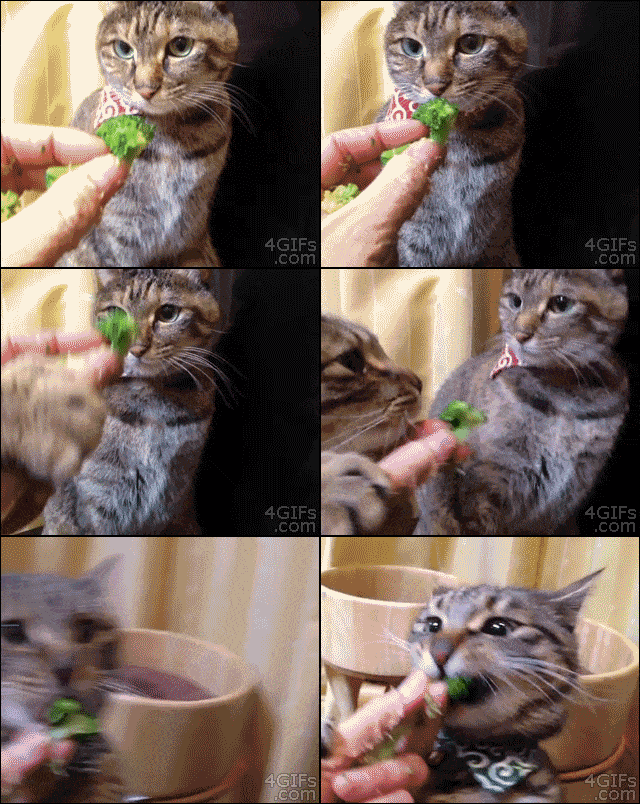
Jenny wasn’t about to let that bitch Natalie get the last broccoli.
baron, Mitch Laue and 7 others like this
15 Jan 17:05

The breast pocket of Albanian Prime Minister Edi Rama at the Je...
by jessethorn
The breast pocket of Albanian Prime Minister Edi Rama at the Je Suis Charlie rally in Paris.
(thanks, Steve)
12 Jan 16:09

Rise of the Machines
by Bill Starr
Jeffrey.bramhallBill Starr in CF Journal. Weird.
Bill Starr chronicles how Universal and Nautilus changed the face of fitness and made black iron a memory in most gyms.
The earliest pieces of equipment used by men wanting to get stronger and build more impressive physiques were kettlebells, dumbbells and barbells with rounded globes at each end. Then barbells advanced so plates of different weights could be added and removed. The next step in the evolution was to put ball bearings in the collars so the bars could rotate as they were lifted.
The number of people who lifted weights as a form of exercise was meager, at best, so there wasn’t a call for any other equipment. Nor were there any fitness facilities as such, but YMCAs always provided some space for weight training. The spaces typically contained the equipment I mentioned, plus stall bars, medicine balls and Indian clubs. YMCAs became hubs of weight training and continued to serve that purpose for over half a century.
In the ’20s, there was a flurry of interest in physical culture, led by such icons as Bernarr MacFadden, Alan Calvert, Charles Atlas and George Jowett. These men promoted their views on weight training and nutrition in the pages of two magazines: Calvert’s Strength, which was the publishing arm for his Milo Barbell Company, and MacFadden’s Physical Culture. These publications fueled the movement to make people stronger and healthier, which led to a few health clubs opening up in the larger metropolitan areas.
In all these facilities, the emphasis was on health more so than strength. Most offered massages, steam rooms, treatments with infrared lamps, and classes in self-defense and even acrobatics.
This is when machines entered the picture.
09 Jan 17:11


January 9, 2015
by Kris Vandevoort
Exclusive Coaching client Chad Michael with a Human Turkish get up PR (140#)
Function
Function 1/9/15
A. Front squat – 4×6-8 – continue building loads based on last week
B. Press – Every 90 seconds x8 – two repetitions, building load per set
C1. Farmers walk – 3x100ft – HEAVY
C2. Sorenson hold – 3xAMRAP(-)
+
6 min AMRAP @90%+:
3, 6, 9, 12, 15…
Wall ball shots – 20/14#, 10/9′
Burpees
Notes:
– Recall AMRAP(-) denotes stopping shy of absolute failure/fatigue
Being
Being 1/9/15
A. HSC TnG x 3 rest 60sec x 10 light weight speed focus
+
5min amrap compare to dec 5th
10 PC and jerk 135/95#
10 PC and jerk 155/105#
10 PC and jerk 185/115#
10 PC and jerk 205/135#
10 pc and jerk 225/145#
rest as needed
3 rounds for time
Row 500m
75 DU
Will
Will 1/9/15
AM
Run 30 min EASY, fasted out of bed
– KEEP pace easy, good breathing
PM
A. Clean pull + PC + PP + PJ + SJ; 1.1.1.1.1 x 5; rest 2 min – build moderate from 185#
B. 5 sets – BB FR lunge x 3/leg; rest 1 min b/t legs – HEAVY sets
C. Emom 10 min – Legless RC x 1
+
For Time:
5-4-3-2-1
Axel bar DL – 275#
wall walk
She
She 1/9/15
For Time:
30 thruster – 75#
50 DU
30 thruster – 85#
50 DU
30 thruster – 95#
50 DU
30 thruster – 105#
50 DU
New to the Blog? Check out our FAQs and Glossary.
Subscribe to the Blog HERE!
08 Jan 16:20
Supplements that "work" - Part 1
by noreply@blogger.com (Paul Carter)
A few weeks ago on the LRB Facebook page I asked what supplements everyone was taking, and which ones they felt like "worked".
Worked being the key word here, but there wasn't always a description of what worked meant to each person.
Let me preface this with the fact that I'm not offering anything revolutionary here. But one of the biggest problems with guys and gals that do buy supplements is that they buy anything new, or anything under the sun, and then sometimes neglect a lot of the supplements to do actually offer real benefits.
With that said, there were a few supplements that generally made the list for the great majority of people. The next few weeks I will be going over those supplements and writing about what "works" means in regards to said supplements.
Fish oil -
Fish oil was for the most part, on everyone's list.
I've used fish oil before, but probably not in large enough doses or consistently enough to notice anything special from its use.
So let me say off hand, I can't vouch for fish oil personally, but there are tons and tons of people who can.
So what are the ways that fish oil "works" for people?
Positive effects of fish oil -
To start with, fish oil is heavily researched. So to throw out the captain obvious quote for this article, we know a lot about it from a scientific standpoint.
To start with, it's been shown that fish oil has an anti-inflammatory effect in the body. For guys with beat up joints and an overall feeling of being beat to shit, this is a really good thing. Anyone that lifts for long enough probably finds their way to the ibuprofen section of the drug store on a fairly often basis.
Seeing as how mega dosing with an NSAID isn't a truly wise thing to do, does fish oil opt as an alternative to dealing with inflammation in place of it?
It appears so.
http://www.ncbi.nlm.nih.gov/pubmed/16531187
From this linkage...
Of the 250 patients, 125 returned the questionnaire at an average of 75 days on fish oil. Seventy-eight percent were taking 1200 mg and 22% were taking 2400 mg of EFAs. Fifty-nine percent discontinued to take their prescription NSAID medications for pain. Sixty percent stated that their overall pain was improved, and 60% stated that their joint pain had improved. Eighty percent stated they were satisfied with their improvement, and 88% stated they would continue to take the fish oil. There were no significant side effects reported.
It's been speculated that fish oil can have positive effects on heart health, but that's sketchy at best at this point.
From webmd.....
http://www.webmd.com/vitamins-and-supplements/news/20140317/daily-fish-oil-supplement-may-not-help-your-heart-studies
"Looking at the 17 randomized clinical trials that we combined, the majority of the trials -- especially the more recent and large-scale ones -- showed consistently little or no significant effect on reducing coronary heart disease events," said Dr. Rajiv Chowdhury, lead author of a comprehensive review of nutrition research related to fats.
I read through quite a few other studies in regards to this, and it appears that while fish oil can play a huge part in reducing inflammation and has some serious positive impacts on brain function (though the reviews have been a bit mixed), but not so much in regards to heart health.
Either way, reducing inflammation in the body is a very big deal, and can play a huge impact in regards to overall health, and effective training.
It also apparently saved the life of this 16 year old boy, who had a severe brain injury. Take some time to read it...
http://articles.mercola.com/sites/articles/archive/2014/02/09/fish-oil-brain-health.aspx
How much to take -
The thing to focus on here, is the amount of EPA and DHA you're getting in per day. Studies on the health benefits of omega-3 fats typically use higher amounts of DHA of about 1,000 to 2,500 milligrams per day, which may be required to achieve some of these benefits. If you look around you may see less here and there, but this seems to cover the upper end of the spectrum in regards to how much you need.
Creatine -
Creatine has been around for a long time now (since the 70's actually), and has been one of the most popular supplements to use in regards to actually "working" for people.
Creatine is converted into creatine phosphate in the body, which in turn helps to create something called ATP (adenosine triphosphate). APT is used by the body for muscular contractions. So if should make sense that the more ATP you have, the more energy you have for muscular contraction.
There is also the belief that different kinds of creatine have a greater impact than others, but I believe that has been debunked. So going with regular ol creatime monohydrate is just fine.
Loading -
Most people tend to respond well to creatine by starting off with a loading phase. This is where you take 20 grams a day for the first week, then go on a maintenance dose of around 3-5 grams ED.
Non-responders -
Apparently it turns out (sort of) that about 20% of the people who use creatine are what they call "non-responders". They claim that they took creatine and that there was so significant increase in strength or performance from using it.
However upon looking more closely at why this could be, gives us some answers.
The non-responders in studies didn't have as much muscle mass, especially type-II muscle, as the other people. The other factor was apparently that they were already pretty well "loaded" in regards to creatine so adding more in, didn't seem to do much.
Check here.....
http://www.ncbi.nlm.nih.gov/pubmed/15320650
In boring ass lame fucking scientific talk.......
Responders also showed improvement in 1RM leg press scores following the 5-day loading period. NR had higher preload levels of Cr + PCr, less type II muscle fibers, small preload muscle CSA, and lower fat-free mass and displayed no improvements in 1RM strength scores. The results suggest that to be considered a responder to acute oral supplementation, a favorable preexisting biological profile may determine the final extent to which an individual responds to supplementation.
The bolded part there is a sciencey way of saying "look asshole, you don't have enough muscle mass yet."
This makes sense to me as I can see a bunch of kids buying shit at GNC to "get swole" that have been training all of 3 months. In other words, the container (the actual muscle cells) aren't large enough benefit from adding in creatine in the first place.
So if you are a noob, get some muscle on you first before you add in the creatine. Otherwise, there is a good chance it's not going to do a lot for you.
BCAA's -
I remember when I started using BCAA as my choice of peri-workout drink.
I had more energy, felt better during training, and felt like I recovered better from hard training sessions. Of course, it could have all been placebo, but even if so, there is nothing wrong with placebo effect if it does indeed make you better.
I think half of that was placebo, but half was not. Apparently the feeling of recovering better was indeed very real....
http://www.ncbi.nlm.nih.gov/pubmed/18974721
Data show that BCAA supplementation before and after exercise has beneficial effects for decreasing exercise-induced muscle damage and promoting muscle-protein synthesis.
And this one......
http://www.ncbi.nlm.nih.gov/pubmed/16365096
BCAAs (leucine, isoleucine, and valine), particularly leucine, have anabolic effects on protein metabolism by increasing the rate of protein synthesis and decreasing the rate of protein degradation in resting human muscle. Also, during recovery from endurance exercise, BCAAs were found to have anabolic effects in human muscle.

Worked being the key word here, but there wasn't always a description of what worked meant to each person.
Let me preface this with the fact that I'm not offering anything revolutionary here. But one of the biggest problems with guys and gals that do buy supplements is that they buy anything new, or anything under the sun, and then sometimes neglect a lot of the supplements to do actually offer real benefits.
With that said, there were a few supplements that generally made the list for the great majority of people. The next few weeks I will be going over those supplements and writing about what "works" means in regards to said supplements.
Fish oil -
Fish oil was for the most part, on everyone's list.
I've used fish oil before, but probably not in large enough doses or consistently enough to notice anything special from its use.
So let me say off hand, I can't vouch for fish oil personally, but there are tons and tons of people who can.
So what are the ways that fish oil "works" for people?
Positive effects of fish oil -
To start with, fish oil is heavily researched. So to throw out the captain obvious quote for this article, we know a lot about it from a scientific standpoint.
To start with, it's been shown that fish oil has an anti-inflammatory effect in the body. For guys with beat up joints and an overall feeling of being beat to shit, this is a really good thing. Anyone that lifts for long enough probably finds their way to the ibuprofen section of the drug store on a fairly often basis.
Seeing as how mega dosing with an NSAID isn't a truly wise thing to do, does fish oil opt as an alternative to dealing with inflammation in place of it?
It appears so.
http://www.ncbi.nlm.nih.gov/pubmed/16531187
From this linkage...
Of the 250 patients, 125 returned the questionnaire at an average of 75 days on fish oil. Seventy-eight percent were taking 1200 mg and 22% were taking 2400 mg of EFAs. Fifty-nine percent discontinued to take their prescription NSAID medications for pain. Sixty percent stated that their overall pain was improved, and 60% stated that their joint pain had improved. Eighty percent stated they were satisfied with their improvement, and 88% stated they would continue to take the fish oil. There were no significant side effects reported.
CONCLUSIONS: Our results mirror other controlled studies that compared ibuprofen and omega-3 EFAs demonstrating equivalent effect in reducing arthritic pain. omega-3 EFA fish oil supplements appear to be a safer alternative to NSAIDs for treatment of nonsurgical neck or back pain in this selective group.
Outside of pain management, it's important to understand that there are a ton of medical issues related to high level of inflammation. Asthma, cancer, depression, autoimmune diseases, and arthritis just to start. This is why most medical associations recommend eating fish at least two times a week.
It's been speculated that fish oil can have positive effects on heart health, but that's sketchy at best at this point.
From webmd.....
http://www.webmd.com/vitamins-and-supplements/news/20140317/daily-fish-oil-supplement-may-not-help-your-heart-studies
"Looking at the 17 randomized clinical trials that we combined, the majority of the trials -- especially the more recent and large-scale ones -- showed consistently little or no significant effect on reducing coronary heart disease events," said Dr. Rajiv Chowdhury, lead author of a comprehensive review of nutrition research related to fats.
I read through quite a few other studies in regards to this, and it appears that while fish oil can play a huge part in reducing inflammation and has some serious positive impacts on brain function (though the reviews have been a bit mixed), but not so much in regards to heart health.
Either way, reducing inflammation in the body is a very big deal, and can play a huge impact in regards to overall health, and effective training.
It also apparently saved the life of this 16 year old boy, who had a severe brain injury. Take some time to read it...
http://articles.mercola.com/sites/articles/archive/2014/02/09/fish-oil-brain-health.aspx
How much to take -
The thing to focus on here, is the amount of EPA and DHA you're getting in per day. Studies on the health benefits of omega-3 fats typically use higher amounts of DHA of about 1,000 to 2,500 milligrams per day, which may be required to achieve some of these benefits. If you look around you may see less here and there, but this seems to cover the upper end of the spectrum in regards to how much you need.
Creatine -
Creatine has been around for a long time now (since the 70's actually), and has been one of the most popular supplements to use in regards to actually "working" for people.
Creatine is converted into creatine phosphate in the body, which in turn helps to create something called ATP (adenosine triphosphate). APT is used by the body for muscular contractions. So if should make sense that the more ATP you have, the more energy you have for muscular contraction.
There is also the belief that different kinds of creatine have a greater impact than others, but I believe that has been debunked. So going with regular ol creatime monohydrate is just fine.
Loading -
Most people tend to respond well to creatine by starting off with a loading phase. This is where you take 20 grams a day for the first week, then go on a maintenance dose of around 3-5 grams ED.
Non-responders -
Apparently it turns out (sort of) that about 20% of the people who use creatine are what they call "non-responders". They claim that they took creatine and that there was so significant increase in strength or performance from using it.
However upon looking more closely at why this could be, gives us some answers.
The non-responders in studies didn't have as much muscle mass, especially type-II muscle, as the other people. The other factor was apparently that they were already pretty well "loaded" in regards to creatine so adding more in, didn't seem to do much.
Check here.....
http://www.ncbi.nlm.nih.gov/pubmed/15320650
In boring ass lame fucking scientific talk.......
Responders also showed improvement in 1RM leg press scores following the 5-day loading period. NR had higher preload levels of Cr + PCr, less type II muscle fibers, small preload muscle CSA, and lower fat-free mass and displayed no improvements in 1RM strength scores. The results suggest that to be considered a responder to acute oral supplementation, a favorable preexisting biological profile may determine the final extent to which an individual responds to supplementation.
The bolded part there is a sciencey way of saying "look asshole, you don't have enough muscle mass yet."
This makes sense to me as I can see a bunch of kids buying shit at GNC to "get swole" that have been training all of 3 months. In other words, the container (the actual muscle cells) aren't large enough benefit from adding in creatine in the first place.
So if you are a noob, get some muscle on you first before you add in the creatine. Otherwise, there is a good chance it's not going to do a lot for you.
BCAA's -
I remember when I started using BCAA as my choice of peri-workout drink.
I had more energy, felt better during training, and felt like I recovered better from hard training sessions. Of course, it could have all been placebo, but even if so, there is nothing wrong with placebo effect if it does indeed make you better.
I think half of that was placebo, but half was not. Apparently the feeling of recovering better was indeed very real....
http://www.ncbi.nlm.nih.gov/pubmed/18974721
Data show that BCAA supplementation before and after exercise has beneficial effects for decreasing exercise-induced muscle damage and promoting muscle-protein synthesis.
And this one......
http://www.ncbi.nlm.nih.gov/pubmed/16365096
BCAAs (leucine, isoleucine, and valine), particularly leucine, have anabolic effects on protein metabolism by increasing the rate of protein synthesis and decreasing the rate of protein degradation in resting human muscle. Also, during recovery from endurance exercise, BCAAs were found to have anabolic effects in human muscle.
If this is making your head spin, let's understand that what BCAA's do is increase muscle protein synthesis. In laymans terms, muscle protein synthesis is the removing or rebuilding of damaged muscle tissue in the body.
After training, muscle protein synthesis is increased by about 50% approximately four after after a hard training session, and peaks at about 109% 24 hours after training. After that it declines pretty rapidly back to normal at about 36 hours.
So the first 24 hours after training is the time in which you need to do all of the right things to make this process work for you. And that's where BCAA's play a part in helping to speed up recovery.
Dosage -
I use BCAA during training and take in somewhere between 15 and 20 grams in that time. I don't use it before, or after. I generally rely on food for pre and post workout meals. I have used supplements for this, but for me I've found that eating makes me feel better overall. For the last couple of years I have used USPLabs version, in case someone wants to ask for a brand name recommendation.
Broscience -
I did cite studies here, because I do believe they are important. However I don't think any study is the be-all end-all of say in regards to training, diet, or supplementation.
We live in a time where access to studies and research is unparalleled. And that's great. To a point.
If you dismiss the word of thousands of people about the benefits of taking a supplement because a study says it doesn't work, then it's possible you're missing out. Everything in training, dieting, and supplementation can't be narrowed down to a study. It can only give us some insight to particular areas of those things. The rest has to be "tried" by you as an individual so you can make a decision for yourself.
For example, I used chromium picolinate for years and without fail, when I upped the dose on it, I would get leaner. Even if my diet didn't change. But studies will say it can't do it. I can tell you for a fact, it did. Every single time I took it. So had I only read a study, I would have dismissed it as a supplement that doesn't work.
The three supplements above have been both studied AND used by a metric shit ton of people, with great success. So these are three supplements you can start with, and feel pretty good about in regards to spending your money.
Part 2 next week......
Get all LRB books on E-Junkie - http://www.e-junkie.com/263269
Follow LRB on Facebook - https://www.facebook.com/LiftRunBang
Follow LRB on IG - http://instagram.com/liftrunbang
After training, muscle protein synthesis is increased by about 50% approximately four after after a hard training session, and peaks at about 109% 24 hours after training. After that it declines pretty rapidly back to normal at about 36 hours.
So the first 24 hours after training is the time in which you need to do all of the right things to make this process work for you. And that's where BCAA's play a part in helping to speed up recovery.
Dosage -
I use BCAA during training and take in somewhere between 15 and 20 grams in that time. I don't use it before, or after. I generally rely on food for pre and post workout meals. I have used supplements for this, but for me I've found that eating makes me feel better overall. For the last couple of years I have used USPLabs version, in case someone wants to ask for a brand name recommendation.
Broscience -
I did cite studies here, because I do believe they are important. However I don't think any study is the be-all end-all of say in regards to training, diet, or supplementation.
We live in a time where access to studies and research is unparalleled. And that's great. To a point.
If you dismiss the word of thousands of people about the benefits of taking a supplement because a study says it doesn't work, then it's possible you're missing out. Everything in training, dieting, and supplementation can't be narrowed down to a study. It can only give us some insight to particular areas of those things. The rest has to be "tried" by you as an individual so you can make a decision for yourself.
For example, I used chromium picolinate for years and without fail, when I upped the dose on it, I would get leaner. Even if my diet didn't change. But studies will say it can't do it. I can tell you for a fact, it did. Every single time I took it. So had I only read a study, I would have dismissed it as a supplement that doesn't work.
The three supplements above have been both studied AND used by a metric shit ton of people, with great success. So these are three supplements you can start with, and feel pretty good about in regards to spending your money.
Part 2 next week......
Get all LRB books on E-Junkie - http://www.e-junkie.com/263269
Follow LRB on Facebook - https://www.facebook.com/LiftRunBang
Follow LRB on IG - http://instagram.com/liftrunbang
Death is winning...do something
30 Dec 14:56

Why Do Little Boys Wear Blue? The Smithsonian has a great...
by derekguypto
Why Do Little Boys Wear Blue?
The Smithsonian has a great article on how children’s clothing became gendered in the 20th century. An excerpt:
Little Franklin Delano Roosevelt sits primly on a stool, his white skirt spread smoothly over his lap, his hands clasping a hat trimmed with a marabou feather. Shoulder-length hair and patent leather party shoes complete the ensemble.
We find the look unsettling today, yet social convention of 1884, when FDR was photographed at age 2 1/2, dictated that boys wore dresses until age 6 or 7, also the time of their first haircut. Franklin’s outfit was considered gender-neutral.
But nowadays people just have to know the sex of a baby or young child at first glance, says Jo B. Paoletti, a historian at the University of Maryland and author of Pink and Blue: Telling the Girls From the Boys in America, to be published later this year. Thus we see, for example, a pink headband encircling the bald head of an infant girl.
Why have young children’s clothing styles changed so dramatically? How did we end up with two “teams”—boys in blue and girls in pink?
“It’s really a story of what happened to neutral clothing,” says Paoletti, who has explored the meaning of children’s clothing for 30 years. For centuries, she says, children wore dainty white dresses up to age 6. “What was once a matter of practicality—you dress your baby in white dresses and diapers; white cotton can be bleached—became a matter of ‘Oh my God, if I dress my baby in the wrong thing, they’ll grow up perverted,’ ” Paoletti says.
18 Dec 21:16


5 Lessons on Coaching
by Eric Cressey
Jeffrey.bramhallNick responded by telling me that the most important thing at this stage of my career is to get great at coaching what you know, then expand how much you know. Your base of knowledge is only as useful as you can coach it.
Today, I've got a guest post from John O'Neil, who is wrapping up his internship at the new Cressey Sports Performance facility in Jupiter, FL this week. John brings an excellent perspective, having been a CSP athlete before entering the strength and conditioning field. Enjoy! -EC
Late in my senior year of college, I didn’t know what I would do next. I wasn’t passionate about my major- mathematics- and couldn’t see myself sitting in a cubicle crunching numbers. My main passion is strength and conditioning and I wanted to become a strength coach. I contacted everyone whom I regularly read to see if I could spend my internship with them, and I quickly realized that the industry is filled with people looking to help out. Todd Bumgardner offered me an internship and I got my introduction to coaching at Ranfone Training Systems in Hamden, CT. I was fortunate enough to go from a summer there to a fall internship at the new Cressey Sports Performance – Florida, where I continue my transition from S&C junkie to S&C coach.

Here are some of the major takeaways I’ve had as I’ve gone from someone obsessed with the industry to someone actually in the industry:
1. You are a coach.
The most important thing I realized early on in my internships is that I was a coach, first and foremost. I needed to stop worrying about understanding PRI concepts when I wasn’t great at coaching a goblet squat. A basketball coach isn’t worrying about how his team can implement the triangle offense if his team can’t make a layup. During my first weekend at RTS, we hosted a Nick Winkelman seminar. Afterwards, I thanked Nick and told him I was less than a week in to my coaching career and that his cueing and motor learning lessons were stuff that I was looking forward to implementing. Nick responded by telling me that the most important thing at this stage of my career is to get great at coaching what you know, then expand how much you know. Your base of knowledge is only as useful as you can coach it.
2. Understand your impact.
One conversation I had with Todd early in my internship has resonated with me throughout. “My greatest skill as a coach is my ability to relate to my athletes,” he said. It had nothing to do with the science-related knowledge he has gained over the years. As a coach, your most important role in working with youth athletes isn’t to make sure they can perform a half-kneeling chop correctly; it’s to make sure you’re having a positive influence on said athlete’s life. Most of the people you work with won’t make a living performing these movements and may not even be an athlete beyond high school. Make sure your athletes know you care about them as people first and athletes second.
3. Understand the level of your athlete.
A typical day at CSP could involve working with a 12 year old kid who has never lifted a weight, a MLB player, and a 50-year-old with a 9-to-5 job. Each of these people will need to be coached very differently, and it’s important not only to get great at coaching exercises but coaching to populations as well. The kid is much more likely to need hands-on attention (kinesthetic), the pro athlete probably just wants to see and do (visual), and the middle-aged person might just want to be told what to do (auditory). While these aren’t set in stone, being able to coach everything you coach in different styles is very important.
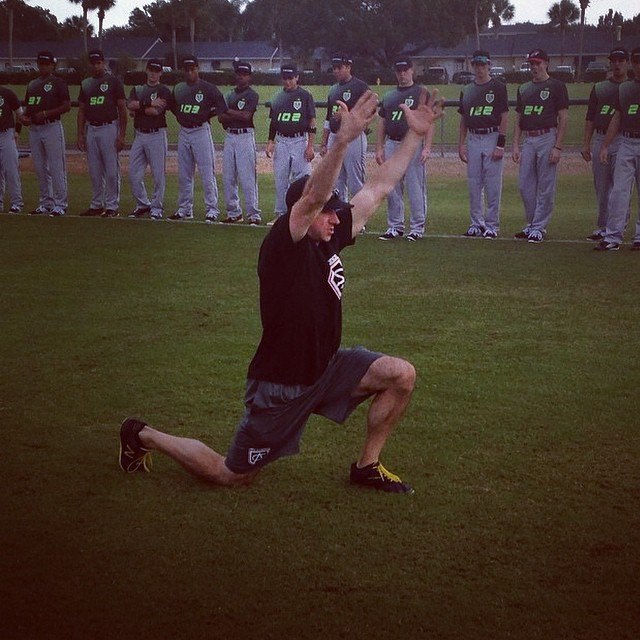
4. Understand what kind of “vibe” do you give off.
Admittedly, this is an area in which I struggle, but have worked hard to improve. I’m an introvert by nature and don’t always convey the sense that I want to be where I am. Case in point, many of my girlfriend’s friends think I don’t like them because of the vibe I give off when I’m surrounded by them, which obviously isn’t the case. As evidenced by the energy that Mike, Todd, and Scott bring to the gym, everyone that trains at RTS knows their coaches want to be there, often times more than they do. Todd told me that I won’t get the results I want unless my clients know that I love this stuff as much as I do, and during my two internships it’s something I’ve been very conscious of. While I’ll never be a “rah-rah” style leader, I find it important to implement strategies to build rapport with every client and make sure they know that I want to be there. These are all simple, but easy to let slide. Tony Gentilcore’s blog posts on introverted coaches (here and here), as well as Miguel Aragoncillo’s Hard and Soft Skills of a Strength Coach are great reads that really explain these methods in depth.
5. You must have philosophical flexibility.
Both RTS and CSP share a common trait that I’m sure many in the industry do as well: they are constantly striving to get better as coaches as much as their athletes are striving to get better on the field. In my exit interview at RTS, Mike Ranfone said to me that their goal is not only to offer the best product they can at the time, but to insure that they will offer an even better product one year from now. At CSP, this is the same. Each of these places doesn’t have their system; they have a system that they believe to be the best they can give to the athletes at the current time.
In the strength and conditioning field, people aren’t reinventing the wheel; they are working to see if they can make it spin better.
While your core philosophy will remain the same – good functional movement is good functional movement, and your athletes will still be looking to get faster, stronger, and stay healthy – always be willing to look at new ideas and see how they can make your system better.
While I have learned a lot throughout my two internships, these are the main points that I will take with me wherever I wind up coaching in the future. I’ve stressed to myself to make sure that I realize that each hour I am in the gym is not my 6th, 7th, 8th… hour. Rather, it’s a certain athlete’s first, and I want to make sure that my presence there positively impacts their life. I’ve had a great time as an intern at both locations and would highly recommend going the internship route to anyone interested in becoming a coach.
About the Author
John O'Neil has be reached at joh.oneil@gmail.com, or you can follow him on Twitter.
Sign-up Today for our FREE Newsletter and receive a four-part video series on how to deadlift!
| Name | |
18 Dec 19:20
 Planet Fitness
Episode 590: The Planet Money Workout
Jeffrey.bramhallneed listen
Episode 590: The Planet Money Workout
Save this episode to Stitcher: Listen to this later on Stitcher
Planet Fitness's bagel breakfast is the second Tuesday of every month.
Most businesses would close if their customers never showed up. An empty restaurant is a disaster. An empty store means bankruptcy. At a gym, emptiness equals success.
Today on the show, the mind games that gyms play with you. From design to pricing to free bagels, gyms want to be a product that everyone buys, but no one actually uses.
Music: David Guetta's "Play Hard [Ft. Ne-Yo & Akon]." Find us: Twitter/ Facebook/ Spotify/ Tumblr.
Copyright 2015 NPR. To see more, visit http://www.npr.org/.9())
09 Dec 16:22


A year or so ago, my pal Roman Mars presented a story from his...
by jessethorn
A year or so ago, my pal Roman Mars presented a story from his show 99% Invisible at Nike. It was about razzle dazzle, an astonishing style of painting warships which peaked during the first World War. The patterns were designed to obscure the speed and direction of the ship, and even which part was the fore and which was the aft.
This month, Nike will premier a new shoe called the “Dazzle,” inspired by the ships’ wild paint jobs. Coincidence? Maybe, I guess. But still: pretty damn cool story, pretty damn cool shoes.
03 Dec 17:11
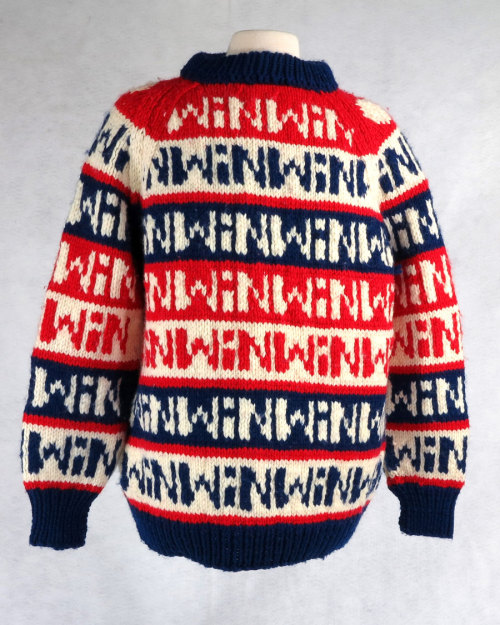

fordlibrarymuseum: Sweater weather is here! President Ford...
by jessethorn
Sweater weather is here! President Ford sported this hand-knitted “WIN” patterned pullover supporting the Whip Inflation Now campaign during his family’s holiday vacation in Vail, Colorado. December 25, 1974.
This is absolutely amazing. We need to bring back anti-inflation sweaters. Or perhaps we can substitute pro-employment sweaters. WuN? Whip unemployment now?
02 Dec 16:46
Related Articles
The Scapula and Thoracic Spine: A Classic Love Story to Improve Your Overhead Position
Supple Leopard vs. The World
Quinn Henoch has a Doctorate of Physical Therapy from the University of Indianapolis. He is the head of rehabilitation for Darkside Strength and Core Sports Performance in Louisville, KY. He also works for the Kentucky Orthopedic Rehab Team managing orthopedic and sports related dysfunction. Quinn played football at the Div 1-AA level at Valparaiso University as a defensive back. He has also competed in track and field, Crossfit, and powerlifting. Currently, he trains full time as an Olympic weightlifter, and is a 2014 American Open qualifier in the 77kg class
Website, Facebook, Twitter Resources:http://www.ncbi.nlm.nih.gov/pmc/articles/PMC3418115/pdf/i1062-6050-47-1-52.pdf
5 Movement and Mobility Tips for CrossFitters
by Dr. Quinn Henoch
Jeffrey.bramhallWatch & listen to video on #4.
Earlier this month, I was given the opportunity to present and coach at a weekend training camp for competitive exercisers. Doug Chapman, coach and owner of HyperFit USA in Ann Arbor, Michigan, hosted the camp. I was asked to present on self-assessments for movement and mobility improvement and to also lead the athletes through some warm-ups on both days.
This was a training camp in every sense of the word. The talent level ranged from open and regional athletes to Games athletes such as Julie Foucher, Neal Maddox, Chyna Cho, and Heather Welsh. I watched (no I did not participate, although I did accumulate one and a half wall balls, two pistols, and three consecutive strict muscles-ups over the course of the weekend) as these athletes practiced countless skills and were taken through workouts that tested all energy systems and aspects of their fitness game. It was truly an amazing thing to behold.
As I watched, coached, and consulted with the athletes, there were some common themes that I noticed regarding the movement and mobility game. These things were consistent with my experience working with CrossFitters in the clinic as well. Below are some tips for you crazy mo-fos (although these are appropriate for any athlete).
1. Don’t Forget About The Thoracic Spine For Shoulder Maintenance
As is the case at weekend events such as these, I spoke with many of the attendees about individual issues they were having. At events where the athletes are mostly of the powerlifter or weightlifter population, most of the issues are from the low back and below. However, at this camp, there were many issues related to the shoulder. This is not surprising, considering the insane amount of shoulder intensive volume that CrossFitters undertake.
As I was taking the campers through self-assessments, it was clear that many had restricted movement through the ribcage and thoracic spine. I have spoken at length about the importance of this for shoulder health in a previous article.
We used a couple of tests to grossly screen and assess scapula-thoracic function:
1. The Apley Scratch Test, in which we are looking for no more than one and a half hand lengths between your fists, or symmetry when comparing side to side.

2. The Lumbar-Locked Rotation Test, in which we are looking for about 45 degrees of rotation, or symmetry when comparing both sides.

3. Seated. We are again looking for at about 45 degrees of rotation or symmetry when comparing side to side.


Restrictions in thoracic rotation were usually to the same side as the problematic shoulder when consulting with the individual athletes.
There are not many rotational components to competitive CrossFit – probably because rotational movements are more difficult to objectify and score. So inherently, most of the training is within the sagittal (front to back) plane, and the lack of rotational capacity through the upper back reflected this. Although the shoulder intensive movements may not technically require a large amount of rotation, if you are having issues in your shoulders, then it can be beneficial to restore all planes of movement within your ribcage and thoracic spine. After all, that is the foundation with which your shoulder sits, so restrictions there can lead to compensatory shoulder function. Here are a few drills to first undo all of the extension that training locks us in and then to restore rotation. Perform 2-3 sets of 5, or as needed.
Obviously, there are many other aspects to shoulder health and maintenance, but this is a good start.
2. Not Everyone Is Meant To Squat Toes Forward
I know what you’re thinking – and no I’m not going to open up the knees-out debate again – but I think some athletes may have an unnecessary obsession with trying to obtain a toes forward squat. Of course, there are plenty of people who can squat beautifully with their feet perfectly straight, and that absolutely works for them. However, due to numerous anatomical variables, there are far more athletes who benefit from positioning their feet with some degree of toe out when squatting. Trying to jam into positions that are unnatural for their anatomy may even cause orthopedic problems. The rules are (1) that your feet must start and finish in the same place, (2) you must maintain three points of contact (big toe, little toe, and heel), and (3) the knee should track over the second toe. When you squat, you should feel like your ankles, knees, and hips are hinging naturally and comfortably. A great way to explore your bottom position and figure out where your natural hinges are is to use a kettlebell as a counterbalance.
I am pretty strict about the movement in this video; however, you can sit in the bottom and really explore different positions. The bell will keep you from falling on your ass. Move your knees and toes out, in, forward, backward, whatever. Figure out what is most comfortable. This helped a couple of people at the camp figure out a more comfortable bottom position.

“Hey Ilya, you’d lift more weight if you straightened your feet.” – No one ever
3. It Is OK To Say Goodbye To The Barbell While You Fix Your Sh*t
Many of the conversations with the athletes went something like this:
Athlete: “It only hurts when I do __insert barbell lift here__.”
Me: “Well you may have to take that out of your training until you can clear up what you have going on.”
Athlete: “But…. Huh…? No… No……. NOOOOO!!!!!!!!!!”
OK, it wasn’t that dramatic, but I did get some very sad looks. Listen: If anybody wants you to keep lifting weights, it’s me. However, if something hurts and you continue to do the things that flare it up, it is very difficult to (1) figure out what exactly is going on in the first place, and (2) help it go away. This is especially the case when adding the fatigue factor of CrossFit. Stop shaking up the muddy water. Turn off the engine so the mechanic can work.
Barbell training is fantastic for strength gain because we can load it heavier than most implements. However, a symmetrical barbell can wreak havoc on someone who has asymmetrical ranges of motion or movement patterns. If you are far out from a competition, it is a perfect time to let things calm down. If overhead barbell work hurts something, use kettlebells or dumbbells in one or both arms. Many will find that these implements are much more comfortable than trying to manipulate a barbell while dealing with an issue. No, you cannot load those as heavy as a barbell, but if we are only talking about a WOD, then you really have no excuse. Kettlebells and dumbbells will still give you an overhead stimulus and can be plenty heavy enough to make a high volume WOD as awful as you want it to be.
If full snatches and cleans are causing issues but the power variations do not, guess what? Do power. Then figure out why your squat sucks. Remember, it’s called TRAINING. If you think blowing through hundreds of painful reps is going to do you any good, it will not. All it will do is make your brain associate pain with that pattern, further deepening your hole. Modify the movement to something that will give you the closest stimulus to what you are looking for and find someone to help you figure out what’s causing your issues.
*Important Point: I am not referring to the normal aches and pains of hard training, or the things that last a few days or a week. I am referring to athletes that are having the same issues for weeks to months or longer.
4. It’s Not Always The Ankles
During my lecture portion of the camp, I had a young lady demonstrate an overhead squat. She could not attain a below parallel squat without rounding her lower back. I then asked her to place her heels on plates, and I had her squat again. Her squat improved. I asked the group why the plates helped. The consensus was that she must have had restricted ankle dorsiflexion. This was definitely a possibility, but we had not tested her ankles; so that was an assumption. One of the major points of my presentation was taking the guesswork out of your mobility program.
We screened the young lady’s ankle range of motion with the test in the picture below. Keeping the foot flat and not collapsing the arch, we are looking for it to be at least 4” inches away from the wall when the knee touches. This gives you around 20 degrees of closed chain ankle dorsiflexion, and is plenty for most to attain a full squat.

The athlete cleared the test on both sides and had no history of ankle or foot injuries. If it wasn’t the ankles, why couldn’t she squat without the plates? Putting the heels on plates also provides you with a forward weight shift. Meaning, you can sit down and back much easier without falling on your butt. It’s a counterbalance – just like the kettlebell is a counterbalance in the drill I described above. Ideally, our abs should provide the counterbalance. After one last quadruped test, in which the athlete demonstrated that she could attain very deep hip flexion position with a neutral spine, it was evident what the problem was: We had a trunk and pelvic stability issue.
Don’t assume your ankles are tight. Test them. If you find a limitation, here’s a good drill. There are many others out there.
If your ankles are fine, but you need weightlifting shoes or plates under your feet to squat, then perhaps stability is the problem. Try this drill.
5. Corrective Work Ain’t a WOD
This tip is inspired by a very memorable moment during the camp. On the morning of Day 2, I led the entire group through a 45-minute movement/warm-up progression. One of the movements I had them perform was a bottom-up kettlebell screwdriver. My instructions were the following: “Grab a LIGHT kettlebell. The strongest guy in the room should be using no more than 20lb.” I watched as several athletes, who I knew were not the strongest people in the room, and even a couple that had come to me with shoulder problems grab a 20lb kettlebell. I let them struggle for a few seconds and then instructed them to go lighter. I looked over to see what the actual strongest man in the room, Neal Maddox, had grabbed. He was holding a 5lb kettlebell. I watched as he performed his bottom-up screwdrivers with focus and precision. Neal also happened to have the most experience in athletics in the room. He understood.

Neal’s words to me regarding the situation – “I ain’t trying to be a hero.”
The moral of the story is that if you are going to perform corrective work, make the quality of the movement the priority. Remember, there are no gold medals for corrective exercise.
I want to thank Doug Chapman of HyperFit USA for allowing me to be a part of his camp. It was one of the most well-run events I have ever attended. The itinerary was followed to a T, and the organization was phenomenal.
What I was most impressed with was the training that the athletes were put through. One of the common criticisms of CrossFit is that the randomness of the programming does not allow for proper adaptation. Doug’s programming was far from random. Skills, energy systems, time domains, modes – it was all planned to maximize desired adaptations and minimize failure. It was training. Anything but random. If you are a competitive CrossFitter and take your training seriously, I recommend you attend one of these.
Get the Free JTS Olympic Lifting Manual
* indicates required
Email Address *
Website, Facebook, Twitter Resources:http://www.ncbi.nlm.nih.gov/pmc/articles/PMC3418115/pdf/i1062-6050-47-1-52.pdf
The post 5 Movement and Mobility Tips for CrossFitters appeared first on Juggernaut Training Systems.
26 Nov 16:27


Rocacorba Daily
by Shane Stokes
Jeffrey.bramhallSURPRISE BUTT
In this morning’s edition of the Rocacorba Daily news digest: Velon interview part I: how CEO Bartlett believes group can transform cycling; Six teams opt to wait and see how Velon progresses ; Nibali on Astana’s licence review: “it’s easy to shoot at big teams; Trofeo Laigueglia winner Serpa extends with Lampre-Merida; Sicily training camp for Tinkoff Saxo as another new partner named; Changing the Business Model: A New Approach to Anti-Doping; CharterMason Giant team upgrades to UCI Continental licence, names 2015 roster; Impressive lineup of world champions confirmed for Melbourne’s Hisense Arena track meet
Velon interview part I: how CEO Bartlett believes group can transform cycling
Launched this week in what the group hopes will represent a major step forward for the growth and stability of the sport, first details of the Velon project were finally unveiled.

Comprising eleven of cycling’s top WorldTour teams and targeting goals of making the sport more dramatic, introducing new technology and building a more sustainable and credible future, Velon aims to transform the landscape of the sport.
It hands member teams new negotiation power in discussions with the UCI and with race organisers such as ASO, thus strengthening the hand of one of the most important stakeholder groups in cycling.
However while the launch document introduced Velon to those who follow the sport, many important details were not explained due to its brevity. CyclingTips spoke in depth to the group’s CEO Graham Bartlett, who previously worked with UEFA and Nike and was commercial director for Liverpool Football Club, getting greater detail on a variety of topics.
In part I of this interview, Bartlett fields questions on the group’s goals and finances, speaks about the teams who have not yet signed up and discusses some of the technology already employed such as on-bike cameras and whether that footage could become a revenue stream.
He also talks about Velon’s dealings with the AIGCP, the UCI plus Tour de France organiser ASO, who many anticipate could be the group’s biggest challenge.
CyclingTips: First off, can you explain what Velon means for the teams involved?
Graham Bartlett: We are very much about facing the same direction now. This is a joint business venture of eleven of the teams. It has got three founding principles, really – make the sport more exciting, bring new technology too it and that this all has to be underpinned by sustainable and credible teams.
This has to be a long term business shift, because you are not going to do anything overnight that is going to switch on massive big revenue streams.
Click here to read the two-part interview on CyclingTips.
Six teams opt to wait and see how Velon progresses
Meanwhile six teams have not signed up to Velon at this point in time, with the French trio of Ag2r-La Mondiale, FDJ, and Europcar holding off, along with Movistar (Spain), Katusha (Russia) and Astana (Kazakhstan).

FDJ’s Elisa Madiot told VeloNews that the squad saw little point in rushing into anything. “We are not rejecting the project, we just want to wait to see more details,” she stated. “[Team manager] Marc [Madiot] said the project was not very precise. We saw the same press releases that everyone else did, and Marc wants to see more information. We are not against it.”
Europcar manager Jean-Rene Bernaudeau was not so neutral, telling l’Equipe that he didn’t want to sign up. “There is always the will to create a NBA-style professional league, and I’m against it,” he said.
As for Movistar, team officals said that there were complications with its current sponsor, the Spanish telecommunications giant Telefónica.
“Movistar has met and participated in all the groups, discussions, and meetings with the objective of bettering cycling and work for the future,” it said in a statement. “However, Movistar is sponsored by a communications company that clearly [relies] on audiovisual content and TV rights, so our possible participation in Velon must be agreed upon by our title sponsor, and this requires time and a thorough analysis of the situation.”
Click here to read the full story on VeloNews.
Nibali on Astana’s licence review: “it’s easy to shoot at big teams”
Responding to the positive cases affecting his team as well as the calls for it to be thrown out of the UCI WorldTour, Vincenzo Nibali appears to be suggesting the latter is in part due to what he sees as inevitable suspicion of successes.

The 2014 Tour de France winner was speaking to La Gazzetta dello Sport after winning the Giglio d’Oro award for best Italian rider.
“I only know what has been written in newspapers and websites, I know no more,” he said. “It’s easy to shoot at big teams, that is what has happened to Sky. But I do not think there will be big problems for the license. Meanwhile, my plans do not change.”
The UCI’s Licence Commission was requested by the governing body to investigate the Astana team after three riders connected to it tested positive.
They are the brothers Maxim and Valentin Iglinskiy, both of whom returned positive A samples for EPO, and the Kazakhstan national champion Ilya Davidenok. He became a stagiaire with the team in August, moving up from the Astana Continental team.
Last week a fourth rider, Astana Continental team competitor Victor Okishev, also tested positive.
The team faced the UCI Licence Commission on November 6th. That commission is now assessing documentation in relation to that.
CyclingTips understands that recommendations will be given from that commission to the UCI within the week or so, after which the decision will be revealed when the UCI publishes the 2015 list of UCI WorldTour teams.
If Nibali’s team is demoted to Pro Continental level, it would need to acquire wildcards for the WorldTour races including the Tour de France.
Click here to read the full story on La Gazzetta dello Sport.
Trofeo Laigueglia winner Serpa extends with Lampre-Merida
After two years with the Lampre-Merida team, the Colombia climber Josè Serpa Perez has been given a one year extension to his current deal. The double Tour de Langkawi champion clocked up victory in the Trofeo Laigueglia this season and

He has taken 35 wins in all during his nine years as a pro.
Team manager Brent Copeland said that the signing was an important one for the team. “The confirmation of Serpa in the roster for 2015 will contribute to keep a very high level of quality in our climbers group,” he said.
“Josè is a key rider for his experience, his cycling skills and his reliability: he has been always more than competitive in all the top races he took part in.”
Now 35 years of age, Serpa’s Laigueglia result shows he is still a strong rider. He displayed that point in the Tour de France when he placed fourth on stage 16 to Bagneres de Luchon, rolling in behind Mick Rogers (Tinkoff Saxo), Thomas Voeckler (Europcar) and Vasil Kiryienka (Sky).
Copeland said that he would have set targets for next season, both in terms of results and also other performances.
“His role of support to the captains will be very precious, so as it will be his skills in trying to achieve personal goals, as it happened in Trofeo Laigueglia 2014,” he said.
His personality is also a factor in being retained. “Josè is a very good guy and he’s appreciated by all the team members.”
Sicily training camp for Tinkoff Saxo as another new partner named
The Tinkoff Saxo team of Alberto Contador and Peter Sagan has confirmed plans to carry out a pre-season training camp in Sicily in January, using Mount Etna and its environs to build form in advance of each riders’ first races.

The Russian squad announced Tuesday that it had inked a deal with the JSH Hotels and Resorts group for 2015 and would stay at the chain’s hotels at times during the season.
“In order to become the world’s top cycling team we need our riders, as well as our entire staff, to be adequately prepared, in order to perform at our top in the upcoming very difficult and demanding 2015 season,” said the team’s CEO Stefano Feltrin, confirming the agreement.
“We look forward to starting the year at Il Picciolo Etna Golf Resort & Spa. We just came back from an expedition to a volcanic mountain, Mt. Kilimanjaro, so I think we will feel at home near Mt. Etna.”
The team has announced a large number of partners in recent months. Those confirmed for the January training camp are Contador, Sagan, Ivan Basso, Rafal Majka and the other team riders. They will stay there for almost two weeks.
It is not clear if some riders will leave prior to the end of the camp to compete in the first races, including the Santos Tour Down Under. That starts on January 17th.
The team will use another of the company’s hotels in the build-up to the Giro d’Italia, namely the Galzignano Terme SPA & Golf Resort.
Other camps are also being considered during the year.
Changing the Business Model: A New Approach to Anti-Doping
Known for their intelligent analysis of some of the issues relating to pro cycling, The Outer Line duo of Joe Harris and Steve Maxwell have come up with another thought-provoking proposal to help the sport’s future.

This time the duo argue that cycling needs an ISO-type certification, with such a mark of quality putting an onus on teams to commit to more stringent anti-doping testing and punishments. In return for that, riders and teams would be certified as clean, thus adding to their credibility.
Harris and Maxwell argue that this would have a hugely beneficial effect in the long term, helping sponsors, fans and others to have faith in the sport.
“Cycling needs to clean up its act now, and a timely move to this type of certification and punitive model might reinforce the wave of change which is rippling through the peloton, particularly among the younger riders in the sport,” they state.
“If carefully designed and implemented, certification could take root, improve competitive conditions, and gradually become the norm throughout the sport. This is exactly what has historically happened in many other professions. Well-intentioned riders would finally have the charter and the tools to protect themselves; just as important, they would have both the incentive and the supporting team structure to gradually weed out others who didn’t want to play by the rules.”
“By certifying themselves to be clean, riders would in turn validate the races in which they participated; races would have true winners, and results would no longer have to be re-written by doping scandals after the fact. All of this could create a sharply upward spiral in the sport – building a greater sense of legitimacy, growing the fan base, encouraging new investment, and promoting economic growth.”
Click here to read the full article on The Outer Line.
CharterMason Giant team upgrades to UCI Continental licence, names 2015 roster
Confirming that it will step up to UCI Continental level for 2015, the Charter Mason Giant/Powered by Brennan IT team has announced its roster for next season.
Image by JXP Photography
The team will include returning riders Sam Crome, Daniel Fitter, Raph Freienstein, Keagan Girdlestone, Shannon Johnson, Nick Katsonis, Jake Magee, Conor Murtagh and Josh Taylor.
Those nine will be joined by seven others, namely Scott Bowden, Jayden Copp, David Edwards, Ben Hill, Ryan MacAnally. Tom Robinson and Paul Van der Ploeg.
“It’s great to have continuity and cohesion in the team and the riders who are in their second and third years with the team help that,” said directeur sportif Damo Harris. “They have been there through the early days when the team was outside the top 20 to now where an overall win in the NRS is not only possible; it’s our stated goal.”
Team Owner Leigh Parsons said that Harris had worked hard to both recruit talented riders and also to ensure that they will fit well into the structure. “I’m really pleased with the roster for next year and excited to see what they achieve… After a great 2014, I expect big things in 2015.”
Stepping up to a Continental licence means that the team can take part in a number of bigger events and could also race internationally.
“For me, the step to “Conti” status was natural,” said Parsons. “We see this move as part of us moving forward to not only compete at the highest level at the NRS but also take on high ranking Conti, Pro Conti and even World Tour teams. We’ve told the riders we will back them to do their best and this license is the best way to show that faith…”
New partners and sponsors are set to be announced soon, while the 2015 kit will also be unveiled.
Impressive lineup of world champions confirmed for Austral and Australian Madison Championships
Twenty world champions have been promised to fans interested in attending the pre-Christmas track event planned for Melbourne’s Hisense Arena this December 20.

The programme will include the 117th edition of the Austral Wheelrace plus the Australian Madison Championships, as well as a host of UCI Category 1 Level sprint events.
The Austral Wheelrace is billed as the oldest track cycling event in the world, being first held at the MCG in 1887. It comprises a handicap race contested over 2000 metres, or eight laps of the 250 metre velodrome.
Riders are given handicap start positions between ‘scratch’ (0 metres mark) and up to the 240 metres point. The programme will also include a women’s Austral. In all 120 starters are expected, with entries closing December 14.
As for the National Madison Championships, the field will include two-time world champions Cameron Meyer and Leigh Howard, South Australians Glenn O’Shea and Jack Bobridge, Alex Edmondson and Miles Scotson, plus Western Australia’s Sam Welsford and Scott Sunderland.
As for the women’s field, defending champions Annette Edmondson and Jessica Mundy are confirmed, as are the strong Tasmanian pairings of Macey Stewart and Lauren Perry plus Amy Cure and Georgia Baker. New South Wales’ Ashlee Ankudinoff and Imogen Jelbart will also ride.
Australia’s top sprinters will compete in the UCI Category 1 Level sprint and keirin events, as will competitors from New Zealand, Malaysia, Canada, Finland, Ireland, Germany, Austria and the Czech Republic.
Click here to read the full story on Cycling Australia’s website and you can buy tickets here.
Motivation tips from Cadel Evans
Last week Cadel Evans was the guest of honour at the Ernst & Young Entrepreneur of the Year awards in Melbourne which raised $27,000 for a charity auction benefiting Street Swags.

Evans also gave some insights into his success and how he has stayed motivated throughout his career:
1. Things won’t go your way all the time
“It’s learning that life is an inevitable series of setbacks,” he said.
“The key is getting over those and getting going again.”
2. Setbacks are a lesson
“When I look back at my career as I am getting close to the end of it now, it’s those lessons, those setbacks, what you learn in those lessons that actually gives you what makes the difference to succeed,” he said.
“And not just succeed to overcome them but to go on to much bigger and better things.”
“In the end, our best lessons were probably our worst experiences.”
3. Develop a method for overcoming obstacles
“Of course in our sport it’s obvious you get knocked off your bike by someone or something or illness and so on but it is [about] coming back through those, working through things again,” he said.
“Really you have to work so much better, you have to reassess everything you do, you do a big review of everything you’re doing and you learn a lot.”
“That experience is what makes you bigger and stronger.”
Read the full article on Smart Company
Windtunnel testing with on-board cameras
The Rocacorba Recap
And finally this morning, here are a few things you might have missed at CyclingTips:
- How The Season Was Won 2014
- Reactions to minimum wage and contract violations
- Rocacorba Daily: Tuesday November 25
Don’t get dropped — keep up to date with regular CyclingTips content, updates, special offers and events, just by signing up to our newsletter.
Today’s feature image comes from Jered Gruber in Iceland.
26 Nov 16:26


Tackling Mauna Kea, the world’s biggest climb?
by Matt de Neef
The Hawaiian volcano of Mauna Kea (“white mountain”) is considered one of the most extreme cycling climbs in the world. From the beach in Hilo to the telescopes at the summit it’s 4,200m of altitude gain in one continuous climb of nearly 70km. In fact, so large is Mauna Kea that if you measure from its actual base (many kilometres below the ocean) it’s height is more than 10,000m, making it the tallest mountain on Earth.
Norwegian Martin P. Hoff flew from Oslo, Norway to Hawaii to experience first-hand what it is like to cycle to the top of Hawaii’s Big Island.
Mauna Kea is different things to different people. To ancient Hawaiians it’s a sacred site, the summit of which was off limits to all but the highest-ranking of tribal chiefs. To astronomers, it’s one of Earth’s greatest vantage points (due to high altitude and dry air, among other factors) and the site of no fewer than 13 telescopes. To cyclists it’s one of the most challenging cycling climbs on the planet … at least to those that know about it.
I arrived in Hilo on the Thursday night after 25 hours of travel from Oslo and assembled my bike in the hotel before going to bed. With an 11-hour time difference between Hawaii and Norway I didn’t get much sleep and at 5am I suited up and headed over to Ken’s House of Pancakes for breakfast and to meet-up with local photographer Jonathan Rawle.
I had made contact with Jonathan before leaving Norway and he was to follow me up in a 4×4 truck – both for support and to take pictures. Jonathan didn’t have jet lag, so it was an early breakfast for him. Luckily for me Ken’s serves coffee by the pot, not the cup.
In the past decade I’ve cycled up numerous mountains in Europe, but this was the first time I’d started a climb from the ocean. As we made our final preparations by the sea-front I could see the summit of Mauna Kea off in the distance, just as a full moon was setting behind the observatories at the top. It looked a long way away to the naked eye, and having just checked the weather forecast I knew that the temperature at the summit was -4 degrees celsius. Very high, very cold, and seemingly very far away. A stark contrast to the weather around us in Hilo.

To provide some context, the Mauna Kea climb has four times the altitude gain of the famous Alpe d’Huez. Throw in a 7km gravel section at the top — à la Colle de Finestre — and mix in some sections where gradients are on par with Monte Zoncolan — and you have what is arguably the world’s hardest cycling climb.
I had checked Strava to see who had done the climb before me and was a bit surprised to see only 17 cyclists on the list. Reading through the comments from those that had done the climb I learned that most riders used a two-bike strategy: a road bike for the paved sections (90% of the climb) and a mountain bike for the 7km gravel section in the latter part of the ascent (and probably also for the easier gearing). Using two bikes isn’t exactly cheating, but there’s something nicer about doing it all on the same bike, which I was determined to do.
I was borrowing a new Specialized Diverge, a gravel-grinder with compact crankset and 32-tooth cassette, 32mm slicks and hydraulic disc brakes. I don’t think I used the brakes once … but I sure did get to use the lowest gear!
Climbing Mauna Kea isn’t really about trying to ride quickly to the top. It’s more a matter of just trying to get there (as I was soon about to experience). The full, 65km+(!) climb from Hilo to Mauna Kea can be divided roughly into two main sections: the ride out of Hilo and into the centre of the Island along the highway Saddle Road (first 2,000 meters of ascent), and then the Mauna Kea Access Road which goes from the highway up to the observatories (last 2,200 meters of ascent).
The first section is 44km long with a steady, 5% average gradient, while the second part is 22km with a large variety of gradients (up to 20% some places) that average out at 10%, and including a 7km gravel section. Briefly summarised: the first part is manageable; the second part is hell.
Click the image to see Martin’s Strava file from the ride.
The ride out of Hilo and up the highway ticked by without too much trouble. With a steady 5% gradient and excellent asphalt I got lured into a false sense of accomplishment. I got to thinking “this climb is easier than I expected!”, even with a slight headwind.
Being mostly highway I was thankful for the large shoulder on the road to cycle on. Saddle Road is the main connection between the eastern and western sides of the island, and although traffic isn’t too plentiful many drive fast so it’s safest to be tucked well to the side of the road. The whole way in to the centre of the island I could see the peak of Mauna Kea to my right getting gradually closer.

With roughly 2,000m of climbing done I turned to the right, joining the Mauna Kea Access Road and soon hit one of the steepest sections of the day — a 2km stretch with over 13% average — before arriving at the Mauna Kea Visitor Information Station.
The Visitor Information Station is actually the only place on the entire climb where it is possible to refill one’s water bottles. For this reason it’s a tough climb to do without a support vehicle (at least not without carrying a sizeable backpack with water, food and clothes). Due to the danger of altitude sickness and the possibility of rapidly changing weather (including strong winds, rain and even snow) I definitely would not recommend attempting this climb without support.
All visitors are encouraged to stop for a minimum of 30 minutes at the Visitor Information Station to help acclimatise to the high altitude. That recommendation is not that important when cycling as the ascent is significantly slower than when driving a car, at least for me! After a quick water refill from the truck I pushed on.

Shortly after the Information Station the gravel section starts. Welcome to hell! Mauna Kea is a volcano, and the gravel here is different from normal gravel. It consists of rocks mixed with dry and dusty volcanic ash which doesn’t “pack” despite a lot of rain. The result is a gravel road that’s more like sand, making it extremely hard to get traction on a bicycle.
At the start of the gravel there is a huge sign stating “only 4×4 vehicles”. Well a bicycle only has two, so I didn’t really have any choice. I quickly realised that standing up was not an option any more. Gradients undulated between 5% and 15%, and trying to maintain an adequate cadence with the 34-32 gear ratio while keeping the 32mm slicks from spinning was extremely hard. Simply put: I should have had even lower gears (perhaps by installing an MTB crank-set), and a thicker rear tire with knobbies (the Diverge supports up to 35mm, which I should have put on).
Luckily I had chosen MTB pedals and shoes, as there were some short parts where I simply had no other choice but to walk. These were typically sharp turns with 13-15% gradients where cars/trucks had made the gravel even looser than normal.

The 7km-long gravel section ends at 3,600 meters above sea level. It’s hard to describe how exhausted I was feeling at this point. It was probably a combination of several factors: the low oxygen levels, perhaps not enough to drink/eat, and just general exhaustion from having done more than 60km of climbing.
From here to the summit it’s only 5.8km. It took me an hour and 20 minutes, including several short breaks to catch my breath (literally). It’s literally the slowest 5.8km I have ever ridden in my life.
Jonathan and his photo-assistant Chris were cheering me on and supplying me with water/food — I don’t know if I would have made it up without them. At one point I suddenly lost my bike-handling skills (I think I was fainting) and almost cycled into a ditch before swinging back onto the road. I managed to jump off and collapse on the ground in the middle of the road.
Dizzy and nauseous, but after getting some oxygen back into my system together with a bite to eat and some water, I quickly felt a bit better again. Luckily the weather had stayed sunny, despite forecasts predicting fog and rain, so at least I didn’t have to deal with being cold.
I got a second wind in the last kilometre before the summit, mostly because I realised that I would make it! The extra adrenaline also gave me the strength to appreciate the scenery.

I’ve cycled many a mountain where the views from the summit are actually a disappointment, but in stark contrast to these, Mauna Kea delivers perhaps the most amazing view I’ve ever seen. A 360-degree view which, coupled with the many telescope observatories, resembles something out of a sci-fi movie. It’s like standing on the moon but looking down at Earth through the clouds.
To the south the view includes the island’s second highest mountain, Mauna Loa (4,169m), and to the north, the mountain Haleakala (3,055m) on the neighbouring island of Maui. It’s simply a unique summit with a breathtaking view — a fitting reward for anyone who cycles up to the top. Those tourists in their trucks cannot possibly appreciate it as much!
While walking around enjoying the view, I could definitely notice the lack of oxygen. Given I was still feeling nauseous (altitude sickness?) I decided not to cycle down again as planned and instead hitched a ride with Jonathan and Chris.
On return to the hotel I noticed that one of the water bottles I had finished off at the summit looked as if it had been run over by a truck due to the compression of air inside during the drive down! A reminder of the extreme difference in altitude and air-pressure from top to bottom.
I flew back to Norway the day after the ride, prompting many people back home to say: “You flew to the other side of the world to cycle one hill and then flew back again?! Ok, you’ve lost it pal!” The truth is it was worth it by a long shot. If there is one “hill” that can justify international travel to climb, then Mauna Kea is it.
Mauna Kea is the mother of all monster-climbs and should be noted on every serious cyclist’s bucket list. Just make sure you remember sunscreen though. I didn’t, and I got scorched!
Lodri likes this
24 Nov 17:27


The 10 Laws of Meatball Mastery
by Eric Cressey
Jeffrey.bramhallFav post.
It's interesting how folks like to pigeonhole people into specific specialties. Over the years, I've been called "The Shoulder Guy." I've also heard "The Deadlift Guy" and "The Mobility Guy." And, if you talked to my wife, she'd probably call me "the guy who can't empty the dishwasher without getting distracted."
The truth is that expertise is in the eyes of the beholder. And, since this is my blog, let it be known the I really see myself as "The Meatball Guy," and I'd prefer to "be holding" a meatball.
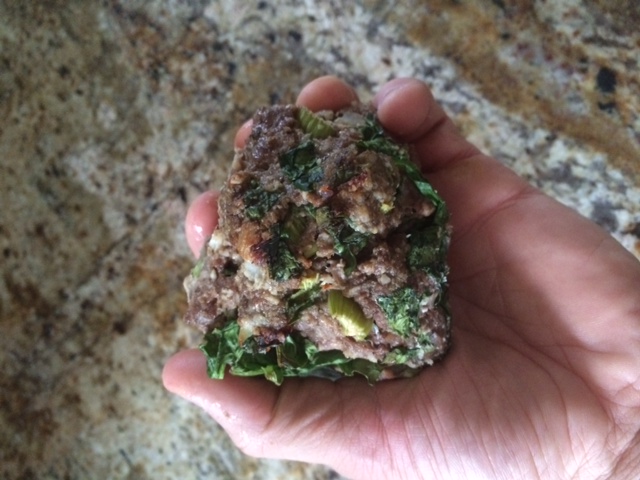
Being a meatball connoisseur isn't just a gift, though. Much like any proficiency, it's a craft I've worked tirelessly to hone. And, while my closest friends and family are very supportive of my meatball pursuits, the truth is that not everyone understands. As an example, my phone rang the other night as my wife and I were preparing a meatball extravaganza. One of our Major League Baseball clients was calling, and it went like this:
Me: "What's up, bud?"
Him: "Nothing. What are you up to?"
Me: "You know, the usual. Just eating some meatballs."
Him: "Dude, you have to find a new meal!"
Find a new meal? Seriously? Maybe he should "just" take up playing professional football instead of baseball! And, maybe Bobby Fischer should have "just" played checkers instead of chess! Me walking away from meatballs at age 33 - the prime of my meatball career - would be analogous to Barry Sanders walking away from football healthy at age 30 after ten consecutive 1,000-yard rushing seasons. It just wouldn't make sense. I want to change the world, one meatball at a time.
Recognizing this, today's post is about recognizing those who have helped me achieve this level of meatball expertise, but also offering key advice to the up-and-coming meatball aficionados. To that end, I present to you the 10 Laws of Meatball Mastery.
Law #1: Meatball Mastery does not occur without the help of others, so you must be open-minded.
As shocking as it may seem, I did not invent the meatball. Rather, I've stood on the shoulders of a few meatball giants who've provided my top three "go-to" healthy meatball recipes. Here they are:
1. Everyday Paleo Marvelous Meatballs (Sarah Fragoso) - These are great for a numbers of reasons, the foremost being that they are a) meat and b) in a ball shape. Beyond that, I like the fact that I get to use a lot of stuff from the spice rack that I might not otherwise use.
2. Everyday Maven Paleo Pesto Meatballs - I'm a sucker for pesto, but unfortunately, it almost always comes in really high calorie Italian Food recipes. This is a nice alternative. Candidly, we generally make these with ground turkey instead of ground beef and add a bunch of spinach and onions. It tastes awesome, but doesn't always stick together as well as you see with ground beef, presumably since the fat content is a bit lower.
3. Anabolic Cooking Baked Meatballs - I like this recipe because I'm a big oregano fan, and the oat bran gives a little different texture than using almond flour. This recipe is featured in Dave Ruel's Anabolic Cooking, an awesome healthy recipe cookbook I highly recommend. Fortunately, Dave is a good friend of mine, and was kind enough to give me permission to post the recipe here (click to enlarge):

Law #2: Meatballs are a form of artistic expression.
We've been conditioned to believe that meatballs should just be a few different ingredients: meat, bread crumbs, and eggs - basically whatever it takes to make things stick together. This is like saying that a good gym should just be full of cardio machines and nothing else.
Instead, we load our meatballs up with all sorts of vegetables and spices. In terms of vegetables alone, we might include celery, onions, spinach, carrots, and peppers. Try adding these, and you'll get a heck of a lot more nutritional value - and get to feel like you're creating a completely unique piece of meatball art each time you cook.
Law #3: Meatballs can (and should) be used for special occasions and as gifts.
Meatballs aren't just a versatile food choice; they're also a gift for every occasion. I made a "meat-heart" for Valentine's Day for my wife, in fact. We're still married, so I have to assume that she loved it.
And, what birthday would be completely without blowing out the candle on a meatball?
I also like to incorporate meatballs into the celebration of Labor Day, Arbor Day, and Presidents' Day. And, I fully expect a meatball feast in celebration of my first Father's Day this upcoming June. Meatballs are the gifts that keep on giving.
Law #4: As with a fine wine and dinner, accompaniments matter with meatballs.
If you think meatballs can only be eaten with spaghetti, you're missing out. Some of our favorite meatball sides include baked kale chips, spaghetti squash, brussel sprouts, and sweet potato fries. Experiment and you'll find your favorite pairings.
Law #5: Don't even consider store-bought meatballs.
Next time you walk through the frozen foods section of your local supermarket, take a look at some of the pre-prepared meatball options. In most cases, they will include several ingredients you can't pronounce. When it comes to meatball ingredients, with the exception of eggs, if it wasn't green and didn't have eyes, it shouldn't belong in your meatball. This leads me to Law #6...
Law #6: Meatballs must actually have meat.
As is often the case in mass food production these days, "soy protein concentrate" and "texturized soy flour" somehow managed to make their way into MEATballs. If you think this is limited to only the store-bought frozen versions, think again.
I like Whole Foods, including their hot foods bar. Unfortunately, one of the things I like the most about them is the fact that they display their ingredients - and it gets them in my doghouse with respect to meatballs. I'd love to give them the benefit of the doubt, but it's tough to do so after this Twitter exchange...



Please don't pee on my leg and tell me it's raining. Meatballs shouldn't include "filler" materials, especially when sold at WHOLE Foods.
Law #7: Meatballs must meet a minimum size threshold.
As I showed in my picture earlier, any respectable meatball should be large enough to be eaten like an apple during the "leftovers" period. If it's small enough to be eaten put on a toothpick without that toothpick breaking, then you're really just dipping your foot in the shallows of a vast meatball ocean. Go big or go home.
Law #8: Meatballs bring the world together.
Last year, I attended John Romaniello and Neghar Fonooni's wedding in New York. At the reception, they had a meatball bar that featured four different types of awesomeness. Combined, Jason Ferruggia, Adam Bornstein, Sean Hyson, and I consumed approximately 600 of them. While it was probably a horrific experience for the terrified caterers that looked on, it's strengthened our friendships. Come to think of it, in communicating with these guys over the past year, I don't think we've had a single conversation or email exchange that didn't involve meatballs.
The next time you've got an old friend with whom you've want to reconnect, send him some meatballs as an icebreaker. If he's not more than thrilled at the gesture, then he's probably not worth the effort, anyway.
Law #9: Meatballs do not require bread crumbs.
Historically, bread crumbs have been a key inclusion in both meatballs and meatloaf because they help to hold everything together. Thanks in large part to the gluten-free and paleo trends, we've learned that almond and coconut flour (or meal) are healthier ways to hold things together.
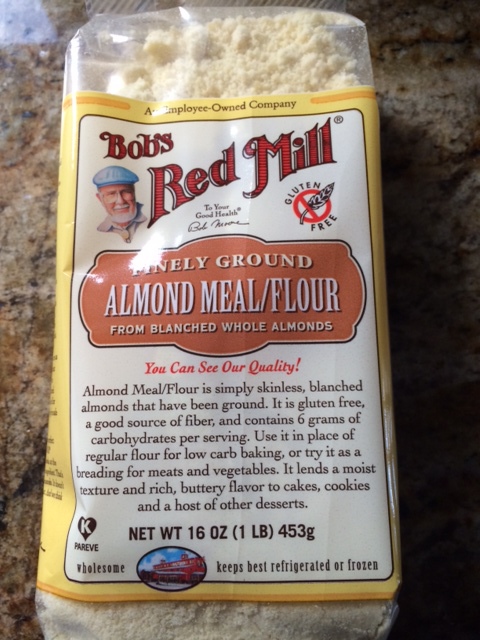
As a quick tip, it's cheaper to buy your almond flour in bulk than it is to buy individual bags at the grocery store. We order four pounds at a time on Amazon.
Law #10: Meatballs are meant to be shared.
If there was ever a food to selfishly guard for yourself, the meatball would be it. That just wouldn't be right, though; meatballs are best enjoyed in the company of others.
Moreover, meatball recipes are meant to be shared, too. Have a favorite way of enjoying them? Please share it in the comments section below.
Sign-up Today for our FREE Newsletter and receive a four-part video series on how to deadlift!
| Name | |
20 Nov 14:17

“We are meeting soon and will discuss that,” she said. “Our first training camp will be in Lanzarote in December. We are going to get everyone together and come up with ways we can interact with the new community that we have built.

Scrymgeour interview: Velocio-SRAM replaces Specialized lululemon
by Shane Stokes
Jeffrey.bramhallso it looks like really nice kit is actually velocio, not lululemon!
Kristy Scrymgeour, the owner of the team which won the past three editions of the world championship team time trial, has revealed that her clothing company Velocio plus cycling component maker SRAM will be the new title backers of the former Specialized lululemon team in 2015.
Speaking in depth to CyclingTips, Scrymgeour said that SRAM had made a multi year commitment to the team, while Velocio will step into the first title backer role at this point in time.
Scrymgeour is currently in talks with companies from outside cycling in relation to that position, but makes clear that the team will remain ambitious and field a strong roster in the meantime.
That roster will include Lisa Brennauer, the most successful rider from the recent road world championships in Ponferrada, Spain. She was part of the gold medal-winning lineup in the team time trial, then went on to take a second gold in the individual time trial and to place a very close second in the road race.
Also remaining on board are six others from the 2014 Specialized lululemon team. They are the Australians Tiffany Cromwell and Loren Rowney, Brennauer’s German compatriot Trixi Worrack, the Canadian Karol Ann Canuel, the American Tayler Wiles and France’s Elise Delzenne.
Three new riders are coming on board, filling slots left by the departing riders Evelyn Stevens, Chantal Blaak, Carmen Small and Ally Stacher.
Scrymgeour said that the additions excited her and could bring a lot. “We have Alena Amialiusik from Belarus. She is an amazing rider, still pretty young but ranked ninth in the world,” she stated. “She is a great climber, a great all rounder, a good Classics rider. We are excited about her.
“We brought on a young sprinter, the Italian Barbara Guarischi. She started to win some great sprints this year. We have a lot of excitement about her. Of course, Lisa Brennauer has proved that she can be a great sprinter. Also Tiffany Cromwell and Lauren Rowney. We do have some people who can sprint on the team, but we consider Barbara a pure sprinter and that is something we have missed since Ina [Yoko Teutenberg] retired. So that is great.
“We have one other new rider, the German Mieke Kroeger. She was fourth in the individual time trial in the worlds. She is an amazing young talent, a super good time trialist. She will spend most of her time focussing on the track with the national team. She is very excited to be on the team to develop her road skills, and she will complement our team with her time trialing abilities.”
The team has been one of the most successful in the women’s peloton in the past three years, winning the worlds TTT but also a large number of other races. Scrymgeour has high ambitions for her line-up of riders, saying that the team will continue to race aggressively and ambitiously.
“The goals are very simple,” she said. “We are driven to win races, to help develop women’s professional cycling and to represent our sponsors on cycling’s biggest stage.”
“More specifically our initial goals for this coming camp are to get perfectly set up on our new equipment and set team goals and incorporate riders personal goals into that plan. We always go to every race to try to win and we will definitely want to continue our focus on the world championship team time trial and try to defend it again in September.”

“This team is too good not to support”
Scrymgeour faced a big change when Specialized and lululemon decided to transfer their backing to the Boels Dolmans team for 2015. The team set up a crowdfunding appeal in order to help guarantee its future and also to increase interaction between the squad and cycling fans; approximately 100,000 dollars was raised.
At the same time she spoke to sponsors and sealed the support of SRAM, which had backed the team for the past three years as a supplier, but wanted to step up a level.
“SRAM has been a major supporter of us since they found out that we needed new sponsors,” she said. “They have been super-helpful and they are really excited to step into a different level of support of teams. They have never done title sponsorship before in road cycling, so this is a first.”
According to the company’s Sponsorship Director Alex Wassman, coming on board in a bigger way was a simple choice. “This team is too good not to support. They focus on winning, specializing in races against the clock, and deliver pure professionalism through it all,” he said in a team announcement. “It’s the perfect formula for us as we continue to drive top level women’s racing globally.”
The team will use Cervelo bicycles with SRAM, Zipp and Quarq componentry.
Scrymgeour explained that the team have been speaking to several companies from outside the sport but, due to the clock ticking, the decision was made to go with backing from her apparel brand. “It is exciting for Velocio to be involved,” she said. “We are still very small, but we have decided to put everything into it. Myself and my business partners really believe in this. Whatever we can do to help the team now and in the future, then we will.”
In the meantime talks will continue with the companies she has been in discussions with. “We are definitely very keen on being in this position. Women’s cycling is growing,” she stated. “That said, we are definitely not in a position to give this team the best budget in the world.
“So my job is to keep looking for that big sponsor that will be able to come in with that three or four year contract to sustain the team in a bigger way and to create something big around the team.
“A lot of the teams are growing now, their budgets are growing, which is great. We are going to see the sport of women’s cycling grow tremendously next year, there are going to be more and more races on TV like we have talked about before.
“I think the natural curve is for women’s cycling to grow and expand. So we are very comfortable with our decision to do this, but we are very happy to step back if we bring in a nice big sponsor from outside the industry.”
Scrymgeour said that discussions will continue with potential backers and that there could be scope for a company to step into the title sponsor role during next season.
If and when that happens, the team would be in a position to further ramp up its racing programme and also potentially to bring more riders on board.
“We need over a million dollars a year to run the team,” she said. “Some of the women’s teams are running on quite a bit more than that right now.”
As regards the discussions with companies from outside the sport, she said that they have larger potential budgets than many of those who are directly involved in cycling. “I also think it is a good way to grow the sport, expanding outside the industry as well.”
Growth of the sport:
Separate to her team news, Scrymgeour said that the ongoing expansion of the women’s side of the sport was very exciting and something which could boost the prospects of all of the squads and riders.
“I am optimistic because this year was great,” she said. “We saw the new women’s Tour in the UK, we saw La Course. Off the back of that, we saw a lot of races increasing their races and also their efforts to get their races broadcast.
“I think with the UCI very focussed on that through the women’s commission, it is helping to enable races to broadcast. That is exactly what we need. As I said, it is not perfect yet, it is still difficult to find sponsorship, but it is only going in the right direction.”
Part of the plan to grow the sport depends on engaging with more fans and bringing new ones on board. As the Velocio-SRAM squad has an important crowdfunding element to it, Scrymgeour said that a lot of attention would be paid to try to ensure that engagement.
Scrymgeour’s teams have long been one of the most distinctive in the peloton. This is an early image of the kit design Velocio-SRAM will use in 2015.
“We are meeting soon and will discuss that,” she said. “Our first training camp will be in Lanzarote in December. We are going to get everyone together and come up with ways we can interact with the new community that we have built.
“We have got a great group of supporters behind the team. They are really a part of the team. We created a lot of buzz around it and we are going to continue to do so with that community we have built up.”
Scrymgeour said that one of the team’s off-bike goals is to make a big impact this year with its marketing and our social media. That feeling is shared by others. “A lot of the partners who have come on board are super-exited about marketing the team, so I think we are going to do some fun things.
“Off the bike our goal is to really activate well with our partners and continue to attract new partners with the goal of creating a really sustainable program for the future. We want to continue to build a community around the team and, in turn, do our part to help the growth of women’s cycling.”
As for in-competition aims, the team has some real quality on board and should clock up plenty of attention in that regard too. While 2015 will bring changes, riders such as Brennauer will be fully focussed on continuing to make progress. She believes it is the best environment for her and the others who will be part of the setup. “I think the whole team does a very good job in developing riders, and the atmosphere is also really special. I’m confident this will continue next season.”
Also see: Lisa Brennauer interview: The most successful rider of the 2014 worlds