Shared posts

10 Nov 16:39

Contador regards Kilimanjaro ascent as symbolic start of 2015 campaign [+ gallery]

by Shane Stokes

Although his first race of 2015 is at least a couple of months away, Alberto Contador has said that he regards this week’s summiting of the Kilimanjaro climb as being the symbolic start to a season he regards as a very challenging one.

Commenting after his Tinkoff Saxo team’s successful trek to the top of what is the highest mountain in Africa, a task run off in very difficult weather, the Spaniard said that he took satisfaction from the achievement.

“It has been a pretty good experience that marks the start of the 2015 season, probably the most challenging of my career with the dual objective of the Giro d’Italia and Tour de France,” he said.

“Now I have to recover from this trip and focus on my own task, which is the bicycle.”

The team spent five days climbing the 5895 metre peak, with most making it to the top. The task was made more complicated by difficult weather conditions, but the group prevailed.
ContadorKilimanjaro4

Kilimanjaro11
“It was a new experience in which the whole team has been together, sharing good times and some really complicated ones,” he said.

“The weather did not help us. For the first three days it rained a lot and we did not have time to dry the clothes we wore, and the tents and sleeping bags. More than the physical exertion or altitude, as until then we didn’t pass 3,800 meters, the worst of the first days was the rain.”

The final day saw the group go from the final camp to Uhuru Peak, a climb from 4,600 metres to 5,895.

“That day we got up at half past eleven p.m. to reach the summit at sunrise, but three hours early to go to sleep for a few hours,” he said. “It was snowing a little and with an impressive wind. It was hard to think about climbing, but luckily when we got up the wind gave us a little respite and we decided to try.”

The Spaniard winner fractured his tibia during the Tour de France but returned to win the Vuelta a España. He wasn’t hampered by his injury and completed the team bonding session, which was intended to build cohesion prior to the 2015 season.

“It was a new challenge for me because I didn’t knew my body’s response to altitude,” he said, talking about the difficulties. “But the sensations I had were pretty good. Only when passing the 5400 meters point I noticed some discomfort in the stomach that quickly disappeared. That [the relaxing of symptoms] kept me going at a good pace to the top.”
Kilimanjaro8

Kilimanjaro9

Kilimanjaro7

Kilimanjaro6

Kilimanjaro5

Kilimanjaro4

Kilimanjaro3
Contador ascended with a local guide plus Michael Valgren and Roberto Kiserlovski. Smaller groups were preferred as it was felt they avoided the danger of people getting lost along the way.

“We had difficult moments,” he admitted. “Although I was lucky that the altitude did not affect me, there were teammates who felt bad and had to turn back. Others needed help to get to the summit and there were others who couldn’t remember anything that had happened by the time they got back to camp.”

Those scenarios all underline the difficultly of the experience, but Contador is convinced that the experience will prove to be of benefit.

“That was partly the aim of this expedition, to face situations that involved union and fellowship. I think we have achieved it, although it was not easy.”

Riis_BassoKilimanjaro1

Kilimanjaro1

DeJonghKilimanjaro1

ContadorKilimanjaro5

ContadorKilimanjaro3

Kilimanjaro10

ContadorKilimanjaro2

Kilimanjaro2

Kilimanjaro12

06 Nov 18:18

Mister Ghibli

by cyclingtips

The Campagnolo Ghibli has been a set of wheels that have carried many athletes to historic wins. Meet the man affectionately known as ‘San Franco della Ghibli’ who builds these labour intensive works of art.

You can read the full story of the Ghibli wheel and about Franco Rigolon, in Rouleur issue 50. Here are some excerpts from the beautifully written piece:

Franco Rigolon’s job involves making just one thing, and it’s not something he can make very quickly. Franco is a wheel-builder, the sole person in charge — the only one with the know how — of one of the company’s most enduring products: the Ghibli wheel.

Franco Rigolon is a local —a Vicentino— who came to Campagnolo a decade ago to take over Ghibli production. Although the materials have gotten more advanced and his methods have been personalised and fine- tuned over the years, he’s still doing it in almost exactly the same way. The intricacies are myriad and it’s immediately apparent that the tactility of Franco’s work would make it impossible to mass produce by machine, even if there was huge demand for a wheel that costs more than most bikes. The Ghibli requires that special blend of exactitude and liberty that man remains unmatched at. There’s an astonishing amount of accuracy involved, but getting it right means being intensely aware of each wheel’s minute differences. Only a highly-skilled free hand can coax it to perfection. It’s more jazz than electronica.

“I’m doing this work ten years,” says Franco, peering out over his red-rimmed glasses. “Before that I was a goldsmith.” Now he makes rings of a different kind, but this bling is probably more expensive.
“I was a modellista, I made the models. Then when the business died out, they closed the workshop. I was 50, I needed to work. I came here because I heard they were looking for someone with my skills. It’s similar enough, really: it’s precision work, manual, with a lot of responsibility. I couldn’t have stayed at home, I have to be doing something.

“When I started, it took time. There’s so many parts to it. I can’t just tell you to do this and this, you need experience. It took a few months to deliver my first wheel, the one I could really say: ‘This is mine, I made it from start to finish’. And now, ten years have passed.

“I’ve never been a fan of cycling, though. Really, I’ve no interest. My interest is in the manual side of the work, using my hands, creating something. I’ve always liked that. But of bicycles, I don’t understand anything. This interests me because it’s precise, you have to understand the measurements, know when not to heat something too much. I don’t just push a button, start the machine and then say I’ve made a wheel. I need to construct it. It could drive someone else crazy. There’s a thousand steps to it. And it’s still impossible to make this with a machine. There’s no alternative.”

“Sometimes,” he smiles, “I sign the inside of the wheels. And on the valve cover [a plastic adhesive patch that covers up access to the tyre valve when not in use] I used to write ‘Buona fortuna’.
“In my time, I suppose I’ve made an average of 20 a month. So, do the math. Now I do a little less, because I’m making the new carbon road wheel [the Bora Ultra TT], but it’s still a lot.”

05 Nov 17:35

3 All-Time Badasses You Need To Know About

by Chad Smith
Jeffrey.bramhall

WATCH VIDEOS

In the age of YouTube, Instagram and the what-have-you-done-for-me-lately world of internet fitness, it is easy to forget about many of the trailblazing athletes who helped push the envelope and inspire the lifters of today. As a fan of all things strength, I think it is important to celebrate the history of these sports and be aware of the greats who came before. Here are a few of my favorites…

Joe Dube

Joe Dube is an athlete I only recently became aware of from a conversation with John Broz at this year’s US Weightlifting Nationals. Broz basically ruined my day and the idea that I’m good at squats when he told me about Dube squatting 770×17. It has since been confirmed that it was actually 710×17, but either way a monstrous feat of squatting, particularly when you consider that this was done in the late 60s or early 70s, and, at most the supportive gear was a weightlifting belt (thinner and less supportive than a powerlifting belt) and ace bandage knee wraps.

Dube is the last American to win a World Weightlifting Championship, having brought home Gold in the Superheavyweight class in 1969. Dube was also a Bronze Medalist in the 1968 Mexico City Olympics. He also crossed over and was 7th place in the 1979 World’s Strongest Man Contest.

During Dube’s competitive days, weightlifting consisted of the Snatch, Clean & Jerk and Clean & Press. He was the first American to hit a 1300 pound 3 lift total, setting 12 American and 4 World Records during his career. In February, 1964 he also became the World’s 1st teenager to clean & press 400 pounds.

Dube’s best official lifts of 210kg (463lbs.) in the Clean & Press, 166kg (369lbs.) Snatch and 215kg (474lbs.) in the Clean & Jerk, coupled with his 710×17 squat and lengthy list of titles and records make Dube a true pioneer of strength.

Joe DubeJoe Dube’s physique matched his record-breaking strength, as you can see him standing atop the World Championship podium and dwarfing another legend, the Belgian champion Serge Redding.


Doug Young

Doug Young is a name you may be a bit more familiar with, as he is widely regarded one of the original “powerbuilders” and one of the greatest all-time bench pressers. Doug Young possessed a physique (as well as exquisite beard and chest hair) that were as inspiring as his 612lbs raw bench in the 275 class. Young won 3 consecutive IPF World Championships and had best lifts of 722lbs squat, 612lbs bench press and 738lbs deadlift.

Doug Young

One of the defining moments of Young’s legend came during his 1977 IPF World Championship victory when he suffered 3 broken ribs in the squat, and then went on to total 1956 by way of 699/545/710. Yes, he benched 545 and deadlifted 710 with 3 broken ribs. Doug Young is tougher than you and me.

Get to know Doug Young better here and oh by the way, powerlifting used to be on TV…

Doug Young’s early system of auto-regulation in his training was also a big influence on the creation of The Juggernaut Method.


Werner Gunthor

My background in track & field has allowed me to be exposed to many of the strongest, fastest and most explosive athletes in the world. I could go on for hours talking about amazing feats of athleticism I have witnessed and been told about, but I’ll save that for another installment of this series. For now, I’ll just show you this…

Go to 45 seconds and prepare to have your mind blown…

What you just witnessed was what I consider to be the most impressive display of reactive/elastic power ever, particularly when you consider that the man performing it, Werner Gunthor, was about 6’7” 315 pounds.

Gunthor

Gunthor was a Swiss shot putter with a PR of 22.75m (74’7.75”), a 4x World Champion (3x Outdoors and 1x Indoors), and the 1988 Olympic Bronze Medalist (The 1988 Olympics is widely considered the greatest shot put competition of all-time).

Gunthor’s power and athleticism may only be matched by the glory of his mullet and mustache. From juggling shot puts, to a 75’+ overhead backwards throw (a truly amazing feat for those familiar with the test), Gunthor was an all-around phenom. His training is also very well documented in a video series (https://www.youtube.com/watch?v=d4e5cuyqjqw) and even though it is in French, you can still glean a lot of great understanding of the ideas of special strength training.

There are lots of amazing athletes throughout the history of strength sports and I would encourage you to look beyond the current top competitors in your particular sport and find lots of great training information and inspiration from athletes of the past and to celebrate all types of strength!

Related Articles:

The Pyramid of Strength by Chad Smith

11 Lessons From the Russians by Colin Burns

jts-1

Chad Wesley Smith is the founder and head physical preparation coach at Juggernaut Training Systems. Chad has a diverse athletic background, winning two national championships in the shot put, setting the American Records in powerlifting, including a 900+ raw w/ wraps squat and a 2200+ total, and winning the 2012 North American Strongman championship, where he earned his pro card. In addition to his athletic exploits, Chad has helped over 50 athletes earn Division 1 athletic scholarships since 2009 and worked with many NFL Players and Olympians. Chad is the author of The Juggernaut Method and The Juggernaut Method 2.0 and The Juggernaut Football Manual.
 Facebook, YouTubeTwitter

The post 3 All-Time Badasses You Need To Know About appeared first on Juggernaut Training Systems.

05 Nov 16:19

Cycling Shimanami: exploring Japan’s Inland Sea by bike

by Matt de Neef
Jeffrey.bramhall

okonomiyaki

Last week CyclingTips editor Matt de Neef and Melbourne-based photographer Aaron Upson travelled to Japan’s Hiroshima Prefecture to take part in the Cycling Shimanami recreational challenge ride. But thanks to a week of famous Japanese hospitality, the trip became about far more than a single, 65km ride.

As we rode through yet another sleepy fishing village en route to our final stop of the day I had to remind myself to look around and take it all in. Pretty soon we’d be packing our bikes up for the final time, and we’d be on a plane back home to Australia. It was important to savour the moment.

We’d spent the past five days riding around and between the many interconnected islands of Japan’s Seto Inland Sea, south-east of Hiroshima. The trip had revolved around Cycling Shimanami, a mass participation event held largely on the Shimanami Kaido, an often-breathtaking expressway featuring mighty suspension bridges and frequent ocean views.

But both Aaron and I would take so much more from the trip than that one single ride. After all, how often do you get to go on an all-expenses-paid trip to Japan, to ride your bike for ‘work’?!

DSC00995

It all came about after CyclingTips founder Wade Wallace and a couple of his mates visited the Hiroshima Prefecture earlier this year and published a Roadtripping article about the experience. The local tourism board loved the piece and invited CyclingTips back to take part in and write about the region’s flagship cycling event: Cycling Shimanami.

At this point it’s worth offering full disclosure: our flights, accommodation, transfers and meals were all covered by the local tourism organisations, and CyclingTips was paid to be there. That said, there’s been exactly zero pressure from JTB or anyone else to tell the story they want us to — we’ve only been asked to write honestly about our experience and that’s what we’ve done here.

DSC01332-2

From the moment Aaron and I landed in Japan it was clear we were going to be looked after very well. Our hosts were waiting for us at Tokyo’s Haneda airport and would help us check in to and accompany us on our domestic flight through to Hiroshima. We’d heard about the famous Japanese hospitality (or “omotenashi”) and now both Aaron and I were getting to experience it first-hand.

In Hiroshima we met the rest of our international media tour group comprising eight other journalists — two from the USA, two from South Korea and four from Taiwan — a tour coordinator, three translators — one each for English, Mandarin and Korean — a bus driver, a truck driver (to move our bikes around) and a cycling tour guide.

Our international media group doing some stretches pre-ride. Our cycling guide, Yo, can be seen in the background in the Garmin kit. Not sure I quite had this stretch worked out.

Our international media group doing some stretches pre-ride. Our cycling guide, Yo, can be seen in the background in the Garmin kit. Not sure I quite had this stretch worked out.

Our days were tightly scripted — our guides stuck to the detailed itinerary with ruthless efficiency, and we were moved around quickly between activities. On the days that we rode (with the exception of the main event itself, Cycling Shimanami) we covered an average of 35km. The rides were leisurely, allowing us to look around, soak it all in and take plenty of photos. So many photos.

On average we spent perhaps six hours a day in lycra despite the short distances covered, and we often felt self-conscious as we wandered through Shinto temples and towel factories, our sweaty lycra clinging to us. But it was almost always worth it — these diversions from the riding gave us a chance to learn about Japanese and culture in a way that we wouldn’t have if we’d been on our bikes all day.

Getting a guided tour of the ancient town of Mitarai ... in lycra.

Getting a guided tour of the ancient town of Mitarai.

The rides we did saw us hop from island to island in Japan’s Inland Sea, following, more or less, the Shimanami Kaido. This 60km expressway links two of Japan’s four main islands — Honshu and Shikoku — crossing many smaller islands along the way. Alongside the expressway runs a network of bike tracks and local roads which, thanks to a seemingly omnipresent blue strip designating the cycleway, allows cyclists to navigate the islands with ease.

Riding through the towns and villages of the Inland Sea — in consistently immaculate weather I might add — we were struck by the number of cyclists out and about. There was the occasional roadie out on a training ride, but the vast majority of cyclists we saw were elderly men and women on town bikes, simply using their bikes to get around. It seems that when you have people of all ages and genders (not just middle-aged men) on bikes, there’s a noticeable impact on the way cyclists are treated — every driver that passed us gave more than enough room, and no-one seemed to get impatient.

CC9Q4167

After a few days of island-hopping with our media tour group, it was time on Sunday to line up for the main event. A smaller, pilot version of Cycling Shimanami had been held in driving rain the year before, but this year — 15 years after the full length Shimanami Kaido first opened — some 6,000 cyclists made the most of a rare opportunity to ride on the expressway.

Like any mass participation ride there were a number of ride options — from a simple 15km through to a full 110km up-and-back along the expressway. Our media group — comprising cyclists of all abilities — was signed up for the 65km ride which took us north-east from Imabari on the island of Shikoku through to Onomichi, on Honshu.

The defining feature of Cycling Shimanami (and indeed of the expressway) is the impressive suspension bridges that span the vast stretches of sea between islands. In all we traversed seven of these towering structures in our 65km ride, the longest — the Kurushima-Kaikyo Bridge — being some 4km long, comprising three long spans back-to-back.

DSC01193

The first two-thirds of the event saw us stick to the Shimanami Expressway, crossing the monstrous bridges and skirting the thickly forested hills of the Inland Sea islands. Every so often we’d pop out of the wilderness and get an elevated view of a small town or city, the raised freeway affording us an impressive vantage point.

We descended off the expressway after 43km and joined the Shimanami Cycleway on the local roads of Innoshima Island. And with that, the scenery changed. No longer were we looking out over the islands and hills from on high; we were now riding through small fishing villages and other small settlements as we made our way north-east in the final third of the ride.

DSC01436

In the expressway section of the ride I’d been struck by the sheer number of event staff lining the course — an orange-glad volunteer stood by the roadside literally every couple hundred metres, many of them with a bike pump or other means of rider support. At every overpass local residents looked down on us from above, clapping and offering their words of encouragement.

And when we left the expressway the number of supporters only grew. From frail old women peering cautiously from their front doors, to young children jumping and cheering by the roadside with their parents, we never went more than a minute or two without hearing what I assume were words of encouragement, or without having people bow to us with a smile on their face.

DSC01435

In the final section of the ride we ventured briefly away from the local roads to segregated bike paths, some of which we’d visited in the days before. These sections of path link the coastal roads with the bike lanes on the nearby suspension bridges by way of short climbs.

Before too long we were back on the flatter roads and continuing along the coast, ticking off the final kilometres into Onomichi where our day came to an end. A large crowd cheered us as we rolled across the line and a local TV crew bundled us up for an interview.

Untitled-30

In all Aaron and I spent six days in Japan and Cycling Shimanami, while being the focus of the trip, was actually only a small part. In four days of cycling we covered roughly 185km on and around the Shimanami Cycleway, but as with any cycling trip, the off-the-bike moments were often as memorable as the riding. There were many highlights …

The first night we got to stay at the impressive Onomichi U2 Hotel Cycle, an old warehouse that was refurbished especially for cyclists, with a hotel, cafe, restaurant, bike shop and more. Best of all it’s located right at the start of the Shimanami Cycleway.

U2

We got the chance to visit a handful of Shinto shrines and learned the proper way to ‘cleanse’ one’s self upon entry. We stumbled our way through what felt like a minefield of Japanese social customs and etiquette, particular when staying at a traditional Japanese hotel on the second night (nude bathing in the onsen, anyone?). We watched as a woman made delicious okonomiyaki (a sort-of pancake with noodles and cabbage, among other things) right in front of us in a hole-in-the-wall restaurant, the same way she had done for 50 years.

We learned that there’s an elegant way of using chopsticks (in stark contrast to the way I was doing it), we got to watch some cutesy J-Pop at the Cycling Shimanami pre-event expo, and we learned that you can never have enough business cards when you’re meeting people in Japan (hold the card with two hands when you present the card, and be sure to bow).

We also fumbled our way through countless conversation with people who didn’t speak English, not least at a sake bar where we were the only Westerners to be seen. But we always found a way to make it work — in this case “Sake?” was all it took.

Don’t get me wrong; getting the chance to ride the islands and bridges of the Seto Inland Sea was a real privilege, and an experience I won’t quickly forget. But I’ll also treasure the memories I made away from the bike.

Hiroshima-style okonomiyaki prepared right in front of you. Delicious.

Hiroshima-style okonomiyaki prepared right in front of us. Delicious.

In the final days of the trip Aaron and I had the opportunity to swap the gentle, quiet pace of life of the fishing towns we’d ridden through, for the hustle and bustle of Hiroshima and, very briefly, Tokyo. Hiroshima is a truly beautiful city, thanks in no small part to the rivers that thread through the city and the well-kept parks dotted around the place.

A visit to the Hiroshima Peace Memorial Park provided a confronting but valuable reminder of the atrocities the city faced in 1945. The city still bears the scars of the world’s first atomic bomb attack, but it does so with an inspiring optimism for the future.

Our time in Tokyo was little more than a fleeting visit between flights, but we did get to see Shibuya Crossing, Tokyo’s answer to New York City’s Times Square, made famous by films like Lost in Translation. The sheer number of pedestrians crossing the street at one time was a sight to behold, and well worth braving the crowded Tokyo train system for.

Untitled-16

In my time at CyclingTips I’ve been blessed with some amazing travel opportunities — Hong Kong, Italy, France and Azerbaijan — and I’m grateful to have a job that allows me the opportunity to see the world while ‘working’. I never want to take these opportunities for granted.

I thoroughly enjoyed my time in Japan and was blown away by the hospitality of our hosts and by the Japanese people as a whole. I very much hope to return soon, hopefully with another opportunity to explore by bike. Thanks for reading.

A selection of photos

DSC00748 DSC00762 DSC00752 Hassaku daifuku, a rice cake stuffed with Hassaku orange. Tasty! Our lunch spot on day 2, at Sunset Beach on Ikuchi Tou Island. DSC00885 On the second night we stayed at a traditional Japanese hotel ... ... with amazing views from our room. Including this one. Deer in the headlights of a roughly 10-course traditional Japanese dinner. A selection of delicious courses. DSC01066 The Shimanami Keido Cycleway is clearly designated by a thick blue line and frequent signs. DSC01720 DSC01704 We visited a couple of Shinto temples. Stunningly beautiful places. Horsing around at the Cycling Shimanami expo. Old mate having a bit of a pre-ride stretch at Cycling Shimanami. The local press was using a drone to film the start of Cycling Shimanami. Notice the headset being used in the top two frames - this allowed the operator to see what the drone could see. Very cool. No comment. I reckon roughly a third of all competitors that I saw had a camera of some kind mounted on their helmet or handlebars. Almost all riders had more gear strapped to their bike than you would see at a gran fondo in Australia. One of the coolest bike/kit combinations of the day. And something a little more weapon-like, still with a lot of gear attached. DSC01272 DSC01710 Untitled-14 Aaron approaching one of the many bridges on the Expressway. Untitled-11 Untitled-36 Untitled-34 In addition to the bridges there were a number of tunnels to traverse during the ride. Vending machines like this are seemingly omnipresent in Japan. Aaron took a great liking to the Boss canned coffee. Tastes better than you might expect. DSC01440 DSC01523 The local support during Cycling Shimanami was a real highlight. CC9Q4320 The Japanese do love their mascots! Untitled-33 DSC01429 The final suspension bridge looms in the distance. The closing kilometres towards Onomichi. Untitled-19 Aaron offers some encouragement to passing riders. The final feedzone, just before the ferry crossing to the end of the ride. These tiny-wheeled bikes seem to be all the rage in Japan. CC9Q4610 We were driven up this mountain to check out the views. I would love to have ridden up instead! Here's the Strava segment for those of you that are interested. IMG_5450 P1120605 More great food. Hiroshima's A-Bomb Dome, formerly the Hiroshima Prefectural Industrial Promotion Hall. Backstreets of Hiroshima. Hiroshima Castle and the views from the top. More city views from the castle. A brief visit to the bustling Shibuya Crossing in Tokyo was a great change from the quiet pace of life in other areas we visited.
04 Nov 17:43

Carry That Weight

by Alex Pappademas
Jeffrey.bramhall

gifs!!!!

The strongman and his girlfriend flew out from Seattle on Tuesday and spent a few days with the strongman’s parents in Burbank, Ohio. It was all right, but now the strongman is thinking about a night’s sleep on something that isn’t a twin bed.

The strongman and his girlfriend are driving from Burbank to Martinsville, Indiana, in the strongman’s mother’s Honda CR-V. Toward the end of the drive, the strongman starts to worry that his weight has done something to the seat of his mother’s car. The springs have started making this sound. Later, when the strongman’s parents come to watch him compete in Martinsville, his mother will tell him not to worry. It’s been doing that. It’s a preexisting sound. But you get self-conscious, at this size, about the wear and tear you inflict on things. The strongman weighs a hard-packed 385 pounds and stands 6-foot-5. (He was 6-foot-2 in the sixth grade.) Travel can be rough. Except at the sport’s very pinnacle, there is little money to be made as a professional strongman, so the strongman flies coach, sitting in airplane seats even normal-size people find punitive. Never does a drink cart go down the aisle without hitting some part of the strongman on its way.

The strongman and his girlfriend are driving to Martinsville for the ninth annual Mid-American Strongman competition at the Morgan County Fair. Saturday is actually the very last day of the Morgan County Fair. On Friday, as the strongman and his girlfriend are checking into their room at the Super 8 in Martinsville, the state fair has already started in Indianapolis, 45 minutes away. A Beatles tribute band plays there that night, bumped up from the free stage to the Coliseum after Robin Thicke’s cancellation. There’s no way the brand-new state fair hasn’t stolen some potential fairgoers away from the winding-down county fair, along with some thunder.

But the last day of the fair is still a day at the fair. Dole whips and elephant ears. Booths in the shade of the Merchants’ Pavilion, where you can learn more about Dish Network service or hapkido or Jesus or new advances in rain-gutter filtration. Fat bunnies in the Rabbit & Poultry Pavilion. The sound of screams from the Gravitron and the Wipeout and the Fireball and the Zipper.

At 7 p.m. there’s going to be a demolition derby. Right now, in a parking lot at the corner of Hospital and John R Wooden drives, rows of amateur strength athletes — strutting would-be pros, awkwardly shaped older dudes in superhero-ish compression shirts, women with no-nonsense bob haircuts, growth-spurting area teens with chin acne and weight belts cinched around Baby Huey bellies — deadlift Hummer-tire barbells while JBL loudspeakers on tripods blast “Du Hast” by Rammstein and “Chokechain” by 3OH!3 and “Superbeast” by Rob Zombie and “Lose Yourself” by Eminem.

The music is trying to assert that this is a badass action sport, like mixed martial arts or big-air BMX or something. It feels wrong. Strongmen don’t thrash. Strongmen barely even grunt. They’re putting that energy into the work. (Anyway, these songs are not what the strongman would be listening to, if the strongman had a choice. “I get irritated at my gym because they’re always listening to death metal,” the strongman says. “I would rather listen to fuckin’ disco. If nobody’s in the gym, I’m playing the Scissor Sisters. I lift better when I’m happy.”)

Today’s sponsors include Greendell Mulch & Mix, Citizens Bank, Big John’s Auto Sales & Repair, Monster Energy, Carlisle Branson Funeral Service & Crematory, Big O Tires, and a company called Black Legion Athletic Gear, whose motto is “ONLY STRONGER & WEAKER EXIST” and whose logo is a furious-looking gorilla. The amateurs will split $2,250 in prize money, plus two of them will qualify to compete at nationals, which take place in October at Circus Circus in Reno. The pros will split $14,000. They will lift tire barbells like the ones the amateurs are lifting right now, except heavier. They will also lift or press or carry 220-pound dumbbells, a 340-pound metal log, and an unwieldy 300-pound hunk of I-beam the contestants can’t quite figure out how to get their arms around. They will toss sand-filled beer kegs of increasing heft — 35 pounds at first, all the way up to 70 — up and over a high bar between goalposts adorned with the flags of Indiana and the United States. They will drag a 700-pound metal chain you could use to bind a kraken.

03-Pappademas-StrongmanAnimation by Damien Weighill

The events have names like the Farmer’s Walk and the Atlas Stones, which allude to roots in traditions older than professional sport, to agrarian and mythic pasts that aren’t really past. If the urge to watch human beings lifting everyday objects of unusual size without assistance isn’t biologically innate, it’s culturally innate. Every strongman contest is a historical reenactment, even a strongman contest held on a sunny day in 2014, across the street from a National Guard armory in Indiana, with an iTunes playlist of motivationally bellicose rap and metal bawitdaba-ing through the PA.

In Greece in the sixth century B.C., wrestler Milo of Croton carries a calf around town on his shoulders until it grows into a full-size bull. Twenty-five-hundred years later, at Universal Studios Hollywood in 1977, Lou Ferrigno runs a footrace with a refrigerator strapped to his back. This is filmed and broadcast on the first season of CBS’s World’s Strongest Man, produced by the sports-management company IMG. The show, which moved back to CBS in 2013 after two decades on ESPN, has been the sport’s lifeline to the culture at large ever since. The TV exposure means World’s, as it’s colloquially known, is still The Big Show for these guys; there’s also the strongman contest at the Schwarzenegger-branded Arnold Sports Festival, held yearly in Columbus, Ohio, and roughly competitive in terms of prestige.

In 1997, a power-lifting-contest promoter named Bill Holland puts on a strongman competition in a horse arena in Texas, and this is how North American Strongman Inc. starts. Holland spends a few years building the company, promoting shows in Texas and around the country — Tennessee, Michigan, Ohio, Missouri. He approaches IMG more than once about making NAS events official qualifiers for World’s Strongest Man and is turned down. Disheartened, weary of travel, he sells the company to Dione Wessels, a former strongman competitor who’s been helping him promote shows in St. Louis. Wessels pays him $500 for it. At the time, there are about 250 athletes in the NAS database; as of today, it contains about 10,000 names, 10 percent of them card-carrying pros. If you ask her what it was like to build this brand in a sport dominated athletically and behind the scenes by men, Wessels will say, “It was kind of a steep, icy, windblown hill for me to climb,” and then laugh.

In many respects, it’s still a grassroots business. Lay hands on some equipment, put together a few grand for the purse, and someone will show up. You never quite know the situation until you get there, Wessels says. A contest may turn out to be taking place in a field or in the loading dock behind a gym. The strongman from Seattle has done shows in parking lots and beer gardens. He once went to Siberia and competed in a stadium in front of 7,000 people; he once went to Charlotte for what was to be an outdoor show, until a thunderstorm forced the event to relocate to a nearby country-western bar full of exuberant drinkers. You go where the weights are.

Strongmen lift heavy, awkward objects and develop thick utilitarian bodies that are themselves heavy, awkward objects. The strongman from Seattle has a sea captain’s beard and a hard, round muscle-gut. Sometimes in the middle of a lift, he’ll roll a log or a stone onto the top of his stomach and rest it there, like it’s the TV remote or a can of beer. He’s big, but he’s also fast, which is an asset in being a strongman, where you’re not just lifting absurd weights, but hustling them from one spot to another more quickly than the next guy. You’re often doing two very different things at once. A man trying to keep a 1,000-pound yoke steady on his back is all red-faced exertion up above, twinkle toes down below, like he’s trying to smuggle a stolen bridge past a snoring night watchman.

I first met the strongman, whose name is Andrew Palmer, at a different strongman contest, held almost a year ago in Las Vegas. What I noticed right away about him and all the other strongmen was their aura of preternatural calm, the meditative way they walked around before they picked up a weight, as if to sneak up on it, catch it by surprise. This strongman contest was happening as part of an enormous bodybuilding expo, in one corner of an exhibit hall full of noise and advertising. Dickishly handsome pitchbros stood in fancy booths, speaking into headsets, hawking substances that promised deliverance from puniness. They were selling products with names like Dark Matter and Sweet Sweat and Conquer and Come Ready and Nano Vapor and Nuke and Napalm. They were selling protein powders and fat burners and stimulants and vitamins and amino acids and myostatin inhibitors and nitric-oxide vaso-muscular matrices and nutrient-rich sports drinks in every imaginable color except those found in nature and something that was just called Oh Yeah! that came in an ominous-looking black jar and carried the endorsement of a scowling Albert Pujols.

Strongman as a sport is not free from the influence of the supplement industry. Some strongmen make a point of competing without chemical assistance, but there’s no mandatory drug testing at any level, so you can basically take what you want. The Vegas show was sponsored by the New Jersey supplement company MHP, the makers of Dark Matter as well as Dark Rage and A-Bomb and No-Bomb and T-Bomb and Dopamite. The strongmen wore T-shirts bearing the MHP logo. But what they were actually doing over in their little corner of the exhibit hall felt entirely separate from the aggro doings out on the floor. The strongmen didn’t flex or pose or scream. Later, by the rooftop pool at the LVH Hotel, I asked Palmer about this. He’d changed into a striped tank top and sunglasses, which made him look like a young Santa Claus on the way to Coachella.

In his booth across the water, the DJ dropped Florida Georgia Line’s “Cruise” and tried to talk a trio of sloshed girls into twerking. Palmer’s girlfriend, Becky, and a few friends from Seattle who’d come for the contest and a weekend in Vegas were catching the last of the sun. A friend of Becky’s had gone to sleep on a pool chair, and later there would be discussion of Palmer transporting her back to her room on his shoulder, although she came to before such gallantry was required. This is one advantage of passing out in the company of a professional strongman; in Seattle, Palmer is often called upon to ferry home the overserved, like a designated driver without the car.

I’d asked about the strongmen’s demeanor, why none of them ever bellowed like Ogre cursing nerds. Palmer said, “Usually, if you see somebody screaming, they’re failing a lift. That’s the truth of it. You’re screaming because you’re pissed and you’re struggling. I don’t know — at our level, we just don’t do that much. You’ve learned that you only scream when you’re failing. You don’t want to fail, so you don’t scream.”

02-Pappademas-StrongmanAnimation by Damien Weighill

At the contest the day before, I’d watched a strongman from Colorado named Mike Burke nearly sever the tip of his middle finger while loading kegs into a modified wheelbarrow. Later I’d see pictures of the finger online, weeping blood, like a wolf had been at it. But when it happened, you almost wouldn’t have known. Burke just stopped and held up his hand; his wife was in the audience, and it was as if he wanted her to know that it wasn’t serious, that the finger was still attached. Then he finished the event. He loaded the rest of the kegs into the wheelbarrow and rolled it down the course and beat the time of the guy who’d done it before him by three seconds. “That’s the kind of crazy you win at strongman with,” Palmer told me.

And isn’t that really the key to everything? What we’re all trying to pull off? You find the thing that compels you to the point that the compulsion is indistinguishable from madness, and then you find a place for that thing inside what’s hopefully a larger and more complex life, and the one feeds the other. Ideally, anyway.

There are no typical strongmen. Michael Caruso is also a microbiologist. The Bulgarian Dimitar Savatinov came to the sport after a stint as an actual strongman with Ringling Brothers, where his act, according to the web site Rogue Fitness, involved “laying [sic] on broken glass while a board on his chest had twelve performers dancing on it, bending iron bars, [and] holding and spinning seven girls on a  human carousel[.]“ Five days a week, Andrew Palmer works as a software engineer at a startup in Seattle. Before that he worked for Microsoft. He played high school football and was briefly the only 300-pound forward on the school soccer team. After college, he slowed down, gained desk-job weight. He started training for his first strongman contest — the 2008 NorCal Winter Strongman Challenge, in Concord, California — the way you might set your sights on a half-marathon. It was a reason to go to the gym. He figured he’d do it and go to the contest and get his ass kicked. Instead he came in second, just behind a more experienced strongman named Chris Grantano. That was how it started.

Palmer had some issues with depression when he was younger, and the lifting helps with that. It helps him sleep. It’s almost like meditation. It does what meditation is supposed to do — it takes him off the wheel of thought and experience for a little while. “When you’re grinding out reps,” he told me in Vegas, “you fall into a tunnel vision where there’s literally nothing but the movement. You’re doing that movement over and over, and then it stops, and you come back, and you’re like, ‘Oh, I’m back. I remember who I am again.’”

The trick is having an existence to come back to. Palmer likes having a circle of friends who don’t do what he does. In recent months, his Instagram feed has included blurry concert photos of Echo & the Bunnymen at the Showbox and Erasure at the 9:30 Club and EMA at a music festival in Portland. Palmer goes to a lot of rock festivals, even though whenever he’s in a crowded place with alcohol flowing, drunks invariably run up to grab his beard without asking, the way strangers feel entitled to touch a pregnant woman’s belly. Palmer likes a few beers, Palmer likes a hang. “I know guys who would never drink a beer except for the night after a contest,” he says. “More power to you, but I’m gonna drink beer more often than that. And if that means I don’t ever take top three at World’s Strongest Man, I’ll deal with that, because otherwise I could go crazy.”

America’s Strongest Man is at the Martinsville contest, too. America’s Strongest Man is Brian Shaw, from Fort Lupton, Colorado. Brian Shaw is built like something you’d point at the gates of a castle during a siege. Shaw is also a two-time World’s Strongest Man, but at this year’s World’s Strongest contest in Los Angeles, he came in third, behind Lithuania’s Zydrunas Savickas, and Hafþór Júlíus Björnsson, who’s from Iceland, and whom you may have seen on Game of Thrones this year, crushing a man’s skull with his bare hands. Shaw is, at the time of the Martinsville contest, still the world’s strongest American.31 It’s said that he gets paid a little extra to come to things like this and compete, because everyone wants to see America’s Strongest Man. (Aaron Molin, promoter of the Martinsville show, says he made individual arrangements with each athlete and declined to discuss how they were compensated.) Local competitors from the amateur contest held earlier in the day are still milling around. They all want pictures with America’s Strongest Man. Shaw obliges, smiles, drapes arms like legs of lamb over people’s tiny shoulders.

In Martinsville there’s a small tent for athletes who need to change, but there’s no real locker room. This is also pretty standard. The strongmen bring their gear to the contest in beat-up wheeled suitcases, which sit open on the grass, the strongmen’s things spilling out. Weight belts, sneakers. Store-brand Cool & Heat roll-on pain reliever. A family-size squeeze bottle of Welch’s grape jelly, a family-size box of Nerds. Have Nerds, will travel. The lack of enclosed locker-room space meant that private moments were not necessarily private. At one point early in the afternoon, I looked up and saw Shaw, sitting maybe 50 feet from the crowd around the parking lot. He was sitting on a comically small folding chair in front of a little one-story prefab house. A sign on a post in front of the house said “Grounds Keepers Residents.” Around the house, some rosebushes were trying to grow and two little American flags flapped in the dirt. Shaw was changing from high-top Nikes into Converses, doing the old Mr. Rogers. There was no one else around, and he looked — well, “lonely” would be an inference too far, but he looked grim.

He went on to win the day, of course. What you start to figure out about strongman is that the difference between third place and sixth place is practically a margin of error, a point and a half, but there’s a gulf between this class of strongman and the top-tier guys. It was as if you tried your hand against an absurdly dominant athlete like Shaw not so much to beat him, but just to see where you stood in relation to a fixture of the landscape. Shaw has it in the bag on points long before the sun goes down and the bugs come out and the announcer calling the contest says, “Here come the lights!” and an anticlimactic pop pulls your eye to the single streetlight that has just come on.

In the purple dusk, the people of Martinsville slap mosquitos off their necks and ankles and close in tighter, climbing over the guardrail around the parking lot for the final event of the day, the Atlas Stones. The Atlas Stones are massive globes of concrete you lift up and over something. In Martinsville it’s a long flatbed trailer parked at one end of the lot, with a wooden platform on top, tiered like a staircase. The promoter of today’s show, Molin, built the platform in his barn. Its tiers range in height from 54 down to 46 inches; the stones are lined up along the trailer so that they get heavier as the platform gets lower. This is the strongman event that always feels the most atavistic, the most like a throwback to premodernity, and the fact that it’s happening in purple dusk intensifies that sensation. We are cave people with cell phones, gathered around a fire. The strongmen coat their hands with sticky pine resin; sometimes it glues their T-shirts to the stones.

“Every culture has a stones thing,” Palmer will tell me later. “There are Irish villages where you couldn’t be considered a man until you’d walked these stones around the village, even if you’re 40 years old.” By then it was over and Palmer had come in sixth. But he was happy. He’d done better in the press medley than he’d ever done in an event like that. He felt good, except that his abs felt like someone had driven nails into them. His mother and father and his girlfriend and the strongman Robert Oberst from Fresno and Palmer’s old college roommate Denis from Columbus were all waiting for him when the show was over. They drove out to the Texas Corral Grill & Saloon on State Road 37, where Palmer drank beer from glasses the size of human heads, and the people he’d brought with him just barely fit in one booth. 

03 Nov 16:54

Eating Belgian sand

by Klaus

As the Superprestige Zonhoven is contested today in Belgium, let's just take a moment to collectively remember how my superb bike-handling skills fared when I took on that course a couple of years ago. But let's also try to collectively forget how much sand went into my mouth, and just how much nearby workers who were putting up sponsor banners laughed at me. I'll be in Belgium again soon, all in an attempt to get even with the entire country. Never forget.
21 Oct 15:43

🎈


🎈

20 Oct 15:46

Kelly Slater, Ageless Wonder

by A.J. McCarthy
Jeffrey.bramhall

because surfer

Kelly Slater is not human. He seems to have been born with an extra gene that allows him to a) not age, and b) do things on a surfboard that mere mortals are simply incapable of matching. With 11 world titles under his belt—including five in a row, from 1994 to 1998—Slater is not only the most dominant surfer of all time, he’s one of the most dominant male athletes of all time. He’s a legend of the surf world and one of the more bad-ass fortysomethings on the planet. He’s also sitting in second place in this year’s ASP World Championship Tour rankings, within striking distance of current leader Gabriel Medina and an absurd 12th career world title—at 42.

20 Oct 15:21

Kenyan rider John Njoroge Muya killed in collision at Tour of Matabungkay

by cyclingtips

Kenyan rider John Njoroge Muya has been killed in a collision at the Tour of Matabungkay in the Philippines over the weekend. Philippine news website Tempo.com.ph and the Kenyan Riders Facebook page report that the 30-year-old died on Saturday October 18 at 10am when he collided with a car coming the other way.

According to the Kenyan Riders Facebook page: “an ambulance was on the spot and our coach Rob arrived a minute later. He was transported to the nearest hospital but his injuries were beyond saving.”

The day after the accident — the final day of the tour — the race organisers and managers organised what is described on the Kenyan Riders Facebook page as a “neutral, non-competitive ride, with the Kenyan Riders leading, to share and honour our loss”.

The Tour of Matabungkay is a three-day race in the Matabungkay region of the Philippines. Njoroge leaves behind a wife and baby boy.

CyclingTips would like to extend its condolences to the friends, family, and teammates of John Muya Njoroge.

15 Oct 17:31

Rocacorba Daily

by Shane Stokes
Jeffrey.bramhall

video to watch

In today’s edition of the Rocacorba news digest: Modolo takes final stage of Tour of Beijing as Gilbert triumphs overall; Important career success for Gilbert in Tour of Beijing; Movistar hails most successful season ever, secures individual and team victory in WorldTour; Report: Ag2r La Mondiale team earns nearly tenfold publicity return for main sponsor

Modolo takes final stage of Tour of Beijing as Gilbert triumphs overall

Philippe Gilbert sealed victory in the Tour of Beijing on Tuesday’s final-ever stage of the race, winning outright ahead of Dan Martin (Garmin-Sharp) and Johan Esteban Chaves (Orica-GreenEdge). The BMC Racing Team rider finished with his rivals in the main bunch, thus ending the race three seconds clear of Martin and a further six ahead of Chaves.

Last year’s world champion Rui Costa was 11 seconds back in fourth.


What a close finish @SachaModolo! @lampre_merida #ToB2014 pic.twitter.com/p0Nok5xdiv

— Tour of Beijing (@TourofBeijing) October 14, 2014

As expected, the final stage ended in a bunch sprint at Bird’s News Piazza. Lampre-Merida’s Italian sprinter Sacha Modolo was quickest in the gallop to the line, beating Andre Greipel’s leadout man Greg Henderson (Lotto-Belisol) and Team Sky’s Edvald Boasson Hagen.

“It’s so good to end the season winning the last race,” said Modolo, who was notching up his eighth victory of the year and Lampre-Merida’s 23rd.

“My team mates and I tried hard to obtain this success and so it’s even more satisfying having got it. After the [stage] victory in Tour de Suisse, I went through a bad period mainly because of some health problems, but with the help and the support of the team I could hang on.”

The final stage began in Tiananmen Square and covered 117 kilometres en route to the finish. It was marked by an early attack by Laurent Mangel (FDJ.fr) and Tosh Van der Sande (Lotto Belisol), who established a gap of over three minutes.

They had two minutes with two laps remaining and looked to have a chance of staying clear, but hard chasing by the sprinters’ teams finally saw them recaptured inside the final kilometre. Modolo got into position and blasted in for victory, while stage three winner Tyler Farrar (Garmin-Sharp) took fourth and snatched victory in the points classification.

Important career success for Gilbert in Tour of Beijing

Former world champion Philippe Gilbert clocked up a notable result in winning the Tour of Beijing, with the event representing the first-ever overall victory in a WorldTour race for the Belgian.


Read all about @PhilippeGilbert's victory at the @TourofBeijing: http://t.co/PfNRXkXPKR #tob2014 pic.twitter.com/NjbzaMf4Lh

— BMC Racing Team (@BMCProTeam) October 14, 2014

His three second margin of victory over Dan Martin (Garmin-Sharp) was based primarily on his victory on the shortened second stage, which was modified due to high levels of air pollution.

It was expected that stage would conclude in a bunch sprint but instead its finale atop a climb gave him the platform to grab the win, the accompanying time bonus and the race leader’s red jersey.

He was expected to come under attack on the tougher climb which concluded the fourth stage but, while Martin was able to race clear and take the victory, Gilbert finished just two seconds back and picked up the time bonus for third on the stage.

This proved to be enough to keep him in red, and with the final stage on much flatter terrain, he had little problem in fending off any attacks.

Gilbert’s success was his seventh of the season, following on from victories in other races such as the Amstel Gold, Brabantse Pijl and the Ster ZLM Toer. His two wins in China elevated the BMC Racing Team’s annual tally to 30 victories, equalling the record set last year.

“This is a big win, not only for me, but also a big one for the team,” he said afterwards. “I knew the team was really good here, which gave me confidence. And when you have confidence, there is less pressure.

“This was a great experience and I am glad my name will be in the palmares. It is a very special victory for me to win in a place like China.”

He acknowledged that his stage four performance was crucial to the overall result. “Yesterday it was a very big effort for me,” he said. “On the climb of more than ten kilometres normally I would be suffering a lot. I was up there with the best climbers of this peloton so for me it’s a big effort and I was really happy about it.”

Hinault believes Nibali could contend for all three Grand Tours

Five time Tour de France winner Bernard Hinault has weighed in on the debate about whether or not the peloton’s top riders could contend for overall success in the Giro d’Italia, Tour and Vuelta a España in the same season, saying that he believes the feat is possible.

“The current calendar provides more space for recovery between one tour and another,” he stated. “For this reason exactly, I think it is possible to race as a challenger not only in the Giro and the Tour, but also in the Vuelta.”

Hinault was speaking at Monday’s Conegliano Gran Gala, which was also attended by 2014 Tour winner Nibali, Felice Gimondi, and Francesco Moser. The Frenchman said that the structure of the calendar should in theory give riders enough time to recover between the three events.

“Can you do all three these days? I say you can do the Giro, Tour, and Vuelta, and then the worlds, as well,” Hinault explained.

“The Giro, three weeks of rest; the Tour, three weeks of rest; and the Vuelta. If there was a hard worlds course following it, he could win that, too.”

Nibali has already won each of the three Grand Tours, but did so in separate seasons. He took the Vuelta in 2010, the Giro in 2013 and then the Tour this year. He tried to do the Giro/Vuelta double last season but came up against Chris Horner and ended up second in the latter event.

The Italian has already responded to calls by Tinkoff Saxo owner Oleg Tinkov for the top riders in the sport to try to win all three Grand Tours. He said that he considers the proposal not to be humanly possible, saying that he didn’t feel that he could recover sufficiently to be able to fight for success in all three.

Tinkov has said that he would put up one million euro as an incentive to Nibali, his rider Alberto Contador, Chris Froome (Sky) and Nairo Quintana (Movistar).

Read more here at VeloNews

Movistar hails most successful season ever, secures individual and team victory in WorldTour

Although the team didn’t have a rider placed in the top ten overall in the Tour of Beijing, Movistar’s huge pre-race advantage saw it confirmed as the final winner of the WorldTour series, with Alejandro Valverde also taking the individual title.

The latter opted not to travel to Beijing when it became clear that his main rival Alberto Contador wouldn’t be able to take part due to injury; Valverde ended up with 686 points, while his compatriot was on 620. Australia’s Simon Gerrans took third with 478.

In the team rankings, Movistar’s 1440 points total was comfortably ahead of BMC Racing Team’s 1212 and Tinkoff Saxo’s 1186. Philippe Gilbert’s stage win and overall success in Beijing saw the BMC Racing Team move up into second, but wasn’t enough to deny Movistar its success.

“Winning both WorldTour classifications makes us immensely happy,” said general manager Eusebio Unzué. “It’s a reward to our sponsors’ big efforts to keep us alive, as well as all our collaborators. A prize for everyone who is part of this structure, and above all, for all our riders for their extraordinary commitment.”

The season was the most successful one to date for the Spanish team, which evolved out of the Reynolds, Banesto and Caisse d’Epargne setups and completed what was its 35th consecutive season in the pro ranks.

It notched up 34 wins in all, including Nairo Quintana’s excellent Giro d’Italia victory; the latter represented the first Grand Tour success for the squad since Movistar took over backing it, and was followed up by Valverde’s fourth in the Tour de France and third overall in the Vuelta a España.

“It’s not that we were really riding to conquer this victory, but with our riders performing extremely well in all races we took part in, we jumped into the lead,” said Unzué of that WorldTour success. “It’s the icing on top of the cake, the best way to end our season, a top mark for a great year, and something that should be more appreciated than it really is.”

He added that he considered the WorldTour rankings as the real world championships of cycling.

Report: Ag2r La Mondiale team earns nearly tenfold publicity return for main sponsor

Basking in the glow of Jean-Christophe Péraud’s second overall in the Tour de France, Blel Kadri’s stage victory in the same event and other wins such as the overall classification in Paris-Nice and the Tour du Haut Var (Carlos Betancur), the Critérium International (Peraud) plus successes in other races, the Ag2r La Mondiale team has received further good news.

According to L’Equipe, a survey by TNS Sofres has seen the team become the biggest favourite for French fans. Not only that, it is reported that an estimated ten million euro investment has generated a publicity figure of many times that, namely 96.5 million euro.

“The advertising equivalent of nearly 100 million euros represents a return on investment of nearly ten times the amount involved in cycling,” said Ag2r La Mondiale’s CEO, Yvon Breton,.

The team has already reaped the benefits of the attention it earns for the sponsor, a French insurance company. During last year’s Tour de France the company announced that it would extend its backing until the end of the 2016 season.

“The partnership with Vincent Lavenu’s cycling team is significant in creating awareness of our brand,” stated its general director André Renaudin then.

The news confirms the exposure that top teams earn through cycling, which is regarded as a relatively expensive sponsorship medium compared to other sports.

How the race was won: Paris-Tours

In this edition of Cyclocosm’s “How the Race Was Won” we take a look at Jelle Wallays’ victory at Paris-Tours over the weekend.

In Cyclocosm’s “How the race was won” series, you’ll see much more than simple race highlights. Cosmo Catalano picks up the details that nobody else sees, analyses the race situation and its progression, and wraps it in his own brand of humour and razor sharp wit. We hope you enjoy it.

The Marymoor Crawl

Ever seen a race like this before? The Marymoor Crawl is a novelty race that’s part of the Marymoor Grand Prix which forces riders into a track stand for up to 4 minutes followed by a one-lap final sprint for the win. Riders get eliminated if they put a foot down, grab the rail, ride off the track surface or fall.

The Rocacorba Recap

And finally this morning, here are a few things you might have missed at CyclingTips:

***

Don’t get dropped — keep up to date with regular CyclingTips content, updates, special offers and events, just by signing up to our newsletter.

Today’s feature image was shot by Kristof Ramon at the BPost Bank Trofee cyclocross race in Ronse, Belgium
13 Oct 14:13

A false sense of surprise and disbelief (and why mixing yogurt and peanuts is not a good idea)

by Klaus
Jeffrey.bramhall

1. Autumn feels like a reunion of sorts, where I get to spend time with Sporza broadcasters again for the first time since the spring. Part of this joy is relishing the moments where I can actually understand the broadcast (due in large part to context, of course), and picking up the English words and phrases that are used. "The Iceman" came up a few times, as did "cross fit". When in doubt, I build makeshift context around these words, and come up with my own interpretation.

For example: Zdeněk Štybar, due to his new goatee, has asked to now be referred to ask "The Iceman" by broadcasters. This, along with the fact that he took up cross-fit have led to his increase in form, which he hopes to take into the cross season.


I arrived to the finish line of Liege Bastogne Liege in 2012 with about a minute to spare before Maxim Iglinsky won. He rodeby me with his arms still up in the air. I took a bad picture of that moment, with a guy that looked a good bit like Spinal Tap's manager Ian Faith (minus the eyes that are looking in eight different directions) in the background. There was an odd silence in the area where I was standing after Iglinsky's win. One photographer finally spoke up, "I wonder how much he paid for the win", a reference to Astana's Alexander Vinokourov well-known shopping trip in Belgium just two years earlier.

Following the race, I walked around the team buses. Among other things, I saw a rider from Team Sky carefully put his bike into the nearly non-existent backseat of his Porsche, as two bikini-clad Kazakh fans looked for the Astana bus. Two kids tried to steal water bottles from bikes resting on the side of the Euskaltel bus, and were caught by team mechanics.

But the one thing I remember most about that afternoon is the general sense of indignation among many people that I talked to after the race. People who work in cycling in one way or another shrugged their shoulders when discussing the race and its winner, and not because of Vinokourov's earlier purchase of it. Rather, it was Iglinsky winning that made many uncomfortable. And while I'm open to the fact that maybe I was projecting my own feelings onto others, the conversations I had that afternoon are memorable.

Now, I'm not going to stretch the truth here, and tell you that I was there for some significant moment, like the much-talked about instance at the Tour de France, when the entire press room laughed in disbelief at the sight of Armstrong motoring up Luz Ardiden. No. But I was amazed by the general mood that Iglinsky's victory caused, and about the stories that it prompted people to start telling. Mind you, these were mere rumors, but everyone I talked to had one more story to add, with varying degrees of detail about Iglinsky and the veracity of what we had just seen. Since then, I have heard similar stories, some with an astounding amount of detail about different teams and riders, always from people who are very much involved in the sport, and sometimes with first-hand knowledge.

But what value do these stories have? They are, after all, gossip. But see, I bring all of this up because I'm always amazed by the disbelief expressed by some members of the press when stories like the Iglinsky positives (plural) break. As I see it, I'm probably below the last rung of people involved with cycling. I don't merely say this for the sake of vain self-deprecation, I assure you. I manage to make it to a race here and there, and see the seasoned veterans from the press, sponsors, and race organizations who are there day in and day out. Their world is different from mine. And so is the level and volume of information they hear. And while members of the press could never publish these rumors (of course), I find it hard to believe that if they've heard even a tenth of what I have (it's probably more likely that you should multiply the amount of stuff by ten, not divide it) that there would be any disbelief left in them for such matters as two positives within a team like Astana. Are they patronizingly putting on this act for the benefit of fans? Or are they really that surprised, despite the talk that surrounds them on a daily basis? Have they perhaps (unlike me) stopped listening to such talk altogether, as part of their sometimes-jaded look at the sport that they really are surprised? That could certainly be the case.

Then again, maybe some of them remain blind, ardent fans at heart. The kind that hopelessly fall in love every season, only to have their hearts broken just as often. It may seem unlikely, but why else would they keep coming back, and investing themselves in something so flawed, so imperfect, and so unpredictable, only to be "surprised"? Maybe they don't much care about such surprises, but just like fans, they shrug their shoulders and move on. After all, I guess that's how love works out for many people, isn't it?


_________________________________________________________________
Marginalia

I watched the Bpost Bank Trophy cyclocross race this weekend through a not-so-terrible internet feed. A few observations about the race and its broadcast, in no particular order.

1. Autumn feels like a reunion of sorts, where I get to spend time with Sporza broadcasters again for the first time since the spring. Part of this joy is relishing the moments where I can actually understand the broadcast (due in large part to context, of course), and picking up the English words and phrases that are used. "The Iceman" came up a few times, as did "cross fit". When in doubt, I build makeshift context around these words, and come up with my own interpretation.

For example: Zdeněk Štybar, due to his new goatee, has asked to now be referred to ask "The Iceman" by broadcasters. This, along with the fact that he took up cross-fit have led to his increase in form, which he hopes to take into the cross season.

I'm completely wrong about all of this, but my imagination can't help but go through these mental exercises to fill in the blanks.

2.  Did anyone else notice how the kit for the Vastgoedservice-Golden Palace team features patches of golden colored lycra that are surprisingly similar to those worn by the Bogota Humana-San Mateo-Solgar team, the ones that caused a huge international uproar?  Considering that Golden Palace is the company who paid $75,000 for William Shatner's kidney stone (along with several other publicity stunts), I'm surprised that no one at their European headquarters has seized this opportunity, and redesigned the Vastgoedservice-Golden Palace kit accordingly. Can you imagine the amount of press the team could get for shots of their riders with mud all over their junk?

3. Growing up in Colombia, there was a kid named Alejandro who lived on our block. His dad owned a bike shop, and he'd always have a cool new pedal cart or bike to show off. And as much as he liked to show off his toys, he also suffered from a problem, namely that he loved to gorge on peanuts and yogurt, two things that when mixed together would—for whatever reason—give him severe intestinal issues, that would lead him to poop his pants. If/when this would happen, his mother would call out to him from their house. "Alejandro why won't you get off your cart and come into the house? It's dark out! Oh no, did you eat yogurt and peanuts again? Are you ashamed to get off your cart?"

Of course he was. He had just defecated on himself, and instead of being seen in that condition, he would just sit in his little pedal car, stewing in his own feces in the small driveway in front of his family home.

Once his mom would eventually lure him inside the house, he would sit by his bedroom window, too sick play outside. He would look longingly at all of us playing in the street. It was a sad look, one that reminded me of the poster for Woody Allen's movie Interiors. It's a look I had not seen in for many, many years, until cameras at the Bpost Bank Trophy kept cutting to Niels Albert this weekend. Unable to race, Albert looked on with a deep sadness in his face. Like he couldn't go out and play.

And all I could think about while watching him was, "Uh oh, maybe he just mixed yogurt and peanuts."

10 Oct 13:22

Fall Inspiration: Marin County Mountain Biking in the...

by breathnaigh


Fall Inspiration: Marin County Mountain Biking in the 1970s

Maybe denim and flannel is not the freshest take on what to wear in the fall, but I can’t help but absorb the vibe of the original mountain bikers: a group of (primarily) guys who raced a course called Repack in late 70s Marin a County, California. These photos look like a current retro lookbook for a brand like Levi’s Vintage Clothing or Band of Outsiders: medium wash denim, sawtooth pocket western shirts (with a DIY frayed hem), trucker jackets, cords, boots and vintage (well, NOW they’re vintage) Nikes. Next time you’re thinking of canceling a ride because you can’t find your lightweight merino baselayer, throw on a shredded chamois shirt instead. All the better for sliding under locked fire road gates.

Ben Marks interviewed some of the core players in the Repack scene, including Gary Fisher, whose small partnership with frame builder Tom Ritchey evolved into a dominant player in the mountain bike industry. At the time, most riders were flying downhill on heavy steel Schwinns from the 1940s, reinforced with custom bars and brakes. See also the Rolling Dinosaur archive for more photos from Wende Cragg, who shot it all with her Nikon and 35mm slide film.

-Pete

10 Oct 13:20

"Toe"tally gross

Misty has the weirdest fetishes…

08 Oct 13:00

The Hardest Worker

by noreply@blogger.com (Paul Carter)
Jeffrey.bramhall

Was not sold on her writing before, but this article was awesome.

Trials, Tribulations and Victories of the “Hardest Worker" – How I got to be the athlete that I am today


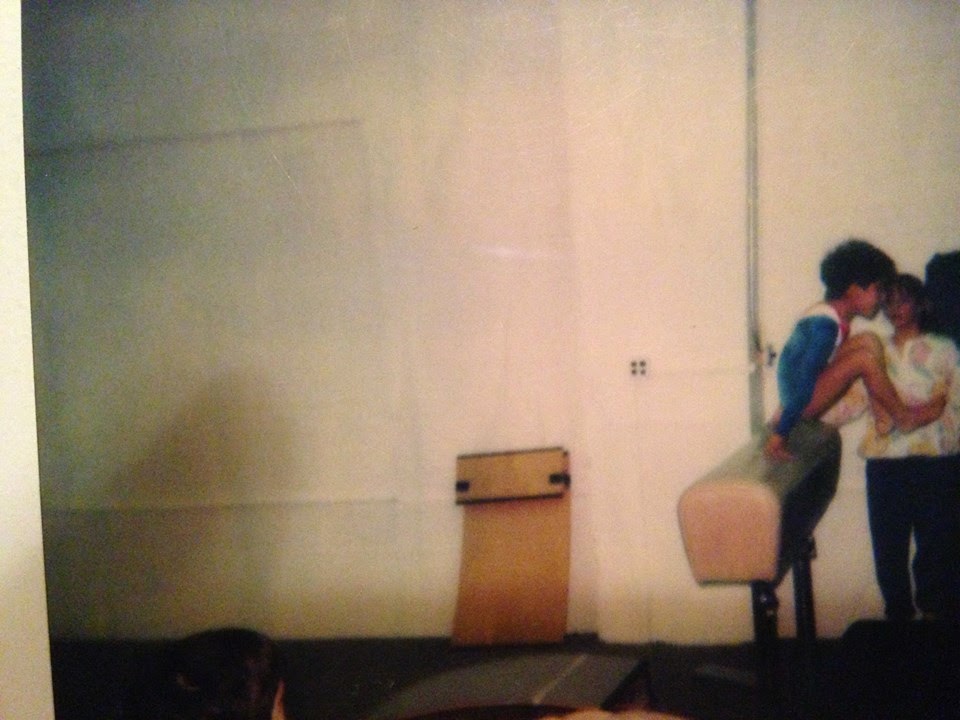
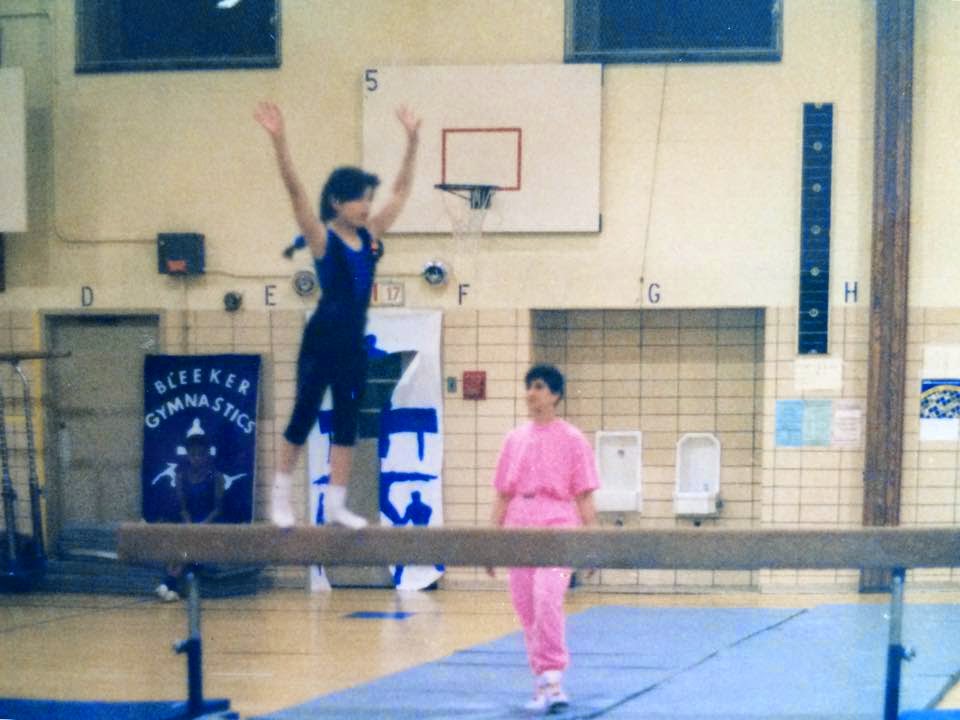
The “Hardest Worker” – that would be me, well, at least according to the inscriptions on the trophies I collected at the end of each year at gymnastics awards ceremonies throughout my childhood.   At the time, I was not too happy about this but knew it to be the truth.  I wanted to be the MVP. That is not to say that I did not do well, my mother has a closet full of ribbons and medals that say otherwise, but most the awards from that time were not the gold ones, unless Kim, my best friend and teammate, was absent from competition.  In these cases my first place finish was meaningless to me because the best girl was not present to challenge me.  


This pattern started shorty after kindergarten and continued until I was 14.  I wasn't the prettiest girl on the team (Sarah), or the most flexible (Christy), or the most graceful (Nicole), or the most technically proficient (Kim).  Nor was I the most fearless competitor (also Kim).  I was the hardest worker and so I became the strongest.  When I was seven years old, the senior girls coach, Ralph, gave my first nickname was "mighty mouse".  I loved the name and answered to it with pride.  In the early years, I was a mess – toes never pointed, posture never correct, runny nose from the chalk, unruly hair, and often walked around sporting a wedgy from my leotard.  

As a result of not being perfect, I was punished with endless conditioning and calisthenics.  In one particular training session I was deemed unworthy of practicing routines with the girls because I yawned during warm-ups (Kim will laugh about this when she reads this).  My coach was not very nice.  I often did push-ups, leg raises, pull-ups, standing back tucks, and squats jumps in solitude while watching the other girls practice the dance sequences of their floor routines.  I recall sitting out a gym pizza party because I was forced to practice my glide kip on the uneven bars.  I never really minded though – I loved the feel of the hard work.  Sometimes I was scolded for puking from over exertion.  If I puked, I was not allowed to have a friend sleep over that night – bummer!  As a result, I learned to hold my cookies!  On occasion, I would be sent home for “chickening out,” and this particularly bothered me.  Failing to fully attempt a skill due to fear, or “chickening out” is about the worst thing you can do in gymnastics – you endanger your own safety and that of the coach.  It implies a lack of trust in the coach and/or personal fear.  Both are big obstacles to conquer, and extremely difficult for an athlete to overcome.


This may sound crazy, but I started my own conditioning regimen at home with my friend, Kim.  We would run, jump, do calisthenics, play on the high bar and balance beam in my backyard, and play fight.  Yes, fight.  Somehow we figured out that beating each other up by throwing punches and wrestling was the best exercise.  Our parents were not very happy and the other kids that witnessed this kept their distance.

This work ethic came from my father Russell and my grandmother (his mom) Shirley.  My father has always lived by the notion that nothing brings more satisfaction than a hard day’s work.  Physical labor and building things with his hands have always been both his therapy and livelihood.  He does not understand the training that I do because I "pick things up and put them down" versus getting real work accomplished like raking leaves, shoveling, digging ditches, and roofing.  Most of my life when I told him I was off to the gym he would offer to give me work in the yard instead.  This might sound a bit odd because I grew up in New York City - Queens to be specific.  For those that are unfamiliar, there are parts of Queens that may seem similar to wilderness in comparison to Manhattan.  My grandmother was tough on me – she accepted nothing less than my best.  She taught me that the only way to get ahead was to work hard and set yourself apart from the others.

I was an anomaly. As a child, I sported a Mary Lou Retton haircut and I wanted to be just like Superman and Tarzan.  Some thought I had gender identity issues – I didn't.   I simply thought that Superman and Tarzan were way cooler than the female action heroes of that time.  I spent many hours daydreaming about swinging through the jungle, or running so fast that I could take off and fly.  It didn't help that I (too frequently) wore a T-shirt my mom gave me emblazoned with the phrase "Anything Boys can do Girls can do Better".  I was not the first of my friends to have a boyfriend.  Somehow I could never accept that there were activities that were gender specific, which leads me to the following…


In 1989, I entered Junior High School at the age of 12.  My school offered two morning activities before school – weight training for the boys and aerobic dance for the girls.  I wanted to participate in weight-training, and begged the PE teacher Mr. Hammer to allow me participate in spite of my gender.  He was hesitant (at first), but conceded when I demonstrated my ability to do pull-ups.  There were few weights - the club equipment was stored in an old closet.  We had a bench, some dumbbells, a dip bar, a pull-up bar, and some mats.  The club maintained a “Wall of Fame” in the gym that boasted various physical records.   The Wall of Fame consisted of three columns ( 7th, 8th, and 9th grade students respectively), and two entries – one for the boys and one for the girls.   As a 7th grade student I looked at the column of 9th grade boy’s records and told Mr. Hammer that I would break every one of those records - that day.  He chuckled – but stopped when I showed him!  Enough said.

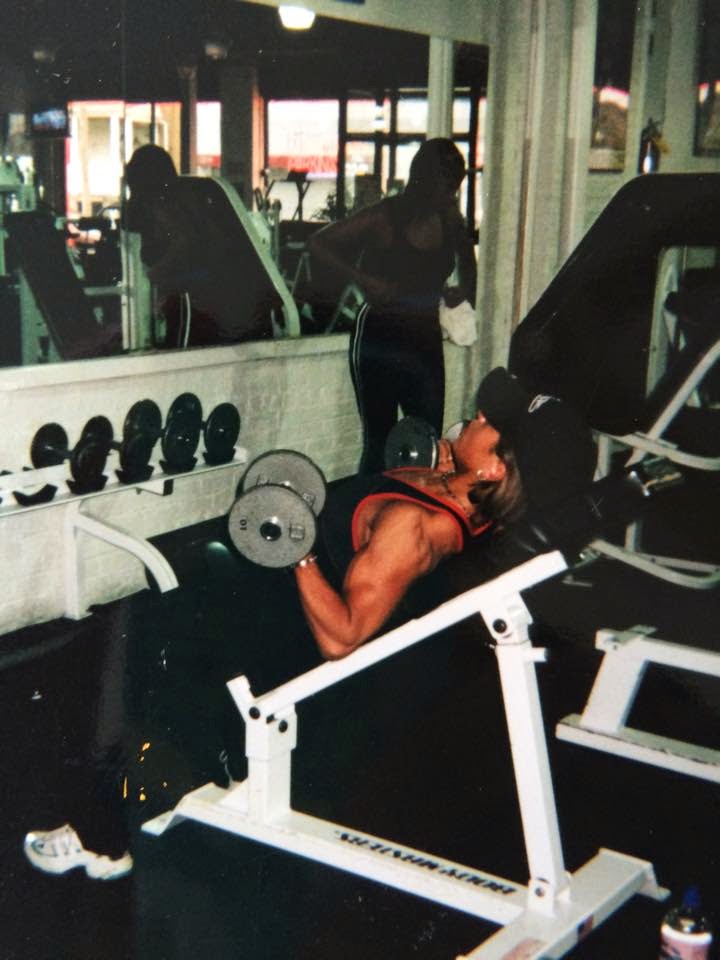
Instances like this were the theme of my life for the rest of my teenage years.  My freshman year of high school I pleaded with my parents to buy me a Universal Station weight machine that was sale at Consumer Distributors.  My bedroom became a gym with a pull-up bar, incline sit-up board, multi-station weight machine, mini-trampoline, sand filled dumbells, and a stair climber.  I hung anatomy charts on the walls and inspiring pictures of athletes.  Admittedly, to an outsider, this was peak adolescent weirdness.  Three cassettes - the soundtracks from Rocky IV, Flashdance, and Footloose – were played on my mini boombox while working out every evening for two hours after gymnastics or track practice.  My younger sister was so embarrassed of me that she did everything in her power to keep her friends out of my stinky room.  At the time, I didn't know much about training and did every exercise that I knew - every single day.  I believe that everyone hoped my obsession would wear off, but it never did.


It was during theses years, 1991-1995 that being the Hardest Worker started to morph into being the MVP.  My passion for physical fitness became infectious at my high school and we started a physical fitness team that competed in the United Stated Marine Corps Physical Fitness Championships at a national level.  Gymnastics started to take a back seat after an injury and I focused more effort on track and field and physical fitness competition outside of gymnastics.  At the time I had exceptional leadership and coaching (thank you Mr. Featherston) and it gave me an opportunity to focus my efforts on specific goals.  I faced significant adversity during this time.  People were not sure what to make of me - especially the boys.  I was often made fun of and groped in the halls.  During my senior year, my pre-calculus teacher once drew a depiction of me on the chalkboard as a cartoon figure with huge muscles and lots of hair with a caption about me beating up my boyfriend.  My boyfriend was in the class at the time.  I arrived three minutes late to see the picture, hear a room full of laughter, and find my boyfriend somewhere between tears and rage.

I never gave up.  No amount of teasing, prodding, or labeling as a freak prevented me from being the hardest worker and reaching my goals.  A local newspaper once ran an article about me titled, "Is she human?" after I won the Marine Corps National Physical Fitness Championship (1995).  I had a strong psyche and a supportive group of friends and family, and this allowed me to press on.  I lived by two personal mottos.  The first, “sticks and stones will break my bones, but words will never harm me”.  I can still hear my grandmother repeating it to me over and over again. The second, “if you quit once, you will quit again”.  I don’t know who said that to me - but it stuck.

I attended a large high school with more than 4,000 students, and I was somewhat of a legend after a school wide push-up competition in the auditorium during my senior year.   The competition was held onstage and a full audience counting reps.   Reps were performed together, with competitors dropping out when no longer capable of performing another rep.  Each rep was chest to the ground with a full lock out at the top. The final two competitors were the best male on the fitness team and me.   Brad did phenomenal – he did somewhere around 160 reps. Long after he finished I was still going.  I stopped at 500 – I am not sure why, perhaps boredom, maybe my wrists were starting to hurt.  I probably should have documented my experience at the time.  Brad was a true friend - he congratulated me, it didn't matter that I did more push-ups than him.  In case you have any doubt I am not a naturally gifted genetic freak – I spent countless hours doing push-ups on a daily basis to train for this. Anyone that knew me at the time can attest to my wacky ways of spending my free time.

Like junior high, my high school boasted its own wall of records, not in the main gym like my junior high, but in the weight room.  I was told that 17 years after I graduated that my records still hang on the wall (push-ups, pull-ups, dips, bodyweight bench press for number of reps).  My mile run time and standing broad jump distance have been broken time and time again, they were far from outstanding.  I ran into the new coach of the fitness team (when I was in high school he was doing his student teaching there are part of his undergrad degree in Phys. Ed.).  He told me that each year his students ask, "Who is Mounsey?" and they want to know whether those numbers are for real or some kind of twisted prank.

This makes me feel special.  I will not always be the best at everything in life but I will always be the Hardest Worker.   My advice - more people should spend less time complaining and comparing themselves to others and more time working!  My satisfaction is far more related to the effort that I put forth versus the end result.  The end result is often out of my control, my effort on a daily basis is not.


Follow Gillian on Facebook - https://www.facebook.com/GillianMounsey
Follow LRB on Facebook - https://www.facebook.com/LiftRunBang
Death is winning...do something
30 Sep 19:33

What He Sees

by Eric Chessen
A week days ago I received an email from the mother of a new athlete I am working with. Two days prior I had sent over video of the assessment session I took him through. She relayed his comment in her email; “Is that what
26 Sep 18:06

BSNYC Friday Fun Quiz!

by BikeSnobNYC
Jeffrey.bramhall

very lol @ bottom

Before anything else, let's follow up on the saga of New York State Senator Diane "Find A Fucking Bike Lane and Get In It" Savino:


[Redacted], who writes the blog, Bike Snob NYC, drew attention to Savino's comments on Twitter and on his site on Thursday.

"A state senator bragging on Facebook about engaging in acts of road rage is inappropriate, alarming and representative of a disregard for public safety," [Redacted] told DNAinfo New York.

"It's an insult to her constituents. It's also totally ironic because the conversational thread that inspired her comment is based on a total misreading of comments I made in which I excoriated reckless bicycling."

Wow, that guy is really eloquent, ain't he?  He should give himself a raise.

Well, predictably, Savino has explained her comments away as a "joke" while continuing to blame cyclists for the ills of society:


Reached by the Daily News, Savino said her comments were meant as a joke but she continued to express frustration with bicyclists who don’t obey traffic laws.

“Unfortunately, those who don’t follow the rules of the road create problems as we saw with that terrible tragedy in Central Park,” Savino said.

And who could blame her, considering we're out there doing 40mph and all:

“Minimally, there’s got to be greater enforcement,” she continued. “And bikers have to take responsibility for what’s happening. They’re moving sometimes at 40 miles an hour. We just went through the whole process of reducing the city speed limit to 25 miles an hour, unless it is otherwise posted. That should apply to bikes as well. We are all in this together.”

Yeah, that's right.  FORTY MILES AN HOUR!  Are you fucking kidding me?  I guess if 46mph is "Fred 'Woo-hoo-hoo-hoo!'" speed then 40mph is "Politician full of shit" speed.  And yeah, sure, even when we're not doing 40 we're routinely cruising around the city in excess of 25mph, that's completely realistic.  After all, according to a certain cycling app, it's only the AVERAGE SPEED OF THE WINNER OF THE GODDAMN 2014 PARIS-ROUBAIX:


At this rate, look for the winner of the 2015 edition to come screaming into the Roubaix velodrome on a Citi Bike.

And how about that "fucking bike lane" we're supposed to use?  Well, a Streetsblog reader was kind enough to upload a photo of the bike lane out of Savino's Staten Island office:


All else aside, who the fuck still drives a Hummer?  Even Escalade drivers think Hummer drivers are douchebags.

But wait, it gets better.  Did you know Savino has a boyfriend?


(Sorry fellas, she's taken.)

Yep, he's a dreamboat named State Senator Jeffrey D. Klein:


“It was very, very cold,” Mr. Klein said.

“We went socks shopping,” Ms. Savino added.

Who, back in 2008, threatened the author of "No Impact Man" with bodily harm after cutting him off with his Mercedes:


At this point, you brought your vehicle to an abrupt halt, not to avoid hitting me, but because you apparently needed to communicate something to me. You rolled down your window and said, "Get your hands off my car, you fucking asshole."

I said, "You were veering into me and going to crush me."

You said, "You better not touch other people's cars. You might find that touching other people's cars is more dangerous than traffic."

This gave me the impression that you were threatening me.

So I think it's fairly obvious that both of these people are complete and utter pieces of shit, which I realize is redundant inasmuch as they are politicians.

Oh yeah, Klein is also my representative in Albany.

So I've got that going for me.

Which is nice.

Penultimately, here is an article which you should absolutely read but which I hope you'll never need:


And lastly, hit-and-run victim Dulcie Canton is about halfway to her fundraising goal, so if you're inclined please help her make it the rest of the way:


You have my full permission to feel smug after that.

And on that happy note, I'm pleased to present you with a quiz.  As always, study the item, think, and click on your answer.  If you're right that's great, and if you're wrong you'll see apocalyptic cycling.

Thanks very much for reading, ride safe, and watch out for state senators.


--Wildcat Rock Machine


("I'm Frank Dickof, my surname is not a verb, and I approve this message.)

1) Wall Street Journal reader Frank Dickof needs everybody to know he doesn't like residential developments that feature bicycle amenities because he's Frank Dickof, dammit!

--True
--False


2) Felt's $14,000 time trial bike is called the:

--"MAMIL"
--"WANK-R"
--"IA FRD"
--"TRI DRK"

(Via Ken.)


3) Finally!  A saddle that's:

--Inflatable
--Sagging in the middle
--Equipped with a revolutionary tapering frontal portion called a "nose"
--All of the above


4) What is "Swagon?"

--A trailer designed specifically for roadies
--A Rapha Citroën H-Van that will give away free stuff at cyclocross races this fall
--A new social network from the mind of Paul Budnitz
--Basically Uber for Freds


5) The new UCI World Time Trial Champion is:

--Bradley Wiggins
--Stanley Wiggins
--Both Bradley Wiggins and Stanley Wiggins
--Neither Bradley Wiggins nor Stanley Wiggins


6) During a post-hour record publicity tour, Jens Voigt was ticketed by police in Melbourne for not wearing a helment while using the city's bike share system.

--True
--False


7) According to a complete moron with nonexistent reading comprehension skills, I am a:

--Single asshole
--Double asshole
--Triple asshole
--Quadruple asshole


***Special "How Do They Live This Way?!?"-Themed Bonus Video***


26 Sep 14:05

Just relax

“Hey how you doin lil mama? lemme whisper in your ear, Tell you sumthing that you might like to hear, You got a sexy ass body and your ass look soft, Mind if I touch it? and see if its soft - Ying Yang Twins”

25 Sep 14:59

He wore a nice white shirt open just one extra button. He’s...

by breathnaigh


He wore a nice white shirt open just one extra button. He’s into clothes. Not in a fashion-forward way, more of an old-school, deep-quality way. His seamstress mother taught him about fabrics, what they signaled to the world. When Antrim learned last year that he’d won a $625,000 MacArthur “genius award,” his longtime friend and supporter Jonathan Franzen sent him a note saying, Finally you can afford some of the clothes you love. Meaning not that he could finally buy them — he’d been buying them — but that he could now afford them.

John Jeremiah Sullivan on writer Donald Antrim in the New York Times. Thanks to Casey for the link.

-Pete

19 Sep 15:23

Celebrity famous person Nick Cannon wore two million dollars...

by jessethorn


Celebrity famous person Nick Cannon wore two million dollars worth of shoes last night. They’re Tom Ford loafers, encrusted with diamonds. And honestly? I think he looks pretty good.

That’s all, really. I’m just kind of confused that I only have positive thoughts about Nick Cannon’s Two Million Dollar Shoes. So, you know, thought I’d share.

02 Sep 14:05

The Quadrants

by Dan John

This is the third of a set of excerpts from the Intervention DVD.

As I describe the Quadrant concept, Quadrant #1 is what I would call something like a basic PE class — like the PE class I told you about before. How many sports should you learn in a PE class? In a 3-year period, a lot. You should probably know when you’re done with high school that at a basketball game in the NCAA if you stand there at the line and no one messes with you, that’s worth 1 point. If you stand inside this line and people are messing with you, it’s 2 points. If you’re standing behind that line and people are messing with you, it’s 3 points. I have been to a Super Bowl party where someone scored a touchdown …and I hate to pick on 51% of the world’s population…but a female turned to me and said, ‘How much is that worth?’ Now, no offense, but at a Super Bowl party, you should know that a touchdown is worth 6 points. I am just saying that someone dropped the ball on her education.

You should know basic mobility. You should know basic flexibility. You should know how to do a pushup. You should know that doing 25 pullups is an impressive thing, right? When you are in a high school PE class, right? You should know that doing 60 pushups in a minute…that’s really hard to do…you should know…kind of just know some things, right? How high is the level of any of this stuff? Not very. If your 9th grade basketball team wins the 9th grade basketball PE tournament, you’re probably not ready for Division 1 or the NBA yet. It might take one more day. How many qualities should they learn? Oh, just as many as you can think of.

dan22

Quadrant #2 is collision sports. This is high school football. This is Division 1, Division 2, Division 3. This is the NFL. The number of skills that it takes to be at the highest level is simply stunning. To be in high school football…to play high school football today, the strength levels will stun most people. You know? When I see people bragging about how successful this or that is at their local gym, I always…my first thought is, ‘You are at the strength levels of a low-end typical high school.’

Quadrant #3…I always call it Yin and Yang…we don’t do very much or we don’t do it very well. By the way, Quadrant 3 is where most of us live. Quadrant 3 is track and field—most of it. Quadrant 3 is fat loss. How many skills do you need to lose body fat? Well my friend Josh Hillis will tell you that you need a food journal and that you need to do some kind of workout. That’s not a big skill set. How high of a level is it? I’ve talked to…I’ve talked to female physique winners and they laugh about when someone says that they want to lose 20 pounds for their reunion…they laugh about it because it’s like…for a female to go from 14% body fat to 7% or 8% means that you can’t even sniff food for awhile.

Quadrant #4 is a very, very narrow, narrow, narrow band of things. I would suggest the 100-meters in track and field—probably single-event power lifting, for example, like a deadlift specialist, a back squat specialist…by the way and I’m right…there are specialists now in those events. They go to a power-lifting meet and only do one movement. You could probably argue that the Olympic lifts are Quadrant 4. To be a good Olympic lifter…I mean to be a top 10 lifter in the world…you can’t do anything else. If you were to come in and say…someone’s going to ask, you know, seeing an Olympic lifter, the best in the world, and go, ‘Isn’t that unhealthy?’ Shhh. Yes. But he is very fit for that task, you know? He is this tall and he weighs 265 and his legs are this long…I mean, you know…yeah…but at the same time, think about women’s gymnasts. When is the last time that you saw a 6’7” woman gymnast or a 5’1” Division 1 girl volleyball player? But those club coaches always tell them, ‘They might get a scholarship at 5’2,”’ So this is just the introduction to the quadrants.

I’ve gone over the quadrants lots of times in a lot of places and what a lot of people don’t understand is that it is part of our tool kit. Now, you will notice how we start off kind of global. The first 3 are kind of…you know…things you should really think about your whole life. A healthy person would be concerned about these. This is…you know…basically on #3 I told you, ‘Yeah, lift weights. It’s good for you,’ By the way, that’s not bad. If that is all the person hears is, ‘Come in here, get a little stronger,’ we’ve done You know? I know that I can really help you with your life-long goals by getting you a little stronger. I know it’s true.

Basically what I’ve already told you…if we go back to the beginning…is that there are two ways I generally try to help people. The first is when you show up in middle school, I show you the basic four weight-lifting movements, then the basic three kettlebell movements, then I think basic tumbling, basic this, basic sports, basic goals. As you march your way through high school, we keep building it up and up and up. We keep building it up and up. If you’re in the collision sports, we get you in the National Football League. That happens so often when you work in schools in Utah.

Most people are here. The problem with our industry is that most people are here. Everybody is a MMA fighter now. You know, a couple of years ago I was ranked as a body builder. ‘You know, that body builder…well really, you ought to build one,’ You know? I am thinking, ‘Do you lift weights?’ ‘Yes, I do,’ ‘Well, you really ought to lift more,’ Trying to be nice here. Trying to be nice here. It’s not all fat loss. When I gave a workshop right here a year or so ago, I said that, ‘Really, the one thing I can help MMA fighters with is to realize that doing this and this and this and this and this and this and this and that probably gets you in really good shape. It won’t make you a better fighter,’ It doesn’t make you a better fighter at all. There are fighters I put down here too.
Most adults that I work with are not elite nine 800-meter runners. This will shock you but most of the people who call me on the phone are not at the very top end. I think the guy who has this hammered down best is a guy by the name of Barry Ross. Barry Ross is a very interesting guy. I think Tim Ferriss’ new book pretty much made it impossible for Barry to make a lot of money for the next six months because everything you want to know about Barry Ross is in the book. Everything…but Barry Ross, you know. You want to be a faster sprinter? Well, you do mobility. You do deadlifts heavy. You do some kind of push exercise. You go out and sprint as fast as you physically can until any threshold of exhaustion shows up or fatigue and you stop. Why? Well, that’s Quadrant 4, baby.

Quadrant 4—nobody cares about how hard you work. We only care about the answer—the finish line—the solution. How you get to clean-and-jerk? 600 pounds? No one has ever done it before but whoever does it has the correct answer. The rest of us are just wrong.

Most people are in Quadrant 3. Most people are in Quadrant 3. Strength…the number of qualities you need to lose body fat are pretty low according to Josh. We’ll go through this quite a bit today later…you know…it’s a food journal and some kind of movement. You know? I was up at Chico State and Tom Fahey told me, “We’ve known for years how to make people lose body fat. You tie them up to a tree and come back in a few days,” It works every single time. I’m like, there’s the industry for you. Just put…get rid of all of the equipment. Put trees in here and ropes. It will answer everyone’s questions.

So the fourth tool in our tool kit is the quadrants. Now, having said that, here’s the problem in our industry. A lady wants to lose 20 pounds for her upcoming 20-year reunion. So you teach her how to snatch and clean-and-jerk, do gymnastics moves, tumbling…by the way, it all works. It does get people tired. You have them run a 10K, a 5K and a 3K. You have them learn all 7000 kettlebell moves that you can find every single day—new on the Interwebs. We blow her shoulder out and so she goes to her 20-year reunion in a sleeve.

This is the problem with our industry. Most of us are up here but actually most of us should be down here. This is where we should be. So the fourth…and probably most important tool that I am giving you today…make sure you put them in the right quadrant to help them out. In other words, think about this. If I have a 12-year-old, they are Quadrant 1. It’s okay for us to take a lot of time teaching that child the basic movements. It’s absolutely no problem at all to have a little class in here three days a week where you might teach 20 kids at once the basic movements. That’s systematic education. It’s the same idea. You learned the alphabet that way. You learned the musical scales that way. You learned everything systematically.

If Edna comes in here and she wants to lose 20 pounds in six weeks, that’s not the way to go with her. If Ralphie comes in here and he wants to be a better football player…okay…he shows up now and wants to play in the fall…he needs to be up here. If you have an elite sprinter show up here and ask you, ‘I’m running a nine 700 meters, can you get me to 969?’ Tell him, ‘No, I don’t know how to help you,’ I have no idea. That’s the honest answer. You don’t. No one knows how to do that.

This is where…this is what I try to do on the telephone. Now, here’s the thing. One of the first things I ask the person is, ‘What’s your goal?’ By mentally putting them into the right quadrant, how much work have I saved myself to help them with their goal? If they want to play in the National Football League and they say, ‘Dan, I want to spend a week with you,’ this means for that week I have to watch them clean, I have to watch them snatch and I have to watch them squat. I have to help with the bench press. I might want to show kettlebell moves. I might want to show TRX stuff. I might want to show…How many things do I want to show that guy in that one week to help that person get into the National Football League? Now it could be dozens of things. You gotta do this. You gotta do that. You gotta do this. You gotta do that.

Edna wants to lose 20 pounds for her reunion—not so much. By putting people in the right quadrant…and almost universally everyone is a 3…I just gave away…it’s all my method…there’s a gym. By getting people into the right quadrant, intervention—helping them—is now pretty easy. What I now need to do is look at what they know, what their skill set is on the basic human movements and how can I help them move on.

For more of my thinking on quadrants, here’s my Quadrants of Diet & Exercise audio lecture on movementlectures.com.

Click here to see some of the preview clips from Intervention.

28 Aug 20:44

Mcneely’s “Stamped for Sport” Looks to Reduce Accidental Supplement Doping Cases

by andrew reimann
Jeffrey.bramhall

Isn't there a thing like this already?

Evan Mcneely is a talented cyclocross racer with a game plan that could change the perception of professional cycling.
Margus Riga

Evan Mcneely is a talented cyclocross racer with a game plan that could change the perception of professional cycling. Margus Riga

Evan Mcneely is a talented cyclocross racer with a game plan that could change the perception of professional cycling. © Margus Riga

We first met Evan Mcneely last year at the first-ever UCI Race in China. He is a Canadian cyclocross racer that often makes the trip down to compete in races all across New England. His 2013 race resume includes top ten finishes at the UCI races in Ellison Park and Cycle-Smart International. Racing for the Norco Factory Team, he also finished sixth overall in the Canadian National Championships.

He reached out to us recently, not so much to talk about the upcoming season or his past accolades, but to share a simple idea that could have profound effects for preventing accidental ingestion.

He calls the idea Stamped for Sport and believes it could drastically alter the way athletes and spectators view supplements in cycling.

Release from Stamped for Sport:

As controversial headlines continue to question the integrity of athletes in drug-tested sports, current Canadian national mountain bike team member and avid cyclocross racer Evan McNeely has launched a start-up, Stamped for Sport Supplements, to take the stigma out of sports supplements.

An IOC-sponsored study in 2004 out of the WADA-accredited laboratory in Cologne showed that as high as 14.8% of 634 widely recognised nutritional aids contained anabolic agents that were not declared on the label. Contaminates found included dehydroepiandrosterone (DHEA), testosterone, and ephedrine, all members of the WADA prohibited list and talented at producing a positive doping test.

Though a decade has passed since contaminates were proven to present irreparable career damage in sport, the marketplace has remained a minefield. Recent occurrences, such as European 400 meter hurdles champion Rhys Williams’ positive test at the Glasgow Commonwealth Games have become far too common, and merit a second look at accidental ingestion.

Stamped for Sportis an online retail platform of contamination free sports supplements. Only brand name products that have been tested and certified clean, by programs such as the NSF Certified for Sport andInformed-Sport are available for purchase. These agencies purchase products off-the-shelf. They then test and check that the contents of the product match the ingredients listed on the label and, more importantly, ensure no substances on the WADA’s banned list are present in the product.

McNeely’s goal, “is to reduce the number of accidental supplement doping cases by making certified clean products more accessible to athletes participating in drug tested sports.” He stresses the importance of recognizing clean product by exclusively selling nutritional aids that have been tested, down to their specific flavours.

“Things aren’t always what they seem. Athletes need to pay close attention to what they put in their bodies. However, sports supplements don’t need to be scary.”

McNeely hopes that Stamped for Sport’s athlete-friendly accessibility will provide peace of mind in the industry at last.

The post Mcneely’s “Stamped for Sport” Looks to Reduce Accidental Supplement Doping Cases appeared first on Cyclocross Magazine - Cyclocross News, Races, Bikes, Photos, Videos.

27 Aug 16:39

Grateful

by john
I’m happy to say that I’ve been able to maintain not using my computer or listening to podcasts/music when going to sleep for over 2 weeks now. It’s still only been a couple of weeks and I still have to consciously remind myself to not bring my computer into bed but its getting more and […]
22 Aug 16:39

Everything That’s Going Wrong in Ferguson

by Josh Voorhees

After the announcement that a grand jury had declined to indict Darren Wilson, Ferguson, Missouri, was the site of “many fires, frequent bursts of gunshots, looting, and waves of tear gas,” in the words of the New York Times. Before the night was out, “West Florissant Avenue—the epicenter of the summer riots after the shooting—was again in flames,” reports the Washington Post. According to the Associated Press, “Monday night’s protests were far more destructive than any of those that followed Brown’s death.” More than a dozen businesses were burned, at least 14 people were injured, and 61 arrests were made in Ferguson, with an additional 21 in nearby St. Louis. St. Louis County Police Chief Jon Belmar, speaking at a press conference at 1:30 a.m., said that he personally heard at least 150 gunshots in the Ferguson area.

19 Aug 20:02

Love Letters

by Katie Baker
Jeffrey.bramhall

didn't read (too long), but post office!

Six days a week, Geri Canzler packs her lunch and commutes on winding roads through thick Oregon forest. When it’s nice out, she can walk the route, but on this late March day Canzler is tired and the rain hasn’t stopped. So she drives her white SUV to her workplace, the second-smallest free-standing post office in the United States.46 She estimates the wooden shack to be no bigger than 10 feet by 10 feet, though there is also that 3-by-4 storage shed off the back if you’re going to get technical about it.

Canzler is the postmaster of a once-thriving lumber town that has been shaved down to just a few splinters. Gone are all the old mills that once turned mighty fir trees into neat planks, and that later manufactured decorative window sashes for Midwestern homes and little boxes for two-pound blocks of Kraft cheese. Gone is the modest employee lodging that dotted the steep forested hills, and the mill owner’s house that even featured a wooden swimming pool. Gone, as recently as 2011, when the demolition crews were called in once more, is the community church. The one new thing that this enclave has gained in the past few years is its own page on ghosttowns.com.

When Canzler pulls in, the only other vehicle in the parking lot is one manufactured by John Deere. Near the door to the entrance is an honor-system leave-a-book, take-a-book lending library, about half the size of a phone booth and stocked with the usual syndicated romance novels and Sue Grafton fare. Visible, too, is a set of train tracks, and behind the train tracks is Interstate 84, and beyond Interstate 84 is the Columbia River, which separates Oregon from Washington and was described by Lewis and Clark back in the day as “gut Swelling water, boiling & whorling in every direction.” A dam was built in the ’30s, making it all a lot calmer now. In the summer, Canzler says, it’s a windsurfer’s paradise.

All that really remains of the former boomtown, though, are three things: an old bed-and-breakfast that once served up hot meals to transient mill workers; a cemetery; and a post office. The first, owned for 119 years by the same family, is now up for sale. The second was unintentionally discovered by Canzler years ago beneath the big blackberry brambles and 6-foot-tall ivy vines in her side yard.

And the third thing, the little post office, has been kept barely alive — in an era of Postal Service downsizing — thanks almost entirely to an annual army of finicky brides who covet its picture-perfect postmark for their wedding invitations. Bridal Veil, Oregon, 97010, is the name of the town, and Canzler is one of its only employees. She may well wind up being its last.

It’s well documented that weddings make you crazy, though I have come to believe they just expose you as such. The whole planning process often feels like a reverse Rorschach test in which each snap decision bleeds into an ominous pattern revealing exactly who you’ve been all along.

Ordinarily simple acts like setting a table involve 700-page binders that ought to be titled “The Narcissism of Small Differences in Gold Piping.” To many an idealistic couple, the hard truths of the peony economy offer a glimpse into what lies ahead in the realms of home ownership or their children’s education. Grifty cottage industries spring up around such things as Instagram hashtags. It’s all very bizarre. I’d make fun, except that over the last year, planning my own wedding, I have been confronted with some silly fixations of my own.

I couldn’t care less about cake or a complicated honeymoon, but I daydream about calligraphy. This is nothing new. As a kid, I made collages and asked Santa for monogrammed stationery. I have fond, vivid memories of messing around with the ink pads and hole punches in my grandfather’s desk. Even as a nominal grown-up I’ve yet to pass a Kate’s Paperie without ducking inside for a dreamy half hour and emerging with a set of Audubon bookmarks on thick, pleasing stock. Sometimes I put thought into which stamp I should use when mailing in a utility bill. I whiff rubber cement and caress Le Pen markers and believe all of this to be genetic and wholly unfixable, like how some people swear cilantro tastes just like soap.

Needless to say, I’m weird about my wedding invitations, which is how I found out about Geri Canzler and the Bridal Veil post office. And I’m not alone. Each year between March and August, some 150,000 envelopes containing save-the-dates or request-the-honour-of-your-presences are specifically, and even militantly, directed to this particular spot. In a tiny room filled with boxes of envelopes that during high season approach hoarder height, Canzler personally processes every piece of wedding mail, one by one, marking each with a custom postmark and cancellation she designed to honor a place she has long fought to protect.

Visualize a standard envelope: You supply the postage stamp and the address, and once it’s mailed the post office provides the postmark (historically a circle with your town’s name and zip code) and the cancellation (best described as “those squiggly lines”).

They each serve their duty. A stamp on a letter is a square inch, give or take, of personal expression. It’s a little work of art and a historical relic rolled into one, a symbol of both form and function, of logistics and love. In the eyes of the U.S. Postal Service, a stamp is proof of payment for services rendered, and it must be voided, or “canceled,” immediately upon use. The squiggly lines deface the stamp and perform the same job as the ticket taker at the movies who rips off your stub.

“Every post office had its own cancellation, had its own postmark,” Canzler explains. “That was before they had the huge distribution centers that they have now. Now everybody dumps their mail into big trays, uncanceled, so it all goes through the machine, a hundred thousand letters an hour.”

This makes complete sense, obviously; in our digital age the embattled post office needs to be efficient and low-cost.47

But while those machines are perfect for everyday mail, they can cause problems ranging from the merely aesthetic — the automated cancellations look like they’ve been sprung from a dot matrix printer — to the legitimately disruptive. When I sent out engagement party invitations last fall, the colorful ’70s stamps I spent hours hand-glueing (lay off me; I warned you) did not pair well with the high-speed machines. The shipment was decimated en route, money was wasted, understandings were missed, and I started Googling to see if I could buy some sort of postmark or cancellation stamp of my own. I could not, but I did find out about Bridal Veil.

photo

“We put a lot of heart and soul into our wedding invitations,” Dorothy Nelson, who works in the fashion industry and kept a blog, Luv the Bride, chronicling the process of planning her North Carolina nuptials, told me in an email.

Her father-in-law contributed a watercolor design incorporating elements that would appear in the wedding — wisteria and birdcages — and Nelson painstakingly comparison-shopped to find the finest paper available inside her budget. She affixed each envelope with a wax seal depicting a pinecone, in homage to her wedding venue, the golf paradise Pinehurst. After all this thankless work, there was one last crucial step.

“As a bride who appreciates wedding traditions and etiquette,” she said, “I had read about hand-canceling invitations as a way to be more personable, as well as to help keep the envelopes pristine during the mailing process.”

Showing up at one’s local post office can be a crapshoot when it comes to requesting hand cancellation; while USPS employees are technically supposed to honor such requests, there are many variables at play, like the size of the operation, the length of the lines, the number of envelopes, and the general attitude of the person you happen to approach. Message board postings on the subject report responses ranging from snorts of derisive laughter to enthusiastic offerings to let the bride sit at the counter with the stamp and process everything herself.

Whatever precisely artisanal piece of wedding flair you’re going for — hand-crocheted doilies on the center of every table; loopy-lettered chalkboards announcing the coordinates of the loo — it’s available for a few easy clicks on Etsy.48 But getting a guarantee that your pricey invitations will arrive at their destinations unmolested? I haven’t yet found a vendor on WeddingWire for that. 

The postal service is well aware that there are nuts like us who get a kick out of this sort of thing. Around Christmas and Valentine’s Day, it often releases lists of towns with “seasonal” names — Wiseman, Arkansas; Snowflake, Arizona; and Holly, Colorado for the former; Sugar City, Idaho; Darling, Mississippi; and Kissimmee, Florida for the latter — and encourages customers to send their correspondence through those locations. Loveville, Maryland, has a special Cupid postmark for the relevant holidays, while customers in Bethlehem, Pennsylvania, were distraught two years back when a special Christmas postmark featuring a camel was unexpectedly unavailable.

“I had read about a number of cities with ‘wedding-esque’ names including Chapel Hill, North Carolina, and Bridal Veil, Oregon,” Nelson said, “but ultimately decided on the Bridal Veil USPS, as I appreciated its history.”

Depending on how hard it’s raining, Bridal Veil is a roughly 30-minute drive from downtown Portland, which surprised me. Reading about the place as a forgotten, empty, it-all-falls-down husk of a bygone era had made it seem buried away somewhere deep within the state’s central expanse, and not a quick jaunt between city middle and Mount Hood.

The town got its name, the story goes, back in the mid–19th century, when a woman aboard a Columbia River steamship noticed one of the many waterfalls that enliven the cliffs on the Oregon side of the river. This particular feature cascaded and pooled in a way that made it look like a veil flowing over the poufs of a bustled wedding gown — the style of the day — and the description endured. Little did anyone know at the time that the name would help the town to endure, too.

“We probably would have been closed 20 years ago” if it weren’t for the brides, Canzler says, looking over her glasses while her rat terrier Buster stands on a mailroom counter, projecting Napoleonic run-of-the-place.

Canzler slides a guestbook over to me. It covers only the last year or so, but it contains blurbs from spots as far-ranging as London, Honolulu, and, her personal favorite, Taiwan. On one page, someone has written: “Thank you for taking such good care of us. It is such a relief to cross this off the list with a sense of calm.” The signature identifies the author as a mother of the bride.

“Very interesting to visit this place,” says a note from a Dutch visitor. “Very important to keep the post office current.” Next to the entry is a well-done doodle of the Netherlands.

If you want to know about Bridal Veil’s past, Canzler says, the person to talk to is Steve Lehl, a former garbage collector who lives with his wife, Judy, up on a sprawling expanse of land with panoramic views of the Columbia River. Growing up not far away, the pair were always familiar with the scenic region to their east, which showcased numerous waterfalls, featured a big domed structure called Vista House that loomed over a winding highway, and lured not just tourists but also randy teens to its wooded streets.

“Everybody’s first date is to the Vista House,” Judy says. “You get your driver’s license, the first thing you do is drive out the scenic highway. You know, it’s Lovers’ Lane out here.”

“Plenty of places to park, yeah,” Steve agrees.

“You get a new car, you gotta drive along the scenic highway!” Judy repeats. “You see a lot of brand-new cars.”

“The highway’s gonna be a hundred years old here in a couple years,” says Steve, almost to himself.

When they moved here, almost 40 years ago, they were the kids in town, the young hippies. They were both coming from Portland, where they’d been living in their parents’ respective basements. Having saved up some money, they went in — along with an old roommate of Steve’s — on a house up on a hill. The roommate has since left, but it’s where Steve and Judy, who now have matching long, graying hair, his tied back in a ponytail and hers loose, still live.

Steve is one of the town’s self-appointed historians, having been interested in its backstory ever since he found some old artifacts while collecting trash. “When I was a garbageman, I was like a crow,” he tells me as I look around a room neatly filled with knickknacks he’d snagged from the refuse pile over the years. “I’d see something shiny, and I’d bring it home.” Other than the post office, the Lehls’ house is the closest thing Bridal Veil has to a museum. The walls are a tidy mosaic of old framed photographs capturing what used to exist in these parts: log flumes, planing mills, a schoolhouse, steam locomotives, fir trees the size of redwoods being manually sliced apart by floppy band saws the length of several men.

Along with his friend Chuck Rollins, Steve Lehl travels to local Elks clubs and preservation societies to give a slide show presentation he has painstakingly compiled over the years. “Hey, we’ll do it to any group,” he says, as his Rhodesian ridgeback snoozes in an easy chair nearby. “You’re the smallest.”

Clicking through the photos on his computer, he runs through the short, volatile history of the town, which was officially established in 1886 and stood through two catastrophic fires, a diphtheria epidemic, the gradual depletion of an entire mountainside of enormous trees, numerous landslides, economic hardship, and two World Wars. One of the more upsetting pieces of Bridal Veil history includes the various firsthand reports that as World War II loomed, the Japanese gardeners employed by the Kraft family were sent off to internment camps.49 One of the cooler legends is that Clark Gable, who did a stint as a lumberjack before hitting it big onscreen, worked at the company mill.

photo (1)

Bridal Veil (and the adjacent, and mostly connected, mill town of Palmer) was the site of numerous industry advances in its day. It was home not only to the men who worked there, but also to their families. It saw the rise and fall of a lumber operation so healthy it supported an entire company town, pioneered several innovations, and characterized what was, for a time, the Pacific Northwest’s most lucrative industry. Very close to zero of any of it remains.

By 1960, the heady days of the region were mostly over: It was hard to maintain profit margins once the wood had been used up. In 1991, an organization called the Trust for Public Land bought up the bulk of Bridal Veil — the New York Times reported that the town had nine residents at the time — and began the slow dismantling of the historic mill structures.50

One of the few parcels that neither the Trust for Public Land nor the U.S. Forest Service wanted anything to do with was the cemetery on Canzler’s property. It’s morbid, but it’s a silver lining all the same, one small piece of Bridal Veil that has been allowed to remain. The post office, too, was given a reprieve.

Laurel McDonald lived in town until she was 12 and now runs the Bridal Veil Lodge, a small bed-and-breakfast that was built by her great-grandfather Virgil in 1895. Her guests are usually people in town to see the waterfalls.51 But she put it on the market this spring; there was just no one in her family who could take on the commitment of running the business.

“It’s the end of the line,” she tells me as we stand inside the lovely building, with its smooth knotty-pine walls and the same original, hand-built furniture that has been around for almost as long as the house. The sleeves of her zip-up sweatshirt are covered in paint as she extends her hands in the shape of an upside-down pyramid. “Families are supposed to get bigger. Both of the grandparents had a family of nine kids. And now it’s just come down to this.”

Bridal Veil in general isn’t too different, although it was always a place that was in danger of consuming itself. It’s hard, looking at the lush landscape of today, to reconcile it with the pictures Steve cycles through of treeless, naked land a century ago. But even now, as it was then, it’s a difficult place to make your home. Canzler is the kind of woman well suited to living if not off the grid, then on the very edge of it.

“I’m pretty hearty,” she says. “I was raised on a farm without a potty — ya know, you go outside.” Even so, one of the first ice storms she experienced in Bridal Veil, where she relocated after meeting her born-and-raised-here husband,52 nearly broke her. “I deserted my husband, I flew to Reno, and I didn’t come back for seven days,” she says. “We didn’t have any power, we didn’t have any water — we had nothing for nine days and nights.”

The region is drop-dead gorgeous year round, with its canyons and river valleys and dramatic cloud formations. “It’s the most beautiful place I’ve ever lived and probably ever will,” Canzler says, adding that whenever she goes on vacation, she can’t wait to get back home.

But in the spring, the steep and soggy earth loosens and crumbles. (The Lehls lost half of their yard to a landslide years back.) In the summer, the wooded landscape burns. In the winter, you go so crazy you’re moved to flee to Reno. I do suspect that autumn is pretty perfect, because that season always is. Canzler says there was someone in town who had a little Bobcat and would go around plowing people’s streets and driveways when things got really bad, but they moved to North Carolina. That was a shame.

Canzler hates the “crap trees,” like cottonwoods, that now dominate a landscape denuded by logging not really that long ago. They are skinny and everywhere and radioactively green with moss; 30 years ago, she says, none of them was here. They grow fast, but they also won’t last. The firs and the hemlocks and the cedars will eventually take over again. The Forest Service will probably harvest them when they do.
“New York always has the biggest weddings,” Canzler says. “I would say probably 10 batches from New York, they were all at least 400 per batch. Unbelievable, the size of their weddings.” She shows me a photo of what things look like in the early summer, her busiest time of year, when corrugated postal boxes filled with neat stacks of envelopes make it difficult to even walk to her desk. “When the sun comes, the brides come!” she says, with a singsong cadence that makes it sound like a mantra.

From March to August, Canzler processes about 150,000 pieces of wedding-related mail, for about half of which she also sells the postage. That amounts to roughly $40,000 in stamp sales, she says. In general, wedding-related work (and the odd Valentine) accounts for about 80 percent of the Bridal Veil post office’s income. The other 20 percent is a patchwork of small revenue streams. The gift shop at nearby Multnomah Falls, for example, does a brisk business on eBay, and Canzler handles the mailings for that. She does the same for the Oregon Stamp Society.

We are briefly interrupted by a rare visitor: a diminutive nun, one of several who live in a Franciscan convent in town, comes in and checks her P.O. box.

Sometimes the envelopes arrive in kempt packages, and other times they burst through the door in the arms of flushed, harried brides. Once, the envelopes were oddly triangle-shaped, and it was a challenge for Canzler to determine exactly where and how to place the postmarks. There are ivory envelopes with swooping calligraphy and pink ones addressed in a prim hand. One thing they have in common is that, in the minds of the people sending them out, they’re the most important documents to wend their way through the U.S. Postal Service since their first paycheck. There are two custom Bridal Veil cancellations they can choose from: one with interlocking hearts, and one with a pair of doves. If they don’t care, Canzler will decide what she thinks looks best.

When it’s really busy — in the summer, five or six brides can sometimes show up at a time — she sets up a table and chairs out in the parking lot. All she asks is that the brides who send their letters this way purchase the postage stamps from Bridal Veil.

“Oh, it’s so exciting!” Judy Lehl says, clapping, when I ask if she has ever encountered the brides. “We wish them luck, we congratulate them, we say to them, It’s so exciiiiiiiiting!

“Buy your stamps here, now,” Steve adds, imitating himself. “That’s the big push.”

“At Costco they wanna sell you stamps every once in a while,” says Judy. “OHHH NO. If my postmistress knew I bought stamps at Costco, I’d be in trouble!”

Between the rain and the woods and the happy guest ledger and the cabin’s cramped vestibule and its proprietor — “They gave me a postage machine,” Canzler says at one point, “but to tell you the truth, I can hardly operate it” — the vibe is more summer camp canteen than it is government bureaucracy. Even with this community spirit, though, the Bridal Veil post office will always be on the brink.

Four months after my visit, a meeting was called by the Postal Service, and town residents gathered at the Franciscan convent to hear that the hours of operation would be cut by a third on January 1, from six hours daily to four. It was another small loss for a place that has seen more than its share of them. Canzler told me, following the meeting, that the Postal Service wants to reassign her and she sees it as a “foregone conclusion.” But all the jobs she’s seen available thus far are either too far from home or just not for her. She’d rather stay put.

This town was once dominated by men working long shifts in the mills; sometimes, their sons grew up to work there, too. Nowadays, the ongoing ties mostly involve women. Neither group, I would imagine, properly grasped its impact here. Canzler says she recently had a bride come by who represented the third generation of Bridal Veil–postmarked invitations in her family. These things matter, she says. She says that in Corbett — a slightly larger neighboring town with door-to-door postal delivery — the mailmen check on elderly citizens and “save lives every day.” She sometimes thinks about writing a letter to President Obama to explain the importance of preserving rural post offices like her own.

She looks at the clock, and then shakes her head and says she should probably get back to work, postmarking envelopes like she’s banging a small gavel, the stream of mail running the post office the way the Columbia River once powered the mill. 

Illustration by Damien Weighill

19 Aug 16:50

The path you take, and the consequences of it all.

by noreply@blogger.com (Paul Carter)
Mike Matarazzo died this past week.  For those that haven't been in the iron game or paid attention to physical culture for very long, Mike was an IFBB pro bodybuilder that was very popular in the 1990's and 2000's.

Mike was forced into retirement after 2004 because of triple bypass surgery.  He was 39 years old at the time.

In 2007 Mike suffered a heart attack.

Mike passed away awaiting a heart transplant.  He was 48 years old.  No one in Mike's family had a history of heart problems, apparently.

Mike's own words about it all.....

"Oh, god, where do I begin? I'd have to say that everything that led to my heart problem began the minute I started getting serious about competitive bodybuilding. In order to get bigger, I'd eat five, six, seven pounds of red meat a day, no vegetables. And I'd stay away from fruits because of their sugar.  

Worst were the chemicals. I have so many memories of being alone in a hotel room the week, five days or two days before a contest, and doing unspeakable things to my body—steroids, growth hormones, diuretics—anything and everything that we as bodybuilders do to achieve a certain look.It has affected my whole life, so to all those guys who are on an eternal quest to have 21" arms and 20" calves, and who are so vain about their never-say-die attitude, I say, "Change your attitude." Worry about keeping that body of yours as healthy as possible, because it's going to have to last you not just through your next contest or to the end of your bodybuilding contract, but for a long time. And a long time for a human being is nothing. It goes by real quick, even quicker when your health is gone and you have nothing to stand live for."

And.....

"I know it was the drugs that caused this to happen to me and I don’t give a shit what anyone says. All these gurus and self-proclaimed steroid experts that try to downplay the risks are just talking out of their ass. They have no idea what will happen to people. Nobody in my family ever had heart problems. It was the steroids I took for years. Anytime you put a powerful artificial drug in your body you are taking a chance. Most guys think nothing bad will ever happen to them. But you watch – you will be seeing more and more serious heart problems and worse once these guys hit forty."

In 2002, Don Youngblood won the Masters Mr. Olympia.  In 2005, Don died of a massive heart attack at 51 years of age.  

From an interview with Don....

When I asked Don to describe his off-season eating he summed it up with one word - "Nauseating... because I have to eat so much. I eat about 500 grams of protein a day mostly from beef, chicken, eggs and protein powder." He also drinks a lot of American Bodybuilding beverages. As for carbohydrates, Don staggers his carb intake in the off-season. He generally consumes between 400-500 grams of carbs a day but about twice a week allows himself "big carbs" to make sure he doesn't get depleted. "I try to take in as much fat as I want in the off-season," says Don. His top nutrition priority is consuming his protein each day.

Also, in tried and true "old school" fashion, Don believes in bulking-up in the off-season. "Typically, my weight will climb to 290," he says. "This year I plan to push that to 300 pounds."


Art Atwood was an IFBB pro who weighed in come contest time, at around 275 pounds, give or take a few diuretics.  Which means he was well over 300 pounds in the offseason.  

Art died of a massive heart attack in 2011.  He was 37 years old.  His autopsy showed that he had actually suffered a minor heart attack a month before, unknowingly.  

Curtis Leffler was a top level amateur bodybuilder who also competed in strongman.  Curtis was 270+ pounds in contest condition and had veins on veins.  He was also a constant shade of purple and was often dubbed "Barney" because of it.

He died of a massive heart attack at the age of 36 while preparing for a show.  His favorite quote apparently was "life is too short to be small."  How ironic.  

Matt Duvall was an IFBB pro bodybuilder.  Died of a heart attack at 40.

Greg Kovacs was a pro bodybuilder we often weighed in excess of 400 pounds in the offseason, and died of a heart attack at 44.  

I could go on and on, but I hope you're getting the point.  

The counterpoints I've already read.  And to be honest, they make me laugh.  

People will lie to themselves and other people in order to justify their stance or rationalize their beliefs.  Some may say "look at the number of deaths in relation to how many bodybuilders there were."  

This might be true.  However I don't know of any other sport outside of say, professional wrestling, where guys are dropping of heart attacks in their 30's and 40's like this.  Not only that, but the number of deaths related to these same issues are probably unknown.  We tend to only hear about it when it was a well known bodybuilder.  I have no idea how many amateur competitors have died because of similar reasons.  

"But those guys were all over 300 pounds."  

True.  But there are lots of obese people walking (riding in carts?) around in their 50's and even 60's.  Heart conditions?  Maybe....probably.  But I don't see people who are JUST obese dropping all over in their 30's and 40's either.  

PED use is common in just about every sport.  In fact, in cycling PED abuse might be just as bad as bodybuilding.  But those guys are 150 pounds.  They aren't trying to push the limits in regards to muscle mass that bodybuilders, powerlifters, and strongmen are.  

Recreational drugs?  Sure.  Some of these guys obviously did that too.  However lots of pro bodybuilders don't do the party lifestyle thing that suffer the same consequences and heart complications.  

One of my favorite principles to apply to a situation is Ocaam's razor.  That is, the simplest answer is most often the correct one.  And the simplest answer here is, guys abusing PED's and pushing their body to extreme limits has consequences like you know, heart failure.  

I'm not sure why this gets debated so heavily.  It's not a stretch.  I'm not breaking my arm reaching here.  Abuse of any kind will have negatives that come with it.  Alcohol, drugs, sex, adrenaline, etc.  Pushing the boundaries on anything can and usually does have severe repercussions.  Why people want to lie to themselves is beyond me.  If you abuse steroids, growth hormone, insulin, so forth and so on, then you're probably going to pay for that at some point.  With your health, and possibly your life.  

I'm not writing this in a judgmental way at all.  I want to be clear on that.  If you want to abuse anabolics and do so because your goal is to be the best bodybuilder in the world, then by all means, it is your life you are playing with.  Not anyone else's.  Do what you want.  You're the one that will be held responsible for it.  

But being willfully ignorant about it baffles me.  And from a personal perspective, I don't get it.  

Being driven to be the best at something, I get.  But carving off years of my life to be the best at something, especially something as inconsequential as lifting weights or building my physique, I don't get.  From a personal perspective, I don't have that mentality about those hobbies.  And if that means I'm sub-par because I won't delve into abuse, then so be it.  Because being better at powerlifting isn't worth it.  I want to grow old, and see my daughters get married to good men.  I want to spoil my grandchildren and sit my wrinkled ass on my front porch and be as crotchety as I please because I'm old, and cantankerous, and that god damn loud music I used to love so much drives me crazy now.  God damn rebellious teenagers!  

I have no desire to be strapped to a dialysis machine when I'm 45.  I have no desire to see if I can get a heart transplant in order to keep living when I'm only 49 years old like Mike did.  

I understand the desire to win.  I just don't understand the desire to win "at all costs".  Because "at all costs" could mean your life.  As I've written before, it's hard to kick ass from your grave.  I personally think that kicking ass means surviving for as long as possible.  Not burning the candle from both ends and succumbing to an early grave so I could have some extra trophies in my office.  In searching my soul I find nothing fulfilling in that.  If someone else does, then that is their life.  And they can do with it as they please.  I just desire a different path, want a different journey, and desire a different destination.  

My guess is, if Mike could do it all over again, he would have made different choices.  In fact, I think he says as much.....

"I would also encourage anyone out there reading this to really think hard when it comes to putting artificial things in your body to have bigger muscles. Remember that we are all mortal and we all only have a short time on this earth – so think twice before you do anything to make that time shorter. Life is precious and nothing is more important than the time you spend with your loved ones."

I couldn't agree more.


Death is winning...do something
18 Aug 17:40

What is Health? What is Fitness?

by Dan John

This is the first of a set of excerpts from the Intervention DVD.

What is health? Health—and these are Phil Maffetone’s definition from this wonderful book called, Everyone is an Athlete, which lots of people make fun of. His vision of health and fitness is that no matter who you are, train like an athlete. You know? No matter who you are, train like an athlete.

His definition of health is the optimal interplay of the organs. Your pancreas needs to pancreas very well. Your…that’s the only term I know. Your kidney needs the kidney as well as a kidney can kidney. Your heart should beat.

Now we stop here for a moment because I say this and people always laugh, but here is the key to health. It’s a great story I have used a lot lately. For those of you who don’t know, a lot of my background is in theology, religious studies and religious education. So what happens is that especially—and I’m sure it happens in every field—but when somebody goes off and they’ve gone to theological school for a year or two, they come back a little bit better than the rest of us. You know, a little fuller of themselves. It’s like the first year law student who has to mention they’re in law school or if someone went to a kind of rich, wealthy, famous school in Boston, they have to repeat that name. There is also a Catholic school in the middle of Indiana that the person went there and no matter what the context is, they have to drop the Golden Dome reference all of the time.

dan9

So this young man goes off…goes off to study theology. After two years, on the way home he needs to cross a river so he hires a local boatman and gives him a few dollars to row him across. The guy is rowing and he says, ‘Where have you been?’ ‘Studying theology,’ ‘What did you learn?’ The guys says, ‘Important things—philosophy, theology.’ ‘Did they teach you how to swim?’ ‘No, only important things.’ ‘Ahhh too bad, the boat is sinking.’ The end. That’s a funny story. You should be laughing hysterically right now.

The best thing that I can tell you to do for your health—for your health—is this. Have your wife and children take first aid. Why? Because if you need the Heimlich maneuver, your health is dependent on one of them coming behind you and ‘Uhh,’ So one of the best things you can do when you get hired is to insist that everyone around you take first aid. The most dangerous place in your house is your bathroom. Right? You need to go home today and install all kinds of safety. You should shower with a helmet on. You should have all kinds of gear in your house. That’s health. That is health.

Now we can…there are some rules of health that we can certainly share with you. I know statistically that if you smoke, you should stop smoking. We know, in America anyway, that smoking leads to issues. Secondly, you should wear a seatbelt. If a helmet is an appropriate thing for you to be doing at the appropriate time for you to be wearing it, you should have the helmet on. Interestingly enough, when I first started to ski, no one ever wore helmets.

Why? Because no one ever really went that fast and got that much out of control. The technology of skiing has advanced so fast that a new person can go so fast that they need to wear a helmet now. Trust me. Thirty years ago, you had to be a very good skier to go fast enough on that equipment to endanger anybody but your knees and ankles. Now true – true story? You know, when I was growing up and we had Stingray bicycles, no one ever wore a helmet because you couldn’t go fast enough to really hurt yourself. Of course now, you know, you look around and these kids have these tricked-out bikes that can do all kinds of things. That kid needs to wear a helmet. You follow the point here? Those are health rules. Those are good for your health.

Teaching your wife the Heimlich maneuver may save your life. Now I would kick in, just as a matter of principle, that maybe you should learn some of these important tools too so that you can help out. I’ve done the Heimlich maneuver twice. I’ve done the Heimlich maneuver to two people. My point is that one was a high school teenage girl. She was choking on something. Boy, I’ll tell you one thing. When you ever do the Heimlich, your adrenaline will kick in so much. I shot it and that piece of meat went 65 feet because we measured it. You know? Because I think it’s still a record but I am sure that her arteries were clear, right? Her pancreas was pancreated. Her kidneys were kidneyed. But with that piece of meat lodged here, her health depended on my Heimlich techniques. That’s health.

That’s all that health is and now to what everyone wants to hear. Let’s talk a little bit about fitness. Fitness is a different thing. Fitness is the ability to do a task – the ability to do a task. Now right out of high school, a friend of mine dived into a pool. He had been drinking. The pool was shallow. He broke his neck right here. He has two children because the ability for a male to have a child is not…it’s a different system than it is muscular. He is fit to have children but is not fit to throw the discus, so to speak.

Fitness is the ability to do a task. People always ask me, ‘Dan, why do you go down this road? Why is this so important?’ Because most of the skills…when people ask me about their goals, they will say, ‘Well I want to be the best discus thrower in the world,’ Well with being the best discus thrower in the world, for example, or being the best javelin thrower, you are going to have shoulder issues. Then somebody will say, ‘Well is that healthy?’ You see the problem right there. There is problem #1. You just asked me…you want to play in the National Football League…that’s what you want to do. Then I give you this program and then you say, ‘Is it healthy?’ Probably not! Being 6’8,” 315 pounds, and running as fast as you can into another human being is probably not healthy but that’s the task that you asked me to do.

So before you ever get started on a strength program, you have to ask the question, ‘What is your goal?,’ and then mentally have the courage to separate it out.

Very often, the healthiest thing you can do is to strength train. I have seen it change lives. Anybody over the age of probably 28 needs to strength train. It will make you, in an odd way, healthier.

Click here to see some of the preview clips from Intervention.

15 Aug 17:09

Bathroom Surprise

These bathroom goers don’t seem very EMUSED.

13 Aug 15:52

Seafood Diet pt. 2

I’m starting to think that fish aren’t friends and instead are food.

12 Aug 12:56

Sam Anderson Cheats at Mountain Bike Racing

by Colin R
Jeffrey.bramhall

data mines

Note that this is NOT the 24 Hours of Great Glen Race Report. 24HOGG delivered another AMAZING race weekend that reminded me how much I love this event and why it keeps going strong in its 19th year, long after the 24-hour craze of the 90s has faded.  I will be back in 2015, and you should be too! ---- update:  I made a second post that answers some questions and has some more info. The only
08 Aug 19:59

BSNYC Firday Fun Quiz!

by BikeSnobNYC
Jeffrey.bramhall

lol gif @ bottm

By the time you read this I'll be gone...


...for a ride!


(Disclaimer: different dog, the first one is still miserable.)

Sure, I realize bailing early on Friday could be construed as goldbricking, but then again I am a bike blogger, which means I do get to ride a bicycle on weekdays from time to time.  In fact, it's in the contract I negotiated with myself, right after the part about how I get unlimited vacations and semi-hourly bathroom breaks.  Also, I need to train for the IMBA "World Smit" in Steamboat Springs, CO later this month:


Yes, I realize I'm merely a guest speaker, but on the off-chance they put me on a bicycle and push me down a hill I'm hoping to make it at least a few feet before falling down.

But just because I'm probably falling off a bicycle at this very moment doesn't mean you get to fuck off and have fun too.  Oh, no no no no.  First there's the little matter of...a quiz!

[Entire class groans.]

And don't even think of cheating either, because I've hired a proctor:

He can see into your soul.

Now, onto the quiz.  As always, study the item, think, and click on your answer.  If you're right I'm like sooo happy for you, and if you're wrong you'll see pro cyclists fighting.

Thanks very much for reading, ride safe, and you're welcome.


--Wildcat Rock Machine


(Metaphorical representation of gender politics by BKJimmy)

1) This blog is a hotbed of gender political debate.

--True
--False


(Vino, looking trustworthy.)

2) Doping?  Nonsense!  Astana's success is merely attributable to:

--Training
--Vitamins
--Xenon gas
--Acupuncture


(The real deal.)

3) What is a "Hudson Mustache?"

--"...the thick band of silty debris that clings to a swimmer’s upper lip after a nearly mile-long paddle down the Hudson River in the New York City Triathlon"
--"...the New York City counterpart to the 'Brazilian' and the latest craze in bikini waxing"
--An obscure nickname for the Tappan Zee Bridge
--Similar to a Dirty Sanchez, but followed immediately by a Hot Carl


4) Go figure!  Laura Weintraub had no idea people would get upset when she made a movie of herself riding around in a car and talking about how badly she wanted to run them over.

--True
--False


5) What is this?

--The "Gripclip"
--The "Bicyclick"
--The "Bargobbler"
--The "Gloryhole"


6) Which bike is the winner of the Oregon Manifest "Ultimate Urban Utility Bike" contest?

--This one:


--This one:


7) Despite the recent fascination with "Ultimate Urban Utility Bikes," evidently brakeless fixies are still a thing.

--True
--False


***Special CONTAINS FOUL LANGUAGE-Themed Bonus Video***


This is what we think of bikes down here in Canada's cleavage.