Click here to go see the bonus panel!
Hovertext:
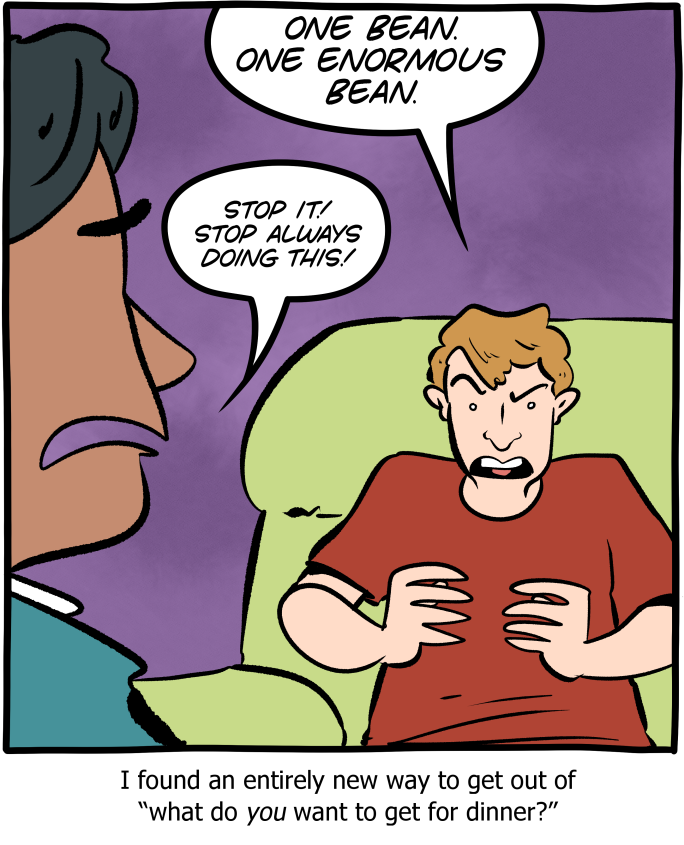
Shouting BLOOOOOOOD is similarly frustrating.
Today's News:
Hovertext:
Shouting BLOOOOOOOD is similarly frustrating.
MG Siegler:
I’m not even talking about Apple and AI here. We’ve done that, a lot. Probably enough — for now (famous last words). I’m talking about Apple in general. Watching this OpenAI video — again, not an event, just a product walk-through with various team members (though this one happened to be “MC’d” by Sam Altman) — I had this old, familiar feeling as they walked through the new features: joy.
As ridiculous as it may sound, I was almost giddy around what I was seeing. It’s a feeling that I recall well from many an Apple event back in the day.
“Yes, this is exactly what I wanted! They did it!” That kind of thing.
This will sound unfair or harsh to Apple, but I really don’t think that it is. I can really only speak for myself here, and perhaps I’m alone — but I suspect that I’m not — it has been a while since I’ve gotten that feeling from an Apple announcement. That loving feeling.
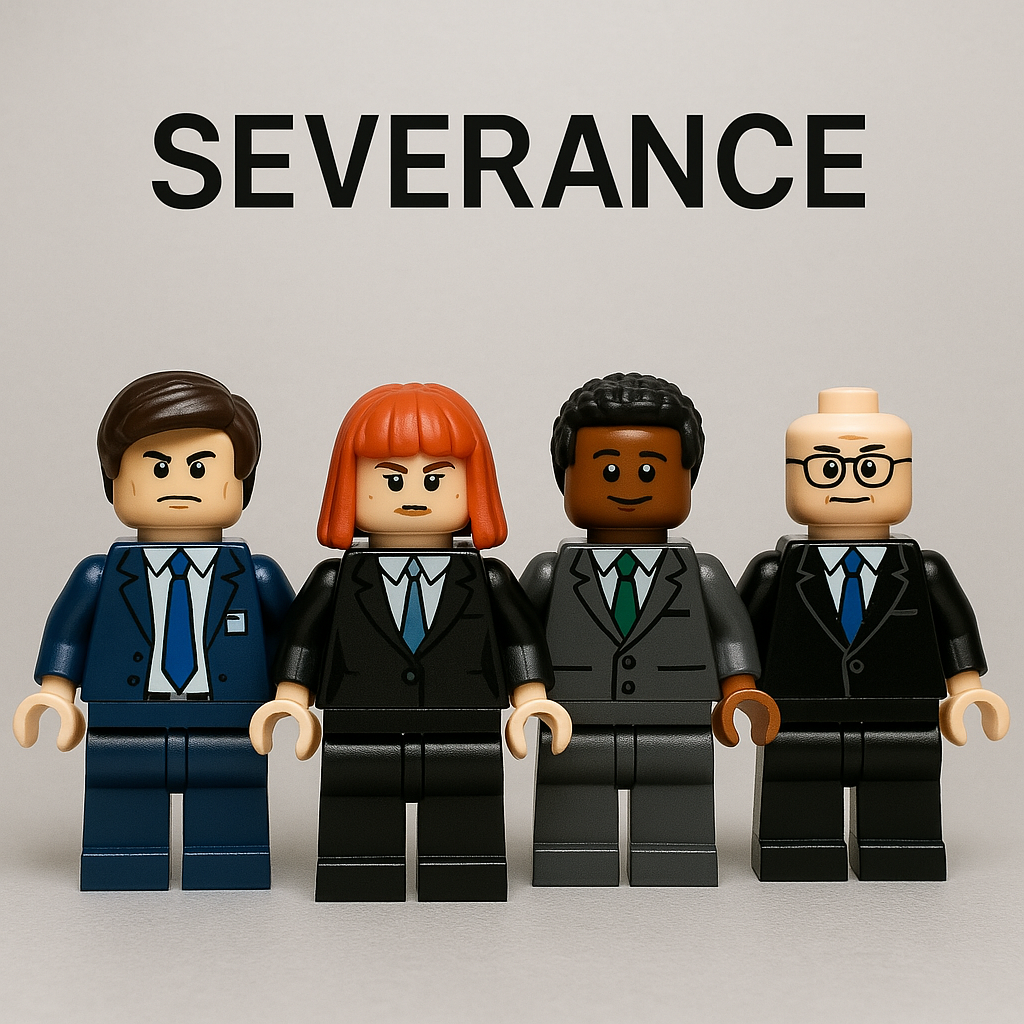
I gave the updated ChatGPT the instruction “Create an image of the main characters from ‘Severance’ as Lego figures” and this is the first response it gave me:
I gave Apple’s Image Playground, running on MacOS 15.3.2 Sequoia, the equivalent prompt — “The main characters from ‘Severance’ as Lego figures” — and it gave me this as its first response:

One of the above images qualifies as “Hey, that could be better but it’s pretty good for the first crack from a simple prompt”, and the other qualifies as “This bears zero resemblance to anyone or anything from Severance”.
Guess which one of the two Apple is actively promoting to users as something they should try?
Welcome to Academia.edu. Now you can stay up-to-date with the latest research from academics around the world.
Your monograph on Lord Byron’s juvenilia has a new reader.
Your monograph on Lord Byron’s juvenilia has a new reader. Bad news: It’s a graduate student, and they are going to eviscerate it in chapter 2 of their dissertation.
Jim Fitzgerald read your article, “Ekphrastic Poetry in Regency-Era Britain.” View Jim’s profile.
Holy crap, Jim is now a full professor at Brown? You once saw him eat a loose M&M off the floor of the student union.
Your article on the suppression of free speech in the early nineteenth century cannot be uploaded to Academia.edu because the journal that published it operates behind a paywall and will not allow you to reprint it elsewhere for seven years, at which point you will no longer be an early-career scholar requiring citations in high-impact journals to include in your application for promotion to associate professor.
Your paper about Thomas Carlyle’s rhetorical strategies in Sartor Resartus was cited in the Journal of Applied Ichthyology. You are confused, but you’ll take the citation.
Someone from a renowned R1 just searched for you on Google. For $1.30/day, we can tell you who it is, or you can spend the next hour fantasizing about which search committee chair is vetting you for a tenure-track line.
Are you the “Steere” cited in over one thousand Biology papers?
Oh, sorry, never mind. That’s A. C. Steere, professor of medicine at Harvard Medical School. He’s written over three hundred scholarly articles on Lyme disease. Wow. That guy really made something of himself.
Someone from a prestigious R1 has scooped a conference paper you gave three years ago and published it in a flagship journal. You snooze, you lose!
Your paper on Percy Shelley’s Epipsychidion has been viewed by a well-known scholar who you’re pretty sure was “blind reviewer #2” when you submitted that paper, since their only comments were that you needed to include references to five articles authored by blind reviewer #2.
You would have saved 11,248 minutes with the Academia.edu summaries feature. With those 11,248 minutes, you could have revised that conference paper you gave three years ago into an article for a flagship journal before someone at a prestigious R1 scooped it.
Your article, “Ekphrastic Poetry in Regency-Era Britain,” has been viewed by the person who got your dream job at that East Coast university for which you made the shortlist. You had a pretty good interview there, actually, but then, when the department head took you out to lunch, you spilled soup on your shirt and had to give your teaching presentation to a room full of first-year students who just stared at the stain. Anyway, she’s wearing black in her faculty photo, and it looks like she’s thriving.
Your paper on Sartor Resartus has been viewed by an online conspiracy theorist, who has taken one sentence out of context and included it on their website devoted to Mothman sightings.
Your profile has been viewed by that guy who kept saying “This is more of a comment than a question, really…” during the Q and A after your conference presentation.
Oh my god, the head of your dissertation committee just viewed your monograph. I’m sure she doesn’t remember how you completely forgot Edmund Burke’s name during your dissertation defense. She probably has no idea you relive the moment in your dreams and sometimes wake up your partner screaming, “Edmund Burke!”
No one, but no one, has viewed your passion project article about Sir Walter Scott.
Your paper on Percy Shelley’s Epipsychidion has been cited in an article titled “Navigating the Complexities of a Vivid Tapestry: Delving into the Intricacies of Romanticism,” which was definitely written by AI.
Your paper on Percy Shelley’s Epipsychidion has also been cited in an article titled “‘Turns Out I’m 100 Percent That Bysshe’: Shelley’s Romantic Radicalism.” You hate cute titles like that but also wish you’d thought of it first.
Someone saw your monograph in an Academia search. Come on, don’t you want to know who? Pay us just $150/year to stroke your ego and fuel your anxiety about a topic so esoteric that literally no one else cares.
SARTELL, MN—Feeling a deep sense of embarrassment wash over his long, scaly body, a local snake getting twirled around like a lasso reportedly realized Friday that he was never going to live this down. “Being spun in circles above the head of a child pretending to be a big strong cowboy is the most humiliating thing that’s ever happened to me, and no one’s ever gonna let me forget it,” said the rapidly revolving milk snake, adding that the worst part was that the child possessed a rope that he easily could have used instead. “I’m gonna get so much shit for this from everybody down in the pit. I can already hear them mocking the noise my body makes whirling so fast like a helicopter blade. Hell, I might just have to move to a new hunting ground, because there’s no way any mouse watching this will ever fear me again. Oh God, he’s using me as a whip now. I’m just gonna close my eyes and pretend this isn’t happening.” The snake added that once this was all over with, he intended to hide in the child’s shoe in order to “bite the shit out of him and regain a little self-respect.”
The post Snake Getting Twirled Around Like Lasso Never Gonna Live This Down appeared first on The Onion.
EDEN PRAIRIE, MN—Causing light bulbs to shatter and plaster to rain down from the ceiling of the quaking room, pale teenage psychic Derek Timmons reportedly collapsed with a nosebleed Friday after trying to jerk himself off with the power of his mind. “I…I thought I was strong enough to harness my psychokinesis to beat my meat, but I…I lost control,” said a sweat-soaked Timmons, veins bulging on his massive head as several researchers rushed in to stop him before he could telekinetically stimulate his genitals again. “I should have never gone in for the fourth round, but I was feeling super horny. I overestimated my tele-masturbatory abilities. However, if I could just push my mind further, beyond the limits of known sexual fantasies, I could bring about an orgasm far greater than humankind’s wettest dreams.” At press time, sources confirmed the teenage psychic’s elderly mentor had agreed to show him the ropes.
The post Pale Teenage Psychic Collapses With Nosebleed After Trying To Jerk Self Off With Power Of Mind appeared first on The Onion.
Hallow, a Catholic prayer app, is observing Lent with a prayer challenge featuring celebrities like Mark Wahlberg, who is also an investor in the app. The Onion shares everything you need to know about Hallow.
Q: Who is Hallow aimed at?
A: Lapsed Catholics seeking a closer connection with Mark Wahlberg.
Q: Is Hallow only for Catholics?
A: It’s for anyone who doesn’t mind spending their money on something they can do for free.
Q: Is it wrong to put God’s teachings behind a paywall?
A: Catholicism has a rich, beautiful history of taking people’s money.
Q: Who is the app’s main competitor?
A: The Beelzebub curse app.
Q: Why would a loving God create yet another tech startup?
A: Do not question His ways, or His bottom line.
Q: Why was Hallow banned in Europe?
A: The blood of Christ contains Red 40.
Q: Why was Hallow banned in China?
A: They really don’t like Mark Wahlberg over there.
The post What To Know About The Hallow Prayer App appeared first on The Onion.
AUSTIN, TX—In an effort to crack down on the statewide proliferation of adult foodstuffs, the Texas Legislature passed a new law Friday requiring all residents to show identification to buy phallic foods. “From bananas to cucumbers to submarine sandwiches, obscene foods will no longer be allowed to fall into the hands of minors in the Lone Star State,” said Gov. Greg Abbott, adding that an officially issued driver’s license or passport would be needed to purchase a baguette, which is defined in the legislation as “any elongated breadlike object used to simulate male genitals.” “No decent person should be buying lewd produce and baked goods, which is why these items need to be safely placed behind locked plexiglass cases or in an adults-only section of the supermarket where innocent kids can’t see them. And rest assured, if you are found to be buying a corn dog or eggplant for a child, you’ll be placed on a watchlist.” At press time, Texas had reportedly expanded the law to require an ID to purchase any deli meats that realistically mimic vaginal texture.
The post New Law Requires Texans To Show ID To Buy Phallic Foods appeared first on The Onion.
WASHINGTON—In a stunning escalation of his ongoing automotive trade war, President Donald Trump announced Friday that he was imposing a 25% tariff on foreign-made cars that talk, make wisecracks, and have real emotions just like people. “For too long, the American market for cars that not only talk but have a personality all their own has been flooded with imports,” Trump said in a fiery address, stating that U.S. manufacturers of sentient, anthropomorphized cars that flap their hoods to speak, use their headlights to see, and curl their bumpers to smile would profit greatly under the new policy. “Our rivals are sending us talking cars that honk to flirt or use their radios to deliver sly zingers after they win a big race. Herbie the Love Bug is a Volkswagen Beetle. Let’s send him back to Germany where he belongs.” Trump added that he would also sign an executive order making the official language of talking cars English.
The post Trump Announces 25% Tariff On Talking Cars appeared first on The Onion.
The post Big Bird Seen Working At Local Starbucks After PBS Funding Cuts appeared first on The Onion.

In brief: Scattered showers and storms will pop up in the Houston area through the day today, leading to locally heavy rain, especially east of I-45. A couple stronger storms cannot be ruled out either, again especially to the east. After a quieter period this weekend and early next week, we may be in store for more unsettled weather and rain chances late next week and weekend.
Of note in Texas, there was some truly awful flooding late yesterday and last night in the Rio Grande Valley. Harlingen had nearly 14 inches of rain yesterday with over 10″ falling between 5 and 11 PM last night. It was their wettest day on record, with all but one other top 25 wettest day occurring between May and November prior to yesterday. For McAllen, it was the third wettest day on record. Even Brownsville cracked their top 25 list as well.

Locally, we have not seen that kind of rain. Fulshear and Simonton saw some locally heavy rain, with 1 to 3 inches falling there, extending north into Waller County. And areas southwest of Wharton and around Matagorda Bay saw 1 to 4 inches. Harris County saw rain yesterday, but most areas saw a half-inch or less.
Radar this morning shows some heavier showers in Liberty County but mostly calm conditions elsewhere. As the day drags on, look for additional showers and embedded thunderstorms to crop up. I would not be at all surprised to see some very hefty downpours occur, particularly along or east of I-45 later this afternoon. We are in a marginal risk (1/5) for severe storms, so any storm that we see today could produce some gusty winds or even a brief, isolated tornado, particularly between Winnie and Lake Charles later today. However, I don’t want to discount the Houston area, as we have not exactly had great model performance with geographic placement of storms this week.
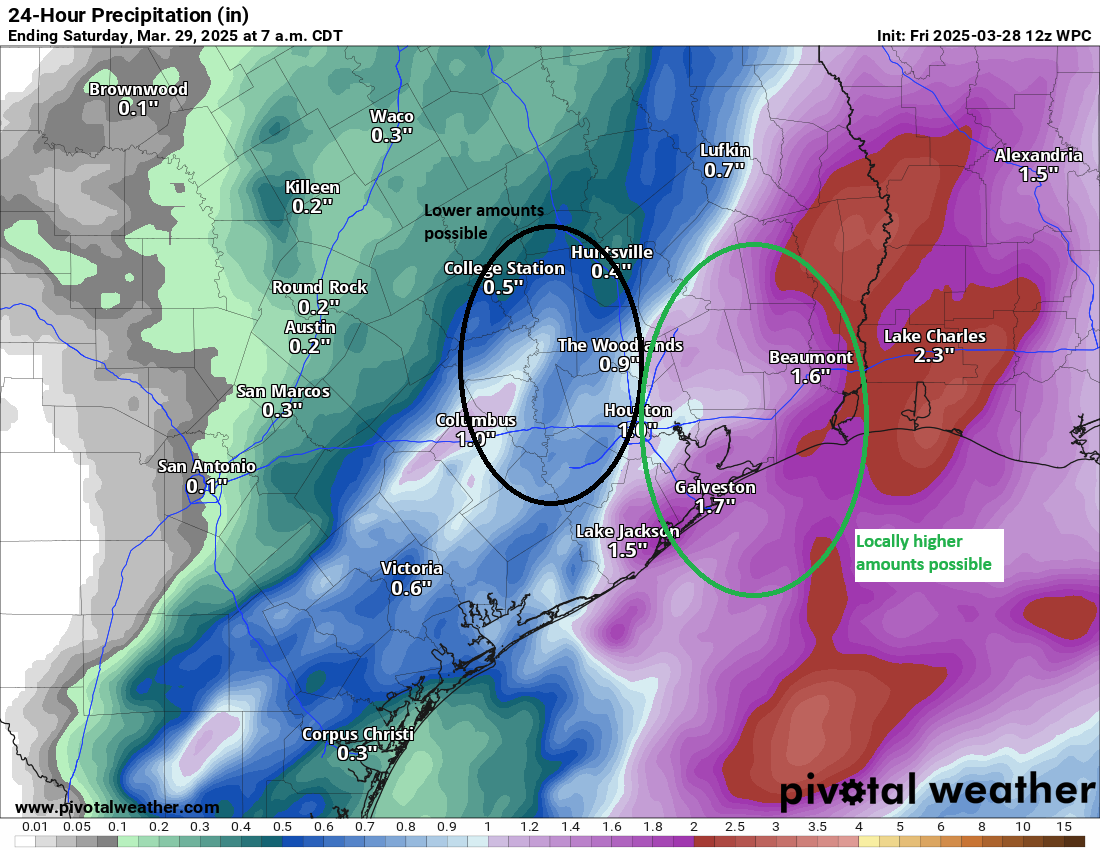
Rain totals are a bit tricky to nail down, but I would say, expect around a half-inch in Houston with a few higher amounts possible east of I-45, lesser amounts to the west. To the east, we should see 1 to 3 inches, with even some higher amounts possible in spots. We will keep our stage 1 flood alert in place. Rain rates yesterday were easily near 3 inches an hour in the Valley, and that could be noted here as well.
So, bottom line: Scattered showers and storms today. Especially this afternoon. Locally heavy downpours, especially east of I-45, along with a low-end severe weather risk. Localized street flooding remains a concern in those areas with heavier, more persistent rain.
I’m going to spin tomorrow optimistically. I think we’ll start off cloudy, perhaps with some areas of fog. There may even be a few light showers around. But as the day progresses, I suspect we’ll see improvement, with more sunshine, less cloud cover, and high temperatures popping back into the 80s. We should hopefully be able to keep the Houston Open moving along.
While the majority of Sunday looks fine in the Houston area, there will be a passing disturbance to our north. As this occurs, it could be enough to set off some thunderstorms, primarily north of I-10 and especially north of Highway 105 across Navasota, Conroe, and Cleveland. South of I-10, storms will be unlikely. The most likely time for a few storms would be in the late afternoon hours, heading into the early evening. Everything quickly clears to our east by mid to late-evening. We’ll warm from the upper-60s into the low-80s.
We should get a weak front through here Sunday night or Monday morning that ushers in some notably more comfortable air for a day or so. Thereafter, the onshore machine will pump back warm, humid air off the Gulf and into Texas by Tuesday afternoon or Wednesday. Low temps should remain in the 60s with highs in the 80s most of the time. Daytime highs could push upper-80s by Wednesday.
A more unsettled pattern looks to settle in over Texas and more broadly the Plains and Southeast later next week, which could linger through the weekend. I don’t expect a ton of rain here right now, but I do believe our thunderstorm chances will increase. This may be especially true as you get north of Houston and northeast into Louisiana and elsewhere.
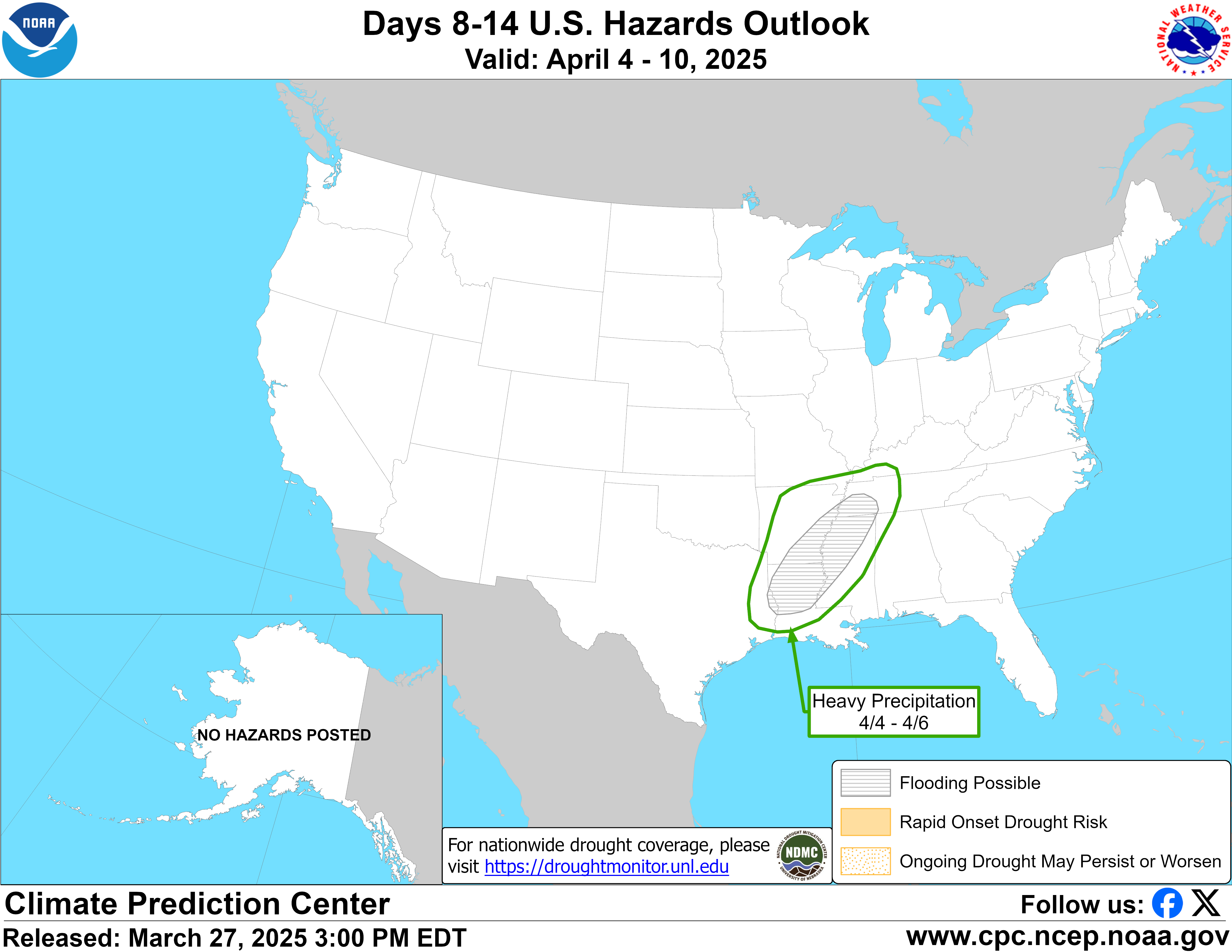
That said, it’s too soon to say much more than that. As we noted in our Q&A post the other day, sometimes there is enough signal in the model noise to highlight a forecast risk, and in this case that’s what we have late next week and weekend. Stay tuned!

This post was written by Alison Green and published on Ask a Manager.
It’s four answers to four questions. Here we go…
1. Perks for remote employees only
Our company works mostly remotely. Employees who live locally come in one day a week. A few departments’ employees are allowed to live elsewhere in the country (this rule does not apply to all departments). Several times a year, all staff are required to come into the office for the full week. Employees who live outside the area get paid hotel rooms near the office, and expense all of their meals. Local employees, however, are required to pay for their lunch every day, as well as the additional costs of commuting for the additional days (parking is quite expensive where we work). Is there a way to make our company see how unfair this is? Or am I being unreasonable?
Yeah, you’re being unreasonable! Employees traveling for work have their meals covered since eating on business trips tends to be more expensive (since you don’t have access to your own stocked kitchen). Meals and hotel rooms aren’t perks when you’re traveling for work (“perks” was the word in your email subject line to me); they’re business expenses.
Some extra days in your local office but still going home each night is a very different thing than being gone for a week on a business trip.
I don’t think you’re likely to get traction if you suggest that the company pay for local people’s extra commuting costs or lunches that week. (In theory it could be good for morale if your company provided lunch to everyone at least once or twice during those weeks, but it’s not outrageous that they’re not; this is just a difference in being local vs. non-local.)
Related:
our non-traveling employees are upset about the travel “perks” that others get
2. Being the only woman at a retreat in an AirBnB
My manager, a VP, invited me to attend an upcoming director summit with five directors. While my role is more administrative, he felt my presence would be valuable. The summit is planned for the summer at a rented AirBnb with entertainment amenities like a swimming pool, game room, etc. I would need to take a five-hour road trip with one of the male directors, and the group would conduct meetings around a large kitchen table or in the living room with a projected screen.
I was initially uncomfortable with the setup and expressed my concerns to my boss. He acknowledged them but emphasized that he still wanted me to attend. After discussing it with family and colleagues, opinions were split on whether this arrangement — one woman among six men at a rental property for a work event — was entirely appropriate or potentially questionable. What do you think?
I don’t think it’s inappropriate, but it’s also not unreasonable if you decide that you personally feel uncomfortable with it and want to ask for separate lodgings. (I’m assuming there’s an overnight stay, given the five-hour drive.)
Related:
I’d be the only woman at a team-building event at my boss’s remote lake house
3. My mom says I shouldn’t leave a bad Glassdoor review for my old company
I recently was terminated from a very toxic work situation, and have run out my options to legally pursue them. (The contingency lawyers basically told me I had a case but they did not feel it would be profitable enough to be worth pursuing on my behalf, and I cannot afford to retain legal representation on my own.)
In place of hitting them in their wallet, where I know they would pay attention, I was at least hoping to post an honest review of the job. If I had done my due diligence in the first place, I never would have applied. I want to add my voice to the chorus of others who have proclaimed this company to be bad to work for.
My issue comes because my well-meaning mother is trying to discourage me from posting anything because she is convinced that they will figure out that I posted it and come after me legally. She pointed out that I do not have the money to sue them, and I certainly do not have the money to defend myself if they try to sue me. She is also concerned that it will get linked back to me and prevent future employers from considering me. While she is right that I cannot afford to be sued, I am more dubious about her other fears. If a reputable employer is interested in what I have to offer, why should a bad relationship with a former place of employment be relevant? I have connections in the form of other employees who will and actively are giving me positive references for new opportunities.
How valid are my mother’s concerns? Admittedly, she has been out of the workforce for a long time, but I frequently listen to her because she operates from a place of common sense. I have many people telling me to just do it, and many people pointing out that they have not disputed the other negative reviews so why would mine be the tipping point? I’m just truly scared of making myself undesirable to a future employer. So, how far off-base is my mother on this one?
It’s incredibly unlikely that the fact that you left a negative review will somehow get linked to you in the minds of prospective employers. How would they know? The idea that it would prevent future employers from considering you is a non-issue.
Where it could be an issue if your old employer figures it was you and it causes them to give you a more negative reference than they’d give you otherwise — but it doesn’t sound like you were expecting a good reference from them anyway, so I’m not sure that needs to be a real worry. (For the record, though, you may run into employers who want a reference from this company even if you’re offering up different ones, so you shouldn’t rely on “well, I just won’t give them as a reference” — but it sounds like this reference wouldn’t be great regardless of whether you leave them a bad review or not.)
Moreover, you sent me the review you’re considering posting and it’s not the sort of thing that would obviously have to be from one specific person: you talk in general terms about the company culture and management, not about specific experiences unique to you. I don’t see how they’d tie it to you, unless you repeatedly raised the same issues in very loud and specific terms while you were there and no one else ever complained about those things (which, from your review, definitely sounds like it was not the case). There’s also nothing legally actionable here; it’s legal to share your opinions [and here’s Glassdoor’s own page on avoiding defamation, which explains what’s considered an opinion (i.e., not defamatory) versus “verifiable facts” (potentially defamatory if knowingly false)]. I mean, people can sue anyone for anything, but it’s incredibly unlikely that a company would feel moved to take any legal action on this.
Your mom is being overly cautious. That said, Glassdoor has a bad track record on privacy so it’s always smart to use a burner email if you post there.
4. Is it normal for managers not to know how much their employees earn?
A few years ago I was a line manager and hiring manager for new employees joining my team, so I knew what the salary range for the positions being filled was, had negotiating power over said range, had the final say on who we’d extend an offer to, and would communicate to HR how much we’d be offering to the candidate. I also used the knowledge of my direct reports’ compensation to fight for salary increases to improve employee retention and to make sure everyone was being paid fairly for their role, their contributions, and their job experience.
I always thought this was fairly standard, but I’ve discovered that my last two line managers had no idea how much I or anyone else on my team were being paid, nor did they care to ask because the final offer to employees were decided by the CEO, as they’re the ones who have the final say on things like budgets for the company and how much they spend on new talent.
My last line manager tried arguing that my salary was private information and wasn’t relevant for him to do his job, but I argued back that, without this knowledge, he had no idea if we were being paid fairly, and as the person who oversees our day-to-day work, he’s the best person to know our worth and make sure that our compensation matches our contributions to the company. I eventually left that job because not only did I find out I was being underpaid for the industry, my colleague and peer received a significant raise that wasn’t extended to me.
Is this normal? Are line managers usually not told how much their direct reports are being paid? Is this not important information they should have so they can advocate for their team with senior leadership? That’s what I thought at first, but now I’m wondering if I was the outlier and line managers are usually not privy to this information due to data privacy reasons.
No, managers generally know how much people on their teams are being paid, for all the reasons you say. You also need to be able to spot inequities (Persephone is making more than Cordelia, but Cordelia does a better job) and retention risks (we’re currently underpaying Cordelia for the market and risk losing her over it) and actually talk to your employees about their salaries, which is a normal thing people bring up with their managers. There are places where managers don’t have this information, but unless they’re very low-level managers, it’s usually the sign of a culture with weak management (including that managers there aren’t well-trained or supported, which can trickle down to the people working under them in all sorts of ways).
It's no secret that "driving while black" is a real phenomenon. Study after study has shown that minority drivers are ticketed at a higher rate, and data from speed cameras suggests that it's not because they commit traffic violations more frequently. But this leaves open the question of why. Bias is an obvious answer, but it's hard to eliminate an alternative explanation: Minority groups may engage in more unsafe driving, and the police are trying to deter that.
But now, Lyft has given a group of researchers access to detailed data from their drivers. The results confirm that minority drivers get more tickets, and they pay higher fines when they do. And the results also show that minorities aren't in any way more likely to speed or engage in unsafe driving. Which suggests, in their words, that the problem is "animus" against minority drivers.
The work was done thanks to cooperation from the ridesharing company Lyft, which provided data on its drivers in Florida, all 222,838 of them, along with a record of all the GPS pings their tracking systems sent into the company's servers. Combined with a detailed map of Florida's roads, along with their speed limits, they could determine when a given driver was speeding. They also obtained Florida police records of any accidents and cross-referenced their locations to any vehicle that experienced a sudden stop in that spot at the same time.
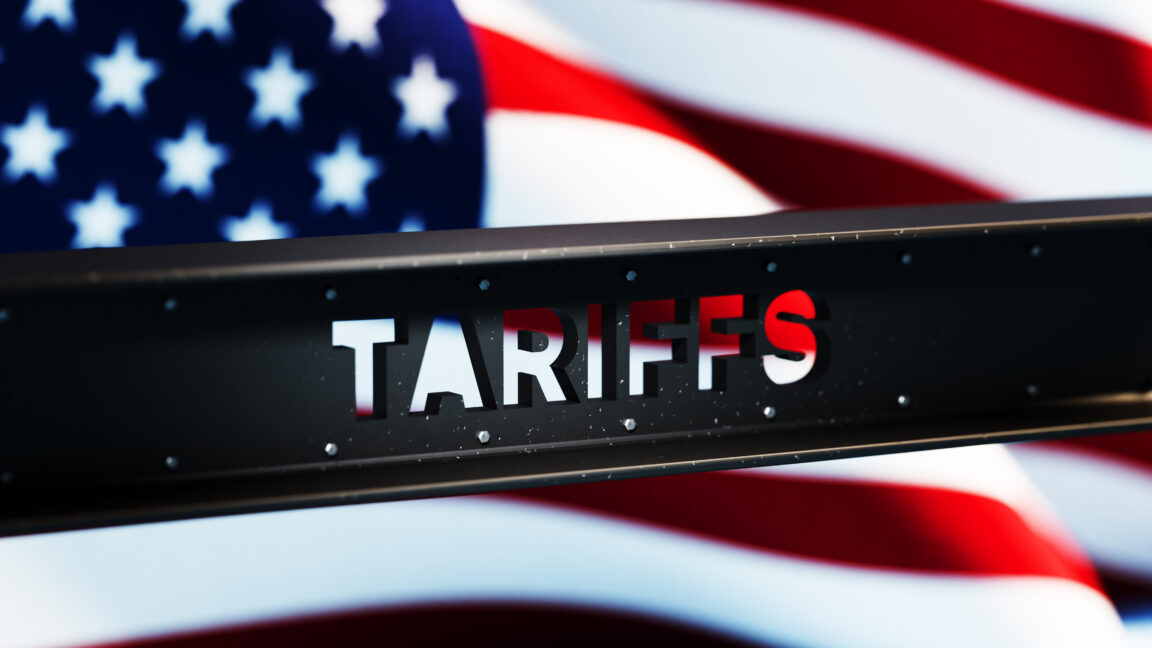
Yesterday afternoon, once the markets were closed and could no longer react immediately, US President Donald Trump announced that starting on April 2, all imported automobiles and many imported car parts will now be subject to an extra 25 percent tariff. Despite Trump's rhetoric during his election campaign and since taking office, tariffs are paid for by those importing the goods, not the exporters, so we can look forward to most new cars and trucks—and their maintenance costs—getting a lot more expensive.
During his first term in office, Trump started trade wars with key US trading partners like Canada, the European Union, and China. Upon his return in 2025, more trade wars have been the name of the game. A 25 percent tariff on all imports from Canada and Mexico was threatened and then implemented at the beginning of March, before being partially reversed just two days later. Additionally, a 10 percent tariff on Chinese exports was also levied.
Less than two weeks later, a new 25 percent tariff on all steel and aluminum imports also joined the club.
President Trump on Thursday signed an executive order purporting to outlaw collective bargaining across two thirds of the federal government, citing a little-used provision of federal labor law relating to national security issues.
A fact sheet announcing the policy document says that Trump cited a rarely used provision of the 1978 Civil Service Reform Act allowing the president to exclude agencies and agency subcomponents from collective bargaining rules if the rules “cannot be applied to that agency or subdivision in a manner consistent with national security requirements.”
Trump first considered using this authority in early 2020, granting then-Defense Secretary Mark Esper the ability to exclude the Pentagon from federal labor law. Following bipartisan pushback in Congress, Esper elected not to use the authority.
According to the White House, Trump’s edict “ends collective bargaining” with unions at the Defense, State, Veterans Affairs, Justice and Energy departments, as well as portions of the Homeland Security, Treasury, Health and Human Services, Interior and Agriculture departments.
The International Trade Administration, Environmental Protection Agency, U.S. Agency for International Development, the Nuclear Regulatory Commission, National Science Foundation, International Trade Commission, the Federal Communications Commission and General Services Administration also are no longer subject to federal labor law, nor are chief information officers’ offices across government.
All told, the agencies covered by Trump’s order amounts to 67% of the federal workforce, and 75% of federal workers who are currently represented by unions.
In a statement, Everett Kelley, national president of the American Federation of Government Employees, the largest federal employee union, vowed to fight the president's edict, which he said was in retaliation for unions' efforts to protect employees' rights amid the mass firings across government. Kelley said his union would take "legal action" to block the order's implementation.
"President Trump's latest executive order is a disgraceful and retaliatory attack on the rights of hundreds of thousands of patriotic American civil servants—nearly one-third of whom are veterans—simply because they are members of a union that stands up to his harmful policies," Kelley said. "This administration’s bullying tactics represent a clear threat not just to federal employees and their unions, but to every American who values democracy and the freedoms of speech and association. Trump’s threat to unions and working people across America is clear: fall in line or else."
Guidance issued by acting Office of Personnel Management Director Charles Ezell told agencies cited in the edict that they are “no longer subject to the collective bargaining requirements” under Title 5 of the U.S. Code, though they should consult with their general counsel regarding implementation. Agencies have been instructed to cease "participating" in any ongoing grievance proceedings before independent arbitrators.
Don Kettl, dean emeritus and a former professor at the University of Maryland School of Public Policy, said the Civil Service Reform Act’s national security exemption does not stretch far enough to cover the agencies cited by the Trump administration.
“The president has power to change the conditions under which union representation occurs and to negotiate new contracts when existing ones expire,” he said. “But the president cannot simply wipe away existing agreements.”
And while the White House’s fact sheet cites the national security exemption within the 1978 law, it repeatedly criticizes the law and accuses unions of “declaring war” on the president’s agenda, citing unions’ various grievances and lawsuits seeking to block the White House’s efforts to purge and politicize the federal workforce.
“The exemption here seems to suggest that the national security responsibilities of the president supersede any existing union agreements and that, therefore, the president can push those existing agreements aside,” Kettl said. “Moreover, the fact sheet asserts that the Civil Service Reform Act allows unions to obstruct agency management. This is a double-barreled shotgun, aimed both at the CSRA in general and at the unions in particular.”
]]>Two Democratic members of the Federal Trade Commission who were fired by President Trump sued him today, saying their removals are "in direct violation of a century of federal law and Supreme Court precedent."
"Plaintiffs bring this action to vindicate their right to serve the remainder of their respective terms, to defend the integrity of the Commission, and to continue their work for the American people," said the lawsuit filed by Rebecca Kelly Slaughter and Alvaro Bedoya in US District Court for the District of Columbia.
Trump last week sent Slaughter and Bedoya notices that said, "I am writing to inform you that you have been removed from the Federal Trade Commission, effective immediately." They were then cut off from their FTC email addresses, asked to return electronic devices, and denied access to their offices.

This page took a long time to draw and that doesn’t include the faces I drew that ended up behind caption boxes.
The post Nihilist fringe appeared first on Bad Machinery.
Hovertext:
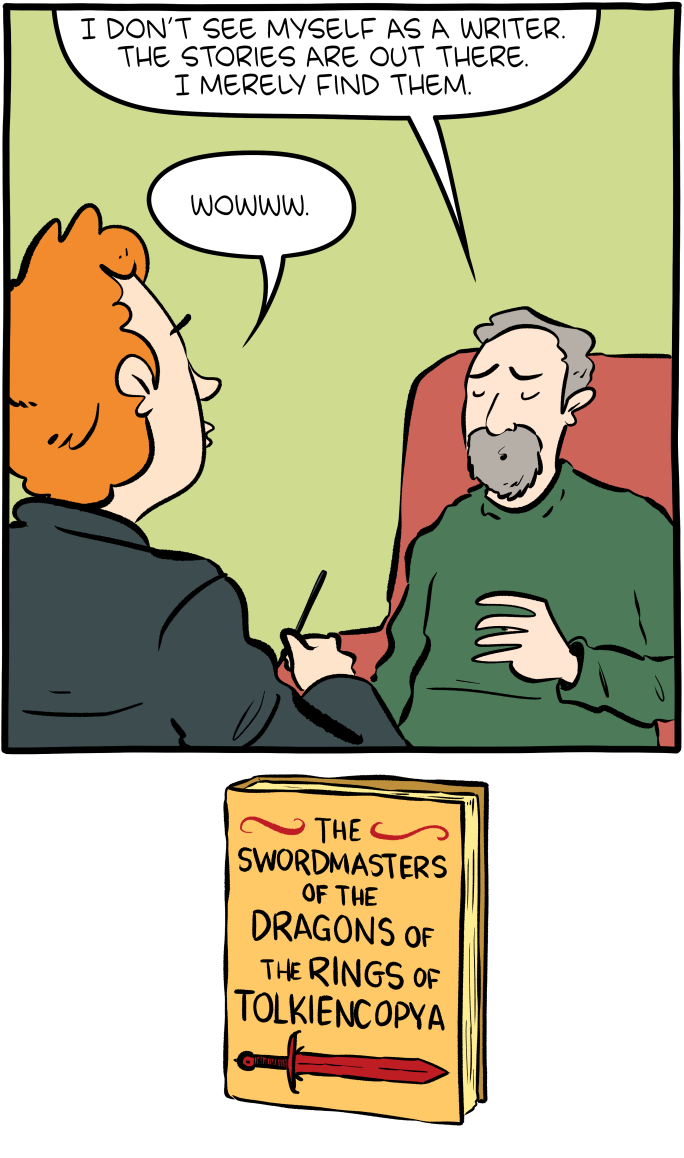
Rule of thumb: you're only allowed to give tedious interviews of process if your book is unreadable modern literary fiction about people coming to terms with something or other.
I think lots of people know the kind of person who thinks they’re more clever than they really are. The kind of person who thinks that they can outwit the system by playing stupid games. The kind of person who thinks that this kind of beating the system is because they’re smart. This kind of person is usually viewed as a dipshit. Donald Trump’s DOJ seems to be, as a group, acting like just that kind of dipshit.
Like that overconfident student who thinks they’ve discovered one weird trick to beat the system, the DOJ keeps playing increasingly transparent games in court — making patently ridiculous arguments while acting shocked and offended when judges see right through their obvious nonsense.
It is a form of contempt. Not necessarily in the legal sense. But it is a kind of obvious contempt for the very systems and institutions of our judicial system that they are supposed to be protecting as a part of the constitutional order. And while judges are often willing to give great leeway to bad actors in their courtroom, at some point the outright contempt for the court can turn into something judges will start calling out.
I’m reminded of a college classmate who exemplified this mindset perfectly. He’d spend countless hours finding elaborate ways to game every assignment and test, devising increasingly convoluted schemes to avoid doing the actual work. The irony was that his schemes typically required far more effort than simply completing the assignments properly would have taken. But he sure was proud of the ways he believed he was beating the system.
That same misguided energy now permeates Trump’s DOJ (indeed, I just looked up on LinkedIn if that classmate might now work for the DOJ — thankfully he’s not there). These officials pour tremendous effort into crafting obviously laughable legal arguments, filing misleading declarations, and playing semantic games with court orders — all while seemingly convinced of their own clever brilliance. Just like my former classmate, they’re expending more energy trying to game the system than it would take to actually fulfill their constitutional duties and serve the American people. The result is a particularly toxic form of institutional contempt — not just disregard for the courts, but a sort of smirking certainty that they’re somehow outsmarting the entire judicial system.
It is nearly impossible to keep track of all of the various lawsuits that have been filed against the plethora of illegal actions taken by the Trump administration in the last two months since inauguration (though kudos to folks like Just Security who have been tracking them as best as they can).
The Boasberg case represents a critical escalation in this pattern of contempt. While legal scholars debate what precisely constitutes a constitutional crisis, Corbin Barthold makes a compelling case that we’ve now crossed that threshold. When a federal judge explicitly orders planes carrying deportees to return and the administration simply ignores that order, we’re witnessing something qualitatively different from their usual games.
THE LONG-AWAITED CONSTITUTIONAL CRISIS has now arrived. It is time for a court to say so.
On Saturday night, James Boasberg, a federal judge in the District of Columbia, issued a pair of emergency orders. The government, he had just been told at a hastily convened hearing, was removing from the country, without due process, more than a hundred alleged gang members. The planes, he learned, were already in the air. To justify this stunning move, President Trump had issued a proclamation invoking the Alien Enemies Act of 1798.
At around 6:45 p.m., Boasberg orally ordered the planes turned around. “Any plane containing these folks that is going to take off or is in the air needs to be returned to the United States,” he ruled from the bench. “This is something that you need to make sure is complied with immediately.”
At 7:26 p.m., he issued a brief written order barring the government from relying on the Alien Enemies Act to remove noncitizens from the country.
The government ignored both orders.
This outright defiance marks a subtle, but notable, departure from the administration’s playbook the past few months. Until now, they’ve preferred more smirking forms of contempt — slow-walking court orders, playing word games with compliance, or burying judges in misleading declarations. But each of these smaller acts of contempt has apparently emboldened them toward more brazen defiance.
Even in this case with Judge Boasberg, the White House has been trying to claim that it’s not ignoring his orders.
A second administration official said Trump was not defying the judge whose ruling came too late for the planes to change course: “Very important that people understand we are not actively defying court orders.”
This argument, that the order came too late, is nonsense. But it’s notable how the administration is trying to insist it’s actually obeying orders in court, while doing wink, wink, nod, nod stuff out of court.
The administration’s attempts to characterize this as a routine “deportation” matter represent perhaps their most cynical wordplay yet (and one the media should stop repeating, though that’s a different issue). Deportation is a legal process with established due process rights. What happened here was something far darker: the US government engaging in what amounts to human trafficking, shipping people to El Salvador as forced labor without any due process. The mask slipped entirely when El Salvador’s President tweeted “Oopsie… too late” in response to Judge Boasberg’s order — a tweet that Secretary of State Marco Rubio and Elon Musk both found amusing enough to amplify:

The full scope of what’s happening deserves to be called out directly. Start with the legal sleight-of-hand: The administration has resurrected the Alien Enemies Act, a widely disparaged authoritarian relic that only applies during “a declared war” or “invasion” — neither of which exists. They’re wielding this zombie legislation to deny basic due process rights to people on American soil, shipping them to El Salvador (not even their country of origin) to become literal slave labor — all funded by US taxpayers.
The contempt deepens with their public justification. Without due process requirements, they don’t actually have to prove their claims that these people are gang members. And they can’t — because the claims are false for many of those shipped out. Reports show that many of the deportees have no gang connections at all. Any competent law enforcement official would recognize these allegations as nonsense.
But the most chilling display comes in their response to judicial oversight: when a federal judge attempts to restore basic due process rights, the administration not only ignores his order, but the Secretary of State publicly mocks it while coordinating with their partner in human trafficking. This isn’t just contempt of court — it’s contempt for the entire concept of legal constraints on executive power.
The administration’s response to Judge Boasberg perfectly encapsulates their broader strategy: when the facts aren’t on your side, attack the judge. Their characterization of Boasberg as a “radical left lunatic partisan” would be merely laughable if it weren’t so deliberately misleading. This is the same conservative judge who repeatedly ruled in Trump’s favor in other cases — ordering Hillary Clinton’s emails released, blocking the release of Trump’s tax returns, and limiting disclosures from both the Mueller investigation and the classified documents grand jury.
The contempt here operates on multiple levels: there’s the surface-level dishonesty of painting a conservative judge as a radical leftist, but more insidiously, there’s the implicit message that any judge who dares enforce the law against Trump must be acting from partisan motives. This fits a broader pattern where the administration’s lawyers aren’t just playing games with legal arguments — they’re actively working to undermine the legitimacy of judicial oversight itself.
The Boasberg case may be the most brazen example, but it’s far from isolated. Across multiple courts, judges are increasingly witnessing this administration’s attempts to treat the judicial system like a game they can cleverly exploit. Their contempt generally takes three forms, each more concerning than the last:
First, there’s the malicious compliance playbook — taking court orders so literally they become absurd. The Social Security Administration exemplifies this approach. When Judge Ellen Hollander blocked DOGE from accessing records, interim SSA head Lee Dudek responded by threatening to shut down the entire Social Security system, claiming his entire IT staff were somehow “DOGE affiliates.” This led to an increasingly furious series of clarifications from the judge, culminating in her observation that either Dudek was lying or the DOJ lawyers were.
Second, there’s the strategy of procedural manipulation — exploiting court customs and courtesy to gain tactical advantages. Take the EPA case, where officials used procedural games to try to circumvent judicial oversight. They asked for a routine 24-hour extension on a hearing (which opposing counsel typically grant as a professional courtesy), then used that delay to sneak in actions that would have been prevented by the pending TRO:


Third, we’re seeing increasingly more open defiance of court orders, coupled with attempts to delegitimize any judge who rules against them. The Perkins Coie case perfectly demonstrates this escalation. When Judge Beryl Howell issued a TRO blocking an obviously unconstitutional executive order targeting the law firm for representing Democratic interests, Attorney General Pam Bondi and OMB Director Russell Vought responded with explicit defiance:
The Executive Branch’s position is that Executive Order 14230 is permissible, and that the Court’s order was erroneous. The government reserves the right to take all necessary and legal actions in response to the “dishonest and dangerous” conduct of Perkins Coie LLP, as set forth in Executive Order 14230.
At the same time, the DOJ is trying to disqualify Judge Howell for… “hostility” towards the President, again setting up the idea that any judicial action holding them to account is driven by bias, rather than an actual respect for the Constitution.
The pattern of contempt continues across other cases, each fitting into these three categories of increasingly brazen defiance:
More malicious compliance games appear in the DOGE leadership saga, where pretend DOGE boss Amy Gleason filed a declaration claiming to run the agency even as Trump himself said in his address to Congress that Elon Musk runs it. When called on this discrepancy, Gleason’s response dripped with technically-accurate-but-misleading wordplay: “Elon Musk does not work at USDS. I do not report to him, and he does not report to me. To my knowledge, he is a Senior Advisor to the White House.” The contempt deepened when it emerged that Gleason was simultaneously appointed as an HHS consultant a week after being named DOGE head.
The EPA case shows how procedural games escalate to outright dishonesty. EPA boss Lee Zeldin, fixated on a deceptively edited Project Veritas video, illegally froze a Citibank account, and attempted to launch a grand jury investigation. When challenged in court, DOJ lawyers told Judge Tanya Chutkan they couldn’t provide evidence of any criminal violation because “this Court is not in a position to rule upon whether or not this termination was consistent with the contracts.”

Perhaps most telling is the transgender military ban case, where the administration’s contempt for judicial oversight is laid bare. The DOJ keeps insisting to the judge that there is no ban on transgender service members, while Secretary of Defense Pete Hegseth openly declares exactly the opposite:

These examples paint a clear picture of an administration that, like my college classmate from years ago, believes it’s brilliantly outsmarting the system while actually just making itself look increasingly desperate to avoid any accountability. But unlike that student’s academic games, these legal shenanigans carry profound constitutional implications.
What started as wannabe-clever-but-obvious attempts to circumvent court orders has evolved into something far more dangerous: a systematic effort to delegitimize judicial oversight itself. Each time they respond to a court order with malicious compliance, procedural manipulation, or outright defiance, they’re not just showing contempt for individual judges — they’re undermining the very concept of judicial review.
The progression is clear: first came the word games and barely-technically-accurate-but-misleading declarations, then the exploitation of court procedures and customs, and now increasingly open defiance coupled with attempts to paint any judge who enforces the law as politically biased. This is how institutional guardrails get dismantled — not through dramatic confrontation, but through a thousand small acts of contempt that gradually normalize the idea that court orders are merely suggestions to be cleverly evaded.
Trump has already effectively neutered congressional oversight. Now his DOJ appears determined to do the same to the judiciary, treating federal judges like frustrated professors whose rules are just obstacles to be gamed. But unlike my former classmate’s academic adventures, the stakes here aren’t just a passing grade — they’re the continued functioning of our constitutional system of checks and balances.
Judges are starting to catch on, calling out these games with increasing fury. But judicial anger alone won’t be enough. An administration that responds to court orders with winks, nods, and “technically accurate” lies isn’t demonstrating clever lawyering — it’s showing fundamental contempt for constitutional governance itself. Those who shrug this off as mere legal gamesmanship are missing the escalating danger: when government lawyers treat the judicial branch as a system to be cleverly gamed rather than an essential check on power, they’re not just failing their professional obligations. They’re actively participating in the dismantling of judicial review itself.
These officials seem convinced they can keep playing these games forever — or at least until there’s no independent judiciary left to play games with. At some point, judges need to stop writing angry opinions and start issuing contempt charges. And Congress needs to wake the fuck up before it’s too late.
by Kavitha Surana and Cassandra Jaramillo
ProPublica is a nonprofit newsroom that investigates abuses of power. Sign up to receive our biggest stories as soon as they’re published.
Texas Republicans have proposed changes to the state’s strict abortion ban they say would make clear that doctors can terminate pregnancies for serious medical risks without having to wait until a patient’s condition becomes life-threatening.
The legislation comes in response to a ProPublica investigation last fall that revealed how three Texas women died after they did not receive critical procedures during miscarriages. The reporting added to the testimonies and reports of dozens of women denied care during pregnancy complications and led to a statewide reckoning on the dire effects of the law.
The bill, which will have its first committee hearing in the state Senate today, represents a remarkable reversal for Republican leaders who had for years insisted no changes were needed. It was written by state Sen. Bryan Hughes, the author of the original ban who said just four months ago that exceptions for medical emergencies were “plenty clear.” Texas’ governor and lieutenant governor have signaled support for the bill.
It is part of a wave of legislation responding to public pressure after ProPublica’s reporting revealed preventable maternal deaths in states with abortion bans. Bills that have the most traction have been filed and championed by the same Republicans who passed the bans and they have earned a mixed reception.
A bill in Kentucky, for instance, has drawn alarms from critics who cast it as a Trojan horse. It creates modest exceptions to the state’s near-total ban while redefining abortion in a way that advocates fear could greatly restrict patients’ access to critical procedures even in emergencies. Democratic Gov. Andy Beshear vetoed the bill Tuesday, saying it failed to protect women or even clarify the state’s law, an action Republicans could vote to override this week.
The Texas bill however, has broader support and was written in consultation with Democrats, major anti-abortion groups, the Texas Hospital Association and the Texas Medical Association.
Some legal experts and reproductive health care advocates are calling it a significant step forward in a Republican-led state that has shown every sign of clamping down in support of its strict laws, even in the face of public outcry.
“We wish there was a lot more in the bill, but nothing that’s in the bill is bad,” said Bee Moorhead, executive director with Texas Impact, an interfaith-based coalition that sent 6,000 postcards to lawmakers, demanding change after ProPublica’s reporting.
“The basic point is that there are people who would die if this bill doesn’t pass, who would not die if it does pass,” she said.
The bill is intended to make it harder for prosecutors to win a case against a doctor who provided an abortion to a patient experiencing pregnancy complications. It no longer requires a patient’s condition to be “life-threatening.” Doctors can act if their “reasonable medical judgment” assesses a “serious risk to a major bodily function.” It also specifies that doctors do not need to wait until an emergency is “imminent” to terminate pregnancies.
“It goes a long way towards fixing the most serious problems with the Texas abortion law,” said Seth Chandler, a law professor at the University of Houston Law Center.
Others are skeptical that the changes would go far enough to reassure risk-averse hospitals and doctors. While the bill attempts to mitigate the criminal risk for providers handling pregnancy complications, it leaves intact the most powerful deterrent: steep penalties of up to $100,000 in fines, 99 years in prison and loss of medical license for those who violate the law.
It also leaves open the question of what constitutes a “serious risk.” Doctors previously told ProPublica the ban’s unclear language and stiff penalties have led to delays in care. In response to ProPublica’s reporting on preventable maternal deaths in Texas, 111 Texas OB-GYNs signed a letter blaming the deaths on the ban and urging lawmakers to “do something to make sure this never happens again.”
The Center for Reproductive Rights, which has represented 20 women suing the state after they were denied abortions and faced health risks, opposes the bill. The American College of Obstetricians and Gynecologists declined to comment on the bill. Many doctors are adopting a wait-and-see stance.
ProPublica parsed through the language and ran it by six legal experts and six doctors to assess how likely the legislation is to save lives. While some expressed tempered optimism that legislators recognizing there was a problem, most said broader changes would be needed to guarantee the protection of patients.
“Too Many Women Have Died”Texas’ abortion laws are among the strictest in the country. While the current laws have exceptions, they are written in a way that requires a patient’s condition to be “life-threatening” before receiving an abortion.
The result: Some doctors and hospitals have held back on treatments, waiting for the fetal heartbeat to stop or for patients to wind up in undeniable distress.
ProPublica has investigated three cases in which women in Texas died after doctors delayed care during miscarriages, finding that doctors have failed to provide critical procedures or delayed them while taking extra steps to record documentation, even when there was no fetal heartbeat and a patient’s condition was urgent.
Josseli Barnica was 17 weeks pregnant when she was diagnosed with an “inevitable” miscarriage at a Houston hospital in September 2021. Though her fetus was already pressing against her cervix, doctors waited 40 hours until the fetal heartbeat stopped to induce a delivery, putting her at serious risk of deadly infection. She returned to the hospital two days later with sepsis and died.
Nevaeh Crain, 18, also died from complications of sepsis after delays in care. In 2023, she was sent home from two hospitals while she showed signs of infection and then made to wait 90 minutes for a second ultrasound to confirm fetal demise as her organs were failing.
Sepsis has become a lot more common in these kinds of cases, ProPublica found, in a first-of-its-kind statewide analysis of hospitalizations for second-trimester pregnancy loss through 2023. After Texas banned abortion, sepsis rates spiked more than 50%.
In every preventable death in a hospital that ProPublica reported on, doctors did not perform procedures that are associated with abortion but are also critical for treating miscarriages.
As Porsha Ngumezi hemorrhaged in 2022, her doctor did not provide a dilation and curettage procedure, the standard way to empty the uterus that a dozen doctors told ProPublica would be the quickest way to stop the bleeding. She died, leaving behind a husband and two sons.
Supporters of the new legislation say it aims to prevent such outcomes.
Current law specifies that the woman must be suffering a “life-threatening” physical condition in order for doctors to intervene. The amendment strikes that phrase and says doctors can perform abortions if, using their reasonable medical judgment, they believe there’s a “serious risk of substantial impairment of a major bodily function” or “risk of death.” (Like federal law, Texas law defines major bodily functions as systems including the body’s reproductive, digestive, bowel, bladder, respiratory and neurological processes.)
The bill also states it should be viewed as consistent with recent rulings from the Texas Supreme Court, which state that the risk to a woman’s life or major bodily function does not need to be “imminent” for doctors to provide abortions under the law. That’s the most important change in the new bill, according to Joanna Grossman, a law professor at Southern Methodist University. She credited ProPublica’s reporting with pushing lawmakers to act.
“I think the GOP in Texas has been shamed a little bit by those stories,” she said. “If nobody is telling the stories of people with wanted pregnancies who are dying and suffering severe harm they can pretend that isn’t happening.”
The bill says an abortion may also be performed for ectopic pregnancies and for removing “a dead unborn child” after a miscarriage. It removes the “affirmative defense” that applied to certain exceptions in the civil code. That part of the law puts the burden of proof on the doctor to show the abortion was necessary — similar to claiming self-defense in a homicide case.
It seeks to insulate medical staff from being accused of “aiding or abetting” an abortion — so nurses and other colleagues don’t need to be afraid they could be prosecuted for participating in an abortion or discussing it.
Another part of the proposal says that the physician should try to preserve the fetus’ life but does not need to “alter or withhold” medical treatment if that delay poses a greater threat to the woman’s life or a major bodily function.
That is meant to show doctors that they can provide abortions for cases with known risks such as pre-viable premature rupture of membranes, or PPROM, when a patient’s water breaks before viability, even if the patient is still stable, said Amy and Steve Bresnen, two lobbyists involved in negotiating the bill for Texas Campaign for Mothers. The nonprofit, which has powerful Republicans on its advisory board, is focused on reproductive health.
Other changes specify that it’s not a violation of the law if a doctor provides a treatment to a pregnant patient and the fetus dies accidentally in the process. The Bresnens say these changes are intended to reassure physicians they shouldn’t delay treatments for other conditions, like cancer, out of fear they could be blamed for harming the fetus.
All of this should add up to a wide buffer for doctors in Texas to provide the same standard of care that major medical organizations recommend, the Bresnens said, because the exceptions will rely on the doctor’s “reasonable” judgment.
For prosecutors, “proving that no other reasonable physician would have done this is a high, high burden,” Steve Bresnen said.
Texas state Rep. Ann Johnson, a Democrat who signed on as a co-author of the bill, believes the amendment would give “all the tools in the medical toolbox” back to physicians.
“Do not delay, do not alter your treatment. Do not second guess it. Do exactly what you need to do to protect this woman,” Johnson said in describing the proposal.
At a press conference last week, Texas state Rep. Charlie Geren, a Republican sponsoring the legislation in the House, said the bill was the most important he has ever carried and acknowledged the toll of the abortion ban he and his colleagues passed four years ago.
“Too many women have suffered, too many women have died — if one woman has died, it’s too many and more have,” he said. “I have friends whose wives can no longer conceive because of the problems they went through with their first pregnancy and the delay that doctors faced in addressing the problem.”
“They Don’t Want to Run the Risk”But the law hasn’t changed in the one way doctors most want it to: It can still effectively send them to prison for life if found guilty of a violation.
“The criminalization of medical decision-making makes the stakes different than it has ever been,” said Tony Ogburn, an OB-GYN practicing in Texas. He was hopeful the bill might lead to some change, but warned, “I think people are still going to be overly cautious because of the severity of the potential outcome and the criminal penalties.”
ProPublica spoke with six OB-GYNs in the state who worried the amendments may not be enough to spur hospital systems to change their policies to make abortions more accessible for patients with medical risks. Besides leaving the threat of penalties in place, they noted that the amendment doesn’t explain what constitutes a “serious risk” to a major bodily function — the circumstance that would justify an abortion.
“It doesn’t really clear things up that much,” agreed Mary Ziegler, a law professor at the University of California, Davis School of Law and leading historian of the U.S. abortion debate. ”Hospitals are not advising doctors not to intervene just because they don’t understand the law — it’s that they don’t want to run the risk.”
The bill directs the State Bar of Texas and the Texas Medical Board to create courses to educate lawyers and doctors about when they can provide abortions under the exceptions. Both declined to comment on specifics. Doctors said it will be crucial to see what guidance comes out of that effort.
In South Dakota, a similar directive resulted in the state medical board collaborating with a professional association of doctors devoted to anti-abortion causes.
In any case, the changes in Texas law would still apply only to the narrowest of cases. Many doctors noted that Republicans have so far rejected efforts to make a broader health exception in the bill or include exceptions for fetal anomalies, rape or incest. The law still explicitly says a medical emergency can’t be based on any diagnosis that patients may harm themselves — effectively a ban on mental health exceptions.
Competing bills filed by Texas Democrats that have included some of those provisions so far have not received support from Republicans. Several Democrats have also filed legislation to better examine how the state’s abortion ban is affecting the maternal health crisis following ProPublica’s reporting.
Texas state Sen. José Menéndez introduced legislation to allow the state committee investigating maternal deaths to review deaths due to abortion, or a miscarriage if an abortion procedure or medication was administered. Currently, state law prohibits the committee from studying such deaths.
Another bill seeks to compel the state committee to report its findings to the CDC’s federal program tracking causes of maternal mortality. Both bills are currently pending in committee and have not been scheduled for a hearing.
Meanwhile, Texas Republicans continue to crack down on abortion in other ways. Another Republican bill filed by Hughes this session is aimed at stopping the flow of abortion pills through the mail as well as restricting online information about the procedure. And last week, the state charged a midwife and an associate with illegally providing abortions.
“I don’t think [the amendment] solves the larger problem of who can have an abortion and when they can have an abortion, and that it’ll be done in a timely manner for all those that need it,” Ogburn said. “There’s a lot of variables, which is why it’s really hard to legislate health care, and I think those decisions could be left to patients and their doctors.”
Ziva Branstetter contributed reporting. Mariam Elba contributed research.
/https://static.texastribune.org/media/files/5591682019fcaa5133ccf6c40cb7bb90/Alamo%20Abortion%20Clinic%20KC%20TT%2017.jpg)