Shared posts

02 Apr 17:00

potential employer wants me to disclose any medical conditions, including migraines, depression, eczema, and more

by Ask a Manager

This post was written by Alison Green and published on Ask a Manager.

A reader writes:

I recently interviewed for an admin role, essentially front reception, for a private hospital. The job is entirely non-clinical.

After the interview, the hiring manager emailed me to say that they would like to progress my application to the next stage. In the email they included a link for me to complete some pre-employment checks. Some were standard, such as proof of identity, criminal history record check, etc. But the first step is a “pre-employment health questionnaire,” which asks me to disclose my medical history, in the form of answering yes/no to a long list of ailments, including but not limited to:
• epilepsy, fits, blackouts, fainting turns, or dizzy spells
• any injury or condition involving the neck, back, shoulders, limbs, etc.
• any skin condition including eczema, psoriasis, or dermatitis
• any heart condition
• any lung condition including asthma
• migraines or frequent headaches
• hay fever (?????)
• mental illness or nervous conditions, including anxiety, depression, phobia, psychosis, or nervous breakdown

None of these are relevant to the requirements of the role. I was already unsure about going further in the recruitment process due to some additional information I gleaned during the interview, but this has me feeling especially uneasy. To be clear, I have not yet received a job offer.

Every person I’ve approached for an opinion has questioned the legality of it all, and frankly I’m in the same boat. I intend to email the hiring manager to withdraw my candidacy, for various reasons, but is this “health questionnaire” reason enough?

Holy hell, yes. This is flagrantly illegal.

(Also, eczema? Why?!)

The Americans with Disabilities Act (ADA) prohibits employers from asking job candidates medical questions unless they are specifically related to the job and “consistent with business necessity.”

Some employers do require a pre-employment physical (which I’d argue is a huge overstep for most jobs, and an outdated relic from the past). But even then, that can’t happen before they’ve offered you the job and they can’t reject you because of information revealed by the exam, unless the reasons for the rejection are “job-related and consistent with business necessity.”

Oddly, the exam itself doesn’t have to be job-related and consistent with business necessity. They can ask about mental illness, STDs, hay fever, anything they want during it. They just can’t reject you over it unless they can show there’s a legitimate job-related reason to do so. (If you are thinking this is bizarre and inappropriately invasive … yes.) Also, generally the only thing from the exam that can be disclosed directly to the employer is the examiner’s conclusions about whether or not you can work with or without accommodations or restrictions. The exam results, including any medical history taken from it, needed to be treated as confidential and kept separate from other employment-related records.

But you’re not even at that point. You don’t have a job offer. You’re a job candidate, not an employee or a new hire. So this is just illegal, plain and simple.

It sounds like you’re planning to withdraw from their hiring process regardless. When you do, free to tell them that part of your reason was this invasive and illegal medical questionnaire. You can also report their violation of the law to the EEOC, and here’s info on how to do that.

02 Apr 16:08

“The Inbetweeness”: An Interview with Huakai Chen

by Brianna Glass
A man wearing a blue sweater stands before a series of paintings.

Huakai Chen

Huakai Chen (陈华铠) (he/him) is a multi-disciplinary artist currently residing in San Antonio, TX. Recently, I had the opportunity to talk with Huakai Chen about his practice and the conceptual process his work involves. We discussed his internal reflection and observations on grappling with social issues in China, as well as his mental, cultural, and physical proximity to them. His work has been shown in China, New York, and Boston. I wanted to talk with Chen because of the concepts he explores through his artmaking. Returning again and again to his website, I was captivated by the depth of meaning imbued in his work. I asked him about his artmaking process and how his work comes into being conceptually. I’d like to thank him for his time and thoroughness in answering my questions. Currently, Chen’s series of oil paintings, Window, Particle, and The Spectacles of The Collectives, are on view in the CAM Perennial exhibition. 


Brianna Glass (BG): Can you tell me about the things you care about in China and how they appear visually or conceptually in your work? 

Huakai Chen (HC): As part of my practice, I read domestic news that never appears on China’s official platforms but is posted anonymously on foreign social media every day. I will not mention the exact content of the stories to protect both the publishers and myself, but they include larger-scale activities like protests and smaller ones like injustice toward individuals. I ponder a lot on the way I observe these things. I think about the physical distance from where these issues happened and the emotions they triggered deep down in my heart, and I realize this way of observation is like looking out from a window: my body is bound to a space while my sight travels through barriers and seeks views from another space in the distance. Therefore, the “window” becomes an important motif in my work. With the intimate size of my work and the visual depth I create, I want to remind my audience of the space where they stand and invite them to look into the space in my paintings, like how I look into the social issues in China from the other side of the Pacific Ocean.

When I make observations on social issues, I become interested in the relationships between individuals and the intricate systems of human society. Some of us devote ourselves to accomplishing the goals for the collectives, while others choose to reject the terms and rebel. That’s why I often use repetitive elements to break up the scenes from my everyday life and explore the interactions among different brush strokes and between these smaller elements and the overall subjects they constitute from an existential perspective.

An abstract painiting with a light grey background and small black dots.

Huakai Chen, “Window I”

BG: Can you cite a specific piece of art and explain how that piece conceptualizes societal issues physically? 

HC: In Window I, the cityscape in the background is a town where my grandmother lives. It wasn’t formed “naturally” but a result of relocation of factories and industries from big cities to a then-no man’s land in response to the nation’s policies last century. The townspeople were all workers of the factories from all over the country, so different from most of the towns in China, there is no local custom or dialect. The alignments of the flies are an echo to this history.

BG: I read a write-up of how you use both Eastern and Western traditional methods of painting. Can you elaborate on how these traditional methods inform your work? Do you have other methods of artmaking that you are drawn to that also convey your concepts?

HC: In terms of the methods of painting, I have been experimenting with diluting oil paints with lots of medium and making them flow like ink. I like them to have the fluidity to respond to the movements of brushes. It allows me to build up the painting with thin layers, similar to the Eastern painting methods, and create the sense of visual depth and ambiguity related to the content of my work.

In addition to my practice in oil painting, I have been practicing Chinese traditional calligraphy for more than two decades. I am informed by the line quality and brush movement. I try to bring the same sensibility and commitment to every brush stroke I make in my work, because to me, these brush strokes metaphorically become individuals in a vast system of a collective, whether they work together to hold up the image, or when they fracture the image to make it morph into other forms.

A non-figurative abstract painting with a light grey background and small brushstrokes in green and red.

Huakai Chen, “Window II”

BG: Do you see patterns in what you are addressing as far as East/West narratives? 

HC: From my observation, the narratives in the East are often associated with collective, nation, history, and patriotism, and the narrators often hide behind the curtains to lift up the authority of the narratives. In the West, the narratives are usually more grounded and focus on empowering individuals and minorities. However, I notice that the narratives in politics have taken a rapid turn this year.

BG: Can you briefly tell from your perspective how narratives in politics have taken a rapid turn this year? 

HC: I feel that the narrative in politics used to hold some level of virtues or objectivity, but now it aims to build the facade of certain individuals or institutes in favor of their interests.

BG: How is the art scene similar/different between China and San Antonio, Texas? 

HC: I did not participate in the art scene in China for various reasons. I will say in China, the art scene and its art institutions are mostly under the control of the government on different levels. Commercial galleries and other non-official organizations are very rare. In San Antonio, I know the city government gets involved in the art scene to some degree, but there are also non-profit organizations, galleries, curators, and artists from diverse cultural backgrounds that are all actively contributing to the local artistic community. So, I think it’s more vibrant here.

BG: From that vibrancy, how has the San Antonio art community impacted your own practice? 

HC: The vibrancy here helps me realize that in San Antonio, I can have the platform to explore my cultural roots and express them in the art-making process. It feels liberating for me.

A non-figurative abstract painting with grey and white shapes and cracks in the paint.

Huakai Chen, “Window VI”

BG: Tell me about your art in The Inbetweeness CAM perennial show and how you occupy the inbetweeness in your artmaking practice. 

HC: In the show, I will exhibit three works in a series, which are Window, Particle, and The Spectacles of The Collectives. They are the recent series I made with oil on different grounds on small-scale panels. The contents I painted in these works are scenes I capture in life. Some of them are very common, like a hole in the wall or a flock of birds flying over the roof, but through repetition, juxtaposition, and embedding of my reflection on my experience, I find the possibilities of morphing into something surreal or poetic in these mundane scenes.

When Marisa and I had conversations about the theme of the show and how it relates to my work, I mentioned entanglement, the term in quantum physics about how two related particles have influence on each other, no matter how far apart they are in the universe, and I used that as a metaphor that bridges me and my hometown in my practice. I emphasize the sense of distance and longing with the in-between space I create between the foreground and background in my work. Such in-between space draws the vision in to explore the obscure and mystical background, and in the meantime, blocks the viewers out with a sharp and definite foreground layered on top. This is the kind of push-and-pull of the inbetweeness I want to convey in my art-making.

Ambiguity is another theme I explore a lot in my work. And to me, it is the space between representation and abstraction and the countless possibilities in between. I tend to paint scenes that are not easily recognized at the first glance. It is more open to me that way to embed my thoughts and receive different interpretations of my work.

BG: What was the process and conversations like in selecting Window, Particle, and The Spectacles of The Collectives

HC: I submitted the Window series in my application to CAM. In the selection process, when Marisa came to my studio, I showed her the former version of Particle, and we talked about my practice. We had a Zoom meeting later, and she expressed her interest in Particle and showed me some of her writing for the show. I was very inspired by that and thought the themes of transformation and translation she chose for the show lined up with my work. With those thoughts in mind, I did a new version of Particle and created the series of The Spectacles of The Collectives.

BG: Is there a particular theme or idea you are looking forward to exploring in your future artmaking?

HC: Currently, I’m working on incorporating the term “spectacle” by French philosopher Guy Debord into my work. I find it very relevant to the use of social media and the manipulation of narratives in current society, and painting is the perfect vessel for it because I believe the making of paintings is the creation of spectacles. I dabbled in this notion when making the series The Spectacles of The Collectives, but I want to push it forward more by exploring the materiality of painting and searching for different subjects and substances to present it.


The Inbetweeness, the CAM Perennial exhibition is on view at the UTSA Russell Hill Rogers Gallery through April 12, 2025 and is as part of Contemporary Art Month (CAM), San Antonio programming and activities. Brianna Glass is the fourth recipient of the Contemporary Art Month Writer’s Fellowship.

The post “The Inbetweeness”: An Interview with Huakai Chen appeared first on Glasstire.

02 Apr 16:07

This forecast is for the birds, and also the weekend weather looks unsettled

by Eric Berger

In brief: Today’s post discusses high winds expected over the Houston region this week, and our warm temperatures. Depending on clouds, some locations may hit 90 degrees. A strong front arrives this weekend and brings a chance of storms on Saturday. Next week looks much cooler and drier. Also, it’s bird migration time. We provide a way to track the nocturnal activity of these friendly fliers.

It’s bird migration time

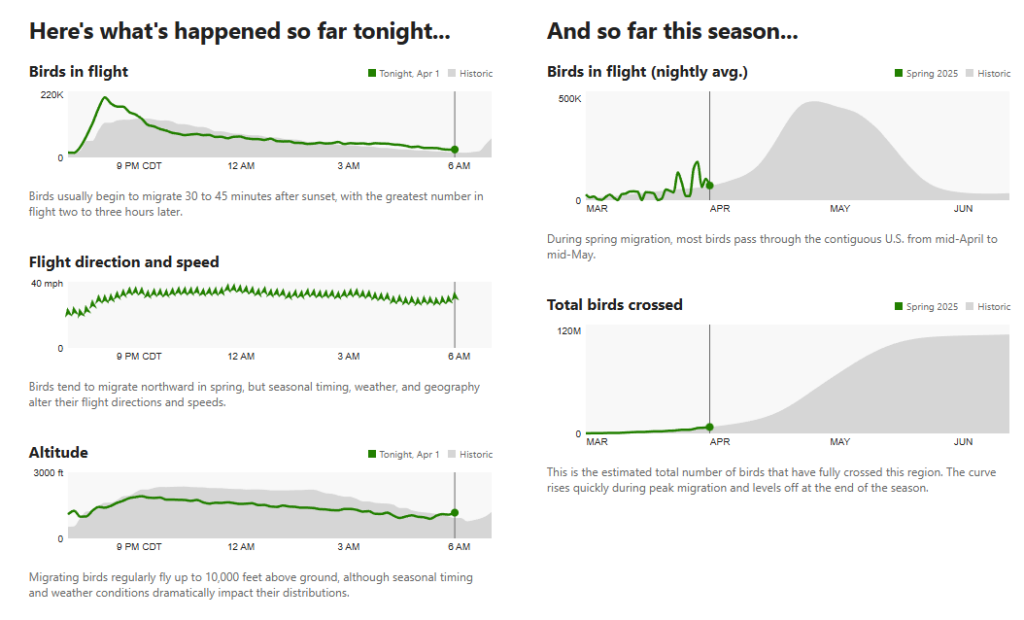
I had a little fun with the headline this morning, but the reality is that April is the prime month for birds to migrate north across Texas from tropical South America and Mexico. There’s a fantastic resource called BirdCast which uses a variety of tools to track such migrations over Harris County, including weather radars and local observations. For example, the site estimates that about 600,00 birds flew overhead last night.

Real-time data on bird migration across Harris County. (BirdCast)

Migrations are also greater when winds are from the south, as this assists the flight of the birds, and we’re expecting fairly pronounced southerly winds this week. (Hence, this weather really is for the birds). Although birds will typically fly at 1,000 or more feet up in the atmosphere, they may stop to rest in our parks and coastal sanctuaries. If you want to help, you can turn out lights at night, as these can prove disorienting to birds. This video from Cornell University’s Lab of Ornithology offers much more information about all of this.

Wednesday

I wasn’t kidding about those winds. We are seeing gusts this morning of 30 mph, or higher, across much of the area, and we’re going to see fairly gusty conditions from now through Saturday. Winds should peak during the afternoon hours. Our high temperatures today will be determined by the extent to which we see clearing skies this afternoon, but my sense is that most areas will see enough clouds to hold highs in the upper 80s. But it’s still going to be quite warm and humid outside, especially with dewpoints around 70 degrees. There is a very slight chance of some showers, and possibly a thunderstorm or two north of Houston this afternoon and evening. We’re likely talking areas along and north of Highway 105 here, so most of the Houston region should experience none of this.

HRRR model forecast for maximum wind gusts on Thursday. (Weather Bell)

Thursday and Friday

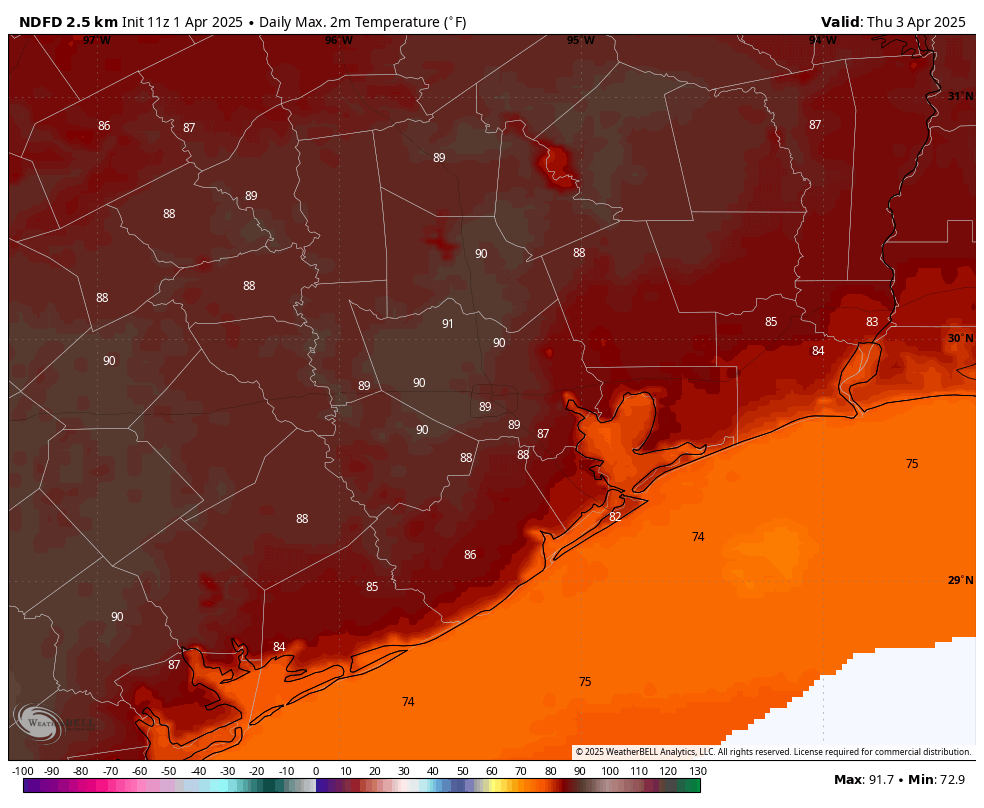
These look to be similar days, with gusty southerly winds and temperatures slotting in between the mid-80s and 90 degrees depending on cloud cover. Thursday probably has the best chance to be sunny during the afternoon, so that’s when most of the area probably will make a run at 90 degrees. It will be humid regardless, with warm nights. Both days will have about a 10 percent chance of some showers, so most of us will be dry.

Saturday and Sunday

A strong cold front will push through the area on Saturday, likely during the daytime hours. This should bring a good shot of rain with it, along with the potential for severe thunderstorms. Although the dynamics for strong storms look better to the northeast of Houston, we certainly cannot rule out impacts in the city. We are talking about the potential for heavy rainfall, brief street flooding, damaging winds, hail, and possibly a tornado. Again, none of these are certainties or perhaps even likely, but conditions are such that they’re possible. (Much of the city probably will see 0.5 to 1 inch of rain, for example). We should have a better idea about the overall threat in the coming days. The bottom line is that you should be prepared for the possibility of inclement weather on Saturday, especially in Kingwood and points to the northeast.

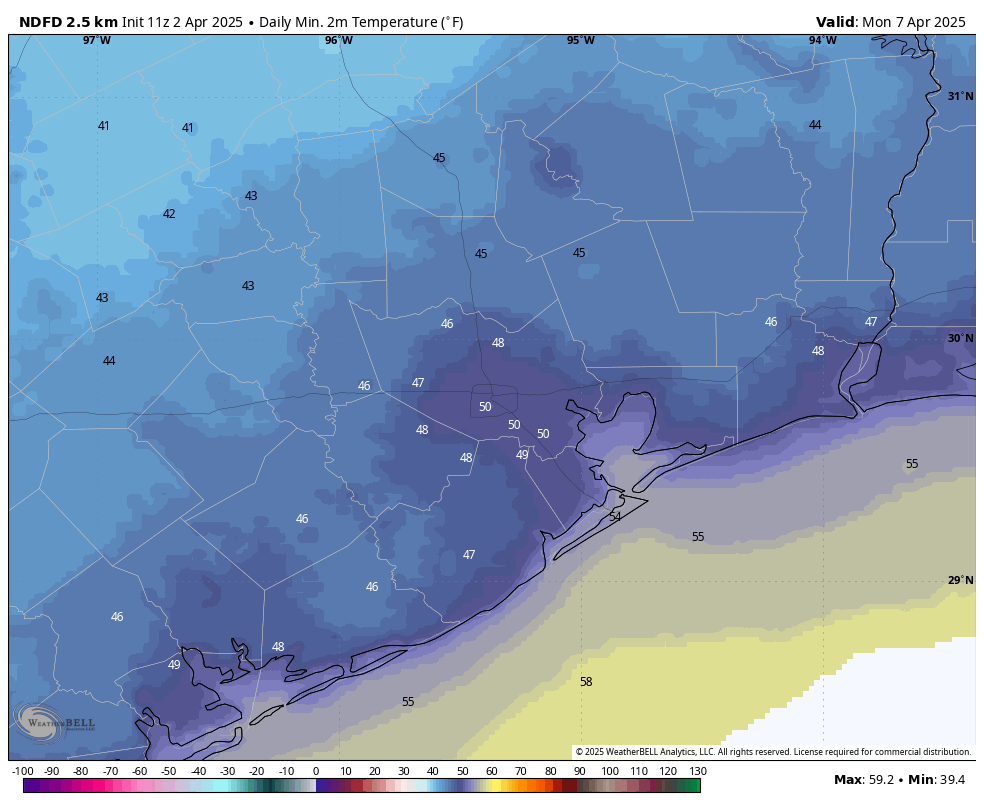
Depending on the timing, temperatures probably will reach the low- to mid-80s before the front trundles through. Lows on Saturday night will likely drop into the low 50s for much of the area. Some slight rain chances linger on Sunday, but I expect clearing skies at some point during the day. Highs probably will still only max out in the 60s.

By Monday morning it will be borderline chilly in Houston. (Weather Bell)

Next week

Most of next week looks sunny and spring-like. Seriously, if you like mild temperatures and dry air, I’d advise soaking next week up. We should see daytime temperatures in the 70s and nights in the 50s through Wednesday or Thursday before we warm back up into the 80s. In addition to lots of sunshine we can expect much lighter winds for the most part. Cannot wait.

02 Apr 15:26

drunk coworker’s aggressive behavior outside of work, a retroactive pay cut, and more

by Ask a Manager

This post was written by Alison Green and published on Ask a Manager.

It’s five answers to five questions. Here we go…

1. Can I report my coworker’s drunken, racist aggression outside of work?

This past weekend, after a Saturday work event, a coworker invited me out for lunch and a few drinks to celebrate a job well done. We made a call to another coworker who lived in the area to join us. She said she would be joining with one of our out-of-country coworkers, Fergus, who was in-country on a work trip and looking to socialize. None of us is a fan of Fergus as we find him annoying (long overshares about his fraught divorce, a general negative outlook), but our impression of him was that he was harmless, just unpleasant.

During the lunch, Fergus was really throwing back the drinks. He became distracted by a few men at the table next to us, and joined their conversation, which they initially seemed to welcome. My coworkers and I enjoyed catching up in his absence.

After a time, one of the men came over to our table and said, “The time has come, you need to take your friend back. You need to get him out of here.” On further inquiring, we learned that, after becoming very drunk, Fergus had made an offensive comment about one of the men’s wives, asking how he could, as a black African man, be married to a white woman. (Fergus is a white African.) The man did not take kindly to this and put an end to their conversation.

On hearing this, my coworkers and I quickly paid our bill and tried to corral Fergus away and convince him to leave the restaurant. This proved difficult, as again and again he kept walking back to the men to try to apologize. They made it clear they did not want to hear it, they just wanted him to leave. I reiterated this to Fergus, saying, “We need to go. They’ve told us they want us to leave this here, so we need to leave it here.” He then turned on me, angrily called me the c-word, and said that I don’t understand because I am not African and it is in their culture to make things right, and I am a Trump American who will never understand their culture. He also said he wanted to kill me, and then find my husband and kill him. I took this calmly as we needed to leave the restaurant, and you can’t reason with a drunk person, but this malice really shook me. (Also, not that it matters as he was being ridiculous, but I am not aligned politically with Trump at all, and he knows this).

We thankfully made it out of the restaurant, where one of our coworkers took him back to her place to sober up before she felt he could reasonably take a taxi back to his hotel without harassing the driver. I received a text from him the next day apologizing for his appalling behavior and asking for forgiveness. I replied that I was thankful for the apology and glad to hear he made it home safely.

Now we are back at the office after the weekend, and I want nothing to do with him. I’ve heard him all morning walking down to my office to try and make right, and I’ve managed to avoid him so far. I will never spend time outside of work with him ever again, but I’m not sure how to proceed from here. Is this something that HR can take up? I don’t want to tank a person’s career over a drunk mistake, but this felt like more than that to me. He has really soured our working relationship. It all happened outside of work so I’m unsure of my options. I didn’t take his comments and threats to be real, but regardless, they were ugly.

For context, we are located outside of the United States.

I can’t speak to norms and laws outside the U.S. so this advice is necessarily from within my own cultural frame of reference (as is always the case) but: yes, talk to HR! Their purview doesn’t stop just because this happened outside of work; if you harass a coworker on your own time, it’s still harassment that your employer has a right to be interested in stopping.

And this wasn’t just “oh, a coworker got a little drunk and rowdy.” This was someone making racist comments, calling you an obscene slur, and threatening to kill you and your husband (!). This is way, way beyond needing to give him any benefit of the doubt or worrying about what the consequences to him might be. (If anything, worry about what could happen if he’s allowed to keep behaving this way without some kind of official intervention.)

If this was a one-time, out-of-character incident for Fergus (which I very much doubt), he’s free to explain that to HR. You don’t need to sort through what the appropriate consequences are; you just need to let them know it happened and assume they will take it from there.

If Fergus does approach you to try to “make it right,” you should feel free to tell him (ideally in writing, with HR cc’d) that you don’t want to discuss it further with him and that the contact is unwelcome and needs to stop.

2. We get bonuses for more dangerous work — are we unethical if we spread it around?

I work in a medical setting. Four or five times a week, we have to handle patients who have serious and infectious diseases. While we of course have safety precautions in place, there’s still a risk. So every time we do, we can claim a $10 allowance — with a catch. We may only claim it once per day.

So if a patient in this category comes in and has to be moved three separate times and I do it all three times, I still only get $10.

So I might say to my colleague Bob, “Hey I’ve already claimed my 10 bucks, when the call comes through, you should do the next move and claim yours” to spread the money around (any staff member can respond to any call). Bob in turn would let Carol know and she would take the next assignment and claim her allowance.

Is this ethical? We tend to do this very quietly and not draw management attention to it. We’re increasing the cost to the facility but also we’re reducing the risk for any one person, and the risk is the reason behind the allowance.

I’m hard-pressed to say it’s unethical — it’s the system that’s in place, and if they feel they’re paying out too much or people are taking advantage of it, they can revisit it.

The part that makes me a little uncomfortable is that you’re sort commodifying the patients themselves, who might feel weird knowing people are gaming out how they can make a bonus off of their infectious disease. (On the other hand, some patients might be delighted to help with that!) That makes it extra important to ensure you’re treating these patients with dignity and compassion and not losing sight of their humanity (important regardless, obviously) and that they’re not ever waiting a longer amount of time so Carol can show up even though Bob is right there and could otherwise do it. If it ever does build in a delay (for them or for another patient), that’s when I think it would cross over into unethical, because you’d be prioritizing the bonus above the person.

3. Too soon to brag about a new accomplishment?

I was recently selected to join a new advisory council initiative at my workplace that brings together different parts of the company so we can best work together. (I suspect I was the only person who applied to represent my role, two or three tops — so not a huge accolade.) I’m also low-key job searching right now.

My first question is how soon can I start listing this on my resume? We haven’t had our first meeting yet and might not for several weeks, by which point I definitely will have applied to a very promising position. It feels wrong to list it before we ever meet, but my friends say I’m too shy about showing off my accomplishments. And my second question is how to discuss this type of thing on applications. I would list it as a bullet point in my resume, right? Or wait to discuss it in an interview?

I wouldn’t put it on your resume until more has happened with it. If it’s on your resume, you may be asked about it, and you don’t want your answer to be, “Well, we haven’t done anything yet.” And just being appointed to it doesn’t really warrant using resume space (so far).

That said, if you ignore me and include it anyway, it’s not a huge problem! I’m just talking best practices here, not “a thing you must not do under any circumstances.”

4. My company wants to cut our pay retroactively

I’m in an industry hard hit by the federal cuts and our team just went through layoffs. I received a mass email from HR saying that we would be getting a pay cut retroactive to the beginning of the month (time worked but not yet paid). We were asked to send agreement via email ASAP as they were about to run payroll. A quick search of your site says a retroactive pay cut is not legal, but do you think the company successfully got around it by asking for agreement in writing?

Nope. Employers cannot cut your pay retroactively. They can cut it going forward — since then you have the chance to agree to work at that rate or to decline to (i.e., quit) — but they cannot reduce it after you’ve already done the work while thinking it was for your previously-agreed-upon rate. That doesn’t change just because they ask you to agree to it afterwards.

The way to handle it is to reply that you can agree to the cut going forward (if indeed you do agree to it) and then say, “But my understanding is that we can’t legally make it retroactive, even if people agree, and I don’t want us to get in trouble for that.” If they push back, the next move is to report it to your state department of labor. (That said, realistically that may put a target on your back at a time when they’re already cutting jobs, and I don’t want you to be unaware of that risk.)

5. Digital nomad visas

I am considering looking for a job that could be done remotely from anywhere and moving my family out of the U.S. using another country’s digital nomad visa (other country TBD). I was hoping some people may have done the same and would be willing to discuss experiences? I really trust your blog for advice.

Sure, I’m happy to throw this out to people with experience with digital nomad visas.

02 Apr 15:20

DEA Classifies Red Wine As Schedule I Drug To Spite Ex-Wife 

by The Onion Staff

SPRINGFIELD, VA—In a decision meant to crack down on the allegedly dangerous substance and the “total fucking bitch” who uses it, the acting head of the U.S. Drug Enforcement Administration, Derek Maltz, classified red wine as a Schedule I drug Wednesday in order to spite his ex-wife. “We have been far too lenient to the cold, vicious harpies who use this substance—if you run to the liquor store down the street for a bottle of Yellow Tail malbec, bring it home, and pour yourself a glass, that will now be classified as drug-trafficking,” said Maltz, explaining that substances newly classified as Schedule I include pinot noir, merlot, shiraz, and any beverage enjoyed during a tasting tour of the Loudoun County wineries outside of D.C. “This drug has caused irreparable damage to society and needs to be taken off the street. Otherwise, the country will continue to be overrun by passive-aggressive scolds who don’t even need all that goddamn child support.” At press time, Maltz added that mixing up a pitcher of margaritas for the girls should be made a Class B felony punishable by up to 25 years in a federal penitentiary.

The post DEA Classifies Red Wine As Schedule I Drug To Spite Ex-Wife  appeared first on The Onion.

02 Apr 15:20

Washington Monument Collapses After Someone Pulls Loose Block

by The Onion Staff
02 Apr 15:19

“We are not for sale” state Juno winners and stars who work primarily in United States

by Geoff Cork

Vancouver, USA – Celebrities who attended the 2025 Juno awards had a firm and clear theme for the night’s proceedings, that their talents which they mostly perform in the United States are only for Canada. “We are the greatest nation on earth,” said Míchael Bublé, likely speaking of the United States where he had a […]

The post “We are not for sale” state Juno winners and stars who work primarily in United States appeared first on The Beaverton.

02 Apr 15:19

Increasingly Inconvenient MTA Service Advisories

by Tom Smyth

Local trains along the 1-2-3 line will be running express between Chambers Street and Fourteenth Street due to urgent repairs (all of the “C” tiles fell off of the “Canal Street” mosaic).

Due to track maintenance, the A train will not be running between Canal Street and Fourteenth Street. Shuttle service will be made available via the Sex and the City tour bus, with service beginning at Steve’s Bar and stretching to Magnolia Bakery, with an intermediary stop at Carrie’s apartment.

Due to a technology malfunction, arrival-time signs are incorrectly indicating that trains are running every thirty minutes. Trains will continue to be running every forty minutes, as expected.

Trains are being held due to an investigation at the Hoyt-Schermerhorn station. They’re trying to figure out how to pronounce “Schermerhorn.”

The Forty-Second Street shuttle does not run overnight. Or during the day.

The woman walking up and down the train cars of the Manhattan-bound J train selling candy bars from a shopping cart is out of Peanut M&Ms.

Expect delays on the Q line; we can’t find the keys to the train anywhere.

Due to reports that the cartoon character Snidely Whiplash has tied a damsel in distress to the railroad tracks somewhere between Yankee Stadium and Fordham Road, northbound 4 trains will not be running to Woodlawn.

Northbound A trains will run via the F line between Jay Street–MetroTech and West Fourth Street for a little change of scenery.

Queens-bound M trains are delayed after a person was struck by a train at Myrtle Avenue. They are totally fine, but the impact completely broke the train.

Trains will no longer service the Greenpoint Avenue stop along the G line, because the terminal has been sold and is going to be converted into a Banana Republic.

Service has been disrupted due to a power outage at Fifty-Ninth Street–Columbus Circle because I had to unplug the third rail to charge my phone.

Commuters should expect delays along the 1-2-3 line due to reports that four young boys are walking along the train tracks in search of a dead body as a part of some kind of coming-of-age adventure.

The 7 train is now approaching the station, but we won’t say which station. And every seat is a little bit wet.

Expect delays on the M line in both directions because all the guards and all the porters and the stationmaster’s daughters have been searching high and low, saying, “Skimble, where is Skimble?” For unless he’s very nimble, then the M train just can’t go.

Service will be disrupted along the J-Z line while we wait for NYPD to respond to an incident at Fulton Street, which they should attend to as soon as one of the twelve stationed officers beats their level of Candy Crush.

Due to ongoing repairs to train cars, service will be provided by the Coney Island Cyclone along the Q line between Stillwell Avenue and Brighton Beach. Commuters are advised to brace for the loop-the-loop.

A Manhattan-bound K train is arriving in six minutes. We don’t know what the K train is either; it just showed up and started making stops.

No trains will be running this Saturday, as we will be holding a company BBQ.

Due to maintenance between Monday and Friday, local trains will not run on the 4-5-6 line between Wall Street and Eighty-Sixth Street Instead, express trains will run with their doors open, allowing local commuters to board by jumping from the platform onto the moving train like a drifter ditching town.

We don’t do trains anymore.

02 Apr 15:14

#Runa #Rowen #RoninWarriors

02 Apr 15:14

Inside ICE Air: Flight Attendants on Deportation Planes Say Disaster Is “Only a Matter of Time”

by by McKenzie Funk

by McKenzie Funk

ProPublica is a nonprofit newsroom that investigates abuses of power. Sign up to receive our biggest stories as soon as they’re published.

Leer en español.

The deportation flight was in the air over Mexico when chaos erupted in the back of the plane, the flight attendant recalled. A little girl had collapsed. She had a high fever and was taking ragged, frantic breaths.

The flight attendant, a young woman who went by the nickname Lala, said she grabbed the plane’s emergency oxygen bottle and rushed past rows of migrants chained at the wrists and ankles to reach the girl and her parents.

By then, Lala was accustomed to the hard realities of working charter flights for Immigration and Customs Enforcement. She’d learned to obey instructions not to look the passengers in the eyes, not to greet them or ask about their well-being. But until the girl collapsed, Lala had managed to escape an emergency.

Lala worked for Global Crossing Airlines, the dominant player in the loose network of deportation contractors known as ICE Air. GlobalX, as the charter company is also called, is lately in the news. Two weeks ago, it helped the Trump administration fly hundreds of Venezuelans to El Salvador despite a federal court order blocking the deportations, triggering a showdown that experts fear could become a full-blown constitutional crisis.

In interviews with ProPublica, Lala and six other current and former GlobalX flight attendants provided a window into a part of the deportation process that is rarely seen and little understood. For migrants who have spent months or years trying to reach this country and live here, it is the last act, the final bit of America they may experience.

An ICE detainee waves from inside a bus that transported passengers to the airport before departing from Seattle’s Boeing Field on a GlobalX deportation flight in February. (Emily Schultz)

All but one of the flight attendants requested anonymity or asked that only a nickname be used, fearing retribution or black marks as they looked for new jobs in an insular industry.

Because ICE, GlobalX and other charter carriers did not respond to questions after being provided with detailed lists of this story’s findings, the flight attendants’ individual accounts are hard to verify. But their stories are consistent with one another. They are also generally consistent with what has been said about ICE Air in legal filings, news accounts, academic research and publicly released copies of the ICE Air Operations Handbook.

That morning over Mexico, Lala said, the girl’s oxygen saturation level was 70% — perilously low compared with a healthy person’s 95% or higher. Her temperature was 102.3 degrees. The flight had a nurse on contract who worked alongside its security guards. But beyond giving the girl Tylenol, the nurse left the situation in Lala’s hands, she recalled.

Lala broke the rule about talking to detainees. The parents told Lala their daughter had a history of asthma. The mom, who Lala said had epilepsy, seemed on the verge of her own medical crisis.

Lala placed the oxygen mask on the girl’s face. The nurse removed her socks to keep her from further overheating. Lala counted down the minutes, praying for the girl to keep breathing.

The stories shared by ICE Air flight attendants paint a different picture of deportations from the one presented to the public, especially under President Donald Trump. On social media, the White House has depicted a military operation carried out with ruthless efficiency, using Air Force C-17s, ICE agents in tactical vests and soldiers in camo.

The reality is that 85% of the administration’s “removal” flights — 254 flights as of March 21, according to the advocacy group Witness at the Border — have been on charter planes. Military flights have now all but ceased. While there are ICE officers and hired security guards on the charters, the crew members on board are civilians, ordinary people swept up in something most didn’t knowingly sign up for.

When the flight attendants joined GlobalX, it was a startup with big plans. It sold investors and new hires alike on a vision of VIP clients, including musicians and sports teams, and luxury destinations, especially in the Caribbean. “You can’t beat the eXperience,” read a company tagline.

A GlobalX post on Facebook recruiting flight attendants in March. Alexandria, Louisiana, is a hub for ICE Air. (Screenshot by ProPublica. Redacted by ProPublica.)

But as the airline grew, more and more of its planes were filled with migrants in chains. Some flight attendants were livid about it.

Last year, an anonymous GlobalX employee sent an all-caps, all-staff screed that ricocheted around the startup. “WHERE IS THE COMPANY GOING?” the email asked. “YOU SIGNED A 5 YEAR CONTRACT WITH ICE? ... WHAT HAPPENED TO THIS BECOMING A PRESTIGE CHARTER AIRLINE?”

One flight attendant said he kept waiting for the sports teams his new bosses had talked about as he flew deportation routes. “You know, the NFL charters, the NBA charters, whatever the hockey one is …” he said.

A second said his planes’ air conditioning kept breaking — an experience consistent with at least two publicly reported onboard incidents — and their lavatories kept breaking, something another flight attendant reported as well. But the planes kept flying. “They made us flush with water bottles,” he said.

But the flight attendants were most concerned about their inability to treat their passengers humanely — and to keep them safe. (In 2021, an ICE spokesperson told the publication Capital & Main that the agency “follows best practices when it comes to the security, safety and welfare of the individuals returned to their countries of origin.”)

They worried about what would happen in an emergency. Could they really get over a hundred chained passengers off the plane in time?

“They never taught us anything regarding the immigration flights,” one said. “They didn’t tell us these people were going to be shackled, wrists to fucking ankles.”

“We have never gotten a clear answer on what we do in an ICE Air evacuation,” another said. “They will not give us an answer.”

“It’s only a matter of time,” a third said, before a deportation flight ends in disaster.

Lala didn’t think she had a chance at a flight attendant job. She hadn’t, in truth, remembered applying to GlobalX until a recruiter called to say the startup was coming to her city. “But I guess I did apply through LinkedIn?” she said. She’d been working an office job — long hours, little flexibility — and was looking for something new.

The job interviews were held at a resort hotel. The room was packed with dozens of aspirants when Lala showed up. After the first round, only about 20 were asked to stay. She couldn’t believe she was one of them. After the second round came a job offer: $26 an hour plus a daily expense allowance. Soon Lala got a uniform: a blue cardigan, a white polo shirt and an eye-catching scarf in cyan and light green.

For part of her Federal Aviation Administration-mandated four-week training, her class stayed in a motel with a pool at the edge of Miami International Airport. Just across the street, on the fourth floor of a concrete-clad office building ringed by palm trees, was GlobalX’s headquarters.

“In the beginning, we were told that because it’s a charter, it’s only gonna be elites, celebrities,” Lala said. “Everybody was really excited.”

But flying was not going to be all glitz. The real reason for having flight attendants is safety. GlobalX was certified by the FAA as a Part 121 scheduled air carrier, the same as United or Delta, and it and its crew members were subject to the same strict standards.

“We’re there to evacuate you,” one recruit told ProPublica. “Yes, we make good drinks, but we evacuate you.”

Lala’s class practiced water landings in the pool at the nearby Pan Am Flight Academy. They practiced door drills — yelling out commands, shoving open heavy exit doors — in a replica Airbus A320 cabin. They learned CPR and how to put out fires. They took written and physical tests, and if they didn’t score at least 90%, they had to retake them.

They were reminded, over and over, that their job was a vocation, one with a professional code: No matter who the passengers were, flight attendants were in charge of the cabin, responsible for safety in the air.

Lala’s official “airman” certificate arrived from the FAA a few weeks after training was done. She was cleared to fly, ready to see the world.

But what she would see wasn’t what she signed up for. The company was growing beyond glamorous charters. GlobalX was moving into the deportation business.

Her bosses delivered the news casually, she recalled: “It was like, ‘Oh yeah, we got a government contract.’”

The new graduates were offered a single posting: Harlingen, Texas. Deportation flights were five days a week, sometimes late into the night. Lala went to Guatemala, Honduras, Colombia and, for refueling, Panama.

A standard flight had more than a dozen private security guards — contractors working for the firm Akima — along with a single ICE officer, two nurses, and a hundred or more detainees. (Akima did not respond to a request for comment.) The guards were in charge of delivering food and water to the detainees and taking them to the lavatories. This left the flight attendants, whose presence was required by the FAA, with little to do.

“Arm and disarm doors, that was our duty,” Lala said.

The flights had their own set of rules, which the crew members said they learned from a company policy manual or from chief flight attendants. Don’t talk to the detainees. Don’t feed them. Don’t make eye contact. Don’t walk down the aisles without a guard escorting you. Don’t sit in aisle seats, where detainees could get close to you. Don’t wear your company-issued scarf because of “safety concerns that a detainee might grab it and use it against us,” Lala said.

“You don’t do nothing,” said a member of another GlobalX class. “Just sit down in your seats and be quiet.” If a detainee looked at him, he was supposed to look out the window.

A chained detainee boards a GlobalX flight at Seattle’s Boeing Field in February. (Emily Schultz)

A rare public statement from the company about life aboard ICE Air came in a 2023 earnings call with GlobalX founder and then-CEO Ed Wegel, when he discussed the company’s work for federal agencies like ICE. GlobalX employees “essentially don’t do much on the airplane,” Wegel said. “Our flight attendants are there in case of an emergency. The passengers are monitored by guards that are placed on board the airplane by one of those agencies.”

Fielding a question about how GlobalX ensures passengers are treated humanely, Wegel continued: “There have been threats made to our crew members, and they’re especially trained to deal with those. But we haven’t seen any mistreatment at all.”

Flight attendants said they had little to do but sit in their jumpseats after delivering the preflight safety briefing in English to the mostly Spanish-speaking passengers. Above 10,000 feet, the two in the rear usually moved to passenger rows near the cockpit, then sat again. Some did crosswords. Others took photos out the window. On a deportation to Guatemala, one saw his first erupting volcano.

Lala had been scared before her first deportation flight, worried that violence might break out. But fear soon gave way to discomfort at how detainees were treated. “Not being able to serve them, not being able to look at them, I didn’t think that was right,” she said.

Some flight attendants, drawn to the profession because they liked taking care of people, couldn’t help but break protocol with passengers. “If they said ‘hola’ or something,” one said, “I’d say ‘hola’ back. We’re not jerks.”

Another recalled taking a planeload of children and their escorts on a domestic transfer from the southern border to an airport in New York. He tried to slip snacks to the kids. “Even the chaperones were like, ‘Don’t give them any food,’” he said. “And I’m like, ‘Where is your humanity?’” (A second flight attendant said that children on a New York flight were fed by their escorts.)

While flight attendants were allowed to interact with the guards, the dynamic was uncomfortable. It came down to a question of who was in charge — and which agency, ICE or the FAA, ultimately held sway. (The FAA declined to comment on this story and directed questions to ICE.)

The guards often asked flight attendants to heat up the food they brought from home. They asked for drinks, for ice. “They treated us like we were their maids,” said Akilah Sisk, a former flight attendant from Texas.

“In their eyes, the detainees are not the passengers,” another flight attendant said. “The passengers are the guards. And we’re there for the guards.”

Some guards thumbed their noses at the FAA safety rules that flight attendants were supposed to enforce while airborne, multiple flight attendants recalled. “One reported me because I asked him to sit down in the last 10 minutes,” Sisk said. “But you’re still on a freaking plane. You gotta listen to our words.”

Flight attendants said that if they told guards to fasten seatbelts during takeoff or stow carry-ons under a seat, they risked getting reported to their bosses at GlobalX, who they said wanted to keep ICE happy. The guards would complain to the in-flight supervisor, Sisk said, and eventually it would get back to the flight attendant.

“We’d get an email from somebody in management: ‘Why are you guys causing problems?’” another flight attendant recalled. “They were more worried about losing the contract than about anything else.”

Nothing bothered flight attendants more than the fact that most of their passengers were in chains. What would happen if a flight had to be evacuated?

Most of the migrants crowding the back seats of ICE Air’s planes have not been, historically, convicted criminals. ICE makes restraints mandatory nonetheless. “Detainees transported by ICE Air aircraft will be fully restrained by the use of handcuffs, waist chains, and leg irons,“ reads an unredacted version of the 2015 ICE Air Operations Handbook, which was obtained by the Center for Constitutional Rights, a legal advocacy group.

The handbook allows for other equipment “in special circumstances, i.e., spit masks, mittens, leg braces, cargo straps, humane restraint blanket, etc.” Multiple lawsuits on behalf of African asylum-seekers concern the use of one such item, known as the Wrap, a cross between a straitjacket and a sleeping bag. A flight attendant said detainees restrained in the device are strapped upright in their seats or, if less compliant, lengthwise across a row of seats. Getting “burritoed, I call it,” the person said.

The Department of Homeland Security’s Office for Civil Rights and Civil Liberties investigated the asylum-seekers’ complaints and found ICE lacked “sufficient policies” on the Wrap, but how the immigration agency addressed the finding is not publicly known. ICE responded to one lawsuit by saying detainees were not abused; it said another should be dismissed, in part because it was filed in the wrong place. The cases are pending.

Use of the Wrap continues. A video from Seattle’s Boeing Field taken in February shows officers and guards carrying a wrapped migrant into the cabin of a deportation plane.

A choppy video feed shows ICE officers and guards carrying a migrant in a full-body restraint into a GlobalX deportation plane at Seattle’s Boeing Field in February. (Obtained by ProPublica via a public records request)

Watch video ➜

Neither the ICE Air handbook, nor FAA regulations, nor flight attendant training in Miami explained how to empty a plane full of people whose movements were, by design, so severely hampered. Shackled detainees didn’t even qualify as “able-bodied” enough to sit in exit rows.

To flight attendants, the restraints seemed at odds with the FAA’s “90-second rule,” a decades-old manufacturing standard that says an aircraft must be built for full evacuation in 90 seconds even with half the exits blocked.

Lala and others said no one told them how to evacuate passengers in chains. “Honestly, I don’t know what we would do,” she said.

The flight attendants are not alone in voicing concerns.

In an interview with ProPublica, Bobby Laurie, an airline safety expert and former flight attendant, called the arrangement on ICE Air flights “disturbing.”

“Part of flight attendant training is locating those passengers who can help you in an evacuation,” Laurie told ProPublica. That would have to be the guards. “But if they have to help you,” who is helping the detainees, Laurie wondered.

According to formal ICE Air incident reports reviewed by Capital & Main, the deportation network had at least six accidents requiring evacuations between 2014 and 2019. In at least two cases, both on a carrier called World Atlantic, the evacuations were led not by flight attendants but by untrained guards. Both took longer than 90 seconds, though not by much: two-and-a-half minutes for the first, “less than 2 minutes” for the next. But in a third case, it took seven minutes for 115 shackled detainees to escape a smoke-filled jet.

In one of the World Atlantic incidents, part of the landing gear broke, a wing caught fire and the smell of burning rubber seeped in, according to investigative records obtained by the University of Washington Center for Human Rights. In an email to ICE Air officials, an agency employee aboard the plane later wrote that flight attendants made no emergency announcements for passengers. The flight attendants simply got themselves out.

The ICE officer, guards and nurse were “confused on what to do and in which direction to exit during distress,” the officer wrote. He said that other than the flight crew, “no one has received any training on emergency evacuation situations.”

The University of Washington’s collection does not include findings or recommendations from ICE based on what happened, and ICE did not say what they were when asked by ProPublica. The National Transportation Safety Board said that after the accident, World Atlantic launched a campaign to reinspect landing gear, gave employees and contractors further training, and revised its procedures for inspections. The airline did not respond to questions from ProPublica.

An ICE Air flight was evacuated in Alexandria, Louisiana, in April 2018 after a piece of the landing gear failed upon touchdown. All detainees were helped off the plane by guards, according to emails to ICE officials from an agency employee who was on board. (Courtesy of the University of Washington Center for Human Rights)

Other reports obtained by the University of Washington mention fuel spills, loss of cabin air pressure and a “large altercation” on ICE Air after 2019 but no more evacuations, at least as of June 2022. More recent incidents that have been mentioned in the press include an engine fire last summer on World Atlantic and a failed GlobalX air conditioning unit that sent 11 detainees to the hospital with “heat-related injuries.”

The rare guidance some flight attendants said they received on carrying out ICE Air evacuations came during briefings from pilots. What they heard, they said, was chilling and went against their training.

“Just get up and leave,” one recalled a GlobalX pilot telling him. “That’s it. … Save your life first.”

He understood the instructions to mean that evacuating detainees was not a priority, or even the flight attendants’ responsibility. The detainees were in other people’s hands, or in no one’s.

When asked if they got similar guidance from pilots, three flight attendants said they did not, and one did not answer. Two more, like the first, said pilots gave them instructions that they took to mean they shouldn’t help detainees after opening the exit doors.

“That was the normal briefing,” said a flight attendant from Lala’s class. “‘If a fire occurs in the cabin, if we land on water, don’t check on the immigrants. Just make sure that you and the guards and the people that work for the government get off.’”

“It was as if the detainees’ lives were worthless,” said the other.

The day the girl collapsed on Lala’s flight, the pilot turned the plane around and they crossed back into the United States.

The flight landed in Arizona. Paramedics rushed on board and connected the girl to their own oxygen bottle. They began shuttling her off the plane. Her parents tried to join. But the guards stopped the father.

Shocked, Lala approached the ICE officer in charge. “This is not OK!” she yelled. The mom had seizures. The family needed to stay together.

But the officer said it was impossible. Only one parent could go to the hospital. The other, as Lala understood it, “was going to get deported.”

Most of the flight attendants who spoke with ProPublica are now gone from GlobalX. Some left because they found other jobs. Some left even though they hadn’t. Some left because the charter company, as it focused more and more on deportations, shut down the hub in their city.

Lala eventually left because of the little girl and her family, because she couldn’t do the deportation flights anymore. Her GlobalX uniform hung in her closet for a time, a reminder of her career as a flight attendant. Recently, she said, she threw it away.

She never learned whether the little girl lived or died. Lala just watched her mom follow her off the plane, then watched the dad return to his seat.

“I cried after that,” she said. She bought her own ticket home.

02 Apr 03:04

Out of le service

by John Allison

I wonder if you can imagine a member of the small regular cast of this comic who might make a sign that says “out of le service”.

The post Out of le service appeared first on Bad Machinery.

02 Apr 02:57

Contentious Montrose Boulevard project in Houston draws protest ahead of construction

by Dominic Anthony Walsh, Colleen DeGuzman
The plan for the thoroughfare, which involved creating more space for cyclists and pedestrians, was changed after Mayor John Whitmire overhauled the local management board. Protesters spoke out against the changes Monday afternoon.
02 Apr 02:56

Austin Street bike lane removal draws mixed reactions from Houston Midtown residents, elected officials

by Dominic Anthony Walsh
As Houston Public Works eliminates a key segment of the city's bike network, the Harris County commissioner who installed it says he’s “deeply disappointed.” Some Midtown residents say the two-way bike lane on a one-way vehicular street caused problems, while commuters say it’s a critical artery for cyclists.
02 Apr 02:56

Potential for catastrophic flooding by the weekend in the Mid-South and near the Ohio Valley

by Matt Lanza

The National Weather Service in Paducah, KY did not mince words this afternoon in their briefing on the upcoming rainstorm across the Ohio Valley: “Significant and potentially historic rainfall will begin Wednesday afternoon, with numerous rounds of heavy rain continuing into the first half of the weekend, leading to potentially catastrophic flash flooding.”

I have a whole post eventually coming to my Substack page on words and how we use them. But suffice to say, whenever the NWS uses a word like “catastrophic,” it is an extremely deliberate decision that more than one person agrees to. In other words, they understand the weight of the word “catastrophic,” and after discussing it as a team, they agree to use that phrasing. Because they’re convicted of an outcome that they believe will indeed be possibly catastrophic.

National Blend of Models (NBM) forecast rainfall through the weekend with pockets of 10″ or more between northeast Arkansas and southern Indiana. (Pivotal Weather)

And the model data today continues to provide ample additional support for a wide ranging, widespread, potentially historic and/or catastrophic outcome. Within their area forecast discussion, the technical briefing the forecasters at the NWS provide that essentially explains or justifies their decision-making, the Paducah office maintained that type of language. “We cannot overstate the extremity of the flooding danger with this event incoming and these historic forecast rainfall amounts.”

To the north, in Indianapolis, their forecast discussion stated it had the potential to be one of the most significant rain events in the last 15 years. “This has the potential to be near the top of the list for highest impact heavy rain/flooding events for central Indiana in the last 15 years.”

Same story in Memphis, where their office also warned of catastrophic flooding. “Catastrophic flooding remains possible in portions of the Mid-South Wednesday through Saturday as the previously discussed front stalls right along the I-40 corridor.”

I wanted to just post that so folks, especially new visitors, didn’t think that we’re just randomly going ballistic over something. No, this is objectively a very serious threat between Arkansas and Ohio that is going to make the national news. All we can do at this point is hope for the best.

A very serious severe weather threat

There will also be severe thunderstorms at times, especially tomorrow (Wednesday) and Saturday I think.

A moderate risk (4/5) is in effect for Wednesday between central Arkansas and southwest Indiana due to possible tornadoes, damaging winds, and large hail. (Pivotal Weather)

Being from Houston and having dealt with a 5-day rain event in 2017 by the name of Harvey, these types of events are long-duration tests of will. I’ve found that rather than trying to focus on every single element of the threat, it’s better to break it into manageable chunks. Today, that’s the overall rainfall threat (as laid out above), in addition to Wednesday’s severe threat. The moderate risk (4/5) was issued to cover all forms of severe weather (strong tornadoes, large hail, and damaging wind gusts), and all of them look potentially potent tomorrow. I will refer you to your local NWS office or some of the other fine weather blogs out there for more on the severe threat. There will be additional rounds of strong to severe storms across the Mid-South through Saturday, with perhaps Saturday itself being the second peak day of the event, in addition to peak concerns about flooding.

Stay safe everyone.

02 Apr 02:53

College Campus Tour Ends Inside Unmarked ICE Vehicle

by The Onion Staff

ITHACA, NY—As nearly a dozen prospective students were forced into the back of a car with tinted windows, a Cornell University campus tour reportedly ended Tuesday inside an unmarked Immigration and Customs Enforcement vehicle. “Over there you can see our student center, which boasts its own bowling alley, and then, if you all will follow me, it seems these masked gentlemen want us to wrap things up in their black SUV,” said tour guide and Cornell junior Jacob Geisner, who was preparing to describe the college’s housing options and meal plans when three ICE officers in street clothes rushed up and, without identifying themselves, demanded the group of 16- and 17-year-olds come with them immediately. “This isn’t a scheduled part of the tour, but I can tell you we’re currently leaving the campus at about 100 miles per hour. Out that window, you’ll see the last glimpse of our largest dining hall, named after Toni Morrison. At this point I need to depart from my prepared script because I don’t know where they’re taking us, but this highway does go to the nearest major airport, in Syracuse, and it sounds like we all need to bind our wrists with these heavy-duty zip ties or they’ll treat us as if we’re resisting arrest.” At press time, the Department of Homeland Security issued a short statement saying the tour group was now in a detention facility in Jena, LA.

The post College Campus Tour Ends Inside Unmarked ICE Vehicle appeared first on The Onion.

02 Apr 02:53

Attorney General Seeks Death Penalty For All UnitedHealthcare Customers

by The Onion Staff
02 Apr 02:53

Trump ‘Not Joking’ About Seeking Third Term

by The Onion Staff

Donald Trump claimed he is not joking about the possibility of seeking a third presidential term despite it being barred by the Constitution, asserting that “there are methods” by which he can circumvent the prohibition. What do you think?

“Ah, I’m sure he’s just joking.”

Sandra Leftwich, Cocktail Infuser

“Yeah, my dad had a tough time retiring, too.”

Felix Turner, Trinket Recycler

“Makes sense. There can’t be a fourth Trump term without a third.”

Freddy Ovando, Mirror Shatterer

The post Trump ‘Not Joking’ About Seeking Third Term appeared first on The Onion.

02 Apr 02:53

I’m a German Citizen in 1933, and Is It Just Me or Is It Really Hard to Get Any Work Done Right Now?

by Lia Woodward and Leah Folta

Guten tag. I’m just wondering if anybody else can relate to this feeling I’ve been having that I just can’t shake. It’s only Tuesday, but what a week, huh? Just when we thought yesterday was another regular Monday, the Reichstag burned down, and it sounds like Chancellor Hitler is going to permanently suspend more of our rights. Crazy, right? Never thought that would happen here. My real problem, though, is that it’s my job to finish tuning this glockenspiel in time for the big concert tomorrow, and I just can’t seem to focus.

It’s only been a day since the fire, but it feels much longer. They said the communists are planning a violent uprising, so we need the Reichstag Fire Decree. Apparently, it’s going to suspend the right to assembly, freedom of speech, freedom of the press, and other important-sounding stuff in our German constitution.

Should we do something? It feels like we should do something. Hopefully, I’ll feel more like I can dedicate the brain space to that just as soon as I finish my work, which is tuning this glockenspiel.

I haven’t had the chance to read this decree yet, because I’m forcing myself to get at least one piece of this glockenspiel to sound right in the next hour. Honestly, though, it has been such. A. Slog. Is something wrong with me, or does anybody else feel like they’ve been moving through molasses since yesterday?

They can’t do that, can they, all this stuff they’ve been doing since the fire? Surely, we have emergency brakes to stop these kinds of things. Someone will intervene. I would look into who that is supposed to be exactly, but this glockenspiel isn’t going to tune itself.

If you’ve been able to get stuff done in the last twenty-four hours, I’d love your tips, because this inability to stay on task is really stressing me out. My friends keep saying that I just need to do more of die selbstpflege, or “self-care” as they say in America. Bingeing Wagner on the radio hasn’t distracted me as much as it used to, especially with all the pro–Chancellor Hitler undertones. I’ve been trying out mindfulness lately, but that hasn’t helped. I even went outside just to feel the wind in my hair, but something about the vibe is just off. I’m trying to focus on what I can control—the only constant is change.

Honestly, this is an especially annoying time for all this bad news, because I’m trying not to drink this month. If the chancellor could stop being bonkers until I can have beer again, that would be great.

Work at the shop is even harder than usual because I used to be able to blow off steam with my friends about the news and the latest wild, unprecedented thing the chancellor said, but I think everyone’s sick of talking about it. I mean, how much of our time are we really supposed to dedicate to politics? Is it even healthy? At a certain point, I’ve just been tuning it out. Tuning is what I do, after all, haha. On top of it all, I have to figure out what I’m doing for my birthday this month. I can drink for that, right?

My boss has no sympathy for me either. In fact, Karl won’t let us talk about the news at the shop anymore. He keeps saying that he feels discriminated against in our workplace because he loves the chancellor, and it’s like, what do you want from us, man? Your guy is winning, everyone has his haircut. I mean, come on, Karl. I’m just trying to do my job, which is tuning this glockenspiel, and not say anything—even when he insists that the chancellor promised to make the economy strong again.

All right, I’ll make a deal with myself—I can think about the Reichstag and all the fallout as much as I want for the next five minutes, and then I’ll get right back to crushing this glockenspiel.

Whatever helps us stay productive is what really matters right now. There’s still plenty of time left for 1933 to be our year. Politics will come and go, but I’m sure when I look back on this period, what I’ll remember most will be the work that I completed on schedule.

02 Apr 02:53

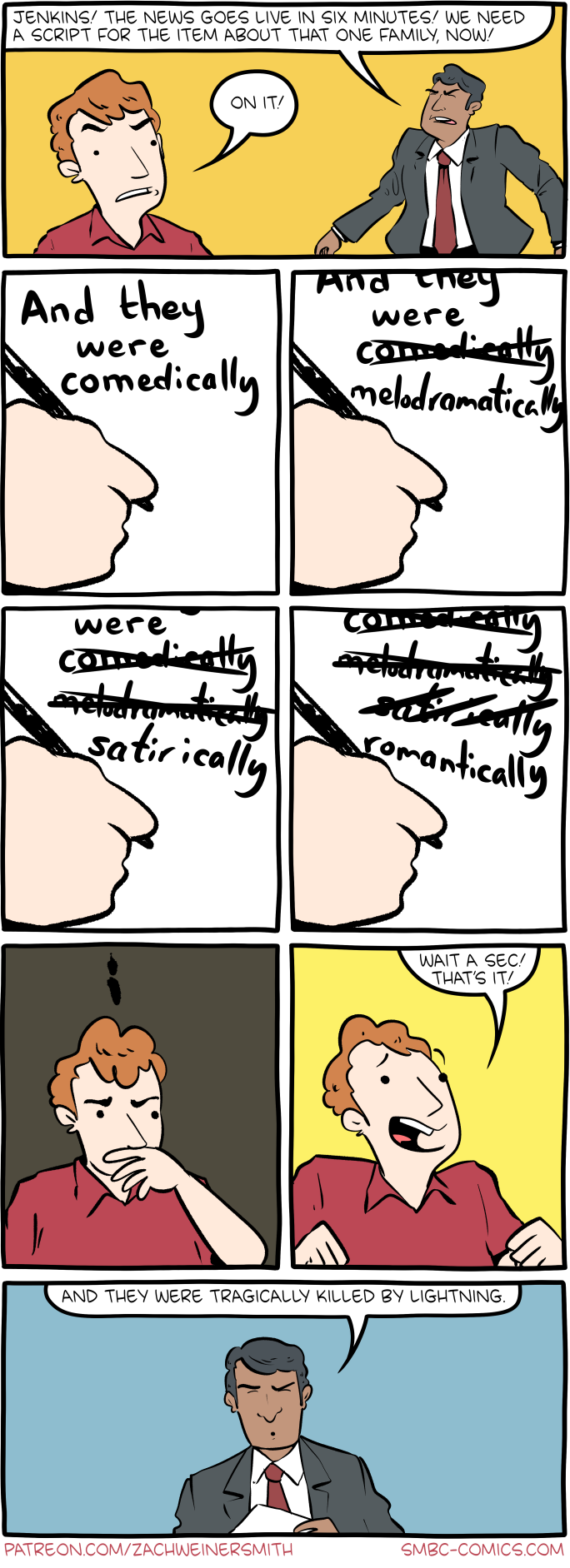
Saturday Morning Breakfast Cereal - Genre

by Zach Weinersmith


Click here to go see the bonus panel!

Hovertext:
Epically would have also worked.


Today's News:
01 Apr 15:08

If one program blocks shutdown, then all programs block shutdown, revisited

by Raymond Chen

Some time ago, I noted that if one program blocks shutdown, then all programs block shutdown. Each program is asked in turn if they have any final words, and only after each program says that it’s finished do we ask the next program.

But what if we asked all the programs for their final words? After all, it’s frustrating to go through two shutdown confirmations from two programs, only to find that the question from the third program is one that you realize “Oh, right, I should send that unfinished email. I need to cancel shutdown.” If you could see all the questions at once, then you would see the third question right away and cancel shutdown without having to deal with the first two programs.

The problem with this design is that the current shutdown mechanism doesn’t have a way for the system to tell programs, “I know I asked you to say your final good-byes, and you’re in the middle of a dialog with the user, but I need you to cancel out of it right now because we’re not shutting down after all.”

That’s not to say that such a mechanism couldn’t be invented, but you’d have to deal with the adoption curve, because the feature doesn’t work until everybody supports it, and in practice, there will always be programs that don’t support it, either because it’s too hard to implement, or because the programs are no longer being maintained by their vendors.

Windows has instead been encouraging programs to dispense with the farewells entirely.

Programs written to the Universal Windows Platform, for example, never even get told that the system is shutting down. They are expected to autosave any relevant state whenever they receive a notification from the system that they are about to be suspended, and once suspended, the system is permitted to terminate the program without any further warning. And programs that adhere to the classic application model are encouraged to employ their own autosave/autorecover logic so that the user can shut down with a minimum of fuss.

I mean, when you power off your phone, you don’t get a barrage of apps asking you if you want to save. They just go away quietly, and when you launch them next time, they try to pick up where they left off.

In other words, instead of trying to make the shutdown problem easier to deal with, Windows is trying to make the shutdown problem go away.

The post If one program blocks shutdown, then <I>all</I> programs block shutdown, revisited appeared first on The Old New Thing.

01 Apr 15:00

Former Houston livestock show VP sentenced to federal prison for wire fraud scheme

by Sarah Grunau
Galvan is accused in court documents of using his position with the livestock show and rodeo to solicit short term loans from investors including other rodeo volunteers.
01 Apr 15:00

Expect breezy and warm conditions for awhile, but next week still looks considerably cooler

by Eric Berger

In brief: Houston’s overall pattern appears to be set for the next 10 days. We’ll be breezy, warm, and humid for the rest of this week, with the potential for some thunderstorms on Saturday as a strong front rumbles through. Then, next week looks quite a bit cooler with the potential for some nights in the 40s. Also, we’re introducing an exciting new product for younger readers. Check that out at the end of today’s post.

Tuesday

We are seeing patchy fog this morning, and that’s an indication that conditions are fairly muggy outside. It also means that winds are fairly light, but that will soon change. Beginning this afternoon winds will pick up from the south at 15 to 20 mph, with gusts up to 30 mph or so. We’re going to see fairly gusty conditions over the region for the rest of the week as a fairly tight gradient sets up. As for temperatures, we’re probably going to hold in the low- to mid-80s today, depending on the extent of cloud cover. Lows tonight will only drop into the lower 70s, so very muggy for early April.

Thursday should be the hottest day of the week. (Weather Bell)

Wednesday, Thursday, and Friday

The second half of the work week will bring similar, but still warmer conditions. Each day will see a mixture of sunshine and clouds, with high temperatures ranging from the mid-80s to around 90 degrees. Nights will be warm and muggy. As noted above, each day will be feature a pronounced southerly wind. We cannot rule out some scattered showers on Friday afternoon or evening, but at this point it appears likely that rain will hold off until Saturday.

Saturday

Speaking of Saturday, there’s the possibility of some strong thunderstorms to go along with a frontal passage. This will be a rather strong front for April, so the setup for severe weather will be in place, but at this point we cannot have too much confidence in the details. In any case, know there is the potential for some storms on Saturday, with details to come. Highs likely will reach the mid-80s, but again this is dependent upon the timing of the front. Some showers may linger into Saturday night, when lows drop into the 50s.

NOAA rain accumulation forecast for now through Sunday. (Weather Bell)

Sunday

I expect some clouds to linger on Sunday, and the combination of overcast skies and the influx of cooler air my limit high temperatures in the 60s. Lows on Sunday night will likely drop into the upper 40s for inland areas, and lower 50s closer to the coast.

Next week

Much of next week looks sunny and cooler, with highs in the upper 60s to 70s, and nights in the 40s and 50s. We’ll probably be back in the 80s by Thursday or so, but humidity levels should remain relatively low. Enjoy the dry air, as it is not clear how much more we’re going to see this spring.

Introducing Hype+

Today I’m excited to announce a new product from Space City Weather that we’re calling Hype+. Although anyone may become a member of the Hype+ community, we’re targeting this service at younger readers who want a faster-paced forecast. We are well aware that many people in their teens and twenties are far less accustomed to reading longer stories and posts online. We typically write 500 to 1,000 words per update. Matt, bless his heart, sometimes writes half a novel.

That’s why we’re introducing Hype+ today. This is a version of Space City Weather available exclusively in select apps, including Roblox, TikTok, Snapchat, and Bumble. Through a partnership with OpenAI, a special WeatherBot will summarize each post in an anime video that is 30 seconds or less.

Because younger people generally appreciate controversial or visually stimulating content, this Bot will be trained to sensationalize our posts with explosions, hurricanes, and derechos of every shape and size. Updates will automatically be inserted into your feed. Subscribers will recognize it as a post from Space City Weather because each update will be preceded by the word BREAKING with lots of exclamation points and emojis.

If you’re interested in Hype+, the service can be purchased for $4.01 a month, and at that price you’d be a fool not to take us up on it!

01 Apr 14:59

COBRA Extension Lets Terminated Employees Continue Raiding Office Fridge For 18 Months

by The Onion Staff

MANCHESTER, NH—Saying the option offered an extra safety net to anyone faced with a job loss, administrators at Brentwell Solutions confirmed Wednesday that an extension of benefits through COBRA would allow terminated employees to continue raiding the office fridge for 18 months. “As part of our standard severance offerings, peckish beneficiaries have a period of one and a half years during which they can still pilfer a few bites from Tupperware containers in the fridge to meet their lunchtime needs,” said HR representative Taylor Malmquist, adding that eligible individuals could also polish off somebody’s half-eaten BLT and then act like they hadn’t noticed the name written on it when confronted by their former coworker. “While you’re searching for your next job, you can rest easy knowing you’ll be able to access the same tub of Philadelphia Cream Cheese you swiped the occasional scoop from as an employee. If you have dependents, feel free to snag them a couple seltzers from the mini fridge as well. And even after your 18 months are over, you can apply to continue going to town on the oranges and trail mix packets in the snack rack indefinitely. We usually just end up throwing them out, regardless.” Malmquist later clarified that COBRA did not allow former employees to keep using office paper towels, given how hard it was to find a roll already.

The post COBRA Extension Lets Terminated Employees Continue Raiding Office Fridge For 18 Months appeared first on The Onion.

01 Apr 14:59

Highway Patrol Officer Asks Pete Hegseth To Carry Out Drone Strikes In Straight Line

by The Onion Staff

ARLINGTON, VA—Saying the defense secretary had recklessly veered out of his lane numerous times, a highway patrol officer reportedly asked Pete Hegseth on Tuesday to carry out drone strikes in a straight line. “Sir, I’m going to need you to step out of the vehicle and demonstrate to me that you can authorize a straight line of aerial bombardments along the shoulder here,” Marcus Hensley of the Virginia State Police said to a visibly flushed Hegseth, who dabbed sweat from his brow as he was told he would also need to recite the branches of the military in backward alphabetical order. “I’d like you to call in nine drone strikes, counting each one out loud, and then carry out nine more back toward me. Take a deep breath first, if you need to. Just go ahead and place those AGM-114 Hellfire missiles one in front of the other for me. Keep your eyes on your MQ-9 Reaper drones and begin whenever you’re ready.” At press time, sources confirmed Hegseth was sitting in the back of the officer’s cruiser after accidentally incinerating a passing Chevy Tahoe.

The post Highway Patrol Officer Asks Pete Hegseth To Carry Out Drone Strikes In Straight Line appeared first on The Onion.

01 Apr 14:58

Guy Ordering Nonalcoholic Beer Has Either Seen A Ton Of Shit Or No Shit At All

by The Onion Staff

LYNCHBURG, VA—In a move that betrayed no hint of his past behavior or experiences, a guy ordering a nonalcoholic beer Tuesday had reportedly either seen a ton of shit or no shit at all. “The second this dude bellied up to the bar and put down a tattered $10 for an Athletic Brewing Co. nonalcoholic IPA, I knew he was a crazy motherfucker who had been through the ringer—or else a total namby-pamby wuss who’s terrified of life,” said local bar-goer Alison Price, confirming that the customer’s shabby appearance and tired stare as he nursed his beverage could connote a hard-living carouser at the end of his rope or a shrinking violet so coddled that the mere act of going into a bar was an exhausting ordeal.  “With a guy like this, my best guess is that he’s been binge-drinking since he was 9 years old, started getting into fights, maybe did some prison time, and now his best shot of getting his life back on track and spending time with his estranged kids is total sobriety. Of course, it’s equally likely that he’s just a dweebie stockbroker or something who took D.A.R.E. super seriously and has never had more than a glass of white wine at a wedding.” After he began chewing on a large wad of gum and working on a crossword puzzle, observers stated they were no closer to understanding whether the bar patron was going cold turkey after years of nonstop partying or was continuing a lifetime of forswearing all vices.

The post Guy Ordering Nonalcoholic Beer Has Either Seen A Ton Of Shit Or No Shit At All appeared first on The Onion.

01 Apr 14:58

An Open Letter to ICE Regarding My Potential Disappearance

by Saba Khonsari

Dear ICE official(s),

I noticed you recently detained your first Iranian foreign national. As a first-generation Iranian American, I’ve been conditioned to assume this is a testament to our great Persian culture. At least I’m sure that’s what my dad will say. Is he from Shiraz?

I just had a few questions ahead of any potential deportation and/or the disappearance of myself or my family members.

I know a lot of people might criticize your lack of a formal DEI initiative, but I want to commend the diversity of the first batch of students you’re detaining. It’s like the cast of The Sex Lives of College Girls, if you swapped the white girls for a South Korean and a Palestinian.

Speaking of college, are you deporting only Western, South, and Eastern Asians (and Muslim Africans) with impressive educations? I noticed that, thus far, most of them are pursuing their PhDs. If it helps, despite pleas from my dad, I have no interest in being an MD or PhD.

I also noticed the students are in fields like mechanical engineering or have elite credentials like being a Fulbright Scholar. Again, my dad really wanted me to pursue that path. “Just get a business degree,” he told me. “What about being a lawyer?” he asked. I think he would have settled for a minor in business. But I just got an English degree, and my GPA was not great. Does that help my case?

Also, are you deporting only these legal residents with ties to college campuses, or do you plan on expanding to other places, like cultural centers or the Halal Guys?

I guess what I’m wondering is, are you super committed to universities, and what would you consider a “tie” to a university? If I go to a college campus once a week to take my kids to piano lessons, will you abduct me there, or is this really more to instill fear in all of the “good” immigrants that come to the United States to share their talents here instead of staying at home? Like, is this just an attack on the brain drain that benefits America?

I want to emphasize again that I only have an English degree. Yes, I ended up getting a master’s, but that was in social work, so again, really nothing to see here.

Speaking of preparation, I noticed you’re starting to use plainclothes agents. Bold move. Way to instill fear. Is there any sort of uniform hoodie we should be aware of, or just generally be afraid of any hooded white guys? I actually was already afraid of them, but honestly, I usually felt okay in broad daylight in a public place. Thank you for reminding me that I was never really safe.

Hypothetically speaking, if my Iranian dad had a relationship with a blonde American from the Midwest, thereby ending in my conception, will my 23andMe DNA results be taken into account when choosing what country to deport me to? Or do you detain/deport/disappear based on the highest percentage?

I deleted my 23andMe account out of concern for my data privacy, but on the off chance it will help me make my case, let me go ahead and disclose I’m actually only 49.7 percent Iranian. (I’m 0.5 percent Ashkenazi Jewish, so I physically can’t be antisemitic.) I’m 40.1 percent British and Irish.

If it’s possible to make a request, I wouldn’t mind Ireland. I know it’s not perfect, but they have access to abortion. Also, they speak out against genocide. Of course, I guess that’s what made me a target in the first place.

Thanks for your help,
Saba Khonsari

01 Apr 14:55

#Kento #Ryo #RoninWarriors

01 Apr 12:02

Here's your guide to voting in Texas's May 2025 local elections

by By María Méndez and Yuriko Schumacher
On May 3, many Texans will vote on local leaders and initiatives. Here's how to check for elections in your area and register by April 3.
01 Apr 12:00

Republicans fear Florida election upset could threaten Trump's agenda

With a 218 to 213 majority in the House, Republicans cannot afford to lose winnable elections – let alone slam dunks.
01 Apr 11:55

old boss told potential new boss my salary, people who just say “hi” in messages, and more

by Ask a Manager

This post was written by Alison Green and published on Ask a Manager.

It’s five answers to five questions. Here we go…

1. How to get someone to say what they want on Teams chat, not just say “hi”

I’m looking for a polite script to nip a problem in the bud. I started a new job today, and a colleague with whom I’ll be working closely just messaged me saying, “Hi.”

To find out this was all she said, I had to put in a long password to open the app, just to find nothing actionable. She still hasn’t sent me the information I need about where to meet tomorrow, so I guess she’s holding off until I reply “hi.” I really don’t want to encourage this kind of empty message leading to back and forths before getting to the point. I write friendly warm messages, but always with the request or information the other person needs in it, assuming they will respond when they can.

I don’t want to get off on the wrong foot and am looking for ways to respond that will stop this style of messaging which I literally don’t have time for!

Your first week on the job is not the time to fight that battle.

This behavior is annoying and inefficient; you’re not wrong! But you’re brand new and people don’t know anything about you and are trying to be friendly. It would be a very bad idea to make this a priority so early on, when you haven’t built relationships with people yet.

If it’s still happening a couple of months from now, by all means tell your coworker that it’s easier for you to respond quickly if she includes what she needs in the first message (if your understanding of the culture by that point indicates that would be fine to do; sample wording here), but not during week one.

2. Old boss told potential new boss my previous salary

This happened years ago, but I still wonder if there’s anything else I could’ve done.

Earlier in my career (religious nonprofit), I worked in the same organization as my husband (we did not report to one another; our first boss was cool with this). A new CEO (Good Old Boy #1) was hired when the old one retired, and he was NOT cool with this — he wanted one of us gone immediately, and made it clear that I (younger, female, earlier in my career) was the one.

I quickly found a new job in the same city, an excellent if slightly lateral move into a related religious nonprofit, headed by Good Old Boy #2.

Well, somehow GOB1 found out that I had been offered the job by GOB2, and he reached out and told GOB2 my salary! I found this out because, when entering the negotiation phase post-offer, GOB2 offered me that exact number because “GOB1 told me this is how much you make now, and as a smaller org, we can’t improve much on that” (not true).

WTF?!? As a highly desirable candidate for Job #2, I had serious leverage before GOB1 overshared. I’m certain that I lost as much as $50k over the next few years as a result. Anything else I could’ve done?

WTF indeed. Your boss was wildly out of line in sharing that info on your behalf.

All you really could have done at that point was to say something like, “I’m searching in part because I’m underpaid for the market and I’m looking for a range of $X in order to make a move.” But as with any negotiation, it would ultimately come down to who was more willing to walk away (or who each person believed was more willing to walk away).

3. Did I mess up by sending my new house listing to my team?

I have a question about what’s appropriate for managers to share with their direct reports, I think I’m overthinking it. After living in a small condo for 10 years, my partner and I just sold it and bought a new house (yay!). I am a manager of a seven-person team and we regularly share life updates with each other and celebrate personal wins (wedding gifts are purchased, virtual baby showers thrown, and all gifts flow downwards) so I didn’t think twice when I shared that I was planning to buy a new house, and my team expressed nothing but excitement.

Here’s where I potentially misstepped. I live in a smaller but popular metro city where median house prices are ~$500,000 – it’s expensive to live here! We purchased our new house for ~$100,000 more than the median. My team asked to see the listing and I happily shared it with them. But afterwards, I wondered if I shouldn’t have. I don’t make an insane amount of money more than those who report to me, and many of them also own homes, but was it too much to share that I bought what I perceive as a very expensive house? I’m honestly not sure how I could have got around it since my team directly asked to see the new place, but I wish I could have hidden the price somehow!

Well, if you could go back in time, I’d say to just send a couple of photos without the listing itself.

But what’s done is done and there’s no point in stressing about it. People probably will be interested in what you paid (which is always the case with real estate!) but they’re also presumably aware of housing prices in your area and won’t be taken aback/bothered unless your housing budget is significantly higher than theirs thanks to your partner and you’ve previously seemed out of touch to them in other ways. (Hopefully you haven’t been quizzing them on your horses and your vineyard!)

4. I put myself on a PIP — could that help me get a new job?

Last year was rough. Had a confluence of physical and mental health issues, a substance use problem, and stressful life issues all slam together. All combined, it affected my job performance to the point where I very nearly (and understandably) was fired. Up until that point, I had been one of my agency’s top performers.

When I saw the writing on the wall, I asked my supervisor to put me on a PIP.

And this PIP was honestly a lifesaver. Within a couple of months, I was back on track. The confidence I regained in my work and the trust I began to win back also gave me a lot of momentum to finally get help for all the personal issues I was dealing with: I got sober, I started seeing a therapist and a rockstar psychiatrist. I’m miles better than I was last year. And that’s translated into my performance; I’m even better at what I do.

I’m considering applying for a new job because I’m at a point in my career where I’d like to move up.

I’m wondering a couple things: is having ever been on a PIP a red flag to an employer (if they ever do learn I was for some reason)? And could I actually use experiences of turning things around on a PIP to my advantage in emphasizing my value? In other words, I won’t ignore a problem before it’s too late, I’ll do whatever I can to fix it, etc.

It’s definitely true that it reflects well on you that you recognized there was a problem and figured out what you needed to get back on track (and then did that), but it’s not something you should use in job interviews. There’s too much risk that interviewers will be concerned since they won’t want things to get to that point while you’re working for them, and they might wonder why you needed the external threat of consequences to fix things rather than doing it on your own. That’s not necessarily reasonable, but there are so many ways it could land, some of them not good, that it’s not a risk worth taking.

(Also, they’d be likely to ask about specifically what you changed to fix things, and sobriety and therapy aren’t things you want to be talking about during an interview, important as they have been to you!)

5. Being told you have to go from 40 hours/week to 56 hours/week

My sister has been working for a company for about a year. The job she was hired for is 40 hours a week, Monday through Friday. Today, her management team told her whole department that they would now be working 56 hours a week, Monday through Saturday. Is there anything she and her team can do about this?

They can push back as a group and say they’re unavailable and this isn’t what they signed on for. Ultimately, if the company won’t budge, it won’t budge, and so your sister and her coworkers will have to decide if they still want their jobs under those terms — but having multiple employees object and say “this won’t work for us and it’s not going to be possible” will carry a lot more weight and power than just one or two people saying it.

There’s also unionizing.