Shared posts

14 May 13:40

Here one day, gone the next: OST/South Union residents furious over removal of community mural

by Monique Welch

Earlier this year, Joan Alexander, a longtime Old Spanish Trail/South Union resident, was making a routine shopping trip to the Renaissance Center to join Planet Fitness. When she got there, however, she was surprised to see a familiar mural missing from the outside wall of the gym on Scott Street. 

The vibrant, interactive, augmented-reality mural had been a beloved cultural fixture in the neighborhood for almost five years. It showcased stories of Black excellence by celebrating local heroes who have contributed to the area, and depicted community collaboration. Amid a political climate where companies face pressure to dismantle diversity, equity and inclusion following President Donald Trump’s anti-DEI executive orders, community members say the mural’s sudden disappearance is particularly unnerving.

“You just pass one day, and it’s gone. It’s like erasing a piece of us,” said Alexander, who is the secretary of the OST South Union Civic Association. “It’s like a slap in the face.”

The mural was located on a building owned by Houston-based Williamsburg Enterprises, a commercial real estate investment firm. Williamsburg Enterprises painted over it in 2024, a move it said it made with all its properties to maintain consistency. 

“This decision reflects our broader approach to maintaining consistency, upkeep, and long-term planning across our portfolio,” the company said in a statement. 

Alexander and many community members are shocked and feel slighted by the quiet removal of the cherished community mural. She is leading the charge to push Williamsburg Enterprises to rectify the issue with the community.

“I took a very personal take on it,” she said before a group of community leaders at an April 2 OST-South Union Steering Committee meeting. “It was like whitewashing.”

Many agreed, claiming the act was offensive and disrespectful.

“The disturbing thing is that we didn’t have an inkling that it would be removed,” said Paulette Wagner, 40-plus-year resident of OST/South Union and president of the MacGregor Trail Civic club. “I get it’s their property and they can do whatever they want but it would have been nice to have a heads up. It would have been a sign of respect to just let us know that it would be removed.”

“Painting is an important part of our commitment to maintaining a fresh and welcoming atmosphere. The Renaissance Center has been painted multiple times, each with a new color scheme to keep the look modern,” the company said in its statement. “Routine repainting is a standard practice in retail centers to preserve curb appeal and property value.”

At the meeting held at South Union Place Apartments, community leaders brainstormed different ways to keep the pressure on the company, urging the importance of speaking up and airing their grievances.

“I think if we don’t speak up and push back, there’s other murals in the community and if corporations or organizations, or whoever is developing, if they feel like they painted [over] that one and nobody said anything they’ll just start … painting and tearing down [others],” said Louann Pepper, social services coordinator at Radney Management and Investments who manages South Union Place Apartments.

(Left) Paulette Wagner, president of MacGregor Trails Civic Club, welcomes attendees during an OST/ South Union Community Steering Committee. (Right) Attendees socialize after an OST/ South Union Community Steering Committee meeting. (Annie Mulligan for Houston Landing) (Bottom) A Planet Fitness sits in a plaza of various businesses, Tuesday, April 22, 2025 in Houston. A cultural mural used to decorate the front of the building. Recently, the owners of the building painted over it without any notice. (Lexi Parra / Houston Landing)

Attendees came up with a handful of corrective actions that Williamsburg could do, such as issue a public apology, replace the mural, commission an additional mural, and increase involvement in the community. Community members also discussed launching a petition and crafting a letter signed by each civic association group leader, addressed to the company outlining their concerns.  

Despite painting over the mural, Williamsburg said it remains “invested in the Renaissance Center.”

“We believe in the long-term potential of this location and continue to focus on creating a safer, more vibrant environment for tenants and visitors alike,” the company said in its statement.

‘The community felt like they owned that mural’

Danny Asberry El, founder and president of Solel International and the artist commissioned to paint the mural, said Williamsburg Enterprises hired him to beautify the vacant building, which struggled to find a tenant after H-E-B relocated from there to the MacGregor area in 2019. El received $15,000 to design and complete the mural. 

The company had been trying to backfill the site with a new tenant for a while, roughly six to 12 months, said Matthew Kelley, former vice president of development at Williamsburg Enterprises, who spearheaded marketing the property. 

“I thought it was a great thing to give money to and hire these artists,” he said. 

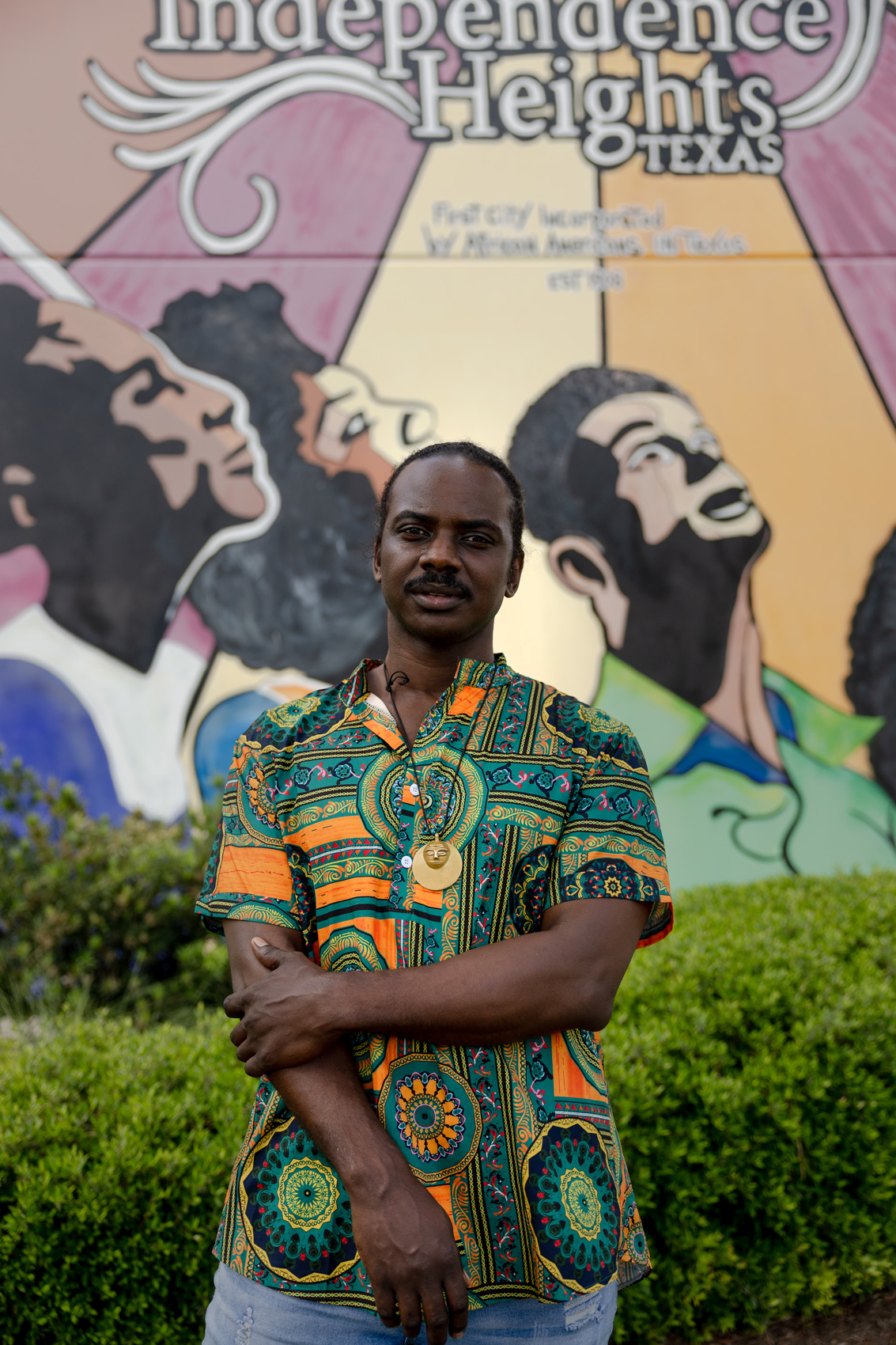
Williamsburg was aiming to attract another grocer, Kelley said, so it chose El to design a community mural, based on a similar project he worked on at a Whole Foods on 101 N. Loop West at Yale Marketplace in Independence Heights. That piece showcases the history and legacy of Independence Heights — the first Black incorporated city in Texas — and incorporates community stakeholders who played a part in its development. Williamsburg Enterprises wanted the same for the OST-area mural. It helped that El also had connections to the OST community. 

“We were looking at how we kind of reposition the asset and market it,” Kelley said. 

It was just the second art project the company endeavored on one of its many shopping plazas. 

As the project kicked off, Kelley and El held meetings and focus groups with the community to gather input on potential tenants for the site and ideas for inclusion in the mural. It was a collaborative effort, both Kelley and Asberry El confirmed.

As a result everyone settled on a mural that celebrated the spirit of community leadership and collective effort to uplift their neighborhood through education, sustainability and social support in OST South Union by recognizing key individuals who made a lasting impact. It highlighted Swatara and Tawali Olushula’s advocacy for healthier food options, Terry Garner’s stewardship of the Palm Center Community Garden, Hassani Sallah’s support through the Sehah Youth & Fitness Center, and Kavanagh Nweze’s dedication to business education and raising awareness.

Everyone was pleased with the end result and  community members took pride in protecting it. 

Danny Asberry-El, the lead artist who painted the OST and Independence Heights murals, poses for a portrait outside of a Whole Foods where his first mural for the community was displayed Wednesday, April 16, 2025 in Houston. (Lexi Parra / Houston Landing)

“The community felt like they owned that mural,” El said. “They kept a lot of things from happening to that establishment. That’s that community synergy.”

The October 2020 unveiling of the mural at a ribbon-cutting ceremony was widely attended by the community and elected officials, including District D Councilmember Carolyn Evans-Shabazz.

“Having a project of that size and scale, hiring people and really trying to engage [the] community with it, I thought ultimately it was very successful,” Kelley said. “I was happy with the way it turned out.”

But Kelley said he was surprised that the mural remained for so long, given the frequent turnover in commercial real estate, particularly in shopping centers.

“It was never meant to be a permanent thing that lasted forever,” he said. “It was always meant to be ephemeral and sort of temporal in nature.”

Kelley said that at the time of the mural’s creation, the building was entirely vacant. Because of this, he always considered the possibility that future tenants might need to alter the building by adding features like doors or extra windows in locations where the mural was situated, in order to make the space suitable for their business operations. While he was unsure if that was specifically communicated to the community, he believes the company and El had an understanding. 

El also attended the meeting virtually to speak about artist rights and conditions of his contract with the company. While he couldn’t share much about the details of the contract, he said it had a clause that specified he would be notified of any changes to the mural. 

He said he was not notified of plans to remove it and found out from the community. 

“People don’t think artists have rights, but we do,” he said, referring to the Visual Artist Rights Act

Enacted in 1990, the law safeguards an artist’s moral rights, preventing the unauthorized alteration or destruction of specific works of art that could damage their reputation.

“We need to know,” said El. “We send people to our murals and that’s bad for business.”

El said he retains the copyright, and the mural should not have been changed without his permission. Doing so, without a formal change-order agreement, may constitute a breach of contract, he said, and potentially lead to legal actions, mediation and the need for restorative action.

Williamsburg said in a statement that the original mural was a “work-for-hire piece” that it  commissioned and owned to help foster community identity.

So far, community members and El said they have contacted the company several times, but said their concerns have largely been disregarded. 

During a recent visit to the Renaissance Center, Houston Landing journalists inquired with employees and patrons of nearby businesses about the mural, including Planet Fitness where it was housed. Management refused to comment. While some patrons noticed it, they attributed it to the ongoing changes in the neighborhood.

“This area is being highly gentrified,” said longtime resident Ebony Broussard while picking up a takeout order from Juicy Crawfish in the building adjacent to Planet Fitness. To her, the removal of the mural was inevitable. 

Others hadn’t noticed it. 

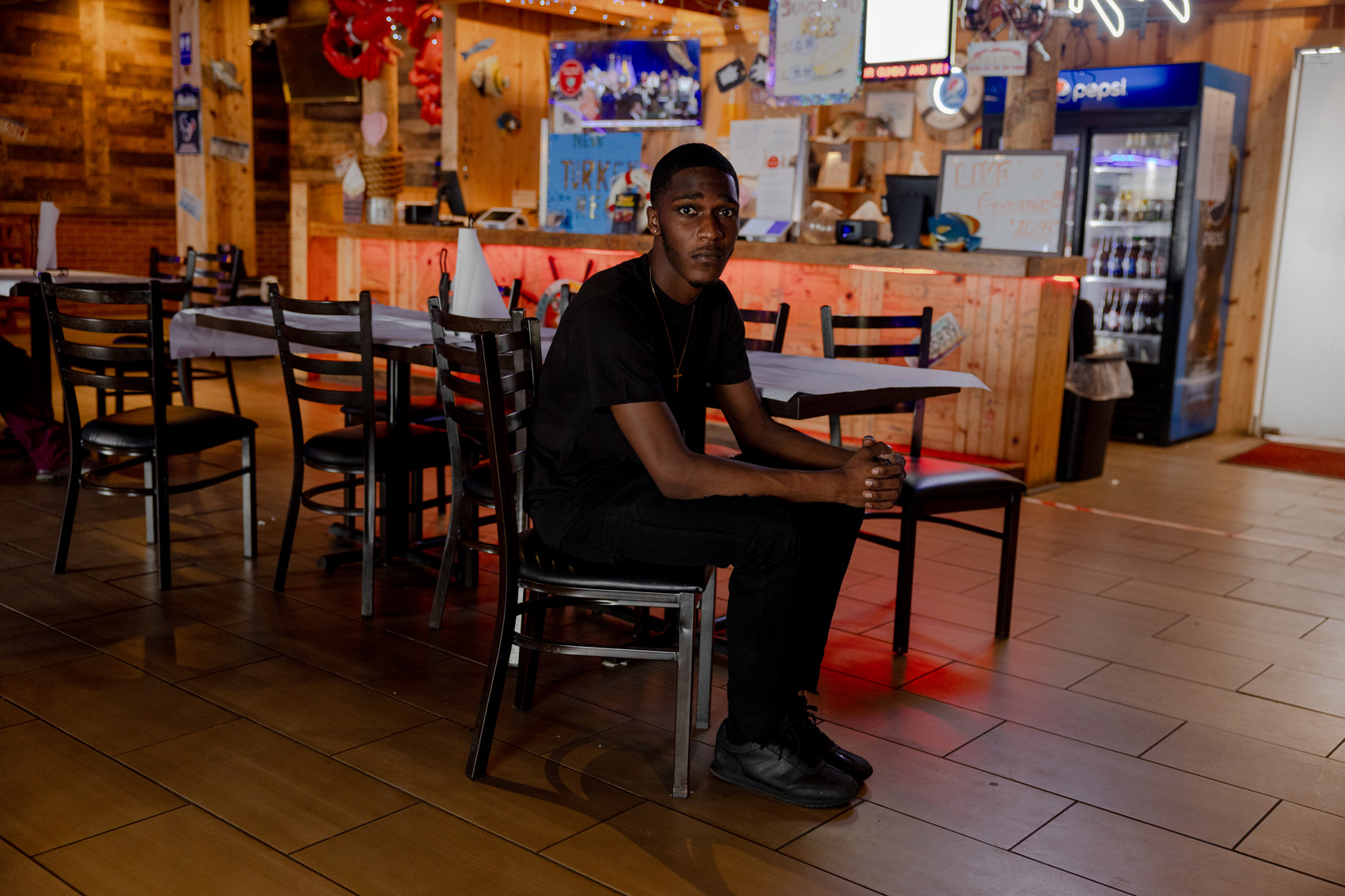
Nikolas Edmonson poses for a portrait at a local Cajun seafood shop in a strip mall, Tuesday, April 22, 2025 in Houston. A cultural mural in the area used to be a reference point, a sign of pride, for local Houstonians like Edmonson. Recently, the owners of the building painted over it without any notice. (Lexi Parra / Houston Landing)

“Man, that’s crazy,” Nikolas Edmonson said frequently, an employee at Juicy Crawfish, while staring across the street at the now blank canvas. If anything, given how long the mural was there, he hoped it would be extended to wrap around the building rather than removed. While he understands it’s business, he still wishes Williamsburg Enterprises would’ve at least tried to communicate with the community to bring something rather than just taking something. 

“It’s already bad enough that this is not a wealthy neighborhood, so you want to give us at least as much joyness as possible,” Edmonson said. “I genuinely do think they have to give something in return. Maybe a new mural.”

The post Here one day, gone the next: OST/South Union residents furious over removal of community mural appeared first on Houston Landing.

14 May 13:38

Trump Appointees Blocked From Entering US Copyright Office

by Kate Knibbs
The two men appeared at the US Copyright Office days after the Trump administration fired its leader, who had just published a report about the use of copyrighted materials for AI training.
14 May 13:38

GOP sneaks decade-long AI regulation ban into spending bill

by Benj Edwards

On Sunday night, House Republicans added language to the Budget Reconciliation bill that would block all state and local governments from regulating AI for 10 years, 404 Media reports. The provision, introduced by Representative Brett Guthrie of Kentucky, states that "no State or political subdivision thereof may enforce any law or regulation regulating artificial intelligence models, artificial intelligence systems, or automated decision systems during the 10 year period beginning on the date of the enactment of this Act."

The broad wording of the proposal would prevent states from enforcing both existing and proposed laws designed to protect citizens from AI systems. For example, California's recent law requiring health care providers to disclose when they use generative AI to communicate with patients would potentially become unenforceable. New York's 2021 law mandating bias audits for AI tools used in hiring decisions would also be affected, 404 Media notes. The measure would also halt legislation set to take effect in 2026 in California that requires AI developers to publicly document the data used to train their models.

The ban could also restrict how states allocate federal funding for AI programs. States currently control how they use federal dollars and can direct funding toward AI initiatives that may conflict with the administration's technology priorities. The Education Department's AI programs represent one example where states might pursue different approaches than those favored by the White House and its tech industry allies.

Read full article

Comments

14 May 13:38

#Ryo #RoninWarriors

14 May 13:38

Luckly, my curious and inquiring mind provides ...

Luckly, my curious and inquiring mind provides me with spurious and inspiring answers. #CowboyWho

14 May 13:38

What is the developer set-up for developing Windows for multiple processor architectures?

by Raymond Chen

The operating systems in the Windows NT lineage have supported multiple processor architectures for nearly all of its existence. There was a brief period of darkness when Compaq ceased production of Alpha AXP systems and before Intel released its Itanium processors. But even during that period, the Alpha AXP systems were still being used, just not in ways visible to the public: They were being used to develop 64-bit Windows. So there was never a period of time where Windows developers weren’t developing for multiple processor architectures. How did this work? Did every developer have a machine of every architecture in their office to validate their work on every processor?

No, it didn’t work that way.

Most developers had an Intel-class system as their primary machine, and another Intel-class system as their test machine. Some developers had a second test machine which was one of the other architectures. And some developers were all-in and had a non-Intel-class system as their primary machine.

I believe Jon Vert, the original author of the Windows NT blue screen, had a MIPS system as his primary system, and then when support for MIPS was dropped, he switched to an Alpha AXP as his main machine. That’s dedication to the non-Intel architectures.

For a long time, Windows NT did not have cross-compilers. If you wanted to compile for MIPS, you needed to have a MIPS system, for example. Every team knew who their representatives were for the non-Intel architectures, and if you needed to test your changes on one of those systems, you would ask them to build a binary for you, and you could go to their office to run your changes on a test system.

Most of the time, this step wasn’t necessary. Since Windows NT was designed as a portable operating system, the architectural differences rarely showed up in how you wrote your code, so if it worked on one 32-bit architecture, it probably worked on the others. We used the same principle when porting Windows to 64-bit: The vast majority of the work was in the initial port from 32-bit processors to 64-bit Alpha AXP. The port from 64-bit Alpha AXP to 64-bit Intel Itanium was handled almost entirely by the kernel team, since it is deep inside the kernel that the architectural differences become significant.

There are still places where architectural differences are visible in high-level code, however. The two biggest ones were multithreading and misaligned data. The Intel processors have rather strict memory models, so you didn’t observe race conditions that would be problems on systems with weaker memory models. And the Intel processors are quite forgiving of misaligned data, so code that used misaligned pointers would run just fine on an Intel system and then crash horribly on a processor that enforces alignment more strictly. To catch those types of issues, we had to exercise vigilance during code reviews and supplement it with a lot of testing to exercise the new code paths.

The Windows division still works this way. Windows supports Intel x86-32, Intel x86-64, ARM AArch32, and ARM AArch64. Most developers have an Intel x86-64 system as their main system and run Intel x86-32 and Intel x86-64 virtual machines for testing. Developers who are working with ARM-specific features will usually have an Intel x86-64 system as their main system and an ARM test system. Fortunately, we now have cross-compiling, so you no longer need to have a build environment on your ARM system. You can build an ARM binary on your Intel system.

Bonus reading: Anybody who writes #pragma pack(1) may as well just wear a sign on their forehead that says “I hate RISC.”

The post What is the developer set-up for developing Windows for multiple processor architectures? appeared first on The Old New Thing.

14 May 13:32

Pluralistic: Trump can't do ANYTHING for his base (12 May 2025)

by Cory Doctorow


Today's links


A playground slide. Standing atop it is a male figure in early 20th century garb, who is tipping a barrel of oil down the slide; the oil has pooled at the slide's base. The figure has Trump's grinning head. The background is a blown up, dark, halftoned detail from a US $100 bill.

Trump can't do ANYTHING for his base (permalink)

Trump's coalition includes a huge number of people who will suffer terribly from his policies, but who voted for him anyway. Trumpism requires that he find ways to keep those Christmas-voting turkeys happy, or at least distracted.

Trump's go-to move for keeping his base happy is inflicting pain on people they hate, like immigrants, racialized people, queers and women. That goes a long way, obviously: there's a kind of person who can be distracted from their own deteriorating material condition by the spectacle of cruel treatment for their enemies.

But Trumpism can't just run on sadism. There's a lot of people who enjoy the sadism, but not so much that it cancels out their own rage at their deteriorating personal conditions. Trump's main tactic is to blame the suffering of his base on the rest of us: "radical leftists," "wokeism" and other hobgoblins of the small-minded. That, too, has its limits – especially when Trump controls Congress, the courts, the senate and the White House. Obviously, Trump isn't above blaming his own people for being traitors (e.g., by sending a literal noose-bearing lynch mob after his own vice president), but there are limits to this, even for Trump. If all the power-brokers in Trump's coalitions are branded as disloyal, cowardly, or traitorous, Trump will have no one left to do the actual work of advancing his agenda.

Ultimately, keeping Trump's base happy requires providing some form of material benefit to that base. Every authoritarian has a version of this – like the cash handouts that Poland's former far-right government gave out:

https://pulitzercenter.org/stories/poland-model-promoting-family-values-cash-handouts

For Trump, this presents a problem: because he represents the interests of exploitation, extraction and looting, everything nice that he gives to everyday people in his base potentially gores the ox of someone who really matters to him. It's no surprise, for example, that he reversed Biden's price-cuts for Big Pharma's most expensive drugs – the cheaper drugs are for sick people, the less profitable they'll be for pharma companies:

https://www.levernews.com/trump-already-disarmed-the-war-on-drug-prices/

Luckily (for Trump), Biden's consumer protection and antitrust agencies teed up a long list of extremely good policies that would directly shift money from rich parasites to everyday people. For example, the Consumer Finance Protection Bureau passed a rule that would make it very easy to find out which bank would charge you the least and pay you the most, and let you switch banks with one click:

https://pluralistic.net/2024/11/01/bankshot/#personal-financial-data-rights

It was a move that would have shifted $667m/year from banks to everyday people, every year, forever. But Trump's most important barons, like Elon Musk, hated the Consumer Finance Protection Bureau and insisted that it be shuttered, so that $667m/year will go to the banks after all – indeed, virtually all of the good things Biden's CFPB decreed the American public would enjoy henceforth have been destroyed. Sure, Trump would have liked to have taken credit for these, but the conflict between stolen valor and displeasing Shadow President Musk will always cash out in Musk's favor.

It's not just the CFPB. The FTC also set up a whole roster of ambitious projects to improve life for Americans. Some of these made the news in a big way, like the antitrust case against Meta:

https://pluralistic.net/2025/04/18/chatty-zucky/#is-you-taking-notes-on-a-criminal-fucking-conspiracy

Trump has lots of upsides from pursuing the Meta case. Everyone hates Meta products, including (especially) the people who are trapped using them because that's where their friends, family, communities, customers or audiences are. Breaking up Meta would be hugely popular with the American people. But also, once a court has convicted Meta of violating antitrust law, Trump can solicit favors – cash and favorable algorithmic treatment – from Meta in exchange for ordering his FTC to go easy on Meta in the "remedy phase," letting them off with a fine, rather than forcing them to spin out Whatsapp and Instagram:

https://pluralistic.net/2024/11/12/the-enemy-of-your-enemy/#is-your-enemy

But even if Trump lets Meta walk, there's plenty of great stuff Biden's FTC did that he could take credit for – policies that would help everyday people.

The most prominent of these is the FTC's "Click to Cancel" rule. It's a pretty simple rule: companies have to make it as easy to cancel a subscription as it was to sign up for it.

In other words, they can't do that thing – beloved of everything from the New York Times to every manosphere influencer's supplement business – where you can sign up for a subscription with one click, but you can't cancel unless you phone them, wait on hold, and beg them to let you off the hook.

Companies do this on purpose, because it's super profitable. Amazon executives carried on internal email threads where they straight up said that they'd deliberately made it confusingly easy to sign up for Prime and basically impossible to stop paying for it:

https://pluralistic.net/2023/09/03/big-tech-cant-stop-telling-on-itself/

This is a no-brainer. Companies make signing up for subscriptions into a greased slide, and they make canceling subscriptions into a greased pole.

No wonder, then, that when the FTC solicited public comments on a proposed "click to cancel" rule, they had no trouble building up the evidentiary record needed to pass the rule.

Now, Trump's FTC has announced that they are delaying enforcement of the rule until mid-July:

https://techcrunch.com/2025/05/10/ftc-delays-enforcement-of-click-to-cancel-rule/

This is the second time they've delayed enforcement (originally, the rule was supposed to go into effect in January). Trump FTC chairman Andrew Ferguson had no trouble getting the votes for the suspension, because he illegally fired the two Democratic Commissioners, Alvaro Bedoya and Rebecca Slaughter:

https://www.theverge.com/decoder-podcast-with-nilay-patel/657115/ftc-bedoya-slaughter-trump-fired-supreme-court-interview

Ferguson is proof that the FTC can't do anything material for Trump's base. Sure, he can set up a snitch-line so that FTC employees can rat each other out for being "woke":

https://www.ftc.gov/system/files/ftc_gov/pdf/bedoya-statement-emergency-motion.pdf

This should be a slam dunk. It epitomizes the "unfair and deceptive" business practices Section 5 of the FTC Act empowers the agency to snuff out. The Trump admin is unwilling to gore the ox of out-and-out scammers, people who trick you into unkillable subscriptions. It seems that there's no material benefit that Trump's oligarch backers are willing to cede to working people. All they can offer is cruelty.

(Image: Vis M, CC BY-SA 4.0, modified)


Hey look at this (permalink)


A Wayback Machine banner.

Object permanence (permalink)

#20yrsago BBC’s RSS: Why do we need a license to aggregate, period? https://memex.craphound.com/2005/05/09/bbcs-rss-why-do-we-need-a-license-to-aggregate-period/

#20yrsago Hillary “RIAA” Rosen: iPod DRM is cruel and unfriendly! https://web.archive.org/web/20050511014032/http://www.huffingtonpost.com/theblog/archive/2005/05/steve-jobs-let-.html

#20yrsago Stoker’s Dracula as a blog https://infocult.typepad.com/dracula/

#20yrsago Canadian MP blogs from Parliament’s floor https://web.archive.org/web/20050514023619/http://www.montesolberg.com/2005/05/voting.htm

#20yrsago Journal of Ride Theory amazing zine is now an amazing book https://memex.craphound.com/2005/05/11/journal-of-ride-theory-amazing-zine-is-now-an-amazing-book/

#15yrsago FOR THE WIN launches today https://memex.craphound.com/2010/05/11/for-the-win-launches-today/

#15yrsago IT in developing nations makes women and poor people happier https://www.bbc.com/news/10108551

#15yrsago Heinlein freaked out at “invasive” review of STRANGER IN A STRANGER LAND https://web.archive.org/web/20100514220628/https://thewaythefutureblogs.com/2010/05/robert-a-heinlein-algis-budrys-and-me/

#10yrsago Copyfighting, jailbreaking legend Ed Felten is the White House’s new deputy CTO https://web.archive.org/web/20150512045054/https://www.whitehouse.gov/blog/2015/05/11/white-house-names-dr-ed-felten-deputy-us-chief-technology-officer

#10yrsago Finance deserves its corrupt reputation https://web.archive.org/web/20150618083908/https://faculty.chicagobooth.edu/luigi.zingales/papers/research/Finance.pdf

#10yrsago Librarians: privacy’s champions https://www.thenation.com/article/archive/librarians-versus-nsa/

#10yrsago Teacher forced into retirement for showing archival queer-scare movie https://www.nydailynews.com/2015/05/07/retiring-missouri-teacher-suspended-after-showing-1959-anti-gay-boys-beware-video-to-class/

#10yrsago Citizen journo who videod Eric Garner’s murder now hounded by NYPD https://web.archive.org/web/20150426160713/https://www.vice.com/read/nine-months-after-he-filmed-eric-garners-killing-the-cops-are-trying-to-put-ramsey-orta-behind-bars

#10yrsago Senators demand CIA boss admit he lied about hacking torture committee https://www.dailydot.com/debug/senate-democrats-john-brennan-cia-computer-search/

#10yrsago Commercial prison messaging system’s terms of service lands inmate in solitary https://www.eff.org/deeplinks/2015/05/jpay-will-no-longer-claim-ownership-over-inmate-family-correspondence

#10yrsago DOJ tells judges they don’t get a say in whether information is classified https://web.archive.org/web/20150510081211/https://firstlook.org/theintercept/2015/05/08/governments-bid-keep-gitmo-force-feeding-videos-secret-runs-skeptical-judges/

#5yrsago The real Lord of the Flies kids were really nice to each other https://pluralistic.net/2020/05/09/im-gonna-say-it-now/#humankind

#5yrsago Brett Favre received $1.1m in welfare money for speeches he never gave https://pluralistic.net/2020/05/09/im-gonna-say-it-now/#welfare-fraud

#5yrsago Flooding Ohio's "work-refusal" snitchline https://pluralistic.net/2020/05/09/im-gonna-say-it-now/#chaffing

#5yrsago Armed Michigan voters escort their state rep to work https://pluralistic.net/2020/05/09/im-gonna-say-it-now/#arms-racism

#5yrsago Facebook's "supreme court" https://pluralistic.net/2020/05/11/delete-facebook/#star-chamber

#5yrsago Podcast of "Rules for Writers" https://pluralistic.net/2020/05/11/delete-facebook/#turkey-city

#5yrsago NLRB nukes Hearst's union-busting https://pluralistic.net/2020/05/11/delete-facebook/#rosebud

#5yrsago The bailout is working (for Wall Street) https://pluralistic.net/2020/05/11/delete-facebook/#guillotine-watch

#5yrsago Shanghai Disneyland re-opens https://pluralistic.net/2020/05/11/delete-facebook/#splash-mountain

#5yrsago 80% of Britons want happiness, not growth https://pluralistic.net/2020/05/11/delete-facebook/#line-go-up

#1yrago Algorithmic feeds are a twiddler's playground https://pluralistic.net/2024/05/11/for-you/#the-algorithm-tm

#1yrago AI is a WMD https://pluralistic.net/2024/05/09/shitting-in-the-well/#advon


Upcoming appearances (permalink)

A photo of me onstage, giving a speech, pounding the podium.


A screenshot of me at my desk, doing a livecast.

Recent appearances (permalink)


A grid of my books with Will Stahle covers..

Latest books (permalink)


A cardboard book box with the Macmillan logo.

Upcoming books (permalink)

  • Enshittification: Why Everything Suddenly Got Worse and What to Do About It, Farrar, Straus, Giroux, October 7 2025
    https://us.macmillan.com/books/9780374619329/enshittification/
  • Unauthorized Bread: a middle-grades graphic novel adapted from my novella about refugees, toasters and DRM, FirstSecond, 2026

  • Enshittification, Why Everything Suddenly Got Worse and What to Do About It (the graphic novel), Firstsecond, 2026

  • The Memex Method, Farrar, Straus, Giroux, 2026


Colophon (permalink)

Today's top sources:

Currently writing:

  • Enshittification: a nonfiction book about platform decay for Farrar, Straus, Giroux. Status: second pass edit underway (readaloud)
  • A Little Brother short story about DIY insulin PLANNING

Latest podcast: Nimby and the D-Hoppers CONCLUSION https://craphound.com/stories/2025/04/13/nimby-and-the-d-hoppers-conclusion/


This work – excluding any serialized fiction – is licensed under a Creative Commons Attribution 4.0 license. That means you can use it any way you like, including commercially, provided that you attribute it to me, Cory Doctorow, and include a link to pluralistic.net.

https://creativecommons.org/licenses/by/4.0/

Quotations and images are not included in this license; they are included either under a limitation or exception to copyright, or on the basis of a separate license. Please exercise caution.


How to get Pluralistic:

Blog (no ads, tracking, or data-collection):

Pluralistic.net

Newsletter (no ads, tracking, or data-collection):

https://pluralistic.net/plura-list

Mastodon (no ads, tracking, or data-collection):

https://mamot.fr/@pluralistic

Medium (no ads, paywalled):

https://doctorow.medium.com/

Twitter (mass-scale, unrestricted, third-party surveillance and advertising):

https://twitter.com/doctorow

Tumblr (mass-scale, unrestricted, third-party surveillance and advertising):

https://mostlysignssomeportents.tumblr.com/tagged/pluralistic

"When life gives you SARS, you make sarsaparilla" -Joey "Accordion Guy" DeVilla

READ CAREFULLY: By reading this, you agree, on behalf of your employer, to release me from all obligations and waivers arising from any and all NON-NEGOTIATED agreements, licenses, terms-of-service, shrinkwrap, clickwrap, browsewrap, confidentiality, non-disclosure, non-compete and acceptable use policies ("BOGUS AGREEMENTS") that I have entered into with your employer, its partners, licensors, agents and assigns, in perpetuity, without prejudice to my ongoing rights and privileges. You further represent that you have the authority to release me from any BOGUS AGREEMENTS on behalf of your employer.

ISSN: 3066-764X

14 May 13:30

Groundbreaking Photorealist Exhibit Highlights Women and People of Color in L.A.

by Ruben C. Cordova

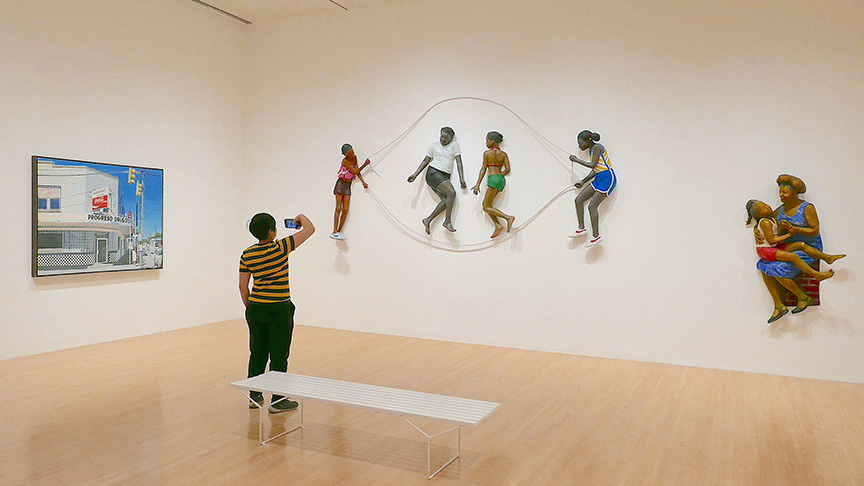
Installation view of “Ordinary People: Photorealism and the Work of Art since 1968.” Photo: Ruben C. Cordova

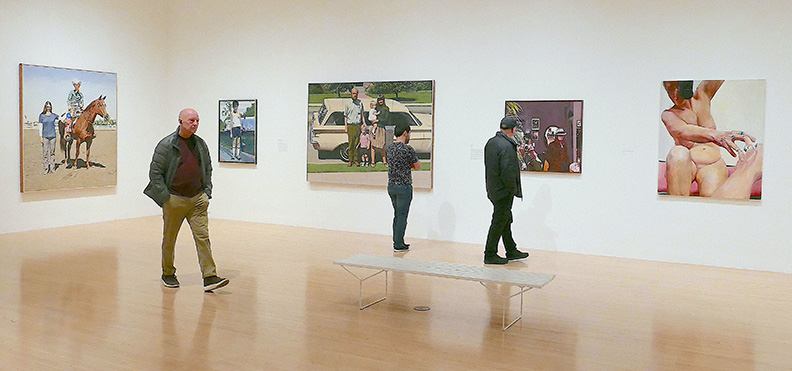
The Museum of Contemporary Art in Los Angeles (MOCA) has mounted a momentous exhibition called Ordinary People: Photorealism and the Work of Art since 1968 that dramatically expands the canon of photorealist art. Too often framed as a short-lived movement of white male artists in New York and the San Francisco Bay Area in the late 1960s and early 1970s, the conventional canon was established by gallerist Louis K. Meisel in 1980, with 13 White artists, only one of whom was a woman. MOCA director Johanna Burton notes that Ordinary People challenges that view by including “the underrepresented — people of color, queer people, and others belonging to diverse, intersectional communities — in all of their specificity.” As Burton also points out, “many Black, Latinx, and women artists in this exhibition were working at the same time as the canonical photorealists yet have not previously been recognized as part of photorealist art history” (“Director’s Foreword” to the catalog, p. 7). Organized by MOCA Senior Curator Anna Katz with Curatorial Assistant Paula Kroll, the exhibition includes more than ninety paintings, drawings, and sculptures by forty-four artists.
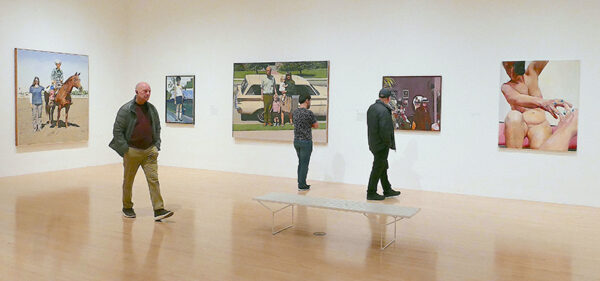
Installation view of “Ordinary People: Photorealism and the Work of Art since 1968.” Photo: Ruben C. Cordova

In reconfiguring a span of six decades, Katz views photorealism not as “an end to painting, figuration, representation in the 1960s — but rather as the beginning of a practice that continues to this day” (“Curator’s Acknowledgements,” p. 11). In her essay, Katz notes the low status many accord to the movement, for various reasons. Some see it as “a last-gasp bid for skill, a death rattle for painting;” others see it as “mere copying” (and lacking the creativity and vision inherent in genuine art); yet others see it as “a nostalgic, reactionary attack on the avant-garde project of modernism,” and thus a backward blow against their teleological view of artistic progress. Its very methods are sometimes regarded as a condemnation, “since, in choreographing the shallowest of relays between the surface of the painting and the surface of the photograph, it occupied an infinitesimally slight field of inquiry.” In a further self-limiting move, it takes on the shallowest of subject matter: “the thin veneer of modern life.” Moreover, in the rarified context of the art world, photorealism carries the “fishy” whiff of populism — anything so accessible to the uninitiated masses must be suspect, right? (“What’s so Real About Photorealism?,” p. 15).
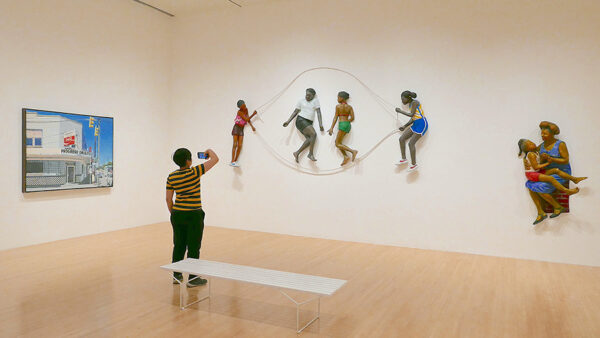
Installation view of “Ordinary People: Photorealism and the Work of Art since 1968.” Photo: Ruben C. Cordova

But in examining the history of repressed or previously unrecognized artists, Katz understood why a photorealist mode of painting was/is so appealing to diverse artists: it is “a rich source of meaning,” both for the artists and their public, who “wish to recognize themselves in art” (p. 15). Ordinary People turns the photorealism canon on its head by prioritizing the marginalized and short-shrifting the canonical.

Three Canonical Photorealist Artists and Paintings

I begin by examining three canonical works before turning to groups of the formerly excluded, particularly Chicano, women, and Black artists in Ordinary People.
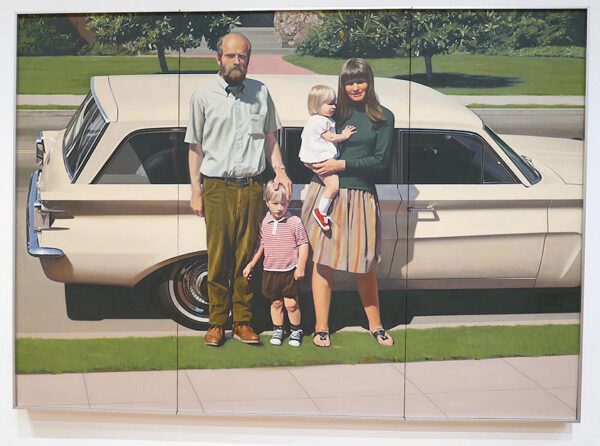
Robert Bechtle “‘61 Pontiac,” 1968-69, oil on canvas. Collection of the Whitney Museum of American Art, New York. Photo: Ruben C. Cordova

When Meisel formulated his concept of photorealism, he meant works that not only utilized photographs as source material but that also imitated the look of photographs to a high degree.

In the above photograph, Robert Bechtle is posed with his family in front of the family car. He replicated a slide by tracing the outlines of the various forms onto his canvas, attempting to create a style-less style. Rather than suppressing or compensating for the distortions and strange effects in his slide, such as the sharp geometrical shapes reflected on the rear window of his car, or the jagged shadow cast by his head, Bechtle imitated them as faithfully as possible. 

He stands straight up, while the child by his side turns towards him, and his wife leans in the other direction. The windows on the visible side of the car are largely opaque, though a small slice of transparency cuts across a portion on the left. Rather than making conscious decisions about how to render all the various details, Bechtle simply follows the example of the photograph.

Robert Bechtle “‘61 Pontiac” (detail), 1968-69, oil on canvas. Collection of the Whitney Museum of American Art, New York. Photo: Ruben C. Cordova

Bechtle must be placing his weight on his heels, since the front of his feet are rising up, such that he almost seems to be floating off the ground. Moreover, with his hand on his son’s head, he almost seems to be pushing off in order to rise up into the air. Other strange effects include a dark shadow line that runs across his wife’s face, obscuring her eyes. Her striped dress looks bleached-out in places. This is almost certainly not a consequence of faded or bleached material, but rather a quirk of the slide (taken in bright sunlight) that served as the artist’s source. Each and every photographic detail, however strange or unusual, is transferred to the canvas, which is why this is a photorealist work. A non-photorealist painting would not imitate its source so assiduously.
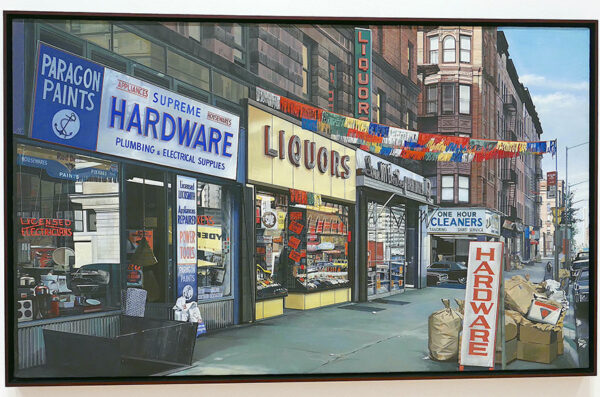
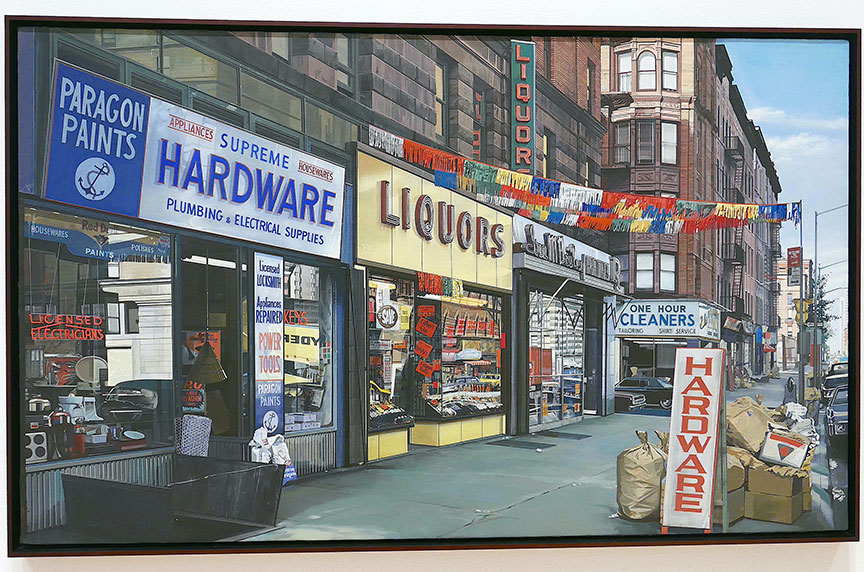
Richard Estes, “Supreme Hardware,” 1974, oil and acrylic on canvas. Collection of the High Museum of Art, Atlanta. Photo: Ruben C. Cordova

Whereas the Bechtle discussed above was a vision of middle-class White suburbia at high noon in California, Richard Estes renders New York City, not in its towering glory, but at its most humdrum and ordinary. Estes’ painting is dominated by three storefronts (a hardware store, a liquor store, and a pharmacy) with highly reflective glass windows. They are particularly complex elements, owing to the fact that they are partially transparent and opaquely reflective. On the right, a pile of boxed and bagged refuse gives way to crumpled papers in the gutter. The painting makes no attempt to elevate and glamorize, nor to bring down and condemn. It simply reflects an instantaneous slice of time captured by a camera, transposed as methodically and carefully as possible into paint. The important artistic decisions are made in the course of choosing and photographing a particular scene.
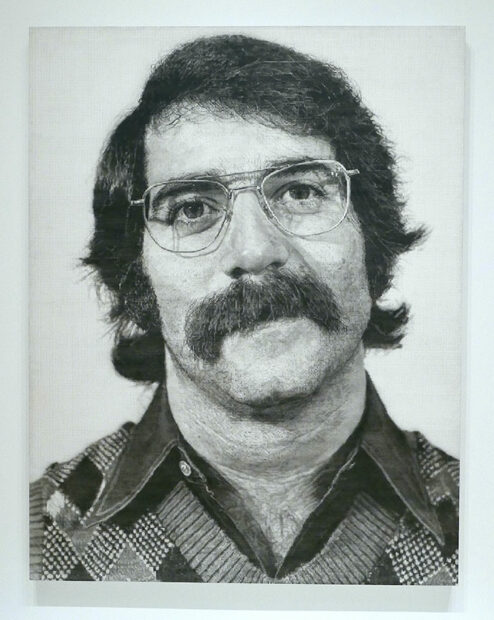
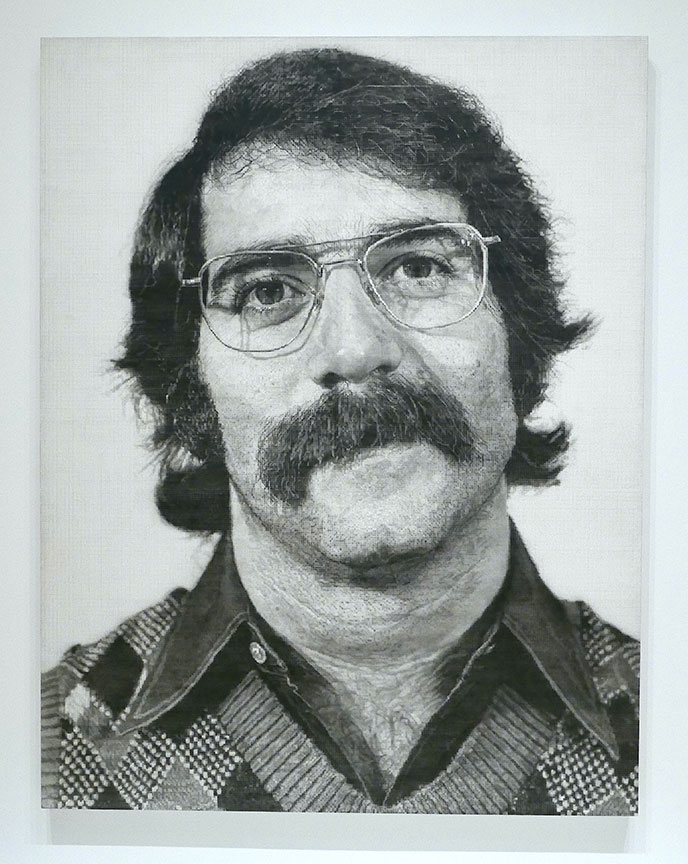
Chuck Close, “Robert/104,072,” 1973-74, synthetic polymer paint and ink with graphite on gessoed canvas. Collection of The Museum of Modern Art, New York. Photo: Ruben C. Cordova

As noted above, the art establishment has often taken a dim view of photorealism, to the extent that it has regarded it as art at all. The most notable exception to this attitude is the body of work by Chuck Close that depends upon a rigorous grid system. This group of paintings bears a clear — if somewhat perverse — kinship to minimalism, a contemporary movement based on grids (sometimes actually composed of grids) and other strictly geometric structural units. 
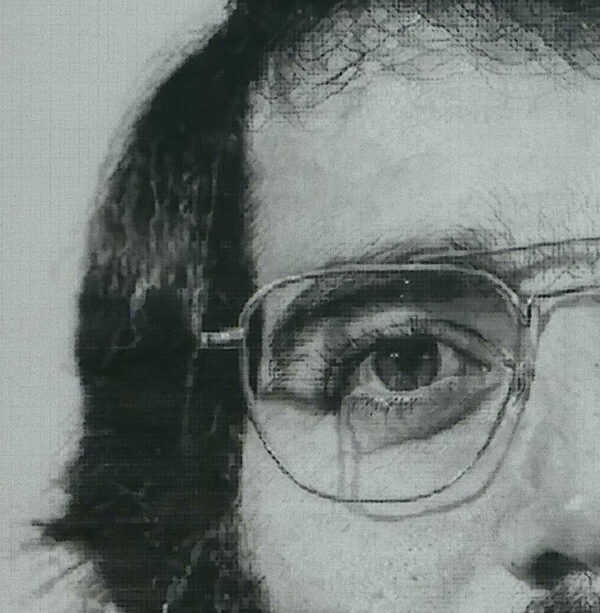
Chuck Close, “Robert/104,072” (detail), 1973-74, synthetic polymer paint and ink with graphite on gessoed canvas. Collection of The Museum of Modern Art, New York. Photo: Ruben C. Cordova

In this detail of the upper left section of Close’s painting, one can see the grid pattern on the left. As noted in the title, 104,072 tiny squares are utilized to make the painting. Particularly along the hairline on the subject’s forehead, the metal rims of his glasses, and his eyelashes, one can see airbrushed effects that mirror, avant la lettre, pixelation in digital scans. 

Chuck Close, “Study for Robert/104,072” (detail of one of four parts), 1973, pressure sensitive tape, airbrush, pen, ink, pencil, and colored ballpoint pen over silver gelatin print mounted on foamcore. Collection of The Museum of Modern Art, New York. Photo: Ruben C. Cordova

Close’s maquette for his painting comprises four photographs, over which he drew grids, overworked with airbrush, pen, ink, pencil, and colored ballpoint pen. The grid patterns are much more evident in the studies (such as the one above) than in the finished painting.

Over the fourteen months he worked on the painting, Close utilized his airbrush an average of ten times per square, resulting in over a million touches. These repetitive actions caused the artist to develop arthritis. Curator Katz repeatedly emphasizes the manual labor and craft-like processes required by photorealist techniques. But, especially in the case of Close, I would place equal emphasis on the ingenuity and complexity of the systematic method he devised to create this body of paintings. 

Latinx Artists
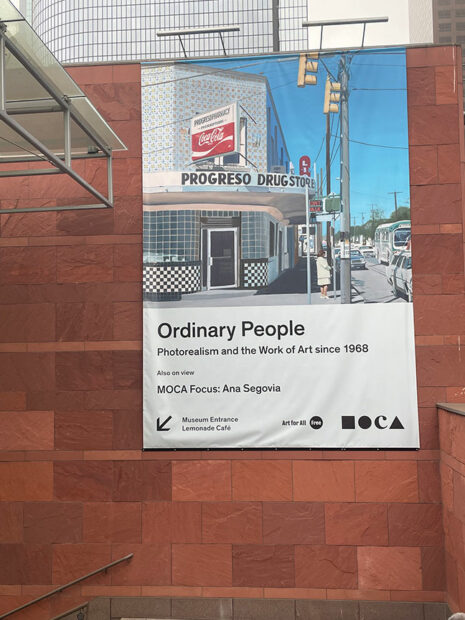
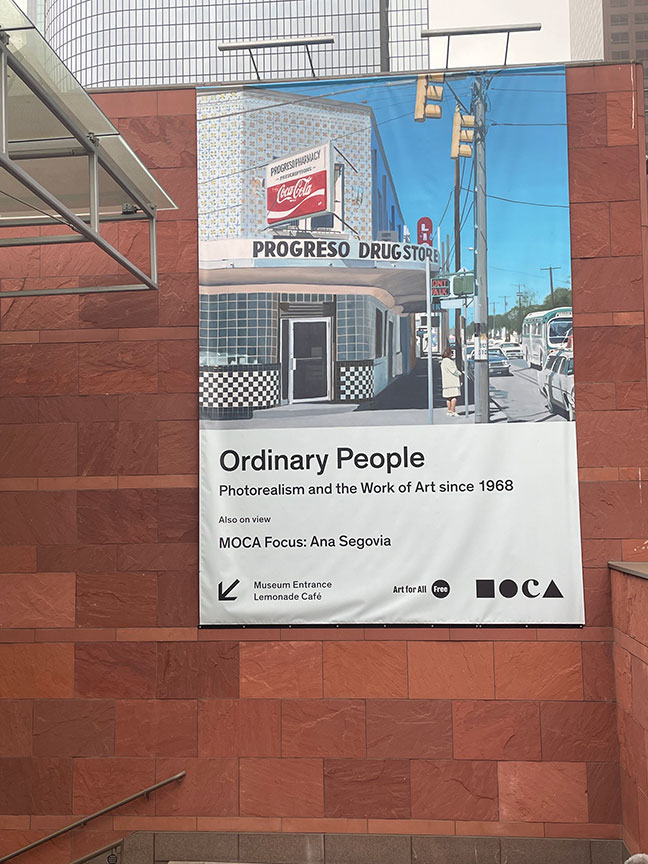
Banner with “El Progreso” by Jesse Treviño at the entrance to MOCA. Photo: Ruben C. Cordova

I curated the 2009-10 Jesse Treviño retrospective at the Museo Alameda in San Antonio, at which time scholars lamented the exclusion of Chicano artists from photorealist exhibitions. Consequently, I was very pleased by the significant presence of artists of color in Ordinary People, as well as their high level of visibility. 

A banner (reproduced above) with an image by Treviño greeted visitors descending the staircase to the museum entrance (it was also utilized in other locales, as was a banner featuring work by John Valadez). 
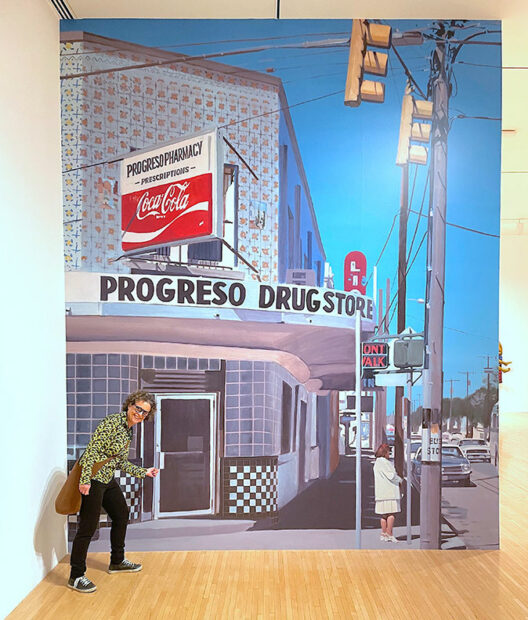
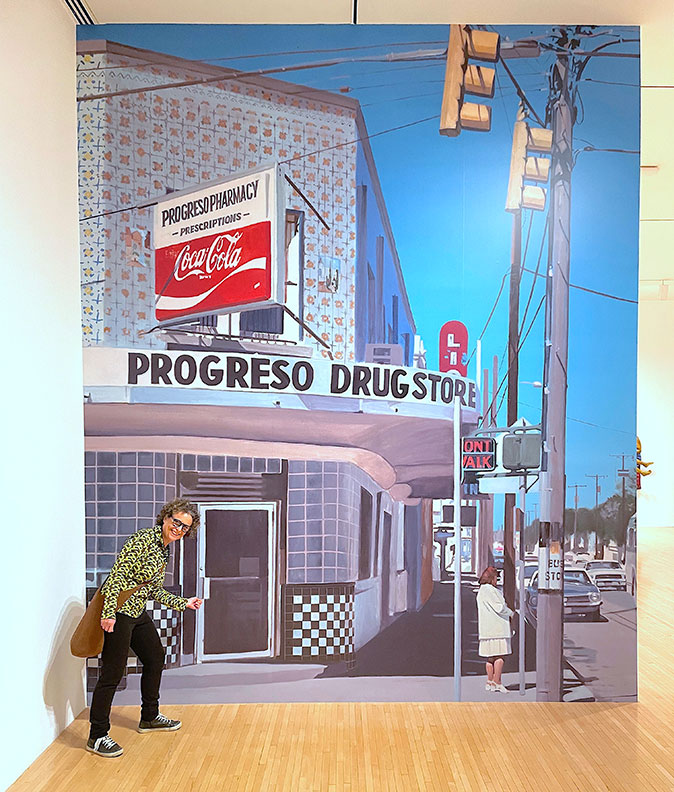
Photomural with “El Progreso” by Jesse Treviño and a visitor at the entrance to the “Ordinary People” exhibition. Photo: Ruben C. Cordova

I was startled to see an enormous photomural of the same painting at the entrance to the exhibition. When visitors came to the actual painting (visible in an installation shot above), many were surprised to find that it was not an enormous painting (it is 50 x 60 inches).

Treviño traveled a unique road to Chicano art. He was at the Art Students League in New York, working in a painterly manner, when he was drafted. Suffering grievous injuries in a Vietnamese rice paddy, Treviño resolved to return to San Antonio if he survived (see my 2019 Glasstire article: “A Baptism of Fire: Jesse Treviño Paints ‘Mi Vida’”).

Near death, Treviño realized that he “had just painted whatever my teachers told me to paint… I had never painted my mother or my brothers. I’d never seen museum-quality paintings of the barrio… It made me want to survive to be able to paint the things that mattered most to me” (see my 2016 San Antonio Report article: “Jesse Treviño: ‘Synonymous with San Antonio’”).

This vision of a new artistic path enabled Treviño to cling to life, to persevere during a lengthy rehabilitation, to overcome the amputation of his painting hand, to learn to paint with his left hand, and to deal with lifelong chronic pain. Treviño became a photorealist painter because he wanted his art to be intelligible to the broadest segment of the public, especially to a Chicano public.
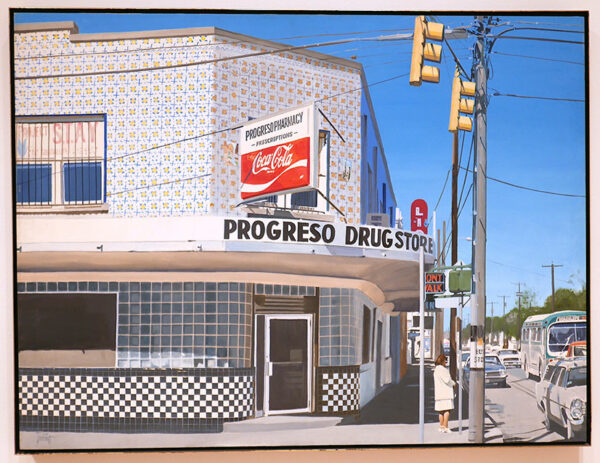
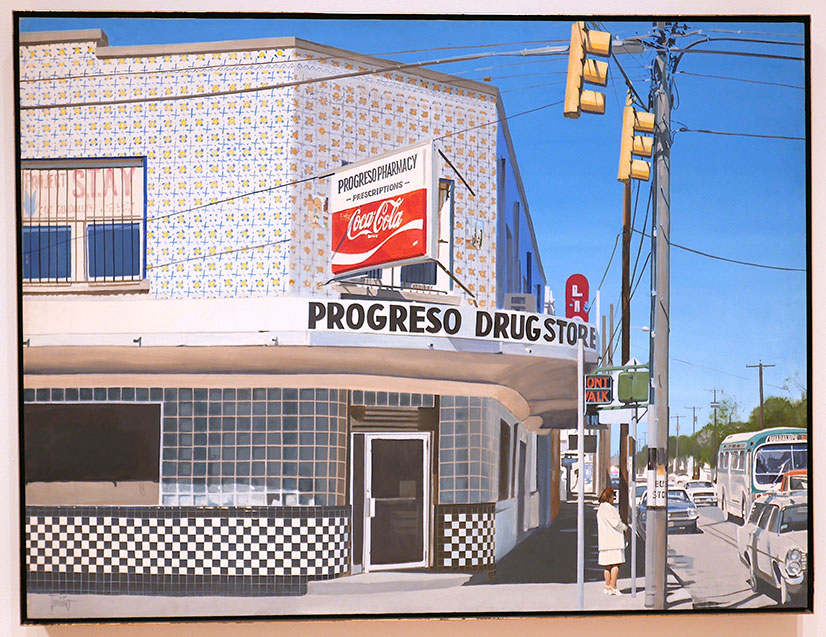
Jesse Treviño, “El Progreso,” 1979, acrylic on canvas. Collection of Kathy Sosa. Photo: Ruben C. Cordova

The beautifully tiled Progreso building, site of a former pharmacy, is a historic building on the West side of San Antonio, a predominantly Mexican American neighborhood. Treviño regarded the Progreso as one of the most beautiful and important buildings in the neighborhood. As a pharmacy, it had fulfilled an important function in an underserved neighborhood. Treviño also compared his painting of the building to “a portrait of a person.”

Located at the intersection of Guadalupe and Brazos, it is an area with substantial bus, car, and foot traffic. It is directly across the street from the historic Teatro Guadalupe (Treviño also painted a “portrait” of that building). Treviño likened this intersection to Grand Central Station in New York City because it was the transit nerve center of the neighborhood. Treviño placed a single figure on the corner as an emblem of someone who “would ride the bus and not drive.” That person was, in fact, his mother. The bus displays the route sign “Guadalupe.” Behind the bus, one can see a vintage Mustang, similar to the model Treviño bought with his disability pay (see: “Baptism of Fire”). According to Treviño, this intersection “set the stage for the West side.” It also had deep personal significance for the artist, who purchased a home/studio on that street.

When Treviño photographed the building for this painting, he recalls that it was serving as a Goodwill Center, though it still sported an illuminated Progreso Pharmacy sign, and “Progreso Drug Store” was written on the awning. Treviño included these details in El Progreso.
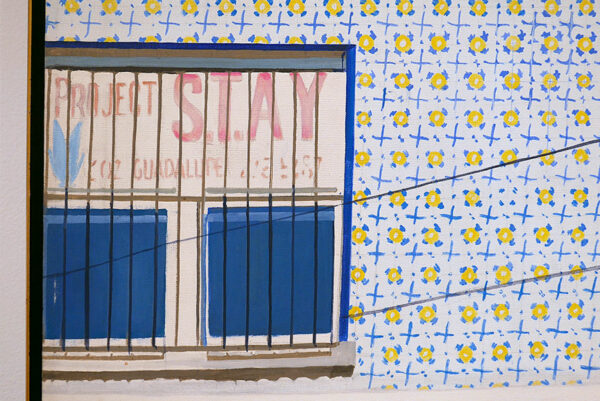
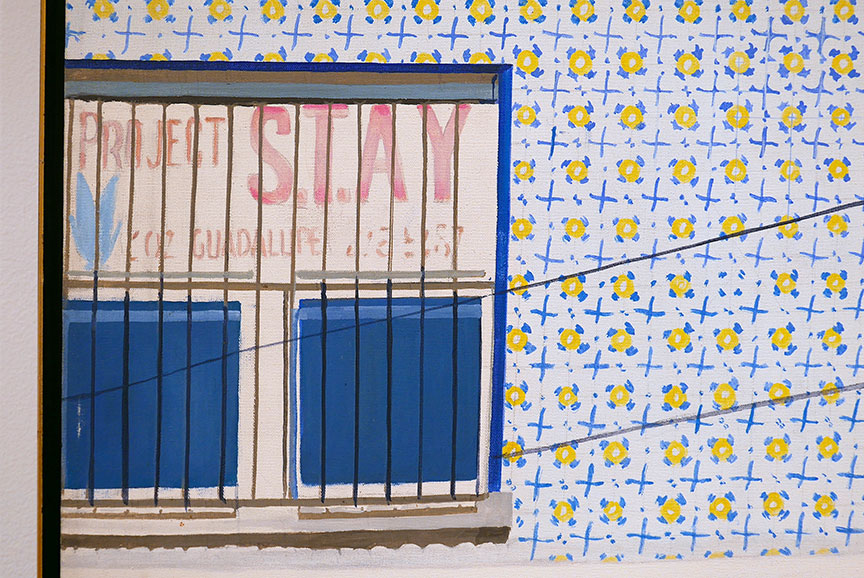
Jesse Treviño, “El Progreso” (detail), 1979, acrylic on canvas. Collection of Kathy Sosa. Photo: Ruben C. Cordova

In Treviño’s painting, a faded Project S.T.A.Y. (a non-profit that helps individuals to pursue post-secondary education) sign is visible in the second-story window. In the mid-1980s, the Progreso building and the Teatro were incorporated into the campus of the Guadalupe Cultural Arts Center (its predecessor group was formed the year this painting was made), thus ensuring that they continued to play a central role in the life of the neighborhood. 

The canonical photorealists painted shop windows that held a multitude of goods and featured complex natural lighting effects. But these shops were not chosen because they were unique, nor because they were somehow central to the life of the city in a distinct manner. Treviño, on the other hand, sought out the most culturally significant buildings, many of which he deemed particularly beautiful. These buildings were important to him and to his friends, family, and ethnic group, especially the Spanish language theaters. If anything, Trevino picked his buildings even more carefully than his human subjects. (I have drawn on my exhibition label and conversations with the artist for the above discussion of this painting.) 

When Treviño chose to paint a shop window, he selected one whose focus was religious statuettes. Additionally, he simultaneously showcased several of San Antonio’s best-known buildings in the reflecting window. The Mexican-descended San Antonio community is deeply religious. Moreover, there is considerable civic pride in the best-known San Antonio buildings, such as, from left to right in Treviño’s painting, the Tower of the Americas (built for Hemisfair, the World’s Fair held in San Antonio in 1968), the Tower LIfe Building (widely regarded as the city’s most beautiful building), and the Drury Hotel (formerly the Alamo Bank building). True to his title, the painting is rife with santos (saints) and it features the San Antonio skyline. Thus, Treviño selected this particular subject due to its very specific qualities, rather than because of its ordinariness or generic qualities. 

Imagine, as a parallel, a New York-centric shop window, one that featured wares associated with the city, as well as the Empire State Building and the Chrysler building in the reflecting glass. Such a display window might contain a row of small Statues of Liberty, a few toy King Kongs thrown in, and some “I-Heart-NY” mugs and memorabilia for good measure. Whereas the canonical photorealist painters chose their subjects because of their generic-ness, Treviño chose his because of their cultural significance. 

I have referred to Treviño as “world-famous in San Antonio,” due to his unparalleled celebrity within the city, and his relative lack of visibility outside of it. Ordinary People will help to make Treviño and other under-recognized artists more visible outside of their immediate circles. 
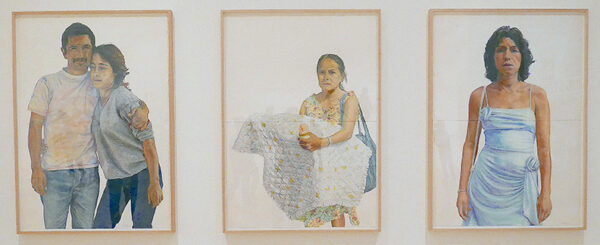
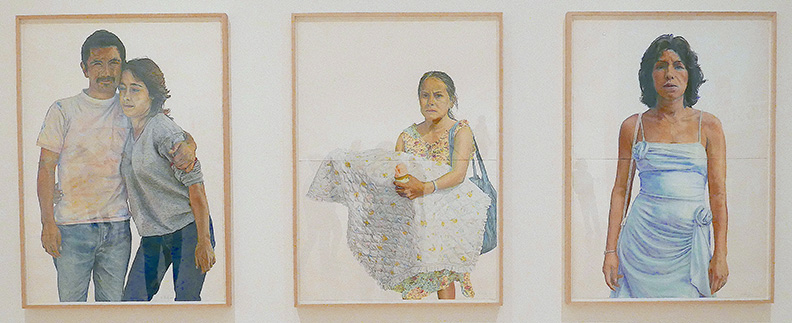
John Valadez, “Robert and Liz,” 1984, pastel on paper, collection of Glenna Avila; “Fatima,” 1984, pastel on paper. Collection of The Bass, Miami Beach; “White Rose,” 1983, pastel on paper. Collection of The Bass, Miami Beach. Photo: Ruben C. Cordova

John Valadez, perhaps the quintessential Chicano photorealist artist, is represented in Ordinary People by three pastels. The first depicts his half brother (in a very soiled white t-shirt) and his girlfriend; the second a Latinx woman who manages to hold a partially eaten ice cream cone as well as her baby, which is wrapped in a quilt; the third is an immigrant from Central America, dressed in a tight-fitting blue dress, in preparation for her job as a taxi dancer. All are based on photographs taken by the artist. 

As Katz notes in her catalog essay, “Confrontation was seeded in specificity,” which allowed the artist to avoid both media stereotypes (which tended to be negative) and excessive idealization, because of the “detail and individuality that the camera can capture” (p. 22). Robert must have been squinting into the light as he faced Valadez’s camera, while actively pulling Liz to his side. Compositional qualities that stand out include Robert’s gnarled face, the subtle wrinkles and coloristic differentiations on his shirt and faded jeans, and the complex, knotty forms of Liz’s half pulled-up sleeve. 

The woman carrying the child, while small in stature, looks very determined. She has a large blue bag, which presumably holds diapers, baby bottles, etc. The baby must be in some kind of crib. Since we cannot see it, we infer its existence by the way she is holding the large blanket that covers it. The taxi dancer seems to look at the spectator very directly, in a manner that she must have utilized to assess her male clients. 

The Broadway Mural (1981), Valadez’s magnum opus, was painted at the Victor Clothing Store on Broadway, a part of L.A. that had fascinated the artist since childhood. It is reproduced and discussed in the catalog by Gabriela Rodriguez-Gomez (“Chicana/o/x Photorealist Murals in California: Agency, Community, and Photography,” p. 206-7). 

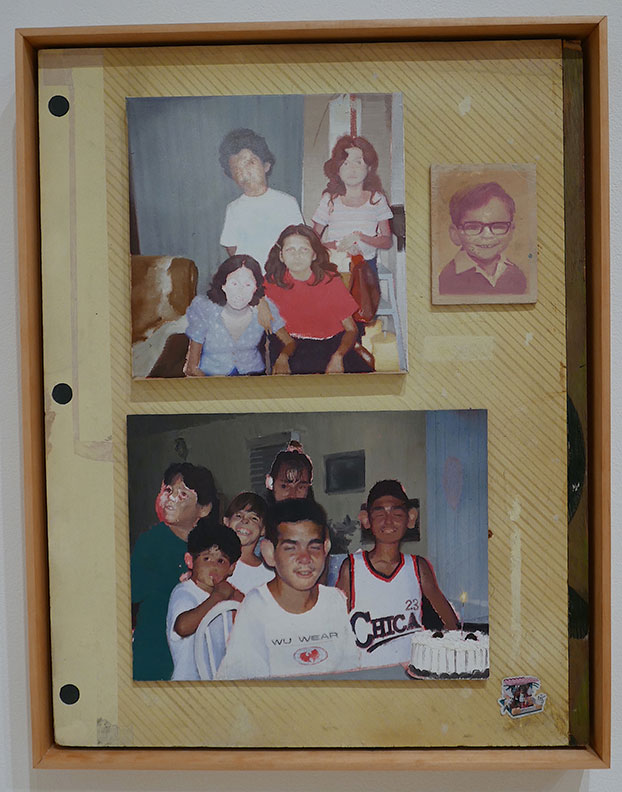
Michael Alvarez, “Look at This Photograph (L-R Primas Locas y El Mike, Flea, Go Shorty It’s Your Birthday),” 2018, acrylic on canvas. Collection of Sylvia Orozco. Photo: Ruben C. Cordova

Michael Alvarez, who was born in East LA, was inspired by Valadez’s example. Alvarez, however, goes beyond artists who have worked from a single image by painting pages from family photo albums. Look at This Photograph, reproduced above, features three small snapshots mounted on a peel-and-stick album page with diagonal lines. Unlike most photorealist paintings, Alvarez not only works from vintage sources (taken by others), but he also foregrounds the normal wear-and-tear of family photo albums, as well as the casual, amateurish, and low-quality nature of his source material. 

In the large photograph in the upper center, the faces of the three girls look like they were blasted out by the flash, while the face of the tallest figure looks deteriorated. This photographic image has suffered damage, whether by accident or by deliberate defacement. The class snapshot of the young man on the right has suffered considerable discoloration. It appears to have been inadequately fixed in its chemical bath. The photo image at the bottom is decidedly humorous. Three of the boys have their eyes closed, their projecting ears seems to be a family trait, and attempts to get the young birthday revelers to smile have not been very successful. Additionally, the cake is cropped at the bottom and on the side. As a conventional document of this event, the snapshot is a failure. As an example of photography’s failure to rise to the ideal, it is a veritable prize. It is not part of Alvarez’s project to replicate his photographic sources with exactitude, so it is highly likely that he exaggerated certain non-ideal qualities for effect. He found the sticker in the lower right on the street, so he may well have taken considerable liberties elsewhere in this image. 
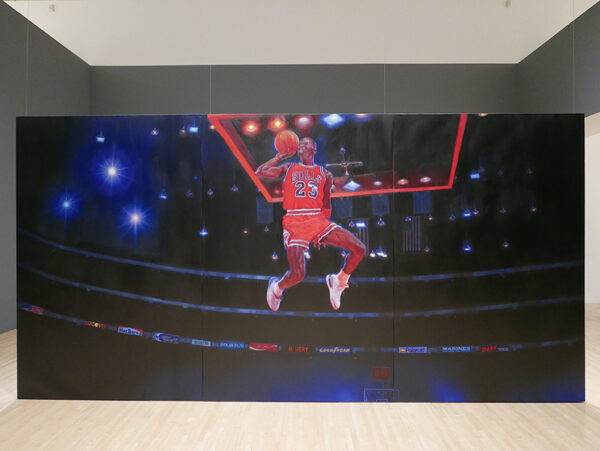
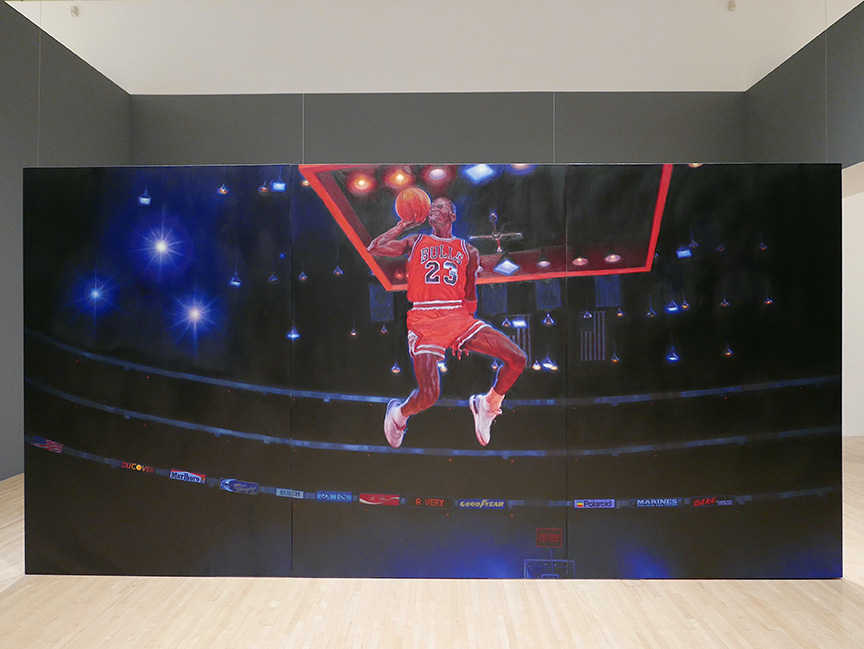
Vincent Valdez, “It Was a Very Good Year (Nineteen Eighty-Seven/Eighty-Eight)” (Nineteen Eighty-Seven is pictured), 2024, oil on canvas, courtesy of the artist. Photo: Ruben C. Cordova

In this work, which is composed of two large paintings that are installed back-to-back in a small room, the entertainment-industrial complex meets the military-industrial complex. 

The painting pictured above depicts Michael Jordan in the act of completing his famous free-throw-line dunk in the NBA’s 1987 Slam Dunk Contest.

Though Dr. J had accomplished a comparable dunk many years prior, Jordan’s flight served as the era’s preeminent symbol of domination and transcendence in the field of athletics. Valdez has selected a viewpoint that makes it seem as though Jordan is not subject to gravity. He looks more like a titan that has snatched a planet from the firmament than a mere hoopster with a ball in his hands.

Jordan’s famous dunk also gave a huge boost to his Air Jordan line of sneakers, which are marketed by Nike. These shoes (worn by an infant in KKK garb) and Jordan’s multi-billion fortune are treated in passing in my review of Valdez’s survey exhibition in Houston, which is traveling to MASS MoCA. 

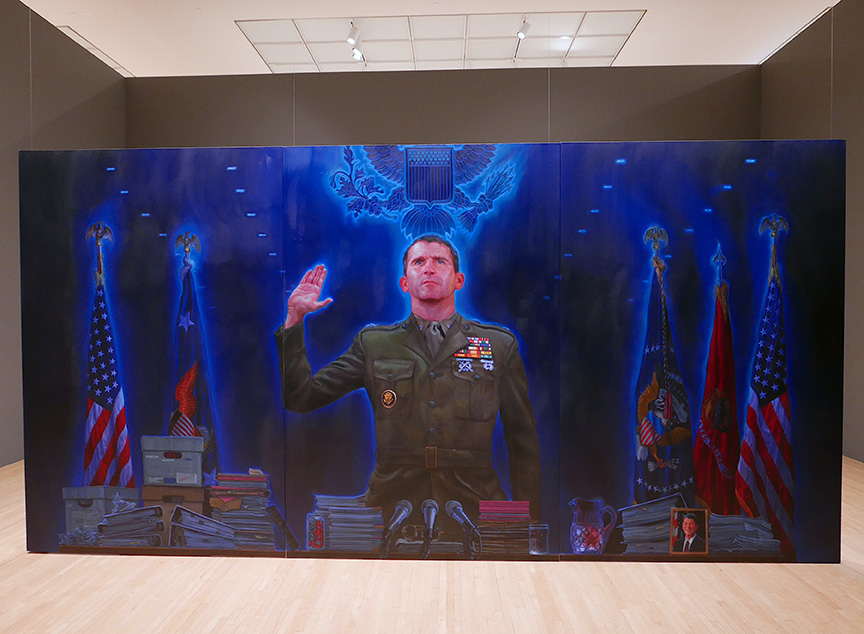
Vincent Valdez, “It Was a Very Good Year (Nineteen Eighty-Seven/Eighty-Eight)” (Nineteen Eighty-Eight is pictured), 2024, oil on canvas, courtesy of the artist. Photo: Ruben C. Cordova

In the above painting, Lieutenant Colonel Oliver North takes his oath, just prior to testifying before congress in the Iran-Contra hearings in 1988. During Ronald Reagan’s second term as president, arms were surreptitiously sold to Iran, violating an embargo. Profits were utilized to illegally fund the Contra rebels in Nicaragua, which Reagan called “the moral equivalent of our Founding Fathers,” despite prohibitions on such sales imposed by congress in 1982 and 1984. 

North took credit for diverting most of the profits to the Contras, while Reagan (combining bad acting with actual dotage), claimed ignorance of such diversions. 

Vincent Valdez, “It Was a Very Good Year (Nineteen Eighty-Seven/Eighty-Eight)” (Nineteen Eighty-Eight is pictured, detail of North), 2024, oil on canvas, courtesy of the artist. Photo: Ruben C. Cordova

North served as both the loyal instrument and as the sanctimonious face of the Iran-Contra scandal. In Valdez’s painting, he is surrounded by a blue halo, which also engulfs the flags, and which seems to emanate from the Great Seal of the United States of America directly above his head. As in real life, North wore a patch of the Great Seal over his heart. Implicitly, North’s actions stem from the highest authority, and they are garbed in sanctity, or some supernatural force field. Reagan, however, avoided direct implication in aiding the Contras, as did Vice President George H. W. Bush. The latter, when he was president, issued seven pardons in connection with the scandal, enabling the lower-level staff to avoid punishment. 

Valdez has collapsed North’s oath-taking (with microphones in the foreground) with his binder, box, and paper-strewn desk. A small picture of Reagan is displayed in the lower right corner. North protected Reagan’s legacy by shielding him from direct culpability. When he left office, Reagan had “the highest approval rating of any president since Franklin Roosevelt” (PBS, “The Iran-Contra Affair,” American Experience).

The television screens that transmitted these salient cultural moments are here aggrandized to the scale of a cinema screen. 
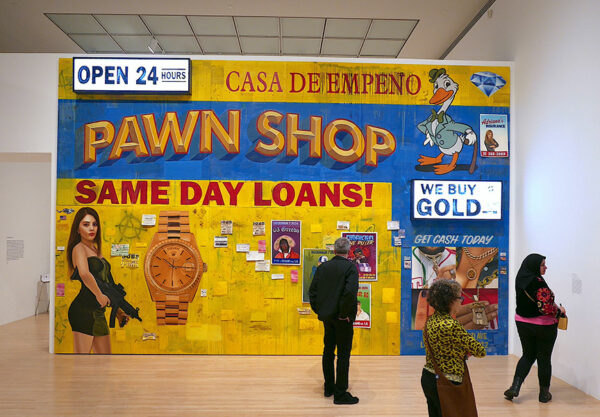
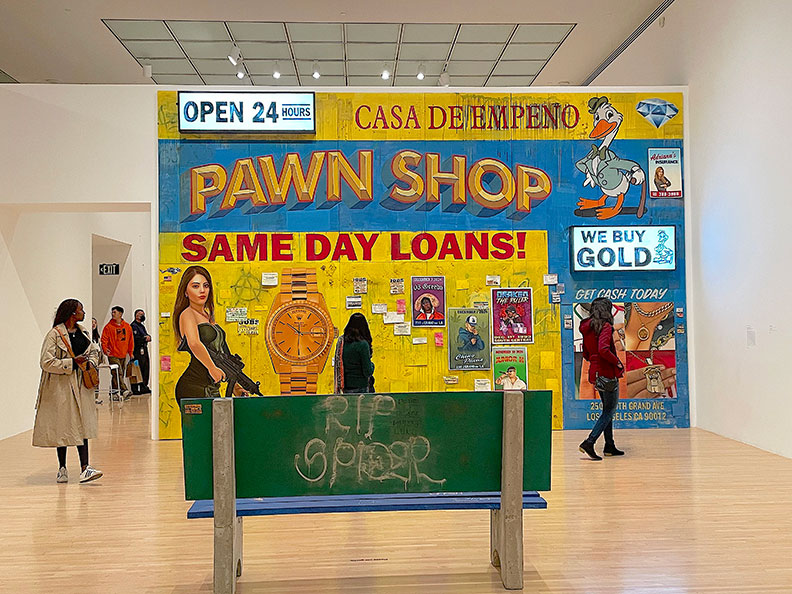
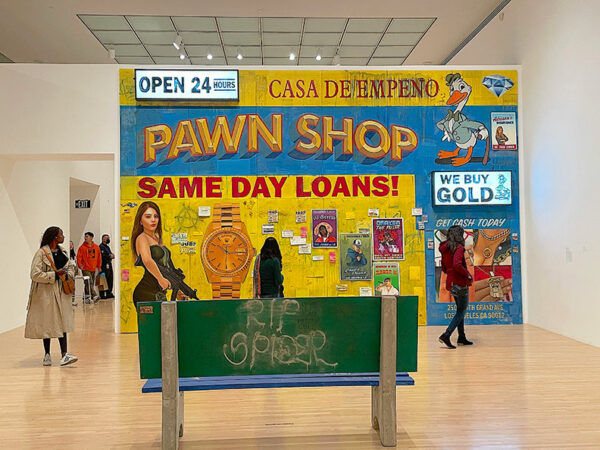
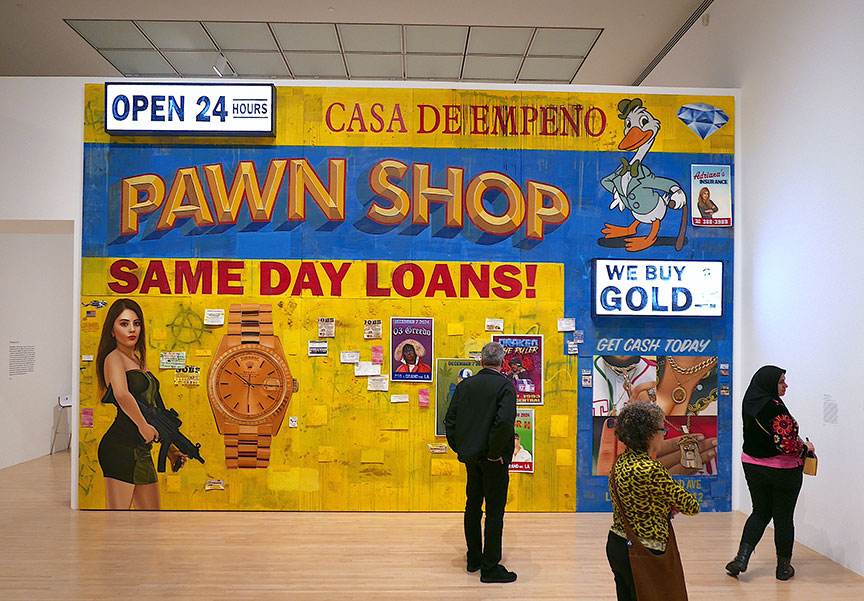
Alfonso Gonzalez, Jr., “American Pawn Shop,” 2024, oil, enamel, latex, dirt, gel medium, and light box on wood panel, courtesy of the artist and Jeffrey Deitch. Photo: Ruben C. Cordova

Gonzalez’s father was a sign painter, and he himself was trained as a billboard painter. Gonzalez Jr. studied at the Los Angeles Trade-Technical College, and he eventually worked as a billboard painter. These skills and experiences were put to good use, as he employs a variety of styles, techniques, and materials to render the facade of a pawn shop, replete with real dirt, aging effects, graffiti, and wheat-pasted posters advertising rap and corrido music. 

The fictive facade, inspired by shops in his Boyle Heights neighborhood, suggest pawning a wide variety of objects, including an assault rifle, a gold watch, rings, and jewelry, including a crucifixion pendant. The shop’s emblem is a duck, likely inspired by the Disney character Scrooge McDuck, though, since he sports a bowler hat rather than a top hat (and no spats), he would be a rather poor relation. 
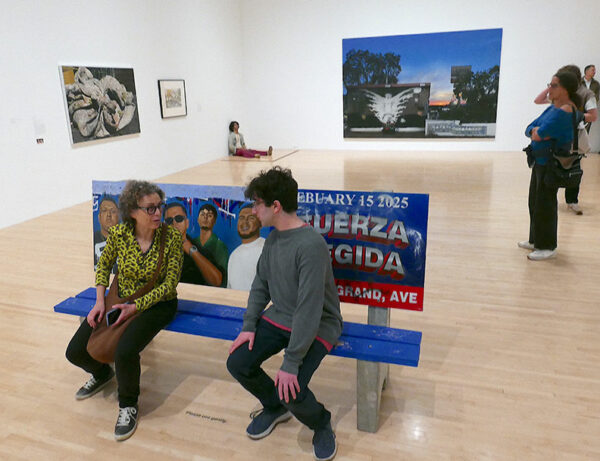
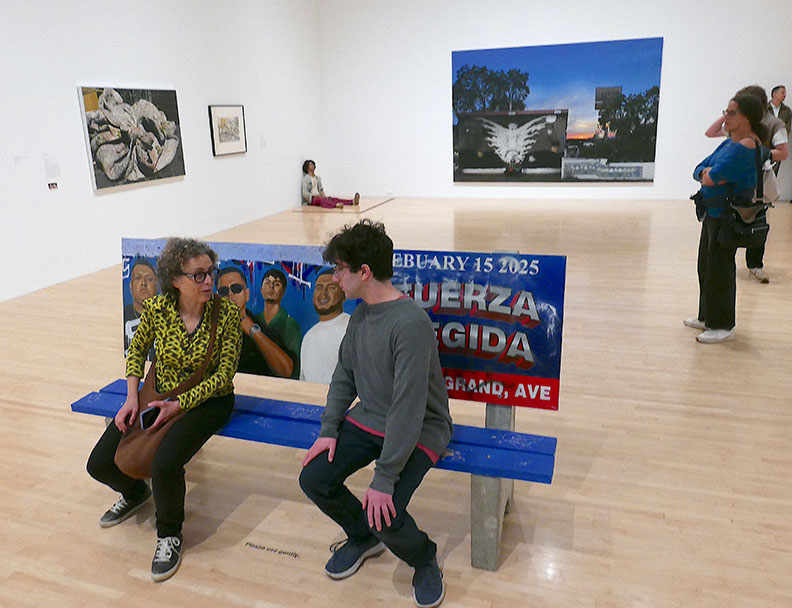
Alfonso Gonzalez, Jr., “American Pawn Shop” (bench detail), 2024, courtesy of the artist and Jeffrey Deitch. Photo: Ruben C. Cordova

Gonzalez has even provided a bench, from which to view his storefront. 

Sculpture
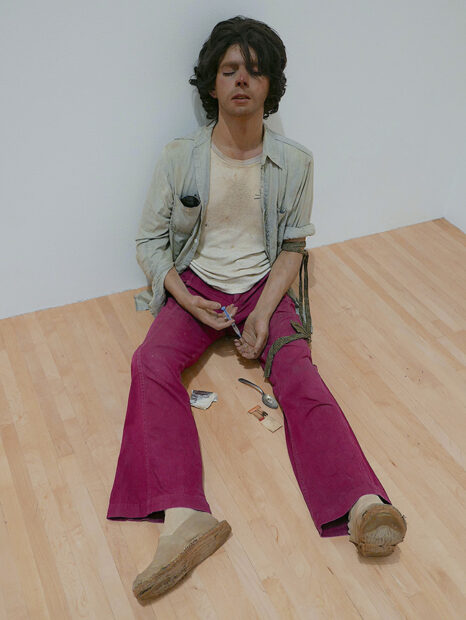
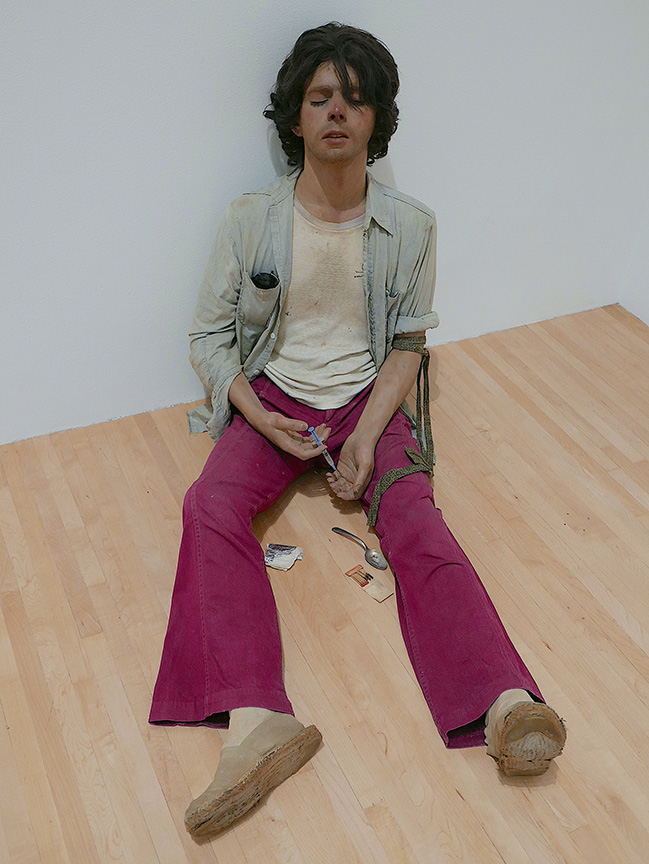
Duane Hanson, “Drug Addict,” 1974, fiberglass and polyester resin, mixed media. Collection of Yale University Art Gallery. Photo: Ruben C. Cordova

Hanson rebelled against the prevailing formal tendencies in art, from Abstract Expressionism to Conceptualism and Minimalism. He pioneered the creation of socially-concerned hyperrealist sculptures that were often included in exhibitions with photorealist paintings. In the above sculpture, a young man holds a hypodermic needle in his hands, while drug paraphernalia is strewn about him. Having tightened a tie around his left arm, his veins bulge out, while bruises or discolorations on his arm suggest that he is the victim of violence or disease. Given his expression, the man has likely shot up heroin. In his early sculptures, Hanson also addressed issues such as homelessness, race riots, death from an illicit abortion, etc. 
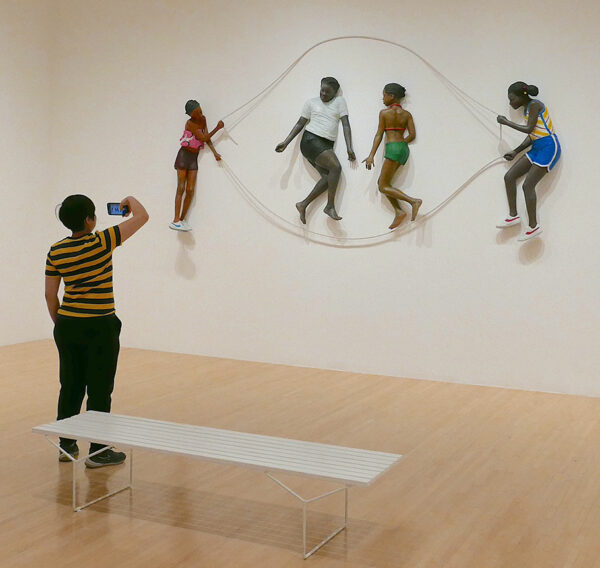
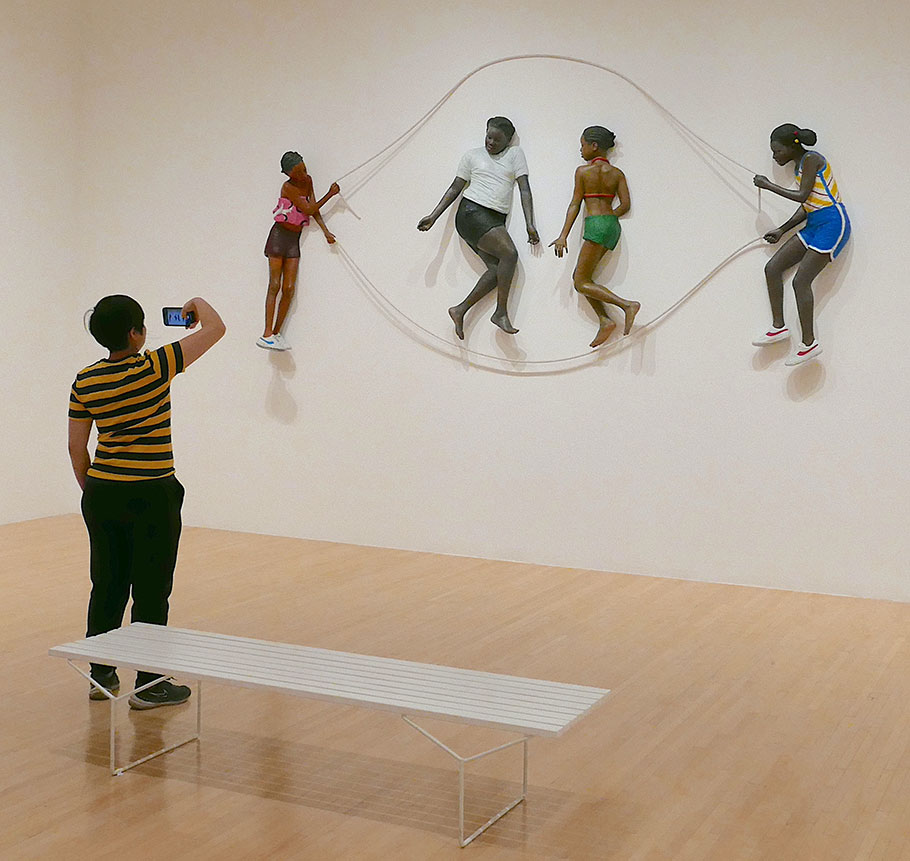
John Ahearn and Rigoberto Torres, “Homage to the People of the Bronx: Double Dutch at Kelley Street–La Freeda, Javette, Tavana, Staice,” 1981-82, oil on fiberglass. Collection of The Broad Art Foundation. Photo: Ruben C. Cordova

The team of Ahearn and Torres became community sculptors par excellence in the South Bronx. When John Ahearn moved to the Bronx, he had a background as a filmmaker, working with his brother Charlie, which led him to life-casting. He came in contact with Rigoberto Torres, who was making religious figurines in a shop as a high school student apprentice. They joined forces and created numerous sculptures honoring South Bronx residents, of which Double Dutch is the most famous. In a conversation with Katz, Ahearn referred to these works as “three-dimensional polaroids” (p. 24). 

Black Painters
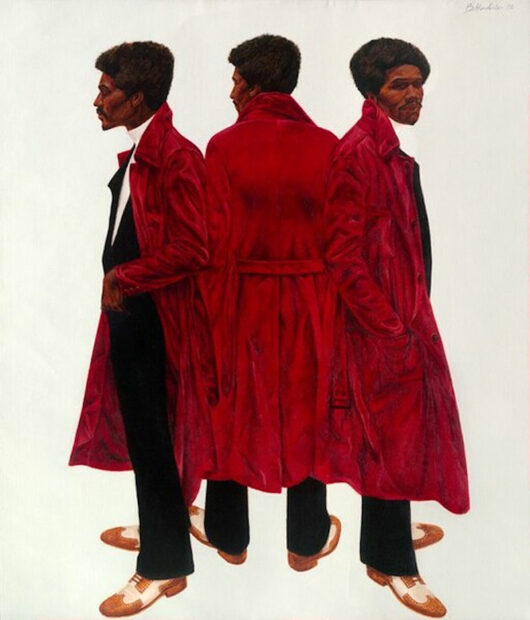
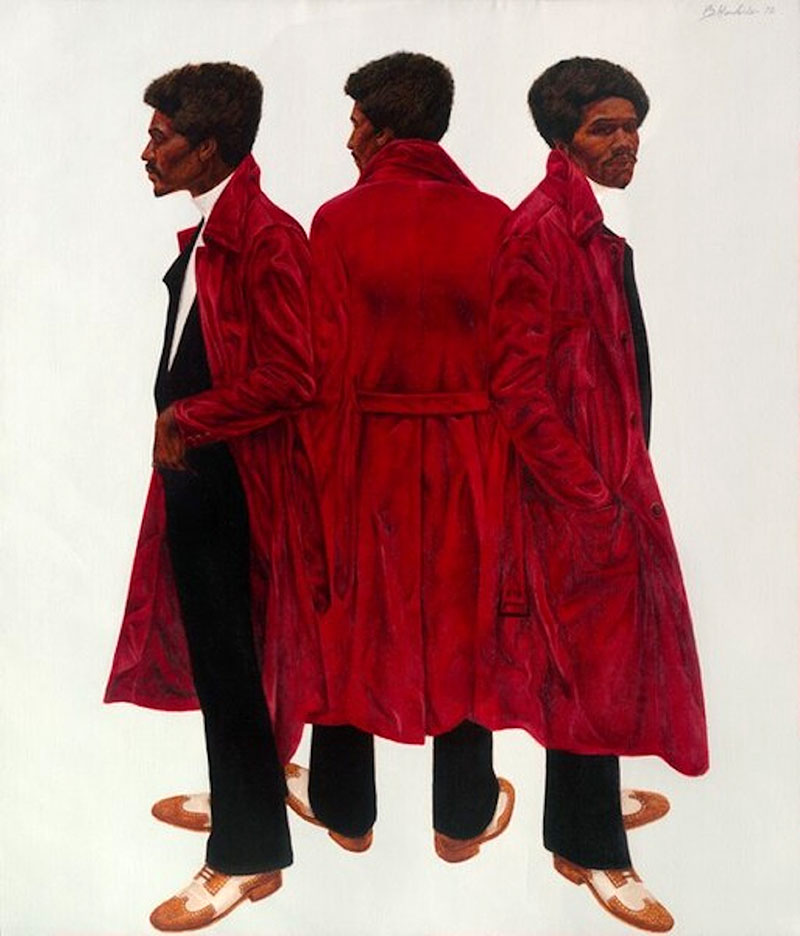
Barkley L. Hendricks, “Sir Charles, Alias Willie Harris,” 1972, oil and acrylic on canvas. Collection of the National Gallery of Art, Washington D.C. Photo: MoCA

When he was a student, Hendricks visited museums in Europe. He was particularly impressed by Baroque paintings, but he also noted the lack of Black subjects as protagonists of painted portraits. Hendricks wanted to capture the swagger of formal European portraits in his depictions of contemporary Blacks. In 1972, he utilized Anthony Van Dyck’s triple portrait of King Charles I (which was created as an aid for the Italian sculptor Lorenzo Bernini) for his portrait of Willie Harris. 

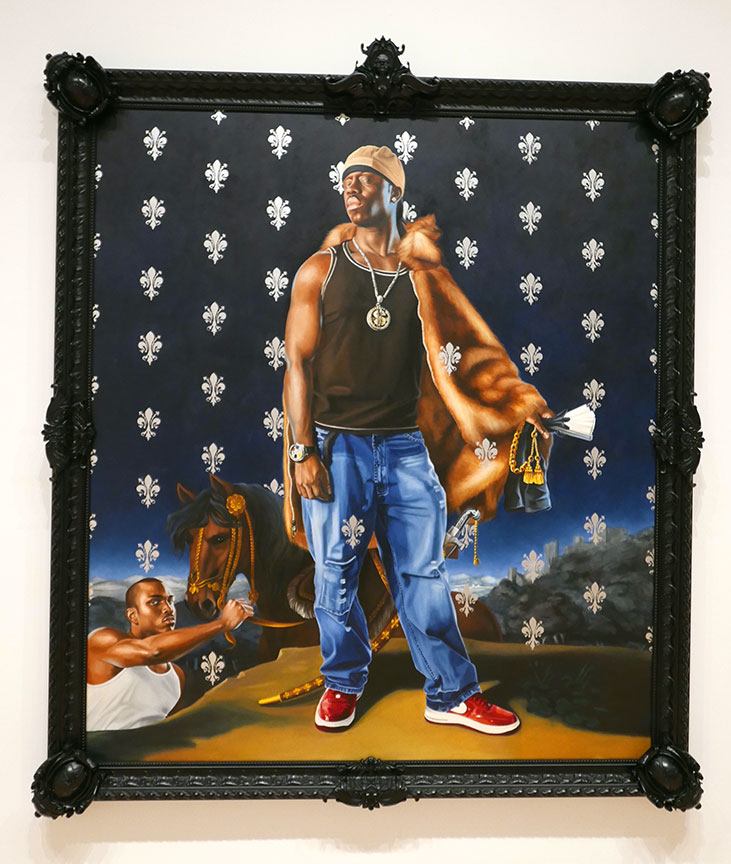
Hendricks’ triple portrait is suave and sophisticated. We can compare it to Kehinde Wiley’s Louis Philippe Joseph, Duke of Orleans, painted a generation later. 
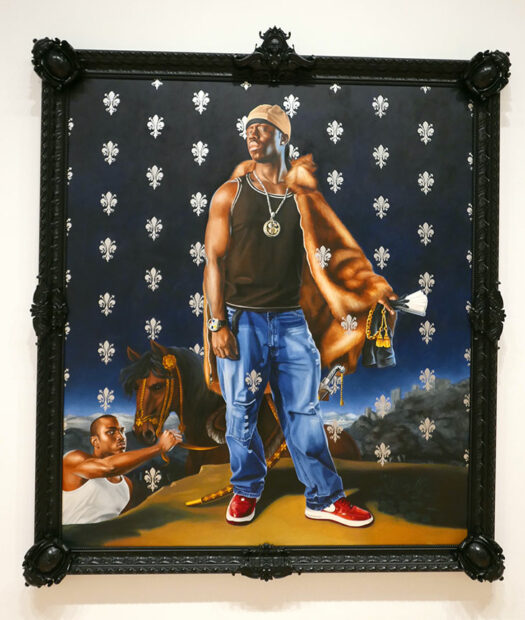
Kehinde Wiley, “Louis Philippe Joseph, Duke of Orleans,” 2006, oil on canvas. Collection of the Museum of Contemporary Art. Photo: Ruben C. Cordova

Wiley has made a career of rendering portraits (mostly of Black men) in poses taken from Old Masters. The quality of his paintings vary a great deal, as do the degree of their connection to Old Master sources. For my taste, this painting too closely resembles an ad for designer jeans or some other commercial product. The anatomy of the man who is restraining the horse also leaves much to be desired. 

Women Painters
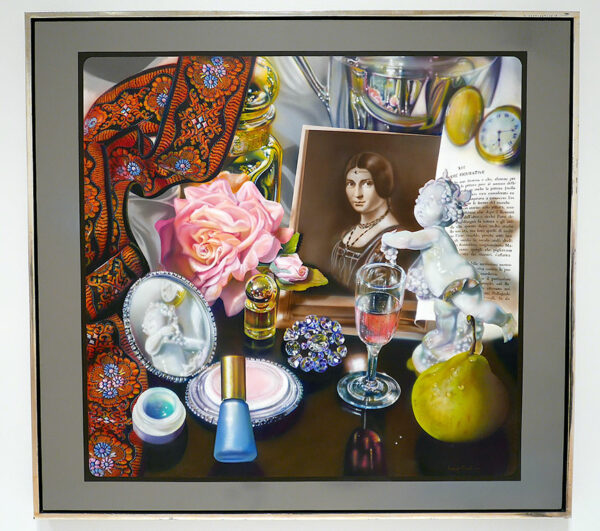
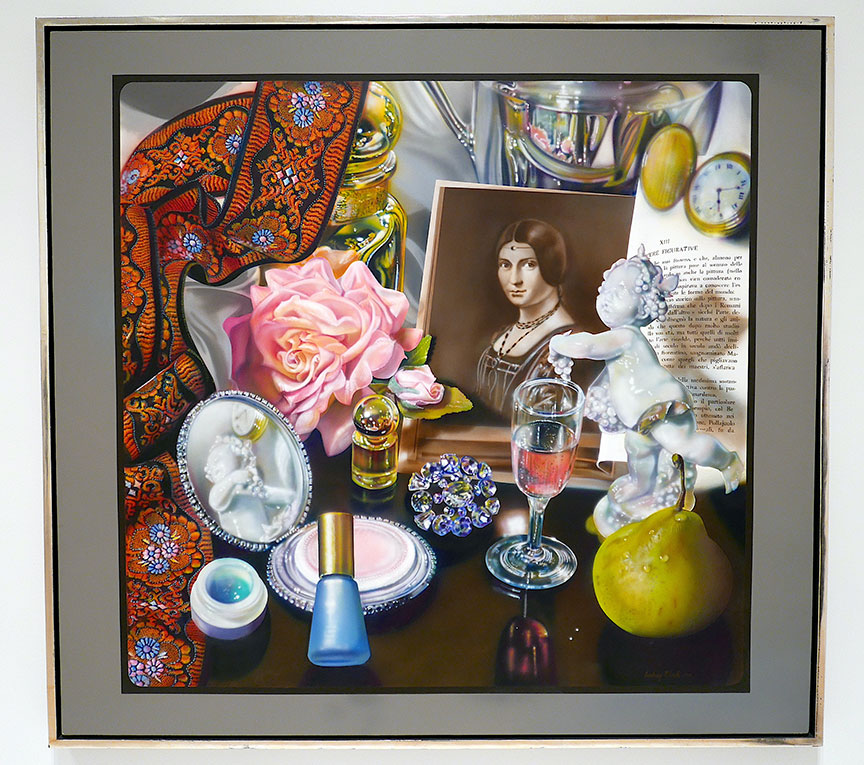
Audrey Flack, “Leonardo’s Lady,” 1974, oil and synthetic polymer on canvas. Collection of The Museum of Modern Art, New York. Photo: Ruben C. Cordova

Audrey Flack was the only female artist included in Meisel’s gallery. Cynthia Diagnault, an artist in the exhibition (her work is discussed below), excoriates the gallerist’s formation of the term photorealism in her essay “The Theory of Everything or: How I Learned to Stop Worrying and Love Photorealism,” which is included in the exhibition catalog. She notes: “His photorealists didn’t know each other; they didn’t share ideas or values; and many of them actively rejected the label” (p. 221). Diagnault adds: “many notable artists of the time meet Meisel’s criteria for photorealism, but are still left out of his version of the history,” which is all-White, and overwhelmingly male and American, with one British artist then living in the U.S. (p. 221-222). Given Meisel’s financial connection to the artists he placed in the photorealist category, Diagnault questions whether photorealism constitutes “a real and compelling cultural idea, or just a convenient marketing term?” (p. 222). 

For good measure, she points out that artists have utilized photographs “since the invention of photography in 1839” (p. 222). A valid counter-argument to Diagnault’s point would consider the degree to which more recent artists utilized photographs as a model for absolute emulation rather than simply as one of several tools. Rather than address this question, Diagnault tumbles down the David Hockney / Charles Falco rabbit hole. She even expands Hockney’s thesis, which she restates as “there would be no realism without the invention of the camera obscura” (a method of projecting images through a pinhole into a dark chamber), by declaring that the claim “can be applied globally” (p. 223). 

One of the highlights of the Ordinary People exhibition was a gallery of women artists titled “Bad Girls.” I start with Audrey Flack, one of Meisel’s canonical photorealists. From the perspective of photographic sources, the most striking aspects of Leonardo’s Lady are the multiple points of focus and the reflections in metal, glass, and ceramic. Leonardo’s Lady is virtually a commentary on photography, without which it could not exist. Only a camera can fix the fleeting reflections, such as those on the gold and silver containers near the top of the painting. Strikingly, the cupid’s elbow is in sharper focus than his feet. We possess a profound grasp of the concept of focus through photography and film, which can reproduce areas that lack focus in a permanent manner. If one tried to capture the effect of something that is out of focus by painting it directly, the very act of concentrating our gaze on that area would serve to bring it into focus. An artist cannot paint something that is blurry out of the corner of one’s eye. 

One of the cleverest conceits of Leonardo’s Lady is the reflection of the cupid in the make-up compact, including the cupid’s right hand, which we cannot see on the statuette itself. The reflected cupid is blurrier than the “real” one, precisely because it is a reflection. There are numerous bright points of distorted light, which we also see in works by Vermeer and some Dutch still life paintings from the seventeenth century, which, along with a limited use of out-of-focus areas, constitutes proof that these artists used lenses (and we know at least some of them used the camera obscura). But Flack’s work is a tour-de-force of photographic effects, one that is quite different from the Dutch examples mentioned above. It was enabled by a fixed photograph. Lenses, cameras obscura, and mirrors were tools utilized by some Old Master painters, along with many others, including linear perspective, atmospheric perspective, systems of geometrical proportion for human figures, and many years practicing drawing and learning to paint in layers (rather than directly), with the use of drawings and sketches. They couldn’t have done a painting like Leonardo’s Lady if they had wanted to — and, since this concentration of photographic effects was not part of their cultural milieu, there was no reason to wish to make such a painting. Moreover, our own knowledge and familiarity with photography and film makes us more appreciative of the limited photographic effects we find in the work of artists such as Vermeer and Velázquez. One might even argue that some aspects of their work speak more directly to our age than it did to their own, which is why some artists were dramatically “rediscovered” after the discovery of photography. 

Finally, I’d like to point out the humorously “old fashioned,” primitive photograph of the Leonardo painting reproduced in the book near the center of Flack’s painting. Nineteenth-century artists could have rendered such photographs as accurately as possible, but no such movement or photorealist style emerged at that time. Flack frames the Leonardo illustration with audaciously painted elements, such as roses, the cupid statuette, and refractive vessels, foregrounding them as the fruits of modern photography. 

Nur Koçak, “Natural Wonders,” 1979; “Chanel Lipsticks,” 1988; “Fruitables,” 1979; acrylic on canvas. Nesrin Esirtgen Collection. Photo: Ruben C. Cordova

Nur Koçak, who was born in Turkey, partially raised in the U.S., and trained largely in Paris, is represented in Ordinary People by a huge triptych of lipsticks. Koçak recalls that the Paris Youth Biennale in 1971, with a large section devoted to conceptual art and photorealism, “set my path as an artist.” It provided an alternative to the “Late-Cubist” style of her teachers at the academy, who professed: “The artist is not an eye that copies what he/she sees, but the eye that interprets!” (“Narratives Interview Series: Nur Koçak,” July 2021).

Koçak’s critique of feminine imagery, also undertaken in Paris on the basis of magazines and shop windows, led to her Fetish Objects series (1974-88), which included other consumer objects such as clothing, perfume, and nail polish, as well as lipstick. The tallest panel in the exhibition is 76 ¾ inches high, resulting in phallic towers of lipstick nearly six feet high. 
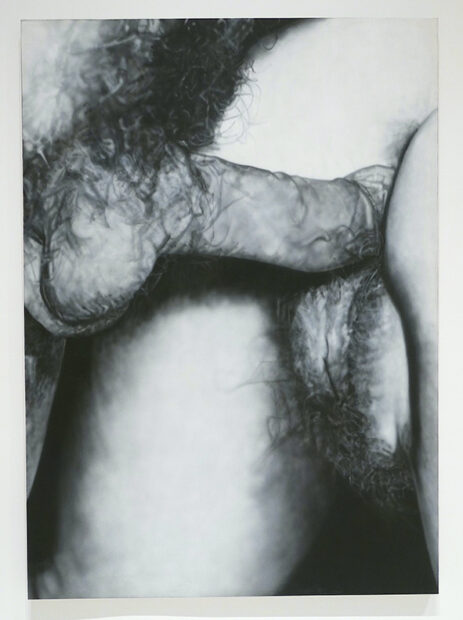
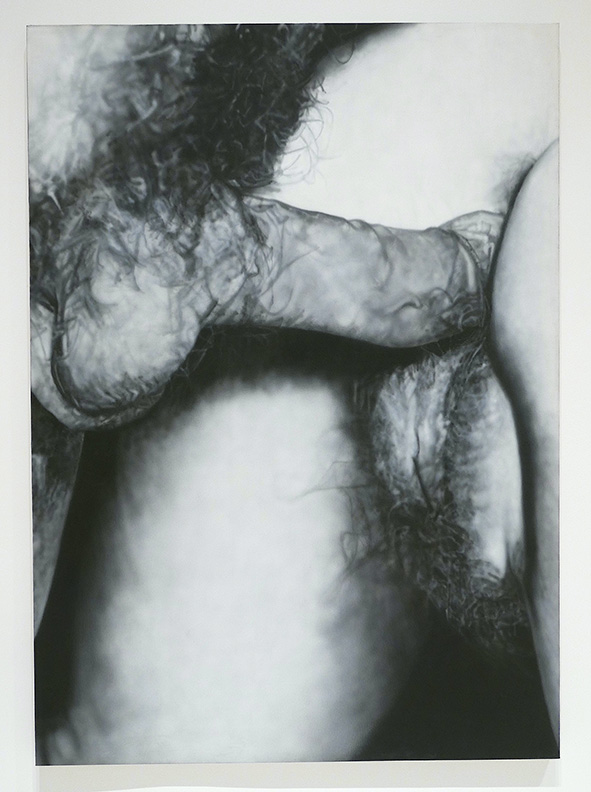
Betty Tompkins, “Fuck Painting #6,” 1963, acrylic on canvas. Collection of the Brooklyn Museum of Art. Photo: Ruben C. Cordova

With Tompkins, we move from the symbolic to the “real” with one of the artist’s monumental works from her much-censored Fuck Paintings series (1969-74). At 83 ¼ inches high, it is considerably bigger than one of Koçak’s lipsticks, and it has not lost its ability to shock. 

Tompkins’ series was sourced from the porn collection of her then-husband, and she utilized a grid system essentially identical to that of Chuck Close (though with larger squares). As the exhibition label notes, “the smooth, cool finish of the airbrushed surface divorces the pornographic image from its erotic function.” The label text also acknowledges that Tomkins’ series is “now considered a significant chapter in the ongoing project of women reclaiming their bodies in the face of sexual objectification.” 

The Flack, the Koçak, and the Tompkins are arguably the three most imposing paintings in the entire exhibition. 
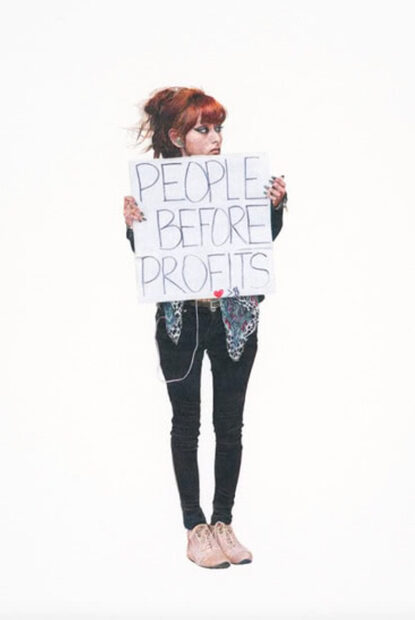
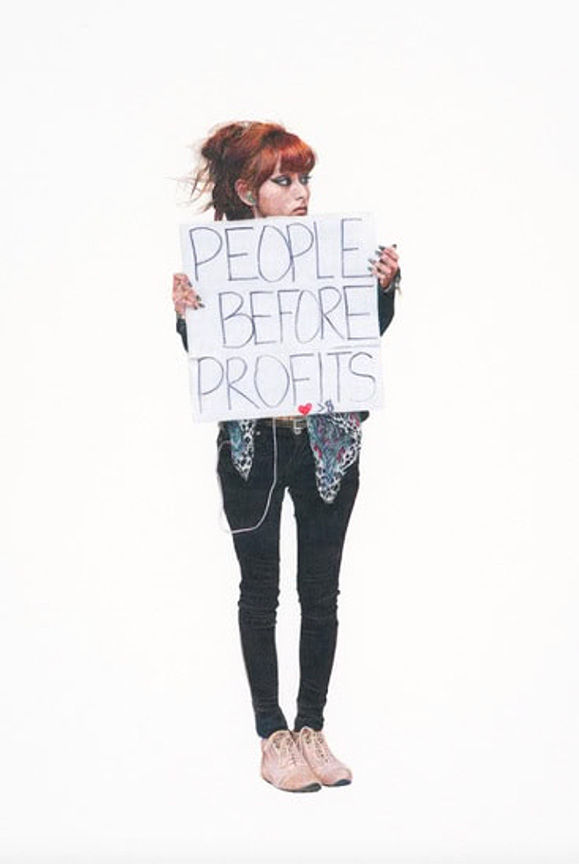
Andrea Bowers, “People Before Profits” (May Day March, Los Angeles, 2012), 2012 colored pencil on paper. Collection of Margaret Morgan and Wesley Phoa. Photo: Robert Wedemeyer

On a more modest scale, Ordinary People features two works by Andrea Bowers. A press release for a recent exhibition describes her work as “a Feminist-centric celebration of workers’ rights movements, highlighting nonhierarchical labor organizing strategies and the use of craft, artistry, and pageantry as valuable political tools.” Her work amplifies the messages found in placards carried by demonstrators, always with well-crafted graphics.

Andrea Bowers, “For My Transgender Sisters” (May Day March, Los Angeles, 2012), 2012, colored pencil on paper. Collection of Phil Mercado and Todd Quinn. Photo: Robert Wedemeyer

Bowers’ work addresses the intertwined connections between feminism, workers’ rights, immigration, and migrant’s rights.

Three Serial Innovators
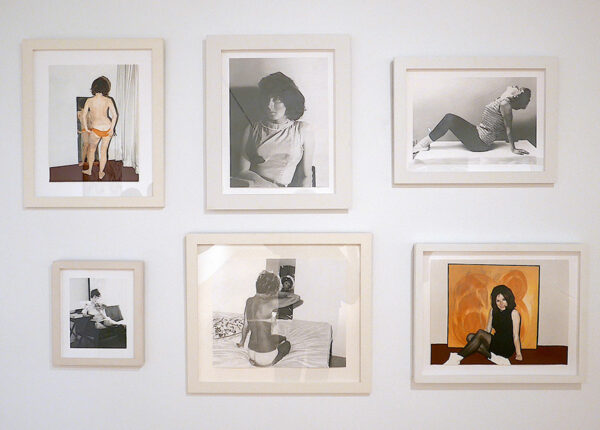
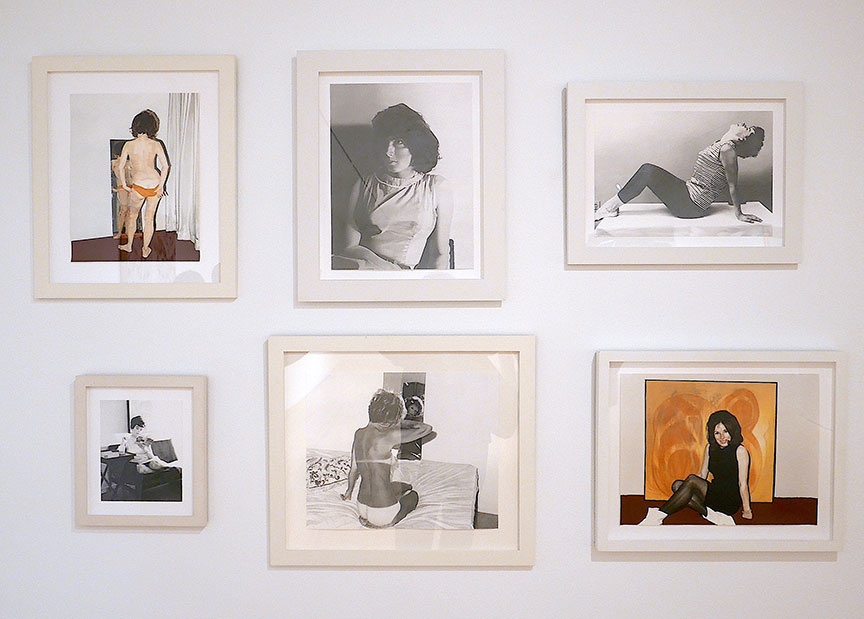
Judie Bamber, “Are You My Mom?” series (suite of six works), 2006-2013, graphite and watercolor on paper, various collections. Photo: Ruben C. Cordova

I conclude this review with the work of three serial photorealist painters that dramatically expand the boundaries of the photorealist genre. 

Judie Bamber’s six works feature a woman in cheese-cakish poses. That woman is her mother, who wanted to be a model. And the images she recreates were made by her father, who was an aspiring artist. As the exhibition label notes, we see that “the intimacy between a man and a woman is being transposed onto a mother and daughter… sexual energy being recharged… onto the loaded territory of looking and being looked at.” These works are particularly complicated reinterpretations.
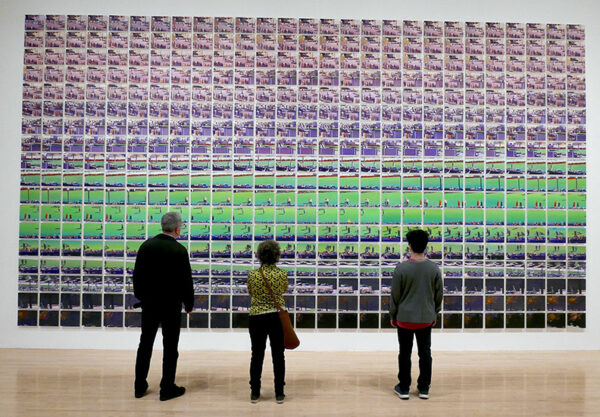
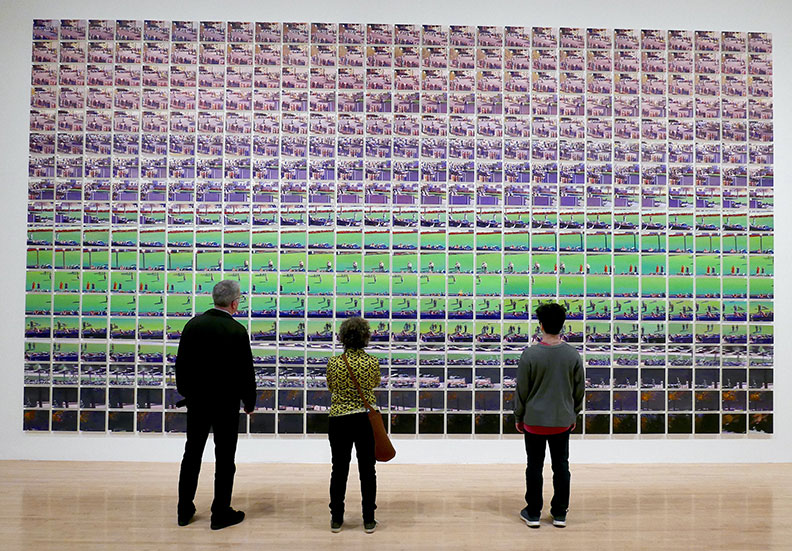
Cynthia Daignault, “Twenty-Six Seconds” (viewed by three visitors to the museum), 2024, oil on linen, courtesy of the artist, Kasmin Gallery, Night Gallery, and The Sunday Painter. Photo: Ruben C. Cordova

Abraham Zapruder captured the assassination of President John F. Kennedy in Dallas on November 22, 1963, in an 8mm home movie made up of 486 frames that lasted 26 seconds. Daignault’s brilliant conceit was to transform each frame of this obsessively studied film into an individual painting. As the artist noted on Instagram at the time of the opening of “Ordinary People”: “It took an entire year of my life. (While I had two kids under 4 and was breastfeeding every 3 hours for the duration.) This almost killed me, and there were many days along the way that I thought I would not finish.” 

It’s somewhat ironic that the only really good evidence of the assassination was captured by an amateur rather than a professional. The museum label holds that Daignault pried “apart the ways in which photographic images shape the collective memory and understanding of this national trauma.” The label insightfully notes “the continued role of citizen-journalists recording police brutality, mass shootings, and military conflict on smartphones.” Moreover, “by abstracting the film into a series of almost unreadable, loosely painted canvases, Daignault renders an exceedingly well-known piece of history strange and therefore viewable anew in our era of permacrisis.”
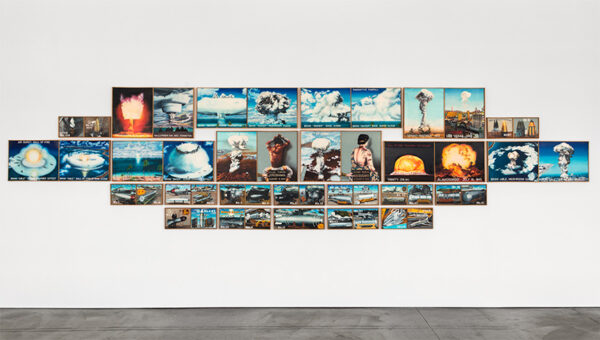
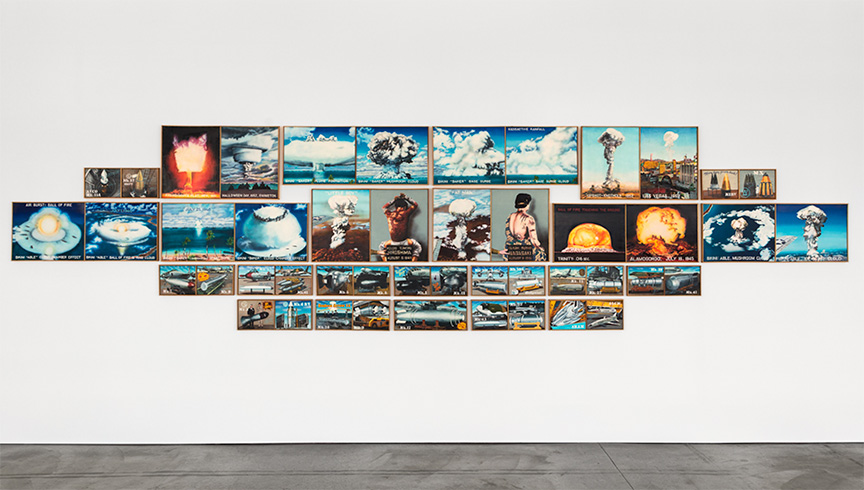
Ben Sakoguchi, “Bombs” (suite of 24 works), 1983, acrylic on canvas with wooden frames. Collection of The Museum of Contemporary Art, Los Angeles. Photo: MOCA

Sakoguchi’s deeply subversive Bombs utilizes the high-keyed colors of advertising and tourist postcards to treat the atomic bombing of Hiroshima and Nagasaki, which killed as many as 226,000 people, the overwhelming majority of which were civilians. Sakoguchi was a toddler when, after the Japanese bombed Pearl Harbor, his family was forcibly detained by the U.S. government. They, along with 17,000 other people of Japanese ancestry, were shipped to Poston, Arizona, where they were imprisoned as “enemy aliens.” Nearly all of the Japanese American detainees were incarcerated until the nuclear bombing of the two Japanese cities, for it was these war crimes that terminated the conflict.

With picture-postcard brightness, Sakoguchi documents atomic blasts, as well as nuclear missiles, warheads, and bombs, as well as the planes that delivered them. He also includes the burnt bodies of two survivors of the nuclear attacks on Japan. It is a searing pictorial statement that Katz describes as “a kind of medieval altarpiece made during the height of the people’s movements for disarmament” (p. 28). Now that racial intolerance has reached a feverish pitch in the highest echelons of the federal government, we would do well to remember the injustices and the horrors such attitudes produce. 

Ordinary People is a badly needed, wide-ranging reexamination of art (paintings in particular) that could potentially fit into the category of photorealism. It even has a couple of cowboy-themed paintings – and they are rather good! The exhibition and the catalog have provided me with a great deal to think about on this subject.

***

Ordinary People: Photorealism and the Work of Art since 1968 is on view through May 4, 2025, at the museum’s Grand Avenue location. A beautifully illustrated 256-page catalog titled Ordinary People: Photorealism and the Work of Art since 1968 accompanies the exhibition. It is co-published by MOCA and DelMonico Books and edited, with lead essay, by Anna Katz. The catalog includes an introduction by MOCA director Johanna Burton, as well as contributions from Gabriela Rodriguez-Gomez, Karin G. Oen, Dhyandra Lawson, and Cynthia Daignault. The catalog also has a particularly useful artist biography section.

Ruben C. Cordova is an art historian and curator. 

The post Groundbreaking Photorealist Exhibit Highlights Women and People of Color in L.A. appeared first on Glasstire.

14 May 13:26

Nervous Matt Gaetz Fumbles With Training Bra

by The Onion Staff
14 May 13:17

coworkers want our office breakfasts to be vegan, how to back out of a job, and more

by Ask a Manager

It’s five answers to five questions. Here we go…

1. A group of coworkers are pushing for our in-office breakfasts to be vegan

My company is doing a weekly in-office breakfast (a “hotel breakfast”-like assortment: toast, cheese, ham, eggs, yogurt and granola, etc.) with the goal of bringing people together, since we’re largely remote.

A small group of vegan coworkers are pushing for a “plant-based default” breakfast, where all animal products are subbed with vegan replacements and meat and dairy are opt-in on request, citing sustainability (which is important in our company culture) and health benefits. I’m all for a diverse breakfast spread, but this seems a little overzealous – and like something that would make a lot of people feel like they need to justify their dietary needs to others, which is the opposite of creating a welcoming environment. Am I wrong in thinking that this is a bit too much?

For context, all our catering includes vegan and gluten-free options by default, plus any special diets upon request, so there isn’t a situation where vegetarians/vegans need to put in requests to accommodate their diets.

I don’t know that it would make people feel like they have to justify their dietary needs to others (unless that’s part of the dynamic in your office), but it doesn’t sound like the change would meet the range of dietary preferences that are actually present. I mean, yes, vegans and non-vegans alike can eat vegan breakfast foods, but if someone isn’t actively preferring/seeking out vegan yogurt or vegan cream cheese, it’s probably because they want the dairy versions. Unless your company is specifically in the business of advocating veganism, it makes sense to provide the foods people prefer to eat, particularly at a meal designed to bring people together when they’re normally remote.

2. What’s the point of references if they’re just going to say nice things?

Last year, I hired someone, “A,” who seemed like a rockstar candidate. They interviewed well and their references were absolutely glowing. However, it turned out that they lacked key skills the role depended on, and they were let go after making a serious error.

Soon after they were hired, I became aware that A had badly needed the job because they were about to lose their previous job and would have been in dire financial straits if they weren’t able to find a new role quickly. The gap between what I was told by references and what I saw was so stark that I started to wonder if A told their references they really needed the job, and so the references embellished in order to help A.

It’s made me question the value of references! Why bother checking them if people exaggerate and cover up deficiencies to be nice to the candidate? I have to do more hiring and I’m questioning how much weight references should have in decision-making.

(For what it’s worth, we asked plenty of “Tell me about a time when” and “Can you give me an example of” questions in the interview. On paper they were a perfect candidate, and they interviewed well. Even now, I don’t know how it went so wrong.)

References definitely cover up deficiencies to be nice to the candidate! It happens all the time. You’ll also get references who suck as managers so aren’t even aware of what someone’s deficiencies are. But you check references because sometimes you get extremely useful information from them. You won’t get useful info 100% of the time, but you get it enough of the time that it’s still worth doing (see the link below!). You just can’t take anything you hear as gospel; you have to assume references are being filtered through the lens of the reference’s own subjectivity and biases, as well as their specific context and priorities (which may be different from yours).

References are just a small piece of the hiring process; the bulk should be based on rigorously probing questions in interviews and finding ways to see candidates in action doing the work so you can see how they actually operate, not just how they say they operate.
Related:
don’t check references? here’s a horror story for you

3. How do I make an employee respect me and my co-owner?
I am the chef and co-owner of a restaurant with a sibling restaurant next door. The other co-owner (of the sibling restaurant) and I share a front of house manager. This manager has zero respect for us owners even though we are her managers. How can we tell her to respect us or get out in a professional way?

She can feel whatever level of respect she feels, but she needs to behave in a way that respects your authority over her work. So first, get really clear on what behaviors need to change, and then sit down with her and say, “We’ve noticed XYZ in your work, and we need to see ABC instead.”

From there, you hold her to that like any other performance expectation — meaning that if you spell out clearly what needs to change and it doesn’t change, and it’s serious enough that you’d part ways over it, then you have one more conversation of escalating seriousness where you say, “We talked a few weeks ago about needing to see XYZ change, and that hasn’t happened. We’d like this to work out but we will need to let you go if this continues, and we’re at the point where this is a final warning.” If you want, you can ask, “Is this something you want to change and feel you can change, or does it make sense to start planning for a transition now?”

4. Is there any value in referring my brother for a job?

My poor brother has been out of work for over a year and a half now. He was unfortunately a part of a restructuring/outsourcing of his job and was laid off.

He has been relentlessly applying to roles, getting interviews, and then not getting the job. It’s just the market out there right now! From what I can tell, he is qualified for each role and interviews well (at least in our practice together).

I work at a large company and want to help refer him to a job within the company. We have an internal referral program, but I’m wondering if it would be appropriate to send an email to the hiring manager as well and recommend him. I am in engineering and he would be in sales/marketing so there is not a conflict of interest.

I was considering something like, “Hello [hiring manager], I hope you are doing well. If you are considering external candidates for this role, I would like to recommend [my brother]. He has [this relevant experience], and these other facts that match the qualifications you are looking for.”

It feels both beneficial and useless, as I know direct referrals can be helpful but is it really worth it?

Sure, you can do that. It’s unlikely to carry a huge amount of weight (you’ll be assumed to have some bias since this is your brother, as opposed to someone you’ve worked with previously and can be presumed to be assessing more objectively), but in a lot of companies it would still get his application a closer look than he might otherwise get.

5. How to back out of a job I’ve already accepted

What is the best way to tell a company that you’re rescinding your acceptance of their job offer? Although it was a great offer, I’d be rescinding it in favor of an excellent one, one I couldn’t possibly pass up: better in terms of salary, benefits, title, prestige of organization, future career trajectory, and fully remote work situation.

Tell them ASAP (meaning today) since they’re going to have to scramble to see if their second-choice candidate is still available (or restart interviews for the job).

Say something like this: “I’m so sorry but unfortunately I need to rescind my acceptance of the X position. I was very excited to work with you, but I’ve received a different offer that I can’t in good conscience pass up. I apologize for the inconvenience this may cause on your end; it’s not a decision I made lightly. I really appreciate all the time you spent talking with me, and I admire so much of what I learned about the work you’re doing.”

The post coworkers want our office breakfasts to be vegan, how to back out of a job, and more appeared first on Ask a Manager.

14 May 13:11

Man living off-grid on deserted island still somehow received HelloFresh invite

by Taryn Parrish

UNKNOWN – For the past year, Kevin Orson had been living anonymously on a deserted island, free of modern annoyances like social media, junk mail, and people. But his world was turned upside down last Tuesday when he received a personally addressed letter from the meal kit service, HelloFresh.  “I was on my morning jog […]

The post Man living off-grid on deserted island still somehow received HelloFresh invite appeared first on The Beaverton.

14 May 13:10

Final Exam Answer Guide for Classics and Contemporary American Culture, Spring Semester 2025

by Sarah Starr Murphy

Dear Students,

Again, my sincerest apologies for offering Classics and Contemporary American Culture this semester. When I pitched this class to the English department chair, I believed Harris would win and we’d spend the semester making interesting literary connections to her sober policy choices. I didn’t foresee that the canon itself would leer at our nation’s pathetic descent into discount fascism.

God knows how many more years of this nightmare we’ll have to endure, but this class is mercifully at an end. Here are the answers to the final exam. Feel free to grade yourselves, and then take full advantage of the open bar at my desk during final office hours this week.

- - -

1. Compare the characters at the end of Our Town to ourselves on January 19, 2025. Is Emily right when she says that the living didn’t know how good they had it?

No.

2. Where is Dorian Gray’s portrait, now that it has left the attic?

Giving a presser on the new, Qatari-Royal-Family-gifted Air Force One.

3. Who in Trump’s Cabinet best represents the detestable Summoner from The Canterbury Tales?

Trick question: it’s all of them. Corrupt from skin to soul, they’re dimwitted, easily bribed, and they repeat incomprehensible drivel ad nauseam.

4. Why are we living in Franz Kafka’s The Trial?

Pennsylvania, the Electoral College, and Joe Biden’s refusal to step down earlier.

5. Who’s the equivalent of Jane Eyre’s madwoman in the attic?

Melania.

6. Who’s the equivalent of Jane Eyre?

Ivanka.

7. Which of Shakespeare’s tragedies most clearly evokes our current situation?

All of them, performed simultaneously in the round by amateur actors with fake British accents who’ve forgotten one-third of their lines. Stage effects include fog machines, strobe lights, and anything else that might cause seizures or heart attacks. Also, the exits are locked.

8. Shirley Jackson’s “The Lottery” accurately describes which part of our government?

ICE, obviously

9. In the Iliad, Troy is the setting for an endless war with unconscionable casualties. What modern countries are most similar to Troy?

Ukraine, Palestine, and we’ll see about Greenland.

10. Of the books we read this semester, which are most likely to be incinerated in the White House’s festive book-burning celebrations?

Beloved, The Satanic Verses, and the Bible, which has been very mean to him, very unfair, and frankly, no one’s seen anything like it.

11. Who is The Monster at the End of This Book?

It certainly isn’t Grover. Maybe it’s the absence of Elmo under the tree in December? Oh no, fuck—it’s Stephen Miller.

12. Since they can’t have dolls, what classic books should you give children to prepare them for their new reality?

The Hunger Games, Bridge to Terabithia, or any of the Little House books, where a beloved character dies of something that’s easily preventable with modern medicine.

13. Speaking of children, what are women no longer allowed to have?

A room of their own.

14. And what else?

The Vagina Monologues. The monologues will continue, but all vagina-related content will be performed by penises.

15. Which title least represents the congressional response to constitutional overreach?

The Sound and the Fury.

16. Which novel was so painfully on the nose about a crazed leader pursuing doomed, maniacal revenge that it led to three separate mental breakdowns during group discussion?

Moby-Dick.

17. What book should we blame for the persistent delusion that the deserving poor will be lifted out of poverty by the benevolent rich?

Ragged Dick.

18. What’s a great new nickname for the president?

“Ragged Dick.”

14 May 13:04

ANIMALS ARE OVER SUMMER MINI-TOUR!

by noreply@blogger.com (COMMODORE GILGAMESH)


6/28 - Dallas @ Texas Theatre (Oak Cliff Film Festival) (BUY TIX)
6/29 - Houston @ Aurora Picture Show (BUY TIX)
7/1 - Austin @ AFS Cinema (BUY TIX)
7/3 - OKC @ Resonant Head (BUY TIX)
7/4 - Fayetteville, AR @ George's Majestic Lounge (BUY TIX)


14 May 13:04

Saturday Morning Breakfast Cereal - Cup

by Zach Weinersmith


Click here to go see the bonus panel!

Hovertext:
More of the relatable humor you've come to appreciate from SMBC.


Today's News:
14 May 13:03

Deposition

P.S. If you have time travel, come to my birthday party Saturday!
14 May 13:02

p156 ii

p156 ii

...

[img]:uexmln

Puffy is grieving at the Fish memorial. He is approached by a robed figure. It's Rabbit.

Puffy: "Didn't expect you to show up. Thanks..."

Rabbit: "I knew them too, you know."

A long time ago before the invention of color:

Rabbit boy stands in a crowd of people observing a MATA_Bot firing squad. Many fish are staring down rifle barrels.

Shots rang out. Rabbit cries.

Baby Puffy is hiding in a coat of one of the observers.

https://analognowhere.com/_/uexmln

14 May 04:27

ANIMALS ARE OVER SUMMER MINI-TOUR!

6/28 - Dallas @ Texas Theatre (Oak Cliff Film Festival) 6/29 - Houston @ Aurora Picture Show 7/1 - Austin @ AFS Cinema (BUY TIX) 7/3 - OKC @ Resonant Head (BUY TIX) 7/4…
14 May 04:25

#Kento #RoninWarriors

14 May 04:25

#CowboyWho

14 May 04:24

Texas Bans Being Different Around Children

by The Onion Staff

AUSTIN, TX—In a landmark piece of legislation designed to stifle individuality across the state, the Texas Legislature passed a bill Friday that legally banned being different around children. “Starting today, adults are no longer permitted to be unique or to deviate from a narrow set of cultural norms while in the presence of a minor,” Gov. Greg Abbott said at a press conference, arguing that the possession of any distinctive, unconventional personality traits was a slippery slope on the way to being outright weird. “No longer will parents have to live in fear of their children one day encountering a quirky, eccentric adult who marches to the beat of their own drum. Anyone who owns a funky wardrobe, exhibits niche interests, or can be considered a free spirit in any sense of the term must stay at least 500 yards away.” Abbott added that all adults would now be subject to mandatory “quirk checks” to ensure they were boring and uptight enough to be near a minor.

The post Texas Bans Being Different Around Children appeared first on The Onion.

14 May 04:24

Dwayne Johnson Honored For Accomplishments In Neck Acting

by The Onion Staff

LOS ANGELES—Presenting him with a small-scale gilded anatomical model at a lavish ceremony Monday evening, the American Film Institute honored top leading man Dwayne Johnson for his outstanding accomplishments in the field of neck acting. “I am so proud to stand on this stage tonight as we recognize this brilliant performer for his commitment to the art of neck acting,” said former AFI Golden Trapezius recipient Arnold Schwarzenegger, who led the audience in a thunderous round of applause for the 52-year-old Rampage star and praised him as a “a master of the Meisner acting technique.” “Whether he’s gulping on cue or simply using his neck to support his head, no one in Hollywood is more committed to their craft. Mr. Johnson, congratulations—you are a true scapular legend.” During an acceptance speech, Johnson’s neck announced it was launching its own tequila brand. 

The post Dwayne Johnson Honored For Accomplishments In Neck Acting appeared first on The Onion.

14 May 04:24

Grandma AirTagged

by The Onion Staff

The post Grandma AirTagged appeared first on The Onion.

14 May 04:23

Ashley Sullivan and Sally Hirst

by The Onion Staff

The couple tied the knot Saturday in the most unique ceremony that their tragically basic tastes would allow.

The post Ashley Sullivan and Sally Hirst appeared first on The Onion.

14 May 04:23

Sean Combs Asks For Quick Trial So He Can Get To Part Where Trump Pardons Him

by The Onion Staff

NEW YORK—Insisting that they were all busy people with things to do, Sean “Diddy” Combs reportedly asked a U.S. district court judge for a quick trial Tuesday so that he could just get to the part where President Trump pardons him. “With all due respect, your honor, can we skip some of the preamble and jump to when Trump gets all these sex trafficking and racketeering charges thrown out?” said the disgraced rap mogul, interrupting a federal prosecutor’s statement in order to stress that it would really be better for all parties if they put aside any allegations of rape or physical abuse that were going to be reversed by a stroke of the president’s pen anyway. “There’s no need to draw this out. Let’s just cut to the chase. If it’s helpful, I’m happy to go do a photo op in the Oval Office today thanking the president and handing him a Bad Boy Records jersey.” After Combs’ statement, the judge was said to have sat in stunned silence for a full minute before admitting the defendant did have a point.

The post Sean Combs Asks For Quick Trial So He Can Get To Part Where Trump Pardons Him appeared first on The Onion.

14 May 04:22

vintage berliner

vintage berliner

...

[img]:mltmgn

It's a demonic army of semi-sentient Mata bots and burning cities.

Girl is recalling her dream to Puffy.

Girl: "And then the evil robot army laid waste to all that was free."

Puffy: "That was no dream."

Girl is surprised. Puffy begins rummaging through old things.

Puffy: "Here it is."

He recovers very old newspapers.

Puffy: "That really happened."

The paper:

MAY 20**
BERLINER
-
MATA KILLS THE WORLD
...APPARENTLY ON PURPOSE?

https://analognowhere.com/_/mltmgn

14 May 04:21

p156

p156

The New Kornshell

[img]:uuusls

Puffy is going on a trip, leaving behind Girl and Penguin. He addresses them as he's getting dressed.

Puffy: "I'll be back in a few days. You know what to do?"

Girl, holding The NEW Kornshell book: "Page 156!"

Puffy, to Penguin: "And you?"

Penguin, annoyed: "Nobody touches your nethack save..."

Puffy leaves.

Girl to Penguin: "Get the 9front iso."

Penguin gulps.

...

Puffy traverses the desert at night, reaching a memorial stone.

It reads: "In honor of the fish who gave their lives for freedom"

Dozens of fish emblems follow.

https://analognowhere.com/_/uuusls

14 May 04:20

Expressing strong views, yes

by John Allison

It’s time for the marmot having a shower video, it helped me, and Claire, and it can help you too.

The post Expressing strong views, yes appeared first on Bad Machinery.

12 May 20:59

receiving praise at work makes my skin crawl

by Ask a Manager

A reader writes:

I am so uncomfortable getting praised or receiving good feedback that it makes me want to crawl out of my skin.

For context, I started my job less than half a year ago, and the issue (which I have had all my life) became more prominent about two months ago. I was reviewing an important project for a coworker, noticed a lot of issues, fixed said issues, and sent it to the team lead. I didn’t think anything of it — my task was to make sure the project did not have issues, I spotted issues, and I fixed them. I then got an email from the team lead thanking me profusely for spotting the issues and correcting them, even though they were not all in the portion I was supposed to review, and for doing such a thorough job. Since then, the same team lead has assigned me to important reviews and tasks over said coworker (who has worked there much longer) and repeatedly thanks me for always being helpful, precise, and accurate.

My boss also thanks me for “busting my butt” on other projects and promoted me to a position that more accurately reflected the work I was doing without me saying anything — I just came in one day and he told me I was being promoted (no new responsibilities, just a higher title and salary).

On one hand, I’m grateful that my work is recognized and appreciated, feel incredibly lucky to have such an amazing boss, and understand that they are just trying to make sure that I feel appreciated and stay with the company. On the other, I feel like I am just doing my job, so why are they thanking me so much? I’m not doing anything special with any of these projects, just completing them to the best of my ability … which is my job.

I don’t know if I feel this way because I am neurodivergent (my brain works like a computer, which is part of what makes me good at my job) or if this is a normal way to feel.

I would appreciate any advice on how to accept praise and positive feedback without wanting to run for the hills, because I absolutely love my job and have no plans of leaving anytime soon. (I am in therapy and on medication and try to reframe the praise as just their way of showing appreciation; I also know if I never received any praise it would lower my morale and recognize the irony.)

It might not seem like a big deal to you but it could still be a big deal to them!

It sounds like you’re doing a better job than the person who they were sending some of the work to previously. That makes their lives and their jobs easier, so they appreciate it, and they’re telling you they appreciate it.

It sounds like you’re taking praise as being either insincere or naive — like if they were being honest or paying enough attention, they’d know that you’re just doing your job and it’s not anything special.

But there are lots of ways for people to approach doing their jobs, and some of those ways make other people’s lives easier and some don’t. You sound like you’re in the former category, which means you’re someone they appreciate working with. They’re letting you know that because that’s a natural response when you appreciate someone, and because they want to make sure you know they value you.

I suspect neurodivergence could indeed be playing a role here: you’re seeing a strictly logical equation of “work is assigned, I do those assignments for pay, and the transaction is completed.” They’re seeing it a very different way — like “I give Jane work and I can always trust that it will be done accurately and on time, without me having to follow up on it, which is such a relief because it sure isn’t like that with everyone,” or “When I give Jane work, she’s a pleasure to deal with, which makes her a bright spot in my day when I’m otherwise dealing with bureacuracy and upset customers,” or “I love that when I give Jane work, she doesn’t just do the assignment by rote but looks at the bigger picture and makes suggestions I didn’t even think of to improve it,” and on and on.

In many ways, communicating those sentiments to you is part of what a “completed transaction” looks like to them — because it’s significant on their end, even if it feels like “just doing my job” to you.

It might get more intuitive if you think about people you’ve worked with before who never went beyond the basics or just weren’t very pleasant to deal with. Don’t you appreciate people who aren’t that? Your coworkers clearly do, and so they’re telling you.

It’s also interesting that you recognize that you wouldn’t like it if you never received praise! Your colleagues know, as you do, that that demoralizes good people over time, and so they’re doing their part to prevent that from happening.

Last: any chance you grew up in a household where you weren’t praised very often? That can wire you to feel like praise is something that’s only warranted for extreme actions, which can make praise for non-extreme actions feel insincere, patronizing, silly, or even manipulative — even though it’s not. If that’s the case, seeing that connection clearly can help you start to rewire how you experience praise as an adult (and if you end up managing people at some point, it would be especially important to actively work on recalibrating that).

The post receiving praise at work makes my skin crawl appeared first on Ask a Manager.

12 May 20:59

W.W. Jacobs’ classic horror story The Monkey’s Paw was originally called the Real Estate Agent’s…

W.W. Jacobs’ classic horror story The Monkey’s Paw was originally called the Real Estate Agent’s Fingers.

12 May 20:59

Man Can’t Believe He Has To Download Stupid App Just To Bribe President

by The Onion Staff

MIAMI—Groaning as he scrolled through the terms and conditions and agreed to hold the platform harmless in the event of a financial loss, local man Ben Tormos told reporters Monday that he couldn’t believe he had to download a stupid app just to bribe the president. “Why can’t bribing the president be as straightforward as doing a dead drop of a briefcase in a parking garage like it used to be?” said Tormos, complaining that he had to link his bank account to a cryptocurrency exchange and make space on his phone by deleting some of the apps he used to bribe other world leaders and public officials. “What do you mean I have to ‘create a wallet’ and convert all my funds into special tokens? This was supposed to make kickbacks simple and streamlined, but it’s just a headache. Christ, I don’t want push notifications informing me about new opportunities to funnel money to the president and his family.” At press time, Tormos’ phone was reportedly glitching as a result of the Chinese spyware that came with the app.

The post Man Can’t Believe He Has To Download Stupid App Just To Bribe President appeared first on The Onion.