Cowboy Who?
Shared posts
Google Gemini’s self-esteem issues

FBI returns stolen conquistador document to Mexico
'Get off our streets' - DC residents protest against federal agents
Gulf tropical disturbance to bring Houston an uptick in rain chances, followed by more typical August weather
In brief: Invest 98L, the Gulf tropical disturbance, will bring an enhanced chance of showers or storms to Houston today and Saturday, but nothing much more than that. After that exits, we maintain typical August weather with heat, humidity, and daily shower and storm chances.
Today/Invest 98L
First off, let’s get the elephant in the room taken care of: Invest 98L, the tropical disturbance approaching the South Texas coast is becoming less likely to develop now, particularly because it’s quickly running out of runway to work with. Odds remain 50% per the NHC, though if it does develop, it would be a tropical depression for about 3 to 6 hours or less before reaching land in South Texas.
That being said, it looks somewhat interesting on satellite this morning, conversationally at least.
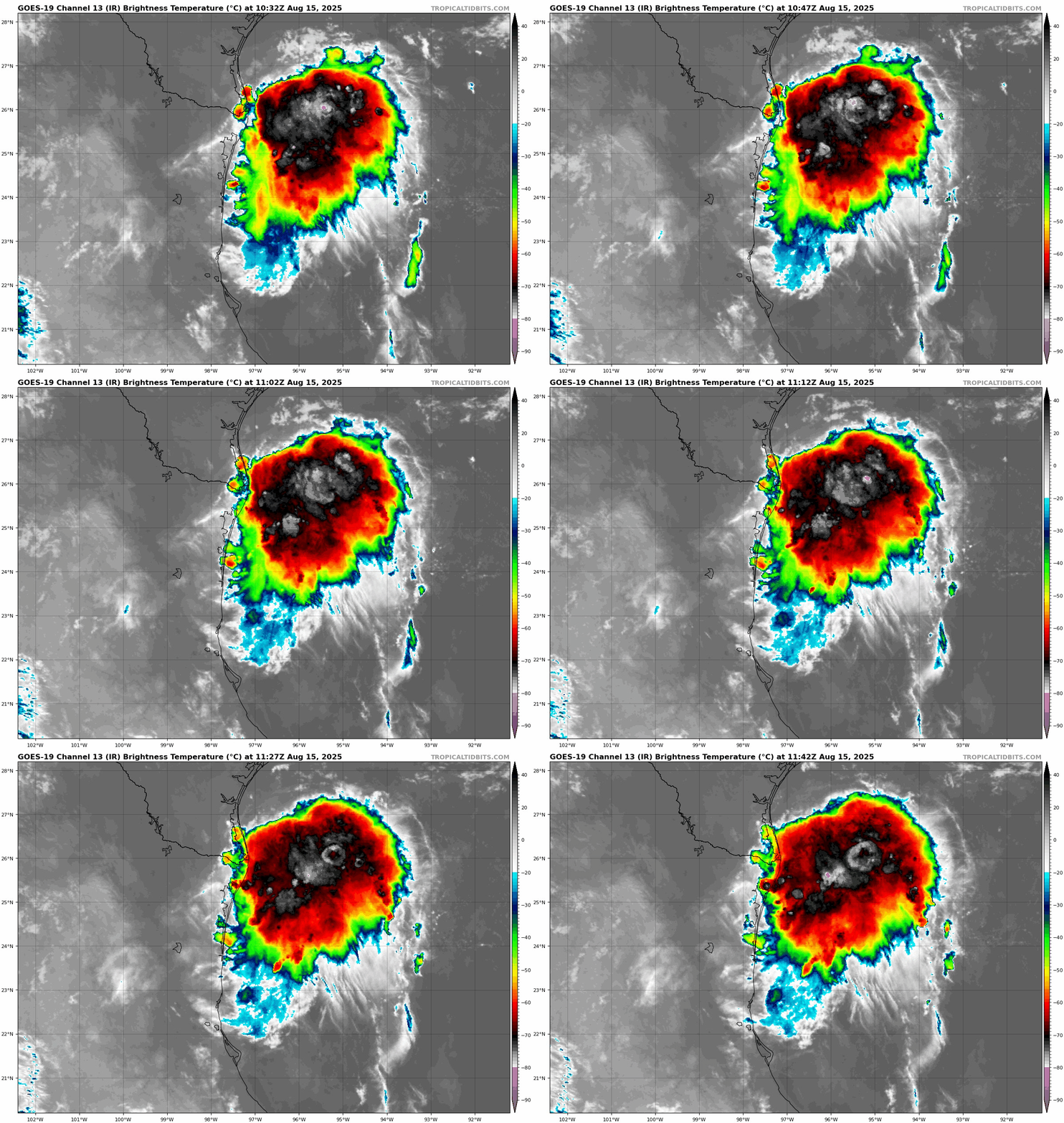
This may look a little scary, but in reality, there is no low-level circulation so while there are some heavy thunderstorms and heavy rain underneath this blob of clouds, the system is not organizing much. So you can disregard any meaningful tropical development (wind, coastal flooding) elements of this for the most part.
What we will watch for at least is rain.
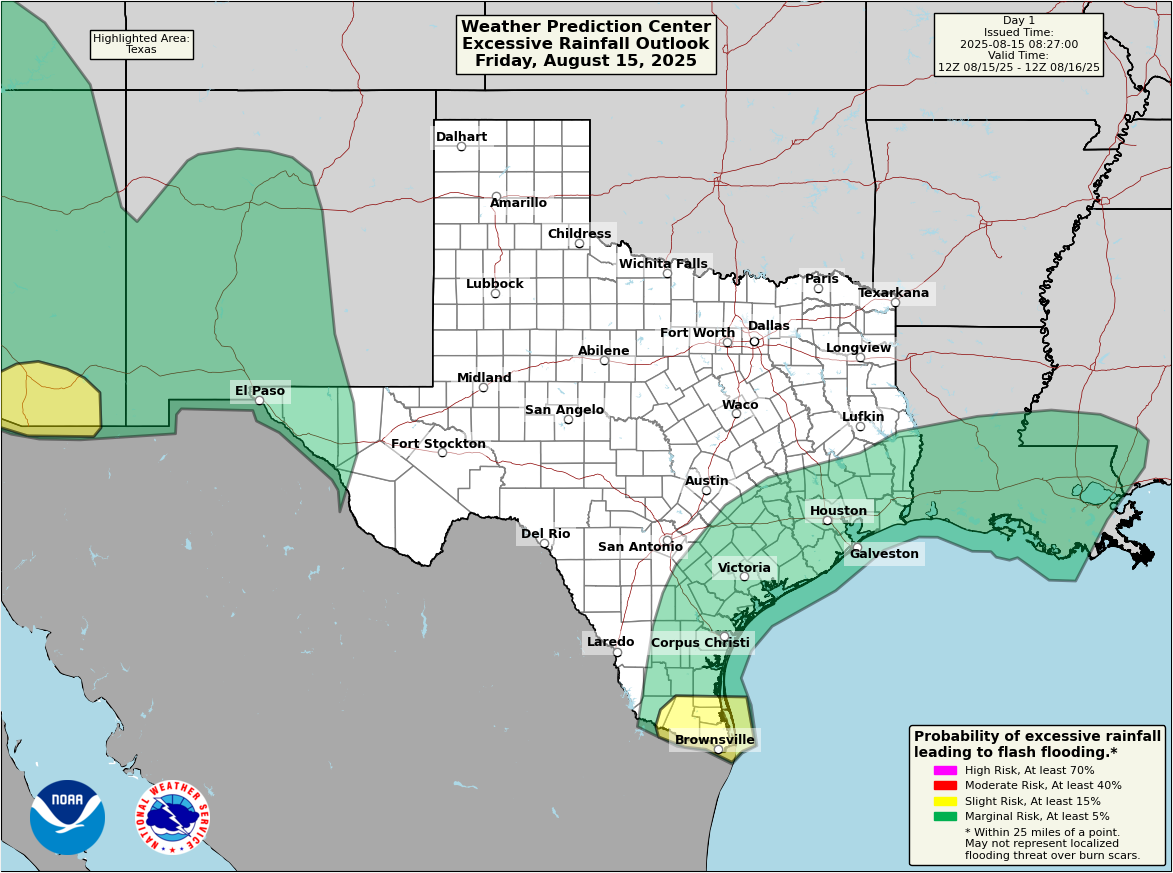
We don’t expect a ton of storms here today. But as this blob of storms lifts toward the coast, watch for development coinciding with daytime heating from Matagorda Bay up through Galveston, quickly moving inland. The one thing that will probably limit flooding is that storm motion today looks pretty quick. Unless we end up seeing several storms in a row over the same area, expect a few places to see perhaps an inch or two in less than an hour, some quick, minor street flooding, and then hopefully calmer weather. It’s possible that we also see a localized stronger storm with gusty winds as well.
Overall, the impacts of the tropical disturbance should be for a slightly more active August afternoon today. Even on slightly active days, some neighborhoods may not see any rain at all, so that’s possible too.
It’s extremely humid outside this morning as some of that added moisture works into the area. We had some of our warmest overnight lows of summer in some parts of the region yesterday, and we’ll be close to matching or exceeding them today (Jamaica Beach has not fallen below 86 degrees as of this writing for example).
Saturday
With the tropical disturbance dissolving inland, we’ll be left with added moisture and onshore flow Saturday. For now, I’d say this is pretty typical August weather, but I wouldn’t be entirely shocked to see a few repetitive thunderstorms that cause some minor street flooding tomorrow. Otherwise, just look for high humidity and warm to hot temperatures in the 90s.
Sunday & Monday
We should see relatively calm weather here, with just a continued slight chance of afternoon thunderstorms. Coverage should be a little less than it will be today and Saturday however. Highs in the mid-90s.
Rest of next week
High pressure is going to flex and expand in the Rockies and central Plains. This should open the door to some rain and thunderstorm chances out of Louisiana into southeast Texas, combining with sea breezes in the area to keep us somewhat active. Look for mid-90s continuing.

8×19 Text Mode Font Origins
I was recently made aware of something that I had noticed before, but never paid much attention to. Consider this screenshot of a BIOS POST screen:

VGA text modes usually use 720×400 resolution and 8×16 fonts (expanded to 9×16). The above screenshot uses 640×480 resolution (VGA graphics), but it is with a high degree a certainty a text mode, using a custom 8×19 font. The BIOS is a Phoenix BIOS 4.0 Release 6.0, running on an Intel Anchorage (AN430TX) board.
For the sake of clarity: The screenshot was taken by digitizing the analog VGA output of a physical AN430TX board with an integrated ATI Rage 3D graphics chip. The VGA connector was plugged into a Lantronix Spider KVM, which was used to save the screenshot. It is not a screenshot of an emulated system.
Some of the earliest examples of boards with an 8×19 font were reportedly Intel Anchorage AN430TX (see above) and Intel Atlanta AL430LX (one of the first AGP-capable boards), both released in 1997. These were probably the first boards using Phoenix BIOS after Intel had been using AMI BIOS for several years, a fact which may or may not be relevant.
The OS/2 Museum happens to own both the AL440LX and AN430TX boards. And as the screenshot above indicates, the AN430TX certainly used an 8×19 font, at least in the final (P10) BIOS update. For reference, here’s what the first BIOS setup screen looks like:

The obvious question is, when did this font show up? The P10 BIOS is from September 10, 1998. I have older BIOS versions, the oldest being update P06 from August 26, 1997. Is the 8×19 font there?
Decoding Phoenix BIOS
That seemingly simple question led to a bit of an adventure. There are tools for decoding Phoenix BIOS images (such as phnxdeco). But phnxdeco has no idea what to do with the Intel flash update files, which are split into several chunks. For the AN430TX, which uses a 2Mbit (256KB) flash, there’s a roughly 64K file called .BIO, another called .BI1, .BI2, and a smaller .BI3 file.
Gluing the files together after removing the obvious headers did not produce satisfactory results. Dumping the soldered flash chip is not that easy either.
There is another Phoenix BIOS decoder called phoedeco. This decoder actually understands the Intel flash update files… but I still had no luck.
Reading the Technical Product Specification of the AN430TX board led to a realization that the entire flash is mapped in physical memory just below 4GB. So I wrote a simple utility to dump the last 256KB of physical memory to a file. That turned out to be very useful.
For one thing, the phoedeco utility was actually able to take my own ROM dump apart:
M:\AN430TX\bios>phoedecw AN430TX2.ROM foo
PHOEDECO * V.K. * 1998.04.02..2006.01.13
AN430TX2.ROM
Position packed   C  unpacked type         target      filename
-------- -------- -- -------- ------------ -------- -- ------------
000FEF15 0000107A 02 00001860 Display      -        -> DISPLAY0.dec
000FC44C 00002AAE 02 00005D80 Template     -        -> TEMPLAT0.dec
000F9227 0000320A 02 00004820 Suspend      -        -> MISER__0.dec
000F851F 00000CED 02 00007AE2 BIOSCode     000F851E +
000F0000 000013EC 02                                +
000D920D 00002DE2 02                                -> BIOSCOD0.dec
000F13F5 0000710E 00 0000710E ROMExec      000F1410 => ROMEXEC0.dec
000E453E 00003A61 02 0000893E Setup        -        -> SETUP__0.edi
000DBFF8 0000852B 02 0000E000 OpROM        -        -> OPROM__0.rom
000D292A 000068C8 02 00009580 BIOSCode.1   000E7E90 -> BIOSCOD1.dec
000D0046 000028C9 02 0000D700 BIOSCode.2   00070000 +
000C8889 00007728 02                                -> BIOSCOD2.dec
-------- -------- -- -------- ------------ -------- -- ------------
000E9000 00001000 -- 00001000 55 AA ROM block          000E9000.rom
000EA000 00002000 -- 00002000 55 AA ROM block          000EA000.rom
000C0000 00007669 02 0000FF46 Strings      -        -> STRINGS0.str
000FDFF0 00002010 -- 00002010 noncompressed            noncomp.rom
000C7684 0002897C -- 0002897C remaining unprocessed    remain.rom
More importantly, the dump showed me how the .BIO files actually end up in flash memory. And this allowed me to use phoedeco to decode older flash updates. Notice the values entered for the addresses:
M:\AN430TX\BIOS06>phoedecw P06-0062.BIO foo
PHOEDECO * V.K. * 1998.04.02..2006.01.13
P06-0062.BIO [$C6000] ? $D0000
P06-0062.BI1 [$D6000] ? $C0000
P06-0062.BI2 [$E6000] ? $F0000
P06-0062.BI3 [$F6000] ? $E0000
Position packed   C  unpacked type         target      filename
-------- -------- -- -------- ------------ -------- -- ------------
000FE974 0000161B 02 00007CD7 Display      -        -> DISPLAY0.dec
000FBDBA 00002B9F 02 00006010 Template     -        -> TEMPLAT0.dec
...
The Intel update files have headers that show the “logical area size” of the combined set. The phoedeco utility tries to align the contents such that the last byte ends up at address 0xFFFFF. But with the AN430TX that does not work, for two reasons.
One reason is that the flash update on this board does not rewrite everything. It leaves in place a boot block, which presumably increases the chances of recovering from a flash update gone bad. It also leaves in place some areas of flash, such as the one which holds the board’s serial number.
The other reason is that adjacent 64K blocks end up being swapped. I have no idea what that’s good for, but they do. This may have something to do with BIOS recovery (which is documented as not working on the AN430TX); a jumper on the board supposedly swaps around flash contents, presumably to map the recovery BIOS to where the standard BIOS would normally be.
Be as it may, mapping the .BIO/.BI1/.BI2/.BI3 files to addresses 0xD0000, 0xC0000, 0xF0000, and 0xE0000 (in that order) allows phoedeco to decode AN430TX BIOS updates.
After decoding the P06 BIOS from August 26, 1997, I was able to locate the 8×19 font in the STRINGS module. But it didn’t look quite the way I expected.
Reduced BIOS Character Set
Presumably in an effort to save a few bytes, the font is encoded in a rather interesting format. The first 128 characters look as one would expect and correspond to code page 437 or 850. The second 128 characters… well, for one thing, there aren’t other 128 characters. There are only about 30-40 or so. And they do not follow any known encoding, although their order appears to follow CP850. How can this possibly work?
That’s easy. Remember, the font is part of the STRINGS module, which contains all user-visible strings in the BIOS, in several languages (English, German, French in case of AN430TX BIOS P06). It appears that whoever produced the strings module (Intel?) collected all the strings, quite possibly coded using CP850, determined which characters in the 128-255 range are actually used, threw out all the unused ones character from the font, and then re-coded the strings to correspond to the new ad-hoc encoding.
For example the German word “ausführen” would normally have the character ü coded as 0x81 (CP850 or CP437). But in this particular instance of an Intel board BIOS, it is coded as 0x80 because the preceding letter (Ç) that normally occupies code point 0x80 was left out.
Since the text strings and the font are stored in the same module and clearly must be used together, this mechanism works reliably.
As a corollary, any strings that contain code points outside the 0-127 range must be displayed using the included 8×19 font in order to be properly legible. But that’s not a problem because the strings are generally used either on the BIOS POST screen or in the BIOS setup, and both of those are under the control of the BIOS.
Intel Boards and 8×19 fonts
For the sake of completeness, I decided to check my AL440LX board as well. The default boot screen revealed nothing:

The BIOS setup, on the other hand, conformed to the expectations. The font used by the setup screen looks exactly like the one on the AN430TX board:

When one skips the graphical logo, it’s not difficult to see why the font looks the same:

The Intel AN430TX and AL440LX boards (both released in 1997) use the same PhoenixBIOS 4.0 Release 6.0, and also use the same font. Not too surprising.
The question is, where did the font come from? Phoenix? Intel? Somewhere else? I started looking at other 1990s Intel boards.
Older Intel Pentium boards from 1994-1996 all appear to have AMI BIOS and do not seem to use the 8×19 font at all. They just use whatever VGA text mode font the display adapter provides. See for example the Atlantis/EV board description here.
The next board I tried was the infamous Cape Cod CC820 from 1999. As on the AL440LX, the default boot screen says very little:

The BIOS setup, on the other hand, is much more revealing. And again, it shows a 640×480 text mode using the 8×19 font. By all appearances it is the exact same font used on the AN430TX and AL440LX:

The POST screen is somewhat interesting. No mention of Phoenix, or AMI for that matter. But strings inside the BIOS as well as Intel’s documentation reveal that the CC820 board used AMI BIOS again.

Which means that Intel used Phoenix and AMI BIOSes with the same font.
Now I needed to focus on older Intel boards, released in the second half of 1996 or late 1997. There was a good chance that the AN430TX was not the oldest board with an 8×19 font.
Unfortunately Intel was extremely prolific at that time, and released a dozen or more boards every year.
Examining available information about the VS440FX board (which came out around May 1996) suggested that it still used regular VGA text modes.
TC430HX and PR440FX
The TC430HX (Tucson) and PR440FX (Providence) boards seemed to be worth checking out.
The TC430HX came out around July 1996, PR440FX in August. And screenshots of the PR440FX looked rather interesting. The boards appear to be using an 8×19 font, but a different font. For one thing, the zero was slashed instead of dotted:

It is undoubtedly an 8×19 font, but a markedly different one. For comparison, this is what the BIOS setup screen looks like on the TC430HX:

Digging through TC430HX BIOS update from September 1996 I was able to establish that yes, an 8×19 font was certainly there, and yes, it was very different from the one used in the 1997 boards. These boards of course used AMI BIOS, so perhaps AMI had an 8×19 font different from Phoenix?
PD440FX
Then I came across the PD440FX (Portland) board. The PD440FX still used the old Pentium Pro 440FX chipset, but it was actually a Slot 1 Pentium II board from April 1997 (same as the AN430TX).
An eBay listing for a PD440FX board showed this rather interesting screenshot:

Compare that with the above screenshot of TC430HX. That certainly looks like the newer 8×19 font, but the screen layout is otherwise extremely similar.. But wait, there’s more:

So the PD440FX board uses AMI BIOS, not Phoenix. But it sports the same 8×19 font that the PhoenixBIOS-equipped Intel boards used. Which suggests (though doesn’t prove) that the font came from Intel, and not Phoenix or AMI.
Back to the Future
On the other end of the spectrum, Intel clearly liked that 8×19 font and kept using it for a long time. This is the BIOS setup of a 2012 Intel DX79SR Stormville board:

This is an 800×600 graphics mode–at some point Intel switched from text modes to graphics. But it is undeniably the same font. The DX79SR was one of the last Intel boards that used text-based setup. Notice that this is a BIOS update from 2014, and that the BIOS identifier starts with SIX79 (which should be read as SI-X79, not SIX-79) because it was originally used with the DX79SI (Siler) board, a slightly older but nearly identical predecessor of the Stormville board.
The final Intel board generation before the desktop board group was shut down used GUI-style “Visual BIOS” and the text was quite different. However…

The above screenshot shows the EFI shell on a 2013 Intel DQ87PG Spring Cave board. That certainly looks like the same font… now part of EFI.
Timeline
With all the above data points in hand, let’s try putting together a rough timeline:
- Intel boards up to about the first half of 1996 used regular VGA text mode with 8×16 (9×16) fonts (AMI BIOS)
- Intel boards from circa the second half of 1996 used an 8×19 font with a slashed zero and 640×480 text modes (AMI BIOS)
- In the first half of 1997, Intel started using a different 8×19 font with a dotted zero (AMI BIOS and Phoenix BIOS)
- By 1999, Intel was back to AMI BIOS, but still used the same 8×19 font with a dotted zero
- Intel kept using the same font in their boards until about 2012 or 2013 when Visual BIOS replaced text-based setup
- The same 8×19 was used in at least some EFI implementations
The 8×19 font (not the actual bitmaps but the 8×19 resolution) eventually made it to the UEFI specification. UEFI 2.1 (2007) added a Human Interface Infrastructure (HII) section and defined 8×19 as the standard “narrow” fixed font size (UEFI 2.1 section 27.2.7, Fonts), with double-wide 16×19 resolution used for CJK glyphs.
The rationale was probably the same that led Intel to using these fonts a decade earlier. 8×19 fonts enable standard 80×25 text using a basic VGA 640×480 resolution. This works well on flat panels which cannot dynamically change resolution like analog monitors.
8×19 fonts were also used on Asian DBCS systems (e.g. DOS/V) a long time ago. The reason was more or less the same in that the systems were forced to run in VGA graphics mode (640×480) in order to render CJK glyphs, and 8×19 fonts were effectively the only option to support standard 80×25 text on these systems.
Open Questions
There were OEM systems that used 8×19 fonts for regular text modes, such as the Cirrus Logic Stingray. I believe this was effectively a failed attempt; although the 8×19 fonts were a great fit for flat panels, there was too much software which assumed standard 8×16 fonts and relied on that to render, say, a “graphical” mouse cursor in text modes.
For that reason, the Intel boards with 8×19 fonts make absolutely no attempt to use these beyond POST. In fact as soon as the system starts POSTing add-on adapters, the BIOS switches to a regular VGA text mode, and also does that before attempting to boot from disk. For systems that use a graphical logo, the system switches to a standard text mode whenever going out of logo mode. When it’s safe to use the graphical logo it’s safe to use 8×19 text, and vice versa.
The obvious remaining question is, who came up with 8×19 fonts for BIOS use? Was it really Intel? Or was it someone else? Note that the Intel boards were used by many OEMs (including but not limited to AST, Dell, Gateway, HP, Micron, Packard Bell) so just because an OEM system uses an 8×19 font doesn’t mean there isn’t Intel behind it.
Provincetown is one week away!
CocoPeru.com/schedule
Rainboweg.com
#provincetown
#dragqueen
#resist
For more info about Coco:
http://www.misscocoperu.com
Poll Finds Americans Still Believe Greatest Threat To Public Health The Undertaker
WASHINGTON—Shedding new light on the widespread dissemination of misinformation, the Pew Research Center released a new poll Friday that found the majority of Americans still believe the greatest threat to public health is the Undertaker. “More than 85% of U.S. adults stated they were ‘extremely concerned’ about the negative health impact the Deadman could have on their community,” said pollster Christopher Hwang, who noted that survey respondents stated they were far more distressed about negative repercussions of the Undertaker’s chokeslam than they were about the opioid epidemic, antimicrobial resistance, heart disease, gun violence, or climate change. “The majority of Americans spend a significant amount of energy preparing for the possibility of the Undertaker entering their home or workplace as ‘Ain’t No Grave’ begins to play. It’s really outdated information they’re working with, as he hasn’t stepped inside the ring since 2020. That being said, small children and the elderly should of course still take precautions against the Undertaker.” Hwang went on to stress that most Americans were dangerously underestimating the threat of El Grande Americano.
The post Poll Finds Americans Still Believe Greatest Threat To Public Health The Undertaker appeared first on The Onion.
Woman’s Career Dies In Childbirth
DAYTON, OH—In a tragic turn to what loved ones had expected to be a joyous day, family sources confirmed Tuesday that area woman Sandra McDowell’s career had died in childbirth. “We did everything we could to preserve the mother’s job prospects, but sadly, she just lost too much employability for her career to survive,” said obstetrician Heather Parlon, adding that McDowell’s husband broke down outside the delivery room when he learned that he’d be raising his child in a single-income household. “Her marketing career was so young and full of promise. She was just an entry-level assistant content manager, for heaven’s sake, with so many good years of moving up the corporate ladder ahead of her. And now she’s lying completely jobless on a hospital bed, and all those promotions and wage increases and corner offices she dreamed of are gone, just like that. It breaks your heart to see a career cut short before it could fully blossom in this world.” McDowell’s husband reportedly chose to honor her career’s memory by naming their daughter Chief Content Strategist.
The post Woman’s Career Dies In Childbirth appeared first on The Onion.
Novelty Nachos Helmet Works Way Into Regular Dishes Rotation
The post Novelty Nachos Helmet Works Way Into Regular Dishes Rotation appeared first on The Onion.
Yasmine Polk
Yasmine Polk, 56, passed over the rainbow bridge last Friday, becoming the first non-pet to do so.
The post Yasmine Polk appeared first on The Onion.
‘Two Seniors,’ Says Jordon Hudson, Looking AMC Cashier Dead In Eye
The post ‘Two Seniors,’ Says Jordon Hudson, Looking AMC Cashier Dead In Eye appeared first on The Onion.
Texas Democrats set terms to end nearly 2-week walkout over GOP redistricting effort

Smithsonian exhibit collects visitors’ hopes for the next 50 years

‘Stop the insanity’: Texas Democrat urges GOP to end redistricting battle

Heavy rains expected in Puerto Rico and Virgin Islands as Tropical Storm Erin nears

Now You Can Get Your Flu Vaccine at Home
New Texas Congressional Districts
Some people think this map looks gerrymandered, but we don’t see it. We also don’t see the innovation, economic growth, and kick-ass food scene that exists in this country, largely thanks to immigrants. Everyone, get your guns: Let’s kick out all the foreigners and shoot ourselves in the foot.
District 2 aims to “Keep Austin Weird” by taking away all of its voting power. But at least urban liberals and rural conservatives now share something in common: one representative to do Trump’s bidding in Congress.
The Third District blows Democratic votes away. We promise a chicken in every pot, a car in every garage, and a firearm in every hand. Sawed-off shotguns are now legal in Texas. With this kind of leadership, how could anyone not want Texas Republicans to have more seats in the House?
\
District 5 is deep in the heart of Texas, and garners us the necessary votes in Congress to make certain that Republicans stay in charge of what goes on deep in the heart of every vagina in the country.
Texas is the top producer of wind energy in the United States. That should put us at odds with Trump, but ultimately we’ll go any way he says the wind is blowing. Meanwhile, District 7 is the first district in the country that can change its shape. With a twist of the turbine, the blades can slice up blue counties however we want.
District 9 may look weird, but it is merely a collection of people who are okay with AI data servers sucking up forty-nine billion gallons of water—just like how this district will suck up Democratic votes and flush them down the toilet (if there’s enough water).
Named after District 10 in The Hunger Games, this district reflects the Republican belief in every person’s freedom to practice whatever kind of Christianity they want. That’s why, as of this fall, public schools in Texas will be required to display the Ten Commandments in every classroom, ensuring a zero-tolerance policy for kindergarteners who commit adultery.
Man Poisoned After Taking Dietary Advice From ChatGPT
A 60-year-old man was hospitalized with rare bromide poisoning after replacing table salt with sodium bromide based on advice given by ChatGPT, despite the FDA claiming the substance is unsafe for human consumption. What do you think?

“ChatGPT tells me the solution here is more sodium bromide.”
Mark Bratos, Retired Whaler

“See? No good ever comes from consuming less salt.”
Jacqueline Pino, Keyboard Cleaner

“That’s why I only trust ChatGPT with advice about my mental health.”
Rhys Hamons, Scooter Detailer
The post Man Poisoned After Taking Dietary Advice From ChatGPT appeared first on The Onion.
Rogue Amoeba
Strange name. Great software.
Added by @rue in Music › Music Software.
omg.lol
Your fun home on the web!
Added by @rue in Internet › Web.
Homebrew
The Missing Package Manager for macOS (or Linux)
Added by @rue in Computers › Command Line Tools.
No surprise

Place your bets, Susan or Orzabal? Who will win?
The post No surprise appeared first on Bad Machinery.

The Wall Street Journal Marches Toward Pravda With American Characteristics
Greg Ip, chief economics commentator for The Wall Street Journal, under the euphemistic headline “The U.S. Marches Toward State Capitalism With American Characteristics”:
A generation ago conventional wisdom held that as China liberalized, its economy would come to resemble America’s. Instead, capitalism in America is starting to look like China.
Recent examples include President Trump’s demand that Intel’s chief executive resign; the 15% of certain chip sales to China that Nvidia and Advanced Micro Devices will share with Washington; the “golden share” Washington will get in U.S. Steel as a condition of Nippon Steel’s takeover; and the $1.5 trillion of promised investment from trading partners Trump plans to personally direct.
This isn’t socialism, in which the state owns the means of production. It is more like state capitalism, a hybrid between socialism and capitalism in which the state guides the decisions of nominally private enterprises.
China calls its hybrid “socialism with Chinese characteristics.” The U.S. hasn’t gone as far as China or even milder practitioners of state capitalism such as Russia, Brazil and, at times, France. So call this variant “state capitalism with American characteristics.” It is still a sea change from the free market ethos the U.S. once embodied.
Ip’s piece is, on the whole, a decent factual survey of the Trump 2.0 administration’s economic policies, six months in. (Or, if you prefer, one-eighth over, and a quarter of the way through until the mid-term election.) But I can’t help but feel that if it were any Democrat — Biden, Harris, whoever — whose early presidential term’s stewardship of our capitalist economy could aptly be described as “starting to look like China”, the tone would be less “a sea change” and more “ALL CAPS ALL THE TIME TOTAL FUCKING FREAKOUT”. It’s the same slippery slope of obeying in advance as describing blatantly unconstitutional shakedowns as “unusual agreements”.
There’s grading on the curve and then there’s grading on the curve. Ip knows damn well that if left unchecked, Trump’s mad-king style policies, like firing the economist in charge of the Bureau of Labor Statistics because the jobs report for July was bad, are going to prove disastrous. That move is more like North Korea than China, and everyone who doesn’t have Fox News injected into their veins knows it. Greg Ip is not drinking the MAGA juice, but he’s not calling fair balls and strikes, either. That’s a problem.
Bloomberg: ‘Trump Administration Said to Discuss Taking Stake in Intel’
Bloomberg:
The Trump administration is in talks with Intel Corp. to have the US government take a stake in the beleaguered chipmaker, according to people familiar with the plan, in the latest sign of the White House’s willingness to blur the lines between state and industry.
A deal would help shore up Intel’s planned factory hub in Ohio, said the people, who asked not to be identified because the deliberations are private. The company had once promised to turn that site into the world’s largest chipmaking facility, though it’s been repeatedly delayed. The size of the potential stake isn’t clear.
The talks come just a week after President Donald Trump had called for the ouster of Intel Chief Executive Officer Lip-Bu Tan, accusing him of being “highly conflicted” because of concerns about his earlier ties to China.
Bloomberg was first (this time), but the WSJ seconded the report shortly after.
No cause for alarm here. Just a bit of a sea change. The Republican Party has always been in favor of social ownership of the means of production. Just like we have always been at war with Eastasia. Sane steady leadership from our 80-year-old dear leader, who is definitely not succumbing rapidly to a dangerous mix of dementia, megalomania, and paranoia.
3 Original Palindromes (Spelled the same backwards and forwards)
Odds increasing for a tropical storm to form in the Gulf, but it’s really not something to stress about
In brief: The National Hurricane Center has raised the odds of a tropical depression or storm forming in the Southern Gulf during the next day or two. This post seeks to quell any fears this may cause Texas residents. In the greater Houston area we can expect elevated rain chances on Friday and Saturday, but nothing extreme.
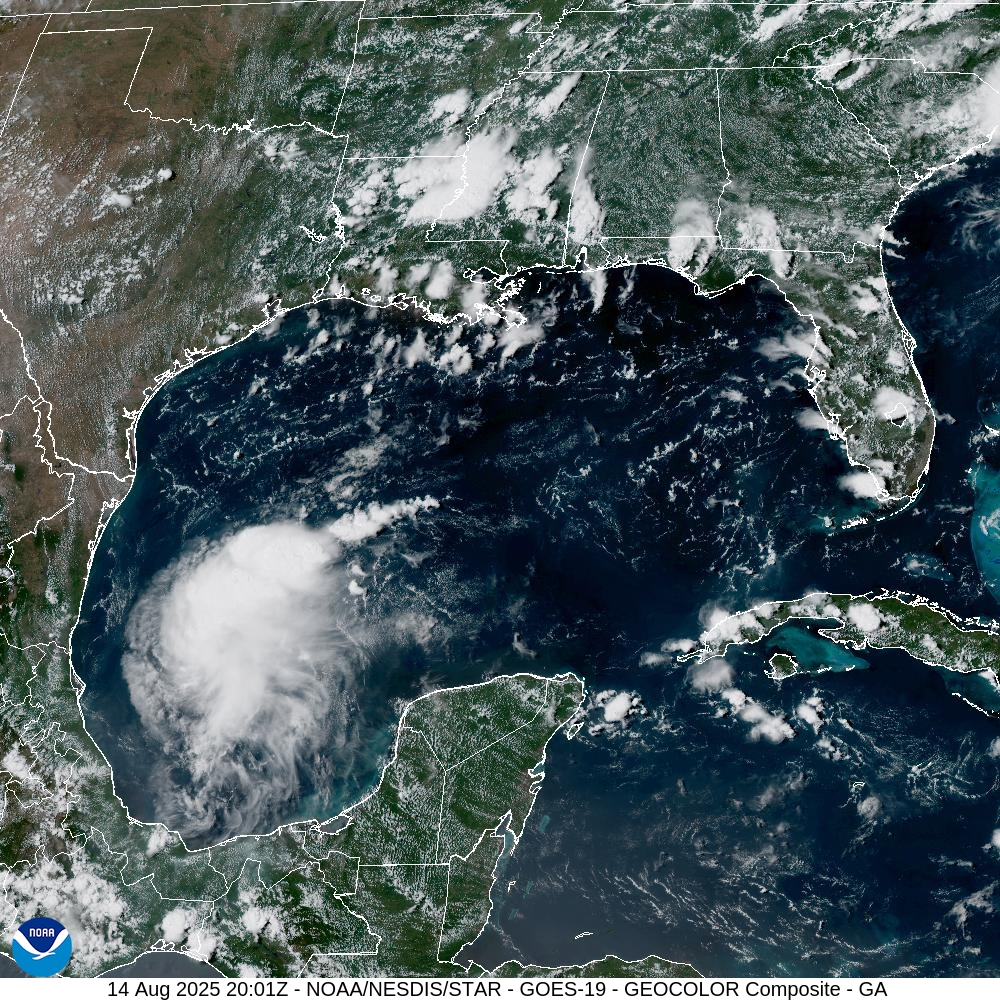
Invest 98L status
Early this afternoon the National Hurricane Center increased the likelihood that a tropical system in the extreme southern Gulf, Invest 98L, will form into a tropical depression or storm during the next two days. The odds this morning were 20 percent, and as of 1 pm CT they are now 40 percent. Accordingly the color of the “tropical blob” on the hurricane center’s site has gone from yellow to orange. This has prompted a number of questions from readers about this system, and a measure of concern.
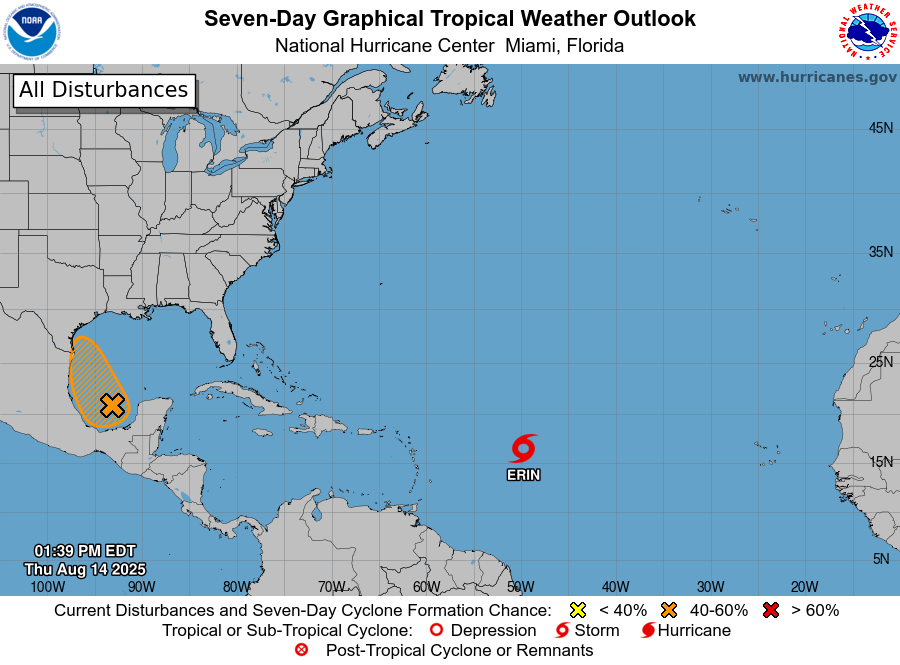
Our most important message is that residents of the greater Houston metro area really should not be concerned.
We will get a better idea about the nature of this system later today when a Hurricane Hunter aircraft flies into it to retrieve data about wind speeds, air pressure, and more. In any case, as of early afternoon on Thursday, the system does not have a closed circulation. However the satellite appearance is improving (in the sense that it is becoming better organized) and there are increasing amounts of thunderstorms. So it is moving in the right direction toward becoming a depression.
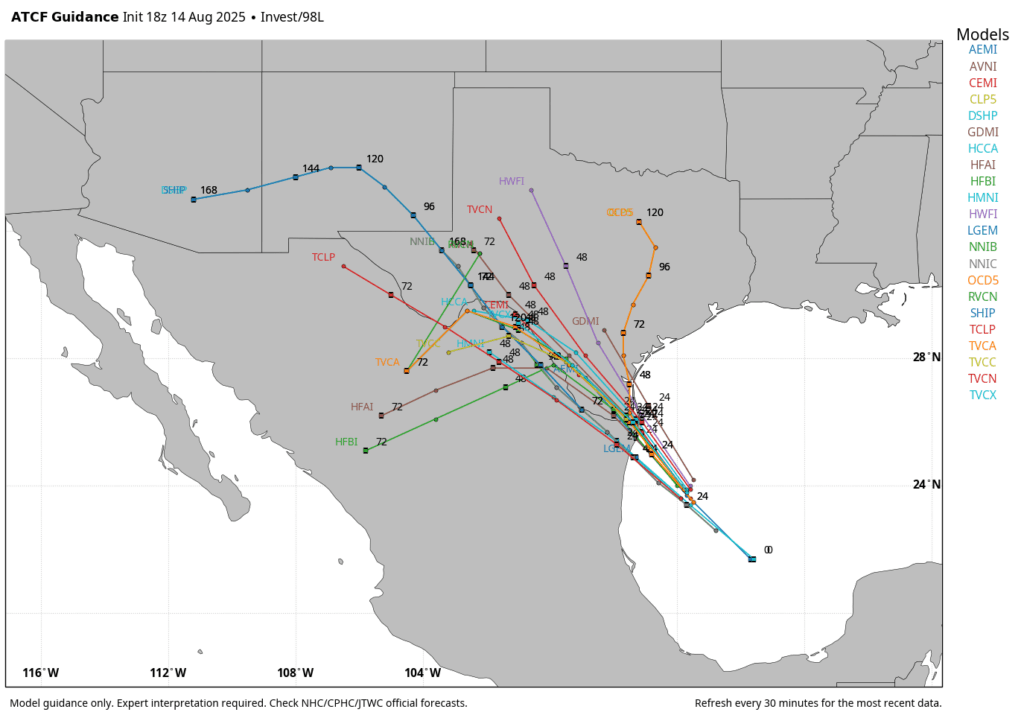
It is therefore plausible that this could become a tropical depression or a low-end tropical storm during the next 24 hours. However, by Friday afternoon or evening this should have moved inland, likely somewhere between Brownsville and Corpus Christi. Given this short window of opportunity, we think there is a pretty hard limit on how strong the storm can get.
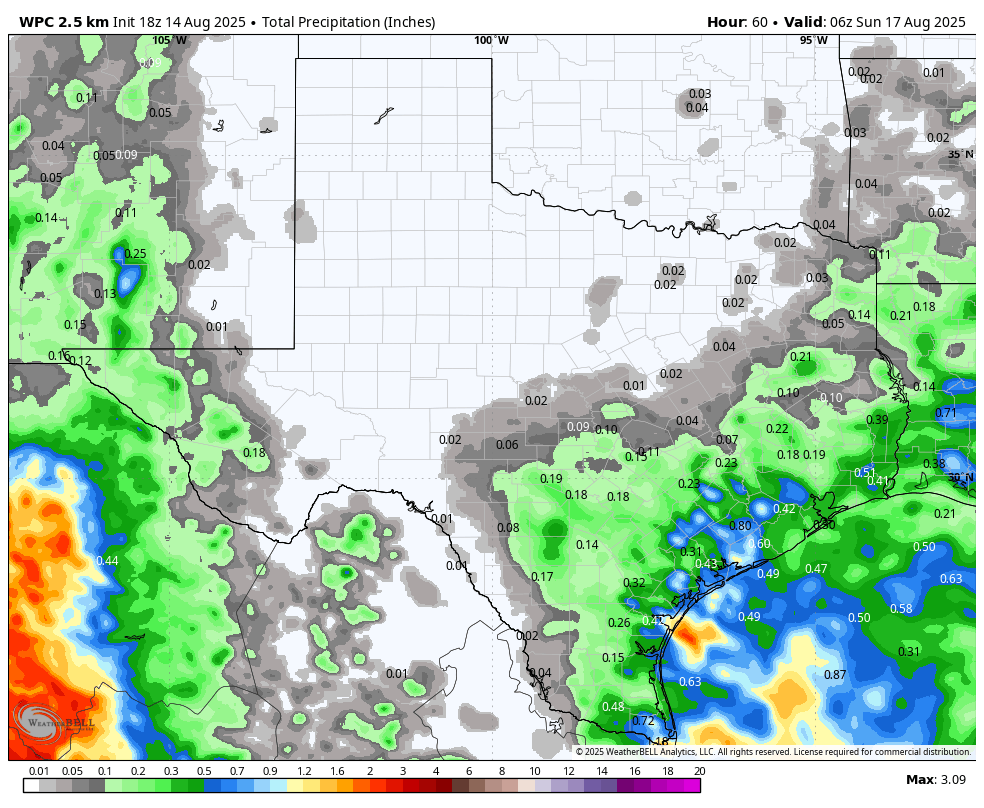
The primary impacts from Invest 98L will therefore be rainfall. And although we can never be too sure about tropical systems, in August, moving into Texas, this one appears to be largely beneficial in terms of the precipitation it will produce. For the greater Houston region this means an elevated chance of showers, some of it potentially heavy, on Friday into Saturday. Coastal regions face the highest risk, with some areas perhaps seeing a bullseye of 1 to 3 inches of rain. Still, I expect most people will receive less than 1 inch, with the majority of that probably less than 0.5 inch.
More tomorrow.

Tropical Storm Erin Graphics

5-Day Uncertainty Track last updated Thu, 14 Aug 2025 14:36:56 GMT

Wind Speed Probabilities last updated Thu, 14 Aug 2025 15:22:38 GMT
Billionaire with doomsday bunker wants you to know AI great
PALO ALTO, CA – Artificial intelligence promises a bright future filled with ease, innovation and abundance, according to one of the several billionaire tech CEOs who has spent hundreds of millions to build an opulent, secure facility underground surrounded by armed guards to wait out the apocalypse. “The AI future poses many challenges, and we […]
The post Billionaire with doomsday bunker wants you to know AI great appeared first on The Beaverton.