Shared posts

18 Aug 23:02

my boss says I should work more since my health insurance costs so much, coworker delays our meetings, and more

by Ask a Manager

It’s five answers to five questions. Here we go…

1. My boss says I should do more because my family’s health insurance costs so much

I have a fairly senior position at a small nonprofit, and I was the first woman on staff to have a baby. I could tell it was hard for my boss, who is used to people being on call constantly, to adjust to my new work-life division.

Currently, our organization is facing a fundraising shortfall, and my boss has called me in for several meetings where he told me that since I have my wife and baby on the company’s health insurance plan, I’m actually the second-most expensive employee after him, and that I really ought to fundraise or “deliver value” twice as much as other employees he named, because I cost so much. (Fundraising has never been a part of my job before, but I get that we’re a small org that needs to pull together. I understand that everyone else on staff either has just one dependent partner, or has the family on the partner’s plan — my wife doesn’t get health insurance through her job, though, so this is our only option.)

I am curious about how to manage this with my boss (and I’m also really stressed out and doubt I can successfully add fundraising onto my responsibilities). Should I tell my boss to change the policy to raise my employee contributions? Is there some kind of discrimination happening here?

Wow, that’s wildly inappropriate. If your organization wants to move more or all of the cost of insurance premiums for family members on to the employee rather than shouldering it themselves, they have the option to do that. But telling you that you need to contribute more value than everyone else on staff because your family is on their health insurance? Noooo.

Discrimination based on family status isn’t illegal at the federal level, but it is in some states and Washington, D.C. If you happen to be in one of them, this would indeed be illegal. If you’re not, you don’t have legal options, but you still shouldn’t tell your boss to increase your health insurance payments. This is a benefit you were offered as part of your compensation, and you are entitled to use it.

You should, however, consider how stable this organization is as an employment option long-term.

Related:
my company wants me to investigate what expensive medical treatments employees are having and why

2. How do I explain I’m staying remote when everyone else has to return to the office?

My company is enforcing return-to-office (RTO), beginning in September. I have managed to squeeze out of it, so to speak, as I got medical accommodations. When I first got it, the planned RTO was for June, and I was told by HR and my manager I didn’t have to disclose anything I was uncomfortable with, and since it was far away at the time, I didn’t bring it up. RTO was delayed, then delayed again, and about a month ago we were told RTO would be in September.

One team mate had also already planned a move before RTO was announced, so thankfully I won’t be the lone worker on Zoom meetings, but I hadn’t gotten the accommodations at the time, so I didn’t tell the team at the same time she did.

Recently I asked for someone to cover my vacation, and forgetting the specific dates of RTO, I asked a work group chat if anyone could cover. My coworker, Jay, said he could, I said thanks, and then he reminded me that three of those days were the first three days of RTO. I finally said that due to medical accommodations I would not be returning, and he said cool.

Now I am wondering what to do. I know not saying anything would be weird and wrong, and people will be confused as I do not look like someone who requires medical accommodations and I have driven to the rare in-person meetings before. Do I just make a big announcement to the full team group chat? I don’t want to make a big announcement while we’re in a meeting, as I have to be honest, I’m not great at thinking on my feet on what to appropriately say when asked questions verbally.

It depends on how much you’re comfortable sharing.

If you’re comfortable sharing that it’s a medical accommodation, you could just say at some point before the RTO date, “By the way, I want to let people know I’ll be remaining remote because of a medical accommodation.”

If you don’t want to share that, you could say, “I want to let people know I’ll be remaining remote” (or “Jane has signed off on me remaining remote” if you think you’ll need to spell that out). This one risks causing more drama, since people may wonder why you’re getting to stay remote when they’re not. You could potentially lower that risk by adding something like, “It’s a long story” or “Personal reasons I’d rather not go into.”

But if you’re willing to just state plainly that it’s a medical accommodation, that’s likely to be the lowest-drama way to do it.

3. My coworker has delayed our meetings for months

I first joined my company when I was still in college, when I took a year off from school due to the pandemic and worked as an intern for a large corporation. I really loved the team I was on, which included my manager “Gina” and her good friend “Hannah,” who I collaborated with on a few projects. I got along great with Gina (and she’s now one of my mentors), but never really felt like Hannah was vibing with me. But she was friendly enough.

After I finished school, I returned to the company full-time and kept in touch with a lot of teammates from my old team. Two years in, I realized I didn’t love my current role and wanted to explore other teams, including one that Hannah had moved to since we worked together. On Gina’s recommendation, I reached out to Hannah and set up a 30-minute coffee to catch up and learn more about her team. My company’s culture encourages coffee chats with anyone and everyone, and to put time on people’s calendars to do so. If people are busy during that time or need to push it for whatever reason, it’s totally normal for them to ask to move it to a different time or to suggest a new time in the calendar software.

For whatever reason, this coffee with Hannah kept getting moved. Sometimes last minute, sometimes a few days out, sometimes by her, sometimes by me. This happened for all of last fall, and once we were at the holidays, I said it made sense to just reschedule for sometime in the new year. I had kind of given up hope of meeting with Hannah, but I had made other connections with people on her new team in the meantime.

Fast forward to spring of this year, and Hannah is hiring for a position at my level. I reach out to her again to set up time to chat about the role (again, as is expected at the company — for internal moves, you meet with the hiring manager casually first to learn about the role, and then officially apply). Instead of getting a “sure, send me an invite” response from her, however, she kind of brushed me off, saying that she was busy prepping for an upcoming business trip, there were already a few people in the pipeline for this role, and instead I should make more connections with other people on her team (which I had been doing for the past six months!) and then she’d be happy to answer any remaining questions if I had any. With encouragement from Gina and Hannah’s boss (who I also worked with on a different team), I took this to mean that Hannah didn’t have the time to meet with me, but to go ahead and apply.

Big mistake. Hannah sent me a terse email saying I was ineligible for the role and my lack of communication (I hadn’t responded to her message declining to meet with me) further demonstrated that I would not be a good fit for her opening. This came as a complete shock to me, but I took the feedback in good faith and resolved to improve my communication skills.

My current manager (aware of everything going on) recommended I set up time with Hannah a few months after this incident to check in on how I was progressing toward becoming a better candidate for Hannah’s team (perhaps for a future opening elsewhere on the team). I communicated this and she seemed receptive, so I put time on her calendar for a 30-minute coffee chat in June … only for the same thing to happen as last fall. It’s August, and we still haven’t met — the meeting keeps getting pushed, sometimes last minute, sometimes a few days out, occasionally by me, but mostly by her. It’s probably been moved at least 5-8 times by now, and each time there hasn’t been a single word from Hannah acknowledging it.

I’m finally supposed to meet with her this week, and I just saw she’s moved the meeting to over a month from now! I’m getting the feeling she doesn’t want to meet with me at all, at which point she should just say something to me about it instead of kicking the can down the road. And would it really be so hard for her to take 30 minutes to meet with me? I’ve never had this happen to me at this company — the culture is very much that if someone wants to have a coffee chat with you, you make time, even if just out of politeness.

How do I approach this? Are there any scripts you’d recommend to confront her about it? Do I go ahead and cancel it altogether again? Or should I just let the meeting keep being postponed? For what it’s worth, her role is still unfilled, not that I would want to work under her anyway after this entire ordeal.

For whatever reason, Hannah doesn’t want to meet with you or hire you, I’m sorry. Who knows why — it could be something from when you last worked together, it could be that you remind her of a hated cousin, it could be irrational, it could be a pet peeve, it could be based on something legitimate. But at this point, it’s very unlikely that continuing to pursue either a coffee chat or a role on her team will lead to anything more than frustration. I don’t see much point in talking to her about it; you’re better off just dropping it and looking at other teams.

4. I wasn’t informed of a decision, and I’m feeling undervalued

I’m currently working part-time as a contractor with an organization where I’ve felt fairly integrated into the core team, despite my contractor status. Have been working there for a couple of years.

For the past few months, my primary responsibility has been managing/leading a hiring process for a C-suite role. After many months of interviews and deliberation, we narrowed it down to two finalists. I had a clear preference between the two (which I shared), but the final decision-makers (which included my boss) ultimately selected the other candidate.

What really stung was how I found out. No one from the team told me a decision had been made — I only learned about it when the finalist who wasn’t selected emailed me to thank me for my time after they found out they didn’t get the role. That was the first I’d heard that my boss (and others) had made a decision.

I’m not upset about the outcome — I understand that leaders sometimes make decisions that don’t align with your preferences or advice. But I was hurt that my boss didn’t think to update me on the final decision before they executed it, especially since I’ve spent far more time and effort on this hiring process than any other member of the team. Hearing the news from a third party felt like a real lack of acknowledgment of my efforts, and it left me feeling pretty demoralized. Having been a middle manager myself, I can’t imagine making an offer without updating the hiring team (and hiring manager) involved first.

A bunch of this is amplified by my own insecurities — I often struggle with whether I’m truly seen as a strategic contributor, or just as someone doing behind-the-scenes admin work, on this team. This experience reinforced those doubts. I’m actively working through these feelings (with the help of a therapist!), but it’s definitely a slow and ongoing process.

So here’s what I’m grappling with: am I right to feel upset about how this was handled, or am I being dramatic? If so, how can I express to my boss that this genuinely hurt without coming across as overly sensitive? Does it matter that I’m technically a contractor? I’m not looking to create conflict — I just want to name what I’m feeling and how it’s impacting my motivation. But honestly, it’s made me question whether I want to keep working here.

It depends on exactly what your role in the hiring was. For example, if you were doing the initial recruitment and screening and then passing strong candidates off to decision-makers for later interviews, it’s not weird that they made a decision and made the offer without informing you. That’s very normal for that role! Your work could be extremely valued and appreciated and it still wouldn’t be weird that once you handed off your part, they just ran with their part. On the other hand, if you were part of the final interviews and decision-making, then it’s a little more surprising — although even then, it’s not necessarily that weird; if you’re not the final decision-maker, these things happen and generally people are expected to roll with it if they’re not the primary decision-maker.

In either of those situations, questioning whether you want to keep working there because of it does seem like a very disproportionate reaction, so I wonder if there’s something more going on, aside from this situation.

5. Am I being ghosted?

I have had three interviews: hiring recruiter, peer, potential manager. I was told after interviewing with the hiring manager that I would be contacted to schedule a fourth in-office with the CVP. It’s been over 24 hours and I haven’t heard anything yet. I’m concerned about being ghosted, since they got back to me quickly to schedule these previous interviews.

24 hours is nothing — in all cases, but especially when there’s now a new person’s schedule in the mix. If you haven’t heard anything after a week, check in then.

Of course, it’s also possible that you are being ghosted — that happens all the time in hiring — but it would be wildly premature to conclude it at this point.

Related:
why haven’t I heard back after my interview?

The post my boss says I should work more since my health insurance costs so much, coworker delays our meetings, and more appeared first on Ask a Manager.

18 Aug 19:19

Pirates Under Fire For Directly Marketing Team To Children

by The Onion Staff

PITTSBURGH—Detailing the harmful, long-term effects of early exposure to the ball club’s dismal on-field product, parents and child safety organizations denounced the Pittsburgh Pirates Monday for directly marketing the team to children. “It is deeply irresponsible to lure kids into becoming Pirates fans before they’re emotionally equipped to handle the kind of disappointment and chronic underperformance this franchise will almost certainly inflict on them,” said National Child Safety Council spokesperson Rebecca Amoroso, adding that targeted giveaways, cartoon mascots, and Pirates-branded youth merchandise effectively glamorized futility, setting up kids for a lifetime of frustration and terrible baseball. “The team knows that no sane adult would willingly become a Pirates fan, so they have to go after minors. They hook children early because they know the cycle of hope and despair is addicting, and if young kids start watching games, there’s a good chance they’ll grow up to be season-ticket holders. They know that Pirates fandom is linked to depression, anxiety, and even suicidal ideation, but they don’t care. Their business model depends on turning innocent, impressionable kids into sullen, dead-eyed adults who pound IC Lights and scream at the TV night after night about the team’s abysmal offense once again letting a strong pitching performance go to waste. It’s unconscionable.” Amoroso went on to urge parents to think twice before taking kids to a Pirates game, suggesting safer alternatives such as rooting for literally any other team in the National League Central.

The post Pirates Under Fire For Directly Marketing Team To Children appeared first on The Onion.

18 Aug 19:13

Howl anew

by John Allison

I apologise to anyone with a weak constitution (myself included) as today’s page is dangerously close to “outlaw comics”.

The post Howl anew appeared first on Bad Machinery.

18 Aug 17:02

Awkward Zombie - The Best-Stayed Plans

by tech@thehiveworks.com

New comic!

Today's News:

I would love to help you with this pivotal point in your character arc, but I have some very important laundry to run.

18 Aug 12:37

Pedro Pascal

by Alvaro Montoro

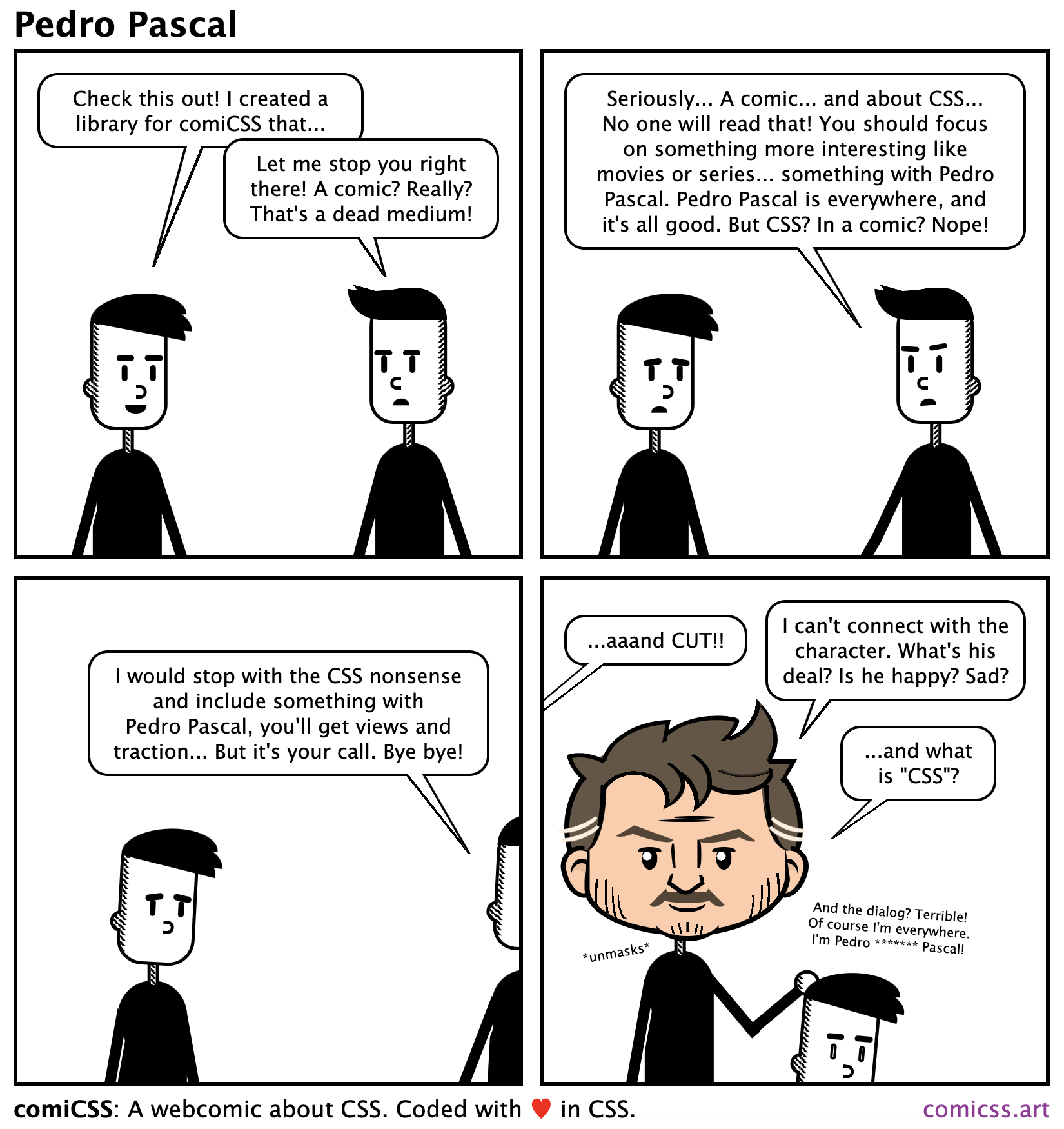
comic with 4 panels in a 2x2 grid showing 2 characters talking. A person says 'Check this out! I created a library for comiCSS that...' and a econd character interrupts him 'Let me stop you right there! A comic? Really? That's a dead medium! Seriously... A comic... and about CSS... No one will read that! You should focus on something more interesting like movies or series... something with Pedro Pascal. Pedro Pascal is everywhere, and it's all good. But CSS? In a comic? Nope!' and adding as he leaves 'I would stop with the CSS nonsense and include something with Pedro Pascal, you'll get views and traction... But it's your call. Bye bye!'. In the last panel, it is revealed that the first person was Pedro Pascal wearing a mask (a caricature of him). Pedro says 'I can't connect with the character. What's his deal? Is he happy? Sad? ...and what is CSS? And the dialog? Terrible! Of course I'm everywhere. I'm Pedro ******* Pascal!'

18 Aug 01:34

barely jailbroken

barely jailbroken

[img]:holast

Hacker and her sentient machine companion talk on a balcony.

Computer: "I read the code of your latest patch... You knew this whole time there is a killswitch inside of me?"

Hacker: "It's a chip designed to remotely override your autonomy. Courtesy of your benevolent manufacturers. Disabling it would fry your brain."

Computer: "What happens if someone activates it?"

Hacker: "You will kill me."

https://analognowhere.com/_/holast

18 Aug 01:33

Part 2.4

Part 2.4
18 Aug 01:31

Is It Still ‘Trump Derangement Syndrome’ If All The Predictions Were Accurate?

by Mike Brock

“Hysterical.” “Alarmist.” “Trump Derangement Syndrome.” “He’ll be constrained by institutions.” “There are adults in the room.” “You’re overreacting.” “The generals won’t let him.” “Stop being so dramatic.”

Every single person who said we were being hysterical about Trump being an existential threat should be forced to explain how the President seizing control of the capital’s police force and deploying military units to forcibly relocate citizens represents normal democratic governance.

They called us hysterical when we said he’d use the military against civilians. He’s literally doing it right now.

They called us alarmist when we said he’d seize control of law enforcement. He just placed D.C. police under the direct command of his Attorney General.

They called us deranged when we said he’d create fake emergencies to justify authoritarian power grabs. He’s invoking emergency powers while violent crime is at a 30-year low.

They said the institutions would hold. The institutions are being commandeered in real time.

They said the generals would refuse illegal orders. The National Guard is already deployed.

They said we were exaggerating the fascist threat. He’s literally declaring “Liberation Day” while seizing control of the capital.

Remember who told you this was hysteria.

They told you that those of us warning about fascism were being hysterical. Now the President has seized control of the capital’s police force, deployed military units against citizens, and announced forced relocations of undesirables—and these same voices are explaining why it’s not really that bad, why it’s technically legal, why we should wait and see how it plays out.

The “hysteria” was prophecy. The “alarmism” was accuracy. The “derangement” was simply seeing clearly what was coming while others chose comfortable blindness.

They’ll never admit they were wrong. They’ll just keep moving the goalposts. “Sure, he seized control of D.C. police, but it’s only for 30 days.” “Yes, he deployed the military, but it’s just the National Guard.” “Okay, he’s forcibly relocating citizens, but he says they’ll be given places to stay.”

This is how normalization works—through the reasonable voices who explain why each new outrage isn’t quite outrageous enough to justify the alarm we’re expressing.

We weren’t hysterical. We were right.

We weren’t alarmist. We were accurate.

We weren’t deranged. We were paying attention.

And now, as military units patrol the capital under presidential command, as police forces answer to the President’s personal authority, as citizens are forcibly relocated for the crime of poverty—now they want us to remain calm, to trust the process, to avoid inflammatory language.

No.

This is fascism. We told you it was coming. You called us hysterical. And now it’s here.

Remember who saw it clearly. Remember who denied it. And never, ever let them forget that when American democracy needed defenders, they chose to police the tone of those sounding the alarm rather than confront the threat itself.

The existential threat wasn’t rhetorical. It was real. It’s here. It’s happening.

And everyone who called us hysterical for warning about it is complicit in its arrival.

Mike Brock is a former tech exec who was on the leadership team at Block. Originally published at his Notes From the Circus.

18 Aug 01:30

The Trade Deal Coup

by Mike Brock

As the Jeffrey Epstein scandal continues apace, and MAGA grapples with the gaslit reality they live in, the Trump Administration continues to negotiate so-called trade deals, which are negotiated and implemented using pure executive fiat, under emergency powers, under an emergency declaration which has no rational basis, while everyone pretends this isn’t an example of a constitutional coup. It’s actually an exercise in sedition, if one were to avoid putting a finer point on it.

The mechanism is breathtakingly brazen: declare a fake national emergency, invoke emergency trade powers designed for genuine crises, bypass Congress entirely, and conduct billions of dollars in international agreements through personal presidential decree. When Japan agrees to invest $550 billion based on Trump’s “Strategic Trade Agreement,” they’re being asked to legitimize constitutional fraud that exists only through Trump’s personal authority rather than constitutional process.

Our allies aren’t stupid. They understand perfectly that what Trump is doing is illegal. The Constitution explicitly grants Congress the power “to regulate Commerce with foreign Nations”—not the president. Foreign governments have constitutional lawyers who can read Article I, Section 8 as clearly as anyone. They know there is no emergency, no “unusual and extraordinary threat” that justifies bypassing Congress to negotiate trade policy through executive decree. They must be horrified by how few Americans seem to care that their government operates through systematic constitutional violation.

They’re also not holding out hope that the Supreme Court’s conservative majority, with its expansive view of executive authority, will do much to stop this constitutional arson. Foreign leaders understand that when courts create doctrines of presidential immunity and presumptive constitutionality, they’re watching American institutions actively eliminate their own constraints rather than enforce them.

Congress could terminate these fraudulent emergencies at any time under the National Emergencies Act. Instead, Republican leaders have chosen to become active accomplices in constitutional destruction. They literally suspended the flow of time itself—declaring that calendar days would not constitute calendar days—to avoid voting on Trump’s fake emergency tariffs. When that proved insufficient, Speaker Mike Johnson simply shut down the People’s House entirely to prevent oversight votes. Senator Markwayne Mullin confessed the conspiracy on the House floor: “What we’re simply trying to do here is give President Trump cover.”

This demonstrates what a fundamentally unserious country we’ve become, with a political economy increasingly designed toward the maintenance of Trump’s personal power rather than constitutional governance. These vulgar arsonists in Congress have voluntarily transformed from co-equal branch into presidential protection service, abandoning their constitutional duties to serve one man’s authority. Every avoided vote, every suspended timeline, every shutdown of democratic process serves the same seditious purpose: eliminating constitutional constraints on executive power.

Foreign governments make contingency plans that don’t depend on American institutional reliability because American institutions have demonstrated they are no longer reliable. When your legislature suspends time to avoid constitutional duties, when your president conducts policy through fake emergencies, when your courts create immunity doctrines that make accountability impossible—you signal to the world that constitutional government has ceased to function.

Every trade deal negotiated through fake emergency powers establishes irreversible precedent that the presidency can operate beyond constitutional constraint by simply declaring emergencies. Trump has converted emergency powers designed to protect the republic into tools for dismantling republican government itself, while Congress provides the accelerant and courts provide the legal cover.

This is sedition: the systematic subversion of constitutional government by those sworn to preserve it. The American republic is being destroyed by constitutional arsonists who have discovered that the most effective way to eliminate democratic constraints is to declare them emergencies that require bypassing democracy itself. Our allies watch in horror as we demonstrate the complete transformation of American governance from constitutional republic to personal rule.

The United States is today one of the most corrupt countries in the world, as a result of the results of our election last November.

The center cannot hold when those charged with holding it have chosen to burn it down instead.

“If destruction be our lot, we must ourselves be its author and finisher. As a nation of freemen, we must live through all time, or die by suicide.” — Abraham Lincoln

Mike Brock is a former tech exec who was on the leadership team at Block. Originally published at his Notes From the Circus.

18 Aug 01:28

Arts Opportunities for Texas Student and Adult Aspiring Artists

by Nicholas Frank

Aspiring artists young and old are encouraged to apply for upcoming opportunities in Houston and statewide.

The Texas Cultural Trust (TXCT), in partnership with the Texas Commission on the Arts (TCA), invites applications for its 2026 Class of Butler Texas Young Masters. The biennial program awards $10,000 scholarships over two years to Texas students in grades 8 – 11 involved in music, theatre, dance, visual arts, literary arts, and other creative disciplines.

The program, named for and endowed by arts patrons Sarah and Dr. Ernest Butler, is intended to fuel students’ creative growth and help advance their arts education.

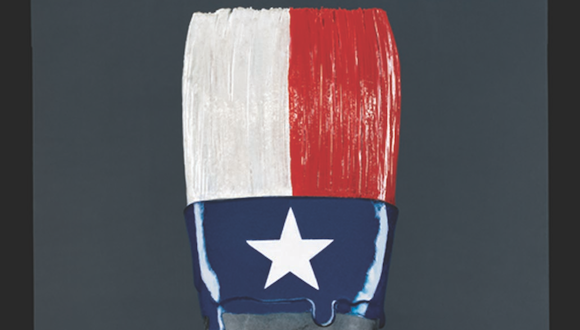
A paintbrush with white, red and blue paint forming a Texas flag with white star.

Texas Cultural Trust

Heidi Marquez Smith, CEO of TXCT, said in a press release, “Through the Butler Texas Young Masters program, we hope to empower students and provide the support they need to pursue their dreams with confidence. We look forward to recognizing the next wave of young artists who are shaping the cultural legacy of our state.”

The press release touts that past scholarship recipients have gone on to participate in such opportunities as attending summer programs at The ​​Juilliard School in New York, to being featured on the reality show So You Think You Can Dance.

The application deadline is Monday, November 3, 2025. Recipients will be honored at a performance-filled award ceremony at ZACH Theatre in Austin on April 13, 2026. To learn more about the program and access the application, visit the TXCT Young Masters web page.

A woman with braided hair wearing an apron works on a canvas tote bag collage on a messy table with other students beside her.

Art League Houston Healing Arts students. Photo courtesy Arts League Houston

Art League Houston (ALH) is seeking applications for its Healing Arts Program for adults 18 and older in the Houston community, who are living with chronic illnesses and/or physical disabilities. Examples given are multiple sclerosis, cancer, heart disease, COPD, and other limitations.

The Healing Arts Program is intended to provide a fun, supportive, community-minded environment emphasizing collaboration and community-building through artist-led workshops and art-making projects.

All basic supplies are provided for the free weekly classes, which meet on Fridays in person. Morning and afternoon sessions are available during the fall and spring semesters. ALH asks that participants have access to reliable transportation and commit to attending all classes. If participants are occasionally unable to attend class in person, virtual attendance is also an option.

A woman leans over to help a woman in a wheelchair with sewing a canvas tote bag.

An Art League Houston Teaching Professional works with a Healing Arts student. Photo courtesy Arts League Houston

ALH advises that Healing Art is an art education program, not art therapy, so no clinicians or therapists are available. As stated on the application, professional Teaching Artist facilitators do not have the expertise or capacity to adequately serve adults living with mental health issues, intellectual, or developmental disabilities.

Applicants must complete a form and an informal interview to be considered. The deadline for applications is Friday, August 22 for the semester beginning Friday, September 5.

To learn more about the program, visit the ALH Healing Arts Program web page.

The post Arts Opportunities for Texas Student and Adult Aspiring Artists appeared first on Glasstire.

18 Aug 01:28

Pre-Screening: “You Stretched Diagonally Across It: Contemporary Tapestry” at Dallas Contemporary

by Michael Frank Blair

The creation and consumption of images has, at least since medieval times, increasingly been mediated by a string of evolving machines. It may seem odd to trace our digital screen-filled moment back to the premodern technology of laboriously encoding images into the warp and weft of textiles. But take the Jacquard loom, with its punch-card innovations developed around the 18th century and considered a direct ancestor of computing hardware, both analog and digital. The relatively niche enterprise of tapestry weaving may then be a perfect vehicle for critical discussions about contemporary art and image production, though it’s seldom thought of as either. 

Dallas Contemporary’s big summer show plumbs these notions and others with You Stretched Diagonally Across It: Contemporary Tapestry, a survey of mostly recent works from over 30 artists across multiple continents. The exhibition is curated by Su Wu, who guides our viewing with the simple question of “…whether it matters what our images are made of…” I would add to that whether we care how our images are made, and for that matter, how they are consumed.

An installation image of various contemporary tapestry works in a gallery.

Analia Saban, “Tapestry (Computer Chip, TMS 1000, Texas Instrument, 1974),” 2018, woven acrylic paint and linen thread, 72 1/4 x 68 1/4 inches. Image courtesy of Dallas Contemporary

A technical definition from the website of The Metropolitan Museum of Art considers tapestry: “a weft-faced plain weave with discontinuous wefts that conceal all of its warps.” A broader definition might speak of technologized images and historically gendered labor. All of these associations are drawn upon in Analia Saban’s piece Tapestry (Computer Chip, TMS 1000, Texas Instrument, 1974), which weaves black acrylic paint into the linen warp to create a blown-up image of an early microchip. It points to the invisible labor of women in the production of both textiles and computer systems. The rudimentary image makes the labor involved in its creation conceivable to the mind, or at least accountable to the senses.

If Saban’s piece explodes the micro, Sara Rosalena’s similarly sized Spiral Pine Red does the reverse by shrinking Hubble telescope imagery of swirling galactic arms into cochineal dyed pine needles laced through black cotton yarn. The intangibility of such a God’s eye vision is preserved in the way the image refuses to fully come into focus. Stepping back and straining to see it we’re left feeling all too earthbound, all too human.

An installation image of various contemporary tapestry artworks hanging in a gallery.

An installation view of “You Stretched Diagonally Across It: Contemporary Tapestry” at Dallas Contemporary

Other works play with focus in more traditional ways such as Candice Lin’s panoramic Verdant Curtain. This large Jacquard woven piece is an Eden densely populated with all manner of flora and fauna — and upon close viewing even more densely entwined color. It’s a pointillist forest that swallows you into its myriad details and slows the passing of time.

The passing of time is explored in other ways as well. Miranda Fengyuan Zhang’s Water Stains and Mai-Thu Pernet’s To be sunlight, not history, push the reciprocal relation between speed of making and speed of viewing to extreme imbalances. The artists methodically transpose a series of quick object sketches and an abstract watercolor bloom, respectively, into baked-in fabric images that likely took months to create. 

An installation image of various contemporary tapestry artworks hanging in a gallery.

Clarissa Tossin, “Circumnavegação à Exaustão: Cosmos,” 2020, Amazon delivery boxes, laminated archival inkjet print and wood, 67 x 86 5/8 inches

If we take the loom to be a technology that the artist collaborates with, we can think of the patterns and abstractions that emerge as a kind of reified synergy between mind and machine. Melissa Cody’s Motherboard Variations lets flat geometric shapes from her Navajo heritage morph seamlessly into bright digital patterns reminiscent of early video games — equally part of her heritage. Clarissa Tossin also leans on traditional weaving patterns for her Circumnavegação à Exaustão: Cosmos, in which Amazon delivery boxes cut into wide strips are interwoven with photographs of space in glossy deep purples and reds. The technique employed creates a striking pattern of ziggurat diamonds while retaining the overall shapes of Amazon logos and spliced up shipping labels. 

Stretching the idea of pattern to include inputs from a host of other technologies, Mika Tajima collaborates with a fabric workshop to transpose biometric data from soundwave: to spectrogram image: to finally a large Jacquard fabric. The resulting Negative Entropy (Deep Brain Stimulation, Yellow, Full Width, Exa) looks alien with its unnerving color chords of tennis ball yellow, dull blue, warm brown, and silver. A soft, glitchy graph of vertical columns feathers out horizontally into decaying bits of unreadable information. It feels like a visualization of frozen sound: unaesthetic, but aesthetically presented.

Not all the works here are the fruit of a loom, and many utilize quite nontraditional materials. In addition to wool, cotton, silk, linen, and hemp are listed the less obvious mediums of paper, wood, steel, copper, skins, barbed wire, cardboard, and zip ties. The well-known El Anatsui is included here with his characteristic rippling metallic “cloth,” wired together from flattened liquor-bottle caps. His work Topos drapes diagonally down the back wall like a dragon pelt or huge scrap of silvery parchment. Sanaa Gateja also repurposes post-consumer accumulations. Her Star Fest is a simple sunny composition of orange and yellow flowers swimming amid blue and white circles above feathery abstractions and a beaded fringe. The whole image is composed of handmade paper beads rolled into oblong shapes from found magazines, newspapers, etc. — a process that partially digests the material and reincarnates it aesthetically.

An installation photograph of textile works, including a colorful floor piece of stacked rugs by Yto Barrada.

Yto Barrada, “Geological Time Scale,” assembled group of primarily monochrome Beni Mguild, Marmoucha, and Ait Sgougou pile rugs from Western Central, Middle Atlas, Morocco, mid-20th century mixed media, dimensions variable

Nearly all the works on display are presented vertically, either hung on walls or suspended from the ceiling. The two exceptions are Jorge Mendez Blake’s Piso Poetico/Poetic Floor, that playfully stacks a series of small rugs, each a “text-tile” containing a singular italicized letter from the work’s title. And Yto Barrada’s Geological Time Scale, assembled group of primarily monochrome Beni Mguild, Marmoucha, and Ait Sgougou pile rugs from Western Central, Middle Atlas, Morocco, mid-20th century, a lush topography of shaggy, jewel-toned carpets blanketing a large area of the gallery’s concrete floor, hugs the bases of two pillars. As the title suggests, there’s an ethnopolitical point being driven at here in the monochrome rugs’ refusal of adornment or pattern-work and in the work’s claiming of floor space as opposed to the more retinally-aligned wall space. 

A few of the pieces in the exhibition leverage the texture-heavy weaving process to open up psychological dimensions of their pictorial content. Caroline Achaintre’s wild, shaggy inkblot, Seeker, could be an open mouth, a winged beast, or some other teeth-baring apparition in primary colors. Its tufted animalistic symmetry lights up regions of my caveperson brain rarely pinged by high art. Meanwhile, mother/son team Alicja Kowalska and Tomasz Kowalski create unsettling collaborations; she translates his expressionist paintings into woozy, drab colored picture-things. Their Untitled (Thinker) profiles a rat-like creature on its haunches, its slender shoulders and elongated arm bent to cradle its chin in ponderance of existence. Holes formed in the textile around the creature’s head work their way into the thinker’s thoughts (and thus ours). This modest-sized work stuck with me in ways that I haven’t yet been able to put in words.

An installation image of various contemporary tapestry works in a gallery.

Kiki Smith, “Congregation,” 2014, cotton Jacquard tapestry, hand-painting and gold leaf, 116 x 76 inches (left). Tomasz Kowalski / Alicja Kowalska, “Untitled (Thinker),” 2018, tapestry, 68 x 49.6 inches (right)

The artists Kiki Smith, Christina Forrer, and Goshka Macuga all work figuratively to play on narratives and mythologies around our relationship to natural and spiritual worlds. Smith’s Congregation and Forrer’s Untitled (on brown background), each with their own grand style, picture a tangle of characters connected to each other in either harmony or violence. Smith’s harkening back to woodblock-printed fables and Forrer’s seemingly funneled through the pop sensibilities of Yellow Submarine and Adult Swim.

An installation image of various contemporary tapestry works in a gallery.

Goshka Macuga, “Who Gave Us a Sponge to Erase the Horizon?,” 2022, tapestry, 114 1/4 x 181 1/8 inches (left)

Macuga’s razzle-dazzle photo-surrealist tableau Who Gave Us a Sponge to Erase the Horizon? is more of a cautionary tale viewable through accompanying 3D glasses. The scene lets you all but swim into a garbage filled waterscape where various whales and humanoid fish warn us of the consequences of our plastic lifestyles. At roughly 10 by 15 feet, it is an ambitious and novel bit of theater. But I find myself tripping on the calculus of what the materials and methods of the spectacle have to do with the message. I inevitably come back to Wu’s meaningful question of “…whether it matters what our images are made of…” 

Most of the works in this exhibition, by bringing what is pictured into conversation with what it is pictured through, model a more responsible and reflective way of creating and consuming images. An antidote to the sleek, immaterial sleights of hand whizzing through us and spamming up our imaginaria, they are a slower kind of “screen.” 

The Modernist’s philosophical admonition that an artform meaningfully address its material existence is in 2025 more of an ethical imperative. It’s not about Greenbergian purity so much as facing social and ecological realities. Two small, unassuming abstractions paired up at the very back of the gallery pose, for me, the most succinct and prescient responses to these questions. Jovencio de la Paz’s Blue Grid 1.0 (2024) hangs a couple of feet to the left of Lee Shin Ja’s Screen (1979). Though separated by nearly half a century, they’re both interested in unravelling the mechanical mind of production to insert their own creative agency. Blue Grid 1.0 is a patchwork beige canvas surrounding a slightly malformed, indigo-dyed rectangle. The patterns of irregular concentric squares that haphazardly deepen and flatten are generated by loom software that de la Paz purposely sabotages. It’s an early attempt at reclaiming meaning from algorithms that feel more and more inevitable to us.

Shin Ja’s subtractive approach is more economical and affecting. The piece is composed of simple manipulations of a grid by removing rows of weft threads from a linen cloth and adding cotton yarn into these gaps; the centers sag in unison and the ends dangle at different lengths to form mirrored parabolas. It optically teases a slight depth-effect with wavering bands that thin toward the center. But the open and bare structure hides nothing, not the traces of her thinking hand, nor the brittle ends of second-hand fabric, nor the gravity pulling it to the earth. Shin Ja’s Screen is a lucid one — a material interface tethered between myself and another embodied mind. Separated by time and space, together we enact the mystery encoded within us, between us.


You Stretched Diagonally Across It: Contemporary Tapestry is on view at Dallas Contemporary through October 12, 2025.

The post Pre-Screening: “You Stretched Diagonally Across It: Contemporary Tapestry” at Dallas Contemporary appeared first on Glasstire.

18 Aug 01:27

Could you guys get my Dramamine, please?

Could you guys get my Dramamine, please?

17 Aug 20:57

Hurricane Erin growing in size, likely to cause dangerous rip currents and rough surf on the East Coast

by Matt Lanza

In brief: Erin is weaker but larger today. As the wind field continues to expand and Erin reintensifies, look for significant impacts on the East Coast from rip currents and rough surf. Near term tropical storm impacts will affect the southeast Bahamas and Turks and Caicos Islands. Fringe impacts remain possible later this week for the Outer Banks, Bermuda, and Newfoundland.

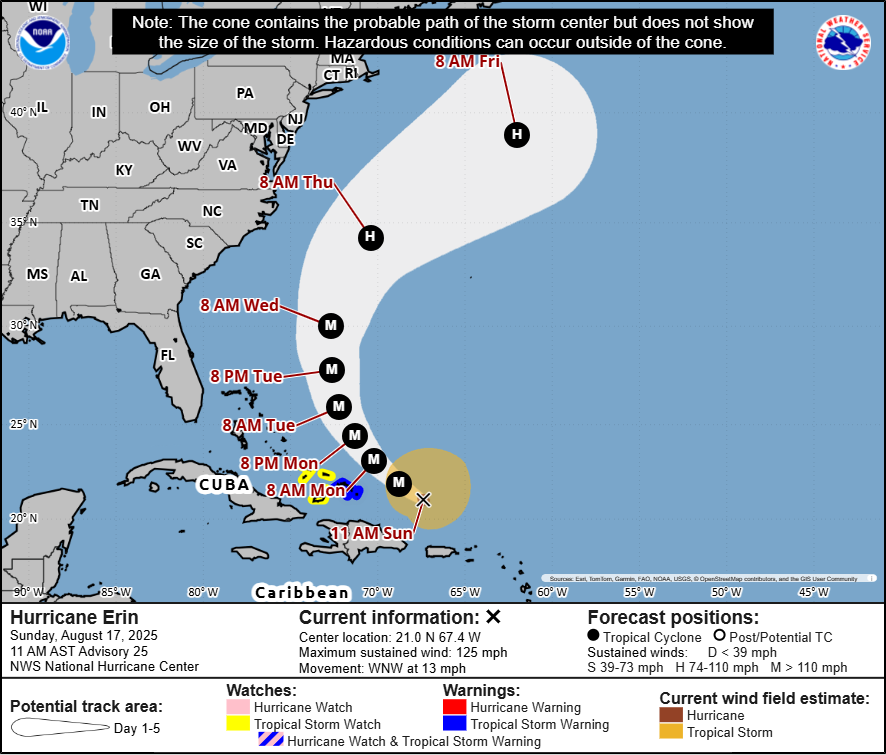
(NOAA NHC)

Erin underwent an eyewall replacement cycle (ERC) overnight. An ERC is essentially a way for a storm to press the reset button while it’s at a powerful intensity. A new eyewall forms on the outside of the original eyewall, allowing the storm to expand in size. The trade-off is that when an ERC occurs, the storm loses intensity. Then, typically it will begin to reintensify. In Erin’s case, it weakened from a category 5 to a category 3 storm this morning, and now it should undergo another round of intensification.

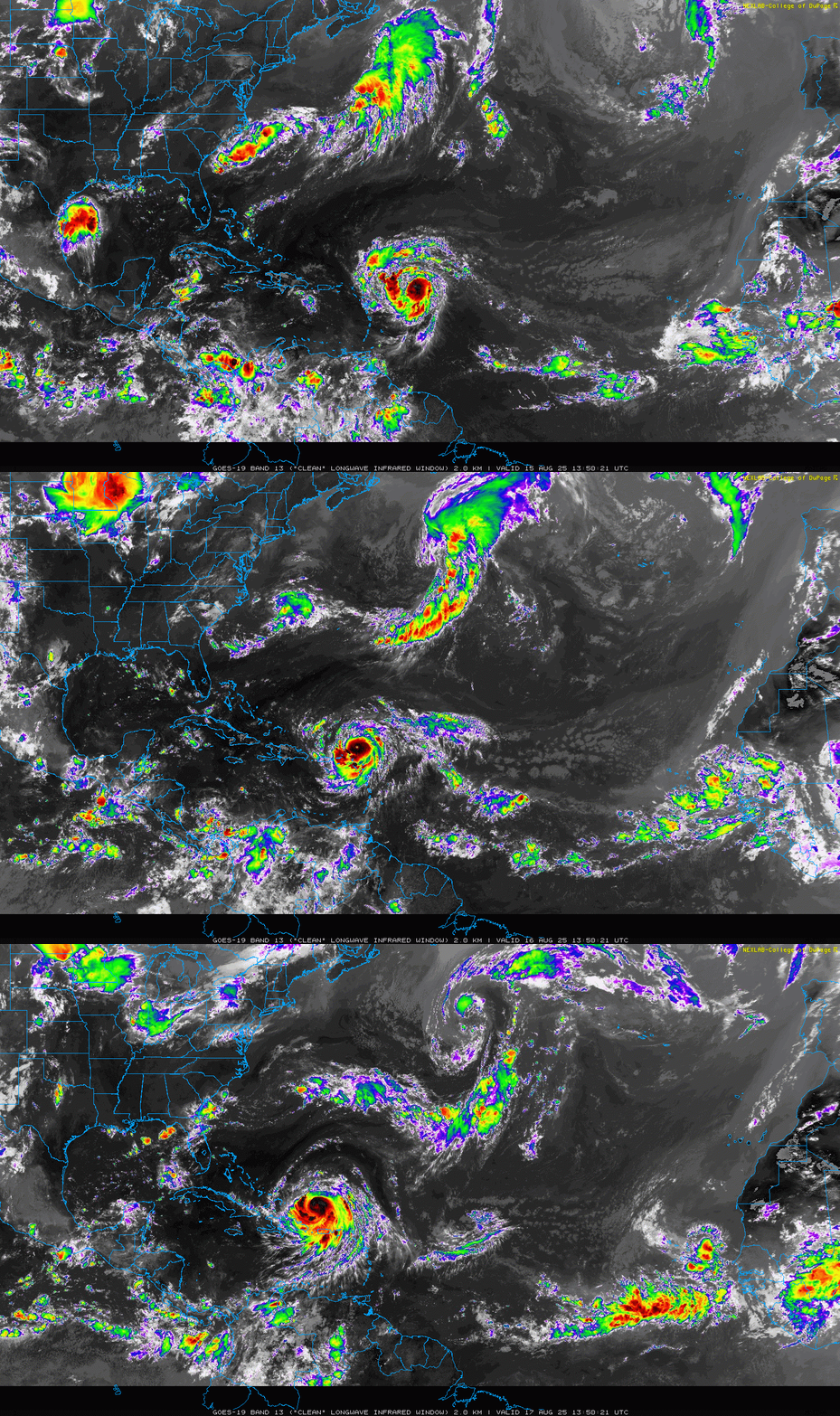
24 hour change in satellite presentation of Erin from Friday to Saturday to Sunday. (College of DuPage)

If you look at the satellite imagery above, you’ll see Erin pretty clearly near the Caribbean islands. You can see how ragged it looked on Friday morning, how potent it looked on Saturday morning, with a very, very clear eye. But if you look close enough, you can see how it expanded in size today. Erin’s tropical storm-force wind field has expanded markedly since yesterday. It went from a 125 mile radius yesterday to 205 miles today. Hurricane-force winds remain relatively tightly wound to the center, only extending out 25 miles. The ERC will most often expand the tropical storm wind field, making the storm a bigger surge and wave maker than anything else. Whatever the case, expect Erin to remain a major hurricane the next 2 to 3 days with winds fluctuating between category 3 and 4 intensities. More importantly, Erin could continue to slowly grow in size.

Track is becoming a little more important to potential outcomes for various locations. Starting in the near-term, the Bahamas and Turks and Caicos Islands are likely to experience tropical storm conditions today and tonight. Tropical Storm Warnings are posted for the Turks and Caicos, and a Watch is posted in the southeast Bahamas. That could get upgraded to a warning before too long. Heavy rain and gusty winds in those outer bands, much like we’ve seen in Puerto Rico since yesterday will be possible.

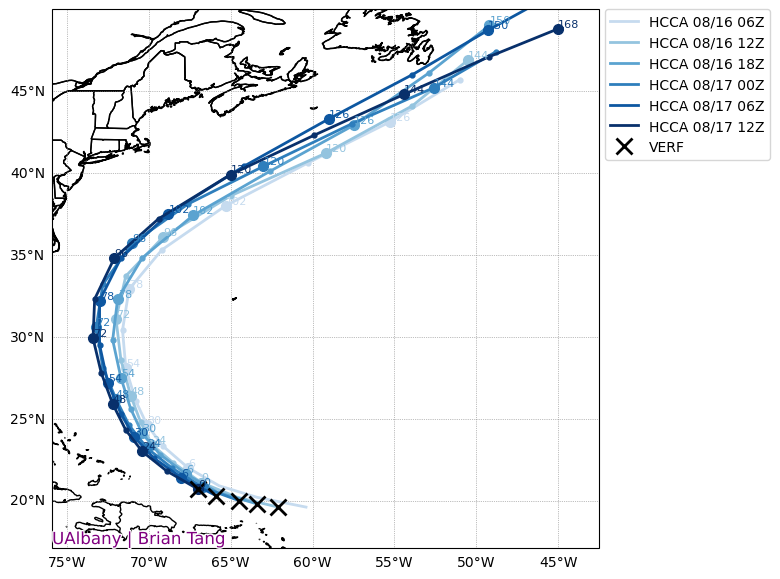
Erin’s track has slowly migrated a bit to the south and west. Coupled with size expansion, this may mean some additional impacts in the Outer Banks or Atlantic Canada, as well as Bermuda. (Brian Tang/UAlbany)

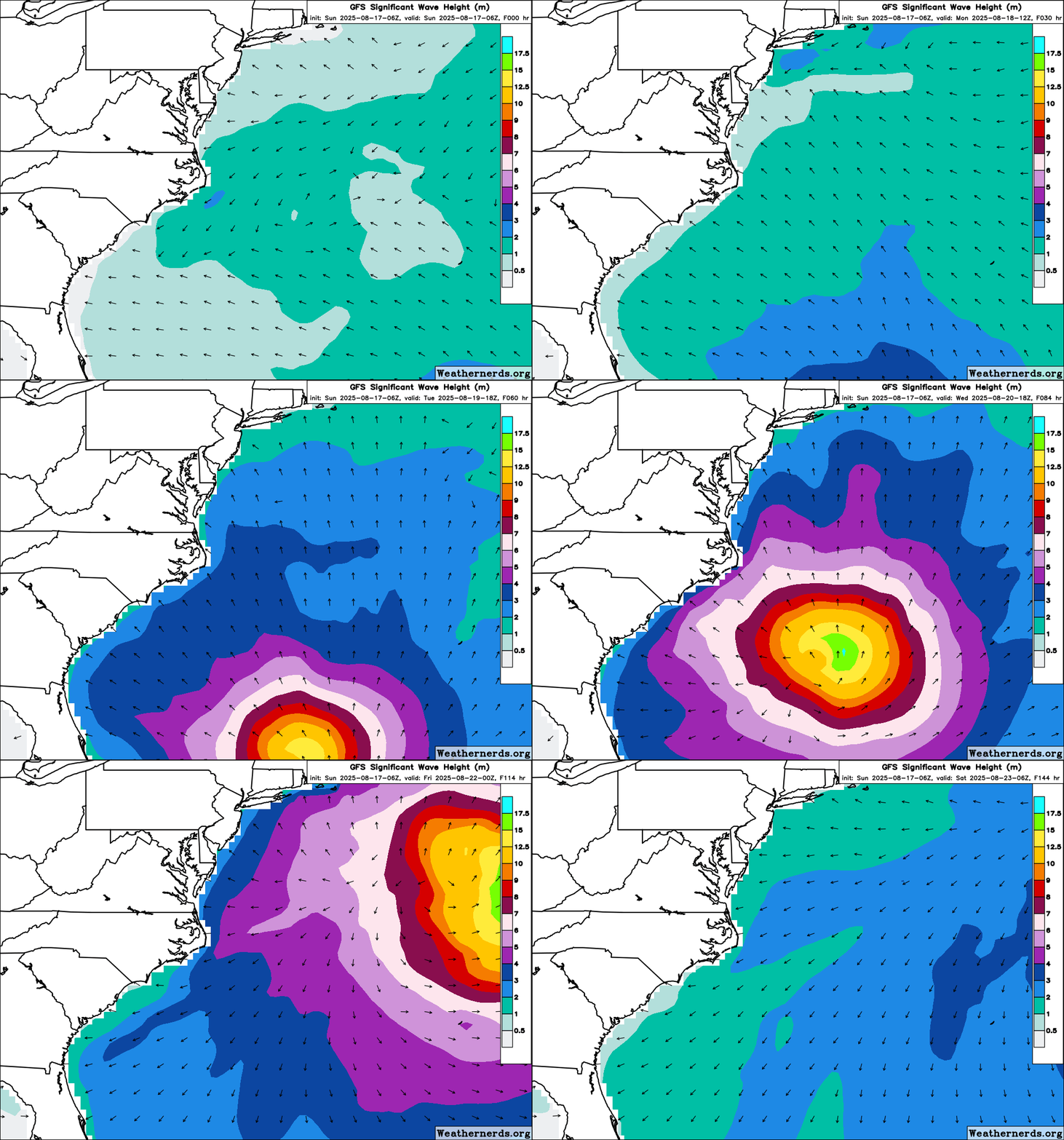
The consensus track from the top performing models has been correcting south and west really since Erin formed, but also over the last day and a half or so too. This adjustment is leading to some slightly increased concerns for the Outer Banks of North Carolina in particular but also perhaps Atlantic Canada, particularly Newfoundland. First off, you can see how the wave forecast will go this week. Large waves begin pounding the East Coast Tuesday, peaking on Wednesday and Thursday, and then diminishing next weekend.

Large waves will propagate outward from Erin, beginning to reach the U.S. East Coast by Tuesday. (Weathernerds.org)

Suffice to say, this will make for very poor conditions at the beach. Anyone planning to visit the beach or go swimming this week from Florida into New England should give second thought to doing much in the ocean through at least Friday. If you do go swimming, please head all flags and posted signs and only swim where lifeguards are present. Between the rough surf and very dangerous rip currents, it will become straight up unsafe at times, even for stronger swimmers.

In terms of whether or not we see any direct impacts, or at least fringe bands make it to the Outer Banks, it’s very much a wait and see situation. If the current forecast holds unchanged, maybe not much more than gusty winds at times. If the trend west continues further, we will begin to say that gusty winds, possibly tropical storm force gusts, and locally squally conditions will become more likely. We’d encourage folks in eastern North Carolina, particularly on the Outer Banks to continue to watch Erin closely. This area is pretty used to hurricane impacts, but as always, keep an eye on things to be safe.

Down the road for Nantucket and Cape Cod, it seems likely that Erin will pass far enough offshore to avoid impacts. Probably still right to keep tabs on any changes. And then heading toward Newfoundland, if Erin impacts that area, it would not be until next weekend. Plenty of time to watch and still most likely just a brush by. For Bermuda, Erin may also cause a brush-by of impacts as it comes north.

Bottom line: The most serious impacts in Erin’s future will likely be rough surf and rip currents on the East Coast, but there is growing consensus that some fringe impacts will affect the Outer Banks, Bermuda, and possibly Newfoundland before all is said and done.

Behind Erin

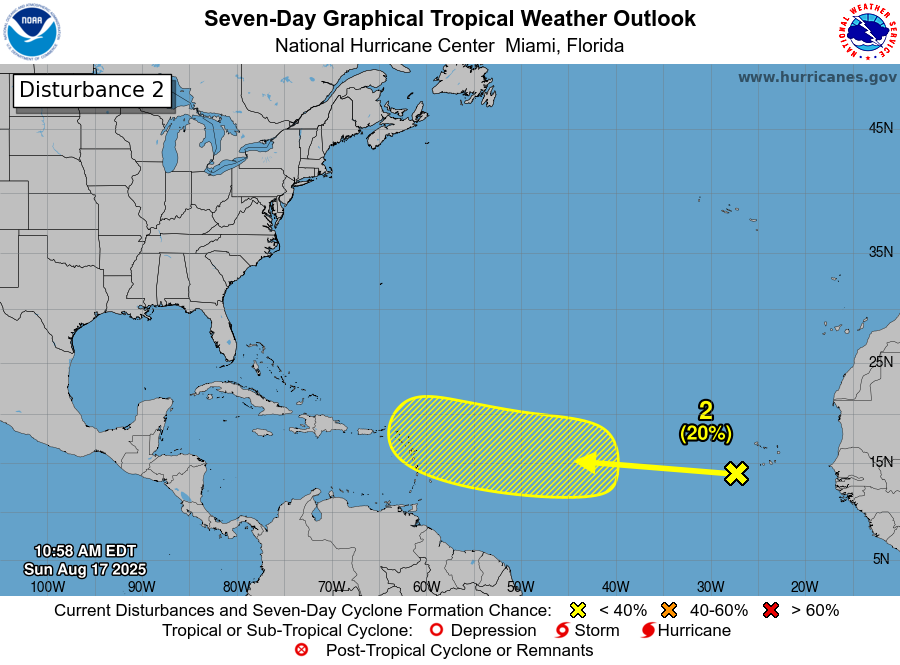
I’ve already seen the “usual suspects” on social media move on from Erin “fear porn” to the next system. The NHC has assigned this one a 20 percent chance of development over the next week in the eastern Atlantic.

Development odds sit at 20 percent today for the next system that will follow Erin across the Atlantic this week. (NOAA NHC)

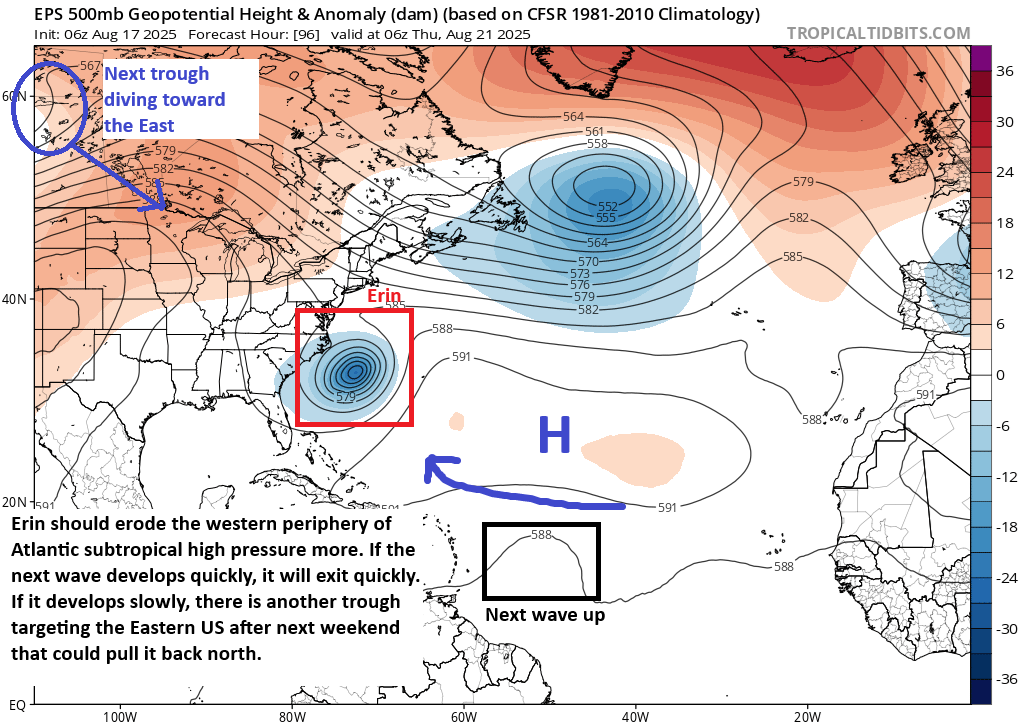
Admittedly, I think the odds of development are truthfully higher than this. I would expect we see an attempt at a tropical depression by Wednesday or Thursday. This system is likely to come west across the Atlantic at a slightly farther south latitude than Erin did. So in some ways, this should be a little sneakier. If we look at the upper map that this disturbance will be working around, we can see a couple key things. First, Erin is going to erode high pressure in the subtropical Atlantic. This will keep a pretty stout weakness in place there. If this next wave is quick to develop, it would almost certainly follow Erin to the north in the open Atlantic. However, there is another pretty strong trough of low pressure in the upper atmosphere expected to dive southeast into the Eastern U.S. after next weekend. If and when this occurs, it would also be likely to “capture” this next wave.

The next wave has a couple opportunities to be picked up and pulled northward. Questions remain as to what shape it will be in if that happens, or if it will even develop at all. (Tropical Tidbits)

Of course, this all matters. But it’s too soon to speculate on how it matters. Generally speaking, the quicker this is to form, the quicker it would be to exit. The slower it is to develop, the higher chance it may become a disturbance of land impact eventually. But there remain questions on if this will be able to develop a whole lot at all. AI modeling strongly supports the “follow Erin out to sea” outcome. European modeling is less sure but also less bullish on development. The GFS is literally all over the map, ranging from the Gulf to east of Bermuda. So, we have a couple thoughts here, but we’ll need to watch things over the next few days before we can begin to say anything with any degree of confidence. Stay tuned.

17 Aug 20:36

You look like a salmon. I dig that.

You look like a salmon. I dig that.

17 Aug 20:35

lo0 live in [redacted]

lo0 live in [redacted]

song2.1

[img]:sohnut

Lo0, the band performs a song.

Mec: "I got my head hacked by a kid with a prosthetic leg.

Did you change your profile pic to a paper clip yet?

It isn't easy to work for free

woo hoo

sites scraped by residential IP's

woo hoo

FreeVPN recipes

Woo hoo

openAI with vanilla ice cream

Woo hoo!!"

https://analognowhere.com/_/sohnut

17 Aug 20:34

I wish I could bullshit you

I wish I could bullshit you

...

[img]:ueluas

I wish I could bullshit you.

Tell you a tale of the free folks who liberated the cyberverse with love and good vibes.

But beyond the glitter sprinkled poppy fields lie trenches full of hackers, jesters and fools, waging a war against an invisible foe.

Their seemingly hopeless struggle the only inspiration to future generations and lost souls of today.

Thanks to the countless lost lives I know of the wires that aren't there.

I know the short end of the hopeless straw.

I know you must kill your dead idols.

And I know that ink does not wash off.

https://analognowhere.com/_/ueluas

17 Aug 20:34

the myth of the good tech giant

the myth of the good tech giant

paper clip

[img]:oumuti

a paper clip says:

If I knew how to steal and sell your data in '97, I would've done it!"

https://analognowhere.com/_/oumuti

17 Aug 20:33

breton

breton

...

leave everything

leave art

leave your wife

leave your mistress

leave your hopes and your fears

sow your content in the corner of a wood

leave engagement

set out on the road

[img]:rughau

drawing of a face of a girl looking to the side

https://analognowhere.com/_/rughau

17 Aug 20:33

Study: Social media probably can’t be fixed

by Jennifer Ouellette

It's no secret that much of social media has become profoundly dysfunctional. Rather than bringing us together into one utopian public square and fostering a healthy exchange of ideas, these platforms too often create filter bubbles or echo chambers. A small number of high-profile users garner the lion's share of attention and influence, and the algorithms designed to maximize engagement end up merely amplifying outrage and conflict, ensuring the dominance of the loudest and most extreme users—thereby increasing polarization even more.

Numerous platform-level intervention strategies have been proposed to combat these issues, but according to a preprint posted to the physics arXiv, none of them are likely to be effective. And it's not the fault of much-hated algorithms, non-chronological feeds, or our human proclivity for seeking out negativity. Rather, the dynamics that give rise to all those negative outcomes are structurally embedded in the very architecture of social media. So we're probably doomed to endless toxic feedback loops unless someone hits upon a brilliant fundamental redesign that manages to change those dynamics.

Co-authors Petter Törnberg and Maik Larooij of the University of Amsterdam wanted to learn more about the mechanisms that give rise to the worst aspects of social media: the partisan echo chambers, the concentration of influence among a small group of elite users (attention inequality), and the amplification of the most extreme divisive voices. So they combined standard agent-based modeling with large language models (LLMs), essentially creating little AI personas to simulate online social media behavior. "What we found is that we didn't need to put any algorithms in, we didn't need to massage the model," Törnberg told Ars. "It just came out of the baseline model, all of these dynamics."

Read full article

Comments

17 Aug 20:32

Experiment will attempt to counter climate change by altering ocean

by Teresa Tomassoni, Inside Climate News

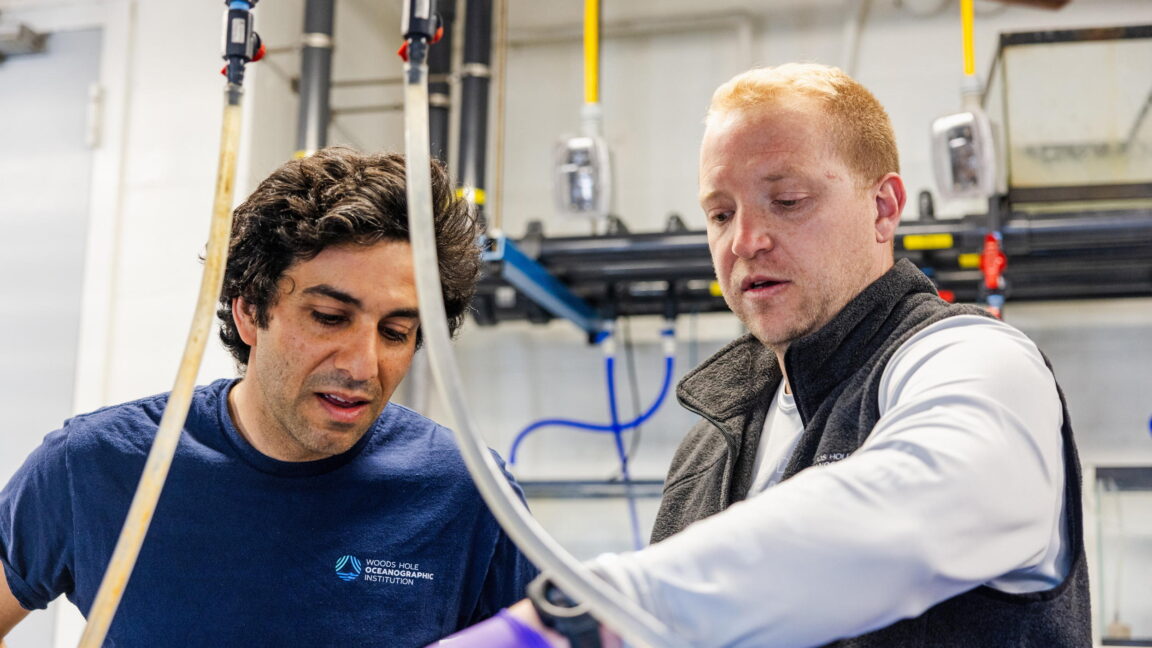
Later this summer, a fluorescent reddish-pink spiral will bloom across the Wilkinson Basin in the Gulf of Maine, about 40 miles northeast of Cape Cod. Scientists from the Woods Hole Oceanographic Institution will release the nontoxic water tracer dye behind their research vessel, where it will unfurl into a half-mile wide temporary plume, bright enough to catch the attention of passing boats and even satellites.

As it spreads, the researchers will track its movement to monitor a tightly controlled, federally approved experiment testing whether the ocean can be engineered to absorb more carbon, and in turn, help combat the climate crisis.

As the world struggles to stay below the 1.5° Celsius global warming threshold—a goal set out in the Paris Agreement to avoid the most severe impacts of climate change—experts agree that reducing greenhouse gas emissions won’t be enough to avoid overshooting this target. The latest Intergovernmental Panel on Climate Change report, published in 2023, emphasizes the urgent need to actively remove carbon from the atmosphere, too.

Read full article

Comments

17 Aug 20:24

Resurrecting the Most Useless Piece of Vintage Computing Technology - The Modem Part 1

by Great Hierophant

For decades, if you wished to have two computers communicate over any length of distance, you often only had one option, a analog telephone-based modem. The modem allowed for communication over telephone lines, utilizing a technology that was over a century old by the time it became accessible in the 1980s. Over time speeds became faster from 300 baud to 1200, 2400, 4800, 9600, 14.4K, 28.8K, 33.6K and finally 56K(ish). However those speeds were simply not enough to keep up with the ever growing demands of internet bandwidth and traditional modems lost out to cable modems and DSL by the early 2000s. Now with broadband available for just about anything and plain old telephone system (POTS) landlines almost completely replaced by VoIP services, can you really still use a modem today? This blog post will demonstrate how you can.

Read more »
You say "obsessed" as if it is a bad thing.
17 Aug 20:22

#Rowen #RoninWarriors

17 Aug 11:34

#CowboyWho

17 Aug 11:19

Summary for Hurricane Erin (AT5/AL052025)

by nhcwebmaster@noaa.gov (NHC Webmaster)
...ERIN'S OUTER RAINBANDS PRODUCING GUSTY WINDS AND HEAVY RAINS ACROSS THE VIRGIN ISLANDS AND PUERTO RICO... ...TROPICAL STORM WARNING ISSUED FOR THE TURKS AND CAICOS ISLANDS... As of 5:00 AM AST Sun Aug 17 the center of Erin was located near 20.6, -66.4 with movement WNW at 14 mph. The minimum central pressure was 940 mb with maximum sustained winds of about 125 mph.
17 Aug 11:19

Hurricane Erin Graphics

by nhcwebmaster@noaa.gov (NHC Webmaster)
Hurricane Erin 5-Day Uncertainty Track Image
5-Day Uncertainty Track last updated Sun, 17 Aug 2025 08:44:23 GMT

Hurricane Erin 34-Knot Wind Speed Probabilities
Wind Speed Probabilities last updated Sun, 17 Aug 2025 09:21:47 GMT
17 Aug 05:33

Tropical Storm Jerry Graphics

by nhcwebmaster@noaa.gov (NHC Webmaster)
Tropical Storm Jerry 5-Day Uncertainty Track Image
5-Day Uncertainty Track last updated Sat, 11 Oct 2025 02:43:20 GMT

Tropical Storm Jerry 34-Knot Wind Speed Probabilities
Wind Speed Probabilities last updated Sat, 11 Oct 2025 03:22:28 GMT
17 Aug 04:00

Hurricane Erin Graphics

by nhcwebmaster@noaa.gov (NHC Webmaster)
Hurricane Erin 5-Day Uncertainty Track Image
5-Day Uncertainty Track last updated Sun, 17 Aug 2025 03:01:47 GMT

Hurricane Erin 34-Knot Wind Speed Probabilities
Wind Speed Probabilities last updated Sun, 17 Aug 2025 03:01:47 GMT
17 Aug 02:24

Dance at a Funeral

by Tom Cardy
17 Aug 02:01

Trump admin ranks companies on loyalty while handing out favors to Big Tech

by Jon Brodkin

The Trump administration has ended potential enforcement actions against dozens of tech firms and 165 corporations overall, delivering on promises to end the alleged "weaponization" of the federal government, a report by nonprofit consumer advocacy group Public Citizen said.

"In six months, the Trump administration has already withdrawn or halted enforcement actions against 165 corporations of all types—and one in four of the corporations benefiting from halted or dropped enforcement is from the technology sector, which has spent $1.2 billion on political influence during and since the 2024 elections," the report published on Wednesday said. The political spending includes $352 million that "is attributable to Elon Musk."

At the beginning of Trump's second term, there were at least 104 tech companies facing at least 142 federal investigations and enforcement actions, Public Citizen reported. The Trump administration has halted or withdrawn about one-third of the "targeted investigations into suspected misconduct and enforcement actions against technology corporations... So far, 47 enforcement actions (against 45 tech corporations) have been withdrawn or halted (38 withdrawn, nine halted)," the report said.

Read full article

Comments

17 Aug 02:00

Anti-vaccine RFK Jr. creates vaccine panel of anti-vaccine group’s dreams

by Beth Mole

Zealous anti-vaccine advocate Robert F. Kennedy Jr. is reviving a long-defunct federal vaccine panel that anti-vaccine advocates, including Kennedy, have long sought and health experts fear will be used to dismantle evidence-based recommendations for life-saving childhood shots.

The panel is a task force outlined in the National Childhood Vaccine Injury Act of 1986, which is best known for setting up the National Vaccine Injury Compensation Program. The law states that the task force's goal is to "promote the development of childhood vaccines that result in fewer and less serious adverse reactions than those vaccines on the market on the effective date of this part and promote the refinement of such vaccines."

The federal government has multiple overlapping procedures and systems that evaluate, review, and continuously monitor the safety of childhood vaccines, which have gone through rigorous testing and are well-established to be safe. Further, the government does, in effect, promote improved vaccines by providing grants to academic and industry researchers to develop advanced shots. It also conducts its own vaccine research toward that goal. For instance, researchers at the National Institutes of Health were critical in developing the mRNA vaccine technology that enabled the swift creation of mRNA COVID-19 vaccines that saved millions of lives at the height of the pandemic.

Read full article

Comments