Cowboy Who?
Shared posts

Top Five: October 23, 2025
Glasstire counts down the top five art events in Texas.
For last week’s picks, please go here.
 1. Flashpoint! Protest Photography in Print, 1950–Present
Hirsch Library at the Museum of Fine Arts, Houston
October 9 – January 24, 2026
From the Hirsch Library:
“Flashpoint! Protest Photography in Print, 1950–Present is a reading room exhibition focusing on global protest photography in print through a presentation of photobooks, zines, posters, pamphlets, independent journals, and alternative newspapers that address protest and resistance from the 1950s to the present. Since its inception, photography has captured key historical moments and served as both a tool and a document of political protest. By placing photobooks in conversation with posters, DIY zines, and independent journals, Flashpoint! explores the diverse roles and aesthetics of the medium in its support of protest and resistance. This hands-on reading room was organized by 10×10 Photobooks, a nonprofit organization that fosters engagement with the global photobook community.”

Works by Tara Eales, Amy Twomey, Philana Oliphant, Georgie Miller, and Valerie Fowler
2. In Her Element
Art Center Waco
September 25 – October 31, 2025
From Art Center Waco:
“In Her Element brings together five distinctive voices from artist members of Women & Their Work, an Austin-based organization dedicated to advancing women artists. Featuring Tara Eales, Amy Twomey, Philana Oliphant, Georgie Miller, and Valerie Fowler, this exhibition showcases the dynamic range of voices of contemporary art practice in Texas. Each artist explores their own creative territory — whether through experimental materials, bold conceptual ideas, or unexpected visual narratives. Together, their works create a dynamic conversation about what it means to be fully immersed in one’s artistic practice today.”

A pastel work by Mago Gándara, 2005
3. Mujer Moderna: The Life and Artwork of Mago Gándara
Mexican American Cultural Center (El Paso)
October 16 – June 7, 2026
“On October 16, 2025, the Mexican American Cultural Center will debut a new solo exhibition on the first Chicana modernist artist in the borderlands, Mago Gándara. Mujer Moderna: The Life and Artwork of Mago Gándara brings together over 100 items, including oil paintings, watercolors, sculptures, drawings, photographs and personal writings. Born in El Paso on February 8, 1929, Mago graduated with a BFA in Arts and Education from the University of Texas El Paso where she studied under the renowned sculptor Urbici Soler. She then studied art at the Art Institute of Chicago and the University of Southern California, and received her master’s from Antioch College. Living and working between El Paso and Juárez since the 1970’s, Gándara created an array of artworks on both sides of the border. A pioneer of her craft, she was the first female muralist in our region working within a large-scale format — utilizing the earth, glass, tile, stone, and found material to create her monumental public art masterpieces.”

An installation view of “Kaleta Doolin: Certainly Uncertain” at Erin Cluley Gallery, Dallas
4. Kaleta Doolin: Certainly Uncertain
Erin Cluley Gallery
October 4 – November 8, 2025
From Erin Cluley Gallery:
“Certainly Uncertain exhibition presents new advancements in the artist’s career-long investigation into historical modes of representation of female bodies and femininity in global art. For the last five decades, Doolin’s multi-dimensional body of work has counterbalanced hard materials against soft forms. Her use of industrial metals, stone, and fibers evoke the inherent dichotomy at the center of feminine subjectivity. Certainly Uncertain recalls symbols from art history and the domestic sphere, reimagining contemporary womanhood outside of masculine constructs.
Trained in metalsmithing and domestic craft at a young age, Doolin’s sculptural work explores the intersections of these contrasting trades. Often her process takes subjects traditionally related to the domestic sphere — patchwork quilts, lace, florals — and recreates their forms in sturdier materials. This interplay of hard/soft and masculine/feminine, investigates gender expression through material experimentation and continues the work of pioneering women sculptors from the late 20th century. The artist’s Laughing Momma series began in the early 1970s as a modernist reimagining of ancient fertility idols. Their smooth, abstracted bodies present an exaggerated image of female bodies, specifically mothers, outside of their cultural context. Across interconnected series of work, Certainly Uncertain raises questions about the contradictions between materiality and gender expression. Doolin’s work interrogates these contradictions, inviting viewers to consider their own relationships to femininity and masculinity in their many representations.”

An installation view of “Proximity: Paintings from the Panhandle-Plains Historical Museum” at West Texas A&M University
5. Proximity: Paintings from the Panhandle-Plains Historical Museum
West Texas A&M University (Canyon)
August 25 – October 24, 2025
From the organizers:
“Proximity: Paintings from Panhandle-Plains Historical Museum is a compelling new exhibition that invites viewers to consider how art brings us closer to one another, to the past, and to place. Featuring rarely seen works from the PPHM collection, Proximity showcases landscapes, portraits, and still life paintings by celebrated Texas artists including Isabel Robinson, Maurice Bernson, Olin Travis, Fred Darge, and Harold Bugbee. These paintings offer more than aesthetic beauty, they become vessels of identity, memory, and regional connection.
In a region shaped by wide-open spaces and close-knit communities, Proximity explores how art narrows distance: between artist and viewer, between history and the present, and between the collective and the personal. It’s an opportunity to engage with the cultural richness of the Panhandle-Plains through works that have long been part of our story, yet rarely on public display. Visitors are encouraged to explore the gallery and reflect on ways art connects us across time and space.”
The post Top Five: October 23, 2025 appeared first on Glasstire.
We will probably see a couple of rounds of showers this weekend, with heavy rain possible
In brief: Today’s post discusses the rounds of rain (some heavy) that will come to Houston this weekend, likely bringing us much needed relief from an emerging drought. We are also increasingly confident in a fine, fall front next week.
Pattern change ahead
It has been a remarkably dry September and October in Houston, and we’re not talking about booze. Although we have had some weak fronts back door into the region, none have produced enough atmospheric disruption to generate widespread showers and thunderstorms. However, that will change over the course of the coming week. We are going to see an initial front on Saturday that will bring a couple of rounds of storms, but not too much cooling. Then next week, probably in the vicinity of Wednesday, we are going to see a stronger front that seems unlikely to bring much rain, but will bring significant cooling into the area. If you’ve been waiting for rain, or fall, or both, you’re in luck!
Thursday
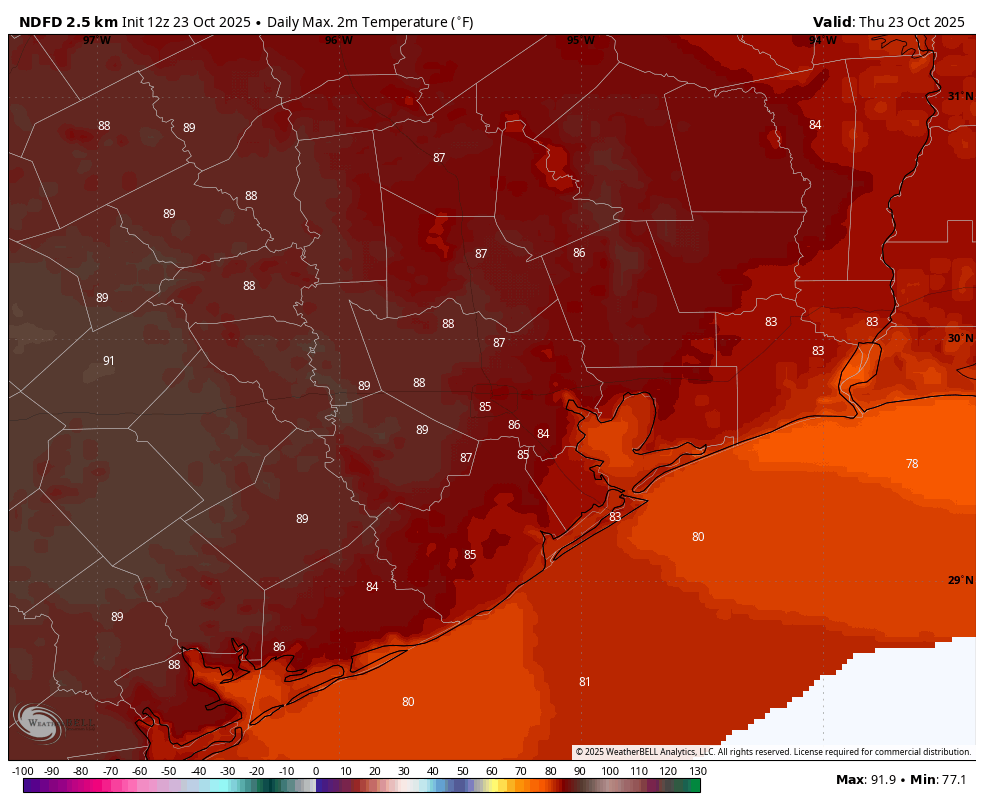
Today will be our last day with near-zero rain chances until next week, although we cannot rule out a few isolated showers this afternoon. Skies will be mostly sunny, but with winds turning more east-southeast, we will see humidity levels rise from what we experienced on Wednesday. Expect highs in the mid- to upper-80s. A few far inland areas may push upward toward 90 degrees, and I’m going to be a little risky here and predict this is our last chance to hit that mark in the year 2025. Lows tonight will be warmer, only falling to around 70 degrees.
Friday
Friday will likely see mostly sunny skies to start, but then with building clouds during the afternoon. Highs will be in the mid-80s with plenty of humidity. Rain chances will increase during the afternoon and evening hours, but overall I still expect this activity to be fairly scattered. So if your plans include Friday Night Lights, the games may well get played. By Friday night we’ll want to keep an eye on conditions to our west. We expect a line of storms to form near the I-35 corridor in Central Texas around midnight, and then advance toward the Houston region overnight.
Saturday
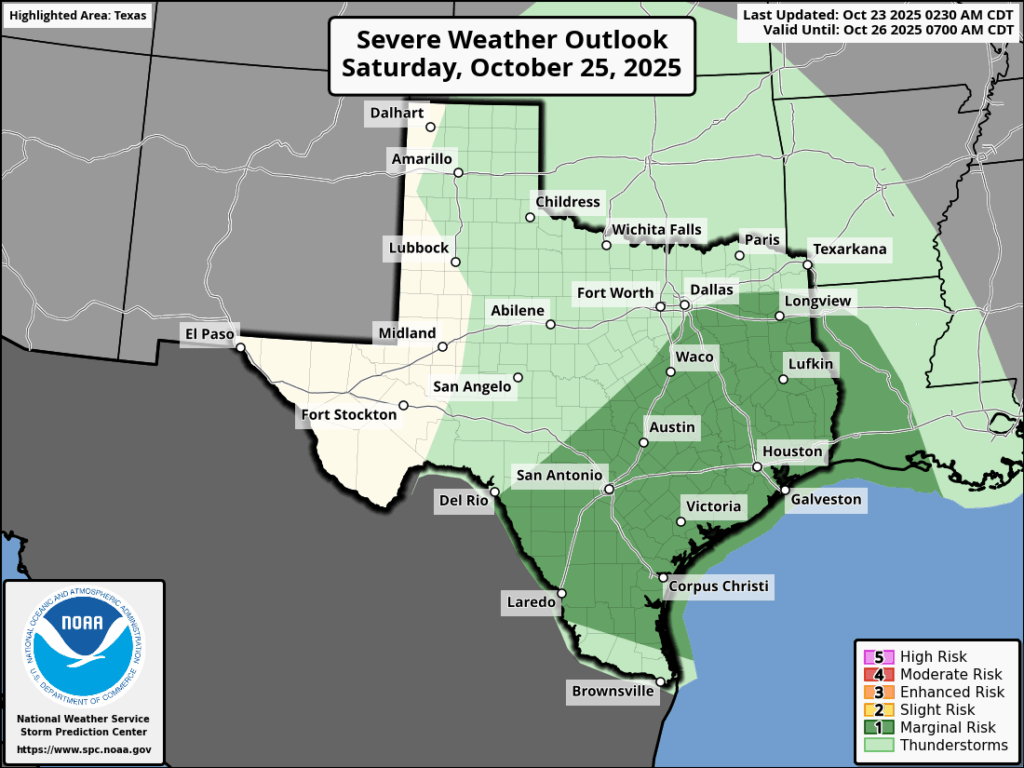
The squall line mentioned above will probably—and bear in mind there remains uncertainty in this timing—push through the Houston metro area around dawn, perhaps in the 6 am to 9 am time frame. Some of these storms could be severe, with the threat of hail. But overall severe storms appear to be less of a threat than heavy rainfall. We need the rain, and it could come in bunches. We expect this line to move through and then to (maybe) be followed by a brief lull in activity during the late morning and early afternoon hours.
Careful readers will know we are planning Fall Day festivities from 10 am to Noon in Midtown Park on Saturday. I’ll be back later this morning with a word on our final decision about whether we are going to press ahead. So stay tuned.
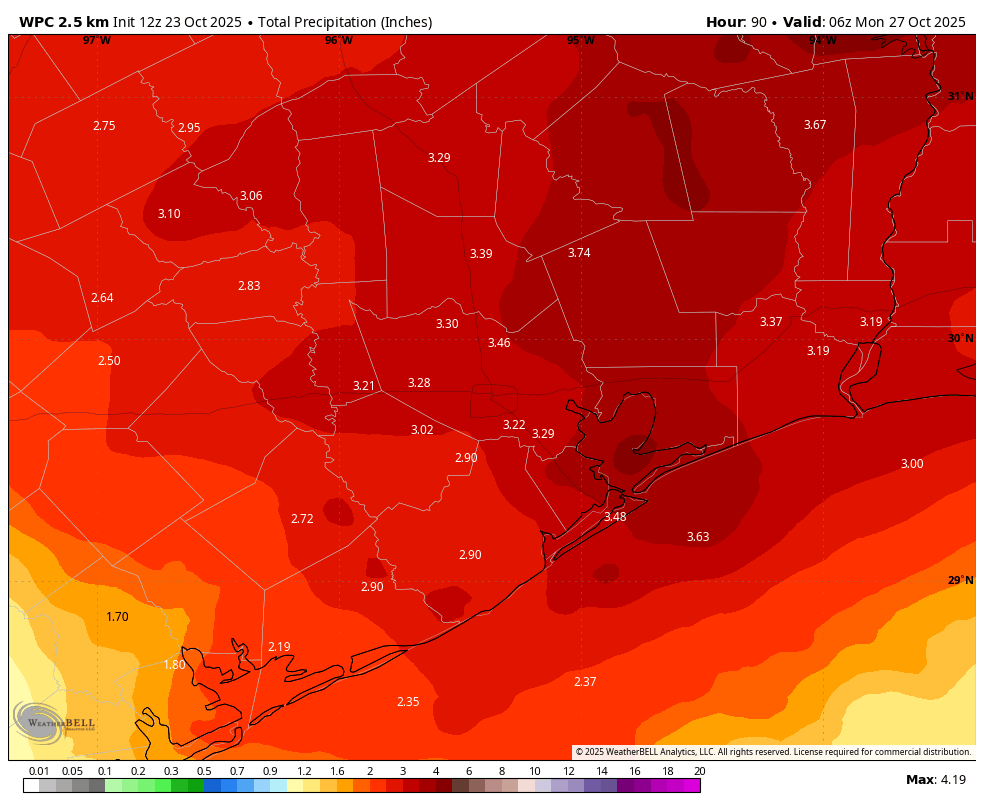
Anyway, the front itself should drive another round of showers later on Saturday or Saturday night. All told we think the majority of the region will pick up 2 to 4 inches of rainfall, but higher local amounts will be possible. Since our soils are so dry they should be able to absorb much of this rainfall, so flooding is not a major concern at this time. But we’ll be watching closely. Temperatures on Saturday should be in the 70s for the most part.
Sunday
Rain chances will be lower (but non-zero) on Sunday. Expect highs in the lower 80s with mostly sunny skies in the afternoon. Lows on Sunday night will drop into the 60s, with a bit of drier air.
Next week
The details are still a bit fuzzy, but I think we can expect highs in the low 80s on Monday and Tuesday, followed by a front that will bring drier and cooler air. Anyone ready for lows in the 50s? Because I think that’s coming.

We are ‘go’ for Fall Day on Saturday: Here’s why, and what you need to know
In brief: We’ve (obviously) been following the forecast for Saturday morning closely, given our Fall Day celebration. At this point we’ve made the decision to go ahead with the gathering. This update explains why, and how you can participate.
Let’s start this post with a fun fact: Today is actually the 10th anniversary of Space City Weather. No kidding. You can read the very first post right here. I started the site on a Friday afternoon because I was concerned about storms that weekend. And here we are 10 years later, same week in October, concerned about weekend storms. It’s funny how history rhymes, if it does not outright repeat.
Speaking of those storms, I have to tell you, Matt and I have been agonizing over the forecast because we have our big Fall Day event planned for Saturday morning. We’ve spent a fair amount of money preparing some special tote bags and t-shirts for this day, and Reliant has invested a lot for a great setup of Midtown Park. It is not easy to delay or reschedule. So for now, we are planning to move ahead with the celebration.

Why? Our primary concern is a line of storms that will move through Houston on Saturday. At this time we think they probably will clear the area by 9 am, but we are not certain. There is a risk that the line moves a little bit slower. So we are going to watch things closely, and if we need to postpone our Fall Day event, we will do so. This will be clearly communicated right here, and on our social channels if the need arises. We are absolutely going to prioritize safety. But we think there’s a path forward to having a great event on Saturday.
Here’s what else we want you to know:
Timing: We’ll be at Midtown Park from 10am to noon, and folks are welcome to swing by whenever there’s a break in the weather. If we need to stay a bit longer to make sure we connect with everyone, we’re happy to do that. Rain gear and smiles encouraged!
Setup: Although the main line of storms should be through, there may be some lingering showers. So we’re shifting as much as possible to the covered stage area of the park and adding a few tents for extra coverage. All the fun stuff (giveaways, kid pumpkin art station, face painting, 360 photo booth) will still be there. Chalk wall, lawn games, etc. will likely go away given the weather. And of course, we’ll have free totes (to the first 100 guests) and special 10th anniversary shirts available for purchase.
Parking: There is a parking garage on Travis, next to the park, that will have ample space and I’ve been told it will be free on Saturday morning. So this should not be an issue.
Thanks for your patience as we have worked through a difficult situation. The good news is that we have really hit a home run here by scheduling the event on October 25th, because now we can take credit for knocking out the region’s emerging drought. You’re welcome, everyone!
how to handle lunch interviews when you have extreme dietary restrictions
A reader writes:
You’ve recommended that interviewers consider lunch interviews in some circumstances and advised candidates with dietary restrictions to review the menu in advance and choose a known safe item. I’m hoping you can help me navigate a more difficult version of this situation.
I don’t eat any food prepared by restaurants because I can’t reliably avoid getting sick unless I’ve tested the exact item multiple times at home. Even if I review the ingredients, I might identify something that will make me sick, but I can’t be confident that it won’t (unless the only ingredient is water).
While nothing I eat would cause serious injury, I’m not comfortable risking even mild illness unless I’m home. As a result, I typically consume only water when away. Fortunately, I’ve only needed to work outside my home a few dozen days in the past five years. On those occasions, I sometimes brought bland, relatively safe food from home if it was easy to floss and brush afterward (due to another health issue). If not, I skipped lunch, even when lunch was provided.
I’m wondering what you think my best options are for handling lunch interviews. Here’s what I’ve considered:
1 Ask to reschedule the interview outside of lunch hours, citing dietary restrictions, if it’s originally scheduled to include (or likely to include) lunch. I worry this would reveal a disability and risk discrimination (even if such discrimination is illegal).
2 Join the lunch interview but don’t eat. This may be more awkward than #1, as it could make the interviewer(s) uncomfortable. Still, it’s not always clear in advance whether lunch will be involved. For example, during a three-hour interview at a previous job, the final interviewer said, “Lunch just arrived. Let’s grab some from the kitchen and eat here together.” (This wasn’t a problem for me at that time.)
3 Accept some risk of getting sick and eat lunch. I can reduce my risk by keeping my portions small, avoiding higher-risk foods, and taking medication that can help in the short term. That would probably work out just fine, but I’d still feel uneasy about it.
Ideally, #1: ask for an interview that isn’t over lunch. Sample language: “I have some dietary restrictions that mean I can’t safely eat in restaurants. Would it be possible to schedule it not over lunch?”
That’s preferable to going to the lunch interview and not eating. There’s a good chance your interviewer will feel uncomfortable eating while you’re not, which will introduce awkwardness into a situation where you don’t want awkwardness. Plus, most interviewers will wonder why you didn’t speak up earlier — and while many will write that off as nervousness about an interview, the higher up you move in your career, the more it might stand out.
But as you pointed out, you might not always get advance warning. One way to handle that is to ask about it ahead of time if the hours they’re proposing you be there seem likely to cover lunch — so for example, if they invite you to a four-hour interview beginning at 11 am, you could say, “Can I ask about the logistics for that day? That time period sounds like it might include lunchtime, and I have some dietary restrictions that mean I’ll need to bring my own food if lunch is planned. I can easily do that, but wanted to flag it in case it affects any planning on your end.”
But there might be other times when you don’t expect food to be involved and suddenly it is. In that case, you can simply say, “Thank you so much for the hospitality. I have some diet restrictions that mean I can’t eat it, but that’s completely fine — I’m happy to just drink some ice water while you’re eating.” (Ideally, though, if there’s something non-perishable you can tuck in a bag when you’re going to interviews, you’d then be prepared to say, “I have a granola bar with me that I’ll eat” or so forth.)
You may get people who try to figure out what they can get for you that you can eat, because they want to be hospitable. In that case, just cheerfully say, “Oh, no thank you! My restrictions make it close to impossible, but I really appreciate you offering.”
Don’t accept the risk of getting sick just to seem polite! You really don’t need to. (And if an employer gets weird about any of this, that’s pretty useful info about what it might be like to work there and navigate their work functions with food.)
The post how to handle lunch interviews when you have extreme dietary restrictions appeared first on Ask a Manager.


Of Course the President Feels Strange About Paying Himself $230 Million of Taxpayers’ Money, but Really, What Else Is He Supposed to Do?
“President Trump is demanding that the Justice Department pay him about $230 million in compensation for the federal investigations into him, according to people familiar with the matter, who added that any settlement might ultimately be approved by senior department officials who defended him or those in his orbit.” — New York Times
Everyone agrees that President Trump has been “damaged very greatly” by the radical left’s many witch hunts against him.
First, they tried to connect him to Russia’s interference in the 2016 election, which the President won fair and square—by a lot. Then they went after him for obstructing that investigation a bunch of times.
After that, they alleged that the President was keeping classified documents containing military secrets at Mar-a-Lago—which, by the way, hosts incredible movie premieres, fundraisers, and so many other events attended by thousands—and that he was obstructing that investigation as well.
On and on the wild claims went. So it’s only right that the government pays him back for all his legal expenses and for all the mental and emotional anguish he’s suffered, which was so, so much.
To be fair, putting a number on that kind of damage to his reputation is impossible, but $230 million of taxpayer money would definitely help soften the blow.
And though the President said that it’s “awfully strange to make a decision where I’m paying myself,” what does it say about the government he leads if he doesn’t?
What does it say about those working for him, like the two people in the Justice Department who can approve such a large and necessary settlement? Or about him being the guy who used to fire people on TV? Or about America?
Should he simply let it go like a normal convicted felon after his latest case was dropped just because he became president again? After so many close calls with the law? Come on, be real.
I mean, think about that for a moment. If he let this go and just went back to work, what would that mean?
That the law can be used to go after political rivals?
That billionaires shouldn’t be paid with taxpayer money for miscarriages of justice just because unemployment and inflation keep rising, the federal government is still shut down, and countless federal employees have lost their jobs?
That because deportations are being expedited without due process, everything else has to move slowly?
That because the Epstein files are still sealed in a nuclear silo under heavy guard, it means that this can’t be put to rest?
That presidents can’t get what they rightfully deserve just because they’re in office?
I mean, what else is Trump supposed to do? Set aside his own interests and his need for retribution against his enemies out of respect for the office of the presidency and the American people?
Carney introduces bail reform mostly just to see the look on Poilievre’s face
“Poilievre’s bill is called ‘Jail Not Bail’, but it should be something cooled like ‘Pris Not Rizz’.” We discuss the most exciting news on every Canadian’s mind this week – Bail Reform! Guest Host Ian and the Panel (Clare Blackwood, and Craig Fay) discuss the why we Canadians barely know anything about bail, AI datacentres […]
The post Carney introduces bail reform mostly just to see the look on Poilievre’s face appeared first on The Beaverton.
I haven’t returned the book a coworker lent me 4 years ago, boss won’t let us use AI transcription, and more
It’s five answers to five questions. Here we go…
1. A coworker lent me a book four years ago and I still haven’t returned it
This feels very low-stakes, but it’s something that hovers at the back of my mind. About four years ago, a coworker and I were talking about books we were reading, and she gushed about a great one she’d just finished. The next day, she brought a copy of the book to the office and gave it to me, suggesting I should read it.
Since then, I’ve moved twice, I still have the book, and I still haven’t read it. I am avoiding returning it because I’m embarrassed that I haven’t read it (I’m a big reader, but I very much read by mood, and this book is outside my usual genres so I’ve never felt a strong urge to pick it up).
I still work for the same office and see that coworker regularly and we have a good relationship. She’s never mentioned the book again, and I honestly don’t know if she remembers I still have it (I do wonder if she’s one of those people who lends books without expecting them to be returned?). It’s not a problem or affecting our work relationship at all, it’s just something that is weighing on me and I feel guilty about it every time I see the book on my nightstand, unread and unreturned.
What should I do? Is it too late to return it now (four years!)? Is it awful to return it and say that I never read it? What if she says, “Oh no, feel free to keep it until you read it” and I still never read it?
It’s not too late to return the book! Maybe she’s completely forgotten it or maybe she hasn’t and wishes you’d returned it but doesn’t want to say anything — who knows. But it’s hers, you have it, and you can just give it back!
When you do, you could just say, “It’s been so long since you loaned it to me and I never ended up reading it so I figured it was past time for me to return it. Thanks for letting me borrow it.” If she tells you to feel free to keep it until you read it, say, “I figure if I haven’t read it at this point, I’m probably not going to so I’d feel better returning it. But I appreciate you giving me the chance to!”
If you feel weird about not reading it — well, first, you don’t need to feel weird. Most readers know that not everything will grab everyone. But if she says something that makes you feel she wants a further explanation, you can just say, “It’s not my usual genre so I think I really had to be in the right mood for it” or “my reading list is ungodly long and I can’t stop reading fantasy heists so I’ll probably never get to it” or “at the moment I am only reading oral histories of frog empires” or whatever you want!
2. How can we convince our boss to let us use AI transcription?
My organization (academic healthcare center) recently purchased MS Copilot licenses. Very quickly my coworkers and I started using the meeting transcription function to take meeting notes. It’s amazing! You can actually pay attention in the meeting and the AI will create a summary of the call and list action items.
My supervisor recently decided we are not allowed to use this tool at all, even for internal meetings. He is worried about discoverability in case of litigation, apparently having lived through it once.
Several of us feel this is taking things to an extreme and we are feeling demoralized that this great productivity tool is now off-limits. (Not to mention the implicit implication that we may be breaking the law in meetings.)
I am looking into whether we have an org-wide policy on this matter, but it’s pretty new. I’ve seen other schools develop policies to address this by limiting how long full transcripts are kept and who has access to them. Do you have any suggestions on how to address this with my boss, who will probably be defensive and prickly if I bring it up?
It’s really your boss’s prerogative to decide that the tool is a security or legal risk, even if AI transcription tools are allowed in the broader organization — and it might be a very valid concern, particularly in a healthcare context. There have been quite a few problems with AI transcription, including making up entire sections of conversations that never happened and getting nuance wrong enough that the entire meaning is changed.
You can certainly try explaining why you’ve found the tool so helpful and see if you’re able to come up with limitations that would mitigate his concerns — but ultimately it’s his call to make, and you should stay open to the possibility that it’s the right one.
3. I have a job offer that’s better than my current job in some ways and worse in others
I currently work a job as a legal recruiter. I like the people in my office, and I work in the office three days a week and am remote two days a week. My team is not based in my office, and I like them most of the time, except when things are stressful I think there is a tendency to punch down. During one such stressful period, I started a job application and I am supposed to get the offer today.
The offer is for $20-35K more and bumps me to a senior manager title (two steps up). The downsides are a week less of vacation, worse healthcare, and it’s fully in person which I have never worked before as someone who graduated right before Covid started.
I like the money and I like the vibe of the people I interviewed with. However, it’s an older firm with more old ways of doing things, whereas my current firm is very new-aged and leading the industry in terms of lawyer compensation. To top it all off, here I am on a four-person team and there I would be on a 100+ person team, so it makes growth into a decision making position seem further away.
What do I do? Do I give my current place a chance to counter in hopes of making manager?
It’s hard to evaluate how significant a raise that is without knowing what you’re making now (a $25,000 raise can have a huge impact if you’re currently making $50,000 and less of one if you’re currently making $150,000). But it seems pretty likely that the lost week of vacation, worse healthcare, and extra in-office days will eat up a lot, if not most, of that bump. If you haven’t already, make sure to do the math on those things to find out what the bump actually will be once you account for those in the equation. After that, it really comes down to how you feel about each company and the work of each position.
Wherever you land, though, I don’t recommend trying to use the offer to get a counteroffer out of your current employer. First, there’s a chance they’ll say they can’t offer you anything close and so you should take the other offer. Second, taking a counteroffer can come with a lot of problems (described here) — not always, but often.
4. Should I tell my boss what I know about a micromanager on the team?
My direct supervisor, Shayla, manages two other people. One of them, Stephanie, has five direct reports. Since we are on the same team, I am close with Stephanie and her reports, even though we have different focuses.
In the last four years, two people who worked under Stephanie have left and told me it was because of her micromanaging. Currently, two more of her staff have told me that they are getting frustrated with the way she manages. They do not have immediate plans to move on, but also do not see a long-term future under Stephanie.
I have given them advice about speaking to Stephanie, which does not go over well as she does not see herself as micromanaging. I have also advised that they speak with Shayla themselves, but they worry about the effects of going over Stephanie’s head.
Shayla has told me in the past how frustrating it is to keep hiring and she hopes that the current staff stay. At what point should I (if ever) mention to her that I know the reason why people are leaving?
Shayla is raising the issue with you and expressing concern about it and you have info she doesn’t have — info that’s arguably highly relevant to the healthy functioning of your team. You should raise it now.
You need to be careful in how you do it so it’s not relayed to Stephanie in a way that risks her retaliating against the people who confided in you — and you should raise that concern explicitly with Shayla — but you should speak up.
5. What’s a performance plan?
I’ve never had an annual review because I’ve always worked in a highly unionized environment, so certain terms sometimes confuse me.
A friend recently started a new job (non-union) and everything seems to be going well. She gets very positive feedback from her colleagues and bosses, but her boss also said they should meet about a performance plan.
Is this different from a PIP? It would be strange to me if she was put on a PIP shortly after joining and with all this great feedback from her boss but I really don’t know much about the world outside my union bubble!
Some companies use “performance plan” to mean “plan for what you should be achieving in the next 6-12 months” (or whatever time period) without there being any component of “because you are not currently meeting expectations.” Which is confusing, because it’s extremely close to “performance improvement plan” (generally used when someone isn’t doing well and needs to make changes to remain in the job), and some companies even drop the “improvement” from that name and just say “performance plan” and now you have two identical terms that can mean different things. So you just need to know how a particular company uses it.
In your friend’s case, I’d assume it’s not the disciplinary type of plan unless she hears otherwise!
The post I haven’t returned the book a coworker lent me 4 years ago, boss won’t let us use AI transcription, and more appeared first on Ask a Manager.
Shelter Dog Just Doesn’t Have That X Factor
LOS ANGELES—Declaring that some animals simply “got the goods” and “you know it when you see it,” officials at a local animal shelter confirmed Thursday that a newly acquired rescue dog lacked the X factor required to be adopted. “We’re looking for a little razzle-dazzle, and all we got is this total dud cowering in the corner of his crate,” said veterinary assistant Amanda Field, adding that despite a few good photos and a great tragic backstory, what the dull mutt brought to the table was not exactly going to land him in a forever home. “This dog lacks style and confidence. Just comes off as a complete flop. If he thinks he’s gonna make it here, he either needs to get way uglier, or way cuter—and fast! Start dangling that tongue out of your mouth, see what that gets you.” Field went on to state that if the shelter dog didn’t shape up soon, she’d have no choice but to give him a “one-way ticket to Euthanasia City.”
The post Shelter Dog Just Doesn’t Have That X Factor appeared first on The Onion.
National Guardsman Awakes Screaming From Nightmare About Americans Going About Daily Lives
FORT WORTH, TX—Catching his breath and wiping the sweat from his brow after he realized it was all just a bad dream, Texas National Guard member Jason Ringgold reportedly woke up screaming at 3 a.m. Thursday after having a nightmare about Americans peacefully going about their daily lives. “Oh God, they were carrying groceries and picking up their kids from school—from school,” said a still-shaken Ringgold, who recently returned home from Chicago, where his unit is still deployed, and who admitted he was reliving scenes such as a woman driving home from work, doing some grocery shopping, and heading home to make dinner. “It all felt so real, like it was happening all over again. There were these…these young men playing a game of pickup basketball. And they were laughing, like it was all just…normal. This one man, oh God, he was eating a sandwich right there on a park bench, and another lady was withdrawing money from a fucking ATM. And of course my buddies are still there! They’re in the shit, man. Christ, it’s so awful to think about.” According to sources, Ringgold drank a glass of water to calm himself down but was unable to get back to sleep after receiving a frantic text from a National Guard member deployed to Portland, OR, who told him the level of normalcy there was even more horrific than anyone could have imagined.
The post National Guardsman Awakes Screaming From Nightmare About Americans Going About Daily Lives appeared first on The Onion.
Biggest Revelations From ‘Mr. Scorsese’
A new five-part docuseries on Apple TV examines the life and career of iconic filmmaker Martin Scorsese. Here are the biggest and most shocking revelations from Mr. Scorsese :
Was often bedridden as a child due to a debilitating spaghetti allergy
Prefers the more casual “Marty” on set and fires anyone who disobeys
Doesn’t know how to log into Apple TV
Came up with the idea for gangsters while eating at an Italian restaurant in 1958
Has seen as many as 12 movies in his lifetime
Initially thought a Hawaiian shirt would be enough to de-age Robert De Niro in The Irishman
Eyebrows insured for $5 million
Old enough to call movies “the pictures” sometimes
Has 200 hit points
Still doesn’t know whether people on screen real or fake but is content not knowing
The post Biggest Revelations From ‘Mr. Scorsese’ appeared first on The Onion.
Ford blames Jays playoff ticket gouging on asshole premier who scrapped Ticketmaster law in 2019
QUEEN’S PARK – After resale tickets to the Blue Jays’ World Series immediately skyrocketed into the thousands of dollars, Ontario Premier Doug Ford held a press conference to place the blame solely on the total dickhead of a premier who scrapped a resale-capping law in 2019. “Folks, this ticket price gouging is a disgrace and […]
The post Ford blames Jays playoff ticket gouging on asshole premier who scrapped Ticketmaster law in 2019 appeared first on The Beaverton.
Nintendo celebrates approval of patent on having fun, laughing
Tokyo, Japan – Nintendo is celebrating after being granted a patent on the human emotion of joy, having fun, and general merriment. “Finally something we exclusively brought to the world is now rightfully ours,” explained Nintendo president Shuntaro Furukawa. “Next, we hope to get necessary patents on some of other ideas like high scores, pressing […]
The post Nintendo celebrates approval of patent on having fun, laughing appeared first on The Beaverton.
GRENDEL pt7
GRENDEL pt7
break the penguin
![[img]:agunoe](https://analognowhere.com/_/agunoe/agunoe.png)
Fossangel: "There, see...? Too bad you guys dinged it up so much. Might have been worth a fortune once. Streamers go crazy for these vintage artifacts in mint condition."
Cirno: "I'm allowed to be wrong."
The crew gathers around the sarcophagus. Penguin brings a hammer to Fossangel.
Girl: "Streamers?"
Fossangel: "Yeah. They put it on a shelf behind them, maybe wrap some LED lights around it, can look pretty cool. Thanks."
![[img]:agunoe](https://analognowhere.com/_/agunoe/agunoe2.png)
Girl: "But what is streamers?"
Fish: "She knows - she just thinks it's funny to act stupid."
Girl: "Grendel taught me that joke :D . One time he told me:"
Flashback Girl and Grendel walk through a spooky field.
Flashback Girl: "This place is so spooky! I'd be really scared if you weren't here."
Flashback Grendel: "You know, when I'm scared, I tell jokes! It's better to laugh than to be scared!"
![[img]:agunoe](https://analognowhere.com/_/agunoe/agunoe3.png)
Girl: "And I'm really scared now that Grendel is going to die."
Fossangel: "That actually reminds me..."
Daemon screams: " ENOUGH WITH THE FLASHBACKS!!! BREAK THE FUCKING PENGUIN! "
![[img]:agunoe](https://analognowhere.com/_/agunoe/agunoe4.png)
Everyone looks at Daemon disapprovingly.
Daemon: "I mean - if you guys want -"
SUDDENLY GRENDEL APPEARS, walking with a stick, wrapped in bandages.
Grendel: "The little Daemon is right! Let's see what's inside!"
Everyone: "GRENDEL!"
tbc
https://analognowhere.com/_/agunoe
GRENDEL pt6
GRENDEL pt6
FOSSANGEL
![[img]:clmceg](https://analognowhere.com/_/clmceg/clmceg.png)
Fish: "And why did you bring it here?!"
Cirno: "Well I wasn't gonna leave empty handed! And Grendel got shot over it"
Fish: "GRENDEL! I forgot all about him -"
They are interrupted by the noise of fluttering packets.
![[img]:clmceg](https://analognowhere.com/_/clmceg/clmceg2.png)
HACKERS I AM THE ANGEL OF FOSS
![[img]:clmceg](https://analognowhere.com/_/clmceg/clmceg3.png)
Fossangel bums a cigarette off Cirno
![[img]:clmceg](https://analognowhere.com/_/clmceg/clmceg4.png)
Fish: "Nobody asked for your 'Divine Intervention'."
Fossangel: "Are you sure about that?"
Girl: "I just said a quick prayer for Grendel..."
Fish: "Fine then. Since you're already here - we seem to have obtained a cursed object."
Fossnagel: "A curse would explain why you and Glenda have been tripping... But this..."
The angel knocks on the sarcophagus.
Fossangel: "Is a dud. Pre war linux decor. Might have candy inside."
Fish: "What."
TBC
https://analognowhere.com/_/clmceg
Elon Musk Discovers What Hierarchy Actually Means
Elon Musk is having a very bad week. The man who bought Twitter for $44 billion to secure unaccountable power over public discourse is discovering what unaccountable power actually looks like when wielded by someone who understands dominance better than he does.
Trump just stripped SpaceX of a government contract and handed it to Jeff Bezos. Musk’s response? Rage-tweeting at Trump officials, including the immortal question “why are you gay”—the rhetorical sophistication we’ve come to expect from the richest man-child on the planet having a public meltdown because Daddy won’t give him what he wants.
This isn’t just delicious schadenfreude, though it is that. This is the neo-reactionary project—the Silicon Valley movement to restore hierarchy and reject democratic constraints—consuming its architects in real-time. A perfect demonstration that the oligarchs funding authoritarian politics fundamentally misunderstood what they were building.
They thought they were buying hierarchy with themselves at the top. They’re discovering that authoritarian hierarchy doesn’t work that way. It requires constant demonstration of dominance through arbitrary humiliation of subordinates. There are no stable positions. No guaranteed seats at the table. No amount of money that exempts you from being the example.
Musk thought he’d bought partnership. He bought the privilege of being degraded publicly.
This is what Peter Thiel and Curtis Yarvin and the entire Silicon Valley neo-reactionary apparatus never quite explained to their fellow travelers: In the systems they’re building, someone has to be subordinate. The hierarchy they’re restoring doesn’t stop conveniently at their own necks. And Trump—whatever else he is—understands this instinctively. He knows that power in authoritarian systems isn’t demonstrated through competent governance or policy achievement. It’s demonstrated through the arbitrary exercise of dominance over those who thought themselves powerful.
Musk genuinely believed his wealth made him Trump’s equal. That his “genius” and his billions and his control of critical infrastructure (Twitter, SpaceX, Starlink) secured him a permanent seat at the table. He thought he was Roy Cohn but permanent. He thought “First Buddy” meant something.
He’s learning what Roy Cohn learned: You’re useful until you’re not. And when you’re not, the humiliation is public, arbitrary, and designed to demonstrate to everyone else what happens when you forget your place.
The contract going to Bezos isn’t about SpaceX’s technical capabilities or cost-effectiveness or any rational criterion. That’s the point. It’s about Trump demonstrating he can take from Musk and give to his rival for no reason except to show he can. And Musk—for all his billions, for all his companies, for all his supposed genius—can do exactly nothing except tweet impotently while the adults laugh at him.
This is the system they built. This is what they wanted—rule by the strong, unencumbered by democratic constraints, where power flows from dominance rather than from consent. They just thought they’d be the ones doing the dominating.
Here’s what makes it particularly delicious: Musk can’t even exit. All that crypto-libertarian fantasy about “exit” and seasteading and network states—it was always cope. You can’t exit power when the person wielding it controls access to the government contracts your companies depend on, the regulatory environment your businesses operate in, and the geopolitical decisions that determine whether your satellites stay in orbit.
Thiel’s dictum that “competition is for losers” works when you’re the monopolist. But Trump is the ultimate monopolist—of attention, of dominance, of the willingness to humiliate anyone anywhere for any reason. There’s no competing with that. Only submitting or being destroyed.
And Musk will submit. He’ll apologize. He’ll grovel. He’ll delete the tweets and post something obsequious about how President Trump is making brilliant decisions for America. Because the alternative is watching everything he’s built get systematically dismantled by someone who understands that in authoritarian systems, the point isn’t good governance—it’s demonstrating who’s subordinate.
The man who bought Twitter because he wanted absolute control is learning what absolute control actually means when someone else has it. The irony would be poetic if it weren’t so terrifying. Because this isn’t just about Musk’s bruised ego. This is about oligarchs discovering that the authoritarian systems they funded don’t stop at the people they don’t like. Hierarchy has teeth. And those teeth point in every direction.
Ask yourself: in the system you’re part of, are you ever really at the top—or always potentially the subordinate? The architects of neo-feudalism are learning the answer the hard way.
This is what authoritarian dominance looks like—cultivated by the powerful, weaponized by the dominant, and turned back on its architects.
Welcome to the world you built, Elon. How’s it feel?
Mike Brock is a former tech exec who was on the leadership team at Block. Originally published at his Notes From the Circus.
Trump Demands $230 Million In Taxpayer Money For Being Prosecuted—And His Own Lawyers Get To Approve It
There are levels of corruption, and then there’s whatever the hell this is.
Donald Trump is demanding that American taxpayers pay him $230 million for being prosecuted. Which is like getting a speeding ticket and then billing the state for the cost of your traffic lawyer. Except in this case, the traffic lawyer is now the judge, and the judge gets to decide how much the state pays you and you get to approve it all, and somehow this is all legal because we’ve apparently given up on the concept of shame.
The New York Times reports that Trump has filed what’s known as administrative claims demanding approximately $230 million in compensation from the Department of Justice for two federal investigations, including one that led to indictments—investigations that only stopped because he won the 2024 election.
According to the Justice Department manual, settlements of claims against the department for more than $4 million “must be approved by the deputy attorney general or associate attorney general,” meaning the person who oversees the agency’s civil division.
The current deputy attorney general, Mr. Blanche, served as Mr. Trump’s lead criminal defense lawyer and said at his confirmation hearing in February that his attorney-client relationship with the president continued. The chief of the department’s civil division, Stanley Woodward Jr., represented Mr. Trump’s co-defendant, Walt Nauta, in the classified documents case. Mr. Woodward has also represented a number of other Trump aides, including Mr. Patel, in investigations related to Mr. Trump or the Capitol riot on Jan. 6, 2021.
This is not normal. This has never been normal. This will never be normal. Although at this point, “normal” is doing a lot of work there, given that we’re living in a timeline where a business failure reality TV host became president, tried to overturn an election, got indicted for stealing classified documents, got re-elected, embraced every authoritarian instinct, and is now suing the government for having the audacity to notice.
According to the Times, Trump submitted two separate administrative claims through a standard government process that typically precedes lawsuits, but can also be used to “negotiate” a settlement. The first claim, filed in late 2023, seeks damages for the Russia investigation and Robert Mueller’s well-publicized (though often misrepresented) probe into Russia’s attempt to influence the 2016 election.
The second, filed in summer 2024, targets the FBI’s search of Mar-a-Lago and the subsequent prosecution for mishandling classified documents—you know, the prosecution where Trump was literally caught on tape discussing how he couldn’t declassify the documents he was showing people, and where there were famously boxes of sensitive documents stored in places like a bathroom at Mar-a-Lago.
The second claim accuses the government of “malicious prosecution” intended to sway the election:
Attorney General Garland FBI Director Wray and Special Counsel Smith’s targeting indictment and harassment of President Trump has always been malicious political prosecution aimed at affecting an electoral outcome to prevent President Trump from being re elected This malicious prosecution led President Trump to spend tens of millions of dollars defending the case and his reputation
By this logic, every criminal defendant should be able to bill taxpayers for their legal fees. And the FBI Director supposedly orchestrating this “harassment”? Christopher Wray, whom Trump personally appointed after firing James Comey. Why would he want to go after Trump?
But let’s get back to the craziest part: Trump’s former personal lawyers, now in government positions specifically because Trump appointed them, get to decide whether the government should pay their former client (and current boss) hundreds of millions of dollars for prosecuting him.
As legal ethics professor Bennett Gershman told the Times:
“What a travesty,” said Bennett L. Gershman, an ethics professor at Pace University. “The ethical conflict is just so basic and fundamental, you don’t need a law professor to explain it.”
He added: “And then to have people in the Justice Department decide whether his claim should be successful or not, and these are the people who serve him deciding whether he wins or loses. It’s bizarre and almost too outlandish to believe.”
This is amazing for multiple reasons, including that the NY Times did its usual “view from nowhere” cop-out of trying to find an expert to give them a quote because the NY Times house style is never to directly call out bullshit for being bullshit. And even that guy is like “dog, you don’t need an expert. Literally everyone can see this is the most corrupt bullshit imaginable.”
CNN’s Kaitlan Collins asked Trump directly about the claims. His response is worth reading in full because he essentially admits everything:
COLLINS: The NYT is reporting your legal team is seeking $230 million from your own DOJ now in response to the investigations into you. Is that something you want?TRUMP: It could be, yeah. I don't even talk to them about it. All I know is they would owe me a lot of money. They rigged the election.
COLLINS: The NY Times is reporting your legal team is seeking $230 million from your own Justice Department now in response to the investigations into you. Is that something you want?
TRUMP: It could be, yeah. I don’t even know what the numbers… I don’t even talk to them about it. All I know is they would owe me a lot of money, but I’m not looking for money. I’d give it to charity or something…. But look, they rigged the election.
“They rigged the election.” There it is. Trump’s entire justification for demanding a quarter billion dollars from taxpayers rests on his repeatedly debunked lie that the 2020 election was stolen from him. The same lie that led to January 6th. The same lie that has been rejected by every court that examined it, including judges Trump himself appointed. The same lie that even his own Attorney General, Bill Barr, said was “bullshit.”
Trump then tries to bolster his case by pointing to recent settlements:
As you know, in one case, 60 Minutes had to pay us a lot of money. George “Slopadopulous” had to pay us a lot of money and they already paid. You know, they paid me a lot of money.
Let’s be clear about those “settlements”: ABC and CBS didn’t settle because Trump’s claims had merit. They settled because fighting Trump—who controls the federal government and has repeatedly threatened to use that power against media companies—became too expensive and risky. And, in the case of 60 Minutes, it happened because Shari Redstone needed FCC chair Brendan Carr’s approval to sell Paramount, and everyone knew that wouldn’t be approved without paying Trump. Those settlements aren’t vindication; they’re protection money. They’re evidence of the exact kind of corrupt pressure campaign Trump is now trying to formalize by demanding payment from the government itself.
But then—and I want you to really appreciate this—he just admits the whole scam on camera:
Now, with the country, it’s interesting. Because I’m the one that makes the decision, right? And, you know, that decision would have to go across my desk. And it’s awfully strange to make a decision where I’m paying myself. [Turns to look over his shoulder]. Did you have one of those cases where you have to decide how much you’re paying yourself in damages?
No, Donald. It’s not “interesting.” It’s a conflict of interest. “Interesting” is when you learn that octopuses have three hearts. This is just corrupt. It’s bad. You’re not supposed to be in a position where you’re both the plaintiff demanding money and the defendant deciding whether to pay it out of the coffers of the US Treasury.
And it’s even worse, though he never acknowledges this, because it’s him deciding how much of the taxpayers’ dollars he gets to transfer to his own bank account. By himself. It’s horrifically corrupt, as anyone can see.
He tries to salvage this with a throwaway line about charity:
But I was damaged very greatly and any money that I would get I would give to charity.
Sure you would. This is the same Donald Trump whose charitable foundation was shut down in 2018 after a lawsuit found it had engaged in “a shocking pattern of illegality” including using charitable funds to settle business disputes, buy portraits of himself, and make illegal campaign contributions. The same Donald Trump who admitted in that case to misusing charitable funds and was ordered to pay $2 million in damages. The same Donald Trump who appears constitutionally incapable of doing anything that doesn’t personally enrich him.
But even if we believed him—even if he pinky-swore to give every penny to charity—the entire premise is corrupt. If the money should go to a good cause, how about leaving it in the federal treasury? You know, the one that’s currently empty because the government is shut down and can’t pay its bills?
Let’s zoom out for a moment, because the specific details of Trump’s grift can obscure just how unprecedented this is.
The government almost never pays compensation to people it prosecutes, even in cases of actual wrongful prosecution. When someone is exonerated after being wrongly convicted, many states don’t provide any compensation at all, and those that do typically cap it at levels far below what Trump is demanding. The idea that you deserve compensation simply for being prosecuted—when the prosecution was based on actual evidence of actual crimes you actually committed—is lunacy.
The Russia investigation that Trump claims he deserves compensation for resulted in 34 indictments, seven guilty pleas, and five people sentenced to prison. The special counsel’s report explicitly did not exonerate Trump, instead noting that if they had confidence Trump didn’t commit a crime, they would have said so. The investigation was not “malicious prosecution”—it was a legitimate investigation into serious matters of national security.
Did some people exaggerate the extent of what Mueller would find? Sure. But there remains no evidence that the investigation itself was improper. Indeed, the exact opposite is true. The investigation was done, it found some clear evidence of law breaking, and that resulted in some people going to prison.
The classified documents case was even more clear-cut. The FBI found over 300 classified documents at Mar-a-Lago, despite Trump’s lawyers claiming they’d returned everything. The evidence included surveillance footage showing Trump’s employees moving boxes of documents around to hide them from investigators. Trump was literally recorded discussing how he couldn’t declassify documents but was showing them to people anyway. This wasn’t a witch hunt—it was an open-and-shut case that only ended because Trump won an election.
And now he wants taxpayers to pay him for it.
Perhaps most disturbing is what Trump’s own comments reveal about how thoroughly he’s corrupted the Justice Department. When asked about the claims, he said, “I don’t even talk to them about it”—implying that his subordinates are pursuing this on his behalf without his direct involvement. This is almost certainly false (Trump has never been shy about directing his personal legal affairs), but even if it were true, it would mean the Justice Department is so thoroughly captured that officials are proactively working to enrich the president without being asked.
The Times notes that “administrative claims are not technically lawsuits” and that “such complaints are submitted first to the Justice Department… to see if a settlement can be reached without a lawsuit in federal court.” In other words, this is all happening behind closed doors, with no public scrutiny, no judicial scrutiny, and the Justice Department has the discretion to simply cut Trump a check.
Oh, and also this:
The Justice Department does not specifically require a public announcement of settlements made for administrative claims before they become lawsuits. If or when the Trump administration pays the president what could be hundreds of millions of dollars, there may be no immediate official declaration that it did so, according to current and former department officials.
Trump could pocket hundreds of millions in taxpayer money, approved by his own lawyers, and there might be no public record.
And if you think that there’s some sort of ethics rules in place to stop it, Attorney General Pam Bondi seems to have made sure nothing stands in the way here:
A White House spokeswoman referred questions to the Justice Department. Asked if either of those top officials would recuse or have been recused from overseeing the possible settlement with Mr. Trump, a Justice Department spokesman, Chad Gilmartin, said, “In any circumstance, all officials at the Department of Justice follow the guidance of career ethics officials.”
In July, Ms. Bondi fired the agency’s top ethics adviser.
Mr. Trump famously hates recusals. He complained bitterly after his first attorney general, Jeff Sessions, withdrew from overseeing the Russia investigation that is now the subject of one of his demands for money.
Trump seems to have taken the joke “no conflict, no interest!” to heart.
Look, we’ve become numb to Trump’s corruption. Every day it’s a new batshit thing, and honestly, I’m exhausted. But this one deserves to break through the noise because it’s not complicated.
The President is demanding the government pay him $230 million for investigating his crimes and prosecuting him. His own lawyers get to approve it. He’s justifying it with the Big Lie. The government is shut down and can’t pay its bills, but sure, let’s cut Trump a check. And he’s doing all of this while admitting on camera that it’s “interesting” he gets to decide how much to pay himself.
This is just theft. The president is looting the treasury, and the only people who can stop him are the Justice Department he controls, the Congress that won’t hold him accountable, and the Supreme Court that already gave him immunity for crimes.
So yeah, he’ll probably get away with it. Because we’ve built a system where the most powerful person in the country can openly steal from us and face no consequences. Trump didn’t break the system—he just realized it was already broken and decided to take advantage.
And honestly? The fact that he can admit all of this on camera and still expect to cash the check is perhaps the most depressing part of all.
I recognize that this is like the fourth impeachable thing he’s done in the past week alone, and with each new horror the old one slides off the front pages, but really, this one deserves extra attention. At a time when the government is shut down, prices everywhere are rising, and the economy is stalling, Donald Trump is looking to personally enrich himself with a quarter of a billion dollars from the US Treasury.
This is a shockingly brazen level of corruption, even for Donald Trump. And we shouldn’t let it just slide away.
So ... why don't you guys down there saddle up ...
So ... why don't you guys down there saddle up the possie and get on out there and find Cowboy Pat? #CowboyWho

Health plan enrollment period is set to be horrifying for everyone this year
Shock and dismay have already begun as Americans face next year’s health insurance costs—and it looks like everyone will be in for some grim numbers.
So far, much of the attention has been on the stratospheric prices that Americans might see on plans they buy from Affordable Care Act marketplaces. Critical tax credits for those plans are set to expire at the end of the year, and, on top of that, insurers have proposed a median 18 percent price increase for 2026. With the higher prices and a loss of credits, some Americans could see their monthly premiums more than double.
In an analysis last month, nonpartisan health policy group KFF estimated that, on average, ACA marketplace premiums would rise 114 percent, going from $888 in 2025 to $1,904 in 2026.
Sylvester Turner’s personal items to be auctioned at Houston estate sale
‘Black Lives Matter’ mural on Third Ward street could face removal under state order
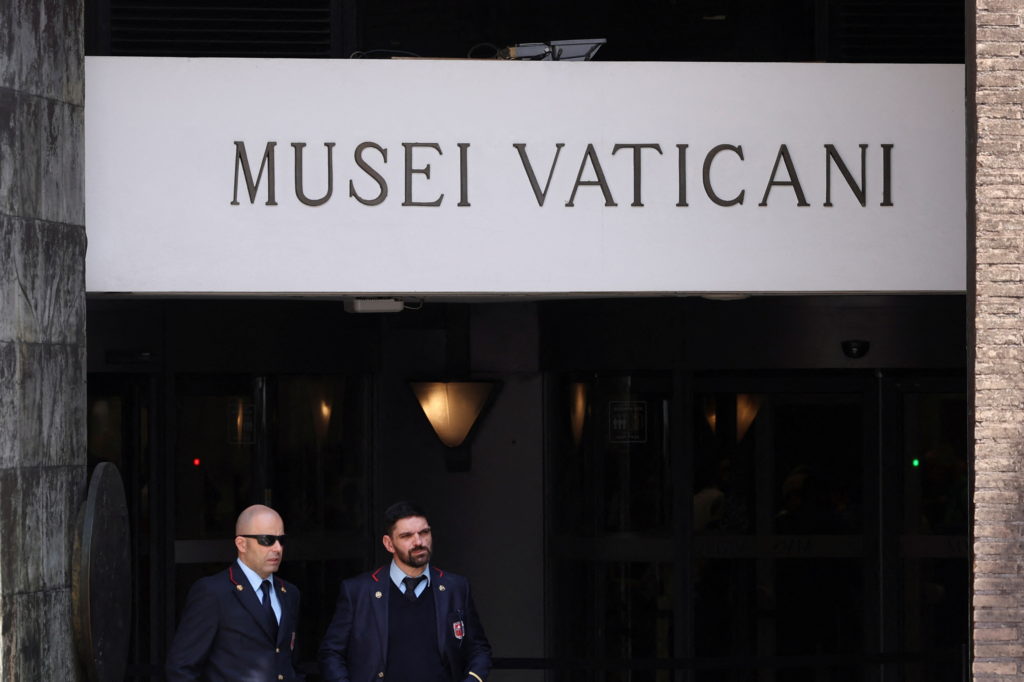
Vatican Museum to return artifacts to Indigenous groups in Canada
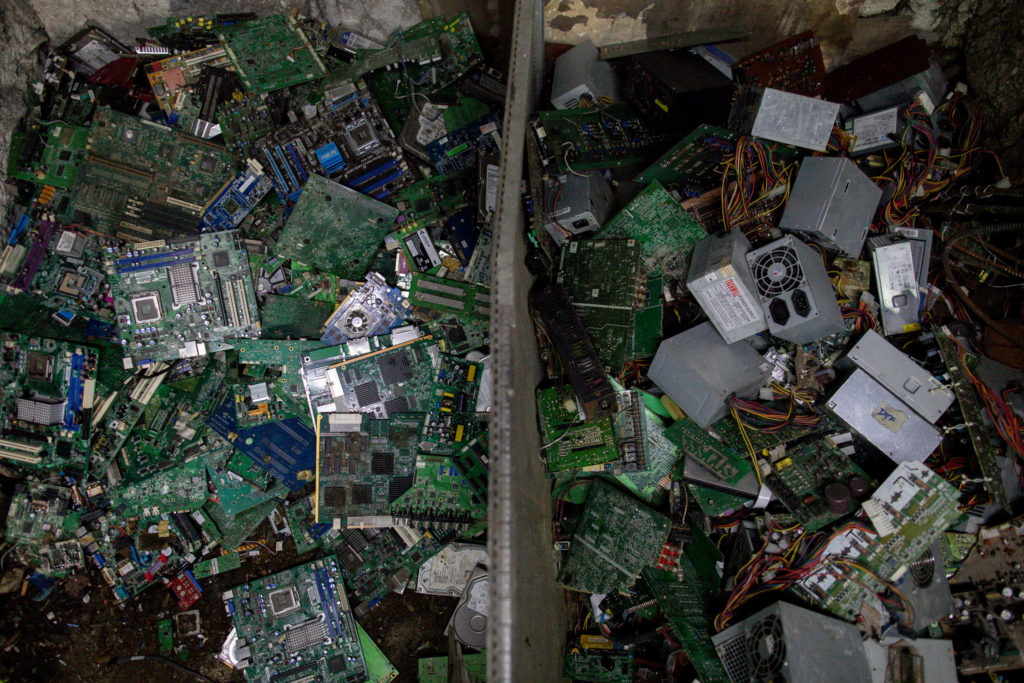
Discarded electronics from U.S. causing ‘e-waste tsunami’ in Southeast Asia, watchdog says
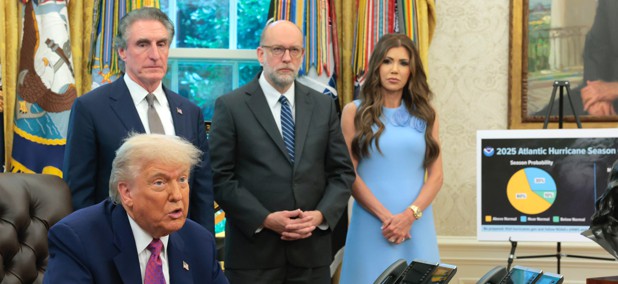
How the president expanded his power without a government
In fact, he (but more particularly, his team) has been so successful at maneuvering through this shutdown that there’s no reason for them to end it. Democrats have called on Trump to get more involved in the negotiations. They’ve gotten little more than a shrug in return. The Republicans are winning, and Vegas card players know never to leave a winning hand on the table.
The Republicans are using two of the big tools to shape governmental action: the power of the purse, which funds what government does; and the power of government bureaucrats, who make it work. The former is the engine. The latter are the wheels. And by vastly expanding the administration’s leverage over both, it—especially OMB Director Russ Vought—is in the driver’s seat.
This is vastly more important than Elon Musk’s Department of Government Efficiency, an unguided bulldozer rambling through government. Vought’s strategy is all out of a single piece of carefully woven cloth.
Start with the engine: the federal budget. Madison, in Federalist #58, made it clear why the founders, concerned with the prospect of a strong executive, vested the power of the purse with the Congress. It was, he wrote, the “most complete and effectual weapon with which any constitution can arm the immediate representatives of the people”. There are two vital components of this: the president cannot spend money for purposes not authorized in law; and that the president cannot pick which programs he wants to spend money on and on which he does not.
There are laws, which Georgetown law professor Eloise Pasachoff has referred to as the “power of the purse statutes”, that reinforce each of those constitutional imperatives. The Anti-Deficiency Act, passed in 1870, creates penalties for the unlawful spending of money that has not been appropriated, or not appropriated for that purpose. The 1974 Impoundment Control Act creates the only legal avenue for the president to refuse to spend money that has been appropriated. The Vought strategy violates both.
For the first almost eight months of the administration, the sole emphasis has been on the latter set of violations. In most cases where the administration attempted to cancel programs, it did so without following the procedures set up by the ICA. In the shutdown, the administration has crossed the ADA lines
With the deadline for the military’s payroll looming, Trump ordered the Pentagon “to use for the purpose of pay and allowances any funds appropriated by the Congress that remain available for expenditure in Fiscal Year 2026.” The administration said it was going to use funds in the Pentagon’s research and development account. DOD did indeed have unexpended R&D funds, but Congress had not authorized draining the R&D account to pay the military, and that’s a clear violation of the ADA. As Bobby Kogan at the Center for American Progress posted on Bluesky, this mechanism “is by far the most illegal budgetary action he's taken as POTUS, potentially setting the stage to break everything.”
How does it risk breaking everything? When the administration can both decide it can spend money from any budget account on anything it wants, AND that it does not have to spend money appropriated by Congress if it does not want to, there are no limits to the budgetary powers possessed by the president. This is exactly the kind of executive overreach that worried the founders.
The Trump administration, as one of us has concluded, “appears to understand that control over the federal budget is central to control over the entire federal government.” The budget maneuvers mark a huge attack on the norms that have defined the constitutional separation of powers for 238 years.
Then let’s move to the wheels: government employees. DOGE had already virtually eliminated the U.S. Agency for International Development, large parts of the Department of Education and other parts of the government deemed “woke.”
But when the shutdown began, the firings ramped up. OMB had already asked for plans from agencies about employees who should be RIFed—fired through a “reduction in force.” The firings began with a short post from Vought, a few days into the shutdown: “The RIFs have begun.” He followed that up with more than 4,000 RIFs, and it took digging into a federal court filing to find out where they were occurring, since there was no transparency from OMB on this important step.
It didn’t take long for a scramble to begin. The Department of Health and Human Services at first said that 982 people got RIF notices. Then word came that the notices went out to 1,760 employees, including 596 employees at the Centers for Disease Control, along with more workers at the Substance Abuse and Mental Health Services Administration and the Administration for Children and Families, among others.
The administration used the RIF process to accelerate its planned shutdown of the Department of Education by laying off more employees. It slashed employment at the IRS by 1,446 people, on top of the 25 percent of the workforce who were DOGEd. In just a few days, the administration eliminated many workers at agencies that were at the bull’s eye of its strategy to transform the executive branch.
With the purse nowhere to be found during the shutdown, Vought seized its power, and his decisions in the fog of the shutdown means there’s no accountability.
The country’s founders had anticipated the risk of executive power but counted on Congress’s control of the power of the purse to rein in the irresistible instincts for expanding presidential power. One of the biggest champions of the executive, Alexander Hamilton, pointed to the importance of Congress’s role. “The legislature not only commands the purse, but prescribes the rules by which the duties and rights of every citizen are to be regulated,” he wrote in Federalist 78. But that only works if Congress chooses to exercise that command—and that it is actually meets to do so.
As always, when the supporter of the Congress, Madison, and the champion of the executive, Hamilton, agree, there’s a very powerful lesson the founders teach us. They’d be aghast at the government that emerges from the shutdown. And given the way the ongoing battles are going for the administration, there’s no reason for the administration to settle the shutdown any time soon.
Philip G. Joyce is professor of Public Policy and Donald F. Kettl is Professor Emeritus, both at the University of Maryland School of Public Policy. They have been working with colleagues on Reform for Results, a nonpartisan coalition of public policy experts dedicated to advancing the government’s mission within the American tradition of the rule of law.
]]>
What about the icons in pifmgr.dll?
Some time ago, I discussed the intended uses of the icons in progman.exe and moricons.dll and we even looked at those icons (progman.exe, moricons.dll).
But what about pifmgr.dll?
The pifmgr.dll file was added in Windows 95. Its job was, as the name might suggest, to manage PIF files, which are Program Information Files that describe how to set up a virtual MS-DOS session for running a specific application.
Whereas the icons in moricons.dll were created with specific programs in mind (list) and the icons in progman.exe were created for general categories of applications, the story behind the icons in pifmgr.dll is much less complicated.
The icons in pifmgr.dll were created just for fun. They were not created with any particular programs in mind, with one obvious exception. They were just a fun mix of icons for people to use for their own homemade shortcut files.
| MS-DOS logo | |
| Umbrella | |
| Play block | |
| Newspaper | |
| Apple with bite | |
| Cloud with lightning | |
| Tuba | |
| Beach ball | |
| Light bulb | |
| Architectural column | |
| Money | |
| Desktop computer | |
| Keyboard | |
| Filing cabinet | |
| Desk calendar | |
| Clipped documents | |
| Crayon with document | |
| Pencil | |
| Pencil with document | |
| Dice | |
| Window with clouds | |
| Eye chart with magnifying class | |
| Dominos | |
| Hand holding playing cards | |
| Soccer ball | |
| Purse | |
| Decorated tree Wizard’s hat with wand | |
| Race car with checkered flag | |
| Cruise ship | |
| Biplane | |
| Inflatable raft | |
| Traffic light | |
| Rabbit | |
| Satellite dish | |
| Crossed swords | |
| Sword and shield | |
| Flail weapon | |
| Dynamite and plunger |
I don’t know if it was intentional, but I find it interesting that clouds were the theme image for Windows 95, and we have a window with clouds. At the same time we have an apple with a bite, but the bite is on the left hand side, as opposed to the right hand side in the logo of Apple Computer.
Coincidence? Tip of the hat? Subtle jab? You decide.
The post What about the icons in pifmgr.dll? appeared first on The Old New Thing.
Microspeak: The hockey stick on wheels
The “hockey stick graph” is a graph which shows slow initial growth, followed by a rapid linear increase. The resulting shape resembles a hockey stick, with the blade of the stick represented by the nearly-flat initial section, and the handle of the stick represented by the rapid linear increase once sales take off.
All sales forecasts have this hockey stick shape because the people who do sales forecasts are all optimists.
The Microsoft finance division has their own variation on the hockey stick: The hockey stick on wheels.
Consider a team which presents their forecasts in the form of a hockey stick graph. They come back the next year with their revised forecasts, and they are the same as last year’s forecast, just delayed one year. If you overlay this revised hockey stick forecast on top of the previous year’s forecast, it looks like what happened is that the hockey stick slid forward one year. When this happens, the finance people jokingly call it a “hockey stick on wheels” because it looks like somebody bolted wheels onto the bottom of the hockey stick graph and is just rolling it forward by one year each year.
Net profit, net profit.
I love ya, net profit.
You’re always a year away.
An example of a hockey stick on wheels is the first few years of the infamous Itanium sales forecast chart. Notice that the first four lines are basically the same, just shifted forward by one year. It is only at the fifth year that the shape of the line changes.

The post Microspeak: The hockey stick on wheels appeared first on The Old New Thing.