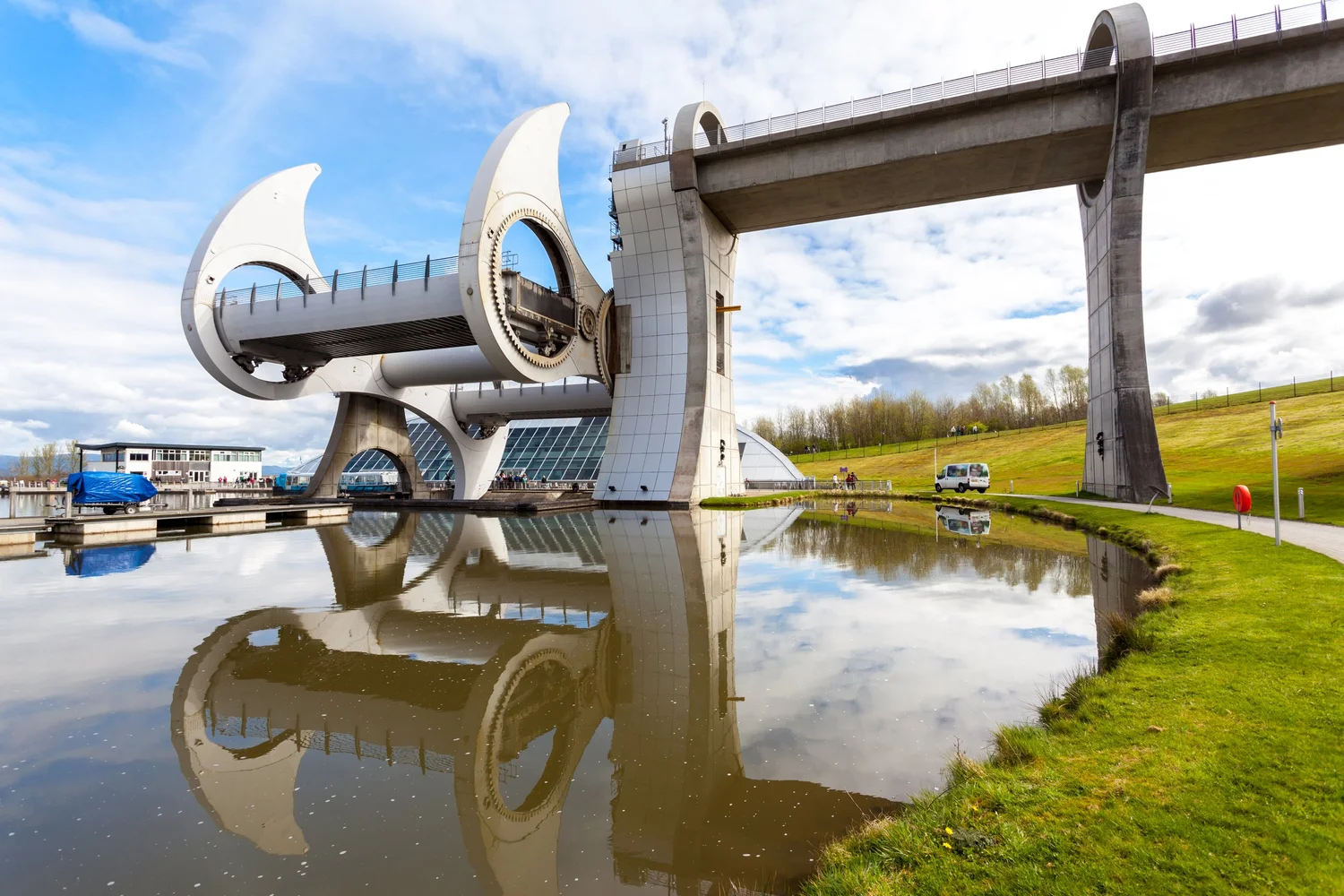
Oh ... well ... hi there little partners! Well ... couple of technical problems down here but, well, that's ok. Because it's time for this week's exciting episode of Trail of the Royal Mounted! #CowboyWho
[Note that this article is a transcript of the video embedded above.]
This is the Forth and Clyde Canal in central Scotland. Completed in 1790, it was the first canal to cross any part of the British Isles. There are a lot of geographical terms for coastal features where the sea indents into the land: sounds, inlets, fjords, lochs, coves, bays, and so on. They all have subtly different meanings that can vary by location, but in Scotland, a lot of them are called “firths,” and they’re pretty important when it comes to navigation. The Forth and Clyde Canal, as its name strongly suggests, connects the Firth of Forth to the Firth of Clyde. It also has a branch into the heart of Glasgow. When it was built, this canal dramatically shortened the transit times for goods in the region, and it also served as the testing waters for the very first steam-powered boats.
Not long after the Forth and Clyde opened, another important canal was completed in Scotland. The Union Canal connected the cities of Falkirk and Edinburgh, opening up a route for coal and other minerals from the mines and quarries around Lanarkshire to the capital. Along the way, it passes over some pretty impressive aqueducts, including the Avon Aqueduct near Linlithgow. A connection to the Forth and Clyde Canal in Falkirk would provide a direct waterway link between the two largest cities in the country (Edinburgh and Glasgow) without ships needing to navigate the hazardous Firth of Forth. But there is the challenge of elevation. Union Canal sits about 115 feet or 38 meters above the level of the Forth and Clyde.
Moving people and goods by boat has a lot of advantages: it’s cheap, it’s efficient, it usually takes less infrastructure, and it allows for connectivity across the globe. But there is a major disadvantage: the waterways that ships and boats traverse have to be pretty much level. Boats don’t climb hills like cars, trucks, and trains. This is the main purpose of a lock: raising or lowering a vessel to navigate elevation changes in waterways. In fact, locks are pretty much the only solution to this engineering challenge… except in a few rare cases.
You’ve seen the title. You know where I’m headed with this. But the story of the Falkirk Wheel - the only rotary boat lift in the world - is fascinating, not just because of the mechanisms, but also how it came to be in the first place. It’s not easy to accomplish projects like this. The Falkirk Wheel is not the passion project of some lone eccentric billionaire. This is public infrastructure, which means a vast array of stakeholders had to come together and agree that this bizarre structure was worth the resources that went into building it. It’s got some very clever engineering under the hood, and a lot of lessons in its creation that, I think, apply to other challenges we face today. I’m Grady, and this is Practical Engineering.
Of course, the original connection between the Forth and Clyde and Union canals did use locks. A lot of locks. This map from 1898 shows the flight of 11 locks required to get boats up and down between the two. You can imagine the time, resources, and effort involved in navigating this staircase. The process took the better part of a day, and not only that, it used a lot of water from the Union Canal. Even though boats can move through locks in both directions, water only moves through in one. Each structure always fills from the upper canal, and always drains to the lower one. That’s just gravity. But, it’s important to realize that even though most locks don’t use pumps, the energy required to raise and lower boats through isn’t free. Each passage through costs roughly one “lock-full” of water from the upper canal.
In addition to the inconvenience and water usage, other factors eventually drove these canal systems in Scotland into disrepair and abandonment. The canals were small, and as ships got larger, the narrow and shallow passages became less useful for transporting materials and goods. The railroads also started competing with the canals, offering faster connections between major cities. By 1930, the canals were barely used, and by 1960, they were choked with vegetation and debris. Motorway construction disconnected several segments, and authorities decided to close them for good. That could have been the end of the story, and honestly, it wouldn’t be too surprising. It’s been the fate of many of the world's great canals and inland waterways as transportation technologies and overland shipping have passed them by. But then the year 2000 happened.
Maybe you remember this. It was a weird time to be alive. There was this strange tension between excitement about the new century and fear that all our computer systems would crash into an apocalypse. The programmers and IT professionals took good care of us on the computer side, but there were people working hard on the celebrations, too. One of those organizations was the United Kingdom’s Millennium Commission. The idea was simple: take some of the money from the National Lottery and direct it toward interesting and impactful projects that would help mark the turn of the century.
In Scotland, a large consortium of organizations - public, private, and volunteers - got together and applied for a grant from the Millennium Commission. In 1997, funding was awarded to cover approximately half of the cost of the Millennium Link: a massive undertaking to revitalize and reopen the canals that once connected Scotland from coast to coast, restore locks, build hike-and-bike trails, and rehabilitate bridges. The work included The Kelpies, a sculpture of two huge horse heads that serve as the gateway to the Forth and Clyde canal. That was a pretty fascinating civil engineering project in its own right. But of course, the Millennium Link’s flagship project was reconnecting the Forth and Clyde to the Union Canal.
But rather than do it with locks, the group wanted a 21st-century landmark, or I guess, more of a watermark. A fast, efficient connection that would serve as a capstone to the canal revitalization, draw tourists from around the world, and serve as a symbol of the region that was once a hub of transportation and commerce in Scotland. And, in fact, a hub is a good metaphor for what they came up with. The Falkirk Wheel opened for traffic in May 2002, and now, more than two decades later, it’s pretty clear that they nailed the idea. Here’s how it works:
Boats bound for the Union Canal enter a circular turning basin at the bottom. The Wheel has two opposed arms, each with water-filled gondolas (or caissons) spanning between them. Those gondolas are mounted on bearings that ride on circular rails. When one goes up, the other comes down, so traffic can move both ways. The wheel is driven at its center using hydraulic motors that keep the motion smooth and slow. Idler pinions mesh between two identical ring gears: one fixed and centered on the shaft; the other surrounding each gondola. This arrangement enables the gondolas to counter-rotate as the wheel moves, maintaining their perfect upright position throughout the full range of motion.
The elegance of the Falkirk Wheel hides some fairly complicated systems that make it function. At the top and bottom, each gondola has to be able to open and close to let boats in and out. And the aqueduct at the top needs the same capability so water doesn’t just flow off the edge when the wheel is moving. The docking and undocking procedure is a delicate dance. When a gondola reaches the top position, stow pins extend to lock it in place. Then an extendable lance connects it to a hydraulic power unit. A U-shaped seal extends to bridge the gap between the two structures, and pipes fill the gap between the gates with water, balancing the pressure. Finally, hydraulic rams open the gates on both sides, allowing boats to enter or leave. The whole process happens in reverse, and then the wheel is free to move again.
Part of the engineering genius of the Falkirk Wheel is that it’s always balanced, whether there are boats inside the gondolas or not. This is one of those confusing things about buoyancy: a floating vessel always displaces its own weight in water. Theoretically, as long as the water level stays the same, when a boat floats over an aqueduct, there is no change in forces on the columns. The displaced water flows away, balancing the new force of the boat. Same thing for the gondolas. When a boat floats in, its weight in water flows out, maintaining a balance between the two sides. As a result, the Falkirk Wheel doesn’t really require a lot of power to operate. It’s about one-and-a-half kilowatt-hours for a half turn of the wheel, often compared to the power required to boil eight kettles of water. Where I live, that’s less than 25 cents in electricity. And unlike the day-long climb of the industrial-revolution-era locks, the Wheel moves boats between levels in about five minutes.
The Scottish Canals see almost no commercial shipping these days. They’re still too small, and the road and rail networks are still faster. But the canals do see a lot of traffic. There’s a whole class of vessels specifically designed for navigating the unique and historic canals of the UK. Similar to RV culture in the US, narrowboats ply the inland waters across England, Wales, Scotland, and beyond, used for holidays, touring, and even as long-term homes. During the early Industrial Revolution, boats like this were pulled along canals by horses or donkeys from towpaths that ran alongside them. Modern narrowboats are self-propelled and often equipped with domestic comforts, including bathrooms, kitchens, heating, and internet. The number of boats has been steadily increasing over the past decade, offering the freedom and lower cost of a nomadic lifestyle on the canals.
Even for those not living on narrowboats, cruises and tours along the canals offer something unique. It’s a totally different way to experience the landscape in some of Great Britain’s most beautiful areas, and it offers insights into the history of the region that you can’t get anywhere else. And of course, you also get to see the fascinating infrastructure, including a boat lift that you won’t find anywhere else in the world.
But it doesn’t go all the way up. When a segment of the canal was relocated as part of the Millennium Link, it needed to cross the Antonine Wall, a Roman-era defensive perimeter and UNESCO World Heritage Site. Rather than disturb it, the new canal was built into a tunnel below. From the aqueduct at the top of the Wheel, two new locks raise boats the remaining distance once they pass underneath the wall to the top of the Union Canal.
The Antonine Wall marked the far northern border of the Roman Empire. On another edge, just a handful of decades before it was built, Mount Vesuvius erupted, burying the city of Pompeii in ash. But there’s a twist to that story. My friends at the podcast, RadioLab, are just about to premiere a fantastic video about the survivors of Pompeii and how we discovered that some people actually escaped. This simultaneous release is part of a collaboration with the Independent Media Initiative to highlight some of the best educational and artistic creators on the internet. I’m really thankful for the award the channel won this year for my Practical Construction special, and I’m so excited to hand off to one of my favorite shows on the internet, RadioLab, for the next video in this collaboration. Go check it out after this!
When I was a kid, my dad used to tell me, “If the only reason you want something is because it’s cool, you probably don’t need it.” You can look at me and probably tell I took that advice to heart. But there are situations where it’s worth doing something just because it’s going to be impressive. The Falkirk Wheel is a perfect example. Locks are a perfectly functional solution to get boats up and down to different elevations. There are thousands of them around the world diligently serving our inland waterways. Scotland wanted something special, something that would spark a resurgence in their canal system and revitalize the sense of pride in the communities along them. It took guts to try something completely different, and it paid off. Millions of people have visited to watch it turn or travel through it. The Falkirk Wheel didn’t just reconnect two canals. It reconnected people with the idea that infrastructure can be both useful and pretty cool.
The Corporation for Public Broadcasting agreed Monday to fulfill a $36 million, multi-year contract with NPR that it had yanked after pressure from the Trump White House.
Dallas-based nonprofit AURORA, known for its presentations of technology-driven public art, has announced the curators for its 2026 AURORA Biennial: Julia Kaganskiy, an independent curator based in New York City, and Tairone Bastien, an independent curator, writer, and educator based in Toronto.
Julia Kaganskiy and Tairone Bastien. Photo: Justin Clemons
Ms. Kaganskiy and Mr. Bastien will select regional, national, and international artists for the citywide biennial exhibition, to take place November 21, 2026, at multiple sites, including Dallas City Hall, the J. Erik Jonsson Central Library, and the AT&T Discovery District. Events and programming leading up to the one-night exhibition will run from November 1-20, 2026.
On Thursday, November 20, at 6 p.m., AURORA will host Ms. Kaganskiy and Mr. Bastien for a panel discussion with Joshua King, AURORA Co-Founder and Executive Director, at FLOCC (606 N. Edgefield). The curators will introduce themselves and discuss their curatorial practices, while Mr. King will offer insights into AURORA’s work as a public art organization and share early details about the 2026 Biennial. The conversation will be moderated by Nancy Cohen Israel, an art historian, writer, educator at the Meadows Museum, and founder of Art à la Carte Dallas.
Previously, Ms. Kaganskiy participated as a member of the 2015 AURORA Biennial six-person curatorial team. “AURORA has grown tremendously over the past decade, as has Dallas’ media art scene, so it’s incredibly exciting to think about what new possibilities we can explore together for 2026,” she said.
In 2010, Ms. Kaganskiy helped launch The Creators Project, a global multimedia artist summit for Vice Media and the Intel Corporation, as well as the NEW INC museum-led incubator for art, tech, and design at the New Museum. As an independent curator, she recently served as Curator-at-Large at LAS Art Foundation in Berlin, and has worked with multiple art centers internationally, including the Barbican Centre and 180 Strand in London, Matadero Madrid, Borusan Contemporary in Istanbul, House of Electronic Arts in Basel, and Eyebeam Center for Art & Technology in New York City.
Mr. Bastien co-curated the first two editions of the Toronto Biennial of Art in 2019 and 2022, and from 2005 to 2010 co-organized the first three editions of the Performa live performance art biennial in New York. Previously, he established the Alserkal Residency in Dubai, and has curated projects with Delfina Foundation and the Shubbak Festival in London, Art Dubai, and the Dhaka Art Summit and Samdani Art Foundation in Bangladesh. His current research, under the title A Feral Commons, examines the ecological impact, needs, processes, and visual languages of public art and art-making in the Global South.
An image from the 2024 AURORA Biennial, with video projections on the Dallas City Hall. Photo: Can Turkyilmaz
“AURORA has done a phenomenal job positioning Dallas as a global destination for digital and media art and bold experimentation in public space,” Mr. Basiten said. “I’m honored to co-curate the 2026 Biennial and excited to work with artists, partners, and communities to imagine new ways technology can bring people together, deepen our understanding of place, and transform how we experience the city.”
Register for the Thursday, November 20, panel discussion here. Learn more about the AURORA Biennial via the organization’s website.
TORONTO – With newly released files from notorious sex trafficker Jeffrey Epstein implicating President Trump in a world of elite, amoral power players, Canadian businessman Kevin O’Leary has formally requested that Trump insert his name into those files as well. “The men named in the Epstein Files are powerful, merciless, and unfathomably wealthy, and it […]
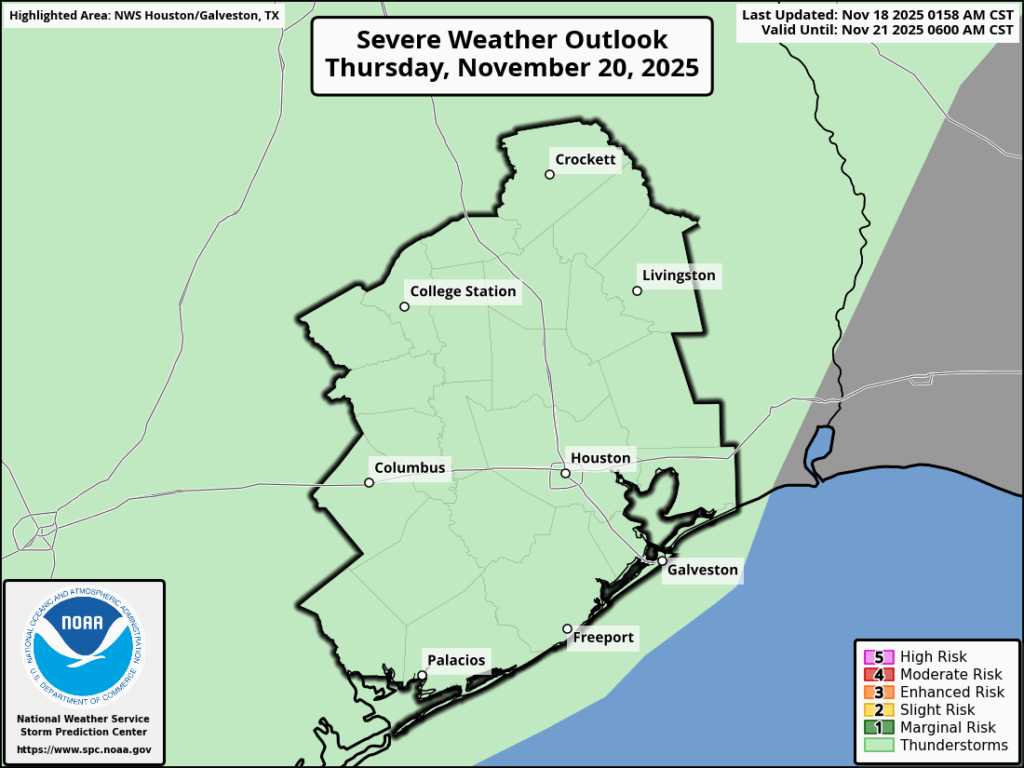
In brief: There is a lot of uncertainty in the forecast, but we can be confident of unseasonable heat through Thursday, and then the likelihood of some showers and thunderstorms on Thursday evening into Friday as a weak front approaches Houston. After that? Well, we’ll see.
Site issues
Good morning. We rely on Cloudflare to manage a lot of our traffic (it is a service that underlies much of the Internet). Unfortunately they have been having some issues this morning and this has caused Space City Weather to go down at times. We apologize for any inconvenience.
Overall pattern
Despite a fair amount of cloud cover, Houston’s high temperature reached 84 degrees on Tuesday, falling just short of setting a record high for the day. With persistent high pressure holding on for a little while longer I expect today and Wednesday to be the warmest days of the week, and we almost certainly will break the city’s record high temperature for today, Nov. 18, which is 84 degrees. Wednesday (85 degrees) is also in play.
Later this week, by Friday, a weak front is going to sag into the area. As a result of this we’ll see healthy rain chances beginning on Thursday, and these may persist into the weekend. We also will probably see some slightly cooler and drier air, but our region will remain unseasonably warm into next week. Most of our model guidance is still pointing to a more significant cooldown by around Thanksgiving, or shortly after.
Yes, today is November 18. These are the forecast highs. (Weather Bell)
Tuesday
We are seeing a bit of patchy fog across the area, and this is not surprising because temperatures are in the upper 60s with dewpoints to match. So yeah, it’s pretty sticky. Highs are going up into the mid-80s for most of Houston, with some upper 80s possible west and north of the city. It’s not even gonna be a dry heat. Lows tonight will be similarly sultry, with another chance of patchy fog.
Wednesday
Expect another warm and humid day, albeit with more clouds. This may limit highs to the mid-80s for much of the region. Dewpoints in the 70s will certainly be sticky. As we start to see the atmosphere become a little more turbulent some slight rain chances, perhaps on the order of 10 to 20 percent, will enter the forecast. Lows on Wednesday night will, again, be quite warm.
Thursday
As a front advances into central Texas we’ll start to see increasing rain chances on Thursday, although they likely won’t pick up until the afternoon hours, and odds will be best Thursday night into Friday morning as the front moves in the Houston region. Highs on Thursday will likely be in the low- to mid-80s.
So what will the front bring? I’m afraid I can’t offer a whole lot of clarity at this point. I do think we’ll see a line of showers and thunderstorms, but I’m not super concerned about severe weather. Can we rule it out? Not yet, but again the overall dynamics are not super favorable for strong storms. In terms of rainfall I expect most of the area to pick up 0.5 to 1.5 inches, but there is a risk for higher accumulations.
Friday
You would expect a cold front in November to bring some significantly colder air, wouldn’t you? Well, in this case you’d be wrong. Highs on Friday are still likely to be in the lower 80s. I think we’ll also see some lingering showers throughout the day, call it a 50 percent chance of rain. Eventually I think we probably will see some drier air filtering in to the region, but I’m not at all convinced how much we’ll see. So the forecast from this point on is pretty uncertain. But for now let’s call for lows on Friday night to be in the lower 60s.
Saturday and Sunday
Both of these days probably will bring partly sunny skies, with highs in the upper 70s—or thereabouts. Saturday and Sunday will each have a modest chance of rain, perhaps 20 to 40 percent. Lows likely will be somewhere in the range of the upper 50s to lower 60s, but again this depends on the extent of the front. I could see a scenario in which lows only get to the upper 60s.
Overall the forecast has trended drier, but the region still should see some decent rain accumulations through early next week. (Weather Bell)
Next week
The first half of next week will probably see highs somewhere in the 70s and lows somewhere in the 50s or 60s, with decent daily rain chances (50 percent, maybe?). Much of our guidance is still pointing toward a more significant cooldown by around Thanksgiving, but whether that means lows in the 40s or 50s is not yet clear.
All in all this forecast has been pretty unhelpful, I realize. But the fact of the matter is that our best models have been waffling around some, and whether Friday’s front stalls over Houston, or offshore, is going to matter a lot to our weather for this weekend and beyond. I hope to provide you with more clarity in tomorrow’s forecast.
Fundraiser
If you can find it in your heart to embrace the uncertainty, we would certainly appreciate any support you could offer as part of our annual fundraiser. Click this link for all the details on what merchandise you can purchase, or how to donate directly to the site.
At 10:40 a.m. EST, Cloudflare said its engineers were still mitigating some lingering issues after they posted a fix for the outage, but that they were continuing to monitor for any further problems.
1. My coworker accidentally linked her nudes to our team Photoshop account
My coworker was using our team’s Photoshop account for a personal project (which our manager is aware of and okay with) and somehow she accidentally linked her phone camera roll to the account so all of her personal photos were visible on the team account. This might have been a nonissue, but my coworker has numerous sexually explicit photos on her phone that were then linked to Photoshop without her knowledge. The way she found out about this was our manager calling her after hours and letting her know she needed to unlink her phone photos immediately. Manager did not mention anything about the content of the photos.
Clearly, my coworker is now embarrassed and freaking out about what this means for her job. Could she be fired over this?
It’s possible, but it’s far more likely that her manager will just have a serious conversation with her about being more careful in the future — or might assume the embarrassment has already handled teaching her the lesson (which it probably has). Your coworker could help things along by thanking for the manager for calling her right away and saying that she’s mortified and it will never happen again.
2. Not telling an intern the real reason she was fired
I am in middle management at a company that takes on a fair number of interns every year. At a recent meeting (just middle managers and our boss), my coworker mentioned some very inappropriate behavior from an intern. Apparently, Coworker and Intern were working with a client and Intern started talking about marijuana use at length — how it’s so helpful for her, how much fun it is, but sometimes the way she acts while high is scary to her — while Client laughed along and encouraged the conversation. We all agreed that the internship needed to be ended early, both because of this and because Intern is late more often than not.
Coworker asked us not to tell Intern that we knew about the inappropriate conversation. Boss said that was fine, and that he’d tell Intern she was being fired for arriving late too many times. I suggested it might be a good idea for Intern to know that what she said in front of the client was not okay, for her professional growth if nothing else. Coworker never discussed it with her, so she wouldn’t know. Nevertheless, she was fired for “tardiness.”
Do you think this was the right way to handle it? I understand Boss wanting to respect Coworker’s request not to tell Intern that he knew what Intern said, but at the same time, I feel like Intern deserves to know. What do you think?
I’m with you. Part of the point of an internship is to learn about how work works, and it’s a disservice to the intern not to tell her that that conversation was firing-level inappropriate. It’s far better for her to learn that lesson as an intern than at a regular job where the stakes will be higher. In asking your boss not to share the info, the coworker was prioritizing her own (extremely mild) issues of comfort over what’s actually best for the intern, and it’s too bad that your boss agreed to handle it that way.
3. How do we ask for extra pay for overnight events when we’re working for a friend?
I work part-time as an assistant event planner. The company is owned by one main planner, Jane, who does this full-time and brings in three assistants to help on the day of events. The three of us all have separate full-time 9–5 jobs during the week, so this is side work for us. Event days are long, physical, and often outside in hot weather, but we all genuinely enjoy working together and have become good friends.
As the business has grown, Jane has started taking on more events that are farther away, which often means overnight travel. We’re paid hourly for the event work itself and reimbursed for expenses while on the road, but the travel adds a lot of extra logistical work for us — arranging time off or remote days from less-than-ideal locations for our regular jobs, managing childcare and pet care, packing for several days, etc. It’s starting to feel like we should be getting some additional compensation for that extra burden, maybe a flat bonus for overnight events or something similar.
The tricky part is: I don’t think Jane realizes how much of an extra ask these overnights are. She’s a workhorse who will happily go from 5 a.m. to midnight, and when she’s in the zone she can get tunnel vision about what the event needs, without realizing that not everyone can or wants to operate that way or that we have other responsibilities outside her business.
Jane genuinely enjoys these trips and I think sees them as friend time as much as work time. To be fair, we do too! We don’t want to damage the good vibe we have, but we also want to feel fairly compensated for the extra effort that goes into supporting her growing business. How can we raise this without hurting the relationship?
Be straightforward and explain that the overnight trips require more from you than the local ones do, and ask to revisit the payment rate in light of that. For example: “Can we revisit the payment rate for overnight trips? Our current payment rate was arranged when all the events were local, but overnight events require a lot more, like time off from our regular jobs or arranging remote work and managing child care and pet care. Could we figure out a different rate for overnight trips that takes those factors into account?”
If she resists that, it’s completely fair and reasonable to say that you can only do local events. And since there’s a friendship element here that you’re worried about too, you can acknowledge that by saying something like, “I do have a great time on the trips and like doing them, but realistically it’s not something I can make work with my regular job at the current rate. So I will sit those out, but if you ever change the way they pay, I’d be interested in doing them again.”
4. Who should really be in the “to” field vs. the “cc” field?
The VP at my work requests that we copy his assistant when emailing him to make sure he responds. Often, if I am scheduling a meeting with him, his assistant will be the right person to respond. I feel weird CC’ing her and addressing the email to VP when the assistant is going to respond.
I have been addressing the emails to both of them and talking about the VP in third person when scheduling meetings. The VP needs information on the topic of the meeting, and the assistant is the one that works out the scheduling. I feel like I should actually be emailing the assistant and CC’ing the VP, but that may not be appropriate given his position either. What are your thoughts?
Either one is fine, and different offices do it differently — and in most cases, no one is really analyzing the to/cc fields that closely (there are some exceptions to that, but they’re rare) and you’re probably putting too much worry into it.
In this case, since the VP has specifically asked that you copy his assistant, you should do it that way. And it’s very, very normal to do it that way! The idea is that you’re emailing the VP about the need, but his assistant is copied in so she can handle the set-up. But most likely, they don’t really care which way you do it as long as you’re sending the info to both of them.
5. I’m on leave and just saw my company advertising my job
I work in middle management at a mid-sized office. There have been a lot of money troubles and management drama here in the past year, and I recently went on FMLA to address health issues I’ve been ignoring. The stress of the job was definitely a contributing factor to my declining health.
I will return to work this winter and have communicated my expected return-to-work date to HR, but I was scrolling a job board and noticed that my employer posted an opening for my job. It has a different title than mine but is exactly what I do in my day-to-day. I’m trying to not freak out and tell myself that maybe management has realized how overworked I was previously, so they’re hiring help for me. But I can’t help but think that they are trying to blatantly replace me. Management is known to hold grudges toward people who go on leave. I know that technically my employer can move me to the “same or equivalent position” when I return from FMLA, but I also know there is quite literally no money or space to hire a Second Me for the office.
Is there any way to interpret this non-maliciously? My current thought is to continue with my current return-to-work plan and see what happens, but the uncertainty is killing me.
It’s possible that they can’t leave the work undone and so they’re hiring for it now, with the plan of moving you to an equivalent role when you return or of having there be two people doing the work or at least of having overlap. Or it’s possible that they’re planning to flagrantly violate federal law and push you out for taking FMLA.
One option, if you want to, is to email your manager and say you saw the job posting and ask if they’re adding a second role or envisioning you returning to a different one. But it also wouldn’t be a bad idea to make sure you have a lawyer to contact if they do indeed try to push you out.
The U.S. government issued new guidance that would deny visas to applicants with certain chronic health conditions such as diabetes or obesity if they may pose a financial burden on public resources. What do you think?
“The stuff they’re calling diabetes over there just isn’t up to our standards.”
Jake Mather, Sandwich Assembler
“But they shouldn’t be too healthy either.”
Shane Asplund, Unemployed
“Aw c’mon, there’s plenty of medical debt for everyone.”
COLUMBUS, OH—Casually minimizing the amount of fulfillment and joy he now finds in his everyday life, area man Tyler Reaves reportedly downplayed his happiness Tuesday while catching up over drinks with his single friend Brian Schur. “Yeah, man, things are fine—same old, same old,” said Reaves, who that night would curl up on the couch with the woman he loves, her head nestled perfectly in his lap as she laughed softly and they planned a future together, later making love and feeling closer to each other than they had to anyone else in their entire lives. “Unlike you, though, I barely get any free time anymore. My girlfriend’s always dragging me to these stupid farmers markets and on walks by the lake. Plus, she makes me watch girl shows instead of football. It’s so awesome that you can just order pizza every night, too, instead of this homemade roasted salmon dish that Vanessa makes. You don’t even know, dude. The other night, instead of going out, we just stayed in and talked about baby names for, like, three hours. You’re so lucky, man.” At press time, reports confirmed Schur had said he was “doing good, too” before returning to an empty apartment, opening a beer in silence, and letting it go warm in his hand.
LOS ANGELES—Accusing the competition series of “blatant favoritism,” Dancing With The Stars fans took to social media Tuesday to criticize the show for allowing contestant Whitney Leavitt to use an extra pair of legs. “How in the world did Whitney get not two, but four different legs to use during her performance?” Dancing With The Stars fan Anne Hordern said in a widely shared post that slammed the judges for clearly giving the six-limbed Secret Lives Of Mormon Wives an unearned advantage. “It’s not fair! If it was just an extra arm or something, I’d say ‘whatever,’ but two extra legs? Come on. Meanwhile, Robert [Irwin] is a million times more talented, and yet he’s being forced to perform limbless.” At press time, fans were in an uproar after Leavitt’s legs had reportedly doubled to eight.
With the festive season upon us and our hearts filled with the reality that we’ve never been so isolated and alone, The Onion offers an extensive guide featuring tips and tricks for preparing an unforgettable annual feast to create a completely miserable dining experience for one.
STEP 1
Leave your ex-wife a long, meandering voicemail.
STEP 2
Measure one cup of Andrew Tate’s Ultimate Male Turkey Powder.
STEP 3
Turn an unused burner on medium and place your hand on it to feel something, anything at all.
STEP 4
Using a steak knife, catch a glimpse of what you’ve become in the blade’s reflection.
STEP 5
Wash vegetables in warm water on a gentle cycle with plenty of fabric softener.
STEP 6
Double the salt in the recipes to reduce your odds of doing another one of these next year.
STEP 7
Mindlessly peel 647 potatoes as you daydream about all the ways you will seek revenge on those enjoying Thanksgiving without you.
STEP 8
Add two cups of melted butter to your open mouth.
STEP 9
Recoil in shock after touching the turkey and suddenly becoming flooded with its memories in which it, too, is scared and alone.
STEP 10
Eat straight from the pan naked for fewer dishes and clothes to wash.
STEP 11
Go outside and press your face to the glass of the dining room window of the happiest family in your neighborhood.
WASHINGTON—Calling the national crisis “a complete justification” for additional airstrikes on boats purportedly trafficking narcotics, the Pentagon issued a statement Tuesday blaming Venezuela for the flow of drugs into Kash Patel. “Day after day, Venezuela’s violent cartels smuggle illicit narcotics across the border and into our country’s FBI director,” said Defense Secretary Pete Hegseth, adding that the South American nation was responsible for 90% of the illicit chemicals flowing through Patel’s veins at any given moment. “This week we destroyed a vessel that was loaded with enough drugs to make Kash Patel humiliate himself during multiple press appearances, and God only knows how many more boats are on their way. Kash once had a bright future, but the narco-terrorists have turned him into a shell of a man who is constantly covered in sweat and clearly losing his mind. We are not afraid to use violence to prevent Venezuelan drug traffickers from continuing to make billions of dollars off Kash Patel.” According to administration officials, Hegseth has repeatedly attempted to help the FBI director by advising him to switch to booze.
WASHINGTON—Embarking on their self-described “diplomatic voyage” at the National Mall Tuesday while their wives and children waved goodbye, Eric and Donald Trump Jr. reportedly declared, “We’re off to see the world!” as they set sail across the Lincoln Memorial Reflecting Pool. “Anchors aweigh!” shouted Donald Jr. jubilantly, peering through a toilet paper tube while standing proudly at the bow of a makeshift raft fashioned from duct-taped air mattresses and patio furniture as Eric dutifully hoisted a velvet curtain sail. “We’ll write to you as soon as we get to Bermuda. Then we’re off to Paris, and, after that, the jungles of Africa! We’re going to find real pirate gold on an island, and when we get to China, we’ll bring back fortune cookies for everybody. Once we finish sailing all the way around the world, we’ll come back into the reflecting pool from the other side—you’ll see! We’ll be the first explorers ever to do it! Now we just have to wait for a big wave to come along and take us to sea.” At press time, the Secret Service rescued Eric and Donald Trump Jr. after they capsized a quarter of the way through the reflecting pool.
OTTAWA – The Prime Minister’s Office has issued a directive that all staffers and civil servants must bow before speaking to Prime Minister Carney. “Upon entering a room in which his excellence, Mark Carney is located, you will enter, bow at the neck (not the waist you ignorant Prussian), then proceed three steps and face […]
Sawyer
Lee is an illustrated middle grade novel starring an unadventurous kid
who'd rather dig a deep dent in the couch than make a mark on the world,
as many in his illustrious family of astronauts, scientists, spies,
champion athletes... blah blah blah... have. He has decided that after
generations of effort, itâs time to spend one lifetime relaxing.
The
problem is that Sawyer keeps getting caught up in the exhausting
expectations of his wicked aunt Celia, his complex relationship with his
ambitious other friend, Angela, and the shenanigans of every else
in town hoping to win the yearly Gourd Thump festival celebrating
natureâs dullest vegetable.
In this tale of mystery, treachery,
conspiracy, plant husbandry, and an imaginary love triangle, Sawyer
knows it will take a regrettable amount of energy to escape these
entanglements and find a way back to his happy place on Garyâs couch,
with a cozy throw blanket, a steaming mug of chamomile tea, and an empty
schedule.
Super-cheap EVs exist in other parts of the world, as advances in battery tech and manufacturing are making new cars significantly cheaper. But the US market presents unique challenges for automakers.
Internet Archive’s Community Webs program has received a grant from the Council on Library and Information Resources (CLIR) and their Digitizing Hidden Collections program to digitize and provide open access to thirty local history collections from six partner organizations across the US and Canada.
“This grant lets us expand access outside of our building and really showcase the stories and lived experience of people and organizations that have been fighting for equality and doing important work throughout Atlanta,” said Derek T. Mosley, Archives Division Manager of the Auburn Avenue Research Library (AARL) on African American History and Culture in Atlanta, Georgia. AARL will receive digitization support for collections documenting leaders, artists, scholars, and advocacy groups in Atlanta. The personal papers of scholars and community leaders Duncan E. Teague, Craig Washington, Anthony “Tony” Daniels, and Dr. Shirlene Holmes will also be digitized.
The Pomo Afro Homos Records from the San Francisco Public Library will be digitized with support from CLIR
Four collections will be digitized from Colorado’s Pikes Peak Library District including the records of the Colorado Springs Pride Center, The Citizens Project, and the Pikes Peak Lavender Film Festival. A selection of related photographs from the Colorado Springs Gazette will also be made available digitally.
Invisible Histories will partner with the Birmingham Public Library to complete digitization of the papers of prominent leaders in the lesbian communities of Mississippi and Alabama. “Invisible Histories is thrilled to be able to make these very rare and important examples of Southern Lesbian history available for everyone,” Invisible Histories Co-Executive Director Joshua Burford stated.
The Marge Ragona Papers from the holdings of Invisible Histories/Birmingham Public Library will be digitized
Collections to be digitized from the San Francisco Public Library include the papers of local authors and activists Barbara M. Cameron and Christopher Hewitt as well as the records of the local theater group Pomo Afro Homos. The ArQuives, based in Canada, will digitize the personal papers of early figures in Canada’s gay liberation movement.
Photograph from the Gerald Hannon fonds from project partner The ArQuives
The Rochester Public Library will digitize the personal papers of Rochester-based gay rights communities and the records of related cultural organizations. “The eight collections chosen for digitization as part of this grant are a treasure trove for researchers seeking to understand how LGBTQIA+ life and activism has evolved outside of major centers such as New York City and San Francisco,” explained Shalis Worthy, Historical Services Coordinator for the Rochester Public Library.
Once digitized, these collections will be accessible to local communities and researchers all over the world, providing valuable evidence of community history and culture.
Map of Oz; John R. Neill – Tik-Tok of Oz, first published in the United States in 1914.
The Wonderful Wizard of Oz is the American fairy tale. Like other fairy tales that resonate across time and cultures, this story has seen retellings time and again that morph, recontextualize, and expand the story. This phenomena continues with the second half of the Wicked film duology releasing this November with Wicked: For Good. Let’s explore some of the stories and lore of this American fairy tale that now live in the public domain. All these different stories crafted the lore and world of Oz in the imaginations of audiences around the world.
Books and Literature
Cover to the original 1900 Oz novel
Oz originates in L. Frank Baum’s The Wonderful Wizard of Oz, published in 1900. Its basic plot is well known: Dorothy of Kansas is swept away to Oz via cyclone. There she meets an exotic cast of characters including the Scarecrow, Tin Woodman, and the Cowardly Lion. Along her journey she faces many challenges in an episodic style as she seeks to return home with the Wizard’s help.
Many fans might believe the Wicked Witch is the novel’s central antagonist, but in fact she appears in just one chapter in the original text. Her larger role in the plot is an association with the 1939 film, an interpretation that became highly influential, as nearly every later Oz story riffs on this idea, including Wicked. Baum would not reuse the Wicked Witch in later novels.
Beyond this original tale are numerous other novels, including another 13 by Baum and 19 by his immediate successor, Ruth Plumly Thompson. Of these 32 tales, 23 were published by the end of 1929 and are in the public domain, including all of Baum’s output. On January 1, 2026, another Plumly Thompson novel, The Yellow Knight of Oz, will join that group. Plumly Thompson’s output ultimately surpassed Baum’s, though her imaginative contributions, including introducing a new main focal character—Peter Brown—remain underappreciated today.
Cover to the first sequel Oz novel
Among Baum’s sequels, The Marvelous Land of Oz (1904), his first sequel, stands out for introducing Princess Ozma and expanding the mythology of Oz. It is the only one of Baum’s works to not feature Dorothy as a character in the story. Due to popular demand, she would return in Ozma of Oz (1907). In this tale she would be referred to as Dorothy Gale for the first time in the novels, although the name originated in the 1902 musical revue.
Check out all of the Oz books in the public domain in our collections!
Musicals and Sound Recordings
Promotional image for the 1902 musical
Part of Baum’s core campaign in expanding Oz’s reach was his ability to spread it into multi-media. In 1902, he penned the book for a musical revue that differed from his original text and introduced many more characters, including Imogen the Cow. Notable among the work are the plethora of songs created for it that were cycled in and out as the production shifted locations.
By 1913, Baum had penned another two successful stage productions: The Woggle-Bug (1905), and The Tik-Tok Man of Oz (1913). This latter work exhibits Baum’s multi-media synergy as the play was based on prior Oz novels, Ozma of Oz (1907) and The Road to Oz (1909). He then adapted this musical into his 1914 book, Tik-Tok of Oz.
A selection of items related to the Oz musicals
While these original Oz musical productions are unable to be viewed now, due to the impermanent nature of theatre, we can still connect to them through sound recordings. While not recordings of the actual shows, these auditory oddities act as gateways to the past. They unlock a direct link to tangible creative expression that also reflects the artistic and performing sensibilities of the time. Surviving from the time is a 1913 recording from The Tik-Tok Man of Oz: My Wonderful Dream Girl.
Explore the many elements of these productions, including sheet music, visual imagery, and sound recordings in our collections.
Film
Rightly remembered for its masterful execution and translation of the fairytale Oz to the big screen, MGM’s The Wizard of Oz (1939) remains the primary association with Oz for most audiences. However, despite its iconic status, that version was preceded by multiple filmed adaptations. Between 1908 and 1925, at least six silent adaptations brought Oz to life, some now lost, others surviving in fragments that reveal inventive visual interpretations often drawn from the stage musicals of the era.
The first—in 1910—acts as a loose adaptation of the stage musical featuring Imogen the cow. In 1914, under Baum’s own supervision, His Majesty, the Scarecrow of Oz stands out for recycling narrative elements and characters that Baum later reshaped into his book The Scarecrow of Oz. A 1925 film, The Wizard of Oz, went feature-length with slapstick sensibility and large deviations from the source material. It was directed by and starred Larry Semon and featured Oliver Hardy in a pre-Laurel and Hardy role as the Tin Man.
Title card of the 1933 cartoon
Deviation from the source material was common into the 1930s with a 1933 short cartoon aptly titled The Wizard of Oz. Directed by Ted Eshbaugh, this cartoon is the first instance of an Oz film in sound and color. Building on the adaptation oddities, this film includes no dialogue, sans a simple song refrain, and it trades out a plot for lively 1930s animation and fantastical moments that fit into the inventive world of Oz. The short features an element inspired by the first book by having Kansas be monochromatic before Oz radiates with color. This shift in color would again be utilized in the 1939 Oz film. Oddly, the short does not end with Dorothy returning to Kansas, similarly to the end of the 1902 musical. Rather it ends on an inconclusive button with a giant egg hatching a tiny chicken for comedic effect. A charming oddity, it shows just how wildly Oz’s world could be reinterpreted even then. Learn more about its history and restoration process over at Cartoon Research.
Oz is ingrained in American culture and remains a global icon. Today, most audiences encounter it through the 1939 film, contemporary interpretations like Wicked, or by revisiting Baum’s original 1900 classic. But beyond those familiar touchstones lies a much broader creative and cultural legacy. We hope this brief journey into the roots of Oz inspires you to explore its forgotten corners and rediscover the wonder that made it timeless in the first place.
This week, I had to fix some equipment. It wasn’t a big fix; a lever had fallen out of alignment with its little sensor and needed to be moved 2 mm back in place so the software would stop claiming that the lever had vanished from the face of the earth. This fix took me around 4 hours, divided up into: opening the box (3 minutes), moving the sensor (30 seconds), watching one of the screws fall onto the floor (5 seconds), scrabbling around trying to find the stupid screw (3 hours, 56 minutes and 35 seconds… ish). No time is included for putting the panel back on because the screw remains missing, and the sensor is now operating ‘alfresco’.
Given this, I think it’s fair to say that I suspect that tiny screws are ruining my life.
Now, I hope you understand that I do appreciate tiny screws. They are invaluable little things that are very well-designed at screwing two things together. As technology has grown more compact and smaller, screw technology has, obviously, worked hard to keep up, and screws have got smaller and more compact to match. I’m sure as you read this within arm’s reach, you can see five different devices that are only possible because of the tiny screws. But with great smallness comes great ability to get lost, and with what I suspect is malicious intent, they do.
They are so tiny that no amount of careful placement on the table can save them. All it takes is a jumper sleeve, a light breeze, or a slightly overcharged static surface nearby and off the table, and they jump into something akin to the screw equivalent of the backrooms. Of course, losing tiny screws is only the first problem. The next is caused by actually finding them.
It’s pretty rare that you find the screw at the same time you drop it. Generally, the screw that goes missing is found some weeks later, long after you’ve forgotten what it goes with. But it’s not uncommon that for every screw you search for, you find 2-3 previously lost screws. This appears to break the laws of conservation, but tiny screws don’t concern themselves with such silly things.
Having spent so much time searching for screws, you know how important any found screws might be, even if they might be the ones you are looking for. And so into a drawer of other assorted tiny screws which you are keeping ‘just in case,’ these re-found screws go and slowly build up a giant collection of tiny screws. None of the tiny screws will ever work as a replacement for your newly lost tiny screw, and they are inexplicably unique to whatever they were holding together.
This is now where I find myself. In a world where tiny screws are missing from equipment all around me, and owning an ever-growing and inexplicable large box of tiny screws that fit no equipment I’ve ever owned. I fear that I am now doomed to spend hours searching for even more tiny screws and constantly simultaneously searching for ever bigger boxes to put the tiny screws I have.
While writing this article, I realised a small screw is missing from the bottom of my Macbook… if you have a 0.8 mm screw with a star-shaped head in your personal giant box of tiny screws, please do get in touch. Maybe together we can beat them.
NEW YORK—Faced with backlash against comments she made last week downplaying the sex trafficking crimes of Jeffrey Epstein, an anxious Megyn Kelly appeared on her podcast Monday waiting for everyone else to start condoning pedophilia too. “I can’t be the only person who thinks having sex with a teenager isn’t all that bad, so don’t leave me hanging here, guys,” a visibly distraught Kelly said to her producer and camera operator, moments before she began cold-calling past guests of her show in search of anyone willing to agree on the record that 15 was “plenty old enough.”“We all thought this was where the messaging was going, right? We all like pictures of young girls, who gives a crap. Hey, Steve, can you call Ben Shapiro again? Let’s get Glenn Beck on the phone. All these clapbacks are going to look really, really silly once everyone starts saying they love pedophilia! Why don’t we all just shout it together? It’s like that movie Spartacus. All right, three, two, one: I love pedophilia!” At press time, Kelly had reappeared on her podcast in a wig and was saying in a British accent that she also condoned pedophilia.