Shared posts

03 Dec 14:53

Hurricane vs. Tiny House

by Wesley Crump

[Note that this article is a transcript of the video embedded above.]

By the end of this video, one of these buildings will be knocked down by the force of a simulated storm surge, because there’s a lot we still don’t understand about hurricanes and their effects on buildings.

In September 2022, Hurricane Ian tore across the Caribbean and southeastern U.S., leaving a trail of devastation from Cuba to the Carolinas. It was one of the strongest and deadliest storms in modern history. We often think of hurricanes in terms of wind and rain. But in coastal areas, it’s the surge of seawater driven inland by the storm that causes the most catastrophic damage. Homes and buildings didn’t just get wet. Many were obliterated, swept from their foundations entirely.

But unlike many storms of the past, Ian came with data, and lots of it. Today’s tools for collecting and analyzing information mean that even tragic disasters can lead to really important insights into how we can build safer and smarter in the future. After Hurricane Ian, FEMA analyzed more than a thousand flood claims, and what they found about building performance was remarkable.

To dig deeper, I’m here at O.H. Hinsdale Wave Research Labratory at Oregon State University. A team of engineers is running a one-of-a-kind experiment to simulate storm surge and study how buildings actually respond. They invited me here to see it firsthand and share what they're learning with you. I’m Grady, and this is Practical Engineering.

Everyone knows hurricanes are destructive, but storm surge often gets underestimated, not just by the public, but policymakers and planners too. The damage from high winds is visually dramatic. We see footage of roofs ripped off and trees snapping like twigs. But just a few feet of storm surge can cause even greater damage. And waves amplify the destruction.

If you’ve spent time in coastal areas, you’ve probably seen homes raised on stilts. Since the early 2000s, this has become one of the most common construction types in flood-prone coastal zones. The concept is straightforward: move the living space above the reach of storm surge. If a hurricane hits, the lower area used for parking, storage, or access might flood, but the critical parts of the building stay dry. All the devastating power of the waves flows through and around the stilts instead of slamming into walls and destroying the structure. It turns out this idea is remarkably effective.

After Hurricane Ian, FEMA found that flood insurance claims for elevated structures in Fort Myers averaged about one-third the cost of claims for non-elevated buildings. That’s a staggering difference in performance. But zoom in, and things get more complicated. On one hand, this is pretty obvious stuff. You don’t need a massive wave laboratory to figure out that elevated structures survive storm surge much better than buildings at grade. But if you look at footage from Hurricane Ian, it paints a more nuanced picture, because some elevated buildings didn’t fare well at all. They weren’t all high enough to avoid the surge. And that gets to one of the most difficult questions in the entire field of hurricane engineering: how tall is tall enough?

Needless to say, it is expensive to lose your home in a storm. The conundrum is that it’s also expensive to build your home in such a way that it can withstand one. If it were easy, every building in Fort Myers would be a hundred feet above sea level. But the reality is that elevating a structure adds significant upfront cost, and the higher you go, the higher that expense climbs. It’s not just a cost for homeowners but also something that’s passed down to renters. Shifting the actual housing upwards shifts the affordability of housing downward for everyone. And because major hurricanes are relatively rare events, the return on that investment comes with a lot of uncertainty, with benefits that are invisible most of the time.

That’s one of the biggest challenges for engineers and officials. In theory, you can design a structure that withstands anything. But in practice, no one’s building hurricane bunkers as homes. Codes and policies have to balance safety with economic viability and long-term risks with the upfront cost of resilience. Local governments want robust, resilient development, but they also need development to happen in the first place. Overly strict codes can scare off builders or price out developers. And while the National Flood Insurance Program might prefer fewer claims, stricter floodplain regulations also come with tradeoffs: reduced property tax revenue, limited housing supply, and the burden of compliance placed on individuals.

These decisions might seem kind of trivial at the scale of a single structure, but when you multiply them out along developed coastlines, the implications of each extra foot of elevation are monumental. So what you end up with is a delicate balancing act, shaped by competing priorities, enormous uncertainty, and billions of dollars on the line. Changing building codes or policies requires buy-in from a broad array of stakeholders, and that kind of consensus demands reliable data.

But there’s one more thing that makes this even more complicated. Of course, “stuff getting wet” is a problem with storm surge, but it’s more than just typical flood damage you’re dealing with when it comes to hurricanes. In a sense, the surge is a rise in sea level itself, and once your home is essentially IN the ocean, that brings wave action into play. Forces intensify. Structural systems are tested in ways that ordinary flood damage doesn’t account for.

You can see why this idea of elevating structures is one of those engineering concepts that seems obvious on the surface, but gets way more complicated when you start looking into the details. And that’s why we’re here. Computer models are limited in their capabilities. And you can’t just call up an actual hurricane to knock over a test structure (and even if you could, it would probably violate the ethics rules). So we go to the next best thing: the wave lab.

The OH Hinsdale Wave Research Laboratory is one of the largest facilities of its kind in the world. Since the 1970s, this lab has supported cutting-edge research into coastal engineering challenges like sediment movement, tsunami behavior, and wave-structure interactions. It actually has two major test beds. This is the Large Wave Flume. It’s used for all kinds of hydraulic experiments related to waves, coastal structures, and erosion. It’s basically a super-sized version of the flume I use in a lot of my garage demos. It can do a lot, but it has a limitation in that it’s inherently two-dimensional. Flow can really only move in the direction of the flume. That’s why the lab also has this: the Directional Wave Basin.

Think of it as a wave pool turned up to eleven. This enormous tank uses dozens of piston-driven paddles, each with independent control, to generate complex, multi-directional waves. You can create a single tsunami-like pulse or dial in irregular wave trains to match the chaotic sea states found in real hurricanes. This facility is utilized in large-scale research projects on wave hydrodynamics, floating structures, and devices that harness wave energy to generate electricity. But, of course, it can also test coastal structures, like these houses.

Dr. Dan Cox is a Coastal Engineer and Civil Engineering Professor at Oregon State. He explained to me why they chose the basin for this experiment.

“The nice thing about the basin is that you can look at kind of a full 3-D picture, rather than just a slice. And I think for this set of tests, we really wanted to do an entire house, not just a wall, you know, a bit of the foundation. And that’s why we chose the basin for this one.”

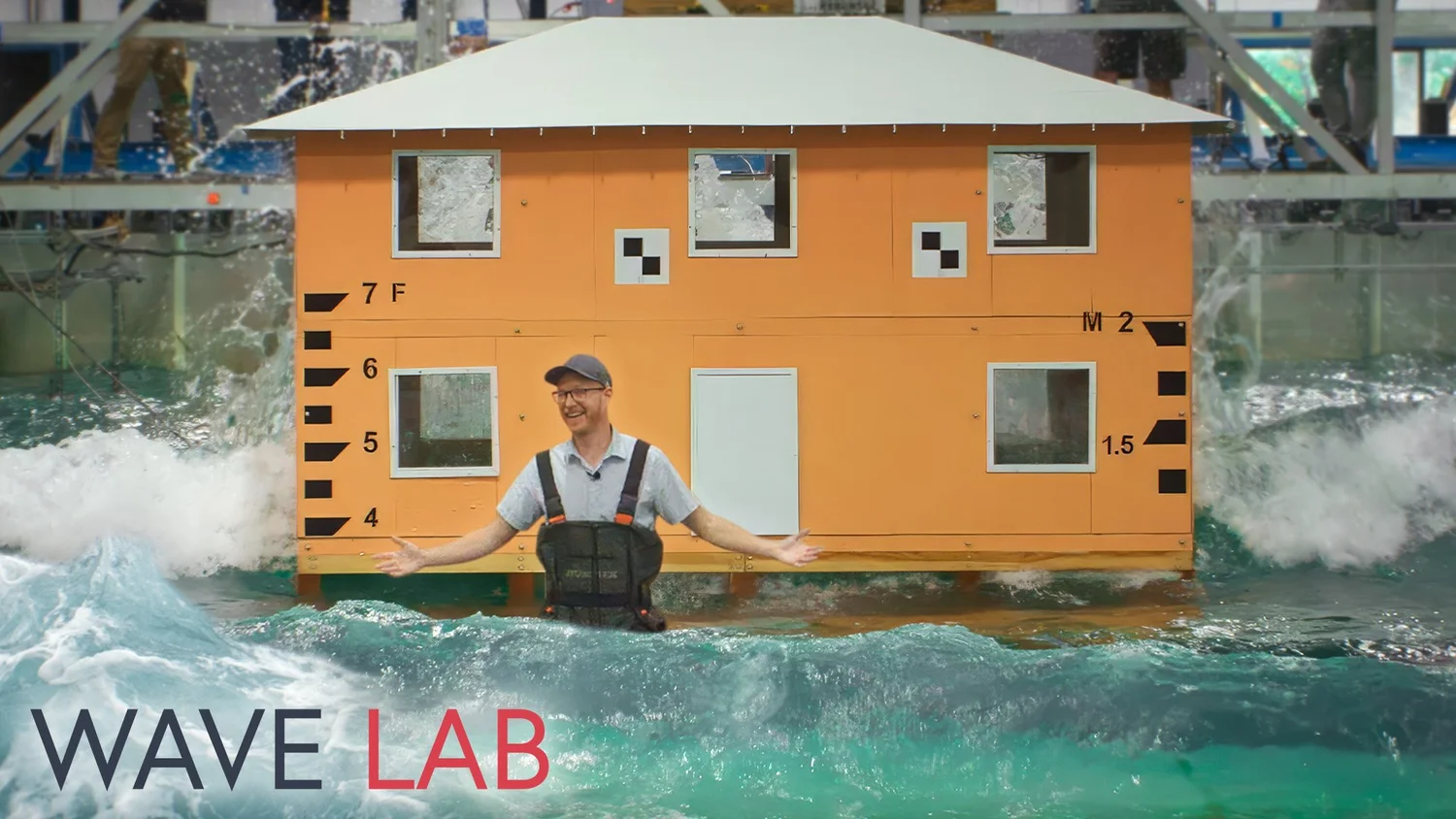
The research team has spent months building two incredibly detailed model homes, each one a near-perfect one-third scale replica of a real coastal house. Each foot is equivalent to three feet in real life. And the only difference (besides color) between them is elevation. The green model is a foot or 30 centimeters higher up than the orange one. That corresponds to 3 feet in the real world or roughly one meter. In every other way, both structures are identical. They’ve got interior walls, windows, framing details, everything. At this scale, that means I’m about the size of an 18-foot-tall civil engineer… which is actually something I’ve had dreams about.

One-third scale is still just a model. But this is not a toy experiment. The researchers have carefully accounted for all the physics involved. The wave periods and velocities have been adjusted to simulate full-scale conditions, and the structures have reduced stiffness to reflect the relative rigidity of real-world buildings. It’s all about maintaining dynamic similarity, a fancy term for making sure the test results actually mean something when translated back to full size. And that’s a tough thing to do:

“On the structure side, it’s a lot more difficult to scale the structural behavior. So, for example, when we’re doing computer simulations, the simulations are primarily at scale - trying to get that difference in shaking. The forces can generally be scaled up as well, so we kind of know what the forces are. But I think the mode of failure - like how this structure failed - I’m not sure so much as like a quantitative scaling. It’s a little bit more like qualitatively, this is what we would expect to happen under these conditions.”

The experimental design has the waves start small and build gradually, both in height and frequency, simulating the approach of a storm. The goal is to observe how both buildings respond as conditions get worse and worse.

It’s mesmerizing to watch: the wave generators churn, sending pulse after pulse across the basin. Within seconds, the models are surrounded by rolling water, with each wave slapping against walls, flowing around supports, and rebounding off the basin walls and shoreline.

Even now, researchers at the lab are measuring the behavior of the structures. If you look carefully, you’ll notice targets for highly specialized cameras and lidar to carefully monitor the behavior of each structure. Sensors placed throughout the experiment are recording everything—wave height, velocity, pressure on the structure, accelerations, and even internal motion. The goal is to build a detailed, physics-based understanding of how each building absorbs and transfers energy from the storm surge. And that data is incredibly valuable.

For one, this expensive and elaborate test is just two buildings. And there are a lot more types of houses in the world than that. So this data can be used to calibrate and validate computer models, making it easier for engineers to get reliable answers to questions without having to build scale buildings and put them through huge model tests like this.

And some of those questions are big ones. When you’re looking at options for large-scale flood infrastructure, a major part of the process is estimating the differences in damage and loss of life between alternatives. Again, we can’t build infrastructure, call down a hurricane, and test it out in real life, then revise accordingly. Even engineers shouldn’t have THAT kind of power. So we have to be able to make predictions about how any proposal will work out. It’s educated guessing, essentially. But the better we understand the connections between all the variables (wave height, surge level, building elevation, movement, and damage), the more educated those guesses become.

“I would say the physical model is closer to the real world. Numerical simulation is kind of the best we think we can do. But - And it always looks pretty, always looks really cool. But there’s really - you have to verify it. You really have to show that it’s correct, not just looks cool. And I think when we get to the laboratory, like we’re seeing during this test, like okay, it’s not as simple as we think. So there’s a lot more complexity, I think, inherent in a physical model.”

That’s why even though these tests seem pretty straightforward at first, they can have a profound impact on how we allocate public funds, regulate floodplains, and ultimately, keep people safe. You probably wouldn’t buy a car without giving it a test drive first; it’s too big a financial decision to take a risk. Imagine changing the building code or floodplain regulations without good data to back it up. We necessarily make high-stakes decisions about how to manage flooding in the face of equally enormous uncertainties. So, you can see why information like this would give more confidence to engineers and regulators to write building codes and improve floodplain regulations, knowing those decisions are grounded in truth.

But it’s not just about the data. You might have noticed that these houses aren’t just bare minimum structures. The team has added details like roofing, window frames, and colorful paint jobs to make them look like real buildings, even though they don’t really affect the final results. That’s because this test is also a communication tool. Most people aren’t going to read the academic papers that get published as a result of this study, but this footage tells a story.

You don’t need data to understand which of these two structures you’d want to live in when a hurricane comes. And the more people who take storm surge seriously, the better the outcomes we can expect when a big storm arrives.

Each set of waves is programmed into the machine to simulate the variability of a storm, with the upper limit of wave amplitude increasing from one set to the next. After four sets of waves (delivered in about an hour), they raise the level in the basin using this massive bathtub faucet and repeat the process. It was actually pretty surprising how well both models were holding up for a while there.

It’s hard to communicate in a video just how awe-inspiring it is when the directional wave basin starts really churning. And eventually, a particularly violent wave comes crashing into the lower house, and we see our first damage. You can see the wall underneath the window give way, and now waves start penetrating into the interior of the structure. In a real house, this would already be catastrophic damage.

But of course, they don’t stop at the first sign of damage, and the team keeps hammering the models with more intense waves. Over the course of the experiment, the sea conditions just keep getting worse and worse, and the damage to the orange house does too. More and more of the first story of the lower house is swept away. Waves flow through the structure and knock out portions of the wall on the beach side, and everybody in the room fills with eager anticipation of a total failure.

And then, something I didn’t quite expect happened. The model seemed to almost stabilize. The walls of the front and back of the structure were so totally obliterated that the first floor almost began to act like another level of stilts! Despite the first floor being utterly wrecked, the second story remained more or less fine for quite a while, even as the waves got stronger.

Dan told us about a test at half this scale (one sixth of real life scale) that had shown similar progressive damage, but that led to collapse much earlier on:

“In the previous study, we started to see the deterioration and then very quickly, rapidly, the entire building destroyed and I thought, okay, well we'll see that again at larger scale, but we didn't.”

That’s one of the cool things about moving up in scale and realism: you learn things that aren’t always expected. If we had cameras on every structure during Hurricane Ian, we likely would have seen similar results - damages from storms rarely follow a linear, progressive trend. It comes in fits and starts. For a while, it seemed like it might be the end of the experiment, since the stronger waves weren’t causing more damage.

“…It was a tough problem, and I thought I knew the answer, and it turns out I didn’t. Little bit tough to swallow, but it also kind of highlights to me, like, okay this is a challenge. This is a hard problem. So for me, you know, I’m trying to put a positive spin on it, but I feel like that’s a success right there. To say hey, this is more complicated than we thought.”

Of course, everyone watching (including me) and those participating in the experiment were hoping for that final blow that would knock the whole thing over so they could get the full range of data needed from safe to damaged to destroyed. And eventually the moment came. The waves finally won, and the lower house collapsed.

What’s probably more interesting than that is the condition of the other house. Take a look at that. Almost no damage whatsoever. This building sat in the exact same conditions as the other house and took almost no damage. And in a way, that’s kind of remarkable. Because there really wasn’t that big of a difference between the two. I said it’s expensive to elevate a structure, but the marginal cost between the green and orange models is almost negligible compared to the overall value of the structure.

“In talking to people about flood risk, you know, we talk about the 100-year, 500-year. And I think there’s a misperception that the 500-year is like 5 times bigger, 5 times worse, I have to elevate 5 times greater. And I think just trying to show people it doesn’t take much. Like, there was not much of a difference in elevation between those two buildings. The one on the right is toast. The one on the left had a little bit of damage, but hardly any, and that was only after we really tried to take the other one out.”

Researchers will be studying the data from this experiment for years to come. But the story's pretty clear. Same surge, same waves. A little difference in elevation can make a huge difference to a structure when it comes to surviving a hurricane.

You might be watching these buildings get knocked about and thinking: “We don’t need more resilient structures in the floodplain; we just need them to not be there in the first place.” And in many ways, you’d be totally right. Often, the most economical way to reduce flood damage is to avoid building in flood prone areas, or if development has already happened, simply to buy out property, tear it down, and leave the land empty as a buffer. But where’s the line between flood-prone and not, especially when it comes to rare events like hurricanes, where the probabilities of occurring in a year are in the range of 1-in-100 or 1-in-500? And if there’s not a bright line between at-risk of flooding and not, what’s appropriate for the fringe?

The truth is that there is no catch-all solution to flooding. We need options to accommodate the vast array of situations where development occurs, whether those areas are flood-prone, flood-free, or, most importantly, somewhere in the middle. And not just options, but also the data to determine which of them is truly the best path forward. Engineering is a balancing act; we need structures that are both strong and safe, but also affordable, easy to occupy, and maybe even architecturally pleasing. Using knowledge gained from tests like this helps us get a clearer definition of the edges of the problem we’re solving.

Huge thanks to Dr. Dan Cox and his team of researchers for inviting us to see this happen.
03 Dec 14:50

Major Artwork by San Antonio Artist Acquired by The Cheech

by Nicholas Frank

Miami-based Fountainhead Arts, an artist residency and career development organization, has announced the acquisition of a major artwork by San Antonio artist Jenelle Esparza by The Cheech Marin Center for Chicano Art & Culture in Riverside, California. 

Ms. Esparza’s three-part weaving and wall sculpture Holder/Receiver 1-3 (2022-2023) was first exhibited in the Soy de Tejas: A Statewide Survey of Latinx Art exhibition that debuted in 2023 at Centro de Artes San Antonio. The 40-artist group show, curated by Rigoberto Luna of Presa House gallery, then toured to Arts Fort Worth in 2024, and recently opened at The Cheech.

A new Fountainhead Arts program, called Forum, facilitates acquisitions by art museums of artworks by alums of the residency program. Ms. Esparza was a Fountainhead Arts resident in July 2023

A three-part artwork of two weavings with faux flowers, and a central piece of loose wire meshed interwoven with vintage rosaries, faux flowers, wire, and thread.
Jenelle Esparza, “Holder/Reciever 1-3,” 2022-2023. Carlos Puma/Puma Photography on behalf of The Cheech Marin Center for Chicano Art & Culture of the Riverside Art Museum

Other Fountainhead alums to receive support from the Forum program in its inaugural year are Ebony G. Patterson (2013), Lucia Hierro (2016), Kennedy Yanko (2017), Amy Bravo (2022), Victoria Udondian (2023), and Gabriela Ruiz (2025). According to a Fountainhead Arts press release, $125,000 in funding will facilitate the appearance of their works in major national and international exhibitions to be announced at a later date.

In a press release, Kathryn Mikesell, Fountainhead Arts Director, explained the practical goals of the Forum program to support artists at pivotal stages of their careers. “We created the Forum because we recognize that museum and institutional exhibitions and acquisitions remain one of the most transformational moments in an artist’s career, and understand firsthand that sometimes museum and institutional budgets fall short of artists’ and curators’ visions. With Forum, I hope our alumni artists will be able to realize their ambitious dreams, carrying their work forward in a way that resonates with audiences globally.”

Artist projects supported by the international program explore material and spatial concerns, address race, social, labor, and gender inequities, and center the work and ideas of diasporic artists.

Visit the Fountainhead Arts website to learn more about the organization’s residents and programs.

The post Major Artwork by San Antonio Artist Acquired by The Cheech appeared first on Glasstire.

03 Dec 14:50

The Source of the Light that Makes the Shadow: A Conversation with A. Savage

by Michael Flanagan

A. Savage is a songwriter, musician, and visual artist best known for his work with the acclaimed New York-via-Texas rock band Parquet Courts. Born in Denton, Texas, and receiving a degree in painting from the University of North Texas (UNT) before transplanting to New York City, Savage’s development of a distinct visual style can be traced through the cover artwork for his band’s discography. Though he has not pursued a traditional career in the visual arts, Savage’s paintings have been exhibited and collected internationally and he was nominated for the Grammy Award for Best Recording Package for Parquet Court’s 2016 album Human Performance.

I spoke with Savage from his home studio in Marseille, France, where he recently relocated after 15 years in New York. We discussed topics ranging from his early days in the Texas DIY music scene to being nominated alongside David Bowie at the Grammy’s, participating in a discussion of artist Eva Hesse at Hauser & Wirth, and a recent visit to the site of Vincent van Gogh’s death. The following conversation has been lightly edited for brevity and clarity.

A line drawing self portrait by artist and musician A. Savage.
A. Savage, “Autoportrait,” 2025

Michael Flanagan (MF): I understand you started drawing at a young age. What were some of your earliest influences when it came to visual art?

A. Savage (AS): I didn’t have proper art education until much later in life, so it was cartoons and video games that were the first things I started to imitate and reproduce.

My parents met working at the Denton Record Chronicle, the newspaper in Denton, and I would be there on the press floor. There would be all this paper, so to keep me in one place they would just give me huge reams of paper to draw. Big A0 size broadsheets of paper that I could just fill up one after the other. So that’s kind of where it all started.

MF: The earliest representation of your visual art that I could find is the 2003 cover artwork for a record by a band called Five Pointers. What do you remember about that artwork?

AS: That is a drawing from the newspaper of a guy performing a Shia ritualistic self-mutilation [in which] people take large knives and hit themselves. There’s nothing in the lyrics about that. It’s just a tough looking image that I thought would be good for aggressive music. That is really as deep as I was going in 2003. 

A drawing of a man holding two large blades and covered in blood splatter. Text in the top right corner reads: "Five Pointers."
Five Pointers cover artwork by A. Savage

MF: What can you say about the significance of hardcore and punk rock in your creative development?

AS: There are a lot of creative people that come out of the hardcore punk scene because so much of it involves autonomy and DIY — doing your own thing. That record that you are talking about, I released on my own. I drew the cover and I drew all the fliers for that band, and other bands, because that’s what you did in that scene. I meet people in all sorts of different artistic disciplines — you get to talking and find out that they were in the DIY punk scene once upon a time. That happens all the time.

MF: You studied painting at UNT at a time when there were some great artists teaching like Annette Lawrence and Ed Blackburn.

AS: I had both of them.

MF: What artists made the greatest impact on you during your time studying there?

AS: One of my best friends that I met in art school, who remains one of my best friends to this day, is the painter Bradley Kerl. He works and teaches in Houston now and is represented in Houston, New York, and in France. He and I played in a band called Teenage Cool Kids together, but we became friends in Robert Jessup’s life figure drawing class and that’s how we started hanging out. Bradley is an amazing painter who I still look to for inspiration. 

It’s funny, because I started as a music major. I was an All-State upright bass player in high school. From that, I got a scholarship to UNT, and it quickly became apparent that it was not the environment for me. It was no surprise when I later found out that the movie Whiplash was based around that program. I was watching these 19-year-old boys have mental breakdowns. So I realized it wasn’t for me and I went to the painting program because you get your own studio and you graduate earlier because it’s less credit hours than the music performance major. It seemed like a no-brainer to me.

MF: Were you engaged with gallery or museum culture at all? 

AS: No, not at all. Not until I moved to New York, to be honest. I didn’t really have expectations for much, but I didn’t have any expectation to be a visual artist in the gallery sense, selling work like I do now. I took art history classes, and I had to learn all the things you learn when you go to art school, but I didn’t really start thinking about it until later. 

I got a job working for a company in New York that sold vintage antique posters. Old French lithograph advertising and stuff. I was selling those original antique posters at Bloomingdales on Madison Avenue, and I got headhunted from that job by this other poster company called Rare Posters. They sold art gallery posters that, for example, Gagosian would have printed to advertise on the subway for a Basquiat show, stuff like that. Rare editions like serigraphs by Robert Rauschenberg or Andy Warhol and rare works on paper. More contemporary and modern art stuff. 

I think that was my real art education, because I was working in the warehouse of this company doing all their orders and it was me handling all the posters. I’d look at, and kind of study, a John Wesley for a bit and be like, “Oh, who’s this guy? What’s his deal?” And so that was my real art education, where I could see a history of the New York gallery scene in a way, because all those posters were there. And the art scene in New York is a good way to learn about the art world writ large.

An album cover designed by A. Savage featuring a line drawing of the New York City skyline. Text below the drawing reads: "In defiance, never bows."
A. Savage’s design for Parquet Court’s “Content Nausea,” 2014

MF: Your band Parquet Courts became your creative focus when you left Denton for New York, and it took a few years for you to get back into a painting practice. Eventually those two things became intertwined, culminating in your Grammy nomination for Best Recording Package for Parquet Court’s 2016 album Human Performance. You designed the artwork for that album, which featured a suite of your paintings along with a silkscreen print. Can you take me through that trajectory? 

AS: You can trace my progress as an artist in New York via the Parquet Courts records. If you look at the first records like American Specialties, Light Up Gold, and Sunbathing Animal, they’re cut and paste jobs that I did at my desk in my first apartment in Brooklyn. All of the art for those I did with scissors, tape, and a pen. It’s with Content Nausea that I started working in the studio. If you look at the cover of Content Nausea, it’s a view of Manhattan from my studio that I got in 2013. And I was there until I left New York in 2023.

With Human Performance, the record that you’re mentioning that was nominated for the package design Grammy, that has one of my early New York paintings on the cover. That’s around the time when I started painting again, but really kind of taking painting seriously for the first time. Because in art school it was just the thing that I did — I liked having the studio and going in there and working, but it became slightly different later. I had matured and maybe found my voice a bit clearer.

MF: You were nominated alongside David Bowie.

AF: Well, I was nominated alongside David Bowie’s art director. But I was the only art director who was also the musician.

A photograph of an album designed by A. Savage featuring an abstracted still life on the cover and other illustration style figurative drawings throughout the album liner pages.
A. Savage’s Grammy-nominated design for Parquet Court’s “Human Performance,” 2016

MF: It seems like the success with music led to a realization that creativity had the potential to be your livelihood, and that you wanted to explore that possibility with your painting. Is that why you decided to take that leap and get a studio in New York?

AS: Yeah, a bit of that. I just wanted a place where I could go and make a mess. It was a leap of faith. I found this section of a warehouse in Bed-Stuy, Brooklyn, right across from the Marcy Projects, which was mostly Hasidic businesses. A lot of importing and exporting. I found this space in there, and I subleased it from somebody for a year. Then that person vacated the lease, so I had the opportunity to lease out a whole section of this warehouse. 

I had it for ten years and it was one of the best decisions I ever made. It was on the corner, on the fifth floor, and had this amazing view of New York. It was a great decision because pretty much everything that I made from that point until I moved to France came out of that room, including, of course, all visuals, but also lyrics. It was a really special place and it was what kept me in New York the longest. It was the hardest thing to leave when I did. And it was a surreal thing, walking out of that door, leaving the keys behind me for the last time. 

For the first time, I had a little bit of money to take a leap of faith like that, and I’m really glad that I took it. My life would be completely different had I not taken that lease.

An illustration by A. Savage of a figure holding a mirror or drawing of themselves. The illustration is featured on a green event poster for an event.
Original artwork by A. Savage featured in the poster design for the event “Eva Hesse. Diaries,” a discussion of the work of Eva Hesse at Hauser & Wirth, 2017

MF: In 2017, you participated in an event organized by Hauser & Wirth around the work of Eva Hesse. What was your interest in her work, and what exactly was your involvement in that event?

AS: It was a discussion between myself and Jennifer Blessing, who is a curator at the Guggenheim. I had read the diary of Eva Hesse, published by Yale. I bought a copy at the Stedelijk Museum in Amsterdam because I thought it was such a lovely looking book. Speaking of awards, that book won an award called — and I think this is my favorite name of any award — The Most Beautiful Swiss Book award. 

Hauser & Wirth read a review that I had written in The Guardian of that book and they liked what I had to say quite a lot. Hauser & Wirth also are the gallerists for the estate of Eva Hesse, so that’s where they come in. They invited me to be in a conversation with Jennifer Blessing about Hesse’s work, which was extremely intimidating, because I am not, nor was I then, an art world guy. I’m not an academic, I don’t have a master’s degree, I’m not a gallery person. Basically what I am, or what I was then, was a guy that played guitar in a band who was lucky enough to be considered an artist by Hauser & Wirth.

What attracted me to the book was that it’s very personal. It talks about the struggles of being an artist, and about the feeling of having a terrible day in the studio and having no ideas and all the self-doubt and self-hatred you go through. And then the joy of the idea and of getting something done and having this work that you’re very proud of. I could relate to that a lot. I think that she’s an exciting artist, but the most exciting thing about that book is just how relatable it is to any artist.

MF: You mentioned not being an art world guy. What do you think about the art world? Are you at all apprehensive about it? Your involvement with a gallery like Hauser & Wirth makes me think of someone like Raymond Pettibon, who started out making flyers and album art for bands in the early ‘80s, and is now represented by David Zwirner. What correlation do you see between the art and music worlds?

AS: I think that the art world and music world are pretty different. Maybe they’re more similar now than they used to be, I don’t know. I’ve largely been outside of the “art world” for a long time. Occasionally I get invited into it, but I’m not linked up with curators. When I meet art world people — people who work at those institutions, people who are curators, stuff like that — they all seem to be very bright people. They seem to be people who are well-educated, who are intellectuals, which I don’t consider myself to be. A lot of times they have this very academic approach to art in the way that they talk about it, evaluate it. I respect that, but I can’t entirely identify with it.

I don’t participate in a lot of the ways that galleries become aware of artists, like Instagram, for example. So, I don’t know how relevant I am to that world. But I sell work, and I make work, and I guess that’s to me what an artist does. And that whole other thing is just peripheral to what I do. 

Now, if anyone reading this works at a major blue chip gallery and thinks that I’m going to fit in well there, then by all means—my email is published, get in touch. But, I’m just going to keep doing what I do. My studio is right here, I go in there every day. I’ve got to stretch some canvases after this. I’m going to continue to do that. And the same with making music. If Rough Trade [Records] decided that they didn’t want to do records with me anymore, that would not be the end of my music career. I would continue to make music, whether it was for another record label or whether it was just for my cat. I’m going to do my thing — my music, my art — not dependent on the powers that be or the means of distribution. They are welcome to come find me, but I will be doing it with or without them.

A serigraph print by A. Savage featuring a collage style of images, including a taxi, text, a potted flower, two figures, and color blocks.
A. Savage, “Neo-Tokyo/Neo York III,” from a series of serigraph prints for the “Golden Week Blues” exhibition at Big Love in Tokyo, May 2019

MF: In an interview for an exhibition at Big Love in Japan, you said that there is a lot of planning that goes into your paintings because it’s important for you to “know what I’m talking about and what I want to say.” Do you aim for the audience to pick up on what it is you’re specifically trying to say in a painting?

AS: No, I don’t, but it’s still important that I know what I’m saying. And the same goes for a song — writing lyrics — or any sort of discipline. If you don’t know what you’re saying, and if the thing that you’re saying isn’t important to you and it doesn’t mean something to you, then it’s not going to be worth a damn.

I need to know what I’m saying before I say it, and the meaning of what I’m saying isn’t the point of the final product. It’s the point of getting started and the process. And so I guess that’s the hardest part of creation for me, is figuring out what I want to say and how I want to say it. If I don’t know exactly what I’m trying to communicate, what the idea behind a painting is, then it’s just going to be an empty exercise.

MF: I just watched re-watched David Lynch’s Eraserhead. That might be one of the most prominent examples of the artist not wanting to get into the meaning.

AS: That’s not the point with him. I don’t know what Mulholland Drive is about, but I love the movie. It’s about something, and what it’s about isn’t exactly the point, you know? But it was the point for him. That’s one of the things that’s different about meaning insofar as being the artist and being the audience.

As long as the artist knows what the meaning is, they don’t have to say. And if they don’t say it, then the audience is never wrong when they decide what it’s about. I like that. When people ask me what something is about, I usually say something along the lines of “I’ve given you all the information—I gave this piece a title, I gave it these colors, I gave it this form and subject matter.” My art is representational, it’s not abstract. So I’ve given you a lot, and then it’s up to you and whatever you think. It won’t be wrong. That’s what I like about Lynch, he gives you everything you need to know, and then he trusts you to come to your own conclusion.

MF: Do you ever find that it is useful to be more explicit about meaning?

AS: Yeah, of course. For example, we know what [Picasso’s] Guernica is about. An understanding about the Spanish Civil War is kind of important to understanding that piece. For me as the artist, there can be as much detail or precision as I want there to be. It depends on the context.

A painting by A. Savage featuring a still life table top of Pez dispensers, a potted flower, Black Cat fireworks, and a snow globe of New York City.
A. Savage, “Observation Deck, New York City,” 2021, acrylic on canvas

MF: I’m looking at a painting of yours now that feels related to what you’re saying about Guernica. It’s a painting from 2021 called Observation Deck, New York City. Is that an example of one of your more explicit paintings?

AS: Perhaps so, yeah. That painting’s definitely explicitly about something for me. Maybe it’s one of the more evident ones.

MF: What stylistic or thematic distinctions do you see within the various bodies of work you’ve explored throughout your career?

AS: In the beginning I was using a very soft line, without many angles. The lines were kind of curvy or wavy. Now my line is jagged and a bit boxy. I didn’t use light at all. Now I really like depicting light, although not in the way that Dutch master painters depict light. In my own way. It used to be form and color that were most important to me. And those are still very important to me, but now, living in the South of France, it’s a great place if you want to depict light. When I look at the older work, it seems like it’s from another lifetime. 

A painting by A. Savage featuring a seated man playing guitar with a snake at his feat and a cactus next to him. The background is of a mountain scene and the guitarist's shadow extends across the mountains.
A. Savage, “Untitled,” 2025, acrylic on canvas

MF: Speaking of light, I’m looking at another one of your paintings. There’s a man playing guitar, and I love how you’ve painted his shadow in this kind of surreal way on the mountain landscape behind him. It doesn’t make sense, but it’s perfect. The use of color is really beautiful. How recent is that painting? 

AS: From last summer. That, to me, is a painting about light and sound. I wanted a painting that you could obviously see, but also hear. It’s one of my best uses of shadow.

The painting that really kind of broke my head apart when depicting light is the one with the film projector, Introducing Valerie. That one is when I got bit by the light bug.

MF: I’ve seen this painting before on the cover artwork for one of your solo records. Is this a self-portrait? 

AS: Yeah, it is.

A painting by A. Savage featuring a movie projectionist preparing film for the projector. In the background, the film can be seen through a window.
A. Savage, “Introducing Valerie,” 2024, acrylic on canvas

MF: I obviously see you in the projectionist. The longer you look at it, though, the woman on the screen also resembles you. Are you projecting yourself onto the woman in the film? 

AS: It’s the projectors shadow, isn’t it? I guess that’s the question you have to answer. What is the source of the light that’s making that shadow? The shadow is itself a projection. The shadow is a projection of the light. And then the projector is doing another type of projection, isn’t it?

MF: You talked about the light in Marseille, where you live now, having an impact on how you work. How else has the transition from the United States to France affected you? 

AS: A lot of my work that I’m making right now has to do with my identity as an American here, and being an American in the world right now. That’s just coming out of me. It’s something I need to communicate, because it’s an interesting thing to be where I am and to be who I am. In one sense, there is a level of relief that I had the foresight to get out. But on the other hand, I take no joy in being right about that. It hurts my heart on a daily basis and it can feel alienating. So that’s what is coming out of me at the moment.

I don’t know how much the American news covers this, but they’re pretty well pissed at Americans here right now. Not “Americans,” but the current administration. As an American, I, to some degree, represent that, whether I like it or not. I just take that with me wherever I go. That’s coming out of me right now and it’s probably evident in the painting I sent you called Rue d’Aubagne, 22h. I finished it two days ago. It’s a study for a [larger] painting that I’m going to start soon. It’s about walking home, on the streets of Marseille, after dark.

I like the the paintings that Stuart Davis made when he was in Paris. They’re kind of these amalgamations of different old world symbolism through this American lens that I can relate to. I can relate to Stuart Davis a lot. He did work as a commercial artist, which I also have done from time to time. He lived in Europe, as did a lot of that generation of American artists, and he looked to the past. A lot of those [arists] were looking to the past for answers, and attaching themselves to certain iconography that wasn’t present where they came from. That’s one of the things that I was thinking of when I was making that piece — that era of Stuart Davis’s paintings.

Marseille is one of the oldest cities in Europe, so there is this connection to the past that there isn’t really in the States. And the light is a huge thing here. There’s a reason that Van Gogh came down to this part of the world. Especially in the summertime, it’s like the days just last forever. There’s light for you to paint by, for a long time, and it does things to the colors.

A painting by A. Savage featuring various figures and scenes that the artist experiences on his nightly walk home.
A. Savage, “Study for Rue d’Aubagne, 22h,” 2025

MF: Did van Gogh paint in Marseille?

AS: No, but he worked and died in Arles, which is less than an hour away. It’s also on the south coast of France.

MF: Have you made any pilgrimages there?

AS: I’ve been to Arles, there’s a major art festival there. It’s a really nice medieval city in the South of France. It’s really lovely. The boarding house where he died — there’s a little museum for him there. It’s not far from here, so the light that they get in Arles is the same light we’re getting. 

A painting by A. Savage featuring a poster of a woman holding a basket with a fish in an outdoor scene, a potted plant, and a plastic shopping bag with the Statue of Liberty and text that seems to read: "America We Care. This Bag is from Recycled Plastic."
A. Savage, “Untitled,” 2025, acrylic on canvas

MF: What projects are you currently working on?

AS: I’m in French language school. From 9 in the morning to 2 in the afternoon everyday, I’m in class. And so that gives my life a lot of structure. It’s actually had a lot of dividends on my practice because my time becomes more valuable. I’ve always been a pretty orderly guy as far as time goes, but I like this process of being in school. Learning a new language opens up new doors in your brain.

Speaking of Lynch, I read a quote by him recently. He was talking about how important order was in his life. How he ate the same meal everyday for lunch. He had tuna fish, feta, and tomatoes everyday. And he likes to order his life because he considers his art a form of disorder. “From two in the afternoon to ten at night,” I’m paraphrasing, “that’s my time to create disorder.” 

I really relate to the idea of that. I keep this book in my pocket everywhere I go — it’s the things that I need to do in a day. There’s always a place in each day for me to get lost in my thing, whether that be at a guitar, a piano, or in the studio working. It’s important to give myself this space to become a freak and be a weirdo, alone by myself. If I can’t do that, then I can’t do my thing. It’s given my day some order, which has had dividends in my art. 

I want to do a show, I haven’t done one in a long time. Right now, in the work that’s coming out, there’s an important context that I was mentioning earlier of being an American in the world. That’s sort of coming out of me, and I just want to make as much as I can and see what that becomes. Maybe a show, maybe a book. But I’m very much in the process of making something right now.


Learn more about A. Savage here.

The post The Source of the Light that Makes the Shadow: A Conversation with A. Savage appeared first on Glasstire.

03 Dec 14:49

“So, This is Love”: A Lesson in Taking Black Worlds Seriously

by Chelsea Lynn Jones

Tomashi Jackson: Across the Universe arrives to Houston in monumental style, spending ten months on the main floor of the Contemporary Arts Museum Houston. The timeframe seems to nod to Jackson’s early career in the San Francisco muralist community, offering her studio works a length of time closer to what is afforded to public art installations and murals. The exhibition’s length acts as an invitation for audiences to return again and again, for reflection on the heavy histories on color and democracy that Jackson examines through her paintings. It also provides time for the city to have a proper reunion with the artist, who is Houston-born and a former artist resident at Project Row Houses.

An installation image of colorful and layered works by Tomashi Jackson on view in a white walled gallery.
An installation view of “Tomashi Jackson: Across the Universe” on view at the Contemporary Arts Museum Houston

Large-scale paintings, sculptural works, and approximately 55 minutes of music videos and video art fill the galleries. The arrangement is colorful, lively, and reverberating, while giving viewers space to wander and contemplate the rigorously researched content by the Yale, MIT, and Cooper Union graduate. While music, history, and literal soil are the contents and materials calling for attention, constructed surfaces, halftone lines, and studies of color provide physical and metaphorical layers for audiences to traverse. 

“Look again, take a peek into the abstraction,” the works seem to announce.

With significant observation of community activism and American governance, Across the Universe is a timely dialogue for the work it takes to see people and their histories honestly — to shift narratives or even save lives by showing up with love. Considering the needs of each work she creates, Jackson allows a system to develop. A type of visual system that listens to Black voices and where Black histories are taken seriously.

An installation image of three mixed media works by Tomashi Jackson.
Tomashi Jackson, “Still Remains” (left) on view in “Across the Universe” at the Contemporary Arts Museum Houston

One such distinctive visual system can be studied in the work Still Remains (2018). Jackson constructs a surface with brown paper bags and postal campaign flyers from the 2017 Georgia congressional election between Jon Ossoff and Karen Handel. Red paint, Georgia red clay, silkscreen prints on vinyl, image transfers, and various slogans build the composition. Starting at the edge of the surface, or perhaps the center, a meandering line invites the viewer to trail along its right-angled turns, as it makes a complex labyrinth. A map-like configuration, the viewer is confronted with a border formed around the center. Reprinted images from the Georgia State University archive can be found there, showing Black passengers waiting in line for their bus, White protestors opposing expanded public transit, and train lines of the Metropolitan Atlanta Rapid Transit Authority (MARTA). Questions about Black communities navigating the transitory routes of democracy across boundaries and land come to my mind.

An installation image of a mixed media layered work by Tomashi Jackson featuring images of the first African American graduate of the University of Colorado Boulder.
Tomashi Jackson, “Blessed Be the Rock (1920s Dearfield Group, 1970s Ruth Flowers in The Little Rectangle, & the 1972 Second Baptist Church Choir),” 2023, acrylic, Yule Mountain Quarry marble dust, and Red Rocks soil on paper bags, canvas, and textile with PVC marine vinyl, brass hooks and grommets on a handcrafted wood awning structure, 86 x 84 x 8 inches

Keep this reference and fast forward to a recent work, Blessed Be the Rock (1920s Dearfield Group, 1970s Ruth Flowers in The Little Rectangle, & the 1972 Second Baptist Church Choir) (2023). The constructed surface of canvas, wood, and blue textile is embedded with marble dust from Colorado’s Yule Quarry, while black, white, and blue painted halftone lines build the composition. Layered on top are two pink vinyl strips with printed halftone lines. Within the layers of color and material is the image of one of the first African American female graduates of the University of Colorado Boulder. Dr. Ruth Cave Flowers stands in front of the home she and her mother built in the historic Boulder neighborhood, Little Rectangle. A second image is parallel, revealing residents of the Black colony of Dearfield, Colorado, standing in front of one of their homes. Finally, in the vinyl layer is a third image of the Second Baptist Church of Boulder’s choir, standing as they perform. The three images captured across decades (1920, 1970, and 1972), exemplify Jackson’s exercise in “zooming in and out time” and creating “a single field of vision.” She unfolds under-publicized geographic histories before our eyes, through these Black communities standing firm.

“Look at the past, read it, keep it, use it to look forward, make new visions, build new communities, it has been done before,” Jackson’s paintings say with persistence!

A photograph of artist Tomashi Jackson dressed as her alter ego Tommy Tonight in a music video.
D’TALENTZ (Big Keto, A-Dogg, King, & Tommy Tonight), 2020, single-channel video with sound, 8:55 minutes. Courtesy of the artist and Tilton Gallery

Completely romanced by the seriousness of Jackson’s research-based approach, revealed through vivid color, I too want to sing about love and heartbreak, as her alter ego Tommy Tonight does. Audiences can meet Mr. Tonight with his collaborators D’TALENTZ in the music video, The End of the Road (2019), among others, or see the deep connection between Mr. Tonight and Jackson as herself, in the duet On My Own (Devotions in the BMA & at Lisa’s House in Roxbury) (2023). The performance of ‘90s R&B lip-synching presents a portal for us to join Jackson in singing our hearts out for a needed release of emotions.

An installation image of a video projected in a dark room.
A still from Tomashi Jackson’s video “Vibrating Boundaries (Law of the Land) (Self Portrait as Tatyana, Dajerria & Sandra), 1963–2015.” Photo courtesy of Tilton Gallery

Nevertheless, releasing our emotions is only part of the journey in Across the Universe. While we release we must also hear the call resonating throughout the entire exhibition. I believe it is most booming in situating the honest pain in the video Vibrating Boundaries (Law of the Land) (2016) with the architectural strength of the bodega awning in Interstate Love Song (2018). Comparing these two works reveals a type of labor Jackson implores in which very difficult and disturbing histories in the United States are revealed with care, support, and love. In Vibrating Boundaries, Jackson performs a color study using a knitted fiber work that partially covers two bodies reenacting the violent poses encountered by Tatyana Rhodes, Dajerria Becton, and Sandra Bland in Texas. In Interstate Love Song a bodega awning physically holds up the images of a Black community in Georgia, long suffering from transportation defunding. 

An installation image of a sculptural work by Tomashi Jackson of an awning extending from the gallery wall with painted strips of transparent paper hanging from it.
Tomashi Jackson, “Interstate Love Song (Friends of Clayton County Transit)(Pitts Road Station Opposition),” 2018, mixed media, 40 1/4 x 111 1/2 x 42 1/4 inches. Courtesy of the artist and Tilton Gallery

With these examples and throughout the exhibition, the use of large-scale structural pieces and bright color hues that are painted, printed, and knitted, deliver a visual reminder we must heed: to repair past wrongs takes a work of love, a work that is heavy and imposing. But, “this, is love.” 

Tomashi Jackson: Across the Universe is on view at the Contemporary Arts Museum Houston through March 29, 2026. Read an interview with the artist here.

Author’s note: The title of this article is inspired by Brandy and Paolo Montalban’s “So This Is Love,” released July 12, 2024, on Descendants: The Rise of the Red, Walt Disney Records.

The post “So, This is Love”: A Lesson in Taking Black Worlds Seriously appeared first on Glasstire.

03 Dec 14:48

updates: not having work friends as the boss, the controversial client, and more

by Ask a Manager

It’s “where are you now?” month at Ask a Manager, and all December I’m running updates from people who had their letters here answered in the past. Here are four updates from past letter-writers.

There will be more posts than usual this week, so keep checking back throughout the day.

1. Adjusting to not having work friends now that I’m everyone’s manager (#2 at the link)

I wrote about six months ago about loneliness at work after being promoted to location manager. On the whole, I’m feeling a great deal more comfortable! Some of my staff were promoted or otherwise moved to different jobs, so the current mix of people has known me mostly as Boss. I’ve been very intentional about being friendly with staff, and the new faces who weren’t my coworkers before have made it much easier to be Friendly Boss to everyone equally. I’ve also been able to start cultivating more communication with managers at other locations, which has helped. My most senior report is doing great at taking on leadership and being in charge when I am gone, which I think has mitigated a lot of stress that I didn’t realize I was feeling as well.

As for making other adult friends with little kids, thanks to everyone for your advice! Some of it I’ve tried out (with limited success; terminal introvert, here), some of it will probably come in handy in the future. My spouse stays home with the kids, so we don’t have daycare friends to get together with. I know I didn’t make it clear in my original letter, but I do have a long-standing hobby group once a week. I was having some trouble getting close to people there but didn’t have the bandwidth to join anything else. Since then, I’ve been more strategic in how I try to connect with the others in that group and in my religious gathering, and it’s becoming easier to connect in both places.

So I might have to be resigned to a new type of relationship with people at work, but I don’t need to be resigned to loneliness!

2. My team doesn’t want to work for a client whose politics they disagree with

Well, the big project we were kicking off at the time is nearing its end, so still TBD on whether or not we survive. :) But as you recommended, I discussed it with upper management and our two highest executives/owners shared how they are both personally active in helping immigrants, which was good for boosting morale among my team.

The client’s social media related to that has quieted down, thank goodness, and they didn’t try to discuss any of that side of their organization within the scope of our project with them. We worked through some minor annoying requests like the usage of “Gulf of America,” but I am hopeful that the tide is starting to turn within our industry against the administration.

None of our other clients have had any sort of requests along these lines, so that’s good! Our biggest problem is mass turnover among clients because their government jobs are so volatile right now that many are leaving for private sector work.

Update to the update:
I spoke too soon. After the final proofing stage, they are now requesting we swap out photos to include some of an elected official with members of ICE. I feel physically sick, and my team wants to push back. Again, it’s a huge project for us with a big financial impact, not to mention the time and resources we’ve put into it, considering I first wrote to you in February.

3. What if hiring a spouse is truly the best choice?

In accord with your advice, our church board all agreed that we didn’t want to hire the minister’s partner as music director, but somehow the HR committee wound up letting her interview anyway. The minister had been so careful to stay out of it that she never even told her partner of the depth of concerns, so it all came as a surprise to the partner in the interview. Fortunately, the partner wound up getting a better offer and withdrew her application before we had to tell her we wouldn’t hire her.

Unfortunately, the other best candidate also withdrew, so we had to start the search all over. Fortunately we did find and hire a wonderful candidate who had not applied in the first round. Unfortunately, the partner/applicant issue inflamed feelings among the choir, who were convinced that the minister had driven out the previous music director. (Not true, but it was a confidential HR issue so no one got the full picture.)

Subsequent work with conflict consultants leads me to believe that music directors are often the focal point of bad blood in congregations. It’s a tricky in-between position, involving deep commitment and loyalty within the music program, and a leader whose skill and training is in music, not religion or management or ministerial presence.

4. I’m getting too many requests for practice exchange (#3 at the link)

I wrote in after being inundated with requests for practice exchange visits. I took both your and the commenters‘ advice to heart and shared it with my team.

A) I decided to point requesters to our university’s week for guests, where people can visit all the units at once. The next one is in 1.5 years‘ time, but it’s something to offer at least. I also send the recordings we already have.

B) I suggested, like someone did in the comments, that my team prep a schedule and short talks we might trot out for every visitor. They thought it’s a good idea.

C) I also took the advice to select with our own benefit in mind, so I’ve just been saying no.

D) I also have been saying no a lot to zoom networking, and to some invites to give talks/workshops, unless it’s really high-profile or from universities we have pre-existing “diplomatic” relationships with, or I just really like the people. I manage a team of six now and serve a target population of 2000, so I feel they need to be my priority.

The stuff I said yes to this year all had a big impact, so I’m very happy. Thanks to all who gave advice!

The post updates: not having work friends as the boss, the controversial client, and more appeared first on Ask a Manager.

03 Dec 14:45

updates: the constantly babbling coworker, the fed who insists everything’s fine, and more

by Ask a Manager

It’s “where are you now?” month at Ask a Manager, and all December I’m running updates from people who had their letters here answered in the past. Here are three updates from past letter-writers.

1. My coworker’s constant babbling is drowning me in info, and my boss won’t help

So as it happened, by the time the post went up I’d left the job and the region. But not long after I sent in the letter, I sat down and laid this out to my boss pretty much exactly as I wrote in. He wasn’t blind so while he wasn’t exactly thrilled, he did get it. I was a receptionist/admin in a small public office with regular customer service and sales tasks in addition to EA and admin work, my desk was the entryway hub, and it was a notoriously “interrupty” environment. I had no real problem with any of that — it was just the coworker I wrote about. She used us all like free dating coaches, therapists, and dumping grounds for everything in her head from House Key Movement Monologues up to and including graphic sex and undiluted trauma in the aftermath of a horrible gruesome local accident. I was the only one tied to a central desk and providing the anchor work keeping the office open to the public so I just bore the brunt.

In the talk, my boss told me that both his predecessor and he had the option of installing a door in the wall between his desks and the coworker’s desk area and that having that door installed and left open was likely what was needed to start keeping them on task and start him providing the constant ongoing “knock it off, get to work” feedback to correct her performance issues, which were significant. Only both of them also thought she was a nightmare and couldn’t face taking this on. To be fair, it would have taken 80% of his time and attention, invariably led to a PIP, insubordination, and various other write-ups and likely her quitting or being fired, whereupon a 30-year veteran of the department (her) would start slandering the office to our entire small town, and we had a significant and important role in the community. I did understand their reluctance to table the entirety of their actual work load to remedial train a 55- year-old Piece of Work in order to maneuver her out the door in the midst of an inevitable shit storm. It’s bad management but it’s pretty human, and I wanted to move anyway. So I preserved my reputation with my boss and got out from under the waterfall, which were my main goals.

If I’d wanted to stay in the community, I would have been a lot more frustrated, as it was a good job with a great wage and there was no need for it to be literally terrible. And yeah, it pushed me out into the worst job market in like a century so had I not had support and savings and been so ready to move on, I would probably be a lot saltier about it all.

I work a well-paying solitary labor job now, my rent is cheaper, the stores sell fresh fruit, and nobody’s pouring poison in my ears all day, so personally I feel this was a grand success. And the last I heard of her, she was trying to hold a conversation with a public works employee who was actively jackhammering a road so … yeah.

2. We’re feds with a coworker who won’t stop insisting everything is fine (#2 at the link)

Fergus toned down the positivity once we were back in the office, so the issue mostly worked itself out on its own. He is still sometimes too rah rah, but it’s not as bad as it was.

Unfortunately, the deputy has only ratcheted up the positivity. Every meeting, no matter how unpleasant or difficult the topic, has to end with a statement of how well things are going or how we’re doing amazing work, and everything we do is just the best. It’s exhausting.

A few weeks before the shutdown, the deputy dropped a bomb on us in a meeting. Something new is coming, and it has the opportunity to be very good for our office, or it has the possibility of being a giant clusterbleep. It’s the kind of situation that needs a lot of thought and careful planning. I’ve been in my office for over 10 years, and this represents, most likely, a radical change to the office and office culture. So, naturally, I was apprehensive and asked a million questions in the meeting about it, most of which management had no answers for. All of my questions were about logistics and planning, but, admittedly, my tone may have been too incredulous because the news was so surprising. Other folks told my manager that they had the exact same questions that I had.

Two days later, the deputy asked me to meet with her, without informing my manager. (This has happened before when she wants to reprimand someone but not discuss it with their manager.) In the meeting, she implicitly threatened my promotion potential for being too negative. I was also told that I could ask questions of the managers, strongly implying that I was not to ask questions in meetings because people “look up to” me as a senior staffer. Again, all I did was ask questions. I made no pronouncements that I thought this would fail or be bad for the office. I just wanted to understand and try to play my part in making it succeed. I have to work closely with the deputy on a project that I loathe, and this conversation has only made that more difficult. I’m a realist by nature, so gushing over how good everything is just isn’t how I operate. I guess I’ve got to learn to fake it.

3. When and how to tell clients I’m closing my business (#2 at the link)

In the end, I didn’t get in to Taco Night School A (day school, actually) here in my city, nor Taco Day School B in neighbor city. I ended up opting for Taco Day School C, which is an hour and a half one-way commute. After working mostly afternoons and evenings for years, waking up at 6:00 every day has been a huge adjustment, but I’m very happy with the program I’m in and the choice to go back to school more generally.

However, I didn’t find any of that out til August, so I proceeded with closing my business following your advice to just tell them in general terms that I was shutting down. Most of them did ask what I would be doing, which I replied to as if I had a solid plan. Despite being sad to lose me, the families generally realize that tutoring is a tough business with low profits and an unforgiving schedule, and were genuinely happy for me pursuing other opportunities.

I made recommendations for replacement tutors when possible, but that wasn’t the case for all families (for example, I couldn’t recommend anyone who works with young kids, or kids with dyslexia). Some families apparently had a very hard time finding new tutors and continued to write me even in mid-October to help them find someone and/or pretty please make an exception just for them. In the end, everyone either found a replacement or gave up on bothering me about it, and I only got guilt-tripped into staying on with one student (who, admittedly, has very specific learning needs that not many people are able to accommodate). I’m not entirely thrilled — it’s a lot combined with my own studies — but all in all I think the closing was handled smoothly, thanks in part to your advice!

The post updates: the constantly babbling coworker, the fed who insists everything’s fine, and more appeared first on Ask a Manager.

03 Dec 14:41

employee says he has a problem with authority, I can’t keep helping friends with their writing, and more

by Ask a Manager

I’m on vacation. Here are some past letters that I’m making new again, rather than leaving them to wilt in the archives.

1. My employee warned me he has a problem with authority

Six years ago, I took a job in a new department. At the time, I only had two years of managing experience and I was eager to not step on the toes of my new four-person team, who had a combined total of 85 years of experience. On my first day and in my first meeting with my employee Fergus, he smirked and opened with, “You should know I have a problem with authority.” To his credit, he was not lying. It’s a nightmare to deal with him but he does just enough to not be let go (we work for the government, it’s harder to get fired).

At the time he told me this, I was so concerned with being liked and learning the ropes in the new department that I tried to approach all interactions with Fergus with that in mind instead of just asking for what I needed. But now I wonder, what would have been a good response? Am I wrong in thinking that the response should have been something that let Fergus know that it indeed was *his* problem and not mine? Or is that just my dislike for my current situation bubbling up?

Ideally, when he told you he had a problem with authority, you would have asked, “Can you be more specific about what you mean?” Let’s pin him down on exactly what he’s talking about here, and then respond to that. If he replied with something like “I don’t like being told what to do” or “I prefer to work independently without a manager,” then you could say, “Well, I certainly appreciate knowing about people’s preferences and I respect the expertise you have, but part of my role here is to oversee that work. You can see how that goes and decide whether it’s for you or not. If you decide it’s not, I’ll certainly understand.”

It sounds like you know this now, but you can’t let an employee dictate how you’ll do your own job (which includes managing them) or value being liked over being effective.

2019

Read an update to this letter here.

2. How do I tell friends and family I can’t keep helping with their writing?

I’m an English teacher and over the years many of my friends and family have asked me for feedback on their writing. Now that I have a family, the demands on my time are greater and frankly, I am less interested in helping like this. How do I transition my friends out of this? I would feel weird charging them but I guess I should? I really don’t know how to broach this with people without sounding awkward and weird; I think I am too emotionally invested.

Would you want to do if they were paying? If not, don’t offer that as an option just to decrease the requests because some people may take you up on it! If you just don’t want to do it regardless of pay, it’s totally okay to just explain your schedule doesn’t allow it anymore. Anything like this works, depending on the tone you want with the particular asker:

* “My schedule is so swamped these days that I wouldn’t be able to do it justice.”
* “Ah, I’m sorry. I don’t have enough free time these days to be able to say yes.”
* “I wish I could help! My schedule is crazed right now though. Sorry I can’t look at it!”
* “If I say yes, it will sit for weeks while I feel guilty for not having enough time to look at it, so I’m going to preempt that by doing the right thing and telling you now I can’t.”
* “I’m trying not to say yes to that anymore, since my schedule has gotten so packed.”

If you make it a big thing where you feel terrible and like you’re letting them down, it’s likely to be weird on their side too. If you’re matter-of-fact about it and then change the subject to something else, it’ll go fine with reasonable people. (And if they’re unreasonable, there’s nothing to feel bad about anyway.)

But if you’d do a few of these requests for the right price, you can say: “I’ve gotten so many of these requests from family and friends, and my schedule is so busy now, that I’ve actually started charging a fee for it. I totally understand if that’s not what you’re interested in, but if you are, the fee people are paying is $X.” (I like “the fee people are paying” rather than “the fee I’m charging,” because it emphasizes that other people find this worth money, which makes it harder for them to complain they shouldn’t have to pay.)

2019

Read an update to this letter here.

3. Employee is monopolizing the conference room to get quiet work space

My office is open, but it’s not a new, innovative concept. It’s an old building and this has happened out of necessity. We’re the support team for several businesses downstairs, so it’s never going to happen that we move into a new, more workable space. We all work pretty silently, and keep distractions to a minimum. We also have a large, open event space where we’re all accustomed to taking phone calls and having meetings.

Recently, we’ve added a few employees and the volume level in the office has increased. Most of us have just deployed headphones, until the newbies catch on. (One is our new boss, so it’s not as easy as telling them all to keep it down.) The problem is with one employee, who has taken it upon herself to consistently go work in the event space. She also happens to be the only employee with a laptop she can work off of. But now, that room is never available for anyone else. Unless we ask her to leave, which she always is willing to do — it’s just awkward. I don’t know how to communicate to her that what she’s doing is inconsiderate. It also seems like she should be able to work in there if she wants to, and it seems petty of me considering the majority of the time that space is vacant. Am I being unreasonable?

If she’s always willing to leave when the space is needed for something else, it doesn’t sound like this is really a problem. Open offices can be incredibly difficult for people to work in, and if there’s a mostly unused conference room sitting vacant, there’s no logical reason why she shouldn’t use it, as long as she’s willing to move when needed, which she is. Working in there could be making a major difference in her concentration or her productivity, as well as to her morale.

I know it might seem unfair since other people without laptops can’t do it — but then the solution is for them to ask for laptops so multiple people could use the conference room as a quiet room at the same time, not to stop her from doing it just because others can’t.

If the issue is that you feel awkward or rude asking her to vacate the room, I’d say the solution is for you realize it’s perfectly okay to do that (and she seems to think so too, based on her cheerfully leaving when asked to).

2019

4. Should I tell a blogger I follow that I work with her boyfriend?

This question is kind of silly but I am the kind of person that would make this situation weird. I was scrolling through Instagram and just discovered a local blogger whose style I really like. Turns out her S.O. is one of my coworkers! I only know him in passing (and honestly, I doubt he knows my name), but he’s a really nice guy from what I’ve encountered.

My first thought was to DM her and say something like “hey, I love your blog and I’m so thrilled to see you live in [same city!] I actually know [your S.O.] from work and he’s a really nice guy” but I am afraid that would come across as awkward.

Should I say anything to him? We don’t work together, and I tend to be very shy and reserved at work.

I’d leave it alone. Not because it would be horribly awkward if you did message her, but because the question I’d have about doing that is “toward what end?” You’ll tell her you know her S.O, she’ll say something kind in response, and then that will probably be that. It’s not really conveying information with much significance. (There are people who respond enthusiastically to connections of any kind, but there are more people who will just think, “Okay … and?” Plus, if she asks her S.O. about you and he doesn’t know who you are, that’s really upping the chances of “Okay … and?”)

That said, there’s nothing wrong with sending her a note letting her know how much you like her work! That’s always lovely to get, and you don’t even need to mention the S.O. connection.

2019

The post employee says he has a problem with authority, I can’t keep helping friends with their writing, and more appeared first on Ask a Manager.

03 Dec 14:10

No further questions.

No further questions.

03 Dec 14:10

It’s Eddie Vedder!

It’s Eddie Vedder!

03 Dec 14:09

Saturday Morning Breakfast Cereal - Daisy

by Zach Weinersmith


Click here to go see the bonus panel!

Hovertext:
I know you're out there somewhere, disgruntled Disney animator. This is your moment.


Today's News:
03 Dec 14:08

Silly moo

by John Allison

It’s fun to think of Esther as a “right raver” but I don’t think she’d fit in on Rowan and Martin’s Laugh-In. Sock it to me!

The post Silly moo appeared first on Bad Machinery.

03 Dec 14:07

Start somewhere more realistic

by John Allison

Maurice returns, and his offer now seems more appealing. Though with such a parade of tins, I’m surprised that Esther can ever be prised out of the house.

The post Start somewhere more realistic appeared first on Bad Machinery.

02 Dec 17:47

Don’t Worry, Our New Stadium Will Have an Endless, Gigantic Parking Lot

by Devin Wallace

When you’re going to a concert or a sporting event, you’re worried about one thing: Will the stadium have an endless parking lot packed with thousands and thousands of cars, making entry and exit a living nightmare?

Rest assured, when the city gave us the green light to build a new stadium, we remembered to include the most important part of any modern arena: a gigantic asphalt hellscape stretching as far as the eye can see.

We know it’s not fun to trudge across a parking lot, but we’re confident that our new stadium will make up for it with its fantastic acoustics. You’ll need an incredible soundscape when you’re missing Lady Gaga’s entire set, trying to parkour your way through twelve acres of haphazardly parked sedans and abruptly abandoned tailgates. Don’t fret about missing the whole show; you’ll have hours to listen to her songs on the radio, sitting in standstill exit traffic, begging God to deliver you from this misery.

You’ll make memories in this state-sponsored La Brea Tar Pit long after the event is over. Your family will never forget Mom and Dad’s whisper-screaming match about where they parked the minivan (hint: They’re both wrong).

We wanted our gargantuan parking lot to be unique, so we said goodbye to boring numbered lot sections. You don’t want to park in Lot A, Section 2. You want the excitement of remembering whether you left the car in the Verizon Lot or the GrubHub: Powered by Seamless—A DoorDash Experience Lot. Here’s a hint: You parked in the Dippin’ Dots Overflow Lot and your car was towed.

Our parking lot lets you drive right up to the action, as long as the action you came for is a swearing match between two panicking dads whose next decade will be defined by their failure to get their daughters to see Sabrina Carpenter.

Our parking lot benefits everyone. This sprawling wasteland will create thousands of jobs, exclusively for the six attendants who sit in tiny booths and never have change for a fifty.

This city’s old arena was so lacking, tucked away in a central business district, easily accessible by a dozen public transit options, and surrounded by regional-appropriate flora and fauna. Now, you can take out a second mortgage to afford the gas, tolls, and overnight emergency equipment you’ll need for the hellish pilgrimage to our paved inferno forty-five minutes outside city limits.

It will easily connect commuters directly to our downtown (via three highways, two freeways, and one space-time wormhole) so businesses can take advantage of their favorite customers: enraged drivers recklessly speeding home after a ruined evening.

Our endless parking lot will earn outside revenue from many sources. We can rent it to postapocalyptic television shows as an easy visual for the destroyed, soulless husk of society, and that’s about it. Fingers crossed for Mad Max: Rochester, New York.

We’re looking toward the future. Specifically, a burning-hot apocalyptic future where harried groups trek across inhospitable landscapes in search of nineteen-dollar bottles of water.

Plus, once you’re through with the Herculean task of navigating our parking lot, you can enjoy our second most popular amenity: a confounding M. C. Escher–inspired series of stairs and escalators that will destroy any hope you had in the cosmic order of the universe.

02 Dec 17:46

A Holiday Gift Guide for the Creative Neurodivergent Baddie in Your Life

by Taylor Harris

You’ve Always Been This Way is a column written by Taylor Harris, a late-diagnosed neurodivergent woman and 1980s preschool dropout, who identifies every moment from her past that filled her with shame, and mutters, “Yep, that tracks. I see it all now.”

- - -

Sorry, Silicon bros and people who go to boardrooms. Hands off my links. This year’s guide centers chronically overwhelmed AuDHD-ers and our neurodivergent kinfolk, who came straight outta gifted programs only to be thrown into an even worse program, called capitalism.

We’re talking those of us who compare folding laundry to “herding dead cats” or are constantly trying to get our ducks in a row before the ducks share a cloacal kiss1 under the mistletoe, and create more ducks.

I know everyone—from the cool kids at The Strategist to the guy who bit an Arby’s steak nugget and immediately coded to President Trump’s chic “barely there” ankles—is telling you what to buy this season. But you need me. Especially if you find yourself enjoying small talk at cocktail parties, hoping to catch your neighbor on her porch just to “check in,” or don’t spit your coffee every time a coworker says, “I’ll tell ya what, I don’t think our country has ever been this divided.” You might not understand the social rules of autistic baddies, but you sure can gift like you do.

For Outside the Cave

Every baddie needs a uniform for low-energy, cozy days (i.e., most days).

Nike Killshot 2 sneakers
If I’m going to sport normie shoes worn by white guys in Nantucket, they’ve got to stand out. Killshots are relatively easy to find on sale, and you don’t have to buy the white/navy/gum-yellow “J.Crew” style. They do run narrow, so size up if you’ve got flippers.

UGGs
I know, I know. What’s next? Crocs? Keens with socks? Hear me out: Cold toes are the devil. Paired with thin, sensory-friendly socks that don’t slip under my heel, UGGs bring a pop of color to my winters and are a staple of my cold-weather uniform.

Madewell Whisper Crew Neck Tee (in memoriam)
We’re running this link at half-staff. My favorite soft tee with perfect sleeve and torso lengths and a swoopy-swoop cut in the back is no longer available in any size, except for XXS. “You can tell me the truth,” I nudged the customer service rep over the phone. “You’re discontinuing it, aren’t you?” I imagine she took one last drag before crushing the cigarette under the heel of whatever fancy boots you wear on a street corner in Manhattan or a break room in Michigan and said, “It’s hard to know, Ms. Harris. But I can assure you our inventory is dynamic.”

Hoody with ZIPPER and Strings
I met a fellow writer to discuss neurodivergence and the Church, and I thought we got along swimmingly until she divulged her preference for pullover hoodies. Later that night, locked in my bedroom for the friendship conclave, surrounded by plushies, I spoke her name, but no one turned on the smoke machine.

Beanie
One time, I wore my Coal-brand beanie to Trader Joe’s, and, apparently, the guy next to me wanted more than bread. He was in search of Christmas banter. “Hey, that’s what I’m getting for Christmas!” he said, pointing to my hat. “Oh, cool!” I said, imagining the plum-colored cap atop his shiny head.

Coffee Shop Accoutrement for the Emerging Artist

Don’t say, “I want to be a writer.” Say, “I am a writer.” Then buy yourself a coffee and start scrolling.

Medieval Autism Sticker
When I sit down with my latte and prepare to pretend to write, I can’t have people thinking I’m a fed or district manager type just knocking out a few emails. Before anyone asks, “Do you work for the man?” I flip open my laptop. BAM. Would someone with a diversified portfolio and dry-cleaned slacks own THREE of these bad boys?

Apple AirPods Max
I married the guy who gave these to me. Yes, we’d already been married for years, but don’t ruin this. I put these on, and no one talks to me. I hope the next version is for your whole body.

Cotopaxi Allpa Backpack—Del Dia
Are you going to the wilderness of Utah or your local café? Does it matter? The color combos are endless, and Cotopaxi made us so many pockets and zippers, like trap doors for secret snacks! Go, people who hike! Go, people who fill their packs with pastries, sour candies, and four books they’ll read at the same time.

Genius Pencil Case
Fake it till you make it, confidence edition.

For Inside the Cave
(Office/Procrastination Zone)

Hobonichi Techo Planner
If your friend or loved one is the type to spend hours researching a product they’ll never use, this gift is perfect. The minimalist design makes this a planner with thousands of possibilities for customization, and who doesn’t love a little exercise in permutations when trying to figure out their life?

In a Mood: A Sticker Book
Feelings wheels are great, but don’t you ever get tired of tilting your head? Sometimes the best way to start my day is by realizing I’m “whelmed” or “sick of your crap” or “having a panic attack.” It’s direct, and there’s a face, so it’s just like real life with neurotypicals, only it’s direct.

Post-it Notes
Duh. We have ideas. That are imminent. And timeless. And belong in squares. And now that we’re adults, we can sketch a dog with a hangover riding a bicycle, and no one even cares.

Dry-Erase Paint
If your brain operated like the Scrambler at the state fair, wouldn’t you want an entire wall for your ideas? And if your kids or partner ever used a corner to write you a note or play hangman, you could scowl and say, “Do I just show up to your school or job and write on the walls?! This isn’t just scribble scrab. This novel is going to pay for your custom orthotics, Richard!”

Oil Pastels
So smooth. No skill needed. Just use and smudge and be happy.

Kuretake Metallic Watercolors
When I was a little kid, I never questioned whether I was good at art. I’m trying to bring that little girl back.

Original Art by Avery Williamson
My friend gave me a pair of earrings made by Avery. I wore them OUT. Then I fell in love with Avery’s abstract paintings.

Old School Pencil Sharpener
It’s giving “back in my day, we carved our own pencils from dust…” but this hand-cranked mystical machine gets the pencils so pleasantly pointy.

Little Spoons
The wrong spoon can ruin a meal. Look for smaller spoons that aren’t too blocky or chonky. The biggest red flag in our house is a spoon with a super skinny neck. I can’t eat ice cream in peace if I’m worried about fracturing my spoon’s vertebra.

Miscellaneous Magic

At home or on the go, these gifts slap and cost less than forty dollars.

A Funny Instagram Reel by Malie Mason
If Estelle the fox’s jacked-up teeth aren’t enough to make you smile, maybe watching her drink hot tea from a metal straw will do the trick. And it’s free! Except for possible surveillance.

Vaseline Intensive Care Lotion
I’m Black, and I got sensory stuff. My biggest fear as a teen was being cast on Survivor and having to choose just one personal item. I would’ve tossed my antidepressants to avoid the awful feeling of dry hand and finger skin rubbing against itself.

Dictionary of Obscure Sorrows by John Koenig
Did someone say beach read? If it’s not sad or mysterious, I don’t want it. Sometimes I see people on the beach reading a book that features a person on the beach, and I wonder if these are the last days.

Smaller LEGO Set
While the big modular LEGO sets are impressive, sometimes the smaller sets, particularly if linked to a special interest, like books, are even cooler.

NeeDoh Nice Cube
If fidgets had been a thing in the ’80s, I’d be the leader of everything now. Instead, as a mom and volunteer ice-cream taster, I never feel guilty about buying a new NeeDoh fidget for our household, because someone will use it, and if a kid manages to rip it apart, then I guess she needed it.

Best Ice Cream Ever
I’m from Ohio, and we love our full-fat dairy. Graeter’s makes the smoothest ice cream with boulders of chocolate and other mix-ins. My personal favorite is Banana Chocolate Chip, and I’ll regret this, but you can now find it at The Fresh Market. (Limit one per household if you live in Virginia.)

- - -

1 That’s duck sex.

02 Dec 17:41

update: a job placement firm sent us someone who can’t do the work but they say they’ll lose their funding if we don’t keep her

by Ask a Manager

It’s “where are you now?” month at Ask a Manager, and all December I’m running updates from people who had their letters here answered in the past.

There will be more posts than usual this week, so keep checking back throughout the day.

Remember the letter-writer whose office had been sent someone who couldn’t do the work by a job placement firm that said they’d lose their funding if the letter-writer’s office didn’t keep her? The hire, Carol, not only couldn’t do the work, but was disruptive — and her wealthy parents were being disruptive too.  Here’s the update.

I found some menial tasks from the lists given and put Carol on them. She really liked making paper chains, cutting out paper decorations for her desk, and coloring them. I spoke with my boss and Alice (the placement firm contact) about getting a job coach for Carol. I told my boss I needed to hire a second person to do the work Carol wasn’t able to do — which was just about everything on her job description. Alice agreed to “look into” getting a job coach. Carol made lots of paper decorations for her 10 hours a week when we were babysitting. My boss said I could hire someone else to do Carol’s job as a part-timer but to interview candidates in September, when I returned from my long-planned vacation.

Two weeks after I asked Alice for a job coach, she was no longer with the job placement firm. We were back at square one. Then, I went on my vacation for two weeks. In those two weeks, my boss covered for me and got to see just what a problem Carol was firsthand. Highlights of those weeks include:

  • Carol’s dad dropped her off extra early one day. She came into the building and took the receptionist’s chair, replacing it with the one at her desk. The receptionist is an older lady with mobility issues and has a large, high backed chair. Carol’s is a simple office chair like the rest of us. Carol refused to give the chair back even saying “I deserve it!” multiple times while waving her arms threateningly at the receptionist. My boss called her dad to pick her up. The next day, he delivered a pricey office chair for her.
  • Carol’s mother decided to try coming to speak to my boss without me there. She arrived during the day, after Carol had been picked up. My boss told her to leave. She yelled across the office at how much better Carol was doing without me around. My boss told her to leave before he called the cops. She left.
  • One of my coworkers was tasked with giving Carol work. Carol yelled at her and told her, “You don’t tell me what to do!” She did this every day I was gone, despite being told I was going on vacation and “Lauren” would be in charge in my absence.
  • One day, Carol’s external conversations with herself were so loud and out of control my boss called her dad to get her. He was honestly afraid she was going to hurt someone or herself.
  • Carol was asked to wipe down the microwave and sink after she used them during lunch and left a mess. She told my boss, “I’m not a maid. You get a maid to do it!”
  • Carol had another run-in with one of the delivery guys. He asked her to hold the door to the package room since she was coming out and he was going in with a large load. She yelled at him to “do his job” and called him fat. Again.

After all of this, my boss called the organization and said Carol could not come back until they sent a job coach. In the meantime, I hired a high school kid to work part-time after school. Best decision ever.

Three weeks later, Carol came back with a job coach in tow. The coach, Fred, wasn’t great and I don’t even think he was trained as a job coach. He seemed very young and inexperienced and spent a lot of time on his phone. I called the agency and asked about Fred. The director there spoke as if this guy walked on water but I wasn’t seeing it. I asked Fred what his last job was, and he said a front desk clerk at a lower tier hotel chain. He said he took this job because the hours were better. I told him I needed a lot more coaching because paying Carol to cut paper decorations all day was ridiculous. He agreed, but didn’t care enough to actually do something. I called the agency again and was told that he was all they had.

So that brings us up to mid-October. Mid-October is our company’s big fall festival for the employees and our families. Carol showed up with both parents in tow. My boss allowed the mom to be there since we weren’t in the office but in a rented space. The parents spent a lot of time socializing with people, including my boss, but the mother made a clear effort to avoid me.

While this was going on, Carol was wandering around trying to play games that were meant for kids. She was told she couldn’t be in the bounce house, since kids were in there. She wanted a pony ride but was told she was too big. Stuff like that. Then she happened upon the cornhole game. A bunch of kids, probably ages 8 – 12, were playing cornhole while “Danny,” one of our long-time employees, was watching and filming his kids. Carol walked up and grabbed the bags off the board and said it was her turn. Danny told her she could play when they were done. Carol kept yelling that it was her turn. Danny told her to go find her dad. Carol then picked up a cornhole board and threw it across the grass. It struck another employee in the legs. Carol then threw the bags at one of the boys, hitting him in the back.

And that’s when my boss fired her right on the spot and told the dad he could come get the chair and any of her belongings on Monday but they had to leave immediately. The mother threatened discrimination lawsuits and kept yelling and ranting about how she’s never been treated so poorly in her life and how awful we all are — that we needed “more compassion” for Carol.

My boss said get out or he’d call the cops because Carol had just assaulted two people.

The dad at least had the good sense to pull the mom towards the car and then went back to get Carol who was still in mid-tantrum.

They never came back for the chair, so I claimed it as my reward for dealing with this ridiculous family.

The other good news is my new part-timer is a great kid. He’s going to welding school next year and I told him if he ever wants a welding job, he’s got one with us.

The post update: a job placement firm sent us someone who can’t do the work but they say they’ll lose their funding if we don’t keep her appeared first on Ask a Manager.

02 Dec 15:31

Monday was Houston’s coldest day since February

by Eric Berger

In brief: A lot to get to today, including some notes on hurricane season and Houston’s chilliest day in nearly 10 months. We are going to briefly warm up before another front brings widespread rain and cooler temperatures on Thursday. Fortunately the weather for this weekend still looks exceptional.

Some news and notes to begin

End of season: First of all, we neglected to mention yesterday that the Atlantic hurricane season officially ended on Sunday, Nov. 30. It did. Truth be told this date is pretty meaningless for Texas since activity really dies off in October in the northwestern Gulf and usually, as we did this year, we can call the ‘end’ of the Texas hurricane season in late September. It was a very quiet season for the Gulf, largely due to a weaker Bermuda High allowing storms to turn into the open Atlantic Ocean. Alas that was not the case with Melissa, a major hurricane that brought devastation to Jamaica at the end of October.

As the 2025 season tracks show, almost everything re-curved this season. (National Hurricane Center)

Very cold day: Monday’s high temperature was just 47 degrees. That was our coldest daily maximum temperature since February 22, when the high topped out at 44 degrees. I guess it’s only fitting because winter began on December 1. Or did it? One of the eternal debates is when winter begins. Is it Dec. 1? Is it the winter solstice later in the month? For us, here, we go with the ‘meteorological’ start of winter on the first day of December. And this year Mother Nature delivered.

No more asking for support: Our 2025 fundraiser ended on Monday night. And I just want to express my appreciation to everyone a final time for the tremendous response. Once again, our readers answered the call in a major way. Y’all took care of us, and we are going to take great care of your weather needs for the next year.

If you think it’s cold in Houston this morning, take a look at the rest of Texas. (Weather Bell)

Tuesday

We are starting the morning out quite chilly. As expected our region has remained above freezing, with even areas well to the north of Houston such as Huntsville, Navasota, and College Station holding in the mid-30s. Most of the rest of Houston is in the upper 30s to lower 40s. We will rise into the mid-50s today, with mostly sunny skies helping to nudge temperatures upward. (This will be our last unbroken sunshine until the weekend). Winds will still be from the north, gusting up to 20 mph this morning before dying down this afternoon. We’re going to have one more cold night, with temperatures probably 1-3 degrees warmer than Monday night.

Wednesday and Thursday

The onshore flow will be in full swing by Wednesday morning, and this is going to rapidly push temperatures to around 70 degrees, with rising humidity. We will see building clouds during the daytime, but I expect rain chances to mostly hold off until Wednesday evening or overnight. Lows drop to around 60 degrees in Houston. We will see widespread showers on Wednesday night and Thursday, as a front approaches and pushes into the region. Some of these will be moderate to heavy, and I think most of our region will pick up 0.5 to 2 inches of rain through Friday. The best chance of rain will come on Thursday, however. As the front moves in highs will top out at around 60 degrees on Thursday.

NOAA rain accumulation forecast for now through Friday night. (Weather Bell)

Friday

We may see some lingering, mostly light showers on Friday. Cloudy skies will keep highs in the 50s, with overnight lows dropping into the upper 40s, probably, on Friday night.

Saturday and Sunday

The weekend still looks very fine. Expect highs in the mid-60s on Saturday, and perhaps 70 degrees on Sunday. Nights will be on the chilly side, likely in the upper 40s although it’s too early to be sure. The best part? You can expect mostly sunny skies for the most part. It will be a great weekend for holiday related activities.

Next week

Overall next week looks to be fairly mild, with highs in the vicinity of 70 degrees, and lows around 50 degrees. Rain chances appear to be low for the most part.

02 Dec 14:51

Costco sues Trump administration for 'full refund' of tariffs

Two lower courts have already ruled against President Trump's use of emergency powers to impose tariffs.
02 Dec 14:50

Come on, this way. I wanna pack you into something.

Come on, this way. I wanna pack you into something.

02 Dec 14:38

update: are there red flags I’m missing at my new job?

by Ask a Manager

It’s “where are you now?” month at Ask a Manager, and all December I’m running updates from people who had their letters here answered in the past.

Remember the letter-writer wondering if they were missing red flags at their new job since their coworkers kept expecting them to be miserable? Here’s the update.

I’m still in the job! My boss is still a stickler, that hasn’t changed, but I’ve adjusted to him, and things have stayed pretty stable overall. I’ve now been here about nine months, and I’m hearing a lot less about the dog (thankfully) and a lot less doom-and-gloom about how the job will “turn nightmarish any day now.” It hasn’t.

My team lead and colleagues are good people, and I get along with Jake, the manager. He can be very particular, but once I figured out how to accommodate that, we’ve had no issues.

That said, I’ve learned a lot more about the backstory since writing in. A lot of commenters questioned whether this involved gender or ethnicity or expat/local dynamics, and while they were sort of on the right track, that isn’t the whole story.

As I mentioned, the office is about 60/40 local residents vs expats, with the C-suite being mostly expats. Jake was the first local of his background to ever hold his managerial position, and to hear it told, when he was first promoted, handled it terribly — badly micromanaging, giving himself grandiose titles, even firing a well-liked employee just to flex his authority (which was not only poor judgment but technically illegal in this country). The staff basically had to band together and go to upper management to push back, and he was forced to eat a giant slice of humble pie. That was a few years ago, and while he’s apparently improved a lot, the resentment has lingered. So now it makes a lot more sense why some of the longtime employees are still bitter, and why there’s still an undercurrent of distrust.

I’ve had a few frustrations of my own, mainly that the company really dropped the ball on helping me find housing in a tough market where I had no connections, which made those first few months harder than they needed to be. I’m also just generally burned out on this field; it’s more the industry itself than this particular job. I’ve been trying to pivot into a related area for a while but haven’t quite broken in yet.

As it happens, I’ll be leaving early next year anyway. I’m moving back to my previous country to live with my partner and work with him on projects that are much closer to the kind of work I want to do, as well as growing my side gig.

So, all in all: imperfect but fine. The job never turned out to be the horror story everyone warned me about, and I’m glad I didn’t let their cynicism scare me off.

The post update: are there red flags I’m missing at my new job? appeared first on Ask a Manager.

02 Dec 14:13

#Ryo #RoninWarriors

02 Dec 14:13

Cory Booker Delivers Historic 25-Hour Wedding Vows

by The Onion Staff
02 Dec 14:12

Man Proudly Saves $8 On Pubic Hair Trimmer

by The Onion Staff
02 Dec 14:12

Pete Hegseth Wakes Up At 3 P.M. With Dozen Missed Calls From The Hague

by The Onion Staff
02 Dec 14:12

Trump Announces 5,000% Increase In All Numbers

by The Onion Staff

WASHINGTON—Touting his latest executive order as a historic win for the U.S. economy, President Donald Trump announced Friday that he was mandating a 5,000% increase in all numbers nationwide. “Effective immediately, 100 will now be 5,100 and—I’m reading off the official statistics from my people—500 will be 25,500,” said Trump, speaking from the Oval Office as he told reporters the move would shift decimals “many places” to the right for wages, stock prices, job numbers, gross domestic product, and other vital economic indicators. “Say your net worth is about $20,000. In that case, you’re now a millionaire. And we don’t have to worry about fertility anymore, because this country now has about 17 billion people. These are really tremendous increases that should have gone into effect years ago.” Trump added that if the executive order was as successful as he expected it to be, he might soon shift to increasing some letters.

The post Trump Announces 5,000% Increase In All Numbers appeared first on The Onion.

02 Dec 14:12

Crying Sounds Coming From Inside Suit Of Armor

by The Onion Staff
02 Dec 14:12

Artist Profile: Rosalía

by The Onion Staff

Rosalía’s fourth studio album, Lux, has been met with critical acclaim, cracking the Billboard top 10 for the first time in the Spanish pop star’s career. The Onion shares everything you need to know about the artist.

Genre: Música

Musical Influences: Traditional Spanish TikToks

Who She’s Beefing With: B-flat

Frequent Collaborator: King Ferdinand V

Controversies: Making Spanish-language music, despite being from Spain

Often Mistaken For: Woody Guthrie

pH Level: 9

The post Artist Profile: Rosalía appeared first on The Onion.

02 Dec 14:11

Mom Impressed By Tattooed Person’s Manners

by The Onion Staff

HILLIARD, OH—Reluctantly admitting to the table that she might have been too quick to judge, local mother Janet Greenbaum told family members Thursday that she was actually quite impressed by the manners of their tattooed restaurant server. “When she first came over to give us our menus, I thought she was in some kind of biker gang, but she turned out to be really polite,” said the 63-year-old mother of two, who remarked that the North Side Grill waitress seemed very smart and well-spoken despite having ruined her “cute little arms” with body art that resembled a “half lady, half skull thing” and a “devil-looking guy.” “Between the tattoos, that haircut, and all those hideous piercings, she looks pretty scary, but underneath, she’s sweet as can be. I’m starting to think she’s never even been to prison!” Greenbaum added that she was also impressed to see a wedding ring on the woman’s finger, although she shuddered to think what kind of man “would marry such a thing.” 

The post Mom Impressed By Tattooed Person’s Manners appeared first on The Onion.

02 Dec 14:11

Lorde Requiring All Concertgoers  To Stash Boyfriends In Locked Pouch

by The Onion Staff

CHICAGO—In a move making her the latest performer to join the distraction-free trend, New Zealand singer-songwriter Lorde confirmed Friday that she was now requiring all concertgoers to stash their boyfriends in locked pouches during her shows. “I understand wanting to share the experience, but I think a live performance is more special when everyone puts their boyfriends away,” said Lorde, who explained that her current Ultrasound World Tour had partnered with Yondr to lock fans’ male significant others in the company’s patented three-by-six-foot pouches before entering the venue. “I don’t want people just glued to their boyfriends for the entire show. Fans should be singing along, dancing, and really getting into the music, so if we see you with a boyfriend, you will be asked to leave. If you need him to get to the venue and get home, we totally understand—just silence him and keep him in the pouch so everyone can enjoy the experience.” According to sources, a fan at a recent Lorde concert was booted from the show after she was caught sneaking in a second boyfriend. 

The post Lorde Requiring All Concertgoers  To Stash Boyfriends In Locked Pouch appeared first on The Onion.

02 Dec 14:11

Francine Holmes

by The Onion Staff

Francine Holmes, 73, passed away Wednesday after three hours of successful surgery followed by four hours of unsuccessful surgery.

The post Francine Holmes appeared first on The Onion.

02 Dec 14:09

Neapolitan

by Alvaro Montoro

The Ice-Cream Web Stack: a neapolitan ice cream with arrows pointing to the chocolate, vanilla, and strawberry. JavaScript is chocolate: Rich, versatile, and everywhere. You cannot avoid it. It comes in many flavors, and people have very strong opinions about each one. HTML is vanilla: The structural backbone of the web. It may seem plain, but it is essential, reliable, and pairs with everything. CSS is strawberry: The color and creativity. It adds personality, style, and makes everything look (and taste) better.