Shared posts

14 Jul 14:15

Favorite NYC Spots Lovingly Illustrated

by Jason Kottke

Downtown Collective

Downtown Collective

The Downtown Collective is a project by illustrator Kelli Ercolano in which she is drawing & painting all of the NYC cafes, restaurants, and bars she’s fallen in love with. You can check out more of her work and process on Instagram.

Tags: illustration   Kelli Ercolano   NYC
03 Jun 21:05

Will Pushing for Impeachment Make It More Popular?

by Ed Kilgore
Nixon Televised Speach 1974
There’s some evidence that impeachment proceedings against Nixon damaged his popularity, but it’s unclear if the same would happen to Trump today.
01 Apr 15:05

“What do I pay?” is the relevant question

by David Anderson

Drew Altman of the Kaiser Family Foundation makes an exceptionally astute point:

But it’s the candidates who can connect their plans and messages to voters’ worries about out of pocket costs who will reach beyond the activists in their base. And the candidates aren’t speaking to that much, at least so far.

There are several different prices in health care. Some are real and relevant to almost everyone and others are seemingly esoteric that excite only nerds and green eye shaders.

Most people care about their premiums. This is the money going out the door every month.

Most people care about their out of pocket maximums. This is the money that leaves their wallet when they need care.

Most people don’t care at all about total cost of care or the incentives of fee for service or bundled payments. Most people don’t care that the Out of Network surprise bill limitation laws have the potential to jack up premiums. Those costs are either diffused through the entire population in the form of incrementally higher premiums or they are hidden by tax subsidies, tax advantages, payroll deductions and tighter networks.

Limiting out of pocket costs that are experienced by most people is good politics.

21 Feb 02:42

What A Pathetic White Power Hour Tucker Carlson Is Running

by Scott Lemieux

Inject it into my veins:

It shouldn’t really need need saying in the wake of Trump, but Tucker’s nominal “economic populism” doesn’t mean he actually wants to enact pro-worker policies, expand the welfare state, etc. The point of the argument is “Democrats and Republicans are exactly the same on economic policy, so vote for Republicans who will, like me, give you the racist and misogynist red meat you crave.”

FacebookTwitterGoogle+Share

19 Jan 16:14

70% is a Modest Reform

by Scott Lemieux

Who says Trump’s upper-class tax cuts aren’t growing the economy!

Dan Snyder, the American billionaire owner of the Washington National Football League (NFL) team, is taking delivery of a new superyacht, complete with the world’s first floating private Imax movie theatre – at an additional $3m (£2.3m) cost.

You may think that sailing a 93-metre (305ft) yacht to the world’s most extraordinary locations would be the ultimate luxury experience. However, up-close encounters with penguins on the Galápagos Islands or sharks off the coast of South Africa do not appear to be immersive enough for Snyder.

Snyder, a former marketing boss who bought the Washington NFL team in 1999, made a “special and unusual request” when ordering his latest superyacht – called Lady S – from the Dutch boatbuilder Feadship.

“He wanted an Imax, that was his main request,” Jan-Bart Verkuyl, the chief executive of Feadship’s Royal Van Lent shipyard, told the Guardian this week. Verkuyl refused to identify the owner, describing him only as a “US billionaire”. The Guardian has since established, via several sources, that the buyers of the yacht, which is understood to have cost more than $100m, are Snyder, 54, and his wife Tanya. A spokesperson for Snyder declined to comment.

We can at least console ourselves with the fact that his football team will never win anything.

FacebookTwitterGoogle+Share

13 Nov 20:37

Magnus Carlsen Is Not Saving Chess

by Kevin Drum

The World Chess Championship is currently being played in London, pitting Magnus Carlsen, the three-time defending champion from Norway, against Fabiano Caruana, the challenger from the United States. The fourth game ended in a draw a couple of hours ago, just like all the games so far. The tournament score is 2-2.

Right now chess has a lot going for it. Carlsen is an affable, young, insanely talented prodigy. Caruana is even younger and is the first American to play for the world championship since you-know-who. But that doesn’t seem to be doing it any good.

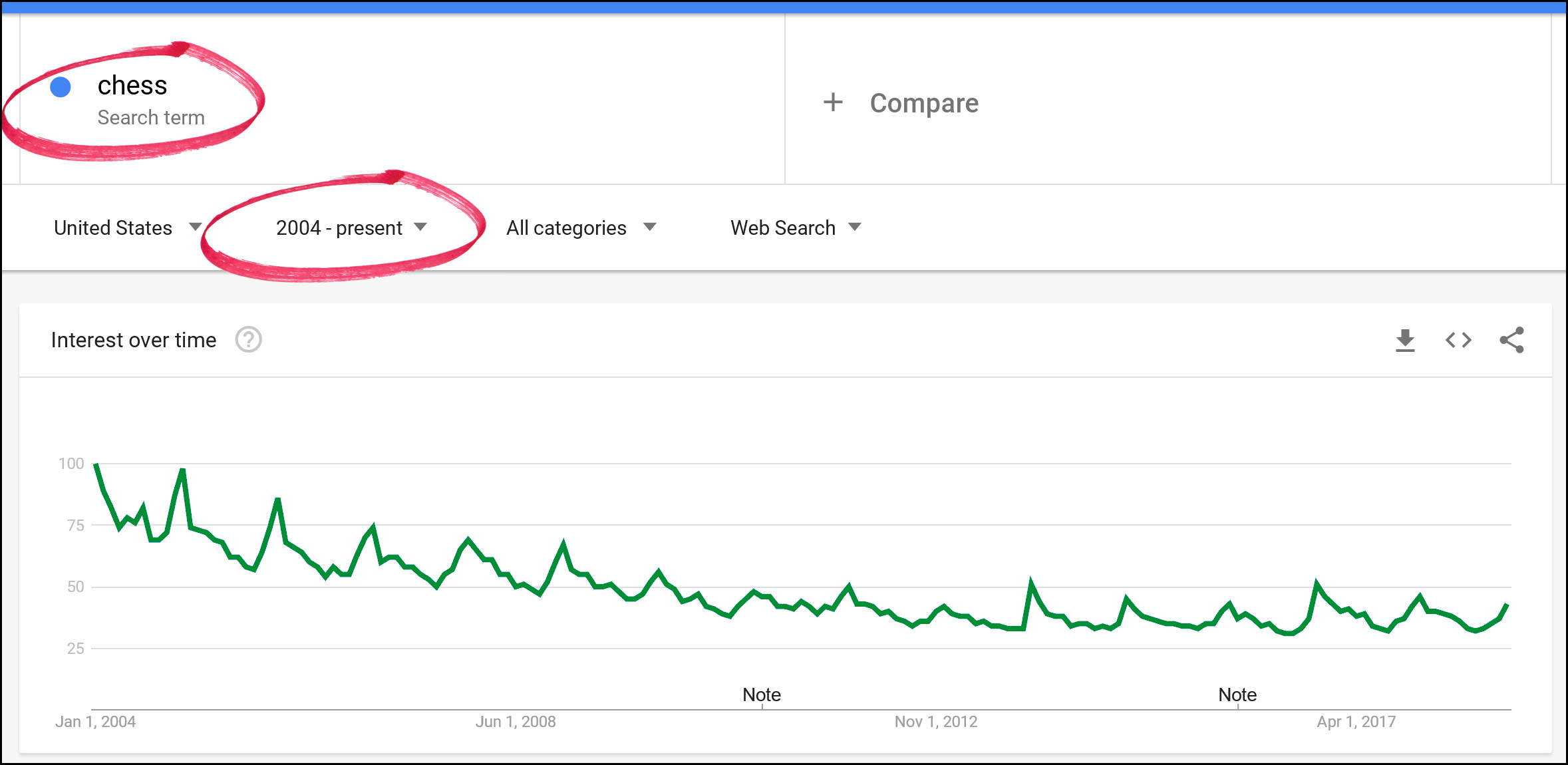
Google Trends is hardly the final statement on what people do and don’t care about, but it sure seems to suggest that chess is becoming even less popular than it used to be:

Worldwide, interest in chess is perhaps eroding even more quickly than it is in the United States. Even in Norway interest has slackened since Carlsen won his first world championship in 2013. In Russia, interest has cratered since the era of endless Russian dominance ended about a decade ago. The only country where it seems to be on an upswing is China, for reasons that escape me.

Anyway, the fifth game will be played Thursday at 10 am Eastern if you want to watch over the internet. Caruana will be playing white.

20 Apr 01:55

Because Fuck It Why Not?

by John Cole

Solid:

Former New York mayor Rudolph W. Giuliani, a combative former prosecutor and longtime ally of President Trump, told The Washington Post on Thursday that he has joined the president’s legal team dealing with the ongoing special counsel probe.

“I’m doing it because I hope we can negotiate an end to this for the good of the country and because I have high regard for the president and for Bob Mueller,” Giuliani said in an interview.

Trump counsel Jay Sekulow said Thursday in a statement that Giuliani is joining the team along with two former federal prosecutors, Jane Serene Raskin and Marty Raskin, a couple who jointly run a Florida-based law firm.

What’s the opposite of the dream team? At least this will be entertaining.

05 Apr 19:28

Erasmus vs. Luther — a Rift That Defined the Course of Western Civilization

by S. Abbas Raza

Rebecca Newberger Goldstein in the New York Times:

Merlin_135768453_f8e258a0-705c-4bb9-ad4d-d27a60162e13-superJumboOften the best way to understand opposing viewpoints is to imagine the proponents in dialogue. How would Euripides have responded to Plato, his Athenian contemporary, concerning the philosopher’s banishing poets from his utopia? Or picture George Eliot cornering Arthur Schopenhauer to challenge his argument that women are unsuited for artistic and intellectual greatness. The history of ideas is filled with pairs of contemporary minds who missed the opportunity to confront each other point blank, leaving us to dream up hypothetical exchanges.

But sometimes our imaginations aren’t necessary. Desiderius Erasmus and Martin Luther, though they never met in person, were articulate in their assessments of each other. In their disdain for the power-hungry abuses of the church, the grotesque superstitions it encouraged in the laity and the equally grotesque scholasticism it encouraged in the era’s theologians, they might have been natural allies; instead they became implacable foes. Each, in opposing the other, clarified his own point of view. In the process, the two great reformist movements of their day — the Renaissance, embodied in Erasmus, and the Reformation, embodied in Luther — were torn asunder. Michael Massing’s riveting “Fatal Discord: Erasmus, Luther and the Fight for the Western Mind” is devoted to this fateful parting of ways.

More here.

05 Apr 19:26

Kevin Williamson Fired From the Atlantic

by Kevin Drum

The curtain has rung down on the great Kevin Williamson affair. It turns out that Williamson didn’t propose the death penalty for women who get abortions in just a single angry tweet, but also in greater depth in a podcast:

Kevin Williamson has been fired from The Atlantic.

From Jeffrey Goldberg’s letter to staff: “The language he used in this podcast—and in my conversations with him in recent days—made it clear that the original tweet did, in fact, represent his carefully considered views.”

— Jessica Valenti (@JessicaValenti) April 5, 2018

“The tweet was not merely an impulsive, decontextualized, heat-of-the-moment post…Furthermore, the language used in the podcast was callous and violent. This runs contrary to The Atlantic’s tradition of respectful, well-reasoned debate, and to the values of our workplace.”

— Jessica Valenti (@JessicaValenti) April 5, 2018

Of all the reasons to get fired, this is the craziest. Goldberg didn’t think Williamson was serious about his view of abortion? That’s nuts. Of course he was serious about it. How could Goldberg have somehow convinced himself otherwise?

Do you remember during the 2016 campaign, when Donald Trump said that “there should be some form of punishment” for women who have abortions? It was obvious at the time that Trump was just freewheeling and had no idea what the pro-life community thought of this. He just figured (a) hey, if abortion is illegal this makes sense, right? and (b) taking the farthest right-wing stance had worked before, so it should work again.

What he didn’t know was how hard the pro-life community works to not say this. They will talk about abortion being murder. They will talk about it being worse than the Holocaust. They will talk about punishing doctors who perform abortions. But they will never, never take the obvious next step of saying that women who get abortions should be punished. “We need to change the culture,” they’ll say. “Women are victims,” they’ll say. “This isn’t the most effective way to reduce abortions,” they’ll say. Trump was advised of this posthaste and he backed down within a few days.

It goes without saying that nobody would take this kind of forgiving attitude if we were murdering, say, a million adult Hispanics every year. We would all agree that the murderers should, in fact, be punished, and not lightly. So if abortion really is murder, then punishing women who get abortions is obviously the right thing to do.

But conservatives are firmly prohibited from saying this because they know perfectly well that everyone would find it heinous—and this prohibition is enforced with an iron fist. Williamson’s crime wasn’t believing that women who get abortions should be hanged, it was saying out loud that women who get abortions should be hanged.

Personally, I wish Williamson had said this loudly and proudly in the pages of the Atlantic. That would help tear the mask off the duplicity of the anti-abortion movement and expose it for the barbarism that it is. It would be great to see them tearing each other apart over what they really think should happen to women who get abortions. I guess now that will never happen.

05 Apr 19:26

But I am still thirsty

by Doug!

I know some of you get sick of poll porn but….

Former Gov. Phil Bredesen has a 10-point lead over U.S. Rep. Marsha Blackburn in the race to succeed U.S. Sen. Bob Corker, according to a new poll from Middle Tennessee State University.

That’s why we have to compete everywhere.

Give to the Balloon Juice fund that is split equally among all eventual Democratic nominees in House districts currently held by Republicans.

Goal Thermometer

I’ve got all kinds of kooky donation ideas we can start in on once we hit our goal.

06 Feb 17:06

Become a Deep Learning Coder From Scratch in Under a Year

by Nick Douglas

Machine learning (aka A.I.) seems bizarre and complicated. It’s the tech behind image and speech recognition, recommendation systems, and all kinds of tasks that computers used to be really bad at but are now really good at. It involves teaching a computer to teach itself. And you can learn to do it in well under a…

Read more...

03 Jan 00:34

The best kottke.org posts and links of 2017

by Tim Carmody

[ As a tease for the first issue of the just-announced Noticing newsletter coming up on Friday, here is last week’s newsletter that we previewed for kottke.org members. It’s a review of the best kottke.org posts and links from 2017. You can sign up for Noticing if you find this kind of thing appealing. Ok, I’ll let Tim take it from here. -jason ]

 
2017 Through the Lens of Kottke.org

If 2016 was chaos, then 2017 was catastrophe. In the middle of an ongoing disaster, the world reckoned with bills long overdue. Kottke.org has never been a terribly political blog, but it’s always been one that’s grappled with history, the problems of art and media, self-reflection, and the long trajectory into the future. The site couldn’t help but reflect that catastrophe back to its readers. At the same time, it continued to offer some small oasis by selecting and presenting the best of the World Wide Web.

 
Messages in Bottles

One of the most exciting weeks of 2017 for me was when I asked Kottke.org readers to help me build a time capsule for the World Wide Web. It felt particularly important this year to try to save the best parts of the things we loved. We had to have something to show the future, despite all this destruction and heartache, that we were still capable of making things that surprised and delighted.

The entire “best of the web” series paid homage to the 20th century technologies that have defined so much of the 21st. It also showcased the deep knowledge and generosity of Kottke readers, who contributed and helped curate all of the entries. If you missed it, or are looking to refresh yourself, the web’s best hidden gems and the web’s funniest stories are good places to start.

Jason on Halt and Catch Fire

Jason as gas station patron on Halt and Catch Fire. Photo courtesy of AMC.

One of the most exciting weeks of 2017 for me on Jason’s behalf was his appearance on Halt and Catch Fire. Jason wrote this wonderful love letter to the show and the moment it tries to capture:

When I was a kid, there was nothing I was more interested in than computers. My dad bought one of the first available IBM PC-compatibles on the market. I’ve read and watched a ton about the PC revolution. I used online services like Prodigy. And the web, well, I’ve gotten to experience that up close and personal. One of the reasons I love Halt and Catch Fire so much is that it so lovingly and accurately depicts this world that I’ve been keenly interested in for the past 35 years of my life. Someone made a TV show about my thing and it was great, a successor to Mad Men great. Getting to be a microscopically tiny part of that? Hell yeah, it was worth it.

Recently, I saw The Farthest, a wonderful documentary about the Voyager missions. In it, Timothy Ferris, producer of the famous Golden Record, laments the fact that so much wonderful music was left off, but says something like, “who would want to live in a civilization that only ever produced 90 minutes of great music?” It made me feel better about leaving off so many wonderful parts of the web in my time capsule; who would want to honor a technology whose entire set of great achievements could be documented in a week of blog posts?

 
In Search of Deep Time

In 2014, it was easier to believe in the future. For The Future Library, an art project by Katie Paterson, a thousand trees were planted. In a century, the trees will become part of an anthology of books, written by Margaret Atwood and David Mitchell, among others.

Between now and then, one writer every year will contribute a text, with the writings held in trust, unpublished, until the year 2114. Tending the forest and ensuring its preservation for the one hundred year duration of the artwork finds a conceptual counterpoint in the invitation extended to each writer: to conceive and produce a work in the hopes of finding a receptive reader in an unknown future.

Deep Time, conceptualized in the eighteenth century but coined in the twentieth by John McPhee, is bigger than centuries; it’s really about time on the geologic scale. Even the time of human civilizations (Stone, Bronze, Iron, etc.) is too small. Deep time is deep.

Something like “The Earth’s five energy revolutions” gets us closer to it: all life on earth begins with geochemical energy, then augmented by sunlight, and finally, oxygen, flesh, and fire. The life and death of entire forests of trees, of entire species and kingdoms, is dwarfed by the history of an entire planet and all the life that’s ever been on it. This point of view has always been a powerful perspective, but in 2017, the cosmic telescope of time was almost a comfort. Even if nations fall and species fail, this too will pass.

Coleman's Cafe in Greensboro, Ala.

Coleman’s Cafe in Greensboro, Ala., in 1971. By William Christenberry

But deep time has its own human counterparts. Consider Teju Cole’s essay “The Image of Time,” on photographer William Christenberry. Christenberry photographed buildings in small towns in the American south over time: seemingly the same photograph, of the same object, from the same distance, with the same framing, shows the object’s subtle or radical transformations, its non-identity.

Time is photography’s illusion. Almost every photograph appears instantaneous. But of course, there’s no such thing as “instantaneous”: All fragments of time have a length. In a photograph, the time during which the light is refracted by the lens, enters the aperture and is allowed to rest on the photosensitive surface could be 1/125th of a second, one-eighth of a second, half a second, a whole minute, much more or much less. What is intriguing about a practice like Christenberry’s is that it employs time elsewhere in the photograph too: as a source of narrative.

Or look at Jon Bois’s magnificent “17776: What Football Will Look Like in the Future,” which dives right into the familiar — maps, calendars, printer readouts — and estranges it, exactly to make the reader experience time. (I can’t even blockquote or screenshot it. It’s one piece you have to read for yourself.)

 
Time Collapsed

In 17776, the angel of history is a far-flung space probe that’s absorbed all of human culture, emotions, and sports statistics through radio transmissions. For Walter Benjamin in 1940, the Angel of History was a thought-experiment to try to understand all of history as an ongoing catastrophe.

These are chaotic times. But to the angel of history, it’s not a sudden eruption of chaos, but a manifestation of an ongoing vortex of chaos that stretches back indefinitely, without any unique origin. When we’re thrust into danger, in a flash we get a more truthful glimpse of history than the simple narratives that suffice in moments of safety. As Benjamin puts it, “the tradition of the oppressed teaches us that the ‘state of emergency’ in which we live is not the exception but the rule.”

For James Baldwin, there were no angels, and no robots; only fallen, imperfect beings who’d likewise absorbed the surrounding culture, but hadn’t necessarily been humanized by it. “People who shut their eyes to reality simply invite their own destruction,” writes Baldwin, “and anyone who insists on remaining in a state of innocence long after that innocence is dead turns himself into a monster.”

Baldwin and Benjamin were the two writers that best helped me understand this year, because they’d already seen how fascism and Jim Crow could fold time over on itself. Had he not been murdered, Emmett Till would have turned 76 in 2017; instead, a new book revealed what was long known, that he died because of a lie.

And in 2017, in a different sort of lie, Rachel Dolezal, a white woman who self-identifies as black, changed her name to Nkechi Amare Diallo. When Baldwin wrote “the world is white no longer, and it will never be white again,” I don’t think this is what he was talking about.

It was not the first time that the curiously stagnant nature of time made me wonder if we were all dead and in Hell. It would not be the last.

 
The New Callousness

In 2017, knowing how to apologize properly is an essential skill. (You might even call it a new kind of liberal art.) The essential components of a genuine apology, according to Beth Polin:

1. An expression of regret — this, usually, is the actual “I’m sorry.”
2. An explanation (but, importantly, not a justification).
3. An acknowledgment of responsibility.
4. A declaration of repentance.
5. An offer of repair.
6. A request for forgiveness.

Most of 2017’s public apologies whiffed on one or more of these. It was a year filled with soul-searching, but also much rejection of any real contrition. We might remember individual acts of selflessness, but the year was fueled by selfishness.

This photo by Kristi McCluer of wildfires in the Pacific Northwest became a metaphor for the summer, and the whole year.

Summer 2017 Fire

A man golfs with a wildfire raging behind him. One of the defining images of 2017.

The New Callousness, swept into power in the United States and elsewhere, led to widespread physical and political fatigue: Kayla Chadwick’s “I Don’t Know How to Explain to You That You Should Care About Other People” reflects the prevailing mood of exhausted incredulity.

It is probably fair to say that in every direction, 2017 involved a lot of human beings writing off other human beings. But pushing back against this were great technologist-humanists like the legendary Ellen Ullman, explaining why hackers need the humanities:

Algorithms surround us, determining how we get mortgages or apartment rentals, or whether we get hired. It is crucial that we open up those algorithms and take them apart, and then either put them back together or scrap and rewrite them. Algorithms may run our lives, but I really believe people make the future.

 
Sharp as Possible

Trying to figure out how to live through this year, I often thought about Thelonious Monk’s advice on how to play a gig:

Just because you’re not a drummer, doesn’t mean you don’t have to keep time.

Don’t play the piano part. I’m playing that.

Don’t play everything (or every time). Let some things go by.

Some music just imagined. What you don’t play can be more important than what you do play.

Whatever you think can’t be done, somebody will come along and do it. A genius is the one most like himself.

What should we wear tonight? Sharp as possible!

I also tried to remember Richard Feynman’s advice that if you can’t explain something simply, you probably don’t really understand it. I admire complexity, but whenever it’s possible, simplicity is better.

The best of all things may be to be able to ratchet the explanation’s complexity up or down depending on who your audience is: neuroscientist Bobby Kashturi explaining a connectome to a five-year-old, teenager, college student, grad student, and scholarly peer is a great example of that.

It all builds from the foundation. As Richard Hamming observed, knowledge and productivity are like compound interest. You grow from work you put in over time, simple things repeated until they become (or appear to become) complex. Learning effects, network effects, path dependence — over time, they all roll up, and who you’re becoming overtakes who you are.

 
The Great Eclipse

In August, after a jab step into Nebraska, Jason drove to Rayville, Missouri to witness and photograph the solar eclipse.

As totality approached, the sky got darker, our shadows sharpened, insects started making noise, and disoriented birds quieted. The air cooled and it even started to get a little foggy because of the rapid temperature change.

We saw the Baily’s beads and the diamond ring effect… When the Moon finally slipped completely in front of the Sun and the sky went dark, I don’t even know how to describe it. The world stopped and time with it. During totality, Mouser took the photo at the top of the page. I’d seen photos like that before but had assumed that the beautifully wispy corona had been enhanced with filters in Photoshop. But no…that is actually what it looks like in the sky when viewing it with the naked eye (albeit smaller). Hands down, it was the most incredible natural event I’ve ever seen.

Eclipse 2017 by Mouser

A view of the eclipse from Rayville, MO. Photo by Mouser.

Jason also collected the best photos and videos of the eclipse, this NASA map showing the eclipse’s path across the continental United States. and eclipse maps of the United States from 2000 BC until 2117 AD. Even for those of us who just sat under a tree and watched the shadows turn into scallops, it was a special experience this year.

 
Did Someone Say Maps?

Talk about visualizing deep time! Here we go:

A Tapestry of Time and Terrain shows the ages of rock in different parts of the continental US.

Another map shows the hometown of nearly all of the warriors from Homer’s The Iliad.

This map of the Roman Empire c. 125 AD shows the major Roman roads as if they were London’s tube.

A collection of miniature metro maps shows world cities with smaller systems, from Bangalore to Tblisi.

There’s a timeline map of US immigration since 1820, a set of hand-drawn infographics made by W.E.B. Du Bois and his students at Atlanta University, auto-generated maps of fantasy worlds, a topographical map of Venus (with geographic features named for historical and mythological women), and even an interactive map of personal debt.

There’s also The Atlas for the End of the World, which looks at critically endangered bioregions worldwide, and NASA’s striking nighttime map of the world, complete with a patch of void separating China from South Korea; the one nation, that, light-wise, may as well be open ocean.

 
So What Was Good?

There were so many essays and features and pop-up op-eds and shameless resistance grifters and rust belt whisperers that all tried to explain what was really happening in 2017. Almost always reporting either from a small red-state town or the comforts of one’s own imagination. And almost always thoroughly ignoring what was happening in the wider world in favor of warmed-over anecdotes and armchair realpolitik. All that noise nearly drowned out a few moments genuine insight. That’s always the case, but it all felt sharper this year.

I’ve already listed a lot of what I loved about this year — and everything I’ve mentioned appeared as a blog post or a Quick Link on Kottke.org. But two pieces of documentary art stand out for having a different set of ambitions, in search of a different kind of truth about 2017.

Flamingos in Planet Earth II

A flock of flamingos in Planet Earth II.

The first is Planet Earth 2. We already know that when the BBC breaks out Sir David Attenborough, they deliver the goods: a respite from our overweening humanity, with cutting-edge photography and cogent commentary. But PE2 went further, because it was just so goddamned beautiful.

The tracking shot of a lemur jumping from tree to tree is one of the first things you see in the first episode and it put my jaw right on the floor. It’s so close and fluid, how did they do that? Going into the series, I thought it was going to be more of the same — Planet Earth but with new stories, different animals, etc. - but this is really some next-level shit.

The second is Whitman, Alabama. Jennifer Crandall’s serial documentary benefits enormously from the fact that it didn’t set out to explain what happened politically in 2016 or 2017. The filmmaking began much earlier as a meditation on the longstanding problems of democracy and diversity in America.

It’s a very different kind of film from Planet Earth 2. It’s not state of the art. It’s relentlessly human. It manifests the spirit of Walt Whitman: his generosity, his capaciousness, his gentle but insistent concern on the public and private lives of his fellow Americans.

The first time Crandall read “Song of Myself,” it was 1990, and she was sixteen, standing in a bookstore in McLean, Virginia, having just moved back to the United States. Because of her father’s job, with U.S.A.I.D., she had spent most of her childhood in Bangladesh, Haiti, and Pakistan. “My mom is Chinese, from Vietnam, and my dad’s a white dude from Denver, and at that moment I just felt that I did not understand America,” she said. She pulled a paperback anthology of poetry off the shelf, and Whitman stuck out right away. “Though I wouldn’t have articulated it then, what I responded to was this idea that everyone embodies diversity, not just the country. That many people are negotiating multiple social contracts, the way I’d been doing since I was born.”

Somewhere between those two, between the whole planet and just one town, between the deep time of the age of fire and the quickfire moments of the post-web internet, between the human and the indifference to humans, is where we are. It’s where we’ve been in 2017 and will be again in 2018, no matter what comes. It’s where we’ve always been, careening between catastrophe and epiphany, callousness and generosity, the divine and the mundane. With luck, we will not destroy ourselves. With luck, and grace, and hope, and because we have no choice, we will find a way to make it through.

Tags: best of   best of 2017   kottke.org
21 Nov 01:02

Every rose has its thorn

by Doug!

Sorry, Charlie:

Eight women have told The Washington Post that longtime television host Charlie Rose made unwanted sexual advances toward them, including lewd phone calls, walking around naked in their presence, or groping their breasts, buttocks or genital areas.

Can’t say I’m surprised. I remember him drooling over Penelope Cruz in the most cringe-worthy manner on 60 Minutes once.

Always hated the guy. I’m partial to drunks but he took it a little too far on air.

Here’s thing with him and his ilk. Act like a fucking professional! Perv on all the women you want to on your own time but not when you’re working with them or worse yet when they work for you and certainly not when you’re on tv. Drink all you want but don’t show up for work visibly hung over every damn day. I guess I’m from the old school when it comes to doing your job.

Update. I didn’t mean Rose could grope women on his own time, that’s assault. I just mean if you want to hit on women in a clumsy way, do it at a bar, not at your workplace. People deserve a workplace that is free from having to deal with that kind of shit.

24 Jul 21:50

Trump Screams “Death”

by Betty Cracker

Remember Trump’s bizarre “Democrats scream death” tweet 500 years ago? Actually, it was only five days ago. Well, now HE’S the one screaming “death,” in a speech this afternoon. Via NBCNews:

Trump: ‘Obamacare is Death’

WASHINGTON — President Donald Trump declared the Affordable Care Act a “meaningless promise” Monday, using his presidential bully pulpit to amplify his calls for action on stalled Republican attempts to repeal and replace Obamacare — which he called “death” at one point.

“Obamacare has wreaked havoc on the lives of innocent, hard-working Americans,” Trump said at the White House, joined by families whom he said had suffered under the ACA.

The president hammered Democrats for their lack of bipartisanship and decried their criticism of Republican efforts to reform health care.

“They say death, death, death. Well, Obamacare is death,” Trump said. “That’s the one that’s death.”

Trump’s remarks come amid failed GOP pushes so far to repeal and replace Obamacare, with the White House urging Republicans to act this week.

Of course, he doesn’t have a fucking clue what Obamacare is or what provisions are in his own party’s bill. All he sees is a big, fat goose egg on the scoreboard under his name, and if Republicans don’t get in line, he’ll turn his fire on them. Yesterday, Trump threatened Republicans as follows:

I think he’s right about that — the infighting will consume this rancid pustule of an administration and rip that putrid turd of a party apart if this bill goes down. So yeah, keep calling!

20 May 01:05

#53851

10 Apr 19:22

Unquote

by Greg Ross

https://pixabay.com/en/caveman-primeval-primitive-man-159359/

“Those writers who lay on the watch for novelty, could have little hope of greatness; for great things cannot have escaped former observation.” — Samuel Johnson

“It is not once nor twice but times without number that the same ideas make their appearance in the world.” — Aristotle

“What wise or stupid thing can man conceive
That was not thought of in ages long ago?” — Goethe

09 Apr 21:33

National Security Adviser K. T. McFarland Ousted As NSC Shake-up Continues

by Chas Danner
US-TRUMP-POLITICS
Trump will nominate her to become the U.S. ambassador to Singapore.
16 Feb 01:51

#53269

03 Oct 23:53

Meticulously Preparing a Teeny Tiny Lasagna

by Scott Beale
05 Jun 22:27

Swysh Is a Motion Gesture Controlled Music App for iPhone

by Thorin Klosowski

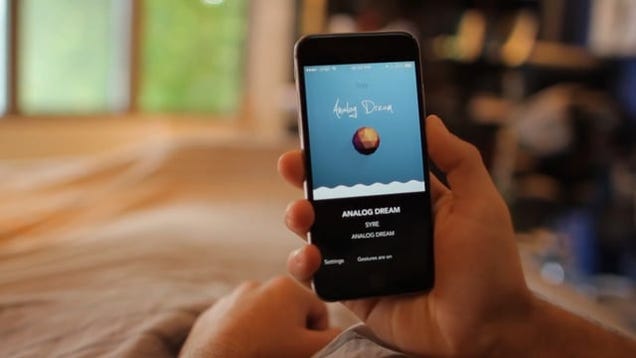
iPhone: If you’re on the move a lot, controlling the music on your iPhone by tapping buttons isn’t always easy. Swysh is an iPhone app that lets you use simple motion gestures to switch between songs.

Read more...

05 Jun 22:26

Sunday Evening Open Thread: Much Regret

by Anne Laurie

One of our three rescue dogs actually eats (peeled) orange segments… while the other two stare at him with their best ‘What is WRONG with you, old dude?’ expressions. Guy at the top looks like he’s at least part Australian Cattle Dog, a breed renowned for both their intelligence and their cheerfully propriety attitude towards anything that might be edible, so I’m sure he thinks it as good a joke as the rest of us, now that his mouth is no longer burning.

***********
Apart from making the best of life’s indignities, what’s on the agenda as we wrap up the weekend?

07 May 17:06

Women Who Write about Sports

by bspencer

  • Sports-writers Julie DiCaro and Sarah Spain participated in a video where men read them abusive comments that had been directed at them online.
  •  Jane McManus  and Juliet Macur expound.

FacebookTwitterGoogle+Share

18 Mar 18:13

Flowstate Keeps You Focused on Writing by Deleting Your Progress When You Stop

by Kristin Wong

OS X/iOS: Focus is important when it comes to any task, and if you have trouble staying focused while writing, Flowstate can help. Namely because, if you get distracted and stop writing, it will delete your progress.

Read more...


19 Jan 19:23

Broad Humor

by Andrew Sullivan

Lenika Cruz praises the second season of Broad City, which premiered this week:

[T]he show isn’t getting complacent, subject-wise: The first few episodes weave rape, sexual experimentation, discrimination, death, and socioeconomic privilege into their storylines, but avoid shoehorning commentary or moralizing. [Show creators and co-stars Ilana] Glazer and [Abbi] Jacobson proved in the first season that they could pull off outrageous without being tone-deaf or relying on stunt scenes—an admirable achievement for a show that centers on two self-absorbed female millennials. Sweet (flatulent) Abbi is often passive and self-doubting, given to bursts of energy and gall at the urging of Ilana, who is equal parts bullshittery and sincerity, and whose deep ignorance and irony are only sometimes redeemed by her sensitivity and good intentions.

In a profile of the two comedians, Rachel Syme appreciates that “as broad and slapstick as the comedy on the show can be, Glazer and Jacobson ultimately traffic in precision; their jokes could not be anyone else’s jokes.” She notes that “sex is a big part” of the series:

They both seek it, desire it, and talk about it constantly (in one episode, Ilana tells Abbi her detailed fantasy for a sexual position featuring them both, called the “Arc de Triomphe”). They treat sex with no judgment or sneers; Abbi and Ilana’s carnal victories are always shared. In the new season, when Abbi decides to “peg” one of her hookups with a neon-green dildo, she immediately calls Ilana (who happens to be at her grandmother’s shiva). Ilana screams, “This is the happiest day of my life!” What’s funny about the sex on Broad City is not that women are openly having it (we have Sex and the City to thank for that, as well as just about every cable show that has followed), but that when Abbi and Ilana do it, things tend to go horribly wrong. In the case of the strap-on triumph, Abbi quickly finds a way to melt the apparatus in the dishwasher and must embark on a Chaucerian quest to find a new one before the clock runs out.

Stephanie Boland compares the show to Girls:

While Girls – a frequent point of comparison – is known for its characters’ awkwardness, the cast of Broad City are framed as likeable even, or perhaps especially, when their behaviour is questionable. The shame which is one of the central emotions of Girls is almost entirely missing here. Broad City’s surrealism lets its creators play disgust for laughs while also revelling in its truth. At one moment, the girls accidentally get a sixteen-year-old high school student stoned; another scene shows Abbi using a blow-dryer on her genitals before the aforementioned heat wave sex. At no point, however, does our revulsion transmute into dislike for the protagonists – and rarely do they suffer consequences.

This is the central contradiction at the heart of the show. Unlike Dunham’s wonderfully unlikable Hannah Hovarth, Broad City demands we find its women charming while they do terrible things. When Hannah quotes Missy Elliot during her break up with Donald Glover’s character Sandy, he is rightly horrified. By way of contrast, the intern Ilana pictures singing slave spirituals still seems happy enough at the end of the skit. The difference is partly one of absurdity, but also one of politics. Drugs, sex, and troubling attitudes to race and gender are part of the texture of city life, and Broad City suggests to sanitise would be remiss. It’s a winning feature for the show’s young demographic, and the programme has already been renewed for a third season.

Meanwhile, Nate Jones looks back at the web series that inspired the Comedy Central series. He highlights “VChat,” the episode above, as especially worth revisiting:

There’s one thing about friendship that the web-cam segments of Broad City get at so well: the feeling that life is just one long conversation punctuated briefly by the interruption of outsiders. “VChat” is the first of these—the format would later turn into a spinoff series, Hack Into Broad City—and it sees Ilana advising Abbi on a potential hookup. Their interactions are gold; you get the sense that the actual things that happen to the two of them are secondary to the experience of talking to each other about it.


03 Jan 23:05

Hood Rats

by Zandar

When it comes to 1) firearms and 2) sweatshirts with hoods on them, guess which one Oklahoma Republicans want to regulate to the point of making illegal?

Oklahoma lawmakers are planning to introduce a bill this February that would make it illegal to wear hooded sweatshirts, or “hoodies,” in public, according to a report from Oklahoma’s Channel 6 News.

Republican Senator Don Barrington will introduce the bill, which would make it a misdemeanor to “wear a mask, hood, or covering” either while committing a crime or in order to intentionally conceal one’s identity. If the bill is passed, offenders would be subject to a fine of $50 to $500, and up to one year in jail. The ban would not affect mask-wearers on Halloween or at masquerade parties, nor would it apply to people who wear head coverings for religious purposes.

The bill’s purpose is seemingly to deter crime. As Channel 6’s report notes, robberies caught on surveillance camera often show the perpetrator wearing a mask or hoodie to cover his or her face. With the bill’s language only prohibiting wearing hoodies while committing a crime or to intentionally hide, supporters say the ban wouldn’t negatively affect people just trying to wear a sweatshirt in day-to-day life.

Others, however, have argued that bans on hoodies — no matter the intention — only serve to exacerbate problems with racial profiling. CNN legal analyst Sunny Hostin took on the issue when an Indiana mall banned the garment in March:

“This is about the pretext of being able to stop young African-American males,” she said. “Hoodie is code for ‘thug’ in many places and I think businesses shouldn’t be in the business of telling people what to wear. The Fourteenth Amendment protects us from this.”

Republicans are clearly for smaller, less intrusive government.  Unless it’s for black people, in which case criminalize every aspect of their lives.

Bonus points: under this legislation, who decides if a person is wearing a hoodie to “intentionally conceal” their identity?  Why, the cops, of course.

FacebookTwitterGoogle+Share


This space reserved for your ad.

02 Dec 02:14

Cyber Monday Sales Roundup Don’t worry, we’ve got...

by derekguypto


Cyber Monday Sales Roundup

Don’t worry, we’ve got you covered for Cyber Monday as well. Keep locked to this post and we’ll be updating sales as we’re notified of them throughout the day. Like with our Black Friday sale roundup, this list will be alphabetized, but you can find new listings by seeing what’s italicized.

Oh, and of course we’re also holding a Cyber Monday sale in our pocket square shop. Take 20% off everything — including sale items — with the code LETSCYBER.

20 Nov 16:44

How businesses are planning for Obamacare’s Cadillac tax

by Jason Millman

The Obamacare tax on high-cost employer health plans is back in the news, thanks to MIT professor Jonathan Gruber's controversial comments that the provision would eventually upend all employer health plans. In the short term, though, very few companies are now expecting to drop their health plans the first year the tax kicks in, according to a new survey of employers.

Just a quick overview of what the Cadillac tax does: It’s a 40 percent excise tax on employer health plans on amounts above a certain threshold – it starts at $10,200 for an individual plan and $27,500 for a family plan. The tax won’t take effect until 2018, but firms are already starting to plan for it.

The tax is a big deal since it's a departure from one of the biggest tax breaks in the entire code: that the federal government does not tax the value of health insurance provided by employers to their workers. Gruber’s comments on the Cadillac tax stirred up controversy, in part, because he said it would eventually end the tax advantage, across the board, in 20 years. That’s not something that supporters of the ACA — himself included — were saying when the law was being drafted. They said the Cadillac tax would hit only the most expensive coverage, and that the tax would nudge employers to choose less expensive health plans and, in return, improve employee wages.

Economists generally agree that the preferred tax treatment for employer health plans is bad policy. But suggestions to end or limit this design are pretty unpopular, as Gruber's comments acknowledge.

A new survey suggests that in the short term, at least, the Cadillac tax won’t spur employers to drop coverage in a big way. Just about 3.5 percent of employers said they expect to stop offering coverage in the tax’s first year, according to a survey of more than 3,000 firms from the Employee Benefit Research Institute and the Society for Human Resource Management released on Wednesday. Another 30 percent of employers said they’re still unsure what effect the tax will have in 2018.

About 85 percent of firms in the survey said they don't expect their health plans would trigger the Cadillac tax in 2018, but firms that historically offer more generous coverage are more likely to anticipate hitting the tax in its first year. Businesses with at least 750 employees were twice as likely as smaller employers to say they expect to face the tax in 2018. Government employers, when compared to privately owned for-profit businesses, were more than twice as likely to expect to face the tax that year. It will also hit much more expensive preferred provider organizations much harder than any other type of plan.

The survey comes as the cost of employer health plans has been growing at a historically slow rate over the past few years. The cost of family coverage in 2014 grew just 3 percent, reaching $16,834 this year, according to the annual Kaiser Family Foundation/HRET survey. Employer-sponsored individual coverage grew just 2 percent, hitting $6,025 for the average plan.

How that rate changes over the next couple of years will affect how many plans will be subject to the Cadillac tax. For what it's worth, the Congressional Budget Office last year said the tax would bring in less revenue — $80 billion instead of $137 billion over the decade — because of lower health spending and changes in the employer-sponsored insurance market. So it indicates some employers will pay the tax and pass the cost onto workers.

With new attention on the tax and Republican control of Congress, there’ll likely be increasing pressure to blunt the tax’s impact. But it's still a big chunk of change to replace.


07 Nov 21:06

Don’t Waste Any Tears on the Democrats

by S. Abbas Raza

Ezra Palmer in Far From Brooklyn:

16395_10152458693736179_870729479636026355_nThere are a thousand and one reasons the Democrats lost control of the Senate, but the main one is this: They didn’t stand for a goddam thing.

The GOP ran on a single talking point — “We’ll stop Obama” — whereas the Dems couldn’t even work up the guts to admit they voted for the man.  

What a bunch of empty suits, lacking vision, courage, values, goals — indeed, lacking any sort of apparent dream other than that of being elected to public office.

It’s become a commonplace to criticize President Obama for failing to lead.  I call bullshit on that.  What happened is that his party has failed to follow.

How hard is it to campaign alongside a man who ended two wars and staved off a second Great Depression?   How hard is it to remind the electorate of what life was like in 2008, when there was a very real possibility of mass failure of our bank system, the collapse of much of our mutual fund infrastructure, and erasure of wealth on a scale never before seen in history?

But the 2014 Democratic candidates, this cluster of zymotic panderers, no, they didn’t even dare to share a podium with the man, let alone attempt to argue for anything that’s happened in the past six years.

So they deserved to lose.  They deserved to have the Senate wrested from them.  They deserved the shame of listening to the victorious GOP talk magnanimously about the need for bipartisanship.

More here.

07 Nov 17:41

GoldieBlox Premieres Their Brand New Action Figure for Girls in ‘Big Brother’-Style Ad Campaign

by Lori Dorn

GoldieBlox (previously), the toy company that offers girls alternative options for play, has debuted their GoldieBlocks Zipline Action Figure with “GoldieBlox vs.the Big Sister Machine,” a “Big Brother”-style campaign that is eerily reminiscent of the Apple “1984” ad and features “Help, I’m Alive” by the Canadian band Metric.

Imagine a world that’s colored in pink, where all girls look and act exactly the same. Role models on big screens tell them that being pretty is their primary purpose. Beauty reigns supreme. This world is not so far fetched ….One fashion doll is sold every 3 seconds. Research shows that girls who play with fashion dolls see fewer career options for themselves than for boys. It’s time for girls to have options. It’s time for us to take action. Girls’ feet are made for high-tops, not high heels…it’s time for change

The fully articulated action figure is the spitting image of Goldie, their cartoon ambassador and comes complete with a zip line kit which is fully compatible with other GoldieBlocks products.

For the first time ever, Goldie comes to life as an action figure! More than just a doll, her articulated shoulders, hips, knees and joints along with specially designed hands and feet are designed for action. With the included construction kit, kids learn how to build Goldie a 13′ zipline and send her soaring!

Goldie on Zipline

Zipline

Goldie's Zipline

images via GoldieBlox

15 Sep 00:24

Face Of The Day

by Andrew Sullivan

dish_fotdsun14

Sage Sohier captured the expressions of people being treated for facial paralysis:

Sage Sohier spent three years at a facial nerve clinic, photographing people in the beginning stages of treatment of facial paralysis for her series “About Face.” The portraits of men, women, and children of all ages and ethnicities with varied causes and visible extents of paralysis are striking. Looking directly into the camera, directly at the viewer, the patients smile.

Sohier adds:

Most people I photograph are acutely aware of their imperfections and try to minimize them. Some have confided in me that, in their attempt to look more normal, they strive for impassivity and repress their smiles. They worry that this effort is altering who they are emotionally and affecting how other people respond to them.

See more of her work here.