submitted by BeauElliot
[link] [24 comments]
Shared posts



20 Jun 05:54
A pictoral representation of how race is viewed in the US.
 |
submitted by CaptnandMaryann [link] [19 comments] |









20 Jun 05:44
For the people wondering the difference between science and engineering
 |
submitted by Mr_honesty_ [link] [535 comments] |
20 Jun 03:37

The Houses Famous Directors Would Design If They Were Architects
by Hannah Keyser

If Alfred Hitchcock designed a house, don't you think it would have plenty of perilous balconies and at least one noose visible through the yellow-tinted windows? If George Lucas went into architecture, he would probably build something extraterrestrial, and a home designed by Tim Burton would look, well, like something out of a Tim Burton film.
The combination of movie directors and architecture may seem a little niche, but iconic auteurs often earn their status and a dedicated following through their distinct aesthetics. Barcelona-based illustrator and architect Federico Babina distills the artistic vision of 27 famous movie directors into stylized buildings in his recent series, Archidirector.
From Federico Fellini to Wes Anderson, generations of successful movie-makers are honored in these cool graphic prints. You can buy these and other architecture-minded posters from Babina—including series that combine design with music, machines, and animals—on Society6.


20 Jun 02:01
Chinese Fire Drill Is Incredibly Intense
by John Farrier
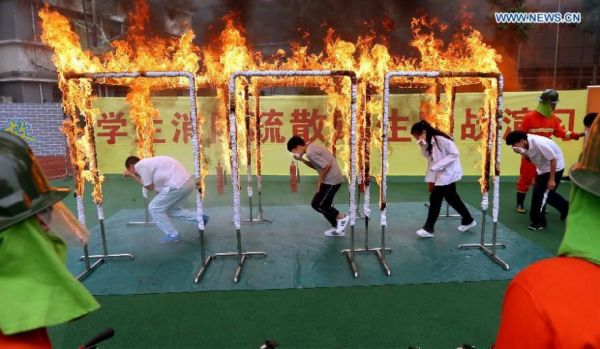 (Photos: Xinhua/Fan Jun)
In the United States, school fire drills are so universal that there's almost no need for training: when the alarm sounds, file out of the building, assemble in an open area, then wait for the fire department to investigate.
At this school in China, the process is very different. Students at the Nanhu Vocational School in Hongkou District, Shanghai, perform fire drills with real fire. They hold cloths over their faces and run through a fiery gauntlet representing a burning school hallway. Once they've escaped the fire, students are expected to pick up fire extinguishers and return to the scene to put it out.
-via Oddity Central
18 Jun 23:32

Black Americans Are Killed At 12 Times The Rate Of People In Other Developed Countries
by Nate Silver
“We as a country will have to reckon with the fact that this type of mass violence does not happen in other advanced countries,” President Obama said earlier today, in reaction to the killing of nine people at a historically black church in Charleston, South Carolina, on Wednesday. The details of the case, including the motivations of the suspect, Dylann Roof, are still unfolding. (We encourage you to read coverage broadly, including from our colleagues at ABC News.) But I wanted to add just a little bit of context to Obama’s remarks — how the U.S. compares to other countries overall, and how that comparison obscures a wide racial divide: Black Americans are far more likely to be homicide victims than white Americans.
We’re looking for good data on the incidence of mass shootings in different countries. There doesn’t appear to be all that much of it. But mass shootings represent a tiny fraction of homicides overall. And thanks to recent efforts by the United Nations Office on Drugs and Crime (UNODC), which published data on homicide rates for almost every country, we can compare the overall homicide death rate in the U.S. to those elsewhere.
According to the CDC’s WONDER database, 5.2 out of every 100,000 Americans were homicide victims, on average, from 2010 to 2012. That’s not especially high by global standards; the median country had 4.7 homicide deaths per 100,000 persons over the same period,20 according to the UNODC data. The highest homicide rate in the world was in Honduras, with 87.9 homicide deaths per 100,000 persons.
But the homicide death rate in the U.S. — as Obama intimated — is more unusual in comparison with other highly developed countries. In the chart below, I’ve compared each country’s rate of homicide deaths against its Human Development Index (HDI), an overall measure of welfare and the standard of living.21

Whether the U.S.’s homicide rate qualifies as an outlier depends on exactly where you set the cutoff for an “advanced” country. Among countries with an HDI of .850 or higher — these are the 31 most well-off countries in the world — the U.S.’s rate of homicide deaths, 5.2 per 100,000 persons, is easily the highest. The next-highest are Brunei (2.0), Finland (2.0) and Israel (1.9). And the U.S. homicide death rate is more than three times higher than neighboring Canada (1.5).
The U.N., however, sets a slightly lower threshold for a developed country, describing all countries with an HDI of .800 or higher as having “very high human development.” Several countries with an HDI between .800 and .850 have a homicide death rate comparable to the U.S., including Lithuania (6.9), Argentina (5.5), Estonia (5.2), Cuba (4.2) and Latvia (3.8). The U.S.’s homicide death rate is also much lower than Mexico’s (22.0), though Mexico’s HDI is just .755.
But these comparisons neglect a massively important fact, and one that is especially pertinent in the wake of the Charleston shootings.
Extending on an analysis by the academic Kieran Healy, I calculated the rate of U.S. homicide deaths by racial group, based on the CDC WONDER data.22 From 2010 through 2012, the annual rate of homicide deaths among non-Hispanic white Americans was 2.5 per 100,000 persons, meaning that about one in every 40,000 white Americans is a homicide victim each year. By comparison, the rate of homicide deaths among non-Hispanic black Americans is 19.4 per 100,000 persons, or about 1 in 5,000 people per year.
Black Americans are almost eight times as likely as white ones to be homicide victims, in other words.
So for white Americans, the homicide death rate is not so much of an outlier. It’s only modestly higher than in Finland, Belgium or Greece, for instance, and lower than in Chile or Latvia.

But there’s no other highly industrialized country with a homicide death rate similar to the one black Americans experience. Their homicide death rate, 19.4 per 100,000 persons, is about 12 times higher than the average rate among all people23 in other developed countries.
Instead, you’d have to look toward developing countries such as Mexico (22.0), Brazil (23.6), Nigeria (20.0), Rwanda (23.1) or Myanmar (15.2) to find a comparable rate. The Charleston killings were unusual in that it was a mass shooting — and also in that the suspect is of a different race than the victims (both black and white homicide victims are much more likely to be killed by someone of their own race.) But that doesn’t negate that the threat black Americans face from homicide is radically different from the one whites do.
18 Jun 22:05

Forget about Rick-Rolling, it's time for Rick Grimeing!
Randy Laue, Roumen.ganeff and 7 others like this
18 Jun 21:50

Hilarious 1996 News Clip Warns About the Dangers of Virtual Reality
by Matt Novak on Paleofuture, shared by Kelsey Campbell-Dollaghan to Gizmodo
Are you excited for our virtual reality future? Well, don’t get too excited just yet. Because there are hidden dangers! Or at least that was the message from this hilariously alarmist NBC News segment from 1996.

18 Jun 21:49


Rachel Dolezal favorite comic book
by J.P. Travis

Rachel Dolezal’s favorite comic book as a kid? The day Superman turned Lois Lane into a black woman.



![[link]](http://i.imgur.com/ZCGDW0r.jpg)
![[link]](http://i.imgur.com/kp1Wf0O.jpg)
![[link]](http://i.imgur.com/7FJhLbA.jpg)
![[link]](http://i.imgur.com/L7q5fZK.jpg)
![[link]](http://i.imgur.com/7B6PFvc.jpg)
![[link]](http://i.imgur.com/tyutcqP.png)
![[link]](http://i.imgur.com/Tmo16Du.png)
![[link]](http://i.imgur.com/hXJVDrZ.gif)