
Nano Letters
DOI: 10.1021/acs.nanolett.7b04684
Quantum emitters radiate light omni-directionally, making it hard to collect and use the generated photons. Here we propose a 3D metal-dielectric parabolic antenna surrounding an individual quantum dot as a source of collimated single photons which can then be easily extracted and manipulated. Our fabrication method relies on a single optically-induced polymerization step, once the selected emitter has been localized by confocal microscopy. Compared to conventional nano-antennas, our geometry does not require near-field coupling and it is therefore very robust against misalignment issues, and minimally affected by absorption in the metal. The parabolic antenna provides one of the largest reported experimental directivities (D=106) and the lowest beam divergences ({\Theta}=13.5 deg), a broadband operation over all the visible and near-IR range, together with more than 96% extraction efficiency, offering a practical advantage for quantum technological applications.
Author(s): Semyon Chervinskii, Kalle Koskinen, Sergey Scherbak, Martti Kauranen, and Andrey Lipovskii
Second-harmonic generation from Au metal nanoislands is significantly enhanced by covering the nanoislands with a thin dielectric film of titanium dioxide.
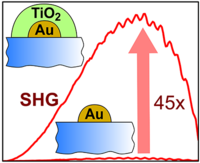
[Phys. Rev. Lett. 120, 113902] Published Thu Mar 15, 2018

Surface plasmon polaritons (SPPs) are extremely sensitive to the surrounding refractive index and have found important applications in ultrasensitive label-free sensing. Reducing the linewidth of an SPP mode is an effective way to improve the figure of merit (FOM) and hence the sensitivity of the plasmonic mode. Many efforts have been devoted to achieving a narrow linewidth by mode coupling, which inevitably results in an asymmetrical lineshape compromising the performance. Instead, the SPP modes are directly narrowed by elaborately engineering periodic plasmonic structures with minimized feature sizes to effectively reduce the radiative losses. A narrow linewidth smaller than 8 nm is achieved over a wide wavelength ranging from 600 to 960 nm and a minimum full width at half maximum of 3 nm at 960 nm. Benefiting from the almost perfect Lorentzian lineshape and the extremely narrow linewidth, a record FOM value of 730 is obtained. The sensor is capable of detecting bovine serum albumin with an ultralow concentration of 10−10m. The sensor has great potential for practical application for its ultrahigh FOM, broad working wavelength, and ease of high-throughput fabrication.

A plasmonic array with linewidth down to 3 nm is reported, which benefits from the nearly completely suppressed metal losses. The array shows an ultrahigh sensitivity, with a record figure of merit of 730 for the bulk sensing. The array can work over a broad wavelength from 600 to 960 nm and can be fabricated with a low cost.
Author(s): Jing Chen, Song Cheng, Haidong Xie, Lei Wang, and Tao Xiang
The restricted Boltzmann machine is a fundamental building block of deep learning. The authors demonstrate its equivalence with tensor network states with explicit mappings, thus drawing a constructive connection between deep learning and quantum physics. On one side, deep learning approaches can be used to study novel states of matter. In return, investigations of tensor network states and their expressibility can be adapted to guide neural network architecture design.

[Phys. Rev. B 97, 085104] Published Fri Feb 02, 2018
We report here chiroptical amplification effect occurring in the hybrid systems consisting of chiral molecules and Si nanostructures. Under resonant excitation of circularly polarized light, the hybrid systems show strong CD induction signals at optical frequency, which arise from both the electric and magnetic responses of the Si nanostructures. More interestingly, the induced CD signals from Si-based dielectric nanoantennas are always larger than that from Au-based plasmonic counterparts. The related physical origin was disclosed. Furthermore, compared to the Au-based high-loss plasmonic nanoantenas, Si-based low-loss structures would generate negligible photothermal effect, which makes Si nanoantennas become an optimized candidate to amplify molecular CD signals with ultralow thermal damages. Our findings may provide a guideline for the design of novel chiral nanosensors for applications in the fields of biomedicine and pharmaceutics.
We present a rigorous finite element method to calculate circular dichroism (CD) in various systems consisting of nanostructures and oriented chiral molecules with electric quadrupole transitions. The interaction between oriented molecule materials, which are regarded as anisotropic chiral media, and metallic nanostructures has been investigated. Our results show that the plasmon-induced CD is sensitive to the orientations of the molecules. In many cases, the contribution of molecular electric quadrupole transitions to the total CD signal can play a key role. More interesting, we have demonstrated that both the quadrupole- and dipole-based CD signals can be improved greatly by matching the phases for the electromagnetic fields and their gradients at different regions around the nanostructures, which are occupied by the oriented chiral molecules. Different regions might produce CD of opposite sign. When integrating over regions with only one side of the proposed nanostructure, we find that the CD-peak may be nearly hundreds-fold over the case of integrating both sides. We believe that these findings would be helpful for realizing ultrasensitive probing of chiral information for oriented molecules by plasmon-based nanotechnology.
In this work we describe different types of photonic structures that allow tunability of the photonic band gap upon the application of external stimuli, as the electric or magnetic field. We review and compare two porous 1D photonic crystals: in the first one a liquid crystal has been infiltrated in the pores of the nanoparticle network, while in the second one the optical response to the electric field of metallic nanoparticles has been exploited. Then, we present a 1D photonic crystal made with indium tin oxide (ITO) nanoparticles, and we propose this system for electro-optic tuning. Finally, we describe a microcavity with a defect mode that is tuned in the near infrared by the magnetic field, envisaging a contact-less magneto-optic switch. These optical switches can find applications in ICT and electrochromic windows.
VAMPnets for deep learning of molecular kinetics
VAMPnets for deep learning of molecular kinetics, Published online: 02 January 2018; doi:10.1038/s41467-017-02388-1
Extracting kinetic models from high-throughput molecular dynamics (MD) simulations is laborious and prone to human error. Here the authors introduce a deep learning framework that automates construction of Markov state models from MD simulation data.Highly doped semiconductors (HDSCs) are promising candidates for plasmonic applications in the mid-infrared (MIR) spectral range. This work examines a recent addition to the HDSC family, the dilute nitride alloy In(AsN). Postgrowth hydrogenation of In(AsN) creates a highly conducting channel near the surface and a surface plasmon polariton detected by attenuated total reflection techniques. The suppression of plasmonic effects following a photoannealing of the semiconductor is attributed to the dissociation of the N![[BOND]](http://onlinelibrarystatic.wiley.com/undisplayable_characters/00f8ff.gif) H bond. This offers new routes for direct patterning of MIR plasmonic structures by laser writing.
H bond. This offers new routes for direct patterning of MIR plasmonic structures by laser writing.

Mid-infrared surface plasmon polaritons are created in the highly H-doped In(AsN) semiconductor. The spatial modulation of the plasmon resonance is achieved by laser writing: the photon excitation tailors the chemical composition of the semiconductor by dissociation of the NH bond, thus offering a new route for plasmonic patterning in the mid-infrared spectral range.

No-limit Texas hold’em is the most popular form of poker. Despite AI successes in perfect-information games, the private information and massive game tree have made no-limit poker difficult to tackle. We present Libratus, an AI that, in a 120,000-hand competition, defeated four top human specialist professionals in heads-up no-limit Texas hold’em, the leading benchmark and long-standing challenge problem in imperfect-information game solving. Our game-theoretic approach features application-independent techniques: an algorithm for computing a blueprint for the overall strategy, an algorithm that fleshes out the details of the strategy for subgames that are reached during play, and a self-improver algorithm that fixes potential weaknesses that opponents have identified in the blueprint strategy.
I give an exact but deconstructed version of the second-order wave-like equation that encapsulates the hydrodynamic model for plasmonics. Comprising two first order equations, the deconstruction has potential uses in understanding or interpreting the hydrodynamic model, since its meaning is not obscured by approximation. However, as the physical interpretation of the deconstructed model is difficult, due to the choice of the polarization as the significant quantity, I also consider a alternate model based on the polarization current. This alternate model has a clear and direct physical interpretation.
Subwavelength, high–refractive index semiconductor nanostructures support optical resonances that endow them with valuable antenna functions. Control over the intrinsic properties, including their complex refractive index, size, and geometry, has been used to manipulate fundamental light absorption, scattering, and emission processes in nanostructured optoelectronic devices. In this study, we harness the electric and magnetic resonances of such antennas to achieve a very strong dependence of the optical properties on the external environment. Specifically, we illustrate how the resonant scattering wavelength of single silicon nanowires is tunable across the entire visible spectrum by simply moving the height of the nanowires above a metallic mirror. We apply this concept by using a nanoelectromechanical platform to demonstrate active tuning.


Chiral light-matter interactions have been investigated for two centuries, leading to the discovery of many chiroptical processes used for discrimination of enantiomers. Whereas most chiroptical effects result from a response of bound electrons, photoionization can produce much stronger chiral signals that manifest as asymmetries in the angular distribution of the photoelectrons along the light-propagation axis. We implemented self-referenced attosecond photoelectron interferometry to measure the temporal profile of the forward and backward electron wave packets emitted upon photoionization of camphor by circularly polarized laser pulses. We measured a delay between electrons ejected forward and backward, which depends on the ejection angle and reaches 24 attoseconds. The asymmetric temporal shape of electron wave packets emitted through an autoionizing state further reveals the chiral character of strongly correlated electronic dynamics.
The paper overviews our recent work on the synthesis of metasurfaces and related concepts and applications. The synthesis is based on generalized sheet transition conditions (GSTCs) with a bianisotropic surface susceptibility tensor model of the metasurface structure. We first place metasurfaces in a proper historical context and describe the GSTC technique with some fundamental susceptibility tensor considerations. Upon this basis, we next provide an in-depth development of our susceptibility-GSTC synthesis technique. Finally, we present five recent metasurface concepts and applications, which cover the topics of birefringent transformations, bianisotropic refraction, light emission enhancement, remote spatial processing and nonlinear second-harmonic generation.
In this paper, we have derived planar multilayer dyadic Greens functions by Fourier expansion method and have checked its correctness by comparing results for reflected electric fields from dipole emissions near such structures available in previous literature. Furthermore, we show how these dyadic Greens functions can be applied to calculate reflected fields from a dipole source with arbitrary orientations. We believe our formulation will be powerful in the modeling of molecular fluorescence near these structures.

