31 Oct 11:49
by Jianchen Lu, Zilin Ruan, Yurou Guan, De-Liang Bao, Xiao Lin, Zhenliang Hao, Hui Zhang, Lingling Song, Cuixia Yan, Jinming Cai, Shixuan Du, Hong-Jun Gao

The Journal of Physical Chemistry C
DOI: 10.1021/acs.jpcc.8b08964

31 Oct 11:48
by Y. Yang, A. C. Reber, S. E. Gilliland , III, C. E. Castano, B. F. Gupton, S. N. Khanna

The Journal of Physical Chemistry C
DOI: 10.1021/acs.jpcc.8b07538

04 Jul 13:45
by Mukesh Tripathi, Andreas Mittelberger, Nicholas A. Pike, Clemens Mangler, Jannik C. Meyer, Matthieu J. Verstraete, Jani Kotakoski, Toma Susi

Nano Letters
DOI: 10.1021/acs.nanolett.8b02406

02 Jul 07:53
by Yuta Tsuji, Kazunari Yoshizawa

The Journal of Physical Chemistry C
DOI: 10.1021/acs.jpcc.8b03184

08 May 13:01
by C. Hogan, O. Pulci, P. Gori, F. Bechstedt, D. S. Martin, E. E. Barritt, A. Curcella, G. Prevot, and Y. Borensztein
Author(s): C. Hogan, O. Pulci, P. Gori, F. Bechstedt, D. S. Martin, E. E. Barritt, A. Curcella, G. Prevot, and Y. Borensztein
Silver is a popular choice of substrate for the growth of nanostructured 1D and 2D silicon – possibly silicenelike – layers. First-principles simulations and measurements of reflectance anisotropy and surface differential reflectivity spectroscopy are applied to the study of single monolayer Si/Ag(111) and Si/Ag(110) interfaces. The authors demonstrate the absence of structural and electronic properties of freestanding, graphenelike silicene, finding evidence for strong Si-Ag bonding in the Si/Ag(111) case and the formation of pentagonal nanoribbons on Si/Ag(110). Many-body effects in the optical response of silicene are found to cancel out.
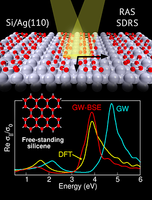
[Phys. Rev. B 97, 195407] Published Mon May 07, 2018
04 May 07:54
by Ch. Zaum, K. M. Meyer-auf-der-Heide, and K. Morgenstern
Author(s): Ch. Zaum, K. M. Meyer-auf-der-Heide, and K. Morgenstern
We follow the diffusion of CO molecules on Cu(111) by time-lapsed low-temperature scanning tunneling microscopy. The diffusivity of individual CO molecules oscillates with the distance to its nearest neighbor due to the long-range interaction mediated by the surface state electrons. The markedly dif...
[Phys. Rev. B 97, 155437] Published Mon Apr 30, 2018
04 May 07:53
Chem. Commun., 2018, 54,5381-5384
DOI: 10.1039/C8CC03145B, Communication
Allison M. Bergmann, Adam M. Oldham, Wei You, M. Kevin Brown
A method for the Cu-catalyzed cross-coupling of both aryl and alkylboranes with aryl bromides is described.
The content of this RSS Feed (c) The Royal Society of Chemistry

04 May 07:51
by Yvonne Dorenkamp, Christian Volkmann, Vladimir Roddatis, Sven Schneider, Alec M. Wodtke, Oliver Bünermann

The Journal of Physical Chemistry C
DOI: 10.1021/acs.jpcc.8b02692

02 May 11:58
Chem. Commun., 2018, 54,5809-5818
DOI: 10.1039/C8CC01553H, Feature Article
Manoj K. Manna, Siamak Shokri, Gary P. Wiederrecht, David J. Gosztola, A. Jean-Luc Ayitou
Tuning the structural complementarities of organic donor and accepter chromophores for photonic amplification.
The content of this RSS Feed (c) The Royal Society of Chemistry

02 May 11:58
Chem. Commun., 2018, 54,5546-5549
DOI: 10.1039/C8CC02224K, Communication
Shih-Ting Chiu, Hsin-Yu Chiang, Yen-Jen Lin, Yun-Yung Lu, Hirofumi Tanaka, Takuya Hosokai, Masaki Horie
We report the STM and AFM images of cyclophane trienes and their ROMP products, presenting unique surface morphologies on HOPG.
The content of this RSS Feed (c) The Royal Society of Chemistry

02 May 11:58
Chem. Commun., 2018, 54,5574-5577
DOI: 10.1039/C8CC02371A, Communication
Caihong Zheng, Fangling Lu, Hanwei Lu, Jie Xin, Yi Deng, Dali Yang, Shengchun Wang, Zhiliang Huang, Meng Gao, Aiwen Lei
Oxidative radical-radical cross-coupling: a new protocol for C-S bond formation was developed by selective cross-coupling between a thiyl radical and an isobutyronitrile radical.
The content of this RSS Feed (c) The Royal Society of Chemistry

30 Apr 11:54
by Maëlis Piquemal-Banci, Regina Galceran, Florian Godel, Sabina Caneva, Marie-Blandine Martin, Robert S. Weatherup, Piran R. Kidambi, Karim Bouzehouane, Stephane Xavier, Abdelmadjid Anane, Frédéric Petroff, Albert Fert, Simon Mutien-Marie Dubois, Jean-Christophe Charlier, John Robertson, Stephan Hofmann, Bruno Dlubak, Pierre Seneor

ACS Nano
DOI: 10.1021/acsnano.8b01354

05 Sep 11:03
by Marco Carlotti, Maarten Degen, Yanxi Zhang and Ryan C. Chiechi

The Journal of Physical Chemistry C
DOI: 10.1021/acs.jpcc.6b07089

05 Sep 11:01
Chem. Commun., 2016, 52,11704-11707
DOI: 10.1039/C6CC06637B, Communication
Yuan Tian, Shun-Qi Xu, Cheng Qian, Zhong-Fu Pang, Guo-Fang Jiang, Xin Zhao
A strategy to construct covalent organic frameworks (COFs) bearing two different kinds of pores has been developed. The as-prepared dual-pore COFs exhibit good adsorption capacities for CO2 and H2.
The content of this RSS Feed (c) The Royal Society of Chemistry

31 Aug 14:48
by Dimas G. de Oteyza, Aran García-Lekue, Manuel Vilas-Varela, Néstor Merino-Díez, Eduard Carbonell-Sanromà, Martina Corso, Guillaume Vasseur, Celia Rogero, Enrique Guitián, Jose Ignacio Pascual, J. Enrique Ortega, Yutaka Wakayama and Diego Peña

ACS Nano
DOI: 10.1021/acsnano.6b05269

31 Aug 14:45
Chem. Commun., 2016, 52,11227-11230
DOI: 10.1039/C6CC04874A, Communication
B. Cirera, L. Dordevic, R. Otero, J. M. Gallego, D. Bonifazi, R. Miranda, D. Ecija
Tunability of cavity size and assembly motif of dysprosium-directed nanomeshes through ionic interactions.
The content of this RSS Feed (c) The Royal Society of Chemistry

31 Aug 14:44
Chem. Commun., 2016, 52,11465-11487
DOI: 10.1039/C6CC05256H, Feature Article
Joan Teyssandier, Steven De Feyter, Kunal S. Mali
In this feature article, we survey recent developments in host-guest chemistry studied in surface-adsorbed physisorbed supramolecular networks.
The content of this RSS Feed (c) The Royal Society of Chemistry

11 Jul 11:21
by Ke Zhu, Yaobiao Xia, Zhenrong Zhang and Kenneth Park

The Journal of Physical Chemistry C
DOI: 10.1021/acs.jpcc.6b04875

11 Jul 11:19
by Sebastian E. Reyes-Lillo, Tonatiuh Rangel, Fabien Bruneval, and Jeffrey B. Neaton
Author(s): Sebastian E. Reyes-Lillo, Tonatiuh Rangel, Fabien Bruneval, and Jeffrey B. Neaton
The Ruddlesden-Popper (RP) homologous series Srn+1TinO3n+1 provides a useful template for the study and control of the effects of dimensionality and quantum confinement on the excited state properties of the complex oxide SrTiO3. We use ab initio many-body perturbation theory within the GW approxima…
[Phys. Rev. B 94, 041107(R)] Published Fri Jul 08, 2016
15 Jun 23:16
by Lishu Liu, Zengxia Mei, Aihua Tang, Alexander Azarov, Andrej Kuznetsov, Qi-Kun Xue, and Xiaolong Du
Author(s): Lishu Liu, Zengxia Mei, Aihua Tang, Alexander Azarov, Andrej Kuznetsov, Qi-Kun Xue, and Xiaolong Du
Oxygen vacancy (VO) is a common native point defect that plays crucial roles in determining the physical and chemical properties of metal oxides such as ZnO. However, fundamental understanding of VO is still very sparse. Specifically, whether VO is mainly responsible for the n-type conductivity in Z…
[Phys. Rev. B 93, 235305] Published Wed Jun 15, 2016
15 Jun 23:15
by Andreas Krönlein, Jens Kügel, Konstantin A. Kokh, Oleg. E. Tereshchenko and Matthias Bode

The Journal of Physical Chemistry C
DOI: 10.1021/acs.jpcc.6b05177

13 Jun 21:08
Chem. Commun., 2016, 52,8726-8729
DOI: 10.1039/C6CC03137D, Communication
Ke Ji Shi, Xin Zhang, Chen Hui Shu, Deng Yuan Li, Xin Yan Wu, Pei Nian Liu
The efficiency of Ullmann reaction of aryl chlorides on an Au(111) surface has been substantially increased by using dosed Cu as a catalyst.
The content of this RSS Feed (c) The Royal Society of Chemistry

08 Jun 11:34
by Yuanjun Zhou and Andrew J. Millis
Author(s): Yuanjun Zhou and Andrew J. Millis
Monolayer films of FeSe grown on SrTiO3 substrates are electron doped relative to bulk and exhibit a significantly higher superconducting transition temperature. An interaction of electrons in the FeSe layer with SrTiO3 phonons has been suggested. We present density functional calculations and a mod…
[Phys. Rev. B 93, 224506] Published Mon Jun 06, 2016
06 Jun 17:14
by M. Ormaza, L. Fernández, M. Ilyn, A. Magaña, B. Xu, M. J. Verstraete, M. Gastaldo, M. A. Valbuena, P. Gargiani, A. Mugarza, A. Ayuela, L. Vitali, M. Blanco-Rey, F. Schiller and J. E. Ortega

Nano Letters
DOI: 10.1021/acs.nanolett.6b01197

03 Jun 09:49
by Jun-Yi Ge, Vladimir N. Gladilin, Cun Xue, Jacques Tempere, Jozef T. Devreese, Joris Van de Vondel, Youhe Zhou, and Victor V. Moshchalkov
Author(s): Jun-Yi Ge, Vladimir N. Gladilin, Cun Xue, Jacques Tempere, Jozef T. Devreese, Joris Van de Vondel, Youhe Zhou, and Victor V. Moshchalkov
In a magnetic field, superconductivity is manifested by total magnetic field expulsion (Meissner effect) or by the penetration of integer multiples of the flux quantum Φ0. Here we present experimental results revealing magnetic dipoles formed by Meissner current flowing around artificially introduce…
[Phys. Rev. B 93, 224502] Published Thu Jun 02, 2016
02 Jun 13:25
by Christopher R. Ryder

Nature Chemistry 8, 597 (2016).
doi:10.1038/nchem.2505
Authors: Christopher R. Ryder, Joshua D. Wood, Spencer A. Wells, Yang Yang, Deep Jariwala, Tobin J. Marks, George C. Schatz & Mark C. Hersam
Few-layer black phosphorus (BP) is a promising semiconductor, but it is highly reactive and susceptible to ambient degradation. Covalent functionalization with aryl radicals has now been shown to significantly improve the stability of exfoliated BP, as well as the performance of BP-based electronic devices through a controllable p-type doping effect.

02 Jun 12:43
by K. Fukutani, T. Sato, P. V. Galiy, K. Sugawara, and T. Takahashi
Author(s): K. Fukutani, T. Sato, P. V. Galiy, K. Sugawara, and T. Takahashi
We report the discovery of two-dimensional electron gas (2DEG) at the surface of thermoelectric material In4Se3 by angle-resolved photoemission spectroscopy. The observed 2DEG exhibits a nearly isotropic band dispersion with a considerably small effective mass of m*=0.16 m0, and its carrier density …
[Phys. Rev. B 93, 205156] Published Tue May 31, 2016
20 May 16:26
by Azzedine Bendounan and Sonia Aït-Ouazzou

The Journal of Physical Chemistry C
DOI: 10.1021/acs.jpcc.6b00902

18 May 08:00
by Aparajita Singha, Fabio Donati, Christian Wäckerlin, Romana Baltic, Jan Dreiser, Marina Pivetta, Stefano Rusponi and Harald Brune

Nano Letters
DOI: 10.1021/acs.nanolett.5b05214

12 May 15:39
by Jens Baringhaus, Mikkel Settnes, Johannes Aprojanz, Stephen R. Power, Antti-Pekka Jauho, and Christoph Tegenkamp
Author(s): Jens Baringhaus, Mikkel Settnes, Johannes Aprojanz, Stephen R. Power, Antti-Pekka Jauho, and Christoph Tegenkamp
We realize nanometer size constrictions in ballistic graphene nanoribbons grown on sidewalls of SiC mesa structures. The high quality of our devices allows the observation of a number of electronic quantum interference phenomena. The transmissions of Fabry-Perot-like resonances are probed by in situ…
[Phys. Rev. Lett. 116, 186602] Published Thu May 05, 2016


