Shared posts

13 Sep 12:58

A Synthetic Route for Crystals of Woven Structures, Uniform Nanocrystals, and Thin Films of Imine Covalent Organic Frameworks

by Yingbo Zhao, Lei Guo, Felipe Gándara, Yanhang Ma, Zheng Liu, Chenhui Zhu, Hao Lyu, Christopher A. Trickett, Eugene A. Kapustin, Osamu Terasaki and Omar M. Yaghi

TOC Graphic

Journal of the American Chemical Society
DOI: 10.1021/jacs.7b07457
11 Sep 13:07

Supramolecular Sensors for Opiates and Their Metabolites

by Elena G. Shcherbakova, Ben Zhang, Samer Gozem, Tsuyoshi Minami, Peter Y. Zavalij, Mariia Pushina, Lyle D. Isaacs and Pavel Anzenbacher

TOC Graphic

Journal of the American Chemical Society
DOI: 10.1021/jacs.7b06371
04 Sep 07:08

Tuning Singlet Fission in π-Bridge-π Chromophores

by Elango Kumarasamy, Samuel N. Sanders, Murad J. Y. Tayebjee, Amir Asadpoordarvish, Timothy J. H. Hele, Eric G. Fuemmeler, Andrew B. Pun, Lauren M. Yablon, Jonathan Z. Low, Daniel W. Paley, Jacob C. Dean, Bonnie Choi, Gregory D. Scholes, Michael L. Steigerwald, Nandini Ananth, Dane R. McCamey, Matthew Y. Sfeir and Luis M. Campos

TOC Graphic

Journal of the American Chemical Society
DOI: 10.1021/jacs.7b05204
04 Sep 07:08

Mechanical-Bond-Protected, Air-Stable Radicals

by Junling Sun, Zhichang Liu, Wei-Guang Liu, Yilei Wu, Yuping Wang, Jonathan C. Barnes, Keith R. Hermann, William A. Goddard, Michael R. Wasielewski and J. Fraser Stoddart

TOC Graphic

Journal of the American Chemical Society
DOI: 10.1021/jacs.7b06857
31 Aug 15:03

The Rolling-Up of Oligophenylenes to Nanographenes by a HF-Zipping Approach

by Ann-Kristin Steiner, Konstantin Y Amsharov

Abstract

Intramolecular aryl–aryl coupling is the key transformation in the rational synthesis of nanographenes and nanoribbons. In this respect the C−F bond activation was shown to be a versatile alternative enabling the synthesis of several unique carbon-based nanostructures. Herein we describe an unprecedentedly challenging transformation showing that the C−F bond activation by aluminum oxide allows highly effective domino-like C−C bond formation. Despite the flexible nature of oligophenylene-based precursors efficient regioselective zipping to the target nanostructures was achieved. We show that fluorine positions in the precursor structure unambiguously dictate the “running of the zipping-program” which results in rolling-up of linear oligophenylene chains around phenyl moieties yielding target nanographenes. The high efficiency of zipping makes this approach attractive for the synthesis of unsubstituted nanographenes which are difficult to obtain in pure form by other methods.

Thumbnail image of graphical abstract

Roll up, roll up: Virtually linear fluorinated oligophenylenes are converted into the “preprogrammed” challenging nanographenes via effective domino-like aryl–aryl coupling. The fluorine positions in the precursor structure unambiguously dictate the running of the “HF-zipping-program” leading to the formation of the target nanographene structure.

31 Aug 12:49

Photoswitchable molecules as key ingredients to drive systems away from the global thermodynamic minimum

Chem. Soc. Rev., 2017, 46,5536-5550
DOI: 10.1039/C7CS00112F, Review Article
Michael Kathan, Stefan Hecht
We highlight the unique features of photodynamic equilibria that drive chemical reactions and transport, structure formation and molecular motion.
The content of this RSS Feed (c) The Royal Society of Chemistry
31 Aug 07:59

Redox Control over Acyl Hydrazone Photoswitches

by Ivica Cvrtila, Hugo Fanlo-Virgós, Gaël Schaeffer, Guillermo Monreal Santiago and Sijbren Otto

TOC Graphic

Journal of the American Chemical Society
DOI: 10.1021/jacs.7b03724
30 Aug 13:01

First hyperpolarizabilities of Pt(4-ethynylbenzo-15-crown-5)2(bpy) derivatives with the complexation of mono-cations (Li+, Na+, K+) and di-cations (Mg2+, Ca2+): development of a cation detector

RSC Adv., 2017, 7,41830-41837
DOI: 10.1039/C7RA04919F, Paper
Open Access Open Access
Creative Commons Licence&nbsp This article is licensed under a Creative Commons Attribution 3.0 Unported Licence.
Hai-Ling Yu, Wen-Yong Wang, Bo Hong, Yan-Ling Si, Tian-Liang Ma, Ran Zheng
The coordination of mono-cations and di-cations onto the crown merits the design of the NLO-based cation detector.
The content of this RSS Feed (c) The Royal Society of Chemistry
29 Aug 07:26

Enantioselective Anion Recognition by Chiral Halogen-Bonding [2]Rotaxanes

by Jason Y. C. Lim, Igor Marques, Vítor Félix and Paul D. Beer

TOC Graphic

Journal of the American Chemical Society
DOI: 10.1021/jacs.7b06144
25 Aug 08:05

Porphyrin Antennas on Carbon Nanodots: Excited State Energy and Electron Transduction

Porphyrin Antennas on Carbon Nanodots: Excited State Energy and Electron Transduction

Antennas up! The synthesis and electron donor–acceptor features of a novel hybrid nanomaterial are reported. The nanohybrid combines the light-harvesting and electron-donating properties of a meso-tetraarylporphyrin (TArP) with the electron-accepting features of nitrogen-doped carbon nanodots (NCNDs).

[Communication]
Francesca Arcudi, Volker Strauss, Luka Đorđević, Alejandro Cadranel, Dirk M. Guldi, Maurizio Prato
Angew. Chem. Int. Ed., August 24, 2017, https://doi.org/10.1002/anie.201704544 Read article

23 Aug 13:11

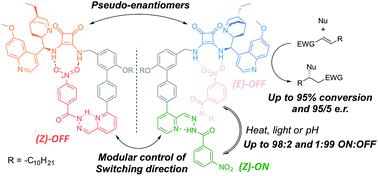
A complementary pair of enantioselective switchable organocatalysts

Chem. Sci., 2017, 8,7077-7081
DOI: 10.1039/C7SC02462B, Edge Article
Open Access Open Access
Creative Commons Licence&nbsp This article is licensed under a Creative Commons Attribution 3.0 Unported Licence.
Guillaume De Bo, David A. Leigh, Charlie T. McTernan, Shoufeng Wang
A pair of enantioselective switchable bifunctional catalysts are shown to promote a range of conjugate addition reactions in up to 95 : 5 e.r. and 95% conversion.
The content of this RSS Feed (c) The Royal Society of Chemistry
23 Aug 09:33

Fulleretic Materials: Buckyball- and Buckybowl-Based Crystalline Frameworks

by Allison M. Rice, Ekaterina A. Dolgopolova and Natalia B. Shustova

TOC Graphic

Chemistry of Materials
DOI: 10.1021/acs.chemmater.7b02245
23 Aug 08:15

Spectrally Switchable Photodetection with Near-Infrared-Absorbing Covalent Organic Frameworks

by Derya Bessinger, Laura Ascherl, Florian Auras and Thomas Bein

TOC Graphic

Journal of the American Chemical Society
DOI: 10.1021/jacs.7b06599
21 Aug 16:02

Signal transduction in a covalent post-assembly modification cascade

by Ben S. Pilgrim

Nature Chemistry. doi:10.1038/nchem.2839

Authors: Ben S. Pilgrim, Derrick A. Roberts, Thorsten G. Lohr, Tanya K. Ronson & Jonathan R. Nitschke

Two coordination cages have been devised that undergo covalent modification during a cascade of two orthogonal Diels–Alder reactions. This results in increased lipophilicity for the second cage, enabling its phase transfer and separation from the first. The trigger, relay and inhibition features of this cascade system mimic key aspects of natural post-translational modification cascades.

21 Aug 16:02

Dynamic covalent chemistry enables formation of antimicrobial peptide quaternary assemblies in a completely abiotic manner

by James F. Reuther

Nature Chemistry. doi:10.1038/nchem.2847

Authors: James F. Reuther, Justine L. Dees, Igor V. Kolesnichenko, Erik T. Hernandez, Dmitri V. Ukraintsev, Rusheel Guduru, Marvin Whiteley & Eric V. Anslyn

Despite advances in peptide synthesis techniques, explicit control over the quaternary structure of synthetic peptides has remained elusive. Now, the dynamic covalent chemistry of hydrazide- and aldehyde-containing peptides has now been shown to enable the formation of unique quaternary structures with topological diversity. Using this method, oligomers were assembled into complex structures showing dramatic enhancements of antimicrobial effectiveness versus Staphylococcus Aureus.

17 Aug 12:27

Highly Efficient Chemiluminescence Probe for the Detection of Singlet Oxygen in Living Cells

Highly Efficient Chemiluminescence Probe for the Detection of Singlet Oxygen in Living Cells

Illuminating singlet oxygen: A chemiluminescence probe for singlet oxygen based on dioxetane formation is described. The dioxetane decomposes by a highly efficient chemiexcitation process to emit green light. The probe was used to detect and image intracellular 1O2 produced by a photosensitizer in HeLa cells during photodynamic therapy.

[Communication]
Nir Hananya, Ori Green, Rachel Blau, Ronit Satchi-Fainaro, Doron Shabat
Angew. Chem. Int. Ed., August 16, 2017, https://doi.org/10.1002/anie.201705803 Read article

16 Aug 10:47

Hydrogen-bonded rosettes comprising [small pi]-conjugated systems as building blocks for functional one-dimensional assemblies

Chem. Commun., 2017, 53,9663-9683
DOI: 10.1039/C7CC04172A, Feature Article
Bimalendu Adhikari, Xu Lin, Mitsuaki Yamauchi, Hayato Ouchi, Keisuke Aratsu, Shiki Yagai
One-dimensional nanoassemblies obtained by the columnar stacking of hydrogen-bonded supermacrocycles (rosettes) comprising [small pi]-conjugated molecules.
The content of this RSS Feed (c) The Royal Society of Chemistry
16 Aug 10:10

Rigid, Branched Porphyrin Antennas: Control over Cascades of Unidirectional Energy Funneling and Charge Transfer

by Maximilian Wolf, Astrid Herrmann, Andreas Hirsch and Dirk M. Guldi

TOC Graphic

Journal of the American Chemical Society
DOI: 10.1021/jacs.7b04589
16 Aug 09:56

Enzyme-Mediated Directional Transport of a Small-Molecule Walker With Chemically Identical Feet

by Christopher J. Martin, Alan T. L. Lee, Ralph W. Adams and David A. Leigh

TOC Graphic

Journal of the American Chemical Society
DOI: 10.1021/jacs.7b06503
14 Aug 07:24

Annulative π-Extension (APEX): Rapid Access to Fused Arenes, Heteroarenes, and Nanographenes

Annulative π‐Extension (APEX): Rapid Access to Fused Arenes, Heteroarenes, and Nanographenes

Tip top: The annulative π-extension (APEX) reaction has the potential to have a tremendous impact on the fields of materials science and pharmaceutical/agrochemical industries, since it can access fused aromatic systems from relatively simple aromatic compounds in a single step. In this Review, the progress and applications of APEX reactions to form unfunctionalized arenes, heteroarenes, and nanographenes are described.

[Review]
Hideto Ito, Kyohei Ozaki, Kenichiro Itami
Angew. Chem. Int. Ed., August 10, 2017, https://doi.org/10.1002/anie.201701058 Read article

09 Aug 13:32

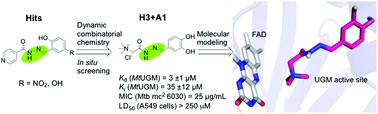
Identification of inhibitors targeting Mycobacterium tuberculosis cell wall biosynthesis via dynamic combinatorial chemistry

Chem. Commun., 2017, 53,10632-10635
DOI: 10.1039/C7CC05251K, Communication
Jian Fu, Huixiao Fu, Marc Dieu, Iman Halloum, Laurent Kremer, Yufen Xia, Weidong Pan, Stephane P. Vincent
In this study, we report a dynamic combinatorial approach along with highly efficient in situ screening to identify inhibitors of UDP-galactopyranose mutase (UGM), an essential enzyme involved in mycobacterial cell wall biosynthesis.
The content of this RSS Feed (c) The Royal Society of Chemistry
09 Aug 09:50

Functional Mechanically Interlocked Molecules: Asymmetric Organocatalysis with a Catenated Bifunctional Brønsted Acid

by Raja Mitra, Hui Zhu, Stefan Grimme, Jochen Niemeyer
Thumbnail image of graphical abstract

A catenane-based organocatalyst shows excellent stereoselectivity in the transfer hydrogenation of quinolines. In their Communication (DOI: 10.1002/anie.201704647), J. Niemeyer and co-workers report the first application of a catenane catalyst in asymmetric catalysis. The bifunctional catenane shows superior stereoselectivity in comparison to its non-interlocked analogues. DFT calculations indicate involvement of both catalytically active groups as the reason for the high stereoselectivity.

09 Aug 06:10

Noninvasive Substitution of K+ Sites in Cyclodextrin Metal–Organic Frameworks by Li+ Ions

by Hasmukh A. Patel, Timur Islamoglu, Zhichang Liu, Siva Krishna Mohan Nalluri, Avik Samanta, Ommid Anamimoghadam, Christos D. Malliakas, Omar K. Farha and J. Fraser Stoddart

TOC Graphic

Journal of the American Chemical Society
DOI: 10.1021/jacs.7b06287
08 Aug 16:31

Anaerobic Origin of Ergothioneine

by Reto Burn, Laetitia Misson, Marcel Meury, Florian P. Seebeck

Abstract

Ergothioneine is a sulfur metabolite that occurs in microorganisms, fungi, plants, and animals. The physiological function of ergothioneine is not clear. In recent years broad scientific consensus has formed around the idea that cellular ergothioneine primarily protects against reactive oxygen species. Herein we provide evidence that this focus on oxygen chemistry may be too narrow. We describe two enzymes from the strictly anaerobic green sulfur bacterium Chlorobium limicola that mediate oxygen-independent biosynthesis of ergothioneine. This anoxic origin suggests that ergothioneine is also important for oxygen-independent life. Furthermore, one of the discovered ergothioneine biosynthetic enzymes provides the first example of a rhodanese-like enzyme that transfers sulfur to non-activated carbon.

Thumbnail image of graphical abstract

Without oxygen: The sulfur metabolite ergothioneine is a ubiquitous scavenger of reactive oxygen species. Discovery of ergothioneine production in strictly anaerobic bacteria and archaea suggests that ergothioneine is also important for anoxic life.

07 Aug 10:18

Unexpected formation of [5]helicenes from hexaarylbenzenes containing pyrrole moieties

Org. Chem. Front., 2017, 4,861-870
DOI: 10.1039/C7QO00112F, Research Article
Felix Ammon, Stephanie Theresia Sauer, Rainer Lippert, Dominik Lungerich, David Reger, Frank Hampel, Norbert Jux
Surprisingly helical: a pyrrolic [5]helicene embedded into a six-membered ring framework is preferred over a heterocyclic pendant of hexabenzocoronene.
The content of this RSS Feed (c) The Royal Society of Chemistry
07 Aug 06:54

Fabrication and Postmodification of Nanoporous Liquid Crystalline Networks via Dynamic Covalent Chemistry

by Dirk J. Mulder, Luc M. W. Scheres, Jingjin Dong, Giuseppe Portale, Dirk J. Broer and Albertus P. H. J. Schenning

TOC Graphic

Chemistry of Materials
DOI: 10.1021/acs.chemmater.7b01334
04 Aug 14:06

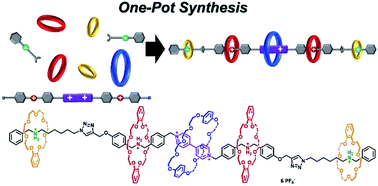
One-pot synthesis of hetero[6]rotaxane bearing three different kinds of macrocycle through a self-sorting process

Chem. Sci., 2017, 8,6777-6783
DOI: 10.1039/C7SC03232C, Edge Article
Open Access Open Access
Creative Commons Licence&nbsp This article is licensed under a Creative Commons Attribution 3.0 Unported Licence.
Si-Jia Rao, Qi Zhang, Ju Mei, Xu-Hao Ye, Chuan Gao, Qiao-Chun Wang, Da-Hui Qu, He Tian
A hetero[6]rotaxane bearing three different kinds of macrocycle is designed and successfully synthesized through a one-pot "click" reaction by employing a facile and efficient integrative self-sorting principle.
The content of this RSS Feed (c) The Royal Society of Chemistry
04 Aug 11:38

Thiosemicarbazone Dynamic Combinatorial Chemistry: Equilibrator-Induced Dynamic State, Formation of Complex Libraries, and a Supramolecular On/Off Switch

by Dennis Larsen, Anne Jeppesen, Claudia Kleinlein and Michael Pittelkow

TOC Graphic

The Journal of Organic Chemistry
DOI: 10.1021/acs.joc.7b01161
04 Aug 10:55

Ultrastretchable, Self-Healable Hydrogels Based on Dynamic Covalent Bonding and Triblock Copolymer Micellization

by Peng Wang, Guohua Deng, Lanying Zhou, Zhiyong Li and Yongming Chen

TOC Graphic

ACS Macro Letters
DOI: 10.1021/acsmacrolett.7b00519
03 Aug 15:28

Orthogonal switching of self-sorting processes in a stimuli-responsive library of cucurbit[8]uril complexes

Chem. Commun., 2017, 53,9546-9549
DOI: 10.1039/C7CC05469F, Communication
Stefan Schoder, Christoph A. Schalley
The self-sorting processes in dynamic libraries of cucurbit[8]uril complexes can be switched orthogonally by pH and redox stimuli.
The content of this RSS Feed (c) The Royal Society of Chemistry