
Pokemon Go’s Hidden Pikachu. Source
 The arrival of both the SNES-CD prototype hardware and accompanying BIOS files have amazed countless retro gamers within the community, but more importantly inspired homebrew developers too. While very little appears to be known regarding the true power and capabilities of the unreleased hardware, that hasn’t stopped a team of Super Nintendo programmers from tapping into it.
We like the idea of plug-and-play retro consoles on principle, but they can really be a mixed bag sometimes. What looks like an excellent deal often turns out to be slightly underwhelming due to poor video output, dodgy hardware or a lack of the games you loved as a kid.
The Nintendo Classic Mini: Nintendo Entertainment System looks like it might just sidestep the problems that other such devices have had when it arrives on 11th November this year. The dinky unit features 30 built-in games, removable NES controllers (which can also connect to your Wii/Wii U for Virtual Console games), HDMI output, and it’s all powered by USB. It’ll cost $60 in North America, with a UK price to be determined.
However, what’s really impressive is the line-up of games Nintendo has managed to secure for the device. Rather than relying solely on its own excellent back catalogue, the company has licensed a wide range of third-party NES hits to ensure that your favourites are included. Here’s the full list:
Given the price and range of games, as well as the pre-Christmas timing, we reckon this could go down a storm if the hardware’s up to scratch – particularly in North America, where the NES was the undisputed king of consoles.

 Nintendo is releasing a new console this November, and it's not the NX. It's not exactly new either. The company is launching the Nintendo Entertainment System: NES Classic Edition on November 11th for $59.99 USD that will plug right into an HDMI port. The system will include over 30 games, two of which are The Legend of Zelda, and Zelda II: The Adventure of Link. If you would like to play in two-player mode for some of the games listed below, don't worry...
Nintendo has announced that it will be releasing an official Mini NES system this November.

"The classic NES is back in a familiar-yet-new form as a mini replica of Nintendo’s original home console. Plugging directly into a high-definition TV using the included HDMI cable, the console comes complete with 30 NES games built-in.
The Nintendo Classic Mini: Nintendo Entertainment System comes packaged with an HDMI cable, a USB cable for powering the system, and one Nintendo Classic Mini: NES Controller.
Players can even enjoy playing many of these games together by attaching a second Nintendo Classic Mini: NES Controller, sold separately. A Classic Controller or Classic Controller Pro for the Wii console can also be used. The Nintendo Classic Mini: NES Controller can also be used to play Virtual Console NES games on a Wii U or Wii console."

The 30 games that come built-in are as follows:
The Mini NES launches on November 11th in North America and Europe.
Full Article - http://www.vgchartz.com/article/265065/nintendo-announces-mini-nes-system-for-the-holidays/
For quite some time, whenever someone wanted to make a generalized statement about how popular mobile gaming is, he would use Candy Crash Saga as the example, and that made sense given the game's 20 million peak active users in the US. However, there's a new kid in town now, Pokemon GO [Free], and according to this Surveymonkey data, it has just surpassed Candy Crash Saga to claim the US mobile gaming throne and officially become the biggest mobile game in US history. The game now haz 21 million active daily users, so it's handily beating games like Clash Royale, Slither.io, and pretty much everything else around. And the game hasn't been out in the States for that long either, so we've definitely not reached peak Pokemon GO.
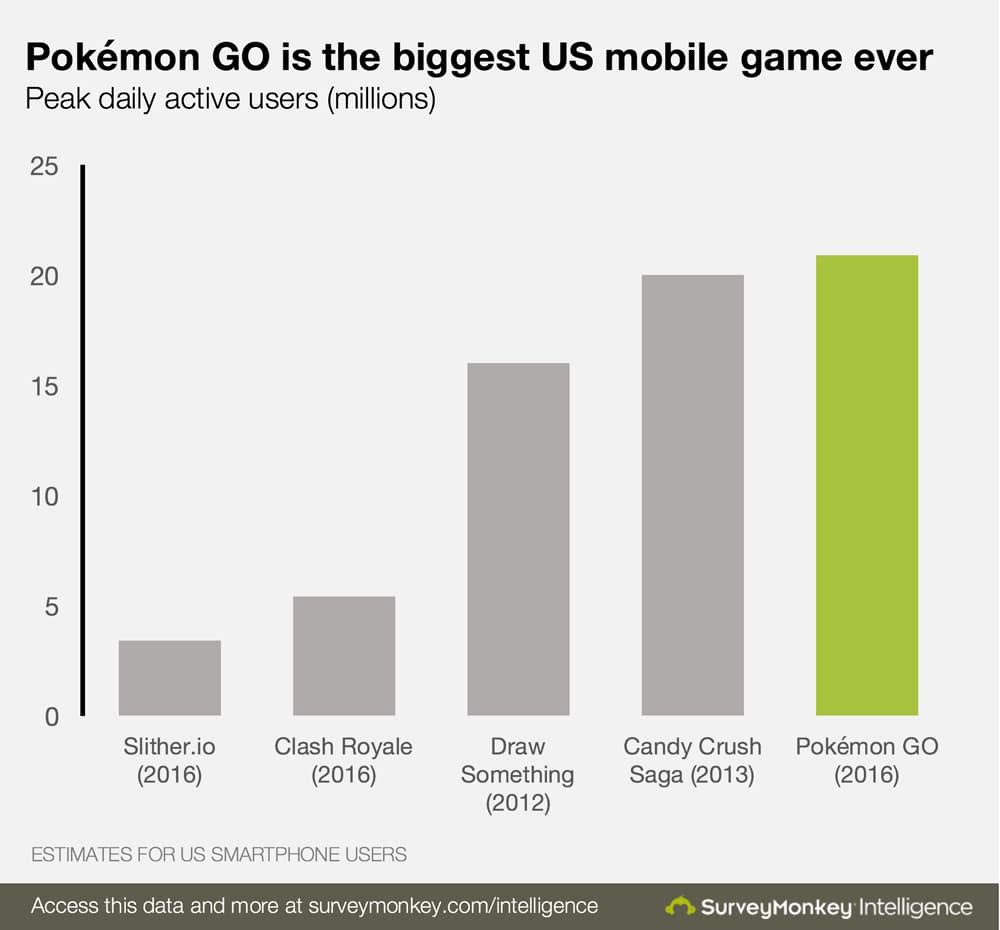
Speaking of growing, SurveyMonkey estimates that Pokemon GO is on track to beat Snapchat in terms of active daily users on Android devices and will also beat Google Maps' active users on that platform. And this whole phenomenon is still snowballing because the more companies see Pokemon GO's popularity, the more they want to take advantage of it, and the more they take advantage of its popularity, the more popular it will get. So strap in guys and girls, we've yet to see the crest of this Pokemon GO wave.
Update #2: Now Italy, Spain, and Portugal can try to catch 'em all!
Update: The game is now out in the United Kingdom. Go get 'em, friends.
It's been a grueling few days for anyone living in Europe. We have had to sit back and watch as our friends from America, Australia and New Zealand have been catching Pokemon left, right and center while Pokemon GO [Free] remains unavailable to play outside of these areas. Thankfully, the wait appears to be coming to an end, as Pokemon GO has begun its rollout (no pun intended) in Europe, and has this morning launched in Germany. Based on what Nintendo and Niantic have been suggesting, the game should appear in other European countries in a few days, however a slow spread of Pokemon is most likely as the developers make sure the servers don't capitulate under the vast number of players as they did after the North American launch. Regardless, any German Pokemon trainers should spare no time in catching 'em all and claiming the gyms while the rest of us wait.
Despite this being the 'official' launch of Pokemon GO within European territories, it has by no means stopped people from playing the game through more subversive means. Whether it's from an Android APK or through using an iTunes account from the US or New Zealand (for anyone still waiting, here is our soft launch guide on how to do so), Pokemon GO has already become a massive hit in European territories and has permeated massively into the mainstream media. Here's hoping that the phenomenon doesn't lead to Germany becoming divided again into regions of Team Mystic, Valor and Instinct - remember that we're all on the same Pokemon loving team at the end of the day. For anyone who is just downloading Pokemon GO, check out our guide to finding PokeStops and Gyms, and share your hints, tips and views on our forums.
While I've been doing research for my History of Video Games series I've also had the chance to see the rise and fall of countless video game publishers, developers, franchises, and creators who at one point or another were at the top of the video game industry. They had the eyes of the industry on them looking to see what great things they would do next, only to fall flat on their faces trying to replicate former glory. It's often a fascinating journey to watch unfold, and today we're going to count down ten of the most memorable ones.
Some of the entries below are certainly still around - some even have managed to find success after falling flat - but they are far from the heights that they once reached by creating some of the greatest games and platforms in video game history. Looking at critical reception, commercial success, and general perception by the public, the following ten entries are some of the most spectacular falls from grace in our industry.
10. LucasArts

Between 1987 and 1998 LucasArts created some of the greatest adventure games of all time, from Maniac Mansion in 1987 all the way to 1998's Grim Fandango. Following the release of these and other games (like Secret of Monkey Island, Sam & Max Hit the Road, and Full Throttle), LucasArts was arguably the best developer in the world when it came to adventure titles. However, after 1998 things began to change.
Between 1998 and 2014 LucasArts developed 75 games for various platforms. Of those 75, 59 were based on Star Wars, and of the remaining 16 five were based on Indiana Jones. That's 64 out of 75 games. Not exactly a very good track record for a company that once developed some of the most imaginative original games of all time. Things got even worse when the company was acquired by Disney in 2012.

In 2013 it was announced that LucasArts would cease all internal development of games, and became just a licensor for its existing properties. This meant that all of the games that were in development at the time were cancelled and around 150 employees were let go as a result. Today, less than 10 people remain within the company that was once among the best developers in the world.
9. John Romero

John Romero was at one point in the 90s quite possibly the most famous video game creator in the world. He was one of the main driving forces behind the popularization of first person shooters in the early 90s, thanks to his work on games like Wolfenstein 3D, Doom, and Quake. He was the rock star of video game world at the time, and rode a wave of momentum generated by his role in producing some of the most influential games of all time into huge levels of hype and goodwill for his first game after leaving iD Software and founding Ion Storm.

That game was Daikatana, one of the biggest commercial failures in video game history, and a product of an endless string of poor decisions that ultimately made Romero something of an unwanted developer in the industry. Since then he hasn't done much of note, although he is currently in the process of trying to get funding for a new FPS called Blacklight through Kickstarter.
8. Silent Hill

One of the greatest and most influential horror video game series ever created, Silent Hill has certainly seen better days. Starting in 1999 on the PS1 Silent Hill quickly earned both critical acclaim and commercial success which continued with both Silent Hill 2 and 3, with Silent Hill 4: The Room being in many ways the point at which the series lost its way. After this 4th game the series went on hiatus, and it was during this period that the series' original development team, known as Team Silent, was disbanded.
By the time Silent Hill returned in 2007 the games were no longer being developed internally by Konami. Instead, they were contracted out to a number of different western studios. The results have been just as varied as you'd expect, with most new Silent Hill games being forgettable attempts at capturing the greatness of the earlier titles without really understanding what made them great in the first place.

However, it seemed like the series might finally make a triumphant return when Konami released an interactive teaser titled P.T. This turned out to be for a new game called Silent Hills which was being developed by Kojima Productions as a collaboration between Hideo Kojima and Guillermo Del Toro. However, due to various issues between Konami and Kojima which eventually lead to the latter leaving the developer, the game was cancelled in 2015, leaving fans of the series to wonder what could have been.
Since then the series has practically disappeared; Konami apparently has little-to-no interest in actually making video games anymore, let alone great ones. It's difficult to say if Silent Hill will ever return but, considering the current state of Konami, it's not going to happen anytime soon.
7. Sega

In the early 90s Sega was on, or near to being, top of the world. It was the only console manufacturer that was able to challenge Nintendo's home console dominance until Sony came along, it was responsible for one of the biggest video game series in the world at the time (its flagship Sonic series; more on that later), and its Sega Genesis/Mega Drive platform had just become (and still is, of course) the company's best-selling console of all time. Unfortunately for Sega it was all downhill from then on.
The first warning signs actually emerged quite early on - in 1991 - when Sega released the Sega CD peripheral for the Genesis. Admittedly, it wasn't a complete disaster, as it did have its share of great games and the CD was quickly growing in popularity at the time, so there was a clear justification for its release. The 32X on the other hand had no such excuses when it came out in late 1994 with the intention of bridging the gap between the Genesis and Sega's next console, the Saturn.

The problem here was that Saturn was already very close to release at the time (Saturn actually released before the 32X in Japan), so nobody cared about the 32X, making it a huge failure in just about every way. It had a very small software library and it cost more than the Genesis itself at that point in time. It was soon discontinued as focus turned to the Saturn. Unfortunately, the Saturn proved to be yet another misstep from Sega.
Everything about the Saturn was marked by panic and fear on Sega's part. Sony had recently announced its entry into the console market with the PlayStation, and Sega was clearly worried about the impact it would have on its upcoming new console. As a result, at E3 1995, Sega announced that instead of releasing on the originally planned date in September that year, the console would be available immediately at select retailers. Sega wanted to capitalize on an early US release, but ended up upsetting a number of developers and retailers who were caught badly off-guard by the sudden announcement.
As the Saturn's fortunes went from bad to worse over the next few years, Sega placed its hopes on the next home console - the Dreamcast. However, the company once again stumbled in how it handled the transition between the two consoles, basically abandoning the Saturn long before the Dreamcast had even been officially announced and leaking rumours concerning the Dreamcast to the public, effectively discouraging gamers from purchasing the Saturn.

With the Dreamcast at least Sega finally did some things right, but it was seemingly far too late in the day. Despite a successful US launch and a great early (and legacy) reception, interest in the console quickly began to wane as Sony's PS2 neared release. Ultimately, Sega couldn't recover from a string of bad decisions between 1994 and 1998, and in 2001 it exited the console market and shifted exclusively to game development. Sega is still a successful company and has a number of great franchises under its wing, but it's hard to not see that as a major demotion from being the second biggest console manufacturer in the world.
6. Konami

Up until a few years ago Konami was a respected developer and publisher that was generally praised for the classic series it had been responsible for in years past and present, including Metal Gear Solid, Castlevania, Contra, and many others. In addition Konami was synonymous with one of the most well-known and beloved video game creators in the world - Hideo Kojima. And then the rumours of the company's internal implosion began to surface.
The problems within Konami first came to light during the development of Metal Gear Solid V: Phantom Pain. Reports stated that Hideo Kojima had been involved in a falling out with Konami, and soon all mention of Kojima was removed from the game's marketing. Eventually Kojima ended up leaving Konami for good - the rift between the famed developer and Konami management being irreconcilable - and since then the company has been repeatedly criticized for its treatment of employees.
After the release of MGSV Konami hasn't exactly treated its franchises with respect either, instead leveraging their name value as a means to sell pachinko machines. Konami has since more or less abandoned its traditional video game business, deciding instead to focus on mobile gaming. Meanwhile, most of the company's IPs are left to rot in a corner somewhere, brought out only when it requires an easily recognisable name to sell something with. This is undoubtedly one of the biggest and most well-known falls from grace in the industry in recent years.
5. Sonic The Hedgehog

Sonic has gone through more than a few rough periods over the last 20 years or so. From 1991 to 1994 the series was one of the biggest and most beloved video game franchises in the world, with numerous hugely popular and well received releases coming under its banners in a very short time span. Then Sega started to experiment with the series with games like Sonic 3D Blast and Sonic R, and in doing so discovered 3D, which has been employed with some extremely varied results in Sonic games.
At first it seemed like the series would have a decently painless transition from 2D to 3D, with the two Sonic Adventure games being quite well received and providing a good foundation from which to improve upon. Unfortunately, everybody involved with the series seemed to have forgotten about the 'improve' part when games like Shadow The Hedgehog, Sonic The Hedgehog (2006), and Sonic Unleashed began to come out.
The series had apparently finally found its footing when Sonic Colors and Sonic Generations received mostly positive reviews, giving people hope that maybe Sega did know what it was doing. Even after so many poor entries into the series Sonic games were still selling very well, with Generations moving over 4 million copies across all platforms. Of course, Sega then followed this up with Sonic: Lost World and then finally hit rock bottom with Sonic Boom: Rise of Lyric.

These last two releases seem to have finally been enough for even the most devoted fans of the series to give up hope, as neither game managed to reach 1 million copies sold. Sega itself has confirmed that Sonic Boom is the lowest selling game in franchise history. Basically, Sonic The Hedgehog has now reached its lowest point both commercially and critically in its 25 year history. Quite a sorry state of affairs for a game series that was once among the biggest in the world.
4. Spyro The Dragon

It's sad that I have to include Spyro the Dragon on this list, but there's no denying the fact that the series has fallen far since the PS1 era when it was one of the highest profile platforming franchises around. The first three games sold over 12 million copies combined, but then Insomniac Games left the series behind as it moved from the PS1 to the PS2. Of course, that wasn't the end for Spyro, although it probably should have been.
Since then the series has bounced from publisher to publisher, until it eventually ended up in Activision's hands, where Spyro has become pretty much just a side character in the Skylanders series. The first Skylanders game at least still carried his name, but since then Spyro's been relegated to the supporting cast in a spin-off series to his own games.
As a side note, originally I also intended to include Crash Bandicoot on this list, but then Sony announced the remakes of the original trilogy at E3 this year, which at least makes it possible for the series to make a comeback at some point. Spyro, on the other hand, shows no signs of receiving such treatment.
3. Tony Hawk's Pro Skater

Remember when Tony Hawk's Pro Skater was still one of the biggest and most critically acclaimed series around? You know, about ten years ago or so. Funny how things change. Tony Hawk's Pro Skater 2 on the PS1 is still one of the highest rated games of all time, while 2015's Pro Skater 5 is one of the lowest rated titles on every single platform it was available for.

There really isn't much more to say about this one. The Tony Hawk's Pro Skater series hasn't really been viewed as anything other than the butt of jokes for years now, not because it couldn't still be great, but simply due to a string of poor releases over the last ten years. Maybe one day someone will figure out how to make the series successful again, but I wouldn't hold my breath.
2. Duke Nukem

The more I think about it, the more I realize that in many ways the reputation Duke Nukem had as a great series was based almost entirely on a single game – Duke Nukem 3D. The first two games were 2D action platformers which helped popularize the genre on PC in the early 90s, but they were never going to be huge games. Duke Nukem 3D blew up and the series quickly gained incredible levels of popularity, but outside of a handful of spin-offs 3D Realms was never able to capitalize on its success.

The development hell that took place during the creation of Duke Nukem Forever have been well documented, with a number of game engine changes pushing the release date back further and further until it became a meme before the term meme even took off. Until, against all odds, it was actually released in 2011, only to prove to be a dated relic of the late 90s without a clear identity of its own. It was trying to be too many things at once, taking inspiration from both the fast-paced shooters of the past while also striving for realism in some of its mechanics.
It's now been five years since the last new release in the series, and while it's always possible for Duke to make a comeback it just feels like time has passed this series by.
1. Atari

Once the biggest video game developers and console manufacturers in the world from the late 70s to the early 80s, Atari had the entire industry in the palm of its hand and controlled the vast majority of video game sales in North America with the Atari 2600. And then the mistakes began to pile up. The company's follow-up consoles - the 5200 in 1982 and the 7800 in 1986 - were failures both commercially and critically, especially in comparison to the 2600.
The market itself was becoming oversaturated with horrible games, a situation Atari was in many ways responsible for. The firm tried to make a few comebacks over the next decade, most notably with the misguided Jaguar console, but it was never really able to get off the ground with any of them. Atari was then split into two soon after the 1983 video game market crash - into Atari Games, which lasted until 2003 under various owners until being dissolved by Midway Games, and Atari Corporation, which went defunct in 1996.

The Atari that exists today is barely a shadow of its former self. The video game giant of years past is now just a name brand adopted by Infogrames in 2009 after it acquired the rights to all of Atari's assets. Since then Infogrames has published a handful of poorly received games based on old Atari properties and entered the social casino gaming industry.
To make matters even more confusing, Atari SA is the parent company formerly known as infogrames, while Atari Inc is the video game developer owned by Atari SA. Furthermore, Atari Interactive is another subsidiary that acts as a publisher for the company's PC games. At least I think that's how it goes. Basically, the Atari(s) that is/are still around has/have very little to do with the Atari that was once at the top of the video game world. It's a disappointing end for a company as important to the development of the whole video game industry as Atari.
Those are, in my opinion, the biggest and most notable falls from grace in the history of video games thus far. Naturally there are many more that have taken place over the last several decades, so if you think I missed any let me know in the comments. As always, thanks for reading.
Full Article - http://www.vgchartz.com/article/265012/top-10-falls-from-grace-in-video-game-history/

News-Update vom 14.7.:
Die PC-Version von Fallout Shelter ist nun da. Allerdings kann der rund 1,24 GB große Spieleclient nicht einfach so bezogen werden. Ihr könnt ihn lediglich mit dem Bethesda-net-Launcher herunterladen, wofür ihr entsprechend auch ein Nutzerkonto anlegen müsst.
Ursprüngliche News:

Was ist besser als 80 Folgen Spieleveteranen-Podcast? 81 Folgen, natürlich! Und damit Willkommen zum neuesten auralen Erguss der gestandenen Spieleveteranen – dieses Mal in der Besetzung Heinrich Lenhardt, Jörg Langer, Mick Schnelle und Roland Austinat.

In der Regel wurde der Kopierschutz einer Konsole in der Vergangenheit innerhalb weniger Jahre geknackt. Nicht so beim Saturn, Segas glückloser 32-Bit-Konsole. Erst jetzt ist es einem Bastler nach drei Jahren Arbeit gelungen das System zu überlisten. Mittels Reverse Engineering fand er heraus, wie er Zugang zu dem Chip bekommt, auf dem das Betriebssystem des Geräts gespeichert ist.
I know everyone is in the midst of Pokemon GO [Free] fever, and maybe even some Super Stickman Golf 3 [Free] when they're not out trying to rule their local gym, but Double Fine has just dropped a cool release on us: Day of the Tentacle Remastered [$4.99] has just released on iOS. This classic point-and-click adventure game cmae out in a remastered version earlier this year, but a mobile version was conspicuously absent despite other games such as Grim Fandango [$4.99] getting mobile versions. It seemed really only like a matter of time, and well, time has come!
This is one of the most beloved games from the peak point-and-click adventure era, and reviews of the remastered edition on other systems seem to indicate that this one has held up well with time. Point-and-click games have enjoyed a resurgence in popularity, possibly due in part to more of an audience and the ease of distributing them, but if you haven't checked this classic of the genre out yet, well, $5 is a steal for it. And hey, you gotta have something to do when you're not playing Pokemon GO.
Nintendo developer Shigeru Miyamoto has named Star Fox Zero the most underrated game on the Wii U in an interview with GameInformer during E3.
"I think personally Star Fox is a really fun game if you sit down and play it," answered Miyamoto when asked what he think is the most overlooked Wii U game. "I think, for example, an elementary school kid who plays it without any preconceived notions, I think it would be really fun for them. I think it’s also really, really fun for siblings to play it together."

Senior product marketing manager of Nintendo of America Bill Trinen added what game he feels is most overlooked: "Personally, I think Pikmin 3 is the most amazing game on Wii U. It’s probably one of my favorite games in the last six or seven years. I think that hardly anyone realizes that the multiplayer bingo battle mode was literally the best new multiplayer mode that has been created since Smash Bros. It is so much fun."
Miyamoto in response to Trinen added: "Pikmin is the kind of game that you have to play maybe three times to get the full effect, but you know, people don’t have a lot of time, so they just clear the stage and just move on. Games are becoming more of a consumable product, and it’s getting harder and harder for people to let a game to sink in and enjoy leisurely."
A life-long and avid gamer, William D'Angelo was first introduced to VGChartz in 2007. After years of supporting the site, he was brought on in 2010 as a junior analyst, working his way up to lead analyst in 2012. He has expanded his involvement in the gaming community by producing content on his own YouTube channel and Twitch channel dedicated to gaming Let's Plays and tutorials. You can contact the author at wdangelo@vgchartz.com or on Twitter @TrunksWD.
Full Article - http://www.vgchartz.com/article/264917/miyamoto-star-fox-zero-most-underrated-wii-u-game/
 The moment Nintendo Game Boy Advance fans have all been waiting for is finally here. Flash cartridge manufacturer Krikzz has finally unveiled the Everdrive GBA X5 and opened up pre-orders for the feature packed device. Best of all, those lucky enough to secure their place on the list will hopefully have their cartridges towards the end of the month.

The Wii U isn’t Nintendo’s most popular console, but it has quietly amassed a decent collection of games that include hits like Super Mario Maker, Splatoon, and Bayonetta 2. However, there are a few Wii U titles that didn’t get a whole lot of attention. So which Wii U game does legendary designer Shigeru Miyamoto think you should give a second look?
During an interview at E3, we were able to interview the Nintendo luminary. During the conversation we asked Mr. Miyamoto which Wii U game he thinks has been overlooked. “I think personally Star Fox is a really fun game if you sit down and play it. I think, for example, an elementary school kid who plays it without any preconceived notions, I think it would be really fun for them. I think it’s also really, really fun for siblings to play it together."
Senior product marketing manager of Nintendo of America Bill Trinen also jumped into the conversation to add his two cents. “Personally, I think Pikmin 3 is the most amazing game on Wii U. It’s probably one of my favorite games in the last six or seven years. I think that hardly anyone realizes that the multiplayer bingo battle mode was literally the best new multiplayer mode that has been created since Smash Bros. It is so much fun.”
In response to this Miyamoto added, “Pikmin is the kind of game that you have to play maybe three times to get the full effect, but you know, people don’t have a lot of time, so they just clear the stage and just move on. Games are becoming more of a consumable product, and it’s getting harder and harder for people to let a game to sink in and enjoy leisurely.”
Our Take
Bill Trinen is correct.
We're getting quite close to present day now, but there are still a few more years to cover before we reach the end of this article series. The period we're covering today looks at the resurgence of Nintendo, with the company being propelled back to the top of the video game world after two generations of struggling to find any traction on the home console front.
In general, the 7th generation of consoles only just started to gain real traction over the course 2007. Although 2007 did not feature any new console hardware it was nonetheless a pivotal year, as sales of both software and hardware saw some huge year-on-year increases. By this stage of course only the PS2 had anything like a significant presence on the market as far as the previous generation hardware was concerned; even the GBA, which had managed to maintain relevance in 2006, was being quickly phased out in favour of the Nintendo DS.

As far as the PS2 went, its few notable releases of the year were smaller profile titles such as Rogue Galaxy, GrimGrimoire, Odin Sphere, Wild Arms 5, and Shin Megami Tensei: Persona 3. Smaller profile JRPGs pretty much took over the console in its later life, as Japanese developers continued to support the platform long after western game creators had abandoned ship. That said, there was at least one more huge game for the PlayStation 2.
That game was God of War II and it released to critical acclaim and great sales in March of 2007, cementing the series' position as one of Sony's most important franchises. God of War II went on to sell over 4 million copies despite releasing towards the end of the PS2's lifespan, making it the console's biggest title of the year by quite a wide margin. It is also often seen as the “swan song” for the aging PlayStation 2 system, and the last truly massive release of the 6th console generation.

Of the newer consoles, the handhelds had been on the market the longest, and as such had already established themselves with strong libraries. Both the PSP and the Nintendo DS had good momentum and were consistently trying to outdo one another. Of course, the DS already had a clear advantage by this stage, having sold over 35 million units by the start of the year, but the PSP actually wasn't that far behind - it surpassed 25 million units shipped by March of 2007.
The DS had another excellent year in terms of games, as pretty much every single video game publisher desperately wanted to take advantage of the handheld's runaway success. During the first half of the year alone the console received Lunar Knights, Etrian Odyssey, Final Fantasy Fables: Chocobo Tales, Hotel Dusk: Room 215 and, most notably, Pokémon Diamond/Pearl, among many others.

The latter half of the year was arguably even better for the console, with games such as Rune Factory: A Fantasy Harvest Moon, DK Jungle Climber, Sonic Rush Adventure, Mario Party DS (The best-selling game on the console for the year), Contra 4, Final Fantasy XII: Revenant Wings, and what was likely the handheld's most anticipated game of the year, The Legend of Zelda: Phantom Hourglass, all launching.
Phantom Hourglass went on to sell over 5 million units, becoming the 4th best-selling game in the entire series, and the highest selling handheld Zelda game ever. It also received a great reception from fans and critics alike. Titles like these drove sales of the system to new heights in 2007 and by the end of the year the DS had sold nearly 65 million units; that's right, in a single year alone it sold roughly 30 million units and almost doubled its lifetime sales.

The PSP had a very good year as well, although understandably it was somewhat overshadowed by the monumental success of the Nintendo DS. Still, Sony's handheld got its fair share of notable games, including the likes of Ratchet & Clank: Size Matters, Final Fantasy Anniversary Edition, Monster Hunter Freedom 2, Final Fantasy Tactics: The War of the Lions, and Prince of Persia: Rival Swords.
Overall the PSP sold around 13 million units in 2007, which was a notable increase on previous years. This brought the total number of PSPs sold to 32 million units, putting to rest all doubts about the lasting success of the system, at least on the hardware front. Of course it had already fallen far behind the DS, but there was no question that Sony's handheld had by this point established itself as a serious contender in the handheld console market.
On the home console side of things, the PS3 and the 360 were practically even, both selling slightly under 8 million units during the year. The Nintendo Wii, on the other hand, was pretty much in a league of its own, selling over 16 million units in 2007. This also meant that before its first full year on the market the Wii had caught up and surpassed the 360 in sales, despite the latter having a year's head-start.
Of the three consoles the PS3 had the thinnest release schedule in 2007, likely due to the console's unusual and complex architecture, which made creating games for the system much more challenging than for its competitors. While most of the true system sellers wouldn't release until later on in the platform's lifecycle, the PS3 did receive some notable games in 2007.
These games included exclusive titles such as Folklore, MotorStorm, Ninja Theory's Heavenly Sword, Ninja Gaiden Sigma, and a game that would go on to spawn one of the console's flagship franchises, Uncharted: Drake's Fortune. Despite being developed by one of Sony's premier developers in Naughty Dog, the first Uncharted had a very slow start as far as sales were concerned, taking almost three weeks to pass 100,000 copies sold. However, the game proved to have exceptionally good legs, and has since gone on to sell nearly 5 million copies.
In addition the console received numerous big multiplatform titles such as The Darkness, Skate, Rock Band, Guitar Hero III: Legends of Rock and one of the most hyped games of the new console generation up to this point, Assassin's Creed. Assassin's Creed received a lot of attention prior to its release, and was an immediate sales success, but it was not critically acclaimed. The main missions were interesting and well crafted, but everything in-between became extremely repetitive very quickly, making it something of a chore to grind through.

By far the biggest multiplatform release of the year was Call of Duty 4: Modern Warfare, which is often still considered the peak of the series. The game propelled the Call of Duty series to the present day, abandoning the WW2 setting that it was synonymous with at that point in time. Modern Warfare received great reviews and has sold over 18 million units. This is effectively the point at which the series became the industry giant it is today.
The Xbox 360 had a very similar year to the PS3, with the two consoles sharing a large portion of the same games, including the multiplatform ones I mentioned above. The biggest difference between the two platforms were the exclusive offerings, which were generally more commercially successful on the Xbox 360.

These included some smaller profile releases such as Eternal Sonata and Blue Dragon, with which Microsoft attempted to lure in Japanese audiences, and games like Crackdown, Forza Motosport 2, and Tom Clancy's Ghost Recon Advanced Warfighter 2, which appealed to more western audiences. Still, the three most important releases for the console in 2007 were undoubtedly the debuts of both BioShock and Mass Effect, as well as the highest profile release on the console thus far - Halo 3.
Halo 3 would quickly become a massive success for Microsoft and the Xbox 360, eventually going on to sell over 12 million copies, making it the best-selling game in the series by a wide margin. Within 24 hours of its release Halo 3 had generated over $170 million, making it the highest grossing opening day in the history of video games up to that point.

Then there was the Wii, which had already become something of a phenomenon. Nintendo had gambled heavily on the console's motion control technology to sell its system to the masses and, as everybody now knows, it paid off immensely. Even the somewhat lacking 3rd party support for the Wii didn't blunt sales, thanks in large part to Nintendo's own efforts at bringing quality and often original games to the system.
Some notable 3rd party titles did come to the Wii, including the highly acclaimed Resident Evil 4: Wii Edition, Zack & Wiki: Quest for Barbaros' Treasure, and Resident Evil: Umbrella Chronicles, all from Capcom. Other developers also supported the Wii but most of their early offerings were rather lackluster, with games like Medal of Honor: Heroes 2 from EA and Nights: Journey of Dreams being considered average at best.
Fortunately, Nintendo had things covered with its own first party line-up. Some of the smaller profile titles tor 2007 included WarioWare: Smooth Moves, Fire Emblem: Radiant Dawn, and Battalion Wars 2, although it's debatable if WarioWare can really be called a smaller profile release since it went on to sell nearly 3 million copies. In addition, million sellers like Super Paper Mario and Mario Party 8 brought even more diversity to the system's game library.

Nintendo also launched the WiiWare service in 2007 to compete with Microsoft and Sony's online marketplaces. Unfortunately, Nintendo's service struggled to become truly successful, due in part to limitations imposed on the games released through it, such as an initial size limit of 40MB on games. Indeed, this restriction even caused some developers to cancel games they intended to release on the Wii. Among these was the Wii version of Super Meat Boy.
The two most important releases of the year for the Wii were Metroid Prime 3: Corruption and Super Mario Galaxy. Metroid Prime 3 was the long-awaited conclusion to the Metroid Prime trilogy and sold close to 2 million copies on the Wii, while Super Mario Galaxy was the first 3D Mario game since Super Mario Sunshine was released in 2002. Galaxy went on to sell over 11 million copies, becoming the 2nd best-selling 3D mario game ever. Additionally, both games received critical acclaim, with Galaxy becoming one of the highest rated video games of all time.

On PC things were generally progressing as usual, with a number of great games coming out in 2007. These included RTS titles such as Supreme Commander and Command & Conquer 3: Tiberium Wars, FPS titles like S.T.A.L.K.E.R.: Shadow of Chernobyl and Crysis, and RPGs like Guild Wars: Eye of the North and The Witcher, among numerous other games.
2008 continued the upward trajectory of the console market, as every single major current generation platform saw increased sales compared to the previous year. However, it also marked the final year that the PS2 would be considered a relevant platform; most developers had already abandoned the system but even those who hadn't would soon follow suit.
I mentioned earlier that God of War II is often considered the PS2's swan song, but for me personally its swan song is Persona 4, which is quite possibly the last truly significant release on the console. From that point onwards the PS2 mostly only received yearly sports releases, party games, and shovelware titles that were looking to squeeze out what little money there was left in the PS2 ecosystem.

The DS on the other hand was still on its way up, selling ridiculous amounts every single month. It basically matched its previous year, falling just short of 30 million units sold, bringing the platform's sales total up to nearly 94 million in slightly over 4 years. For comparison, it took the PS2 5 years and 9 months to reach 100 million units sold.
Given the enormous install base it's no surprise that developers flocked to the platform. Square Enix especially seemed to be busy bringing as many games to the handheld as possible. These included Valkyrie Profile: Covenant of the Plume, the remakes of Chrono Trigger and Dragon Quest V: Hand of the Heavenly Bride, and cult classic The World Ends With You. In addition the system received Castlevania: Order of Ecclesia and Etrian Odyssey II: Heroes of Lagaard from other 3rd party developers.
Nintendo was also responsible for numerous notable releases on the DS as well. Games like Advance Wars: Days of Ruin, Fire Emblem: Shadow Dragon (a remake of the first game in the series), Kirby Super Star Ultra and, most importantly, Pokèmon Platinum all helped ensure the Nintendo DS maintained its heavy momentum.

Sony's PSP also had an excellent year both in terms of hardware units sold as well as new software releases. The handheld sold over 14 million units in 2008 alone, which would end up being its peak yearly performance. While not even close to the numbers the DS was able to achieve at its peak, this was actually more than any other non-Nintendo handheld has ever sold lifetime (the PS Vita sits at 13.9 million at the time of writing).
In terms of software the PSP played host to small but acclaimed titles like Patapon 2, LocoRoco 2, and Echochrome, as well as big hitters like Dissidia Final Fantasy, Monster Hunter Freedom Unite, Crisis Core: Final Fantasy VII, and God of War: Chains of Olympus. Monster Hunter Freedom Unite would actually go on to become the 2nd best-selling game on the PlayStation Portable, with total sales of around 5.5 million copies.

By 2008 the PS3 was starting to pick up the pace and finally had a steady software release schedule. The console managed to sell over 10 million units in 2008 - an increase of over 2 million over the previous year - and although it was still clearly in last place out of the three main home consoles, jokes about the console having no games were starting to become seriously dated by the end of the year.
Notable multiplatform releases on the console in 2008 included Soul Calibur IV, Dead Space, Prince of Persia, Devil May Cry 4, and by far the biggest release of the year on both the PS3 and 360, Grand Theft Auto IV, which went on to sell over 10 million copies on the PS3 alone.
In addition the PS3 was starting to receive a steady supply of exclusives. 2008 brought with it the likes of Ratchet & Clank: Quest for Booty, MotorStorm: Pacific Rift, Siren: Blood Curse, Resistance 2, and Valkyria Chronicles, which is one of my personal favourite games of the 7th console generation. Valkyria Chronicles became a surprise hit, going on to sell over 1.2 million copies and spawning two handheld sequels (as well as a recent remaster).

The two biggest PS3 exclusives of 2008 were Media Molecule's LittleBigPlanet, a puzzle platformer with heavy emphasis on user-generated content that other players could play, and one of the most hyped games of the year, Metal Gear Solid IV: Guns of the Patriots. Both games were highly successful commercially, with each going on to sell around 6 million copies on the console. They were also among the most highly rated games of the year across all platforms. Games like these were helping the PS3 to become a competitive system after having a very rough start.
The Xbox 360 still had a significant advantage over the PS3 at this stage, with most multiplatform games performing better on the Xbox 360. As such, titles like Army of Two, Tom Clancy's Rainbow Six: Vegas 2, Saints Row 2, Rock Band 2, Far Cry 2, Battlefield: Bad Company, Condemned 2: Bloodshot, Mirror's Edge, Call of Duty: World at War, and Fallout 3 all generally helped the Xbox 360 just that little bit more. In addition, the Xbox 360 was the first platform to receive Braid, which has come to be seen as one of the sign posts for the rising popularity of indie games.

Of course, the console also got a number of high profile exclusive titles as well, including Tales of Vesperia, Ninja Gaiden II, Fable 2, and Lost Odyssey. Additionally, Gears of War 2 was the year's biggest exclusive release on the Xbox 360. It built on the success of the first game by selling nearly 7 million copies and thus established itself as one of the Xbox 360's most important exclusive franchises.
While the PS3 and Xbox 360 were trading blows on roughly equal footing, the Wii was on a whole other level as far as sales were concerned. In 2008 the PS3 and Xbox 360 sold 21 million units combined. During that same time the Wii outsold them both by itself, shifting over 24 million units. This would, however, end up bring the Wii's peak year.
In terms of software releases the Wii received Boom Blox, LostWinds, Wario Land: Shake It!, Fatal Frame: Mask of the Lunar Eclipse (only released in Japan), Mega Man 9, World of Goo, No More Heroes, and Okami, which brought a huge amount of variety to the console's game library. There were great games available in just about every genre imaginable on the console by this point.

Still, there was no doubt which titles were most important for the Wii in 2008. The first was Super Smash Bros. Brawl, the long awaited third entry in the Super Smash Bros. series. The other was Mario Kart Wii, one of the most successful video games ever released. Brawl was a huge success as well, selling over 13 million copies, but Mario Kart Wii eventually went on to sell nearly 36 million copies and for six straight years sold at least 1 million copies every year. It is now the 3rd best-selling game of all time, only behind Wii Sports and Super Mario Bros. for the NES.
PC also had another very good year as it received most of the multiplatform releases that the Xbox 360 and PS3 got as well as titles like Civilization IV: Colonization, Brothers in Arms: Hell's Highway, Command & Conquer: Red Alert 3, World of WarCraft: Wrath of the Lich King, Left 4 Dead, Sins of a Solar Empire, and Flatout: Ultimate Carnage.

2008 was one of the biggest years of all time for the video game industry, with Nintendo especially having an absolutely phenomenal year; the Nintendo DS and Wii achieved combined sales of over 43 million units. The new generation's other platform all saw increased sales as well, and over a hundred games sold over one million copies.
Next time, however, we'll witness the Wii's decline and the PS3's rise to prominence as from 2009 onwards it began to seriously claw its way back into what ultimately proved to be a remarkably close home console race. But that's all for now. As always, thanks for reading.
Full Article - http://www.vgchartz.com/article/264896/history-of-video-games-nintendos-resurgence-2007-2008/
 Drawing inspiration from Capcom’s finest Mega Man series, an all new homebrew platformer has been born from the depths of Spain. Rocket Man is the latest development to hit the Nintendo Game Boy and one that is already showing plenty of promise.

One of virtual reality's biggest challenges is getting people to try and enjoy the technology. While early adopters are eagerly bringing head-mounted displays home, that group represents a fraction of the potential audience. However, getting people to try an amusement park-style experience as part of a visit to a popular venue has huge potential to make believers out of average consumers.
On July 1, Madam Tussauds at Times Square in New York City will be opening its Ghostbusters Dimension experience to the general public. Visitors will be able to strap on a proton pack, hoist a particle thrower, and bust some ghosts. Sort of.
The Void, a company specializing in fully immersive, mobile VR experiences, has crafted a "hyper reality" attraction that uses custom hardware, including the Rapture backpack computer, haptic vest, head-mounted display, and gun to simulate busting ghosts. Once the visor on the HMD was lowered, I was transported into a virtual recreation of the prep room.

The experience had my team of three walking from room to room, as doors opened and walls blasted to pieces. To be clear, I don't mean we pushed a thumb stick on a game pad. The self-contained Rapture system allowed us to walk around an apartment, through doors, out onto a roof, and more.
Everything is rendered one-to-one. Every wall is perfectly mirrored in the real world, and we were encouraged to reach out and touch them. One of my teammates even sat in a chair placed in the apartment.
The first steps I took were disconcerting, but largely because we've been trained not to trust virtual environments lest we bump into our furniture. Once I touched the first door and another wall, I was able to give myself over to the illusion.
Ghostbusters Dimension makes use of some "4D" elements. Stepping onto a roof triggers fans that make it feel like wind is whipping past, an elevator rumbles and shakes as it carries passengers upward, and getting hit with ectoplasm from an angry ghost triggers directional haptics in the vest.

The Void's Rapture head-mounted display, vest, and gun.
The tracking on the Rapture gun was good for most of the experience. At the edges of the room, it tended to start acting erratically, but slightly moving fixed the problem.
There was a bit of stuttering when looking at the other people, and I’d love to see it improved, but it’s forgivable for how much fun the whole package is. The resolution and field of view don't seem quite as good as the home VR headsets (Rift, Vive, PSVR) available this year.
“Those are all kind of in the works,“ says The Void chief visionary officer James Jensen of the specific output specifications. “What we’ve noticed in what we’ve created with walking virtual reality and one-to-one matching is that you kind of look past that these things that you’re critical of when sitting in a seat. The screen-door stuff kind of disappears because you’re so immersed in the experience.”
My time as a Ghostbuster was a thrilling 15 minutes that I'd love to do again. But I'm more excited about what The Void has in store for the future.

The company has larger experiences planned that offer visitors a chance to choose their paths through the environment. These are still a blend of scripted content and interactive moments, not quite a game as many of our readers think of them, but certainly not a virtual film.
“We have other stages called Dimension stages that are four times as big,” says The Void chief visionary officer James Jensen. “They allow you to have pathing options. You can go right, you can go left, you can break off from your team, you can go back to your team. The story method is kind of like a choose-your-own-adventure. That’s where you’ll really see the power of what we put together.”
As for Sony, the company sees virtual reality as a multi-channel technology. Sony’s newly appointed senior vice president of virtual reality Jake Zim says that there are different purposes for hardware like PlayStation VR and experiences like the company's team-up with the Void.
“The way we see virtual reality reaching the consumer is through a couple of different channels,” Zim says. “Location-based channels are a destination. You buy a ticket, you come to the city, you go through the experience. It’s limiting in one sense, but like those early arcades were, the first instance where people will get a chance to play game or do a VR experience until the technology gets to a point where people can bring it into the home. We see VR right now as deliverable on channels that exist in locations, at home (PlayStation VR is a great product), and mobile.”
Ultimately, what’s going to make VR compelling for creators is the ability to tell stories. There are challenges inherent in that, but storytellers have long adapted to new mediums.

Ken Bretschneider, CEO of The Void (L) and original Ghostbusters director Ivan Retiman (R)
Famed director and producer Ivan Reitman, who was behind the camera for the original Ghostbusters films and is involved in the Ghostbusters Dimension experience sees both opportunity and challenge in virtual reality.
“It’s a little bit scary, because you have to really change the vocabulary,” Reitman says. “People will say it’s not meant for film or long-form or that it’s just a gimmick. I think that’s a very short-sighted approach. Just like there were many people who thought the advent of sound in film was hurting film, and for a minute it did. The sound techs said, ‘You can’t move the camera, and we have to have these huge blimp boxes all over the place.’ Movies started slowing down, and some of the worst movies ever made were in that first year.”
Despite the challenges, Reitman sees the potential for impactful storytelling that places the audience in the scene. He believes that filmmakers will need to adapt themselves to the intimacy of placing someone in private, emotional moments.
“What the storytellers have to learn is that there is a remarkable storytelling opportunity,” Reitman explains. “Storytelling started around a campfire, when a guy went off and hunted a buffalo. He told his friends all about it. With the advent of film, you could cut away to him fighting the buffalo and see what he experienced, but it’s still a proscenium event. With virtual reality, you’re experiencing the buffalo hunt. It’s way more complicated. Frankly, if it’s going to be done right, your character – and I don’t mean you’re actually a character with a name that people refer to – but somehow the fact that you’re at the center of it and are experiencing it in such a really tumultuous way, the opportunity is remarkable. It made me want to do it right away.”

As for Sony, the Ghostbusters Dimension attraction is just the beginning. The company expects to evaluate future projects to receive similar treatment in parallel with the efforts of the PlayStation VR team working to bring content into the home.
“The first question we ask when consider green lighting a VR project is ‘What is going to make this VR worthy?’” Zim says. “We ask why the story has to be in VR. It’s a high barrier to entry to do VR. It’s a pain in the butt to put the goggles on or come to a location like this. The value of VR is that you are in the story. I think the opportunity in a narrative VR space is to bridge and collaborate with game design people who understand moving people through a story based on triggers, throttles, achievements, wins, and losses. Take all of that, distill it, and then get the creative minds of narrative people to come together and figure out how to make the character the audience, the gamer, the user. Let’s give them a story that really creates empathy with them and a level of activity that doesn’t overwhelm them. We’re not trying to create triple-A games. There are a ton of people doing that. We’re trying to create a storyline that changes somehow because you’re in it.”
The Ghostbusters Dimension “hyper reality” attraction opens alongside the Ghostbusters Experience only at Madam Tussauds in Times Square. The images above are a small glimpse of what you’ll find walking through different scenes from the upcoming Ghostbusters film, which opens on July 15.


