06 Jul 11:47
by Lin Ma, Feng Hao, Constantinos C. Stoumpos, Brian T. Phelan, Michael R. Wasielewski and Mercouri G. Kanatzidis

Journal of the American Chemical Society
DOI: 10.1021/jacs.6b09257

16 Feb 08:43
J. Mater. Chem. A, 2016, Accepted Manuscript
DOI: 10.1039/C6TA09845B, Paper
Hong Zhang, Dan Li, jiaqi Cheng, Francis Lin, Jian Mao, A Jen, Michael Gratzel, Wallace C.H. Choy
Recently, organic-inorganic lead halide perovskites have been intensively studied for the use in solar cells because of their low cost and high performance. While most of efficient perovskite solar cells...
The content of this RSS Feed (c) The Royal Society of Chemistry
16 Feb 08:43
J. Mater. Chem. A, 2017, 5,2346-2354
DOI: 10.1039/C6TA09125C, Paper
Koen H. Hendriks, Jacobus J. van Franeker, Bardo J. Bruijnaers, Juan A. Anta, Martijn M. Wienk, Rene A. J. Janssen
The higher volatility of 2-methoxyethanol compared to that of commonly used N,N-dimethylformamide results in compact perovskite layers with increased photovoltaic performance.
The content of this RSS Feed (c) The Royal Society of Chemistry
16 Feb 08:42
J. Mater. Chem. A, 2017, 5,2572-2579
DOI: 10.1039/C6TA08970D, Paper
Cong-Cong Zhang, Meng Li, Zhao-Kui Wang, Yu-Rong Jiang, Hai-Rui Liu, Ying-Guo Yang, Xing-Yu Gao, Heng Ma
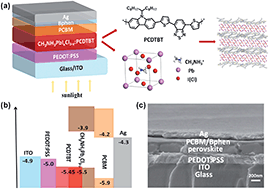
Photovoltaic performance of planar perovskite solar cells has been improved by mixing CH3NH3PbIxCl3-x and a donor polymer [N-9[prime or minute][prime or minute]-hepta-decanyl-2,7-carbazole-alt-5,5-(4[prime or minute],7[prime or minute]-di-2-thienyl-2[prime or minute],1[prime or minute],3[prime or minute]-benzothiadiaz-ole)].
The content of this RSS Feed (c) The Royal Society of Chemistry
16 Feb 08:41
J. Mater. Chem. A, 2017, 5,1658-1666
DOI: 10.1039/C6TA08783C, Paper
Guang Yang, Changlei Wang, Hongwei Lei, Xiaolu Zheng, Pingli Qin, Liangbin Xiong, Xingzhong Zhao, Yanfa Yan, Guojia Fang
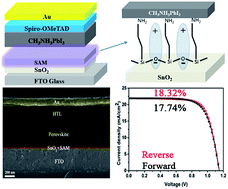
APTES-SAM as an efficient interfacial layer in planar perovskite solar cells, optimizing the interface and enhancing performance.
The content of this RSS Feed (c) The Royal Society of Chemistry
16 Feb 08:41
J. Mater. Chem. A, 2017, 5,1713-1723
DOI: 10.1039/C6TA08739F, Paper
Xi Liu, Tao Liu, Chunhui Duan, Junyi Wang, Shuting Pang, Wentao Xiong, Yanming Sun, Fei Huang, Yong Cao
Three perylenediimide (PDI) acceptors (P2O2, P2N2 and P4N4) functionalizing the bay positions of PDI with different geometrical linker units were synthesized and applied in efficient non-fullerene organic solar cells.
The content of this RSS Feed (c) The Royal Society of Chemistry
16 Feb 08:41
J. Mater. Chem. A, 2017, 5,1706-1712
DOI: 10.1039/C6TA07541J, Paper
Xin Wang, Lin-Long Deng, Lu-Yao Wang, Si-Min Dai, Zhou Xing, Xin-Xing Zhan, Xu-Zhai Lu, Su-Yuan Xie, Rong-Bin Huang, Lan-Sun Zheng
Low-temperature, solution-processed cerium oxide can serve as a promising electron transport layer to replace commonly used TiO2 in planar perovskite solar cells, with high efficiency and enhanced stability.
The content of this RSS Feed (c) The Royal Society of Chemistry
16 Feb 08:41
J. Mater. Chem. A, 2017, 5,1724-1733
DOI: 10.1039/C6TA07876A, Paper
Weiran Zhou, Jieming Zhen, Qing Liu, Zhimin Fang, Dan Li, Pengcheng Zhou, Tao Chen, Shangfeng Yang
A new successive surface engineering method via a dual modification of TiO2 compact layer by PC61BM and C60-ETA was developed, affording dramatic efficiency enhancement with suppressed-hysteresis current-voltage response.
The content of this RSS Feed (c) The Royal Society of Chemistry
16 Feb 08:40
J. Mater. Chem. A, 2017, 5,1348-1373
DOI: 10.1039/C6TA08449D, Review Article
Pooja Agarwala, Dinesh Kabra
Development of triphenylamine (TPA) based hole-transporting-materials (HTMs) leading to high Tg, higher morphological stability and longevity of dye-sensitized and perovskite solar cells.
The content of this RSS Feed (c) The Royal Society of Chemistry
16 Feb 08:39
J. Mater. Chem. A, 2017, 5,1434-1441
DOI: 10.1039/C6TA09174A, Communication
Wei Hu, Tao Liu, Xuewen Yin, Hu Liu, Xingyue Zhao, Songping Luo, Ying Guo, Zhibo Yao, Jinshu Wang, Ning Wang, Hong Lin, Zhanhu Guo
Hematite electron transporting layer based planar perovskite cells were developed with reduced hysteresis and good stability in ambient air.
The content of this RSS Feed (c) The Royal Society of Chemistry
12 Feb 05:56
by Chenxin Ran, Zhaoxin Wu, Jun Xi, Fang Yuan, Hua Dong, Ting Lei, Xin He and Xun Hou

The Journal of Physical Chemistry Letters
DOI: 10.1021/acs.jpclett.6b02578

12 Feb 05:56
by S. J. Park, A. R. Kim, J. T. Hong, J. Y. Park, S. Lee and Y. H. Ahn

The Journal of Physical Chemistry Letters
DOI: 10.1021/acs.jpclett.6b02691

12 Feb 05:56
by Dehui Li, Hung-Chieh Cheng, Hao Wu, Yiliu Wang, Jian Guo, Gongming Wang, Yu Huang and Xiangfeng Duan

The Journal of Physical Chemistry Letters
DOI: 10.1021/acs.jpclett.6b02841

12 Feb 05:56
by Yu Yu, Yating Zhang, Zhang Zhang, Haiting Zhang, Xiaoxian Song, Mingxuan Cao, Yongli Che, Haitao Dai, Junbo Yang, Jianlong Wang, Heng Zhang and Jianquan Yao

The Journal of Physical Chemistry Letters
DOI: 10.1021/acs.jpclett.6b02423

12 Feb 05:49
by Xizheng Wang, Tao Wu and Michael R. Zachariah

The Journal of Physical Chemistry C
DOI: 10.1021/acs.jpcc.6b10571

12 Feb 05:49
by Hsien-Hsin Chou, Chou-Hsun Yang, Jiann T’suen Lin and Chao-Ping Hsu

The Journal of Physical Chemistry C
DOI: 10.1021/acs.jpcc.6b08553

12 Feb 05:47
by Abdelrahman M. Askar, Guy M. Bernard, Benjamin Wiltshire, Karthik Shankar and Vladimir K. Michaelis

The Journal of Physical Chemistry C
DOI: 10.1021/acs.jpcc.6b10865

12 Feb 05:46
by Lydia H. Manger, Matthew B. Rowley, Yongping Fu, Alexander K. Foote, Morgan T. Rea, Sharla L. Wood, Song Jin, John C. Wright and Randall H. Goldsmith

The Journal of Physical Chemistry C
DOI: 10.1021/acs.jpcc.6b11547

12 Feb 05:46
by Feijiu Wang, Ai Shimazaki, Fengjiu Yang, Kaito Kanahashi, Keiichiro Matsuki, Yuhei Miyauchi, Taishi Takenobu, Atsushi Wakamiya, Yasujiro Murata and Kazunari Matsuda

The Journal of Physical Chemistry C
DOI: 10.1021/acs.jpcc.6b12137

12 Feb 05:44
by Elinore M. L. D. de Jong, Genki Yamashita, Leyre Gomez, Masaaki Ashida, Yasufumi Fujiwara and Tom Gregorkiewicz

The Journal of Physical Chemistry C
DOI: 10.1021/acs.jpcc.6b10551

12 Feb 05:25
by Hong Zhou, Shuangping Yuan, Xiaoxia Wang, Tao Xu, Xiao Wang, Honglai Li, Weihao Zheng, Peng Fan, Yunyun Li, Litao Sun and Anlian Pan

ACS Nano
DOI: 10.1021/acsnano.6b07374

12 Feb 05:03
by Qinglong Jiang, Mingming Chen, Junqiang Li, Mingchao Wang, Xiaoqiao Zeng, Tiglet Besara, Jun Lu, Yan Xin, Xin Shan, Bicai Pan, Changchun Wang, Shangchao Lin, Theo Siegrist, Qiangfeng Xiao and Zhibin Yu

ACS Nano
DOI: 10.1021/acsnano.6b08004

23 Dec 02:01
by Quinten A. Akkerman
Strongly emissive perovskite nanocrystal inks for high-voltage solar cells
Nature Energy, Published online: 22 December 2016; doi:10.1038/nenergy.2016.194
Despite their impressive performance, more efforts are required to develop industrially scalable perovskite solar cells from less toxic solvents. Towards that aim, this study presents the use of colloidal nanoparticle inks for room-temperature fabrication of CsPbBr3 solar cells.

29 Nov 03:37
by Nam-Gyu Park
Towards stable and commercially available perovskite solar cells
Nature Energy, Published online: 17 October 2016; doi:10.1038/nenergy.2016.152
Perovskite solar cells have emerged as a potential low-cost alternative to existing technologies. In this Perspective, Park et al. explore a strategy for the commercialisation of perovskite solar cells.

29 Nov 03:34
by K. P. Marshall
Enhanced stability and efficiency in hole-transport-layer-free CsSnI3
perovskite photovoltaics
Nature Energy, Published online: 21 November 2016; doi:10.1038/nenergy.2016.178
Tin-based photovoltaic devices are less toxic than their lead-based counterparts, but suffer severe stability issues due to the susceptibility of tin oxidation. Here the authors report a CsSnI3 perovskite solar cell with a SnCl2 additive that displays a remarkable stability.

29 Nov 03:33
by Jae Hwan Chu, Do Hee Lee, Junhyeon Jo, Sung Youb Kim, Jung-Woo Yoo, Soon-Yong Kwon

J.-W. Yoo, S.-Y. Kwon, and co-workers introduce a highly conductive and environmentally stable organic transparent electrode (TE), laminated with graphene barrier, on page 7234. Structural, electrical, and barrier properties as well as operational and thermal stability of TEs are systematically investigated. The electrodes possess excellent operational and thermal stability by employing 2D carbon materials while maintaining high conductivity and mechanical flexibility.
29 Nov 03:26
by Cheng Mu, Jinlong Pan, Shiqiang Feng, Qi Li, Dongsheng Xu

MACl, as additive to the standard FAPbI3 precursor solution, enables near-complete coverage perovskite film to stabilize the phase-pure black FAPbI3 annealing at 100 °C. A partial substitution of FACl for FAI in precursor solution is used to grow FA perovskites with controllable chlorine doped fraction, which improves the performance of the planar perovskite solar cell.
29 Nov 03:25
by Zhilong Zhang, Zihan Chen, Jianbing Zhang, Weijian Chen, Jianfeng Yang, Xiaoming Wen, Bo Wang, Naoya Kobamoto, Lin Yuan, John A. Stride, Gavin J. Conibeer, Robert J. Patterson, Shujuan Huang

A PbSe quantum dot solar cell with an efficiency of 7.22% and a fill factor of 62.4% is achieved by applying a CsPbBr3 perovskite quantum dot back layer. The back layer can effectively suppress carrier recombination at the PbSe/Au interfaces, hence lead to significant improvement in open-circuit voltage and fill factor.
29 Nov 03:23
by Iwan Zimmermann, Javier Urieta-Mora, Paul Gratia, Juan Aragó, Giulia Grancini, Agustín Molina-Ontoria, Enrique Ortí, Nazario Martín, Mohammad Khaja Nazeeruddin
The synthesis and characterization of a series of novel small-molecule hole-transporting materials (HTMs) based on an anthra[1,2-b:4,3-b′:5,6-b′′:8,7-b′′′]tetrathiophene (ATT) core are reported. The new compounds follow an easy synthetic route and have no need of expensive purification steps. The novel HTMs are tested in perovskite solar cells and power conversion efficiencies (PCE) of up to 18.1% under 1 sun irradiation are measured. This value is comparable with the 17.8% efficiency obtained using 2,2′,7,7′-tetrakis(N,N-di-p-methoxyphenylamine)-9,9′-spirobifluorene as a reference compound. Similarly, a significant quenching of the photoluminescence in the first nanosecond is observed, indicative of effective hole transfer. Additionally, the influence of introducing aliphatic alkyl chains acting as solubilizers on the device performance of the ATT molecules is investigated. Replacing the methoxy groups on the triarylamine sites by butoxy-, hexoxy-, or decoxy-substituents greatly improves the solubility of the compounds without changing the energy levels, yet at the same time significantly decreasing the conductivity as well as the PCE, 17.3% for ATT-OBu, 15.7% for ATT-OHex, and 9.7% for ATT-ODec.

A sulfur-rich polycyclic aromatic hydrocarbon with a flat and rigid π-conjugated structure endowed with triarylamine groups is synthesized for highly efficient perovskite solar cells. The influence of alkyl chains, often introduced to increase the solubility of the hole-transporting materials, is furthermore investigated. Efficiencies as high as 18.1% are obtained.
11 Oct 03:52
by Jinfeng Wang, Xiangkun Jia, Jianping Zhou, Likun Pan, Sumei Huang and Xiaohong Chen

ACS Applied Materials & Interfaces
DOI: 10.1021/acsami.6b10173