Lead halide perovskites have been demonstrated as high performance materials in solar cells and light-emitting devices. These materials are characterized by coherent band transport expected from crystalline semiconductors, but dielectric responses and phonon dynamics typical of liquids. This "crystal-liquid" duality implies that lead halide perovskites belong to phonon glass electron crystals, a class of materials believed to make the most efficient thermoelectrics. We show that the crystal-liquid duality and the resulting dielectric response are responsible for large polaron formation and screening of charge carriers, leading to defect tolerance, moderate charge carrier mobility, and radiative recombination properties. Large polaron formation, along with the phonon glass character, may also explain the marked reduction in hot carrier cooling rates in these materials.
Chen Weijie
Shared posts
Lead halide perovskites: Crystal-liquid duality, phonon glass electron crystals, and large polaron formation
Dopant-free and low-cost molecular "bee" hole-transporting materials for efficient and stable perovskite solar cells

DOI: 10.1039/C7TC03931J, Paper
TPD based molecular "bee" dopant-free HTMs for PSCs exhibit a PCE of 15.28% which is comparable to doped spiro-OMeTAD.
The content of this RSS Feed (c) The Royal Society of Chemistry
Past and future of graphene/silicon heterojunction solar cells: a review

DOI: 10.1039/C7TC03060F, Review Article
Graphene/silicon (Gr/Si) Schottky junction solar cells represent an alternative low-cost, easy fabrication structure in photovoltaic devices.
The content of this RSS Feed (c) The Royal Society of Chemistry
Recent progress of metal halide perovskite photodetectors

DOI: 10.1039/C7TC03612D, Review Article
The metal halide perovskites have attracted unprecedented attention in the field of photodetectors. The recent progress of perovskite photodetectors for different spectral regions and applications are reviewed. The enhancement strategies of device performance are discussed as well. In addition, summary and outlook are given to boost the development of perovskite PDs.
The content of this RSS Feed (c) The Royal Society of Chemistry
Cs2AgBiBr6 single-crystal X-ray detectors with a low detection limit
Cs2AgBiBr6 single-crystal X-ray detectors with a low detection limit
Nature Photonics, Published online: 2 October 2017; doi:10.1038/s41566-017-0012-4
Double perovskite Cs2AgBiBr6 single crystals are used to make a sensitive X-ray detector. The device exhibits a high sensitivity of 105 µC Gyair −1 cm−2 and a low detection limit of 59.7 nGyairs−1, and demonstrates long-term operational stability.
Carbon Nanotubes versus Graphene as Flexible Transparent Electrodes in Inverted Perovskite Solar Cells

Centrifugal-Coated Quasi-Two-Dimensional Perovskite CsPb2Br5 Films for Efficient and Stable Light-Emitting Diodes

Unraveling the Charge Extraction Mechanism of Perovskite Solar Cells Fabricated with Two-Step Spin Coating: Interfacial Energetics between Methylammonium Lead Iodide and C60

In Situ Monitoring of Chemical Reactions at a Solid–Water Interface by Femtosecond Acoustics

Efficient and High-Color-Purity Light-Emitting Diodes Based on In Situ Grown Films of CsPbX3 (X = Br, I) Nanoplates with Controlled Thicknesses

Electronic structure of organic-inorganic lanthanide iodide perovskite solar cell materials

DOI: 10.1039/C7TA07716E, Paper
The lead-free lanthanide iodide perovskite materials explored herein, show potentials for implementation as light absorber or charge transfer layer in perovskite solar cell devices.
The content of this RSS Feed (c) The Royal Society of Chemistry
Radical polymers as interfacial layers in inverted hybrid perovskite solar cells

DOI: 10.1039/C7TA07732G, Paper
We report high performance hybrid perovskite solar cells engineered by a UV crosslinkable radical polymer.
The content of this RSS Feed (c) The Royal Society of Chemistry
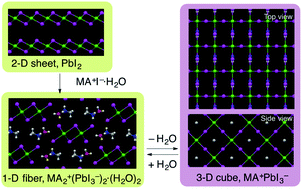
Effects of water on the forward and backward conversions of lead(II) iodide to methylammonium lead perovskite
DOI: 10.1039/C7TA08042E, Paper
This work has chemically addressed the enigmatic effects of water on solar cell devices based on an organic-inorganic hybrid perovskite, i.e., water can exert either beneficial or detrimental effects on device fabrication and device stability.
The content of this RSS Feed (c) The Royal Society of Chemistry
Effects of Defects on the Temperature-Dependent Thermal Conductivity of Suspended Monolayer Molybdenum Disulfide Grown by Chemical Vapor Deposition
Abstract
It is understood that defects of the atomic arrangement of the lattice in 2D molybdenum disulfide (MoS2) grown by chemical vapor deposition (CVD) can have a profound effect on the electronic and optical properties. Beyond these it is a major prerequisite to also understand the fundamental effect of such defects on phonon transport, to guarantee the successful integration of MoS2 into the solid-state devices. A comprehensive joint experiment-theory investigation to explore the effect of lattice defects on the thermal transport of the suspended MoS2 monolayer grown by CVD is presented. The measured room temperature thermal conductivity values are 30 ± 3.3 and 35.5 ± 3 W m−1 K−1 for two samples, which are more than two times smaller than that of their exfoliated counterpart. High-resolution transmission electron microscopy shows that these CVD-grown samples are polycrystalline in nature with low angle grain boundaries, which is primarily responsible for their reduced thermal conductivity. Higher degree of polycrystallinity and aging effects also result in smoother temperature dependency of thermal conductivity (κ) at temperatures below 100 K. First-principles lattice dynamics simulations are carried out to understand the role of defects such as isotopes, vacancies, and grain boundaries on the phonon scattering rates of our CVD-grown samples.

The lattice structure–thermal conductivity relation of MoS2 monolayer grown by chemical vapor deposition is investigated in a wide temperature range using a suspended microdevice with integrated resistance thermometers. Higher degree of polycrystallinity leads to smoother temperature dependency at temperatures below 100 K. The observations are explained by the first-principles lattice dynamics calculations.
Using Bulk Heterojunctions and Selective Electron Trapping to Enhance the Responsivity of Perovskite–Graphene Photodetectors
Abstract
Graphene field effect transistor sensitized by a layer of semiconductor (sensitizer/GFET) is a device structure that is investigated extensively for ultrasensitive photodetection. Among others, organometallic perovskite semiconductor sensitizer has the advantages of long carrier lifetime and solution processable. A further step to improve the responsivity is to design a structure that can promote electron–hole separation and selective carrier trapping in the sensitizer. Here, the use of a hybrid perovskite–organic bulk heterojunction (BHJ) as the light sensitizer to achieve this goal is demonstrated. Our spectroscopy and device measurements show that the CH3NH3PbI3–PCBM BHJ/GFET device has improved charge separation yield and carrier lifetime as compared to a reference device with a CH3NH3PbI3 sensitizer only. The key to these enhancement is the presence of [6,6]-phenyl-C61-butyric acid methyl ester (PCBM), which acts as charge separation and electron trapping sites, resulting in a 30-fold increase in the photoresponsivity. This work shows that the use of a small amount of electron or hole acceptors in the sensitizer layer can be an effective strategy for improving and tuning the photoresponsivity of sensitizer/GFET photodetectors.

Mixing a small amount of electron acceptors ([6,6]-phenyl-C61-butyric acid methyl ester) with hybrid organometallic perovskite significantly increases the photoresponsivity of perovskite–graphene photodetectors. It is found that the electron acceptors act as effective sites for both charge separation and electron trapping, which enhances the photoinduced change in the conductivity of the graphene channel.
Design of a New Small-Molecule Electron Acceptor Enables Efficient Polymer Solar Cells with High Fill Factor
Abstract
Improving the fill factor (FF) is known as a challenging issue in organic solar cells (OSCs). Herein, a strategy of extending the conjugated area of end-group is proposed for the molecular design of acceptor–donor–acceptor (A–D–A)-type small molecule acceptor (SMA), and an indaceno[1,2-b:5,6-b′]dithiophene-based SMA, namely IDTN, by end-capping with the naphthyl fused 2-(3-oxocyclopentylidene)malononitrile is synthesized. Benefiting from the π-conjugation extension by fusing two phenyls, IDTN shows stronger molecular aggregation, more ordered packing structure, thus over one order of magnitude higher electron mobility relative to its counterpart. By utilizing the fluorinated polymer (PBDB-TF) as the electron donor, the corresponding device exhibits a high efficiency of 12.2% with a record-high FF of 0.78, which is approaching the theoretical limit of OSCs. Compared with the reference molecule, such a high FF in the IDTN system can be mainly attributed to the more ordered π–π packing of acceptor aggregates, higher domain purity and symmetric carrier transport in the blend. Hence, enlarging the conjugated area of the terminal-group in these A–D–A-type SMAs is a promising approach not only for enhancing the electron mobility, but also for improving the blend morphology, and both of them are conducive to the fill-factor breakthrough.

By extending the conjugated area of the end-group, a newly designed A–D–A–type small-molecule acceptor, namely IDTN, exhibits dense and ordered packing, and therefore, the electron mobility of the IDTN is over one order of magnitude higher than that of its counterpart. When blended with the donor polymer PBDB-TF, a high efficiency of 12.2% with an outstanding fill factor of 0.78 is achieved.
Ab initio study of the role of iodine in the degradation of CH3NH3PbI3

DOI: 10.1039/C7TA07754H, Paper
DFT calculations were carried out to study the roles of iodine, excess electrons and holes on the MAPbI3 surface degradation.
The content of this RSS Feed (c) The Royal Society of Chemistry
Non-integer induced spontaneous polarization of highly efficient perovskite-based NBTO SCN photocatalysts

DOI: 10.1039/C7TA06284B, Communication
Non-integer perovskite-based NBTO SCNs possess giant spontaneous polarization along the c-axis, and exhibit excellent photocatalytic activities.
The content of this RSS Feed (c) The Royal Society of Chemistry
Perovskite Thin Films: High-Resolution Spin-on-Patterning of Perovskite Thin Films for a Multiplexed Image Sensor Array (Adv. Mater. 40/2017)

A novel patterning method for perovskite thin films is developed by Dae-Hyeong Kim and co-workers, which is described in article number 1702902. The patterning method (spin-on-patterning) is based on the thermodynamically preferred dewetting behavior of the perovskite precursor solution during the spin-coating process. By using this method, a high-performance, ultrathin, and deformable perovskite-on-silicon multiplexed image sensor array is successfully achieved.
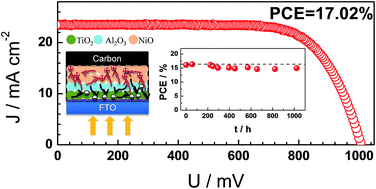
17% efficient printable mesoscopic PIN metal oxide framework perovskite solar cells using cesium-containing triple cation perovskite
DOI: 10.1039/C7TA07660F, Communication
Cs0.05(FA0.4MA0.6)0.95PbI2.8Br0.2 based devices showed an impressive efficiency of 17.02% and excellent thermal stability with long electron and hole diffusion lengths.
The content of this RSS Feed (c) The Royal Society of Chemistry
Understanding the stability of mixed A-cation lead iodide perovskites

DOI: 10.1039/C7TA08617B, Communication
 Open Access
   This article is licensed under a Creative Commons Attribution 3.0 Unported Licence.
Thin films of the mixed A-cation phase MA1-xFAxPbI3 have been shown experimentally and computationally to have greater kinetic and thermodynamic stability towards decomposition.
The content of this RSS Feed (c) The Royal Society of Chemistry
Tetrabutylammonium cations for moisture-resistant and semitransparent perovskite solar cells

DOI: 10.1039/C7TA06735F, Paper
Open Access   This article is licensed under a Creative Commons Attribution-NonCommercial 3.0 Unported Licence.
Tetra-butylammonium cations have been partially substituted for methylammonium cations in perovskite thin films. The stability of devices stored under ambient conditions was enhanced by the presence of TBA and cells with high mol% TBA were found to have reasonable efficiencies while being semi-transparent.
The content of this RSS Feed (c) The Royal Society of Chemistry
Air exposure induced recombination in PTB7:PC71BM solar cells

DOI: 10.1039/C7TA03741D, Paper
Magnetic resonance identifies oxidised PC71BM recombination centres in PTB7:PC71BM solar cells processed when using DIO and exposed to air.
The content of this RSS Feed (c) The Royal Society of Chemistry
Strong Carrier–Phonon Coupling in Lead Halide Perovskite Nanocrystals

High Performance PbS Colloidal Quantum Dot Solar Cells by Employing Solution-Processed CdS Thin Films from a Single-Source Precursor as the Electron Transport Layer
Abstract
CdS thin films are a promising electron transport layer in PbS colloidal quantum dot (CQD) photovoltaic devices. Some traditional deposition techniques, such as chemical bath deposition and RF (radio frequency) magnetron sputtering, have been employed to fabricate CdS films and CdS/PbS CQD heterojunction photovoltaic devices. However, their power conversion efficiencies (PCEs) are moderate compared with ZnO/PbS and TiO2/PbS heterojunction CQD solar cells. Here, efficiencies have been improved substantially by employing solution-processed CdS thin films from a single-source precursor. The CdS film is deposited by a straightforward spin-coating and annealing process, which is a simple, low-cost, and high-material-usage fabrication process compared to chemical bath deposition and RF magnetron sputtering. The best CdS/PbS CQD heterojunction solar cell is fabricated using an optimized deposition and air-annealing process achieved over 8% PCE, demonstrating the great potential of CdS thin films fabricated by the single-source precursor for PbS CQDs solar cells.

A heterojunction PbS quantum dot solar cell with an efficiency over 8% is achieved by optimizing CdS electron transport layer deposited by a simple single-source precursor spin-coating process. The optimized band alignment of the device improves the short circuit current and fill factor.
p-Type CuI Islands on TiO2 Electron Transport Layer for a Highly Efficient Planar-Perovskite Solar Cell with Negligible Hysteresis
Abstract
Compact TiO2 is widely used as an electron transport material in planar-perovskite solar cells. However, TiO2-based planar-perovskite solar cells exhibit low efficiencies due to intrinsic problems such as the unsuitable conduction band energy and low electron extraction ability of TiO2. Herein, the planar TiO2 electron transport layer (ETL) of perovskite solar cells is modified with ionic salt CuI via a simple one-step spin-coating process. The p-type nature of the CuI islands on the TiO2 surface leads to modification of the TiO2 band alignment, resulting in barrier-free contacts and increased open-circuit voltage. It is found that the polarity of the CuI-modified TiO2 surface can pull electrons to the interface between the perovskite and the TiO2, which improves electron extraction and reduces nonradiative recombination. The CuI solution concentration is varied to control the electron extraction of the modified TiO2 ETL, and the optimized device shows a high efficiency of 19.0%. In addition, the optimized device shows negligible hysteresis, which is believed to be due to the removal of trap sites and effective electron extraction by CuI-modified TiO2. These results demonstrate the hitherto unknown effect of p-type ionic salts on electron transport material.

It is revealed that the CuI islands on the TiO2 electron transport layer can induce change of polarity increasing electron extraction, establish barrier-free band alignment with perovskite, and reduce the trap sites. These changes of interface properties induce power conversion efficiency of 19.0% perovskite solar cell with negligible hysteresis.
Efficient Solar Cells Based on Light-Harvesting Antimony Sulfoiodide
Abstract
Although antimony sulfoiodide (SbSI) exhibits very interesting properties including high photoconductivity, ferroelectricity, and piezoelectricity, it is not applied to solar cells. Meanwhile, SbSI is predominantly prepared as a powder using a high-temperature, high-pressure system. Herein, the fabrication of solar cells utilizing SbSI as light harvesters is reported for the first time to the best of knowledge. SbSI is prepared by solution processing, followed by annealing under mild temperature conditions by a reaction between antimony trisulfide, which is deposited by chemical bath deposition on a mesoporous TiO2 electrode and antimony triiodide, under air at a low temperature (90 °C) without any external pressure. The solar cells fabricated using SbSI exhibit a power conversion efficiency of 3.05% under standard illumination conditions of 100 mW cm−2.

Solar cells with the configuration of FTO (fluorine-doped SnO2)/TiO2 blocking layer/mesoporous TiO2/SbSI/hole-transporting material/Au are demonstrated for the first time. The cells fabricated using TiO2 as an electron-transporting layer and poly[2,6-(4,4-bis(2-ethylhexyl)-4H-cyclopenta[2,1-b;3,4-b′]dithiophene)-alt-4,7-(2,1,3-benzothiadiazole)] as a hole-transporting layer exhibit a power conversion efficiency of 3.05% under full illumination of air mass 1.5G.
Photodetectors: Large-Scale Synthesis of Freestanding Layer-Structured PbI2 and MAPbI3 Nanosheets for High-Performance Photodetection (Adv. Mater. 39/2017)

High-density, crystalline, and freestanding PbI2 and MAPbI3 nanosheets are synthesized by Johnny C. Ho and co-workers in article number 1702759, on a large scale through the nucleation of microplanes on substrates with a rough surface by manipulating the microenvironment during physical vapor deposition. When configured into photodetectors, they exhibit efficient photodetection with excellent performance in responsivity and detectivity.
Highly Efficient Ternary-Blend Polymer Solar Cells Enabled by a Nonfullerene Acceptor and Two Polymer Donors with a Broad Composition Tolerance
Abstract
In this work, highly efficient ternary-blend organic solar cells (TB-OSCs) are reported based on a low-bandgap copolymer of PTB7-Th, a medium-bandgap copolymer of PBDB-T, and a wide-bandgap small molecule of SFBRCN. The ternary-blend layer exhibits a good complementary absorption in the range of 300–800 nm, in which PTB7-Th and PBDB-T have excellent miscibility with each other and a desirable phase separation with SFBRCN. In such devices, there exist multiple energy transfer pathways from PBDB-T to PTB7-Th, and from SFBRCN to the above two polymer donors. The hole-back transfer from PTB7-Th to PBDB-T and multiple electron transfers between the acceptor and the donor materials are also observed for elevating the whole device performance. After systematically optimizing the weight ratio of PBDB-T:PTB7-Th:SFBRCN, a champion power conversion efficiency (PCE) of 12.27% is finally achieved with an open-circuit voltage (Voc) of 0.93 V, a short-circuit current density (Jsc) of 17.86 mA cm−2, and a fill factor of 73.9%, which is the highest value for the ternary OSCs reported so far. Importantly, the TB-OSCs exhibit a broad composition tolerance with a high PCE over 10% throughout the whole blend ratios.

Highly efficient ternary-blend nonfullerene organic solar cells based on two copolymer donors and one electron acceptor are fabricated and evaluated. The multiple energy and charge-transfer pathways in this ternary system enable the power conversion efficiency to reach 12.27%, which is a new record for ternary-blend organic solar cells at present. These devices also exhibit a broad composition tolerance.
Planar-Structure Perovskite Solar Cells with Efficiency beyond 21%
Abstract
Low temperature solution processed planar-structure perovskite solar cells gain great attention recently, while their power conversions are still lower than that of high temperature mesoporous counterpart. Previous reports are mainly focused on perovskite morphology control and interface engineering to improve performance. Here, this study systematically investigates the effect of precise stoichiometry, especially the PbI2 contents on device performance including efficiency, hysteresis and stability. This study finds that a moderate residual of PbI2 can deliver stable and high efficiency of solar cells without hysteresis, while too much residual PbI2 will lead to serious hysteresis and poor transit stability. Solar cells with the efficiencies of 21.6% in small size (0.0737 cm2) and 20.1% in large size (1 cm2) with moderate residual PbI2 in perovskite layer are obtained. The certificated efficiency for small size shows the efficiency of 20.9%, which is the highest efficiency ever recorded in planar-structure perovskite solar cells, showing the planar-structure perovskite solar cells are very promising.

Planar-structure perovskite solar cells with efficiencies of 21.6% in small size (0.0737 cm2) and 20.1% in large size (1 cm2) with moderate residual PbI2 in perovskite layer are obtained. The certificated efficiency for small size shows the efficiency of 20.9%, which is the highest efficiency ever recorded in planar-structure perovskite solar cells.