08 Dec 01:02
Energy Environ. Sci., 2018, 11,151-165
DOI: 10.1039/C7EE02415K, Paper
Wolfgang Tress, Mozhgan Yavari, Konrad Domanski, Pankaj Yadav, Bjoern Niesen, Juan Pablo Correa Baena, Anders Hagfeldt, Michael Graetzel
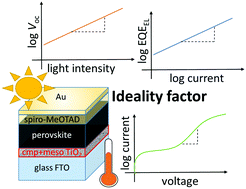
Insights into the interplay of different recombination mechanisms and their origins (bulk, surface) are provided comparing fresh, light-soaked and aged devices.
The content of this RSS Feed (c) The Royal Society of Chemistry

05 Dec 01:07
J. Mater. Chem. A, 2017, Accepted Manuscript
DOI: 10.1039/C7TA07501D, Paper
Feng Liu, Biao Xiao, Jingnan Song, Bing Guo, Minli Zhang, Wanbin Li, Ruixue Zhou, Jiyan Liu, Hong-Bo Wang, Maojie Zhang, Guoping Luo, Thomas P Russell
Organic solar cells (OSCs) with a fused-ring dye, ITIC, and fullerene derivative PC71BM as the acceptor materials were fabricated. Compared to PC71BM-based cells, which reach a power conversion efficiency of...
The content of this RSS Feed (c) The Royal Society of Chemistry
05 Dec 01:05
J. Mater. Chem. A, 2017, Accepted Manuscript
DOI: 10.1039/C7TA09930D, Paper
Ming Liu, Jing Yang, Yuli Yin, Yong Zhang, Erjun Zhou, Fengyun Guo, Liancheng Zhao
Two novel acceptor-acceptor (A-A) typed polymeric electron acceptors PPDI-DTBT and PFPDI-DTBT, which contains perylene diimide (PDI) and fused PDI (FPDI) with the electron deficient 4,7-dithienyl-2,1,3-benzothiadiazole (DTBT) units, respectively, are designed...
The content of this RSS Feed (c) The Royal Society of Chemistry
05 Dec 01:05
J. Mater. Chem. A, 2017, Accepted Manuscript
DOI: 10.1039/C7TA09494A, Paper
Wiley Dunlap-Shohl, Trey Daunis, Xiao-Ming Wang, Jian Wang, Boya Zhang, Diego Barrera Mendez, Yanfa Yan, Julia Hsu, David B. Mitzi
Delafossite oxides are promising hole transport layer (HTL) candidates for perovskite solar cells, due to their wide band gap, favorable energy band alignment relative to the perovskite absorber and simplicity...
The content of this RSS Feed (c) The Royal Society of Chemistry
05 Dec 01:05
J. Mater. Chem. A, 2017, Accepted Manuscript
DOI: 10.1039/C7TA08533H, Paper
Ruchika Mishra, Ramprasad Regar, Varun Singh, Piyush Panini, Rahul Singhal, Mukhamed Lostambievich Keshtov, Ganesh D Sharma, Sankar Jeyaraman
Thiophene-containing molecular materials are recognised as efficient substrates in organic photovoltaics. Herein, we have demonstrated the effect of substitution pattern of thiophenes on the electron accepting ability of perylenebisimide derivatives...
The content of this RSS Feed (c) The Royal Society of Chemistry
05 Dec 01:02
by Wei E. I. Sha, Hong Zhang, Zi Shuai Wang, Hugh L. Zhu, Xingang Ren, Francis Lin, Alex K.-Y. Jen, Wallace C. H. Choy
Abstract
A modified detailed balance model is built to understand and quantify efficiency loss of perovskite solar cells. The modified model captures the light-absorption-dependent short-circuit current, contact and transport-layer-modified carrier transport, as well as recombination and photon-recycling-influenced open-circuit voltage. The theoretical and experimental results show that for experimentally optimized perovskite solar cells with the power conversion efficiency of 19%, optical loss of 25%, nonradiative recombination loss of 35%, and ohmic loss of 35% are the three dominant loss factors for approaching the 31% efficiency limit of perovskite solar cells. It is also found that the optical loss climbs up to 40% for a thin-active-layer design. Moreover, a misconfigured transport layer introduces above 15% of energy loss. Finally, the perovskite-interface-induced surface recombination, ohmic loss, and current leakage should be further reduced to upgrade device efficiency and eliminate hysteresis effect. This work contributes to fundamental understanding of device physics of perovskite solar cells. The developed model offers a systematic design and analysis tool to photovoltaic science and technology.

A modified detailed balance model is built to understand and quantify the efficiency loss of perovskite solar cells. The optical loss, nonradiative recombination loss, and ohmic loss are identified quantitatively. The perovskite-interface-induced surface recombination, ohmic loss, and current leakage are also analyzed.
05 Dec 00:52
by Zhengkun Du, Xichang Bao, Yonghai Li, Deyu Liu, Jiuxing Wang, Chunming Yang, Reinhard Wimmer, Lars Wagner Städe, Renqiang Yang, Donghong Yu
Abstract
Based on the most recently significant progress within the last one year in organic photovoltaic research from either alkylthiolation or fluorination on benzo[1,2-b:4,5-b′]dithiophene moiety for high efficiency polymer solar cells (PSCs), two novel simultaneously fluorinated and alkylthiolated benzo[1,2-b:4,5-b′] dithiophene (BDT)-based donor–acceptor (D–A) polymers, poly(4,8-bis(5′-((2″-ethylhexyl)thio)-4′-fluorothiophen-2′-yl)benzo[1,2-b:4,5-b′]dithiophene-2,6-diyl)-alt-2′-ethylhexyl-3-fluorothieno[3,4-b]thiophene-2-carboxylate (PBDTT-SF-TT) and poly(4,8-bis(5′-((2″-ethylhexyl)thio)-4′-fluorothiophen-2′-yl)benzo[1,2-b:4,5-b′]dithiophene-2,6-diyl)-alt-1,3-bis(thiophen-2-yl)-5,7-bis(2-ethylhexyl)benzo[1,2-c:4,5-c′]dithiophene-4,8-dione (PBDTT-SF-BDD), namely, via an advantageous and synthetically economic route for the key monomer are reported herein. Synergistic effects of fluorination and alkylthiolation on BDT moieties are discussed in detail, which is based on the superior balance between high Voc and large Jsc when PBDTT-SF-TT/PC71BM and PBDTT-SF-BDD/PC71BM solar cells present their high Voc as 1.00 and 0.97 V (associated with their deep highest occupied molecular orbital level of −5.54 and −5.61 eV), a moderately high Jsc of 14.79 and 14.70 mA cm−2, and thus result a high power conversion efficiency of 9.07% and 9.72%, respectively. Meanwhile, for PBDTT-SF-TT, a very low energy loss of 0.59 eV is pronounced, leading to the promisingly high voltage, and furthermore performance study and morphological results declare an additive-free PSC from PBDTT-SF-TT, which is beneficial to practical applications.

Superior balance between high Voc and large Jsc is realized via synergistic effect of fluorination and alkylthiolation on benzo[1,2-b:4,5-b′] dithiophene (BDT) moiety, leading to new efficient conventional BDT-based polymer solar cells are achieved with high power conversion efficiency of 9.07% for poly(4,8-bis(5′-((2″-ethylhexyl)thio)-4′-fluorothiophen-2′-yl)benzo[1,2-b:4,5-b′]dithiophene-2,6-diyl)-alt-2′-ethylhexyl-3-fluorothieno[3,4-b]thiophene-2-carboxylate and 9.72% for poly(4,8-bis(5′-((2″-ethylhexyl)thio)-4′-fluorothiophen-2′-yl)benzo[1,2-b:4,5-b′]dithiophene-2,6-diyl)-alt-1,3-bis(thiophen-2-yl)-5,7-bis(2-ethylhexyl)benzo[1,2-c:4,5-c′]dithiophene-4,8-dione.
04 Dec 11:43
by Andrea R. Bowring, Luca Bertoluzzi, Brian C. O'Regan, Michael D. McGehee
Abstract
The future commercialization of halide perovskite solar cells relies on improving their stability. There are several studies focused on understanding degradation under operating conditions in light, but little is known about the stability of these solar cells under reverse bias conditions. Reverse bias stability is important because shaded cells in a module are put into reverse bias by the illuminated cells. In this paper, a phenomenological study is presented of the reverse bias behavior of halide perovskite solar cells and it is shown that reverse bias can lead to a partially recoverable loss in efficiency, primarily caused by a decrease in V
OC. A general mechanism is proposed, supported by drift–diffusion simulations, to explain how these cells breakdown via tunneling caused by accumulated ionic defects and suggests that the reversible loss in efficiency may be due to an electrochemical reaction of these defects. Finally, the implications of these phenomena are discussed and how they can possibly be addressed is also discussed.

The stability of halide perovskite solar cells in reverse bias is investigated. The cells uniformly pass current across the device at breakdown voltages between –1 and −4 V. A partially recoverable decrease in open-circuit voltage is seen for cells held in reverse bias. Drift–diffusion modeling supports breakdown via tunneling, and the implications and some possible solutions are discussed.
04 Dec 11:42
by Nicholas Rolston, Adam D. Printz, Jared M. Tracy, Hasitha C. Weerasinghe, Doojin Vak, Lew Jia Haur, Anish Priyadarshi, Nripan Mathews, Daniel J. Slotcavage, Michael D. McGehee, Roghi E. Kalan, Kenneth Zielinski, Ronald L. Grimm, Hsinhan Tsai, Wanyi Nie, Aditya D. Mohite, Somayeh Gholipour, Michael Saliba, Michael Grätzel, Reinhold H. Dauskardt
Abstract
Photoactive perovskite semiconductors are highly tunable, with numerous inorganic and organic cations readily incorporated to modify optoelectronic properties. However, despite the importance of device reliability and long service lifetimes, the effects of various cations on the mechanical properties of perovskites are largely overlooked. In this study, the cohesion energy of perovskites containing various cation combinations of methylammonium, formamidinium, cesium, butylammonium, and 5-aminovaleric acid is reported. A trade-off is observed between the mechanical integrity and the efficiency of perovskite devices. High efficiency devices exhibit decreased cohesion, which is attributed to reduced grain sizes with the inclusion of additional cations and PbI2 additives. Microindentation hardness testing is performed to estimate the fracture toughness of single-crystal perovskite, and the results indicated perovskites are inherently fragile, even in the absence of grain boundaries and defects. The devices found to have the highest fracture energies are perovskites infiltrated into a porous TiO2/ZrO2/C triple layer, which provide extrinsic reinforcement and shielding for enhanced mechanical and chemical stability.

As reflected in the fragility of state-of-the-art perovskite solar cells, mechanical reliability has too long been an afterthought in their development. The aim of this work is to understand the effects of cation composition (combinations of methylammonium, formamidinium, cesium, butylammonium, and 5-aminovaleric acid) on perovskite mechanical integrity and determine design criteria to increase reliability toward the development of module-scale devices.
04 Dec 11:42
by Gan Jin, Nannan Chen, Qingsen Zeng, Fangyuan Liu, Wei Yuan, Siyuan Xiang, Tanglue Feng, Xiaohang Du, Tianjiao Ji, Lijing Wang, Yaohua Wang, Henan Sun, Haizhu Sun, Bai Yang
Abstract
Aqueous-solution-processed solar cells (ASCs) are promising candidates of the next-generation large-area, low-cost, and flexible photovoltaic conversion equipment because of their unique environmental friendly property. Aqueous-solution-processed polymer/nanocrystals (NCs) hybrid solar cells (AHSCs) can effectively integrate the advantages of the polymer (e.g., flexibility and lightweight) and the inorganic NCs (e.g., high mobility and broad absorption), and therefore be considered as an ideal system to further improve the performance of ASCs. In this work, double-side bulk heterojunction (BHJ), in which one BHJ combines the active material with electron transport material and the other combines the active material with hole transport material, is developed in the AHSCs. Through comparing with the single-side BHJ device, promoted carrier extraction, enhanced internal quantum efficiency, extended width of the depletion region, and prolonged carrier lifetime are achieved in double-side BHJ devices. As a result, power conversion efficiency exceeding 6% is obtained, which breaks the bottleneck efficiency around ≈5.5%. This work demonstrates a device architecture which is more remarkable compared with the traditional only donor–acceptor blended BHJ. Under conservative estimation, it provides instructive architecture not only in the ASCs, but also in the organic solar cells (SCs), quantum dot SCs, and perovskite SCs.

A double-side bulk heterojunction (BHJ) is developed in the aqueous-solution-processed solar cells (ASCs). Through comparing with the single-side BHJ device, promoted carrier extraction, enhanced internal quantum efficiency, extended width of the depletion region, and prolonged carrier lifetime are achieved in double-side BHJ devices. As a result, power conversion efficiency exceeding 6% is obtained, which breaks the bottleneck efficiency around ≈5.5% in the ASCs.
04 Dec 11:42
by Haijun Bin, Yankang Yang, Zhengxing Peng, Long Ye, Jia Yao, Lian Zhong, Chenkai Sun, Liang Gao, He Huang, Xiaojun Li, Beibei Qiu, Lingwei Xue, Zhi-Guo Zhang, Harald Ade, Yongfang Li
Abstract
Side-chain engineering is an important strategy for optimizing photovoltaic properties of organic photovoltaic materials. In this work, the effect of alkylsilyl side-chain structure on the photovoltaic properties of medium bandgap conjugated polymer donors is studied by synthesizing four new polymers J70, J72, J73, and J74 on the basis of highly efficient polymer donor J71 by changing alkyl substituents of the alkylsilyl side chains of the polymers. And the photovoltaic properties of the five polymers are studied by fabricating polymer solar cells (PSCs) with the polymers as donor and an n-type organic semiconductor (n-OS) m-ITIC as acceptor. It is found that the shorter and linear alkylsilyl side chain could afford ordered molecular packing, stronger absorption coefficient, higher charge carrier mobility, thus results in higher Jsc and fill factor values in the corresponding PSCs. While the polymers with longer or branched alkyl substituents in the trialkylsilyl group show lower-lying highest occupied molecular orbital energy levels which leads to higher Voc of the PSCs. The PSCs based on J70:m-ITIC and J71:m-ITIC achieve power conversion efficiency (PCE) of 11.62 and 12.05%, respectively, which are among the top values of the PSCs reported in the literatures so far.

Side-chain engineering is performed to optimize photovoltaic properties of the 2D-conjugated polymer donors. The polymer solar cells with m-ITIC as acceptor and J70 and J71 polymer donors with shorter and linear alkyl substituents in their alkylsilyl side chains achieve power conversion efficiency of 11.62% and 12.05%, respectively.
04 Dec 11:41
by Bin Kan, Jiangbin Zhang, Feng Liu, Xiangjian Wan, Chenxi Li, Xin Ke, Yunchuang Wang, Huanran Feng, Yamin Zhang, Guankui Long, Richard H. Friend, Artem A. Bakulin, Yongsheng Chen
Abstract
Organic solar cell optimization requires careful balancing of current–voltage output of the materials system. Here, such optimization using ultrafast spectroscopy as a tool to optimize the material bandgap without altering ultrafast photophysics is reported. A new acceptor–donor–acceptor (A–D–A)-type small-molecule acceptor NCBDT is designed by modification of the D and A units of NFBDT. Compared to NFBDT, NCBDT exhibits upshifted highest occupied molecular orbital (HOMO) energy level mainly due to the additional octyl on the D unit and downshifted lowest unoccupied molecular orbital (LUMO) energy level due to the fluorination of A units. NCBDT has a low optical bandgap of 1.45 eV which extends the absorption range toward near-IR region, down to ≈860 nm. However, the 60 meV lowered LUMO level of NCBDT hardly changes the Voc level, and the elevation of the NCBDT HOMO does not have a substantial influence on the photophysics of the materials. Thus, for both NCBDT- and NFBDT-based systems, an unusually slow (≈400 ps) but ultimately efficient charge generation mediated by interfacial charge-pair states is observed, followed by effective charge extraction. As a result, the PBDB-T:NCBDT devices demonstrate an impressive power conversion efficiency over 12%—among the best for solution-processed organic solar cells.

An acceptor-donor-acceptor nonfullerene acceptor NCBDT is reported. NCBDT exhibits a low optical bandgap of 1.45 eV and broadened absorption range. The PBDB-T:NCBDT-based device achieves an impressive PCE of 12.12% and Jsc over 20 mA cm-2—one of the best results for solution-processed OSCs. Further photophysical study reveals slow (≈400 ps) yet efficient free charge generation.
04 Dec 01:26
by Alberto Privitera, Marcello Righetto, Michele De Bastiani, Francesco Carraro, Marzio Rancan, Lidia Armelao, Gaetano Granozzi, Renato Bozio and Lorenzo Franco

The Journal of Physical Chemistry Letters
DOI: 10.1021/acs.jpclett.7b03077

02 Dec 01:04
J. Mater. Chem. A, 2017, Accepted Manuscript
DOI: 10.1039/C7TA10136H, Paper
Chunhui Duan, Xi Liu, Boming Xie, Zhaojing Wang, Baobing Fan, Kai Zhang, Baojun Lin, Fallon Colberts, Wei Ma, Rene A J Janssen, Fei Huang, Yong Cao
The majority of organic semiconductors have a low relative dielectric constant (εr < 6), which is an important limitation for organic solar cells (OSCs). A high dielectric constant would reduce...
The content of this RSS Feed (c) The Royal Society of Chemistry
02 Dec 01:02
J. Mater. Chem. A, 2017, Accepted Manuscript
DOI: 10.1039/C7TA09716F, Paper
Rongming Xue, Moyao Zhang, Guiying Xu, Jingwen Zhang, Weijie Chen, Haiyang Chen, Ming Yang, Chaohua Cui, Yaowen Li, Yongfang Li
Organic hole transport layer (HTL) play very important role for realizing high performance and low-cost planar p-i-n perovskite solar cells (pero-SCs). In this work, we synthesized two X-shaped organic HTL...
The content of this RSS Feed (c) The Royal Society of Chemistry
01 Dec 11:05
by John A. Love, Markus Feuerstein, Christian M. Wolff, Antonio Facchetti and Dieter Neher

ACS Applied Materials & Interfaces
DOI: 10.1021/acsami.7b10361

01 Dec 10:57
by Cong Li, Qiang Guo, Zhibin Wang, Yiming Bai, Lin Liu, Fuzhi Wang, Erjun Zhou, Tasawar Hayat, Ahmed Alsaedi and Zhan’ao Tan

ACS Applied Materials & Interfaces
DOI: 10.1021/acsami.7b15229

01 Dec 10:57
by Ik Jae Park, Seongrok Seo, Min Ah Park, Sangwook Lee, Dong Hoe Kim, Kai Zhu, Hyunjung Shin and Jin Young Kim

ACS Applied Materials & Interfaces
DOI: 10.1021/acsami.7b13947

01 Dec 10:57
by Jianwei Yu, Joshua Loroña Ornelas, Yumin Tang, Mohammad Afsar Uddin, Han Guo, Simiao Yu, Yulun Wang, Han Young Woo, Shiming Zhang, Guichuan Xing, Xugang Guo and Wei Huang

ACS Applied Materials & Interfaces
DOI: 10.1021/acsami.7b11863

01 Dec 10:56
by Muyu Xue, Raisul Islam, Andrew C. Meng, Zheng Lyu, Ching-Ying Lu, Christian Tae, Michael R. Braun, Kai Zang, Paul C. McIntyre, Theodore I. Kamins, Krishna C. Saraswat and James S. Harris

ACS Applied Materials & Interfaces
DOI: 10.1021/acsami.7b12886

01 Dec 10:56
by Yu-Tang Hsiao, Chia-Hua Li, Shao-Ling Chang, Soowon Heo, Keisuke Tajima, Yen-Ju Cheng and Chain-Shu Hsu

ACS Applied Materials & Interfaces
DOI: 10.1021/acsami.7b12612

01 Dec 10:55
by Qiqi He, Kai Yao, Xiaofeng Wang, Xuefeng Xia, Shifeng Leng and Fan Li

ACS Applied Materials & Interfaces
DOI: 10.1021/acsami.7b13621

01 Dec 02:02
by Dong Han, Cuncun Wu, Yunbiao Zhao, Yi Chen, Lixin Xiao and Ziqiang Zhao

ACS Applied Materials & Interfaces
DOI: 10.1021/acsami.7b12476

01 Dec 02:01
by Ming-Hsien Li, Yu-Syuan Yang, Kuo-Chin Wang, Yu-Hsien Chiang, Po-Shen Shen, Wei-Chih Lai, Tzung-Fang Guo and Peter Chen

ACS Applied Materials & Interfaces
DOI: 10.1021/acsami.7b12367

01 Dec 01:59
by Fong-Yi Cao, Cheng-Chun Tseng, Fang-Yu Lin, Yuzhong Chen, He Yan and Yen-Ju Cheng

Chemistry of Materials
DOI: 10.1021/acs.chemmater.7b03688

01 Dec 01:56
J. Mater. Chem. A, 2017, 5,25469-25475
DOI: 10.1039/C7TA06841G, Paper
Nick Aristidou, Christopher Eames, M. Saiful Islam, Saif A. Haque
Halide perovskites offer low cost and high efficiency solar cell materials but serious issues related to air and moisture stability remain.
The content of this RSS Feed (c) The Royal Society of Chemistry
01 Dec 01:00
J. Mater. Chem. A, 2017, Accepted Manuscript
DOI: 10.1039/C7TA09736K, Paper
Tingting Zhu, Deyu Liu, Kaili Zhang, Yonghai Li, Zhe Liu, Xudong Gao, Xichang Bao, Mingliang Sun, Renqiang Yang
Extending [small pi]-conjugation in benzodithiophene (BDT) side chains has been proved helpful to improve the efficiencies of BDT-based polymer solar cells (PSCs). Hereon, combined with symmetry-breaking strategy of BDT unit, we...
The content of this RSS Feed (c) The Royal Society of Chemistry
01 Dec 00:59
by Hua Dong, Zhaoxin Wu, Jun Xi, Xiaobao Xu, Lijian Zuo, Ting Lei, Xingang Zhao, Lijun Zhang, Xun Hou, Alex K.-Y. Jen
Abstract
High crystallinity and compactness of the active layer is essential for metal-halide perovskite solar cells. Here, a simple pseudohalide-induced film retreatment technology is developed as the passivation for preformed perovskite film. It is found that the retreatment process yields a controllable decomposition-to-recrystallization evolution of the perovskite film. Corresponding, it remarkably enlarges the grain size of the film in all directions, as well as improving the crystallinity and hindering the trap density. Meanwhile, owing to an intermediate catalytic effect of the pseudohalide compound (NH4SCN), no crystal orientation changing and no impurity introduction in the modified film. By integrating the modified perovskite film into the planar heterojunction solar cells, a champion power conversion efficiency of 19.44% with a stabilized output efficiency of 19.02% under 1 sun illumination is obtained, exhibiting a negligible current density–voltage hysteresis. Moreover, such a facile and low-temperature film retreatment approach guarantees the application in flexible devices, showing a best power conversion efficiency of 17.04%.

A facile and low-temperature pseudohalide-induced postprocessing technology is developed to improve the crystallinity and compactness of the perovskite active layer by integrating the modified perovskite film into the planar heterojunction solar cells, a best efficiency of 19.44%, with a negligible current density–voltage hysteresis. Meanwhile, successful application is obtained in flexible devices, showing a best power conversion efficiency of 17.04%.
01 Dec 00:56
by Alexander B. Khanikaev
Two-dimensional topological photonics
Two-dimensional topological photonics, Published online: 30 November 2017; doi:10.1038/s41566-017-0048-5
Topological photonic structures offer unique features such as reflection-free and non-reciprocal devices. This Review highlights the experimental progress in the relatively new field of photonic topology.

29 Nov 01:14
by Miglė Graužinytė, Stefan Goedecker and José A. Flores-Livas

Chemistry of Materials
DOI: 10.1021/acs.chemmater.7b03862